Translate

Saturday, September 23

The grim prognosis if a key dam fails in storm-battered Puerto Rico UPDATED 9/24 - 4:15 AM EDT

UPDATE
Engineers got the spillway open late last night, easing pressure on the cracked dam. 
END UPDATE

Gomez noted that "there is no way to fix it" right now considering the conditions and said if the dam tops over or fails structurally, "thousands of people could die." ... The Puerto Rico Electric Power Authority, which operates the dam, says that the failure is already causing flash flooding downstream. 

A flash flood emergency has been issued out of concern that Guajataca Dam is at risk of "imminent" failure. 

The good news is that the dam is still holding, and that initial reports might -- might -- have overstated the estimated number of people (70,000) who need to be evacuated. The situation is very confused as of about 4:00 PM today when the following report was filed. 

No, the floodgates can't be opened to take pressure off the cracked dam, as they were for another dam in Puerto Rico in danger of overflowing (Rio La Plata Dam in Tojo Baja). This is because the storm damaged the mechanical gates at the Guajataca Dam, making it "impossible" to open them automatically. In addition, the opening of the gates at Rio La Plata still created significant flooding in Tojo Baja.) 

As to whether the damaged gates could be opened manually -- I do not know; in any case there is no mention in news reports about this possibility, not any I've seen. 

From a New York Times report, Hurricane Maria Live Updates: Structural Damage at Dam Prompts Evacuations in Puerto Rico, filed Friday evening:

According to the United States Army Corps of Engineers, Guajataca Dam is an earthen structure, 120 feet high and nearly 1,000 feet long. It was built in the mid-1920s by the Army Corps of Engineers, but is now owned by the power authority.

It lies across the Guajataca River, forming a reservoir that can hold about 11 billion gallons of water that is used for drinking, irrigation and power generation. ...
From the following report, here is more bad news about the imperiled dam:
  • Even with the best-case estimate, roughly 8,000 people live within the flood zone and 300 families need to be evacuated immediately. But given the dire conditions in the region in the wake of Hurricane Maria the question is "Evacuate to where?"  
  • Communication is knocked out in the affected region due to Maria, so it's hard to alert the people who most need to be evacuated.
  • The storm has made quick evacuation impossible because of bad road conditions from the storm; the only way into the region right now is by helicopter.
'Hysteria Is Starting to Spread' As Humanitarian Crisis Grows in Puerto Rico After Maria
By Pam Wright
Sep 23 2017 04:00 PM EDT
Weather.com

[Pundita note: I don't think "hysteria" was the right term for Manati's mayor to use; more like "justifiable fear"]

[...]

In Puerto Rico, vital supplies are running low in some towns – even in the shelters.

The humanitarian crisis is growing in Puerto Rico in the wake of Hurricane Maria.

The death toll rose to 21 in the U.S. territory Friday as supplies ran low, gasoline shortages led to panic and the search for loved ones continued to be hindered by downed communication systems.

"Hysteria is starting to spread. The hospital is about to collapse. It's at capacity," Mayor Jose Sanchez Gonzalez of the north coastal town of Manati told the Associated Press Saturday, crying. "We need someone to help us immediately."

Puerto Rico Gov. Ricardo Rosselló told The Weather Channel they were attempting to reach the most remote areas of the island by helicopter, as travel has been crippled by debris and downed power lines on Puerto Rico's roads. Officials said Saturday they still could not communicate with more than half the territory's towns.

On Friday evening, authorities said they ordered the evacuation of 70,000 people living downstream from the Guajataca Dam in the northwestern part of the territory amid fears that the dam would fail.

The dam continued to hold Saturday, despite a reported crack.

Javier Jimenez, the mayor of the town of San Sebastian, said he believed the number of people needing to be evacuated was far smaller than the 70,000 reported. The NWS San Juan said a population of nearly 8000 individuals lived within the area under the flash flood warning downstream from the dam, and Secretary of Public Affairs Ramon Rosario said about 300 families were in harm's way.

The AP noted that the discrepancy could not immediately be explained.

A crack was reportedly discovered by an engineer inspecting the 90-year-old Guajataca Dam, which could be the first sign of a total failure of the dam, Anthony Reynes, a meteorologist with the U.S. NWS, told the Associated Press.

"There's no clue as to how long or how this can evolve. That is why the authorities are moving so fast because they also have the challenges of all the debris. It is a really, really dire situation," Reynes said. "They are trying to mobilize all the resources they can but it's not easy. We really don't know how long it would take for this failure to become a full break of the dam."

Puerto Rico Gov. Ricardo Rosselló implored people in the flood zone to evacuate immediately.

Abner Gomez, executive director of Puerto Rico's emergency management agency, told the New York Post Friday that the dam's floodgates suffered mechanical damage during the storm, which made it impossible for authorities to open and let out normal water currents.

Gomez noted that "there is no way to fix it" right now considering the conditions and said if the dam tops over or fails structurally, "thousands of people could die."

The dam lies across the Guajataca River to form a reservoir that can hold roughly 11 billion gallons of water.

According to El Nuevo Dio, government officials reported that people in one small community near the dam refused to evacuate. Authorities intended to enforce a law that allows responders to evacuate children and the elderly in an emergency.

A flash flood warning continues for Isabella and Quebradillas, the NWS says.

[END REPORT]

The report also notes:
  • Tens of thousands are without power in the Dominican Republic in the wake of the hurricane.
  • Damage is massive and more than a dozen people died on the island of Dominica, the country's prime minister announced.
********

"Puerto Rico is America, and it needs its country to rush to the rescue"

The editorial board at the New York Daily News has sprung into executive action. Good for them.

Help Puerto Rico now: What the battered island needs and deserves from its country
September 23, 2017 - 8:18 PM EDT
New York Daily News

The 3.4 million American citizens on Puerto Rico, their lives in rubble after a throttling by Hurricane Maria, are owed a federal government-led recovery effort that’s every bit as energetic, professional and sustained as if they were Texans, Floridians or New Yorkers.

The fact that the island, as a U.S. territory, lacks voting representation in Congress changes nothing. Nor does Puerto Rico’s fiscal crisis, which has thrown the island’s government deep into a pit of debt and sent doctors, lawyers and others fleeing.

Puerto Rico is America, and it needs its country to rush to the rescue.

While the damage done by Wednesday’s apocalyptic wind, rain and landslides continues to come into focus, we know at least this much:

Thirteen people are dead. Countless homes and businesses are wrecked. Power is out entirely, and in many areas is expected to stay out for weeks or months; the electric authority says island energy infrastructure has been “destroyed.”

In hospitals and nursing homes, lives hang in the balance. Thousands upon thousands lack clean water. Friday, a key dam was giving way.

An insult-atop-injury metaphor is insufficient; given the island’s woes, all this is a head wound atop an amputation.

A staggering $74 billion in hock to bond holders, Puerto Rico essentially declared bankruptcy in May. It is already furloughing government workers. Slashing services. And grappling with a poverty rate that approaches 50% as the middle class flees for the mainland.

The federally imposed control board that now oversees the island’s finances has until now been rightfully consumed with making creditors whole without eviscerating basic services.

That court-approved fiscal recovery blueprint must now be redrafted to account for the deep wounds just sustained and the Federal Emergency Management Agency funding the island is due.

Wednesday, President Trump rightly wasted no time in approving a disaster declaration; he plans to follow up soon with a visit.

Stopgap short-term aid must be as robust and responsive as what Houston and the west coast of Florida have gotten these last two weeks.

And as soon as there are credible estimates of the damage done, the President must press Congress to speed long-term rebuilding help.

Build back the island’s infrastructure. Do it well. Give the American people and businesses who live in Puerto Rico the hand up they so desperately need in this hour of deepest crisis.

[END DAILY NEWS EDITORIAL]

********

Please help


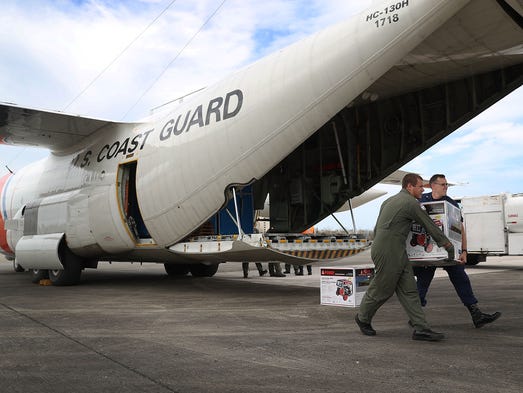
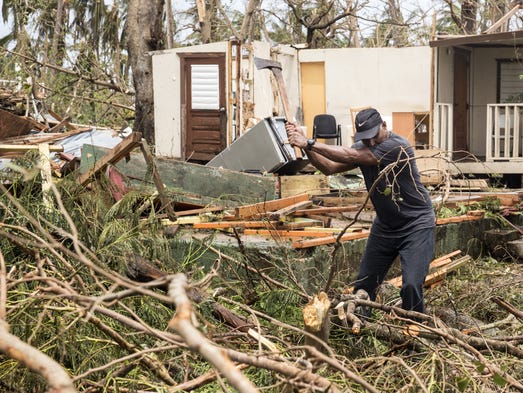
The above photographs are from USA Today's gallery of 95 photos with captions related to Hurricane Maria. The storm laid waste not to a city or country but to many parts of an entire region of the world -- and this is an addition to the widespread damage done to the region by Hurricane Irma just days before Maria began its onslaught.   

Here, from a September 22 New York Times report by Niraj Chokshi, is a list of charities helping people affected by the storms:

Local Charities

ConPRmetidos
While its main focus is on promoting innovation by connecting Puerto Ricans abroad to those on the island, this local nonprofit has also started a fund to help victims of Hurricanes Maria and Irma.
Dominica Hurricane Relief Fund
The government of Dominica is collecting donations through JustGiving, a crowdfunding website. The money will go toward temporary roofing, blankets and non-perishable foods.
GoFundMe
The crowdfunding website maintains a list of verified campaigns, many of them local, collecting donations for victims of the storm. Donors can give to a campaign or directly to GoFundMe, which will then distribute the money to the campaigns.
Unidos por Puerto Rico
This initiative, from Beatriz Rosselló, the first lady of Puerto Rico, enlists private sector help in providing aid to those affected by Hurricanes Irma and Maria. Donations are accepted through a variety of means, including PayPal.

National and Global Charities

Each group below has earned the top rating, four stars, from Charity Navigator, which grades charities based on transparency and financial health.
All Hands Volunteers
All Hands works with local volunteers and groups to respond to natural disasters. With Hurricanes Harvey and Maria, it is focusing its efforts on the U.S. Virgin Islands. “Our help is needed in the islands, so that’s where we’ll be,” said Erik Dyson, the group’s chief executive.
AmeriCares
The relief and development organization, which provides health services to those in need, said that it was working with officials in Puerto Rico to stock emergency shelters with medical supplies. Earlier in the week, it had airlifted $1.8 million worth of medicine and supplies to the U.S. Virgin Islands.
Catholic Relief Services
Donations to the faith-based group will help to provide shelter, water, tarps, tents, kitchen kits and other supplies to families affected by the storm, it said.
Convoy of Hope
Another faith-based initiative, Convoy of Hope provides food, water and emergency supplies to those in need throughout the world.
Direct Relief
Direct Relief reported that it was working with local authorities to deliver a shipment of medicine and medical supplies to islands in the region. It also said it was working to provide insulin to 120 displaced dialysis patients.
GlobalGiving
This crowdfunding website connects donors to nonprofits and companies around the world. Donations will be spent first on the immediate needs of victims and then on longer-term recovery efforts “run by local, vetted organizations,” according to the website.
International Medical Corps
The group has been working with local authorities to provide emergency care after Hurricane Irma and said it had moved medical supplies into place ahead of Hurricane Maria.

Don’t Forget to Ask Questions

It’s important to research charities to fully understand how they might — or might not — spend your money. Charity Navigator, as we mentioned, is a good resource.
But high ratings may not always be enough. Despite earning three stars from Charity Navigator, the American Red Cross has faced strong criticism in recent years for its response to the 2010 earthquake in Haiti, stemming from a ProPublica and National Public Radio investigation that suggested that the group had badly mismanaged relief efforts. (The Red Cross has disputed the criticism.) The organization also recently apologized for temporarily suspending registrations for financial assistance for victims of Hurricane Harvey.


********

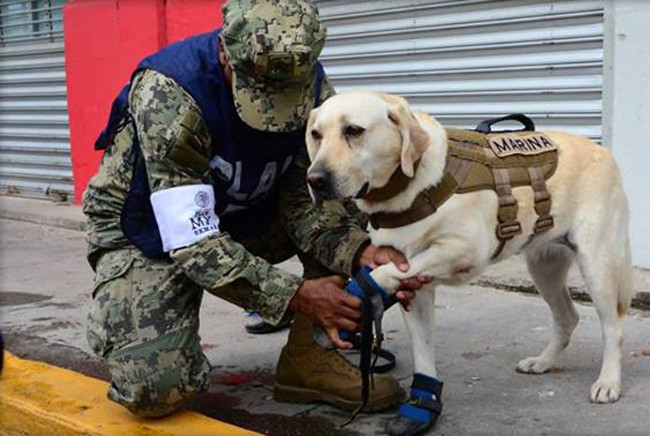
"Frida, the rescue dog in Mexico who has captured the hearts of the world"

She is so loved there are proposals on Facebook to feature her image on a Mexican currency note.


September 21, 2017

Frida is a six-year-old labrador who was trained by the [Mexican] Navy to assist in finding people in disaster zones. She, along with her three companions Eco, Evil and Titan, have won the applause and hearts of the Mexicans thanks to their rescue work, especially in the last September 7 earthquake, which left several areas in Oaxaca devastated.

Frida has rescued more than 52 people in Mexico. This great work is added to her work in the fire in the Pemex tower, and also landslides in Guatemala and an earthquake in Ecuador.

Frida has filled articles, threads from Reddit and a lot of love messages on Twitter and Facebook. The friendly appearance of the animal and its particular outfit, with protective booties and goggles to protect against smoke and debris, has triggered a worldwide lovefest for Frida on social media.

The iconic character of Frida is so popular that there are already proposals on Facebook to put her on the 500 peso notes.

Frida’s work life, as well as that of the other companions of the SEMAR Search and Rescue Team, is limited so her retirement, after five years of self-sacrificing work, is not far off. Most of the animals are offered as pets to the service humans themselves, who have lived and worked with them, side by side, for years.

Since the earthquake in Oaxaca, the rescue dogs of the Mexican Marine Secretariat (SEMAR) have played a key role in rescue efforts. Dogs, being smaller and less heavy than humans, are less risky on unstable debris, and their training and sense of smell allows them to identify more quickly people trapped alive.

[END REPORT]

*******

Friday, September 22

NYT update 6:04 PM: Hurricane Maria damage Puerto Rico, Dominican Republic

The New York Times - updated 6:04 PM EDT
Hurricane Maria Live Updates: Structural Damage at Dam Prompts Evacuations in Puerto Rico


A dam in northwestern Puerto Rico suffered structural damage on Friday, the governor said at a news conference, prompting evacuations of areas nearby in the aftermath of Hurricane Maria.
“Close to 70,000 is the estimate of people that could be affected in the case of a collapse,” the governor, Ricardo Rosselló, said about the Guajataca Dam, which is operated by the Puerto Rico Electric Power Authority. “We don’t know the details. It’s time to get people out.”
A flash flood warning was previously issued by the National Weather Service for the municipalities of Isabela and Quebradillas. “This is an extremely dangerous and life-threatening situation,” the service said in an advisory.
Messages sent to the power authority about the condition of the dam were not immediately returned.
The National Guard has been activated in the area, the governor said.
“Its been hard to see infrastructure deteriorate in Puerto Rico,” he said, “but it has been harder to meet citizens who have lost it all.”
According to the United States Army Corps of Engineers, Guajataca Dam is an earthen structure, 120 feet high and nearly 1,000 feet long. It was built in the mid-1920s by the Army Corps of Engineers, but is now owned by the power authority.
It lies across the Guajataca River, forming a reservoir that can hold about 11 billion gallons of water that is used for drinking, irrigation and power generation.
Sign up for the Morning Briefing for hurricane news and a daily look at what you need to know to begin your day. See how the storm traveled across Puerto Rico, and here is a guide on how to help victims.

Aid is being sent to Puerto Rico.

Officials in Puerto Rico were corralling incoming aid as rescue and recovery efforts continued after the storm, Mr. Rosselló said on MSNBC on Friday.
“There’s still some rain and, of course, the soils are saturated, so it’s still not safe to go outside,” he said. “We’re still on emergency protocol and our main objective right now is making sure people are safe.”
Mr. Rosselló said that the island was getting generators, mattresses, food and water from the Federal Emergency Management Agency, and from others in the private sector.
Officials have established a logistics center, which will receive all incoming aid and then distribute it to 12 zones throughout the island, he said.
“The people of Puerto Rico are really being tremendous under these circumstances,” he said.
Some elderly residents had been found in rural areas without food and necessary medication, Carmen Yulín Cruz, the mayor of San Juan, said on CNN on Friday.
“My biggest fear is that we don’t get to those that need it,” she said. “If we get to an elderly home too late, the situation of care will be disastrous.”

The Dominican Republic appears to have been spared the storm’s full force.

Early reports indicated there was minimal damage to the country. In a statement late Thursday, the Ministry of Tourism said that the tourism industry was not directly impacted by the hurricane. The industry fuels a large portion of the economy. So far in 2017, at least five million tourists have visited the country.
“In the north, the situation is under control despite intermittent rains and moderate winds that have caused some trees to fall,” said Julio Almonte, vice minister of tourism for the Dominican Republic’s northern zone. “We have toured the area and can report that the hotel infrastructure has not suffered any damage and that electricity and water services are working.”
Punta Cana, La Romana and Samaná El Catey airports reopened on Thursday evening.
“So far, no significant damage is reported in the country’s tourist destinations,” said Joel Santos, president of the National Hotel and Tourism Association of the Dominican Republic. “There are cleaning and gardening crews operating to repair some of the things that wind and rain have affected, but fortunately there is nothing that the current protocols and established procedures have not helped us deal with.”

Puerto Rico: Dam in 'imminent' danger of collapse, 70,000 need to evacuate UPDATES 9/23 - 6:50pm, 9/24 4:20am EDT

UPDATE 9/24
Engineers got the spillway opened late last night, easing pressure on the cracked dam.   
END UPDATE

UPDATE 9/23
See this Pundita post for the latest on the dam situation; it's possible that the number that need to evacuate was initially overstated but the situation is very confused as of the latest report filed at 4 PM EDT today by Weather.com
END UPDATE   

5:52 PM EDT - Friday, September 22, 2017
Report by Samantha Schmidt, Sandhya Somashekhar and Daniel Cassady

Authorities have been hampered in their ability to assess damage because foul weather continued to batter parts of the island early Friday. The storm also knocked out power to the entire island and left only 15 percent of the territory's 1,600 telecommunications towers functional, officials said. Of the island's fiber cables, up to 85% are damaged.


SAN JUAN, PUERTO RICO — Tens of thousands of people in northwestern Puerto Rico were ordered to evacuate Friday afternoon after floodwaters from Hurricane Maria damaged the Guajataca Dam, which the National Weather Service said is in "imminent" danger of failing.
The dam, built by the Army Corps of Engineers in 1929, suffered a "fissure," Gov. Ricardo Rosselló said in a news conference Friday. An estimated 70,000 people in the municipalities of Quebradillas, Isabela and part of San Sebastian could be affected if the dam collapses, he said. A failure would likely send a massive amount of water from an inland lake along the Guajataca River, which flows north through coastal communities toward the ocean.
"To those citizens (of those areas) who are listening: Please evacuate," Rosselló said. "We want your life to be protected…Please, if you're listening, the time to evacuate is now."
The situation adds a new urgency in Puerto Rico as officials here survey the wreckage left by Hurricane Maria, the most powerful storm to strike the island in more than 80 years.
Authorities reported at least six fatalities, three of which occurred in the municipality of Utuado as a result of mud slides. Two people died in flooding in Toa Baja, and one other person died in Bayamón when a panel struck him in the head, the U.S. territory's public safety department said in a statement. More deaths are likely to be reported in the coming hours and days, officials said.
"We are aware of other reports of fatalities that have transpired by unofficial means, but we cannot confirm them," said the secretary of the department of public safety, Héctor M. Pesquera.
Authorities have been hampered in their ability to assess damage because foul weather continued to batter parts of the island early Friday. The storm also knocked out power to the entire island and left only 15 percent of the territory's 1,600 telecommunications towers functional, officials said. Of the island's fiber cables, up to 85% are damaged.
But the breadth and depth of the devastation is coming into focus as Puerto Ricans begin to clear out the rubble.
Photos taken from a helicopter surveying the damage in the southeast part of the island, encompassing an area that on a good day would be a two-hour drive from the capital of San Juan, show entire neighborhoods blanketed in murky water, the waves in some cases reaching near the first-floor windows. Tops of buildings were sliced open, their top-floor rooms visible like dollhouses.
"We saw houses with the roof ripped away totally," said Dennis M. Rivera Pichardo, a freelance photographer for The Washington Post. One shopping center had a huge hole in the roof, "open like a can of tuna," he said. "You could see all the merchandise, clothes hanging in the shelves."
A large building on a coastal luxury resort, once with enviable ocean views, is now partially floating over open air as rocks and mud crumbled under one corner and fell into the sea. Windmills broke and shattered solar panels shone "like broken mirrors," Pichardo said. One reassuring sign, he said, is that people appeared to have fled many of the flood-damaged areas; occasionally people peeked out of second-floor windows or lingered on balconies, apparently waiting for the waters to recede.
Damaging floods continued to plague Puerto Rico in Maria's wake, hampering rescue missions and making it difficult for officials to survey the full extent of the destruction. Authorities have not yet been able to reach or contact some remote communities, in part because of the power outages and damage to communication systems, including cellphone towers and landlines.
Shock has given way to frayed nerves as officials warn residents that it could be months before power is restored. People queued up at gas stations to fuel cars as well as generators, and long lines snaked from grocery stores. Residents unable to reach family members in remote areas took to the roadways to try to find them, only to meet downed trees and other debris. News was particularly scarce from the southern and central parts of the island, as well the tiny island of Vieques to the east.
On Radio Isla Friday morning, Rosselló urged residents to stay in their homes.
"It's still not safe in the roads. There's still a great deal of flooding," he said. "Now is not the time — unless it's an emergency — to be on the roads."
He said that Puerto Rican residents and civilians have been essential in the rescue and recovery efforts.
"That solidarity is how we're going to be able to get people out of danger" and help lift Puerto Rico out of this, he said.

Thursday, September 21

Real or unreal, Frida Sofia kept attention on Mexico's tragedy

Enrique Rebsamen Elementary School,
where a child was believed to be still buried alive 
      
Associated Press


September 21, 2017, 4:00 PM - last updated 7:59 EDT
CBS/Associated Press 
Mexico earthquake: Navy says no missing child in collapsed school

MEXICO CITY -- Hour after excruciating hour, Mexicans were transfixed by dramatic efforts to reach a young girl thought buried in the rubble of a school destroyed by a magnitude 7.1 earthquake. She reportedly wiggled her fingers, told rescuers her name and said there were others trapped near her. Rescue workers called for tubes, pipes and other tools to reach her.

News media, officials and volunteer rescuers all repeated the story of "Frida Sofia" with a sense of urgency that made it a national drama, drawing attention away from other rescue efforts across the quake-stricken city and leaving people in Mexico and abroad glued to their television sets.

But she never existed, Mexican navy officials now say.

"We want to emphasize that we have no knowledge about the report that emerged with the name of a girl," navy Assistant Secretary Angel Enrique Sarmiento said Thursday. "We never had any knowledge about that report, and we do not believe - we are sure - it was not a reality."

Sarmiento said a camera lowered into the rubble of the Enrique Rebsamen school showed blood tracks where an injured person apparently dragged himself or herself, and the only person it could be -- the only one still listed as missing -- was a school employee. But it was just blood tracks -- no fingers wiggling, no voice, no name. Several dead people were removed from the rubble, and it could have been their fingers rescuers thought they saw move.

Twitter users quickly brought out the "Fake News" tag and complained that the widespread coverage had distracted attention from real rescue efforts where victims were pulled from the rubble -- something that hasn't happened at the school in at least a day.

Meanwhile, President Enrique Pena Nieto's office raised the death toll from Tuesday's magnitude 7.1 earthquake to 273, including 137 in the capital. In a statement, it said there were also 73 deaths in Morelos state, 43 in Puebla, 13 in the State of Mexico, six in Guerrero and one in Oaxaca.

More than 2,000 were injured and more than 50 people rescued in Mexico City alone, including two women and a man pulled alive from the wreckage of a building in the city's center Wednesday night.


How to help victims of the earthquake in Mexico

Rescuers removed dirt and debris bucketful by bucketful and passed a scanner over the rubble of the school every hour or so to search for heat signatures that could indicate trapped survivors. Shortly before dawn the pile of debris shuddered ominously, prompting those working atop it to evacuate.

"They are (there) all day, the families around the building. So they are very worried," volunteer Alex Osorio, a banker who helped save four people from the rubble of a collapsed office building, told CBS News correspondent Manuel Bojorquez.

Bojorquez reports that a teacher was brought to the site to help the search crews hoping that if the student [Frida Sofia] heard a familiar voice that it would help her remain calm.

Viewers across the country [and around the world] hung on the round-the-clock coverage of the drama Wednesday from the only network that was permitted to enter. The military, which ran the rescue operation, spoke directly only to the network's reporters inside the site.

Reports about the trapped girl led to the donations of cranes, support beams and power tools at the school site -- pleas for help quickly met based on the urgency of rescuing children. It was unclear if that affected other rescue operations going on simultaneously at a half dozen other sites across the city.

Despite all the technology brought to bear at the school, including thermal imaging devices, sensors, scanners and remote cameras, the mistake may have come down to a few over-enthusiastic rescuers who, one-by one, crawled into the bottom of shafts tunneled into the rubble looking for any signs of life.

"I don't think there was bad faith involved," security analyst Alejandro Hope said. "You want to believe there are children still alive down there."

Rescuers interviewed by The Associated Press late Wednesday at a barricade that blocked most journalists from reaching the site believed the story of the girl implicitly. O
perating on little sleep and relying on donated food and tools, rescuers were emotionally wedded to the story, and the adrenaline it provided may have been the only thing keeping them going.

Rescue worker Raul Rodrigo Hernandez Ayala came out from the site Wednesday night and said that "the girl is alive, she has vital signs," and that five more children had been located alive. "There is a basement where they found children."

Despite the setback -- and the diminishing hopes that anyone was left under the rubble -- rescuers appeared unwilling to question the effort.

"It was a confusion," said Alfredo Padilla, a volunteer rescuer at the school. "The important thing is there are signs of life and we are working on that."

In retrospect, the story of "Frida Sofia" had some suspicious points from the start.

Officials couldn't locate any relatives of the missing girl, and the AP reported that no girl with that name attended the school. Rescuers said they were still separated from her by yards of rubble, but could somehow still hear her.

It could have political repercussions: Education Secretary Aurelio Nuno, often mentioned as a possible presidential candidate, had repeated the story about Frida Sofia.

Hope noted "something similar happened in 1985," referring to the magnitude 8.0 quake that killed 9,500 people. [Pundita note: most accounts put the death toll higher -- 10,000 -- and there is an account that it was 20,000.]

Media quickly reported that a 9-year-old boy had been located in the rubble days after the Sept. 19 quake 32 years ago. Rescuers mobilized in a huge effort to find the boy, but he apparently never existed.

"That generated anger against those who had spread the story," Hope noted.

[END REPORT]

********

Initial summaries of devastation in Caribbean caused by Hurricane Maria

By Pam Wright and Eric Chaney
Sep 21 2017 -  07:30 PM EDT

[see website for videos, photos]

[Summaries:
Dominican Republic
Puerto Rico
Four main U.S. Virgin Islands
Dominica
Guadeloupe
Martinique]
 
 
Story Highlights
Tens of thousands are without power in the Dominican Republic.
At least 19 people have died from the storm, including 15 in Dominica.
Puerto Rican emergency officials are reporting that 100 percent of the island is without power after Hurricane Maria.
Maria destroyed 80 percent of the homes in the Juana Matos neighborhood of the San Juan suburb of Cataño.
Dominica was made into a wasteland and communication with the island is non-existent except through satellite phones and HAM radio operators.
Tens of thousands were left without power in the Dominican Republic Thursday as deadly Hurricane Maria battered the country with torrential rainfall. 
“In the south zone there are four circuits out of service, and about 40,613 customers, or 30 percent of the population,” Dominican Corporation of State Electrical Companies (CDEEE) Emergency Operations Center representative Ernesto Perez told DominicanToday.com.
He added that 45 of the east region’s 204 circuits were affected, which amounts to 100,000 customers. A downed power line between the towns of Playa Dorada and Cabarete has left the country's entire north coast without power. 
The storm has contributed to at least 19 deaths, including 15 from the devastated Caribbean island of Dominica, the country's prime minister announced Thursday.
Prime Minister Roosevelt Skerrit addressed his nation from Antigua Thursday afternoon, saying the storm was "brutal" to the Caribbean island. 
Skerrit confirmed that 15 people had died in the country and at least 20 are missing. He noted that the toll is likely to rise as word comes from isolated villages. 
At least two deaths were reported in Puerto Rico, including a man died who died off the coast of the island Wednesday after a boat capsized near Vieques, the U.S. Coast Guard reports. In a search and rescue effort by the U.S. Coast Guard, U.S. Navy and British Royal Navy, a woman and two children also on the boat were rescued.
The rescue came after a distress call was received from the vessel, stating they were disabled and adrift in 20-foot seas and 120 mph winds. The Coast Guard said it lost contact with the vessel because of the weather.
The Coast Guard said Thursday they were unable to retrieve the man's body from the capsized vessel.

Dominican Republic

Flooding was reported as winds downed power lines in the country Thursday, according to Reuters. 
The local Emergency Operations Center (COE) said 9,990 people were evacuated from their homes and most of the country was placed under flash flood and landslide warning, reports DominicanToday.com.  

Puerto Rico

Residents of Puerto Rico woke Thursday to massive destruction in the wake of the hurricane and a new reality – one without electricity, water and, for many, a home to return to once roads cluttered with debris and power lines are cleared.
The storm smashed into the U.S. territory Wednesday morning as a Category 4 hurricane, twisting metal, snapping trees and utility poles and effectively paralyzing the island.
"Months and months and months and months are going to pass before we can recover from this," Felix Delgado, mayor of the northern coastal city of Cataño, told the Associated Press.
On Thursday, the National Guard were rescuing dozens of families from rooftops in flooded Levittown, east of San Juan.
The extent of the damage is still unknown given that dozens of municipalities remained isolated and without communication, the AP reported.
On Thursday, President Donald Trump issued a disaster declaration for the territory that is home to 3.4 million people, making federal funding available to Puerto Ricans affected by the storm.
The director of the State Agency for Emergency Management and Disaster Management, Abner Gómez, said that 100 percent of the subscribers of the island's Electric Energy Authority are affected, Primera Hora reported.
[...]
In San Juan, metal roofs flew off buildings and windows broke even before Hurricane Maria made landfall as a Category 4 storm on the island's southeastern coast early Wednesday morning.
"No generation has seen a hurricane like this since San Felipe II in 1928," Puerto Rico Governor Ricardo Rosselló said Tuesday. "This is an unprecedented atmospheric system."
Those who sought shelter at the Roberto Clemente Coliseum in San Juan were moved to the building's second and third floors. According to El Nuevo Dia, the exterior roof of the coliseum is now "in pieces."
As the worst of the storm hit, people calling local radio stations reported that doors were flying off hinges and a water tank flew away in the island's southern region, the AP reports. Meanwhile, widespread flooding was reported in the capital of San Juan.
The storm has also done major damage to Cataño, a western suburb of the city. Mayor Felix Delgado told Nueva Dia the neighborhoods of Cucharilla, Puente Blanco and La Puntilla are "destroyed." Delgado also reported damage in the Juana Matos neighborhood, where 80 percent of the 457 houses in the area "should no longer exist."
"This generation is going to build the new Cataño," Delgado said. "We have to build the new Cataño, after Maria."
San Juan Mayor Carmen Yulín Cruz said half the city was flooded Wednesday.
"We’re looking at four to six months without electricity," she added.

U.S. Virgin Islands 

There are reports of widespread damage on St. Croix in the U.S. Virgin Islands, the VI Consortium said, and many are pleading for help in compromised buildings. Major flooding is being reported on St. Thomas.
Gov. Kenneth E. Mapp announced a 24-hour curfew Thursday morning on the four main US Virgin Islands — St. Croix, St. Thomas, St. John and Water Island.
"Your presence on the roads during the curfew hours will only hamper clean-up efforts and could delay the distribution of critically needed supplies," Mapp said.
Communications were down across the islands Wednesday and the local government was working to assess the damage, Virgin Islands Territorial Emergency Management Agency emergency operations supervisor Garry Green told the New York Times.
Photos and videos posted to social media out of the U.S. Virgin Islands showed major flooding on St. Thomas. On St. Croix, WTJX reporter Bob Tonge said the roads were blocked with downed wires and electrical poles. 
WTJX also reported numerous roofs were ripped off buildings in Christiansted town. Roads there remain impassable.
Recovery may be a long road as the island chain is short on crucial supplies, according to internal briefing documents obtained by Politico.
“There are supplies that are literally out to sea right now that are not being brought in,” FEMA spokesman Don Caetano told Politico by phone from St. Croix on Monday. “Had Maria not been a factor, those supplies would have been there already.”

Dominica

There is still little word from Dominica after Maria crushed the island nation on Tuesday. An advisor to Prime Minister Roosevelt Skerrit said seven people had died on the island, the AP reported.
With communication systems down, including electricity, phone lines and internet, much of the information coming from the devastated island is through HAM radio operators.
Initial images show a once tropical paradise that is home to more than 73,000 people turned into a wasteland of crushed homes and smashed vehicles. Areas with more than 90 percent of roofs ripped off of buildings are being reported.
An advisor to Skerrit was able to convey the news that seven people had died after speaking with the prime minister via satellite phone. Advisor Hartley Henry didn't give details about how the deaths occurred, the AP noted. Henry added that there has been a "tremendous loss of housing and public buildings."
Authorities at the Ross University School of Medicine said Wednesday in a Facebook post that they plan to evacuate students and staff to St. Lucia beginning on Thursday.
“Our crisis team continues to be in communication with the U.S. State Department about the possibility of a larger-scale military evacuation, but as of now, moving forward with our evacuation plan is our best choice,” Ross officials said.
“We plan to begin the transport of people with taking care of the children and elderly first. Each family will be permitted to have one parent travel with their children. We will also certainly transport anyone with any serious injuries in this first group, although we are grateful to report at this time that we have few reports of injuries, and those are said to be somewhat minor,” the post said.
During the storm early Tuesday, Skerrit posted on his Facebook page that "initial reports are of widespread devastation."
"So far we have lost all what money can buy and replace. My greatest fear for the morning is that we will wake to news of serious physical injury and possible deaths as a result of likely landslides triggered by persistent rains."
 The prime minister, who was reportedly left homeless because of the storm, said crews would begin rescue efforts as soon as the all-clear sign was given.
"I am honestly not preoccupied with physical damage at this time because it is devastating...indeed, mind-boggling," Skerrit wrote. "My focus now is in rescuing the trapped and securing medical assistance for the injured."

Guadeloupe 

According to the Préfecture of Guadeloupe, one person was killed Tuesday morning on the French island after being struck by a falling tree. Authorities note that the person did not heed orders to remain indoors. A second death was reported Wednesday by the AP. Two people are also reported missing after a boat sank near the island of La Désirade.
According to a press release by Guadeloupe's Préfecture office, 80,000 – or 40 percent – of the homes on the island were without power as of Tuesday.
The prefecture reports that most of the island's roads are impassable from downed trees and flooding. While the majority of the buildings remain structurally sound, numerous roofs were ripped off.
Martinique
In another French territory, Martinique, authorities said some 70,000 homes were without power and 50,000 without water, but the airport at Fort-de-France was reopened Tuesday.
[END REPORT]
********