Translate

Tuesday, October 23

Honduran Migrant Caravan: Can she identify the "foreign assistance?"

What I think about the Daily Beast is unprintable but the publication can sometimes be helpful by accident. This was the case today with their report headlined, Forget Trump Hysteria, Here’s How the Migrant Caravan ‘Crisis’ Really Began: "It wasn’t supposed to be a big deal, but a TV station close to the Honduran gov’t wanted to embarrass an organizer and said he’d pay for everything. Then ‘the avalanche’ began."

However, the big news in the report isn't found in the lede but in this passage:
... But then a report on the country’s most-watched cable news channel, HCH, painted a picture of the caravan that changed everything. The anchors interviewed a woman who was supposedly part of the caravan. The woman talked about safety in numbers, called [Bartolo] Fuentes the organizer and mentioned foreign assistance. ...
The reporter goes on to type:
The anchors, without any supporting evidence, then said that Fuentes would pay for the migrants’ food and transportation
Then supposedly things got out of control, with hundreds then thousands of Hondurans swelling the ranks of the original small caravan as it traipsed to Guatemala. In a phone interview with a Beast reporter Mr Fuentes pointed the finger of blame at the TV station.
Fuentes was later interviewed by the anchors and strongly refuted what was said, but by then the damage was done.
He did not explain to the Beast how it was that he came to be arrested in Guatemala while helping to coordinate the out-of-control caravan's progress in Guatemala and deported back to Honduras.

Nor did the Beast attempt to delve into the unnamed woman's bombshell statement that foreign assistance was being provided to the caravan.

Instead The Beast rattles on, talking about everything but the key issue, which is that nobody told the U.S. Democratic Party, or the Republicans for that matter, what century this is.

I have a message for those dinosaur political parties. This is not the era to weaponize the troubles of other countries for America's domestic political or defense purposes. Here's why said weaponization is a really bad idea in the 21st Century:  

The single largest driver of the present crises in all the world's poorest countries is that their societies were monetized to such an extent during the past century that their crucial subsistence farming sectors were destroyed.

With that, the countries went from being 'societies' to economies. These economies, which can't hope to hold their own in agricultural trade against the wealthy economies, can be likened to a mountain of gunpowder. All it takes is the spark of a severe climate event to set off an explosion. 

Which is to say Americans haven't seen anything yet when it comes to migrant crises forming south of the U.S. border. 

If the Trump administration ever decides to acknowledge this century, it can throw technical assistance at small-scale farmers in Central America that teaches them how to do something new for a change: Raise enough food to actually feed themselves, instead of trying to raise crops/livestock to sell so they can get enough money to buy food to feed themselves.

The Trump administration, and the European Commission, could also provide the same technical assistance to small-scale farmers in all other basket-case regions of the world.

If U.S. and E.U. governments balk at the idea of de-monetizing a certain segment of a county, then let them prepare to bomb migrant caravan ocean liners making stops all along the shores in better-off countries. 

By the way, there's something else the U.S. and its buddies can do, which is to stop sucking the water tables dry while fighting terrorists in arid regions of the world, which just so happen to house a few billion people who live in the world's poorest -- uh, economies.

The next Pundita post. Bring beer. You'll need it.

********

Monday, October 22

Elite terrified of "a peasant with no teeth on stool softener"

Stacy Herbert and Max Keiser at the top of their form. Max wants to talk about the Singularity, Stacy wants to talk Apocalypse. Hilarious, bizarre, reviewing the elite's belief that the Apocalypse is looming and how the elite might stave off the guillotine.  


********


Indonesian farmer's brilliant crowdfunding startup to help others in his position

"Agents for CROWDE go into villages across the sprawling archipelago to persuade farmers to sign up. To date, the scheme has attracted about 14,000 farmers and 22,000 investors who have pledged $4 million-$5 million." The initial target is to sign up 100,00 farmers. 

The following report about crowdfunding for small-scale Indonesian farmers also discusses the same situations for small-scale farmers throughout the Asia-Pacific region, which is home to 4.3 billion people with more than half dependent on agriculture for a living. But the report has implications for small-scale commercial farmers, and subsistence farmers, the world over. 

Very helpful report. Thank you, Thomson Reuters Foundation and reporter Michael Taylor.

By Michael Taylor
October 10, 2018
Thompson Reuters Foundation


(KUALA LUMPUR, MALAYSIA) Indonesian poultry farmer Yohanes Sugihtononugroho faced ruin four years ago when plummeting prices forced him to slaughter all 100,000 of his chickens and shutter his business.

He blamed large-scale poultry farmers who carried out a mass cull after their birds fell sick, flooding the market and sending prices tumbling.

“We were a small player fighting tooth and nail every day,” he told the Thomson Reuters Foundation. “When it all came crashing down, I was really depressed and didn’t know what I then wanted to do with my life.”

Instead of turning his back on farming, the 26-year-old decided to help others struggling financially by setting up CROWDE, a mobile crowdfunding platform that allows users to invest as little as $1 in thousands of farms across Indonesia.

Most of Asia-Pacific’s 422 million farms are run by smallholders with less than 2 hectares (5 acres) of land each.

The majority of farmers in the region face an uphill battle to access credit, leaving them unable to modernize, boost yields, diversify into new crops, or stay afloat when hit by extreme weather fueled by climate change.

CROWDE’s app aims to change that by making it easier for people to invest in Indonesian farmers - whether producers of beef, poultry, fish, rice or chilli - and share in the profits.
Agents for CROWDE go into villages across the sprawling archipelago to persuade farmers to sign up. To date, the scheme has attracted about 14,000 farmers and 22,000 investors who have pledged $4 million-$5 million, said Sugihtononugroho.

CROWDE farmers do not receive cash, but instead get equipment like tools, seeds, fertilisers and pesticides, which CROWDE buys at a lower rate from agricultural suppliers.

When crops are harvested or animals slaughtered, CROWDE links farmers with buyers and suppliers to get them the best deals, and already has agreements with major supermarkets.

“I know the farmers I’m helping,” said Sugihtononugroho, whose startup takes a 3 percent share of all money invested to run the app. “I’m going to every village - from west to east Java - talking to farmers.”

INFORMAL LOANS

Asia-Pacific is home to 4.3 billion people and more than half depend on agriculture for a living, according to the U.N. Food and Agriculture Organization (FAO).

Because agriculture is seasonal, farmers often have to wait until harvest time before their work generates any revenue.

Many are subsistence farmers whose incomes cannot stretch to cover emergencies - like school fees, a sick family member or losses caused by disasters.

The bulk of investment in the region’s farms comes from small, private and domestic lenders, including family savings, friends, buyers, traders and loan sharks.

But that informal system leaves poor farmers vulnerable to indebtedness after crop losses.

“In India you have horror stories of farmers who end up committing suicide,” said Akmal Siddiq, head of rural development and food security at the Asian Development Bank (ADB) in Manila.

As well as holding farmers back, informal lending can also hinder growth in the value chain because traders and buyers who offer loans cannot invest that money in their own businesses.

Less than 10 percent of investments in agriculture in Asia-Pacific come from formal financial service providers like banks, experts say.

Banks tend to have fewer branches in rural areas and lending to farmers with no collateral is seen as too risky, driving interest rates higher than for urban loans.

Without access to financial services, Asian farmers struggle to pay premiums for crop insurance, join certification schemes that open up new markets, use the latest technologies or buy hardier seeds - dampening yields as a result.

Farmers cannot afford to upgrade their practices to supply higher-paying markets for export and big retailers, said Eva Galvez Nogales, an agriculture officer at the FAO in Bangkok.

“They cannot increase the quality of their products or make investments required for that,” she said.
GOVERNMENT HELP

In developing countries, supply and demand for agricultural products is often badly managed by governments, leading to price fluctuations, said the ADB’s Siddiq.

In addition, post-harvest losses due to spoilage caused by poor packing, long transport times or inadequate cooling range between 25 and 45 percent, he said.

After reaching market, Asian farmers tend to receive only about 30 percent of a food’s sale price, he added.

With such high risks, policy makers must take the lead and introduce state-backed crop insurance schemes and regulation to boost formal lending and banking services, food experts said.

Supportive measures could include lending quotas for the agriculture sector, interest rate caps for farmers and rules requiring banks to expand into rural areas, they added.

Alongside credit, they urged banks to offer farmers insurance, financial management, savings accounts and technical assistance by creating partnerships spanning the value chain.

Bangladesh has had some success in promoting private-sector micro-finance institutions, which offer small loans and do not ask for collateral in many cases, experts said.

India - which has a third of Asia-Pacific’s farms - has made strides in federal schemes for weather-based crop insurance, while China is using apps to get financial services to farmers.

Alibaba Group, China’s biggest e-commerce firm, meanwhile has devised a system that uses big data and artificial-intelligence algorithms to provide loans to Chinese farmers.

The FAO’s Galvez Nogales said formal lenders must also offer products targeting women farmers because they contribute the most labor but often lack access to farming income and assets.

At Indonesian startup CROWDE, the initial target is to get 100,000 farmers to join the scheme and then foster their growth.

“We want to help and empower every farmer,” said Sugihtononugroho.
___

Reporting by Michael Taylor, Editing by Megan Rowling. Please credit the Thomson Reuters Foundation, the charitable arm of Thomson Reuters, which covers humanitarian news, women's rights, trafficking, property rights, climate change and resilience. Visit news.trust.org 

Our Standards: The Thomson Reuters Trust Principles.

[END REPORT]

Sunday, October 21

Those American yuppies leaving cities to take up small-scale farming

The same trend has been happening in Greece. See Al Jazeera's May 2017 report by Nikolia Apostolou, Why are so many young Greeks turning to farming?

A growing number of young Americans are leaving desk jobs to farm
By Caitlin Dewey
November 23, 2017
The Washington Post

"For the resiliency of the food system and of rural communities, we need more agriculture of the middle."

Liz Whitehurst (L), co-workers cut and weigh arugula on Whitehurst's farm

Michael Robinson Chavez/The Washington Post


Liz Whitehurst dabbled in several careers before she ended up here, crating fistfuls of fresh-cut arugula in the early-November chill.

The hours were better at her nonprofit jobs. So were the benefits. But two years ago, the 32-year-old Whitehurst — who graduated from a liberal arts college and grew up in the Chicago suburbs — abandoned Washington for this three-acre farm in Upper Marlboro, Md.

She joined a growing movement of highly educated, ex-urban, first-time farmers who are capitalizing on booming consumer demand for local and sustainable foods and who, experts say, could have a broad impact on the food system.

For only the second time in the last century, the number of farmers under 35 years old is increasing, according to the U.S. Department of Agriculture's latest Census of Agriculture. Sixty-nine percent of the surveyed young farmers had college degrees — significantly higher than the general population.

This new generation can't hope to replace the numbers that farming is losing to age. But it is already contributing to the growth of the local-food movement and could help preserve the place of midsize farms in the rural landscape.

"We're going to see a sea change in American agriculture as the next generation gets on the land," said Kathleen Merrigan, the head of the Food Institute at George Washington University and a deputy secretary at the Department of Agriculture under President Barack Obama. "The only question is whether they'll get on the land, given the challenges."

The number of farmers age 25 to 34 grew 2.2 percent between 2007 and 2012, according to the 2014 USDA census, a period when other groups of farmers — save the oldest — shrunk by double digits. In some states, such as California, Nebraska and South Dakota, the number of beginning farmers has grown by 20 percent or more.

A survey conducted by the National Young Farmers Coalition, an advocacy group, with Merrigan's help shows that the majority of young farmers did not grow up in agricultural families.

They are also far more likely than the general farming population to grow organically, limit pesticide and fertilizer use, diversify their crops or animals, and be deeply involved in their local food systems via community supported agriculture (CSA) programs and farmers markets.

Today's young farmers also tend to operate small farms of less than 50 acres, though that number increases with each successive year of experience.

Whitehurst bought her farm, Owl's Nest, from a retiring farmer in 2015.

The farm sits at the end of a gravel road, a series of vegetable fields unfurling from a steep hill capped by her tiny white house. Like the farmer who worked this land before her, she leases the house and the fields from a neighboring couple in their 70s.

She grows organically certified peppers, cabbages, tomatoes and salad greens from baby kale to arugula, rotating her fields to enrich the soil and planting cover crops in the offseason.

On Tuesdays, Thursdays and Fridays, she and two longtime friends from Washington wake up in semidarkness to harvest by hand, kneeling in the mud to cut handfuls of greens before the sun can wilt them. All three young women, who also live on the farm, make their living off the produce Whitehurst sells, whether to restaurants, through CSA shares or at a D.C. farmers market.

Finances can be tight. The women admit they've given up higher standards of living to farm.

"I wanted to have a positive impact, and that just felt very distant in my other jobs out of college," Whitehurst said. "In farming, on the other hand, you make a difference. Your impact is immediate."

That impact could grow as young farmers scale up and become a larger part of the commercial food system, Merrigan said.

Already, several national grocery chains, including Walmart and SuperValu, have built out local-food-buying programs, according to AT Kearney, a management consulting firm.

Young farmers are also creating their own "food hubs," allowing them to store, process and market food collectively, and supply grocery and restaurant chains at a price competitive with national suppliers.

That's strengthening the local and organic food movement, experts say.

"I get calls all the time from farmers — some of the largest farmers in the country — asking me when the local and organic fads will be over," said Eve Turow Paul, a consultant who advises farms and food companies on millennial preferences. "It's my pleasure to tell them: Look at this generation. Get on board or go out of business."

There are also hopes that the influx of young farmers could provide some counter to the aging of American agriculture.

The age of the average American farmer has crept toward 60 over several decades, risking the security of midsize family farms where children aren't interested in succeeding their parents.

Between 1992 and 2012, the country lost more than 250,000 midsize and small commercial farms, according to the USDA. During that same period, more than 35,000 very large farms started up, and the large farms already in existence consolidated their acreage.

Midsize farms are critical to rural economies, generating jobs, spending and tax revenue. And while they're large enough to supply mainstream markets, they're also small enough to respond to environmental changes and consumer demand.

If today's young farmers can continue to grow their operations, said Shoshanah Inwood, a rural sociologist at Ohio State University, they could bolster these sorts of farms — and in the process prevent the land from falling into the hands of large-scale industrial operations or residential developers.

"Multigenerational family farms are shrinking. And big farms are getting bigger," Inwood said. "For the resiliency of the food system and of rural communities, we need more agriculture of the middle."

It's too early to say at this point whether young farmers will effect that sort of change.

The number of young farmers entering the field is nowhere near enough to replace the number exiting, according to the USDA: Between 2007 and 2012, agriculture gained 2,384 farmers between ages 25 and 34 — and lost nearly 100,000 between 45 and 54.

And young farmers face formidable challenges to starting and scaling their businesses. The costs of farmland and farm equipment are prohibitive. Young farmers are frequently dependent on government programs, including child-care subsidies and public health insurance, to cover basic needs.

And student loan debt — which 46 percent of young farmers consider a "challenge," according to the National Young Farmers Coalition — can strain already tight finances and disqualify them from receiving other forms of credit.

But Lindsey Lusher Shute, the executive director of the coalition, said she has seen the first wave of back-to-the-landers grow up in the eight years since she co-founded the advocacy group. And she suggested that new policy initiatives, including student loan forgiveness and farm transition programs, could further help them.

"Young farmers tend to start small and sell to direct markets, because that's a viable way for them to get into farming," Lusher Shute said. "But many are shifting gears as they get into it — getting bigger or moving into wholesale."

Just last year, Whitehurst was approached by an online grocery service that wanted to buy her vegetables. While Owl's Nest produces too little to supply such a large buyer on its own, the service planned to buy produce from multiple small, local farmers.

Whitehurst ultimately turned the deal down, however. Among other things, she feared that she could not afford to sell her vegetables at the lower price point the service wanted.

"For now, I'm focused on getting better, not bigger," she said. "But in a few years, who knows? Ask me again then."

[END REPORT]

********

Tactics to stem a country's internal brain drain that don't depend on federal programs

Below are my notes on Joshua Johnson's "1A" radio show on WAMU, "Why some [US] states are experiencing a labor shortage," broadcast on October 18, 2018. The parts of the conversation I'm referencing start shortly after the 30 minute mark on the tape; listen for more details about the tactics under discussion. 

The first part of the show deals specifically with America's critical shortage in skilled tradespeople; e.g., electricians, welders, plumbers, etc. One listener to the show remarked, correctly, that for a half century American educators turned up their noses at teaching trades. 

Today, those trades can pay six figures in income -- while many American 'white collar' college grads are driving taxis and serving coffee when they can get work. The segment also discusses how Americans can learn skilled trades. 

The second segment discusses America's internal brain drain, where jobs in big cities are emptying small towns across the country and in U.S. states with a large rural population.           

  • Cities, states, and counties taking matters into their own hands.
  • A city in Nebraska  will match signing bonuses up to 5K for people who will work there.
  • State of Vermont pays people 10K to move to Vermont and work remotely if they have a job in a nearby state.
  • St. Clair County in Michigan, about an hour outside the big city of Detroit. The "Come Home Award Program." Launched in 2016, will pay a student's debt if a student completes a college degree and returns to the county to work. Many American college graduates are carrying 80K debts in student loans. 
  • Reasoning behind St. Clair's award program: "We stopped waiting for Washington or Lansing [seat of Michigan's government] to save us with a plan."
********

Of course U.S. Democrats organized the Honduran "migrant caravan"

Democrats and anti-Trump mainstream news outlets such as The Guardian are treating the claim as a conspiracy theory. (Trump baselessly claims Democrats are behind migrant caravan)  Trump seems to have misspoken about a specific incident -- standard procedure for him -- but well-established facts are that charities receiving financial assistance from George Soros have been organizing 'migrant caravans' from Central America, and that Soros is an important Democratic Party financier and operative. From WND's report in April about an earlier caravan:
WASHINGTON – Hundreds of Central American migrants demanding asylum at the U.S. border with Mexico Sunday may be poor, but they have support of major foundations, corporations and billionaire George Soros for their well-organized caravan-style invasion.
President Trump has instructed the Department of Homeland Security not to allow the caravan into the U.S. to hear their asylum claims. They are expected to attempt to enter the U.S. Sunday.
The caravan is organized by a group called Pueblo sin Fronteras. But the effort is supported by the coalition CARA Family Detention Pro Bono Project, which includes Catholic Legal Immigration Network, the American Immigration Council, the Refugee and Immigration Center for Education and Legal Services and the American Immigration Lawyers Association – thus the acronym CARA. At least three of the four groups are funded By George Soros’ Open Society Foundation, WND has confirmed.
The CARA coalition was formally announced last week.
Other support groups are funded by the MacArthur Foundation, Ford Foundation and the Carnegie Corporation.  
The three latter organizations also have strong ties to the U.S. Democratic party but it's not much of an exaggeration to say that the present Democratic National Party leadership is "George Soros" spelled backward. The party now exists to further the Soros agenda given that last fall Mr Soros transferred $18 billion, the bulk of his fortune, to Soros foundations. But it's long been the case that if Mr Soros said jump to cash-hungry Democratic politicians and operatives  their only question was how high. 

To return to WND's report: 
Soros pledged on September 20, 2016, to invest up to $500 million in programs and companies benefiting migrants and refugees “fleeing life-threatening situations.” That’s exactly the case Pueblo sin Fronteras is making.
“We will invest in startups, established companies, social impact initiatives, and businesses started by migrants and refugees,” said in an official statement.
“These investments are intended to be successful. But our primary focus is to create products and services that truly benefit migrants and host communities. I hope my commitment will inspire other investors to pursue the same mission.”
A press release dated March 23 by the “Refugee Caravan” made clear the goal is “abolishing borders” as the name Pueblo sin Fronteras (People Without Borders) implies.
The opening statement reads: We are a group of people form different nations, religions, genders, gender expressions and sexual orientations migrating and seeking refuge. We seek to become one collective, supporting each other shoulder to shoulder and demonstrating that by uniting we can abolish borders.”
[...]
I'll interject that elsewhere in the report WND goes along with the line that George Soros's charitable giving is prompted by his "globalist, borderless ideology both in the U.S. and around the world." Although you won't read this in any Soros foundation mission statement, the history of Mr Soros' globe-spanning activism points less to promoting borderless societies and more to the balkanizing of nations. 

That's something conservative American Republicans didn't realize when they cheered on Mr Soros' efforts to peel former Soviet countries away from the Russian sphere of influence and into the American one. Today these same political conservatives are howling about his efforts to sow as many divisions as he possibly can in the United States of America.

To return to the present migrant caravan, stating the obvious is not the same as proving in a court of law that Democratic operatives organized it with Soros money. And there will not be an investigation of the matter by an American independent counsel or congressional committee. However, the caravan launched so close to the U.S. midterm elections on November 6 that every American who supports President Trump's immigration policies surely believes the Democrats were somehow involved.   

All the above said, there is a feature of the Honduran Migrant Caravan which struck me as so odd that in my earlier post on the matter I interrupted a Reuters report on the caravan's progress to observe:
"Somehow I don't think waving the Honduran flag is the best idea when demanding refuge in the United States."
Reuters had reported that Honduran marchers in the caravan were waving Honduran national flags, and one photo accompanying the report showed caravan leaders displaying a large version of the Honduran flag to Guatemalan border guards blocking their path. If George Soros had been personally involved in organizing the march I think he would've instructed his operatives to create a special flag with a 'rainbow coalition' logo -- internationalized since the 2008 Obama presidential campaign that Mr Soros orchestrated -- and maybe a mashup depiction of Central American, Mexican and US flags.

Such a flag would have sent a message to Mexico's government in particular that the Hondurans weren't trying to actually invade their country -- although the message would've fallen apart when migrants in the caravan began throwing rocks at Mexican border police blocking their path. 

One news report quoted someone who said that the rocks were actually being thrown by bystanders who supported the marchers. There was no room for bystanders on the bridge leading up the checkpoint; it was stuffed from end to end with Honduran marchers. 


One of the marchers told a reporter that the scene was chaos, with rocks flying through the air. Unless we're to assume that the bridge was littered with rocks, those starving migrants had been picking up rocks and carrying them some distance before they reached the bridge, and with the specific intent of throwing them at Mexican border guards, at least six of whom were injured by the rock throwers. 

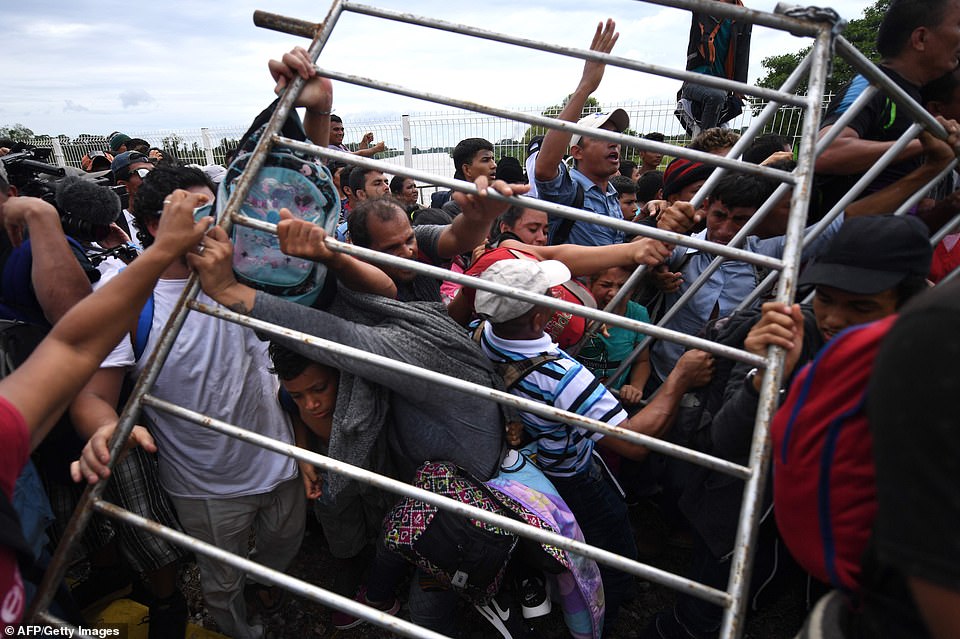
The starving migrants also proved to be quite strong when it came to smashing through the gates at Guatemala's border and dispensing with security fencing meant to check their progress to the Mexican border checkpoint.


Such scenes, reminiscent of scenes from Europe's migrant crisis, speak more to aggression than a plea for refuge. This caused me to turn my eyes to Honduras President Juan Orlando Hernandez. 


What Was Hernandez Thinking?

President Hernandez has a lot of explaining to do to the governments of Guatemala, Mexico, and the United States about that caravan, which Honduran authorities could and should have broken up once it became obvious that the caravan organizers were planning to assault three national borders and thereby create an International Incident. 

Already Hernandez is contrite. From a Daily Mail report, which features all the photos I've used in this post (and several more besides):
On Friday evening, Honduran President Juan Orlando Hernandez said he had spoken to his Guatemalan counterpart Jimmy Morales for clearance to send civil protection personnel to help the Hondurans and to find transport for those wanting to return.
"I also asked authorization to hire ground transportation for anyone who wants to return and an air bridge for special cases of women, children, the elderly and the sick," Hernandez tweeted. "We'll continue this operation for as long as is necessary."
Shortly afterwards, Guatemala's government tweeted that Hernandez would meet Morales on Saturday in Guatemala City to implement a strategy for returning the Honduran migrants.

Late Friday night, Mexican President Enrique Pena Nieto said in an address to the nation that a large group of migrants had "tried to enter Mexican territory irregularly, attacking and even hurting some elements of the Federal Police."
"Mexico does not permit and will not permit entry into its territory in an irregular fashion, much less in a violent fashion," he said.
President Hernandez' decision to extend the olive branch to Guatemala seems to have arisen on Friday after Guatemalan authorities detained then deported a former Honduran legislator, Bartolo Fuentes, who's been the most visible organizer of the Honduran migrant march. 

Yet in light of an earlier announcement by Guatemala's president, the question is why the Honduran government didn't move like lighting to head off the caravan in the first place. On October 11 President Morales told a Guatemalan newspaper, Prensa Libre:
“... we have apprehended close to 100 persons completely involved with terrorists, with ISIS, and we have not only detained them within our territory, but they have been deported to their country of origin.”
This leaves open how many terrorists they didn't spot and who could've joined the Honduran migrant caravan from Honduras or Guatemala.

Yet President Hernandez was clearly aware of the terrorist threat because on October 11, the same day President Morales spoke to Prensa Libre, Hernandez or a high-ranking official from his government participated in a "security and prosperity" conference in Washington, DC. The conference was attended by Morales and other Central American leaders and ones from Mexico and the USA. So what was Hernandez thinking by allowing thousands of Hondurans to embark on a mission to crash the gates in Guatemala, Mexico, and the U.S.?

Remittances

Desperation has a way of shoving aside reasoned thought, and Honduras' president has good reason to be desperate.  The country's large number of very poor people are greatly dependent on remittances. These threaten to dry up with stronger U.S. (and Mexican) immigration policies. Once that prop falls, then unless the IMF and Inter-American Development Bank can pull a rabbit out of the hat, the next step could well be armed revolution because the stopgap measure, humanitarian aid agencies, are now stretched very thin. 

The only other possible option, which I assume Latin American leaders floated at the October 11 conference, was the U.S. federal government coughing up more foreign aid -- a great deal of foreign aid. However, President Trump has already made it clear that he's not a big believer in foreign aid.

And so, given the grim prospects, Honduras' president might have looked at the caravan idea and said this'll get the Americanos' attention, but without stopping to consider that it would also get the attention of the Guatemalan and Mexican governments not to mention Americans who were already worried about an invasion from south of their border.

I have no words to fully convey just how grim the prospects really are but a lengthy report on Honduran remittances from the Migration Policy Institute does a bang-up job of finding the words. Here are a few passages from the report by way of background:
After the end of the Cold War in 1989 and the return to democracy in Honduras in 1990, the political system became decentralized, and individual municipalities were given greater legal autonomy than they had in the past. National agrarian boards, peasant organizations, and labor unions lost political clout, and international nongovernmental organizations (NGOs) moved in to fill the void. Soon NGOs were the most visible promoters of social welfare in Honduras.
These movements—seen across Central America at the time—shifted the grounds of social policy. They also did little to bolster a faltering Honduran economy.
Emigration seemed to be the only option for many, and the nation became increasingly dependent on remittances from its diaspora. Between 1990 and 2005, remittances went from an insignificant part of the Honduran economy to the single largest source of foreign exchange.
The rise of Honduran migration to the United States in the past two decades is evidence of the inability of Cold War-era development policies to bring about meaningful reform and economic stability in Honduras.
After decades of agrarian reform, state-led development programs, and billions of dollars of foreign aid spent on international development schemes, remitted wages from people working in the United States have become the most important source of income for many rural communities.
The rest of the report, published in 2013 under the title Honduras: The Perils of Remittance Dependence and Clandestine Migration, is required reading for everyone trying to understand this part of the 21st Century. Yet I very much doubt Democratic Party operatives have read the report or considered the downsides when they decided to use some of Central America's poorest as a battering ram against the Republican Party. The tactic is shameful cruelty and arrogance on the part of a U.S. political party, and surely violates U.S. and international laws. 

The Answer

The answer is not remittances. The answer is to concede that in a nation with a large number of small-scale commercial farms, a small manufacturing base and little petroleum, the nation's poorest commercial farmers should convert to subsistence farming -- a modernized system of subsistence farming that develops a sturdy base for expansion into commercial farming. Thailand's King Bhumibol Adulyadej created just such a system and demonstrated that it is workable. 

Until versions of his system are introduced in the worst-off Central American countries and many other countries,  "agrarian reform, state-led development programs, and billions of dollars of foreign aid spent on international development schemes" -- and remittances -- are treating the worst problems of the world's poorest with a fly swatter.        

See also


Migrants vow to re-form caravan, continue north toward US; AP, October 20
Guatemala's farming crisis floods across US border in another wave of illegal immigration; Pundita, October 14)

Blueprint to Shore Up Civilization's Base; Pundita,  October 8. Outlines King Bhumibol's farming system 

********

Thursday, October 18

Millions of starving Afghans flee drought-stricken farms. But STAY IN PLACE has worked where it's been used

“It’s hard to put into numbers, but the humanitarian community agrees that the response could have been cheaper if large-scale migration could have been prevented.”

Afghan displaced persons' tent camp on outskirts of parched town

Photo: Stefanie Glinski/IRIN

The drought crisis has been building all this year in Afghanistan's farming regions, mainly in the north and west. By July the United Nations had estimated that at least 1.4 million Afghans would urgently need food aid in coming months. But by their own admission the UN greatly underestimated the scope of the crisis -- not really their fault given that the Afghan government had been slow to declare an emergency. (1)

On Monday, October 15 the UN announced that at least 3 million Afghans were in the emergency phase of the five-phase food security index, which is one phase away from famine. The organization is scrambling to pull together  international aid in efforts to get food by December to 2.5 million of the 3 million Afghans who are surviving on less than a meal a day -- the "less than" amounting to tea and bread.  

The drought was fueled by a La Nina weather cycle that caused record low snowfall in Afghanistan last winter, followed by high temperatures and up to 70 percent less rain in some areas, which meant water tables couldn't recharge, drying up many wells. (2) 

The rest has been a predictable pattern of dying livestock and destitute farming families heading to the nearest cities, where they set up flimsy tents and try to find work that isn't available, and wait for government help that so far has not been forthcoming. With winter closing in, the tents are no protection against freezing temperatures. 

More than 260,000 destitute, starving Afghans have already fled to tent encampments -- a displacement crisis now larger than the one caused by the government's war with the Taliban.   

Many of the displaced want to flee to Pakistan or Iran but the doors are closed; both countries, dealing with their own severe problems, have deported large numbers of Afghan refugees from earlier crises, and set up stringent entry requirements. The deportees have returned to no jobs and drought.

The familiar pattern has features unique to the 21st Century, and I will discuss them in due time, but because of these features the humanitarian disaster in Afghanistan is a triple disaster on top of the usual drought-driven one. So if Afghanistan's (legit) farming belt doesn't see significant precipitation soon, the drought-driven famine in the country from the late 1990s to 2002, which touched off a massive refugee crisis, will seem like small chips. 

Moreover, al Qaeda/Taliban will pick up many more of recruits. And cultivation of the country's technically illegal poppy crops, which can exist on little precipitation, will skyrocket all the more. (3,4) 

All that is on the way in Afghanistan if this winter sees measly snowfall and the spring brings little rain.

STAY IN PLACE

Against the nightmare scenario is an approach to aid that can stop much of humanity from going the way of Afghans. The approach is still so new that it doesn't yet have a name, beyond Stay in Place, and you won't find an article about it in Wikipedia -- although one needs to be written 'yesterday.'  

STAY IN PLACE is pretty much what it sounds like; the idea is to apply relatively cheap, simple methods to helping farmers in drought- and flood-prone regions stay on their farms rather than becoming internally displaced or fleeing to other countries. 

STAY IN PLACE is not a magic bullet, and in my view has to be combined with a modernized type of subsistence farming to be effective over the long-term in many regions. But SIP has allowed farmers to beat the odds where it's been applied. The approach has been used during Afghanistan's present drought crisis. So here I turn over the podium to the IRIN organization, which has a free website that provides the 'inside story' on mass emergencies around the world. 

Note that the report was filed before the UN's latest announcement, on October 15, about the fast-moving Afghan crisis, so some statistics cited in the report are already out-of-date.  

Also, please see IRIN's website for great photographs accompanying the report (taken by the reporter), one of which I've featured above.
Oasis amid the drought: Local water systems give Afghans a reason to stay home
By Stefanie Glinski, regular IRIN contributor
October 11, 2018
IRIN


The dusty, barren hills of western Afghanistan stretch far into the horizon. Here in Badghis Province, a severe drought has left barely any vegetation alive. But some villages in Abkamari District are an exception.

(ABKAMARI DISTRICT/Afghanistan) - Parts of the district are full of life – a green oasis with verdant vegetable gardens stretching between parched hillsides.

Although Abkamari has not been spared from a drought that has destroyed harvests, killed livestock, and forced 250,000 people from their homes across the country, here one simple solution has made a difference: New water systems and rehabilitated pumps have allowed farmers to grow food – and kept hundreds of local families from abandoning their homes in search of help.

While emergency aid is necessary for the most desperate, some NGOs worry it’s also pulling people away from their homes, creating new displacement and adding to the costs of what’s now a half-billion dollar humanitarian response in war-torn Afghanistan. Instead, they say, the broader aid sector could have mounted a drought response far earlier, and done more to prevent people from leaving in the first place.

The United Nations estimates that $116 million is needed to respond to the drought. This includes both emergency aid – such as food assistance totalling $14 million a month – and longer-term help. According to NGO World Vision, rehabilitating a water pump costs about $80, while a new purification system is priced at $58,000.

Haji Bismillah, a 45-year-old farmer, is one of the people who decided to stay along with his two wives and 15 children. In his sun-bleached traditional dress and a white cap, he proudly pulls weeds between the tomato plants in his vegetable garden – a patch of greenery surrounded by sparse hills.

“I’ve always been a farmer, but all of my rain-fed crops have died,” he said. “This plot has changed our lives.”

Aid groups and the Afghan government are struggling to keep pace with soaring humanitarian needs caused by the drought. An estimated 1.4 million people need help with water, food, and shelter, but funding shortfalls and conflict have prevented aid from reaching everyone who needs it. Sprawling tent camps of displaced rural families have emerged on the outskirts of urban centres like Qala-i-Naw, the provincial capital an hour’s drive from Bismillah’s home, and in Herat city to the west.

Bismillah decided to stay for a simple reason: Access to water in his remote village.


The cost of clean water

A five-minute walk uphill from Bismillah’s plot, World Vision set up a solar-powered water purification system for the 700 families living around the area. The system pumps salty groundwater from a deep well, which is then filtered into drinking water. Before the system was finished, the NGO trucked water to the village to make up for the shortages.

Dwain Hindriksen, operations director for World Vision in Afghanistan, said the organisation set up water systems to help people stay home rather than join the ranks of the displaced.

“We wanted to meet the needs in the communities and support people to get back on their feet,” he said. “If we can help people maintain their livelihoods, it will sustain them long after the emergency has passed.”

Since last November, the organisation has constructed two water purification systems, rehabilitated old pumps, and built solar-powered irrigation networks in the district.

In Abkamari’s Zingar village, where a water purification system has been in place for almost a year, none of the 300 families have left. In Bismillah’s village, Qapchiq, 100 families left before the system was installed, but 188 other households decided to stay once water was available, according to Saskidad, a community leader and member of the village-level water management committee.

The drought had already destroyed his crops, he said, but access to water has helped him survive.

“This water system is saving us time,” he said. “We used to walk up to six hours to find enough water. We’re also receiving food to make up for our lost harvests.”

NGOs operating in other parched areas of Afghanistan have found similar results. In Nimroz Province, along Afghanistan’s southwestern border with Iran, 30 percent of the population of the district of Chakhansoor had fled to packed Zaranj, the provincial capital, according to Relief International. Many migrants planned to head to Iran, even though the country is facing its own economic crisis and Afghans there are returning home – or being deported – in droves.

But Relief International is building new wells in Nimroz, giving some communities access to water. People in affected villages told NGO staffers they would stay if they had water – even though the drought had stripped farming communities of their livelihoods and worsened health conditions.


Preventing a crisis

Drought is a frequent concern in Badghis, as well as elsewhere in the country, and some aid groups say the government and the humanitarian sector could have lessened today’s emergency by responding far sooner. Last August, the Integrated Food Security Phase Classification, a multi-agency body that monitors food insecurity around the world, marked Badghis as an “emergency” – the fourth level on its five-point warning scale, just below “famine”.

This year, a July statement by 10 major NGOs working in Afghanistan called on the broader aid sector to view humanitarian assistance to displaced people as a “last resort”, and to invest in measures that would build livelihoods in the remote communities many Afghans are now leaving.

The statement urged “greater leadership” from the UN-dominated cluster system – the organisational structure used to coordinate the many humanitarian and development groups working in Afghanistan.

In a separate statement given to IRIN, the Agency Coordinating Body for Afghan Relief and Development, which represents 146 Afghan and international NGOs, said that OCHA, the UN’s humanitarian coordination arm, had “failed” in organising an effective response to the drought.

“We are now facing a drought situation which could have been mitigated with better coordination with government and other stakeholders,” the statement said, citing “weak relations among the humanitarian [and] development donors as well as [the] Afghan government”.

David Throp, the deputy head for OCHA in Afghanistan, said: “It’s hard to put into numbers, but the humanitarian community agrees that the response could have been cheaper if large-scale migration could have been prevented.”

Osman, an engineer at Afghanistan’s Ministry of Rural Rehabilitation and Development, said that the government did not officially declare a drought until April, delaying an earlier opportunity to fund a response. The UN says that more than 1.4 million people nationwide will need some form of emergency assistance due to the drought.

Osman, who uses one name, noted: “If it doesn’t rain this coming season, people will be facing a major catastrophe far beyond their ability to cope.”

☰ Read more: Numerous reasons behind migration [see website]


sg/il/js

[END REPORT]

See also IRIN's October 4 report, 
“If the water finishes, we will leave:” Drought is forcing hundreds of thousands of Afghans from their homes. Barren fields, rising debt, and desperate measures: What daily life looks like in the drought-stricken regions of Herat and Badghis. 

1) I've based my summary of the crisis on a number of news reports; see the following ones for more details.

BBC, October 17: Afghan drought 'displacing more people than Taliban conflict'

RT, October 15: UN warns 3mn Afghans are in ‘urgent’ need of food amid ‘worst drought in living memory’

AFP, October 11: Afghan farmers fleeing drought face more hardship in camps

PHYS.org, August 12: Farmers in war-torn Afghanistan hit by worst drought in decades

The Telegraph, July 22: Afghanistan faces worst drought in decades, as UN warns 1.4 million people need help

(2) From the Swedish Committee for Afghanistan, an explanation of what Afghanistan's climate is like

(3) For the latest on the allover conflict situation, listen to Long War Journal's October 15 report for the John Batchelor Show, "US now negotiating an exit with the Taliban and Al Qaeda." (Ten minutes.) 

(4)  Read the November 2017 Brookings report on skyrocketed poppy cultivation in Afghanistan. When last I checked Brookings is considered the world's #1 'think tank.' But I'm not sure whether they're correct in claiming that the booming poppy-growing in Afghanistan has had virtually no connection with the booming opioid prescription industry in the United States -- although I understand an official probe based on the question would not be welcomed by the pharmaceutical companies that make opioid pills. 

But aside from that caveat I found the report valuable, and it contains current information on Taliban 'taxation' schemes and legit businesses. Those Islamist fighters are making so much money it partly explains why they're hard to dislodge. 

The other part, as always, is Pakistan's regime and the longstanding unwillingness of several other regimes, notably British, Saudi, Chinese, and American ones, to cross Pakistan's generals in any significant way. As to whether the generals are getting a cut of Taliban profits -- another question that is Taboo.) 

*********

Tuesday, October 16

Shame on US Democrats for using Central America's poor against Republicans! Shame! UPDATED 10/21


UPDATE

Thousands of Hondurans in U.S.-bound migrant caravan head into Mexico; October 21, Reuters

END UPDATE

I've stayed outside the political fray in my series about the crisis in small-scale farming, a crisis that affects almost every nation including the United States. But last night I learned that America's Democratic political party is using the crisis in the worst-off Central American countries for its own ends. The Democrats are organizing 'migrant marches' from those countries as a battering ram against U.S. immigration laws and American border patrols along the U.S. southern border. 

The latest migrant march, launched just a few days ago, has  about 3,000 Hondurans marching across Guatemala's border in the effort to get into Mexico and from there into the United States. (See Reuters report, below.)

The political strategy behind the marches is an outrage. It weaponizes some of the most vulnerable people in Latin America, and does so in the name of humanitarianism.

The strategy, as applied to Central Americans, was launched during the Obama regime with President Obama's support. The strategy has carried over to fighting the Trump regime's close adherence to U.S. immigration laws, which is backed by the Republican majority in Congress. But the Honduran March of Migrants looks to me specially designed by Democratic operatives to throw yet another wrench at Republicans ahead of the November 6 congressional elections.   

In any case the funding for the marches, reportedly provided by Democratic-leaning American foundations and notably Soros ones, is a tragic misapplication of millions of dollars. See this May 2018 report "Reports: Soros funding border caravan invasion" and ones quoted by the report. 

Mr Soros' funding of cross-border migrations the world over is well known, but less known is that his agenda is hopelessly out of date.  A year or two ago I reported that big international humanitarian organizations have recognized that in the face of 'climate change,' overpopulated cities and galloping desertification the name of survival in this era is "Stay in Place." 

The World Bank and the United Nations have also come round to this way of thinking, as has the European Commission -- although the latter's idea of helping people stay in place boils down to transforming the world's downtrodden into model European Union bureaucrats. (See the EU-US experiment in Syria's Idlib province.)

I'm sorry to break the news to the EC and US Department of State, but the biggest challenge at this time isn't good governance; it's how small-scale farmers in poor, drought-ridden regions can manage to stay in place. The challenge is giving impetus to what I term the "third wave" in farming modernization. The third wave brings together scientists and engineers from across hundreds of disciplines in what is shaping up to be humankind's greatest knowledge-sharing project to date. 

The basic idea is to develop low-cost solutions to land- and water-use problems that small-scale farmers, even unschooled ones, can implement and maintain largely by themselves -- albeit with startup help from governments, international organizations, and technical advisers. Such help doesn't come cheap but considering the alternative to a few billion people staying in place, it's a bargain.

Right now the best way to help the poorest Central Americans is to teach them how to maintain their farmlands in the face of droughts and to produce enough food to feed themselves and their families. For this task the legions of lawyers, lobbyists, and social justice activists who work for the Democratic party and Mr Soros need not apply. 

This isn't to say there's not plenty of room for lawyers and activists and even lobbyists in this era; it's just that many of them need to revise their priorities. One way this can happen is if Mr Soros' charitable organizations and the Democratic party revise their priorities to fit with the 21st Century. 

None of the above gets Republicans off the hook. Right now the political landscape in the United States harks to the scene in "Jurassic Park" where the family is saved only because a dinosaur appeared in the hotel lobby and started fighting with the other dinosaur.  

Northbound migrant group doubles in size, enters Guatemala
By Jorge Cabrera
October 15, 2018
Reuters

Guatemalan border police confront Honduran caravan 

Photo: Jorge Cabrera/Reuters, October 15, 2018

AGUA CALIENTE, Guatemala (Reuters) - Up to 3,000 migrants crossed from Honduras into Guatemala on Monday on a trek northward, after a standoff with police in riot gear and warnings from Washington that migrants should not try to enter the United States illegally.

The crowd more than doubled in size from Saturday, when some 1,300 people set off from northern Honduras in what has been dubbed "March of the Migrant," an organizer said. The migrants plan to seek refugee status in Mexico or pass through to the United States.

Reuters could not independently verify the number of participants, but images showed a group carrying backpacks and clogging roads near the border, some waving the Honduran flag.


[Pundita note: Somehow I don't think waving the Honduran flag is the best idea when demanding refuge in the United States.]

The impoverished nations of Central America, from which thousands of migrants have fled in recent years, are under mounting pressure from U.S. President Donald Trump's administration to do more to curb mass migration.

"We are seriously concerned about the caravan of migrants traveling north from Honduras, with false promises of entering the United States by those who seek to exploit their compatriots," the U.S. Embassy in Honduras said in a statement on Sunday evening.

U.S. Vice President Mike Pence last week called on presidents in the region to tackle the issue, saying Washington would be willing to help with economic development and investment in return.


 [Pundita note: AP reported "The [Honduran] caravan formed just one day after U.S. Vice President Mike Pence urged the presidents of Honduras, El Salvador and Guatemala to persuade their citizens to stay home."]

Guatemala said in a statement on Sunday that it did not promote or endorse "irregular migration."

Rows of Guatemalan police in black uniforms, some wearing helmets and shields, initially blocked migrants from reaching a customs booth, Reuters images showed. It was not clear how long the standoff lasted, but the group was ultimately able to cross, said march organizer Bartolo Fuentes, a former Honduran lawmaker.

A police official on site said all Central Americans could pass freely through the region as long as they complied with migration control.

"We're going to drop in on Donald Trump. He has to take us in," said Andrea Fernandez, 24, who left Honduras with a newborn baby, a 5-year-old daughter and 7-year-old son because she said she could not find work and feared for their safety.

Mexico's migration institute said in a statement on Monday that march participants would need to follow immigration rules to enter the country, without specifying the criteria.

"The law does not provide for any permission to enter the country without meeting the requirements, and then go on to a third country," the government agency said.

(Reporting by Jorge Cabrera; Additional reporting by Gustavo Palencia in Tegucigalpa; Writing by Daina Beth Solomon; Editing by Peter Cooney)

[END REPORT]

********