Qur'an burning protests: Nato recalls staff after two officers are shot dead
Damien Pearse and agencies
February 25, 2012, 8:53 AM EST
The Guardian
Two American officers are killed at Afghanistan interior ministry as death toll in riots reaches at least 28
Nato has recalled all staff from government ministries in Afghanistan after two officers were shot dead in Kabul amid riots over the burning of Qur'ans at a US military base.
Two Americans – believed to be a major and a colonel – were killed at the heavily guarded interior ministry in the capital, where they worked.
General John Allen, the commander of Nato and US forces in Afghanistan, said he was recalling Nato personnel from the ministries in the capital Kabul "for obvious force protection reasons".
He said Nato was investigating the latest shooting and would pursue all leads to find the person responsible.
"The perpetrator of this attack is a coward whose actions will not go unanswered," the general added.
The shootings came as the death toll in anti-western riots across the east of Afghanistan rose to at least 28.
A spokeswoman for Nato's International Security Assistance Force confirmed two of its servicemen had been shot dead but declined to say if the killer was a member of the Afghan military or police.
Afghanistan's Taliban movement claimed responsibility for the shootings, which it said were in retaliation for the desecration of the Qur'ans at Bagram airfield, north of Kabul.
In a statement, the Taliban spokesman Zabiullah Mujahid said the gunman was an insurgent named Abdul Rahman. He said that an accomplice in the ministry helped the gunman to get inside the compound.
The interior ministry is responsible for Afghanistan's police and security forces.
Early reports suggested that the two officers were shot in the ministry's command and control centre.
The British embassy in Kabul has withdrawn civilian mentors and advisers from the 20 government ministries and other institutions in the city as a temporary measure, the Foreign Office said on Saturday.
Elsewhere, protesters threw rocks at police, government buildings and a UN office following news that Qur'ans had been thrown into a fire pit used to burn rubbish at the Bagram base.
Four Afghans were killed in Kunduz province on Saturday and three in Logar, police said.
The US president, Barack Obama, said the burning was a terrible mistake, but the incident has sent thousands into the streets in this deeply religious country.
Hundreds of demonstrators staged peaceful protests in Nangarhar and Paktia provinces, but ones in Laghman, Kunduz and Logar provinces turned violent.
Laghman's police chief, Abdul Rahman Sarjang, said about 1,000 protesters threw stones at Afghan security forces, smashed windows of government buildings and tried to attack the governor's house in the provincial capital of Mehterlam. He said gunmen were among the protesters, but police did not fire their weapons into the crowd or the air because they did not want to incite the crowd further.
Mohammad Jawad, a university student who helped transport injured protesters to the hospital, said at least 20 people were wounded, mostly by bullets.
"Security forces opened fire on the crowd," he said.
In Kunduz, the capital of Kunduz province in north-east Afghanistan, more than 1,000 people protested, throwing stones at government buildings and a UN office, said the police spokesman Sarwer Hussaini. Officers fired guns into the air to try to disperse the crowd, he said.
Dr Saad Mukhtar, the health department director in Kunduz, said a number of protesters had died and 50 were injured during the demonstration.
Showing posts with label NATO. Show all posts
Showing posts with label NATO. Show all posts
Saturday, February 25


Friday, February 24
Afghan Koran burnings: Aw, put a sock in it, Newt
I'm writing this post in the attempt to correct the wrong impression that Newt Gingrich's criticism of President Obama's apology regarding the Afghan Koran burnings has sowed in the American and international news media:
The reason Obama had to issue an apology, and a hasty one, is that the Nato command announced that it would have the findings of the investigation into the Koran burning incident ready by Thursday -- that being yesterday. Yesterday being the day before Friday prayers at the mosques in Afghanistan. So all of Afghanistan was waiting on Thursday for the Nato announcement about the findings of the investigation, which didn't materialize.
With no findings forthcoming on Thursday, and with only hours to attempt to avert a bloodbath, President Karzai needed something, anything, that might take the edge off the anger of Afghans prior to the Friday prayer meets. Thus, a rare apology from an American president.
So this isn't the kind of situation that led to Nato's knee-jerk apology to Pakistan in the immediate aftermath of the November 2011 cross-border shooting of Pakistani soldiers before Nato and the American command even had a chance to investigate the incident to learn what had happened.
Obama's decision in this case was in the manner of a triage decision, made in the attempt to save American civilians working in Afghanistan under minimal security, as well as the lives of other foreign nationals there, as well as Afghan lives, from mob rampages.
Newt's public statements about the Koran burning incident also make clear something else he didn't understand: he didn't take into account the Nato investigation, which was launched only three days ago. The Koran incident is complex and in several ways mysterious. Just one of the many questions that need to be answered is whether the prison at Bagram had been disposing of worn or otherwise unusable Islamic-related materials for years, and without burning them. If that's the case, just exactly how did such materials end up in a burn pit on one occasion?
In short, it needs to be ruled out whether an act of sabotage had been committed against the American and/or Nato command in Afghanistan or against the Afghan government in an attempt to further destabilize Karzai's regime.
The Nato spokesman who announced the investigation on Wednesday made an oblique reference to the above angle when he listed in a televised appearance the surprisingly large number of factors that the investigators had to examine.
Just one item on the list involved going up and down the entire chain of command to learn exactly who decided what in relation to the books at the prison.
So he was talking about casting a wide net. I wondered at the time I heard him speak how such a thorough investigation could be completed by the next day. Perhaps he also wondered. It could be that the announcement of a Thursday deadline was another example of Nato's infamous communication breakdowns during the Afghan expedition, which have often found one hand not knowing what the other is doing.
And it could be the same with Nato hastily terming the incident an "accident" and a "mistake" -- perhaps a politically correct statement in the effort to placate public opinion in Afghanistan. If so, the attempt placated no one.
In any event, the seriousness of the Koran burning incident warrants a very detailed forensic investigation, which can take considerable time -- time being the thing the Karzai regime is fresh out of, as it's watched the clock approach Friday prayers.
I do appreciate Newt's outrage, if the families of the two American soldiers have not yet received an apology from Karzai. And yet doing the 'right' thing in the face of an approaching lynch mob is often not the top priority.
The top priority at this time is to prevent more deaths and disperse the mobs, several of which are being incited and directed by Taliban operatives and other anti-American factions. This effort is particularly critical so that the rioting doesn't spread to other countries.
In short, President Obama and his advisors at the State Department are trying to stop a runaway freight train; his apology has to be seen in that light.
Several Afghans have been killed and wounded in the rioting during the past three days. So when calm has been restored, when cool heads in Afghanistan (and there are many such) have prevailed, then will be the time for a formal public apology from Karzai to the families of the slain Americans, and perhaps even a memorial service for all those killed during the rioting including the American soldiers.
Finally, Newt Gingrich's knee-jerk criticism of Barack Obama's apology is part and parcel of the American domestic political scene, and understood by the most informed Americans as such. But American domestic political jousting has no place in high-stakes U.S. diplomatic and security initiatives -- and they're all high stakes initiatives during a time of war.
Friday, February 10
Amrullah Saleh on Afghanistan's neglected majority
Readers who've followed my blog for years would understand why I interrupted my weekend to post the following op-ed at the Wall Street Journal.
My mother once told me that I was a sunny, even-tempered toddler, but that every so often I lost my temper. She said that at those times I expressed outrage by going to the kitchen cabinet where the pot and pans were stored -- the cabinet was at my eye level -- then with all my might hurling every pot and pan out of the cabinet, which of course made a huge racket. Having made my editorial statement I'd then return all the cookware to the cabinet, neatly stacking each one in its proper place.
Reading through Amrullah's latest attempt to talk to reason to Washington, for the first time I understand exactly how I felt when I headed for the kitchen cabinet. For years I've kept my nose to the grindstone of the Afghan War by telling myself that if Amrullah Saleh can see all he's seen and still remain calm and reasonable in his discussions with Washington I have no right to scream and yell on this blog. But sometimes.....
Why Negotiate With the Taliban?
By AMRULLAH SALEH
February 9, 2012 - 8:03 P.M. ET
The Wall Street Journal
Washington's olive branch to the Taliban -- no matter the excuses or justifications -- amounts to the management of failure, not the mark of victory. Negotiating with the Taliban after more than 10 years of fighting means giving legitimacy and space to militant extremism.
The objective of NATO's post-9/11 intervention in Afghanistan was to starve militant extremism by defeating the nexus of al Qaeda and the Pakistan-backed Taliban. That now seems like a dream.
With support from Pakistan, the Taliban has managed to protract the fighting and create a strategic deadlock. The U.S. military surge in 2010 weakened the Taliban, but it hardly pressured their strategic support across the Durand line in Pakistan. So the deadlock remains -— chiefly because of Pakistan's unwillingness to cooperate fully with NATO, coupled with the fractured state of Afghan politics since the fraud-marred 2009 presidential elections.
Pakistan and the Taliban have no interest in producing quick positive results from talks. The Taliban has already gained certain advantages, including the possible transfer or release of their commanders from U.S. custody, the opening of an office in Qatar, and the legitimacy to enter into mainstream politics at the time of their choosing. They will definitely use these preliminary gains to further their psychological influence over the Afghan populace. And they won't likely bargain away the gains they have earned by suicide bombings, ambushes and the marginalization of civil society. Now that the Taliban has guaranteed its basic survival, it will fight for domination.
Washington's talks with the Taliban -- taking place, on and off, in Qatar -- come at a time when most anti-Taliban Afghan civil society leaders have deserted President Karzai. He is head of a heavily subsidized state whose pay master (Washington) is now largely bypassing his government to negotiate with the enemy. This raises the question: Who and what does President Karzai represent?
In a bid to make himself relevant, President Karzai has adopted a strategy of meddling. He has demanded that NATO halt night raids, hand over the Bagram detention facility, and place strict restrictions on security companies. He has also refused to echo NATO's mission goals and justifications, and he wanted the Taliban to open an office in Saudi Arabia, not Qatar.
In return, NATO has accused Mr. Karzai of corruption, of committing abuses of human rights, and of being detached from reality. Successful counterinsurgency work requires international troops and the host nation to be seen as unified; that is simply not the case here.
Pakistan and the Taliban are more coordinated in their approaches than are NATO and Afghanistan. This is one of the key reasons why concerned anti-Taliban Afghans are creating a third force to ensure their rights and interests are represented and protected. They no longer see either President Karzai or NATO committed to those rights and interests. Though fragmented in their approach, these forces share a common goal: to counterbalance the growing influence of the Taliban and to fill the vacuum created by the declining relevance of Afghanistan's democratic institutions.
Certainly no Afghan political coalition can stop Washington from talking to the Taliban -- but those talks won't bring stability. Talks and a potential ceasefire may provide the U.S. and its NATO allies their justification for a speedy withdrawal, but it won't change the fundamentals of the problem in Afghanistan. Striking a deal with the Taliban without disarming them will shatter the hope of a strong, viable, pluralistic Afghan state.
The absolute majority of the Afghan people are against the Taliban and the domination of our country by militant extremism. They have wholeheartedly supported and participated in the democratic process, but they are now marginalized both by President Karzai, who controls massive resources with no accountability, and the international community, which is focused disproportionately on transition, withdrawal and the Taliban.
Afghanistan's neglected majority can provide a political alternative for the military mission in Afghanistan. Its inclusion, which the U.S. could secure by pursuing reconciliation in a way that pressures President Karzai to respect the role of parliament and independent judges, would contain or push back the Taliban, increase the cost of war for Pakistan, and provide hope for post-transition Afghanistan. By contrast, should that majority remain outside the strategic calculus, we'll see further fragmentation of political power and legitimacy in Afghanistan. That will weaken Washington's position and endanger the entire mission.
Mr. Saleh, who directed Afghanistan's national security directorate from 2004 to 2010, is now an opposition political activist.
Friday, February 3
Vanishing Act

Leon Panetta set off such an uproar on Wednesday afternoon with his mention of (maybe) a 2013 exit from Afghanistan for U.S. combat troops that -- well, you'll never guess what. By Thursday the topic of the leaked NATO report (leaked Wednesday morning) fingering Pakistan's support for the Afghan Taliban and other groups fighting NATO troops in Afghanistan was nowhere to be found on American TV!
Wait, I take that back -- maybe the BBC (U.S. version on PBS) spoke a sentence about it in passing or maybe I was hallucinating. Anyhow, with regard to the Afghan war, newscasts last night on both cable and broadcast TV stations were fixed on, nay welded to, discussions revolving around Panetta's remarks. These of course generated debates between talking heads about whether it was a good idea to end combat operations in 2013.
The problem was that after materializing a three-ring circus out of thin air, Panetta then had to explain to a bunch of confused defense ministers from NATO countries what he meant by his remarks:
(Reuters) - U.S. forces will cede the lead role in combat operations in Afghanistan next year, but will keep fighting alongside Afghan troops, Defense Secretary Leon Panetta said on Thursday, as the Obama administration struggled to clear up confusion over its Afghan exit strategy. Panetta surprised allies on Wednesday by suggesting the U.S. combat mission in Afghanistan would end in 2013, the first time Washington had floated such a deadline.Did Panetta or Obama or both of them stage a magic show, or were Panetta's remarks simply a panic reaction to the leadking of NATO report? The crystal ball is out for repairs again so I have no idea what really happened. One thing is clear, though: if the motive for leaking the NATO report was to raise public awareness about Pakistan's role in attacks on NATO troops, news of it vanished too quickly from the public sphere to make an impression. The report will be studied by defense analysts and country experts specializing in South Asian affairs, but its news value was overtaken by bigger news of the day.
[...]
Thursday, February 2
Afghan War, Groundhog Day chapter
 Many things happened with blinding speed yesterday after Washington awakened to the news, already all over Europe, Kabul, Tehran and Rawalpindi, of a leaked NATO report that pointed to Pakistan's ISI as supporting the Afghan Taliban's war against NATO troops. I haven't checked which press source broke the story yesterday morning, European time, but if the BBC wasn't the first it was among the first.
The leaked report coincided with a visit to Kabul by Pakistan's Foreign Minister, Hina Rabani Khar, and was leaked on the eve of a NATO defense ministers' meeting in Brussels, which U.S. SecDec Leon Panetta was preparing to attend.
The rest of the news day went by in a blur of rumors, speculations and damage-control, all of which heated up when Panetta announced to reporters (on the flight to Brussels, if I recall) that the U.S. "might" move up to 2013 the end of U.S. combat operations in Afghanistan instead of staying with the agreed-on timeline of the end of 2014.
By the evening, when Jennifer Griffin reported on Fox that an unnamed White House official told her that Panetta had jumped the gun and that Obama had planned to make the announcement of the 2013 pullout in May at the NATO summit in Chicago, the confusion threatened to collapse into farce, as diplomats and reporters scrambled to keep up with the spin from official sources here and abroad.
Here, three reports that provide a window on how the day shook out:
> It was announced yesterday after his meeting in Kabul with Pakistan's Foreign Minister that he'll attend a trilateral meeting in Pakistan on February 16-17 that will include a (presumably high-ranking) member of Iran's government. See this report from Online News (Pakistan) for details.
> Last night David S. Cloud reported for the Los Angeles Times:
By announcing a specific timetable, Defense Secretary Leon Panetta is hoping to head off a push by military allies to pull out their Afghan forces more quickly. [...]Last night Robert Burns reported on the situation for the Associated Press (with contributions from AP writer Anne Gearan). The report, headlined, Panetta: US combat in Afghanistan to end next year, is on the long side because it goes into detail to dispel, to the extent possible at this time, the confusion raised by Panetta's announcement. But I'm going to cherry pick just a few passages because I think they have significance with regard to the leaked NATO report (see my Feb. 1 post Who was the leaker at NATO?), which the Burns report doesn't mention, and leave you to pore over the rest:
[...] On his second trip to Europe since becoming Pentagon chief last July 1, Panetta is gathering with his counterparts at a delicate time for NATO, not only because of the uncertainty surrounding the military mission in Afghanistan but also because of a growing gap in military power between the U.S. and nearly all other European members of the alliance.You will note from the rest of the report that Panetta brings up the money topic more than once.
That chasm is not expected to narrow even as the U.S. reduces its defense budget by nearly $490 billion over the coming decade and reduces the size of the Army and Marine Corps.
The U.S. remains the leader of a 28-nation NATO, but the Obama administration has made no secret of its intention to shift focus toward Asia and the Middle East. It announced last week that it will remove two Army brigades from Europe in the next two years, leaving one in Germany and one in Italy. The alliance also is quietly discussing the possible withdrawal of American nuclear weapons from Europe in coming years. The nuclear issue is on the agenda for the Brussels meeting.
Gen. Ray Odierno, the Army chief of staff, said last week that the two brigades being removed from Europe will be eliminated rather than reassigned to U.S. bases. Both are based in Germany — the 172nd Infantry Brigade, in Grafenwoehr, and the 170th Infantry Brigade, in Baumholder.
Odierno said that in the long run [Pundita emphasis] this change will benefit both the United States and its European partners because U.S. Army combat and support units will periodically rotate in and out of Europe for training and joint exercises that are designed to meet the needs of the European forces.
[...]
One more point about the AP report: I don't like arguing with Burns, who is a respected veteran reporter, but I think he's wrong if he's implying that the sudden decision to move up the end of combat operations was motivated by Obama's campaigning for reelection. ("The [new] timeline fits neatly into the U.S. political calendar, enabling President Barack Obama to declare on the campaign trail this year that in addition to bringing all U.S. troops home from Iraq and beginning a troop drawdown in Afghanistan, he also has a target period for ending the U.S. combat role there.")
I think the Obama administration was caught flat-footed by the leak of such a highly sensitive NATO report, which goes further than any other report that's come to public light in pointing to the fact that the U.S. has been pandering to a regime that it has known aids and abets the killing of NATO troops.
The best Obama could do, to douse a scandal that could bring down his administration, was to immediately signal that he was yanking U.S. combat troops out of the sights of Pakistan's military/ISI as soon as possible.
Of course I could be wrong and the unnamed White House official could have been right; maybe it was Panetta who made the decision on his own initiative to announce a change in the timeline. If that's the case I'd say he saw the leaked report's danger to the Obama administration, and the Pentagon, faster than Obama did. The danger is very real given the implications of the leaked report. If a Republican had been in the White House when the report was leaked, by the start of next week ranking Democrats in Congress could have been calling for the President's impeachment.
The only way out for the Obama administration, other than announcing an early end to combat operations, would have been to signal a radically different U.S. approach to Pakistan. Obama and his counterparts in the other major NATO countries, who've also pandered to Pakistan's regime, have not to this point displayed the inclination to make such a change.
That's the way things stand, as official Washington prepares to awaken to Groundhog Day.
Wednesday, February 1
Obama caves into pressure from NATO allies: Panetta announces 2013 as end to U.S. combat mission in Afghanistan
UPDATE 7:30 PM ET
Jennifer Griffin reporting frm Pentagon 7:07 PM for Fox: White House unnamed official claiming Panetta might have jumped the gun on Obama's planned announcement at May NATO summit to move up timeline for end of combat operations. Panetta told reporters that 2013 end "may" be the end of U.S. combat operations. Point is that O is trying to pin blame on his Secretary of Defense for moving up the announcement. What a boss to work for, eh?
************
Obama decided not to wait until the May NATO summit in Chicago to talk timelines for withdrawal. See the New York Times report if you haven't already heard the news. U.S. trainers for ANA will remain through 2014 -- maybe. See this VOA report, 'Insider' Attacks Against Coalition Forces by Afghan Security Forces Probed in US Congress.
Who was the leaker at NATO? (UPDATED 2X)
(First updated version, at 4:55 PM ET, added a few clarifications. The second update, at the end of the post, is a question from a reader and my reply.)
A reader asked, in response to the Dragon Lady post, if I was implying that the British command at NATO was behind the leaked report. No; I was simply responding to Rashid's comment. As much as I like to blame the British foreign office for too much rain in Washington or too little, I can't feature Cameron or anyone in the MoD authorizing such a leak. Of course the one time I'm willing to let the British off the hook could be the time I was wrong, but if I had to take a guess as to which government had its fingerprints on the leak, it would be Germany.
Here's the reasoning behind my guess:
The real point of the NATO leak is that most Afghans are willing to put up with the Taliban; that's not true but that's the meta-message of the report -- the part of the report that was leaked. The implied conclusion is, 'So then what is NATO doing in Afghanistan?'
Germany's government wants out of Afghanistan even more than the French or the British. The German command in NATO might have become concerned that Obama was building a case for war with Pakistan -- or at least military operations in the country that would drag the EU even deeper into the mess.
The Germans have more on their plate right now than any other major country including the United States because the EU is staring into the abyss. The concern in many quarters is that the 2008 financial meltdown might have been just a prelude to what's coming. There are too many variables at this point to call how it will all shake out. But I think whether or not the worst-case economic scenario materializes, the Germans feel it's imperative to wash their hands of the entire 'AFPAK' matter right now, and leave it to the Northern Alliance, with covert help from India, Russia and Iran (and posssibly China) to settle Pakistan's hash in Afghanistan. As to whether that means they'd go as far as to leak that report to drum up more support for a very early exit from Afghanistan, well, desperation is the mother of many things.
Again, I'm guessing.
*************
UPDATE 6:10 PM ET
Reader question: "Pundita, you don't think the leaker could be Sarkozy, who hates Karzai?"
I think that's too obvious. Sarkozy has already made his case publicly known and in spectacular fashion. But Sarkozy's announced plan to leave A'stan a year early would be the perfect opportunity for Germany. I think Merkel wants Europe out of A'stan even earlier than Sarkozy does. So if ever there was a perfect time for Germany to try and tip the scales of NATO involvement in A'Stan, it's now. Bonus for Merkel: the leak would be blamed on the USA (that's who Islamabad is blaming -- see Rashid's interview -- or France.)
It's possible that Panetta's statements on 60 Minutes about Pak-OBL, most of which were made available at least two days in advance of the broadcast, might have raised alarms that Obama was starting to make a case for boots on the ground in Pakistan, even though State scrambled to do damage control in Islamabad about Panetta's statements.
One other point about Sarkozy: A big question in my mind is whether the US command in A'stan managed to hide from other ISAF members the pattern of increasing number of NATO troops killed by ANA soldiers, or the number of troops killed, until the NYT report ripped the lid off the situation.
If the answer is yes -- if the French command at NATO had to learn the story from the Times -- I think Sarkozy's fury might have been directed more at Obama or the US command at NATO than Karzai.
Again, it's just a question I have but one that keeps me up at night.
Pundita
Deputy Barney Fife meets the Dragon Lady
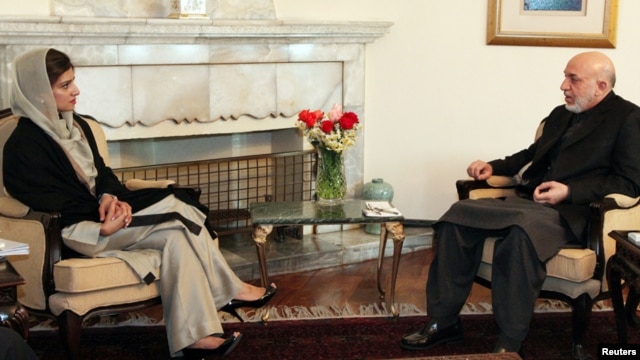 "Afghan President Hamid Karzai meets with Pakistani Foreign Minister Hina Rabbani Khar in Kabul on February 1."
Pix from RFERL interview today with Ahmed Rashid about the leaked NATO report fingering the ISI. Rashid thinks the report was leaked to time with the Karzai-Khar meeting. It would have been leaked anyway.
The dog and pony show that Gilani and Kayani put on, in the attempt to persuade the IMF that there was something approximating a civilian government in Pakistan, backfired. So then Gilani had to run around Davos last week assuring everyone that there was not going to be a coup in Pakistan.
My favorite part of the Rashid interview:
RFE/RL: Is the revelation in this NATO report about Islamabad's support for the Taliban news to you?"Ignored?" So Tony Blair and Gordon Brown had nothing to do with anything. They were just sitting there in Downing Street, pure as the driven snow.
Ahmed Rashid: It's very well known amongst NATO militaries [and] amongst the U.S. military. I was told by senior American generals that they approached [U.S.] President [George W.] Bush and Secretary of Defense Donald Rumsfeld back in 2005 about the support that the Taliban were getting from Pakistan. But it was ignored by Bush at that time.
See this what I keep warning: the longer Americans stay in there and play with NATO, the more bags we're going to be left holding.
NATO's Superduper Top Secret You Mustn't Read This leaked report: "ISI supporting Afghan Taliban" or what NATO and waterbugs have in common
Once I was chasing a waterbug around the house to kill it when it made an executive decision to hide instead of run.
"You do realize I can see you, you nitwit," I said peevishly.
It didn't realize; it thought that because it could no longer see me, I couldn't see the back of its body sticking out from the hiding place.
I couldn't bring myself to kill a creature that meant me no harm and couldn't comprehend that its attempts at subterfuge were completely transparent.
So, in the manner of the samurai who sheathed his sword and walked away when the thief he'd cornered spat in his face, I lowered the swatter then made enough noise to scare the waterbug into running again. The chase resumed until the waterbug lucked into a cranny big enough to hide its entire body from my eyes.
At least as far back as 2005, when the Taliban resurgence in Afghanistan became evident, the British government has wanted a 'political' settlement with them, and other NATO nations that haven't wanted to confront Pakistan's regime have wanted the same settlement. And hang the facts that most Afghans hate the Taliban and don't want any settlement that puts Pakistan and its Taliban proxies in control of their country. The following report, which has set off another predictable cascade of denials from Pakistan's regime, is best understood with those facts in mind:
Pakistan helping Afghan Taliban - Nato
February 1, 2012
"The Taliban are not Islam. The Taliban are Islamabad."
The Taliban in Afghanistan are being directly assisted by Pakistani security services, according to a secret Nato report seen by the BBC.
The leaked report, derived from thousands of interrogations, claims the Taliban remain defiant and have wide support among the Afghan people.
[...]
The report alleges that Pakistan knows the locations of senior Taliban leaders.
"We have long been concerned about ties between elements of the ISI [Pakistan's intelligence service] and some extremist networks," said US Pentagon spokesman Captain John Kirby, adding that the US Defence Department had not yet seen the report.
[...]
The BBC's Quentin Sommerville in Kabul says the report - on the state of the Taliban - fully exposes for the first time the relationship between the ISI and the Taliban.
The report is based on material from 27,000 interrogations with more than 4,000 captured Taliban, al-Qaeda and other foreign fighters and civilians.
The report notes: "Pakistan's manipulation of the Taliban senior leadership continues unabatedly".
It also says that Pakistan is aware of the locations of senior Taliban leaders.
"Senior Taliban representatives, such as Nasiruddin Haqqani, maintain residences in the immediate vicinity of ISI headquarters in Islamabad," it said.
It quotes a senior al-Qaeda detainee as saying: "Pakistan knows everything. They control everything. I can't [expletive] on a tree in Kunar without them knowing. The Taliban are not Islam. The Taliban are Islamabad."
Pakistan is finding it harder to convince outsiders it is not helping the Afghan Taliban and giving safe haven to its leaders.
In effect, the accusation is that Pakistan is betting on the insurgents being the strongest power in Afghanistan and most likely ally once Nato leaves - something Islamabad of course strenuously denies.
The leak of this report comes at a particularly sensitive time. Pakistan is already blocking the supply route to coalition forces in Afghanistan, following a Nato attack in which 24 Pakistani soldiers were killed.
With increasing pressure being heaped on Pakistan, public support here for formally ending co-operation with the West simply grows.
Our correspondent says the report seems to suggest that the Taliban feel trapped by ISI control and fear they will never escape its influence.
However, it states: "As this document is derived directly from insurgents it should be considered informational and not necessarily analytical."
Adm Mike Mullen, former chairman of the US Joint Chiefs of Staff, has explained Pakistan's closeness to the Afghan Taliban by pointing to infiltration of its army by the religious right, but he also says it is part of a grand strategy to increase leverage in the region via "proxies".
Despite Nato's strategy to secure the country with Afghan forces, the secret document details widespread collaboration between the insurgents and Afghan police and military.
Lt Col Jimmie Cummings, a spokesman for Nato's International Security Assistance Force (Isaf) in Afghanistan, said the document was "a classified internal document that is not meant to be released to the public".
"It is a matter of policy that documents that are classified are not discussed under any circumstances," he said.
The report also depicts the depth of continuing support among the Afghan population for the Taliban, our correspondent says.
It paints a picture of al-Qaeda's influence diminishing but the Taliban's influence increasing, he adds.
Taliban influence
In a damning conclusion, the document says that in the last year there has been unprecedented interest, even from members of the Afghan government, in joining the Taliban cause.
It adds: "Afghan civilians frequently prefer Taliban governance over the Afghan government, usually as a result of government corruption."
The report has evidence that the Taliban are purposely hastening Nato's withdrawal by deliberately reducing their attacks in some areas and then initiating a comprehensive hearts-and-minds campaign.
It says that in areas where Isaf has withdrawn, Taliban influence has increased, often with little or no resistance from government security forces. And in many cases, with the active help of the Afghan police and army.
When foreign soldiers leave, Afghan security forces are expected to take control.
The report says that surrender is far from their collective mindset.
"For the moment, they believe that continuing the fight and expanding Taliban governance are their only viable courses of action," it adds.
According to the report, rifles, pistols and heavy weapons have been sold by Afghan security forces in bazaars in Pakistan.
The report adds that Taliban members "do not receive salaries or other financial incentives for their work", but their operations are funded by the narcotics trade and they frequently take a cut from the trade.
Their main revenue, though, is from donations, and they travel around the country from door to door making no secret of their affliation, it says.
Friday, January 27
Urgent advice for State: Warn Obama to stop pushing the envelope (UPDATED 2X)
UPDATE 2:05 PM ET January 29
Adding two important news reports to the footnotes, both of which I'd misplaced at the time I published this post and just found.
Footnote #1: Egypt faces hurdles in securing IMF aid, January 25, Reuters. Although the January 25 report doesn't contain the news about the billion dollar-'bridge' loan that I'd mentioned in the text, it presents key observations that were dropped from the updated January 26 Reuters report I'd originally linked to.
Footnote #8: Pakistan stoking anti-Indian sentiments to divert attention from the heat at home, January 26, Times of India. At first glance this report doesn't differ markedly from the one in The Hindu about the LeT 'resurgence' in Pakistan but it brings out points which underscore the seriousness of the development, and not only for India. LeT is one of the world's most dangerous international terrorist organizations; that Pakistan's military let its leader out of his cage at home at this juncture is almost beyond belief. Almost.
******************
I was sitting on the patio one morning six years ago, enjoying the quiet and early Spring weather, when I heard the most godawful sound. I'd barely blurted, "What the --?" when I learned the sound was a squirrel's idea of a battle cry issuing from maybe 200 squirrel throats. All the squirrels in the neighborhood, it seemed, had banded together to run off a large rat and the chase was taking them through my back yard. I never saw or heard anything like it my life. And let me tell you that rat was burning rubber. Never saw a rat run so fast.
I told this story not to insult any government but to graphically illustrate that when sufficiently provoked and desperate, even the weakest governments can set the mighty United States back on its heels. Once this gets underway it can snowball into a trend.
With all such situations it's perceptions of American actions that count, or to be more precise the perceived pattern of actions. During the past year the perceived pattern is that President Barack Obama is throwing his weight around the world, everywhere he can.
I understand that Obama can cite reasons for each instance in which he's crashed national borders in pursuit of the bad guys. Yet the perception is that Obama has gotten hold of two very efficient lethal weapons -- U.S. Special Forces teams and armed drones -- and is deploying them anywhere in the world he sees fit.
But even President George W. Bush and his most aggressive predecessors in the Cold War managed to meddle in ways that didn't make it look as if the entire planet was suddenly under surprise attack from the United States. They knew when to back off -- and they were operating in a communications era when their every move in a foreign country wasn't broadcast around the world.
Times have changed. It's the piling-on phenomenon that's leading people to these perceptions Okay, so you wanted to shoot rockets at al Qaeda operatives in Pakistan's badlands. Okay, so you had to support Sarkozy's war against Gaddafi. Okay, so you had shoot rockets at al Qaeda in Yemen. Okay, so you had to take out Osama bin Laden when you found him. Okay, so you had to rescue an American citizen who was kidnapped by common criminals.
But all of these "okay" situations are piled on top of Obama expressing public support for Egypt's democracy activists and as much telling Mubarak to decamp. And piled on top of meddling in spectacular fashion in Pakistan's internal affairs. And starting a cold war with Iran's regime not to mention starting a cold war with Syria's regime.
All this within the space of a year.
I don't need to tell State that the juntas in Pakistan and Egypt are in absolutely desperate straits. They are both staring at the imminent prospect of a complete economic collapse in their countries. And the fear is that raising loans amounting to a billion dollars from the World Bank and African Development Bank until the IMF can (if it chooses) to bail them out might not be enough to stave off economic collapse in Egypt. (1)
Nor should I need to tell State that both juntas have broad and deep support in their respective countries, if for no other reason than the large number of civilians the businesses owned by the juntas employ.
So a reasonable person would assume that last month, after Egypt's junta gave a clear warning to the Obama administration to back off in Egypt, State would have immediately yanked the Democratic and Republican party NGOs that were operating in Egypt. I mean -- how much more of a warning do you need, when a security force raids the NGOs and confiscates their computers while the junta accuses the NGOs of being fronts for the American government and meddling in Egypt's internal affairs? (2)
But no, the NGOs continued to operate in Egypt -- all for a good cause, of course -- after State pulled their irons out of the fire in December. Now we learn as of yesterday some Americans working for the NGOs have been barred from leaving Egypt. This is a prelude to arrest warrants being issued -- or at least that's the implied threat of the action to prevent the Americans (and some Europeans who work for othe ngos from leaving Egypt. (2)
Obama is understandably furious about the situation but he could have seen this coming even before Mubarak left office. And now Egypt's generals believe they have no other choice but to find a scapegoat for the country's economic crisis. The Obama administration's ill-conceived attempt to bring more democracy to Egypt, which is using a very small number of Egyptians, has handed the junta the perfect goat.
Now I turn to Pakistan. The country is not only facing economic collapse but it's also in the throes of the worst fuel crisis in its history. (3) So why has the Obama administration decided that this is the perfect time to turn the heat up on Iran by trying to get Pakistan's regime to abandon the gas pipeline Iran is building for them, and sign up to get gas from the TAPI pipeline? (4)(5)
Is the answer that chipmunks are managing the Pakistan portfolio for the Obama administration? I ask this also because this is the same question they're asking in Afghanistan. I mean -- our war office and State couldn't even keep track of containers being transshipped through Pakistan, many of those containers containing desperately needed food supplies for Afghans.
Why "desperate?" Because the Obama administration and Congress haven't wanted the Afghan government to use an Iranian route for shipping food to Afghanistan and because the Northern Distribution Network, where it's the middle of winter anyway, is full up with shipping war supplies for NATO. So they've had a food shortage in Afghanistan, which has driven food prices, even for food basics, through the roof.
But how can you lose track of almost 160,000 shipping containers? The containers have disappeared in Pakistan. Gone! Poof! (6)
And not to put too fine a point on it but the U.S. command can't even win a war against a bunch of guys in baggy pants who take their orders from Rawalpindi. What's been the Obama strategy to deal with this situation? Play patty-cake with the Emir of Qatar and increase meddling in Pakistan. (7)
What has the answer been from Pakistan's junta? They've let Lashkar-e-Taiba out of its cage in Pakistan. (8) Do I have to draw stick figures to explain to State what that implies?
For starters, the junta is saying to forget Doha; the Obama administration can negotiate a truce with Mullah Omar all it wants, and it won't mean squat to LeT, which just might take the prize as the world's most dangerous international terrorist organization. (9) The larger implication is that the junta is signaling Obama that if he's worried about international terrorists taking over Pakistan's nuke weapons, the worry is misplaced because the junta will simply hand them a nuke if they get any angrier at him.
I understand that little blame for the entire mess I've described above can be laid at State's door. But someone has to take responsibility for conveying the facts of life to President Obama and State has to be the designated fool in this instance.
In summary, this is one of those times it's crucial for the American government to practice message discipline across the board. Sometimes you can have it all, but if you try to have it all at the same time, you sow the impression that you're crazy. That's a fast way to replace respect with fear. When people become afraid that you're both crazy and hogging their turf, they act in the same way a bunch of Washington squirrels did one fine morning.
1) January 26, Egypt says to seek extra $1 billion to support budget; Reuters
2) January 27, 2012: Egypt Bans Travel for 10 U.S. Citizens; Ben Hubbard, Associated Press via TIME online
4) In the first version of this post I referred to the TAPI pipeline as "crazy;" without getting into a discussion of TAPI, I had it confused in my mind with the Nabucco gas pipeline. So many pipelines to keep straight.
5) This report is undated although it was surely published within the past week; I'm linking to this version rather than the International Herald Tribune report because of the wording of the title supplied by the Pakistani website that quotes IHT: US enticing Pakistan with cheap gas; Online International News Network (Pakistan)
6) January 27, 2012: Afghanistan bound 157,736 US containers; Aftab Maken, The News International (Pakistan)
8) January 24, 2012:Hafiz Saeed ‘threatens' India; Hasan Suror, The Hindu
9) January 26, 2012: What's wrong with the following sentence?, Pundita
Adding two important news reports to the footnotes, both of which I'd misplaced at the time I published this post and just found.
Footnote #1: Egypt faces hurdles in securing IMF aid, January 25, Reuters. Although the January 25 report doesn't contain the news about the billion dollar-'bridge' loan that I'd mentioned in the text, it presents key observations that were dropped from the updated January 26 Reuters report I'd originally linked to.
Footnote #8: Pakistan stoking anti-Indian sentiments to divert attention from the heat at home, January 26, Times of India. At first glance this report doesn't differ markedly from the one in The Hindu about the LeT 'resurgence' in Pakistan but it brings out points which underscore the seriousness of the development, and not only for India. LeT is one of the world's most dangerous international terrorist organizations; that Pakistan's military let its leader out of his cage at home at this juncture is almost beyond belief. Almost.
******************
I was sitting on the patio one morning six years ago, enjoying the quiet and early Spring weather, when I heard the most godawful sound. I'd barely blurted, "What the --?" when I learned the sound was a squirrel's idea of a battle cry issuing from maybe 200 squirrel throats. All the squirrels in the neighborhood, it seemed, had banded together to run off a large rat and the chase was taking them through my back yard. I never saw or heard anything like it my life. And let me tell you that rat was burning rubber. Never saw a rat run so fast.
I told this story not to insult any government but to graphically illustrate that when sufficiently provoked and desperate, even the weakest governments can set the mighty United States back on its heels. Once this gets underway it can snowball into a trend.
With all such situations it's perceptions of American actions that count, or to be more precise the perceived pattern of actions. During the past year the perceived pattern is that President Barack Obama is throwing his weight around the world, everywhere he can.
I understand that Obama can cite reasons for each instance in which he's crashed national borders in pursuit of the bad guys. Yet the perception is that Obama has gotten hold of two very efficient lethal weapons -- U.S. Special Forces teams and armed drones -- and is deploying them anywhere in the world he sees fit.
But even President George W. Bush and his most aggressive predecessors in the Cold War managed to meddle in ways that didn't make it look as if the entire planet was suddenly under surprise attack from the United States. They knew when to back off -- and they were operating in a communications era when their every move in a foreign country wasn't broadcast around the world.
Times have changed. It's the piling-on phenomenon that's leading people to these perceptions Okay, so you wanted to shoot rockets at al Qaeda operatives in Pakistan's badlands. Okay, so you had to support Sarkozy's war against Gaddafi. Okay, so you had shoot rockets at al Qaeda in Yemen. Okay, so you had to take out Osama bin Laden when you found him. Okay, so you had to rescue an American citizen who was kidnapped by common criminals.
But all of these "okay" situations are piled on top of Obama expressing public support for Egypt's democracy activists and as much telling Mubarak to decamp. And piled on top of meddling in spectacular fashion in Pakistan's internal affairs. And starting a cold war with Iran's regime not to mention starting a cold war with Syria's regime.
All this within the space of a year.
I don't need to tell State that the juntas in Pakistan and Egypt are in absolutely desperate straits. They are both staring at the imminent prospect of a complete economic collapse in their countries. And the fear is that raising loans amounting to a billion dollars from the World Bank and African Development Bank until the IMF can (if it chooses) to bail them out might not be enough to stave off economic collapse in Egypt. (1)
Nor should I need to tell State that both juntas have broad and deep support in their respective countries, if for no other reason than the large number of civilians the businesses owned by the juntas employ.
So a reasonable person would assume that last month, after Egypt's junta gave a clear warning to the Obama administration to back off in Egypt, State would have immediately yanked the Democratic and Republican party NGOs that were operating in Egypt. I mean -- how much more of a warning do you need, when a security force raids the NGOs and confiscates their computers while the junta accuses the NGOs of being fronts for the American government and meddling in Egypt's internal affairs? (2)
But no, the NGOs continued to operate in Egypt -- all for a good cause, of course -- after State pulled their irons out of the fire in December. Now we learn as of yesterday some Americans working for the NGOs have been barred from leaving Egypt. This is a prelude to arrest warrants being issued -- or at least that's the implied threat of the action to prevent the Americans (and some Europeans who work for othe ngos from leaving Egypt. (2)
Obama is understandably furious about the situation but he could have seen this coming even before Mubarak left office. And now Egypt's generals believe they have no other choice but to find a scapegoat for the country's economic crisis. The Obama administration's ill-conceived attempt to bring more democracy to Egypt, which is using a very small number of Egyptians, has handed the junta the perfect goat.
Now I turn to Pakistan. The country is not only facing economic collapse but it's also in the throes of the worst fuel crisis in its history. (3) So why has the Obama administration decided that this is the perfect time to turn the heat up on Iran by trying to get Pakistan's regime to abandon the gas pipeline Iran is building for them, and sign up to get gas from the TAPI pipeline? (4)(5)
Is the answer that chipmunks are managing the Pakistan portfolio for the Obama administration? I ask this also because this is the same question they're asking in Afghanistan. I mean -- our war office and State couldn't even keep track of containers being transshipped through Pakistan, many of those containers containing desperately needed food supplies for Afghans.
Why "desperate?" Because the Obama administration and Congress haven't wanted the Afghan government to use an Iranian route for shipping food to Afghanistan and because the Northern Distribution Network, where it's the middle of winter anyway, is full up with shipping war supplies for NATO. So they've had a food shortage in Afghanistan, which has driven food prices, even for food basics, through the roof.
But how can you lose track of almost 160,000 shipping containers? The containers have disappeared in Pakistan. Gone! Poof! (6)
And not to put too fine a point on it but the U.S. command can't even win a war against a bunch of guys in baggy pants who take their orders from Rawalpindi. What's been the Obama strategy to deal with this situation? Play patty-cake with the Emir of Qatar and increase meddling in Pakistan. (7)
What has the answer been from Pakistan's junta? They've let Lashkar-e-Taiba out of its cage in Pakistan. (8) Do I have to draw stick figures to explain to State what that implies?
For starters, the junta is saying to forget Doha; the Obama administration can negotiate a truce with Mullah Omar all it wants, and it won't mean squat to LeT, which just might take the prize as the world's most dangerous international terrorist organization. (9) The larger implication is that the junta is signaling Obama that if he's worried about international terrorists taking over Pakistan's nuke weapons, the worry is misplaced because the junta will simply hand them a nuke if they get any angrier at him.
I understand that little blame for the entire mess I've described above can be laid at State's door. But someone has to take responsibility for conveying the facts of life to President Obama and State has to be the designated fool in this instance.
In summary, this is one of those times it's crucial for the American government to practice message discipline across the board. Sometimes you can have it all, but if you try to have it all at the same time, you sow the impression that you're crazy. That's a fast way to replace respect with fear. When people become afraid that you're both crazy and hogging their turf, they act in the same way a bunch of Washington squirrels did one fine morning.
1) January 26, Egypt says to seek extra $1 billion to support budget; Reuters
Egypt said on Thursday it would ask the World Bank for a $500 million loan and another $500 million loan from the African Development Bank to help it fill a budget gap widened by a year of political and economic turmoil.January 25, Egypt faces hurdles in securing IMF aid; Patrick Werr, Reuters
Egypt has also persuaded the International Monetary Fund (IMF) to reduce the interest rate it would charge on $3.2 billion loan Cairo had requested from the IMF, Planning and International Cooperation Minister Faiza Abu el-Naga told reporters.
"We have achieved a reduction from the IMF on the interest rate on the loan from 1.5 to 1.1 percent," she said, adding that this would put the cost of the finance more in line with interest rates worldwide.
The turmoil in Egypt has pushed up unemployment, widened its budget and balance of payments deficits and drained its foreign reserves. Many economists believe a currency devaluation is imminent.
Egypt announced earlier this month it had formally asked the IMF for an aid package, saying it wanted the money as soon as possible and hoped an agreement would be signed within weeks.
The IMF, however, says any agreement would have to be accompanied by financial commitments from other international donors and attract broad political support within the country.
Thrashing out the technical details of a loan will take two to three months, it said.
The World Bank and African Development Bank loans would carry an interest rate of between 7 and 8 percent, Abu el-Naga said. Egypt would request a mission from the World Bank come to Egypt soon, she added, without giving details or a date.The central bank, trying to keep the Egyptian pound stable against the dollar, has run through $9 billion of its foreign reserves since June, when the government rejected an IMF agreement similar to the one it is now seeking.
The depletion accelerated before the parliamentary election and during a series of violent political protests in November and December, with the central bank spending at least $2 billion in each of the last three months. By the end of December, reserves had fallen to $18 billion.
2) January 27, 2012: Egypt Bans Travel for 10 U.S. Citizens; Ben Hubbard, Associated Press via TIME online
CAIRO) — Egypt banned at least 10 Americans and Europeans from leaving the country, including the son of U.S. Transportation Secretary Ray Lahood, hiking tensions with Washington over a campaign by Egypt's military against groups promoting democracy and human rights.3) January 25, 2012: Energy Deficit Renders Punjab Uncompetitive; Dawn (Pakistan)
The United States warned Thursday that the campaign raised concerns about Egypt's transition to democracy and could jeopardize American aid that Egypt's battered economy needs badly after a year of unrest. [...]
The travel ban was part of an Egyptian criminal investigation into foreign-funded democracy organizations after soldiers raided the offices of 10 such groups last month, including those of two American groups.
The investigation is closely intertwined with Egypt's political turmoil since the fall of Hosni Mubarak nearly a year ago. The generals who took power have accused "foreign hands" of being behind protests against their rule and they frequently depict the protesters themselves as receiving foreign funds in a plot to destabilize the country.
[...]
4) In the first version of this post I referred to the TAPI pipeline as "crazy;" without getting into a discussion of TAPI, I had it confused in my mind with the Nabucco gas pipeline. So many pipelines to keep straight.
5) This report is undated although it was surely published within the past week; I'm linking to this version rather than the International Herald Tribune report because of the wording of the title supplied by the Pakistani website that quotes IHT: US enticing Pakistan with cheap gas; Online International News Network (Pakistan)
6) January 27, 2012: Afghanistan bound 157,736 US containers; Aftab Maken, The News International (Pakistan)
ISLAMABAD: The Federal Board of Revenue (FBR) on Thursday made a stunning revelation before the Senate Standing Committee on Commerce that a total of 157,736 containers of the United States destined to Afghanistan have never reached the landlocked country and disappeared inside Pakistan.7) January 25, 2012: Brahma Chellaney learns U.S. Afghan War exit strategy is literally full of gas; Pundita
[...]
8) January 24, 2012:Hafiz Saeed ‘threatens' India; Hasan Suror, The Hindu
In a spectacle guaranteed to “send a chill through New Delhi,” as The Financial Times put it, Hafiz Saeed, the suspected mastermind behind the 2008 Mumbai terror bombings, is being feted in Pakistan as a “hero” attracting thousands of people as he “criss-crosses” the country at the head of a radical road-show targeting India and calling for “jihad.”January 26, 2012: Pakistan stoking anti-Indian sentiments to divert attention from the heat at home; Times of India
[...]
9) January 26, 2012: What's wrong with the following sentence?, Pundita
Wednesday, January 25
Uh oh. Is NATO lying in its teeth about the level of violence in Afghanistan?
"We find their suggestion that the insurgency is waning to be a dangerous political fiction ..."
NATO is consistently reporting a decrease in violence nationwide, which should pave the way for a handover to Afghan security forces and a NATO withdrawal.
The issue of whether violence across Afghanistan is rising or falling is key to the NATO-led mission's objective of pacifying the country and handing it over to Afghan forces so NATO combat troops can slowly withdraw by 2014.
Violence spikes in key Afghan regions
By Nick Paton Walsh
January 25, 2012
CNN
Kabul - Attacks by the Taliban in southern and eastern Afghanistan have risen sharply in recent months, according to figures released by the U.S.-led coalition, a sign that the allied offensive against the insurgency is yet to blunt its potency.
The figures are in contrast to the broader trend of decreasing violence nationwide depicted by the NATO mission. That depiction is challenged by non-government organizations active in Afghanistan; Human Rights Watch describes 2011 as "the most violent year ever."
NATO's International Security and Assistance Force, or ISAF, says overall enemy attacks declined by 9% across the country in 2011. But the number of attacks by the insurgency rose last year by 19% in the east when compared to 2010. A smaller rise was seen in the south of the country, 6%.
These two areas - known by ISAF as RC South and RC East - account for nearly two-thirds of insurgent attacks across the country. The statistics are significant, as NATO is consistently reporting a decrease in violence nationwide, which should pave the way for a handover to Afghan security forces and a NATO withdrawal.
One analyst said the figures from the south are especially noteworthy, as this region was the target of major NATO operations in 2010. Even taking into account the insurgent violence triggered by those 2010 operations, last year was still more violent.
The increase suggests a continuation of fighting during the traditionally quieter winter months. In fact, the south and east of Afghanistan, according to NATO figures, saw a decline in violence in late summer (compared to 2010) only to spike as winter approached.
An ISAF spokesman, Lt. Col. Jimmie Cummings, said the rise in insurgent attacks was a result of coalition forces taking the fight to the enemy.
"This increase in enemy-initiated attacks is attributed to deliberate operations (surge) in both the east and south by Afghan and ISAF forces in the fall designed to further pressure insurgents in former Taliban strongholds," he said in an e-mail statement.
Cummings added that operations in the south had helped reduce high-profile attacks in the city of Kandahar by about a third compared to 2010.
The issue of whether violence across Afghanistan is rising or falling is key to the NATO-led mission's objective of pacifying the country and handing it over to Afghan forces so NATO combat troops can slowly withdraw by 2014.
Human Rights Watch takes issue with NATO's depiction of declining violence, especially as it affects civilians. The organization's Afghanistan researcher Heather Barr told CNN: "This has been the most violent year ever and the worst year for civilian casualties. If this is what winning looks like, it does not look that way for the Afghan communities experiencing this violence first hand."
Barr said the group's analysis was based on data that it considered credible from the United Nations and from the Afghan Non-government Safety Organization, or ANSO, which uses similar data to ISAF's to evaluate the risk for charity and development groups working nationwide.
A recent U.N. report highlighted a considerable rise in security incidents. ANSO said in its last quarterly report that there was a continuing rise in violence, and that attacks by the insurgency nationwide were 14% higher last year than in 2010.
But ANSO said that is significantly lower than year-on-year rises recorded previously, and it's unclear whether that's because ISAF has the insurgency under pressure or because the insurgents have, ahead of the 2014 withdrawal, made "the calculus that there is no point sprinting to the finish if everyone else has dropped out of the race."
ANSO also challenges NATO's analysis of insurgent violence. Its latest report says the group is unable to analyze NATO statistics that pointed to a 3% reduction in attacks in the first eight months of 2011, compared with the same period in 2010.
But it adds: "We find their suggestion that the insurgency is waning to be a dangerous political fiction that should be given no consideration in NGO risk assessment for the coming year."
Tuesday, January 24
Let's see what kind of mood Messr. Sarkozy is in today.
The conference I was attending broke up early. Translation: I got bored and cut out. So I'm as free as a bird until Thursday. Translation: Now I'm working my way through a backlog of half-finished Pundita posts. To give myself a break I looked up the news from France regarding A'stan. Here's the latest from VOA (with my comments inserted in a few places), which seems to indicate that Sarkozy has calmed down a little. Even so I wouldn't want to be in Karzai's shoes when he meets behind closed doors later this week with France's President.
France Rules Out Hasty Afghanistan Withdrawal
Tuesday, January 24th, 2012 at 1:35 pm ET
France is ruling out a hasty withdrawal from Afghanistan after an Afghan soldier shot and killed four French troops last week.
French President Nicolas Sarkozy suspended military operations in Afghanistan and said he was considering an early pullout from the country if security conditions are not clearly established following Friday's attack in eastern Afghanistan.
On Tuesday, French Foreign Minister Alain Juppe told parliament that France will not give in to panic [Pundita note: Panic? I think it was rage.] and immediately withdraw all French troops from Afghanistan this year. He said calls for a complete withdrawal of troops by the end of of 2012 have not been thought through.
France has about 3,600 soldiers serving in Afghanistan, mainly in the east, with all French combat troops scheduled to leave the country in 2014.
Afghan President Hamid Karzai left Tuesday for a five-day trip to Turkmenistan and Europe. He is expected to travel to France, where his office says he will sign a strategic partnership treaty with President Sarkozy.
On Friday, an Afghan soldier opened fire on unarmed French troops during a training exercise at a base in Kapisa province. The shooting was the latest in a series of incidents in which international troops have been killed by Afghan security forces.
NATO Secretary-General Anders Fogh Rasmussen reiterated the attack was isolated. He [Pundita note: Aw, put a sock in it, Rasmussen. The New York Times is standing by its report.] told the French newspaper Le Monde Tuesday that he understood France's concerns about security and that the process of recruiting Afghan soldiers must be reexamined.
French Defense Minister Gerard Longuet was quoted as saying the shooter was an insurgent infiltrator. But NATO officials said Tuesday it was too early to tell if the Taliban was behind last week's killing of the four French troops.
Coalition spokesman Brigadier General Carsten Jacobsen told reporters said that past investigations into similar events have found many different reasons for them.
He said “there are no indicators of a systemic issues of infiltration” by the Taliban into the Afghan security forces and that officials look at this “closely every day.” [Pundita note: What you mean 'we' Kemosabe? Has the Coalition asked Afghanistan's intelligence service to look into whether the attacks have been systemic since -- let me see -- 2009? Say, wasn't that the year LeT established a major presence in Afghanistan, or do I have the years mixed up again?]
Sunday, January 22
Note
Starting with the "Moo Shu Pakistan" essay I've published seven posts since around 4:30 ET on Friday morning; I've been driven by a sense of foreboding about the situation in Afghanistan. But I have to stop now. And the way my schedule is stacking up for next week I might not even have time to check my emails at the Pundita address until Tuesday night. So if you post a comment don't look for it to be published before then because I have to moderate all comments.
In the meantime I suggest you carefully read this post at Long War Journal about NATO's lack of frankness about the number of NATO troops that have been killed by Afghan soldiers since 2009, and Sarkozy's threat to pull all French troops out of Afghanistan in the wake of the murder of French military trainers by an Afghan soldier on Friday.
The latest news (from today) is that Sarkozy is arguing with the U.S. command about whether he has the right to withdraw French troops. He is not playing. He is furious.
Maybe his famous temper will be a help in this instance if he manages to light a fire under Obama, who is refusing to confront the reality that his announcement of a set date for troop withdrawal from A'stan and attempts to negotiate with 'Taliban' have given Pakistan's regime and the various terrorist factions operating in Afghanistan a huge advantage, which they are using to the hilt.
All right; signing off, and probably until Tuesday night.
Best regards to all,
Pundita
Saturday, January 14
"It is a bold challenge to the United States and Pakistan to live up to their pious homilies."
"This is the first time that the leadership of the Tajik, Uzbek and Hazara communities has come to a common line of thinking to oppose the US's peace strategy and to present an alternate blueprint of pan-Afghan settlement. In essence, the Northern Alliance is being resuscitated as a political entity."
"What may have incensed the Northern Alliance groups partly at least is that, despite the chill in US-Pakistan relations, Washington has kept the Pakistani military and Inter-Services Intelligence (ISI) in the loop on the Qatar talks, while blithely ignoring them as protagonists."
"Karzai has sprung a surprise by insisting that peace talks should be "Afghan-led" - meaning, he expects a "hands-on" role for himself. He has said this before, but this time he means it. He knows that regional opinion strongly disfavors a US-led peace process, and he also anticipates the danger of being left behind as road kill unless he is in the driver's seat."
". . . On Monday, Karzai raised the stakes much higher by demanding that the Taliban must agree to a ceasefire before formal peace negotiations could begin."
- M.K. Bhadrakumar, January 12
On October 1 and again on December 29 I observed that Afghan President Hamid Karzai was being forced to stiffen his spine in his relations with Washington; Indian former Career Diplomat M.K. Bhadrakumar makes the same observation and then some in his January 12 column for Asia Times Online, There's more to peace than Taliban . The column makes up for a lot of hot air he's blown from his perch at AToL; this time, he absolutely nails a situation. (Unless one also wants to see a discussion about which nations the U.S. regime is carrying water for in Afghanistan and Pakistan, but that topic would be outside the scope of writing, as it is for every news outlet that exists.)
Before I turn to Bhadrakumar's discussion I'll note a development that probably occurred after the column was put to bed; in any case his discussion of a meeting in Berlin between Afghan opposition leaders and U.S. members of Congress didn't mention that on January 11 the Afghan Foreign Ministry issued a statement "condemning" the meeting as a breach of Afghanistan's constitution and as interference with Afghan's internal affairs and national unity.
I am still waiting for the Foreign Ministry to issue a statement condeming NATO and specifically the United States of America for trying to sell Afghanistan to Pakistan but I'll let Amb. Bhadrakumar do the talking for me this time because he says it all quite wonderfully:
There's more to peace than Taliban
by M K Bhadrakumar
January 12, 2012
Asia Times Online
The hype over "secret discussions" between the United States and Taliban officials has subsided; the hot topic is vanishing from public view once again.
Nevertheless, Iranian media insist that three high-ranking Taliban leaders have been released - Mullah Khairkhawa, former interior minister; Mullah Noorullah Noori, a former governor; and Mullah Fazl Akhund, the Taliban's chief of army staff - in exchange for an American soldier held by the Taliban.
United States diplomats might have put the cart before the horse in their hurry to get a peace process going before North Atlantic Treaty Organization (NATO) leaders gather for their summit in Chicago in May. They may have made two cardinal mistakes. One, they underestimated Afghan President Hamid Karzai's political compulsions. Two, the US took it for granted that the anti-Taliban Northern Alliance groups would fall in line since many of them have been co-opted through the 10-year period of the war and their capacity to unite is in doubt.
Karzai has sprung a surprise by insisting that peace talks should be "Afghan-led" - meaning, he expects a "hands-on" role for himself. He has said this before, but this time he means it. He knows that regional opinion strongly disfavors a US-led peace process, and he also anticipates the danger of being left behind as road kill unless he is in driver's seat.
Besides, Karzai is demanding that the US should transfer any Taliban prisoners from the US detention facility at Guantanamo Bay in Cuba to his custody rather than to Qatar (as apparently sought by the Taliban). He is also raking up a related issue questioning US control of Bagram airbase near Kabul as a detention center.
On Monday, Karzai raised the stakes much higher by demanding that the Taliban must agree to a ceasefire before formal peace negotiations could begin. His spokesman, Emal Faizi, said, "When the talks start, there should be a ceasefire and the violence against the Afghan people should stop." Faizi also said it was too soon to send a delegation from Kabul to Qatar for talks. "The government has no immediate plans for such a trip."
The hardening of Karzai's stance also needs to be understood against the backdrop of growing restiveness on the part of the erstwhile Northern Alliance groups.
On Monday, the alliance stalwarts came out against the Barack Obama administration's secret discussions with the Taliban. These leaders - Ahmed Zia Massoud, brother of late Ahmad Shah Massoud and formerly vice president under Karzai; General Abdul Rashid Dostum, the Uzbek leader who leads the Jumbish in northern Afghanistan; Haji Mohammad Mohaqiq, the Hazara Shi'ite leader from Mazar-i-Sharif who heads the Hezb-e-Wahdat; Amrullah Saleh, former head of Afghan intelligence - held talks with a group of four US congress members - Dana Rohrabacher, Loretta Sanchez, Louie Gohmert and Steve King (all except Sanchez are Republicans) - in Berlin over the weekend and issued a joint statement on Monday.
This is the first time that the leadership of the Tajik, Uzbek and Hazara communities has come to a common line of thinking to oppose the US's peace strategy and to present an alternate blueprint of pan-Afghan settlement. In essence, the Northern Alliance is being resuscitated as a political entity.
Their statement attacked the power structure headed by Karzai as dysfunctional, far too centralized and rampantly corrupt and demanded that in the first instance what Afghanistan needed was an inclusive parliamentary form of government "instead of a personality-oriented presidential system", which could optimally represent all ethnic and regional interests.
They also sought a thorough revamping of the country's electoral system from the present single non-transferrable voting system to a "national-accepted variant of the proportional representative system" and the direct election of governors and provincial council leaderships with delegation of powers to create budgets, collect revenue and oversee local policing and administer social sectors.
But, most important, they frontally questioned the US's locus standi to initiate peace talks with the Taliban. Their statement said:We firmly believe that any negotiation with the Taliban can be acceptable, and therefore effective, [only] if all parties to the conflict are involved in the process. The present form of discussions with the Taliban is flawed, as it excludes anti-Taliban Afghans. It must be recalled that the Taliban extremists and their al-Qaeda supporters were defeated [in 2011] by Afghans resisting extremism with minimal human-embedded support from the United States and international community. The present negotiations with the Taliban fail to take into account the risks, sacrifices and legitimate interests of the Afghans who ended the brutal oppression of all Afghans.A challenge to Obama
In order to speed the withdrawal of international forces, the participants believe it is essential to strengthen regional and national institutions that are inclusive and represent the concerns of all the communities of Afghanistan. [Emphasis added.]
The Northern Alliance statement challenges the US's monopoly of conflict resolution and Washington's unilateralist estimation that the Taliban are the only group that matters as protagonists on the Afghan chessboard in a peace process.
Its entire approach is to take the "Afghan settlement" from the narrow path of a secretive US-Taliban-Pakistan compromise formula to a transparent, inclusive, broadly-participatory inclusive approach that would not ignore any Afghan interest group, which has genuine mass support, from participation, with strong, elected local leaderships that enjoy delegated powers of local governance.
In sum, it offers a vision for returning Afghanistan to its historical character of a federated system of government that allows a plural society to thrive, but with a representative form of government as a modern-day democracy. Indeed, the Northern Alliance statement implies readiness to reconcile politically with the Taliban, provided they "seize" power through the ballot box rather than the guns supplied from the Pakistani military inventory, among other places.
It is a bold challenge to the United States and Pakistan to live up to their pious homilies.
The alliance's strategy puts enormous pressure on Karzai. He is caught between two contending constituencies. The Northern Alliance leaders are critical of Karzai, but he finds no acceptability with the Taliban, too. Karzai's position becomes precarious if he antagonizes the Northern Alliance groups and turns them hostile. He won't want to put all his eggs in the American basket, either, since the US may find him expendable at some point. Karzai needs time to maneuver and create a new coalition that strengthens his standing.
What may have incensed the Northern Alliance groups partly at least is that, despite the chill in US-Pakistan relations, Washington has kept the Pakistani military and Inter-Services Intelligence (ISI) in the loop on the Qatar talks, while blithely ignoring them as protagonists. Nonetheless, interestingly, they made no critical reference to Pakistan.
Unsurprisingly, Islamabad is sitting tight. It refrains from taking open stance on the proposed talks with the Taliban in Qatar. At the same time, the ISI is on the ball and its chief, Lieutenant General Ahmed Shuja Pasha, even paid an overnight visit to Qatar.
Pakistan would draw satisfaction that Washington finally dropped its pre-conditions for talks with the Taliban. Equally, Pakistan would welcome any release of top Taliban figures from Guantanamo. And Pakistan didn't put roadblock when former mujahideen leader Gulbuddin Hekmatyar (who lives in Peshawar in Pakistan) deputed envoys to Kabul to sound out the US and NATO officials whether he too could be provided a seat at the conference table in Qatar.
However, Pakistan won't proffer an opinion on the prospects of the talks, rather pretending it is all a matter between Taliban leader Mullah Omar who is quartered in Quetta in Pakistan and American officials.
All this is being played against the backdrop of the troubled US-Pakistani relationship. Besides, the Taliban comprise hopelessly fragmented factions and neither Mullah Omar nor the Haqqani clan has yet commented on the proposed talks in Qatar.
Pakistan can rest on its oars that the ISI would be the only party capable of shepherding the Taliban factions to come on a united platform for talks, and the US ultimately has no choice but to knock on its doorstep seeking help.
As the Northern Alliance groups see it, Pakistani strategy is to wait out the period between now and 2014 - the date set for the US troop withdrawal - and then regroup the Taliban and make a bid to capture power in Kabul. Their strong show of unity in Berlin suggests that they will not roll over and give way to an exclusive US-Taliban-Pakistan settlement being imposed on their nation.
Their challenge to Barack Obama is to concede for the Afghan people the very minimum privilege of an Arab Spring so that Islamism can reconcile with democracy - quintessentially, expecting the US to be on the "right side of history". It is not too much to ask for, really.
Ambassador M K Bhadrakumar was a career diplomat in the Indian Foreign Service. His assignments included the Soviet Union, South Korea, Sri Lanka, Germany, Afghanistan, Pakistan, Uzbekistan, Kuwait and Turkey.
Friday, December 30
Washington's 40 percent solution to Pakistan's proxy war against NATO in Afghanistan or Pundita's solution. Take your pick.
I begin with thanking Madhu at Chicago Boyz and Zenpundit's Mark Safranski for highlighting my December 17 post, Would the U.S. pay Pakistan's military to help murder American troops if the U.S. had military conscription?. Mark included a helpful history lesson in his comments on the post:
There is no viable rationale, and the American public is fast running out of excuses for not knowing the score on Afghanistan, which is that counterinsurgency doctrine never got a fair test in the country because there was never any insurgency to speak of; there was and remains a covert proxy war waged by Pakistan's military -- a war funded in no small part by the U.S. taxpayer. A war that needlessly kills and maims many Americans because even the most basic, common-sense actions have never been taken by the American civilian leaders and military commands to discourage Pakistan's military from waging war on Afghanistan.
And despite all the publicity in the USA since the Abbottabad raid about Pakistan's support for terrorism and the public criticism of Pakistan from members of Congress, a host of media figures and high-ranking officials, there has been no real change in Washington's stance on Pakistan. If that's hard to believe, consider:
The 40 Percent Solution
A December 17 Reuters report (updated on December 19) on the foreign aid section of the U.S. spending bill for fiscal 2012 summarizes the stipulations attached by Congress to U.S. aid to Pakistan:
And as to why the American taxpayer should pay for U.S. forces to further train Pakistan's military in counterinsurgency tactics, which repeated history tells it passes to terrorist groups fighting Americans and other NATO troops, the Reuters report doesn't say. To return to the report:
The Washington workaround has been a 40 percent solution: no strings on monies always intended to be disbursed to Pakistan, and attach the strings to the phantom 60 percent.
This, despite the fact that even Fareed Zakaria bluntly told Pakistan's foreign minister (in an interview aired on CNN October 2, 2011) that it's been open knowledge for years in American journalistic and diplomatic circles that Pakistan is aiding and abetting the Haqqani Network.
Hina Rabbani Khar didn't bother to keep the contempt out of her voice when she replied to Zakaria's grilling. I'd say she knew she was dealing with people in Washington who make the monsters in her own government look like saints, for even the worst in Pakistan's military wouldn't pay another military to kill its own troops.
On November 13, 2009 The Atlantic Council's New Atlanticist blog published an essay by Donald M. Snow, Professor Emeritus at the University of Alabama and author of over 40 books on foreign policy, international relations and national security, which dealt with the implications of an all-volunteer force in the United States. Little more than a week after the Snow essay appeared at NA I published Why General Stanley McChrystal is going straight to hell, the first of what must be more than a hundred essays by now on the U.S. government's attempts to placate Pakistan even though it knew that Pakistan's military/ISI was complicit in the murder and maiming of U.S. troops.
I've half a mind to republish the Snow essay and mine right here and now, but will content myself with providing the links to the essays and asking you to read (or re-read) both. Then you tell me what you think should be done about a situation that has no precedent in recorded history.
If your answer is that the United States should immediately withdraw all U.S. troops from Afghanistan: if you and I hadn't egged on Pakistan's military to create a monster that was turned loose on Afghanis I'd say it's the right answer. However, that we weren't really aware of how our tax money was being used, or that some of us weren't even born at the time President Ronald Reagan hailed the Taliban as freedom fighters, doesn't let us off the hook.
If you tell me that we don't dare add another shooting war to our list: there is more than one way to stop Pakistan's proxy war and without the U.S. firing a shot at Pakistan. I've detailed such ways on my blog at least twice, but they depend on something Americans have in short supply, which is patience. There is fast way, however:
The Pundita Solution
The U.S. ambassador to every major NATO country should be instructed to convey to his or her counterpart that President Obama wants to call a special session of Congress to recommend that the United States withdraw from NATO, and to kindly pass this along to the country's leadership.
When the American ambassadors are asked why, they should reply that the President finds himself in a real pickle: he can't order that the United States immediately withdraw from Afghanistan but neither can he continue to tolerate that his government and the governments of other NATO countries are encouraging Pakistan to continue its proxy war against NATO troops and Afghanistan's government.
The ambassadors should also convey that President Obama would be all ears if NATO country leaders had suggestions that would allow him to refrain from calling the special session, particularly because he would have to go into considerable detail in front of Congress to explain why he wants to withdraw from NATO.
That would be a better way of accomplishing the objective than Obama snarling into the phone at NATO country leaders that unless every one of their governments immediately suspended all loans and every kind of aid to Pakistan, including technical assistance, the United States would immediately withdraw from NATO.
There are other tactics along similar lines that can be launched, but it all starts with the U.S. halting every kind of loan, aid and TA to Pakistan, and bringing pressure on the World Bank to the same and nudging Brussels to do the same at the IMF.
The halting should be done without a word of explanation, criticism or threat to Pakistan's leaders. As I've explained before the Pakistanis in charge are adults; they don't need to be told what they already know. They've just been waiting to see whether Washington will ever get serious about having them stop their proxy war. So far, they've had every indication that the answer is no.
A fast withdrawal from NATO would be a drastic step for the United States but there is no use bringing any lessor threat to bear. These other NATO countries want to do business with Pakistan just as the United States does, so Pakistan would continue to play one country off another if there wasn't a coordinated approach.
A coordinated approach would also be helpful in persuading China to hear its phone ringing when Pakistan began whining that the USA was being really mean this time. China has a big interest in seeing peace in Afghanistan. Ditto for Iran. Sooner there is peace, the sooner U.S. combat forces can withdraw.
As to whether Obama would go for the plan -- I think he would, but if he is up against a powerful faction in Washington that does not want peace in Afghanistan on the theory that peace would mean a speedy exit for U.S. combat troops, he would have his work cut out for him.
I honestly don't know whether such a faction exists, although surely there are some in Washington who would like to keep combat troops near Russia and Iran and possibly Pakistan. But when you weigh that desire against what Pakistan's proxy war is doing to Americans, only those Americans with no conscience whatsoever -- real fiends -- would consider the maiming and murder of Americans to be justifiable collateral damage. Such people should have no place in the United States; they shouldn't deserve citizenship here.
In any event the only way such a crime against humanity can happen is in the shadows of the American public's inattention and in the silence of the Pentagon and the U.S. Department of State. So it's time for everyone to step up.
I'll close with a quote from Professor Snow's essay on the AVF:
Militaries come in several forms, historically speaking. There are military castes like the Samurai, Spartans or the Janissaries; there are armies of citizen volunteers as with ancient Athens, ancient Rome or Washington’s Continental Army; there are armies built by conscription and finally there are professional mercenaries. Each kind of military has a different relationship with the political community from which it emerged and when a political community changes its form of military, this signals a change in the political community.Yet the history Mark summarizes provides no precedent for the situation I discussed in the Conscription post. So while societies with AVFs are historically not as engaged with their militaries as ones where there is conscription, this doesn't explain the relationship between Washington and Pakistan, whereby one government has been in effect paying another to murder its own troops, and doing so on the thinnest rationalizations -- some of which I shot down in yesterday's post; others I've dealt with in several essays going back years.
The Roman legions annihilated at Cannae by Hannibal were of a different character than the Roman legions lost by Emperor Valens under the hooves of Gothic heavy cavalry at Adrianople (note which set of Romans had the systemic capability to recover and win).
Richard Nixon is the father of our AVF [all volunteer force] and he initiated the transformation at the time for shrewd, self-interested, political reasons. One of those reasons was that a republican (small “r”) military composed of conscripts representing the broad population of American citizens was a politically difficult army to employ ruthlessly for reasons of state compared to a military with the ethos of professional soldiers.
Herein lies the root of the much remarked distance between the American public and the small fraction who are soldiers, sailors, airmen and marines fighting wars on our behalf.
There is no viable rationale, and the American public is fast running out of excuses for not knowing the score on Afghanistan, which is that counterinsurgency doctrine never got a fair test in the country because there was never any insurgency to speak of; there was and remains a covert proxy war waged by Pakistan's military -- a war funded in no small part by the U.S. taxpayer. A war that needlessly kills and maims many Americans because even the most basic, common-sense actions have never been taken by the American civilian leaders and military commands to discourage Pakistan's military from waging war on Afghanistan.
And despite all the publicity in the USA since the Abbottabad raid about Pakistan's support for terrorism and the public criticism of Pakistan from members of Congress, a host of media figures and high-ranking officials, there has been no real change in Washington's stance on Pakistan. If that's hard to believe, consider:
The 40 Percent Solution
A December 17 Reuters report (updated on December 19) on the foreign aid section of the U.S. spending bill for fiscal 2012 summarizes the stipulations attached by Congress to U.S. aid to Pakistan:
The legislation allocates $850 million for a fund to help Pakistan's military develop counterinsurgency capabilities to fight Islamist militants within its borders. This is actually a slight increase from last year's $800 million but less than the $1.1 billion President Obama requested for the fund in 2012.So Congress is betting that 40 percent of the aid -- the part that is being given without strings attached -- will not be used by the Pakistani military to help train and supply terrorists who attack U.S. troops and civilian workers in Afghanistan and U.S./NATO supply convoys in Pakistan and Afghanistan.
However, a massive defense bill Congress passed on Thursday freezes 60 percent of this amount, or $510 billion, until the U.S. defense secretary provides lawmakers with assurances that Pakistan is working to counter improvised explosive devices (IEDs).
And as to why the American taxpayer should pay for U.S. forces to further train Pakistan's military in counterinsurgency tactics, which repeated history tells it passes to terrorist groups fighting Americans and other NATO troops, the Reuters report doesn't say. To return to the report:
[...] No number was included for economic aid to Pakistan, leaving the Obama administration to specify the amount in consultation with Congress. This is a comedown for Pakistan; in each of the past three years, about $1 billion or more in economic aid for Pakistan was written into spending bills, in part to meet pledges made under 2009 legislation sponsored by Senators John Kerry and Richard Lugar.The large political rally held on December 25, 2011 in Karachi for Imran Khan was Rawalpindi's answer to all the conditions that Washington has attached to its aid, conditions that were telegraphed many weeks prior to the aid bill's passage. Not long before he was murdered the Pakistan bureau chief for Asia Times Online, Saleem Shahzad, reported that the strongly anti-American Khan was being groomed by Pakistani military leaders as Pakistan's next likely (figurehead) civilian leader. As I noted in my April 22. 2011 comments on Shahzad's report:
Economic as well as security aid was made conditional on Pakistan's cooperation in fighting militants such as the Haqqani network.
With some understatement Khan is not U.S.- or NATO-friendly. At the time Shahzad filed his report Khan was leading a two day sit-in outside Peshawar, the capital of northwestern Khyber Pakhtunkhwa province, "planned for Saturday and Sunday to block supply convoys ferrying goods to North Atlantic Treaty Organization troops in Afghanistan."So this is something Washington could see coming: any attempt to tie sticks to U.S. aid to Pakistan would be met with countermoves from Rawalpindi, such as promoting Khan -- whose entire political platform at this time is fighting corruption and standing up to the United States.
The Washington workaround has been a 40 percent solution: no strings on monies always intended to be disbursed to Pakistan, and attach the strings to the phantom 60 percent.
This, despite the fact that even Fareed Zakaria bluntly told Pakistan's foreign minister (in an interview aired on CNN October 2, 2011) that it's been open knowledge for years in American journalistic and diplomatic circles that Pakistan is aiding and abetting the Haqqani Network.
Hina Rabbani Khar didn't bother to keep the contempt out of her voice when she replied to Zakaria's grilling. I'd say she knew she was dealing with people in Washington who make the monsters in her own government look like saints, for even the worst in Pakistan's military wouldn't pay another military to kill its own troops.
On November 13, 2009 The Atlantic Council's New Atlanticist blog published an essay by Donald M. Snow, Professor Emeritus at the University of Alabama and author of over 40 books on foreign policy, international relations and national security, which dealt with the implications of an all-volunteer force in the United States. Little more than a week after the Snow essay appeared at NA I published Why General Stanley McChrystal is going straight to hell, the first of what must be more than a hundred essays by now on the U.S. government's attempts to placate Pakistan even though it knew that Pakistan's military/ISI was complicit in the murder and maiming of U.S. troops.
I've half a mind to republish the Snow essay and mine right here and now, but will content myself with providing the links to the essays and asking you to read (or re-read) both. Then you tell me what you think should be done about a situation that has no precedent in recorded history.
If your answer is that the United States should immediately withdraw all U.S. troops from Afghanistan: if you and I hadn't egged on Pakistan's military to create a monster that was turned loose on Afghanis I'd say it's the right answer. However, that we weren't really aware of how our tax money was being used, or that some of us weren't even born at the time President Ronald Reagan hailed the Taliban as freedom fighters, doesn't let us off the hook.
If you tell me that we don't dare add another shooting war to our list: there is more than one way to stop Pakistan's proxy war and without the U.S. firing a shot at Pakistan. I've detailed such ways on my blog at least twice, but they depend on something Americans have in short supply, which is patience. There is fast way, however:
The Pundita Solution
The U.S. ambassador to every major NATO country should be instructed to convey to his or her counterpart that President Obama wants to call a special session of Congress to recommend that the United States withdraw from NATO, and to kindly pass this along to the country's leadership.
When the American ambassadors are asked why, they should reply that the President finds himself in a real pickle: he can't order that the United States immediately withdraw from Afghanistan but neither can he continue to tolerate that his government and the governments of other NATO countries are encouraging Pakistan to continue its proxy war against NATO troops and Afghanistan's government.
The ambassadors should also convey that President Obama would be all ears if NATO country leaders had suggestions that would allow him to refrain from calling the special session, particularly because he would have to go into considerable detail in front of Congress to explain why he wants to withdraw from NATO.
That would be a better way of accomplishing the objective than Obama snarling into the phone at NATO country leaders that unless every one of their governments immediately suspended all loans and every kind of aid to Pakistan, including technical assistance, the United States would immediately withdraw from NATO.
There are other tactics along similar lines that can be launched, but it all starts with the U.S. halting every kind of loan, aid and TA to Pakistan, and bringing pressure on the World Bank to the same and nudging Brussels to do the same at the IMF.
The halting should be done without a word of explanation, criticism or threat to Pakistan's leaders. As I've explained before the Pakistanis in charge are adults; they don't need to be told what they already know. They've just been waiting to see whether Washington will ever get serious about having them stop their proxy war. So far, they've had every indication that the answer is no.
A fast withdrawal from NATO would be a drastic step for the United States but there is no use bringing any lessor threat to bear. These other NATO countries want to do business with Pakistan just as the United States does, so Pakistan would continue to play one country off another if there wasn't a coordinated approach.
A coordinated approach would also be helpful in persuading China to hear its phone ringing when Pakistan began whining that the USA was being really mean this time. China has a big interest in seeing peace in Afghanistan. Ditto for Iran. Sooner there is peace, the sooner U.S. combat forces can withdraw.
As to whether Obama would go for the plan -- I think he would, but if he is up against a powerful faction in Washington that does not want peace in Afghanistan on the theory that peace would mean a speedy exit for U.S. combat troops, he would have his work cut out for him.
I honestly don't know whether such a faction exists, although surely there are some in Washington who would like to keep combat troops near Russia and Iran and possibly Pakistan. But when you weigh that desire against what Pakistan's proxy war is doing to Americans, only those Americans with no conscience whatsoever -- real fiends -- would consider the maiming and murder of Americans to be justifiable collateral damage. Such people should have no place in the United States; they shouldn't deserve citizenship here.
In any event the only way such a crime against humanity can happen is in the shadows of the American public's inattention and in the silence of the Pentagon and the U.S. Department of State. So it's time for everyone to step up.
I'll close with a quote from Professor Snow's essay on the AVF:
Veterans’ Day reminds us that military commitment and sacrifice has historically been a national burden, not one borne by those we hire to perform our duty for us (we have, of course, also done that, as in the provision for draftees to hire replacements on the Union side of the Civil War).
Philosophically, the danger is that we become so disconnected from the military obligation that we forget that sacrifice is a national, not a minority, responsibility. I do not want to saddle the military with an unruly force, but I would like a force that is more representative of us all and which cannot be activated without a conscious recognition that we and those we all hold dear may be very personally affected.
Saturday, December 17
Would the U.S. pay Pakistan's military to help murder American troops if the U.S. had military conscription?
Through it all -- throughout all the deceptions, denials, evasions, rationalizations and insultingly useless advice given over the years by Americans in civilian government, the military and academia -- there is one question relating to U.S. tolerance for Pakistan's proxy war against NATO and Afghanistan that towers above all others. And yet it's the one question that has never been asked of a public figure. So in the title of this post I've put the question to the public.
I'd say the answer to the question is "Very unlikely."
By this I don't mean to shift blame to Americans at large, nor am I arguing to restore conscription. I'm simply pointing out that if service in the U.S. military was compulsory, there would have been such a large number of Americans personally involved in the outcome of the Afghan War that there would have been no 'dark' or 'lost' years in the war while the U.S. was fighting in Iraq.
Combine this with the instant era in global communications, and I think the outcome would have been that factions in Washington that managed for the better part of a decade to hide Pakistan's proxy war from the American public would have found their machinations quickly overwhelmed by the volume of complaints from conscripted Americans and their parents -- many of those parents veterans of the Vietnam War, I might add.
This would have forced the U.S. news media to dig deeper and faster into the conditions that kept Pakistanis pouring across the Afghan-Pakistan border to kill Afghans and Americans and troops from other NATO countries. This would have quickly destroyed the rationalizations voiced by factions in Washington and Brussels that wanted to hand off Afghanistan to Pakistan's junta, or which preferred to see American troops die as a tradeoff for what they term "geostrategic" reasons; e.g., keeping Russia off balance, placating Saudi Arabia, etc.
Again, I'm not arguing for conscription but I am asking whether it's possible for the United States to field an all-volunteer fighting force that's not treated as a mercenary army. The question needs to be answered. Unless you want to subscribe to the thesis I floated several weeks ago, which is that card-carrying fiends attached themselves to the U.S.-NATO prosecution of the Afghan War. By the way, my thesis does carry some weight. Let's face it: even history's most sadistic tyrants wouldn't have paid a military to murder and maim the tyrant's own troops. Even Vlad the Impaler wouldn't have thought of that one.
So we have very little wiggle room when it comes to explaining why the U.S. regime did pay Pakistan's junta to murder and maim American troops, then spent years lying to cover up this practice, then more years attempting to rationalize the practice when it finally came to public light -- a cycle of betrayal, deception and denial that continues to this day.
If you want to run with the fiend thesis, it's possible the entire problem of the U.S. approach to Pakistan could be solved by deploying a contingent of exorcists around various civilian government and military buildings, lobbying firms and academic institutions in Washington and Brussels.
But if you pooh-pooh the idea that Hell somehow got loose in those two seats of power you might want to opt for the only other proposition I can see that covers all the bases. This is that U.S. soldiers wouldn't be treated with such contempt if they weren't considered disposable; i.e., as mercenary hirelings. And as corollary that this treatment wouldn't occur if U.S. military service was compulsory.
.
Monday, December 5
Hillary Clinton has serious concerns about Russia's parliamentary election vote. I have serious concerns about State.
In a sickening irony U.S. Secretary of State Hillary Clinton chose to announce while she was attending a conference on Afghanistan's future that she had "serious concerns" about Russia's election process.
So Mrs Clinton is concerned that there were voting irregularities in a Russian election, is she? Here are some of my concerns about the U.S. Department of State:
1. I am concerned that State fully supported the U.S. military's COIN/nation building approach in Afghanistan even while knowing that the majority of attacks on U.S. troops in the country were not an insurgency but a proxy war mounted and overseen by Pakistan's junta -- a proxy war unwittingly paid for, over the course of a decade, by the American public.
2. I am concerned that State supported what it knew was a fundamentally flawed U.S. war plan in Afghanistan and did so because the COIN/nation building approach meant a greater role for the State Department in the Afghan War and thus, a bigger congressionally-mandated budget.
3. I am concerned that State supported initiatives mounted by NGOs and GONGOs in this country and Europe meant to destabilize Russia's government, and that State continued the support even after it was clear that (a) Pakistan was leveraging its transport route for NATO supplies in order to block NATO military action against Taliban and other Pakistan-based terrorist groups, and (b) the best countermeasure was to seek cooperation from Russia's government in using a transport route that didn't go through Pakistan.
4. I am concerned that it took years longer than should have been necessary for the U.S. to secure Russian permission and influence in former Soviet republics to set up a transport route for delivering NATO supplies to Afghanistan that avoided Pakistan.
5. I am concerned that State continues to support the British project, launched at least as early 2004, to cut power-sharing deals with Taliban that are under the control of Pakistan's junta and thus give Pakistan de facto control of Afghanistan.
6. I'm concerned about State's motives for supporting the British project, which has wreaked utter havoc on Afghanistan, caused an unconscionable loss of life among British and American troops serving there, and made the Afghan War virtually unwinnable for NATO.
That's just the short list and it conveys only my most pressing concerns about the conduct of the U.S. Department of State.
If State argues it can't be held responsible because it doesn't write U.S. foreign policy and military strategy -- what kind of policy is it, what kind of strategy can it be called, when you're aware that your government knowingly pays another to murder and maim the very troops sworn to protect your life and your nation? This is not a policy or strategy issue. This is about demonstrating baseline human decency, as did the British military officers who resigned their commands to protest their government's betrayal of British troops in Afghanistan.
So I'd say that at this juncture the Secretary of State should be less concerned about human rights abuses in Russia and more concerned about the conduct of the agency she heads. The conduct has helped make a mockery of human rights in Afghanistan and the United States and specifically in the treatment of Americans serving tours of duty in Afghanistan and the Afghans serving in their country's military. And that's not even mentioning the mayhem that State has helped unleash on Pakistan.
Given all that, how dare Mrs Clinton lecture foreign governments about human rights abuses? First lecture Washington on its disregard for the lives of American troops, but only after State has straightened out its own priorities.
Subscribe to:
Posts (Atom)