Quotes below are from Congressman (R-WI) Jim Sensenbrenner's June 9 op-ed for The Guardian titled, This Abuse of the Patriot Act Must End:
"President Obama falsely claims Congress authorised all NSA surveillance. In fact, our law was designed to protect liberties."
"The administration claims authority to sift through details of our private lives because the Patriot Act says that it can. I disagree. I authored the Patriot Act, and this is an abuse of that law."
"In his press conference on Friday, President Obama described the massive collection of phone and digital records as "two programs that were originally authorized by Congress, have been repeatedly authorized by Congress". But Congress has never specifically authorized these programs, and the Patriot Act was never intended to allow the daily spying the Obama administration is conducting.
"To obtain a business records order like the one the administration obtained, the Patriot Act requires the government to prove to a special federal court, known as a Fisa court, that it is complying with specific guidelines set by the attorney general and that the information sought is relevant to an authorized investigation. Intentionally targeting US citizens is prohibited.
"Technically, the administration's actions were lawful insofar as they were done pursuant to an order from the Fisa court. But based on the scope of the released order, both the administration and the Fisa court are relying on an unbounded interpretation of the act that Congress never intended.
"The released Fisa order requires daily productions of the details of every call that every American makes, as well as calls made by foreigners to or from the United States. Congress intended to allow the intelligence communities to access targeted information for specific investigations. How can every call that every American makes or receives be relevant to a specific investigation?
"This is well beyond what the Patriot Act allows."
Again, those are just excerpts, but now I want to turn to President Barack Obama's replies to Charlie Rose during Mr Rose's interview with him (see the Washington Post website for links in the report) for PBS:
Obama says administration making ‘right trade-offs’ in surveillance programs
By Juliet Eilperin
Published: MONDAY, JUNE 17, 8:41 PM ET
The Washington Post
President Obama defended his administration’s right to engage in extensive surveillance of U.S. communications in an interview with PBS host Charlie Rose, saying the programs had disrupted multiple terrorist plots and had adequate checks and balances. During the interview — which was conducted Sunday before Obama left for Europe and was set to air Monday night — the president took pains to distinguish his national security approach to those of former president George W. Bush and former vice president Richard B. Cheney.
“The whole point of my concern, before I was president — because some people say, ‘Well, you know, Obama was this raving liberal before. Now he’s, you know, Dick Cheney.’ Dick Cheney sometimes says, ‘Yeah, you know? He took it all lock, stock and barrel,’ ” Obama said, according to a transcript provided by PBS.
“My concern has always been not that we shouldn’t do intelligence gathering to prevent terrorism, but rather are we setting up a system of checks and balances?”
The Foreign Intelligence Surveillance Court, Obama argued, provided sufficient oversight of the National Security Agency’s activities and said the government was “making the right tradeoffs” in balancing privacy rights with national security prerogatives.
“What I can say unequivocally is that if you are a U.S. person, the NSA cannot listen to your telephone calls, and the NSA cannot target your e-mails,” he added, before Rose interjected, “And have not.”
“And have not,” Obama reiterated.
“They cannot and have not, by law and by rule, and unless they — and usually it wouldn’t be ‘they,’ it’d be the FBI — go to a court, and obtain a warrant, and seek probable cause, the same way it’s always been, the same way when we were growing up and we were watching movies, you want to go set up a wiretap, you got to go to a judge, show probable cause.”
The number of requests for wiretapping orders from the FISA court, Obama said, is “surprisingly small.”
[...]
.
Monday, June 17


Guardian: "Edward Snowden flatly denies Chinese spy claims"
"Extraditing
Snowden back to the US would not only be a betrayal of Snowden's trust,
but a disappointment for expectations around the world. The image of
Hong Kong would be forever tarnished." -- HK newspaper op-ed
Edward Snowden flatly denies Chinese spy claims
by Tania Branigan in Hong Kong
The Guardian
June 17, 2013 13.01 EDT
by Tania Branigan in Hong Kong
The Guardian
June 17, 2013 13.01 EDT
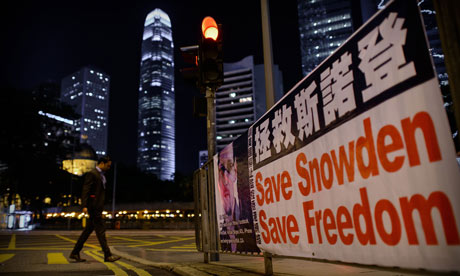
A banner in Hong Kong supporting NSA operative Edward Snowden. Photograph: Philippe Lopez/AFP/Getty Images
NSA whistleblower Edward Snowden has dismissed speculation that he might provide classified US information
to other governments as a smear and distraction, saying he could be
"petting a phoenix in Beijing by now" if he were a Chinese spy.
The former US vice-president Dick Cheney and others had voiced suspicion about his decision to fly to Hong Kong, where he accused the US government of hacking targets there and on the Chinese mainland.
In a live chat with Guardian readers Snowden wrote: "This is a predictable smear that I anticipated before going public, as the US media has a kneejerk RED CHINA!' reaction to anything involving HK or the PRC, and is intended to distract from the issue of US government misconduct.
"Ask yourself: if I were a Chinese spy, why wouldn't I have flown directly into Beijing? I could be living in a palace petting a phoenix by now."
Pressed again to state clearly whether he had given any information to Beijing, he said: "No. I have had no contact with the Chinese government … I only work with journalists."
Earlier, China's foreign ministry said suggestions he might have acted for Beijing were completely groundless. Spokeswoman Hua Chunying, speaking at a regular press briefing on Monday, also urged the US to "pay attention to the international community's concerns and demands and give … the necessary explanation" of its surveillance activities.
Her remarks were in response to questions from two state media organisations. She had previously declined to comment on the 29-year-old's case, or his claims that the US had hacked targets in Hong Kong and on the Chinese mainland.
On Sunday, Cheney told Fox News that Snowden was a traitor and questioned his decision to travel to Hong Kong. "I'm suspicious because he went to China. That's not a place where you would ordinarily want to go if you are interested in freedom, liberty and so forth," he said, adding: "It raises questions whether or not he had that kind of connection before he did this."
Cheney suggested that Snowden could still have confidential data and that the Chinese would "probably be willing to provide immunity for him or sanctuary for him in exchange for what he presumably knows or doesn't know".
Others have suggested that if anything, Beijing could lean on the Hong Kong government to return him to the US for the sake of bilateral relations. Hong Kong is part of China but enjoys considerable autonomy under the "one country, two systems" framework.
Snowden told the Guardian he chose to go there because "they have a spirited commitment to free speech and the right of political dissent", and he believed it was one of the few places that could resist the US government.
But he also noted: "I think it is really tragic that an American has to move to a place that has a reputation for less freedom. Still, Hong Kong has a reputation for freedom in spite of the People's Republic of China."
He checked out of a hotel there to move to an unknown location last Monday, but told the South China Morning Post last week that he would stay and fight any request for his surrender in the territory's courts. "I'm neither traitor nor hero. I'm an American," he told the paper.
Any surrender request would normally be the decision of the Hong Kong government, but Snowden would be able to challenge it through the territory's legal system, although lawyers think he would probably be unsuccessful in the end.
In theory, Beijing could step in to stop him being sent back, but it would be unlikely to relish an all-out public row with the US.
Earlier on Monday, the populist state-run Chinese tabloid The Global Times said that agreeing to surrender Snowden to the US "would be a face-losing outcome for both the Hong Kong SAR [special administrative region] government and the Chinese central government".
It added: "Unlike a common criminal, Snowden did not hurt anybody. His crime is that he blew the whistle on the US government's violation of civil rights.
"Extraditing Snowden back to the US would not only be a betrayal of Snowden's trust, but a disappointment for expectations around the world. The image of Hong Kong would be forever tarnished."
The newspaper does not represent the official voice of the government and often runs provocative material such as hawkish commentaries from former military officers. But after years of criticism from the US over its human rights abuses and more recently hacking, Beijing appears to be enjoying its opportunity to turn the tables, with extensive coverage of Snowden's allegations on television and websites and in newspaper commentaries.
According to the latest revelations from top secret documents uncovered by Snowden and seen by the Guardian, British intelligence agencies intercepted the communications of foreign politicians and officials who took part in two G20 summit meetings in London in 2009.
END REPORT
.
The former US vice-president Dick Cheney and others had voiced suspicion about his decision to fly to Hong Kong, where he accused the US government of hacking targets there and on the Chinese mainland.
In a live chat with Guardian readers Snowden wrote: "This is a predictable smear that I anticipated before going public, as the US media has a kneejerk RED CHINA!' reaction to anything involving HK or the PRC, and is intended to distract from the issue of US government misconduct.
"Ask yourself: if I were a Chinese spy, why wouldn't I have flown directly into Beijing? I could be living in a palace petting a phoenix by now."
Pressed again to state clearly whether he had given any information to Beijing, he said: "No. I have had no contact with the Chinese government … I only work with journalists."
Earlier, China's foreign ministry said suggestions he might have acted for Beijing were completely groundless. Spokeswoman Hua Chunying, speaking at a regular press briefing on Monday, also urged the US to "pay attention to the international community's concerns and demands and give … the necessary explanation" of its surveillance activities.
Her remarks were in response to questions from two state media organisations. She had previously declined to comment on the 29-year-old's case, or his claims that the US had hacked targets in Hong Kong and on the Chinese mainland.
On Sunday, Cheney told Fox News that Snowden was a traitor and questioned his decision to travel to Hong Kong. "I'm suspicious because he went to China. That's not a place where you would ordinarily want to go if you are interested in freedom, liberty and so forth," he said, adding: "It raises questions whether or not he had that kind of connection before he did this."
Cheney suggested that Snowden could still have confidential data and that the Chinese would "probably be willing to provide immunity for him or sanctuary for him in exchange for what he presumably knows or doesn't know".
Others have suggested that if anything, Beijing could lean on the Hong Kong government to return him to the US for the sake of bilateral relations. Hong Kong is part of China but enjoys considerable autonomy under the "one country, two systems" framework.
Snowden told the Guardian he chose to go there because "they have a spirited commitment to free speech and the right of political dissent", and he believed it was one of the few places that could resist the US government.
But he also noted: "I think it is really tragic that an American has to move to a place that has a reputation for less freedom. Still, Hong Kong has a reputation for freedom in spite of the People's Republic of China."
He checked out of a hotel there to move to an unknown location last Monday, but told the South China Morning Post last week that he would stay and fight any request for his surrender in the territory's courts. "I'm neither traitor nor hero. I'm an American," he told the paper.
Any surrender request would normally be the decision of the Hong Kong government, but Snowden would be able to challenge it through the territory's legal system, although lawyers think he would probably be unsuccessful in the end.
In theory, Beijing could step in to stop him being sent back, but it would be unlikely to relish an all-out public row with the US.
Earlier on Monday, the populist state-run Chinese tabloid The Global Times said that agreeing to surrender Snowden to the US "would be a face-losing outcome for both the Hong Kong SAR [special administrative region] government and the Chinese central government".
It added: "Unlike a common criminal, Snowden did not hurt anybody. His crime is that he blew the whistle on the US government's violation of civil rights.
"Extraditing Snowden back to the US would not only be a betrayal of Snowden's trust, but a disappointment for expectations around the world. The image of Hong Kong would be forever tarnished."
The newspaper does not represent the official voice of the government and often runs provocative material such as hawkish commentaries from former military officers. But after years of criticism from the US over its human rights abuses and more recently hacking, Beijing appears to be enjoying its opportunity to turn the tables, with extensive coverage of Snowden's allegations on television and websites and in newspaper commentaries.
According to the latest revelations from top secret documents uncovered by Snowden and seen by the Guardian, British intelligence agencies intercepted the communications of foreign politicians and officials who took part in two G20 summit meetings in London in 2009.
END REPORT
.
"Poll: Snowden should be prosecuted for NSA leaks"
An interview with Obama on PBS' Charlie Rose show is scheduled to air Monday night. The session, which included questions about the NSA controversy, was recorded at the White House Sunday.
Poll: Snowden should be prosecuted for NSA leaks
In a USA TODAY/Pew Research Center Poll, most Americans say the NSA leaker should be prosecuted, but two-thirds don't like the idea the U.S. government is collecting their own communication records.
WASHINGTON — A majority of Americans say the person responsible for leaking top-secret documents about U.S. surveillance of phone and Internet records should be criminally prosecuted, a new USA TODAY/Pew Research Center Poll finds, even as views are closely divided about the wisdom of the programs themselves.
The poll, taken Wednesday through Sunday, shows a nation riven by cross-currents about the unauthorized disclosures by Edward Snowden, a former contractor for the National Security Agency, of sweeping surveillance programs that can collect information about millions of Americans and foreigners.By 54%-38%, those surveyed say he should be prosecuted. Most Americans say the programs have helped prevent terrorist attacks, by 53%-41%, a point pressed by top administration officials including Director of National Intelligence James Clapper.
There is an almost even split on the most fundamental question. By 48%-47%, Americans divide over whether they approve or disapprove of the programs as part of the effort to fight terrorism. By another narrow margin, 49%-44%, they say the release of classified information serves rather than harms the public interest.
The mix of views, some of them conflicting, underscores the complications of public opinion on the issue. Previous polls have shown divergent results when asked about the programs. That may help explain why both President Obama and Snowden publicly were making their arguments for and against the programs in interviews published and aired Monday.
"The more people learn about this, it could affect their final judgment on whether the government was right or wrong to do what it's been doing," says Michael Dimmock, director of the Pew Research Center for the People & the Press. "What I think you're seeing in a lot of the surveys is that the public isn't particularly happy about this program, particularly in the realm of civil liberties and privacy, but a lot of people are willing to give the government a certain amount of leeway in fighting against terrorism."
The apparent ambivalence is no surprise, he says. "The struggle to find the balance between civil liberties and security is one of the toughest struggles Americans face because we hold both of those principles dearly."
By now, nearly everyone is aware of the issue. In the USA TODAY/Pew Research Center poll, 51% say they had heard a lot about it; 35% said they had heard a little.
A 54% majority of Americans assume that the government probably has collected data about their own communication — and most aren't happy about it. Nearly two-thirds, 63%, say they would feel their personal privacy had been violated if that happened.
In a polarized world, there is no partisan difference on some of the questions. Republicans and Democrats hold virtually identical views on whether the leaks serve the public interest — 49% of Republicans and 50% of Democrats say it did — and on whether the government should prosecute the leaker. Fifty-nine percent of Republicans and Democrats endorse that idea.
There was a significant generational divide on some questions. Sixty percent of those 18 to 29 years old say the leaks serve the public interest. Thirty-six percent of those 65 and older agree.
The survey of 1,512 adults by landline and cellphone has a margin of error of +/-2.9 percentage points.
In an online chat Monday hosted by Glenn Greenwald of The Guardian, which first published the leaks, Snowden denied that he had shared secret intelligence with the Chinese government or that he had taken steps against the interests of the United States.
"It's important to bear in mind I'm being called a traitor by men like former vice president Dick Cheney," Snowden said in the chat, blaming Cheney for violations of civil liberties and the Iraq War. "Being called a traitor by Dick Cheney is the highest honor you can give an American."
An interview with Obama on PBS' Charlie Rose show is scheduled to air Monday night. The session, which included questions about the NSA controversy, was recorded at the White House Sunday.
END REPORT
.
B Raman dies; U.S. Dept of State breathes a sigh of relief
Godspeed, Ramanji. From the Times of India obituary: [...]On
Sunday evening, the 77-year old Raman - Raman mama to some of his
acolytes - one of the founders of India's spy outfit Research and
Analysis Wing (RAW) and the public face of its underrated and
understated analysts community, passed away in Chennai. In the arcane
world of espionage, where practitioners generally keep a low profile
(particularly in India), Raman became a prolific contributor to public
discourse on intelligence matters, often challenging conventional
wisdom, and going upstream of establishment flow, especially on Pakistan
and the United States. In a political establishment that is
increasingly in thrall of Washington, he repeatedly counseled caution
and vigilance, a result of what he saw as repeated American betrayal of
Indian interests.
In fact, the United States was the only country that riled him up in conversations - not even Pakistan, which he dismissed as a basket case beneath contempt. He said he ''always loved the US...and always liked the American people'' but he despised Washington's policies. ''There is one American species, which I could never bring myself to like during the 27 years I spent in the intelligence community -- the officers of the US State Department,'' he writes in his memoirs, The Kao-boys of R&AW: Down Memory Lane, the title being an admiring tribute to the RN Kao, RAW's principal founder and first chief.
Two incidents, both relating to Pakistan -- and to one individual in particular -- deeply colored his perspective of Washington and its mandarins. The first came after the 1993 Mumbai blasts engineered by Pakistan through Dawood Ibrahim. Raman headed the counter-terrorism division of RAW at that time and rushed to Mumbai soon after the serial explosions that killed 259 people, just two weeks before the first World Trade Center attack by Ramzi Yousef. Among the evidence gathered by the police were detonators and timers that were of American origin. On the advice of then Prime Minister Narasimha Rao, Raman said he shared this evidence with US experts, and at their request, allowed them to take the material back to America. Bad mistake, he later regretted.
A few days later, Raman said, the Americans gave an unsigned report saying the detonators and timers were of American origin and were part of stock given to Pakistan during the Afghan war in the 1980s. The report gratuitously added this did not necessarily mean the terrorists got them from the ISI. It pointed out that in Pakistan there was a lot of leakage of government arms and ammunition to smugglers and expressed the view that the terrorists might have procured them from the smugglers.
''When I asked them to return the detonator and the timer as promised by them they replied that their forensic experts had by mistake destroyed them. They did not apparently want to leave any clinching evidence against Pakistan in our hands,'' Raman wrote later. ''This was a bitter lesson to us that in matters concerning Pakistan one should not totally trust the US. They would do anything to ensure that no harm came to Pakistan.'' [...]
In fact, the United States was the only country that riled him up in conversations - not even Pakistan, which he dismissed as a basket case beneath contempt. He said he ''always loved the US...and always liked the American people'' but he despised Washington's policies. ''There is one American species, which I could never bring myself to like during the 27 years I spent in the intelligence community -- the officers of the US State Department,'' he writes in his memoirs, The Kao-boys of R&AW: Down Memory Lane, the title being an admiring tribute to the RN Kao, RAW's principal founder and first chief.
Two incidents, both relating to Pakistan -- and to one individual in particular -- deeply colored his perspective of Washington and its mandarins. The first came after the 1993 Mumbai blasts engineered by Pakistan through Dawood Ibrahim. Raman headed the counter-terrorism division of RAW at that time and rushed to Mumbai soon after the serial explosions that killed 259 people, just two weeks before the first World Trade Center attack by Ramzi Yousef. Among the evidence gathered by the police were detonators and timers that were of American origin. On the advice of then Prime Minister Narasimha Rao, Raman said he shared this evidence with US experts, and at their request, allowed them to take the material back to America. Bad mistake, he later regretted.
A few days later, Raman said, the Americans gave an unsigned report saying the detonators and timers were of American origin and were part of stock given to Pakistan during the Afghan war in the 1980s. The report gratuitously added this did not necessarily mean the terrorists got them from the ISI. It pointed out that in Pakistan there was a lot of leakage of government arms and ammunition to smugglers and expressed the view that the terrorists might have procured them from the smugglers.
''When I asked them to return the detonator and the timer as promised by them they replied that their forensic experts had by mistake destroyed them. They did not apparently want to leave any clinching evidence against Pakistan in our hands,'' Raman wrote later. ''This was a bitter lesson to us that in matters concerning Pakistan one should not totally trust the US. They would do anything to ensure that no harm came to Pakistan.'' [...]
Ed Snowden answers his critics
(note to B -- thanks for alerting me that I'd placed the G8 summit in London; I fixed the title of the post.)
Okay; here's the AP report on Snowden's email Q&A with the Guardian. This seems to be the 'money' quote:
Snowden explained his claim that from his desk, he could "wiretap" any phone call or email – a claim top intelligence officials have denied. "If an NSA, FBI, CIA, DIA, etc. analyst has access to query raw SIGINT (signals intelligence) databases, they can enter and get results for anything they want," he wrote in the answer posted on the Guardian site. "Phone number, email, user id, cell phone handset id (IMEI), and so on – it's all the same."
Edward Snowden: I'm Not A Spy For The Chinese
AP/The Huffington Post
|
Posted: 06/17/2013 1:58 pm EDT | Updated: 06/17/2013 2:01 pm EDT
"No. I have had no contact with the Chinese government. Just like with the Guardian and the Washington Post, I only work with journalists," he said in response to a question from The Guardian's Spencer Ackerman.
Responding to a similar query, Snowden painted the spy allegations as an attempt to destroy his character:
This is a predictable smear that I anticipated before going public, as the US media has a knee-jerk "RED CHINA!" reaction to anything involving HK or the PRC, and is intended to distract from the issue of US government misconduct. Ask yourself: if I were a Chinese spy, why wouldn't I have flown directly into Beijing? I could be living in a palace petting a phoenix by now.Snowden also appeared defiant in the face of calls for his prosecution.
"The U.S. government is not going to be able to cover this up by jailing or murdering me. Truth is coming, and it cannot be stopped," he said. He added the government "immediately and predictably destroyed any possibility of a fair trial at home," by labeling him a traitor, and indicated he would not return to the U.S. voluntarily.
Congressional leaders have called Snowden a traitor for revealing once-secret surveillance programs two weeks ago in the Guardian and The Washington Post. The National Security Agency programs collect records of millions of Americans' telephone calls and Internet usage as a counterterror tool. The disclosures revealed the scope of the collections, which surprised many Americans and have sparked debate about how much privacy the government can take away in the name of national security.
"It would be foolish to volunteer yourself to" possible arrest and criminal charges "if you can do more good outside of prison than in it," he said.
Snowden was working as a contractor for NSA at the time he had access to the then-secret programs. He defended his actions and said he considered what to reveal and what not to, saying he did not reveal any U.S. operations against what he called legitimate military targets, but instead showed the NSA is hacking civilian infrastructure like universities and private businesses.
"These nakedly, aggressively criminal acts are wrong no matter the target. Not only that, when NSA makes a technical mistake during an exploitation operation, critical systems crash," he said, though he gave no examples of what systems have crashed or in which countries.
"Congress hasn't declared war on the countries – the majority of them are our allies – but without asking for public permission, NSA is running network operations against them that affect millions of innocent people," he said. "And for what? So we can have secret access to a computer in a country we're not even fighting?"
Snowden was referring to PRISM, one of the programs he disclosed. The program sweeps up Internet usage data from all over the world that goes through nine major U.S.-based Internet providers. The NSA can look at foreign usage without any warrants, and says the program doesn't target Americans.
U.S. officials say the data-gathering programs are legal and operated under secret court supervision.
Snowden explained his claim that from his desk, he could "wiretap" any phone call or email – a claim top intelligence officials have denied. "If an NSA, FBI, CIA, DIA, etc. analyst has access to query raw SIGINT (signals intelligence) databases, they can enter and get results for anything they want," he wrote in the answer posted on the Guardian site. "Phone number, email, user id, cell phone handset id (IMEI), and so on – it's all the same."
The NSA did not immediately respond to an email seeking comment. But Director of National Intelligence James Clapper has said that the kind of data that can be accessed and who can access it is severely limited.
Snowden said the restrictions on what could be seen by an individual analyst vary according to policy changes, which can happen "at any time," and said that a technical "filter" on NSA data gathering meant to filter out U.S. communications is "weak," such that U.S. communications often get ingested.
Snowden defended U.S. Army Private Bradley Manning for his disclosures of documents to Wikileaks, which he called a "legitimate journalistic outlet," which "carefully redacted all of their releases in accordance with a judgment of public interest." He said the Wikileaks release of unredacted material was "due to the failure of a partner journalist to control a passphrase," which led to the charge against Manning that he dumped the documents, which Snowden called an attempt to smear Manning.
Manning is currently on trial at Fort Meade – the same Army base where the NSA is headquartered – on charges of aiding the enemy for releasing documents to Wikileaks.
Snowden defended his description of his salary as being $200,000 a year, calling that a "career high," but saying he did take a pay cut to take the job at Booz Allen Hamilton, where he worked as a contractor at an NSA facility in Hawaii. When Booz Allen fired him, they said his salary was $122,000.
__
On the web:
Follow Associated Press reporter Kimberly Dozier on Twitter at http://twitter.com/kimberlydozier
The Parable of the Priest and the Whore
On Thursday, June 13 John Batchelor discussed Ed Snowden with Wall Street Journal editorial board member Mary Kissel. Here are John's notes on the discussion. I would like to reply to Ms Kissel's remarks, as John summarized them:
1. Ms Kissel asked rhetorically whether you would flee to Hong Kong if you'd stolen documents from NSA. Yes, an American's best bet would be to head for Hong Kong if he didn't want to be extradited to the U.S. and arrested here.
An American citizen can enter Hong Kong without a visa and stay there without a visa for up to three months. And at this time in history Hong Kong represents a very unusual if not unique situation, which involves the United Nations. The situation is so complex, and so confused, that no one can agree on exactly what it means in terms of procedure. This means an American can reasonably hope to spend years in Hong Kong while different courts and institutions argue about his case.
2. According to John's notes Ms Kissel also said that Mr Snowden had the choice of going to Congress and being a whistleblower.
American law regarding whistleblowers needs to be revised. But as it stands now, if he had followed whistleblower procedure under the law, his allegations about the NSA's abuse of data would not have reached the American public. The allegations, by the time they were written up in an official report, would have been so heavily redacted that the report would have provided virtually no information to the public. And U.S. members of Congress who heard his complaint would have been prevented by law from discussing anything about it that was deemed classified -- and virtually everything concerning the NSA and U.S. intelligence is classified.
That means Mr Snowden had only a Sophie's Choice. He could choose to be a criminal by stealing documents as evidence to back up his allegations or he could choose not to warn the American public.
He rightfully chose the criminal route on the sound principle that when scoundrels write the laws the justice system that upholds them is an offense to the concept of jurisprudence.
3. John wrote, "Whatever we think of NSA surveillance, it’s a fact that China is gathering data not to protect a democracy but to keep the Communist Party in power."
Here I am reminded of the parable about the priest and the whore. The two died at the same hour. When they reached the gates of heaven the whore was immediately ushered through; the priest was turned away. Outraged, the priest told the gatekeeper that he'd allowed a whore into heaven. When the gatekeeper asked how the priest knew the woman in her mortal coil had been a whore, the priest replied, "Because she lived across the street from me. I kept track of her shameless behavior every hour of every day."
China is a hot mess and a security threat to the United States. Yet so many countries are now deemed a threat that our government is transforming the bastion of freedom into a police state -- for our safety and security, of course. This situation, not China, is the greatest threat Americans face; not to confront this is to have skewed priorities.
That's enough banging your head against a stone wall, Pundita. Time to try and get some sleep; I've been up for 70 hours, I think. But then it's not every week one learns the unvarnished truth about one's government.
.
1. Ms Kissel asked rhetorically whether you would flee to Hong Kong if you'd stolen documents from NSA. Yes, an American's best bet would be to head for Hong Kong if he didn't want to be extradited to the U.S. and arrested here.
An American citizen can enter Hong Kong without a visa and stay there without a visa for up to three months. And at this time in history Hong Kong represents a very unusual if not unique situation, which involves the United Nations. The situation is so complex, and so confused, that no one can agree on exactly what it means in terms of procedure. This means an American can reasonably hope to spend years in Hong Kong while different courts and institutions argue about his case.
2. According to John's notes Ms Kissel also said that Mr Snowden had the choice of going to Congress and being a whistleblower.
American law regarding whistleblowers needs to be revised. But as it stands now, if he had followed whistleblower procedure under the law, his allegations about the NSA's abuse of data would not have reached the American public. The allegations, by the time they were written up in an official report, would have been so heavily redacted that the report would have provided virtually no information to the public. And U.S. members of Congress who heard his complaint would have been prevented by law from discussing anything about it that was deemed classified -- and virtually everything concerning the NSA and U.S. intelligence is classified.
That means Mr Snowden had only a Sophie's Choice. He could choose to be a criminal by stealing documents as evidence to back up his allegations or he could choose not to warn the American public.
He rightfully chose the criminal route on the sound principle that when scoundrels write the laws the justice system that upholds them is an offense to the concept of jurisprudence.
3. John wrote, "Whatever we think of NSA surveillance, it’s a fact that China is gathering data not to protect a democracy but to keep the Communist Party in power."
Here I am reminded of the parable about the priest and the whore. The two died at the same hour. When they reached the gates of heaven the whore was immediately ushered through; the priest was turned away. Outraged, the priest told the gatekeeper that he'd allowed a whore into heaven. When the gatekeeper asked how the priest knew the woman in her mortal coil had been a whore, the priest replied, "Because she lived across the street from me. I kept track of her shameless behavior every hour of every day."
China is a hot mess and a security threat to the United States. Yet so many countries are now deemed a threat that our government is transforming the bastion of freedom into a police state -- for our safety and security, of course. This situation, not China, is the greatest threat Americans face; not to confront this is to have skewed priorities.
That's enough banging your head against a stone wall, Pundita. Time to try and get some sleep; I've been up for 70 hours, I think. But then it's not every week one learns the unvarnished truth about one's government.
.
2006: NSA Killed System That Sifted Phone Data Legally (ThinThread)
Again, note the year the report was published:
NSA Killed System That Sifted Phone Data Legally
by Siobhan Gorman
May 18, 2006
Published by The Baltimore Sun
[report posted here in its entirety via Common Dreams]
WASHINGTON -- The National Security Agency developed a pilot program in the late 1990s that would have enabled it to gather and analyze massive amounts of communications data without running afoul of privacy laws. But after the Sept. 11 attacks, it shelved the project -- not because it failed to work -- but because of bureaucratic infighting and a sudden White House expansion of the agency's surveillance powers, according to several intelligence officials.
The agency opted instead to adopt only one component of the program, which produced a far less capable and rigorous program. It remains the backbone of the NSA's warrantless surveillance efforts, tracking domestic and overseas communications from a vast databank of information, and monitoring selected calls.
Four intelligence officials knowledgeable about the program agreed to discuss it with The Sun only if granted anonymity because of the sensitivity of the subject.
The program the NSA rejected, called ThinThread, was developed to handle greater volumes of information, partly in expectation of threats surrounding the millennium celebrations. Sources say it bundled together four cutting-edge surveillance tools. ThinThread would have:
* Used more sophisticated methods of sorting through massive phone and e-mail data to identify suspect communications.
* Identified U.S. phone numbers and other communications data and encrypted them to ensure caller privacy.
* Employed an automated auditing system to monitor how analysts handled the information, in order to prevent misuse and improve efficiency.
* Analyzed the data to identify relationships between callers and chronicle their contacts. Only when evidence of a potential threat had been developed would analysts be able to request decryption of the records.
An agency spokesman declined to discuss NSA operations.
"Given the nature of the work we do, it would be irresponsible to discuss actual or alleged operational issues as it would give those wishing to do harm to the U.S. insight and potentially place Americans in danger," said NSA spokesman Don Weber in a statement to The Sun.
"However, it is important to note that NSA takes its legal responsibilities very seriously and operates within the law."
In what intelligence experts describe as rigorous testing of ThinThread in 1998, the project succeeded at each task with high marks. For example, its ability to sort through massive amounts of data to find threat-related communications far surpassed the existing system, sources said. It also was able to rapidly separate and encrypt U.S.-related communications to ensure privacy.
But the NSA, then headed by Air Force Gen. Michael V. Hayden, opted against both of those tools, as well as the feature that monitored potential abuse of the records. Only the data analysis facet of the program survived and became the basis for the warrantless surveillance program.
The decision, which one official attributed to "turf protection and empire building," has undermined the agency's ability to zero in on potential threats, sources say. In the wake of revelations about the agency's wide gathering of U.S. phone records, they add, ThinThread could have provided a simple solution to privacy concerns.
A number of independent studies, including a classified 2004 report from the Pentagon's inspector-general, in addition to the successful pilot tests, found that the program provided "superior processing, filtering and protection of U.S. citizens, and discovery of important and previously unknown targets," said an intelligence official familiar with the program who described the reports to The Sun. The Pentagon report concluded that ThinThread's ability to sort through data in 2001 was far superior to that of another NSA system in place in 2004, and that the program should be launched and enhanced.
Hayden, the president's nominee to lead the CIA, is to appear Thursday before the Senate Select Committee on Intelligence and is expected to face tough questioning about the warrantless surveillance program, the collection of domestic phone records and other NSA programs.
While the furor over warrantless surveillance, particularly collection of domestic phone records, has raised questions about the legality of the program, there has been little or no discussion about how it might be altered to eliminate such concerns.
ThinThread was designed to address two key challenges: The NSA had more information than it could digest, and, increasingly, its targets were in contact with people in the United States whose calls the agency was prohibited from monitoring.
With the explosion of digital communications, especially phone calls over the Internet and the use of devices such as BlackBerries, the NSA was struggling to sort key nuggets of information from the huge volume of data it took in.
By 1999, as some NSA officials grew increasingly concerned about millennium-related security, ThinThread seemed in position to become an important tool with which the NSA could prevent terrorist attacks. But it was never launched. Neither was it put into effect after the attacks in 2001. Despite its success in tests, ThinThread's information-sorting system was viewed by some in the agency as a competitor to Trailblazer, a $1.2 billion program that was being developed with similar goals. The NSA was committed to Trailblazer, which later ran into trouble and has been essentially abandoned.
Both programs aimed to better sort through the sea of data to find key tips to the next terrorist attack, but Trailblazer had more political support internally because it was initiated by Hayden when he first arrived at the NSA, sources said.
NSA managers did not want to adopt the data-sifting component of ThinThread out of fear that the Trailblazer program would be outperformed and "humiliated," an intelligence official said.
Without ThinThread's data-sifting assets, the warrantless surveillance program was left with a sub-par tool for sniffing out information, and that has diminished the quality of its analysis, according to intelligence officials.
Sources say the NSA's existing system for data-sorting has produced a database clogged with corrupted and useless information.
The mass collection of relatively unsorted data, combined with system flaws that sources say erroneously flag people as suspect, has produced numerous false leads, draining analyst resources, according to two intelligence officials. FBI agents have complained in published reports in The New York Times that NSA leads have resulted in numerous dead ends.
The privacy protections offered by ThinThread were also abandoned in the post-Sept. 11 push by the president for a faster response to terrorism.
Once President Bush gave the go-ahead for the NSA to secretly gather and analyze domestic phone records -- an authorization that carried no stipulations about identity protection -- agency officials regarded the encryption as an unnecessary step and rejected it, according to two intelligence officials knowledgeable about ThinThread and the warrantless surveillance programs.
"They basically just disabled the [privacy] safeguards," said one intelligence official.
Another, a former top intelligence official, said that without a privacy requirement, "there was no reason to go back to something that was perhaps more difficult to implement."
However two officials familiar with the program said the encryption feature would have been simple to implement. One said the time required would have involved minutes, not hours.
Encryption would have required analysts to be more disciplined in their investigations, however, by forcing them to gather what a court would consider sufficient information to indicate possible terrorist activity before decryption could be authorized.
While it is unclear why the agency dropped the component that monitored for abuse of records, one intelligence official noted that the feature was not popular with analysts. It not only tracked the use of the database, but hunted for the most effective analysis techniques, and some analysts thought it would be used to judge their performance.
Within the NSA, the primary advocate for the ThinThread program was Richard Taylor, who headed the agency's operations division. Taylor who has retired from the NSA, did not return calls seeking comment.
Officials say that after the successful tests of ThinThread in 1998, Taylor argued that the NSA should implement the full program. He later told the 9/11 Commission that ThinThread could have identified the hijackers had it been in place before the attacks, according to an intelligence expert close to the commission.
But at the time, NSA lawyers viewed the program as too aggressive. At that point, the NSA's authority was limited strictly to overseas communications, with the FBI responsible for analyzing domestic calls. The lawyers feared that expanding NSA data collection to include communications in the United States could violate civil liberties, even with the encryption function.
Taylor had an intense meeting with Hayden and NSA lawyers. "It was a very emotional debate," recalled a former intelligence official. "Eventually it was rejected by [NSA] lawyers."
After the 2001 attacks, the NSA lawyers who had blocked the program reversed their position and approved the use of the program without the enhanced technology to sift out terrorist communications and without the encryption protections.
The NSA's new legal analysis was based on the commander in chief's powers during war, said former officials familiar with the program. The Bush administration's defense has rested largely on that argument since the warrantless surveillance program became public in December.
The strength of ThinThread's approach is that by encrypting information on Americans, it is legal regardless of whether the country is at war, according to one intelligence official.
Officials familiar with Thin Thread say some within NSA were stunned by the legal flip-flop. ThinThread "was designed very carefully from a legal point of view, so that even in non-wartime, you could have done it legitimately," the official said.
In a speech in January, Hayden said the warrantless surveillance program was not only limited to al-Qaida communications, but carefully implemented with an eye toward preserving the Constitution and rights of Americans.
"As the director, I was the one responsible to ensure that this program was limited in its scope and disciplined in its application," he said.
[END OF REPORT]
.
NSA Killed System That Sifted Phone Data Legally
by Siobhan Gorman
May 18, 2006
Published by The Baltimore Sun
[report posted here in its entirety via Common Dreams]
WASHINGTON -- The National Security Agency developed a pilot program in the late 1990s that would have enabled it to gather and analyze massive amounts of communications data without running afoul of privacy laws. But after the Sept. 11 attacks, it shelved the project -- not because it failed to work -- but because of bureaucratic infighting and a sudden White House expansion of the agency's surveillance powers, according to several intelligence officials.
The agency opted instead to adopt only one component of the program, which produced a far less capable and rigorous program. It remains the backbone of the NSA's warrantless surveillance efforts, tracking domestic and overseas communications from a vast databank of information, and monitoring selected calls.
Four intelligence officials knowledgeable about the program agreed to discuss it with The Sun only if granted anonymity because of the sensitivity of the subject.
The program the NSA rejected, called ThinThread, was developed to handle greater volumes of information, partly in expectation of threats surrounding the millennium celebrations. Sources say it bundled together four cutting-edge surveillance tools. ThinThread would have:
* Used more sophisticated methods of sorting through massive phone and e-mail data to identify suspect communications.
* Identified U.S. phone numbers and other communications data and encrypted them to ensure caller privacy.
* Employed an automated auditing system to monitor how analysts handled the information, in order to prevent misuse and improve efficiency.
* Analyzed the data to identify relationships between callers and chronicle their contacts. Only when evidence of a potential threat had been developed would analysts be able to request decryption of the records.
An agency spokesman declined to discuss NSA operations.
"Given the nature of the work we do, it would be irresponsible to discuss actual or alleged operational issues as it would give those wishing to do harm to the U.S. insight and potentially place Americans in danger," said NSA spokesman Don Weber in a statement to The Sun.
"However, it is important to note that NSA takes its legal responsibilities very seriously and operates within the law."
In what intelligence experts describe as rigorous testing of ThinThread in 1998, the project succeeded at each task with high marks. For example, its ability to sort through massive amounts of data to find threat-related communications far surpassed the existing system, sources said. It also was able to rapidly separate and encrypt U.S.-related communications to ensure privacy.
But the NSA, then headed by Air Force Gen. Michael V. Hayden, opted against both of those tools, as well as the feature that monitored potential abuse of the records. Only the data analysis facet of the program survived and became the basis for the warrantless surveillance program.
The decision, which one official attributed to "turf protection and empire building," has undermined the agency's ability to zero in on potential threats, sources say. In the wake of revelations about the agency's wide gathering of U.S. phone records, they add, ThinThread could have provided a simple solution to privacy concerns.
A number of independent studies, including a classified 2004 report from the Pentagon's inspector-general, in addition to the successful pilot tests, found that the program provided "superior processing, filtering and protection of U.S. citizens, and discovery of important and previously unknown targets," said an intelligence official familiar with the program who described the reports to The Sun. The Pentagon report concluded that ThinThread's ability to sort through data in 2001 was far superior to that of another NSA system in place in 2004, and that the program should be launched and enhanced.
Hayden, the president's nominee to lead the CIA, is to appear Thursday before the Senate Select Committee on Intelligence and is expected to face tough questioning about the warrantless surveillance program, the collection of domestic phone records and other NSA programs.
While the furor over warrantless surveillance, particularly collection of domestic phone records, has raised questions about the legality of the program, there has been little or no discussion about how it might be altered to eliminate such concerns.
ThinThread was designed to address two key challenges: The NSA had more information than it could digest, and, increasingly, its targets were in contact with people in the United States whose calls the agency was prohibited from monitoring.
With the explosion of digital communications, especially phone calls over the Internet and the use of devices such as BlackBerries, the NSA was struggling to sort key nuggets of information from the huge volume of data it took in.
By 1999, as some NSA officials grew increasingly concerned about millennium-related security, ThinThread seemed in position to become an important tool with which the NSA could prevent terrorist attacks. But it was never launched. Neither was it put into effect after the attacks in 2001. Despite its success in tests, ThinThread's information-sorting system was viewed by some in the agency as a competitor to Trailblazer, a $1.2 billion program that was being developed with similar goals. The NSA was committed to Trailblazer, which later ran into trouble and has been essentially abandoned.
Both programs aimed to better sort through the sea of data to find key tips to the next terrorist attack, but Trailblazer had more political support internally because it was initiated by Hayden when he first arrived at the NSA, sources said.
NSA managers did not want to adopt the data-sifting component of ThinThread out of fear that the Trailblazer program would be outperformed and "humiliated," an intelligence official said.
Without ThinThread's data-sifting assets, the warrantless surveillance program was left with a sub-par tool for sniffing out information, and that has diminished the quality of its analysis, according to intelligence officials.
Sources say the NSA's existing system for data-sorting has produced a database clogged with corrupted and useless information.
The mass collection of relatively unsorted data, combined with system flaws that sources say erroneously flag people as suspect, has produced numerous false leads, draining analyst resources, according to two intelligence officials. FBI agents have complained in published reports in The New York Times that NSA leads have resulted in numerous dead ends.
The privacy protections offered by ThinThread were also abandoned in the post-Sept. 11 push by the president for a faster response to terrorism.
Once President Bush gave the go-ahead for the NSA to secretly gather and analyze domestic phone records -- an authorization that carried no stipulations about identity protection -- agency officials regarded the encryption as an unnecessary step and rejected it, according to two intelligence officials knowledgeable about ThinThread and the warrantless surveillance programs.
"They basically just disabled the [privacy] safeguards," said one intelligence official.
Another, a former top intelligence official, said that without a privacy requirement, "there was no reason to go back to something that was perhaps more difficult to implement."
However two officials familiar with the program said the encryption feature would have been simple to implement. One said the time required would have involved minutes, not hours.
Encryption would have required analysts to be more disciplined in their investigations, however, by forcing them to gather what a court would consider sufficient information to indicate possible terrorist activity before decryption could be authorized.
While it is unclear why the agency dropped the component that monitored for abuse of records, one intelligence official noted that the feature was not popular with analysts. It not only tracked the use of the database, but hunted for the most effective analysis techniques, and some analysts thought it would be used to judge their performance.
Within the NSA, the primary advocate for the ThinThread program was Richard Taylor, who headed the agency's operations division. Taylor who has retired from the NSA, did not return calls seeking comment.
Officials say that after the successful tests of ThinThread in 1998, Taylor argued that the NSA should implement the full program. He later told the 9/11 Commission that ThinThread could have identified the hijackers had it been in place before the attacks, according to an intelligence expert close to the commission.
But at the time, NSA lawyers viewed the program as too aggressive. At that point, the NSA's authority was limited strictly to overseas communications, with the FBI responsible for analyzing domestic calls. The lawyers feared that expanding NSA data collection to include communications in the United States could violate civil liberties, even with the encryption function.
Taylor had an intense meeting with Hayden and NSA lawyers. "It was a very emotional debate," recalled a former intelligence official. "Eventually it was rejected by [NSA] lawyers."
After the 2001 attacks, the NSA lawyers who had blocked the program reversed their position and approved the use of the program without the enhanced technology to sift out terrorist communications and without the encryption protections.
The NSA's new legal analysis was based on the commander in chief's powers during war, said former officials familiar with the program. The Bush administration's defense has rested largely on that argument since the warrantless surveillance program became public in December.
The strength of ThinThread's approach is that by encrypting information on Americans, it is legal regardless of whether the country is at war, according to one intelligence official.
Officials familiar with Thin Thread say some within NSA were stunned by the legal flip-flop. ThinThread "was designed very carefully from a legal point of view, so that even in non-wartime, you could have done it legitimately," the official said.
In a speech in January, Hayden said the warrantless surveillance program was not only limited to al-Qaida communications, but carefully implemented with an eye toward preserving the Constitution and rights of Americans.
"As the director, I was the one responsible to ensure that this program was limited in its scope and disciplined in its application," he said.
[END OF REPORT]
.
On eve of G8 Summit, a stunning revelation from Ed Snowden that British spied on delegates at 2009 London G20 summit (UPDATED)
The (U.K.) Guardian broke the story; the stunner is that "There have often been rumours of this kind of espionage at international conferences, but it is highly unusual for hard evidence to confirm it and spell out the detail." Hard evidence is exactly what Edward Snowden provided the Guardian.
Note from the report (opening paragraphs below) that the British government didn't only spy on government delegates from countries that have tense relations with the U.K.; it also spied on allies, even those in NATO! Such a gracious host.
As to what any of this spying had to do with keeping British citizens safe from terrorism -- nothing.
GCHQ intercepted foreign politicians' communications at G20 summits
by Ewen MacAskill, Nick Davies, Nick Hopkins, Julian Borger and James Ball
The Guardian
Sunday 16 June 2013 15.46 EDT
Foreign politicians and officials who took part in two G20 summit meetings in London in 2009 had their computers monitored and their phone calls intercepted on the instructions of their British government hosts, according to documents seen by the Guardian. Some delegates were tricked into using internet cafes which had been set up by British intelligence agencies to read their email traffic.
The revelation comes as Britain prepares to host another summit on Monday – for the G8 nations, all of whom attended the 2009 meetings which were the object of the systematic spying. It is likely to lead to some tension among visiting delegates who will want the prime minister to explain whether they were targets in 2009 and whether the exercise is to be repeated this week.
The disclosure raises new questions about the boundaries of surveillance by GCHQ and its American sister organisation, the National Security Agency, whose access to phone records and internet data has been defended as necessary in the fight against terrorism and serious crime. The G20 spying appears to have been organised for the more mundane purpose of securing an advantage in meetings. Named targets include long-standing allies such as South Africa and Turkey.
There have often been rumours of this kind of espionage at international conferences, but it is highly unusual for hard evidence to confirm it and spell out the detail. The evidence is contained in documents – classified as top secret – which were uncovered by the NSA whistleblower Edward Snowden and seen by the Guardian. They reveal that during G20 meetings in April and September 2009 GCHQ used what one document calls "ground-breaking intelligence capabilities" to intercept the communications of visiting delegations.
This included [...]
There's much more to the Guardian report.
Saturday, June 15
CBS News investigative reporter Sharyl Attkisson's work and home computers hacked by sophisticated means
The Fox News report on the hacking is a little more detailed in some respects than the Associated Press one; however, Fox, which is focused on Ms Attkisson's investigative reporting on the September 11 attack on the U.S. compound in Benghazi, neglects to mention what I consider to be an important fact, which the AP report by David Bauder (6/14) highlights:
Now to the Fox News report:
[emphasis throughout mine]
Attkisson said she had been having problems with a computer in her house since at least February 2011. At that time, she said, she was investigating the Bureau of Alcohol, Tobacco, Firearms and Explosives' "Fast and Furious" gun-smuggling sting operation and stimulus spending on clean-energy projects. Attkisson won an Emmy award for her "Fast and Furious" investigation.
Now to the Fox News report:
[emphasis throughout mine]
Friday, June 14
Has Obama launched a Wag the Dog war in Syria? (UPDATED)
UPDATE
I typed "Friday" evening n the first paragraph; have corrected to Thursday and added the calendar date; no other changes.
***********
(For readers unfamiliar with the term "Wag the Dog" see this Wikipedia article.)
It was just last Thursday evening (June 6) that the Washington Post and Guardian published Ed Snowden's revelations about the Surveillance State. By Wednesday things had gotten out of hand. Journalist James Bamford, who probably knows more about NSA and the Surveillance State than any other civilian, was shooting off his mouth again (and again) about NSA; TV news producers were pulling NSA whistleblowers like William Binney out of mothballs for in-depth interviews; pollsters were reporting that a solid majority of Americans, having gotten oriented to Mr Snowden's news, were extremely upset to learn that their personal business was routinely surveilled; members of Congress were grilling the head of the NSA and everyone else they could get their hands on about a lengthening list of 'affairs' that pointed to surveillance overreach on the part of the Obama Administration (Associated Press Affair, James Rosen Affair, etc.).
Worse, CNN and MSNBC cable TV, which are virtual propaganda arms of the Obama Administration, had gone rogue. They were featuring long interviews with Talking Heads who warned in great detail about the Surveillance State. Even Democratic Party spin doctor Howard Dean got into the act. He corrected an Obama Zombie Politician while she was trying to shrug off the NSA scandal by saying here was nothing oppressive about a spy agency spying. Mr Dean interjected that building an "architecture of oppression" was definitely something to worry about and that Americans shouldn't assume government is always benign.
And by Wednesday the early fallout from the NSA Affair was raining down on European heads of state. European publics were angry to learn that American spying had extended even to their personal business while their elected leaders looked the other way.
Something had to be done to change the national conversation, none of which was going the Obama administration's way. The next day, Thursday, that being yesterday, the Obama administration announced it now had proof that Bashir Assad had used chemical weapons against 150 Syrians. This meant the Red Line on Syria that President Obama had established last year had been crossed -- a situation that the British and French governments had been pointing out for several months.
Reporter John King told Anderson Cooper last night on AC360 that he had word from his sources in the Obama administration that the U.S. was now engaged militarily in Syria, although exactly what this engagement entails -- we'll just have to wait for the official explanation. (Reuters reported about an hour ago that the Obama administration is considering establishing a "No Fly" zone over Syria.)
Lawrence O'Donnell, the host for MSNBC's The Last Word, did not take the news well. How, he practically shouted, was the Obama administration going to manage the situation if Assad was overthrown, given the U.S. track record with nation building?
It remains to be seen whether by this evening American editorialists, bloggers and news-talk hosts on radio and TV will be chanting in unison, 'Obama's Wag the Dog War!'
The next revelation from Edward Snowden also remains to be seen.
.
I typed "Friday" evening n the first paragraph; have corrected to Thursday and added the calendar date; no other changes.
***********
(For readers unfamiliar with the term "Wag the Dog" see this Wikipedia article.)
It was just last Thursday evening (June 6) that the Washington Post and Guardian published Ed Snowden's revelations about the Surveillance State. By Wednesday things had gotten out of hand. Journalist James Bamford, who probably knows more about NSA and the Surveillance State than any other civilian, was shooting off his mouth again (and again) about NSA; TV news producers were pulling NSA whistleblowers like William Binney out of mothballs for in-depth interviews; pollsters were reporting that a solid majority of Americans, having gotten oriented to Mr Snowden's news, were extremely upset to learn that their personal business was routinely surveilled; members of Congress were grilling the head of the NSA and everyone else they could get their hands on about a lengthening list of 'affairs' that pointed to surveillance overreach on the part of the Obama Administration (Associated Press Affair, James Rosen Affair, etc.).
Worse, CNN and MSNBC cable TV, which are virtual propaganda arms of the Obama Administration, had gone rogue. They were featuring long interviews with Talking Heads who warned in great detail about the Surveillance State. Even Democratic Party spin doctor Howard Dean got into the act. He corrected an Obama Zombie Politician while she was trying to shrug off the NSA scandal by saying here was nothing oppressive about a spy agency spying. Mr Dean interjected that building an "architecture of oppression" was definitely something to worry about and that Americans shouldn't assume government is always benign.
And by Wednesday the early fallout from the NSA Affair was raining down on European heads of state. European publics were angry to learn that American spying had extended even to their personal business while their elected leaders looked the other way.
Something had to be done to change the national conversation, none of which was going the Obama administration's way. The next day, Thursday, that being yesterday, the Obama administration announced it now had proof that Bashir Assad had used chemical weapons against 150 Syrians. This meant the Red Line on Syria that President Obama had established last year had been crossed -- a situation that the British and French governments had been pointing out for several months.
Reporter John King told Anderson Cooper last night on AC360 that he had word from his sources in the Obama administration that the U.S. was now engaged militarily in Syria, although exactly what this engagement entails -- we'll just have to wait for the official explanation. (Reuters reported about an hour ago that the Obama administration is considering establishing a "No Fly" zone over Syria.)
Lawrence O'Donnell, the host for MSNBC's The Last Word, did not take the news well. How, he practically shouted, was the Obama administration going to manage the situation if Assad was overthrown, given the U.S. track record with nation building?
It remains to be seen whether by this evening American editorialists, bloggers and news-talk hosts on radio and TV will be chanting in unison, 'Obama's Wag the Dog War!'
The next revelation from Edward Snowden also remains to be seen.
.
Thursday, June 13
Wanted Dead or Alive High School Dropout Making $200K/yr: SALLIE MAE offers $50 million reward for capture of Ed Snowden (UPDATED)
"More likely that the [college] student loan market will continue its expansion and increasing numbers of students will be subject to what can only be described as a sort of debt peonage."
-- Philip Pilkington at Naked Capitalism
Things took a strange turn last night on MSNBC's The Last Word during Lawrence O'Donnell's interview with a friend of Edward Snowden. Mr O'Donnell began pressing Mavanee Anderson, a 2008 alumni of Vanderbilt University, about whether she thought that college helps a person's intellectual maturation process. No, that hadn't been her experience, Ms Anderson replied.
Ms Anderson also said that too much was being made about Ed Snowden's educational background; that he'd gotten a GED after he dropped out of his senior year in high school and that he'd taken a few college courses. But Mr O'Donnell was persistent: if Ed Snowden had only gone to college, might he have emerged mature enough in his thinking to avoid taking the kind of uncompromising position that he's demonstrated in his actions against the State?
The singular contribution that college makes to intellectual maturation is on display every Saturday night among certain guests who appear on CNBC's Suze Orman Show to plead for her financial advice. The guest is a college graduate, the gender is male or female, the age is 30 or 40 Something; he's carrying about $80K in college student loan debt and $50K in credit card debt, facing bankruptcy and/or foreclosure on his home, and earning about $100K/yr in salary before taxes. And as Suze has pointedly said more than once to this American guest: The only reason you finally came to me for help is that the credit card companies cut you off, isn't it? Yes, the guest meekly acknowledges.
A spokesperson for Booz Allen Hamilton said, after the company got around to firing Ed Snowden, that it hadn't paid him as much as the $200K/yr he'd claimed to be making, although it's unlikely the company figured bonuses and projected overtime pay into a base salary of at least $125K. Whatever his exact income, for a 29-year old with no children he was making a good salary in a career with great prospects for advancement in a field with great job security. And he accomplished all that without miring himself in student loan debt.
Ironically, his lack of a college degree rankled him, according to Maveen Anderson; it's easy to see why given that his critics since he became a media sensation have dismissively described him as a high school dropout. However, Edward Snowden, simply because of the publicity he's received, is the worst nightmare for con artists who've sold a college education and student loan debt to millions of unsuspecting American parents and children as a necessary rite of passage for financial success in the USA. Now see where this particularly cruel scam has led; read Philip Pilkington's March 9, 2012 report for Naked Capitalism, Student Debt in the U.S. Continues to Blow Up:
"Perhaps the most obvious indicator that the US has become a society of debtors is the ever-expanding market for student loans. Recently clocked at $870 billion and rising quickly, this market has been a focal point for the recent Occupy movements. The White House knows that this is a key issue among potential voters and recently tried to provide some relief to debtors by placing a cap of 10% of discretionary income on the repayment of such loans – down from a previous cap of 15%. But of course placing a cap on how much needs to be repaid is hardly a solution to what appears to be a much larger problem.
"Student loans are growing at a remarkable rate. Between the second and third quarter of 2011 they grew from an estimated $852m to an estimated $870 billion – that’s an increase of 2.1% in only one quarter; and this while other types of consumer debt either declined or remained flat. And even these estimates are pretty fuzzy because, as the New York Fed highlights, the market is highly complex and difficult to gauge:
Student loans support the education of millions of students nationwide, yet much is unknown about the student loan market. Relevant data are limited and, for the most part, anecdotal. Also, sources tend to focus on recent college graduates and do not reveal much information about the indebtedness of parents, graduate students, and those who drop out of school."The rapid expansion of student debt appears to be due in large part to the increasing numbers of Americans enrolling in third-level (what Americans call “advanced”) education.
[...]
"The market for student debt has also become remarkably complex.
[...]
Unsurprisingly, the burden of this debt – at least, that which is counted – is falling on the shoulders of the young, as the chart below indicates.[...]"
Read the rest to the bitter end, if you have the stomach.
(*) To be fair to Mr O'Donnell, he did say after grilling Ms Anderson that Ed Snowden had started an "invaluable debate" that "like so many debates we are having too late." Mr O'Donnell is wrong in part. We've had this debate before, it's just that the Surveillance State keeps moving the goal posts on the American public, journalists and Congress.
Note: This blog hasn't accepted comments for several months due to technical difficulties. If you have a comment you're always welcome to email me.
.
Wednesday, June 12
Beyond the Military-Industrial Complex
Greetings from sunny K Street, the Seat of Government here in the Economy of the United States of America. I see that an American who calls herself Dymphna, and who writes for a blog with the dangerously un-American title of "Gates of Vienna," has commented on my post of yesterday (We had to kill this republic to save it ...).
Clearly, Dymphna has neglected to enroll in a reeducation camp because she highlighted comments of a dangerous anarchist named Dwight Eisenhower. Mr Eisenhower somehow became a U.S. President when this country was a republic. As Dymphna pointed out, as he was leaving office he warned about what he termed America's "military-industrial complex:"
First of all, according to data published in November 2011, only 1 in 5 Americans are taking anti-psychotic prescription medications including anti-anxiety medications. So while I don't have the precise breakdown, the data indicate we are a long way from market saturation in anti-anxiety medications. To in any way imply that American physicians, health insurance carriers and the pharmaceutical industry are not doing their part to support the U.S. economy is -- well, this is just why I am proposing legislation to make enrollment in reeducation camps mandatory.
Secondly, the military-industrial "complex" or nexus is a quaint artifact of the mid-20th Century. Eisenhower was talking about the industry in military hardware -- ships, bomber jets, and stuff. Today, if you can think it, we can industrialize it, and then we can sell it to the military.
This is how we fought the second phase of the Afghan War: Death by Power Point, Death by NGO, etc. Granted, we didn't win the war with this approach. But we won the only war that counts, which is beating out other nations in market share of ideas that can be weaponized then eventually sold for $59.99 at Walmart, or say, marketed to fools in "Arab Spring" countries who don't understand that concepts such as democracy and human rights can be weaponized and marketed to dissidents and NGOs. Hell, we've even weaponized protests against genocide.
Of course the tendency for human nature to weaponize everything it can wrap its mind around is not unique to Americans. And when you consider the extent to which religion has been weaponized throughout history, the tendency is probably as old as human conflicts. America's contribution to human progress in this area has been to apply modern business and economic principles to one of human nature's blips.
Thirdly, we in the Government of the Economy of the United States exist to keep Americans safe and secure. So for Dymphna to imply that Americans are unusually worried about danger is, well, subversive to Government and a danger to the American economy.
.
Clearly, Dymphna has neglected to enroll in a reeducation camp because she highlighted comments of a dangerous anarchist named Dwight Eisenhower. Mr Eisenhower somehow became a U.S. President when this country was a republic. As Dymphna pointed out, as he was leaving office he warned about what he termed America's "military-industrial complex:"
Eisenhower was wise to save that warning for his exit lines. But it was unfortunate he didn’t have the nerve to name the third party in this unholy trinity: our growing security complex – complex in both senses of that word.If I understand her correctly Dymphna is implying that Americans are excessively anxious. I have a few points to make about such a dangerous observation:
First of all, according to data published in November 2011, only 1 in 5 Americans are taking anti-psychotic prescription medications including anti-anxiety medications. So while I don't have the precise breakdown, the data indicate we are a long way from market saturation in anti-anxiety medications. To in any way imply that American physicians, health insurance carriers and the pharmaceutical industry are not doing their part to support the U.S. economy is -- well, this is just why I am proposing legislation to make enrollment in reeducation camps mandatory.
Secondly, the military-industrial "complex" or nexus is a quaint artifact of the mid-20th Century. Eisenhower was talking about the industry in military hardware -- ships, bomber jets, and stuff. Today, if you can think it, we can industrialize it, and then we can sell it to the military.
This is how we fought the second phase of the Afghan War: Death by Power Point, Death by NGO, etc. Granted, we didn't win the war with this approach. But we won the only war that counts, which is beating out other nations in market share of ideas that can be weaponized then eventually sold for $59.99 at Walmart, or say, marketed to fools in "Arab Spring" countries who don't understand that concepts such as democracy and human rights can be weaponized and marketed to dissidents and NGOs. Hell, we've even weaponized protests against genocide.
Of course the tendency for human nature to weaponize everything it can wrap its mind around is not unique to Americans. And when you consider the extent to which religion has been weaponized throughout history, the tendency is probably as old as human conflicts. America's contribution to human progress in this area has been to apply modern business and economic principles to one of human nature's blips.
Thirdly, we in the Government of the Economy of the United States exist to keep Americans safe and secure. So for Dymphna to imply that Americans are unusually worried about danger is, well, subversive to Government and a danger to the American economy.
.
Tuesday, June 11
We had to kill this republic to save it. Or why Ed Snowden is a traitor to the U.S. economy.
Hi. I'm a representative of the Economy of the United States of America. We here in the Economy operate according to a simple guiding principle that makes a lot more sense than the unnecessarily complex principles informing the obsolete U.S. Constitution. Our motto is, "Whatever creative idea you can think up, we can find a way to weaponize it and then we can find a way to commercialize it."
The way the guiding principle works out in practice is also simple. Every time a military or commercial venture we think up meets with opposition on legal grounds we create a law that nullifies or reinterprets the earlier law. We also stamp "Top Secret Classified" on just about everything we do in Government. This means anarchists are in violation of the Espionage Act if they try to get cute with us by claiming they're defending an ethical principle or -- my personal favorite -- the U.S. Constitution or Bill of Rights.
Stop and think it through: what use are life, liberty and the pursuit of happiness if you don't have a job? What use are the amendments to an outmoded Constitution if you don't have a job?
We here in the United States pledge allegiance to jobs and security, not a flag and the primitive republic for which it stood. We are proud Consumers, not citizens, and Government will defend to the last drop of blood of the contractors we hire your right to a job. This is so you can contribute to your retirement fund to keep Wall Street gainfully employed; so you can support the housing market to keep bankers, real estate agents and building contractors employed; so you can buy stuff and services to keep the American GDP afloat; so Government can keep borrowing enough from foreign governments to keep itself in business.
I hope all that is enough to explain why Edward Snowden is a traitor, unless you don't know that Big Data represents big employment numbers. During an era when all the world's major economic regions are teetering on the edge of recession, and when unemployment numbers in the U.S. are bad and a disaster in the Eurozone economies, it's most definitely an act of sedition to cast aspersions on any industry that creates a lot of jobs. Protecting American Consumers is a big industry that represents a marriage of military and commercial enterprises, and data mining is a fast growing sector of the industry.
That's the way things are in the Economy of the United States. If Edward Snowden refuses to accept the way things are, he's going to be jailed after he's caught. Rest assured he will be caught, whenever NSA can get the math right in the algorithms it uses to find its hands with a flashlight.
.
The way the guiding principle works out in practice is also simple. Every time a military or commercial venture we think up meets with opposition on legal grounds we create a law that nullifies or reinterprets the earlier law. We also stamp "Top Secret Classified" on just about everything we do in Government. This means anarchists are in violation of the Espionage Act if they try to get cute with us by claiming they're defending an ethical principle or -- my personal favorite -- the U.S. Constitution or Bill of Rights.
Stop and think it through: what use are life, liberty and the pursuit of happiness if you don't have a job? What use are the amendments to an outmoded Constitution if you don't have a job?
We here in the United States pledge allegiance to jobs and security, not a flag and the primitive republic for which it stood. We are proud Consumers, not citizens, and Government will defend to the last drop of blood of the contractors we hire your right to a job. This is so you can contribute to your retirement fund to keep Wall Street gainfully employed; so you can support the housing market to keep bankers, real estate agents and building contractors employed; so you can buy stuff and services to keep the American GDP afloat; so Government can keep borrowing enough from foreign governments to keep itself in business.
I hope all that is enough to explain why Edward Snowden is a traitor, unless you don't know that Big Data represents big employment numbers. During an era when all the world's major economic regions are teetering on the edge of recession, and when unemployment numbers in the U.S. are bad and a disaster in the Eurozone economies, it's most definitely an act of sedition to cast aspersions on any industry that creates a lot of jobs. Protecting American Consumers is a big industry that represents a marriage of military and commercial enterprises, and data mining is a fast growing sector of the industry.
That's the way things are in the Economy of the United States. If Edward Snowden refuses to accept the way things are, he's going to be jailed after he's caught. Rest assured he will be caught, whenever NSA can get the math right in the algorithms it uses to find its hands with a flashlight.
.
Thursday, April 25
Money, Wealth and You, Part 2: A brief review of reality
1. American Pensions
Following is from John Batchelor Show Schedule March 5, 2013. I don't know who wrote this summary for a show segment but the remark at the end about "selfish Boomers" is silly. The rest is not.
September 17, 2011:
Bank deposits soar despite rock-bottom interest rates
E. Scott Reckard
Los Angeles Times
Consumers worried about the economy are pumping cash into checking, savings and money market accounts. But the banks don't need their money and have slashed interest rates to discourage customers.
Americans are pumping money into bank accounts at a blistering pace this year, sending deposits to record levels near $10 trillion on escalating fears that the U.S. economy is on the verge of another implosion.There's no sign that the flood into checking, savings and money market accounts is slowing down. In the last three months, accounts at U.S. commercial banks have increased $429 billion, or 10%, almost double the increase for all of last year.
There's one big problem: Banks don't want your money."Banks and credit unions are doing everything they can to get rid of the cash except make loans," said Mike Moebs, a Lake Bluff, Ill., banking consultant.
He said banks are driving away deposits by refusing to renew CDs at higher rates and by imposing fees on checking accounts for depositors who don't use other, profitable financial services as well.
During the housing boom, banks gobbled up deposits — including plenty of "hot money" provided by brokers chasing high interest rates for their clients — to fuel binges of mortgage and construction lending. The collapse of home prices and the ensuing financial crisis caused nearly 400 banks to fail, more than at any time since the savings and loan meltdown in the 1980s.
The latest flood of deposits has occurred in spite of banks paying the lowest interest rates on record for money they know could flow back out if the economy improves. Similar "flights to safety" with huge deposit inflows occurred in late 2008, when the financial crisis struck, and in 1999, when fears of massive defaults on Russian debt panicked investors.
The large amount of cash only adds to expenses such as paying for deposit insurance premiums. With lending standards tight as a drum after the financial fiasco, and demand for loans growing only slightly, banks have been doing everything they can to demonstrate how little they need new cash.In the most obvious sign, they have slashed interest payments to discourage customers. Wells Fargo & Co., which has the most branches in California, halved its payments on one-year certificates of deposits to 0.1%; Citigroup, which paid 2% in 2009, dropped its payment to a paltry 0.3%.
And in a possible glimpse into the future, one New York banking giant is even charging big customers for the right to park money there. The Bank of New York Mellon is forcing institutional clients to pay fees if they deposit more than $50 million into an account.
For bankers like John Biggs, who runs Santa Rosa, Calif., thrift Luther Burbank Savings, the strategy was to always court deposits using high rates to enable growth while keeping costs down. Now he's not sure what to do.In 2007, Luther Burbank was offering a whopping 5.4% interest rate on a one-year CD. The Sonoma County bank used money from new customers to expand into Southern California by opening branches in Encino, Burbank, Pasadena and Beverly Hills.
Those days are definitely over. Biggs' savings bank now pays just 0.9% on the investment. That means for every $100 his customers lock up for a year, they'll get back just 90 cents extra — a difficult thing to explain, he says, to retirees accustomed to living off their interest checks.
Still, it beats the 35 cents that savers in Southern California would get from Bank of America, the 30 cents they'd get from Citibank and the 10 cents they'd get from Wells Fargo, according to researcher Bankrate.com.
"In all honesty, I'm not happy," said Biggs, who has been with the company since the mid-1980s. "Our philosophy is that we are a savings bank; we are rate payers. We will continue to pay you rates at the top of the market. That's just not very good right now."Part of the problem, he said, is that the "government has chosen to drive down rates to abnormally low levels" — a reference to the Federal Reserve slashing interest rates to the bone to encourage Americans to borrow money cheaply and spend it.
But the negligible bank rates have punished retirees and others who depend on interest income, which plunged 40% to $546 billion last year from $903 billion in 2008, according to the federal Bureau of Economic Analysis.
The Fed has pledged to hold short-term rates near zero through mid-2013 unless the economy improves as a way to combat the nation falling back into a recession. That's going to continue to cause pain to savers, and could force banks to become even more stringent about their intake of new deposits.
Bankers such as Robert H. Smith, former chairman of L.A.'s Security Pacific Corp., say the industry is being throttled by a combination of the weak economy and regulations that were tightened in the aftermath of the financial crisis.
"What little demand that is out there for loans is regarded very skeptically [by the banks] because of the pressures from the regulators," said Smith, who sold Security Pacific to Bank of America 20 years ago and is now a founding director of Commerce National Bank in Newport Beach.
The banks also have another problem: what to do with all the billions of dollars in temporary deposits being parked by giant corporations, institutional investors and retail customers.
Like Biggs' depositors, they are stashing it in a safe but unrewarding place: Federal Reserve banks, which are paying them an interest rate of just 0.25% to tend the funds. Such deposits rose to more than $1.6 trillion at the end of August from about $1 trillion a year earlier, according to the Fed.
And until new lending grows strong and depositors start pulling funds out to invest elsewhere, banks will have little reason to increase rates. They now are even lower than in 2003, when the Fed pushed rates down to then-record lows after the Internet bubble popped."I never imagined yields would get lower than what we saw in 2003," said Greg McBride, senior analyst with Bankrate.com. "Well, in Japan maybe. But not here."
Following is from John Batchelor Show Schedule March 5, 2013. I don't know who wrote this summary for a show segment but the remark at the end about "selfish Boomers" is silly. The rest is not.
Washington State’s Pensions in Crisis Too2. American savings accounts:
Add Washington to the list of blue states with grossly underfunded public pension systems. A great new investigative piece in the Seattle Times finds that the state is using fanciful figures to provide teachers and taxpayers with misleading assurances about the safety of the pension system, one of the largest in the nation:
After consulting with several economists and pension experts, The Times decided to use discount rates derived from yields on long-term state general-obligation bonds, matched to each individual plan’s duration. The rates ranged from 3.48 percent to 6.26 percent. Those rates were used to compute present-day values of each plan’s projected future payments, using data provided by the state actuary’s office. The values were compared to the market value of each plan’s assets, as disclosed in their financial statements. Looked at this way, funding levels varied widely from plan to plan. Though none was fully funded, the two plans that cover local police and firefighters came closest: They were about 83 percent funded, generally considered a reasonably healthy level. On the other hand, the gap between assets and liabilities in the original (and now closed ) state workers’ plan grew from $3.7 billion to nearly $10 billion. The gap in the original teachers’ plan, also now closed, widened from $1.8 billion to $6.8?billion.
The investigation found that the system as a whole was underfunded to the tune of almost $31 billion. Much like we’ve already seen in California, cash-strapped local governments will be asked to make up the difference by upping their contributions to the plans.
Take the time this Monday morning to read the whole thing. It’s as well-written a summary of a pension crisis story as you’re likely to get, [emphasis mine] and this is a story that’s being repeated all across the nation. Then, if you haven’t already, have a look at how much you or your loved ones are relying on generous promises made by state bureaucrats to fund your retirement—and start asking some hard questions.
Then take a look at what’s coming, as all over America battles will erupt over whether to cut services to poor people and kids today to honor unrealistic promises made to retired workers. Will non-state workers who don’t have pension programs vote to slash the funding for their kids’ education? Will a generation that’s been systematically lied to and bilked by irresponsible Boomers tax itself to the eyeballs to give the Boomers a stress-free retirement that younger folks won’t be able to share? A world of ugly is coming in American retail politics, and the Democratic Party in particular is going to be split by conflicts among different wings of its large coalition
September 17, 2011:
Bank deposits soar despite rock-bottom interest rates
E. Scott Reckard
Los Angeles Times
Consumers worried about the economy are pumping cash into checking, savings and money market accounts. But the banks don't need their money and have slashed interest rates to discourage customers.
Americans are pumping money into bank accounts at a blistering pace this year, sending deposits to record levels near $10 trillion on escalating fears that the U.S. economy is on the verge of another implosion.There's no sign that the flood into checking, savings and money market accounts is slowing down. In the last three months, accounts at U.S. commercial banks have increased $429 billion, or 10%, almost double the increase for all of last year.
There's one big problem: Banks don't want your money."Banks and credit unions are doing everything they can to get rid of the cash except make loans," said Mike Moebs, a Lake Bluff, Ill., banking consultant.
He said banks are driving away deposits by refusing to renew CDs at higher rates and by imposing fees on checking accounts for depositors who don't use other, profitable financial services as well.
During the housing boom, banks gobbled up deposits — including plenty of "hot money" provided by brokers chasing high interest rates for their clients — to fuel binges of mortgage and construction lending. The collapse of home prices and the ensuing financial crisis caused nearly 400 banks to fail, more than at any time since the savings and loan meltdown in the 1980s.
The latest flood of deposits has occurred in spite of banks paying the lowest interest rates on record for money they know could flow back out if the economy improves. Similar "flights to safety" with huge deposit inflows occurred in late 2008, when the financial crisis struck, and in 1999, when fears of massive defaults on Russian debt panicked investors.
The large amount of cash only adds to expenses such as paying for deposit insurance premiums. With lending standards tight as a drum after the financial fiasco, and demand for loans growing only slightly, banks have been doing everything they can to demonstrate how little they need new cash.In the most obvious sign, they have slashed interest payments to discourage customers. Wells Fargo & Co., which has the most branches in California, halved its payments on one-year certificates of deposits to 0.1%; Citigroup, which paid 2% in 2009, dropped its payment to a paltry 0.3%.
And in a possible glimpse into the future, one New York banking giant is even charging big customers for the right to park money there. The Bank of New York Mellon is forcing institutional clients to pay fees if they deposit more than $50 million into an account.
For bankers like John Biggs, who runs Santa Rosa, Calif., thrift Luther Burbank Savings, the strategy was to always court deposits using high rates to enable growth while keeping costs down. Now he's not sure what to do.In 2007, Luther Burbank was offering a whopping 5.4% interest rate on a one-year CD. The Sonoma County bank used money from new customers to expand into Southern California by opening branches in Encino, Burbank, Pasadena and Beverly Hills.
Those days are definitely over. Biggs' savings bank now pays just 0.9% on the investment. That means for every $100 his customers lock up for a year, they'll get back just 90 cents extra — a difficult thing to explain, he says, to retirees accustomed to living off their interest checks.
Still, it beats the 35 cents that savers in Southern California would get from Bank of America, the 30 cents they'd get from Citibank and the 10 cents they'd get from Wells Fargo, according to researcher Bankrate.com.
"In all honesty, I'm not happy," said Biggs, who has been with the company since the mid-1980s. "Our philosophy is that we are a savings bank; we are rate payers. We will continue to pay you rates at the top of the market. That's just not very good right now."Part of the problem, he said, is that the "government has chosen to drive down rates to abnormally low levels" — a reference to the Federal Reserve slashing interest rates to the bone to encourage Americans to borrow money cheaply and spend it.
But the negligible bank rates have punished retirees and others who depend on interest income, which plunged 40% to $546 billion last year from $903 billion in 2008, according to the federal Bureau of Economic Analysis.
The Fed has pledged to hold short-term rates near zero through mid-2013 unless the economy improves as a way to combat the nation falling back into a recession. That's going to continue to cause pain to savers, and could force banks to become even more stringent about their intake of new deposits.
Bankers such as Robert H. Smith, former chairman of L.A.'s Security Pacific Corp., say the industry is being throttled by a combination of the weak economy and regulations that were tightened in the aftermath of the financial crisis.
"What little demand that is out there for loans is regarded very skeptically [by the banks] because of the pressures from the regulators," said Smith, who sold Security Pacific to Bank of America 20 years ago and is now a founding director of Commerce National Bank in Newport Beach.
The banks also have another problem: what to do with all the billions of dollars in temporary deposits being parked by giant corporations, institutional investors and retail customers.
Like Biggs' depositors, they are stashing it in a safe but unrewarding place: Federal Reserve banks, which are paying them an interest rate of just 0.25% to tend the funds. Such deposits rose to more than $1.6 trillion at the end of August from about $1 trillion a year earlier, according to the Fed.
And until new lending grows strong and depositors start pulling funds out to invest elsewhere, banks will have little reason to increase rates. They now are even lower than in 2003, when the Fed pushed rates down to then-record lows after the Internet bubble popped."I never imagined yields would get lower than what we saw in 2003," said Greg McBride, senior analyst with Bankrate.com. "Well, in Japan maybe. But not here."
Wednesday, April 24
Money, Wealth and You, Part 1: "We're drowning in a sea of complexity"
MICHAEL WRIGHT: What happened in the gold market last week? Every gold expert has a different opinion about what caused the price crash.
PUNDITA: When you mix millions of unsophisticated investors with sophisticated ones, toss in high-speed computerized trading mechanisms, and shake this together with the monetary policy of major central banks and the bottom lines of mega-hedge funds and exchange-traded funds, then add the Twitter Knee-jerk method of news dissemination, anything can happen. And it can happen with blinding speed. If you pile on top of this sophisticated investors chewing their nails to the quick about the present state of the global economy and the Federal Reserve's dollar-creation spree, you're looking at chaos. That's what happened in the gold market last week.
MICHAEL: You're saying you know what happened to gold but because you know you're not going to say.
PUNDITA: The crystal ball is out for repairs again. I have a guess as to what toppled the first domino but my guess is as good as anyone's. The point is that this is the Age of the Masses, so whether it's war or money or gold, there's an awful lot people in the mix; they're generating an awful lot of factors that combine in an awful lot of ways. This situation is the real 'Black Swan' in this era. It's not any single catastrophic event; it's the Age of the Masses interwoven through all the large events that impact societies.
Recently a former FDIC official said it best: "We're drowning in a sea of complexity." She was referring to the huge number of hideously complex regulations strangling the U.S. banking industry, but the observation applies across the board.
What she didn't say is that it was the attempt by American banks to escape from drowning in the sea of complexity that fueled the expansion of the shadow banking system, which at that time was almost completely unregulated. At first the expansion was a good idea; it allowed money to flow to freely, which kept business expansion --
MICHAEL: Hold on; this isn't a criticism but you analyze so many factors that often when you talk I can't keep up.
PUNDITA: Okay; here's a way to understand fast. A portion of the illegal traffic from Mexico to the U.S. for decades wasn't really immigration; it was Mexicans fleeing their banking system. This was because it could take them years and huge bribes just to attempt to get a loan from their bank -- any kind of loan, small or large. This was killing legitimate business in Mexico. Business loans are the lifeblood of an economy and the blood couldn't flow freely through the arteries of Mexico's economy. So borrowers applied to American banks for loans. They had to do this in person, which meant crossing the border illegally in a lot cases. And they couldn't walk into an American bank and say, "Hi, I've just popped in from Mexico. Can you lend me a half million dollars?" It was a process that could involve staying in the USA until the loan came through.
However, something like that situation was also happening to American borrowers. This is the hidden part of the boom in offshoring U.S. manufacturing to China and other low-wage countries. Governments in those countries, through their banking system, were making instant, no questions asked loans to Americans who wanted to set up a manufacturing plant in the country. There was no way American banks could match that deal because they had to operate within the U.S. business-banking model, which includes a huge number of regulations.
Add to this, the banks in offshore tax havens were doing the same thing that banks in offshore manufacturing hubs were doing. If an American company had money in a small offshore tax haven, that was the company's ticket to getting fast loans from the banks in the country, and often bigger loans than an American bank might be able to provide given the regulations in the U.S.
MICHAEL: So the big flight of money from the USA wasn't all about getting tax breaks.
PUNDITA: Right. The upshot was massive capital outflows from the United States -- and from the U.S. banking system. The big U.S. banks took one look at all this and instead of doing a John Galt -- folding their arms and saying, 'We'll just wait for the house of cards to collapse,' they came up with an ingenious way to beat the dealer. The dealer being a combination of U.S. banking and business regulations and China's lack thereof.
Beating the dealer involved a lot of complicated paperwork, but the basic idea is simple: If a bank can't write the kind of loans a business asks for, it can do this in a roundabout way. How? Set up investment divisions and financial investment vehicles for corporate customers that allow them to quickly raise capital from financial markets. And because technically these money transfers aren't legally defined as loans but as investments, banks and their borrowers could circumvent masses of red tape.
That's how the shadow banking system, which had always existed in a small way for the banks' biggest customers, took off.
Expanding the shadow system was a great patch to the creaky machinery of the U.S. banking system. But it didn't factor in the Age of the Masses. When millions of individual and corporate investors and thousands of non-bank institutions from around the globe piled into the shadow system, this created huge markets in derivative paper -- basically, investment vehicles derived from nothing more than betting on the direction of various financial markets. These markets are now so various I wouldn't be surprised to learn there's one that trades on price moves in loans made to tea shop owners in Tahiti. So even if the bottom hadn't fallen out of the mortgage derivatives market, it would have eventually fallen out of another kind of market.
MICHAEL: By trying to get away from one house of cards American banks helped create another.
PUNDITA: That's one way to put it. If you drill down to bedrock that's what happened to gold. To really understand the gold story you need to see the gold market as getting tangled up with the shadow banking system. This led straight to the proliferation of what's called the paper gold market -- investment instruments based on the action of the gold market.
MICHAEL: Chasing its own tail.
PUNDITA: Pretty much. Now, in February, if I recall, there was an unsettling news story related to gold. The reaction to the news might have toppled the first domino, but this is getting into the weeds. The important concept is that trading in paper gold is just one part of the complexities of shadow banking.
The shadow system got so complex that only two people in the entire world were able to correctly estimate its size in the United States. These were two guys at the International Monetary Fund. They pointed out that no one -- no one, to include central bankers and government economists and the IMF -- had thought to figure rehypothecation into their calculations. Don't ask me what rehypothecation is because clearly only two people actually understand it -- those guys at the IMF.
Once they corrected everyone's math, this showed that the size of the shadow banking system, just in the USA, had been underestimated by roughly half. So instead of $5 trillion, it was about $10 trillion. When this corrected figure got into the London Financial Times, the ground shook. It wasn't an earthquake. It was American economists and bankers fainting in unison from shock.
That was in 2010. What the size of the American shadow banking system is today -- maybe only those two guys at the IMF have a good guess. But just to give you an idea, BlackRock currently manages $4 trillion. That's more money than the Federal Reserve manages. Think of it: a single Wall Street investment firm manages more money than the central bank of the United States of America.
MICHAEL: Then American monetary policy is a joke.
PUNDITA: Well the Fed policy of keeping the rate of borrowing money very low since the 2008 crash is a big factor in both the current size of the shadow banking system and BlackRock's portfolio. So while the Fed's current policy of easy money is questionable, it's not a joking matter. However, given the scope of the shadow system, it is a joke for anyone to claim that nationalizing the Federal Reserve, or abolishing it, would fix what's wrong with the U.S. economy and the banking system.
MICHAEL: From what you're telling me, fiscal policy is the caboose on a runaway train.
PUNDITA: Age of the Masses. Combine penicillin with democracy and this is what you get. Unimaginable amounts of money chasing any scheme that might return a profit. You just try putting fiscal or even monetary policy up against that tsunami.
Now just see, this is one benefit of tyrannies; people living under them are so scared they keep what money they can scrape together sewn into their clothing. Once government lightens up, they have money burning a hole in their pockets. There are uncounted millions of people who are very happy to help them invest it, and save it.
MICHAEL: And spend it.
PUNDITA: Oh they never say spend. They always say save. "Look! Save 60 percent if you act now!"
So there is a correlation between the rise of democracies and the rising waters in the sea of complexity.
MICHAEL: Nobody but the strongest can swim in that kind of sea. How are people supposed to live, to raise a family and build a career, when they're up against so much complexity just trying to manage their personal finances? There's a lot of fear right now; people are afraid they're going to be wiped out again when the next market bubble bursts. It's a vicious cycle and it keeps getting more violent.
PUNDITA: It's not called a vicious cycle for nothing. However, there might be a way to short out the cycle without crashing civilization as we know it. Doing this would allow American individuals to build and preserve wealth and without trying to navigate the sea of complexity.
MICHAEL: I'm all ears.
PUNDITA: Okay, we can talk about it the next time.
MICHAEL: Thank you. This conversation has been illuminating for me. I'm still chewing over the idea of using tax havens to scare up loans.
PUNDITA: Yup, that's the deal for many American businesspeople. Park your money in our bank in our glorious downtown banana republic, and we won't put you through a ringer to get a loan.
MICHAEL: People talk about drug lords doing money laundering by setting up businesses. Could the laundering also include writing a lot of loans? At least since the 2008 meltdown. American banks got stingy with loans after that.
PUNDITA: [laughing] Michael, anybody can be a shadow banker -- you, me, drug lords, anybody. That's what peer-to-peer lending is about, although technically it's too informal to be considered part of the shadow system, and such arrangements are confined to outright lending. But the rise of P2P, which can be done by anyone with money to loan, illustrates why attempts to regulate the shadow system are just piling more complexity on top of chaos.
MICHAEL: After tying up the banking system, the regulators want to bring on the same conditions that led to the huge shadow system?
PUNDITA: Not only that, they plan to actually enforce regulations on the shadow system. That will only create a bigger and more complex and diffuse shadow banking system than exists now -- a shadow-shadow system.
Try to imagine the enforcement mechanism at that point. Millions of employees from a global version of the Federal Deposit Insurance Corporation fanning out to interview the owner of every pizzeria, fast food stand, halal butcher shop and kosher bakery on the planet. "Hi, I'm from the Global Deposit Insurance Corporation. I need you to fill out these forms so we can see if your capitalization rate is sufficient to write loans."
[laughing] Welcome to the Three Stooges era of banking.
MICHAEL: You're having fun. After almost 12 years of being immersed in war maybe you needed a break.
PUNDITA: Heck, all I've done is switch from watching the Ghost of 1939 chase defense policymakers in circles to watching the Ghost of 1929 chase economists in circles.
Ben Bernanke won't stay in the Federal Reserve building in Washington after midnight because of the Ghost of 1929, which considers the Fed its personal domain. The ghost entertains itself in the wee hours by making a racket that sounds like 40,000 1930's-era bank teller windows slamming shut at the same time.
The Ghost of 1929 even put in appearance at Davos this year. A brainstorming session on how Big People can restore Little People's trust in the financial system was interrupted by mysterious squeaking noises. These were finally identified by a student of the French Revolution as the sound of a portable guillotine being wheeled into place. So much for the lore that the ghost won't hang out in Switzerland because it's scared of Swiss bankers.
MICHAEL: [laughing] You really are having fun.
PUNDITA: Jump in, the water here in the sea of simplification is nice and calm.
MICHAEL: Societies live with their ghosts.
PUNDITA: Yes they do. In the USA we live with the Ghost of 1939 and the Ghost of 1929. That's understandable when you consider the trauma that World War Two and the Great Depression visited on Americans. So it's only natural that policies were created in the attempt to insure that such horrific events never again happened to Americans. Yet when it gets to the point where policymakers are chased into vicious cycles by reactions to trauma, it's time to realize we don't need more policies. We need ghostbusters.
.
Sunday, April 21
Typical American 2
For readers who feel in need of a little translation of yesterday's Pundita post; i.e., didn't spend 12 hours studying saturation cable news TV coverage of the Boston Marathan Bomber manhunt:
At least as early as 2011 an "unnamed" foreign government asked the FBI to check out Tamerlan Tsarnaev for ties to Chechen terrorist groups. CBS reporter Bob Orr dug up that information yesterday. According to this CBS report, at first the FBI denied they'd received any such request, which for some unfathomable reason John Miller pegged as coming from Moscow. By then, however, Tamerlan's mother was shooting off her mouth to a Russia Today reporter, so the FBI rolled over and admitted they'd investigated him.
Officially the Bureau found nothing alarming about Tamerlan's behavior (although that's not what his mother told RT about their opinion of him; see the CBS report). But given U.S. policy on Russia ("We don't care if it's a terrorist, anarchist or stalinist as long as it gives Putin grief"), he would have had to be firing live rounds on K Street before the FBI could have officially designated him a security threat. He was, from their conversations with him, officially a typical American. So what if he hung out at a few extremist websites? So did millions of other typical Americans.
The 'Typical American' theme popped up several times yesterday on all national American TV stations covering the manhunt, which means only reporters for the Weather Channel weren't trying to discover why two seemingly well-adjusted brothers would want to blow up Americans. With big brother Tamerlan by then dead from numerous gunshot wounds and shrapnel and maybe also a Mercedes SUV being driven over him by little brother in the haste to run a police barricade, energetic reporters scared up former classmates and acquaintances of the manhunt's objective in an effort to get inside his head.
The reporters learned that by all accounts little brother was a completely typical American -- smoked a little pot and got along with everybody, as one former classmate put it.
Have a nice day!
.
At least as early as 2011 an "unnamed" foreign government asked the FBI to check out Tamerlan Tsarnaev for ties to Chechen terrorist groups. CBS reporter Bob Orr dug up that information yesterday. According to this CBS report, at first the FBI denied they'd received any such request, which for some unfathomable reason John Miller pegged as coming from Moscow. By then, however, Tamerlan's mother was shooting off her mouth to a Russia Today reporter, so the FBI rolled over and admitted they'd investigated him.
Officially the Bureau found nothing alarming about Tamerlan's behavior (although that's not what his mother told RT about their opinion of him; see the CBS report). But given U.S. policy on Russia ("We don't care if it's a terrorist, anarchist or stalinist as long as it gives Putin grief"), he would have had to be firing live rounds on K Street before the FBI could have officially designated him a security threat. He was, from their conversations with him, officially a typical American. So what if he hung out at a few extremist websites? So did millions of other typical Americans.
The 'Typical American' theme popped up several times yesterday on all national American TV stations covering the manhunt, which means only reporters for the Weather Channel weren't trying to discover why two seemingly well-adjusted brothers would want to blow up Americans. With big brother Tamerlan by then dead from numerous gunshot wounds and shrapnel and maybe also a Mercedes SUV being driven over him by little brother in the haste to run a police barricade, energetic reporters scared up former classmates and acquaintances of the manhunt's objective in an effort to get inside his head.
The reporters learned that by all accounts little brother was a completely typical American -- smoked a little pot and got along with everybody, as one former classmate put it.
Have a nice day!
.
Saturday, April 20
Hi! I'm a typical American! I smoke a little weed, kill a few Americans when I'm upset and have a list of grievances as long as your arm
It's because of me that the Department of Homeland Security will need to install closed-circuit television cameras in your home and the Department of Education is educating your children not to bully typical Americans or exclude us from their prom parties. Not to worry, these measures are just to insure that untypical Americans don't say or do anything to upset typical Americans.
Have a nice day!
.
Have a nice day!
.
Subscribe to:
Posts (Atom)