Translate

Tuesday, August 5

Shoot Yourself in the Foot model of globalized manufacturing and agribusiness: Water Crisis Gordian Knot, Part 14

Looking back I suppose we should have asked, "Are economists farmers? Are they water engineers? Can they read a map?" But there's nothing like hindsight.  Anyhow the idea was to offshore manufacturing to the less advantaged countries, like China, so they could pull themselves up by the bootstraps of factory production. 

It was supposed to be a win-win situation. The advantaged countries would save on labor and factory costs and the disadvantaged would bring in high-value foreign currency from charging the advantaged countries to manufacture in their countries.

The idea took off like a rocket; soon everybody involved in making things for sale wanted his own factory operation in China. But by the time American companies that sold very incidental stuff like baseball caps were getting into offshoring, China had also set up many factories for exporting its own manufactured products.

Then one day somebody in China's government or maybe at the World Bank got out a pad and #2 pencil and a map of China and began doing arithmetic. 

By the time the totting was done it was evident that at the current rate of factory expansion soon there would be no arable land left in China. This because the land was being covered up by factories and the exponential growth of cities to house factory workers. There wouldn't be any water left, either.

That Ain't Just Hay, That's Also Water

Then some genius said, "No worries.  What China is losing in food and forage can be simply imported from the United States." 

Which is how tons of alfalfa for China's cows started getting shipped from California to Beijing. It was actually cheaper for alfalfa farmers in California's Imperial Valley to ship the hay to China than across a couple counties in California. This on account of container ships docking at California are laden with stuff made in China but because of the huge trade imbalance go home almost empty, meaning hay farmers could ship their produce to China for a song. 
   
This new business model didn't make California's cattle ranchers and dairy farmers happy because they now had to stand in line behind foreigners to buy alfalfa. But raising hay for Chinese cows was so much more profitable than raising it for American ones. 
 
There was a catch, however.

The water being used to grow the alfalfa for shipping to China didn't actually belong to California's Imperial Valley. It belonged to the Colorado River; the valley farmers only had rights to use a certain amount of the water. 

Trouble is, agricorporations in six other U.S. states also had rights to the same river water, not to mention entire cities in those states -- cities like Phoenix and Los Angeles.

In fact, so much Colorado River water had been going to vitally important things like keeping umpteen Phoenix golf courses green and Los Angeles swimming pools filled that one day while rafting on the Colorado somebody said, "Is it my imagination, or is my canoe paddle scraping sand?"

So then everybody got out the maps and pads and #2 pencils and tried to figure how long before the Colorado, which is called America's Nile, would turn into a wading pond. 

The irony is that alfalfa is a drought resistant plant. It can go months without being watered. How many months?  I can't recall whether the National Geographic article I learned about all this stuff from (Exporting the Colorado River to Asia, Through Hay; January 23, 2014)  mentioned how many. But the point is that treaties for the Colorado's water use were written many decades ago, and the way they're worded means farmers can lose their rights to the water if they don't use it. 

This has meant that Imperial Valley alfalfa grown for shipment to China and other countries in China's predicament got watered, whether it needed it or not.

This wasted zillions of "acre-feet" of Colorado River water, which is how water engineers measure water. Frankly the river can't support that much waste anymore, not when golf courses, swimming pools, drinking water, waste treatment facilities, etc., for large cities in desert climes are piled on top of agriculture's huge drain on the river.
 
In fact, a big push was launched last week to save what's left of the Colorado and it involves spending $11 million dollars -- although if the states that joined the U.S. Bureau of Reclamation in throwing money into the pot don't resolve the water treaties issue, good intentions and millions of dollars could amount to nothing
more than cosmetic fixes.   

Agra-Foolishness

Now we arrive at the pièce de résistance.  At least the Chinese weren't so foolish as to attempt to copy the American model of globalized agricultural exports.  Nations like Mexico and Pakistan were.  This, despite the fact that those nations started out water stressed, then pile on outdated water infrastructures.

For Pakistan, this means endless squabbles with India and Afghanistan about water rights and also pumping the nation's farmbelt wells like crazy. That last means killer floods during heavy rains because the farmland has sunk so much due to the pumping, and because the efficient flood management system the British Raj set in place were allowed to fall into disrepair.  It also means the flood waters carry off huge amounts of topsoil.

In Mexico, it means pumping aquifers so low to export agricultural produce to the USA under NAFTA that a "historic" drought in 2012 wiped out thousands of small farms and cattle and dairy ranches. And drove into the stratosphere the cost of drilling wells because all the easy water was drilled and used up; now the drilling has to be done deep.

Mexico and Pakistan are just two examples but I think those are enough to convey the looniest aspect of the Shoot Yourself in the Foot ("SYF") model. 

As to why the USA, an agricultural exporting giant, would need to import produce, there are probably several reasons but here are three:  

(1) poor water management in U.S. agricultural states such as Arizona and California;
(2) high consumer demand for out of season produce and "exotic" produce like mangos; and
(3) the fact that people in Washington's foreign policy establishment aren't farmers, either, and neither are they water engineers. 

With regard to (3), the practice of the U.S. importing produce it doesn't actually need from countries that can ill afford to play the mega agri-export game often works out to a Washington tactic to keep completely insane government administrations in other countries happy.  (Okay, you buy weapons from us, we'll buy your mangos and avocados.)

Flinging Around Virtual Water and Yet More on Alfalfa

The SYF model also includes the practice of throwing away imported water, or what the water scientists call "virtual water" -- products and produce in which water has been used in the manufacturing and growing processes.  As to how this happens, because produce sold in grocery stores in the USA (and other Western countries) that's past its "fresh" date, or even looks wilted to the consumer, gets fed to garbage trucks and garbage dumps. Where it rots.

The only living creatures that benefit from eating the tossed produce are rodents, birds, and the occasional gourmand bear. (Dear, see if you can find some arugula in the dumpster.)
    
This doesn't include the acre-feet that water stressed countries use up in washing produce meant for export and otherwise processing it.  And don't forget that all the crates made to pack the produce for export also represent virtual water.
 
Nor does it include the methods by which the less advantaged countries irrigate crops they export (and use for their own consumption).  I think it's the National Geographic article on saving the Colorado River that mentions Egypt's farmers are experimenting with drip tape and burying irrigation pipes in the ground. This to prevent Nile River water used for irrigation from evaporating in the desert sun. Glad they're finally getting around to conserving Nile water in ways they should have adopted decades ago.

Now if only more California farmers would also use drip tape. Guy T. Saperstein, a past president of the Sierra Club, who from a diatribe he penned in May clearly hates Chinese cows, American cows, California Democrats, alfalfa, meat eaters, and milk drinkers in that order, fumed that California's farmers snub drip tape.

As to what he has against the Democrats:
Agriculture uses 93% of California's water and almost half of that is devoted to growing alfalfa for shipment to the Far East, mainly China, to feed their cows. California is, in effect, shipping almost half its precious water to China.

And none of this would have been possible without the help of Democrats. The extravagant waste of California water by California agriculture is the result of cheap water, water subsidized by state and federal water projects begun more than 50 years ago.  

When water is cheap and the state is willing to continue building water infrastructure like viaducts and tunnels there is little incentive for California agribusiness to do anything but continue to feed California politicians.

Yes, California agribusiness supports Republicans too, but the Democrats get most of the big agriculture money because Democrats have delivered the water for Big Ag. Jerry Brown's father, Pat, delivered the California Water Project in 1959, and Jerry Brown supported the Peripheral Canal 30 years ago and supports the Twin Tunnels project today.
I think Saperstein might get an argument on the 93 percent statistic he quotes although this doesn't necessarily mean he's wrong, and in any case most of the water does indeed go to agriculture.  And he neglected to mention that water used in the Imperial Valley for alfalfa growing isn't exactly California's.

Also, according to a June 8 Los Angeles Times report on the alfalfa issue (U.S. farmers making hay with alfalfa exports to China),  Japan is a big buyer of California's alfalfa and obviously has been for a long time. That would make sense, given the country never had much arable land to begin with and that much of it went to building factories for the Japanese Manufacturing Miracle in the last century.

And I'm sure Saperstein would have been interested to learn from the LA Times report that alfalfa production has actually declined in California:
China has now pushed past Japan as Asia's biggest buyer of U.S. alfalfa and is second only to United Arab Emirates as the globe's top importer, according to data from the U.S. Department of Agriculture. Sales of alfalfa shipped abroad amounted to $586 million last year, part of the nation's record $144 billion in agricultural exports.

The thriving trade had largely gone unnoticed, not unlike more established export oddities to China such as scrap paper and chicken feet. But when three years of drought upended farms in the [American] West, alfalfa became one of the most sought-after commodities in the bovine business.

Cattle ranchers with withered pastures were now in the market for the pricey forage, alongside dairy farmers. At the same time, production has been steadily declining in California, replaced by more profitable crops such as almonds and wine grapes. The Golden State produced 6 million tons of alfalfa hay last year, down from a high of 8 million in 2002, according to the USDA.
[...]
Agricultural exports to China soared to $25.8 billion last year from $5 billion a decade earlier. China is the biggest buyer of U.S. soybeans, which is used to feed livestock and make cooking oil. U.S. dairy exports to China — fueled in part by U.S. alfalfa — grew to $706 million last year, up from $137 million in 2009, according to the U.S. Dairy Export Council in Virginia.
But Jay Saperstein has seen with his own eyes, or talked with people who've seen firsthand, the huge waste of water in California agriculture:
Drive down Interstate 5 in the middle of summer in 100+ degree weather and you will see huge sprinklers spraying water in the middle of the day and fields being flooded in the process, losing huge amounts of water to evaporation. Very few crops and very little acreage is watered with drip irrigation in California compared to other arid regions of the world.
Shoot Yourself In the Foot Global Business Logic

Now to put it all together. As it applies to the USA, SYF globalized manufacturing and agribusiness has two interlocked parts:

One part is that the U.S. exports huge amounts of its water in the form of agricultural produce from water-stressed U.S. states to less advantaged foreign countries.  In return, the USA gets cheaply manufactured products.

The other part is a reverse of the above process.  All those cheaply manufactured products equate to water shipped to the USA (in virtual form) from less advantaged countries, most of them water-stressed, in return for American dollars.

Nature's Logic

That's how the model works.  However, neither the developing countries nor the U.S. agricultural states that export large amounts of produce to Asia can afford to export that much virtual water in the present era, which in great measure manifests the 4-Ds:

Drought
Desiccation
Deforestation
Desertification

These are compounded by Nature having hissy fits in drier regions; e.g., massive attacks from bark beetles that desiccate trees and massive attacks from toxic fungi that decimate certain food crops.

So there is a compounding effect with the 4Ds: the more drought, the more beetles attack trees, leading to more desiccation, leading to more deforestation, leading to more desertification, repeat the cycle, which leads to the cycle accelerating.

Then there are the 5-Ws:

Water misuse in huge amounts
Water waste in huge amounts
Water evaporation in huge amounts
(from aboveground irrigation systems and man-made reservoirs)
Water having to serve megapopulations
(human and livestock and pets)
Water turned brackish
(when marshlands guarding estuaries against the salty seas are decimated)

This era is also meeting with steadily rising global temperatures that work out to increasingly sparse rainfall in the drier regions and increasingly heavy rains in the wetter ones. The latter leads to increasingly big floods that wipe out crops and wash away huge amounts of topsoil.

Add to that the galloping expansion of cities, which sucks up huge amounts of water just in waste-processing facilities alone.  According to a recent report from the United Nations, since 2010 more than half of humanity now lives in cities, with the number growing by almost 60 million every year.  The expansion of cities from the human influx means a lot of paved-over arable land.  And many of the cities house manufacturing hubs that follow the SYF model of globalized manufacturing and agriculture trade.

Add to that decades of dam-building, which helped prop up the SYF model and its agriculture-exporting variation in water-stressed countries.

None of the above touches on what's called the carbon footprint, which many climate scientists believe is playing a part in rising global temperatures.  Greenhouse gasses and all that.  But a large carbon footprint, which is made by huge amounts of electricity and diesel fuel/ gasoline use, intersects with large-scale water usage in mega- manufacturing and agricultural operations. As with dam-building, electricity and cheap carbon-based fuel help players in the SYF game fling around their water resources more than common sense would dictate.

Now it's time to get out the #2 pencil and maps and do some figuring:

Megapopulations+SYF model+4Ds+5Ws = waterwise we're screwed.

Nature's Bottom Line v. Global Business Bottom Line

The SYF business model has always been unsustainable in water-stressed regions both in the USA and other
countries.  So while manufacturing outsourcing helped lift many millions of people in 'developing' countries out of abject poverty and greatly reduced the cost of manufacturing in the wealthier countries, it also opened a Pandora's Box.

However, the model didn't cause the water crisis; it just accelerated it and exacerbated its secondary effects.  Without or without globalized manufacturing processes and mega-sized agricultural trade, the converging of megapopulations on limited water resources is the driver of water's bottom line.

The bottom line also limits how much recycling and conserving of water can be done in this era to offset the impact of megapopulations on water resources.

So while some urbanized populations can, through inspired water management policies and draconian enforcement, save themselves from dying of hunger and thirst, the big picture is grim. How grim, at present?  I'll take up the question in the next post.

Note: I am grateful to National Geographic's illuminating reports on saving the Colorado River and the alfalfa issue. With regard to the latter, I couldn't have seen the SYF model without Ben Jervey's report, Exporting the Colorado River to Asia, Through Hay. While it doesn't make the ramifications of the model explicit, it revealed to my eyes what was hidden in plain sight about the mutual self-destructiveness of manufacturing outsourcing on an unrestrained scale.   

********

UPDATED: Did a draconian $500/day fine for wasting water in California cause two big water main breaks in LA? Water Crisis Gordian Knot, Part 13

UPDATE
The draconian fine went into effect July 29, not August 1.  Does this overturn my point?

***************
The water crisis, which is almost global in nature, has many parts.....

"Much of [American] drinking water infrastructure is nearing the end of its useful life."
-- American Society of Civil Engineers

"[T]he country has reached a point where vast lengths of pipe are wearing out at about the same time, said Greg Kail of the nonprofit American Water Works Association."

"In Los Angeles, a million feet of piping has been delivering water for at least 100 years."

"At its peak, water was gushing out of the break in the riveted steep pipe at a rate of 75,000 gallons a minute. The amount of water spilled could serve more than 100,000 Los Angeles Department of Water and Power customers for a day."

"In 2009, several dozen breaks [in L.A.] -- one that sent up a gusher the size of Old Faithful -- flooded streets. There was disagreement on the cause, but one independent investigation found the culprit was a city law that rationed lawn watering for conservation. With residents restricted to watering only two days a week, pressure fluctuated in the city's water system, straining aging and corroded cast iron pipes until they burst, it concluded."

The above quotes are from a very informative CBS News/Associated Press report on two water main breaks in Los Angeles last week; the report provides considerable background on the city's water pipe situation, so I'm featuring a big chunk of the report later in this post.

From a July Los Angeles Times report headlined California approves big fines for wasting water during drought:
California emergency rule allows cities to restrict outdoor watering
Local agencies may be given power to fine water-wasters $500 a day
L.A. and Long Beach already have mandatory water restrictions because of drought; other cities may follow soon

Cities throughout California will have to impose mandatory restrictions on outdoor watering under an emergency state rule approved Tuesday.Saying that it was time to increase conservation in the midst of one of the worst droughts in decades, the State Water Resources Control Board adopted drought regulations that give local agencies the authority to fine those who waste water up to $500 a day.

Many Southern California cities, including Los Angeles, Santa Barbara and Long Beach, already have mandatory restrictions in place.

But most communities across the state are still relying on voluntary conservation, and Californians in general have fallen far short of meeting Gov. Jerry Brown’s January call for a 20% cut in water use.

The emergency rules, expected to take effect Aug. 1, don’t order cities to slash water use by a certain amount. Rather they direct agencies to — at a minimum — ban wasteful practices such as allowing runoff from outdoor sprinklers, hosing down driveways and sidewalks and using drinking water in ornamental fountains that don’t recirculate.
It just so happens that the day before the draconian $500/day was to go into effect, there was a large water main break in Los Angeles, and two days earlier there was a massive one.  According to Los Angeles Mayor Eric Garcetti, who gave a press conference yesterday on the water main breaks, the worst of the two ruptures was because of a "poorly engineered" pipe joint dating to the 1950s; that according to a Los Angeles Times report headlined Garcetti on UCLA water main break: "This will not be the last one"

But from the last of the AP/CBS quotes I featured above, it seems to me that big fluctuations in pressure caused by a sharp increase  in water usage ahead of the announced $500/day fine might have caused the "poorly engineered" pipe joint to give way -- and also another water main break two days later. 

In any case, California officials have known for years that the water pipes in Los Angeles were in such bad shape that any big fluctuations in water pressure could lead to massive water main breaks. Yet still Sacramento ordered draconian water conservation measures throughout the state, punishable by a whopping fine of $500/day for violations.

Of course the two big water main breaks in LA could have been entirely unrelated to the looming fine regime.  But it does raise a question.   

Only about 2-4 percentage of water use in California is from individuals.  Much of the rest -- I've seen an estimate as high as 93 percent -- is used by agriculture.  And it's also in agriculture that the biggest water waste is in the state.

But the city of Los Angeles isn't farmland.  Why, then, extend the draconian water use restrictions to the city and its fragile pipe system?  Where massive water main ruptures could wipe out water savings from using spray nozzles on garden hoses, not hosing sidewalks, etc.?

Or is the point to collect enough revenue from the $500 fines to start work on replacing decrepit pipes? What is certain is that Mayor Garcetti doesn't want to raise taxes at this time for water pipe repairs. To return to the LA Times report on his presser:
[...] Reacting to criticism that city leaders have been loath to take the unpopular step of hiking rates that could raise revenue for repairs, Garcetti said he had voted for rate increases in the past. However, he stood by his earlier promise to not increase water or electricity rates this year, saying the city first needed to restore trust in the DWP after a billing problem that caused erroneous or inflated bills for some ratepayers.

The city has boosted its budgeted spending to maintain or replace water mains from $82 million to $112 million between 2011 and 2014, according to the mayor's office." [...]
If the city is going to drag its feet about raising more revenue for replacing old pipes, could the water engineers work out a way to take pressure, and big fluctuations in water pressure, off the aged pipes?  
Might not be possible but I want to ask the question in case there's a water engineer in the house.

Another question I have is whether it's counterproductive to sharply curtail or cut out watering trees and shrubs in the city during hot weather.  I saw a headline at Google that mentioned just that issue, although I didn't stop to read the op-ed.  I would even question whether L.A. homeowners should stop watering their lawns. The large number of brown patches can now been seen from NASA satellites.

Doesn't all that brown (and dead/dying trees and shrubbery) cut into sopping up carbon dioxide?

All right, that's enough questions.  I think my allover point is that during a crisis government administrations can go for spectacular acts, to show they're doing something.  Not all the acts are well thought out, and I wonder if this is the case with directing draconian water restrictions at Los Angeles because nobody knows how long the drought will wear on. Killing off a lot of greenery in that case in a city like LA and not thinking through the possible consequences of a draconian fine don't sound to me like good ideas.. 

Now on to the AP/CBS report. See the website for links in the text:
     
Another water main ruptures in Los Angeles
CBS/APJuly 31, 2014, 9:31 AM

LOS ANGELES -- Crews were working to repair another water main break Thursday in the wake of Tuesday's rupture of a pipeline that spewed more than 20 million gallons of water, CBS Los Angeles reports.
The pipe broke around midnight in the Eagle Rock neighborhood, the Los Angeles Department of Water and Power said.

It was unclear what caused the pipe to rupture.

Tuesday's rupture of a nearly century-old water main ripped a 15-foot hole through Sunset Boulevard and turned a swath of the University of California, Los Angeles, into a mucky mess.

The flooding sent more than 20 million gallons of water cascading from a water main in the midst of California's worst drought in decades and as tough new state fines took effect for residents who waste water by hosing down driveways or using a hose without a nozzle to wash their car.

Much of the piping that carries drinking water in the country dates to the first half of the 20th century, with some installed before Theodore Roosevelt was in the White House.

Age inevitably takes a toll. There are 240,000 breaks a year, according to the National Association of Water Companies, a problem compounded by stress from an increasing population and budget crunches that slow the pace of replacement.

"Much of our drinking water infrastructure is nearing the end of its useful life," the American Society of Civil Engineers said in a report last year, noting that the cost of replacing pipes in coming decades could exceed $1 trillion.

The association of water companies says nearly half of the pipes in the U.S. are in poor shape, and the average age of a broken water main is 47 years. In Los Angeles, a million feet of piping has been delivering water for at least 100 years.

When taps are running and swimming pools are brimming, no one pays attention to water lines, typically invisible underground. But the country has reached a point where vast lengths of pipe are wearing out at about the same time, said Greg Kail of the nonprofit American Water Works Association.

"Water pipes last a long, long time, but they don't last forever," he said. "There is a lot of pipe in the ground and there is an enormous expense, collectively, in replacing it."

The 30-inch pipe that burst Tuesday near UCLA shot a 30-foot geyser into the air that sent water down storm drains and onto campus.

The nearly century-old pipe was still gushing 1,000 gallons a minute Wednesday afternoon, but it was shut off completely by 9 p.m., some 30 hours after it stopped flowing, Los Angeles Department of Water and Power spokesman Albert Rodriguez said.

Rodriguez says workers had a giant inflatable plug at the ready to stop the flow, but it wasn't needed. Repairs were expected to take until Friday night or Saturday morning.

At its peak, water was gushing out of the break in the riveted steep pipe at a rate of 75,000 gallons a minute. The amount of water spilled could serve more than 100,000 Los Angeles Department of Water and Power customers for a day.

The pipe had been worked on before. While the cause of the break remained under investigation, Mike Miller, a district superintendent for the city Department of Water and Power, said the crack occurred near a connection where the 93-year-old water main joined a pipe installed in 1956.

The pipe must be dry for repair work to begin, but on Wednesday, leaky valves above the break allowed water to continue seeping in. Shutting off valves and pipes creates the risk of more ruptures in the 7,200-mile system, especially on hilly areas in and around campus.

The reputation of Los Angeles for producing the next new things in style and culture doesn't extend to its creaky infrastructure. The city is decades behind in repairs to cratered streets and sidewalks, and some of its water lines have been around so long that William Mulholland could have seen them going in.

Mulholland is the father of the Los Angeles Aqueduct, completed in 1913, that brings in water from 200 miles away and reshaped Los Angeles from a parched railhead into the nation's second most populous city.
Recent years have seen a series of pipe breaks that have prompted promises to expand repairs and replacements. There's been talk of a water rate increase to speed the work. [Pundita note:  From Garcetti's presser, it was just talk]

In 2009, several dozen breaks -- one that sent up a gusher the size of Old Faithful - flooded streets.
There was disagreement on the cause, but one independent investigation found the culprit was a city law that rationed lawn watering for conservation. With residents restricted to watering only two days a week, pressure fluctuated in the city's water system, straining aging and corroded cast iron pipes until they burst, it concluded.

Cast iron pipes make up 65 percent of the city's water distribution system.

The UCLA flood left people stranded in parking garages and sent water cascading into the school's storied basketball court, Pauley Pavilion, less than two years after a $136 million renovation, into a mucky mess.
[...]

Oops! It's the Aquifers! Water Crisis Gordian Knot, Part 12

"Until now, however, no one realized the extent to which Westerners were using underground water to make up the shortfall. That knowledge required NASA satellite measurements of water mass below the surface."

What I call Alexander's Sword -- sophisticated data collection methods being deployed to cut  through complicated water issues -- has produced another critical discovery. See the Bloomberg website for links in the following text:

The West's Drought Goes Underground
By The Editors
August 3, 2014 - 6:03 PM EDT

Seven Western states have just received an overdraft notice from nature's water bank, written in red ink, all caps. It turns out that three-fourths of the H2O they've been using during the American West's record drought (14 years and counting) has been drawn from their precious savings account: not the Colorado River itself but aquifers below ground.

The significance of this discovery, by scientists looking at a series of satellite measurements of the river basin, can hardly be overstated. The West has to measure and manage its underground water at least as carefully as it does the surface supply, and find new ways to drastically conserve.

The Colorado's surface water is measured and parceled out to 40 million people and 4 million acres of farmland in the basin according to the "Law of the River," a collection of almost a dozen agreements among seven states, the federal government and Mexico. That surface supply is diminishing in the present drought, as is obvious from photos of a 130-foot-deep bathtub ring around Lake Mead. This reservoir behind the Hoover Dam is at its lowest level since it was filled in the 1930s.

Until now, however, no one realized the extent to which Westerners were using underground water to make up the shortfall. That knowledge required NASA satellite measurements of water mass below the surface. Since the end of 2004, the researchers found, two Lake Meads worth of water have been drained from Colorado Basin aquifers.

The states are in charge of managing their own underground water, and many of them don't. No one knows how much of it is left, or if the withdrawals of recent years will soon be replenished. This makes it difficult, to say the least, to ensure that water use is sustainable.

What's needed are measurements of underground water tables -- this can be done by measuring a series of local wells -- and a plan to keep those levels from falling farther. The Central Arizona Groundwater Replenishment District has done this and, at least until the drought began at the start of this century, was able to keep the water levels stable.

This strategy should be expanded, and ideally states and cities throughout the basin would coordinate new efforts to monitor and conserve groundwater. However much is there, it is not infinite, and states would be foolish to keep blindly tapping it as if were.

One creative strategy to reduce demand is the Colorado River System Conservation Program, a pilot project in which water users in Denver, Las Vegas, Los Angeles and Phoenix will pay regional farmers and industries millions of dollars to use less water more efficiently. Farms, after all, account for 80 percent of Colorado River water use.

At the same time, people also need to use less water. And water agencies can give them the incentive by charging more for water use beyond what's needed for drinking and keeping clean. The California-American Water Co. in Los Angeles County also raises prices in the summer, when demand is higher. Both these strategies work best with automated meters.
[...]
[END EDITORIAL]
********

Wednesday, July 30

Top 10 signs of climate change in Northern California

by  on September 05, 2013
 
Dying conifers in Sierra Nevada. Photo: John Curley
 

Show and Tell from Bay Nature website. Disturbing signs singly, but together -- brings home that many, many things have been converging. And of course the photo essay was made before the worst of the drought began to manifest.

********

What caused the weather pattern that touched off California's drought? Water Crisis Gordian Knot, Part 11 UPDATED

UPDATE

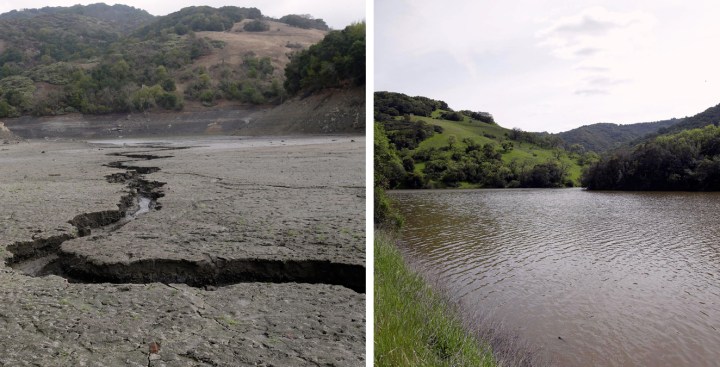
This post was published in 2014. On November 3, 2016 NBC Bay Area news reported Drought is Over in Nearly One-Fourth of California: Monitor, which featured before-and-after photos from AP with the caption:
This combo of two photos shows (left photo) the cracked-dry bed of the Almaden Reservoir on Friday, Feb. 7, 2014, in San Jose, Calif., and (right photo) the same Almaden Reservoir full of water on Monday, March 14, 2016. Four straight days of rain have replenished several key reservoirs in drought-stricken California.


Boom and bust weather pattern.

END UPDATE 

Of course the climatologists are still trying to solve the puzzle, but the guess in the following report is worth keeping on file. I'm adding this observation, which is definitely not guesswork, from the report, even though it doesn't relate to causes:
"... most of [California's] infrastructure was designed and built during the 20th century, when the climate was unusually wet compared to previous centuries. That hasn't set water management on the right course to deal with long periods of dryness in the future."
I assume the observation holds true for virtually all major U.S. cities. We are at the bottom of a very tall ladder that we need to scale fast. From National Geographic's February 13, 2014 report Could California's Drought Last 200 Years? by Thomas M. Kostigen
CLUES FROM THE PAST SUGGEST THE OCEAN'S TEMPERATURE MAY BE A DRIVER.
California is experiencing its worst drought since record-keeping began in the mid 19th century, and scientists say this may be just the beginning. B. Lynn Ingram, a paleoclimatologist at the University of California at Berkeley, thinks that California needs to brace itself for a megadrought—one that could last for 200 years or more.
[...]
 What's causing the current drought?
Ingram and other paleoclimatologists have correlated several historic megadroughts with a shift in the surface temperature of the Pacific Ocean that occurs every 20 to 30 years—something called the Pacific Decadal Oscillation (PDO). The PDO is similar to an El Nino event except it lasts for decades—as its name implies—whereas an El Nino event lasts 6 to 18 months. Cool phases of the PDO result in less precipitation because cooler sea temperatures bump the jet stream north, which in turn pushes off storms that would otherwise provide rain and snow to California.
Ingram says entire lakes dried up in California following a cool phase of the PDO several thousand years ago. Warm phases have been linked to numerous storms along the California coast.
"We have been in a fairly cold phase of PDO since the early 2000s," says Brian Fuchs, a climatologist at the National Drought Mitigation Center, "so the drought we are seeing now makes sense."
That said, scientists caution against pinning the current drought on the PDO alone. Certainly ocean temperatures, wind, and the weather pattern in the Pacific have contributed to the drought, says Nate Mantua, of NOAA's National Marine Fisheries Service in Santa Cruz, California, where the PDO pattern was first discovered and named. "But it's more nuanced than saying the PDO did this."
After all, as its name suggests, the PDO is decades in the making.
[...]
*********

U.S. water cost increased 33 percent between 2010-2014: Water Crisis Gordian Knot, Part 10

Need to find the water from somewhere, fast.

"For the past century, water use has been increasing at more than twice the rate of the population increase"


The Life-Threatening Problem of Water Scarcity in the World

July 21, 2014

Liquid Investments

Nestlé’s Chairman, Peter Brabeck has added considerable influence to the issue of strategic water supplies. As the head of one of the world’s biggest food companies, he has stated quite bluntly that the problem of water scarcity is a far more urgent crisis than climate change. In his view, much greater attention needs to be devoted to this predicament.

Society has been treating water as a free and infinite raw material and as governments implement tougher rules for its use, the cost of water will continually increase around the world. By 2030, demand for freshwater is now expected to exceed global supply by around 40%, affecting both populations and economies, according to the 2030 Water Resources Group.

For the past century, water use has been increasing at more than twice the rate of the population increase, as highlighted by the Food and Agriculture Organization (FAO). With a current world population of 7.6 billion and forecasts suggesting a further 40% rise in the population to 9.6 – 10 billion by 2050, water usage will need to triple to a minimum of 10 trillion cubic meters (105.94 trillion cubic feet) a year in order to meet the increased future demand.

Nowadays, the agricultural sector already accounts for 70% of the total global water use. According to the FAO, there will be a need for a 70% expansion in global food production up to the mid-century point, meaning that there will be a greatstress on water to be able produce enough food for all world consumers.

With water being an essential resource for different industries such as agriculture, energy, mining and high-tech; it will continue to impact companies around the world. In the US, between 2010 and 2014, the average water price had increased by 33%, widely affecting different companies. At the same time, in the three years up to 2014, companies such as Nestlé, Coca-Cola, Ford, and Rio Tinto have spent more than $84 billion in improving the way they conserve, manage and obtain water consistent with data from the Global Water Intelligence and the Financial Times.
[END REPORT]
****************

100 days of water left for megacity São Paulo unless it starts rationing: Water Crisis Gordian Knot, Part 9

A worker steps over the cracked ground of Jaguary dam in Braganca Paulista, 100 km from São Paulo in January 2014. January was the hottest on record in parts of Brazil, and the heat plus a severe drought fanned fears of water shortages, crop damage and higher electricity bills. Reuters

From Wikipedia's article
São Paulo ...is the largest city in Brazil, the largest city in both the Americas and in the southern hemisphere, and the world's ninth largest city by population. The metropolis is anchor to the São Paulo metropolitan area, ranked as the most populous metropolitan area in Brazil, the second most populous in the Americas and the eighth largest in the world.[2] São Paulo is the capital of the state of São Paulo, Brazil's most populous state. It exerts strong regional influence in commerce, finance, arts and entertainment and a strong international influence.[3][...] The metropolis has the largest economy by GDP in Latin America and Southern Hemisphere

"Sao Paulo state, Sabesp’s controlling shareholder, is going through its worst drought in at least four decades"

Sao Paulo Told to Cut Water or Risk Running Out in 100 Days
By Denyse Godoy Jul 29, 2014 11:03 AM ET

Bloomberg News
Sao Paulo risks having its biggest reservoir run out of drinking water within 100 days unless it starts rationing, Brazilian federal prosecutors warned.

Water utility Sabesp and Sao Paulo Governor Geraldo Alckmin have 10 days to come up with measures to deal with the crisis, according to a statement on the prosecutors’ website. Both may be sued to force them to start rationing if they don’t take appropriate action, it said.

The utility disagreed with the recommendation, it said in an e-mailed statement to Bloomberg News. “That measure would penalize customers and may have the opposite effect,” it said.

Efforts by Sabesp and the population have already reduced demand equivalent to a rationing regime that would allow water for 36 hours, followed by a cut in supply for 72 hours, the company said.
[...]
END REPORT
********

“You can make water run uphill if you have enough money.” Water Crisis Gordian Knot, Part 8

[shuffling through her file cabinet] Resnick, Resnick, now why does that name ring a bell? Ah yes; way back in November 2009 Alternet published a report from Yasha Levine that was colorfully titled, How Limousine Liberals, Water Oligarchs and Even Sean Hannity Are Hijacking Our Water Supply -- "our" meaning Californians. It starts like this: 

" A group of water oligarchs in California have engineered a disastrous deregulation and privatization scheme. And they've pulled in hundreds of millions of taxpayer dollars without causing much public outrage. The amount of power and control they wield over California's most precious resource, water, should shock and frighten us -- and it would, if more people were aware of it. But here is the scary thing: They are plotting to gain an even larger share of California's increasingly-scarce, over-tapped water supply, which will surely lead to shortages, higher prices and untold destruction to California's environment." 

 Soon he arrives at Resnick:

"The leader of these recent water privatization efforts in California is a Beverly Hills billionaire named Stewart Resnick. Stewart and his wife, Lynda Resnick, own Roll International Corporation, a private umbrella company that controls the flowers-by-wire company Teleflora, Fiji Water, Pom Wonderful, pesticide manufacturer Suterra and Paramount Agribusiness, the largest farming company in America and the largest pistachio and almond producer in the world. Roll Corp. was ranked #246 on Forbes' list of America's largest private companies in 2008 and had an estimated revenue of $1.98 billion in 2007.

"They are a limousine liberal power couple. Hyperactive in politics, business and philanthropy, the two raise huge amounts of cash for the Democratic party, donate to the arts, support education and hobnob with influential progressives like Arianna Huffington and the anti-global warming activist and producer of An Inconvenient Truth, Laurie David. Stewart Resnick gave over $350,000 to the Gray Davis campaign and various anti-recall groups between 2000 and 2003, a favor Governor Davis returned by appointing Resnick to co-chair his agriculture-water transition team.
[... ]

But there is a gaping hole in most accounts of the jet-set Baby Boomer couple: their company, Roll International, is one of the largest, if not the largest, private water brokers in America. Through a series of subsidiary companies and organizations, Roll International is able to convert California's water from a public, shared resource into a private asset that can be sold on the market to the highest bidder.


It all comes down to Stewart Resnick's involvement in the creation of a powerful but little-known entity called the Kern County Water Bank -- an underground water storage facility at the center of a plan to bring deregulation to California's most important public utility: water.

According to a 2003 Public Citizen report titled " Water Heist," the Kern County Water Bank is an underground reservoir in the hottest, driest, southernmost edge of the Central Valley with a capacity of 1 million acre-feet, enough to convert the entire state of Rhode Island into a swampland one-foot deep or supply the City of Los Angeles with water for 1.7 years.


The water bank was envisioned in the late '80s by the Department of Water Resources as a safeguard against prolonged drought. During wet years, it would serve as a repository for excess water coming in from Northern California and the Sierras, and pumped out in dry years. California spent nearly a hundred million dollars to develop the underground reservoir and connect it to the state's public canals and aqueducts, but in 1995, California's Department of Water Resources suddenly, and without any public debate, transferred it to a handful of corporate interests.


Here is how Los Angeles Times writer Mark Arax described it in 2003:
[...]  " 

All right, enough from Yasha for now. (It's a VERY long report, almost an e-book].  Now to a report from Open Secrets that from the date seems like ancient history as the crow of California's water crisis flies, but is actually very educational, and here again Resnick pops up.

The Politics of Drought: California Water Interests Prime the Pump in Washington

by Kitty Felde and Viveca Novak on April 10, 2014

This story is the result of a collaboration between Southern California Public Radio and the Center for Responsive Politics.

Last year, as California endured one of its driest years on record, the Westlands Water District made it rain 3,000 miles away — on Capitol Hill.
The nation’s largest agricultural water district, located in the Central Valley, spent $600,000 on lobbying efforts, according to an analysis by KPCC in partnership with the nonpartisan Center for Responsive Politics. That’s by far Westlands’ biggest annual expenditure for lobbying — about six times what it spent in 2010.
The lobbying comes as Congress and federal agencies consider how to respond to three years of drought conditions that have cut water supplies across the state and ratcheted up political pressure from the hard-hit agricultural sector, including many of Westlands’ customers.

California farmers grow nearly half the nation’s fruits, vegetables and nuts. The California Farm Water Coalition, an industry group, estimates farmers — and the processors and truckers who get crops to market — could lose $5 billion this year due to the drought.
How important is this issue? Well, in recent months it’s brought President Obama, the House Speaker and the powerful House Natural Resources Committee to the Central Valley. 
Congress is considering two major legislative packages — one already passed by the House, authored by freshman Republican Rep. David Valadao of Hanford; and one introduced in the Senate by California Democrats Dianne Feinstein, with Barbara Boxer as a co-sponsor.

The bills have the common goal of redistributing water to meet farmers’ needs, but they differ on execution and the ramifications.

The House bill, which was co-sponsored by the state’s entire GOP delegation, would rewrite water contracts and in the process set aside protections, which has environmental groups up in arms.
The Senate bill would allow regulators to “provide the maximum quantity of water supplies possible” to where it’s most needed and boost existing federal drought programs by $200 million.
As is true with many issues in Washington, money is part of the fight. As Bay Area Rep.George Miller, a Democrat, says, “You can make water run uphill if you have enough money.”
The DC bucket brigade
California water politics is mostly about geography — Northern California’s watershed versus the Central Valley, which relies on that water coming south to irrigate crops, versus Southern California, with its massive and thirsty urban population.
As the drought has worsened, those various interests have pushed harder for relief through campaign contributions to key members of Congress and by employing lobbyists. 
The two biggest spenders on water issues are Westlands, whose customers own 600,000 acres of farmland in Fresno and Kings counties, and the owners of Kern County-based Paramount Farms, the nation’s largest grower of pistachios and almonds.
Just how serious is the quest for water? Last year, Westlands hired four different lobbying firms — even as the overall amount spent by all groups and corporations on federal lobbying has been going down since 2010. All eight of Westlands’ officially registered lobbyists previously worked in government — including a former Republican congressman from Minnesota.
And the $600,000 Westlands spent in 2013 is only what was reported on required disclosure forms. According to an internal document obtained by Southern California Public Radio, Westlands also paid $90,000 last year to former California Democratic Rep. Tony Coelho for “Washington representation,” which was not included in Westlands’ lobbying reports.
Coelho, who did not respond to requests for an interview, is related to one of Westlands’ board members and they are partners in a dairy farm. Westlands also paid another firm nearly $1 million for an “outreach and awareness” campaign.
Democratic lawmaker Miller, who has been on Capitol Hill for more than four decades, says lobbyists keep their “A-game” going all the time, rain or shine, “because you never know when the good Lord’s going to turn off the water. So you’d better be ready.”
Money is extremely helpful in obtaining access and influence, which is crucial whenever Congress gets involved. That’s true whether the cash is in the form of spending on lobbying or campaign donations.
Paramount Farms is owned by Lynda and Stewart Resnick of Los Angeles. Their multi-billion dollar fortune comes from a diverse portfolio that includes Fiji bottled water. They have a controlling interest in the Kern Water Bank Authority, which stores underground supplies of water to irrigate Paramount’s nut trees.
The Resnicks don’t hire lobbyists at the federal level, but they’re generous campaign contributors. They and people who work for their companies have given nearly $457,000 to candidates, political action and party committees since 2011. That includes nearly $321,000 from the Resnicks themselves. (See table at end of story.)
Setting the Water Table

You can’t just read the House and Senate bills and point to paragraphs that directly help either Westlands or the Resnicks. But John Lawrence, a former Capitol Hill staffer who currently teaches at the University of California’s DC Center, says water bills are “very often written specifically in a vague sort of way.” Congressman Miller adds: “There’s rarely any word in a piece of water legislation that’s there accidentally.”
The bill that passed in the House would mandate an increase in pumping from the Sacramento Delta. Doug Obegi, an attorney with the Natural Resources Defense Council, says that water would primarily go to Central Valley Project contractors, including the biggest — the Westlands Water District.
The bill also extends for 40 years all existing federal water service contracts — including the one for Westlands. Lawrence says that takes away any flexibility to make water decisions for a generation. He notes that once you’ve delivered a “signed, sealed contract, let alone been directed to do it by the Congress,” you’ve taken away any chance at reviewing how future water should be allocated.
Feinstein’s Senate bill includes several provisions that would allow Delta water to be sent farther south to Kern County. Patricia Schifferle of the environmental group Pacific Advocates says, because of previous legislative amendments, the water would be made available to the groundwater bank controlled by Feinstein’s supporters — the Resnicks.
(Neither Westlands nor the Resnicks’ holding company, Roll International, responded to requests for interviews.)
Feinstein recently revised her bill. This latest version includes a provision to boost Colorado River storage in Nevada, home to Senate Majority Leader Harry Reid. This version could make it to the Senate floor for a vote without going through the committee process.
Horse trading on Capitol Hill isn’t new. Some of the lobbying money goes to making sure everyone gets to wet their beak. Miller notes that deals get made — trading something Midwest lawmakers want in the farm bill for something Central Valley interests need in the water bill. He says there are “a lot of chits out there that have been planted around the anticipation of a water bill coming to the floor of Congress.”
If the House bill became law, Ron Stork of Friends of the River says not only would habitat restoration be hurt, but so would two other water consumers: farmers and residential users in the northern part of the state. Delta farmers, with some of the oldest water rights in California, and the city and county of Sacramento, which contract for drinking water, would find their supply “commandeered and delivered south.”
The lobbying isn’t limited to Capitol Hill. It also takes place at the agency level. John Lawrence says private meetings are held behind closed doors at places such as the Bureau of Reclamation or the Environmental Protection Agency, where there’s “greater wiggle room” on how water policies are implemented. Those conversations are confidential, not debated openly in Congressional committee hearings.
Westlands’ reports show it lobbied the EPA, the Agriculture Department, the Interior Department (which includes the Bureau of Reclamation) and the Council on Environmental Quality, in addition to Congress and the White House. Three of the water district’s lobbyists are former high-ranking officials of the Interior Department.
There’s even a place lobbyists and campaign contributions collide: Schifferle from Pacific Advocates notes a 2012 breakfast fundraiser for Feinstein in the offices of one of Westlands’ lobbying firms, held “right around the time” of a budget amendment that gave water agencies access to federal water.
In Washington, certain wells never run dry.
[...]
END REPORT 
********

Tuesday, July 15

Carving California into 6 states: this is one of the stupidest plans I've ever seen

This is quite literally a whine and cheese plan by someone who may be smoking dope.  To solve California's problems, carve the state into marijuana (North California), wine (Napa Valley), cheese (Central Valley dairy) regions, and some other stuff. 

Democrats hate the idea, of course, but I'm with them on this one.  The plan's mastermind is one Tim Draper, a "venture capitalist."  His six state initiative has collected enough signatures, 800,000+, to get on the Nov. 2016 ballot.  What I find disturbing is that a snap survey turned up only 59 percent of Californians who are against the plan. This, according to the USA TODAY report on the plan, which includes a map of the proposed states.  

Looking at his map I get the feeling that Tim Draper doesn't want six states, he wants one country: Silicon Valley. But he knows that would never get on the ballot.

A state is not a company; its problems aren't troublesome divisions that corporate can peel off.  Move to Singapore, Mr Draper, if you like the idea of a small nation-state. Get out of my country.

********

Amazing GRACE and California's groundwater: Water Crisis Gordian Knot, Part 7

A stunning technological achievement but with very bad news to report.  Yet GRACE could give humanity the edge it needs, on the theory that there would have been no chance without governments here and around the world, from the federal to municipal levels, knowing exactly where they stand in terms of their groundwater supplies. 

See the National Geographic website for the many links in the article below, including link to the NASA GRACE Mission website. 

A note regarding the author's mention in passing of Nevada's vast Lake Mead: On July 10 the Associated Press reported that the water level in the lake had dropped to an all-time low; the lake is now at 39 percent of its capacity.  (Its 'sister' reservoir farther up the Colorado River, Lake Powell, is at 52 percent capacity.)  Officials had projected the decline at Lake Mead and don't expect there will be cuts to water deliveries to Nevada and Arizona this year or next, but they give a 50-50 chance there will be cuts in 2016 (depending on drought conditions).  Las Vegas, a city of 2 million residents, is almost completely dependent on Lake Mead for its drinking water.
Epic California Drought and Groundwater: Where Do We Go From Here?

Posted by Jay Famiglietti of University of California, Irvine
in Water Currents via National Geographic Society
February 4, 2014

Yesterday our team at the UC Center for Hydrologic Modeling released a report on the California drought.  The report describes the bird's eye view of statewide water resources that we see from the NASA GRACE satellite mission.

The NASA GRACE satellite mission

We’ve been working since the mid-1990’s, well before the mission was launched in 2002, to develop and test methods to help monitor groundwater depletion from space.  We’ve applied them around the world — in California, across the U.S., in the Middle East, East Africa, in the Amazon River Basin and in India.Our endgame is simple.  We want to use GRACE and other satellites, combined with invaluable measurements on the ground, to help quantify how regional and global freshwater availability is changing.

The good news is that the methods work great. The GRACE mission functions like a giant ‘scale in the sky,’ weighing how various regions around the world are gaining and losing water each month.  We can see the ups and downs of ‘total’ water storage – all of the snow, surface water, soil moisture, and groundwater – like never before.

The bad news is that we are running out of groundwater.

In particular, this is happening in the places that we need it most — the dry parts of the planet where we love to live, precisely because it does not rain.  Out of necessity, our reliance on groundwater in these parts of the world is much greater than elsewhere.

Our team and several others around the globe are showing that most of the major aquifers in the world’s arid and semi-arid regions are being depleted at a rapid pace, and one that is most likely unsustainable in the long term. Groundwater is a finite resource after all.
[...]
What has GRACE shown us about California?

Our earlier study showed that between October 2003 and March 2010, the Sacramento and San Joaquin River Basins lost about 30 cubic kilometers of freshwater, nearly the equivalent of the full volume of Lake Mead. Of this, we determined that about two-thirds was due to groundwater depletion in the Central Valley.
During the drought of 2006-2010, state and federal surface water allocations were drastically reduced, forcing farmers to tap groundwater reserves far more heavily than in ‘normal,’ wetter years.  The resulting volume of depleted groundwater was so great that it was registered by a satellite ‘scale’ that orbits about 400 km above Earth’s surface.

Our new report is an update to this previous work, and it points to one critical question for California.

One of the key numbers to emerge from the report is that the combined Sacramento and San Joaquin River Basins have already lost 10 cubic kilometers of freshwater each year in 2012 and 2013.
[...]
To put that number in perspective, it is roughly the amount of water used by the entire population of California, for household, municipal, and industrial use (that is, for nearly everything else besides agriculture and environment). 

It is also the steepest decline in total water availability that our team has witnessed in the 12 years that we have been monitoring California water resources with the GRACE mission.

A second contribution of the report is that it further exposes the unsustainable pattern of groundwater use in the Central Valley.  While there is some replenishment of groundwater during wet years, groundwater levels decline precipitously during drought, when farmers have no choice but to rely far more heavily on groundwater to meet their irrigation water needs.
[...]
All right. There's much more to the report, and again, numerous links to papers, satellite data, the GRACE mission, etc., but I think the above is enough to convey the picture.  More than 80 percent of California's water use goes to agriculture, and much of that is in the two valleys that make up the Central Valley -- San Joaquin and Sacramento.  Triage efforts will have to focus there first, but this running smack dab into the state's hydropolitics, which is almost cosmic in complexity.  .
              
********

Saturday, July 5

Can beer save the world again? Water Crisis Gordian Knot, Part 6

It's one thing to run out of water for incidentals like bathing and growing vegetables; it's another for beer.  So talk about desperation being the mother of invention:
One example comes from southern Idaho, where grower Timm Adams has worked with [Anheuser-Busch beer company] to shift his barley production to the winter season. Because the crop can use the natural moisture from the rain and snow that falls during that time frame -- it requires 20 percent less water while producing a greater yield than other strains -- his operation can decrease its purchases from the local irrigation district, Adams said. Overall, the load on the local estuary is also decreased.
Wow. It's almost unimaginable how much water could be saved if all grain farmers took up the same method wherever possible.

The quote is from a report GreenBiz did last year on beer and water scarcity.  Yesterday I featured GreenBiz's most recent report on the same theme, which discusses MillerCoors beer maker's innovations to save water.  Here are more quotes more from the earlier report:
Anheuser-Busch InBev: Less Water, More Beer

By Heather Clancy
June 5, 2013
GreenBiz.com

The world's biggest beer brewer, Anheuser-Busch InBev has adopted an aggressive series of five-year environmental goals, calling for further reductions in water and energy consumption and setting its first formal targets for packaging reductions and eco-friendly coolers.

The seven new commitments come just four months after AB InBev revealed it had surpassed previous three-year commitments for water, energy and waste.

The Belgian-based brewer already has saved enough water to produce about 25 billion cans of AB InBev beverages. Currently, it uses an average of 3.5 hectoliters of water for every hectoliter of production.
Now it is trying to squeeze more from the process: The new five-year goal aims to reach a global average of 3.2 hectoliters of water per hectoliter of production. For those who like to visualize this sort of thing, that works out to the amount of water it would take to fill approximately 5,400 Olympic swimming pools.
The Carterville brewery in Georgia already has outstripped that goal: It uses just 2.8 hectoliters of water per hectoliter of production.

To move toward that measure in other production facilities, the company is introducing water management measures in each of its key barley growing regions through partnerships with local stakeholders and growers.

In addition, it is introducing watershed protection measures at all of its facilities in Argentina, Bolivia, Brazil, China, Mexico, Peru and the United States.

Heightened attention deeper into the supply chain

The new commitments are notable for their global scope and because they also focus far more attention on encouraging sustainable operations throughout AB InBev's entire supply chain, according to AB InBev executives.

"Our approach recognizes that there isn't a one-size-fits-all solution to improve sustainability," said AB InBev CEO Carlos Brito. "The key will be to leverage the experience and expertise of our colleagues globally, foster a collective approach through partnerships with local stakeholders and continue to scale best practices across our company."
[...]
Yuppers, beer has saved the world before, and just might do it again.

********

Looking for Alexander's Sword: Water Crisis Gordian Knot, Part 5

"The theme here is that stewardship starts with measurement."

I'm featuring more passages from the GreenBiz report I quoted from yesterday because they really deserve their own post:
As many exciting solutions as the speakers identified, they kept coming back to the reality that businesses need to get much more serious about assessing their own water performance and risks. The scarcity of data -- both on the risk side and top-line -- remains a huge obstacle; many stakeholders are reluctant to publicly release data and there is a lack of standardized data collection.

Ultimately, the reality of water scarcity and climbing demand will leave no choice for stakeholders who are reluctant to part with data sets. Advances in technology such water-smart meters may provide a promising path to better and easier data collection, lowering the cost and hassle factor for water users, including farmers.

The theme here is that stewardship starts with measurement: if they haven't already, businesses need to start assessing their water performance, set a baseline and work towards reducing use.
For commercial and institutional water users, tools such as the Water Efficiency Toolkit that EDF developed with AT&T can offer a first step toward assessing water performance and mapping out actions they can take to improve it.
[...]
See the report for links to information on the toolkit and advances in technology. The Associated Press and Reuters reports I quoted in an earlier post make clear that California's government has the same problem as the private sector when it comes to getting accurate data on water usage.  The situation exists across the board; few if any governments at the local and national levels in the USA and around the world know with any accuracy the amount of water used in their jurisdictions and how it's used.

The upshot: Many big surprises about how quickly and where water supplies are running out.

So while it's good to talk about shared responsibility, stewardship, and great new technologies, intelligent prioritizing about where to place resources for dealing with water scarcity depends on accurate, comprehensive data collection.  If there's one thing that can cut through the Gordian Knot of water crises in the United States and worldwide, it's that.

********