Translate

Saturday, July 2

Transcript of Australian TV interview with Syrian President Bashar-al Assad

July 2, 2016
SANA


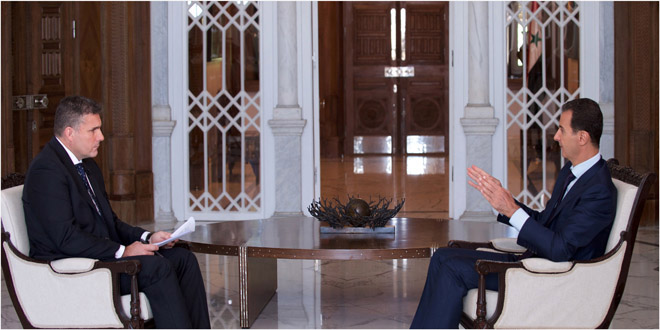
Damascus, SANA - President Bashar al-Assad gave an interview [on July 1, 2016] to the Australian SBS TV channel in which he criticized the double standards of the West -- openly attacking the Syrian government politically, but continuing to deal with it through back channels -- and called for a more humanitarian and less costly solution to refugee crisis through stopping support to the terrorists.
The following is the full text of the interview:
Journalist: Mr. President, thank you for speaking with SBS Australia.
President Assad: You’re most welcome in Syria.
Question 1: It’s now more than five years since the Syrian crisis began. It’s estimated somewhere around a quarter of a million people have been killed, many of them civilians. There’s an undeniable humanitarian disaster. How far into the crisis do you think you are, and is there an end in sight?
President Assad: Of course, there is an end in sight, and the solution is very clear. It’s simple yet impossible. It’s simple because the solution is very clear, how to make dialogue between the Syrians about the political process, but at the same time fighting the terrorism and the terrorists in Syria. Without fighting terrorists, you cannot have any real solution. It’s impossible because the countries that supported those terrorists, whether Western or regional like Turkey, Saudi Arabia, and Qatar, don’t want to stop sending all kinds of support to those terrorists. So, if we start with stopping this logistical support, and as Syrians go to dialogue, talk about the constitution, about the future of Syria, about the future of the political system, the solution is very near, not far from reach.
Question 2: Much of the reporting in the West at the moment suggests that the demise of the Islamic State is imminent. Do you believe that’s true, and how far away from seizing Raqqa, this very important city of Raqqa, do you believe you are?
President Assad: It’s not a race. Raqqa is as important as Aleppo, as Damascus, as any other city. The danger of those terrorist groups is not about what land do they occupy, because it’s not a traditional war. It’s about how much of their ideology can they instill in the mind of the people in the area that they sit or live in. Indoctrination, this is the most dangerous thing. So, reaching Raqqa is not that difficult militarily, let’s say. It’s a matter of time. We are going in that direction. But the question when you talk about war is about what the other side, let’s say the enemy, could do, and that’s directly related to the effort of Turkey, especially Erdogan, in supporting those groups, because that’s what’s happening since the beginning. If you talk about Syria as an isolated military field, you can reach that area within a few months or a few weeks, let’s say, but without taking into consideration the Turkish effort in supporting the terrorists, any answer would be a far cry from the reality, an un-factual answer.
Question 3: Mr. President, how concerned are you about recent fatal clashes which have been reported between your longtime ally Hezbollah and your own forces?
There is good Syrian-Russian-Iranian coordination on fighting terrorism
President Assad: Fighting between us and Hezbollah? They are not fighting. They support the Syrian Army. They don’t fight against the Syrian Army, they fight with the Syrian Army. The Syrian Army and Hezbollah, with the support of the Russian Air Forces, we are fighting all kinds of terrorist groups, whether ISIS or al-Nusra or other affiliated groups with Al Qaeda that’s affiliated automatically to al-Nusra and ISIS.
Question 4: So, there have been some recent reports of clashes between… are those reports incorrect.
President Assad: No, they are talking not about clashes; about, let’s say, differences and different opinions. That’s not true, and if you look at the meeting that happened recently between the Ministers of Defense in Iran, in Tehran; Syrian, Russian, and Iranian, this means there’s good coordination regarding fighting terrorism.
Question 5: To be clear, do you categorize all opposition groups as terrorists?
President Assad: Definitely not, no. When you talk about an opposition group that adopts the political means, they’re not terrorists. Whenever you hold machineguns or any other armaments and you terrorize people and you attack civilians and you attack public and private properties, you are a terrorist. But if you talk about opposition, when you talk about opposition it must be Syrian opposition. It cannot be a surrogate opposition that works as a proxy to other countries like Saudi Arabia or any other country. It must be a Syrian opposition that’s related to its Syrian grassroots, like in your country. It’s the same, I think.
Question 6: You said recently that the ceasefire offered Syrian people at least a glimmer of hope. How, five months on, do you think that hope is going?
President Assad: Yeah, it is. It’s still working, the ceasefire, but we don’t have to forget that terrorist groups violate this agreement, on a daily basis. But at the same time, we have the right, according to that agreement, to retaliate whenever the terrorists attack our government forces. So, actually you can say it’s still working in most of the areas, but in some areas it’s not.
Question 7: There are various accounts of how the Syrian crisis began. Some say it was children graffiting anti-government slogans and they were dealt with brutally by the government. I understand you don’t accept that narrative. How, in your view, did the crisis begin?
President Assad: It’s a mixture of many things. Some people demonstrated because they needed reform. We cannot deny this, we cannot say “no everybody was a terrorist” or “everyone was a mercenary.” But the majority of those demonstrators – I’m not talking about the genuine demonstrators – were paid by Qatar in order to demonstrate, then later they were paid by Qatar in order to revolt with armaments, and that’s how it started, actually. The story of children being attacked, this is an illusive story. It didn’t happen. Of course, you always have, let’s say, mistakes happening in the practice on the ground, like what happened in the United States recently, during the last year, but this is not a reason for people to hold machineguns and kill policemen and soldiers and so on.
Question 8: You do say that some of these people legitimately needed reform. Was that as a result of any heavy-handedness from your government at all?
President Assad: No, we had reform in Syria. It started mainly after 2000, in the year 2000. Some people think it was slow, some people think it was too fast, this is subjective, not objective, but we were moving in that regard. But the proof that it wasn’t about the reform, because we made all the requested reforms after the crisis started five years ago, and nothing has changed. So, it wasn’t about reform. We changed the constitution, we changed the laws that the opposition asked for, we changed many things, but nothing happened. So, it wasn’t about the reform; it was about money coming from Qatar, and most of the people that genuinely asked for reform at the beginning of the crisis, they don’t demonstrate now, they don’t go against the government, they cooperate with the government. They don’t believe, let’s say, in the political line of this government, and this is their right and that’s natural, but they don’t work against the government or against the state institutions. So, they distinguish themselves from the people who supported the terrorists.
Question 9: How do you respond to the fact that some of your ministers defected and cited brutality as reason?
President Assad: Actually, they defected because they’ve been asked to do so by, some of them, Saudi Arabia, some of them by France, it depends on the country they belong to. And now, they are belonging to that so-called opposition that belongs to those countries, not to the Syrians. They have no values in Syria, so we wouldn’t worry about that. It didn’t change anything. I mean it didn’t affect the fact or the reality in Syria.
Question 10: One of your main backers, Russia, has called for a return to the peace talks. Do you think that’s a good idea?
President Assad: You mean in Geneva?
Journalist: Yes.
Geneva negotiations need to have the basic principles in order to be fruitful
President Assad: Yeah, of course, we support every talk with every Syrian party, but in reality those talks haven’t been started yet, and there’s no Syrian-Syrian talks till this moment, because we only made negotiations with the facilitator, which is Mr. de Mistura. Actually, it hasn’t started. So, we support the principle, but in practice you need to have a certain methodology that didn’t exist so far. So, we need to start, but we need to have the basic principles for those negotiations to be fruitful.
Question 11: One thing that intrigues a lot of people about the Syrian crisis is why your close allies Iran and Russia stay so loyal?
By defending Syria, allies are defending their stability and interests 
President Assad: Because it wasn’t about the President, it’s not about the person. This is the misinterpretation, or let’s say the misconception in the West, and maybe part of the propaganda, that Russia and Iran supported Assad, or supported the President. It’s not like this. It’s about the whole situation. The chaos in Syria is going to provoke a domino effect in our region, that’s going to affect the neighboring countries, it’s going to affect Iran, it’s going to affect Russia, it’s going to affect Europe, actually. So, when they defend Syria, they defend the stability and they defend their stability, they defend their interest. And at the same time, it’s about the principle. They defend the Syrian people and their right to protect themselves. Because if they defend the President and the Syrian people are not with him and don’t support him, I cannot withstand five years just because Russia and Iran support me. So, it’s not about the President, it’s about the whole situation, the bigger picture, let’s say.
Question 12: Do you have any dialogue either direct or indirectly with the United States?
Western countries are dealing with Syria through back channels
President Assad: At all, nothing at all. Indirect, yes, indirect, through different channels. But if you ask them they will deny it, and we’re going to deny it. But in reality, it exists; the back channels.
Question 13: What are some of those channels?
President Assad: I mean, let’s say, businessmen going and traveling around the world and meeting with the officials in the United States and in Europe, they meet in Europe, and they try to convey certain messages, but there’s nothing serious, because we don’t think the administration, the American administration, is serious about solving the problem in Syria.
Question 14: Well, quite recently, there were reports more than 50 diplomats have called for what they described as “real and effective military strikes” against you, against Syria. Does this in any way concern you, and do you think it signals a more aggressive policy from the United States towards Syria moving forward?
American administrations are famous of creating problems, but they never solve any 
President Assad: No, warmongers in every American administration always exist. It’s not something new. But we wouldn’t give a fig, let’s say, about this communique, but it’s not about this communique; it’s about the policy, it’s about the actions. The difference between this administration and the previous one, Bush’s one, is that Bush sent his troops. This one is sending mercenaries, and turned a blind eye to what Saudi Arabia and Turkey and Qatar did, since the beginning of the crisis. So, it’s the same policy. It’s a militaristic policy, but in different ways. So, this communique is not different from the reality on the ground. This is asking for war, and the reality is a war.
Question 15: You referred to the previous government, the Bush government. There are some who say one of the reasons you’ve survived as long as a government has been America’s reluctance to get on the ground in another war in the Middle East. Do you not accept that, based on what you’re saying?
President Assad: Yeah, the American administrations since the 50s are very famous of creating problems but they never solve any problems, and that’s what happened in Iraq. Bush invaded Iraq, in a few weeks he could occupy Iraq, but then what’s next? It’s not about occupying. This is a great power. We’re not a great power. So, it’s not about America occupying Syria. What’s next? What do they want to achieve? They haven’t achieved anything. They failed in Libya, in Iraq, in Yemen, in Syria, everywhere. They only created chaos. So, if the United States wants to create more chaos it can, it can create chaos, but can they solve the problem? No.
Question 16: Do you have a preference who wins the upcoming US election?
President Assad: Actually no, we never bet on any American president, because usually what they say in the campaign is different from their practice after they become president, and Obama is an example, so we don’t have to wait. We have to wait and see what policy they’re going to adopt, whoever wins the elections.
Question 17: So, you can see a circumstance where Syria would work collaboratively with the United States and the West?
We are not against cooperation with the US based on mutual interest
President Assad: We don’t have a problem with the United States, they’re not our enemy, they don’t occupy our land. We have differences, and those differences go back to the 70s and maybe before that, but in many different times, let’s say, and events and circumstances, we had cooperation with the United States. So, we’re not against this cooperation. But, this cooperation means talking about and discussing and working for the mutual interest, not for their interest at the expense of our interest. So, we don’t have a problem.
Question 18: Mr. President, you’ve spent a lot of time yourself, as you’ve just said, in the United Kingdom. Can you see there being any repercussions for Britain’s decision to exit the European Union for Syria and for the Syrian crisis?
British people are revolting against their “second-tier” and “disconnected” politicians
President Assad: I don’t think I can elaborate about that, as it’s a British issue, and I’m not British neither European. But at the same time I can say that this surprising result, maybe, has many different components, whether internal as economic and external as the worry from the terrorism, security issues, refugees, and so on. But this is an indication for us, as those officials who used to give me the advice about how to deal with the crisis in Syria, and say “Assad must go” and “he’s disconnected” proven to be disconnected from reality, otherwise they wouldn’t have asked for this referendum, but I think this is a revolt of the people there against, I would call them sometimes second-tier politicians. They needed special, let’s say, statecraft officials, to deal their country. If another administration came and understands that the issue of refugees and security is related to the problem in our region, this is where you’re going to have a different policy that will affect us positively. But I don’t have now a lot of hope about this. Let’s say we have a slim hope, because we don’t know who’s going to come after Cameron in the UK.
Question 19: Can I ask; Australia is part of the international coalition to defeat the Islamic State. Obviously, that’s one of your goals, so in that instance there’s a shared goal. Do you welcome international intervention when there’s a shared goal like that.
President Assad: Actually, we welcome any effort to fight terrorism in Syria, any effort, but this effort first of all should be genuine, not window-dressing like what’s happening now in northern Syria where 60 countries couldn’t prevent ISIS from expanding. Actually, when the Russian air support started, only at that time when ISIS stopped expanding. So, it needs to be genuine. Second, it needs to be through the Syrian legitimate government, not just because they want to fight terrorism and they can go anywhere in the world. We are a legitimate government and we are a sovereign country. So, only on these two circumstances we welcome any foreign support to fight terrorism.
Question 20: A number of Australians have died fighting for either the Kurdish militia or the Islamic State. Do you have a message for these young people who feel so enraged by what’s taking place in Syria that they travel over here to fight?
President Assad: Again, the same, let’s say, answer. If there are foreigners coming without the permission of the government, they are illegal, whether they want to fight terrorists or want to fight any other one. It is the same. It’s illegal, we can call it.
Question 21: Mr. President, Australian politicians have used very strong language about your role in the crisis, as have other leaders, internationally. Australia’s Prime Minister has referred to you as a “murderous tyrant,” saying that you’re responsible for killing thousands of innocent civilians. Australia’s opposition leader has called you a “butcher.” Yet Australia’s official position is still to work with you toward a peace agreement. How do you reconcile those two very different positions?
Western nations attack Syrian government and yet deal with it under the table
President Assad: Actually, this is the double standard of the West in general. They attack us politically and they send us their officials to deal with us under the table, especially the security, including your government. They all do the same. They don’t want to upset the United States. Actually, most of the Western officials only repeat what the United States wants them to say. This is the reality. So, I think these statements, I just can say they are disconnected from our reality, because I’m fighting terrorists, our army is fighting terrorists, our government is against terrorists, the whole institutions are against terrorists. If you call fighting terrorism butchery, that’s another issue.
Question 22: Australia has agreed to take an additional twelve thousand Syrian refugees; some have already arrived. Do you have a message for these Syrians, many of whom still say they love Syria and they want to return. Do you have a message for those people, as I said, who are in Australia, and other countries around the world?
A more humanitarian and less costly European solution to refugee crisis is stopping support to terrorists
President Assad: Actually, you mentioned a very important point. Most of the refugees that left Syria, they want to come back to Syria. So, any country that helped them enter their new country, let’s say, their new homeland, is welcome as a humanitarian action, but again there is something more humanitarian and less costly: is to help them staying in their country, help them going back by helping the stability in Syria, not to give any umbrella or support to the terrorists. That’s what they want. They want the Western governments to take decisive decisions against what Saudi Arabia and other Western countries, like France and UK, are doing in order to support the terrorists in Syria just to topple the government. Otherwise, those Syrians wouldn’t have left Syria. Most of them, they didn’t leave because they are against the government or with the government; they left because it’s very difficult to live in Syria these days.
Question 23: Do you hope that these people will return and would you facilitate for them to return?
President Assad: Definitely, I mean losing people as refugees is like losing human resources. How can you build a country without human resources? Most of those people are educated, well trained, they have their own businesses in Syria in different domains. You lose all this, of course, we need.
Question 24: The Commission for International Justice and Accountability says there are thousands of government documents which say has proved your government sanctioned mass torture and killings. In the face of that evidence, how do you say that no crimes have taken place, and I point also to other independent organizations, which are critical of deliberate targeting hospitals. Do you concede that some mistakes have been made as you’ve targeted some rebel-held areas?
President Assad: You are talking about two different things. One of them, the first one is the reports. The most important report that’s been financed by Qatar, just to defame the Syrian government, and they have no proof, who took the pictures, who are the victims in those pictures, and so on. Like you can forge anything if you want now on the computer. So, it is not credible at all. Second, talking about attacking hospitals or attacking civilians, the question, the very simple question is: why do we attack hospitals and civilians? I mean the whole issue, the whole problem in Syria started when those terrorists wanted to win the hearts of the Syrians. So, attacking hospitals or attacking civilians is playing into the hands of the terrorists. So, if we put the values aside now for a while, let’s talk about the interests. No government in this situation has any interest in killing civilians or attacking hospitals. Anyway, if you attack hospitals, you can use any building to be a hospital. No, these are an anecdotal claims, mendacious statements I can say; they are not credible at all. We’re still sending vaccines to those areas under the control of the terrorists. So, how can I send vaccines and attack the hospitals? This is a contradiction.
Question 25: Mr. President, as a father and as a man, has there been one anecdote, one story, one image from the crisis, which has affected you personally more than others?
President Assad: Definitely, we are humans, and I am Syrian like the other Syrians. I will be more sympathetic with any Syrian tragedy affecting any person or family, and in this region, we are very emotional people, generally. But as an official, I am not only a person, I am an official. As an official, the first question you ask when you have that feeling is what are you going to do, what are you going to do to protect other Syrians from the same suffering? That’s the most important thing. So, I mean, this feeling, this sad feeling, this painful feeling, is an incentive for me to do more. It’s not only a feeling.
Question 26: What’s your vision for Syria? How do you see things in two to three years?
President Assad: After the crisis or…? Because, the first thing we would like to see is to have Syria stable as it used to be before, because it was one of the most stable countries and secure countries around the world, not only in our region. So, this the first thing. If you have this, you can have other ambitions. Without it you cannot. I mean, if you have this, the other question: how to deal with the new generation that lived the life of killing, that saw the extremism or learned the extremism or indoctrinated by Al Qaeda-affiliated groups, and so on. This is another challenge. The third one is bringing back those human resources that left as refugees in order to rebuild Syria. Rebuilding the country as buildings or infrastructure is very easy; we are capable of doing this as Syrians. The challenge is about the new generation.
Question 27: How do you think history will reflect on your presidency?
President Assad: What I wish is to say that this is the one who saved his country from the terrorists and from the external intervention. That is what I wish about it. Anything else would be left to the judgment of the Syrian people, but this is my only wish.
Journalist: Mr. President, Thank you very much for speaking with SBS Australia.
President Assad: Thank you very much.
[END TRANSCRIPT]



Dhaka cafe siege ends with commando raid: 20 hostages killed, 13 rescued, 40 wounded, 6 attackers killed and 1 taken alive

> The siege lasted 12 hours, according to a DNA (India) report; DNA also reports that "at least" 9 attackers stormed the cafe. If the number is correct and 6 attackers were killed and 1 captured, then at least two of the attackers escaped.  

> The number cited in the headline for hostages rescued is from the latest Reuters report (below). The CNN report (below) says that 14 hostages were rescued. 

> Most of the 20 hostages killed were hacked to death by the attackers; all the hostages killed were foreigners. 

> Reuters reports that there are questions about whether the attack was masterminded by Islamic State even though the group has claimed responsibility; it might have been a local outfit claiming the attack in Islamic State's name. The CNN report mentions that one U.S. official considers it more likely that AQIS is the perp.   

> See the 2015 report I linked to yesterday by C. Christine Fair and Seth Oldmixon, Think Again: Islamism and Militancy in Bangladesh, for background on the local terrorist groups. 

> See bdnews24.com (Bangladesh) for a blow-by-blow account on how the commando raid on the cafe unfolded.  

> I note from this passage in the Reuters report that the cafe might not have been the intended target:
The hostage crisis began when security guards in the Gulshan district of Dhaka, popular with expatriates, noticed several gunmen outside a medical center, Rizvi said. When the guards approached, the gunmen ran into the Holey Artisan cafe ... 

Sat Jul 2, 2016 4:48am EDT
Islamic gunmen kill 20 before Bangladesh commandos end siege
DHAKA | BY SERAJUL QUADIR

Reuters

Islamic gunmen shouting "Allahu Akbar" attacked an upscale cafe in the Bangladeshi capital, killing 20 people inside, before police stormed the building on Saturday and rescued 13 hostages, officials said.

The attack, claimed by Islamic State, marks a major escalation in a campaign by Islamic militants over the past 18 months that had targeted mostly individuals advocating a secular or liberal approach in mostly Muslim Bangladesh.

Six gunmen were killed during the police operation and one was captured, Prime Minister Sheikh Hasina said in a TV broadcast.

"Most of (the hostages) were killed mercilessly by sharp weapons last night," before the siege began, Army Brigadier General Naim Asraf Chowdhury said.

The army concluded an operation to clear the cafe after a 12-hour siege that began when gunmen stormed the restaurant on Friday night. Two police were killed in the initial assault.

The 13 hostages that were rescued included one Japanese and two Sri Lankans, Chowdhury told a news conference. Police said earlier the gunmen were holding about 20 hostages.

One Japanese man was among those rescued and taken to a Dhaka hospital with a gunshot wound, a Japanese government spokesman said. Seven Japanese were unaccounted for.

Italy's ambassador to Bangladesh, Mario Palma, told Italian state TV seven Italians were among the hostages.

Islamic State posted photos of what it said were dead foreigners killed in the assault, which could deal a major blow to the country's vital $25 billion garment sector.

Police said they believed about eight to nine gunmen had been holed up in the cafe, armed with assault rifles and grenades.

Gowher Rizvi, an adviser to Hasina, told Reuters security forces had tried to negotiate with the gunmen.

SPORADIC GUNFIRE

The hostage crisis began when security guards in the Gulshan district of Dhaka, popular with expatriates, noticed several gunmen outside a medical center, Rizvi said. When the guards approached, the gunmen ran into the Holey Artisan cafe, which was packed with people waiting for tables, he said.

Ali Arsalan, co-owner of the restaurant, said that his staff told him the attackers yelled "Allahu Akbar" (God is Great) as they stormed the building

Police said the assailants exchanged sporadic gunfire with police outside for several hours after the gunmen attacked the restaurant around 9 p.m. on Friday.

A police officer at the scene said that when security forces tried to enter the premises at the beginning of the siege they were met with a hail of bullets and grenades that killed at least two of them.

Television footage showed a number of police being led away from the site with blood on their faces and clothes.

A cafe employee who escaped told local television about 20 customers were in the restaurant at the time, most of them foreigners. Some 15 to 20 staff were working at the restaurant, the employee said.

The rescued Japanese man was eating dinner with seven other Japanese, all of whom were consultants for Japan's foreign aid agency, the Japanese government spokesman said. He did not know what happened to the others.

SPATE OF MURDERS

The hostage crisis marks an escalation from a recent spate of murders claimed by Islamic State and al Qaeda on liberals, gays, foreigners and religious minorities.

A Hindu priest was hacked to death on Friday at a temple in Jhinaidah district, 300 km (188 miles) southwest of Dhaka.

Both Islamic State and al Qaeda have claimed responsibility for many of the killings, although local authorities say no operational links exist between Bangladeshi militants and international jihadi networks.

Bangladesh security officials say two local militant groups, Ansar-al-Islam and Jamaat-ul-Mujahideen, have been behind the spate of violence over the past 18 months. Ansar pledges allegiance to al Qaeda, while Jamaat-ul-Mujahideen claims it represents Islamic State.

"The bottom line is Bangladesh has plenty of local, often unaffiliated, militants and radicals happy to stage attacks in ISIS's name," said Michael Kugelman, South Asia associate at The Wilson Center in Washington D.C., using an acronym commonly used for Islamic State.

Islamic State had claimed more attacks in Bangladesh than in Pakistan or Afghanistan, he said.

The restaurant assault also comes after Bangladesh hanged an Islamist party leader, Motiur Rahman Nizami, on May 11 for genocide and other crimes committed during a 1971 war of independence from Pakistan. That has drawn an angry reaction and some scattered violence from supporters. Nizami, 73, was a former legislator and minister during opposition leader Khaleda Zia's last term as prime minister.

Foreign diplomats and human rights groups have warned that Bangladesh's ongoing war crime tribunals and the government's pressure on the Bangladesh Nationalist Party have created a backlash domestically, according to Brad Adams, Asia director at Human Rights Watch.

"They need to maintain legal political space for Jamaat and the BNP so that they don't drive people into the shadows and violence," Adams said in a telephone interview, cautioning that it's not known whether that dynamic and the bloodshed in Dhaka were related.

(Additional reporting by Krishna Das and Rupam Jain in NEW DELHI, Isla Binnie in ROME, Melissa Fares in NEW YORK ande Stanley White in TOKYO; Writing by Bill Tarrant; Editing by Nick Macfie)

[END REUTERS REPORT]


By Saeed Ahmed, Madison Park and Farid Ahmed, CNN
Updated 4:56 AM ET, Sat July 2, 2016


Dhaka, Bangladesh (CNN) Gunmen seized a bakery in Dhaka, killing 20 hostages and two officers in an overnight siege that ended Saturday morning, the Bangladeshi military said.

All the hostages killed were foreigners, the military said.

The attackers used guns, explosive devices and "a lot of sharp domestic weapons," said Brig. Gen. Naeem Ashfaq Chowdhury of the Bangladesh army. The hostages' bodies were found after the standoff ended in the country's capital.


Fourteen hostages were rescued, said Brig. Gen. Mujibur Rahman of the Bangladesh army.

Prime Minister Sheikh Hasina provided a different number, but officials said the figures are preliminary.

"We were able to save 13 people, we weren't able to save a few ... and of these terrorists, six died on the spot," Hasina said at a news conference. One of the terrorists was captured alive, she said.

One Japanese national and two Sri Lankans were among the hostages rescued, officials from both nations said.

Bullets, shrapnel
Witnesses described chaotic scenes when the gunmen raided the Holey Artisan Bakery.

Cafe worker Sumon Reza said he saw six to eight gunmen enter the bakery, and escaped as they came in.

In his office nearby, Ataur Rahman said he heard a series of gunshots as people raced for cover, some yelling that the gunmen were shouting "Allahu Akbar."
When police arrived, the gunmen shot and threw explosives at officers, a witnesses said.

ISIS has claimed responsibility for the terror attack, according to its media branch, Amaq, but some U.S. officials doubted the claim.

Even in a country that has become increasingly numb to Islamist attacks, the Holey Artisan Bakery standoff was particularly jolting in its brazenness.

It was not so much that the attack took place in a public place, in full view of a horrified public. Such public attacks have happened before — American blogger Avijit Roy was hacked with machetes outside Bangladesh's largest book fair.

It was not even that the targets were foreigners. That too has happened before —more than once.  It was the time and the location that revolted many everyday Bangladeshis.

The gunmen went into the bakery on a Friday, the holiest day of the week in Islam, and at a time when the devout would be sitting down to break their fast in the holy month of Ramadan.

And they targeted not a bar or a club — the kinds of venues fundamentalist Muslims rail against — but a bakery.

Why did it happen at the bakery?

It's more likely because of the bakery's location: Gulshan.

Gulshan is one of Dhaka's most affluent neighborhoods. Perhaps more importantly for the attackers, it's a diplomatic enclave. Most of the embassies and high commissions have a presence in Gulshan.

Residents in the neighborhood expressed shock because the upscale neighborhood was considered safe with buildings behind walls, gated driveways and security guard booths.

Holey Artisan Bakery had become a popular destination for expats and diplomats, and attackers may have chosen it hoping for maximum global impact.

"They wanted maximum exposure. They got it," said Sadrul Kabir, a Gulshan resident.

Is ISIS behind the attack?

Though there was the reported ISIS claim of responsibility, the U.S. State Department said Friday that cannot be confirmed. Spokesman John Kirby said the State Department is assessing information.

ISIS has claimed responsibility for a number of past attacks in Bangladesh through its media affiliates, but the government has consistently denied the terror group's presence in the country. Other attacks have been claimed by local Islamist groups.

"We don't want these terrorists in Bangladesh," the Prime Minister said. "This type of situation is a first in Bangladesh, until now they were committing individual murders. But now suddenly they created this type of situation. What they did here was a very heinous act.

But experts said Bangladesh is a target for terrorists.

"In the case of ISIS and its connection to international terrorism in Bangladesh, they have mentioned the country several times in Dabiq, their online journal," said Sajjan Gohel, the international security director at the Asia Pacific Foundation. 

"They talked about the fact that they were going to carry out more attacks, they were going to increase the tempo, and they were calling for volunteers from Bangladesh to join them."

One U.S. official familiar told CNN's Barbara Starr that based on past operations, it is more likely al Qaeda in the Indian Subcontinent conducted this attack -- not ISIS. The official said AQIS has demonstrated a more capable presence in Dhaka over the past few months than ISIS, and so far, all of its attacks in the nation have been in the city.

[END CNN REPORT]

John Tamny's silly defense of globalization


This happened on John Batchelor's Friday show, in which Tamny (and John) strongly criticized Donald Trump's criticism of globalization. (Podcast; 19:26 minute mark) But in attempting to defend globalization Tamny portrayed globalized trade as the reason for the cost of an automobile coming within range of the common man. And Batchelor chimed in with his recollection of how television sets became affordable for Americans because of exports.

Yes, exporting Ford cars to Sichuan Province and villages in Peru were what brought their price down. And I well remember that exporting TV sets to Phnom Phenh and the African bush were what put the contraptions within reach of the average American budget.

Gentlemen, innovation brought the prices down. Had nothing to do with export of those technologies. 

Now look -- globalization, as with a long list of other terms, has been accorded so many meanings that it's now useless to debate it without adding such a large number of qualifying statements that the thread of the argument can only be followed by the most tenacious. But the bare bones of the concept -- the free interchange of people, ideas, and goods across all national boundaries -- is in theory all to the good.  It's when the bones get fleshed out with economics, finance, politics, defense strategies, and human nature at its worst that the troubles with globalization begin.  

And the troubles began early in the modern iteration of globalization when countries that excelled in sea-faring navigation and with access to advanced weapons decided to turn less developed regions of the world into plantations in order to enrich themselves. 

The world was barely starting to recover from the age of Western colonization when the post-war Japanese got the idea to turn their own country into a factory plantation that became an export engine with which the United States and other Western nations couldn't compete -- not without a lot of fiddling with currencies and unpleasant trade barriers.  

Then the Chinese decided to copy Japan's idea.  The difference being that the Chinese population dwarfed the Japanese one and was far less homogeneous, and far less democratic.  That was when the horror story of the modern era of globalization began, as Chinese rulers emptied out China's countryside and squished hundreds of millions of Chinese into city factories.  

The Faustian bargain struck between American business and China was that Americans provided the innovation, which was then turned over to Chinese factories to crank out U.S. goods at far below what it would cost to make them in the USA -- factories which then used the blueprints given them by American companies to counterfeit U.S. products, which were then sold in the 'developing' world at far below what American exporters could afford. The story was repeated in West European countries that also used China as a factory plantation.  

Meanwhile, Western governments were realizing that unrestricted globalization had unleashed so many ills, including globalized trade in financial instruments that were one big Tulip Bulb Bubble, that they began talking about globalizing government.  Which was another way of saying 'wiping out national borders,' which undid the concept that globalization crosses borders. Gradually the arguments for globalization were being replaced by the argument for one-world totalitarian government.  

And here we are today, with people as diverse as hard-core leftists and right-wingers making common cause to stop the juggernaut from being built before it crushes all humanity.              

Donald Trump's supporters, whatever the flaws in his criticism of globalization, are as much a part of this gathering storm of protest as the "Leave" voters in the United Kingdom. The wisdom of the crowd recognizes that brakes have to be applied to all things unrestricted when it comes to globalization, whether this is in finance, trade, economics, or the movements of populations.  

Meanwhile, China's rulers were learning the downside of the saying "A rising tide lifts all boats," which is the motto of modern globalization. Just so, a rising tide of relative prosperity in China meant that poorer countries could also turn themselves into factory plantations and in this way cut into some of China's exports. 

And so it goes, a race to the bottom, and the entire race being run on a treadmill of exports.

Of course there is a way out, but societies will have to get more desperate than they are today before they jump off the treadmill. So, barring a large-scale outbreak of common sense, the governments and economists driving the globalized exports mania will have to be knocked off the treadmill.              

********

Friday, July 1

Emails reveal American NATO general plotted against Obama about Russia UPDATED

The Intercept published the report today. I seem to recall warning Europeans that they leave NATO before it destroyed them. What's it going to take for Europeans to face the truth that they are in VERY SERIOUS DANGER from card-carrying lunatics? Europe rendered a nuclear wasteland? Huh?

UPDATE

A coda to the Intercept report on General Breedlove's plotting and scheming is John Batchelor's conversation on Friday night with Michael Vlahos that he titled for the podcast, Accidental War, 2016, or Dr. Strangelove meets General Breedlove & the New Cold War. The parallels they draw between Breedlove and the completely insane Strangelove character Gen. 'Buck' Turgidson are -- disturbing, as is the 'new' cold war against Russia that Breedlove did his best to turn into a hot war while he was at NATO.

One of the hallmarks of crazy people is that they can't allow as much as an iota of the unexpected into their mental constructs. Batchelor and Vlahos make the unsettling point that the same failing can bedevil people whose job is always to prepare for war.....   

*********     

Breaking News: Bangladesh Forces Move to End Hostage Standoff

(Dhaka is 10 hours ahead of U.S. Eastern Daylight Time:)

RT is reporting that "at least" 10 hostages freed as Bangladeshi forces stormed the site.

Reuters reported that 7 Italians were among the hostages and that one had escaped.

See also 'live' reports on the hostage crisis from the Dhaka Tribune, last updated 9:24 AM July 2 local time: "5 bodies recovered, 14 rescued, 2 cops killed: 11 hours into the apparent terrorist attack, law enforcement still have the area under lockdown. Gunfire and explosions are being heard."


See also NBC News update JUL 1 2016, 10:54 PM EDT:

Bangladeshi security forces on Saturday reportedly moved to end a standoff at a restaurant popular with foreigners where gunmen took what was feared to be dozens of hostages the night before.
Local media reported that gunfire and explosions were heard at around 7:40 a.m. local time in the diplomatic district of the nation's capital of Dhaka, where the attack on the Holey Artisan Bakery occurred Friday night.
"Our commandos have stormed into the restaurant. Intense gunfighting on," Mizanur Rahman Bhuiyan, a deputy director at the Rapid Action Battalion force, told Reuters.
The gunfire as troops moved to storm the restaurant was heard more than 10 hours after the attack began. Journalists were not allowed near the scene.
"We heard gunfire open, it continued for about 10 minutes — very loud, rapid gunfire, multiple explosions," Maimuna Ahmad, who lives near the restaurant, told MSNBC. The gunfire was then sporadic and stopped, she said.
Seven or eight attackers with guns and bombs attacked the bakery in Dhaka's Gulshan district, described as popular with foreigners, at around 9:20 p.m. Friday local time (11:20 a.m. EDT), officials said.
The ISIS-affiliated Amaq news agency reported that the ISIS had claimed responsibility for the attack, according to the terror research firms Flashpoint Intelligence and Site Intelligence Group. The claim has not been confirmed.
At least four security personnel were killed responding to the attack, a senior police official, Assistant Superintendent Fazle-e-Elahi told NBC News.
Fazle-e-Elahi, said most of the police casualties occurred when one hostage escaped, and as officers rushed to help him a grenade was tossed at them from a balcony. The dead included the assistant police commissioner, he said.
He described the assailants as "heavily armed and equipped" and "tactically sound."
"The attackers are not identified. They were shouting 'Allah Akbar' when they entered the restaurant," Fazle-e-Elahi said.
Sumon Reza, a kitchen staffer who escaped the attack, told reporters that the gunmen were armed with firearms and bombs as they entered the restaurant.
A huge contingent of security guards cordoned off the area around the establishment, trading gunfire with the attackers who set off bombs.
State Department spokesman John Kirby said all of the Americans under the diplomatic chief of mission in Dhaka are accounted for. Officials were still accounting for other American citizens who may have been in the area.
Fazle-e-Elahi, said most of the police casualties occurred when one hostage escaped, and as officers rushed to help him a grenade was tossed at them from a balcony. The dead included the assistant police commissioner, he said.
He described the assailants as "heavily armed and equipped" and "tactically sound."
"The attackers are not identified. They were shouting 'Allah Akbar' when they entered the restaurant," Fazle-e-Elahi said.
Sumon Reza, a kitchen staffer who escaped the attack, told reporters that the gunmen were armed with firearms and bombs as they entered the restaurant.
[...]
********


Terror Attack in Gulshan: Christine Fair gave a detailed warning a year ago about Bangladesh. Washington didn't listen. Here's why.

Although Islamic State took responsibility for the Gulshan attack it's no sense trying to blame any one terror organization for what's been happening in Bangladesh. The society has been headed down a darker and darker path for a long time. I really don't know how Christine Fair has managed to hold onto her sense of humor for years as she warned and warned and warned and warned and warned about Pakistan and Islamic terrorism in other parts of the Indian subcontinent.                      


July 1, 2016
On the night of 1 July 2016, at [9:20 PM] local time, up to nine attackers opened fire on the Holey Artisan Bakery in the wealthy Gulshan neighborhood and diplomatic area of Dhaka, Bangladesh. They also threw bombs and took several dozen hostages and killed at least four police officers in shootouts with police. They reportedly chanted "Allahu Akbar!" during the attack.  ... Since 2013, Bangladesh has experienced an increase in Islamist attacks on religious minorities, secularist writers and bloggers. Since September 2015, there have been over 30 cases of such attacks; ISIL has claimed responsibility for 21 of them. [Wikipedia]
August 13, 2015

Think Again: Islamism and Militancy in Bangladesh
By C. Christine Fair and Seth Oldmixon
The National Interest

"It is easy to get Bangladesh very wrong. Dangerously wrong."

Islamist militancy in Bangladesh rarely draws the attention of scholars and policy analysts for a number of reasons. First, South Asia programs in the United States produce very few Bangladesh experts. In fact, most South Asia programs in the United States focus upon North India as well as a smattering of South Asian languages (e.g. Tamil).  Second, most students of those programs who study the Bengali language will do their language training in India’s state of Bengal rather than Bangladesh.
Within the U.S. government, expertise on Bangladesh is even thinner. The U.S. Department of State, which does not have a South Asia cadre, has few Bangladesh experts because such expertise has little reward in the bureaucracy. Think tanks similarly entertain very little focus upon Bangladesh, with few exceptions because their funders typically find little interest in the ostensibly obscure South Asian state. Finally, few scholars and analysts travel to Bangladesh and when they do, they rarely venture beyond the confines of the country's capital, Dhaka.  These reasons have combined to ensure that Bangladesh has not garnered the scrutiny it merits.
In fact, as both the Islamic State and Al Qaeda in South Asia have locked their sights on South Asia, Bangladesh deserves special attention.
Reasons Not to be Insouciant about Bangladesh
Recently, Atif Jalal Ahmad and Michael Kugelman sought to explore whether or not the Islamic State will infect Bangladesh. While they offer the usual disclaimers of uncertainty, the authors made a series of fundamental misjudgments about Bangladesh.
First, it is not clear why they believe that Bangladesh has not been “infected” by the Islamic State. Indeed, going by the numbers, none of South Asia’s major countries have yielded strong public bastions of support. Even in Afghanistan, the Taliban commanders that have thrown their support to the Islamic State seem to have done so because they have grown exhausted with the organization’s domination by Pakistani intelligence. Elsewhere, criminal elements in Pakistan are hoisting the Islamic State flag to conceal their criminal activity and garner impunity or as an intimidation tactic. India has had relatively few recruits march off to Syria and Iraq—so far the numbers are single digits. 
In contrast, Bangladesh has produced considerably more ISIS recruits than has India despite having about equal numbers of Muslims. Authorities have arrested several Bangladeshis who are living in the United Kingdom who were recruiting fighters from Bangladesh. Just last month, Indian intelligence intercepted a group of jihadi recruits on their way to meet an ISIS handler in Bangladesh.
However, ISIS is just one threat to this important state of some 169 million people, nearly 90 percent of whom are Muslim. In fact, Bangladesh has a long dalliance with numerous kinds of political violence, including that which can be described variously as inter-party, communal, sectarian, hartal (strike)-related, and political assassinations. While it is nowhere as violence prone as its neighbors, according data from the University of Maryland’s Global Terrorism Database (GTD), between March 1986 and December 2014, there have been 1,049 terrorist attacks. This no doubt understates the case given that Bangladesh does not garner the attention in international media that its more popular neighbors do and international media is a key input to the GTD.
[...]
*****
There are four more pages in the report. Settle yourself for the rest of a harrowing story.

BY BILL ROGGIO, June 30, 2016; The Long War Journal

********

US has consistently underestimated strength of al Qaeda in Indian Subcontinent

See also Hindu Temple Worker Hacked to Death in Bangladesh; July 1, Associated Press.

In addition to underestimating al Qaeda’s strength in Afghanistan, US officials have maintained for years that the jihadist group has been weakened in Pakistan due to drone strikes, and that no more than 400 operatives were in country. But The Washington Post shattered that long-held estimate on June 3 when it reported on al Qaeda’s growing presence in Karachi, Pakistan. Hundreds if not thousands of al Qaeda operatives and recruits are thought to be operating in that Pakistani city alone.

US adds Al Qaeda in the Indian Subcontinent, leader to terrorism list
BY BILL ROGGIO
June 30, 2016
The Long War Journal


The Department of State added Al Qaeda in the Indian Subcontinent (AQIS) to its list of Foreign Terrorist Organization and listed its emir, Asim Umar, as a specially Designated global terrorist. The US government and intelligence services have consistently underestimated the strength of AQIS, which is an official branch of al Qaeda that is based in Afghanistan, Pakistan, India, Bangladesh, and Burma.
“Today’s action notifies the US public and the international community that AQIS and Umar are actively engaged in terrorism,” State notes in today’s press releaseannouncing the designation.
State’s designation says that Ayman al Zawahiri, al Qaeda’s emir, announced the formation of AQIS in September 2014. However, when Zawahiri announced the formation of AQIS, he noted that al Qaeda worked to create the group for over two years.
Additionally, Zawahiri said that AQIS reported directly to the emir of the Afghan Taliban. This fact was omitted from State’s designation of AQIS.
“This entity was not established today, but it is the fruit of a blessed effort for more than two years to gather the mujahideen in the Indian subcontinent into a single entity to be with the main group, Qaedat al-Jihad, from the soldiers of the Islamic Emirate and its triumphant emir, Allah permitting, Emir of the Believers Mullah Muhammad Omar Mujahid,” Zawahiri said in September 2014. [See LWJ report, Al Qaeda opens branch in the ‘Indian Subcontinent’.]
State also notes that Asim Umar is “a former member of US designated Foreign Terrorist Organization Harakat ul Mujahideen.” Umar also served as a commander in the Movement of the Taliban in Pakistan as well as a sharia official in al Qaeda’s branch in Pakistan, before it merged into AQIS.
Umar’s previous positions in Harakat ul Mujahideen and the Movement of the Taliban in Pakistan should come as no surprise. Al Qaeda has relied on what it used to call the “deep bench” of jihadist groups in South Asia to bolster its ranks after suffering losses from US drone strikes and counterterrorism operations in Pakistan and Afghanistan.
AQIS includes elements from the Afghan and Pakistani Taliban, Harakat-ul-Muhajideen, Harakat-ul-Jihad-al-Islami and Brigade 313, Jaish-e-Mohammad, Lashkar-e-Jhangvi, the Indian Mujahideen (a front for Lashkar-e-Taiba), the Islamic Movement of Uzbekistan, the Turkistan Islamic Party, Junood al Fida, and other groups based in Afghanistan, Pakistan, and India. [See LWJ report, Al Qaeda in the Indian Subcontinent incorporates regional jihadist groups.]
The State designation also noted some high-profile AQIS attacks in the region, including the Sept. 6, 2014 attempt to hijack a Pakistani frigate in Karachi. AQIS used Pakistani naval personnel to aid their plot.
“AQIS has also claimed responsibility for the murders of activists and writers in Bangladesh, including that of US citizen Avijit Roy, US Embassy local employee Xulhaz Mannan, and of Bangladeshi nationals Oyasiqur Rahman Babu, Ahmed Rajib Haideer, and A.K.M. Shafiul Islam,” State notes.
AQIS emir Umar claimed those killed in Bangladesh were “blasphemers” as they were atheists, homosexuals, and other activists who insulted Islam. Umar also said the attacks were order by Zawahiri. [See LWJ report, Al Qaeda in the Indian Subcontinent leader says attacks on ‘blasphemers’ ordered by Zawahiri.]
AQIS expands
While State notes the high profile attacks executed by AQIS, it omitted two key threats posed by AQIS: the re-establishment of training camps in Afghanistan, and a burgeoning cadre of fighters and operatives loyal to al Qaeda.
While the State Department recently described al Qaeda’s network in Pakistan and Afghanistan as “severely degraded in the region,” al Qaeda is know to have operated three training camps in Afghanistan over the past year. One of the two camps, in Shorabak, Kandahar province, was a massive facility that was well stocked and covered over 30 square miles. In October 2015, a large US military strike force took four days to clear the two al Qaeda camps in Shorabak and killed over 150 al Qaeda operatives. The US military was shocked by the size of the facility. [See LWJ reports,US military strikes large al Qaeda training camps in southern Afghanistan, and Al Qaeda’s Kandahar training camp ‘probably the largest’ in Afghan War.]
The Shorabak raids forced the US government and military to admit that its previous long-held estimates on al Qaeda’s strength in Afghanistan were wrong. Since 2010, US officials have claimed that al Qaeda has been “decimated” in Afghanistan and has maintained a consistent minimal presence of 50 to 100 operatives in contry. In April, Brigadier General Charles Cleveland, the top spokesman for Resolute Support, toldThe Washington Post that al Qaeda has forged close ties to the Taliban and is resurgent in the country.
Additionally, Buchanan told CNN that al Qaeda may have upwards of 300 operatives in the country, “but that number does include other facilitators and sympathizers in their network.” [See LWJ report, US military admits al Qaeda is stronger in Afghanistan than previously estimated.]
In addition to underestimating al Qaeda’s strength in Afghanistan, US officials have maintained for years that the jihadist group has been weakened in Pakistan due to drone strikes, and that no more than 400 operatives were in country. But The Washington Post shattered that long-held estimate on June 3 when it reported on al Qaeda’s growing presence in Karachi, Pakistan. Hundreds if not thousands of al Qaeda operatives and recruits are thought to be operating in that Pakistani city alone.
“Counterterrorism officials in Karachi have a list of several hundred active al Qaeda members, which makes them assume there are at least a few thousand on the streets,” the Post reported. “In Karachi, AQIS has divided itself into three operational segments — recruitment, financial and tactical — made up of four-to-six-person cells. The recruitment cells work in madrassas and schools, casually preaching Islam before targeting certain students for potential recruitment, officials said.”
The Post report did not touch on al Qaeda’s presence in other traditional areas of Paksitan, such as the tribal areas, Peshawar, Lahore, and a host of Pakistani cities.
Al Qaeda’s massive expansion in Pakistan and Afghanistan can be directly attributed to AQIS emir Umar and Zawahiri, who carefully plotted al Qaeda’s path in the Indian Subcontinent.
Bill Roggio is a Senior Fellow at the Foundation for Defense of Democracies and the Editor of The Long War Journal.
[END REPORT]
********