Translate

Wednesday, May 11

An Irish Shaggy Dog story, or one of the two reasons the Afghan War has dragged on forever

Michael Semple


Technically, a Shaggy Dog story should never be consigned to writing in order to thwart people who want to jump to the punch-line, thus invalidating the point of a long and completely pointless joke. Yet for those with sporting instinct and stamina perhaps fortified by the strongest brew available the reward for not jumping ahead is that they can inflict the story on others. So in an effort to throw the spoilsports off the scent I'll give away the punch-line here, which is that only Hungarians should be allowed to wage war. For readers who've already jumped ahead and want to know what this has to do with Piglet, the only way to find out would be to read everything between the beginning and end of the tale.

London, July 7, 2005, aftermath of Muslim terrorist bombing


June 13, 2006, Quotes from a speech by the Chancellor of the Exchequer, the Rt Hon Gordon Brown MP, at the Islamic Finance and Trade Conference, London:
Assalamu alaykum. Let me start by saying what a pleasure it is to be here this morning at this important and groundbreaking conference, a conference that not only brings together so many distinguished leaders in commerce, business and community life, but sets the important long term ambition -- and an ambition that I share with you -- to make Britain the gateway to Islamic finance and trade.
[...]
[T]he foundation for making Britain the gateway to Islamic trade, is to make Britain the global centre for Islamic finance.
[...]
Today British banks are pioneering Islamic banking -- London now has more banks supplying services under Islamic principles than any other Western financial centre.
September 29, 2006:
Taliban attacks double after Pakistan's deal with militants

By Declan Walsh in Kabul
The (U.K.) Guardian

Taliban attacks along Afghanistan's southeastern border have more than doubled in the three weeks since a controversial deal between Pakistan and pro-Taliban militants, the US military said yesterday.
[...]
On Wednesday George Bush hosted a dinner to try to mend fences between Gen Musharraf and Mr Karzai. Western allies worry that deteriorating relations between the two are affecting their ability to quell the Taliban insurgency. It is of particular concern to Britain and Canada, who have lost 32 soldiers in fighting since July 1.

A meeting at Chequers yesterday between President Musharraf and Tony Blair was overshadowed by a leaked Ministry of Defence document that suggested Pakistan's ISI intelligence agency was supporting the Taliban.

The BBC also quoted the document as saying: "Pakistan is not currently stable but on the edge of chaos."

Gen Musharraf angrily denied the allegations. "I totally, 200 percent, reject it," he said. "ISI is a disciplined force, breaking the back of al-Qaida."

Downing Street reassured him that the leaked document "did not reflect the views of the government", while the MoD tried to play down the importance of the paper, saying it was merely research notes and did not represent official policy.[...]
January 19, 2008:
Talking to the wrong people

By Syed Saleem Shahzad
Asia Times Online

KABUL - Within a few weeks, Britain's Paddy Ashdown [born in British Colonial India, raised mostly in Northern Ireland; worked for MI6 during one period of his life] takes up a new job as the United Nations' special envoy to Afghanistan. Even with his experience in the strife-torn Balkans, he will have his work cut out in not repeating the mistakes that have been made over the past seven years since the Taliban were ousted from power.

US Defense Secretary Robert Gates does not think the North Atlantic Treaty Organization is doing its job properly in Afghanistan. "It needs to do a better job in training for counter-insurgency," he said in hard-hitting comments this week. The US solution is to throw more muscle at the problem. The Pentagon announced this week that 3,200 Marine Corps would beef up the US presence to 30,000. To date, the military option has not worked.

The British approach, and some some extent the US's, has been centered on engaging the Taliban, but without Taliban leader Mullah Omar and al-Qaeda-linked elements. This, too, has not worked.

Lord Ashdown's test will be to learn from this, mindful that the Taliban are the most powerful reality of today's Afghanistan.

The desire to talk

Throughout 2007, the British Embassy in Kabul under Sherard Cowper Coles made desperate overtures in southwestern Afghanistan to find a political solution with the Taliban, but without Mullah Omar. Multiple clandestine operations were launched and millions of dollars were funneled to the Taliban.

However, it all came to nothing and only caused serious differences between the two major allies - Britain and the US. And all the time the Taliban consolidated their position in the south.

The case of Irishman Michael Semple, who was acting head of the European Union mission in Kabul, is instructive. The fluent Dari-speaking Semple had spent over 18 years in Afghanistan in various capacities, including with the United Nations and as an advisor to the British Embassy in Kabul, before being expelled last month after being accused of talking to the Taliban.

His colleagues within the Western community call him a British spy; he had become close to tribes in northern Afghanistan during the Taliban's rule in the late 1990s. Semple has a Muslim Pakistani wife.

While on the EU's payroll and with development funds from the Irish Foreign Ministry, he visited restive Helmand province to see the Taliban. Using his wife's Pakistani connections and giving the impression of being Muslim - along with funds - he won some hearts and minds. People like Taliban commander Mullah Salam, now the administrator of Musa Qala district of Helmand, were thrilled to find a "blond-bearded Muslim".

Semple went to Helmand with the complete approval of the Afghan Ministry of Interior, which is supported by northern Afghan politicians. But the US and the Afghan presidential palace abhorred the idea of making Taliban friends and giving them control of parts of the province without them having to denounce Mullah Omar.
The governor of Helmand, Asadullah Wafa, called Semple a Pakistani agent and he was subsequently expelled. He now lives in Islamabad with his Pakistani in-laws.

Himouyun Hamidzada, a spokesman for Afghan President Hamid Karzai, told Asia Times Online, "This great game style of things cannot be approved in Afghanistan. Afghanistan is not a colony but a sovereign country. Everything must be done with the approval of the Afghan government."

However, Semple's plan was just a stepping stone of the broader British design in which Coles says British troops will stay in Afghanistan for another 10 years.

The ambassador came up with the idea of tribal militias - arabikai - as a way to defeat the Taliban. In Afghanistan's past, when invading armies approached a town, drums were beaten to call people to oppose the enemy. The idea was that towns and villages would form their own militias to respond to such drum-beating. The idea met immediate opposition from the NATO commander, who happened to be an American.

"He [Coles] thought that the people would fight against the Taliban, but the Taliban happen to be the sons of the soil," a Western strategic analyst based in Kabul told ATol on the condition of anonymity. "The idea of arming tribal militias in Helmand is silly and will fall flat. Helmand is in the hands of anti-coalition insurgents, and we expect arrangements like arabikai to be a success?"

A spokesperson for the British Embassy in Kabul countered, "I think the Afghan government is completely in favor of arabikai and this has been successfully implemented in a few Afghan provinces."

In one British initiative they targeted Mullah Mansoor Dadullah, the brother of slain Taliban strongman Mullah Dadullah, who was the new commander of the Taliban in southwestern Afghanistan. The former opposition leader of the Pakistani Parliament, Maulana Fazlur Rehman, was a conduit.

The initial talks were successful and several Taliban commanders in the southwest agreed on a ceasefire and Mullah Mansoor Dadullah gave his word of honor to Rehman that he would represent the Taliban in jirgagai (small tribal councils) and that he would convince Mullah Omar on the need for peace talks.

However, the "coalition of the willing" in Afghanistan had serious differences, especially the US, and while debate on the issue raged, Mullah Omar made a move. Dadullah was "sacked" from his position and he is now just a Taliban foot soldier.

Meanwhile, the Pakistani Ministry of Interior warned Rehman, a self-proclaimed founding father of the Taliban, that he was now number one on al-Qaeda's hit list. Rehman's movements are now restricted because of security concerns.

Britain's backroom maneuvering has thus stalled and the Taliban are once again regrouping in the Waziristan tribal areas in Pakistan for another spring offensive.

When Ashdown arrives, he will need to think of options that include talking with the real players - Mullah Omar and al-Qaeda.
February 4, 2008:
Revealed: British plan to build training camp for Taliban fighters in Afghanistan

By Jerome Starkey in Kabul
(U.K.) Independent

Britain planned to build a Taliban training camp for 2,000 fighters in southern Afghanistan, as part of a top-secret deal to make them swap sides, intelligence sources in Kabul have revealed. The plans were discovered on a memory stick seized by Afghan secret police in December.

[The "police" were not secret; they worked for Afghan's security agency, NDS, led at that time by Amrullah Saleh.]

The Afghan government claims they prove British agents were talking to the Taliban without permission from the Afghan President, Hamid Karzai, despite Gordon Brown's pledge that Britain will not negotiate.

The Prime Minister told Parliament on 12 December: "Our objective is to defeat the insurgency by isolating and eliminating their leaders. We will not enter into any negotiations with these people."

The British insist President Karzai's office knew what was going on. But Mr Karzai has expelled two top diplomats amid accusations they were part of a plot to buy-off the insurgents.

The row was the first in a series of spectacular diplomatic spats which has seen Anglo-Afghan relations sink to a new low. Since December, President Karzai has blocked the appointment of Paddy Ashdown to the top UN job in Kabul and he has blamed British troops for losing control of Helmand.

It has also soured relations between Kabul and Washington, where State Department officials were instrumental in pushing Lord Ashdown for the UN role.

President Karzai's political mentor, Sibghatullah Mojaddedi, endorsed a death sentence for blasphemy on the student journalist Sayed Pervez Kambaksh last week, and two British contractors have been arrested in Kabul on, it is claimed, trumped up weapons charges. The developments are seen as a deliberate defiance of the British.

An Afghan government source said the training camp was part of a British plan to use bands of reconciled Taliban, called Community Defence Volunteers, to fight the remaining insurgents. "The camp would provide military training for 1,800 ordinary Taliban fighters and 200 low-level commanders," he said.

The computer memory stick at the centre of the row was impounded by officers from Afghanistan's KGB-trained National Directorate of Security after they moved against a party of international diplomats who were visiting Helmand. [Pundita note: I can't resist interjecting that the NDS is as much or more so CIA-trained.]

A ministry insider said: "When they were arrested, the British said the Ministry of the Interior and the National Security Council knew about it, but no one knew anything. That's why the President was so angry."

Details of how much President Karzai was told remain murky. Some analysts believe Afghan officials were briefed about the plan, but that it later evolved.

The camp was due to be built outside Musa Qala, in Helmand. It was part of a package of reconstruction and development incentives designed to win trust and support in the aftermath of the British-led battle to retake the stronghold last year.

But the Afghans feared the British were training a militia with no loyalty to the central government. Intercepted Taliban communications suggested they thought the British were trying to help them, the Afghan official said.

The Western delegates, Michael Semple and Mervyn Patterson, were given 48 hours to leave the country. Their Afghan colleagues, including a former army general, were jailed.

The expulsions coincided with a row within the Taliban's ranks which saw a senior commander, Mansoor Dadullah, sacked for talking to British spies. One official claimed the camp was planned for Mansoor and his men.

The computer stick contained a three-stage plan, called the European Union Peace Building Programme. The third stage covered military training.

Curiously, the European Union says the programme did not exist and there were no EU funds to run it.

Afghan government officials insist it was bankrolled by the British. UK diplomats, the UN, Western officials and senior Afghan officials have all confirmed the outline of the plan, which they agree is entirely British-led, but all refused to talk about it on the record. President Karzai's office claimed it was "a matter of national security".

The memory stick revealed that $125,000 (£64,000) had been spent on preparing the camp and a further $200,000 was earmarked to run it in 2008, an Afghan official said. The figures sparked allegations that British agents were paying the Taliban.

President Karzai's spokesman, Humayun Hamidzada, accused Mr Semple and Mr Patterson of being "involved in some activities that were not their jobs."

The camp would also have provided vocational training, including farming and irrigation techniques, to offer people a viable alternative to growing opium. But the Afghan government took issue with plans to provide military training to turn the insurgents into a defence force.

Afghan government staff also claimed the "EU peace-builders" had handed over mobile phones, laptops and airtime credit to insurgents. They said the memory stick revealed plans to train the Taliban to use secure satellite phones, so they could communicate directly with UK officials.

Mr Patterson, a Briton, was the third-ranking UN diplomat when he was held. Mr Semple, an Irishman, was the acting head of the EU mission.

Officially, the British embassy remains tight-lipped, fuelling speculation that the plan may have been part of a wider clandestine operation.

A spokesman repeated the line used since Christmas: "The EU and UN have responded to inquiries on this. We have nothing further to add."

But privately, the UN maintains it had no role in setting up the camp. Meanwhile, Mr Semple's EU boss, Francesc Vendrell, admitted he had very little idea what was going on.

Yet the British ambassador, Sir Sherard Cowper-Coles, cut short his Christmas holiday to meet President Karzai and "spell out the Foreign Office paper-trail" which diplomats claim proves his government had agreed. They met twice, but it was not enough to stop Mr Semple and Mr Patterson being forced to leave.
[...]
Further to the differences between sheep herding in Ireland and war

February 05, 2008:
Afghanistan, Ireland and MI6

By Tom Griffin
Green Ribbon blog

[See the blog entry for links Griffin provides to cited reports]

Moon of Alabama offers a compelling reconstruction of the blown MI6 back-channel operation in Afghanistan, about which new details have emerged in the past few days.

He also draws attention to Syed Saleem Shahzad's allegations in the Asia Times, about Irish official Michael Semple. It's worth noting that the British official expelled from Afghanistan along with Semple, Mervyn Patterson, is from Northern Ireland.

This is highly suggestive given MI6's long history in Ireland of involvement in back-channel negotiations that did not always have universal support on their own side, a feature that appears to have been repeated in Afghanistan.

One interesting question is whether the Irish Government could have wittingly cooperated with such an operation. It could be interpreted as consistent with its commitment to export the peace process model.

It may also be significant that there are seven members of the Irish Defence Forces working at ISAF HQ in Kabul, four of whom are employed in the liaison and negotiations branch.
December 15, 2008:
Pakistan 'linked to 75% of all UK terror plots', warns Gordon Brown

By Sam Coates, Chief Political Correspondent,
and Jeremy Page, South Asia Correspondent, in Islamabad
(U.K.) Times Online

Gordon Brown demanded "action, not words" from Pakistan yesterday, blaming Pakistani militants for last month's attack on Mumbai and revealing that three quarters of the gravest terror plots under investigation in the UK had links to Pakistan.

Winding up a two-day tour of Afghanistan, India and Pakistan, the Prime Minister urged Asif Ali Zardari, Pakistan's President, to "break the chain of terror" linking Islamist militants in Afghanistan and Pakistan to attempted terrorist attacks in Britain.

British military officials believe there are a "handful" of British militants fighting alongside the Taleban in Afghanistan, often entering the country through northern Pakistan, where al Qaeda and Taleban leaders are thought to be sheltering.

Officials also believe that there are currently around 30 major terrorist plots in the United Kingdom with 2,000 suspects being watched by police and the intelligence services.

"Three quarters of the most serious plots investigated by the British authorities have links to al-Qaeda in Pakistan," said Mr Brown in a press conference alongside Mr Zardari in the presidential palace in Islamabad. "The time has come for action, not words."
[...]
July 18, 2010:
Hillary Clinton's Pakistan trip: More talk, less action

By Ben Arnoldy
Christian Science Monitor

New Delhi - United States Secretary of State Hillary Clinton met with Pakistani leaders today in Islamabad in an effort to shore up relations with a country vital to peace negotiations in Afghanistan.

Mrs. Clinton's Pakistan visit – which includes the announcement of $500 million in US funding for new projects aimed at improving water, energy, agriculture, and health in Pakistan – comes directly before her attendance at this week's Kabul Conference, a meeting of 60 countries interested in Afghanistan that starts Tuesday. The summit has been billed as a chance for the international community to ratify parameters for talks between the Afghan government and Taliban leaders.
[...]
Alice lost in Wonderland with the Cheshire Cat's smile for company

The Grocer and Alice’s Cat

By Brigadier (Ret., Pakistan military) F. B. Ali
Sic Semper Tyrannis blog

It was the dawn of 2010, and the ISI had a problem: Pakistan’s spy agency was losing control over some of its Taliban proteges. The previous year the British and some Europeans, wearying of the unending war, had prevailed upon the UN representative in Afghanistan, Kai Eide, to get peace negotiations started between the Karzai government and the Taliban.

With the assistance of the Saudis, Eide arranged some meetings with a few former Taliban leaders and also involved some Afghan officials. These didn’t bother the ISI; what was getting them worried now were reports that the Taliban’s No. 2 man, and operational commander, Mullah Baradar, was involved in these talks.

The ISI’s predicament was that they didn’t know where Baradar was. While they kept track of the Taliban political leadership, Baradar had disappeared into the large Pashtun community in Karachi’s 18 million inhabitants.

The ISI had information on his satellite communication links, but didn’t have the hi-tech equipment to pinpoint his location through them. Their friends in the CIA had such equipment but, even though they claimed the US wasn’t in favour of any peace negotiations, the ISI couldn’t be sure. So, they just told the CIA they needed help to pick up some low-level Taliban operatives in Karachi.

The CIA obliged, and the ISI nabbed Baradar. A week later they told the CIA: Guess what? We’ve just discovered we got a big fish in that roundup!

The CIA was pleased, Kai Eide was not. The nascent peace talks were squashed, and the Taliban leadership got the message: no talking without Pakistani permission.

The message to the Karzai government and the West was: if you desire peace talks with the Taliban and other insurgents, come to us and we’ll bring them to the table.

Months passed and then, all of a sudden, everyone in Kabul started jumping onto the peace talks bandwagon, including, notably, Gen Petraeus. The trouble was they weren’t asking the Pakistanis to help; instead, they were again throwing out feelers directly to the Taliban. The ISI didn’t like this at all; since they couldn’t be sure another leader wouldn’t decide to do some freelancing, they decided to create their own freelancer. The person they settled on was Mullah Mansur, who had replaced Mullah Baradar in the Taliban hierarchy.

The call went out to ISI operatives to find a Mansur look-alike. The person selected for this role was an Afghan who was running a small grocery shop in Quetta. Since all the Taliban, conveniently, wear turbans and sport large beards, discovery of the imposture was not a big worry; they hoped suitable briefings would take care of other issues.

Even though the US commander in Afghanistan was now all for peace talks, the ISI wasn’t so sure about the CIA. So, they decided to have the fake Mansur approach the British spy agency, the SIS [aka MI6], instead.

The SIS couldn’t believe their luck. Marginalized in Afghanistan by the huge CIA operation, they were facing budget crunch time back at home. Here was a chance to play the lead role in a critical venture, and prove to everyone the importance of their contribution. Not wanting to look a gift horse in the mouth, they didn’t do any serious checking of his bona fides. Even if they’d wanted to, they didn’t have the means; they couldn’t ask the ISI, and they didn’t want to involve the CIA. Their Taliban contact was playing hard to get, so they overcame his hesitations with a large payment upfront, with promises of more to come.

When they broke the news of their coup to the CIA and the Afghans, both warmly welcomed it but warned of the essential need to keep it hidden from the ISI. A plane landed at the US airbase in Pakistan, picked up ‘Mullah Mansur’, and flew him to Kabul. Adequately briefed, the ‘Mullah’ held his own in talks with the Americans and the Afghans. Everyone was surprised at the very moderate conditions that he put forward for a settlement ‒ except Gen Petraeus, who was convinced that this was the result of the hard knocks he had recently been giving the Taliban.

The Taliban ‘leader’ had to be persuaded with several hundred thousand dollars to repeat his visits to Kabul. On one of them he was taken by the British to visit with President Karzai, who was generous in the promises that he made about the future. Gen Petraeus made it known to the media that his strategy was succeeding, and had brought the Taliban to the negotiating table. Already he could see the laurels of Afghanistan being added to those of his “victory” in Iraq. Taliban denials that any such talks were going on were met with knowing smiles.

The ISI had succeeded beyond its wildest dreams. It had managed to have its Quetta grocer conduct talks for months with the Afghans and the Americans as a senior Taliban emissary. It had learnt a great deal of their negotiating positions. This was sweet revenge for the Afghans and the West trying to cut them out of the peace moves. They had now effectively proved that such talks could not be held without using them as the intermediary. Having achieved what they wanted they pulled the plug on the caper; the doughty ‘Mullah Mansur’ and the humble Quetta grocer both suddenly disappeared. Word was quietly leaked as to what had really happened.

It is not known if the ISI has a mascot. Perhaps they should adopt the Cheshire Cat as one. After all, it was adept at vanishing into thin air, leaving behind only its huge grin hanging in the tree branches.

Full Disclosure: The writer does not have, and has never had, any connection with the ISI. In fact, apart from le Carre’s doomed protagonists, he heartily detests spies ‒ present company excepted, of course [means ex-spy Colonel (Ret., U.S. military) Patrick Lang of the Sic Semper Tyrannis blog]. This piece is a connecting of the dots of information available in the public record, while ignoring the chaff scattered by certain (rather red-faced) interested parties. [...]
October 4, 2005 -- Quotes from Making a pig's ear of defending democracy by Mark Steyn writing for the (U.K.) Telegraph:
Alas, the United Kingdom's descent into dhimmitude is beyond parody. Dudley Metropolitan Borough Council (Tory-controlled) has now announced that, following a complaint by a Muslim employee, all work pictures and knick-knacks of novelty pigs and "pig-related items" will be banned. Among the verboten items is one employee's box of tissues because it features a representation of Winnie the Pooh and Piglet. And, as we know, Muslims regard pigs as "unclean", even an anthropomorphised cartoon pig wearing a scarf and a bright, colourful singlet.
Piglet always knew ......

Piglet and Winnie on the trail of the Heffalump


Now as to the other reason the Afghan War has dragged on forever, stay tuned.

********

Friday, May 6

Amrullah Saleh tipped off Pakistan's president four years ago that bin Laden was near Abbottabad; Saleh says Mullah Omar in Karachi protected by ISI

Note: The Guardian's bias against Amrullah Saleh, which in my opinion reflects British government bias against any Afghan leader who won't play ball with Islamabad, shows through in this report but just because the Guardian keeps a close eye on Saleh we have this interesting news which includes Saleh's remarks about Omar's present whereabouts and a priceless remark by Pervez Musharraf.

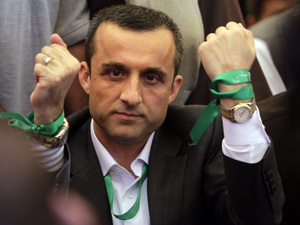
Former NDS chief Amrullah Saleh at anti-Taliban rally in Kabul yesterday

Photograph: Kamran Jebreili/AP

May 5, 2011:
Osama bin Laden death: Afghanistan 'had Abbottabad lead four years ago'

Afghanistan's former intelligence chief says Pakistan's then president Pervez Musharraf angrily rejected Osama hideout tip

By Jon Boone in Kabul
The Guardian

Afghan intelligence believed Osama bin Laden was hiding in an area close to Abbottabad four years ago – but no action was taken after the claim was furiously rejected by Pakistan's president, Afghanistan's former intelligence chief has said.

Agents working for the National Directorate of Security (NDS), the country's intelligence service, worked out that the world's most wanted man must be inside Pakistan proper, rather than the semi-autonomous tribal areas, as early in 2004, Amrullah Saleh told the Guardian. [emphasis mine]

He said they believed Bin Laden must be there based on "thousands of interrogation reports" and the assumption that Osama – "a millionaire with multiple wives and no background of toughness" – would not be living in a tent.

"I was pretty sure he was in the settled areas of Pakistan because in 2005 it was still very easy to infiltrate the tribal areas, and we had massive numbers of informants there," he said. "They could find any Arab but notBin Laden."

Their intelligence became more precise in 2007 when they believed he was hiding in Manshera, a town a short distance from Abbottabad where the NDS had identified two al-Qaida safe houses.

But the former spy chief said that Pervez Musharraf, then president of Pakistan, was outraged at the suggestion that Bin Laden was hiding in such a prominent part of the country.

In a meeting with Musharraf and Hamid Karzai the Pakistani president became furious and smashed his fist down on the table. "He said, 'Am I the president of the Republic of Banana?'" Saleh recalled. "Then he turned to President Karzai and said, 'Why have you have brought this Panjshiri guy to teach me intelligence?'"

He said Karzai had to intervene as Musharraf got increasingly angry and began to physically threaten Saleh.

Afghanistan's former top spy –- who has long been a hate figure in Islamabad among officials who believed he was implacably anti-Pakistani –- also said he had no doubts that Mullah Omar, the leader of the Taliban movement, was hiding in a safe house owned by the Inter-Services Intelligence (ISI), the Pakistani spy agency, in the city of Karachi.

"He is protected by ISI, General Pasha [Lieutenant-General Ahmad Shuja Pasha, director-general of the ISI] knows as I am talking to you where is Mullah Omar and he keeps daily briefs from his officers about the location of senior Taliban leaders; simple," he said.

Saleh was speaking to the Guardian soon after addressing a rally of several thousand Afghans in Kabul organised as a show of strength of what he called Afghanistan's "anti-Taliban constituency" who are alarmed at the prospect of peace talks with insurgents.

The killing of Bin Laden, who was sheltered by the Taliban regime in the 1990s, has prompted heady speculation that an "end game" to the 10-year conflict is now at hand, with the Afghan government and the Taliban-led insurgency striking a deal.

But "deal making" were dirty words to the crowd gathered in a huge tent in Kabul lined with banners saying "We didn't vote for Karzai to make deals" and "Don't sacrifice justice for dealing".

Speeches were interrupted several times by chants from the crowd of "Death to the Taliban! Death to the suicide bombers! Death to the Punjabis!" – a reference to the protesters' view that the Taliban are under the control of the ISI.

Saleh is a burly and comparatively young man who earned the respect of the CIA during his sometimes brutal leadership of Afghanistan's intelligence service. He received a rapturous reception from the flag-waving crowd when he marched into the tent.

[Pundita note: See this Canadian news report about humane NDS treatment of detainees while Saleh headed the intelligence organization. One of the reforms that Saleh introduced to the organization was an emphasis on human rights in dealing with prisoners and carrying out interrogations. See his biography in Wikipedia.]

Saleh lambasted Karzai for calling the Taliban disaffected "brothers".

"They are not my brother, they are not your brother – those are our enemies," he declared, to cheers.

Saleh warned the government that his movement would not remain content with peaceful demonstrations if Karzai did not change course. Later he told the Guardian that if Karzai "sold out in order to bring the Taliban" there would be no choice but to "rise up".

"We have been exposed to a lot of weapons, it is not very difficult to resort to fighting and create influence," he said.

U.S. and Pakistani damage control on Rawalpindi's involvement in terrorism ignores much history

Spin machines are working overtime on two continents in the attempt to limit the fallout from bin Laden's stay in Pakistan. Zenpundit blog's Mark Safranski looks at the Washington side in his May 6 post, Pakistan's ISI on trial in Chicago. He links to my May 4 post on steps the U.S. government has undertaken to downplay the ISI role in an upcoming terrorism trial, then observes:
As Pakistan’s corrupt military-feudal elite scramble to put out smoke after Osama bin Laden was caught and killed in an ISI safe house in Abbottabad and hire K Street lawyer-lobbyists like Mark Siegel at $75,000 a month, there are senior officials in Washington, inside and outside of the DoD, who doggedly championed Pakistan and defended the ISI behind closed doors. These officials, as one DC correspondent in the know related to me, are now looking extremely foolish to their peers, even as they double-down and attempt to salvage a thoroughly discredited policy by spinning hard.

While attention is focused on Washington and Islamabad, Pakistan’s dreaded ISI is quietly going on trial. In Chicago. [...]
Meanwhile, John Batchelor looks at the spin from Pakistan. In a summary of his Thursday-night show's discussion about Rawalpindi's presser on the same date, John notes:
Pakistani military officials discussed the U.S. raid in Abbottabad and its implications for U.S.-Pakistani military-to-military relations during the Corps Commanders' Conference, chaired by army chief Gen. Ashfaq Kayani, the Inter-Services Press Relations department said May 5.

The conference admitted shortcomings in developing intelligence on Osama bin Laden's presence in the country but emphasized that the Inter-Services Intelligence (ISI) directorate's achievements against al Qaeda and others were unmatched; approximately 100 senior al Qaeda leaders or operators have been captured or killed by the ISI, with or without CIA support.

The CIA-developed intelligence on bin Laden based on initial information from the ISI, but it did not share additional information on the case, the statement said. An investigation of the circumstances that led to this situation has been ordered.
A May 6 Wall Street Journal report that Mark linked to in his post mentions that Salman Bashir, Pakistan's foreign secretary, hotly defended Rawalpindi's record on dealing with al Qaeda:
Mr. Bashir pointed out that Pakistan had arrested almost 300 members of al Qaeda either alone or in joint operations with the U.S. since the 2001 invasion of Afghanistan, including 9/11 mastermind Khaled Sheikh Muhammed. In turn, al Qaeda leaders turned on Pakistan, unleashing a wave of bomb attacks on civilian and military targets.

"Osama bin Laden declared war against Pakistan. He launched wave after wave of suicide bombers who killed thousands of Pakistani men, women and children. These were the people who attacked the ISI, who attacked (military) general headquarters, who have attacked mosques and shrines," Mr. Bashir said. "You've got to be a really fantastic spin master to say the ISI or elements of the ISI are involved in this."
Their involvement in such attacks would be news to al Qaeda and to counterterrorism expert B. Raman, who many times over the years detailed the Pakistani-grown organizations that have made war on the ISI and Pakistan's military. (See Raman's May 2009 report for Forbes, An Alphabet Soup of Terror.) Al Qaeda has made certain not to soil its nest in Pakistan. But there is an element in Washington's Thinkistan that is all too willing to back up Bashir's claims. From the WSJ report:
Christine Fair, an associate professor and Pakistan expert at Georgetown University in Washington DC, said Pakistan's "record of helping us with al Qaeda is indisputable."
Indisputable, huh? How about if you and I take a trip down memory lane, Professor Fair? Let's link arms and skip back along a path piled high on either side with bodies of American dead.

The U.S. government paid their counterpart in Pakistan $25 million for Khalid Sheikh Mohammed. They paid $10 for another top al Qaeda operative, Abu Zubaydah.

Then Rawalpindi showed photographs of dead men with beards to the CIA, told them the corpses were al Qaeda operatives they'd killed, and got paid tens of millions of dollars in bounty. Some of those photographs cost the CIA one million dollars a pop.

I don't think being skinned counts as receiving indisputable help, particularly when all signs point to top al Qaeda operatives such as KSM being ISI assets that the ISI sacrificed because they wanted the bounty money to keep themselves in business.

If you'd like to review the bounty program in detail, Professor Fair, you can read my November 2009 post, How the U.S. government built a perpetual-motion war machine in Afghanistan and sacrificed American values in the process

The upshot of the bounty program is that together the U.S. and Pakistan built a kind of perpetual motion machine:
At the end of every complex set of transactions between the CIA and the ISI, yet more enemy combatants materialize, to be rounded up or dispatched, leading to yet more enemy combatants to attack ISAF troops and nation-building efforts in Afghanistan, to be rounded up or dispatched, leading to -- well, last night CNN reported that "Taliban" now control 80 percent of Afghanistan, even though only 7 percent of Afghanis support the Taliban.
No, I wouldn't call that infernal machine "indisputable help." I'd call it a work of evil. The same kind of work that led to Operation Airlift of Evil.

Now let's get down to brass tacks. Christine Fair and other Thinktankistan denizens have spent years shopping the line around Washington that whatever 'alleged' terrorism the ISI engaged in was due to the Pakistani government's fear of India. Odd -- Pope John Paul II didn't look Indian to me, and neither does Kurt Westergaard, the Prophet Mohammed cartoonist -- two high-profile targets of terrorists linked to the ISI.

All this is threatening to come into the light of the U.S. mainstream media once the trial of Tahawwur Hussain Rana gets underway in Chicago because the prosecution's star witness, David Headley aka Dawood Gilani, has already confessed that he worked for the ISI. Which is why the government of the United States of America is moving heaven and earth to downplay Rana's testimony.

Isn't it so, Professor Fair?

For readers who might think I'm picking on to Christine Fair because of that little dustup in 2009 in response to her claim that India was staging provocations in Balochistan, why no. I'm picking on her because of what she told India's Rediff News in response to the dustup:
Fair argued that the massive [U.S.] aid to Pakistan would not "fix Pakistan's chronically neuralgic sense of insecurity vis-a-vis India."
On what recitation of facts about the history of Pakistan's aggression does Fair base her conclusion that Pakistan is insecure about India?

No such facts exist outside the brains of Professor Fair and the host of other South Asia experts whose opinions form the foundation of Washington's Thinktankistan. Another way to put this is to observe that never before has so much American blood been shed because of a complete fantasy.

Wednesday, May 4

U.S. government goes to lengths to shield Pakistan's ISI at Rana trial in Chicago. Once again, keep your eye on the USG's little cat feet.

This follows on my Tuesday post. The quotes I've pulled from ProPublica's latest report on the upcoming trial of Tahawwur Hussain Rana will be upsetting to anyone who believes the U.S.-Pakistan relationship will change in significant fashion in light of the revelation that Osama bin Laden was quartered in a Pakistan garrison town.

The ProPublica report presents clear evidence that all costs, including running roughshod over the American criminal justice system, the United States government will continue to cover for Pakistan's military and intelligence services, as it's done for decades. This is a point I emphasized in the Tuesday post so for anyone who thought I was being unduly pessimistic, read on. And be sure to read the rest of the report at the ProPublica site.

Note from the report that the U.S. "intelligence community" still refuses to look at the Mumbai massacre in the context of the history of Pakistani military-sponsored terrorism and massacres going back decades. The community, at least according to the source ProPublica quotes, still insists that rogue officers, not the ISI institution, were responsible for the massacre in Mumbai.

Before proceeding with the quotes I'll note that ProPublica is an award-winning nonprofit American investigative journalism organization. It's been keeping a close eye on Rana's upcoming trial and other issues related to the 2008 massacre in Mumbai, India -- to my knowledge the only U.S. media outlet that's doing so despite the fact that six Americans were killed in the massacre. Here's the link to earlier ProPublica reports on the issues.

I've also included excerpts from a report posted at the Times of India news website that provide additional details about Rana and his trial.

May 4, 2011, 5:11 p.m.
Pakistan’s Terror Ties at Center of Upcoming Chicago Trial
by Sebastian Rotella
ProPublica

It may be years, if ever, before the world learns whether Pakistan’s powerful Inter-Services Intelligence Directorate (ISI) helped hide Osama bin Laden. But detailed allegations of ISI involvement in terrorism will soon be made public in a federal courtroom in Chicago, where prosecutors last week quietly charged a suspected ISI major with helping to plot the murders of six Americans in the 2008 Mumbai attacks.

The indictment has explosive implications because Washington and Islamabad are struggling to preserve their fragile relationship. The ISI has long been suspected of secretly aiding terrorist groups while serving as a U.S. ally in the fight against terror. The discovery that bin Laden spent years in a fortress-like compound surrounded by military facilities in Abbottabad has heightened those suspicions and reinforced the accusations that the ISI was involved in the Mumbai attacks that killed 166 people.

“It’s very, very troubling,” said Congressman Frank Wolf, R-Va., chairman of the House Appropriations sub-committee that oversees funding of the Justice Department. Wolf has closely followed the Mumbai case and wants an independent study group to review South Asia policy top-to-bottom.

“Keep in mind that we’ve given billions of dollars to the Pakistani government,” he said. “In light of what’s taken place with bin Laden, the whole issue raises serious problems and questions.”


Three chiefs of Lashkar-i-Taiba [LeT], the Pakistani terrorist group, were also indicted in Chicago. They include Sajid Mir, a suspected Mumbai mastermind whose voice was caught on tape directing the three-day slaughter by phone from Pakistan. Mir, too, has links to the ISI. He remains at large along with the suspected ISI major and half-a-dozen other top suspects.

Despite the unprecedented terrorism charges implicating a Pakistani officer, the Justice Department and other agencies did not issue press releases, hold a news conference or make any comments when the indictment was issued last week. The 33-page document names the suspect only as “Major Iqbal.” It does not mention the ISI, although Iqbal’s affiliation to the spy agency has been detailed in U.S. and Indian case files and by anti-terror officials in interviews with ProPublica over the past year.


“Obviously there has been a push to be low-key,” said an Obama Administration official who spoke in an interview last week and requested anonymity because of the pending trial. “There is a desire to make sure the handling of the case doesn’t mess up the relationship” with Pakistan.


The first public airing of the ISI’s alleged involvement in the Mumbai attack will begin on May 16 with the trial of Tahawwur Rana, owner of a Chicago immigration consulting firm. Rana was arrested in 2009 and charged with material support of terrorism in the same case in which the four suspects were indicted last week. The star witness will be David Coleman Headley, a Pakistani-American businessman-turned-militant who has pleaded guilty to scouting targets in India and Denmark. Rana allegedly helped Headley use his firm as a cover for reconnaissance.

Rana’s attorney, Charles Swift, contends that Rana is not a terrorist because he thought he was assisting the ISI with an espionage operation. Swift said the U.S. indictment omits the ISI in hopes of mitigating tensions. [emphasis mine]


“The U.S. is attempting to walk a fine line between disclosure and non-disclosure,” Swift said.

“What’s unusual is that the reason is to protect diplomatic relations... This indictment answers a few questions, but like everything else in this case, it raises even more.”

Even before the bin Laden slaying, the Obama Administration had taken a tougher tone about the ISI’s alleged links to militants. But a U.S. official said this week that U.S. counter-terror agencies still think that any involvement in the Mumbai attacks was limited to rogue officers.


“No one is saying we can’t work with the ISI -- people are just pointing out the problems that exist,” said the official, who requested anonymity because of the sensitivity of the issue. “I think the problems are largely with individual officers as opposed to the institution.”

[...]
May 5, 2011, 12:58 a.m. IST
26/11 co-accused Tahawwur Hussain Rana arraigned in Chicago court
PTI via Times of India

CHICAGO: Pakistani Canadian Tahawwur Hussain Rana, the co-accused in the Mumbai terror attack case, has been arraigned for the trial that is set to begin on May 16.

Clad in an orange jumpsuit, Rana appeared in the Dirksen Federal Courthouse looking around and exchanging pleasantries with his attorneys.

Rana's attorney Patrick Blegen told Judge Leinenweber that he required time to translate about a 1000 pages of Urdu text in preparation for the trial set for May 16.

The next status hearing is set for May 11, after which there will be jury selection.

Opening statements by both the prosectors and defense willl be presented on May 23.

While co-accused David Headley has pled guilty in plotting the carnage, Rana has pled not guilty in providing material support to the attack.

Rana was indicted by a federal grand jury under 12 counts on Feb 15 last year for planning out the carnage, providing material support to LeT to carry out the bombings, and guiding Headley in scouting targets in Mumbai in the process.

Headley, who was originally Daood Gilani, changed his name in order to carry out the carnage without being caught.

Rana, who had served as a doctor in the Pakistani Army Medical Corps, before he migrated to Canada, is also accused in plotting an attack with Headley on a Danish newspaper Jyllands-Posten that published blasphemous cartoons of Prophet Muhammad.

If convicted, Rana faces a possible life sentence. On April 25, in a second superseding indictment, US prosecutors charged four additional men, all Pakistani residents, in the 26/11 terror attacks that left 166 dead including six Americans.

According to court documents filed on May 2, Rana objected to government's jury instructions and said that the government understates the benefits that Headley has received from the government in this case.

As made clear in Headley's plea agreement, Headley is also avoiding extradition to India, Denmark, or Pakistan for his conduct, "so long as he fully discloses all material facts concerning his role with respect to (his) offenses and abides by all other aspects of (the plea agreement)".

Furthermore, Headley received numerous small benefits from the government during his post-arrest interview and proffer sessions normally not provided to those in custody, including hotel accommodations, specially arranged meals, and visits and phone calls with his wife and children, the documents state.

"The devils look the same, no matter the era"

May 4:
Osama Bin Laden's killing caused WABC evening host John Batchelor to cut World War II coverage short
BY David Hinckley
DAILY NEWS STAFF WRITER

WABC evening host John Batchelor was in rural Poland, covering commemorative events at the site of the World War II Auschwitz and Birkenau death camps, when word came late Sunday evening that Osama Bin Laden had been killed.

This was particularly significant to Batchelor because he started his career at WABC (770 AM) on Sept. 12, 2001, pledging to stay on the station until Bin Laden was captured or killed.

So Bin Laden too, Batchelor says from Poland, is his story - and in many ways, he sees Bin Laden as the same story he is covering in the stark, crumbling remains of Auschwitz.

"The stories of Auschwitz and the Hitlerite SS and 9/11 and the jihadists join together for me," he says. "Hitler living in the Führer bunker under the Reichsministry in 1945 and cursing 'International Jewry' in his last will on April 29, 1945. Bin Laden living in a bunker-built compound near a golf course and cursing the Jews and Crusaders with his last videos.

"Two murder cult figures self-poisoned by hatred of Judaism."

Batchelor had traveled to Poland to do two nights of his WABC show from the Auschwitz-Birkenau site. He was covering the annual March of the Living, launched a quarter-century ago as part of Holocaust Remembrance Day on May 1.

But when the Bin Laden news hit, says WABC program director Laurie Cantillo, modern technology enabled him to quickly integrate Bin Laden news, analysis and response into his program. By the time WABC had carried President Obama's Sunday night speech, Batchelor had lined up response at home and abroad.

When his show ended, he joined WABC "Red-Eye Radio" host Doug McIntyre for further analysis.

WABC wasn't the only radio station to carry the speech and analysis. News stations WCBS-AM, WINS and WNYC were there, along with WRKS and others.

It shows, Cantillo says, that even at this most "off" of off-hours, news can happen. It shows that even in the age of 24-hour TV news, Twitter, Facebook and e-blasts, good radio stations can pull it all together with unique immediacy.

Batchelor says good radio, like with covering the Bin Laden raid, is simply a product of working hard and being ready.

"This show staff works together perfectly," says Batchelor, "even on Tieline remote from the banks of the Vistula in medieval Krakow."

Batchelor admits he wasn't sure Bin Laden would ever be apprehended. But now that he has been, Batchelor and Cantillo say he will be extending his WABC stay - because just as the death of Hitler didn't eradicate evil, neither will the death of Bin Laden.

"The devils look the same, no matter the era," Batchelor says. "Now there are other new devils to capture or kill. ... One devil down, many to go, so little time."

Canada makes real economic progress; meanwhile U.S. corporations flee to quaint medieval town in Switzerland to avoid fate of Golden Goose


Bloomberg, May 4:
Canada Seen Rebounding as Currency of Choice With Harper Winning a Mandate
By Simon Kennedy and Theophilos Argitis

Investors worldwide have a reason to make Canada the economy of choice after Prime Minister Stephen Harper’s decisive election earlier this week ratified policies that helped the government outperform most of its peers among the Group of Seven industrialized countries.

After the Conservative Party won the first majority in the Ottawa-based House of Commons in seven years, Harper vowed to fulfill his pledge to eliminate the budget deficit by 2014 and cut corporate taxes and spending.
[...]
“Canada is a poster-child for the rest of the G-7,” said Jim O’Neill, chairman of Goldman Sachs Asset Management in London, who remembers lamenting the state of the economy when he entered banking three decades ago. “They have commodities, links to growth-driving economies such as China and very solid policies and governance. It’s hard to pinpoint what its immediate challenge is.”
[...]
Harper sought re-election on a plan to maintain reductions in corporate tax rates for companies such as Royal Bank of Canada and Barrick Gold Corp. (ABX) that would cost the government more than C$6 billion in revenue next year. He argues lower taxes are needed to sustain the recovery and generate jobs.
[...]
There's lots more riveting news in the Bloomberg report about Canada's economic prospects but I wanted to stop at the point about reductions in corporate tax rates to ask if you saw a 60 Minutes segment aired on March 25 titled A look at the world's new corporate tax havens. It's about the flight of U.S. corporations to avoid a killer tax rate. Many have settled in a "quaint medieval town in Switzerland call Zug."

The details brought out in the 60 Minutes interview are a nightmare. We're hemorrhaging jobs here in the United States because the federal government with backing from Congress is determined to kill the goose that lays the golden egg.

If you haven't seen the segment and think you know how dire the developing situation is with corporate flight, you might be in for a shock. Here's the CBS 60 Minutes transcript or watch the video of the segment, also posted at the same CBS website.

Tuesday, May 3

Pakistan: May 1 killing of Osama bin Laden and May 4 arraignment of Rana in a Chicago court. Keep your eye on the little cat feet.

"Thanks" is a paltry word to convey my happiness with President Barack Obama, the Central Intelligence Agency, U.S. Navy Seals and all others who were directly involved in tracking down bin Laden and bringing him to justice.

However, I would be even happier if Operation Geronimo had been carried out just a tad earlier so as not to distract press attention from the arraignment of one Tahawwur Hussain Rana.

I know, I know; so little time, so many terrorist names to keep straight. But you remember my April 22 post about Rana and Admiral Michael Mullen; right? Rana is the terrorist who from all indications is planning on singing in a U.S. criminal court about his involvement with Pakistan's Inter-Services Intelligence agency (ISI).

If Rana is not somehow persuaded to keep his mouth shut at his trial, which starts May 16, this is going to be extremely embarrassing to the White House, U.S. Congress, CIA, State Department, Pentagon and in particular highest-ranking U.S. military officers, such as Mullen, who have been covering for the ISI and Pakistani military.

Some indication of just how embarrassing things might get can be gleaned from counterterrorism expert B. Raman's description of U.S. machinations to head off Rana in court. From Raman's April 28 paper titled Incriminating Spotlight on ISI in the US:
1. Pakistan’s Inter-Services Intelligence (ISI) Directorate has come under incriminating spotlight in the US as a result of the ongoing judicial proceedings in a Chicago court against Tahawwur Hussain Rana of the Chicago cell of the Lashkar-e-Toiba (LET) in connection with the 26/11 terrorist strikes in Mumbai and certain leaked WikiLeaks cables relating to the interrogation of Al Qaeda suspects detained at the Guantanamo Bay detention centre in Cuba.
[...]
5. In a supplementary indictment to the main indictment against Rana filed before the Chicago court on April 25, 2011, the FBI has for the time given the identifying particulars of LET members A, B, C and D, but not Person A. They have been sought to be prosecuted along with Rana for their role in the 26/11 terrorist strikes. By combining the trial of these four persons with the trial of Rana, the FBI seems to be trying to highlight the role of the LET and to undercut the expected defence of Rana that he had helped the ISI and not the LET.

[See this April 27 Sify report for the names mentioned in the indictment].

6. One has strong grounds for suspecting that the belated decision of the FBI to disclose the identities of these four persons and try them along with Rana is meant to help the ISI in avoiding any embarrassment due to its role in the 26/11 terrorist strikes.

The US intelligence [establishment] may have many differences with the ISI because of its perceived non-cooperation against Al Qaeda, the Jallaludin Haqqani network and the Afghan Taliban, but it is not prepared to initiate any action against the ISI for its role in the 26/11 terrorist strikes.
Raman tactfully avoids mentioning for emphasis that if Americans don't want to properly investigate the ISI connection to the 9/11 attacks and a host of other terrorist attacks on Americans, we're sure as heck not going to lose sleep about the ISI connection to the massacre in Mumbai.

But just to review and reflect on the proximity of the May 1 U.S. operation against bin Laden, who'd been lounging around for years right under the nose of Pakistan's military, to the May 4 arraignment of Rana, how about if we take a walk together down memory lane? I know this will be a boring exercise for readers with encyclopedic knowledge of the war on terror but bear with me.

Let's start in the Philippines. In his May 2 report for GMA website titled, United by plot: John Paul II rises, Bin Laden falls on same day, J.M. Tuazon points out that Pope John Paul's beatification and bin Laden's death happened on the same day, then he goes on to review the history of al Qaeda-linked terrorist plots to assassinate the pope and al Qaeda's activities in the Philippines.

Tuazon doesn't specify motivation for the plots against the pope but he doesn't have to; the facts speak for themselves. Pope John Paul was targeted for one reason and one reason only: he was the world's most visible symbol of Christendom:
On two separate occasions, Osama bin Laden’s international terrorist network, al Qaeda, was linked to plots to assassinate the late Pope John Paul II, hatched in the Philippines no less.

Khalid Sheikh Mohammed, one of Bin Laden's lieutenants, had planned to kill the late pope during the pontiff’s 1995 World Youth Day visit to Manila.

The plot called for planting a pipe bomb at the altar in Luneta Park, where the Pope was set to celebrate Mass, and have al Qaeda snipers deployed around the area to “shoot randomly at those fleeing the carnage."

The 1995 plot, however, was foiled after a fire gutted the Josefa Apartments along Quirino Avenue in Manila, where he and nephew Ramzi Yousef had taken quarters. [The fire was started by Yousef when he accidentally detonated a bomb he was making in his apartment.]

Their next plot was an extraordinary and historic success.

Mohammed and Yousef were instrumental in carrying out the September 11 attacks on the World Trade Center, as they hatched the idea of using aircraft and flying them into the twin towers of New York City.

Mohammed’s conspiracy of a second attempt at assassinating the pope, meanwhile, was hatched in 1999 but was also thwarted following the cancellation of the pontiff’s trip to Manila for health reasons.

“Documents found in a block of flats in Karachi, Pakistan, used as a hideout by Mohammed show that he visited the Philippines on a number of occasions to finalize details for the assassination attempt," [a London Times report] said.
[...]
The Times report, published in November 2002, mentioned that news of the 1999 plot against the pope had been suppressed, presumably on orders from the Vatican, until after the 9/11 attacks.

There has been quite a bit of suppression of facts relating to al Qaeda's activities; Tuazon's trip down memory lane, coupled with a 2006 investigation launched by a U.S. House of Representatives committee, underscores this. In his January 2, 2007 report on the investigation Robert Longley, writing for About's Guide to U.S. government news, notes:
Foreign terrorists, including al-Qaeda operative Ramzi Yousef, may have played a role in the 1995 Oklahoma City bombing, according to an oversight investigation [PDF] by the House International Relations Committee.

In his report The Oklahoma City Bombing: Was There A Foreign Connection? International Relations Committee chairman Dana Rohrabacher (R - California), presents evidence suggesting that Timothy McVeigh and Terry Nichols may have been assisted in the bombing of the Alfred P. Murrah Federal Building by "Middle Easterners" and "a German national living at an extremist compound in eastern Oklahoma."

The bomb exploded in front of the Murrah Building on April 19, 1995, killed 168 people, including 19 children, and injured countless others. To date, Timothy McVeigh and Terry Nichols remain the only persons convicted of the crime. McVeigh was executed by lethal injection on June 11, 2001. Nichols is now serving a life sentence in a Florence, Colorado supermax prison.

Throughout his trial and appeals, McVeigh contended the FBI had concealed evidence that he and Nichols had actually acted as part of a larger group of conspirators.

Rohrabacher's committee presents extensive, "yet in some cases circumstantial," evidence establishing a relationship between Terry Nichols and Ramzi Yousef, the al-Qaeda terrorist convicted of carrying out the 1993 World Trade Center bombing.
[...]
Rohrabacher also finds fault with the Justice Department for both its failures in the initial investigation of the Oklahoma City bombing and for what the committee call its current "lack of willingness" to examine the many question raised in the committee's report.
Rohrabacher wasn't the only one who found fault with the DOJ, and more fault can surely be found somewhere in that mishmash of agencies that were subsumed after 9/11 into a behemoth called the Department of Homeland Security. The dust had barely settled on the Murrah building explosion when credible links to al Qaeda and Saddam Hussein were uncovered by independent investigators, links that were never fully explored by the FBI and other U.S. security agencies.

All that says nothing about the U.S. failure to properly investigate the links between the murder of Wall Street Journal reporter Daniel Pearl and Pakistan's military, between Khalid Sheikh Mohammed and the same military, and between the same military and the 9/11 attack on the United States. And it says nothing about the laxity of successive U.S. administration in clearly establishing the Pakistani military's connection to its fig-leaf called the ISI.

Yet in July 2004, in a strongly-worded editorial published in the (U.K.) Guardian, British Labor MP Michael Meacher called out the U.S. government for its reluctance to thoroughly investigate Pakistan's role in the 9/11 attack and Pearl's murder in Pakistan while Pearl was investigating ISI links to 9/11.

Meacher observed that to a great extent the ISI was a creation of U.S. aid money and noted:
Another person who must know a great deal about what led up to 9/11 is Khalid Sheikh Mohammed, allegedly arrested in Rawalpindi [the Pakistani garrison city] on March 1 2003.

A joint Senate-House intelligence select committee inquiry in July 2003 stated: "KSM appears to be one of Bin Laden's most trusted lieutenants and was active in recruiting people to travel outside Afghanistan, including to the US, on behalf of Bin Laden."

According to the report, the clear implication was that they would be engaged in planning terrorist-related activities.

The report was sent from the CIA to the FBI, but neither agency apparently recognised the significance of a Bin Laden lieutenant sending terrorists to the US and asking them to establish contacts with colleagues already there.

Yet the New York Times has since noted that "American officials said that KSM, once al-Qaida's top operational commander, personally executed Daniel Pearl ... but he was unlikely to be accused of the crime in an American criminal court because of the risk of divulging classified information".

Indeed, he may never be brought to trial.
By gum it turned out Mohammed will indeed never appear in a U.S. criminal court. And even though he'll be greatly hampered by what he can say before a U.S. military tribunal the U.S. government is still dragging its feet about allowing him a day in court.

So I wouldn't hold my breath waiting to learn whether the U.S. Congress will cut off aid to Pakistan's military if investigation turns up that the military was knowingly harboring Osama bin Laden. It's already been made crystal clear that no such cut-off will occur. From a report today by the Associated Press:
[...] "For those who want to cut off aid to Pakistan, I understand your frustration," said [Republican] Senator Lindsey Graham.

"But at the end of the day, if you want to create a failed state in Pakistan, one of the best things to do is sever relationships. It is not in our national security interest to let this one event destroy what is a difficult partnership but a partnership nonetheless."

The Obama administration pushed back on talk of punishing Pakistan.

White House spokesman Jay Carney told reporters Tuesday that the U.S. is committed to cooperating with Pakistan despite questions about who in the Islamabad government may have known that bin Laden was in hiding in his compound in Abbottabad.

"We don't know who if anybody in the government was aware that bin Laden or a high-value target was living in the compound. It's logical to assume he had a supporting network. What constituted that network remains to be seen," Carney said. "It's a big country and a big government and we have to be very focused and careful about how we do this because it is an important relationship." [...]
Thank you for feeling our pain, Senator Graham. But a relationship in which a governments pays another military to massacre the government's own troops is best not characterized as "important;" I'd call it an evil unparalleled in the history of warfare, but that's just me.

Moving along, see B. Raman's post about John Brennan's May 2 presser about Operation Geronimo; Raman pulls out exchanges that pertain specifically to the implications of bin Laden living in a garrison town.

If the U.S. government doesn't want to come out and say that Yousef and KSM were Pakistani military assets until they were no longer useful, I will say it. A great many others have said the same; indeed, one can't claim even a passing familiarity with the U.S. war on terror without drawing the same conclusion.

So let's get down to brass tacks, shall we? The mess did not start with 9/11. It started in the late 1940s, at the inception of Pakistan as a sovereign nation. Since that time the U.S. government has been so deeply involved in the machinations of Pakistani's military that there are offices in the Greater Washington, DC region where you don't dare open a closet if you don't want a pile of skeletons falling on you.

B. Raman's May 3 post nails it:
Pak Perfidy will have no enduring impact on its ties with US
[...]
7. There is already an exercise on in the US State Department to respect the sensitivities of Pakistan, to spare it of any undue embarrassment and to avoid any punitive action against it.

8. Yes, tough questions are being asked. They will continue to be asked. Pakistan is embarrassed, but not unduly worried over these tough questions because it knows from the long history of its relationship with the US that tough questions are rarely followed by tough action against the State of Pakistan.

9. Yes. Some actions were taken in the past against some individual officers on the insistence of the US. As against Lt.Gen. Javed Nasir, the Director-General of the ISI, in 1993, who was sacked because of his alleged collusion with the Afghan Mujahideen. As against Lt. Gen.Mahmood Ahmed, another DG of the ISI, in 2001 because of his suspected collusion with the Afghan Taliban. Nasir was sacked by Nawaz Sharif, the then Prime Minister. Ahmed was shifted out of the ISI by Gen.Pervez Musharraf.

10. That is all. Once action was taken against senior officers of the ISI, US-Pakistan relations were back to their normal state of pampering.

11. History is going to repeat itself now after the death of OBL at Abbotabad. One or two senior officers of the Army and the ISI will be identified by the US as responsible for the collusion. The US will ask for their heads. Pakistan will happily offer their heads.

12. The State-to-State relations will be back to their sickening normalcy. The pampering of Pakistan will resume. The exercise to feed and fatten the Pakistani Army and intelligence will resume.
[...]
If any of this pampering was tactically necessary for the U.S. effort in Afghanistan one might scrape up a rationale for it. But as the U.S. operation against OBL demonstrated, it's not.

Monday, May 2

There is no contraption: Sathya Sai Baba and the Spitball, Part 3

Here are links to the first and second parts of this essay.

Sathya Sai Baba in his mid-50s, during the time I stayed with him, 30 years ago


The white objects are letters he's holding in his hand. Many simply prayed to him for help but those who liked to put their requests and thanks to him in letters would offer them to him as he passed near them in the darshan line. He didn't accept all letters, which often prompted the authors to re-think and reformulate their request or decide that his answer to a request was "No" or "Wait."

The letter ritual also served a practical purpose. Silence was to be observed while Sai Baba gave darshan unless he inititated a conversation, which wasn't an easy rule to enforce if people sitting on the darshan line had a very urgent request. So instead of calling out to Baba, they could hold up a letter.

Regarding his hair style -- while it's unremarkable to moderns it scandalized Indian society in the 1940s and continued to do so for many years. By leaving his hair au natural, i.e., by refusing to slick it down with pomade or oil to hide that it was the hair of someone with African heritage, he was flying in the face of color prejudice on the Indian subcontinent, which first the Mogul rulers then the British Raj had exploited.

While the society that Sai Baba was born into in 1926 could accept Yogis, saints and 'miracle workers' who had swarthy skin, white or a tasteful shade of blue was (and still is) the color used to depict the skin of a god and human avatars of Vishnu, the god representing preservation, and the gods are never represented with frizzy hair. So Indians rolled their eyes in mortification and exasperation when the swarthy-skinned, frizzy-haired Sathya Sai Baba announced that he was the latest avatar of Lord Vishnu and the embodiment of the god of destruction, Lord Shiva, and in fact the embodiment of the lord of the entire freakin' universe.

If only the lord of the universe would use hair pomade, was the thought of many early Indian devotees of Sai Baba.

Yet Sai Baba's decision to leave his hair in its natural state shouldn't be seen as the vanguard of the 'Black is Beautiful' movement; it was to announce that he intended to restore what was beautiful about the ancient past -- a past in which sages didn't pay attention to the state of their hair.

A good metaphor to describe India when Sathya Sai Baba arose is the story of how residents of a village called Harappa used perfectly uniform bricks they found lying around in some old ruins to build with. The same bricks were found and used as ballast in 1856 by the British engineers John and William Brunton, who were tasked with laying the East Indian Railway Company line connecting the cities of Karachi and Lahore.

Those bricks and those old ruins turned out to be part of the incredible Indus Valley Civilization. Serious excavations didn't start until the 1920s but as more of the civilization was dug up linguists, historians, archeologists, anthropologists, religious activists and everyone else with a nag in the race squabbled about the enthnicity, language, religion and genesis of the civilization. (The squabbles continue to this day.)

The use of building materials from an ancient civilization to shore modern structures was the story of India's life, where the artifacts and rituals of ancient times were manifested in the present but with their true meanings long forgotten.

The task is always to rescue the best of the past and leave behind the rest. Yet this restoration project takes precise knowledge of the ancient truths and the ability to demonstrate to human nature that amidst the riot of wise men and religious sects, all purporting to possess the truth of truths, the restorer has the requisite knowledge. Human nature, which delights in deflating a know-it-all, is not as easy a sell as many would believe.

Once, a ranking monk in a Vajrayana Buddhist lineage mocked Sathya Sai Baba's materialization of objects. The monk told me that any garden-variety Yogi could perform the same feats. Then, waving his hand in imitation of the circular motion that Sai Baba often made to presage a materialization he told me, "I can do the same things if I practice."

Let him try to practice this:

Pandemonium in the Abode of Perfect Peace

When all the chits had been drawn a volunteer nodded at me after I showed that I held the chit with Number 1. I stood and the rest in my row followed as another volunteer ushered me onto the temple grounds to the Block A area I described in the first part of this essay. Block A was formed at a right angle to the temple. As I was the first person in line there would be no one sitting on my right. I sat down cross-legged on the sand. Lynn, who'd been the second person in line after me, took her seat to the left of me. Then we waited for the rest of the darshan lines to enter the grounds and settle themselves.

"He's looking at you," whispered Lynn.

That he was. After walking out of the temple Sathya Sai Baba had spent an unusually short time speaking with visitors seated on the temple's verandah, then he'd turned and looked straight at me. Then, instead of heading for the men's side of the darshan lines as was his usual routine, he'd stepped off the verandah on the women's side. Then with an exaggerated slow walk he'd headed in my direction, his jaws working.

Lynn hissed, "What's he chewing? Betel nut?"

"No."

Sai Baba's cheeks distended as he worked his tongue around what was clearly a big wad of something in his mouth, while all the time he slowly sauntered toward where I was sitting.

Lynn giggled, "Oh no!"

"Oh yes."

"He wouldn't!"

"Yes he would."

"You still have time to leave," she whispered.

"I'm not going to let him run me off the darshan line; besides, he'll just clip me in the back with it if I turn and run."

"What are you going to do then?"

"When he throws it I'll fall to my right," I whispered. That meant the woman behind me would get the spitball between the eyes but that would be Sai Baba's problem.

Sai Baba's saunter had slowed to a snail's pace as he busied himself with the wad in his mouth, which seemed as big as a golf ball. I began to lose my nerve.

"I can't watch this anymore or else I'm going to run," I whispered to Lynn. "Do me a favor. I'm going to close my eyes. When he starts to throw the spitball say, 'Duck!' and I'll fall out of range."

"Okay."

"Make sure you watch him like a hawk because he'll be quick with the throw."

With the plan in effect there was nothing to do but wait.

"It looks like he's finished mashing it up."

I hadn't asked for the blow-by-blow but I didn't want to distract the lookout by saying anything.

"He's raising his arm. Now he's putting his hand to his mouth -- DUCK!"

I flung the upper part of my body onto the sand to my right but I wasn't quite quick enough. I still had my eyes shut but I could feel the spitball, which felt much smaller than a golfball, bounce off my shoulder and land in my lap.

At that second a bird flew directly above and dropped what must have been a terminal load of diarrhea on my head.

As the runny poop oozed onto my face I tried, all at the same time, to shriek for help, shriek at Sai Baba and shriek at Lynn to get the spitball off me.

I was dimly aware that pandemonium had broken out in Block A as everyone tried to discover what was happening in the front row of the darshan line.

"This isn't a movie! I am going to be blinded by bird shit -- get that spitball off me," I yelped with my eyes still squeezed shut.

The darshan line sprang into executive action. Lynn grabbed the spitball and I felt myself being lifted by several hands then led off the temple grounds amidst much sympathetic clucking. I was led to a fountain, where Indian ladies took turns sacrificing clean handkerchiefs to the chore of cleaning the shit off my face while I vented my rage.

"The lord of the universe is a two-year old," I sputtered. "This explains everything."

"What's going on?"

Victoria's voice. Lynn started to explain then the laughter she'd been struggling to swallow burst into gaffaws.

"It's not one bit funny. Throwing a spitball at an innocent woman on his own temple grounds," I snapped.

Through laughter that sounded oddly close to sobs she cried, "Here is the spitball Sai Baba threw at you. Look at it! Look!"

When I wouldn't open my eyes she grabbed my hand and thrust something into it while crying out, "Look! It's candy! A sweet for the sweet!"

I opened my eyes a slit. There was a piece of candy in a prettily-decorated cellophane wrapper.

"Was there any spit on it?"

"There was no spit on it! He must have palmed it or materialized it at the last second," she cried. "There was no spitball! He faked you out," and with that she doubled with laughter. The laughter was tinged with an emotion I couldn't place.

Lynn and Victoria walked me to my room then I agreed to meet them at Raju's after I'd cleaned myself up.

From one nonexistent spitball many lessons

As I washed my hair, bathed and changed into clean clothes I pondered the incident on the darshan line and reviewed the events leading up to it.

Victoria had arrived late for darshan, as usual, and as usual stood behind the low wall that separated Block A on the temple grounds from the rest of the ashram. But by then people in the back rows of Block A had jumped up to see what was happening at the front, blocking her view.

So by doing things her way and flouting the rules for darshan attendance she'd missed out on an incident which involved her to some extent. Moreover, she'd missed seeing Sathya Sai Baba in a very rare mood. During his youth he'd been a prankster but while he'd retained his sense of humor he'd showed it less and less on the darshan lines in recent years.

More importantly, she had missed the satisfaction of seeing that Sai Baba had agreed with her point that my joking had gone too far. Just as I'd told her that I'd only been joking about throwing a spitball at Sai Baba, so he'd demonstrated during the morning darshan that he was only joking about throwing a spitball at me. Yet he'd given a graphic demonstration that such misplaced and malicious joking could have untoward results.

Victoria also learned from hearing about the incident that her view of Sathya Sai Baba needed revising. She'd spoken of his physical form as a mere place-marker for the divine and dismissed as boring his daily interactions with people. Because of those views she'd spent her time in India listening to second- and third-hand accounts of him, gleaning information about life in his ashram from insider gossip, and reading books about him.

So while Vicky knew a thousand stories about Sathya Sai Baba virtually none of her knowledge came from her own experiences with him. This meant she had gained little direct knowledge of the spiritual truths Sai Baba taught; she'd relied instead on the writings of mystics and philosophers to guide her.

And by refusing to interact with Sai Baba on a personal level, Vicky had robbed herself of the opportunity to establish trust in his judgment The ability to trust another comes from repeated interactions with the person. But her intellect had quashed her intuition and sapped her of direct experience, thus rendering her ability to trust Sathya Sai Baba into a very small and frail boat to carry her through the storms of life. Now her time with Sai Baba was coming to an end; family matters would soon return her to England.

Lynn for her part had learned from the morning's darshan that she'd assigned Sathya Sai Baba a role in her life that was not necessarily correct. Believing her Karma to be very bad, she'd decided -- on the basis of zero empirical evidence -- that the way Sai Baba would help her work through the pile of shit that her presumed bad deeds in past lives had created for her was to mete out punishment while she stayed with him.

My assumption that Sai Baba would punish me for being disrespectful had prompted me to take a defensive action with the result that I got pooped on. So, Lynn saw with her own eyes what could happen when one expected the worst from Sai Baba and acted in accordance with the expectation.

And her view of Sai Baba as an impersonal engine of justice overlooked the person she was in her present incarnation. She was clearly someone with enough conscience to fear the doing of evil and to so regret any presumed evil done in past lives that she meekly submitted to what she believed was her bad Karma manifesting in demonic attacks on her while she slept.

As with Victoria, Lynn's view of Sathya Sai Baba had very effectively limited his approach to her by creating a kind of false idol of Sai Baba and putting faith in it. On the darshan line that morning Lynn saw that the real Sai Baba was marvelously astute at distinguishing between a deed done with the intent to harm and a thoughtless deed. And that he was very creative at devising a punishment that precisely addressed a misdeed while recognizing the person's good qualities and true intentions. Thus, the candy. "Sweets for the sweet."

There was another lesson for Lynn in the incident although it was not immediately evident to me. The ax had fallen very close to her, so to speak. Lynn wouldn't have thought to disrespect Sai Baba by joking about throwing a spitball at him, yet she'd laughed at my joke and gone along with it because of her friendly feelings toward me. The friendliness had ended up making her a party to the incident.

Later I learned that Lynn had a tendency to ignore her better judgment in order to 'get along' with someone she was friendly with. This revelation was the best answer to her worry that Sai Baba would wreak punishment on her for evil deeds in her past lives. He could punish her so thoroughly it would wipe out all her bad Karma. But unless she made efforts to change, the tendencies that had led to the bad Karma would land her right back in the soup.

This was a point Sathya Sai Baba stressed in his teachings and gave as answer to people who pleaded that he intercede more in 'worldly' affairs to stop evil in its tracks. He said that the appearance of previous avatars had been accompanied by epic wars in which good and evil battled it out with much bloodshed. He said that this time around there was so much evil afoot that all were touched by it, so that the epic war was now within each person, with the heart serving as the battlefield if the individual struggled to improve his character.

He promised that just as the avatar Lord Krishna had served as the humble charioteer to General Arjuna in the epic war recounted in the Mahabharata, so he would use his vast powers to aid and protect anyone who made sincere efforts to reform his character.

I found several lessons for myself in the spitball incident. The one that rose to the top, but only in retrospect, was that I placed more stock in my intelligence and experience than anything else. This could be a very grave problem when I didn't leave room for considering factors I hadn't been able to predict.

I'd never heard of anyone on the darshan line getting pooped on by a bird. Those were very respectful birds, so to speak. And the bird that shit on me actually hadn't pooped on anyone in the darshan line; it was just that I'd thrown part of my body outside the line. Therefore, an event I couldn't predict had skewed my plan to dodge what I assumed was a spitball.

Given the precision of the bird's strike and the amount of poop and the context in which the strike occurred, this was not a random event; it was Sai Baba's leela. The leela was a dramatic illustration that I'd thought of everything by way of evasive action except what I would have deemed an extremely unlikely event if I'd thought about it. Yet the likelihood of the event was so remote I hadn't thought about it.

For reasons I didn't understand at the time, Sathya Sai Baba was determined to get that particular lesson across to me, and he repeated it in variations throughout my time with him. Twenty years after the spitball incident, at a moment that was beyond the eleventh hour -- at one minute to midnight, so to speak -- I suddenly grasped the full import of the spitball incident and the lesson about the peril of discounting the unlikely in certain situations. Thus, a great tragedy that would have involved many people was averted.

The Macrocosm in the Microcosm

There were generic lessons embedded in the spitball incident as well. And it served as a demonstration that Sathya Sai Baba could compress the macrocosm of his teachings into the microcosm of a mundane event, and that he could do this without recourse to dogma. This allowed very different psychological types and intellects to benefit from the same teaching.

This was the way the wise ones taught in the old days, the really old days, before literacy. And even after writing came into existence they still didn't rely on the spoken word, which can so easily be misinterpreted by the hearer. They communicated teachings in the language of the heart, at a deeply intuitive level. No 'initiations' were required for such teachings, no transmission of special energy, etc. No faith in the guru was required; no dogma was necessary. All it took was the student's determination to pay close attention to the teacher and the ability to muster patience -- two qualities in shorter and shorter supply as the eras have unfolded.

This is not to say that Sathya Sai Baba didn't teach in words and writing. He spoke oceans of words over the course of his lifetime and wrote countless letters to devotees. But he taught me in the ancient tradition and anyone else who mustered the patience to learn in that way. In my case his teaching style was a great gift because eventually I met the person who would be my main guru is this lifetime and he spoke far fewer words to me than Sai Baba did.

In fact, that teacher made a Zen master look like a chatterbox. If you didn't get it the first time that was too bad. And there were no recordings, no video, nothing to download from the internet, no books, no chat rooms where you could ask others what they thought a teaching meant. So if not for the concentrative power and patience I gained by learning from Sai Baba I wouldn't have been able to benefit from the guru's teachings.

(The guru looked as Lynn had described him, for those who read the second installment of this essay.)

And as with Sai Baba, when my time with that teacher was up, it was up. In the old school, there was no hanging around the guru for decades, asking for ever more teachings while not bothering to absorb even Lesson One.

Sathya Sai Baba had many functions in addition to teaching, yet time and again I heard people on the darshan line ask him for a teaching. Darshan was one big school, and class was always in session from the moment Baba stepped out of the temple.

There is No Contraption

The next morning Victoria joined Lynn and me on the darshan lottery line.

I couldn't resist saying, "Welcome to the party."

From that morning on, Vicky sat in the darshan line along with the rest of the proles. It was a good thing she did. Sai Baba's rare mood continued for a few weeks, and during that time the men's side of the darshan line looked on in envy as the women's side rocked with laughter.

In those days at least, in that part of India, rural Indians didn't think much of laughing aloud; I think they tended to associate it with mental instability. But Sai Baba's evoking of uproarious laughter from the Westerners on the darshan line served to clue the Indians that the nutty Westerners were in his life to stay. So they might as well learn to laugh and bear with us.

I'll bring the tale of Sathya Sai Baba and the Spitball to close by telling two stories that involve Americans and one involving an Indian.

The first is an exchange between Baba and an American name Jack Hislop. He was a staunch devotee of Sai Baba's for many years and wrote at least one book about him with Sai Baba's blessing. He had many interviews with Sai Baba and was instrumental in establishing formal Sai Baba centers in the USA over Baba's initial objections.

One day Sai Baba said, "Hislop! Do you believe Swami is God?"

Jack replied, "Of course, Swami, you're God!"

Sai Baba shot back, "Then how is that when you're in America you think Swami is in India?"

The other tale concerns a husband and wife team of psychologists. When they learned about Sai Baba they watched all the films they could find about him with an eye to figuring out how Sai Baba was producing objects such as rings and necklaces, seemingly from thin air. The more they studied footage of him producing objects the more certain they became that he was performing sleight of hand.

Finally they decided to pose as his devotees and visit his ashram so they could attempt to learn exactly how he produced the objects and then expose him as a fraud.

Once they arrived at the ashram they made a huge fuss over Baba with the aim of gaining his trust. The more they did this, the more Sai Baba materialized objects around them. The more they saw the materializations the more certain they became that he was pulling off the trick with the help of a contraption he'd strapped to his right arm underneath his robe. Soon they could actually see the outlines of the contraption.

So to their delight Sai Baba soon called them for an interview. They whispered that they should make sure to get a seat on the floor of the interview room as close as possible to him. Then, when he materialized something one would grab his arm and yank up his sleeve and the other would grab the contraption.

Everything went exactly as they planned. They yanked up the sleeve, spied the contraption, then yanked it from his arm. So they didn't mind when Indian volunteers ordered them to leave the ashram; they left clutching the contraption.

Countless times I and countless other people watched Sathya Sai Baba bring forth objects while his sleeves were rolled up. Countless others and I saw him materialize objects at some distance to himself. But the husband and wife had gotten exactly what they'd wanted from Sai Baba: a worthless contraption. They left happy with that.

An old Indian man who tottered onto the Prasanthi Nilayam temple grounds one day had wanted much more from his visit to Sai Baba. He'd taken his seat on the men's side of the darshan line (this was before the lottery system was established) and sat in silence as Baba walked along the line. Baba didn't notice him.

After darshan ended the old man continued to sit. A volunteer approached and said he had to leave the darshan area so the sand on the temple grounds could be swept. The old man didn't move or reply.

Suddenly Sai Baba, who'd been on the temple verandah in deep conversation with some of his administrators, turned and saw the man.

Baba let out an exclamation then ran toward the man crying, "Your son is healed!"

The old man didn't reply but Sai Baba was so deeply moved that tears began flowing from his eyes and the purest white vibhuti ("holy ash") began flowing from his palms. The more Sai Baba cried the more the vibhuti flowed. The people who witnessed this were transfixed with wonder. They'd never seen so much vibhuti flow from Baba, not even during festivals, and they'd never seen Sai Baba cry.

The vibhuti flowed and flowed onto the old man and the piles of the white ash rose and rose, until the onlookers feared the old man would be buried under a small mountain of ash. Finally some of them gently told Sai Baba he had to stop crying. Making a supreme effort he got hold of himself and the vibhuti flow stopped.

Then he told volunteers to bring water and food for the man and give him a room at the ashram where he could sleep that night, and to give him money for his return journey to his home.

When the old man had been restored enough to speak, he told his story to the volunteers. His only son had been suffering from an incurable disease and was dying. Someone who stopped by to offer sympathy mentioned that he'd heard there was a wonder worker named Sathya Sai Baba in the south of India, in Andhra Pradesh state, who was rumored to be God incarnate.

The old man was very poor. He had no money for a bus ticket so he walked to Sai Baba's ashram in Puttaparthi, not stopping for food or drink or for rest for three days and nights, and all the while praying to God to keep him alive so he could ask the wonder-worker to heal his son. But when he got to the ashram he found himself too weak to do anything but sit down outside the temple.

When the old man returned to his home he found his son hale and hearty and completely cured.

Few of us can muster the faith of the old man who so greatly moved Sai Baba but I don't recall him ever asking anyone for that much faith. What I recall most is that Sathya Sai Baba staged a whale of a show to demonstrate that nothing we do, not the smallest act, not even a joke about throwing a spitball, takes place in an impersonal scheme.

He produced the play with the help of many Indian devotees of his who served as volunteers at his ashrams. The volunteers put up with a great deal from foreigners they knew didn't understand India's history and religious traditions. My hat's off to those volunteers.

Well I hope Noam Chomsky reads this essay someday, seeing how I wrote it for him. In any event I hope he doesn't die before realizing that there is no contraption; there is no machine, no box, no container, no limitations. There is no dividing up humanity according to the oppressors and the oppressed. There is just a dynamo humming underneath our daily awareness, always there, always there. It's a big help to ourselves and others if we learn to tune our inner ear to hear it.