There are additional articles on the theme as well at Counterpunch, all worth the read.
As the revelations of mass
NSA surveillance raised shock-waves around the globe, 29-year old Edward
Snowden came forward to identify himself as the one behind the largest
leak in NSA history. His
video interview with
the Guardian reporter Glenn Greenwald went viral and the the world saw
and heard the man who left his life behind to expose this insidious
global spying program. Snowden
spoke of the motives behind his action:
“I don’t want to live in a world where there’s no
privacy and therefore no room for intellectual exploration and
creativity…. My sole motive is to inform the public as to that which is
done in their name and that which is done against them.”
As Snowden himself expected, the calls for aggressive
prosecution quickly rolled out from Washington. Republican speaker of
the House John Boehner
called him a “traitor”. House Minority Leader Nancy Pelosi
called for his prosecution. Diane Feinstein, head of the senate intelligence committee
denounced him for what she called his ‘act of treason’.
The backdrop for this is incessant drumbeat of the
war-on-whistleblowers that the Obama administration has engaged in
constantly since he took office. This president has
prosecuted more whistleblowers than all other administrations combined. The inevitable political and media
backlash poured
out from corporate media as they demonized him by painting him as
narcissistic and grandiose. An article in the New Yorker
characterized his
deed as speaking more to his ego and depicted it as reckless dumping of
necessary secrets, when in truth he had carefully examined what was to
be released and shared that authority of judgment with responsible
journalists. David Brooks of New York Times Op-Ed columnist
described him
as a “solitary naked individual and the gigantic and menacing state”.
Distortion flows freely with character assassination just as it did with
the personal attacks on Julian Assange and Bradley Manning.
Yet, the general public saw it differently. After the
Guardian interview unmasked him, Snowden temporarily dropped out of
sight. He then stepped out into the limelight in Hong Kong and
spoke to
a South China Morning Post reporter: “I’m neither traitor nor hero. I’m
an American, … “I believe in freedom of expression. I acted in good
faith but it is only right that the public form its own opinion.”
According to
Reuters/Ipsos poll,
roughly one in three Americans sees this former security contractor
behind the exposure of the NSA surveillance program as a patriot and
feels he should not be prosecuted. Associate editor at Reason magazine
reported a poll that shows more Americans approve of Snowden than approve of Congress.
The unprecedented and egregious erosion of civil
liberties is ever more out in the open for all to see. More and more
people are realizing how the stale
government narrative of ‘national security’ is simply used to cover abuses of the Constitution and the right to privacy.
As of June 11, already over 30,000 people
had signed a thank-you note to this young NSA whistleblower at
SupportEdwardSnowden.org - a website set up by
RootsAction.org. Right after Snowden emerged in public, protesters around the world
rallied to show support for the whistleblower. In New York, people
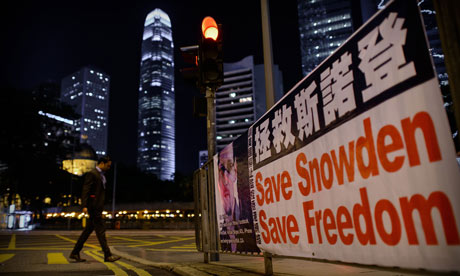
gathered in Union Square with the message “I stand with Edward Snowden”. In Hong Kong, hundreds of demonstrators
took to the streets on Saturday to stand up against US surveillance policies and voice support for this former CIA employee.
Praises for this young man’s action came from older
generations; those who remember a time when there were laws effectively
protecting whistleblowers who revealed government crimes. Retired CIA
analyst Ray McGovern
noted Snowden’s “uncommon courage, uncommon devotion to the Constitution” and shared his hope for a future society:
“It’s very, very encouraging to see that young people
like that have been able to do some of the things that have been very
difficult for people of my generation to do because we have been so
hidebound behind secrecy strictures.”
Daniel Ellsberg recently spoke at a panel discussion on “
Our Vanishing Civil Liberties” in Berkeley. This
former military analyst who leaked the Pentagon Papers during the Nixon
administration, thus exposed the criminality of the Vietnam war
spoke of
how Snowden made him proud to be an American and that this NSA leak was
worth risking one’s life, the same way Ellsberg felt when releasing the
Pentagon papers 40 years ago.
In 2010, after the release of more than 91,000
classified military records on the war in Afghanistan, WikiLeaks founder
Julian Assange
spoke about the inspiration behind his work:
“What keeps us going is our sources. These are the
people, presumably who are inside these organizations, who want change.
They are both heroic figures taking much greater risks than I ever do,
and they are pushing and showing that they want change in, in fact, an
extremely effective way”. (July 28, 2010)
The WikiLeaks motto, “Courage is contagious” is
showing itself to be true. Behind the NSA leaks are those who are
infected by courage. In an interview on DemocracyNow!, Glenn Greenwald
spoke of how he was inspired by Snowden’s deed:
“….To watch what he did, because he knows … because
he knows exactly how the government treats whistleblowers, and yet he
went forward and did it anyway. And what I really hope is that his
courage is contagious, that people get inspired by his example, as I
have been, and decide that they ought to demand that their right
s not be
abridged and that they have the full authority to stand up to the
United States government without being afraid.”
This exposure of NSA abuse of power would not have
been possible without the integrity and bravery of one woman.
Award-winning documentary filmmaker, Laura Poitras was the first media
contact on the story. She was behind the camera for Snowden’s interview
at hotel in Hong Kong. When asked by a Salon reporter about whether she
was concerned about becoming a target of government investigation,
Poitras
said:
“It’s not OK that we have a secret court that has
secret interpretations of secret laws; what kind of democracy is that? I
felt like, this is a fight worth having. If there’s fallout, if there’s
blow back, I would absolutely do it again, because I think this
information should be public. Whatever part I had in helping to do that I
think is a service. People take risks. And I’m not the one who’s taking
the most in this case”.
One man’s brave action leads to another. Before Snowden, there were four former National Security Agency analysts who
were alarmed by
widespread government surveillance: Thomas Drake, William Binney, J.
Kirk Wiebe and Edward Loomis. Thomas Drake criticized the court that
authorized the surveillance. In speaking of Snowden, he
observed:
“We are seeing an unprecedented campaign against
whistleblowers and truth-tellers: it’s now criminal to expose the crimes
of the state. Under this relentless assault by the Obama
administration, I am the only person who has held them off and preserved
his freedom. All the other whistleblowers I know have served time in
jail, are facing jail or are already incarcerated or in prison. That has
been my burden. I’ve dedicated the rest of my life to defending life,
liberty and pursuit of happiness. I didn’t want surveillance to take
away my soul, and I don’t want anyone else to have to live it. For that,
I paid a very high price. And Edward Snowden will, too. But I have my
freedom, and what is the price for freedom? What future do we want to
keep?”
John Kiriakou became the first CIA officer to confirm
the use of torture and to face jail time for any reason relating to the
U.S. torture program. Before going to jail, he
spoke of his decision:
“I took my oath seriously. My oath was to the
Constitution. On my first day in the CIA, I put my right hand up, and I
swore to uphold the Constitution. And to me, torture is
unconstitutional, and it’s something that we should not be in the
business of doing … If you see waste, fraud, abuse or illegality, shout
it from the rooftops, whether it’s internally or to Congress.”
Jeremy Hammond is another young man sitting behind
bars for more than a year for revealing that this insidious network of
corporate and government surveillance has been used on activists. When
he recently plead guilty to one count of violating the Computer Fraud
and Abuse Act (CFAA) for his role in Stratfor hack, he
made a
statement: “I did this because I believe people have a right to know
what governments and corporations are doing behind closed doors. I did
what I believe is right.”
On Monday, Edward Snowden appeared online to participate in a
Q and A hosted
by the Gurdian. Snowden spoke of how the Obama administration’s
aggressive response to whistle-blowers will only encourage better
whistle-blowers and how ones conscience is something that cannot be
stopped:
“Binney, Drake, Kiriakou, and Manning are all
examples of how overly-harsh responses to public-interest
whistle-blowing only escalate the scale, scope, and skill involved in
future disclosures. Citizens with a conscience are not going to ignore
wrong-doing simply because they’ll be destroyed for it: the conscience
forbids it. Instead, these draconian responses simply build better
whistleblowers.”
These brave individuals were all driven by a common
belief that the public always has a right to know about the wrongdoings
of governments and corporations. These people stepped forward and
sacrificed their safety to bring vital information into the light of
day. This allegiance to ordinary people and their right to determine
their future has motivated many whistleblowers to overcome fear and act
out of conscience.
The only fear Snowden
expressed in
the aftermath of his disclosures was that he might fail to overcome
public apathy and miss the chance to trigger a worldwide debate: “The
great fear that I have regarding the outcome for America of these
disclosures is that nothing will change.”
Snowden is not alone. This was also the primary wish
expressed by another brave young whistleblower. Private Bradley Manning
who is now being court marshaled,
wrote in
his chat log: “I want people to see the truth, because without
information, you cannot make informed decisions as a public … hopefully
worldwide discussion, debates, and reforms…if not…than we’re doomed…as a
species.”
In
his speech to
the military court in Ft. Meade about his motivations for leaking over
700,000 government documents to WikiLeaks, Manning made clear that he
wanted to show the American public the true costs of war and spark a
debate on the role of the military and foreign policies.
Glenn Greenwald’s follow-up article on June 14 on NSA story
shared promising
signs of how Snowden’s worst fears have so far not unfolded. It reports
how Snowden’s revelations “are met with anything but the apathy he
feared” as it sparked lively debate among the public, Congress and
journalists.
Using documents evidencing the surveillance, the American Civil Liberties Union (ACLU)
has filed suit
over the NSA massive spying program. The revelations of the Obama
administration transgression also sent an alarm internationally
regarding this immediate global threat to freedom of speech and privacy.
Concerns about possible US extradition of Snowden have caused countries
to step forward to help the whistleblower. National Journal
reports a
variety of responses around the world to possible US retribution on
Snowden. A Kremlin spokesman said Russia will consider asylum if he
seeks it. The head of France’s far-right party, Marine Le Pen demanded
France let Snowden immigrate into the country. The Iceland Pirate Party
is also working to let him in. In regards to a possible asylum request
for Snowden, Ecuadorian foreign minister Ricardo Patiño
spoke of
the possibility for a similar arrangement as they made with Assange and
that the Ecuadorian government would certainly consider the request.
Protesters in Hong Kong handed over a letter criticizing the National Security Agency’s internet surveillance program and
urged the
Chinese government not to extradite the NSA whistleblower. The poll
results that came after the protest in the Sunday Morning Post
revealed half
of people in Hong Kong don’t want Snowden to be extradited to the US
and that public sentiment in Hong Kong is growing against the US
government.
Julian Assange warned in his book
Cypherpunks of this ever increasing surveillance state. Hailing Snowden as a hero from the London Ecuadorian embassy, Assange
noted that
these waves of courage are changing the tide; “I think we are winning,
and we are a part of a new international body politic that is
developing, thanks to the internet,”.
Snowden’s noble deed was a clear-eyed attempt to
uphold the Constitution. The highest law of the land that he followed is
more than a rhetorical ideal. His conviction is based on the premise
that the Constitution was written for the people. It starts out “We the
People” -not We the Kings, or We the Presidents. It indicates that
people are to be the authors of their own society. Snowden gave
information to people in the world, especially to Americans to see what
their own government is doing, because he believed people need to be
informed. During the Guardian’s Q and A session, he
noted how “the consent of the governed is not consent if it is not informed.”
After moving to Hong Kong, Snowden
said in
the interview with the South China Morning Post “I am not here to hide
from justice; I am here to reveal criminality, … My intention is to ask
the courts and people of Hong Kong to decide my fate.” His actions and
words clearly speak of his faith in the people and that their conscience
alone can determine justice and the direction of the future. Leaking
the truth through courageous acts of these ordinary people is what stirs
vital public debate.
We are standing at a truly significant moment in
history. From Ellsberg to Manning to Snowden; whistleblowers that stand
up for the public interest show how courage is contagious. We now have a
great opportunity to open the court of public opinion. In the end, fear
will never prevail.
Nozomi Hayase is a contributing
writer to Culture Unplugged, and a global citizen blogger, at Journaling
Between Worlds. She can be reached at: nozomimagine@gmail.com
END REPORT