Translate

Wednesday, August 2

Syrian Army on its way to glorious downtown Al-Sukhnah


Breaking: Syrian Army reaches first buildings in Al-Sukhnah
By Leith Fadel
August 2, 2017
AMN

BEIRUT, LEBANON (5:15 P.M. local time) – Minutes ago, the Syrian Arab Army (SAA) reached the first buildings in the strategic city of Al-Sukhnah, a military source told Al-Masdar News.

Led by their 5th Corps and 18th Tank Division, the Syrian Arab Army captured all of the remaining hilltops and farms at the southwestern part of the city before reaching the first buildings in Al-Sukhnah’s southwestern sector.

According to a soldier from the 5th Corps, the Syrian Army is still advancing despite some heavy resistance from the Islamic State (ISIL) militants and look to take control of the city in the next 24 hours.

The source added that the Islamic State has already moved many of their fighters from Al-Sukhnah to the Deir Ezzor Governorate, as they prepare for the next major battle in eastern Syria.


[END REPORT]

Now where is Al-Sukhnah? For this vital information we turn to maps at SouthFront:

NOTE:  If you can understand this map you have a problem 


Now this is so much clearer isn't it

But this still doesn't tell us where Al-Sukhnah actually is. So we'll have to go hat in hand to Wikipedia 
Al-Sukhnah (Arabic: السخنة‎‎, also spelled al-Sukhanah) is a town in eastern Syria under the administration of the Homs Governorate, located east of Homs in the Syrian Desert. Nearby localities include Mayadin and al-Asharah to the east, al-Taybah and Raqqa to the north, Salamiyah to the west, Arak and Tadmur (Palmyra) to the southwest.
Now is there anything in Al-Sukhnah besides sand?
According to Syria Central Bureau of Statistics (CBS), al-Sukhnah had a population of 16,173 in the 2004 census. It is the administrative center of the al-Sukhnah nahiyah ("subdistrict") which consists of six localities with a collective population of 21,880 in the 2004 census.[1] The town's inhabitants are predominantly Sunni Muslims.[2][3] Al-Sukhnah has attracted hundreds of residents from nearby villages in the past century[4] and is currently a processing center for natural gas.
So maybe it's the gas business there that attracted Islamic State.

To return to SouthFront, from the report today accompanying the maps (no time stamp):

According to pro-government sources, the Syrian Arab Army (SAA) began its offensive on ISIS in the strategic town of Sukhna in the eastern Homs countryside.

The SAA captured the mountain of Tunotur west of Sukhna, allegedly stormed the southwestern entrance of the town and captured several buildings.

From its side, the Syrian Ministry of Defense confirmed that the SAA had captured all ISIS fortifications south and west of Sokhna [we'll assume that is a typo] town.

Opposition sources also claimed that Russian and Syrian warplanes launched dozens of air strikes against ISIS in Sukhna and its vicinity. Furthermore, Russian attack helicopters provided close air support to the SAA during its advance.

According to the Syrian media, a majority of the ISIS fighters withdrew from Sukhna last week, but dozens of them decided to stay in the town and try to defend it. Most of these fighters are suicide bombers and snipers.

Experts believe that the SAA will be able to capture Sukhna soon. However, the SAA may suffer notable casualties during this difficult operation.


[END REPORT]

MEANWHILE 
Although AMN reported (above) that IS has moved many of their fighters from Al-Sukhnah to the Deir Ezzor Governorate, many IS commanders are absconding from Deir Ezzor Governorate, if FARS sources are to be believed. Are the sources making this up? Who cares; it's fun to read. 

August 2, 2017 - 11:58 local time [I think that's AM time]
FARS

TEHRAN (FNA)- Infighting and tensions among ISIL members have been on rise as notorious commanders of the terrorist group continue to escape from the Eastern province of Deir Ezzur, local sources said.

The sources said that Commander of ISIL Hasaba (monitoring-security forces) Abu Othman al-Mayadeeni has escaped from the town of Albu Kamal in Southeastern Deir Ezzur.

The sources said that ISIL has appointed Abu Khotab al-Araqi as al-Mayadeeni's successor, adding that unprecedented security crisis has covered Albu Kamal after the escape of al-Mayadeeni.

The sources went on to say that ISIL has set up more security checkpoints in Albu Kamal to control the crisis.

According to reports, ISIL has dismissed Qatibeh al-Hanoud nom de guerre Abu Bakr, one of the most important security members of the group in Deir Ezzur.

The reports further said that heavy fighting has erupted between the Syrian and non-Syrian members of ISIL in Albu Kamal after security crisis began in the town.

Local sources in Eastern Syria reported on Tuesday that a large number of ISIL members were cutting ties with the terrorist groups amid rapid advances of the Syrian Army troops in Homs and Raqqa province in their push towards Deir Ezzur.

The sources said that a number of ISIL members in the town of Albu Kamal cut relations with the group and fled the town after the terrorist group ordered them to move to the frontline.

The sources added that ISIL, in a decree, confiscated the properties of those who escaped, and established several checkpoints to arrest those on the run.

The army's advances in Eastern Homs and in Southeastern Raqqa towards Deir Ezzur intimidated a large number of ISIL commanders, inciting them to flee the battlefield.


[END REPORT]

So ends my Syrian war report for today. 

********

What can be done to mitigate devastating wildfires during a time of drought?

A lot of people have been asking that question as massive wildfires this summer have hit in Mariposa County, California (the Detwiler Fire); Canada's British Columbia; and in Europe.

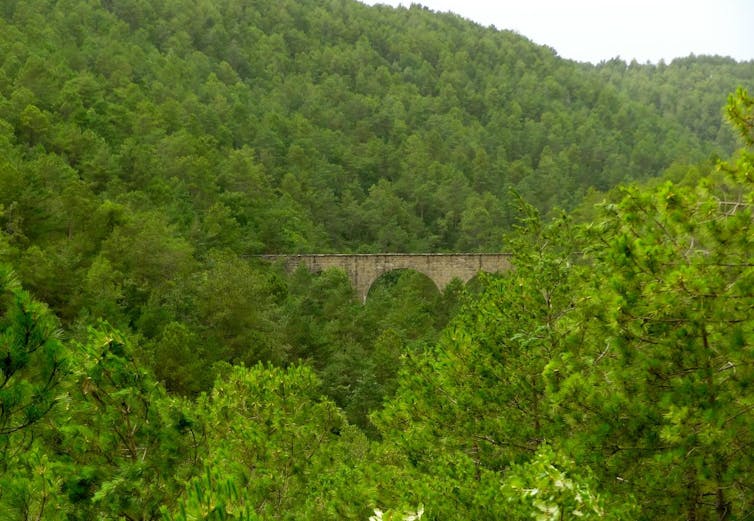
The Conversation published two photos of the exact same location that together clearly convey one of the problems Europe is facing today. To introduce the photos:
... In 1950, almost 50% of the Spanish population lived in rural areas. By 1990, that figure had fallen by more than 25%.
As a result, landscapes that previously comprised small-scale mosaics of farmland, grazing land and relatively open forests are now dominated by young, dense forests.
As an example, see the images below of the same Spanish landscape in the 1900s and today:

 Pont de la Frau, Solsona County in Central Catalonia, in northwestern Spain, in the mid-1900s. Solsonés County Counsil


Pont de la Frau in 2016. Marc Font Bernet


The entire article at The Conversation (H/T The Local) is worth the read. ("Wildfires are raging in the Mediterranean. What can we learn?") It's written by Luke Kelly, Research Fellow, University of Melbourne; Eduard Plana Bach, Head of Unit of Forest Policy and Environmental Governance, Forest Sciences Centre of Catalonia; and Marc Font Bernet, Researcher in the Forest Sciences Centre of Catalonia.

So these are experts who get paid to think about forests and about wildfire mitigation.

FARO

FARO is the acronym I've concocted from three important trends in drought/famine mitigation approaches that are now favored by relief agencies ranging from big international organizations to small, local nonprofits.

Flexibility
Adaptability
Resilience

I added the "o" for "organization," because these approaches are having a big impact at the organizational levels of humanitarian assistance. With understatement, FARO is a very healthy trend in combating famines and building resistance to drought among the most vulnerable populations. The recent series of articles by The Christian Science Monitor about searches for solutions to famine reflect FARO principles in action.

I think FARO can also be applied to mitigating the worst effects of forest fires. The ideas from the three forestry experts who wrote for The Conversation very much reflect the FARO trend. 

Here I will add a few ideas I've picked up over the years.
  
Neighborhood Watch in the Sky

Ironically I got this idea from learning about the characters who fly their personal drones above forest fires; this so they can get a lookee-see that they can post to social media or try to sell to local TV stations. Time and again fire-fighting planes have had to be temporarily grounded because fire officials can't risk the drones bringing down one of the planes. 

But if there are people who have nothing better to do than fly drones, why not deploy them as a volunteer network of sentinels? During the dry season they could use their drones to patrol expanses of forest and raise the alarm when the drone camera picks up smoke/flames that seem larger than a campfire. Sort of a neighborhood watch in the sky. 

As to whether the sentinels would easily get bored waiting for a fire to break out -- from April 1 of this year through the end of July, at least 840 wildfires burned in British Columbia, charring 4,260 square kilometers of land. No I don't think they'd be bored looking for fire outbreaks during fire season.
    
If warnings from such sentinels could shave off even a few minutes of response time for fire crews, I think it would make a big difference. One of the problems with using dousing planes to fight forest fires is that the planes can't fly blind. Visibility becomes so poor because of thick smoke that the planes have to be grounded until the wind shifts and clears away some of the smoke. That happened in France last month at one point, and it's happening right now in British Columbia. For the latter situation, see the above link to news about the number of wildfires in B.C.

The idea is to send in the planes before the fire gets so out of control that it generates a literal smokescreen. Again, sentinels using drones could help in this regard. And because the drones are up above the forests, they can pinpoint the coordinates of a fire outbreak on Google Maps; this information could be quickly relayed to fire crews that have dousing planes on hand.       

Green Firebreaks

This idea isn't new, but another very informative article from The Conversation, published in February 2016 and written by (another) trio of experts, discusses how the idea is being refined so that it's more useful:

... The planting of low-flammability species in gardens and on property boundaries has been advocated in many parts of the world, including Australia, New Zealand, the United States and Europe. Many lists of suitable species are available.
Unfortunately, many resources don’t specify how these species lists were developed. Some base their recommendations on particular plant characteristics known to influence flammability, while others come from observations of how well certain plants burn in wildfires.
However, very few lists are derived from experimental tests of plant flammability. We set about testing which New Zealand plants were the least flammable – by throwing them on the barbecue.
[...]
In our paper published in the International Journal of Wildland Fire, we compared the flammability of 60 common plant species from New Zealand. We used a recently developed method for testing shoot flammability.
This involves placing shoots on a grill (our “plant barbecue”), turning on a blowtorch and then measuring how easily samples ignited, how hot they got, how long they burned for, and how much of them burned.
 [...]
Given favourable fire conditions, any plant will burn, so green firebreaks are unlikely to provide protection in extreme fire conditions. The best option to protect houses from such fires may well be to reduce fuel within a 40m radius.
In less extreme fire conditions, green firebreaks are one of the options available to land managers to reduce fire spread across the landscape and could be established in areas where fire risk is greater, such as on the edge of highly flammable ecosystems. We should also consider deploying green firebreaks comprised of native species to help protect large-scale restoration projects.
At the individual plant level, certain traits make plants more or less flammable.
One key factor is moisture content; plants with moister leaves are less likely to ignite and don’t burn as readily. Hence, it helps to keep your plants well watered when fires threaten.
Some plants retain dead leaves and branches that provide ready fuel during a fire. Therefore, pruning dead limbs is a good way to reduce fire risk around your home.
While we are increasing our understanding of plant flammability, many questions remain. For instance, we have been testing plant shoots, but do whole plants burn differently? Under what climatic conditions does a low flammability species become a readily burning fuel? What happens when you burn low and high flammability species together? What risk do highly flammable weed species pose when they invade new areas?
We plan to tackle these and other questions by throwing many more plants on our barbie!
Of course, keeping plants well-watered throughout fire season isn't always feasible during a severe drought or even a period of 'water stress' as it's called. 

As to reducing fuel within a 40 meter radius -- that translates to 131 feet or about 44 yards. I'm not sure how feasible that is in a neighborhood of subdivisions, although of course homeowners who can reduce fuel within that radius would not only have a better chance against a fire but also -- if there were enough such properties in the fire zone -- break or at least slow a wildfire's progress. And I'd think this would be doable especially if a fire is progressing through brush rather than among trees.    

But I venture one problem with the 40 meter radius is that a flaming pine cone could traverse past that distance, I think. Pine cones, I've learned, act something like flamethrower weapons in a forest fire. They pop in the flames and get airborne. So once pine trees burst into flames, their cones quickly spread a fire over distances. 

I seem to recall that was one of the big problems with devastating wildfires that broke out in Greece some years ago; people couldn't figure out at first why the fires were spreading so fast. It was the flamethrower pine cones.  
  
Those fires in Greece were blamed on arsonists. Might have been in some cases but flying flaming pine cones are one reason a forest fire can break out in several places around the same time. 

As I've noted before, the most dangerous arsonist is Nature.

So in addition to reducing fuel within a certain distance of a building, you'd also want to use other precautions, such as fire-retardant roofs.  

All else I can add to the discussion about firebreaks is my recollection of the middle-income homeowner in southern California's 'wildfire alley.' He made it a mission not to be run off his property by wildfire. I might have mentioned him before on this blog; anyhow, his successful battle with a wildfire was publicized on American national TV news, which was where I learned about it. This might have been as far back as a quarter century ago.   

He made his home and acreage fire-resistant using different tactics and materials he learned about, including fire-resistant plantings. He also installed a portable water tank on his property just for the purpose of ensuring he'd have access to water when he would need it most -- which was when a fire came near.    

Eventually a wildfire did come his way. I think he sent his wife and kids to safety; maybe a friend or two or maybe a male relative volunteered to stay at the property with him. 

I do clearly remember that when the fire closed in, he stood on his house roof, hosing it down, and hosing down the vegetation he'd planted and the garage -- and tool shed, if I recall. 

If my memory serves the fire burned down all the homes around his property; at any rate this wasn't some little brush fire. But the wildfire didn't touch his property beyond a few flaming branches and leaves, which extinguished when they hit because of all water he'd sprayed, or which he immediately doused with water from the spray hose -- or they flamed out when they hit fire-retardant housing and landscaping materials

It was amazing.

He was happy to give free advice to anyone who also wanted to make it very hard for a fire to burn down a home.

His actions demonstrated several principles including flexibility, adaptability and resilience -- the FAR in FARO. By this he also showed how people can live with Nature without taking a scorched-earth approach, if you'll pardon the expression, to dealing with its threats.

********   

Hi Seattle and Portland!

I'd lecture the Masters of the Universe who reside in those cities about hyperfocus on greenhouse gas emissions, which has led them to lack of preparedness for dealing with simple stuff such as cyclic changes in weather patterns. But one can't explain anything to people who already know it all.

(From The Daily Mail, more or less)
National Weather Service predicts record temperatures in the Pacific northwest! 
Sweltering in Seattle, Washington! Seattle warned to expect highs of around 104 degrees! City where only a THIRD of homes have air conditioning braces for a dangerous heat wave! 
"This is not a town that was built on air-conditioning," said a local meteorologist. 
MEANWHILE! Temperatures as high as 107 degrees are expected to hit city of Portland, Oregon!
(From USA Today:)
.
... "The current heat wave in the Northwest may end up being the most notable event of the entire summer for the U.S.," according to AccuWeather meteorologist Elliot Abrams.

The intense heat will threaten human health, potentially cause power blackouts and exacerbate the spread of wildfires.

Portland will likely flirt with its all-time record high temperature of 107 degrees on Wednesday, AccuWeather said.

If the city hits 108 degrees, it would be the hottest day in Portland since records began in January 1874, during the Grant Administration about 52,000 days ago.

The Weather Channel is forecasting a high of 109 degrees Thursday in Portland.

[...]

Excessive heat warnings are in effect in Seattle and Portland from Tuesday afternoon through Friday. The heat will create "a dangerous situation in which heat illnesses are possible," the National Weather Service said.

"Widespread record highs are expected Wednesday and Thursday," the weather service in Seattle predicted, noting that normally mild Seattle could see a high of almost 100 degrees on Thursday. If it hit 100, it would be only the city's 4th 100-degree temperature on record.

Seattle-based meteorologist Cliff Mass called these forecasts "crazy warm" on his blog.

According to the weather service, "there could be some air quality concerns, which can occur with very hot weather as ozone and other pollutants increase."

What often makes the heat more intolerable in cities such as Portland and Seattle is the lack of air conditioning.


[...]


Yugoslavs did it. Wolves did it. Climate Change did it. Explanations for European wildfires, from wacky to reasonable.


Wildfire in Split, Croatia - July 17

Canadair water bombers -- unable to take off on Monday due to strong winds -- are expected to join a large number of firefighters, soldiers and citizens in an effort to contain and extinguish the fires.
[...]
And although authorities in Croatia are saying that the cause of the fires is yet to be determined, many Croatians believe they are the work of arsonists. 

Retired General Davor Domazet Loso thus voiced his suspicion that the fires have been caused by "Yugoslavs who hate Croatia and Croatians." 

He also blamed these Croatia-hating Yugoslavs of waging "asymmetric warfare" against the country, and also Croats in neighboring states: 

"The Bay of Kotor (in Montenegro), Herzegovina, and Dalmatia are on fire. That cannot be a coincidence. And right at a time when according to forecasts, one was to know that a gale has been blowing for four days," said Loso. 

Citizens, meanwhile, think that the fires have been started on purpose because they broke out in about 20 places within several hours. But Croatia's firefighting services urge caution, and explain that only an investigation can determine the cause. 

The Split-based daily Slobodna Dalmacija writes that despite these suspicions prompted by the wildfire's multiple sources, a number of natural phenomena could have been the cause of the "cataclysmic blaze."
Firefighting commander Drazen Glavin offered one - saying that he was an eyewitness to the fire "literally jumping from place to place." ...
Yup; at one point during the monster wildfire in British Columbia, fire literally jumped across a river that's more than a mile wide.

And all the good general had to do was read headlines at the time to see that if Yugoslavs were at work, they were trying to burn down all of Europe.

Or he could look at the NASA map of fires across Europe. See the Guardian, link below, for the map.

Over in Provence, France, wolves might be to blame, reported the Guardian on July 29:

... Such arson is not a new thing. Sitting with friends in square in Carros – a village that has traditionally been spared tourist scrums but which was quieter than usual –Malika Merzouk, a local resident, explained some of the motives cited in the past for forest arson.
“Some people might set the fires to clear new land to build for example, while others might be trying to bring the price of property down. But either way, it’s criminal and very dangerous,” she added.
Throwing another theory into the mix, meanwhile, her friend Stephan Van der Stuyft suggested that the fires could be caused by wolves that have reappeared in the region after crossing over from Italy.
After being hunted to extinction France in the 1930s, they now number in the hundreds and have been blamed for driving farmers and their sheep off pastures that then become fire-prone shrubland.
“It might be nonsense, but a lot of people seem to be taking it seriously as an idea,” he added. “Still, if you talk to a fireman here they will just tell you that there is no real reason for what has happened. Everything is so dry that sometimes even the spark from a car exhaust can cause something.”  ...
Yuppers; in California during the drought a hippie marijuana grower was trying to avoid the fuzz so he drove across a field rather than taking the road. One spark from the dilapidated pickup's exhaust pipe, and WHOOSH! within moments, a monster wildfire.  I forget the name of that fire -- there were so many in California during the drought -- but it was very well known at the time, and everyone heaped abuse on the hippie.

Of course this doesn't mean arsonists and pyromaniacs and just plain careless and ignorant people haven't contributed to the wildfires. During the fires in France, a fire crew came across a group of campers sitting around a little fire while tiny sparks from the fire were wafting on the breeze. I guess the campers figured that because nothing went up in flames it was okay. 

All it would have taken in those bone-dry drought conditions was one wind gust catching just one of those sparks to touch off an inferno.

Nature is the most dangerous arsonist. I remember watching with a sense of horror and awe the Carlton Complex Fire in Washington state in 2014 -- the largest wildfire recorded in the state's history, burning over 250,000 acres. 

It was actually four fires, started in different areas by four separate lightning strikes on the same day, July 14, which then merged. The most unsettling part was that it was wildly shifting winds that drove these four fires together to form an incredible conflagration; the effect was that the wind was coming from four directions. 

At least some of the fire's fast progress might have been 'crown' fires -- where fire jumps from treetop to treetop; I'd have to check the archives to make sure. But that would have been another reason for the incredible speed and span of the wildfires' paths. 

There was no way firefighters could have gotten that fire under control without help from the weather, so one might say God stepped in. Rain on July 24 slowed the Carlton Complex Fire, ten days after it began, allowing fire crews to contain the fire by 60% by July 26. 

Hundreds of homes were destroyed. Entire towns were ordered evacuated. Incredibly there was only one fatality, and that was a man who died of a heart attack while trying to protect his home from the fire. So he might not have paid attention to an evacuation order -- or maybe he was just caught by surprise. 

Perhaps the most dangerous aspect of wildfires that arise during very dry conditions is the deceptive speed with which they can spread. A fire can be at a distance of several miles, then suddenly the wind shifts or picks up force and suddenly it's on top of you. Californians learned that lesson the hard way during the historic drought in the state, and since then people in one drought-struck region after another have been learning the same lesson.   

It's not necessarily drought itself, it's the length of time it's been in existence. So at first Californians who were 'old hands' at living in a fire-prone region weren't factoring in the extraordinarily dry condition of the forests that had crept in from years of severe drought.

Add to this, many trees had been eaten away from the inside and dried out by huge numbers of insects that were attacking trees during the drought. It was like living near forests of bone-dry paper. 

Today, Californians know. When the evacuation order comes in don't stop to pack your most treasured possessions. Grab the dog and run to the car and pray you're not caught in a traffic jam with others fleeing the fire.

As to the wolves theory -- it depends. As we examined during the killer wildfires in Portugal, deserted countryside can be a factor, even a significant one, when there's nobody around any longer to sound the alarm, beat out the beginnings of a fire, and keep the brush and forest at bay with a carefully tended farm.

The theory doesn't apply much if at all when we turn to study the wildfires on the French Riviera. There, fires broke out in a pretty well-populated region, even though one of the factors was that forest and brush had over years crept ever closer to human habitations -- a very familiar situation in southern California. In that scenario, extremely dry conditions could be the biggest problem.  

And the large numbers of people and buildings in the Riviera fire zone meant that fire crews had to focus foremost on saving people and homes, which wasn't necessarily the most efficient way to fight the fires.       

There are numerous factors that play into the outbreak of forest fires and their spread. The factors are amplified in their danger during an extended drought. So I think people are no longer as philosophical as they were about forest fires. Several people in Provence told the Guardian that they considered climate change to be the biggest factor in the Riviera wildfires. 

Could be, but it doesn't have to be climate change; just a cyclic change in weather patterns can raise warning flags. That, and the fact that times have changed since the last bout of severe prolonged drought in human-inhabited areas. Many more people, many more buildings, much more expense to property owners and insurance companies from forest fires.

In that scenario the "Let it burn" viewpoint might not be feasible. And the idea of 'managing' forest fires through controlled burns, which became popular in the closing decades in the USA in the last century, isn't wise during a prolonged drought.

See also What can be done to mitigate devastating wildfires during a time of drought?; August 2, Pundita

********

Tuesday, August 1

When will California farmers stop planting almond trees? When the wells run dry.

From Water Deeply's California’s water troubles didn’t end with the drought -- they just went underground; July 5, 2017:
... During the drought, trillions of gallons of water were pumped without being replaced in the Central Valley, one recent study in Geophysical Research Letters shows. And farmers continue to invest in almond orchards, which cannot be fallowed during dry periods.
Vickie Ortiz, whose well is dry in Fairmead, south of Chowchilla in Madera County, says she respects her farm neighbor. But if her neighbor drills down 1,000 feet for water, it probably will eventually dry up any new, shallower well that she might get.
“We’re finding new almond plantings all around here now,” she says. “To the right of my five-acre parcel, there are 30 acres of almonds. Behind me, there’s another 20 acres. When his well goes dry, he’s going to dig deeper. Then I’ll have to dig deeper. And I’ll still have a loan on the well I’ve got. No, this is not going to end until somebody is monitoring it.”
And who's going to monitor the monitors? The Almond Board of California?

********

Drought/Famine Resistance: Deserting the food plants of the desert is unwise

Rajasthani vendor selling traditional desert foods

Tree Of Rajasthan – Khejri


"These foods have saved us during troubled times."

I'm putting the final paragraphs first in the following article. Note the year of publication -- 2000. I can only wonder what the situation is today for food plants indigenous to the desert in Rajasthan,  India. 
June 30, 2000
Down to Earth magazine

Abundant, nutritious and tasty. Yet traditional desert food is gradually losing out to commercially grown crops

Now being deserted
But for the residents of the desert times are changing and so are their food habits; they are now relying on vegetables from the market. 

"It is not very easy to live on traditional foods because gathering them and preserving them is time-consuming and a very difficult task. And as people outside the desert learn the nutritious value of some of the trees of the desert they have started buying them.  Also, since many have medicinal value, they are exported. The liquid cash we earn by selling them is more important now," says Tikaram of Kanoi village.

Prajapati says that bui (small shrubs with a cotton like formation on them) is being lost, but they need to be preserved because they bind the desert soil.

The Indira Gandhi Canal has encouraged farmers to increase agricultural production in many areas. Khejri cultivation has decreased because it is being used as wood, ker is being rooted out to increase cultivation area. 

"The emergence of the tractor has played havoc as far as plants are concerned because the tractor hulls scoop the roots of the local plants that take at least 10-12 years to grow. Therefore, it will be very difficult to replenish them. Moreover, with greater water availability farmers have resorted to more profitable crops like groundnut and mustard," says Prajapati. 

Whether these traditional, inexpensive and nutritious foods will stand the test of time remains to be seen.

[...]

As the sun kisses the desert dunes near the Sam village in Jaisalmer it signals the end of a hectic day for the tourists. This has been the last leg of their journey into the unknown. They return to their desert camp near the Sam dunes tired and hungry. However, a surprise awaits them -- a sumptuous fare of traditional desert food. As the tourists laze on their charpoys (cots) inside the tents a lad wearing a bright red turban comes and serves rabori, an appetiser made of bajra, jeera, chach and salt, in earthen cups.

While the tourists enjoy the soothing strains of algoza, a traditional flute-like instrument, they are served with the popular khejri (sangri) vegetable with bajra rotis (bread) laced with ghee (butter). 

"Be it bajra ki roti, plain roti or makka ki roti , a liberal quantity of ghee is a must," says the chef Kishen Maharaj. 

As the tourists start delving into their bowls of khejri, they want to know more. Regaling in the spotlight, Maharaj divulges a little. "Boil some water and put in haldi (turmeric), salt and the sangri (boiled khejri). Then warm up some oil and add hing,  jeera and mustard seeds and keep it aside. Then mix it with the vegetables."

Oasis of food 

The desert areas of Rajasthan abound with khejri. It is considered a blessing. It provides shelter to weary travellers and is grazed by camels, goats and other livestock. Its leaves and shoots provide vegetables for people. The young pods, called sangri, are also eatable. The mature pods, which contain a sweet pulp, are eaten as a fruit. The bark of the tree is eaten during drought. It is stripped off, dried and ground with any available coarse grain to augment a meagre meal. 

The gum obtained from khejri , known as bantaka is also eaten. The sangri is boiled and preserved in a kalsi or matka (container). In fact, with the growth of tourism khejra vegetable is served in many hotels of the state.

"Nothing stands still; characteristics of the desert are also changing fast. People are more interested in money and therefore they are selling desert foods to buy fresh vegetables. For example, one kilogramme of khejri fruit sells for Rs 50-100. 

Migration is another factor. While the original desert people are leaving for the cities, there is reverse migration due to the Indira Gandhi Canal. Many have come to the desert from other areas and now they have become the desert people. But they do not know anything about these plants. Subsequently, there is a loss of indigenous knowledge," says Narayan Das Prajapati, owner of Jodhpur-based Rajasthan Agro-Forestry Corporation. 

He adds that with the growth of tourism and a good road network, there is now a good scope for earning money from other jobs. "This has weaned people away from traditional food systems because they are difficult to procure and preserve," adds Prajapati.

Meanwhile, having polished off the first course, the tourists learn more about the meals that the desert people thrive on during times of food scarcity. 

One of the organisers of the camp, Trilok Singh, says that on the undulating expanse of the sand dunes is written the story of a race of hardy people who have learnt to play by the rules of nature and survive gallantly. Nature, for its part, has provided them with alternate food resources, if not water.

"These foods have saved us during troubled times. We preserve the sangri in a kalsi or a matka . We also make roti of lana ," says Phool Devi, a resident of Sam. "Khejri fruit is known as khokha and is usually eaten raw by the people. Its leaves contain nearly 12 per cent protein and are also called loong , which has great fodder value. In villages the inflorescence of khejri is used to prevent miscarriages," explains N K Bohra of Jodhpur-based Arid Forest Research Institute (AFRI).

Back at the desert camp the dinner proceeds to a more sumptuous fare. Along with the vegetables, a pickle preparation from ker (Capparis decidua) and a vegetable treat of kumat ( Acacia sengal ) is served. The seeds of kumat have been boiled and dried before being cooked. The half-ripe fruit of ker is boiled and after drying can be used as vegetable. 

"The fruits of ker are a favourite. It grows in abundance and also we pick them for acchar (pickle preparation)," says Motia, a eight-year-old of Damodara village.

The other dish that is a real steal is the Panchkuta, which is made of five fruits from the local plants. It includes seeds of kumat , fruits of ker and khejri, khachri ( Cucumis supp.) and goonda ( Cordia mixa). They are mixed and fried after adding required condiments are added. 
Also on the fare are vegetables goonda , goondi andsahajan ( Moringa oleifera). 

And of course, the perennial favourite Imli chatni ( Tamarindus indica ). Tamarind seeds are also used in vegetable preparations. The imli plant is often planted in public places and near wells. The fruit is reduced to powder and chewed, like betel nut, and is popular with women. The meal is rounded off with peelu ( Salvadore oleoides) , also called mitha jaal and khara jaal . This fruit grows even in saline soil.

"During food scarcity, people also eat the fruits of neem (Azadirachta indica ) which has a great medicinal value," says Bohra. " Ber ( Zizyphus nummularia) is eaten fresh and the leaves known as pala is used a fodder. Pala is very rich in protein," he adds. The ber root is also good for colouring and the fruit is rich in protein and carbohydrate, says Prajapati. Then there is phog (Calligonum polygonoides) whose flowers and buds are eaten with curd.

Bhurat, a type of grass found abundantly in the region, is considered highly nutritious food. The seeds are considered to contain a very high fat and protein content, says Bohra.

Other desert foods include toos, whose seeds are mixed with flour and prepared into chapatis (bread) and matira, a succulent fruit, is eaten fresh. The seeds are dried and pounded into flour, which is then mixed with flour of bajra to prepare cakes called sogra and arjuna whose bark is ground, mixed with flour of bajra, and eaten. 

[...]

[END REPORT]

********

Gee Officer Krupke, many Americans are too deprived to pass a drug test!

Axios' report on widespread illicit drug use among unemployed Americans skirts the obvious question: If they're unemployed, how can they afford the drugs? And from Axios it seems Goldman Sachs also avoids the obvious in a note to its clients. So I'm not sure I'll buy the explanation for the situation, which from Axios goes like this:
The reports suggest a circularity to the crisis in America's rust and manufacturing belts: the loss of jobs and wage stagnation has led to widespread disaffection, alienation and drug abuse; and drug abuse has led to joblessness, hopelessness and disaffection.
The explanation, which political Liberals have deployed to rationalize everything from drug epidemics to street gangs to crime sprees to unemployment, reminds me of West Side Story's hilarious "Gee, Officer Krupke!" The song's shrewd lyrics, I suspect, are as relevant in today's USA as they were more than a half century ago.  


******** 

Refugee camps help fuel Middle East's illicit synthetic drugs epidemic among Arab youth

This is an eye-opening investigative report from a contributor at Al-Masdar News (AMN), which usually focuses on war reportage. 

Exclusive: Cheap drug sweeps across Arab countries, with gruesome outcomes
By Beatriz Yubero
July 31, 2017
AMN


“It is from Aqaba and Ma’an, from where the drug is distributed. The tribes involved in this business lead the Salafist movement and organized crime all at once. This is a time bomb.”

(AMMAN, JORDAN) Joker is the latest and most fashionable drug in the Middle East. Joker is a mixture of fertilizers, chemicals, pesticides, oil, animal hormones among other components. Its consumption has become the nightmare for the Jordanian anti-narcotics agency (PSD) It made its first appearance in the early 2000s, however, it was not until a year ago that it burst into the illegal drug market. Since then, it has gained popularity, especially among the youth.

According to PSD sources, after the Jordanian anti-narcotics agency succeeded in eliminating 95 percent of the country’s marijuana plantations the joker took over the drug market. “Getting joker is easier than going to the supermarket”, says Yusef, a barber who has lived and run his business for decades in the al-Wehdat refugee camp in eastern Amman.

According to a study by the Jordanian Economic and Social Council, the price of narcotics in the country is among the lowest in the world. In fact, a joker bag costs around 3 Jordanian dinars, (about 4 dollars) while a pill of captagon, has a derisory price of 0.35 Jordanian dinars (0.50 dollars). It is precisely the accessibility to this type of substances that is causing havoc in some of the poorer areas of the Jordanian Kingdom while also becoming the access corridor of the new drug towards the Gulf countries. 


“People are afraid, they do not want to enter the refugee camp. Some neighbours prefer to rent their own homes and move to other areas because of the problems the drug is causing and because businesses are being affected. It has damaged our image.”

Accessibility to these types of substances is wreaking havoc in some of the poorest areas of the kingdom. This substance, also known as Spice, Dream and Diesel, produces the same effects as common narcotics but the health risks are multiplied. Kidney and liver failure, mental disruptions, cerebrovascular failures, convulsions, loss of concentration and abstraction of reality, psychosis, hallucinations and panic attacks are just some of their effects. It has the highest mortality rate among all the narcotic substances sold in the Hashemite Kingdom.


“The old dealers are the ones who manufacture the joker. They know how to do it and how to sell it, but they do not consume it”, says Yusef.

So why is it so popular? Among young people, especially university students, the idea that the joker works as a substitute for tobacco and 100% natural was promoted. The mafias say it improves memory and helps to socialize. The reality is that it is manufactured in clandestine laboratories throughout the country and is completely synthetic. 


“It is very easy to play joker, most of the traffickers do it here, in the refugee camps – which are already part of the structure of the big cities. Everyone knows how to make joker”.

A few kilometres from Al Wehdat, in Sahhab, a suburb south of Amman, this type of substance is even more popular. The neighbourhood is one of the favorite destinations for the sale and distribution of drugs. In this district, dominated by three tribes, it sells up to 30% of all the drug of individual sale of Jordan. ...

"Most traffickers do their business in the cafes they control and in the smoke-shops. Everyone who uses drugs does it here and everybody knows each other, so they avoid informers”, says Mohammed, owner of a traditional pastry shop in the neighbourhood. “The main reason for being a drug dealer is that there are a lot of people in the refugee camps and because there is no job, many are looking for an alternative. They start using drugs and then go on to traffic. Most of them do not have a job,” says Yusef.

According to PSD sources, the consumption of narcotic substances shot up 25% between 2015 and 2016, coinciding with the arrival of Syrian refugees to Jordan. Drugs have become a way to deal with the harsh living conditions offered by the Middle East. 


“Life here, in the fields, is very hard and drugs have become an escape route for young people,” says Yusef. A few meters away an old man, dressed in a traditional kufiyah, listens to the conversation and adds: “Teenagers consume it. They need something to have fun and believe they are men”.

Last February, police officers seized up to 133,000 narcotic pills and 17 kilos of hashish, one of the largest anti-narcotic operations in the past year. After battling marijuana and caption, the rapists’ drug and whose consumption is widespread in the region, the Jordanian anti-drug department has opened a battle against joker and other synthetic drugs.

Safuan -- not his real name -- is the youngest son of a prominent Sheikh, a religious leader. From his childhood he and his siblings have been the model for their community, but that has not stopped drugs from entering his family.

[...]

Up to three times a week, police and army sweep through major drug outlets and distribution centres; however, “although police do their jobs, they cannot control the flow of substances. There are too many people and tribes involved.”

The UN has warned that since the war in Syria began the lack of security has led to an increase in organized crime and drug trafficking in the Middle East.

Jordan, the region’s last peace oasis, has become a transit zone for illegal substances into the Gulf countries, especially Saudi Arabia.


“It is from Aqaba and Ma’an, from where the drug is distributed,” says Safuan. “The tribes involved in this business lead the Salafist movement and organized crime all at once. This is a time bomb”.

[END REPORT]

********