It was not very thoughtful to feature Syria war news headlines from FARS News right after a post I'd titled In this era one doesn't so much study war reports as untangle them lol. When I realized this I took down the post for a little mending.
Actually, there is little to untangle about Syrian war news that FARS reports. The reader already knows:
> the Iranian government's very obvious biases
> that they accent the positive about a Syrian Arab Army operation and downplay or studiously ignore an incident where the SAA gets walloped. Same goes for Russian, Iranian militia and Hezbollah ops in Syria.
But those caveats aside, at least readers can get on-the-ground reporting from Iran's state news agency that is reasonably accurate. Many times FARS reports on war situations that the 'corporate' news media ignores, or doesn't know anything about -- or doesn't have the sources in Syria to learn about in any detail.
And their reporting is a good counterweight to the anti-Assad, anti-Syrian Army propaganda put out by Saudi and other Gulf Arab news outlets.
A bonus, which I might have mentioned before, is that there are limits to how much outright lying FARS can do about the kinetic ops in Syria because if it happens too many times their reporting will be discounted by enemies 'on the ground' who closely follow the site -- and have their own sources about what really happened in a battle.
********
Tuesday, March 27


In this era one doesn't so much study war reports as untangle them
Compare MOA and AP reporting on the same war incident to see why President Trump, and mainstream news consumers, don't stand a chance at understanding wars in the Middle East.
The simple truth is that Moon of Alabama took the time to untangle information put out by a propaganda outfit; AP left it up to TV news producers, print editors, and the public to do the untangling. Only a member of the German public, "b" at Moon of Alabama, rose to the challenge.
"Independent Watchdog Group" Lobbies For War On Yemen And Iran (Moon of Alabama, March 27) will tell you all you need to know about the AP report, but b also links to the report and quotes from it.
********
Confirmed: US building military base in vicinity of Syria's largest oil field
SDF CONFIRMS REPORTS THAT US ESTABLISHES MILITARY BASE IN VICINITY OF SYRIA’S LARGEST OIL FIELD
March 27, 2018
March 27, 2018
The US is building a large military base in the vicinity of Syria’s largest oil field – the Omar oil field, Mehdi Kobani, a press secretary of the Syrian Democratic Forces (SDF) in Deir Ezzor confirmed to Sputnik Turkiye.
“The US is building a large military base in the oil-rich Al Omar region of Deir ez-Zor province. Due to security concerns we cannot provide information about the acreage of this new installation. There is currently construction machinery working in the vicinity of the base, and security is being provided by SDF forces,” Kobani said thus confirming earlier reports on the issue.
The Omar oil field was captured by the US-backed SDF during its anti-ISIS campaign in eastern Syria. According to Syrian sources, the military installation in the area is aimed to allow the US to consolidate control of the oil resources in the eastern part of the country setting ground for further occupation of the area. These oil resources will also be used to strengthen the influence of the US proxies – the SDF – in the area.
[END REPORT]
********
Does Trump know there's no evidence the Kremlin was involved in the Skripal incident?
I'll put the answer this way. If he doesn't know, his intelligence advisers lied to him or were asleep at the wheel. If he does know, he ignored the truth in a bid to curry favor.
Either option is frightening to contemplate.
********
Either option is frightening to contemplate.
********
What's left of the American republic hits the skids in Syria
Murphy's report, published in September 2016, as was Parker's, should be required reading for anyone trying to understand the U.S. involvement in Syria.
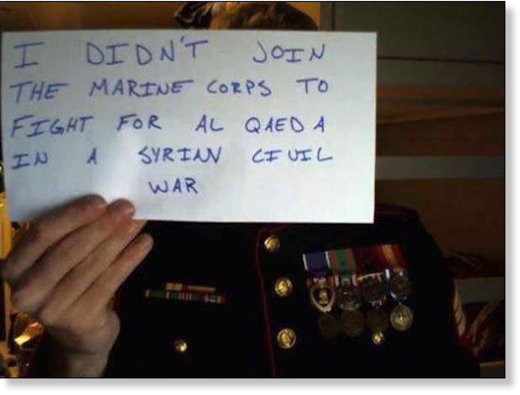
However, Murphy, "an eight year Army Special Operations veteran who served as a Sniper and Team Leader in 3rd Ranger Battalion and as a Senior Weapons Sergeant on a Military Free Fall team in 5th Special Forces Group," was writing as a U.S. Special Forces insider for Special Forces insiders. (SOFREP is a news and intelligence source for Special Operations veterans.) Parker's discussion of the report, although it skirts a considerable amount of Murphy's material, allows outsiders to get their toes wet without taking away from the allover point -- aptly conveyed in the photo Parker found to illustrate his article and in these two quotes from Murphy's writing:
"Nobody believes in it. You're like, 'Fuck this,'" a former Green Beret says of America's covert and clandestine programs to train and arm Syrian militias. "Everyone on the ground knows they are jihadis. No one on the ground believes in this mission or this effort, and they know they are just training the next generation of jihadis, so they are sabotaging it by saying, 'Fuck it, who cares?'"
While the games continue on, morale sinks for the Special Forces men in Turkey. Often disguised in Turkish military uniform, one of the Green Berets described his job as, "Sitting in the back room, drinking chai while watching the Turks train future terrorists."Has morale improved since 2016? Unlikely given that American Special Forces are still ordered to train "jihadis" in Syria. But the saboteurs are in the position of the genie in Disney's Aladdin, who had no choice but to serve the evil magician once the magician gained control of the lamp, although he served the magician's orders poorly as his protest. The Special Forces continue to carry out orders, no matter how poorly, no matter how much they despise them and the ones who give the orders. They're good soldiers, after all, and the first rule for good soldiers is to carry out an order.
But what do such orders say about the civilian rulers of the American military?
********
American land grab in Syria
"Already, the US has taken 30% of northern Syria east of the Euphrates River. If Turkey manages to take the rest of the border region west of the Euphrates and all the way down through Idlib province, Syria’s strategic position will be badly damaged. Foreign powers will control all northern border crossings and highways. They will also own much of Syria’s best agricultural land and water resources. This is not to mention that the US zone includes over 50% of Syria’s oil and gas fields."
The quote is from Joshua Landis during an interview he gave to ISPI published on February 27 under the title, Afrin, Ghouta, and the Post-IS scramble for Syria.
As to whether the Trump regime has taken control of even more Syrian territory since late February -- reliable data from that war front is hard to come by, but I'd say it's a good guess that the regime is trying to grab as much land as it can.
So no one should be surprised by Turkey's land grabs in Syria. The Turks are playing Monkey See Monkey Do. If the United States is getting away with an unprovoked invasion of a country and grabbing its land in the process, why shouldn't they?
********
Monday, March 26
No
Huskies are probably better at vocalizing their anger than any other dog breed but I don't think they can beat out a German Shepard when it comes to the Whole Body method of expressiveness.


From a photo gallery of dogs and cats registering anger about their trip to the veterinarian.
********
No you did not make me feel all better now
From a photo gallery of dogs and cats registering anger about their trip to the veterinarian.
********
Sunday, March 25
"Under a false flag UK attempts three chemical attacks in the Ghouta"
From Voltaire Network, March 20, 2018:
Mr. Lavrov then went on to give a stern warning to Washington, London and Paris, should they take the decision to bomb Damascus. The documents seized by the Syrian and Russian Secret Services confirm the existence of a plan to attack Damascus along similar lines to the plan conceived against Bagdad in 2003. Part of this plan includes killing off President al-Assad. Allied ships have been positioned to enable them to carry out this attack from the Mediterranean.
On 19 March 2018, the Syrian and Russian armies warned of a new chemical attack in Eastern Ghouta instigated by the United Kingdom under a false flag. The Syrian and Russian armies have already seized two chemical laboratories on 12 and 13 March. On 20 March, during a meeting of the Leaders of the Russian Armed Forces, the Russian Minister for Defence, General Sergey Shoygu, referred to three attempts to use these weapons during the week in Eastern Ghouta. While he explicitly avoided inculpating London with backing these attempted bombings, the way his words were couched removes any possible doubt from his listeners’ minds. He continued:
“We are hoping that in the current situation, our Western partners will allow good sense to guide their decision-making; that they stop flirting with terrorists and come together with Russia in their peaceful initiatives in Syria”.
In five days, more than 79,000 prisoners of armed groups in the Ghouta have successfully sought refuge in the Syrian Arab Republic. This is thanks to the humanitarian corridors of Muhayam al-Wafedin and Hamouriyah.
Translation
Anoosha Boralessa
On 17 March 2018 the Russian Minister for Foreign Affairs, Sergey Lavrov, denounced the presence of the US, British and French Special Forces in Syria; this is something that both London and Paris deny. He drove home the point, insisting: “What this presence means is that the issue is no longer a war by proxy but direct intervention in a war”.
Mr. Lavrov then went on to give a stern warning to Washington, London and Paris, should they take the decision to bomb Damascus. The documents seized by the Syrian and Russian Secret Services confirm the existence of a plan to attack Damascus along similar lines to the plan conceived against Bagdad in 2003. Part of this plan includes killing off President al-Assad. Allied ships have been positioned to enable them to carry out this attack from the Mediterranean.
On 19 March 2018, the Syrian and Russian armies warned of a new chemical attack in Eastern Ghouta instigated by the United Kingdom under a false flag. The Syrian and Russian armies have already seized two chemical laboratories on 12 and 13 March. On 20 March, during a meeting of the Leaders of the Russian Armed Forces, the Russian Minister for Defence, General Sergey Shoygu, referred to three attempts to use these weapons during the week in Eastern Ghouta. While he explicitly avoided inculpating London with backing these attempted bombings, the way his words were couched removes any possible doubt from his listeners’ minds. He continued:
“We are hoping that in the current situation, our Western partners will allow good sense to guide their decision-making; that they stop flirting with terrorists and come together with Russia in their peaceful initiatives in Syria”.
In five days, more than 79,000 prisoners of armed groups in the Ghouta have successfully sought refuge in the Syrian Arab Republic. This is thanks to the humanitarian corridors of Muhayam al-Wafedin and Hamouriyah.
Translation
Anoosha Boralessa
[END REPORT]
See also:
"Not proxy": Lavrov says US, British, French special forces "directly involved" in Syria war; RT, March 17, 2018
See also:
"Not proxy": Lavrov says US, British, French special forces "directly involved" in Syria war; RT, March 17, 2018
What an Afghani did with his uncanny resemblance to Bruce Lee

********
Saturday, March 24
Ambassador van Dam, negotiation would be useless if the war was always a foreign-led effort
"When democracies confront dictatorships like the Syrian regime, the chance of positive results can be higher by communicating with it than by refusing to communicate with it."
All this noted, I found Ambassador van Dam's lecture worthwhile and quote extensively from it below. I've omitted the first part, which is about how the Baathists got established in Syria, and skipped over a few other passages; this in order to focus on his enumerations of the grim and ongoing consequences of the Syrian conflict. The added emphasis throughout is mine.
But political isolation of the Damascus regime was bound to be unsuccessful.
The alternative was to militarily defeat the Syrian regime, after which talks would not be necessary anymore. But direct military intervention was rejected in the democracies involved, just as well.
Nevertheless, by way of an alternative, various Western and Arab governments chose to militarily intervene indirectly, by arming, financing and politically supporting the various Syrian opposition groups; but this turned out not to be enough to topple the regime. And I leave out of consideration here whether an alternative regime would have been much better.
Reproaching foreign countries for giving insufficient support to help topple the regime, whereas simultaneously being against any military intervention appears to be contradictory. Let me therefore clarify what I mean. I am strongly against military interventions in general because there are so many examples which illustrate that such interventions mainly lead to disaster. My point is that the countries that encouraged the military opposition to confront the Syrian regime, without sufficiently arming them or sufficiently coordinating their militarily actions, were in practice leading many of the opposition military into the trap of death.
[...]
Most of the Syrian opposition at the time were not able to accept any negotiations with the regime, not only because of their feelings and emotions towards the regime, but also because they still expected to receive strong foreign support, as happened in Libya, which caused the fall and death of Libyan leader al-Qadhafi.
Many demonstrators wanted to attract foreign attention via the media in the hope of triggering foreign help, but the support they wanted did not come as expected.
With some hindsight, and purely theoretically speaking, many Syrians might not have started the Syrian Revolution, had they been aware of the disastrous consequences beforehand. [Pundita note: I strongly believe this was the case, based on numerous anecdotes from Syrians I've read during the years of the war.] But in reality, things do not work that way.
[...]
[...]
The position of Qatar, which has been one of the key supporters of the civilian and military opposition for a long time, changed as well in October 2017, particularly after the other states of the Gulf Cooperation Council imposed sanctions against it with the accusation that Qatar had been supporting terrorist organizations in Syria.
Remarkable is also that there has not been any compromise whatsoever between the Syrian regime and the opposition inside the country.
The quote is from Ambassador Nikolaos van Dam's lecture at the Bruno Kreisky Forum for International Dialogue, Vienna, March 7, 2018; the full transcript was published March 8 by Syria Comment (edited by Joshua Landis) and titled Foreign intervention in Syria: Isn't it time to admit that the war against the Syrian regime is lost?
Ambassador van Dam is a Dutch career diplomat (Indonesia, Germany, Turkey, Egypt, and Iraq) who served as the Netherlands' Special Envoy to Syria from 2015-2016 and came to specialize in observing the Syrian conflict. His latest book is Destroying a Nation: The Civil War in Syria (London: I.B. Tauris, 2017).
I have not read his book but van Dam is, to my reading of his lecture, intelligent and well-informed about Syria and brought his considerable experience as a diplomat to bear in his argument that no matter how grim the conflict, the channels of communication must be kept open by both sides.
However, I venture this is one of those times when one's point of view as a diplomat is an impediment to clear seeing. If, as van Dam indicates, the Syrian conflict was from the early days actually fueled by foreign governments in a bid to overthrow President Bashar al-Assad and his government, attempts at communication would have always been useless because the regime change plotters were never sincere; they weren't interested in reaching a compromise.
The ambassador might reply that one should never give up on attempts at negotiation no matter how insincere the parties, and that the catastrophe in Syria is the best argument to keep trying.
I think that could be true for the local parties in conflicts. But when powerful governments bent on regime change are involved, something much stronger than negotiation also needs to be deployed. The aims of the foreign governments party to regime change need to be exposed for the public to see. In a democracy, this is the task of the press and government officials.
But in the case of Syria the outside governments trying for regime change have been at least three NATO members -- the USA, France, and Turkey -- and at least two very rich Gulf Arab governments -- Qatar and Saudi Arabia.
The upshot is that even today there has been no official acknowledgement in democratic countries of the role played in Syria by foreign interventionists. And there is scant reference to the situation in the mainstream American press -- and certainly not enough references to awaken the majority in the American public to the true situation.
The great irony is that many Americans at this time have reasons to believe the current U.S. President, Donald Trump, was the target of a nonviolent coup attempt engineered by elements in the Department of Justice, Central Intelligence Agency, and Federal Bureau of Investigation. If the belief is borne out by more evidence, this could be termed Washington's propensity for regime change come home to roost.
So while it's important to attempt to maintain dialogues in the face of even the most seemingly intractable armed conflicts, here I am reminded of the old Protestant saying, "Pray, but row away from the rocks."
The advice would go double if the Trump regime is planning to win the war against the Assad regime by murdering Assad.
The advice would go double if the Trump regime is planning to win the war against the Assad regime by murdering Assad.
All this noted, I found Ambassador van Dam's lecture worthwhile and quote extensively from it below. I've omitted the first part, which is about how the Baathists got established in Syria, and skipped over a few other passages; this in order to focus on his enumerations of the grim and ongoing consequences of the Syrian conflict. The added emphasis throughout is mine.
By Nikolaos van Dam
March 7, 2018
BEGIN QUOTES
[...]
But political isolation of the Damascus regime was bound to be unsuccessful.
The alternative was to militarily defeat the Syrian regime, after which talks would not be necessary anymore. But direct military intervention was rejected in the democracies involved, just as well.
Nevertheless, by way of an alternative, various Western and Arab governments chose to militarily intervene indirectly, by arming, financing and politically supporting the various Syrian opposition groups; but this turned out not to be enough to topple the regime. And I leave out of consideration here whether an alternative regime would have been much better.
Most foreign governments claimed that they wanted a political solution, and this was true in principle. But they only wanted a political solution that would lead to regime change, and this turned out to be impossible without sufficient military means. Such military interventions were actually in violation of international law which bars UN member states from supporting military action to overthrow other members’ governments.[1]
The results of indirect military intervention have been just as disastrous as direct military intervention would have been: notably almost half a million dead, millions of refugees, a country in ruins and a nation destroyed to a great extent.
Reproaching foreign countries for giving insufficient support to help topple the regime, whereas simultaneously being against any military intervention appears to be contradictory. Let me therefore clarify what I mean. I am strongly against military interventions in general because there are so many examples which illustrate that such interventions mainly lead to disaster. My point is that the countries that encouraged the military opposition to confront the Syrian regime, without sufficiently arming them or sufficiently coordinating their militarily actions, were in practice leading many of the opposition military into the trap of death.
[...]
Most of the Syrian opposition at the time were not able to accept any negotiations with the regime, not only because of their feelings and emotions towards the regime, but also because they still expected to receive strong foreign support, as happened in Libya, which caused the fall and death of Libyan leader al-Qadhafi.
Many demonstrators wanted to attract foreign attention via the media in the hope of triggering foreign help, but the support they wanted did not come as expected.
With some hindsight, and purely theoretically speaking, many Syrians might not have started the Syrian Revolution, had they been aware of the disastrous consequences beforehand. [Pundita note: I strongly believe this was the case, based on numerous anecdotes from Syrians I've read during the years of the war.] But in reality, things do not work that way.
[...]
It should go without saying that those who confront the Syrian regime with a limited will and limited means must also set limited goals if they are to accomplish even a limited amount of what they want to achieve. Yet, even after seven years of bloody war, and well over 450,000 dead, many Western and Arab politicians still tend to be blinded, to some extent at least, by wishful thinking, as a result of which they officially keep approaching the conflict in Syria from a supposedly moral high ground. They have not been prepared to accept the basic reality, that with a limited will and limited means only limited goals can be achieved.
Foreign leaders either ignore these basics or pretend not to be aware of them. By continuing to maintain so-called ethically and politically correct points of view concerning justice, without, however, providing the necessary means to help realize their just aims, various Western and Arab politicians indirectly have helped the war to continue with all its dead, refugees and destruction.
[...]
The position of Qatar, which has been one of the key supporters of the civilian and military opposition for a long time, changed as well in October 2017, particularly after the other states of the Gulf Cooperation Council imposed sanctions against it with the accusation that Qatar had been supporting terrorist organizations in Syria.
Former Prime Minister and Minister of Foreign Affairs, Shaykh Hamad bin Jasim Al Thani, in a reaction, confided that the support of Qatar for the Syrian opposition had earlier on been fully coordinated with Saudi Arabia, and that all their common support went via Turkey, where further arms distributions were coordinated with the United States, together with Turkey and Saudi Arabia.
Shaykh Hamad denied having provided any support to the Islamic State (Da’ish), and that in [any?] case it would have ended up in the hands of the al-Qa’ida related Jabhat al-Nusra, which apparently had been the case, this would have been stopped, because that would have been a mistake. Saudi Arabia and Qatar had focused on, what he called ‘the liberation of Syria’, but when the two countries started to quarrel over their common ‘prey’ (by which he meant Bashar al-Asad and the Syrian regime), the prey escaped.
Shaykh Hamad bin Jasim added that it would be okay if al-Asad would stay on if the Saudis wanted this. After all, Qatar used to be friends with al-Asad. Shaykh Hamad criticized that there had not been a consequent policy between Qatar and Saudi Arabia but did not mind to change course if past policies turned out to have been a mistake.[10] This change in policy happened after more than 450,000 victims had fallen and was apparently mainly the result of a dispute between Qatar and Saudi Arabia, not because of a spontaneous change of views, or special feelings for the Syrian people.
As far as negotiations were concerned, the Syrian opposition has already been communicating with the Syrian regime for several years through the successive United Nations Special Envoys for Syria, but they did so under pre-conditions that made any serious negotiations impossible, because they demanded as a kind of pre-condition that President al-Asad and those of his regime with blood on their hands should leave and should be excluded from playing any role in Syria’s future and should be courtmartialed. These demands may seem fully understandable, but they were unrealistic, because they guaranteed that any compromise or serious negotiations with the regime were excluded.
As far as negotiations were concerned, the Syrian opposition has already been communicating with the Syrian regime for several years through the successive United Nations Special Envoys for Syria, but they did so under pre-conditions that made any serious negotiations impossible, because they demanded as a kind of pre-condition that President al-Asad and those of his regime with blood on their hands should leave and should be excluded from playing any role in Syria’s future and should be courtmartialed. These demands may seem fully understandable, but they were unrealistic, because they guaranteed that any compromise or serious negotiations with the regime were excluded.
Moreover, the fate of president al-Asad is not at all mentioned in the Geneva Communique (2012), which is one of the main internationally agreed cornerstones of the intra-Syrian negotiations.
If, after some seven years of bloodshed, some Arab and Western leaders decide to change course and decide that al-Asad should be accepted as staying in power in Syria and would think it opportune to reestablish relations and to reopen embassies in Damascus, they should not expect the Syrian regime to welcome them back. On the contrary, such overtures would most probably be rejected at first, until political accounts are settled, because the regime considers the foreign interference and support for the armed opposition as one of the principal reasons why the Syrian War has lasted that long.
Any international reconstruction aid could only be channeled to government-controlled areas with the approval of the regime. And reconstruction efforts in areas not under regime control run the risk of coming under fire in case these areas would be reconquered by the regime.
What might perhaps have been achieved through dialogue with the regime in the earlier stages of the Syrian Revolution, became more and more difficult later on with all the killing and destruction that has occurred. The longer the war lasted, the more difficult it has become to negotiate and reach any compromise.
One might also argue that the regime has never been interested in any dialogue whatsoever that would have led to drastic political changes or reform but it has – in my opinion – not been tried long enough.
[Pundita note: Damascus did institute several reforms, including a new constitution but these weren't enough, and could never have been enough, for the foreign parties wanting control of Syria.]
The serious efforts in the beginning should have been continued. Sometimes one should even make a serious effort if one is not fully convinced of the possibilities of achieving success.
Considering the millions of Syrian refugees, one would logically speaking expect that most of them will return to Syria, once the war is over, but realities may turn out to be quite different. In particular those refugees who are suspected of having been active against the regime – most of them Sunnis – may not be allowed to return, certainly not in the shorter run when the economic prospects are dim.
Syria expert Fabrice Balanche suggests that president al-Asad even might not want the return of millions of refugees, because Syria was already overpopulated before the Syrian War that started in 2011, and suffered from severe economic problems, water shortages and other issues that helped trigger the Syrian Revolution. Refusing the reentry of millions of Syrian refugees might, according to this vision, give Syria the opportunity of a new start with a smaller population which, in the thinking of the regime, might ‘give Syria some air’.[11] Moreover, it can be expected that refugees wanting to return to Syria may have to prove that they were loyal to the regime and not against it. All this might imply rigorous demographic changes to the disadvantage of the Syrian Sunni population.
Fabrice Balanche has convincingly demonstrated that, although various other factors have played a role as well, the sectarian divide in Syria should not be ignored, because it is a key issue, with the opposition areas being mainly Sunni, and the areas numerically dominated by minorities being pro-regime.[12] This divide can have serious implications for the future once the Syrian War would be over.
Remarkable is also that there has not been any compromise whatsoever between the Syrian regime and the opposition inside the country.
[Pundita note: Damascus has worked out compromises with many thousands of insurgents. The author might be speaking of the major opposition leadership, which I believe is controlled by various foreign governments; e.g., Saudi Arabia.]
And some opposition leaders who were originally operating from inside the country, like Lu’ayy Husayn, leader of Building the Syrian State, have been sentenced to long term imprisonment in absentia, making it impossible for them to return.
Prominent opposition members abroad who publicly repented their opposition to the regime and wanted to come back to Syria were refused entry into their home country, although there have been exceptions.[13]
I have hardly touched on the role of Russia and Iran in the conflict and will do so only very shortly. The US-British invasion of Iraq in 2003 has led to a war, the end of which after 15 years is by far not in sight. By removing president Saddam Hussein, they have laid out a red carpet for Iran to expand its influence in Iraq, Syria, Lebanon and elsewhere in the Middle East.
The – direct or indirect – foreign military interventions in Syria have caused the position of Russia to be strengthened considerably. The main reason for Russia to intervene was to keep its ally, the regime, in power. Without other foreign interventions in Syria trying to effectuate regime change, Russia would have had no reason to intervene the way it did since 2015.
What is in it for the regime to have a political solution instead of a military one? It cannot stay in power forever, and therefore it is in its interest to help establish a new Syria that is inclusive for all Syrians in such a way that a new revolution or settlement of accounts in the form of revenge is avoided. The regime should have done so long before the revolution started, or directly afterwards, but Bashar al-Asad and his supporters choose the path of violent suppression. [Pundita note: I disagree with this view of Assad's actions in the early years of the revolution.]
Syria expert David Lesch has suggested that al-Asad hesitated in the beginning of the Revolution between a more lenient approach and a violent crackdown by government forces. It was a ‘fateful decision’ not to have seriously explored the road of reform and reconciliation in the beginning, certainly when taking into account the disastrous aftermath.[14]
Nevertheless, it is far from certain whether an announcement in the beginning by the president of reform measures would really have satisfied the demonstrators as long as the Syrian dictatorship persisted. After all, the demonstrators were overwhelmed by enthusiasm as a result of the so-called Arab Spring in Tunisia, Egypt and Libya where the presidents had fallen.
Now it has become much more difficult to effectuate drastic reform measures. But this in itself is no reason not to seriously try to achieve it. Nevertheless, it is doubtful whether the regime will make serious efforts in this direction because this could imply undermining its own position, as would have been the case in the beginning of the Syrian Revolution.
Whereas the common sectarian, regional and family or tribal backgrounds of the main Ba’thist rulers have been key to the strength of the regime, their Alawi sectarian background has also inherently been one of its main weaknesses. The ‘Alawi factor’ is hindering a peaceful transformation from Syrian dictatorship towards a more widely representative regime. This ‘Alawi Gordian knot’ should therefore be disentangled in order to establish trust between all Syrian population groups, irrespective of their religious or ethnic background.
I strongly doubt, however, whether the regime would be prepared to cut this ‘Alawi Gordian knot’, because it has always been essential for its survival.
Therefore, even if the regime will win the war, which seems likely, the future prospects for peace in Syria look very grim.
END QUOTES
See the Syria Comment website for lecture footnotes.
********
Thursday, March 22
Was Skripal the "Russian intelligence source" for the Steele Dossier?
Gregory Copley, the Editor of GIS/Defense & Foreign Affairs states flatly in his March 21 article for the World Tribune that Sergei Skripal was indeed Christopher Steele's "Russian intelligence" source for reports in the dossier.
(As to Gregory's reliability -- I won't call him the best in the business because I'm not familiar with the work of every defense analyst, but I do know many would agree that he is among the very best.)
And if Gregory's claim about Skripal's contribution to the dossier is correct, it could explain the Russian government's stunning accusation on March 21 that the British government was hiding and possibly planning to destroy evidence in the Skripal poisoning case. (See Russia accuses UK of hiding evidence in Skripal case; the Guardian, March 21. )
During the March 21 John Batchelor Show Gregory spoke about the connection between Skripal and the Steele Dossier and said there was every indication Skripal was willing to talk openly about his contribution to Steele's dossier. (JBS Podcasts Part 1 of 2 and Part 2)
If Skripal indeed said he was willing to sing like bird, he could well have signed his death warrant with his tongue, given the Steele dossier connection with the highest levels of the Obama Administration, the U.S. Democratic National Party, and the Hillary Clinton presidential campaign.
So talk about a solid motive for murder.
From Gregory's World Tribune article (Murky waters: The attack on Sergei Skripal, the assassination of Kim Jong-Nam, and the ‘Steele dossier’, which point-by-point examines the British claim that 'Russia' ordered the hit on Sergei Skripal and his daughter Yulia (who surely knew all about about her father's involvement with the Steele dossier):
[...]
5. Again, what is significant is the obvious matter which has not been raised in any of the discussions of the attack on the Skripals: the ongoing links between Sergei Skripal and SIS [aka MI6].
It is worth bearing in mind that Skripal’s period as a double agent for MI6 overlapped the period when now-former MI6 officer Christopher David Steele worked under diplomatic cover in the British Embassy in Moscow (1990-93) and as head of the Russia Desk at MI6 between 2006 and 2009.
A number of sources have indicated a series of ongoing links between Steele and Skripal, and certainly, as head of the Russia Desk, Steele would have overseen aspects of Skripal’s handling in retirement in the UK.
Furthermore, Skripal was known to have undertaken freelance work “in retirement”, preparing reports on Russia. He was well known to be an “author for hire” for anyone seeking a supposedly authoritative assessment on Russia or on Russian intelligence issues.
He was, in short, the “Russian intelligence source” for the Steele Dossier compiled for the election campaign of Hillary Clinton on then-Presidential candidate Donald Trump.
This Service raised the issue of the witting compliance of SIS/MI6, or its tacit support of, the activities of Christopher Steele — by this time retired from SIS, and working from his corporate base, Orbis Business Intelligence, Ltd. — in preparing what was clearly a document designed for political warfare use against a U.S. presidential candidate. Moreover, this was not an isolated example:
[...]If the British secret service was involved in the creation and/or use of the Steele dossier to influence the U.S. 2016 presidential election, would this be considered a crime in the United States? Well, the British government has deniability given that Steele was a former MI6 agent at the time he put reports together for the dossier. That wouldn't be the same for Steele -- unless he too has a story to tell the media, one he hasn't divulged yet.
And although it's is behind a paywall at GIS/DFA, just the title of this special analysis, “Significant Ramifications for UK-USA Accord Signatories of Possible Unauthorized US Recruitment of a UK Intelligence Professional” (February 6, 2018) indicates there are very serious questions related to the matter.
Of course the attempted murder of the Skripals would be different story altogether and also raise questions about unauthorized recruitment.
In any case perhaps the U.S. Special Counsel Robert Mueller should cast his net just across the Pond if he's still looking for evidence of a foreign influence in the U.S. election.
I'll close with a few more quotes from Gregory's article, which I recommend needs to be read in its entirety:
[...]
What seems clear is that the “rush to judgment” against the Russian Government seemed necessary to many parties because there were too many unpleasant realities — many of which had immediate political and legal consequences — to be faced by (a) the U.S. Democratic National Committee (DNC); (b) the Clinton campaign; (c) former U.S. President Barack Obama; (d) SIS/MI6 and Christopher Steele; and (e) the UK Government (which may have felt that it had no other alternative but to pay a price to sweep the actions of recent years under the carpet).
Moreover, the whole nature of the attempt to stop Skripal from talking to the media (and this was apparently being mooted, according to GIS/Defense & Foreign Affairs sources) was designed in such a way that the immediate “suspect” would be Moscow.
[...]
********
Wednesday, March 21
Afrin Kurds believed U.S. and Al Saud would carve a country for them in Syria
Talk about a sucker born every minute. They should've taken the deal Damascus offered them.
********
The Kurds of Afrin were promised that Saudi Arabia would rebuild the province and invest in reconstructing better homes and contribute, under the US forces’ protection, to offering a mini-state to the Kurds in north-east Syria, a dream the Kurds always aspired to.From Elijah J. Magnier's March 20 report, Why Afrin Has Fallen: US - Turkish - Russian - Kurdish roles
********
Corporate media's marketing of terrorists as Syrian freedom fighters
From Eva K. Bartlett's March 11 interview with veteran war zone correspondent Elijah J. Magnier:
When Magnier says never in his life, he's speaking as someone who's reported on a great deal of warfare over a period of more than 30 years. From his website:
See also James Corbett's November 2017 interview with Canadian Eva Bartlett about her extensive 'on the ground' reporting on the Syrian War and her challenges, based on her first-hand investigations, to corporate media's propaganda claims about the Syrian government's prosecution of the Syrian War.
********
BARTLETT: "I know you've been a journalist for many, many years. Have you ever seen such shameful journalism without any sort of ethics?"
MAGNIER: "Never, never in my life. In fact, today, the head of the tribes in Ghouta [said] the only reason the jihadis are holding onto Ghouta and not willing to leave and keeping the civilians as a shield is because of the mainstream media. The mainstream media is supporting them, the international community is supporting them -- they're supporting the jihadis. [...]The exchange is at the 27:40 mark in the YouTube video titled "Developments in Ghouta, Afrin, and Corporate Media's Shameful Reporting on Syria"
When Magnier says never in his life, he's speaking as someone who's reported on a great deal of warfare over a period of more than 30 years. From his website:
... Covered on the ground the Israeli invasion to Lebanon (1st war 1982), the Iraq-Iran war, the Lebanese civil war, the Gulf war (1991), the war in the former Yugoslavia (1992-1996), the US invasion to Iraq (2003 to date), the second war in Lebanon (2006), the war in Libya and Syria (2011 to date). ...
See also James Corbett's November 2017 interview with Canadian Eva Bartlett about her extensive 'on the ground' reporting on the Syrian War and her challenges, based on her first-hand investigations, to corporate media's propaganda claims about the Syrian government's prosecution of the Syrian War.
********
Sunday, March 18
"The continuing US policy of regime change in Syria"
This is not so much a war as a nightmare but one that has exposed the true face of the American government across Democratic and Republican regimes. From Col Pat Lang's Syrian War Report - March 17, 2018 at Sic Semper Tyrannis:
[...]
The continuing US policy of regime change in Syria leaves little possibility that the [Syrian] government can recover Syria east and north of the Euphrates River. That land is under US government "protection." How the movement of (US) Kurds to Afrin to fight will affect that is unpredictable.
As SST forecast just after the fall of Aleppo City to the government, Idlib Province has become a cancerous wound in the side of the possibility of a fully reunited Syria.
The Turks are taking advantage of their burgeoning relationship with Russia to eradicate Kurdish control of Afrin district in Aleppo Province. The Turks are making steady progress in this effort.
The evolving tie to Russia is evident in the S-400 SAM deal and Russia seems complicit in the "Olive Branch" campaign. There are clearly limits to Russian protection of the SAG [Syrian Arab government]. The Turks have now established "observation posts" of company size all along the eastern border of Idlib Province. These are positioned to impede a renewed advance of R+6 into Idlib Province once SAA and friends are finished in the Damascus area.
The latest of these posts is now being placed just NW of Aleppo so as to prevent an advance by the government to the west into northern Aleppo Province. IMO what we are seeing is a slow motion annexation of NW Syria by Turkey.
[...]********
"Over 20,000 people left militant=occupied E. Ghouta on Sunday morning"- Russian MoD
Thousands of civilians fleeing militant-occupied E. Ghouta as mass exodus continues (LIVE VIDEO REPORTS)
Published time: 18 Mar, 2018 06:10
More than 20,000 people have left the militant-occupied areas of the Damascus suburb of Eastern Ghouta on Sunday morning, the Russian military said. Live images from the scene show people streaming to safety.
In total, more than 68,000 people have so far left Eastern Ghouta through the humanitarian corridors set up by the Syrian Army and Russia, the Russian Defense Ministry’s Center for Syrian Reconciliation said in a statement.
“The humanitarian corridor in Eastern Ghouta continues to work,” Maj. Gen. Vladimir Zolotukhin, a spokesman for the Reconciliation Center, said.
READ MORE: ‘We were about to die’: E. Ghouta civilians say militants used them as human shields & barred escape
Published time: 18 Mar, 2018 06:10
Edited time: 18 Mar, 2018 07:44
RT
In total, more than 68,000 people have so far left Eastern Ghouta through the humanitarian corridors set up by the Syrian Army and Russia, the Russian Defense Ministry’s Center for Syrian Reconciliation said in a statement.
“The humanitarian corridor in Eastern Ghouta continues to work,” Maj. Gen. Vladimir Zolotukhin, a spokesman for the Reconciliation Center, said.
READ MORE: ‘We were about to die’: E. Ghouta civilians say militants used them as human shields & barred escape
[END REPORT]
********
"Turkish-backed forces storm Afrin city in all-out assault - BREAKING NEWS" Updated 4:37 a.m. EDT
Update
Sputnik is reporting as breaking news that Erdogan has announced Turkish Army and "Syrian opposition" forces have taken over Afrin.
END UPDATE
(There's so much big breaking news from the Syrian war front that Al Masdar News has installed a Breaking News ticker tape.)
BEIRUT, LEBANON (8:49 A.M. March 18 - report filed by Andrew Illingworth for AMN)
Sputnik is reporting as breaking news that Erdogan has announced Turkish Army and "Syrian opposition" forces have taken over Afrin.
The Turkish Army and the Free Syrian Army armed opposition group have seized control over the Kurdish-held northern Syrian city of Afrin.
"Backed by the Turkish armed forces, Free Syrian Army (FSA) units entered Afrin and took complete control of the city. The majority of terrorists have fled. Our military and the opposition are defusing mines they have left," Turkish President Recep Tayyip Erdogan has declared as quoted by local media.
He added Ankara would do its best to fix the infrastructure in the region.
The final offensive on Afrin, which has been under control of the Kurdish militia, was launched early on Sunday morning, the Anadolu agency reported.
Erdogan's press secretary Ibrahim Kalin has earlier stated that Turkey is not going to hand in control over Afrin to Damascus.
On January 20, Ankara, jointly with the opposition Free Syrian Army forces, launched Operation Olive Branch in Afrin in order to "clear" Turkey's Syrian border from the terrorist threat.
Turkey considers the Democratic Union Party (PYD), a Kurdish political party in northern Syria, and the Kurdish People's Protection Units (YPG) militia to be linked to the Kurdistan Workers' Party (PKK), listed as a terrorist organization by Ankara.Ankara's Olive Branch Operation in Afrin has been strongly condemned by Damascus, calling Turkey's move "a violation of the country's sovereignty." In response, Turkish Foreign Minister Mevlut Cavusoglu said that preservation of the territorial integrity of Syria is the common goal of Ankara and Damascus and that Turkish troops are not going to attack government forces in Syria.
Moscow has called for respecting Syria's integrity.
[END REPORT]
(There's so much big breaking news from the Syrian war front that Al Masdar News has installed a Breaking News ticker tape.)
BEIRUT, LEBANON (8:49 A.M. March 18 - report filed by Andrew Illingworth for AMN)
After a week of systemically outflanking the Kurdish-held city of Afrin in Syria’s Aleppo province, Turkish-backed forces have now kicked-off the operation to capture the small but nonetheless highly strategic settlement.
The assault has been confirmed by a local Syrian paramilitary fighter (belonging to the National Defence Forces) in contact with Al-Masdar News.
The ground assault on Afrin by pro-Ankara militants comes after a week of relentless bombardment of the city by Turkish jets and artillery that has ultimately served to kill hundreds.
The[re] exists unconfirmed reports that Syrian Kurdish fighters will not actually attempt to fight for Afrin and have instead abandoned the city and its remaining inhabitants, as well as virtually all of the Afrin region, to the control of Turkish coalition forces.
[END REPORT]
Let me see if FARS has a report yet on the assault. [taptaptap] No but some related reports:
********
Saturday, March 17
Deadly nerve poison no match for London bobbies

British government claims about the "poisoning" of a former Russian double agent and his daughter by a super-toxic nerve agent are so silly they can't be considered propaganda or even fake news. What could they be termed, then?
Obviously, the Spanish Inquisition
For a straight-faced analysis here's Moon of Alabama's March 16 deconstruction of the latest exercise in British anti-Russian buffoonery.
********
Thursday, March 15


Subscribe to:
Posts (Atom)