Translate

Tuesday, April 3

Syria's fantasy nuclear reactor: "When the building exploded it should have sent graphite everywhere."

So many lies have been told about Syria's President Assad and the Syrian government and its military I've lost track but the whopper that takes the cake is the one about a nuclear reactor bombed to smithereens by the Israeli Air Force in 2007. In an April 3 article for Anti-war.com Ted Snider takes apart the story, and in a way that even someone with no background in nuclear reactor issues can easily understand. I'm so impressed with his ability to clearly and succinctly explain very complicated matters that I'm republishing the whole thing here. 

What Did Israel Bomb in the Syrian Desert in 2007?
Posted on April 03, 2018
Anti-war.com

In September 2007, in the dark of night, warplanes crossed the Syrian border and bombed a covert nuclear reactor. Recently, Israel took responsibility for the bombing mission that obliterated the Syrian reactor.

The Israeli announcement was unnecessary if it was intended to be an admission of responsibility. The origin of the bombers had never been a mystery. As early as 2008, Seymour Hersh began his report on the bombing with the line “Sometime after midnight on September 6, 2007, at least four low-flying Israeli Air Force fighters crossed into Syrian airspace and carried out a secret bombing mission.” Even the International Atomic Energy Agency’s (IAEA) report on the bombing said that the building had been "destroyed by Israel in September 2007."

That the nuclear reactor was bombed by Israeli planes is clear. That the building the Israeli planes bombed was a nuclear reactor is far less clear.

The Nontechnical Questions

If Syria was building a nuclear weapons program, they were doing it entirely without the knowledge of the CIA. CIA Director Michael Hayden told President Bush that the CIA knew nothing about the Syrian reactor. That the CIA missed a secret nuclear program is not impossible to believe or even entirely unprecedented. What is more unbelievable is that they missed it when it was right out in the open. The Syrians made no attempt to conceal their biggest secret. The highly sophisticated U.S. satellites missed what a commercial satellite easily picked up.

It is hard to make sense of that. In fact, it is hard to make sense of a lot of nontechnical features of the Israeli story. Even to the layman with no technical knowledge of enrichment or nuclear reactors, a number of features made no sense. 

Investigative journalist Seymour Hersh picked up on these nontechnical anomalies in his early investigative reporting of the strike, “A Strike in the Dark.” A former State Department intelligence expert told Hersh that many of the features that one would see around a nuclear reactor were missing from the site. There was not even any security around it. 

Former senior IAEA inspector Robert Kelley expanded on this anomaly in a personal correspondence. He said there was "no security whatever: no fences, no guards, no perimeter road, no security on the river pump house, water lines run under a public highway." A nearby agricultural desert water station pump house had more security, he told me. He called the lack of security "a pretty big deal." So did Syria’s then ambassador to the United States, Imad Moustapha:
“An allegedly strategic site in Syria without a single military checkpoint around it, without barbed wire around it, without anti-aircraft missiles around it, without any sort of security surrounding it, thrown in the middle of the desert without electricity, plans to generate electricity for it, with out major supply plans around it? And yet, it is supposed to be a strategic installation? And people don’t even think of it. Yesterday, in the White House presidential statement, it was stated to the letter that that was a secret location. And yet, every commercial satellite service available on earth was able to provide photos and images of this so-called secret Syrian site for the past five, six years.”
There were other details that didn’t fit the Israeli narrative either. The nuclear reactor was supposed to be based on a North Korean design, and North Korea was cast as a key player in the construction of the clandestine nuclear reactor. A North Korean ship called the Al Hamed attracted a lot of the spotlight. It was claimed to have brought the Syrians nuclear equipment from North Korea. But, the problem was that, in his investigation, Hersh found that neither maritime intelligence nor the ship’s transponder gave any indication that the Al Hamad had recently docked in North Korea.

At least two people I spoke to were also struck by the absence of people and the lack of activity at the site. You need a program, one person told me. You need bureaucratic support. Building a nuclear reactor is a huge project. Kelley says "there were very few workers as in there are no busses and just a few motorcycles. That is a pretty big clue this is not a big deal. About to start up a super critical facility? No workers?"

Pursuing a different line of nontechnical questioning, one person I spoke to asked why, when war broke out in Syria, and America threw everything bad it had at Assad and Syria, from chemical weapons to barrel bombs, why did it never return to the illegal nuclear weapons program if it had real evidence that it had had one?

But perhaps the most telling thing is not that the CIA missed what was out in the open for commercial satellites to pick up, not that they didn’t “have any proof of a reactor – no signals intelligence, no human intelligence, no satellite intelligence,” as a former senior US intelligence official who had access to the current intelligence told Hersh. 

What is, perhaps, more telling is that when they were provided with the intelligence, despite signing on to the Israeli narrative, they actually assessed only “low confidence” that the targeted site was part of a Syrian nuclear weapons program. And they weren’t the only ones. Mohamed ElBaradei, then director-general of the IAEA, said that their “experts who have carefully analyzed the satellite imagery say it is unlikely that this building was a nuclear facility.”

The IAEA Verdict

Despite the inconsistencies and the low confidence, by May 2011, the IAEA had rendered a verdict, repeated in their September 2014 report, that "based on all the information available to the Agency and its technical evaluation of that information, it was very likely that the building destroyed at the Dair Alzour site was a nuclear reactor which should have been declared to the Agency." The Background section of the report informs that the information they had been provided with alleges that the bombed building was "a nuclear reactor that was not yet operational and into which no nuclear material had been introduced."

But if the IAEA verdict is correct, why did Israel cross into Syrian air space and bomb the building in what was almost certainly an act of war? Joseph Cirincione, president of Ploughshares Fund and a leading expert on nuclear weapons, told me that he has no reason to doubt the IAEA’s verdict. But, he said, their verdict was only that it was "an unfueled nuclear reactor under construction," and that, he said, is "only an initial step" "towards Syria developing a nuclear weapons capability." Cirincione told me that "there was no imminent risk; no justification of an illegal Israeli attack" because Syria was still "a very long way from assembling the technical, industrial and financial capabilities needed to support a nuclear weapons program." He said that, at this point in Syria’s development of a nuclear weapons program, the "matter should have been brought to the United Nations, not the Israeli Defense Force."

The Technical Questions

But there were also reasons to doubt the IAEA’s verdict. More problematic for the Israeli-American-IAEA story than the nontechnical questions were a host of technical questions. There were three topics of technical questions.

The Photographs

The first was the photographs provided by Israel’s Mossad. There were two problems with the photographic evidence. The first was that Hayden never asked the Israelis how they got the photographs even though the CIA Director knew that at least one of the photographs had been photo-shopped to make the case more convincing, as investigative journalist Gareth Porter reports. The second was that the CIA was provided a bunch of photographs from inside a potential nuclear reactor and a bunch of photographs of the outside of the targeted building in Syria, but “nothing that links the two,” as former U.N. weapons inspector Scott Ritter has pointed out. The former were potentially of a nuclear reactor, but were the latter?

The Bombed Building

The second set of technical problems involves the building itself. The first is that the building is the wrong size. The weight of the claim that the Syrian building was a nuclear reactor rests on the Israeli-CIA insistence that the building looks like the North Korean reactor at Yongbyon upon which they claim it was modeled. It is a type of reactor known as a gas-cooled graphite-moderated (GCGM) reactor. If it looks enough like that nuclear reactor, it could be a nuclear reactor; if it doesn’t, it wasn’t. But it doesn’t: the Syrian building didn’t fit the blueprint. Hersh pointed out this crucial inconsistency early. He says that nonproliferation expert Jeffrey Lewis told him that “even if the width and the length of the building were similar to the Korean site, its height was simply not sufficient to contain a Yongbyon-size reactor.”

Gareth Porter’s later investigation confirmed the contradiction. Porter relied on Yousry Abushady, the top IAEA specialist on North Korean reactors. Abushady knew GCGM reactors better than anyone at the IAEA, and “the evidence he saw in the video convinced him,” Porter reports, “that no such reactor could have been under construction” in Syria. And the first reason, again, according to Abushady was “that the building was too short to hold a reactor like the one in Yongbyon, North Korea.” According to Abushady the building bombed in Syria was only “a little more than a third as tall” as the supposed North Korean archetype.

But there were other problems. The North Korean reactor required at least twenty supporting buildings, but the Syrian site had few or none even though Israeli intelligence insisted that it was only a few months from being ready to operate. 

The reactor was supposed to be a gas-cooled reactor, but there was nothing in place to cool the gas: there was no cooling tower. 

Porter reports that Robert Kelley also pointed to a lack of facility for treating the water in the imaging. That means the water arriving in the reactor would be full of "debris and silt." Kelley has said elsewhere that "the IAEA’s analysis of the water lines that purportedly would in the future have supplied cooling water to the bombed building ignored a number of relevant features." 

Kelley told me there was no support for fuel fabrication of reprocessing. There was also no building for a spent fuel pond. But, Abushady says that every GCGM reactor ever built has a separate building to house the spent fuel pond. Building after building is missing from the imaging, but the nuclear reactor was supposed to be on the verge of going operational.

The Environment

The most serious problem is the third: the environmental inconsistencies. There were three damning environmental inconsistencies: the first had to do with barite, the second with uranium and the third with graphite.

The IAEA says that Syria purchased "large quantities" of barite, which can be used, amongst other uses, to "improve radiation shielding properties of concrete." Since the IAEA did not believe that Syria sought the barite for use in rooms in hospitals that use radiation, it said that it "cannot exclude the possibility" that the barite was intended for use in the nuclear reactor. 

But Ritter says that the imagery of the site makes it clear that the "shield" would already have been in place. That means that the barite would already be there. In fact, he says, nearly 2,000 tons of it would be there. So when the building was bombed, barite would have been scattered all over the site. But sensitive environmental sampling revealed none. Robert Kelley says that "none of the concrete samples analyzed . . . contain any barite": a fact that he says that the IAEA analysis conveniently "failed to report". 

Ritter concludes that, "The lack of Barite, especially when logic dictates its presence if the [Syrian] facility was in fact nuclear related, is a strong indicator that there was no nuclear function, especially that associated with the operation of a nuclear reactor... ."

The second crucial ingredient missing was uranium. If the bombed Syrian building was a nuclear reactor, there should have been uranium in the environmental samples the IAEA took. But there wasn’t. Mohamed ElBaradei said that “so far, we have found no indication of any nuclear material.” Every sample that was actually taken from the ground in the area of the Syrian building tested negative for uranium and plutonium.

Gareth Porter says that "Tariq Rauf, who headed the IAEA’s Verification and Security Policy Coordination Office until 2011, has pointed out that one of the IAEA protocols applicable to these environmental samples is that "the results from all three or four labs to have analyzed the sample must match to give a positive or negative finding on the presence and isotopics or uranium and/or plutonium." And they did: they all gave a negative finding. There was no uranium at the Syrian site.

Strangely, though, Porter reports, uranium was found in an additional sample that was taken in violation of IAEA protocol. That anomalous result was used as evidence that a nuclear reactor had sat on that land. But, that sample was problematic. Why did it disagree with the protocol compliant samples the IAEA had taken?

Every sample taken from the ground around the bombed building had tested negative for uranium. But the positive sample wasn’t taken from the ground around the building. It was taken from a "toilet" or, according to David Albright of the Institute for Science and International Security, from "a changing room in a building associated with the reactor." 

But why did the sample from inside the changeroom analyze positive for uranium?

The Syrians say the uranium came from the bombs the Israelis dropped on the site. The IAEA has rejected this explanation as having a low probability. But Ritter says that the penetration bombs likely used by Israel could well have had uranium in them. He says that bombs dropped by the US in Kosovo led to the detection of uranium. 

Kelley agrees. He says that the IAEA assumed that the uranium in the bombs would have to be depleted uranium, and, since the uranium they found was not depleted, they said the uranium they found could not have been introduced by Israeli bombs. 

But," Kelley has argued, "that assumption and the conclusion that followed it are incorrect. They fail to take account of the fact that natural uranium, of which Israel has an abundance based on what is known about its nuclear program, can be used as a strong nose in an earth-penetrating bomb (of the kind that was used at Dair Alzour) [Deir Ezzor] with precisely the same effectiveness as depleted uranium." 

Kelley goes on to say that the uranium that would be detected from such earth-penetrating bombs "would be similar to those found" in Syria. Kelley told me that the scientific reasoning the IAEA used was "kindergarten nonsense." 

Intriguingly, Ritter says that "through its admitted morphology studies" on the uranium collected, the IAEA could answer questions about the source of the uranium. He says that "The fact that the IAEA is withholding the specific properties of the anthropogenic nuclear particles . . . suggests that this issue is being used more for political purposes than scientific."

Kelley, who was still with the IAEA at this time, told me that the IAEA handling of the uranium question was "embarrassing." Stories had surfaced that there may have been traces of uranium found in Lebanon from Israeli earth-penetrating bombs. 

When "Israel began dropping earth penetrators in Gaza," Kelley says he "went to IAEA management and suggested we get samples." But, he told me that the IAEA refused. "So an opportunity to compare samples from three sites, Lebanon, [Syria] and Gaza passed." And with it passed the opportunity to resolve the Syrian claim that uranium could have been left by Israeli bombs.

Ritter also says the uranium could have been "brought in by the IAEA inspectors, . . . suggesting the presence . . . of cross-contaminated equipment." That might explain why uranium was found only inside the one site and not outside on the ground all around. And, that, Robert Kelley says, is exactly what probably happened.


In a comment he made on a previous article of mine, Kelley said "the IAEA samples were almost certainly cross-contaminated." He told Gareth Porter a lot more. Kelley told Porter that a "very likely explanation" is that the uranium found in the change room was the result of "cross contamination" from the IAEA inspector’s clothing. According to Kelley, the Syrian case would not be exceptional: this type of cross contamination had occurred a number of times before, including in Iraq.

But the barite and the uranium were not even the biggest problem. The biggest environmental inconsistency came not from testing for barite or uranium but for graphite. After all, the Syrian site was supposed to be a gas-cooled graphite-moderated reactor. If it was, then when the building exploded it should have sent graphite everywhere, according to former UN weapons inspector Scott Ritter. Ritter says there would have been thousands of pounds of graphite in the facility already. 

But, he says, “there’s no evidence in the destruction. . . . If it had been bombed and there was graphite introduced, you would have a signature all over the area of destroyed graphite blocks. There would be graphite lying around, etc. This was not the case.” 

According to Porter, this inconsistency is what bothered Abushady the most too. He says the bombing of the reactor “would have spread particles of nuclear-grade graphite all over the site.” But none of the samples taken by the IAEA showed even a trace of graphite: graphite that would have to be there and that “would have been impossible to clean it up,” as nuclear expert Behrd Nakhai told Porter. Abushady says that “these results are the basis to confirm ... that the site cannot [have been] actually a nuclear reactor.”

It is presumably because of the lack of uranium and graphite in the sampling that the IAEA said that "based on all the information available to the Agency and its technical evaluation of that information, it was very likely that the building destroyed ... was a nuclear reactor" but that it was a reactor that "was not yet operational and into which no nuclear material had been introduced."

But there are two seemingly damning problems that seem to finally refute the Israeli-American-IAEA charge against Syria. The claim, presumably, is that there was no graphite in the environmental sampling because the nuclear reactor was not yet operational. But Scott Ritter told me in a recent correspondence that:
"The graphite is an integral part of the reactor that would need to be in place prior to any nuclear material being inserted. According to the Israeli-provided images, the construction stage was pre-concrete pour, meaning graphite columns would logically be in place. Even if the graphite hadn’t been installed, it should have been present at the site awaiting installation given the alleged advance state of construction. Of course, the Israeli provided images could have been falsified, in which case no graphite would have been present ... ."
Graphite bricks and tiles would have been part of the core structure of the building if it was a nuclear reactor. Ritter says there would have been about 30,000 bricks containing around 325 tons of graphite. If a building incorporating such bricks blew up, there would be graphite everywhere. There wasn’t. So, the nonoperational solution wilts.  So does the "into which no nuclear material had been introduced" solution. 

Saying that no nuclear material had yet been introduced was presumably supposed to make sense of the failure to find uranium in the environmental analyses. But rather than throwing a problematic result back at the Syrians, it only placed the problem right back in the Israeli-American-IAEA narrative. 

What is not given enough attention – and maybe even none – is that if no nuclear material had been introduced to the Syrian site, there should have been no uranium found in the additional sample taken outside of protocol from the inside of the change room of the associated building. If there was uranium brought into the change room before the Syrians had brought uranium into the site, then that means it was brought in by the inspectors who found it or from some other non-Syrian source. The anomalous uranium must have been the result of cross contamination.

And that, it seems, leaves little evidence of a nuclear reactor in the middle of the Syrian desert. No uranium, no barite and not even any of the graphite that a graphite-moderated reactor would have to be made of. Only a square building that doesn’t even look like the building whose resemblance is supposed to prove that the Israelis bombed a Syrian nuclear reactor in the dark of night in September 2007.

Ted Snider has a graduate degree in philosophy and writes on analyzing patterns in US foreign policy and history.

Read more by Ted Snider

********

Sunday, April 1

Pundita Easter Basket for Readers


4 WARNINGS: Toxins lurk in the most innocuous places and can hide in otherwise healthy food (emphasis throughout mine)

Cinnamon: Pantry staple -- and medical powerhouse?; CNN, March 8

[...]

Not all cinnamon is created equal

There are two basic types of cinnamon. Ceylon, or Cinnamomum verum, is grown in Sri Lanka. C. cassia, C. loureiroi and C. burmannii, communally known as cassia, are widely produced in China and Indonesia. Cassia has the stronger flavor and odor of the two and, due to its much lower cost, is what we buy in the store to sprinkle on our food.
But it's the more expensive Ceylon version, with a milder, sweeter flavor, that might be the best for your health.
Cassia can contain relatively high concentrations of coumarin, a plant compound that can damage the liver. A study of 91 cinnamon samples from various stores in Germany found 63 times more coumarin in cassia cinnamon powder than Ceylon powder. Cassia sticks, which look like a thick layer of rolled bark, also contained 18 times more coumarin than Ceylon sticks, which have thin layers.
[...]
Many Restaurant Meals Come With a Side of Hormone-Disrupting Phthalates; Gizmodo, March 29, 
[...]
Phthalates are a group of chemicals used to help make plastics more flexible and durable. They can be found in everything from cosmetics to children’s toys to medical devices. Most of us, though, are exposed to low doses of phthalates through contamination of our food. Research, mostly in animals, has suggested that certain phthalates can muck with the organs and glands responsible for making hormones, particularly androgens like testosterone.
[...] 
If any of the highlighted foods below has even a slightly bitter taste, spit out the mouthful immediately; hang politeness at the dinner table.

It happens rarely but hair loss wouldn't necessarily be the worst of the poisonous effects --
Poisoned by Bitter Squash, Two Women Lose Their Hair'; Live Science, March 28
[...]
As it turns out, some members of the Cucurbitaceae family — which includes pumpkins, squash, melons and cucumbers — can produce a group of chemicals known as cucurbitacins. Not only do these chemicals taste bitter, but they can also have toxic effects on human cells.
Normally, farmers cultivate these plants to produce little to no cucurbitacins, because people don't like the bitter taste. But in some situations, such as when there's accidental cross-pollination of crops or when plants grow in the wild, some varieties may contain high levels of the chemicals. This creates a potentially toxic, bitter-tasting, inedible food.
The problem, however, is that the bitter-tasting vegetable looks no different from a normal one, and a person can't tell the difference until they take a bite.
Toxic squash syndrome
Although it's rare, other cases of cucurbit poisoning have been described in the medical literature; in those cases, people developed food poisoning after eating bitter-tasting squash, zucchini and other gourds, according to the new report.
[...]
Top bottled water brands contaminated with plastic particles: report; AFP, March 14. Yes the report does name brands found to be contaminated. .

1 POTENTIALLY LIFE-SAVING TIP

Weight loss is by no means the only benefit of limiting food near bedtime. Even if you don't follow the plan to the letter, just cutting out food/beverages near bedtime can return big health benefits. 

Time-restricted eating can help with weight loss, researchers say; NBC News, January 17
[...]
“What we've learned in the last 10 to 15 years is not only what you eat, but when you eat seems to matter,” said Courtney Peterson, Ph. D, assistant professor of nutrition medicine and scientist in the University of Alabama at Birmingham’s Nutrition Obesity Research Center (NORC).“It doesn't seem like the number of meals per day that you eat affects weight loss or your health in general, so unlike what you see on magazine covers, if you eat lots of small meals throughout the day it's not going to rev up your metabolism."
Time-restricted feeding is not a plan of recommended foods to consume, but a system of limiting meals to a set time throughout the day.
Meals take 3 to 5 hours to digest, so by shifting eating patterns earlier food is metabolized by bedtime, leaving stored fat to burn.
Not only are you burning fat while you sleep but in fact that's when we find the fat burning is the highest," said Peterson.
The time constraints of TRF — a program similar to intermittent fasting — vary from 8-hour to 12-hour eating windows. The window starts when a dieter firsts ingest something that isn’t toothpaste and ends with the last bite or sip of beverage that isn’t water at the end of the day.
According to the University of Alabama research, following a time-restricted eating plan can help reduce blood pressure, ward off diabetes and has been linked to increased longevity.
[...]
If you say you can't go to sleep without first having a snack -- that's what I said. But given that this is the laziest way on record to lose weight, I got creative and popped a sublingual 1 mg melatonin pill into my mouth instead of a snack. I figured this way I'd be asleep before my stomach started yammering for sustenance to get through the night. 

A sublingual pill is the one that dissolves under the tongue so the ingredients quickly enter the bloodstream. If you swallow a pill it has to go instead through the digestive rigamarole. 

Yes, just one tiny pill has to gear up the entire digestive system if only for a half hour or so. Now think what a snack near bedtime does. That's working the digestive system overtime. We're supposed to live off our body fat during sleepy time, it seems.

If nothing else works you can try reasoning with yourself.  
Explain that no well-fed person ever died of starvation during a night's sleep.

And now a few words about ginger, one of Nature's miracle medicines:

Is Ground Ginger As Beneficial As Fresh Ginger?; Joy Bauer, undated article
Q: True or false – In order to reap the health benefits of ginger, you must use fresh ginger root.
A: False. Ginger’s nutrient profile does undergo some changes during the drying and bottling process, but it still offers up plenty of health benefits and is definitely worth adding to your diet – in any form. The method used to create ground ginger from fresh ginger reduces the amount of gingerol (one of the ingredients that contributes to its health properties) in the root, but it also appears to increase levels of other compounds, such as shogaols, which appear to have impressive medicinal benefits and may be even more potent than gingerol. Plus, ground ginger is more convenient to cook with, so you’ll probably use more of it. Try adding it to smoothies, marinades, dressings, healthy muffin recipes (like my spiced Pumpkin version), and even oatmeal if you like.
If you can, try to mix things up and use a combo of both fresh ginger root and dried ginger in your diet – the more the better! Fresh ginger root is very inexpensive and keeps for a while in the produce drawer. You can even store it in the freezer to make it last longer.
[...]
[Pundita note: Mixing fresh and ground ginger sounds like a good idea. But I don't know about that last advice. When I froze a large piece of fresh ginger, it turned into mush after it defrosted, and was so hard to cut through in the frozen state I would've needed a saw. For crying out loud we're not living in the middle of the Gobi Desert where fresh ginger is hard to come by. I now buy enough fresh ginger to last a week in the frig.]
All right. That exhausts my patience with mucking around in the cache. Wait, one more! From Sputnik's breathtaking photo gallery of some of the world's enchanted forests.


CC BY-SA 4.0 / ARMANDO GONZALEZ ALAMEDA / OTZARRETA FOREST (CROPPED IMAGE)

Located between the provinces of Alva and Vizcaya in the Basque Country, the Otzaretta Forest is arguably the most beautiful in Europe.

Now that would be a great place to hide Easter eggs, and maybe even spot the Easter Bunny. 

Happy Easter!   
********

Friday, March 30

Syria conflict developments

Linked headlines today at FARS. Note the report about failed talks between Russian and Turkish military officials.


Uh oh. "Deployment of French Troops to Syria's Manbij Coordinated With US - Reports"

As to how Turkey's President Erdogan is responding to the development -- not terribly well, from what I read into the Sputnik report. 

********

Yuliia Skripal is recovering; responded well to medical treatment

Today's (U.K.) Telegraph has the latest news on her condition: 


B's response at Moon of Alabama, when the news broke yesterday, was a tad acerbic:
"She Is Risen!" - Last Act Of 'Novichok' Drama Revealed: "The Skripals' Resurrection"
It seems that the 'Novichok' fairy-tale the British government plays to us provides for a happy ending - the astonishing and mysterious resurrection of the victims of a "military grade" "five to eight times more deadly than VX gas" "nerve agent" "of a type developed by" Hollywood.
 [...]
Only yesterday the Skripals chances to survive were claimed to be 1 out of 99. Nerve agents are deadly weapons. A dose of ten milligram of the U.S. developed VX nerve agent will kill 50% of those exposed to it. The 'Novichok' agents are said to be several times more deadly than VX.
[...]
After getting all that out of his system he settled into a review of claims the Skripals were poisoned by a Novichok toxin -- and the debunking of the claims by some in a position to know.

*******

Wednesday, March 28

Come away, come away


The Altai Band from Mongolia. Suggest you begin with the short piece that starts at the 15:27 mark and ends at 19:28 on the YouTube video. It has to be short because we can't stay. Few of us could survive the life there. But for just a few minutes, just a few.....


The Altai Mountains are a mountain range in Central and East Asia, where Russia, China, Mongolia, and Kazakhstan come together, and are where the rivers Irtysh and Ob have their headwaters .

********

Brits figure out how to get evidence the Russians poisoned the Skripals

They moved Russia out of the category of guilty "with a high degree of probability" into the category of "guilty without the slightest doubt".

Then the Brits noted the Russia had not provided them with conclusive evidence of its non-involvement in the Skripal poisoning incident.

Therefore, if and when the Russians produce evidence of their innocence, Presto! this will be the evidence of their guilt given they've already been found guilty. 


For the rest of the story you'll have to go to Kommersant Business Daily, which got hold of a leaked copy of the British government's presentation to various governments about Russia's guilt, and which served as the basis for several of those governments to expel Russian diplomats.

Oh all right, I'm not doing anything else at the moment so I'll post the machine translation of the report; the machine struggled a bit with a passage in the lede but the rest is clear enough. As to the report's date -- that's wrong. The editor was probably laughing too hard to notice the typo; I'd guess it was published last night or today (in Russia) given the Sputnik and RT reports about it.

Ready? I suggest you crack open a beer before tackling this; I'm on my third. Well, getting sloshed was easier than standing on my head to make sense out of the presentation. I must say, only a government presiding over the U.S. dollar laundering capital of the world would find such a clever way to solve a crime. 

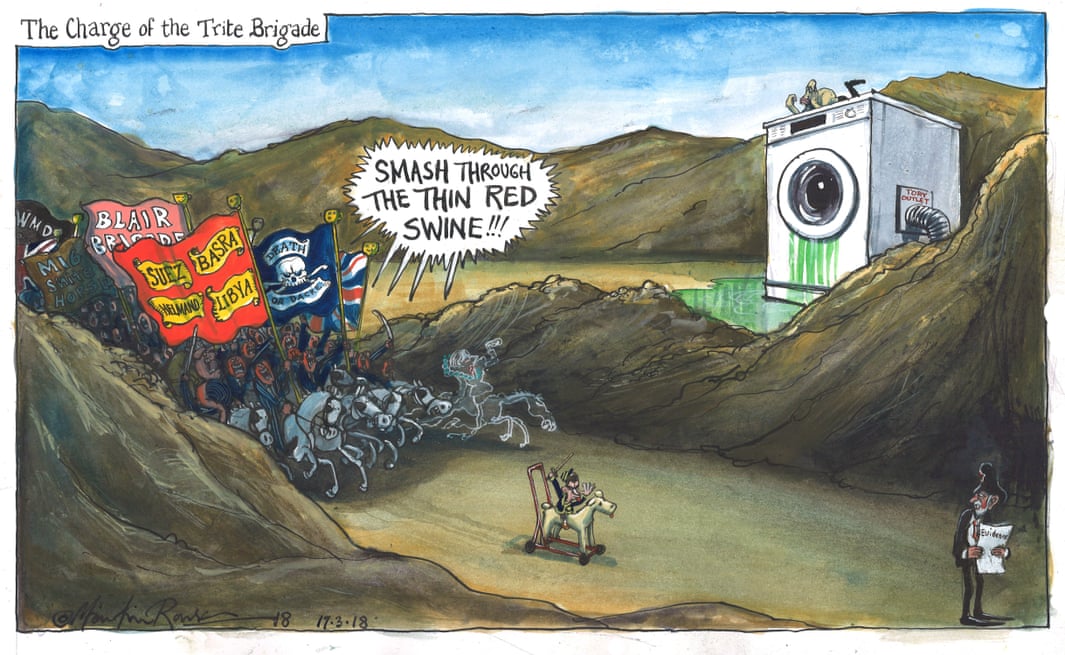
As to how I know London is the greenback laundering capital of the world, I have it on authority from a British cartoon in the Guardian. In the U.K., at least, that's enough conclusive evidence to prove anything. 
The geezer in the lower right-hand corner is Labor Party leader Jeremy Corbyn. The ruckus had to do with his initial call to come up with some evidence that the Russians poisoned Skripal before finding them guilty, or something like that. Anyhow I did have to stand on my head to figure out why the water coming out of the washing machine was green.

Ready? Ignore Kommersant's annoying practice of inserting "Kommersant" in the text.  

Russia was branded a review
At the disposal of Kommersant was a document from a closed briefing at the British Embassy
03/03/2018
Kommersant

At the disposal of Kommersant was a presentation, which representatives of foreign embassies received at a briefing at the British Embassy in Moscow on March 22. In it, the representatives of official London described their view of the "business of Skripal", and it was she, according to the US Ambassador to Russia John Huntsman, prompted the British allies in solidarity to send Russian diplomats. Basically, the presentation repeats the theses of London, which have already been expressed, but with one important exception: Russia out of the category "with a high degree of probability" guilty of poisoning the defector has been transferred to the category of "guilty without the slightest doubt".
The presentation that was available to Kommersant ( .pdf ), which was was shown and distributed in print to 80 high-ranking representatives of foreign embassies on March 22, four days before the mass expulsion of Russian diplomats. Recall, on March 21, the Russian Foreign Ministry also held a briefing on the "Skripal case" for foreign diplomats - it was conducted by the Director of the Department for Nonproliferation and Arms Control Vladimir Ermakov ( see "Kommersant" on March 22 ). The British Ambassador to Moscow, Laurie Bristow, did not come to Smolenskaya Square (a lower-level diplomat attended the briefing). But the next day he held a presentation for his foreign diplomatic corps in his residence.
One of the participants in the British briefing, US Ambassador to Russia John Huntsman, in an interview with Kommersant on March 26 said that the position of London presented in the presentation seemed "very convincing" to him. "They (the British.-  Kommersant ) have prepared a very qualitative and convincing review of this incident, comparing it with similar cases that occurred in the past," the ambassador added. Press Secretary of the Russian Foreign Ministry Maria Zakharova on her page in page complained that the presentation "is not being passed on to the Russian side and is not being made public." According to her, "at the moment, nothing has been sent from London to Russia regarding what happened."
The presentation consisted of six slides (counting the title, containing the date and the inscription "Incident in Salisbury") and accompanied by an expanded oral commentary from the British Ambassador.
he second slide sets out the chronology of the incident in the period from March 4 (admission to the hospital of the former double agent Sergei Skripal, his daughter and local police officer) until March 20, when "23 unregistered Russian intelligence officers were expelled from the UK." A map with the scene of the incident in the British town of Salisbury is attached to the side: the house of Sergei Skripal, the Zizzi restaurant, the shopping center and the Bishop's Mill pub.
The third slide, entitled "A New Phase of Russian Aggression," contains a description of the Novice poison agent, which was recognized by the military chemical laboratory of Porton Down, not far from Salisbury. The presentation affirms that the application of the "Novice" is "the first use of chemical weapons in Europe since the Second World War" and "violation of the ban imposed by the Convention on the Prohibition of Chemical Weapons". "Without any doubt, Russia is responsible," the document reads. "No other country had the same opportunities, intentions and motives (in order to do this.  " "Kommersant"). There is no credible alternative explanation. " Until the end of last week, recall, British Prime Minister Teresa May publicly confined to statements that Russia is "highly likely" involved in the attack.
The presentation also indicates that Russia has not provided the UK with conclusive evidence of its non-involvement in the incident. Instead, "by March 18, we (the British authorities.-  " Kommersant " ) counted about 30 parallel attempts at disinformation," the document says.
The fourth slide describes the impact of the "Novice" on the human body and gives statistics of the victims and the incident involved in the investigation. "51 people were examined in the hospital, 131 people could potentially be in contact with the poisonous substance," the authors of the presentation write. "The investigation involves 250 employees of anti-terrorist units and 180 military personnel." Side effects of the "Novice" are listed: convulsions, loss of consciousness, coma, slow heartbeat, nausea, diarrhea, excessive sweating, etc. "Death can arise from suffocation or cardiac arrest," the British embassy concluded.
The fifth slide is entitled "A Long List of Russia's Hostile Actions" and includes 12 blocks describing incidents that London classifies as such. The first of them is "the murder in November 2006 of Alexander Litvinenko," another Russian defector who died of polonium poisoning. Next are "DDoS attacks on the Internet Estonia" in 2007, "invasion of Georgia", "the occupation of the Crimea", "destabilization of Ukraine", shot down over the Donbass "Boeing" MH-17, "breaking the Bundestag", "interference in elections in USA "," an attempt to organize a coup in Montenegro "," cyberattack to the Danish Ministry of Defense "and" attack using a virus-extortioner NotPetya ". This series is crowned by the "poisoning of Sergei and Yulia Skripal" in March 2018.
Finally, the last slide talks about the measures that the British government took as a result of the above. Among them - "direct indication of Russia's responsibility", "dismantling of the Russian intelligence network in the UK", "freezing all planned bilateral contacts", "strengthening border control", "combating crime and corruption", "adoption of new laws" and "other measures to counter the hostile state ".
The presentation was published on the website of Kommersant. It does not report practically any new information compared to what was previously provided by the British authorities. The only difference is the re-qualification of Moscow's status from "with a high probability" of the guilty party to the guilty "without the slightest doubt." At the briefing, British Ambassador Laurie Bristow said that "the principle of Russia's actions is to disentangle, mislead and sow doubt." "In the coming months, your support in taking measures to ensure the security of every person and our common international security will be of key importance," he said to the crowd. "We must show Russia that it must be held accountable for what happened ".
Over the past two days, 25 countries, as well as NATO, have announced the expulsion of Russian diplomats after Great Britain.
Mikhail Korostikov
[END REPORT]

********

U.S. SecDef: No evidence Assad used poison gas in Ghouta or Khan Sheikhoun incidents

The author, Ian Wilkie, an international lawyer, U.S. Army veteran, and intelligence contractor, ended his report by noting, "It is time for America to stop shooting first and asking questions later."

I wonder what he makes of the American government's reaction to the Skripal Incident.      

BY IAN WILKIE
February 8, 2018 
Newsweek

Lost in the hyper-politicized hullabaloo surrounding the Nunes Memorandum and the Steele Dossier was the striking statement by Secretary of Defense James Mattis that the U.S. has “no evidence”that the Syrian government used the banned nerve agent Sarin against its own people.

This assertion flies in the face of the White House (NSC) Memorandum which was rapidly produced and declassified to justify an American Tomahawk missile strike against the Shayrat airbase in Syria.

Mattis offered no temporal qualifications, which means that both the 2017 event in Khan Sheikhoun and the 2013 tragedy in Ghouta are unsolved cases in the eyes of the Defense Department and Defense Intelligence Agency.

Mattis went on to acknowledge that “aid groups and others” had provided evidence and reports but stopped short of naming President Assad as the culprit.

There were casualties from organophosphate poisoning in both cases; that much is certain. But America has accused Assad of direct responsibility for Sarin attacks and even blamed Russia for culpability in the Khan Sheikhoun tragedy.

Now its own military boss has said on the record that we have no evidence to support this conclusion. In so doing, Mattis tacitly impugned the interventionists who were responsible for pushing the “Assad is guilty” narrative twice without sufficient supporting evidence, at least in the eyes of the Pentagon.

This dissonance between the White House and the Department of Defense is especially troubling when viewed against the chorus of weapons of mass destruction (WMD) experts who have been questioning the (Obama and Trump) White House narratives concerning chemical weapons in Syria since practically the moment these “Assad-ordered events” occurred.

Serious, experienced chemical weapons experts and investigators such as Hans Blix, Scott Ritter, Gareth Porter and Theodore Postol have all cast doubt on “official” American narratives regarding President Assad employing Sarin.

These analysts have all focused on the technical aspects of the two attacks and found them not to be consistent with the use of nation-state quality Sarin munitions.

The 2013 Ghouta event, for example, employed home-made rockets of the type favored by insurgents. The White House Memorandum on Khan Sheikhoun seemed to rely heavily on testimony from the Syrian White Helmets who were filmed at the scene having contact with supposed Sarin-tainted casualties and not suffering any ill effects.

Likewise, these same actors were filmed wearing chemical weapons training suits around the supposed “point of impact” in Khan Sheikhoun, something which makes their testimony (and samples) highly suspect. A training suit offers no protection at all, and these people would all be dead if they had come into contact with real military-grade Sarin.

Chemical weapons are abhorrent and illegal, and no one knows this more than Carla Del Ponte. She, however, was unable to fulfill her U.N. Joint Investigative Mechanism mandate in Syria and withdrew in protest over the United States refusing to fully investigate allegations of chemical weapons use by “rebels” (jihadis) allied with the American effort to oust President Assad (including the use of Sarin by anti-Assad rebels).

The fact that U.N. investigators were in Syria when the chemical weapon event in Khan Sheikhoun occurred in April 2017 makes it highly dubious that Assad would have given the order to use Sarin at that time. Common sense suggests that Assad would have chosen any other time than that to use a banned weapon that he had agreed to destroy and never employ.

Furthermore, he would be placing at risk his patronage from Russia if they turned on him as a war criminal and withdrew their support for him.

Tactically, as a former soldier, it makes no sense to me that anyone would intentionally target civilians and children as the White Helmet reports suggest he did.

There is compelling analysis from Gareth Porter suggesting that phosphine could have been released by an airborne munition striking a chemical depot, since the clouds and casualties (while organophosphate-appearing in some respects) do not appear to be similar to MilSpec Sarin, particularly the high-test Russian bomb-carried Sarin which independent groups like “bellingcat” insist was deployed.

America’s credibility was damaged by Colin Powell at the United Nations in 2003 falsely accusing Saddam Hussein of having mobile anthrax laboratories. Fast forward to 2017 and we encounter Nikki Haley in an uncomfortably similar situation at the U.N. Security Council calling for action against yet another non-Western head-of-state based on weak, unsubstantiated evidence.

Now Secretary Mattis has added fuel to the WMD propaganda doubters’ fire by retroactively calling into question the rationale for an American cruise missile strike.

While in no way detracting from the horror of what took place against innocent civilians in Syria, it is time for America to stop shooting first and asking questions later.

Ian Wilkie is an 
international lawyer, U.S. Army veteran and former intelligence community contractor.

[END REPORT]

Tuesday, March 27

Any questions about why Beijing and Moscow became Washington's bogeymen this year?

Russia's RT  reports today:

Petro-yuan helps Russia & China dump US dollar in oil trade

China is the world's biggest crude consumer and buys most of its oil from Russia. However, most settlements are still in US dollars. The launch of the petro-yuan now allows Moscow and Beijing to use national currencies instead.

China and Russia are actively reducing dependence on the dollar in bilateral trade. In October 2017, Beijing launched a payment system for transactions in yuan and Russian rubles. This means that settlements for Russian oil deliveries to China, which have reached 60 million tons per year, can be done without using the dollar.

After Monday's launch of the yuan-backed oil futures in Shanghai, there have been negotiation between Russia and China on mutual promotion of oil futures in national currencies, RIA Novosti reported. In 2016, the St. Petersburg exchange in Russia launched Urals oil futures in the Russian ruble, and support from China could prop up Russian crude futures.

China's new oil benchmark had a hugely successful debut. On the first day of trading in Shanghai, 62,500 contracts with more than 62 million barrels of crude traded for a notional value of nearly 27 billion yuan ($4 billion), Zerohedge reported. Glencore, Trafigura, Freepoint Commodities and other huge oil-trading corporations took part.

Russia held its position as China's largest crude oil supplier in February. Russia supplied 5.052 million tons, or 1.32 million barrels per day (bpd) last month, up 17.8 percent from a year earlier, according to Reuters, quoting the Chinese General Administration of Customs.

The increase in volume happened as a result of a second Sino-Russian oil pipeline, which began operations on January 1. It doubled China’s capacity to pump oil from the East Siberia-Pacific Ocean (ESPO) system. ESPO connects Russia and China with a direct pipeline.


[END REPORT]


********