Translate

Saturday, May 12

Of course you can't understand SouthFront's battle maps. You don't have a decoder ring.


Yes I can make it larger. There. That's a help, isn't it?  


You see that blotch that looks like a little explosion and a bent arrow near Suwaghiyah? That means something's happening there. That's all we need to know.

Oh all right; let's see exactly what the battle is about in glorious downtown Suwaghiyah -- if it has a downtown. For this I turn to the SouthFront report accompanying the above map:
On May 11, fighters of the Syrian National Defense Forces (NDF) in the besieged towns of al-Fu’ah and Kafriya in the eastern Idlib countryside repelled an attack by radical militants on their positions from the eastern direction, according to the Hezbollah media wing. Local sources said that the NDF had lost one of its fighters while repelling the attack.
No group has claimed responsibility for the failed attack yet. However, Syrian pro-government sources said that the attack had been carried out by fighters of Hay’at Tahrir al-Sham (HTS) and Jaysh al-Ahrar.
In response to the attack, warplanes of the Russian Aerospace Forces carried out a series of airstrikes on positions of HTS and the Free Syrian Army (FSA) in the villages of al-Sawaghiya, Taftanaz and Ram Hamdan east of al-Fu’ah and Kafriya, according to the Syrian Observatory for Human Rights (SOHR).
[...]
Ah! Sawaghiyah doesn't have a downtown because it's a village. That clears up everything. Not another word, Pundita, before SouthFront sends someone after you.  

*******

Friday, May 11

I'll believe Western Europe will "resist" the U.S. if they leave NATO


From Der Spiegel's signed editorial, dated May 11, 2018, Time for Europe to join the Resistance: "U.S. President Donald Trump's decision to withdraw from the Iran nuclear deal marks the temporary suspension of the trans-Atlantic alliance. What now?"
[...]
The most shocking realization, however, is one that affects us directly: The West as we once knew it no longer exists. Our relationship to the United States cannot currently be called a friendship and can hardly be referred to as a partnership.

President Trump has adopted a tone that ignores 70 years of trust. He wants punitive tariffs and demands obedience. It is no longer a question as to whether Germany and Europe will take part in foreign military interventions in Afghanistan or Iraq. It is now about whether trans-Atlantic cooperation on economic, foreign and security policy even exists anymore. The answer: No.
It is impossible to overstate what Trump has dismantled in the last 16 months. Europe has lost its protective power. It has lost its guarantor of joint values. And it has lost the global political influence that it was only able to exert because the U.S. stood by its side.
[...]
At least the last sentence I quoted is honest but I'm not hearing honesty in the general complaint. I am hearing pique that President Trump took the USA out of the JCPOA over objections from Western Europe and the U.K.  

The day Western European leaders really want to resist the United States is the day we'll hear serious talk about leaving NATO. Until then America is just too useful for the Europeans to make efforts to be their own guarantors.

******* 

Netanyahu regime is aiding not only Saudi Arabia but also al Qaeda

The Israeli defense establishment under Netanyahu isn't the only one to make that kind of deal. But there you have it -- Israel formed a close alliance with the agent of its doom, that being the Wahhabist Kingdom of Saudi Arabia. 

What to say about such a tragedy? [shrugging] "The moving finger writes and having writ moves on ..."

Of more pressing concern for me is cooperation between the IDF and al Qaeda in Syria. Is it possible that the incident Israel used as justification to bomb Syria the other night was staged by al Qaeda? If it was a false flag and not an outright lie, al Qaeda would be the prime suspect. 

From Moon of Alabama, June 24, 2017: Israel's Fire Support For Its Al-Qaeda Mercenaries Started Three Years Ago

[...]

Al-Qaeda attacked a Syrian Arab Army position in Madinat al-Baath (map) next to the Israel occupied Golan heights. Al-Qaeda requested Israeli fire-support by launching some mortars towards empty space in the Israel occupied area. The Israeli Defense Force accepted the request and destroyed two Syrian Arab Army tanks. Two Syrian soldiers were killed. The SAA held steady and the al-Qaeda attack on its position failed.

This was very easy to predict. Israel has supported al-Qaeda in the area since at least 2014. The al-Qaeda fire-request-by-mortar scheme has been in place for at least three years. In October 2014 the UN Disengagement Observer Force (UNDOF), which back then still covered the area, reported to the UN Security Council:
On 23 June [2014], Israel targeted nine Syrian army positions with tank fire and air strikes after mortar fire from the Syrian side the previous day killed an Israeli civilian. Israel’s assessment is that most of these incidents are due to errant fire resulting from fighting in Syria. Israel said that armed opposition groups were probably responsible but that its forces fired on Syrian military positions to stress that Syria was responsible for security on its side of the ceasefire line.
The UN observers mentioned the "black flags" the "rebels" were using. The "rebels" in that area are al-Qaeda forces. This "fire support request by mortar" scheme has been repeated again and again. 

The Israeli argument is an insult to logic: The Syrian army is responsible for keeping al-Qaeda out of the area so we respond to "errant" al-Qaeda fire by [attacking] the Syrian army.

But 'western' and Israeli media have not reported or analyzed the obvious scheme. This even as the theater act gets repeated over and over again. They lie and simply report the "errant fire" nonsense even when it is clear that this is coordinated military support for al-Qaeda. For years they have hidden Israeli support for al-Qaeda and deep involvement in the Syrian war. 

Consider Israel's Haaretz, which only today(!) headlines: Analysis - Israel’s Slow Creep Into the Syrian Civil War. That "slow creep" Haaretz analyzes as a new phenomenon started at least three years ago and was neither slow nor a creep. It is full-fledged support for terrorism and has been since the beginning.

The Wall Street Journal, also three years late, reported last week that Israel had set up a special IDF unit to advise, train, support and control al-Qaeda in the Golan area: Israel Gives Secret Aid to Syrian Rebels

Israel even pays al-Qaeda's salaries:
The person familiar with Israel’s assistance confirmed that cash moves across the border but said it goes for humanitarian purposes. However, rebels interviewed said they use the cash to pay fighters’ salaries and to buy weapons and ammunition—something the Israeli military wouldn’t comment on.
[...]

********

Thursday, May 10

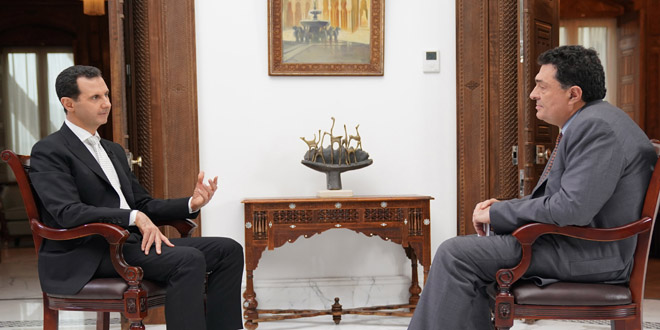
Full text Greece's Kathimerini newspaper interview with President Bashar al-Assad

President al-Assad to Greek Kathimerini newspaper: Syria is fighting terrorists, who are the army of the Turkish, US, and Saudi regimes
May 10, 2018
SANA


Damascus, SANA – President Bashar al-Assad said that France, Britain, and the US, along with Saudi Arabia, Qatar, and Turkey are responsible for the war in Syria due to their support of terrorism, describing the Western allegations about the use of chemical weapons by the Syrian Arab Army as a farce and a very primitive play whose only goal is to attack the Syrian Army after the defeat of terrorists.

In an interview given to the Greek Kathimerini newspaper, President al-Assad said that Syria is fighting terrorists, who are the army of the Turkish, US, and Saudi regimes, stressing that any aggressor and any army, whether Turkish, French, or whoever, they are all enemies as long as they came to Syria illegally.

Following is the full text of the interview:
Journalist: Mr. President, thank you very much for agreeing to do this interview. It’s a pleasure to be here in Damascus.
President Assad: You’re most welcome in Syria.
Question 1: Let me ask you first of all, you know, there’s been accusation by the US and the Europeans about the use of chemical weapons, and there was an attack after that. What is your response to that? Was there a chemical attack? Were you responsible for it?
President Assad: First of all, we don’t have any chemical arsenal since we gave it up in 2013, and the international agency for chemical weapons made investigations about this, and it’s clear or documented that we don’t have. Second, even if we have it, we wouldn’t use it, for many different reasons. But let’s put these two points aside, let’s presume that this army has chemical weapons and it’s in the middle of the war; where should it be used? At the end of the battle? They should use it somewhere in the middle, or where the terrorists made advancement, not where the army finished the battle and terrorists gave up and said “we are ready to leave the area” and the army is controlling fully that area. So, the Western narrative started after the victory of the Syrian Army, not before. 
When we finished the war [battle], they said “they used chemical weapons.”
[Pundita note: this pattern has repeated again and again, not just with Douma]
Second, use of mass destruction armaments in a crammed area with a population like Douma – the supposed area, it’s called Douma and they talk about 45 victims- when you use mass destruction armaments in such an area, you should have hundreds or maybe thousands of victims in one time. Third, why all the chemical weapons, the presumed or supposed chemical weapons, only kill children and women? They don’t kill militants. If you look at the videos, it’s completely fake. I mean, when you have chemical weapons, how could the doctors and nurses be safe, dealing with the chemical atmosphere without any protective clothes, without anything, just throwing water at the victims, and the victims became okay just because you washed them with water. So, it’s a farce, it’s a play, it’s a very primitive play, just to attack the Syrian army, because… Why? That’s the most important part, is that when the terrorists lost, the US, France, UK, and their other allies who want to destabilize Syria, they lost one of their main cards, and that’s why they had to attack the Syrian Army, just to raise the morale of the terrorists and to prevent the Syrian Army from liberating more areas in Syria.
Question 2: But are you saying that there was an incident of chemical attack and someone else is responsible, or that there was nothing there?
President Assad: That’s the question, because, I mean, the side who said – allegedly – that there was a chemical attack, had to prove that there was an attack. We have two scenarios: either the terrorists had chemical weapons and they used them intentionally, or maybe there was explosions or something, or there was no attack at all, because in all the investigations in Douma people say “we didn’t have any chemical attack, we didn’t see any chemical gas, or didn’t smell” and so on. So, we don’t have any indications about what happened. The Western narrative is about that, so that question should be directed to the Western officials who said there was an attack. We should ask them: where is your concrete evidence about what happened? They only talk about reports. Reports could be allegations. Videos by the White Helmets, the White Helmets are funded by the British Foreign Office, and so on.
Question 3: President Trump, in a tweet, used a very strong expression. He said “animal Assad.” You remember that? What is your response to that?
President Assad: Actually, when you are in that position, I mean president of a country, you have first of all to represent the morals of your people before representing your own morals. You are representing your country. Question: does this language represent the American culture? That is the question. This is very bad, and I don’t think so. I don’t think there’s a community in the world that has such language. Second, the good thing about Trump is that he expresses himself in a very transparent way, which is very good in that regard. Personally, I don’t care, because I deal with the situation as a politician, as a president. It doesn’t matter for me personally; what matters is whether something would affect me, would affect my country, our war, the terrorists, and the atmosphere that we are living in.
Question 4: He said that his mission was accomplished. He said “mission accomplished in Syria.” How do you feel about that?
President Assad: I think maybe the only mission accomplished was when they helped ISIS escape from Raqqa, when they helped them, and it was proven by video, and under their cover, the leaders of ISIS escaped Raqqa, going toward Deir Ezzor just to fight the Syrian Army. The other mission accomplished was when they attacked the Syrian Army at the end of 2016 in the area of Deir Ezzor when ISIS was surrounding Deir Ezzor, and the only force was the Syrian Army. I mean, the only force to defend that city from ISIS was the Syrian Army, and because of the Americans’ – and of course their allies’ – attack, Deir Ezzor was on the brink of falling in the hand of ISIS. So, this is the only mission that was accomplished. If he’s talking about destroying Syria, of course that’s another mission accomplished. While if you talk about fighting terrorism, we all know very clearly that the only mission the United States have been doing in Syria is to support the terrorists, regardless of their names, of the names of their factions.
Question 5: But, I mean, he was using such language with the North Korean leader, and now they’re going to meet. Could you potentially see yourself meeting with Trump? What would you tell him if you saw him face to face?
 President Assad: The first question you should ask, whether to meet or to make contact or whatever, what can you achieve? The other question: what can we achieve with someone who says something before the campaign, and does the opposite after the campaign, who says something today, and does the opposite tomorrow, or maybe in the same day. So, it’s about consistency. Do they have the same frequency every day, or the same algorithm? So, I don’t think in the meantime we can achieve anything with such an administration. A further reason is that we don’t think the president of that regime is in control. We all believe that the deep state, the real state, is in control, or is in control of every president, and this is nothing new. It has always been in the United States, at least during the last 40 years, at least since Nixon, maybe before, but it’s becoming starker and starker, and the starkest case is Trump.
Question 6: When is your mission going to be accomplished, given the situation here in Syria now?
President Assad: I have always said, without any interference, it will take less than a year to regain stability in Syria; I don’t have any doubt about this. The other factor is how much support the terrorists receive; this is something I cannot answer, because I cannot foretell. But as long as it continues, time is not the main factor. The main factor is that someday, we’re going to end this conflict and we’re going to re-unify Syria under the control of the government. When? I cannot answer. I hope it’s going to be soon.
Question 7: Now, there was some criticism lately, because you apparently have a law that says that anybody that doesn’t claim their property within a month, they cannot come back. Is that a way to exclude some of the people who disagree with you?
President Assad: No, we cannot dispossess anyone from their property by any law, because the constitution is very clear about the ownership of any Syrian citizen. This could be about the procedure. It’s not the first time we have such a law just to re-plan the destroyed and the illegal areas, because you’re dealing with a mixture of destroyed and illegal suburbs in different parts of Syria. So, this law is not about dispossessing anyone. You cannot, I mean even if he’s a terrorist, let’s say, if you want to dispossess someone, you need a verdict by the judicial system, I mean, you cannot make it by law. So, there’s either misinterpretation of that law, or an intention, let’s say, to create a new narrative about the Syrian government in order to rekindle the fire of public opinion in the West against the Syrian government. But about the law, I mean, even if you want to make a procedure, it’s about the local administration, it’s about the elected body in different areas, to implement that law, not the government.
Question 8: Now, who are your biggest allies in this fight? Obviously, they are Russia and Iran. Are you worried that they might play too an important role in the future of the country after this war is over?
President Assad: If you talk about my allies as a president, they are the Syrian people. If you talk about Syria’s allies, of course they’re the Iranians and the Russians. They are our strongest allies, and of course China that supported us politically in the Security Council. As for them playing an important role in the future of the country, these countries respect Syria’s sovereignty and national decision making and provide support to insure them. So, it doesn’t make sense for these countries to take part in a war to help Syria defend its sovereignty, and at the same time violate or interfere with this sovereignty. Iran and Russia are the countries which respect Syria’s sovereignty the most.
Question 9: How about Turkey now? Turkey did an intrusion, an invasion of part of your country. You used to have a pretty good relationship with President Erdogan. How is that relationship now after that intrusion?
President Assad: First of all, this is an aggression, this is an occupation. Any single Turkish soldier on Syrian soil represents occupation. That doesn’t mean the Turkish people are our enemies. Only a few days ago, we had a political delegation coming from Turkey. We have to distinguish between the Turks in general and Erdogan. Erdogan is affiliated with the Muslim Brotherhood. Maybe he’s not organized, but his affiliation is toward that ideology, I call it this dark ideology. And for him, because, like the West, when the terrorists lost control of different areas, and actually they couldn’t implement the agenda of Turkey or the West or Qatar or Saudi Arabia, somebody had to interfere. This is where the West interfered through the recent attacks on Syria, and this is where Erdogan was assigned by the West, mainly the United States, to interfere, to make the situation complicated, again because without this interference, the situation would have been resolved much faster. So, it’s not about personal relations. The core issue of the Muslim Brotherhood anywhere in the world is to use Islam in order to take control of the government in your country, and to create multiple governments having this kind of relation, like a network of Muslim Brotherhoods, around the world.
Question 10: In an election campaign rally, he said that two days ago, that he’s going to do another intrusion into Syria. How are you going to respond to that if it happens?
President Assad: Actually, since the very beginning of the war, Erdogan supported the terrorists, but at that time, he could hide behind words like “protecting the Syrian people, supporting the Syrian people, supporting the refugees, we are against the killing,” and so on. He was able to appear as a humanitarian president, let’s say. Now, because of these circumstances, he has to take off the mask and show himself as the aggressor, and this is the good thing. So, there is no big difference between the Turkish head of regime Erdogan sending his troops to Syria, and supporting the terrorists; this is his proxy. So, we’ve been fighting seven years his army. The difference actually between now and then is the appearance; the core is the same. At that time, we couldn’t talk about occupation, we could talk about supporting terrorists, but this time we could talk about occupation, which is the announcement of Erdogan that he’s now violating the international law, and this could be the good part of him announcing this.
Question 11: But how can you respond to that?
President Assad: First of all, we are fighting the terrorists, and as I said, the terrorists for us are his army, they are the American army, the Saudi army. Forget about the different factions and who is going to finance those factions; at the end, they work for one agenda, and those different players obey one master: the American master. Erdogan is not implementing his own agenda; he’s only implementing the American agenda, and the same goes for the other countries in this war. So, first of all, you have to fight the terrorists. Second, when you take control of more areas, you have to fight any aggressor, any army. The Turkish, French, whoever, they are all enemies; as long as they came to Syria illegally, they are our enemies.
Question 12: Are you worried about the potential third world war starting here in Syria? I mean, you have the Israelis hitting the Iranians, you know, here in your own country. You have the Russians, you have the Americans. Are you concerned about that possibility?

President Assad: No, for one reason: because fortunately, you have a wise leadership in Russia, and they know that the agenda of the deep state in the United States is to create a conflict. Since the campaign of Trump, the main agenda was against Russia, create a conflict with Russia, humiliate Russia, undermine Russia, and so on. And we’re still in the same process under different titles or by different means. Because of the wisdom of the Russians, we can avoid this. Maybe it’s not a full-blown third world war, but it is a world war, maybe in a different way, not like the second and the first, maybe it’s not nuclear, but it’s definitely not a cold war; it’s something more than a cold war, less than a full-blown war. And I hope we don’t see any direct conflict between these super powers, because this is where things are going to be out of control for the rest of the world.
Question 13: Now, there’s a very important question about whether Syria can be a unified, fully-sovereign country again. Is that really possible after all this that has happened?
President Assad: It depends on what the criteria of being unified or not is. The main factor to have a unified country is to have unification in the minds of the people, and vice versa. When those people look at each other as foreigners, they cannot live with each other, and this is where you’re going to have division. Now, if you want to talk about facts and reality, not my opinion, I can tell you no, it’s not going to be divided, and of course we’re not going to accept that, but it’s not about my will or about my rhetoric, to say we’re going to be unified; it’s about the reality. The reality, now, if you look at Syria during the crisis, not only today, since the very beginning, you see all the different spectrums of the Syrian society living with each other, and better than before. These relationships are better than before, maybe because of the effect of the war. If you look at the areas under the control of the terrorists, this is where you can see one color of the Syrian society, which is a very, very, very narrow color. If you want to talk about division, you have to see the line, the separation line between either ethnicities or sects or religions, something you don’t see. So, in reality, there’s no division till this moment; you only have areas under the control of the terrorists. But what led to that speculation? Because the United States is doing its utmost to give that control, especially now in the eastern part of Syria, to those terrorists in order to give the impression that Syria cannot be unified again. But it’s going to be unified; I don’t have any doubt about that.
Question 14: But why would the US do this if you’re fighting the same enemy: Islamic terrorism?
President Assad: Because the US usually have an agenda and they have goals. If they cannot achieve their goals, they resort to something different, which is to create chaos. Create chaos until the whole atmosphere changes, maybe because the different parties will give up, and they will give-in to their goals, and this is where they can implement their goals again, or maybe they change their goals, but if they cannot achieve it, it’s better to weaken every party and create conflict, and this is not unique to Syria. This has been their policy for decades now in every area of this world. That’s why, if you see conflicts around the world, after the British, the Americans are responsible for every conflict between different countries everywhere on this globe.
Question 15: Do you feel you’ve made any mistakes in dealing with this crisis and the civil war, when it started, if you look back?
President Assad: If I don’t make mistakes, I’m not human; maybe on daily basis sometimes. The more you work, the more complicated the situation, the more mistakes you are likely to make. But how do you protect yourself from committing mistakes as much as possible? First of all, to consult the largest proportion of the people, not only the institutions, including the parliament, syndicates, and so on. But also the largest amount of this society, or the largest part of the society, to participate in every decision.
While if you talk about the way I behaved toward, or the way I led, let’s say, the government or the state during the war, the main pillars of the state’s policy were to fight terrorism – and I don’t think that fighting terrorism was wrong – to respond to the political initiatives from different parties externally and internally regardless of their intentions, to make a dialogue with everyone – including the militants, and finally to make reconciliation; I don’t think we can say that this was wrong. So, about the pillars of our policy, I think the reality has proven that we were right. About the details, of course, you always have mistakes.
Question 16: Now, how much is it going to cost to reconstruct this country, and who is going to pay for this?
President Assad: Hundreds of billions, the minimum is two hundred, and in some estimations it’s about four hundred billion dollars. Why it’s not precise? Because some areas are still under the control of the terrorists, so we couldn’t estimate precisely what is the number. So, this is plus or minus, let’s say.
Question 17: Now, there is a lot of speculation, people say in order for a political solution to be viable, you might have to sacrifice yourself for the good of the country, you know this, that kind of speculation. Is that something that crosses you mind?
President Assad: The main part of my future, as a politician, is two things: my will and the will of the Syrian people. Of course, the will of the Syrian people is more important than my will; my desire to be in that position or to help my country or to play a political role, because if I have that desire and will and I don’t have the public support, I can do nothing, and I will fail, and I don’t have a desire to fail. After seven years of me being in that position, if I don’t have the majority of the Syrian people’s support, how could I withstand for more than seven years now, with all this animosity by the strongest countries and by the richest countries? Who supports me? If the Syrian people are against me, how can I stay? How could I achieve anything? How could we withstand? So, when I feel that the Syrian people do not want me to stay anymore, of course I have to leave without any hesitation.
Question 18: But you know, there is a lot of blood that has, you know, taken place, and all that, so can you see yourself sitting across from the opposition and sharing, you know, power in some way?
President Assad: When you talk about blood, you have to talk about who created that blood. I was president before the war for ten years, had I been killing the Syrian people for ten years? No, definitely not. So, the conflict started because somebody, first of all part of the West, supported those terrorists, and they bear the responsibility for this war. So first of all the West, who provided military and financial support and political cover, and who stood against the Syrian people, who impoverished the Syrian people and created a better atmosphere for the terrorists to kill more Syrian people. So, part of the West – mainly France, UK, and US, and also Saudi Arabia and Qatar and Turkey are responsible for this part. It’s not enough to say there is blood; this is a very general term. Of course there is blood; it’s a war, but who’s responsible? Those who are responsible should be held accountable.
Question 19: Now, it’s been a few years since you visited Greece. Your father had a very close relation with some of the Greek political leaders. How have the relations been between Greece and Syria these days, and what kind of message would you like to send to the Greek people?
President Assad: At the moment, there are no formal relations between Syria and Greece; the embassies are closed, so there are no relations. At the same time, Greece wasn’t aggressive towards what happened in Syria. It always supported a political solution, it never supported war or attacks against Syria. You didn’t play any role to support the terrorists, but at the same time, as a member – and an important member – of the EU, you couldn’t play any role, let’s say, in refraining the other countries from supporting the terrorists, violating the international law by attacking and besieging a sovereign country without any reason, without any mandate by the Security Council. So, we appreciate that Greece wasn’t aggressive, but at the same time, I think Greece has to play that role, because it’s part of our region. It is part of the EU geographically, but it’s a bridge between our region and the rest of Europe, and it’s going to be affected, and it has been affected by the refugee situation, and the terrorism now has been affecting Europe for the last few years, and Greece is part of that continent. So, I think it’s normal for Greece to start to play its role in the EU in order to solve the problem in Syria and protect the international law.
Journalist: Thank you very much Mr. President.
President Assad: Thank you.
[END]
********

Of course NOW Syria's military and Iran's are shooting missiles into the Golan

Well, the Israelis wanted a shooting war, they got one.

Breaking: Syrian military launches new wave of missiles into occupied Golan Heights
By Leith Aboufadel
May 10, 2018
Al-Masdar News

BEIRUT, LEBANON (4:10 A.M.) – At approximately 4:05 A.M. (Damascus Time), the Syrian military launched a fresh wave of missiles towards the occupied Golan Heights.

According to a military report, the Syrian missiles reportedly targeted Israeli Army bases around the Golan Heights.

The fate of these missiles is still unknown.

While the Syrian military is doing the bulk of the work, the Iranian forces in Syria are believed to be participating in these retaliatory strikes against Israel.

[END REPORT]

********

See this is what you do when you're helping Syria's military win a war in Syria --

You launch an attack on Israel from Syrian soil, just so Israel can have an excuse to bomb Syrian military installations.

In other words, the Israelis are lying in their teeth about an Iranian attack. 

As for Bibi bin Netanyahu -- well this is just why he served Japan's First Couple their dessert in a shoe. Bibi is now serving the UAE and Saudi Arabia so much that he's gotten confused about how to carry out even the simplest duties of a host.    

********

Israel, why bomb Damascus if you're defending against Iranian attacks near the Golan?

Sputnik, 00:41 10.05.2018 (updated 06:57 10.05.2018):
... Israeli missile strikes against Damascus continued for hours after the skirmish erupted near the Golan Heights. The escalation marked a significant confrontation between Israel and Syria and perhaps the biggest military escalation since the Yom Kippur War, also known as the 1973 Arab-Israeli War, which ended with an agreement on disengagement in 1974.

According to the Syrian-based media reports, Israeli shelling destroyed a Syrian radar site early on Thursday. Moreover, several Israeli rockets hit several military sites. Syrian state media reported earlier that southern suburbs of the Syrian city of Homs came under heavy fire. A military source told the SANA news agency one of the rockets struck an ammunition warehouse.
In addition, Israeli warplanes raided Iranian positions in Syria overnight, firing dozens of rockets into the Syrian territory in response to a barrage of Iranian rockets, the Israeli army said Thursday. "The Israeli Defense Forces attacked tens of military targets belonging to Iran's al-Quds militia in the Syrian territory," the military said in a statement. ...
"The bombing is reportedly being carried out by Israeli warplanes from Lebanese airspace." 

Visit the Sputnik site for lots of video and eyewitness accounts of the bombings included with the above report, and Sputnik is reporting a lot of 'breaking news' on the conflict.  Also watch for reports on the conflict from Al-Masdar News, SANA, and FARS.   

RT, May 9 - 22:54, updated 03:53

"The [Israeli] bombardment appeared to go on for hours, with the first missile strikes reported at about 1:30 am Damascus time on Thursday (22:30 GMT)."
ISRAEL LAUNCHES MASSIVE MISSILE STRIKES IN SYRIA
 [...]
Syrian air defenses were deployed to thwart an attack by the Israeli rockets, Syria’s state SANA news agency reported. The bombing is reportedly being carried out by Israeli warplanes from Lebanese airspace.
Syrian air defenses engaged missiles that Israeli warplanes are launching from outside the country's territory, SANA reported on Thursday.
The bombardment appeared to go on for hours, with the first missile strikes reported at about 1:30 am Damascus time on Thursday (22:30 GMT).
Early Thursday morning, IDF spokesman Avichay Adraee confirmed that the Israeli army was continuing to hit “Iranian targets” in Syria, warning that any retaliation by Syrian forces would be met with “extreme seriousness.”
SANA has released footage of Syrian air defense systems responding to incoming missiles.
The Israeli strikes are seen as a continued retaliation to what Israel claims were some 20 rockets launched by Iran’s Quds Force from Syrian territory into the Israeli-occupied part of the Golan Heights earlier in the night. The Israel Defense Forces said its Iron Dome systems intercepted some of the projectiles and the reported attack resulted in no injuries.
Around the same time, Syria’s state media reported that Israel shelled the city of Baath in the northern Quneitra governorate.
[...]
*********

Wednesday, May 9

War Drums! Israel, KSA will fight Iran to the last drop of American tax dollars!


As to when this latest war will get underway -- 
      
May 8,  Sic Semper Tyrannis (Col. Pat Lang, Rtd.): 
Israel will now drive the U.S. to war with Iran 
... I am told that Israeli electronic counter-measure units started a massive jamming effort against air defense assets in Syria three days ago. Israeli ground forces on the Golan Front have been placed on high alert. IMO a false flag attack on Israel is likely.
May 10, Debkafile: 
Golan under Iranian attack. Al Qods units launch 20 rockets at IDF positions. No casualties
... The missiles falling around the IDF’s forward positions on the Golan border with Syria set off warning sirens just before one a.m. Civilians were ordered to take shelter in protected areas.
The IDF issued a communique half an hour later, saying: “We view with extreme gravity the Iranian missile attack on the Golan and are ready for a number of different scenarios.”
A short time later, social media reported that several explosions rocked Damascus, and claimed that Israeli jets struck several military sites belonging to Bashar Assad’s forces and the Iranian Al-Qods units near the Syrian capital. This was not confirmed by any authoritative source.
In short, it looks like the war will launch as fast as Israeli and American war hawks can make it happen. But U.S. taxpayers should look on the bright side; at least Israel and Saudi Arabia won't have to fight Iran to the last drop of American blood. That's because the District of Columbia wised up. (I refuse anymore to refer to the U.S. regime as "Washington"). This was after too many Americans came home in body bags as the Afghan War, launched in 2001, ground on for years while generals fiddled with "population-centric" counterinsurgency tactics. CENTCOM then dusted off the Afghan Mujahideen Model of U.S. Armed Conflict during the Soviet era. 

So now U.S. troops no longer actually fight wars; we contract out our wars then equip and supervise the mercenaries we whip into a fighting force. 

More good news for American parents is that the real target of the war drums isn't actually Iran; it's our dear European allies -- the ones who've dug in their heels about abandoning the infamous Iran Deal. 

Got all that? No? Then I'll give the last words to The Independent's crazy Robert Fisk, who after all has only spent 40 years mucking around conflict zones in the Middle East:
... Some days ago Bashar al-Assad held a private meeting of Syrian journalists in Damascus and informed them that relations had resumed – at a very low and humble level – between Qatar and Syria. They were not under any circumstances to quote him as saying this, nor to give any presidential credence to the story. But they could mention it in passing, stressing that this was not a resumption of relations, merely two nations maintaining contact. But it makes an intriguing story.

[See the report for the intriguing story, which involves the world's most expensive nuns.]

But it is Qatar which we should be thinking about. Qatar is great because it has oil and liquid gas and the al-Jazeera television channel. But it is alone, praying that the Saudis and the Emiratis don’t invade it, a tiny peninsula containing a huge American military base but much abused by Donald Trump himself.
Its royal families might be emperors but they have no empire; imagine Britain without India. But if Qatar was to rescue Syria when the war there is over – if its vast wealth could rebuild that ancient land – then Qatar would have an empire for its emperors.
Not that Qatar would ever own Syria – far from it, Syrians would fight to stop that – but it would have, as we say in the Middle East, “considerable influence”. It would have power. And a power – with a Mediterranean coastline – that even Saudi Arabia doesn’t have.
Is that what we are seeing the start of right now? Of course, the Russians would also be involved – and let’s remember that the Saudi king was a guest of Putin not that long ago – and perhaps the Iranians, in a marginal way.

The idea, by the way, that the Iranians dominate Syria is a myth, much repeated by Benjamin Netanyahu. Nor, I might add, are they terribly popular. On all my travels, I haven’t seen an Iranian on the Syrian front lines for more than a year. Hezbollah, yes. And of course, the Syrian army would play a prominent part in the rebuilding of Syria. If Assad survives – and I’ve yet to meet anyone in Syria who thinks otherwise – then the army will survive. ...
As to what Qatar's present predicament would have to do with the Saudis prodding the Israelis to prod the Americans to prod our dear European allies into abandoning the Iran Deal -- it has everything to do with it, from the vantage point of the Mad Hatter's tea parties.


See also:

Syrian air defense engages Israeli rockets near Damascus – State media
Published time: 9 May, 2018 22:54
Edited time: 10 May, 2018 00:57
RT

Syrian air defenses have been deployed to thwart an attack by the Israeli rockets, Syria’s state SANA news agency reported. The bombing is reportedly being carried out by Israeli warplanes from Lebanese airspace.

Syrian air defenses have been engaging missiles that Israeli warplanes are launching from outside the country's territory, SANA reported on Thursday. The bombardment appears to have been going on for hours, with the first missile strikes reported at about 1:30 am Damascus time on Thursday (22:30 GMT).

Early Thursday morning, IDF spokesman Avichay Adraee confirmed that the Israeli army was continuing to hit “Iranian targets” in Syria, warning that any retaliation by Syrian forces would be met with “extreme seriousness.”

SANA has released footage of Syrian air defense systems responding to incoming missiles.

[video]

The Israeli strikes are seen as a continued retaliation to what Israel claims were some 20 rockets launched by Iran’s Quds Force from Syrian territory into the Israeli-occupied part of the Golan Heights earlier in the night. The Israel Defense Forces said its Iron Dome systems intercepted some of the projectiles and the reported attack resulted in no injuries.

Around the same time Syria’s state media reported that Israel shelled the city of Baath in the northern Quneitra governorate.

Tensions were ramped up in the region after US President Donald Trump announced his country’s withdrawal from the Iran nuclear deal. Israeli PM Benjamin Netanyahu, a fierce critic of the accord, hailed the decision, which drew sharp condemnation from Europe, Russia, China and other non-signatory countries. 

A day after Trump reneged on the internationally acclaimed agreement, Israel hit a Syrian army position in the Kisweh area south of Damascus.

Israel has been claiming that Iran is setting up bases of operations in Syria in order to stage attacks against the Jewish state. It has launched numerous air strikes against Syrian government-controlled territories, targeting alleged Iranian positions.

The Golan Heights in southwestern Syria have been occupied by Israel since the Six-Day War of 1967 and are internationally recognized as a Syrian territory.


[END REPORT]
********    

Tuesday, May 8

If Israel's fight is with Iran why bomb Syria?

Answer: Because the light is better in Syria. 

********

"Breaking: Israel allegedly bombs west Damascus" UPDATED 7:55 PM EDT

UPDATE
Re my note in the second report, below, I found the report at SANA, datelined May 9:  https://sana.sy/en/?p=136894
Damascus Countryside, SANA – The Syrian air defenses Tuesday night intercepted two Israeli missiles and destroyed them in al-Keswah area in Damascus Countryside, a military source told SANA.
The source added that the new Israeli aggression coincided with the progress made by the Syrian army in its operations against terrorist organizations in al-Hajar al-Aswad area as a step towards full cleanse of the surroundings of Damascus city from any terrorist presence.
[...]
END UPDATE

10:45 PM Syria time (7 hrs ahead of US eastern time)

BEIRUT, LEBANON (10:40 P.M.) – The Israeli AIr Force has allegedly struck the western countryside of Damascus tonight, causing loud explosions close to the occupied Golan Heights.

According to preliminary reports from the area, the Israeli Air Force struck a military position near the town of Kisweh.

Some reports claim that the Israeli warplanes struck a Hezbollah convoy; however, it is still unconfirmed.


MORE TO FOLLOW

[END REPORT]

Massive Explosions Near Military Base Close To Damascus - State Media
22:56 08.05.2018 (updated 23:30 08.05.2018)
Sputnik

Israeli forces reportedly struck targets near Damascus on Tuesday with missiles, according to Al Masdar News [report above], just hours after US President Donald Trump withdrew from the Iran sanctions deal.

Syria's SANA reports that air defense systems intercepted at least two missiles fired at the al-Kaswa area, which is proximal to southern Damascus. [Pundita note: as of 4:55 PM EDT I am not seeing any such report posted at SANA (English); might have been removed -- or maybe the report was posted at SANA's Arabic version]

[photo and text from Danny Makki's Twitter page:]

"Image from the reported attack in the industrial area of Al-Kissweh south of Damascus"


See Sputnik for rest of their report, video and more photos of the alleged Israeli strike.
********

"The myth of Hezbollah’s electoral domination"

By Joseph Haboush
May 8, 2018 - 12:24 AM
The Daily Star (Lebanon)

BEIRUT: Western media outlets Monday trumpeted the claim that Hezbollah had imposed its dominance through Lebanon’s first parliamentary elections in nine years, but the reality is that little has changed on the political front. 

“Western press gives too much importance to Hezbollah, but considering sectarianism in Lebanon, it’s normal that they consolidated power among the Shiite population,” said Karim Bitar, associate professor of international relations at Universite Saint-Joseph.

The Iranian proxy in Lebanon has undoubtedly increased its military capabilities in recent years while its political prowess has remained strong, helped by its robust ties with their Shiite ally the Amal Movement.

Hilal Khashan, chair of the political studies department at the American University of Beirut, said their electoral victory was due to the sectarian makeup of the country and not because of an overwhelming Hezbollah dominance. While Western media also framed the Lebanese election and the political focus around Hezbollah and Iran versus anti-Hezbollah camps, new parliamentary alliances and arrangements will more likely form around rebuilding Lebanon’s dilapidated infrastructure and reforming the economy.

This is despite the international community – and particularly the U.S. – still focusing on Hezbollah’s relationship with Iran. Analysts say an Israel-Iran conflict is just about the only thing that could lead to an escalation in Lebanon, but domestically Hezbollah’s weapons won’t be the center of debate for the time being.

“Prime Minister Saad Hariri has accepted the status quo,” Bitar said, referring to the premier’s stance on Hezbollah’s arms.

But as Hariri said Monday, in the meantime, he will work to build the economy and state institutions.

Since the polls closed Sunday, Hariri, Speaker Nabih Berri and Hezbollah leader Sayyed Hasan Nasrallah have all expressed a desire to work alongside other parties to form a new government and work to build the state.

But the election results could see new alliances formed, strategically or tactically. While the Lebanese Forces took its parliamentary bloc from eight to over a dozen seats, the Free Patriotic Movement’s quasi-monopoly over Christian communities was weakened.

This, Bitar said, might push the FPM to a more central position to become a mediator between Hariri’s Future Movement and Hezbollah.

An LF source told The Daily Star before the elections that the FPM had hoped to squeeze the party out of the next Cabinet, something that could also push it closer to those butting heads with the FPM – namely Amal and the Marada Movement.

But an Amal source stopped short of confirming a potential alliance between the party and the LF was in the works. “Alliance is a big word and we, as Amal, don’t align with someone just to aggravate someone else,” the source said.

“The alliance between the FPM and Amal is based on strategic viewpoints and they are not our enemies despite the recent rhetoric [between us],” the source said. He noted that it was too early to discuss new agreements and that the rhetoric before the elections might have just been to galvanize voters and increase popularity among their respective sects.

Any alliances will also depend on the election of a new speaker, once the new Parliament convenes for the first time to vote for its head. After that is completed, discussions can start on Cabinet formation. “Based on these [events], we will assess any previous, current or future alliances,” the Amal source said.

Khashan echoed similar points to the source and said he was skeptical of an LF-Amal alliance.

“Amal will not take a step without Hezbollah’s consent and the Shiite environment is not too fond of the LF,” Khashan told The Daily Star.

Meanwhile, the pressure on Hezbollah could increase from within Lebanon. “FPM leader Gebran Bassil has a different stance on Hezbollah than President Michel Aoun and the Christian pressure on Hezbollah will increase with the LF being strengthened in the elections,” Khashan said. He even went as far as saying it was possible to envision an alliance between the FPM, LF and Future to confront Hezbollah.

But Sami Nader disagreed. “Everyone was weakened in these elections except for the LF and Hezbollah, but I’m not sure where the LF can translate this into politics,” Nader, director of the Levant Institute for Strategic Affairs, said.

But Bitar simply said that despite a couple of new faces appearing in Parliament, there had been “no major changes in power, except for Hariri losing a few seats and Parliament losing some key independent legislators like Botrous Harb and former Interior Minister Ziad Baroud [who lost in this year’s race].”

[END ANALYSIS]

A version of this article appeared in the print edition of The Daily Star on May 08, 2018, on page 2.

********