Translate

Monday, January 6

US SecDef disavows letter saying US forces would quit Iraq

"The letter was signed by a U.S. official on Pentagon letterhead, making it unclear whether it applied to forces from the 76 countries which make up the international coalition. ... An Iraqi defense official confirmed the letter was real and had been delivered."

The (U.K.) Daily Mail has the clearest explanation of the muddle as it stands at this moment:

"BREAKING NEWS: Chaos over U.S. troops in Iraq as Pentagon insists they WON'T withdraw despite general leading anti-ISIS coalition saying they'll move 'out of Iraq' in draft letter released by mistake amid anger over attack that killed Qassem Soleimani

  • General in charge of U.S. coalition forces in Iraq tells military counterpart to prepare for helicopter flights as troops pull up stakes
  • Letter says troops will soon begin flying out in transport helicopters under cover of darkness
  • But defense secretary tells reporters that 'there's been no decision whatsoever to leave Iraq, period'
  • Chairman of the joint chief of staff confesses that the letter was a draft released by mistake 
  • Donald Trump said Sunday that he would only withdraw troops if Iraq paid the U.S. for building and maintaining the main air base the coalition uses
  • He also threatened greater sanctions than those he has imposed on Iran
  • Iraq's parliament had passed a resolution, which is nonbinding, urging the government to evict American troops
  • That was in response to Trump green-lighting a drone attack on an infamous Iranian military leader while he was in Baghdad, in Iraqi soil  
  • U.S. will send six B-52 bombers to the Diego Garcia air base on an island in the Indian Ocean, to prepare for the possibility of military action against Iran
Reports Monday that the U.S. would soon withdraw all its forces from Iraq were turned on their heads minutes later when U.S. Defense Secretary Mark Esper told reporters there were no plans to pull up stakes.
'There's been no decision whatsoever to leave Iraq, period,' Esper said, adding that he and his staff were 'trying to figure out' the meaning of a letter signed by a brigadier general that suggested the opposite.
'There are no plans to leave,' he emphasized, suggesting discussion of a massive troop movement could be merely a signal that forces are being repositioned inside Iraq's borders.
Separately, Chairman of the Joint Chiefs of Staff Gen. Mark Milley told reporters that the letter was 'a draft. It was a mistake. It was unsigned. It should not have been released.'
The draft was 'poorly worded' and 'implies withdrawal. That is not what’s happening,' Milley declared.
The U.S. military had appeared to inform Baghdad that it was preparing for 'movement out of Iraq,' a day after the Iraqi parliament urged the government in a non-binding resolution to oust foreign troops.
The head of the Pentagon task force in Iraq, Brigadier General William Seely, sent a draft letter to the head of Iraq's joint operations command.
'Sir, in deference to the sovereignty of the Republic of Iraq, and as requested by the Iraqi Parliament and the Prime Minister, [the coalition] will be repositioning forces over the course of the coming days and weeks to prepare for onward movement,' Seely wrote.  He added: 'We respect your sovereign decision to order our departure.' 
President Donald Trump said Sunday aboard Air Force One that troops would not leave Iraq unless the country compensated the U.S. for the costs associated with building and maintaining military facilities there.
'We have a very extraordinarily expensive air base that's there. It cost billions of dollars to build. Long before my time,' he said. 'We're not leaving unless they pay us back for it.'
Trump also said he would punish Baghdad economically if U.S. troops were evicted. 
'We will charge them sanctions like they've never seen before ever. It'll make Iranian sanctions look somewhat tame,' he warned.  
Yet Iraqi premier Adel Abdel Mahdi met with the U.S. Ambassador Matthew Tueller on Monday, telling him it was 'necessary to work together to withdraw foreign forces from Iraq.' 
On Sunday, Iraq's parliament voted in favor of the Baghdad government rescinding its permission for all foreign troops to remain in the country.
That came in reaction to a U.S. precision drone strike on Baghdad that killed Iranian general Qasem Soleimani and top Iraqi commander Abu Mahdi al-Muhandis, among others.
The resulting chaos has made some in Iraq fear a new civil war, and drew millions to crowd streets in Tehran to see Soleimani's coffin paraded through the city. 
And tensions betweeen Washington and Tehran aren't going away: The U.S. will send six B-52 bombers to the Diego Garcia air base on an island in the Indian Ocean, accordign to CNN, to prepare for the possibility of military action against Iran. 
Gen. Seely wrote on Monday in order to reposition thousands of troops elsewhere, 'Coalition Forces are required to take certain measures to ensure that the movement out of Iraq is conducted in a safe and efficient manner.'
The letter was signed by a U.S. official on Pentagon letterhead, making it unclear whether it applied to forces from the 76 countries which make up the international coalition.
An Iraqi defense official confirmed the letter was real and had been delivered. 
Officials said helicopters would be traveling in and around the Green Zone as part of the preparations.
Reporters could hear helicopters flying low over Baghdad throughout the night on Monday.
Some 5,200 U.S. soldiers are stationed across Iraqi bases to support local troops preventing a resurgence of the ISIS terror group.
They make up the bulk of the broader coalition, invited by the Iraqi government in 2014 to help combat the jihadists. 
[...]
********

Soleimani Was in Baghdad on Mission for Saudi Peace with Iran

Does this explain the gracious, appropriate, and prompt reply from the U.S. military to the Iraqi demand that U.S. troops quit Iraq? I think more than one thing explains the military's open contradiction of their commander-in-chief's bluster but this would probably be a part of it. The Saudis are most assuredly livid about the assassination of Qassem Soleimani while he was on a mission for them. And surely they're justifiably worried that his murder could be blamed on a Saudi betrayal. But if the Saudis are upset, one can imagine how the ranking Iraqi officials feel.  

Iraqi PM says Soleimani was supposed to deliver reply to Saudi message January 5, 2020
Anti-war (U.S.)

On Thursday night, the US assassinated top Iranian Gen. Qassam Soleimani in a drone strike at Baghdad International Airport. His arrival was actually part of ongoing diplomatic efforts, according to Iraqi PM Adel Abdul-Mahdi.

Soleimani’s visit was related to well-documented Saudi attempts at diplomacy to ease tensions with Iran. The Saudis had dispatched a message of peace to Iran, with Iraq acting as an intermediary. Soleimani was coming to Iraq to deliver the Iranian government’s reply.

The US assassination, then, undercut the peace effort to an enormous level. Iraq was keen to facilitate peace between its two neighbors, hopefully to calm down US threats against Iran. Instead, the US undercut the entire process.

It’s not clear this totally ends the Saudi effort for peace, though it may be difficult for Iran to safely get messengers into Baghdad in the near future, with the US rather openly threatening more assassinations. Since peace overtures were the Saudi “plan B” after the US didn’t attack Iran, they may no longer bother, given the rapidly escalating military tensions.

[END REPORT]

*********

shaking my head


Just saw the above photos from Sputnik's 6/1 video report: Australian Fires Expected to Burn For ‘Months to Come’ as Death Toll Spikes.

See also:

"Hottest place on earth: Temperatures in Sydney suburb soar to 120F as 8,000 koalas perish in the devastating bushfires sweeping across Australia

  • Almost half a billion creatures are estimated to have died in the blazes
  • Rampaging fires have engulfed almost 12 million acres of bushland in Australia
  • 8,000 dead koalas are equal to a third of their population in New South Wales"


********

US-led Coalition leaving Iraq: Breaking News Updated 2X

UPDATE 2 5:45 PM ET

US SecDef disavows letter saying US forces would quit Iraq


BREAKING NEWS
Sputnik
January 6, 2020
US-Led Coalition Tells Baghdad It Will 'Move Out' of Iraq - Official Letter

[Pundita Note: I can't find the Reuters source story for this Sputnik report -- Reuters may have deleted it, given that the Pentagon hasn't yet verified the letter (see copy of letter below) according to this RT report. My guess is that a source high up in the Iraqi  government showed the letter to journalists who posted a copy at Twitter.
UPDATE 3:50 PM ET: The report is now posted as the Drudge headline, and links to the Reuters report. "The authenticity of the letter, which was addressed to the Iraqi defence ministry's Combined Joint Operations Baghdad, was confirmed to Reuters independently by an Iraqi military source."]  

In a Monday letter to Iraqi military leaders, the US-led coalition in Iraq announced it was preparing to "move out" of the country out of respect for Iraqi sovereignty.

Following approval of a non-binding resolution by Iraq's parliament calling for US forces to leave the country, US Army commanders announced they were drawing up preparatory plans for their departure.

"We respect your sovereign decision to order our departure," the letter says, according to Reuters. US forces will re-position themselves over the coming days and weeks in preparation for the move, the letter states.

The lawmakers' request comes on the heels of a January 3 drone strike at Baghdad International Airport in which US forces killed Iranian Quds Force commander Qassem Soleimani as well as the leader of Iraq's Popular Mobilization Forces, Abu Mahdi al-Muhandis. The two commanders helped lead the fight against Daesh in the 2014-17 Iraqi Civil War that saw the terrorist group expelled from the country. 


At its height, Daesh controlled significant amounts of northern Iraq, including its third-largest city of Mosul, and was advancing on Baghdad.

MORE INFORMATION TO FOLLOW...


Copy of letter via "international correspondent"  at Twitter. There's at least one other posting of the letter.
********.

Sunday, January 5

Soleimani killed Americans. He killed many more Al Qaeda, Islamic State and Taliban. And he killed American soldiers only when he saw they served what became an evil enterprise in Iraq

Americans can learn the truth about Maj. General Qassem Soleimani from Scott Ritter, a former U.S. Marine Corps intelligence officer and acknowledged expert on U.S. military policies in the present era.

I am taking the liberty of omitting the first three paragraphs in Ritter's op-ed, which I post below, partly because this allows readers to go straight to an outline of Gen. Soleimani's accomplishments, and partly because I disagree with his observation in the opening, which is that "Soleimani is the direct result of America’s irresponsibly aggressive policies." Only to the extent that American aggression was directed at Iran. Ritter himself acknowledges at one point that he "was the manifestation of the logical response of Iran to external threats brought on by the actions of others." Not just American actions. 

And not just direct threats to Iran. Gen. Soleimani was indisputably the world's most effective anti-terrorist commander. He saved the Northern Alliance in their battle against the Taliban. His leadership saved Syria and Iraq from being completely destroyed by terrorist organizations and their foreign backers before Russian and American commands, respectively, entered the conflicts against Islamic State. 

As an American I am ashamed that Scott Ritter had to publish his observations in a Russian media outlet but at least many Americans now read RT -- Russia's answer, along with Sputnik, to Orwellian mainstream media reportage in the USA. 

After his editorial I am posting a report from Russia's state news agency about the Russian defense ministry's formal acknowledgement of Gen. Soleimani's contributions to fighting Islamic State and Al Qaeda in Syria.

The US unwittingly helped create Qassem Soleimani. Then they killed him.
By Scott Ritter
January 3, 2020 
RT

Scott Ritter is a former US Marine Corps intelligence officer. He served in the Soviet Union as an inspector implementing the INF Treaty, in General Schwarzkopf’s staff during the Gulf War, and from 1991-1998 as a UN weapons inspector.
[...]
Making of an enemy hero

Soleimani gained prominence in Iran during the Iranian Revolution and the eight-year war with Iraq, where his leadership, courage and decisiveness caught the attention of senior Iranian leaders including then-President Ali Khamenei. During this time, Soleimani developed the skill-set that would later serve him well as the leader of the Quds Force, the paramilitary organization he helped found in the aftermath of the Iran-Iraq War.

The Quds Force was designed to project Iranian influence through covert means. Soleimani and the Quds Force first came into prominence in 1998, after the Taliban murdered hundreds of Afghan Shi’a and nine Iranians (eight diplomats and a journalist) following the capture of the northern Afghan city of Mazar-i Sharif.

While senior Iranian military leadership advocated a massive punitive expedition into western Afghanistan, Soleimani advised a more constrained response, with his Quds Force providing training and material support to the Northern Alliance, an umbrella group of forces opposed to the Taliban. Soleimani personally directed this effort, transforming the Northern Alliance into an effective fighting force.

After the terrorist attacks of 9/11, the US used the Northern Alliance to establish a foothold in Afghanistan and eventually drive the Taliban from power. Soleimani played a major role behind the scenes helping make the US-Northern Alliance partnership viable, including providing operational and intelligence support.

The US-Iranian cooperation was short-lived; President Bush’s designation of Iran as being part of “an Axis of Evil” caused Iran to terminate its cooperation with the Americans.
Training the anti-US Iraq rebels

The US invasion of Iraq in 2003 created another opportunity for Iranian-American cooperation, which the US promptly fumbled. While Iran had no desire for increased American military presence in the region, it found common cause with the US in removing its archenemy, Saddam Hussein, from power.

The Americans, however, were ill-prepared to cope with the reality of a post-Saddam Iraq, especially one where the majority Shi’a population would demand a major role in determining how Iraq would be governed. When the US started turning its guns on Shi’a forces, Soleimani and his Quds Force took the lead in organizing anti-American resistance in Iraq, leading to increasingly violent clashes that resulted in significant American casualties.

Today, many veterans of the US war in Iraq hold Soleimani personally accountable for the hundreds of American soldiers who lost their lives due to the tactics employed by Iraqi militias trained and equipped by Soleimani’s Quds Force.

Mastermind of Tehran’s regional domination plan

Soleimani did not emerge in a vacuum, but rather was the manifestation of the logical response of Iran to external threats brought on by the actions of others. Iran’s role in Lebanon was defined by Israel’s decision to invade and occupy southern Lebanon in 1982; the creation of the Lebanese Hezbollah movement followed.

Iran’s intervention in Syria likewise came on the heels of a massive intervention by outside powers, including the United States, Turkey and Saudi Arabia, to create a resistance designed to remove Syrian President Bashar al-Assad from power. Soleimani’s actions in directing the Quds Force to organize pro-Assad Shi’a militias in Syria was simply a reaction to this foreign intervention in Syria’s sovereign affairs.

Likewise, when the Islamic State erupted on the scene in 2014, it was Soleimani, at the invitation of the Iraqi government, who helped organize and equip various Shi’a militias under the umbrella of the Popular Mobilization Force. Soleimani went on to direct the PMF in a series of bloody battles that helped turn the tide against the Islamic State well before the US became decisively engaged in the fighting. Soleimani played a defining role in shaping the Middle East in the aftermath of 9/11, positioning Iran to become a major power in the region, if not the major power.

Soleimani’s actions in accomplishing this outcome, however, were not part of a master Iranian plan for regional domination, but rather part and parcel of Iran’s ability to react effectively to the mistakes made by the United States and its allies in implementing policies of aggression in the region.

In the aftermath of the US withdrawal from the Iran Nuclear Agreement in 2018, and the subsequent implementation of the so-called “maximum pressure” campaign of economic sanctions and geo-political containment undertaken by the United States, Soleimani cautioned President Trump against embarking down a path toward confrontation.

“You are aware of our power and capabilities in the region”, Soleimani said in a speech delivered in the summer of 2018. “You know how powerful we are in asymmetrical warfare.”

Soleimani’s statements were prophetic; after the US blocked the sale of Iranian oil, Soleimani’s Quds Force responded by orchestrating a series of deniable attacks on oil tankers in the Strait of Hormuz, and used Houthi proxies in Yemen to launch a devastating attack using armed drones against strategic Saudi oil production facilities.

Recognizing the vulnerability of the US position in Iraq, Soleimani began putting pressure on the Iraqi government to bring an end to the US military presence on Iraqi soil. These activities were underway even before the US bombed the Iraqi Popular Militia Forces last Sunday, setting into motion the events that culminated in Soleimani’s assassination.

Will his death make the world safer?

The reality is that the only thing more dangerous for the US than a world where Qassem Soleimani is living is a one where Qassem Soleimani is dead, murdered on orders of an American President.

Alive, Soleimani would be able to credibly advise patience and caution to an Iranian leadership increasingly pressured by more militant members of the Iranian defense establishment to take a more proactive stance in countering American, Saudi and Israeli policies in the region.

Murdered, Soleimani is transformed into a martyr-hero whose exploits will motivate those who seek to replicate them against an American foe void of the kind of self-constraint and wisdom born of experience.

Far from making the Middle East and the world a safer place to live and work, President Trump’s precipitous assassination of Qassem Soleimani has condemned yet another generation to suffer the tragic consequences of American overreach in the post-9/11 era.

[END]

March 8, 2015: Gen. Soleimani uses a walkie-talkie at the frontline during an offensive against Islamic State in Tal Ksaiba, Iraq

 © Reuters

MOSCOW, January 3. /TASS/. The Russian Defense Ministry has highlighted the contribution of Iranian Revolutionary Guards' Quds Force commander Qasem Soleimani, who was killed in a US strike at Baghdad airport, to combating the Islamic State (IS terrorist group, outlawed in Russia) in Syria.

"Under the direct leadership of Qasem Soleimani, armed resistance against international terrorist groups ISIL (Islamic State of Iraq and the Levant, former name of the IS) and Al-Qaeda (outlawed in Russia) was organized in Syria and Iraq long before the so-called international coalition led by the US. His personal contribution to the fight against ISIL on the territory of Syria is undisputed," the Russian Defense Ministry said in a statement published on Friday.

[...]
********

Saturday, January 4

Soleimani joins the ranks of immortals

"Soleimani embraced in death by Imam Husayn ibn Ali, the great martyr of Karbala"


Quote and copy of painting are from Charles Cameron's meditation on martyrdom for Zenpundit. (I can't make out the name of the artist.)

It's likely that Qassem Soleimani would've eventually died during a military operation -- it was the kind of death he welcomed.  As such he would've died a hero and a martyr. But death by treachery while he was on the way to a mass funeral to honor the fallen -- now he's an Immortal. 

**********

Friday, January 3

When the guru likes you he scolds

And if the guru doesn't like you? Then it's, "As you wish."  That's a saying I heard in India, and one I'm coming to live by.     

It has gotten to the point where I have developed a great dislike for many of my fellow Americans so I no longer wish to criticize them because that would imply I hope they will do better.  But I will allow myself this much: 

The United States of America is not Sweden or Israel. This is nothing against either nation and their people but they are not who Americans are, and their countries are fleas in comparison to the United States. So we shouldn't try to imitate them.

********

State Dept advises immediate evacuation US citizens from Iraq

From Debkafile today:
A State Department advisory urges American citizens in Iraq to leave at once in view of the risk they face following the US attack that killed Iran’s top Mid-East commander Gen. Qassem Soleimani in Baghdad early Friday.  In Tehran, supreme leader Ayatollah Ali Khamenei summoned an national security conference after Iran’s military issued a statement saying: “Expect a strong response.”
********


Goodbye, Mr Trump


Wednesday, January 1

We did the best we could with the Christmas decorations

Merry Christmas from Syrian Troops


The pix is from my latest fav site, actually a Twitter page, called ZOKA, manned by someone who obviously has contacts in the Syrian military or maybe is a soldier.  Hat tip to a Moon of Alabama reader writing in response to MoA's December 27 post, Turkey's Military Intervention In Libya Might Help Syria (because Turkey is transferring so many mercenaries patriotic Syrian rebels from Idlib to fight in Libya).  

ZOKA does a lot of reporting on the kinetic aspects of the Syrian war, and now he's also reporting a lot on the Libya situation. The catch is that unless one is proficient in militaryspeak, some of his comments range from indecipherable to hard to follow but I love it that he provides weather reports for Idlib and does his best to keep readers as much up-to-the-minute on Syrian operations as he can.

As to how the operations are going, well, from Al-Masdar News, here's a reasonably comprehensible map of the year's end allover situation; the Syrian government has now regained control of about 70 percent of the country.  


AMN's January 1 report accompanying the map:

BEIRUT, LEBANON (10:30 P.M.) – The Syrian conflict is nearing its ninth year as the Levantine nation continues to experience violent battles in several parts of the country .

While the first half of 2019 witnessed little territorial changes, the Syrian War would see a major shift towards the last three months of the year.

In particular, the Turkish-led military operation, dubbed “Peace Spring”, forced the Kurdish-led Syrian Democratic Forces (SDF) to reach a military cooperation agreement with the Syrian Arab Army (SAA) in order to prevent the militants loyal to Ankara from capturing several border areas.

As a result of this agreement, the Syrian Arab Army entered several areas in northern and northeastern Syria that they have not had a presence in since 2012.

Meanwhile, in the Idlib Governorate, 2019 would see a major shift to this front after the Syrian Armed Forces captured the last militant-held areas inside the Hama Governorate.

The Syrian Army’s capture of Khan Sheikhoun in the Summer of 2019 paved the way for their forces to begin their long-awaited Idlib campain.

This Syrian Army campaign is still ongoing at the moment, as their troops attempt to capture the strategic city of Ma’arat Al-Nu’man, which is located along the Idlib-Hama Highway (M-5 Highway).

[END REPORT]

As of this night, though, AMN, whose glass is always half empty, reports:

Turkish and Syrian armies trade attacks in Idlib as situation worsens

BEIRUT, LEBANON (9:45 P.M.) – The Turkish and Syrian armies have traded attacks in the eastern countryside of the Idlib Governorate today, with both sides firing heavy artillery at one another.

According to a field report from northwest Syria, the Syrian Arab Army (SAA) heavily shelled the eastern countryside of Idlib Governorate, as some of their artillery shells hit the Turkish observation post at Ma’ar Hathat.

In response, the Turkish military fired several artillery shells towards the Syrian Army’s positions near the Jarjanaz front in southeastern Idlib.

The Syrian Army was also attacked from the Turkish military’s observation post in the town of Sarman, which is currently besieged from all sides by the government forces.

Neither side has reported any casualties as of yet.

[END REPORT]


For more on Turkey's transfer of mercenaries from Idlib to Turkey, see Voltaire Network's December 31 post, Jihadi exodus from Syria to Libya is underway. 

[END REPORT]

********

Friday, December 27

France, on the ropes

"Attacks against politicians are now commonplace in France ... 'a phenomenon unprecedented since the war in Algeria.' "

"The thread of civilised society in France is slowly being unpicked as the endgame of identity politics is played out on the streets."

France, not Britain, is the real angry and divided nation
By Gavin Mortimer

December 23, 2019
The (U.K.) Spectator

[...]
But the dissension in the ranks of the LREM is nothing compared to the divisions across the country in general. Last winter it was the Yellow Vest protests that rattled the government, and this year nationwide strikes against proposed pension reforms have ground France to a halt. For nearly three weeks the majority of the Paris transport network has been shut, and in recent days the far-left CGT (Confédération générale du travail) union has temporarily cut the power of hundreds of thousands of homes across the country.
More blackouts are promised by the union if the government doesn’t scrap its pension plans and in another sign of how radical the strikers are becoming, sports minister Roxana Maracineanu was recently forced to beat a hasty retreat from a football stadium after an angry mob shouted abuse and showered her with drink.
Attacks against politicians are now commonplace in France. A report in Le Figaro in August stated that 121 politicians – one fifth of the parliament – had been targeted since Macron came to power, a figure that the historian Jean Garrigues said was ‘a phenomenon unprecedented since the war in Algeria.’
The majority of the attacks involve damage to property. Most are directed against the ruling LREM party. But there is a growing fear in France that as anger increases, violence could switch from property to people.
If it does it will be following a familiar pattern. The thread of civilised society in France is slowly being unpicked as the endgame of identity politics is played out on the streets.
Last month, 30 extreme-left activists ransacked a bar in Rennes, overturning tables and attacking customers; this month, while in the last week far-right thugs have attacked students in Strasbourg and Lyon.
Lille university was the scene of an ugly incident in November when an anti-capitalist mob invaded the auditorium where former president François Hollande was scheduled to speak and destroyed hundreds of his books. The same ideology was responsible for an attack on a nativity play in Toulouse last weekend when 50 anti-capitalists terrorised a group of children in the name of upholding France’s secularism.
As to the identity of those who desecrated a Jewish cemetery at the start of this month, daubing scores of headstones with Swastikas, that could be the far-right, far-left or Islamist extremists. Such is the prevalence of anti-Semitism in France.
Then there’s the daily intimidation farmers face from animal rights extremists; this year there have been 1,000 incidents logged – from arson to graffiti saying ‘murderers’ daubed on walls – prompting the police to offer security training to farmers.
And, of course, the threat from Islamic extremism remains an ever-present danger, with a new report detailing the cases of 30 French soldiers who have deserted to Jihadist groups in recent years.
Macron has two and a half years to heal the divisions, but optimism doesn’t abound in France that he will succeed. The country is depressed, in every sense of the word, and its people weary, cynical and rebellious.
In fact, France is beginning to resemble the country that Michel Houellebecq depicted in his dystopian novel, Submission, a book that was scorned by the French intelligentsia when it was published in January 2015. They mocked the author’s bleak vision of a France on the cusp of a civil war in the lead up to the 2022 presidential election – but no one is laughing at Houellebecq now.
[END]

********

Latest on OPCW-Syrian chemical attack hoax

"... without waiting for the results of the international investigation, the United States, the United Kingdom, and France hit what they called Damascus’ chemical weapons facilities with over 100 missiles in response to the reported attack."

Senior OPCW Official Ordered to Delete Traces of Reports on Douma Chemical Attack - WikiLeaks
December 27, 2019
Sputnik

The Organisation for the Prohibition of Chemical Weapons (OPCW) concluded earlier this year that chlorine was most likely used in the suspected April 2018 attack on the city of Douma.
Wikileaks has published the fourth batch of documents from the Organisation for the Prohibition of Chemical Weapons pertaining to the probe into the alleged chemical attack in the Syrian city of Douma in 2018.
​The whistleblower organisation has shared an e-mail exchange between senior officials from the organisation as well as members of fact-finding mission dealing with the Douma attack.
According to the e-mails, Sebastien Braha, Chief of Cabinet at the OPCW, has demanded that an engineering report, as well as all traces of this document, be removed from the organisation's Documents Registry Archive.
The report in question details the findings of a Douma investigation, which indicates that two cylinders located at the site of the purported attack had likely been planted.
Another document published by Wikileaks is from an OPCW staff member meeting dated 6 June 2018. The publication admits that an expert probe conclusively established that there was no correlation between symptoms manifested by the victims and chlorine exposure.
"The symptoms observed were inconsistent with exposure to chlorine and no other obvious candidate chemical causing the symptoms could be identified,” the extract said.
In addition, the whistleblowing website attached correspondence related to last August's meetings of the OPCW personnel with the toxicologists, as well as emails from last July containing instructions that the eight OPCW inspectors deployed to Douma must be barred from discussions regarding the project.

Alleged Douma Attack

Earlier this year, WikiLeaks published several damning leaked documents about the OPCW probe into the Douma incident, including those suggesting that the final report had been significantly doctored and misrepresented facts obtained during missions on the ground.
When the incident was first reported, the West promptly placed the blame on Damascus. However, the Syrian government denied any involvement, saying that the attack was staged by local militants and non-governmental organisation White Helmets. A week after the incident, without waiting for the results of the international investigation, the United States, the United Kingdom, and France hit what they called Damascus’ chemical weapons facilities with over 100 missiles in response to the reported attack.
The OPCW visited the site of the incident to conduct a probe, but not immediately after the alleged attack. In March 2019, it issued a report on its investigation, saying that chlorine was "most likely" the chemical agent used in the incident but stopped short of apportioning blame.
[END REPORT]
********

U.S. stabs India in the back. Again.

US approves new military training deal with Pakistan as it seeks to bolster its weakening foothold
Analysis by Shishir Upadhyayais,
former Indian Naval Intelligence Officer, PhD.
December 27, 2019
RT

Barely a year after the Trump administration suspended military training for Pakistan, the US government has approved the resumption of Pakistan’s participation in its International Military Education and Training Program, or IMET.

In 2018, US President Donald Trump signaled his decision, blindsiding the State Department, in a tweet squarely blaming Pakistan for failing to crack down on terrorist groups in their country and providing “nothing but lies and deceit.”

That decision was rolled back by the end of the year – as Pakistan’s strengthening relations with Russia and China threatened to sideline American influence.


Defense training as a policy instrument

Defense training is a useful policy in the long term that helps to cultivate potential military leaders and influencers, particularly in military dominated states such as Pakistan. Trump’s decision to cut-off military training assistance for Pakistan appears to have raised concerns in the State Department over loss of influence in the country, carefully cultivated through years of defense cooperation and training provided to a generation of military officers who trained at various defense establishments in the United States. This move to resume the IMET is clearly an attempt to restore American strategic influence in Pakistan.

Significantly, this comes at a time when the United States government is reviewing training for foreign personnel on American soil, following a recent incident involving a Saudi Royal Air Force officer who opened fire in a classroom at Pensacola Naval Air Station in Florida, killing three American sailors and wounding eight other people, before being shot dead by police. This factor could possibly weigh against the government’s decision when it comes up for a vote in Congress. However, the military establishment in the United States, which has always tried to insulate military-to-military engagements from political tensions, regards that long-term benefits of defense cooperation that could potentially build mutual trust outweigh short-term political risks.

Cutting into regional politics

The resumption of defense training comes in the wake of the Prime Minister Imran Khans’ visit to Washington in July this year, in an attempt to re-boot Pakistan’s relations with the US.

Pertinently, Imran Khan was accompanied by the country’s top military leadership including the Chief of the Army and the Director General of the ISI (Inter-Services Intelligence), the premier national intelligence agency of Pakistan. In recent years, Pakistan-US strategic ties have declined significantly, with the Trump administration pressuring Pakistan to crack down on terrorist groups within its borders that targeted US troops in Afghanistan. At the same time, the US elevated its relationship with India – which has always opposed US-Pakistan defense cooperation – to a strategic partnership. Evidently, Pakistan’s reacceptance into IMET is likely to upset India.

But for Washington, the wish to have an avenue of influence on the Pakistani military appears stronger than concerns about India’s opinion – especially seeing as how, snubbed by the United States, the Pakistan military has sought to build closer ties with China and even Russia.

Another reason for a closer alliance with Pakistan could be to facilitate Trump’s promised withdrawal from Afghanistan, where the US has lost over 2,200 soldiers over the past 18 years, and spends $45 billion per annum. The Pakistan military could potentially play a crucial role in the ongoing negotiations involving the Taliban and the Afghan government. [Pundita Note re that last sentence: Surely Shishir is joking.]

Military ties mean political influence

The military has always played an instrumental role in Pakistan since its creation in 1947, with the country being ruled by military dictators on three occasions. Even with a civilian government now in place, the influence of the military is massive – and having it as an ally can be seen as a way for Washington to influence Pakistan politically.

Pakistan was a Cold War ally of the United States, at a time when India refused to align with the Americans, and several US presidents, particularly Nixon, were known to be enamored with the Pakistan military. Significantly, during the Cold War in 1971, Pakistan’s military dictator General Yahya Khan brokered the historic Sino-US rapprochement by facilitating Kissinger’s secret trip to China. Over the years, the United States government has advanced strategic ties with the Pakistan military establishment supported by close defense cooperation, including arms sales and training for officers, many of who have since reached senior and influential positions in the government.

Thus, the resumption of the IMET is clearly a step towards preserving American strategic influence in Pakistan by promoting its military engagements in a country that has shown it is ready to turn elsewhere for allies.

[END ANALYSIS]

See also: Pakistan and state-sponsored terrorism; Wikipedia

********

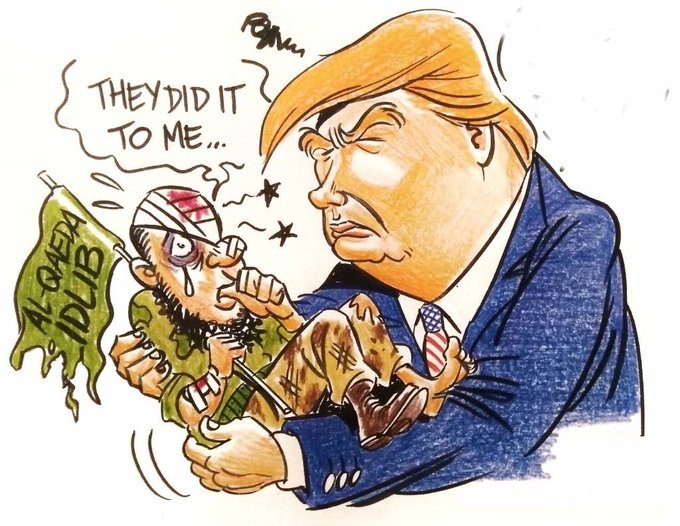
Trump is backing al Qaeda in Syria, Muslim Brotherhood in Libya, Lashkar-e-Taiba in Pakistan

Y.M.N.S.

Donald Trump, a self-proclaimed man of peace, on a self-proclaimed mission of peace. Just like that other self-proclaimed peacenik Barack Obama. Where do they come from? Where do you think fiends come from?


******** 

Wednesday, December 25

They smashed their churches but they could not break Syria's Christians

The remains of ancient Christian books burnt by Daesh militants, found in the ruins of St. George's Church in Al-Hasakah province of Syria.

Above are four of the photographs taken by Valeriy Melnikov for Sputnik's December 2015 photo essay, Rescued at Last: Christian Villages in Syria Liberated from Daesh. Two quotes from the essay:

"Over 30 Christian villages in Al-Hasakah province were completely devastated during the initial attack by Daesh forces."

"Despite being threatened by Daesh extremists, the local residents kept wearing their baptismal crosses and praying."

The caption for the first photograph reads, "A resident of one of the Christian villages in Al-Hasakah province of Syria prays in the ruins of St. George's Church destroyed by Daesh militants."
Merry Christmas to one and all.

Pundita

Oh no! Germany and France forced to stop feeding al Qaeda in Syria!

"The German and French NGOs, which have been providing food to the Al-Qaeda jihadists and their families via Turkey, will have to stop doing so as from January 2020, now that Ankara -- as per a UN resolution -- is no longer under the obligation to allow the supplies for the jihadists to go through."

Mon Dieu! What are those poor terrorists and their families going to do? Kleenex box, I can't find my -- it's all right, I'll use my sleeve. Wait! I have an idea! Put half on ships to France and the other half to Germany. And send some to the U.K. Now what is 1.5 million divided by three -- never mind, just stuff the starving on ships and get them fed while they're under sail. 

But it's not only the mandate. As of today, I think, they can't get the supplies through, if the Syrian Army has indeed taken control of the M5 highway. But have they? I hope Thierry Meyssan is not experiencing irrational exuberance.  According to his report -- well, here is what it says, below. I should add that I don't think all observers agree the Syrian Army's blitz has been that successful as yet. But remember Thierry lives in Syria, which means he watches Syrian news reports live on TV.

(For readers who ask why he's calling it northwestern Syria when everyone else is calling it southeastern -- that gave me trouble for a moment but I think he takes compassion on people who still can't find Idlib on a map. Anyhow, it's southeastern Idlib in northwestern Syria. Something like that.)

Lightning onslaught to liberate northwestern Syria
VOLTAIRE NETWORK 

24 DECEMBER 2019

The Syrian Arab Republic launched the second stage of its offensive against the residual pocket of Al-Qaeda jihadists (now labeled the Levant Liberation Committee - Hayat Tahrir al-Cham) in Idlib Governorate.

At least 1.5 million jihadists and their families have amassed there, and hold hostage about an equal number of Syrians.

The Syrian Arab Army, covered by the Russian air force, liberated the city of Maarat al-Numan, thereby retaking the M5 motorway connecting Aleppo to Damascus.

In accordance with the agreements concluded in Nur-Sultan (formerly Astana), the Turkish army did not intervene.

The German and French NGOs, which have been providing food to the Al-Qaeda jihadists and their families via Turkey, will have to stop doing so as from January 2020, now that Ankara - as per a UN resolution - is no longer under the obligation to allow the supplies for the jihadists to go through.

On 20 December 2019, Germany, Belgium and Kuwait tried to get the Security Council to approve an extension of the cross-border privileges enjoyed by these NGOs. But China and Russia vetoed the motion.

About 400,000 people have fled the fighting. Al-Qaeda jihadists and their families retreated to the city of Idlib, while the Syrians have been accommodated in refugee camps.


[END REPORT] 

********