Wow. Times they are a changing.
Monday, July 18


HIMARS boondoggle explained
Analysis from The Duran's Alexander Mercouris
Another illuminating discussion of the boondoggle and the current military situation in Ukraine is from Brian Berletic at The New Atlas. This video is much shorter than Alexander's; both are helpful for a broad understanding of the present and projected war situation in Ukraine.
Ukraine Loses another HIMARS, Russian Advance Continues (rumble.com)- July 17
For those who can't get enough of Alexander's analyses (that includes me), see:
********
Swedish society no longer a model, to the extent it ever was
The following report makes clear Sweden has become violent.
********
Heat Wave in W. Europe: Unexpected twist to the sanctions war against Russia
In Europe they were worried about the effect of Russia sanctions on heating in Europe's upcoming winter. They didn't think about the summer.
"Weather watchers in the U.K. have been more focused on how cold it might get in winter with energy bills due to jump again in October and exacerbating an already painful cost-of-living crisis. ... The heat is set to put added strain on a U.K. energy system that’s already under pressure from soaring natural gas prices. London office buildings will be ramping up electricity demand to keep workers cool.:
Scorching summer heat wave throws Britain into more chaos | The Spokesman-Review - July 16
It all added to the chaos in a nation that’s grappling with messy politics and a wilting economy. While supermarkets expect ice cream sales to also reach records and coastal resorts welcome people to cool down, the custodians of the U.K.’s infrastructure are flagging the worst-case scenarios.
The electricity infrastructure is straining under the heat and as cooling systems ramp up, a lack of wind is reducing supplies. The railway network, which in the past has seen cables snap and tracks buckle, is reducing speed on services. The National Health Service is concerned hospitals already overwhelmed will see a spike in patients suffering from the heat.
“In this country, we’re used to treating a hot spell as a chance to go and play in the sun,” said Penny Endersby, the Met Office’s chief executive officer. “This is not that sort of weather.”
Searing temperatures across Europe have crippled agriculture in France, forced Spain to cut water supply in some regions and triggered a state of emergency in parts of Italy. While more drastic this year, increasingly hot summers aren’t as unusual as they are in Britain. Greece, for example, regularly experiences deadly wildfires.
Weather watchers in the U.K. have been more focused on how cold it might get in winter with energy bills due to jump again in October and exacerbating an already painful cost-of-living crisis.
The U.K. had taken a break from images of canceled trains, hours-long lines at airports and missing luggage to watch Prime Minister Boris Johnson announce his resignation following a series of scandals involving his conduct. The news this week has been dominated by the race to replace him – but also the weather.
The latest warning is an escalation from forecasts in recent days, when the Met Office expected next week’s temperatures could likely reach the high 80s.
The heat is set to put added strain on a U.K. energy system that’s already under pressure from soaring natural gas prices. London office buildings will be ramping up electricity demand to keep workers cool.
That could increase the load on some grid infrastructure that’s not able to transmit as much power when ambient temperatures rise.
Britain’s network is designed for extreme temperatures but operators in the areas affected by the Met Office’s red warning have escalated preparations for the heat wave, according to the industry lobby group.
On the generation side, the high-pressure system that’s bringing the heat also creates low winds that sap Britain of one of its biggest sources of cheap energy. Wind farms are set to generate less than 2 gigawatts of power on Monday, leaving the electricity grid more reliant on expensive natural gas.
Solar will help lighten the burden, but the U.K.’s fleet of farms is much smaller than its wind power potential.
[END REPORT]
See also:
Hungary declares 'energy emergency' over threat of shortages - ABC News (go.com) - July 13
[...]
In Spain, 237 deaths have occurred due to high temperatures this month, according to the country's Carlos III Institute, which records temperature-related fatalities daily.
The heat has helped fuel raging wildfires in multiple countries:
- In France, firefighters struggled Saturday to contain a huge wildfire that raced across pine forests in the Bordeaux region for a fifth straight day.
- In Portugal, more than 160 people have been injured by wildfires and hundreds have been forced to evacuate. The pilot of a firefighting plane also died when his plane crashed.
- Spain is also battling several wildfires, including two that have burned about 18,200 acres and caused around 3,000 people to be evacuated.
- [...]
"RUSSIA Takes $100 BILLION Risk of Self Insuring OIL DELIVERIES to INDIA & CHINA due to SANCTIONS"
I wondered why the Russians weren't doing that. Turns out they are. This move largely obviates the Western sanctions, which to my understanding are chiefly aimed at Western oil insurers. Yet Russia's move is one of necessity given the great increase of Russian oil shipments via sea since sanctions were imposed. Very clear explanation of a complex situation at this YouTube site:
See also: Russian fuel is flooding the Middle East – Bloomberg — RT Business News - July 17
Thursday, July 14
"It's pretty much done for the U.K."
SAS unit repeatedly killed Afghan detainees, BBC finds - BBC News - July 12
The BBC investigative report on the SAS murder of several Afghan detainees during the Afghan War is shocking news -- but almost as shocking is the British public's reaction to the report, at least according to Andrei Martyanov.
This is the first I'm hearing about the issue, from Andrei's discussion in his video report today.
After listing other horrors in the society, he concludes that Britain is, well, pretty much done for.
Britain is actually very wealthy, so it won't collapse, but the, uh, social fabric seems badly frayed. Yet one obvious bright spot is that the BBC report indicates it reached its gag limit -- or rather a faction in the British military or the government did and alerted the Beeb. From a VOA report dated July 12:
[...]
A BBC investigation, citing newly obtained military documents, alleged Tuesday that 54 people were unlawfully killed in the southern Afghan province of Helmand by a single unit of the Special Air Service (SAS), a special forces unit of the British army.
The broadcaster said its four-year inquiry also found “evidence suggesting the former head of the special forces failed to pass on evidence to a murder inquiry.”
[...]
Report Alleges British Soldiers Committed War Crimes in Afghanistan (voanews.com)
Yet according to Andrei, at least, the British public is more upset about the disclosure threatening to endanger British lives than the war crimes. I doubt all Britons feel that way although it does seem that the society is in deep trouble. They can stand in line; Western societies in general are in deep trouble. "Things fall apart, the center cannot hold."
*******
Yet another great analysis from The Duran's Alexander Mercouris
His high level of analysis is so consistent that it's easy to start taking it for granted, so sometimes I have to remind myself that he is absolutely incredible. Alex Christoforu, his co-host at The Duran, calls him "The Oracle of London" and that he is, although his political analyses of the entire of Europe makes him also "The Oracle of Europe." And while he is always downplaying his understanding of military matters ("Remember I have no military background.") his insights about the Ukraine military situation are often invaluable.
He does have an advantage in that he comes from a political family in Greece and has been steeped in European politics virtually all his life. In addition to this vast knowledge, which has given him good judgment, his research on political and military matters is so painstaking I wonder when he sleeps. He is notoriously high strung, but I would be too if plowed through, analyzed, and reported on as many reports as he does every day.
Yet I think that part of his nerves is the sense of responsibility he has regarding his commentaries, as more and more people turn to him for insights during this very dangerous and confusing time. He obviously wants to get it as correct as he can. That's a heavy load to be carrying, day in, day out, seven days a week.
A driven man. But to our advantage. You can learn a great deal from Alexander Mercouris, so the investment in time listening to him is well worth it. I think you'll agree that as long as minds such as Alexander's are among us, the human race is better off than we tend to assume on our worst days.
Here is his latest, from yesterday, posted at Rumble:
*******.
Monday, July 4
Sunday, June 19
Oops!
Ii updated the previous post but just to make sure everyone sees the update:
UPDATE 9:05 PM ET
From a later entry at Moon of Alabama comment section:
@40; terrifying video of Kinzhal strike;
That video is fake - VFX.
It is a copy of this YT video "What if Russia Started Nuclear War?" from 22 February.
https://www.youtube.com/watch?v=DZ67hVlxM-8
Posted by: moabeobachter | Jun 19 2022 15:56 utc | 67
Oops. Okay, but the what the heck is that explosion? And what does a Kinzhal strike look like? Anyway, the video is definitely not showing a strike today on Uke weapons depot.
"Oh fuck! Oh fuck! Oh my God! Holy shit!" UPDATED 9:05 PM ET
(H/T Moon of Alabama comment section.)
UPDATE
From a later entry at Moon of Alabama comment section:
@40; terrifying video of Kinzhal strike;
That video is fake - VFX.
It is a copy of this YT video "What if Russia Started Nuclear War?" from 22 February.
https://www.youtube.com/watch?v=DZ67hVlxM-8
Posted by: moabeobachter | Jun 19 2022 15:56 utc | 67
Oops. Okay, but the what the heck is that explosion? And what does a Kinzhal strike look like? Anyway, the video is definitely not showing a strike today on Uke weapons depot.
Thursday, June 9
"What a complete mess the collective West has made of things."
The observation is from Alex Christoforu (The Duran) during his walkabout/video report today at the Thessaloniki harbor in Greece.
(Kiev's government called for a global ban on the letter "Z" so Alex took them at their word and always refers to Zelensky as "Elensky." snark.)
********
Russia consolidates gains in Ukraine
Russia Consolidates Gains, Land Bridge to Crimea Complete, Ukraine Must Surrender Kherson Zaporozhie (rumble.com) - Alexander Mercouris (The Duran) video report June 9
Sunday, June 5
While China has been encircling India, India has been encircling China
Interesting. The catch is that the explanation is delivered in VERY rapid-fire Indian-accented English; the moderator is racing to stuff the report into 15 minutes. Also, he keeps referencing his "previous" video about China; I can't find it yet -- "Think School" has several videos posted at YouTube. Well, the previous video is not necessary for an understanding of India's own "String of Pearls." It just requires close listening to keep up with the pace of explanation.
How India is TRAPPING China with its Military STRATEGY? : Geopolitical Case study - YouTube
********
"Why should you have nice relaxed weekend when I can spoil it for you?"
Andrei Martyanov at the top of his form. I decided not to spoil my weekend so I'm watching the complete video tonight but I can't resist the title: "Math of Geopolitics." Something to do with "Composite Index of National Capability, British fake videos, real economy."
Math of Geopolitics, CINC. - YouTube
Sounds like 25 minutes of sheer hell but Andrei has a way of making hell sound almost fun, or at least amusing.
********
"The U.S. cannot defeat China. So what they're going to do is burn down the world to spite China."
Brian Berletic is a one-man army LOL. Listen and learn if you've never heard of the Oslo Freedom Fund before.
Brian, under the pen name of Tony Cartalucci, has been exposing the scheming of such characters for years, which I've mentioned several times over the years on this blog, and is continuing under his own name to pull back the curtain.
I am very proud to say that Brian is an American, born and raised. He has already done more than his share to alert fellow Americans to the worst threats from within their own country. He has lived for years in Thailand but should not be confused with the anti-American contingent of expat Americans around the world. He is most definitely not anti-American. It is just that he knows in great detail the real drivers of the worst of American foreign policy.
His New Atlas channel on YouTube is also available on Rumble and while he started a new blog called The New Atlas, I am seeing a dire security warning associated with the link. So, I am sticking with his old blog, Land Destroyer, which features his most recent writings/videos for New Atlas.
By the way he's doing great video updates on the war in Ukraine. I see The Duran is starting to take notice.
******
Saturday, June 4
Electronic warfare on the battlefield
Telegram: Contact @intelslava - June 4
The newest electronic warfare complex "Palantin" during a special operation suppresses electronic objects of Ukrainian militants [video]
The complex of electronic warfare (EW) of the Armed Forces of the Russian Federation "Palantin" blocks the control of reconnaissance unmanned aerial vehicles of the enemy, "jamming" cellular communication centers and Internet sources at the command posts of the Armed Forces of Ukraine.
Actually, Palantin has been in use for some time:
"Tirada" and "Palantin": 19 new electronic warfare systems have been created in Russia over the past few years (topwar.ru) - 5 May 2021 ("Many of them have no analogs.")
For a broader discussion of battlefield EW:
Deadly secret: Electronic warfare shapes Russia-Ukraine war | AP News - June 4
Detailed report that breaks down complex concepts so a 'general' reader can understand them.
********
Friday, May 27
Middle East sandstorms getting progressively worse
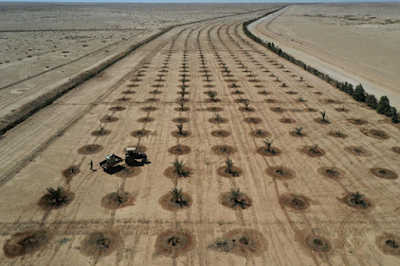
There are a number of problems in addition to 'climate change' making the sandstorms progressively worse and which the following Washington Post report outlines. The situation in Iraq is particularly alarming.
As for planting trees -- the report discusses some of the initiatives, but then you run into the problem of watering the trees well enough to develop deep roots to withstand the high winds from the sandstorms.
And I'm afraid the Dust Bowl plantings, if used as a model for the Middle East, ignore the very different climate in that region of the USA, and the fact that uprooting of native grasses on the plains to make room for crop plantings was the biggest culprit.
Another tip stemming from the lessons of the Dust Bowl-- Scientists got the farmers to stop planting crops in straight rows; they needed to leave a little soil overhang for moisture to accumulate.
and
[...]
But experts say the storms this year are particularly intense, as climate change and desertification increase their frequency. In Iraq, at least nine significant storms have hit the country since April. More are likely to materialize in the summer and, without major policy changes, could continue to get worse in years to come.
“We have had many more dust storms this spring than in the past,” said Salam Abdulrahman, a lecturer at the University of Human Development in Iraq, said in an email. “Every dust storm has lasted from one day to 2-3 days. Previous dust storms were shorter.”
Benjamin Cook, an environmental scientist at Columbia University’s Climate School, said three elements are needed for a sandstorm to take off: wind, a source of dust where there is little to no vegetation, and very dry conditions.
The recent storms in Iraq have stemmed in part from a lack of rain, water-flow issues and human activity.
2020-21 was the second-driest rainfall season in 40 years, resulting in crop failure. Conditions remain poor. In most of the country, groundwater storage, used for crop irrigation and drinking water, is near its lowest levels compared with long-term records, according to NASA data.

The limited water stunts vegetation growth, which loosens the surface for dust storms, said Abdulrahman. He said some locals in Iraq now refer to the dust storm activity as “soilfall” or “earthfall,” because the winds kick up layers of soil.
Wetlands in southern Iraq and Iran, where many people make a living off the land, are drying up.
Ismael al Ameri, a research fellow at Birkbeck, University of London, said the near-disappearance of Al Sawa, a salt lake about 150 miles south of Baghdad, will leave a new source of mud, silt and salt for sandstorms. The construction of dams on the Tigris and Euphrates rivers has added to the problem, he said, and more broadly, military operations in Iraq since 2003 have also damaged topsoil layers.
In Iran and Iraq, the storms are also connected to farming practices in the region and the mismanagement of shared rivers, said Banafsheh Keynoush, a nonresident scholar with the Middle East Institute’s Iran program.
The conditions driving dust storms have been exacerbated by human-caused climate change. The Middle East is heating up about twice as quickly as the rest of the world, which has warmed by about 2.3 degrees Fahrenheit since the preindustrial era.
The hotter temperatures, paired with increasing water-supply issues, prime the desert region for more dust storms.
“These climate extremes are widely reported as clear indicators of climate change,” said al Ameri, who has previously written on the subject. “This is combined with an increase in storm recurrence activity, not only in spring and summer, but in autumn and winter too.”
An Iraqi environmental ministry official said the country’s dusty days have increased from 243 to 272 days a year over two decades, according to data from the General Authority for Meteorology. He said Iraq could face nearly 300 days of dust storms per year by 2050, the Iraqi News Agency reported.
[...]
They also come at a cost to health.
[...]
The Saudi Food and Drug Authority on Tuesday called on people to wear masks and refrain from eating food exposed to the open air to protect themselves from harmful particles carried by the storms.
[...]
Saudi Arabia plans to plant 10 billion trees in the next decades to reduce its carbon footprint and land degradation. Saudi Crown Prince Mohammed bin Salman unveiled a “Middle East Green Initiative” last year, hailed by the United Nations, to work with other Arab countries to plant 40 billion more in the region.
Iran, a regional rival, has spent 450 million euros ($483 million) over the past three years to mitigate sandstorm hot spots in the country by planting trees, stabilizing soil, constructing windbreaks and other measures, according to the Tehran Times.
raq has been experimenting with the strategy for more than a decade, planting eucalyptus and olive trees and date palms as part of a plan to shield the central city of Karbala, one of Iraq’s Shiite holy cities. But construction delays, funding shortages and neglect contributed to the project’s failure, Agence France-Presse reported. Some blame financial mismanagement.
The cabinet on May 10 directed the Finance Ministry to disburse some $2 million to implement a project to stabilize sand dunes, the Iraqi News Agency reported.
Governments in the region have invested in early-warning and monitoring systems for sandstorms, Keynoush said.
But regional governments should take stronger collective action to address the problem, she said. “We need to be a step ahead of sandstorms rather than sandstorms being a step ahead of us.”
[END REPORT]
********
Wednesday, May 25
Who knew BBC was a Russia news site?
No shame. The Western mainstream media have no shame when reporting on Russia matters -- but tagging the BBC Russian-language site a Russian news source is going too far even for them. Bernhard has fun taking this one apart:
MoA - Ukraine Propaganda - BBC Tries To Sell Telegram Rumors That Make No Sense (moonofalabama.org)
Pundita's Global Sitrep
All the roads are rocky right now but as long as they end up in Dublin 1 2 3 4 5
Subscribe to:
Posts (Atom)