Translate

Monday, March 13

Can China help enforce the KSA-Iran peace deal?

 Aye, that is the question because China simply might not have the capacity to be much help in smoothing over inevitable differences that will arise as the deal is put into practice. And of course Washington will do everything in its power to push the deal to fail.  

Moon of Alabama's Bernhard looks at the pitfalls after he reviews details of the agreement:

MoA - China's Prestigious Middle East Deal May Soon See Challenges (moonofalabama.org):  Full text: 

China's Prestigious Middle East Deal May Soon See Challenges

The big deal between Saudi Arabia and Iran, which China mediated, may soon lead to new trouble.

The deal included security clauses:

[C]onfidential clauses were inserted into the Beijing Agreement to assure Iran and Saudi Arabia that their security imperatives would be met. Some of these details were provided to The Cradle, courtesy of a source involved in the negotiations:
  • Both Saudi Arabia and the Islamic Republic of Iran undertake not to engage in any activity that destabilizes either state, at the security, military or media levels.
  • Saudi Arabia pledges not to fund media outlets that seek to destabilize Iran, such as Iran International.
  • Saudi Arabia pledges not to fund organizations designated as terrorists by Iran, such as the People’s Mojahedin Organization (MEK), Kurdish groups based in Iraq, or militants operating out of Pakistan.
  • Iran pledges to ensure that its allied organizations do not violate Saudi territory from inside Iraqi territory. During negotiations, there were discussions about the targeting of Aramco facilities in Saudi Arabia in September 2019, and Iran’s guarantee that an allied organization would not carry out a similar strike from Iraqi lands.
  • Saudi Arabia and Iran will seek to exert all possible efforts to resolve conflicts in the region, particularly the conflict in Yemen, in order to secure a political solution that secures lasting peace in that country.

According to sources involved in the Beijing negotiations, no details on Yemen’s conflict were agreed upon as there has already been significant progress achieved in direct talks between Riyadh and Yemen’s Ansarallah resistance movement in January. These have led to major understandings between the two warring states, which the US and UAE have furiously sought to undermine in order to prevent a resolution of the Yemen war.

In Beijing however, the Iranian and Saudis agreed to help advance the decisions already reached between Riyadh and Sanaa, and build upon these to end the seven-year war.

The Saudi pledges are significant for Iran. Since last October there had been on and off protests and riots combined with terrorist attacks by Sunni militants in Baloch region in southeast Iran and terrorist attacks in northwest Iran by Sunni Kurdish militants which had crossed over from north Iraq.

The protests were fueled by Iran International, a Saudi funded channel in London. That channel is now moving to Washington DC where it seems to have found new funding. Saudi Arabia was also financing the Kurdish and Baloch rebels. They have now stopped their attack in Iran. Today Iran announced an amnesty for some 22,000 people who had been arrested during the riots:

[Iran’s judiciary head Gholamhossein Mohseni Ejehi] said a total of 82,656 prisoners and those facing charges had been pardoned. Of those, some 22,628 had been arrested amid the demonstrations, he said. Those pardoned had not committed theft or violent crimes, he added.

The Iranian pledges have likewise solved Saudi Arabia security problems. There will be no more attacks on its oil infrastructure.

An additional item in the Cradle report is also significant:

On a slightly separate note related to regional security — but not part of the Beijing Agreement — sources involved in negotiations confirmed to The Cradle that, during talks, the Saudi delegation stressed Riyadh’s commitment to the 2002 Arab peace initiative; refusing normalization with Tel Aviv before the establishment of an independent Palestinian state, with Jerusalem as its capital.

This is of course bad for Israel which had hoped to drag Saudi Arabia onto its site to then attack Iran. That has for now become impossible. The China mediated deal is also a red flag for Washington:

[T]he agreement undercuts the posture of the U.S. in the region. The U.S. has downsized in Syria after withdrawing forces in 2021 from Afghanistan.

The deal also comes as Saudi Arabia is demanding certain security guarantees, a steady flow of arms shipments and assistance with its civilian nuclear program in order to normalize relations with Israel, a major U.S. ally, the White House confirmed on Friday.

Speaking to reporters, National Security Council spokesperson John Kirby said the U.S. was “informed” about the Saudi Arabia-Iran talks but played no role in them.

One wonders if the recent anti-Chinese campaign was launched because the U.S. knew of the deal and tried to interrupt it.

The deal may well have implementation issues:

China’s role in the Saudi-Iranian deal is momentous. However, Beijing may find that its relations in the region are undermined by failures in its implementation.
...
As the broker of the deal, or at least the third-party country listed in the statement, the key question is whether China will — or even can — realistically underwrite or support the translation of the agreement into practice. The first issue is one of capabilities. Unlike Washington, China’s power projection capabilities are highly limited. With its sole foreign military base in Djibouti, and no substantial security architecture in the region, Beijing would be unable to enforce the deal with the use — or threat — of force.
While this very absence of military might may be a source of soft power for China in the eyes of regional states, given that it signals a genuine desire to avoid interfering in other states’ affairs, Beijing cannot protect key assets in the region or respond to transgressions. Beijing is still reliant on Washington in this regard.

Who's are the 'key assets' in the region? Are they not owned by the countries they are in? If Iran and the Saudis hold onto the agreement there is no need for the U.S. to be there. Beijing is certainly not relying on anything Washington could do there.

The second, and far more pressing, issue is one of willingness. China’s role in brokering the deal is unlikely to see it raise its head above the parapet if violence or tensions erupt. Beijing has expended decades of diplomatic effort to cultivate good relations with all regional states. We are simply unlikely to see China risk blowing it all by siding with one partner at the expense of the other.

The author seems to believe that China should take sides. If the agreement holds, there will be no need to do that. If it doesn't hold China will mediate again until peace returns.

Fundamentally, this deal comes down to the two regional states (and indeed the other GCC states). If they play ball, China can claim a monumental victory in Middle Eastern diplomacy. If, as is more likely, tensions surface, Beijing will find that it has overstretched. It will almost certainly be unable and unwilling to act as a guarantor of the deal. For a quick diplomatic win, China has placed its policy of neutrality in jeopardy. The current question from China’s perspective is whether it will retain the respect of all parties if the agreement fails.

The real implementation problems the deal and China will face are not the ones the author quoted above mentions.

The U.S. does not like the deal because it diminishes its role in the region. Israel does not like the deal because it lessens its chances to go  after Iran:

The U.S. and Israel don’t look kindly on the news of the diplomatic breakthrough. They first fear that China is increasingly assertive in its role in the region, and the U.S. does not want to experience what Britain experienced in Suez in 1956: a watershed moment signaling its global decline. The U.S. stood up to Britain, France and Israel who combined to attack Egypt after its leader Gamal Abdel Nasser nationalized the Suez Canal. The event is seen as the final act of the British Empire before joining the more powerful U.S. imperium.
...
If the agreement does accomplish the goal of truly bringing peace and amity between the two rivals, China may then enjoy a Suez moment: when the world signals the end of the American Empire like what happened to the British.

Both, Israel and the U.S, are capable and likely willing to do whatever is necessary to prevent an implementation of the deal. They can probably use their good relations with the United Arab Emirates to make things difficult. False flag attacks in Iran and in Saudi Arabia could be a way to do that. If a new 'Iranian' drone attack happens in Saudi oil fields or new 'Saudi financed' terrorist attack in Iran happen the deal could indeed be scrapped.

One hopes that China and the other parties involved in the deal are conscious of that.

[END REPORT]

I am sure they are very consciousness of the challenges that will be mounted against the deal.  

*********


Famous last words on global banking disaster

On Friday John Batchelor interviewed someone who actually knows what he's talking about regarding a banking crisis:

The John Batchelor Show / #SVB: Trampled on the way to the door. Jim McTague, former Washington Editor Barron's. (audioboom.com)

This morning the Associated Press published their latest report on the disaster, which features this great quote from somebody I never heard of before:

Monday will surely be a stressful day for many in the regional banking sector, but today’s action dramatically reduces the risk of further contagion.
-- Economists at Jefferies

The AP's entire report is posted here:

U.S., U.K. try to stem fallout from Silicon Valley Bank collapse [Video] (aol.com) - KEN SWEET - March 13, 2023, 6:09 AM

NEW YORK (AP) — Governments in the U.S. and U.K. took extraordinary steps to stop a potential banking crisis after the historic failure of Silicon Valley Bank, even as another major bank was shut down.

The UK Treasury and the Bank of England announced early Monday that they had facilitated the sale of Silicon Valley Bank UK to HSBC, Europe's biggest bank, ensuring the security of 6.7 billion pounds ($8.1 billion) of deposits.

British officials worked throughout the weekend to find a buyer for the UK subsidiary of the California-based bank. Its collapse was the second-largest bank failure in history.

U.S. regulators also worked all weekend to try to find a buyer. Those efforts appeared to have failed Sunday, but U.S. officials assured all depositors that they could access all their money quickly.

The announcement came amid fears that the factors that caused the Santa Clara, California-based bank to fail could spread.

In a sign of how fast the financial bleeding was occurring, regulators announced that New York-based Signature Bank had also failed and was being seized on Sunday. At more than $110 billion in assets, Signature Bank is the third-largest bank failure in U.S. history.

The near-financial crisis left Asian markets jittery as trading began Monday. Japan’s benchmark Nikkei 225 sank 1.6% in morning trading, Australia’s S&P/ASX 200 lost 0.3% and South Korea’s Kospi shed 0.4%. But Hong Kong’s Hang Seng rose 1.4% and the Shanghai Composite increased 0.3%.

In an effort to shore up confidence in the banking system, the Treasury Department, Federal Reserve and FDIC said Sunday that all Silicon Valley Bank clients would be protected and able to access their money. They also announced steps that are intended to protect the bank’s customers and prevent additional bank runs.

“This step will ensure that the U.S. banking system continues to perform its vital roles of protecting deposits and providing access to credit to households and businesses in a manner that promotes strong and sustainable economic growth,” the agencies said in a joint statement.

Under the plan, depositors at Silicon Valley Bank and Signature Bank, including those whose holdings exceed the $250,000 insurance limit, will be able to access their money on Monday.

Also Sunday, another beleaguered bank, First Republic Bank, announced that it had bolstered its financial health by gaining access to funding from the Fed and JPMorgan Chase.

In a separate announcement, the Fed late Sunday announced an expansive emergency lending program that’s intended to prevent a wave of bank runs that would threaten the stability of the banking system and the economy as a whole. Fed officials characterized the program as akin to what central banks have done for decades: Lend freely to the banking system so that customers would be confident that they could access their accounts whenever needed.

The lending facility will allow banks that need to raise cash to pay depositors to borrow that money from the Fed, rather than having to sell Treasuries and other securities to raise the money. Silicon Valley Bank had been forced to dump some of its Treasuries at at a loss to fund its customers’ withdrawals. Under the Fed’s new program, banks can post those securities as collateral and borrow from the emergency facility.

The Treasury has set aside $25 billion to offset any losses incurred under the Fed’s emergency lending facility. Fed officials said, however, that they do not expect to have to use any of that money, given that the securities posted as collateral have a very low risk of default.

Monday will surely be a stressful day for many in the regional banking sector, but today’s action dramatically reduces the risk of further contagion.Economists at Jefferies

Analysts said the Fed’s program should be enough to calm financial markets.

“Monday will surely be a stressful day for many in the regional banking sector, but today’s action dramatically reduces the risk of further contagion,” economists at Jefferies, an investment bank, said in a research note.

Though Sunday’s steps marked the most extensive government intervention in the banking system since the 2008 financial crisis, its actions are relatively limited compared with what was done 15 years ago. The two failed banks themselves have not been rescued, and taxpayer money has not been provided to the banks.

President Joe Biden said Sunday evening as he boarded Air Force One back to Washington that he would speak about the bank situation on Monday. In a statement, Biden also said he was “firmly committed to holding those responsible for this mess fully accountable and to continuing our efforts to strengthen oversight and regulation of larger banks so that we are not in this position again.”

Regulators had to rush to close Silicon Valley Bank, a financial institution with more than $200 billion in assets, on Friday when it experienced a traditional run on the bank where depositors rushed to withdraw their funds all at once. It is the second-largest bank failure in U.S. history, behind only the 2008 failure of Washington Mutual.

Some prominent Silicon Valley executives feared that if Washington didn’t rescue the failed bank, customers would make runs on other financial institutions in the coming days. Stock prices plunged over the last few days at other banks that cater to technology companies, including First Republic Bank and PacWest Bank.

Among the bank’s customers are a range of companies from California’s wine industry, where many wineries rely on Silicon Valley Bank for loans, and technology startups devoted to combating climate change. Sunrun, which sells and leases solar energy systems, had less than $80 million of cash deposits with Silicon Valley. Stitchfix, the clothing retail website, disclosed recently that it had a credit line of up to $100 million with Silicon Valley Bank and other lenders.

Tiffany Dufu, founder and CEO of The Cru, a New York-based career coaching platform and community for women, posted a video Sunday on LinkedIn from an airport bathroom, saying the bank crisis was testing her resiliency. Given that her money was tied up at Silicon Valley Bank, she had to pay her employees out of her personal bank account. With two teenagers to support who will be heading to college, she said she was relieved to hear that the government’s intent is to make depositors whole.

“Small businesses and early-stage startups don’t have a lot of access to leverage in a situation like this, and we’re often in a very vulnerable position, particularly when we have to fight so hard to get the wires into your bank account to begin with, particularly for me, as a Black female founder,” Dufu told The Associated Press.

Silicon Valley Bank began its slide into insolvency when its customers, largely technology companies that needed cash as they struggled to get financing, started withdrawing their deposits. The bank had to sell bonds at a loss to cover the withdrawals, leading to the largest failure of a U.S. financial institution since the height of the financial crisis.

Treasury Secretary Janet Yellen pointed to rising interest rates, which have been increased by the Federal Reserve to combat inflation, as the core problem for Silicon Valley Bank. Many of its assets, such as bonds or mortgage-backed securities, lost market value as rates climbed.

Sheila Bair, who was chairwoman of the FDIC during the 2008 financial crisis, recalled that with nearly all the bank failures then, “we sold a failed bank to a healthy bank. And usually, the healthy acquirer would also cover the uninsured because they wanted the franchise value of those large depositors so optimally, that’s the best outcome.”

But with Silicon Valley Bank, she told NBC’s “Meet the Press,” “this was a liquidity failure, it was a bank run, so they didn’t have time to prepare to market the bank. So they’re having to do that now, and playing catch-up.”

[END REPORT]

******** 

NATO is out of ammunition? Oh dear, where is my Kleenex box?

The John Batchelor Show / #Londinium90AD: Gaius and Germanicus observe that NATO is out of ammo. Michael Vlahos. Friends of History Debating Society. (audioboom.com)

Bonus:  

The John Batchelor Show / #Londinium90AD: Gaius and Germanicus debate the unknowable world order 2023. Michael Vlahos. Friends of History Debating Society. (audioboom.com)

It certainly is unknowable if NATO is on the ropes, China is brokering a deal between Iran and Saudi Arabia, Mexico wants to join BRICS, and a banking crisis is careening into a global disaster.

Have a nice day!

*********

Iran-Saudi Arabia Rapprochement


Race is on to join BRICS, Mexico's plan to be latest candidate

From the report on Mexico, below:

The BRICS group was formed in 2009 as a way to challenge the dominance of the Western-led institutions such as the IMF and the World Bank. The BRICS have created their own development bank and contingency reserve fund to support their economic growth and stability. The BRICS also cooperate on various issues such as climate change, terrorism, health and education. The BRICS represent about 40% of the world’s population, 30% of the world’s GDP and 20% of the world’s trade.

The above percentages will skyrocket if all the present candidates joion BRICS.

Background on BRICS expansion:

The New Candidate Countries For BRICS Expansion - Silk Road Briefing
November 09, 2022
If accepted, the new proposed BRICS members would create an entity with a GDP 30% larger than the United States, over 50% of the global population and control of 60% of global gas reserves.

By Chris Devonshire-Ellis

The Russian Foreign Minister, Sergey Lavrov has stated that ‘over a dozen’ countries have formally applied to join the BRICS grouping following the groups decision to allow new members earlier this year. The BRICS currently includes Brazil, Russia, India, China and South Africa.

It is not a free trade bloc, but members do coordinate on trade matters and have established a policy bank, the New Development Bank, (NDB) to coordinate infrastructure loans. That was set up in 2014 in order to provide alternative loan mechanisms from the IMF and World Bank structures, which the members had felt had become too US-centric. The Asian Infrastructure Investment Bank (AIIB) was set up by China at about the same time for largely the same reasons and to offer alternative financing than that provided by the IMF and World Banks, which were felt to impose political reform policies designed to assist the United States in return for providing loans. Both the NDB and AIIB banks are Triple A rated and capitalised at US$100 billion. The NDB bank shares are held equally by each of the five members. In total, the BRICS grouping as it currently stands accounts for over 40% of the global population and nearly a quarter of the world’s GDP. The GDP figure is expected to double to 50% of global GDP by 2030. Expanding BRICS will immediately accelerate that process. [...]

Above report continues with world map graphic and individual listings of candidate countries; posted before Mexico's announced bid to join BRICS.

MEXICO

Mexico Plans to Join BRICS Amid Growing Tensions with US | Eurasia Media Network
By:Newsdesk
March 12, 2023

Mexico has expressed its interest in joining the BRICS group of emerging economies, which currently consists of Brazil, Russia, India, China and South Africa. The Mexican Foreign Minister, Marcelo Ebrard, said that Mexico shares the vision and values of the BRICS and hopes to deepen its cooperation with them in various fields, especially in medicine and trade.

Mexico’s move comes amid growing tensions with its northern neighbor, the United States, over issues such as immigration, border security, trade and human rights. The US has imposed tariffs on Mexican goods, threatened to cut off aid and demanded that Mexico do more to stop the flow of migrants from Central America. Mexico has also faced criticism from the US for its handling of the Covid-19 pandemic and its alleged interference in the Venezuelan crisis.

Mexico sees the BRICS as an alternative platform to diversify its foreign relations and increase its global influence. Mexico is the second-largest economy in Latin America after Brazil and has a population of more than 120 million people. It also has a strong manufacturing sector that competes with China in some markets. Mexico has already established close ties with China, which is its second-largest trading partner after the US. Mexico has also participated in several BRICS summits as an observer and guest.

However, Mexico’s bid to join the BRICS faces some challenges and uncertainties. The BRICS group has not formally announced any criteria or process for admitting new members, although Russia has suggested that it could expand by five countries in 2023. The BRICS also have different interests and agendas that may not always align with Mexico’s. For instance, Mexico may have to balance its relations with China and India, which are rivals in Asia. Mexico may also have to deal with the possible backlash from the US, which may see Mexico’s alignment with the BRICS as a threat to its regional hegemony.

The BRICS group was formed in 2009 as a way to challenge the dominance of the Western-led institutions such as the IMF and the World Bank. The BRICS have created their own development bank and contingency reserve fund to support their economic growth and stability. The BRICS also cooperate on various issues such as climate change, terrorism, health and education. The BRICS represent about 40% of the world’s population, 30% of the world’s GDP and 20% of the world’s trade.

[END REPORT] 

******** 

Sunday, January 15

That's what it was about yesterday


"On January 14, 2023, a missile attack was carried out on the military command and control system of Ukraine and related energy facilities, all designated facilities were hit, the target of the strike was achieved - Ministry of Defense of the Russian Federation"
t.me/intelslava/43415


The strikes:


Summary of Russian Army strikes against Ukrainian infrastructure facilities [today]:

Targets were hit in the following cities and regions
▪️Kyiv and region
▪️Kharkov
▪️Odessa and region
▪️Nikolaev region
▪️Dnepropetrovsk and region
▪️Krivoy Rog
▪️Vinnytsia and region
▪️Ternopil region
▪️Ivano-Frankivsk region
▪️Sumy region
▪️Lviv region

We are aware of blackouts and power outages in the following cities and regions:
.Kyiv
▪️Kharkov
▪️Kirovograd
▪️Dnepropetrovsk
▪️Zaporozhye region
▪️Ivano-Frankivsk
▪️Zhytomyr region
▪️Vinnytsia region


Saturday, January 14

"Insufficient analysis, which today leads Biden to proceed mindlessly."

Has the third world war begun?  A famously prescient anthropologist thinks so. The post below is from Bernhard at Moon of Alabama, published today:

MoA - Emmanuel Todd on the Third World War (moonofalabama.org)

Emmanuel Todd On The Third World War

The French Le Figaro has an interview with the well-known anthropologist Emmanuel Todd.

Emmanuel Todd: «La Troisième Guerre mondiale a commencé»

"The third world war has begun" is his new thesis. Todd is quite famous for correctly predicting the devolution of the Soviet Union long before it happened. He was quite alone at that time.

I once had a piece on Todd's later predictions for the U.S. and Europe which still seems spot on. I also quoted him in a piece on social decline as a national security issue.

Unfortunately the Figaro piece is paywalled. But Arnaud Bertrand has done us the favor of translating the gist. Here is his slightly edited thread:

Arnaud Bertrand @RnaudBertrand - 15:42 UTC · Jan 13, 2023

Emmanuel Todd, one of the greatest French intellectuals today, claims that the "Third World War has started."

Small 🧵 translating the most important points in this fascinating interview.

He says, "It's obvious that the conflict, which started as a limited territorial war and is escalating to a global economic confrontation between the whole of the West on the one hand and Russia and China on the other hand, has become a world war."

He believes that "Putin made a big mistake early on, which is [that] on the eve of the war [everyone saw Ukraine] not as a fledgling democracy, but as a society in decay and a “failed state” in the making. [...] I think the Kremlin's calculation was that this decaying society would crumble at the first shock. But what we have discovered, on the contrary, is that a society in decomposition, if it is fed by external financial and military resources, can find in war a new type of balance, and even a horizon, a hope."

He says he agrees with Mearsheimer's analysis of the conflict: "Mearsheimer tells us that Ukraine, whose army had been overtaken by NATO soldiers (American, British and Polish) since at least 2014, was therefore a de facto member of the NATO, and that the Russians had announced that they would never tolerate Ukraine in NATO. From their point of view, the Russians are therefore in a war that is defensive and preventive. Mearsheimer added that we would have no reason to rejoice in the eventual difficulties of the Russians because since this is an existential question for them, the harder it would be, the harder they would strike. The analysis seems to hold true."

He however has some criticism for Mearsheimer:

"Mearsheimer, like a good American, overestimates his country. He considers that, if for the Russians the war in Ukraine is existential, for the Americans it is basically only one 'game' of power among others. After Vietnam, Iraq and Afghanistan, what's one more debacle? The basic axiom of American geopolitics is: 'We can do whatever we want because we are sheltered, far away, between two oceans, nothing will ever happen to us'. Nothing would be existential for America.

Insufficient analysis which today leads Biden to proceed mindlessly. America is fragile. The resistance of the Russian economy is pushing the American imperial system towards the precipice. No one had expected that the Russian economy would hold up against the 'economic power' of NATO. I believe that the Russians themselves did not anticipate it.

If the Russian economy resisted the sanctions indefinitely and managed to exhaust the European economy, while it itself remained, backed by China, American monetary and financial controls of the world would collapse, and with them the possibility for United States to fund their huge trade deficit for nothing. This war has therefore become existential for the United States. No more than Russia, they cannot withdraw from the conflict, they cannot let go. This is why we are now in an endless war, in a confrontation whose outcome must be the collapse of one or the other."

He firmly believes the US is in decline but sees it as bad news for the autonomy of vassal states:

"I have just read a book by S. Jaishankar, Indian Minister of Foreign Affairs (The India Way), published just before the war, who sees American weakness, who knows that the confrontation between China and the US will have no winner but will give space to a country like India, and to many others. I add: but not to Europeans. Everywhere we see the weakening of the US, but not in Europe and Japan because one of the effects of the retraction of the imperial system is that the United States strengthens its hold on its initial protectorates. As the American system shrinks, it weighs ever more heavily on the local elites of the protectorates (and I include all of Europe here). The first to lose all national autonomy will be (or already are) the English and the Australians. The Internet has produced human interaction with the US in the Anglosphere of such intensity that its academic, media and artistic elites are, so to speak, annexed. On the European continent we are somewhat protected by our national languages, but the fall in our autonomy is considerable, and rapid. Let's remember the Iraq war, when Chirac, Schröder and Putin held joint anti-war press conferences."

He underlines the importance of skills and education: "The US is now twice as populated as Russia (2.2 times in student age groups). But in the US only 7% are studying engineering, while in Russia it is 25%. Which means that with 2.2 times fewer people studying, Russia trains 30% more engineers. The US fills the gap with foreign students, but they're mainly Indians and even more Chinese. This is not safe and is already decreasing. It is a dilemma of the American economy: it can only face competition from China by importing skilled Chinese labor."

On the ideological and cultural aspects of the war: "When we see the Russian Duma pass even more repressive legislation on 'LGBT propaganda', we feel superior. I can feel that as an ordinary Westerner. But from a geopolitical point of view, if we think in terms of oft power, it is a mistake. On 75% of the planet, the kinship organization was patrilineal and one can sense a strong understanding of Russian attitudes. For the collective non-West, Russia affirms a reassuring moral conservatism."

He continues: "The USSR had a certain form of soft power [but] communism basically horrified the whole Muslim world by its atheism and inspired nothing particular in India, outside of West Bengal and Kerala. However, today, Russia which repositioned itself as the archetype of the great power, not only anti-colonialist, but also patrilineal and conservative of traditional mores, can seduce much further. [For instance] it's obvious that Putin's Russia, having become morally conservative, has become sympathetic to the Saudis who I'm sure have a bit of a hard time with American debates over access for transgender women in the ladies' room.

Western media are tragically funny, they keep saying, 'Russia is isolated, Russia is isolated'. But when we look at the votes at the UN, we see that 75% of the world does not follow the West, which then seems very small.

With an anthropologist reading of this [divide between the West and the rest] we find that countries in the West often have a nuclear family structure with bilateral kinship systems, that is to say where male and female kinship are equivalent in the definition of the social status of the child. [Within the rest], with the bulk of the Afro-Euro-Asian mass, we find community and patrilineal family organizations. We then see that this conflict, described by our media as a conflict of political values, is at a deeper level a conflict of anthropological values. It is this unconscious aspect of the divide and this depth that make the confrontation dangerous."

There you go. Is he right on everything? I don't know, but Emmanuel Todd is certainly always a very singular and interesting thinker, with a vastly different analysis from the depressingly predictable bad takes that usually dominate French media.

Todd's thinking rhymes well with that of Radhika Desai and Michael Hudson as reproduced at Naked Capitalism. 

Economists Radhika Desai & Michael Hudson Explain Multipolarity, Decline of US Hegemony - Original here

Yves Smith introduces it:

Yves here. Some rousing weekend listening! Radhika Desai and Michael Hudson are launching a bi-weekly talk show, Geopolitical Economy Hour. The opening segment gives an overview, starting with the breakdown of US dominance and how it has been accelerated ironically by self-defeating efforts to preserve the system. It seems trivial at this point to observe that American defense of its hegemony has helped forge a strong Russia-China alliance. But will this partnership wind up dominating other countries, and stymie the development of a truly multipolar order?

Good food for thought ...

Posted by b on January 14, 2023 at 14:52 UTC |

NATO miscalculated in Ukraine

Russian Armed Forces Gaining Momentum In Donbass Following Liberation Of Soledar - South Front - January 13

"This whole house of cards in Ukraine will collapse, sooner than Washington realizes."

Quote from Douglas Macgregor This is MUCH worse than they're telling you | Redacted with Natali and Clayton Morris - YouTube - January 14

See also:

Russia Missile Strike, Advances Bakhmut; German Criticism Tank Transfers, US Navy Stocks Depleted - YouTube -  Alexander Mercouris - January 14


Summary of Russian Army strikes against Ukrainian infrastructure facilities [today]:

Targets were hit in the following cities and regions
▪️Kyiv and region
▪️Kharkov
▪️Odessa and region
▪️Nikolaev region
▪️Dnepropetrovsk and region
▪️Krivoy Rog
▪️Vinnytsia and region
▪️Ternopil region
▪️Ivano-Frankivsk region
▪️Sumy region
▪️Lviv region

We are aware of blackouts and power outages in the following cities and regions:
.Kyiv
▪️Kharkov
▪️Kirovograd
▪️Dnepropetrovsk
▪️Zaporozhye region
▪️Ivano-Frankivsk
▪️Zhytomyr region
▪️Vinnytsia region
*********

"The West has broken its word too many times by now."

"Nobody evens knows what the rules of the rules-based international order are."

Russia's next move, keeps collective west guessing - YouTube - The Duran yesterday

Last part of the discussion is the keeper.  Starts at the 21:49 minute mark with analysis of seizing Russian assets. 

******


Friday, January 13

Things will move faster now in Russia's Ukraine operation

However, the Russian military continues to move with the almost maddening precision that has characterized its operation from the start. 

From Intel Slava Z today:
Establishing full control over Soledar makes it possible to cut off the supply routes of Ukrainian militants in Artemovsk [Bakhmut], and then block and take into the "cauldron" the enemy units remaining in it, the Russian Defense Ministry said.

05:39

Intel Slava Z
On the evening of January 12, the liberation of Soledar was completed, which is important for the continuation of successful offensive operations - the Russian Ministry of Defense.

05:47

Intel Slava Z
Over the past three days, more than 700 Ukrainian servicemen and over 300 units of weapons of the Armed Forces of Ukraine have been destroyed in the Soledar area — Russian Defense Ministry

See also this war analysis at The Duran yesterday:


********


Such lunacy happening around the world

Indian town rapidly sinking, space agency warns — RT World News - January 13

"Subsidence has affected Joshimath for some time, with the impact magnified by the depletion of groundwater for irrigation and the rapid development of infrastructure, including the construction of hydropower plants ..."


The Indian town of Joshimath, known as a gateway to the Himalayas, sank by 5.4cm, sometime between late December and early January, the Indian space agency has reported. The popular tourist destination, at an altitude of over 6,000 ft (1800 meters), is prone to subsidence, partially due to infrastructure development.

A report by the Indian Space Research Organisation (ISRO) released on Wednesday detailed changes detected by satellite observation of Joshimath, revealing that a rapid subsidence event had taken place sometime between December 27, 2022 and January 8, 2023.

The region's chief minister, Pushkar Singh Dhami, ordered a mass evacuation after a 603 buildings in the town were found to have deep cracks.

Recorded elevation changes varied between 1 and 5.4cm, the data shows. ISRO observations over the past year have detected a slow subsidence of up to 9cm over a period of nine months, the report said.

Joshimath is located in the northern Indian state of Uttarakhand on the slope of a hill and is a popular destination for pilgrims and tourists who visit the areas many temples.  

However, the settlement sits atop inherently fragile Himalayan geology and a treacherous environment. Thousands of people have been killed over decades by natural disasters such as earthquakes, landslides, flash floods, and avalanches. The Uttarakhand floods in February 2021 alone claimed over 80 lives.

Subsidence has affected Joshimath for some time, with the impact magnified by the depletion of groundwater for irrigation and the rapid development of infrastructure, including the construction of hydropower plants, according to scientists. 

[END REPORT]

*********


Thursday, January 5

Indian rupee fast emerging as currency to settle global trade debts

I seem to recall asking last month whether the Indian rupee -- trade in the rupee -- is a black swan event. From Firstpost today:

India’s Neighbours Ready to Embrace the Rupee | Indian Rupee Goes Global - YouTube - 3:42 minutes

Introduction to the report: 

De-dollarization became the buzzword after Russia became the first overseas country to settle trade with India in rupees. After all, it's the US dollar that currently exercises hegemony in global trade. And de-dollarisation, effectively, seeks to counter this precise overreliance. Moscow junked the dollar and brought smaller nations like Tajikistan, Cuba, and Sudan on board as well. Now, it's India's immediate neighbors that are eyeing using the Indian rupee for trade, boosting New Delhi's Neighborhood First policy. And this is no mean feat. As a result, the Indian rupee is fast emerging as a plausible alternative to settling global trade. [...]

******** 

Monday, January 2

Wall Street Journal wants to know whether Covid vaccines are fueling Covid's evolution

Public-health experts are sounding the alarm about a new Omicron variant dubbed XBB that is rapidly spreading across the Northeast U.S. Some studies suggest it is as different from the original Covid strain from Wuhan as the 2003 SARS virus. Should Americans be worried?

It isn’t clear that XBB is any more lethal than other variants, but its mutations enable it to evade antibodies from prior infection and vaccines as well as existing monoclonal antibody treatments. Growing evidence also suggests that repeated vaccinations may make people more susceptible to XBB and could be fueling the virus’s rapid evolution.
[...]

That's as much of the article as you can read for free.  Eventually free sources will pick up on the WSJ ruminations, which are not new but in this case quite specific -- and coming from a top mainstream news publication.  

Meanwhile, it seems mainstream medicine continues full support for Covid vaccines; for example:

'Cocktail' vaccines could offer increased protection against future COVID-19 variants of concern (medicalxpress.com)

Have a nice day. 

********

Saturday, December 31

"When you cannot commit one calculation error."

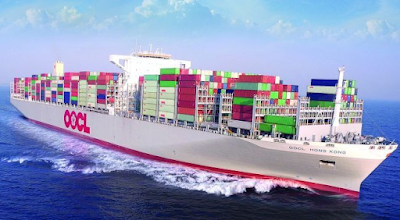
Maiden voyage of World's Biggest Containership | YouTube

The introduction at YouTube [emphasis mine]: 

Mega Transports: Biggest Containership | Engineering Documentary
It is the largest heavy load transport on earth! The maiden voyage of the biggest containership of all times. 
When the first ship of the brand-new OOCL-fleet gets underway, more cargo is moved at one time than anywhere else in the world and never before.
At 21,100 TEU capacity, the vessel is the largest ever ordered to date. 400 meters long and about as wide as a football field (58.8 meters).
These mega-cargo ships will not only be able to load more cargo than ever before, they will also be equipped with a number of high-class energy-saving systems.
This Episode shows the maiden voyage of the OOCL HONG KONG. Everything happens for the first time: the captain, the pilots and the harbour crew have never before manoeuvred a giant ship like this. Berthing, loading, steering: risky manoeuvres, which have never been tested [in real time] before.
Once berthed, the cargo loading pushes everyone involved to the limit -- crew, crane operators and the lashing team. A loading procedure like this, with additional containers on top of the so-far known stacking limit, has only been theoretically discussed, but never tested in real life.
Balancing the ship, moving and securing the stunning mass of containers is a task that does not allow even the slightest mistake. 
The route from Shanghai to Rotterdam, with stop in Singapore, brings constant challenges: pirate areas, onboard emergency drills and the navigation through the narrow waters of the Suez Canal. All of this happens under incredibly high pressure of time.
Will the world’s largest container ship stay on schedule on its maiden voyage?

The 48-minute documentary, published February 2020, gives the audience a front-row seat to an amazing ship's journey.  

********

Tuesday, December 27

"Authorities never expected the impacts to be as bad as they were." A symbolic snow disaster.

The quote is from Buffalo’s no stranger to snow. Why was the storm so deadly? - The Washington Post - December 27, 2022.  (Access to the report at WaPo is free; it's also published here: Buffalo’s no stranger to snow. Why was the storm so deadly? (msn.com)

We've seen the pattern before in other types of natural disasters that were worsened by poorly conceived attempts at preparedness. (Remember this?) 

But what WaPo reporters Brianna Sacks and Emily Wax-Thibodeaux learned about Buffalo's preparations for a historic blizzard is perfectly symbolic of how Europe got into such a jam this year. Governments did projections of the impacts of making financial war on Russia but overlooked so many factors they were left wide open to a series of disasters.

So, in addition to the number of lives it took, a snowstorm in America serves as a warning about the limitations of projections and the dire consequences of snubbing common sense.  

******** 

Friday, December 23

As Russia prepares for outright war with NATO, U.S. "too thinly stretched in too many places."

The Duran's report today includes a brief review of the fighting in Bakhmut but focuses on Russian preparations for large-scale war with NATO.

Russian military prepares for conflict with neocons and NATO - YouTube

See also today's report from The New Atlas; Brian Berletic analyzes the Pentagon's woefully inadequate military aid to Ukraine:

Pentagon's "End-of-Year" Wishlist for Ukraine's Military Falls Far Short - YouTube

********

Wednesday, December 21

"Curse this damn road. I'm not coming back."

He'll be back. He's a lorry (truck) driver, delivering between New Delhi and Leh, in India.  His route takes him along the Manali-Leh highway. I've never before seen a film about the road journey, which is probably the most consistently treacherous anywhere. Also the most beautiful -- otherworldly in parts.  Seeing something of the journey helps put things in perspective.  

Can't believe I made the journey once -- and that was before the Indian military widened and upgraded the road, which had been built only for single-file military jeep traffic.  You may trust I took a plane out of Leh when it was time to leave.  Once by road was more than enough for me. 

Best driving advice is from a lorry driver in the film who allows his apprentice to get into the driver's seat and take the wheel during a stretch of the road:  "When you sit here you have to be submissive and pray to the gods."  

If you say you don't believe in gods -- by the time you're on that road an hour, you will. I think even monotheists pray to the gods on that road.


Foreign governments no longer see USD as safe haven for their national reserves

The view of the U.S. dollar as the sure refuge was the one thing shoring up the dollar no matter how much debt the U.S. piled up. Now the view has changed. One chapter in world history has closed. Another now opens.

Canadian scholar Gregory Chin explains how American policies boxed in their own currency. That part of his discussion is in Part 2 starting at the 21:00 mark. 

Chin's talk, titled The Renminbi and the Making of an International Currency, given for the London School of Economics, starts at the 8:24 mark after the introduction. The talk is followed by a Q&A session. 


********


Bakhmut Battle Sitrep

Granular discussion among three expert analysts with Gonzalo Lira moderating while chain-smoking.  (He's still in Kharkov. The building next to where he's staying was bombed some days ago.)  After about the first 20 minutes the discussion expands to other regions in Ukraine but keeps returning to Bakhmut.

Dima (Military Summary Channel) thinks Marinka is more important than Bakhmut for the Russians; he explains his reasoning starting at the 50:30 mark; debate and discussion follows.  Basically he's saying that the Ukrainians need to be ejected from Donetsk as the top priority.     


Saturday, December 17

Is the Indian Rupee a Black Swan Event?

We may have been looking in the wrong direction -- at the yuan (technically Renminbi) and asking whether it could rival or even replace the U.S. dollar as a reserve currency.

 Six hours ago from India's Firstpost, 4:46 minutes:


Part of the story is not new. See this five-minute report from India's WION on July 12:

Gravitas: RBI announces rupee mechanism for foreign trade - YouTube

"The Reserve Bank of India has rolled out a system to settle international trade transactions in the Indian rupee instead of the dollar. How does the rupee trade work? How will it impact India's trade relations? Palki Sharma tells you."

But as Firstpost indicates, several policies and global trade/financial trends are suddenly converging and moving fast to propel the rupee to an important reserve currency status. This is something nobody could have predicted.  

********