Translate

Showing posts with label earthquakes. Show all posts

Wednesday, August 24

One species at the National Zoo raised an alarm 15 minutes before the earthquake struck Washington, DC

Man's Newest Best Friend?

From DC Day After the Quake, NBC Washington:
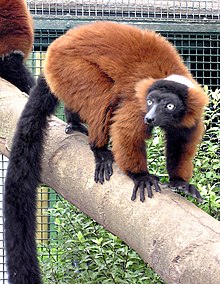
The first warnings of the earthquake may have occurred at the National Zoo, where officials said some animals seemed to feel it coming before people did. The red ruffed lemurs began “alarm calling” a full 15 minutes before the quake hit, zoo spokeswoman Pamela Baker-Masson said. In the Great Ape House, Iris, an orangutan, let out a guttural holler 10 seconds before keepers felt the quake. The flamingos huddled together in the water seconds before people felt the rumbling. The rheas got excited. And the hooded mergansers — a kind of duck — dashed for the safety of the water.
There's a large body of lore about unusual animal behavior prior to an earthquake but nothing definitive as far as science is concerned. And while many pet owners have noticed unusual behavior in their dogs, cats, or birds just prior to an earthquake, the anecdotes I've read suggest that much of the behavior occured just a few seconds before the quake struck.

And it's possible that much of the behavior, as seems the case with that of the flamingos and ducks at the National Zoo, was actually after the fact: the quake had already occurred at the epicenter, 80 miles from Washington, but the fowl were reacting to subtle vibrations as the shock waves traveled outward.

To be sure, a few seconds warning would be better than nothing -- it would be enough time for a pet owner to run out of the house or take cover in the bathtub, but not enough time to act as any kind of public warning.

Fifteen minutes warning, on the other hand, would be an eternity in relation to an earthquake warning because humans have no public warning system of any kind. When one considers that even a three-minute warning ahead of a 6.5 or higher earthquake could save thousands of lives and prevent many serious injuries, the notations of the zookeepers at the Washington National Zoo about the lemurs' behavior will probably come in for serious study by scientists who study earthquakes and tsunamis.

Assuming for the sake of discussion that the lemurs at the National Zoo were indeed reacting to a subtle precursor of the 5.8 earthquake that was felt across one-third of the United States and in parts of Canada yesterday, the first question would be whether they would have been as sensitive to an impending earthquake of the same magnitude in the western part of the USA.

Different soil density and types of tectonic plates mean the difference between tremors carrying from a quake epicenter over a huge area, as happened in the eastern part of the USA and Canada yesterday, or carrying over a very limited area, as they do in California and other western regions of the USA.

Another big factor is the depth of a quake. The fault that opened yesterday in Mineral, Virginia, the epicenter of the quake, was only three miles underground. Would the lemurs at the National Zoo have noticed anything if the depth of the fault had been twice or three times that?

No way to answer the question now, because even if the lemurs were reacting to something associated with the quake, it's not known what the something is. So scientists have their work cut out for them.

In the meantime, however, those who live in an earthquake alleyway might want to ring up their neighborhood zoo and ask if there are any red-ruffed lemurs in residence. If not, well, lemurs seem to be pretty low-maintenance and if they turn out to be duds at earthquake prediction they're still a nice addition to a zoo.

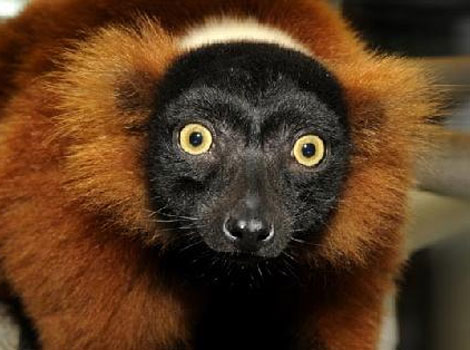
I'm an endangered species, I'm vegetarian, oh and by the way I'm extremely clean
Sunday, March 27

Batchelor on the latest in Japan's nuclear reactor crisis

The John Batchelor Show has been closely following the situation. Below is John's most recent post at his website on the still-unfolding crisis. See the website for links and photos included in the post.
10 Million Times
by John Batchelor on March 27, 2011 12:46 AM ET

Sudden darkening news from Fukushima includes a Reuters flash, now backed by a BBC report, that the water at Unit #2 is up to 10 million times normal, and that the workers must be evacuated. This is not a positive development after anecdote for the last days of workers damaged by radiation from working in water.

The Japanese government has aleady estimated the quake and tsunami and reactor disaster to cost over $300 Billion. The puzzle remains if it can be contained. The reports for several days have pointed to Unit #3 as the problem. Unit #2 (below, #2 control room as they restored lights) was not featured for several days and was presumed solved.

The evacuation zone outside of Fukushima continues to grow, with a quarter of a million already evacuated and the red line spreading into Fukushima Prefecture.

The challenge is how to measure the TEPCO failure at Fukushima. The reminder is that this is said to be a 60% man-made crisis caused by TEPCO's denial, arrogance, delay and deception in the first critical hours.

A strange victim, of many more to come, is Angela Merkel, who is now slated to lose a bi-election in Baden-Wurtemberg because she reversed course on nukes in Germany. The Germans have only 17 reactors, and they have closed the 7 most like Fukushima for the short-term. The Greens are rallying voters to the no-nuke cause.

It is coming the US way, and we have 104 reactors, with four on fault zones and more than twenty like the light-water reactors at Fukushima.

The ongoing crisis at Fukushima will weaken the nuke forces in all hemispheres. Worse, TEPCO is now baldly revealed as untrustworthy, and this case will spoil all trust of nuke operators.

The clock runs out on Jim Berkland's earthquake prediction for California

This post follows on the March 19 and March 25 posts.

The "major window" Berkland cited was between March 19 and 26. It's now 3:37 Pacific Time on Sunday morning, the 27th. There was a small earthquake on the 26th in Baja California, Mexico, which is on the Mexico-California border. While the quake was technically not in California I suppose diehard supporters of Berkland's earthquake prediction model would say that it counts. Yet my understanding of Berkland's prediction is that it was specific to a major earthquake in California.

If it should turn out that the small quake was a precursor to a major one in California during the coming week, then I'd say the quake on the 26th conceivably breathed oxygen into Berkland's model. And it's always possible that a part of the model, if hooked up with other factors, could generate predictions that are accurate and consistent enough to rule out chance.

As it stands now, however, Berkland needs to go back to the drawing board. I wish him luck in the endeavor; anyone who makes it a calling to attempt to predict earthquakes deserves thanks, not derision.
3.6 earthquake rattles Baja California
by Ann M. Simmons
March 26, 2011, 3:38 pm (PT)
Los Angeles Times

A small earthquake struck Baja California on Saturday afternoon, but there were no reports of damage or injuries, according to the U.S. Geological Survey.

The magnitude 3.6 tremor occurred around noon, with its epicenter about 32 miles south-southeast of Calexico, Calif., and Mexicali, Mexico, on the U.S.- Mexico border, said Leslie Gordon, a spokeswoman for the U.S. Geological Survey, which reports and monitors earthquakes.

Gordon said that the quake was felt “very weakly” in Calexico, Mexicali and El Centro, Calif., and that there was no reports of it being felt in San Diego, about 100 miles west.

“This makes sense,” said Gordon. “Something this small, I wouldn’t have expected it to be felt.”

Friday, March 25

Burma earthquake, more on Jim Berkland's earthquake prediction for California, and a return to the curious case of the L'Aquila quake

I just googled Berkland's name and saw an article at the CBN News website which quotes him as saying on FNC (Fox News Cable) on March 14:
"What I call a seismic window, this top seismic window in years, is developing between the 19th and 26th of this month."
I suppose I should try to find the interview to double check but for now -- if the CBN quote is correct, that would extend the window one day beyond the day -- today -- that Natural News gave for his prediction, and which I quoted in my last post.

The CBN article also noted about Berkland's prediction:
Berkland correctly predicted the 1989 quake that hit California during the World Series in the San Francisco Bay area. He told Fox News that some of the same signs that preceded that quake have shown up again.

He warned that the moon will be very close to the earth, which will increase tidal forces.

Also, he said animal behavior, such as the recent fish deaths, is indicating a change in the earth's magnetic field, which often happens before a quake.

"But I'm saying we just had a massive fish kill," he said. "Maybe a million fish died in Redondo Beach. They had a massive fish sweep in Mexico. We just had a bunch of whales come in close to San Diego."

"I used to just scoff at these kinds of things, because I was a mainstream geologist until I found out that earthquakes are fitting a pattern," Berkland explained. "The big earthquake in the Indian Ocean followed massive beachings of whales in Taiwan -- not Taiwan, but New Zealand and Australia and Tasmania. And then within couple of days, they had a 8.3 in south of New Zealand, and then came the 9.1 in the Indian Ocean, with the big tsunami, on the very day of the full moon."

"The previous big quake and tsunami was in Alaska, which is a 9.2 magnitude event, on the day off the full moon, on the 27th of March," he added.
As the Natural News article noted, Berkland's prediction model for a California quake references not one but four factors: the spring equinox and recent clockwise earthquake activity along the Pacific Ring of Fire in addition to unexplained marine life deaths and the supermoon at perigee.

I'll toss this in with no comment because I know nothing about auroras as applied to earthquake prediction: one CBN reader wrote in the article's comment section:
[...] I've observed major catastrophic earthquakes occur most often when auroral activity is at its peak in the arctic and antarctic regions. The site I use is: http://www.swpc.noaa.gov/pmap/
So far the only major quake within the March 19-26 window that Berkland identified has been in Burma, on March 24; that was a 6.8 magnitude according to the USGS. Burma's government put the magnitude at 7.0 but the USGS readings are considered the worldwide standard for quake measurement.

A question would be whether any of the variables Berkland uses for earthquake prediction might apply to the Burma quake. The last entry on Berkland's website about earthquake activity is from June 2010. So it seems one would have to sign up for his newsletter to receive whatever comments he might have about the Burma quake and any additional comments he's made about his California earthquake prediction since giving the interview at FNC.

There was also a 6.6 magnitude quake off the east coast of Honshu, Japan on March 22, which puts it within the time frame Berkland identified for a major California quake. But I'm assuming the Honshu quake was one of the many aftershocks from the March 11 earthquake in Japan, which is officially named the Tōhoku quake. The Tōhoku was so powerful that its aftershocks can continue for months and even years.

Wikipedia notes that China's Yunnan quake on March 10, which was overshadowed by the Tōhoku one, was near the Burmese border and that "Small tremors had been occurring in this region for two months ..."

Regarding the Burma quake:

March 24, 2011 11:12 AM

6.8-magnitude quake strikes northeastern Myanmar; no tsunami
Associated Press
Yangon, Myanmar — A strong earthquake struck northeastern Myanmar late [Thursday]shaking buildings as far away as Bangkok. No tsunami was generated.

The quake struck along Myanmar's borders with Thailand and Laos, about 70 miles (110 kilometers) from Chiang Rai. The northern Thai city sustained a little damage, according to Thai television.

The 6.8-magnitude quake was just six miles deep, according to the U.S. Geological Survey. At that strength and depth, the monitor said 600,000 people got shaking anywhere from strong to violent and that the buildings are considered vulnerable, so moderate to very heavy damage is expected in homes.

Buildings swayed in Bangkok, about 480 miles south of the epicenter.
[...]
The Pacific Tsunami Warning Center says [the quake] was located too far inland to create a destructive wave.
The Geology section of Wikipedia's article on the quake notes:
The shallow earthquake occurred in northeastern Myanmar, on a geologically active area east of the subduction zone between the Indo-Australian Plate and Eurasian Plate, which created the Arakan Yoma mountains. The earthquake was triggered near fault lines extending from the Yunnan-Guizhou Plateau toward central Thailand, apart from the main seismic zones in central and western Myanmar.[5] Other recent significant earthquakes in this area included the 2011 Yunnan earthquake and the 2007 Laos earthquake.[6]
I share the frustration of the CBN reader who commented about Berkland's prediction:
[...] Did [Berkland] mention where in the 163,696 sq. miles of California it will hit? No one knew about the Northridge fault, let alone predicted the earthquake! I wonder how many "super perigee moons" there have been since 1906.
Yes, well, as I mentioned in the last post, an astronomer has done a good job of debunking claims of a cause-and-effect connection between full moons and earthquakes. But again, Berkland is viewing the pull of a regular full moon and/or supermoon perigee on the earth's oceanic tides as one factor in the timing of major earthquakes.

When I get too frustrated with the rocky road of earthquake prediction I remind myself of how one Giampaolo Giuliani must have felt in the days running up to the April 6, 2009 earthquake in Italy's Abruzzo region, near its capital of L'Aquila. Giuliani predicted the earthquake; however, the authorities didn't take kindly to his attempts to warn the residents of L'Aquila. From the (U.K.) Guardian's April 6 report on the issue:
[...] Giampaolo Giuliani, a researcher at the National Physical Laboratory of Gran Sasso, based his forecast on emissions of radon gas coming from the ground in seismically active areas.

The first tremors in the region were felt in mid-January and continued at regular intervals, leading to concerns that a large earthquake was imminent in the medieval city.

Vans with loudspeakers had driven around the town a month ago telling locals to evacuate their houses after Giuliani predicted the quake was about to strike.

The scientists' warnings drew criticism from the city's mayor, and following complaints to the police, Giuliani was forced to take down warnings he had posted on the internet.

Italy's major risks committee met on 31 March to reassure the city's population that the seismic activity was nothing to be alarmed about. "The tremors being felt by the population are part of a typical sequence [which is] absolutely normal in a seismic area like the one around L'Aquila," the civil protection agency said in a statement that evening.

The statement added that it was impossible to predict an earthquake, but was nonetheless monitoring the situation.[...]
I see that Wikipedia's article on the quake has an update on the uproar caused by Giuliani's prediction:
Predicting earthquakes based on radon emissions has been studied by scientists since the 1970s, but enthusiasm for it had faded due to inconsistent results.[72] In December 2009, Giuliani presented his research, without many important details, to the American Geophysical Union in San Francisco; the union subsequently invited him to take part in developing a worldwide seismic early warning system. On his return home, the Italian authorities lifted the gagging injunctions against his predictions.[73]

More recently [2010], Italian geologists and officials have been indicted for manslaughter for not predicting the 2009 L'Aquila earthquake.[74]
The article doesn't mention how the indictments turned out; I'd be surprised if the accusations even made it to trial.

The article also notes:
The earthquake was felt throughout central Italy; 308 people are known to have died,[3] making this the deadliest earthquake to hit Italy since the 1980 Irpinia earthquake.
The quake measured 6.3 on the moment magnitude scale (MMS), which has superseded the Richter scale for measuring earthquake activity. The Richter reading for the quake was 5.8.

Saturday, March 19

The sciences of heaven and earth, the 'still small voice in the night,' and earthquake prediction

March 25 Update
It seems the Natural News article (see below) gave the wrong date for the window of opportunity that Jim Berkland named for a major earthquake to strike California. According to an article I saw today that quotes Berkland, the window is from March 19 to 26, not March 25th. See my post today for details.
**************
March 19, 2011: Supermoon rises over Cascade Mountain Range. Photo taken from Seattle, Washington by Joshua Trujillo for Seattlepi.com

After giving much of my time in 2010 to reporting on natural events I'd pretty much stopped such coverage early this year. However, I'm going to make an exception regarding the March 19, 2011 supermoon:

A supermoon is so named because the moon's orbit occasionally takes it closer than normal to the earth at the time of perigee; i.e., moon's shortest distance from the earth during the lunar cycle. See this article at National Geographic Daily News page for a crash course on the March 19 supermoon, which came closest to the earth in 18 years, and for an explanation about why it could look pretty much the same to the naked eye as a normal full moon (notwithstanding the awe-inspiring moment that Trujillo captured).

The author of the Geographic piece also takes a swat at claims that supermoons can precipitate earthquakes and tsunamis. Yet it was an ordinarily good-natured astronomer named Phil Plait who pulverized the claims in a March 11 post at Discovery magazine. That wasn't the first time Plait had explained why the idea of a supermoon-earthquake connection was nonsense, but he was so exasperated by a (U.K.) Daily Mail scare piece on the connection between the moon and Japan's earthquake that he put on the hobnail boots. The result is one of those articles that are worth saving and passing on to your grandchildren.

However comma debunking the supermoon connection will not dissuade humanity from its quest to seek signs and portents that warn of an earthquake. One seeker is Jim Berkland, a retired geologist who claims to have developed a set of indicators that can predict major earthquakes. Other scientists have disputed Berkland's methods and the success rate he attributes to his method. Yet this hasn't dampened the general public's interest in his approach to earthquake prediction, perhaps because it feels intuitively correct: not by any one sign but by a particular convergence of these might a warning of the earth's upheaval reveal itself.

Intuitive reasoning, as mathematicians delight in demonstrating, can be spectacularly wrong. Yet there is a difference between perking an ear for intuition's whispers and the intuitive reasoning that keeps casinos raking in profits. And when one considers that 30 seconds is the most warning that even cutting-edge technology can provide for a tsunami that strikes land nearest an earthquake, it's not a fool's quest to sound every nook and cranny of intuition and to scan heaven and earth for signs and portents. Jim Berkland has taken just such an approach in formulating his latest prediction, which is that between March 19 and March 25 a major earthquake will strike California.

From the Australian Natural News article about the prediction:
He says that four factors are coming together that make an earthquake in California a likely event:

First, the moon will be full and at its closest point to the earth during that time, a factor associated with previous earthquakes.

Second, the spring equinox occurs during this time, producing some of the highest tides of the year.

Third, the recent massive and unexplained fish die-off in Southern California could signal a magnetic shift that affects animals with unusual behavior. For example, beached whales have preceded previous earthquakes in California.

And fourth, the Pacific Rim faults, known as the Ring of Fire, have experienced three recent quakes -- in Chile, New Zealand, and Japan. These earthquakes have proceeded in a clockwise direction, possibly indicating that the fault lines in California are next.

Berkland has a website at www.syzygyjob.com and a [print] newsletter through his site. [...]
With regard to the name of Berkland's website, I might have noted before on this blog that astronomical syzygy as an earthquake predictor has been roundly criticized by other scientists. And I think that with little effort one can find on the internet people who have gone to some trouble to critique every one of the signs that Berkland uses in earthquake prediction; e.g., not every instance of mass deaths of marine life can be tagged to an earthquake. But again, Berkland's method doesn't depend exclusively on syzygy or any one event. We'll learn, soon enough, if in this particular instance he's hit on a gestalt worth a closer look from his critics.

And I note that the American Pacific Northwest (and southern British Columbia in Canada) are also situated along the Ring of Fire, so if the quake occurs as predicted it wouldn't necessarily strike in California.

In any event, a major earthquake in California could immediately unleash a tsunami against the coastlines of Washington and Oregon states as well as California's. And conceivably a major quake could effect the Cascade Volcanic Arc, a part of the Pacific Ring of Fire and Cascade Mountains that includes over 160 active volcanoes.

As we saw with Japan, which not only has cutting-edge tsunami warning devices but also a system unmatched elsewhere for instantly communicating the warning to the general populace, much can be accomplished with a warning of only 30 seconds. It's enough time to halt trains and factory machinery, allow drivers to make U-turns and the spryest to sprint for highest ground. But when one considers that the super-tsunami that struck Japan roared inland as far as an astounding six miles, I'd say this isn't the time to take only a purely academic interest in whether Berkland's prediction pans out.

Of course one cannot live on pins and needles all the time. But then it's only once in a long while that the kind of convergence Berkland talks about occurs. So between now and the end of this month (I'd tack a few days onto Berkland's prediction to be on the safe side) I'd say this is the time for Americans and Canadians living along the Ring of Fire to pay special attention to the behavior of their pets and neighborhood wildlife and to focus more inward, on the "still small voice" than on the passing show. And, of course, to review emergency disaster preparations.