Translate

Friday, November 6

Not only doesn't the Obama regime understand Syria, it doesn't even understand France

A soldier of the French foreign legion wearing a skeleton mask stands next to an armored vehicule in a street in Niono, Mali on January 20, 2013

Photo: ISSOUF SANOGO/AFP/GETTY

Within two years of rejoining NATO the French government was charging into Libya, Syria, and Mali. This prompted a bizarre laudatory editorial in the American publication Newseek, France: Leader of the Free World. Actually the French government was abusing its NATO membership to pursue old interests in MENA.

So it's not only Obama's crew and Congress that are clueless about country situations east of the English Channel. 

As I recounted earlier I've resisted delving into the history of Syria but finally I caved and while dawdling on my way to Wikipedia, found an article that might be more to the point than a Wiki history lesson. It's a study published by the journal of the Middle Eastern Policy Council, a U.S. think tank that is not without some funding controversy, at least a few years back -- although to complain about a Washington-based foreign policy institute accepting a $1 million donation from a Saudi prince is like complaining about a squirrel accepting peanuts from park visitors.

Note the year the essay was published.
The Troubles in Syria: Spawned by French Divide and Rule
By Ayse Tekdal FildisWinter 2011, Volume XVIII, Number 4
Dr. Fildis is a tutor at ACRES Beacon College in the UK. She holds a Ph.D in Middle East politics from the University of Sussex.
The writing, which is six 'internet pages' with another page of footnotes, is addressed to the general reader; e.g., aides to Members of Congress who couldn't have found Syria on a map if you paid them. 

The purpose of the writing:
This study will focus on the establishment of the French mandate, its implementation, and the partition process in Greater Syria. It will also review France's responsibilities under the Mandate Act of the League Nations.
Now comes the decision as to how much I'm going to republish of Fildis' essay. To take bits and pieces from it would be to interrupt the flow of events she describes, and it's the flow that needs to be understood. So I'll be a plot spoiler and just publish her conclusion and the passages immediately preceding it, with my preface:
  
There are huge, and I mean huge, problems in "Latin" America and the Caribbean. The number of displaced persons in several countries south of the U.S. border is mind-bending. What if anything can the USA do to help alleviate the situation?  We won't know unless Congress and the Obama regime stop mucking around in far-flung regions of the world they understand not at all, and focus attention on what's happening right next door. 

I know this is unwelcome advice for American manufacturers of big-ticket defense hardware, but their lobbyists couldn't find Syria on a map, either. The industry is supposed to make defense equipment, not U.S. defense policy. 

We can't extricate ourselves from Afghanistan and Iraq at this point, but if we won't let Russia lead we need to pull back from our Syrian adventure, which already has "disaster" written all over it. Countries are not a souffle; they're not something you keep re-doing until you get it right.  

And if by the end of the author's conclusion you're thinking that Syria and Lebanon might actually be one country, you would be right in a manner of speaking. As Fildis explains, for centuries "Syria" was simply a name for a large region.        
 [...] 
Critics (mainly colonialists) claimed that France's abdication from the "Orient" had begun with the establishment of a Syrian Constituent Assembly that was determined to elude the "imperative character of France's international obligations."36 The High Commissioner was accused of bargaining away what France had secured with its own "sweat and blood."36
A year later, France imposed its own constitution on Syria; it upheld France's role as mandate authority, thus preventing Syria from adopting any measures that might intrude on French mandatory privileges. In the coming years, France held the power to veto legislation proposed by Syrian presidents and prime ministers and legislatures aided by this constitution. France's power to veto legislation made "a charade out of Syrian political life and lent it an aura of unreality."38
During the mandate period, France ruled Syria through French administrators and advisers as effectively as any colony; no significant decision could be taken at any level without French approval. After nearly 20 years of the mandate, Syria remained without independence, without institutions of self-government and without territorial unity.
CONCLUSION
The political arrangements imposed by the French under the mandate went wrong from the start. The policy of division was integral to the original French approach to the mandate. France was there for her own strategic, economic and ideological purposes. The French made very few attempts to promote or expedite the formal independence of either Syria or Lebanon. Rather, they haggled for decades over the terms of an independence treaty and eventually had to be forced by the British to evacuate without a treaty in 1946. They did little to train indigenous officials with the subsidiary charges and imposed an artificial and unrealistic division between the different components of Syria and Lebanon.
They failed to give Syria proper instruction in responsible self-government. The numerous divisions and re-divisions of Syria over a quarter century obstructed the development of a unified administrative elite.
The outcome was that Syria emerged after 1945 as a unitary state with very little experience of unity. A fundamental social and political reconstruction that might, in the longer term, have generated a democratic and stable society was not part of the French plan. The process of political radicalization was initiated during the era of the French mandate, the legacy of which was almost a guarantee of Syria's political instability.
The creation of Greater Lebanon condemned the Lebanese to an unstable political system based on sectarian rivalries. Lebanon's uncertain relationship with its Arab neighbors was not the only source of communal tension within the new state. The geographical distribution of the various religious communities posed problems for the creation of a cohesive national system of government. The separation of the Muslim coastal areas as part of Lebanon has proven to be a major mistake that led to much bloodshed in the 1970s and 1980s, as various groups attacked the leadership role of the Maronite minority in what became a predominantly Muslim country.
[END]
********


Thursday, November 5

22,000 Palestinians were thrown out of work when Egypt shut down Gaza tunnels

And Middle East experts are still wondering what set off the "knife intifada."  As I noted in my October 13 post, Who's behind knife attacks on Israelis? Vengeful Palestinian smuggling gangs, the smugglers were hopping mad about the large number of tunnel closings but they couldn't very well (or very easily) launch attacks on Egyptian troops. 

However, I was unaware until I saw the following report that the Egyptian military was using seawater, although I should have thought of that option. But weeks before the knife attacks started, Malcolm Hoeinlein reported to John Batchelor that the Egyptian military was plugging the tunnels with sewer sludge and flooding others with water.  

The 22K statistic is from a Sputnik report today (based on a Reuters report), Egypt is Flooding Gaza Border Tunnels With Seawater, Poisoning Water Supply.
Egypt has been pumping salt water from the Mediterranean into Gaza's underground tunnels, which Cairo says have been used to smuggle weapons to Islamist insurgents in the Sinai desert.
At one point, an estimated 22,000 Palestinians worked in around 2,500 tunnels, bringing commercial goods mainly into Gaza. Weapons were smuggled in separate tunnels controlled by Hamas and other militant groups, Reuters reported.

But in September, while facing of an insurgency in northern Sinai, Egypt shut down the tunnels. In an effort to halt what it said was an arms flow in the opposite direction – from Gaza to the militants – Cairo started pumping water into the tunnels, collapsing the land.

Tunnel-builders said that since September, Egypt has done more damage to the tunnels than Israeli bombing had caused over the past two decades, Reuters reported. It is now thought that less than 20 tunnels remain, with cigarettes the main contraband taken across the border.

But more than destroying the tunnels, the flooding is contaminating water supplies and threatening to wreck farmland and spread disease, Palestinian officials say.
[...] 
Surely Palestinian officials are aware that the aquifers under Gaza, what is left of them, were already poisoned because of over-pumping of the aquifers. See also Gaza’s high population strains water supply, May 31, 2015, Al-Monitor.  

As for the land collapse, over-pumping aquifers will do it, and add to that honeycombing the underground with tunnels.    

But that's all right; what did that Iranian reply when the New York Times Man in Tehran pointed out that he shouldn't be wasting water so flagrantly?  No worries, God has given the Iranians a huge well that never runs dry.

I don't suppose it's ever occurred to the Iranian that God might have left day-to-day matters on Earth to the gods, who become notoriously ill tempered when people go around smashing their shrines. Iran's religious police have destroyed a great many ancient shrines. When I learned that about 12 years ago, I said, 'Well there goes the water supply.'

Yes, God can provide, and so can the gods. But then again it depends.  

A Tibetan Buddhist monk, who in his childhood escaped Chinese-controlled Tibet, returned for a brief visit in the mid-1980s and came back with several photographs of his travels in Tibet. When I looked at one photograph I blurted, "I see a river flowing out of solid rock in that monastery."

Pleased that I'd noticed, the monk explained. Some centuries ago there was a Naga king who was a great admirer of a particular Buddhist monk who had very good character. The monk had his heart set on establishing a monastery at a particular site. However, there was no water in the region. When the king learned of the monk's wish he traveled to the site, transformed into a giant snake, then barreled headlong into a cliff face. Out gushed a river.  

The moral of the story is that you really don't have to believe in the gods -- or God, for that matter. The idea is to conduct yourself in such manner that the gods believe in you. Sainthood isn't the goal here. Sincere efforts are, with the emphasis on sincerity.

And be careful, hear? 

Once a visitor to Sathya Sai Baba's ashram asked him if there was anyone else on Earth who had his same powers. To the astonishment of the devotees present, Sai Baba replied that there was: a woman with a pushcart in Bombay.

He didn't say that she was a 'street person.' She might have sold fruit or trinkets from her cart. But try to imagine standing on the street next to some cart pusher who was carrying enough powers to crash the planet. 

I once worked for an American Franciscan nun who was the most ordinary person you could imagine, except for her Irish temper. That ill-tempered ordinary person saved me from certain death by the most extraordinary means. 

You just never know about people; understand? So be careful. If you don't need to step on someone's toes, don't. And don't go around smashing the old shrines.

Take a page from Ronald Reagan. Work up a little humility. When he was recovering from the gunshot wound, a Sai Baba devotee got some of Sai Baba's vibhuti to him. Reagan, a Christian, accepted the gift with thanks saying, "I need all the help I can get.' 

That's the spirit.   
     
*********          


Have a banana, Prime Minister Trudeau

I don't know why I'm picking on Justin Trudeau, who seems no more intent on heading back to the trees than most in politics. But it was the headline that set me off: Trudeau gives Canada first cabinet with equal number of men and women: Ethnically diverse ministers include 15 men and 15 women. PM Justin Trudeau hails ‘a cabinet that looks like Canada.’ 

Come now, Mr Prime Minister, Canadians don't look like this in my experience.


Of course diversity of experience and opinion have value. But racial, ethnic, and gender makeup are absolutely no guarantee of intelligent analysis and decisions, any more than social station.    

Use it or lose it; the less emphasis on human intelligence, the harder it becomes to recognize intelligence. 

What is the mark of human intelligence? It's wanting to know more than wanting to be right. So intelligence rests on good character because the natural human desire to be right, when unchecked by good character, invariably prompts lying. The more one lies, the more the mind weaves a screen that blocks clear seeing.

Good character is also the talisman against guilt, which too blocks clear seeing because it creates so much fear in a person. The mind is focused on the fear not on what's in front of it. 
      
The society that understands the connection between good character and intelligence can recover from just about any misfortune because it produces genuinely intelligent children. If the understanding is lacking, children gravitate to external behaviors that give them the illusion of security. Belonging becomes so much more important than knowing, and this is where tribal and ethnic affiliations become paramount. Next thing you know we're swinging from the trees. Again.    
         
********

Wednesday, November 4

Oops! Our bad! Who's in charge of America's Moderate Jihadi Identification Program?

I can't even get angry at these people anymore, they're so -- challenged.  

State Department Admits Nusra Front ‘Absorbed’ Part of Moderate Opposition
19:31 04.11.2015(updated 22:49 04.11.2015)
Sputnik

The Nusra Front, al-Qaeda affiliate in northern Syria, has recruited fighters the United States previously designated as moderate opposition, US Assistant Secretary for Near Eastern Affairs Anne Patterson said on Wednesday.

WASHINGTON (Sputnik) — The United States designated the Nusra Front as a terrorist organization. The group has been fighting against Syrian government forces in northern Syria.

"The Nusra Front, which is an al-Qaeda affiliate, has absorbed the various moderate groups…have absorbed a number of what we would previously call the moderate opposition," Patterson told the House Foreign Affairs Committee.

Patterson acknowledged that the Nusra Front "will not be part of a political settlement" in Syria.

Militants from the Nusra Front terrorist group have committed a mass massacre of civilians in a northern part of the Syrian Homs province in October.

Russian airstrikes have targeted the Nusra Front in the northern and central Syria, including in the Idlib province and the city of Homs.

Washington has repeatedly accused Russia of hitting US-supported Syrian moderates, but has refused to share information on terrorist targets in Syria.

[END REPORT]

********

Islamic State's fatal mistake. The Russian airliner crash.

In addition to the statement issued by PM David Cameron's office earlier this afternoon, there is an unconfirmed report from an unnamed Egyptian official that it's looking as if a bomb exploded on board the Russian airliner that crashed in the Sinai.  See AP report, updated 2:45 PM ET; it doesn't mention the Egyptian statement, which a TV reporter speculated was made to Cameron's office about findings after the Egyptian authorities examined data from the flight recorder.   

Meanwhile, IS shot off its mouth again today, claiming again it brought down the plane. If the investigation does point to sabotage this will be the frst case in recorded history of a jihadi terror outfit killing itself off with its tongue.

******** 

Attn meddling governments! Will you jokers get on the same page to deal with IS and AQ?

I took heat yesterday because I quoted from a piece at Voltaire Network about France and Syria by a Frenchman named Thierry Meyssan. Years ago Meyssan wrote a book claiming 9/11 was an inside job; it's probably still available from the Conspiracy Theories Book of the Month Club. That's not the only conspiracy theory he's come up with. He thinks the Haiti earthquake was another inside job.

Look, I never heard of Meyssan or Voltaire Network until the other day. I'm just trying to figure out what's been going on in Syria. If Meyssan went over the top by accusing the French government of actually creating the Free Syrian Army 'brand,' a Guardian report from December 2012, France funding Syrian rebels in new push to oust Assad, suggests he wasn't over the top by much.

France, it turns out, is yet another government that's been pussyfooting around in Syria. So how many pussyfooters are we talking about now? Let's see: Saudi Arabia, Qatar, Iran, Turkey, USA, Lebanon. And Israel and Jordan, although it seems this year they realized they were knee deep in blowback and backed off, at least a bit. England must also be pussyfooting in Syria -- England is always pussyfooting. And France. 

That makes ten.

Then add Russia. But at least Russia has an official invitation from the Syrian government, and is actually focused on the task at hand. The rest are off in la-la land, pursuing their own agendas in Syria. The upshot is that Al Qaeda and Islamic State have run rings around them. It's the ISAF in Afghanistan all over again.

You know what's funny about all this? The Europeans complain they're being overrun by foreigners. To which the Syrian government could reply, 'So how does it feel?'

********

Tuesday, November 3

France and Syria. Oh. Now I understand.

I sat in the hotel bar with the French ambassador and asked what was really going on in Syria. He took the battery out of my Syrian cell phone and then did the same with his. This must have set off an alert, because suddenly Sheherazade materialized in front of us.
“What are you doing?” she asked.
“Aren’t you sick?” I asked. “Go back to bed.”
The ambassador drew maps of Syria’s shifting boundaries, with dates.
The next day Sheherazade took me to Ma’loula, the village where they still speak Aramaic, the language of the Bible.
She said: “We don’t want you to talk to the French ambassador.”

“You can’t talk to me that way,” I said.
Readers who've studied Joan Juliet Buck's 'unvarnished' version of her Vogue profile of President and Mrs Bashar Assad will recall the above anecdote about her talk with the French ambassador, which she didn't take up again in the writing. So I was left wondering. What was the ambassador's point? Why did shifting boundaries and the dates these shifted explain what was happening in Syria at that time -- December 2010?

Surely the ambassador accompanied his drawings with an explanation that connected them with the present-day sitiuation. Yet from the rest of the writing it's clear she described the incident simply to help clarify what she'd only hinted at in the Vogue piece: she'd met with a police state in Syria. 

But her glide over the ambassador's conversation exasperated me. As with James Miles, the British columnist for the Economist who just happened to be the only outsider in Lhasa with press credentials at the time of the 2008 riots, Joan Buck was in a unique position, one with historical significance. She'd spent days with the Assads just a few months before the lid blew off in Syria. So I was more interested in what the ambassador had told her than her brushes with the Syrian mukhabarat.

Perhaps he'd spoken off the record, I thought grumpily, then I turned to other matters. I had no intention of making a study of Syria's history; my interest in the country was limited to American actions there, as with all other countries in Southwest Asia. If my disinterest in the region comes as a surprise -- the best foreign policy advice I ever got was from a Nigerian taxi driver in Washington, DC; this was after the 1983 bombing of the U.S. Marine barracks in Beirut.

He told me, "America should stay out of the Middle East."

When I asked why, he asked, "Is America in the Bible?" When I replied no, he went through a list of other countries that obviously hadn't been in the Bible: "Is Canada in the Bible, Is Japan in the Bible?" and on and on until I pleaded for the punch line.

He said, "Listen to me. All those people over there in the Middle East are in the Bible. You don't get into the Bible and stay in that Bible for five thousand years unless you're real mean and real smart."

By "smart" he meant slick, but I took his point. Obama recently referred to the allover situation in the Middle East as a quagmire. It's only been a quagmire for even longer than five thousand years.

Where was I?      

On Friday I recalled Buck's anecdote when I saw a photograph of all the delegates seated at the Vienna summit representing 17 individual countries plus the UN and EU. At the head of the two conference tables was a third table seating the three leaders of the meeting. Kerry was in the middle; Lavrov was seated next to him. Seated next to Kerry on the other side -- I squinted, trying to make out who he was. Fabius, I later learned from a press account. Laurent Fabius, the French Foreign Minister. He was also one of the speakers at the press conference after the meeting.

Why would the French be co-chairing this meeting, I muttered. Syria had been a French colony or occupied by France or something, I vaguely recalled, but that must have been a long time ago.

Fabius was set against Assad staying in power. The French government wanted Assad gone in the same way Jubeir, the Saudi FM, had said his government did: "Preferably that afternoon." But what did the French expect to replace Assad with?

Then a Figaro poll was published, showing more than 70 percent of the French public in favor of keeping Assad on. The government remained unmoved. Assad had to go, right away. Why? Because he was the cause of all the trouble in Syria, was the official French position.

What had the French ambassador told Joan Buck?

You and I will never know for certain, but we can surmise much from Thierry Meyssan's October 12, 2015 article for Voltaire Network, titled Why does France want to overthrow the Syrian Arab Republic?

It's a long article that goes into history, but skipping to the subheader France’s colonial ambitions in Syria since 2011, then through a few paragraphs, we arrive at the showstopper. Make sure you're sitting down and not sipping coffee or chewing a cheese danish or anything while you're reading:

On the 29th of July 2011, France created the Free Syrian Army (the "moderates").
Contrary to the official communiqué concerning its commander, Colonel Riyad el-Asaad, the first elements engaged were not Syrians, but Libyan members of al-Qaïda.
Riyad el-Asaad is no more than a cover, supposed to give the affair a Syrian veneer. He was chosen because he bears a similar name to President Bachar el-Assad, to whom he is in no way related. However, ignorant of the fact that the two names are not written the same way in Arabic, the Atlantist Press chose to see in him a sign of the "first defector from the [Asssad] régime".
The Free Syrian Army (FSA) is supervised by French legionnaires, detached from their services and placed at the disposition of the Élysée and General Benoît Puga, President Sarkozy’s own private chief commander. The FSA now fights under the French colonial flag.
Currently, the FSA is no longer a permanent army. But its trade name is used from time to time for operations dreamed up by the Élysée and carried out by mercenaries from other armed groups.
France persists in making a distinction between "moderate" and "extremist" jihadists. Yet there is no difference in terms of personnel or behaviour between the two groups. It was the FSA who began executing homosexuals by throwing them from the roofs of buildings. It was also the FSA who broadcast a video of one of their cannibal leaders eating the heart and liver of a Syrian soldier.
The only difference between the moderates and the extremists is their flag – either the French colonial flag or that of the jihad.
At the beginning of 2012, French legionnaires escorted the 3,000 combatants of the FSA to Homs, the ancient capital of French colonialism, in order to make it the "revolutionary capital". They moved into the new area of Baba Amr, where they proclaimed an Islamic Emirate.
A revolutionary tribunal condemned to death more than 150 inhabitants who had stayed in the area, and had their throats cut in public. The FSA held out for a month against a siege, protected by fire stations of Milan anti-tank missiles offered to them by France.
[...]
There is more, much more. I'm still trying to absorb all I've learned from Thierry Meyssan; however, just from the above passages I think we can surmise three things:

1. The French ambassador probably told Joan Buck a pack of lies.

2. Governments have told the public a pack of lies about what's been going on in Syria.

3.  The government of France must be in the Bible.

********      

Monday, November 2

Wildest propaganda about Russia in Syria may be directed at Arab satellite TV watchers

Aw, for Pete's sake: Syria hospitals Russia accused of bombing don’t exist – Defense Ministry

Five of the six hospitals named are nonexistent, and the sixth one is untouched by bombs.  

Satellite TV and millions of rabble-rousing mosque preachers and TV demagogues have combusted to produce a kind of mass insanity in the Arab world reminiscent of the Orléans Rumor in France.  

What I think is most frightening about the rumor is that the attempt by police officials to quash it with facts was woven into the story: obviously the police were in league with the kidnapping ring.
 
There were voices of reason but they were ignored -- and in one instance an attempt to chide people into their senses backfired. The people who believed the rumor wondered how the kidnappers managed to spirit their victims out of the city without the police noticing. One man said sarcastically that obviously the kidnappers were using a submarine. 

But that was it! The submarine was woven into the ever-increasing complexity of the story, which had no basis in fact whatsoever. It had started as a prank by schoolgirls.  

Yet if you study the rumor you can see why a prank turned into a runaway freight train. In the modern era, in a large city in Europe.  
   
********

The Russians understand Islamists are very serious about conquering the West

"Meanwhile, the Obama White House announced that the U.S. would not cooperate with the Baghdad center. The sole result was the further marginalization of U.S. influence in Iraq and elsewhere."

"The Islamists’ theme is that Western society must accept and subsidize them through welfare as a form of jizya (the tax money conquered non-Muslims have to pay their Islamic rulers as proof of their submission)."


Russia-hatred among the vast majority of American defense policymakers and their NATO counterparts, U.S. Members of Congress, and defense analysts blinded the U.S. government and its NATO allies to two facts:


1.  The overriding rationale for Russia's actions in Syria has been to destroy the most dangerous Islamist organizations.  

2. To reach this goal, Russia had worked out a comprehensive plan well before it agreed to carry out military operations to rescue the Syrian government.  

It can't be emphasized enough that this rescue mission was conceived as part of Russia's allover plan. 

The United States completely missed this, and so created a muddle by reacting to Russia's moves in Syria as if they were a power play to expand Russia power in the Middle East and challenge the USA's leadership role in the world. 

I can only wonder what kind of military strategists have come to inhabit American defense agencies, that such a collective blindness should occur. Perhaps part of the answer is the great difficulty Washington's defense and political establishments still have in distinguishing between terrorism as a kind of criminality and the terrorist tactics used as part of a comprehensive plan of conquest. 

In any case the Russian administration and its military take the threat of Muslim conquest with the seriousness it merits. The Russian plan for a regional coalition in the Middle East to fight the terror-wielding Islamists flows from this. The United States government should coordinate closely with the coalition instead of making up strategies as it stumbles along.  

And at all costs the Obama Administration must stop trying to run a war effort as if it's a political contest.   

The best explanation of the Russian plan I've found is in Defense & Foreign Affairs Senior Editor Yossef Bodansky's How Russia Is Deploying Its Military In Syria (October 8, 2015; Oil Price). Here are excerpts:
The Kremlin seemed cognizant that the destruction of the jihadists would first create the most dangerous phenomenon in the Middle East: socio-political vacuum. The law of the region is that, on its own, a vacuum would always be filled by a phenomenon far worse than the one which preceded it.
Hence, before creating a vacuum, it was imperative to prepare the positive forces which would fill it. In the case of the greater Middle East, this meant reinforcing the minorities and rebuilding the Sunni Arab tribes and urban clans (extended families).
 This dynamic is what the Kremlin was determined to accomplish.
While the jihadist forces might be defeated by external forces, the vacuum created must be filled by indigenous grassroots elements. Hence, the Kremlin resolved, it was imperative to coordinate the anti-jihadist effort with all pertinent local forces from the very beginning. Therefore, the Kremlin decided to expand the military coordination center opened in Baghdad in the summer of 2014 into a full-fledged center for the coordination of the regional fight against jihadism.
On September 27, 2015, the Iraqi High command formally announced an agreement on “security and in-telligence cooperation” with Russia, Iran, and Syria in order “to help combat the Islamic State” forces. The statement elaborated that the coordination agreement would enable the participating militaries to “help [each other] and cooperate in collecting information about the terrorist DI’ISH group”. 
 Initially, the center would better coordinate the Russian supply flights from Russia over Iran, Iraq, and Syria. In the very near future, the center was to begin to coordinate the distribution of pertinent intelligence about the jihadist forces they are all confronting jointly. The joint intelligence work would also include coordinating reconnaissance flights, satellite, and other source collection on the basis of operational requirements.
The objective of the center would be to provide the allied forces with actionable intelligence and targeting data. Timing depended, first and foremost, on the Kremlin’s formulating strategy and deciding on timeframes, including how long it would take to deploy all necessary forces and deliver all necessary military supplies.
The long-term objective was to create regional warfighting capacity, from unified logistical effort to coordinated fighting all around al-Jazira, to the establishment of the joint command center for the General Staffs of Russia, Syria, Iraq, and Iran. Ultimately, the center would coordinate a tightening siege on the Islamic State from both Iraq and Syria by Shi’ite, Kurdish, and ‘Alawite-Druze forces.
The Kremlin considers the Baghdad center as the venue through which the great war for the elimination of the jihadists in the entire al-Jazira will be managed and waged. “The Russian Federation, the Syrian Arab Republic, the Republic of Iraq, and the Islamic Republic of Iran have decided to open an information center in Baghdad which will include the General Staff representatives from the named countries,” a Russian senior official noted. 
“The success of the center in the near future will create conditions for the formation on its basis of the coordination committee for the purpose of planning operations and control of units of the armed forces of these four countries fighting against [the Islamic State].” 
The key to the center’s success would be the joint work of the representatives of the general staffs of Russia, Syria, Iran, and Iraq. “The main functions of this structure will be the collection, processing, compilation and analysis of current information about the situation in the Middle East region in the context of the fight against the ‘Islamic state’, the distribution of intelligence and its operational transfer to the general staffs of these countries,” the official explained.
Despite all the declarations of unity and close cooperation, the strain with Iran continues. Politically, Iranian Pres. Hassan Rouhani is reticent about cooperation with Russia.
[...]
Here I'm skipping over considerable discussion to arrive at these passages:
Meanwhile, the Obama White House announced that the U.S. would not cooperate with the Baghdad center. The sole result was the further marginalization of U.S. influence in Iraq and elsewhere.
[...]
Significantly, the Russians’ initial priority areas were also the priority areas of the U.S.-sponsored jihadists in their repeated efforts to reach Damascus and topple the Assad Administration, as well as destroy the ‘Alawite heartland in between. These U.S.-sponsored jihadists not only do not confront the Islamic State forces, but closely cooperate with them in the Aleppo area, the Damascus area, and the Homs pocket.
President Obama, this is no way to run a war.  

A comprehensive Muslim plan for conquering the West is very much in play. This explains the great anger of al Qaeda's Ayman al-Zawahiri about Islamic State, which prompted him to exclaim it was ruining the true jihad, in which attacks on civilians and government forces are only a small part at this stage of the conquest plan.

To understand the outline of the plan, study Dr Bodansky's The Paris Jihad, Ready or Not, Has Begun, and Will Widen (January 9, 2015; Oil Price). Here I provide an excerpt:
Initially, the jihadist uppermost leadership committed to a new cycle of spectacular strikes to include the likely use of WMD and received fatwas authorizing the infliction of carnage upon Western civilians. Jihadist leaders warned that such spectacular strikes would have dire effect on the development, consolidation and radicalization of the Islamist communities in West Europe and North America. They feared that any major strike would provoke the Western security authorities into conducting post-attack dragnets that, in turn, would harm the Muslim communities and reverse the achievements of recent incitement and radicalization.
 These warnings led to a clairvoyant decision by Osama bin Laden, Ayman al-Zawahiri, and the rest of the Shura Kabira, then in Pakistan, to forego the then planned spectacular strikes in favor of protecting and further developing the all-important Muslim communities at the heart of the West. The new importance and capabilities of Islamist grassroots mobilization were first demonstrated to friends and foes alike in the Paris intifada of October-November 2005.
Since then, the radicalization, transformation, and organization of the Islamist communities in Western Europe have been indigenous. A cadre of highly trained imams, intelligence operatives, and community organizers capitalize on the economic and social decay in order to alienate and radicalize the Muslim communities. 
The key to the Islamists’ success is the intentionally self-inflicted isolation and segregation of the rapidly growing disenfranchised Muslim communities from the rest of society: building mistrust and hostility in the name of establishing Islam and Islamic way of life. Consequently, although French citizens, younger-generation Muslims feel very alienated and are convinced they have no future in a modern Western France. In contrast, radical Islam gives their lives sense of meaning and belonging.
[...]
Islamist leaders subject the population — mainly France-born (or European-born) youth and recent converts — to incessant pressure to isolate themselves from society in the name of maintaining Islamic way of life. The emphasis is on mundane aspects of daily life such as access to halal food, outdoor prayers (which block streets for traffic), Muslim dress code, etc. In order to eradicate Western influence, the Muslims created a separate school system in order to completely cut off their children from non-Muslim students.

Graduates of these Muslim schools are unskilled and can’t find but low-paying menial jobs. The Islamist leaders then point out to the gaps between their communities and the rest of urban France, and urge the frustrated youth to rebel against the ensuing destitute and injustice. Muslim youth have taken to widespread car burnings. French police estimates that 40,000 cars are burned in France every year by Muslim gangs.
Fearing cycles of violence and destructive riots, growing numbers of French local authorities have allowed the establishment of virtual Islamic zones that are no-go areas for police and government services, and where the Islamists have power to govern according to the Sharia while flaunting French law.
The Islamists’ theme is that Western society must accept and subsidize them through welfare as a form of jizya (the tax money conquered non-Muslims have to pay their Islamic rulers as proof of their submission).
Islamist leaders argue that the enclaves where sharia law is supreme, being the embodiment of governance by divine law, will ascend to national power and ultimately coerce the infidels to submit to them. Islamist leaders even talk openly of ultimately ruling France and Europe according to the sharia law. The Islamist leadership has thus intentionally created pressure cookers of isolation and hatred.
The alchemy of what could be called Euro-shariasm has been to transform the humiliating condition of living on welfare into a powerful philosophy of conquest. To counter this with praises of Islam and offers of jobs programs is not only ineffective, it's also patronizing.

Just how ineffective the American approach has been when applied in Syria can be appreciated by studying another Bodansky analysis, Syria Behind the Media and Politics. Most of the article is behind a pay wall at Defense & Foreign Affairs but excerpts provided by Questia Magazine, which I'll quote only in part here, reveal the thinking now driving the rebellion against the Assad government:
[..]
September 24, 2013, saw the final nail driven into the coffin of the US and Western effort to influence, let alone control, the Syrian armed opposition.
Abdul-Aziz Salamah, the political leader of Liwaa al-Tawhid in northern Syria, announced that 13 of the leading armed opposition organization inside Syria decided to unite their efforts under an Islamist-jihadist banner as the "Islamist Alliance". 
The Alliance claims to represent more than 75 percent the rebels fighting the Assad Administration. The Islamist Alliance was established in order to create sharia throughout Syria and to formally reject the Western-backed Syrian National Coalition (SNC) as their legitimate representative. 
Significantly, the group includes some of the largest ostensibly moderate Free Syrian Army (FSA) as well as al-Qaida affiliated organizations. Khalid Khoja, a senior SNC official in Turkey, estimated that the 13 groups had around 20,000 fighters and that "they effectively control northern Syria".
The supreme leadership of al-Qaida warmly endorsed the new alliance in a special communiqué. "A group of powerful mujahedin units rejected the authority of the pro-Western Syrian opposition leadership abroad and called for it to be reorganized under an Islamic framework," the al-Qaida communiqué read. "These forces call on all military and civilian forces to unite under a clear Islamic framework based on sharia law, which should be the sole source of legislation."
The immediate roots of this dramatic shift go back to mid-September 2013, when the leaders of the main jihadist organizations and other armed groups gave up on the potentially war-winning intervention by the US-led West and started to reconcile themselves with the irreversible loss of grassroots popular support and legitimization in the Syrian interior. 
Under such conditions, the jihadists' stated goal of an Islamist sharia state against the wishes of both the vast majority of Syrians and the Assad Administration has now become the only viable objective for the armed opposition.
This realization was a reaffirmation of the claim by neo-salafist jihadist leaders that there could be no genuine cooperation with, and support from, the US-led West irrespective of the routine political, intelligence and military cooperation with the sponsoring intelligence services including the "Mukhabarat AmrikT;" that is, US intelligence.
This stunning reversal was both inevitable and unexpected.
Months before the dramatic shift in September 2013, John Kerry shrewdly noted a sea change among moderate Syrian rebels the Obama administration was courting. 

From an October 30, 2015 McClatchy report:
Secretary of State John Kerry and other top international diplomats were just sitting down to dinner in Istanbul after a long day of talks on the war in Syria when the then-leader of the main Syrian opposition coalition decided to make his stand.
Ahmed Moaz Khatib rose before the dinner guests – members of the so-called Friends of Syria group – and declared that he couldn’t eat because all he could see was the blood of his compatriots, according to diplomats who were present as well as his own account of that evening in April 2013.
Khatib accused the deal makers in the room of selling out Syrians’ fight against the government of President Bashar Assad. He resigned on the spot and stormed out of the dining hall, dealing one more blow – a big one – to the Obama administration’s search for reliable partners in the conflict.
“Kerry said, ‘These people are not serious,’” recalled a Western diplomat who witnessed the scene and who requested anonymity because of the sensitivity of the issue.
“He said, ‘I’m done.’ He was just done with them.”
They were serious, all right. It's just that they'd become serious about setting an Islamist government in place of the secular one headed by Bashar al-Assad.

********   

Read more here: http://www.mcclatchydc.com/news/nation-world/world/middle-east/article41967216.html#storylink=cpy

Sunday, November 1

Springtime for Turkey and other snapshots from a fast-moving train of events

Whatever the problem, the solution is more Islamist government 
Turkey, a NATO ally and candidate for EU membership, risks sliding into the sort of ethnic and sectarian strife that has torn Iraq and Syria to its south. In the view of some alarmed analysts, Turkey is starting to resemble its neighbors. “We are becoming more and more Syrianised and we are turning into more of a Middle Eastern country than a European country,” said veteran analyst Cengiz Candar.
-- Reuters, October 27, Turkey is looking more and more like its troubled neighbors


Did a U.S. announcement three days before the Turkey election that it was sending Special Forces to aid Kurdish fighters influence the vote? Do cats have whiskers?  
Turkey looked set to return to single-party rule after the Islamist-rooted AK Party swept to an unexpected victory in elections on Sunday, an outcome that will boost the power of President Tayyip Erdogan but may sharpen deep social divisions.
[...]
Erdogan's crackdowns on media freedoms and tightening grip on the judiciary, following a corruption investigation that was shut down as an attempt to overthrow him, have alarmed European leaders. A large number of journalists and others have faced court proceedings for "insulting the president".

Foreign capitals as well as Turkish media and other organisations will be watching closely for signs of whether a harsh climate will continue or government relaxes its grip.

Erdogan and the AKP have been a fierce critics, for example, of U.S. support for Kurdish militia fighters battling Islamic State (IS) across Turkey's border in neighbouring Syria.

"This (result) makes more difficult a strategy of using the Kurds against IS because AKP appeals to anti-Kurd sentiments," said Bruce Riedel, a former CIA analyst and sometime policy advisor to U.S. President Barack Obama.
-- Reuters Africa, Nov 1, Turkey set to return to single-party rule in boost for Erdogan

No photo op for Obama with grateful Yazidis if it's a purely Kurdish operation
The peshmerga in Sinjar are mainly affiliated with the Kurdistan Democratic Party (KDP), which is accused of seeking to monopolize power by other groups arrayed against Islamic State. 

Many Yazidis lost faith in the KDP when its forces failed to protect them from Islamic State militants who attacked Sinjar in August 2014 and systematically slaughtered, enslaved and raped thousands of them. A Syrian affiliate of the Kurdistan Workers' Party (PKK) came to the rescue, evacuating thousands of Yazidis stranded on Sinjar mountain and establishing a permanent base there.
"We have been ready (to attack Sinjar town) for one year, but political struggles prevented it," said the commander of the PKK's military wing in Sinjar.

"The KDP is working with the Americans and they didn't allow us to go in".


U.S. getting good as Qaeda at coming up with new names for same fighters

Pundita, don't start

Say, I thought jihad in Afghanistan was to expel the Crusaders
Young boys and girls cluster around a small room in a village school in eastern Afghanistan. The teacher calls on a young boy.

“Stand up, Daud. What is this called?” he asks, handing the boy an AK-47.

“Kalashnikov,” the boy replies.

“Why do we use this?”

“To defend the faith,” Daud responds.

The school is run by fighters who pledged allegiance to ISIS — the terrorist group that declared an Islamic caliphate in Iraq and Syria. They live among the locals in the village of Shaigal, take local wives and collect taxes. They seem to control every aspect of life.

The teacher, Abdullah Gul, tells the students what “jihad” means: “We must implement God’s religion over all people,” Gul tells the children in the below video. “God says do jihad until intrigue, idolatry and infidelity are finished in the world.”

-- FRONTLINE, Nov 1, ISIS in Afghanistan: School of Jihad (to be broadcast on PBS Nov 17)

Say, I thought there were only 10 Qaeda left in Afghanistan
-- VOA, Oct 31, US Attacks Massive Al-Qaida Camps in Southern Afghanistan

Watch out for splattering disinformation goo
(Russian gov catches Retuers with its hand in the cookie jar)

(Russian gov catches Paul Gregory with his hand in the cookie jar)

Ukrainian Wikileaks: McCain and Saakashvili are plotting to shoot down American plane in Syria to blame Russia [transcript]
(Aso, Tinker Bell is plotting to blow up the Kremlin and blame it on Americans)

Why bunker busters? Maybe because Syrian Army found IS has dug extensive tunnel networks in Syria? 
-- Sputnik, Oct 31, Trick or Treat: Russia Delivers Powerful Bombs to Islamic State's Doorstep

Is there a disconnect about Syria between French public and their government, or what?

Al Jazeera, Doha-based Qatar state-funded broadcaster, caught with its hands in the cookie jar 
In the second half of December 2011, YouGov conducted a major poll commissioned by the Qatar Foundation throughout the Arab world. The key question was whether Bashar al-Assad should resign. 

The poll found that 55 percent of Syrians did not want Bashar al-Assad to resign as President; that is, 55 percent of Syrians wanted him to remain as President. Significantly, in a poll conducted in December 2010, that is, just before the outbreak of the current crisis, only 46 percent of Syrians considered Bashar a good president for Syria.

The YouGov poll also found that 68 percent of Syrians disapproved of the Arab League sanctions. In contrast, the YouGov poll showed that outside Syria 81 percent of Arabs “want President Assad to step down”. They based their opinion on the coverage of Syrian events on Arab satellite TV news channels.

In other words, Arab satellite news — such as Qatar-based al-Jazeera — has had a profound impact on non-Syrian regional public opinion, shaping it in favor of opposition to Assad, while domestic public opinion is actually more in favor of Assad.

Moreover, to reiterate: the US and West have allowed themselves to claim a moral imperative for intervention in Syria in support of non-Syrian objectives, and particularly objectives desired by Sunni radicals answerable to the Turkish and Qatari governments.
-- Yossef Bodansky, Why the West is Supporting an Anti-Western Solution in Syria, April 2012


Four from Al Jazeera. So, how is your boss' plan to overthrow Syria's government working out? 
Syrian teachers in Turkey say signs of brainwashing already evident in students from Raqqa and Deir El-Zor
The radical movement rules Raqqa, which it has declared the capital of its ‘caliphate,’ with an iron fist
Study based on testimony of 58 ex-fighters paints a picture of brutality, corruption and increasing disenchantment
Death of Syrian activist Ibrahim Abdulqader in Turkey a chilling reminder that ISIL has operatives across the region


All right, Pundita, let's not lay it on with a trowel.  

********


Triumph in Vienna

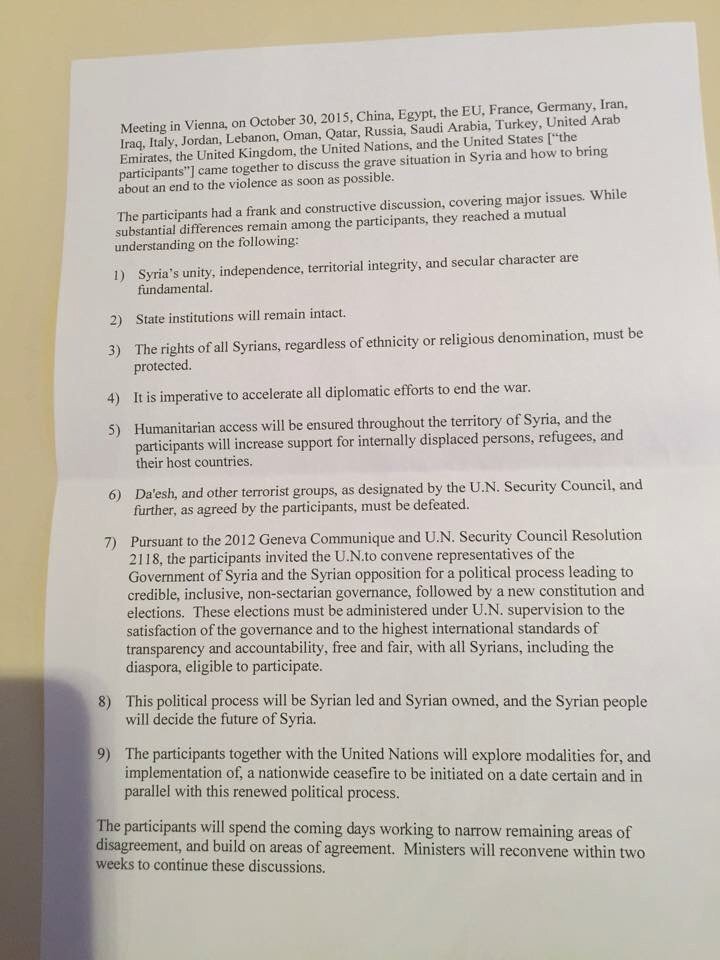
Vienna meeting participants: Russia, the US, Saudi Arabia, Turkey, Iraq, Italy, Egypt, Great Britain, Germany, Lebanon, Qatar, Iran, France, China, the UAE, Jordan, Oman, the EU and the UN.

Seven hours in the shark tank, although some reports say it lasted eight hours. Then there was the joint press conference afterward and probably a dinner. I'll bet they practically had to practically carry Lavrov and Kerry back to their hotel rooms when that very long day was finally ended. Herding sharks is exhausting work.  
       
Did the October 30 meeting really make headway on resolving the crisis in Syria? Yes. There is a beautiful photograph of Kerry holding aloft the joint statement at the end of the meeting that says it all. However, the press reports didn't explain the import of what happened.   

What happened is that through sheer dint of effort, Sergey Lavrov and John Kerry got all the foreign governments instigating in Syria to sign a statement committing themselves to defeating Islamic State and all other terrorist groups in Syria.

If you ask, Isn't the USA one of the instigators? -- why yes, but that's part of the triumph. If you want an idea of what Kerry was up against: just moments before he went into the meeting someone at State or the White House informed him that the White House was about to announce to the world that the U.S. was sending Special Forces into Syria.  

In other words, he went into the meeting with certain knowledge that his efforts were being sabotaged by his own employer -- not the first time this has happened. The other time had to do with his efforts with Lavrov to defuse the crisis in Ukraine; Victoria Nuland at State went over Kerry's head and poured more fuel on the flames in Kiev, despite the fact that he is the Secretary of State.   

But by gum, a joint declaration was got together at the Syria summit, and Kerry signed it on behalf of the government of the United States of America. 

The next day -- yesterday -- Kerry announced that the deployment of U.S. forces to Syria was not against the Syrian government. From Sputnik:
Secretary of State John Kerry said that President Obama is sending US special forces to Syria to help take down Islamic State (ISIL) militants, not to overthrow the government of Syrian President Bashar Assad, RIA Novosti reported.
Meanwhile, over in Bahrain, Deputy Secretary of State Antony Blinken was announcing a pledge of $100 million to "civil" groups in Syria: From the Associated Press:
Funds will support local and provincial councils, civil society activists, emergency services and other needs.
Pardon AP's cynicism but their headline flatly states the money is going to groups opposing the present administration in Syria.  

So is the triumph in Vienna hollow? Once all the ink was dry on the joint statement, the instigators had as much pledged in writing to stop using terrorist groups in their proxy wars in Syria. That won't stop all the instigators, not at this moment. But from here onward they must execute fancy and fancier steps to avoid getting caught red-handed. That is indeed a triumph.

Remember what's been going on in Syria is a hallmark of standard late-twentieth century warfare that carried over into this one: the supplanting of outright invasion of a country for invasion by proxy war and instigation. The joint statement to emerge from the Vienna summit was the opening move in a struggle to bring this kind of warfare to an end -- a struggle clearly articulated by Russian President Vladimir Putin during his address at the United Nations.    

Helping Putin make his point, and helping Kerry and Lavrov at the summit, is the hard lesson taught by Islamic State. All instigators now understand that in this era nonstate actors can quickly become as powerful as governments. And that they can do it more easily when they ride on the back of proxy wars.    
        
There were other, smaller, triumphs at the summit, which of course wasn't called a summit so as not to give Russia too much weight. The flags of all the countries represented at the summit were flanked by an American flag on each end of the flag lineup, meaning it was an American-led summit or er, "multilateral meeting."  

(If someone at the Kremlin complained about this to Lavrov, I'm sure he would have said that if the Americans wanted 10 U.S. flags flanking the other flags to give them 10, and that the idea was to move forward.)      

And there was hard work during the summit to establish a framework for moving forward. To show how busy everyone was, only cheese danishes were available along with the coffee. This, in the pastry capital of the world. But it's hard to eat a chocolate strawberry whipped cream confection without using a fork and full concentration, else risk filling and flaky dough landing on your chin and tie. You can eat a cheese danish with one hand and keep scribbling with the other. 

There could be more frameworking next week, if a report is correct that Syrian government officials and leaders of Syrian opposition groups are scheduled to attend a meeting in Vienna on Monday. See also McClatchy's insightful October 30 report asking why no Syrians were invited to the summit. 

Russia's government has been reaching out like mad to opposition groups during the past month, and with approval from Syria's government (although the unicorn still hasn't been found; i.e., commanders of the Free Syrian Army), and talking every day with Kurdish reps and whatever shows up calling itself a Syrian opposition group. 

There is even an odd story of a Nusra Front rep(s) showing up, offering to help Syria's Army fight Islamic State. This brought a snort that Qaeda, Inc., seeing which way the wind was blowing in Syria, is trying to jockey for a seat at the table.

(All that news from various Sputnik reports during the past week.)    

The next big meeting in Vienna about the Syria crisis is to occur in about two weeks but side meetings, which started October 23, will be ongoing until then.      
Granted, some points in the joint statement smack of yet more attempts to inch toward totalitarian world government. But given that Russia is standing there saying no, no, no, I don't think we need lose sleep over whether the International Community will be running the show in the country. And it was crucial to get all the players, including the U.N., to agree on a framework.         
   
Vienna talks: 19 global powers to work to establish nationwide Syria ceasefire
Published time: 30 Oct, 2015 17:30; Edited time: 30 Oct, 2015 18:35
RT

Russian Ministry of Foreign Affairs 
Joint statement adopted on the results of multilateral meeting on Syria


The 19 global and regional powers who have gathered in Vienna have agreed to work towards setting up a nationwide ceasefire in Syria, according to the joint statement.

Still, terrorists must not be given a chance to seize power in the country, Russian FM Sergey Lavrov said during a press conference, adding that this understanding is shared by all 19 parties attending the talks.

The truce is not going to be applicable to Islamic State extremists and other terrorists, Lavrov said. A comprehensive list of terror groups operating in Syria will be defined during a separate meeting.

Participants of the Vienna talks agreed on the necessity to work on a new constitution in Syria and to hold elections that should be administered by the UN, Lavrov said. State institutions are to remain intact.

Meanwhile, the truce is to be followed by the formation of a transitional government. Earlier reports said that the ceasefire should be achieved within four to six months, but the Russian FM did not confirm the timetable.

The UN is calling for all the countries that have influence on the Syrian government and opposition to try and put them at a negotiating table, the United Nations' special envoy for Syria, Staffan de Mistura said.

Humanitarian organizations should be given access to all territories in Syria, participants of the talks pointed out. [Wishful thinking at this point because it would mean no-fly zones everywhere. And Blue Helmuts to guard the NGOs because the Syrian Army is a little busy these days.]

Should Assad go?

The fate of Bashar Assad remained a stumbling block throughout the seven hour meeting.

The US and its allies including Saudi Arabia believe that the Syrian president, whose term expires in 2021, must resign. There is "no way Assad can unite and govern Syria," US Secretary of State John Kerry said.

The two countries do not demand the immediate resignation as a precondition for peace process anymore, saying Assad can stay in power for months during the period of transition, but insist he must step down when it draws to a close.

At the same time, Russia's Lavrov again stressed that it is up to the Syrian people to make such decisions.

"The Syrian people should define the future of their country including Assad's fate," Russia's FM added.

As the meeting in Vienna wrapped up it remained unclear how a truce and the transitional period are going to be implemented, how long the latter will last, and whether the parties in the Syrian conflict are ready to accept it - as neither Damascus nor the opposition took part in the negotiations. The next round of Vienna talks is scheduled to take place in two weeks.


[END REPORT]

********