Translate

Thursday, November 8

Paradise evacuated as California's Camp fire closes in (UPDATED 6:25, 6:55. 7:35, 8:50 , 9:00 pm ET, 11/9 - 4:32 AM ET)

UPDATE 4:32 AM ET,  11/9
Paradise is gone. 

UPDATE 9:00 PM ET
From SFGate report published 5:45 PT [8:45 PM ET]:

[The fire started at 6:30 AM PT and within three hours went from 10 acres to 5,000 and then to 18,000 and counting.] 

[...]


Evacuation efforts were “difficult, to say the least,” said Lt. Al Smith of the Butte County Sheriff’s Office, noting that several deputies who ventured into evacuation zones to rescue residents also became trapped by flames burning around them. “I can’t think of an area that’s safe right now.”
[...]
Firefighters spent the morning trying to evacuate trapped Paradise residents while creating firebreaks within the town and even moving some people to empty parking lots.
“In the past few years, just the way fires have moved, firefighters have had to help with evacuations before they can go back in to put out the fire,” said Lynne Tolmachoff, a spokeswoman with the state Department of Forestry and Fire Protection, or Cal Fire.

[...]
UPDATE 8:50 PM ET
My notes from a 4:40 PM PT [7:40 PM ET] Los Angeles Times report on the Camp fire:
  • Paradise is a retirement community
  • The sudden fire created chaos.
  • Fire is fueled by dry and windy weather conditions, which are expected to continue into Friday evening. [Friday morning, from the latest update at Chico Enterprise-Record posted at 5:57 PM PT.]
  • "Multiple evacuation centers [for Paradise evacuees] were opened in churches and on fairgrounds in nearby towns."
  • "Thousands of motorists spilled onto local roadways, following recently redesigned evacuation routes intended to make it easier for them to escape. Yet many wound up sitting in gridlock."
  • The fire is burning in areas that are difficult for firefighters to reach.
  • Unconfirmed reports of fatalities.

UPDATE 7:35 PM ET
Updates from Chico Enterprise-Record continue; the last one was 4:28 PM PT
Dignity Health spokesman Mike Mangas reports that Feather River Hospital in Paradise has been destroyed by fire, according to information from John Lord, the associate director of the Sierra-Sacramento Valley Emergency Medical Services Agency [...]
UPDATE 6:55 PM ET
From 3:40 PT update Chico Enterprise-Record
Twitter users are saying smoke from the Camp Fire has reached San Francisco and other Bay Area cities. Photos show the smoke beginning to obscure the Golden Gate Bridge.
UPDATE 6:25 PM
Good grief. The fire is now covering 18,00 acres; it was 8,000 a couple hours ago. I've just added more updates from the Chico Enterprise-Record report, below. This situation is getting more serious by the minute. From the Sputnik report, resources are spread thin -- "resources" meaning help with evacuations.  One problem with evacuation is simply gridlock; vehicles leaving the town are end-to-end. The following photo was taken earlier in the day, and even then traffic was heavy. At least one roadway had to be blocked off because of the fire.   
END UPDATE

Don Thompson/Associated Press

Camp Fire E/SE of Chico at 10:43 AM PT


Photo by Chico resident Eric Kiesow via Chico Enterprise-Record

Talk about a metaphor. But this is California, where fire season is now year round.  27,000 people in the town of Paradise had to evacuate because a wildfire in Butte County, officially (and confusingly) named the Camp Fire, exploded into a fast-moving conflagration. Photos/video of the onrushing fire are apocalyptic. I took the one above from Sputnik, which also posts videos of evacuees trying to outpace the fire in their vehicles with varying degrees of success; some Paradise evacuees have had to abandon their vehicles and flee on foot. But so far no deaths that I know about although there have been scores of 'injuries.' 

Below are the latest updates and first report on the fire from a local paper (AP and the San Francisco Chronicle, which Sputnik quoted, are also closely watching the fire.) But first some background from Sputnik's summary of other reports:

A raging wildfire in Northern California has forced the 27,000 residents of the city of Paradise to flee. Dramatic footage shows flames closing in around the highways out of town and thick smoke hanging in the sky, obscuring the horizon.
Butte County Sheriff Kory Honea called it a "very dangerous and serious situation," AP reports, and noted that some residents have been forced to abandon their vehicles to escape the conflagration.
[...]
Paradise sits in the foothills of the Sierra Nevada mountain range, near the larger town of Chico and about 75 miles north of the state capital of Sacramento. However, on Thursday the place is very far from paradise: a rapidly growing wildfire encompassing 6,000 acres [at last count 8,000 acres] is closing in on the town, forcing its residents to drop everything and evacuate, the San Francisco Chronicle reported.
[...]
​Cal Fire, the state's agency responsible for managing the region's chronic wildfires, reported that the blaze has been dubbed the "Camp Fire," a humorously serendipitous name that comes from its place of origin: the area of Camp Creek Road and Pulga Road near Highway 70 in the Feather River Canyon, to the east of town. At least one young resident was confused by the name.
[...]
​Honea says resources are spread thin, but officials are "doing everything we can to get people out of the affected areas."

Combined staff reports
Published 9:50 a.m. PT Nov. 8, 2018 | Updated 1:50 p.m. PT [4:50 p.m. ET] [Last updated 3:40 PM]
Chico Enterprise-Record

[see site for video and 26 photos]
UPDATE: 3:40 p.m.
Twitter users are saying smoke from the Camp Fire has reached San Francisco and other Bay Area cities.
Photos show the smoke beginning to obscure the Golden Gate Bridge.
A north wind is blowing the smoke south from Paradise.
UPDATE: 3:30 p.m.
A woman who evacuated due to the Camp Fire told The Associated Press that people abandoned their vehicles to flee the blaze and held babies and pets as they escaped.
Gina Oviedo said there were flames everywhere as she got out of Paradise.

Oviedo described a devastating scene, saying homes were engulfed in flames and utility poles were crashing down. She said people left their vehicles and ran when they started hearing explosions.

UPDATE: 3:07 p.m.
A spokeswoman for the Adventist Health Feather River Hospital in Paradise told The Associated Press that 20 patients had to go back to the facility after evacuating because of gridlocked traffic.
Hospital spokeswoman Jill Kinney said clinics and other outbuildings were on fire or had been damaged, but the main hospital was untouched.
At least 27,000 people in Paradise have been ordered to flee.
UPDATE: 3 p.m.
Acting California Gov. Gavin Newsom has declared a state of emergency due to the Camp Fire, according to The Associated Press.
Newsom issued the declaration for Butte County as the fast-moving fire continues to burn around the town of Paradise, about 15 miles from Chico.
Newsom is filling in as governor while Gov. Jerry Brown is out of the state.
UPDATE: 2:58 p.m.
Enloe Medical Center in Chico reports that the number of patients who have been transferred to Enloe from Adventist Health Feather River in Paradise has risen to 35, said Natali Munoz-Moore, Enloe’s digital media specialist. She did not have information on their conditions.
UPDATE: 2:45 p.m.
150 people are huddled in a commercial building in Paradise, hoping for rescue, according to a tweet by Chico Enterprise-Record Editor David Little.
UPDATE: 2:37 p.m.
The fire is now 18,000 acres, Cal Fire is reporting. 
UPDATE, 2:35 p.m.
A new evacuation order has been called for the Nimshew Road area. 
UPDATE, 2:25 p.m.

Evacuee Sherri Pritchard said a neighbor told her that her yard was on fire, so she's certain her house is gone by now. 
UPDATE: 1:50 p.m.
New evacuations are being ordered in the lower Clark and lower Skyway areas, the Butte County Sheriff's Office announced this afternoon. 
Meanwhile, the Redding Police Department announced it was sending eight officers to help handle the Camp Fire. 
UPDATE, 1:45 p.m.
Tyler Holmer and his family were hanging out in the Chico mall's parking lot today after evacuating from their Paradise home. 
Holmer said he got up this morning to go to school and saw flames on a ridge in the distance.
Then the Camp Fire grew out of control. 
"The whole other side was on fire when we woke up this morning," Holmer said. "The sky was orange and raining ash."
UPDATE: 1:20 p.m.
The fire is now 8,000 acres, according to the California Department of Forestry and Fire Protection. 
UPDATE, 1:17 p.m.
Enloe Medical Center in Chico had received 24 patients as of 10:57 a.m. on Thursday. Those patients had been transferred from Adventist Health Feather River in Paradise, said Natali Munoz-Moore, Enloe’s digital media specialist. She did not have information on the condition of the patients, or their injuries.

Other hospitals have offered to assist Enloe, she said, “but we not actively seeking it out.”
A note on the Adventist Health Feather River website says: “Our thoughts and prayers go out to everyone in our community during this challenging time. Due to the current Camp Fire, Adventist Health Feather River is closed. All patients have been safely evacuated and transported to Oroville Hospital or Enloe Medical Center.”
UPDATE, 1:10 p.m.
Highway 99 is now closed as far north as Corning in Tehama County, Caltrans announced on Twitter. The newest closure starts at 99 and South Avenue. 
UPDATE, 12:40 p.m.
Highway 99 in the area of the fire is now closed, Caltrans announced on Twitter this afternoon. The closure is from the junction of Highway 32 to Highway 149. 
UPDATE, 11:55 a.m.
Minutes after their previous evacuation order, the Butte County Sheriff's Office has issued even more evacuations, this time for those living near Highway 70 and Concow Road on both sides of the road, including all of Yankee Hill. 
UPDATE, 11:50 a.m.
The Butte County Sheriff's Office has ordered new evacuations from the intersection of Pentz Road and Highway 70 south to Highway 149.
[...]

Tuesday, November 6

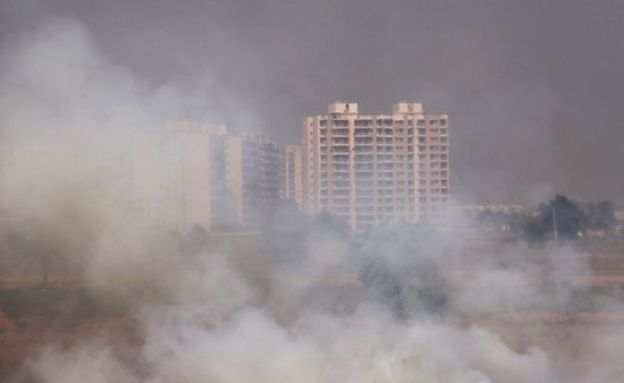
How India's agro-ecological crisis turns Delhi into a "gas chamber" every autumn

The Green Revolution's dark side. From this:


To this:

There are particular reasons why India's capital city is extremely vulnerable, and for that part of the story you can read Siddharth Singh's November 2 article for Quartz India, How Delhi’s location makes its pollution crisis worse. Singh, who is quoted in the following BBC report, is the author of the forthcoming book The Great Smog of India. 

Delhi smog: Foul air came from India's farming revolution
By Soutik Biswas, India Correspondent
October 23, 2018
BBC


Farmers burn crop residue because the stubble left behind after the combine harvesters have done their job is sharper and taller than it otherwise would be, potentially injurious to farmers and not good fodder for animals. If they do not remove the stubble, straw gets stuck in the machines that plant the rice crop.

[...]

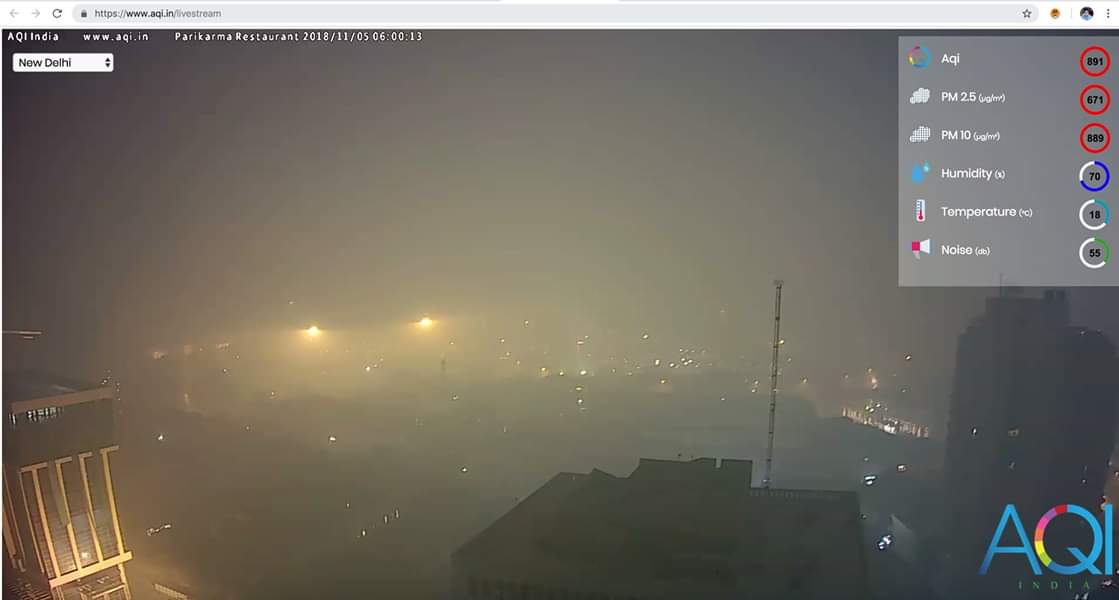
Every year, around this time, residents of Delhi wake up to a blanket of thick, grey smog. Pollution levels reach several times the World Health Organisation's recommended limit. Last year, doctors declared a state of "medical emergency"; and hospitals were clogged with wheezing men, women and children.

Levels of tiny particulate matter (known as PM 2.5) that enter deep into the lungs reached as high as 700 micrograms per cubic metre in some areas. The WHO recommends that the PM2.5 levels should not be more than 25 micrograms per cubic metre on average in 24 hours.

Last winter Air Quality Index (AQI) recordings consistently hit the maximum of 999; exposure to such toxic air is akin to smoking more than two packs of cigarettes a day. The city becomes what many call a "gas chamber".

"This marks the beginning of the Great Smog that goes on to last for about three months, even though the crop residue burning lasts a few weeks. It is during this period that air quality indices hit their maximum possible limits, when visibility drops drastically, when regions even far away - such as Delhi - smell of burning gas," says Siddharth Singh, energy expert and author of a book soon to be published, The Great Smog of India.

And although there are other reasons -- construction dust, factory and vehicular emissions -- it's mainly crop residue that has emerged as one of the main triggers for the smog.

More than two million farmers burn 23 million tonnes of crop residue on some 80,000 sq km of farmland in northern India every winter.

The stubble smoke is a lethal cocktail of particulate matter, carbon dioxide, nitrogen dioxide and sulphur dioxide. Using satellite data, Harvard University researchers estimated that nearly half of Delhi's air pollution between 2012 and 2016 was due to stubble burning.

Another study attributed more than 40,000 premature deaths in 2011 to air pollution arising from crop residue burning alone.

But it wasn't always like this.

In Mr Singh's telling, the deadly pea-souper is result of the "evolution of the farming operations, government policy and changing labour markets" sparked by the "green revolution" in India in the late 1960s and 1970s.

The "green revolution" allowed a country wracked by famines, hobbled by unirrigated farms and dependency on food aid to produce enough grain to feed its people. The northern states of Punjab and Haryana turned into breadbaskets, producing enough rice and wheat for the country. Wheat is sown and harvested during winters, and rice to coincide with the monsoon season in July and August.

Price support for crops, high-yielding seeds, expanded irrigation, official farming timetables and the introduction of combine harvesters, which combined the jobs of cutting and threshing the crop in order to produce processed grain in a matter of seconds, were the catalysts of this modern farming revolution.

The "green revolution" was an unqualified success in giving India much-needed food security. It led to vast increases in wheat and rice production, but also ended up polluting air and depleting groundwater.

"That a revolution in agriculture was necessary is by itself not up for debate. What the revolution and the subsequent policies did, however, was contribute to the creation and timing of the air pollution crisis and also to the rapidly depleting groundwater levels; this has been termed as an 'agro-ecological' crisis," says Mr Singh.

Farmers burn crop residue because the stubble left behind after the combine harvesters have done their job is sharper and taller than it otherwise would be, potentially injurious to farmers and not good fodder for animals. If they do not remove the stubble, straw gets stuck in the machines that plant the rice crop.

So they simply set fire to the farmland to get the soil ready quickly for the next crop, as Mr Sharma saw on the highway to Delhi.

According to Siddharth Singh, there are some 26,000 combine harvesters in use in India, most of them in northern India. They are responsible for a practice that is now a major contributor to air pollution.

The government has tried to solve this with "happy seeders", which are attachments mounted on tractors that help plant wheat seeds without getting jammed by rice straw stubble from the previous crop. But they are expensive -- upwards of 130,000 rupees (£1,363; $1,769) and diesel-guzzlers -- and remain out of reach for most farmers, who own small plots of land.

During the smog season last year, according to Mr Singh, there were about 2,150 of these machines in Punjab and Haryana as against an estimated requirement of more than 21,000. Another machine called the "super straw management system" which chops and spreads the stubble evenly is also effective but expensive for the majority of farmers.

Mr Singh reckons if crop stubble burning is to be stopped fully within five years, 12,000 "happy seeders" will need to be purchased every year. India, he believes, needs a second "green revolution which would be a technological one - one that adequately deals with agricultural shock to air quality". 


Until that happens, Delhi's foul air will continue to poison its 18 million people.

[END REPORT]


See also: Delhi panic over toxic air ahead of Indian festival Diwali; November 5, BBC

"Delhi panic over toxic air ahead of Indian festival Diwali"

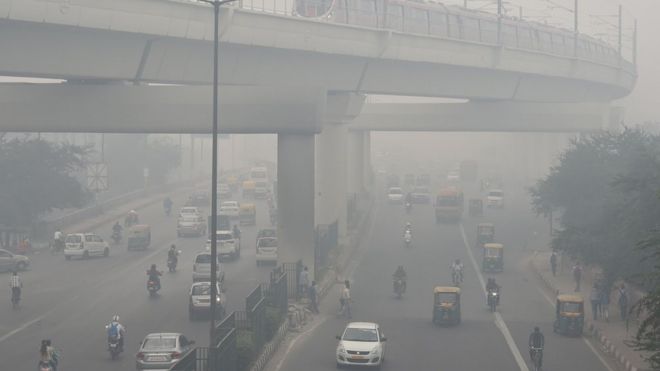
The five-day Hindu festival of lights, Diwali (Sanskrit: Deepavali, "row of lamps"), with the climax on the third night, started this year in India on November 5. It's supposed to be a time for introspection, a time to ponder the triumph of light over darkness, of good over evil. But here is what Connaught Place in Delhi looked like as the first day of Diwali dawned:


Another view of Delhi as the morning sky lightened:


Although experts blamed at least some of the smoky air on Diwali firecracker-lighters getting a head start, a resident of New Delhi tweeted archly:
Haven’t heard a single firecracker in Delhi, yet the air purifiers are blazing red - showing dangerous levels of pollution.
And to pound home the point showing a photo of her air purifier going full blast:


Here is the Beeb's report, from which I snatched the photos:

Panic gripped the Indian capital Delhi on Monday as residents woke up to a blanket of thick grey smog ahead of Diwali, the festival of lights.
Visibility is poor as pollution levels reached 20 times the World Health Organisation's recommended limit. 

[See the BBC website for a reporter's experience as he drove to work on Monday.]
The air quality is expected to worsen in the coming days due to the use of firecrackers, experts have warned. 

[Pundita note: While firecracker smoke doesn't help, the biggest driver of the worsening air index is due to farmers burning rice plant stubble.]   
Indian cities regularly dominate global pollution rankings for the worst air quality.
The Supreme Court has restricted the timeframe for setting off firecrackers to only two hours during the day - but experts believe this curfew will be hard to implement.
However in the last few years, celebrations have seen air pollution rise to hazardous levels after many firecrackers were set off.
Many have taken to social media to share their concerns as well as post dramatic photos of the city to show the extent of the problem.
[See BBC website for several photos]
On Sunday, the pollution level in the city dipped and was categorised as "poor". But a sharp spike in smog on Monday morning - which recorded a reading of 365 on the Air Quality Index (AQI) - has effectively put the city's air in the "hazardous" category.
Authorities in Delhi have warned residents to stay indoors as much as possible and have started to shut down construction activity in the city.
[...]

The Indian capital is the sixth worst place in the world for pollution, according to World Health Organisation (WHO) data.
Air quality in the city worsens every year in November and December as farmers in the neighbouring states of Punjab and Haryana burn crop stubble to clear their fields.
The Graded Response Action Plan (GRAP), an emergency government initiative to try and improve conditions, has also launched around Delhi. It bans activities like rubbish burning to try and improve air quality.
[END REPORT]
And from a report updated today from Pakistan's Dawn.
[...] Authorities warn that crop residue burning will peak in the next few days. [...] The Supreme Court last month allowed the use of “green” firecrackers for Diwali to try to curb pollution, but it was unclear how the rule would be enforced or whether there was such a thing as an environmentally safe firework.[...]

Sunday, November 4

Some news reports I won't find time to write about

But at least I can share the headlines, under alphabetically listed country and issues titles, although there are some that could go under both; e.g., Turkey's huge Kanal project, which is predicted to touch off environmental and social disasters. 

Most of the news reports on the list are from October, and there are about four opinion pieces. I've added my one-liner comments to a few items on the list and snatched up 'priceless' illustrations that were published with three of the articles.    

Afghanistan 

Taliban and Al Qaeda prepare to take over Afghanistan
October 23, 2018 
Long War Journal report for John Batchelor Show (audio)

World Bank Pledges $298 Million For Afghanistan’s Education
October 23, 2918 - TOLONews

Project to exploit Afghanistan’s giant copper deposit languishes
April 25, 2018 - China Dialogue

I can't resist adding these two old articles:

Obama’s Failed Legacy in Afghanistan
February 2016 - The American Interest

December 2009 - Council on Foreign Relations

China - Canada

Vancouver, Canada is drowning in Chinese money
October 20, 2018 - Bloomberg

China - Japan

October 25, 2018 - BBC
Investigative report on China's 'vocational education' camps for Uighurs shows some things haven't changed in China since Mao's rule

Denmark


Proposed Legislation: 12 Years in Prison For Danes Holding Pro-Russia Views

October 13, 2018 - SouthFront
The European branch of the 'Get Russia' crowd in overdrive. 


Diplomacy

October 12, 2018 - Associated Press
Explainer for people who think Khashoggi was killed in Turkey on Saudi territory.

Baghdad rejects US interference in its affairs after embassy Twitter comments
November 4, 2018 - Middle East Eye

Syria could face tough sanctions if it blocks political process: U.S. diplomat
September 28, 2018 - Reuters
" ...and then we will make it our business to make life as miserable as possible for that flopping cadaver of a regime and let the Russians and Iranians, who made this mess, get out of it.”

Dogs
August 2016 - HuffPost
"If you have a dog, you probably already suspected this."

Health/Environment/Natural Resources

October 26, 2018 - CNBC
Are American children so clean their immune systems are weak?

October 22, 2018 - CNN

Russian Scientists Discover Bacteria That Neutralizes Nuclear Waste
October 8, 2018 - Sputnik

October 18, 2018 - WDSU6 News (USA)
Thousands of pounds of wipes clog municipal sewer system(s)

October 17, 2018 - NY Daily News

March 28, 2018 - National Geographic
"The ambitious Canal (Kanal) Istanbul project could displace thousands of people, imperil the city’s tenuous water supply, and impact ocean life, critics say."

October 12, 2018 - Reuters

Honduras

October 18, 2018 - Al Jazeera

Ireland

October 27. 2018 - Reuters
And let's not forget this Reuters report from July 2017:
Drought-hit Rome narrowly avoids water rationing, 
which also reports the capital city's water pipes leak 40 percent of the water they carry. 

Mexico

Can President-elect Lopez Obrador pull Mexico out of slumber?
October 6, 2018 - RT op-ed
Some interesting statistics.


September 18, 2018 - Pew Research

As unusual drought hits eastern Nepal, farmers migrate to get by
October 9, 2018 - Reuters

Somalia
October 15, 2018
Long War Journal report for the John Batchelor Show (audio)
U.S. military in Somalia

Agriculture Remains Key to Somalia’s Economic Growth and Poverty Reduction
March 28, 2018 - World Bank
February 7, 2018 - Sputnik
February 13, 2018 - Sputnik

France: Under Macron, We Don't Talk of Islamist Radicalization, but It's There - Scholar
October 13, 2018 - Sputnik

Syria

Syria's remote Rukban camp receives first UN aid convoy since January
November 3, 2018 - Middle East Eye
"UN estimates that 80 percent of people stranded at Rukban are women and children"

Syria war: Afrin looted by Turkish-backed rebels
March 19, 2018 - BBC


Northern Syria: Ankara-Backed Militants Looting Afrin Dam Equipment
August 25, 2018 - MSN

October 28, 2018 - Sputnik

USA

Who’s really ‘undermining’ US democracy? asks Stephen Cohen
November 2, 2018 - RT
America's 'Get Russia' crowd outsmarts itself.

October 24, 2018 - Capital Research Center

Trump says selling weapons to Saudi Arabia will create a lot of American jobs. That’s not true.
October 22, 2018 - Vox
"The impact of foreign arms sales on the US economy is minuscule"

Hard Times at Snowflake U
October 14, 2018 - PJ Media
This one's a keeper.
Snowflake definition (slang): an emotionally hypersensitive person. In America several universities have set up 'safe' rooms for such students, where they can drink hot cocoa, crayon coloring books, etc., whenever they become upset by something.  


Yemen

Friday, November 2

Honduras: From Banana Republic to Remittances Republic to Failed State

After Hurricane Mitch wrecked the banana plantations the Honduran government decided it could make a mint by making Honduras a Coffee Republic. Daniel R. Reichman, today Associate Professor, Chair of Anthropology at University of Rochester (U.S.), chronicled what happened next. In so doing he also chronicled the whistle stops on the Honduran branch of the express train to disaster in his prophetic book, The Broken Village: Coffee, Migration, and Globalization in Honduras (Cornell University Press, 2011).

In 2013 he used excerpts from the book for an article at the Migration Policy Institute, ominously titled Honduras: The Perils of Remittance Dependence and Clandestine Migration. "Ominous" because by 2013 nothing much had changed since 2011 beyond the size of various statistics. Even by 2011 it was clear the country was on track for disaster.

Nobody listened to Professor Reichman -- at least nobody in a position with the will and power to stop a runaway train. Governments, the United Nations, development banks, the International Financial Community -- of them had gone gaga for remittances. Why, with a virtually borderless world in the age of globalization, people from the poorer countries were going to work in richer countries and send a big chunk of their earnings home. And then -- and then, the world was going to see a Golden Age, with the poorer countries righting themselves through remittances receipts.

In December 2015 the World Bank burbled that international migrant labor and the remittances that went with it were at an all-time high -- remittances dwarfing the amount of foreign aid to all countries combined. The Bank updated their good news earlier this year, reporting Record high remittances to low- and middle-income countries in 2017 with Honduras coming in at number 10 on the list of countries most dependent on remittances (19% of Honduran GDP).

No word yet from the World Bank on the Honduran migrant caravans. 


However, the rise of industrialized remittances is a symptom, not the cause, of the Honduran disaster. Underneath all the Honduran government's failed policies is the inexorable extinction of the country's indigenous societies. The same is happening in many nations. 

In case after case these societies have been going under because they aren't self-sufficient in food production. They aren't self-sufficient because they never modernized subsistence farming or never knew how to do genuine subsistence farming when they switched from hunting-gathering to farming.

Solve that problem and apply the solution and you've prevented civilization from crashing; as a bonus you've saved indigenous societies. Oh but that's right; somebody already did solve the problem. It was Thailand's King Bhumibol Adulyadej. Beep this is a recording. 

The means now exist to modernize subsistence farming to the point where the small-scale farmer can be fully self-sufficient in food production, and without making it a choice between subsistence and commercial farming. The modern era runs on money, so farmers do need to raise enough produce to sell. And yet the key is one of timing. First establish the firm base of food self-sufficiency, then establish a network with other self-sufficient farmers to branch into commercial enterprises.  

The person who worked all this out and successfully applied it was King Bhumibol. And he did it without turning his back on the modern era. To save Thailand's rural peoples and help them preserve their way of life, his majesty deployed all manner of modern technologies (and his own inventions) to modernize subsistence farming. This allowed the thousands of Thai farming villages that adopted his 'New Theory' of agriculture to become remarkably self-sufficient. 

The villages did need help from government in certain respects; e.g., the building of dams and reservoirs to bring water to small ponds that are the centerpiece of New Theory farms, at least for Thai weather patterns and how this affects the staple crop of rice. But essentially New Theory farmers can raise enough produce/livestock to be completely self-sufficient in food for themselves and their families. 

And as I've explained before, his majesty figured out how to do this with less than six acres of land to work with -- six acres being the average size of a small-scale farming plot in Thailand, but which must also hold the farmer's home and buildings for livestock.

Of course a natural disaster along the lines of Hurricane Mitch would require villagers getting outside help, but NT farms are built to bounce back quickly from natural disasters.   

In short, small-scale farmers have to stop the self-defeating practice of trying to raise enough commercial crops to be able to afford to buy enough food to feed themselves and their families. 

From Daniel Reisman's 2013 article:
The rise of Honduran migration to the United States in the past two decades is evidence of the inability of Cold War-era development policies to bring about meaningful reform and economic stability in Honduras. After decades of agrarian reform, state-led development programs, and billions of dollars of foreign aid spent on international development schemes, remitted wages from people working in the United States have become the most important source of income for many rural communities.
Before they work for income, they might try putting the horse before the cart and work for food self-sufficiency. After all, they've already tried everything else. 

********