Translate

Tuesday, August 9

Pakistan's military command concerned about Karachi riots, week-long peace in city holds due to strong paramilitary presence

"The government launched a peace drive and sent hundreds of extra security forces into the troubled neighbourhoods, and calm has held for a week. The military said recent government measures were expected to “help redress the situation." -- The Nation


141st Corps Commanders’ Conference, Rawalpindi, August 8, 2011

Photo: AFP

"The commanders were so worried about the economic implications of the situation in Karachi that a large part of their deliberations unusually focussed on the economic situation in the country."

August 9, 2011:
Commanders back govt efforts to quell Karachi violence
By Baqir Sajjad Syed
Dawn

ISLAMABAD: While the army command on Monday appeared worried about the continuing wave of violence in the country’s commercial and financial hub that has so far claimed over 800 lives, it decided to stay out of the Karachi imbroglio and instead backed the government’s efforts for bringing back peace.

The Corps Commanders Conference, which is the military’s principal decision making forum, was presided over by Army chief Gen Ashfaq Parvez Kayani.

“The forum expressed concern over the law and order situation in Karachi and its ramifications/implications for the national economy and expected that the measures recently undertaken by the government would help redress the situation,” a press statement by the army’s public affairs wing, ISPR, said.

It was for the first time during the current cycle of violence that the military publicly expressed its concerns over the law and order situation and at the same time turned down calls by political parties involved in the conflict for its intervention.

The rare army statement on the situation in Karachi came after about 350 people were killed in July and the Karachi Stock Exchange, which is billed as the barometer of the country’s financial health, dipped to a four-month low last week, losing 6.7 per cent of its value.

The KSE loss was much sharper than the downturn in most of the other Asian markets following a cut in US rating by Standard and Poor’s. Besides, the panic offloading of shares in the KSE because of political, ethnic and sectarian strife had started even before the other Asian markets’ knee-jerk reaction to the developments in the US.

The commanders were so worried about the economic implications of the situation in Karachi that a large part of their deliberations unusually focussed on the economic situation in the country.

Both MQM and ANP, who blame each other for the violence, have asked for army deployment in the city for restoring peace.

The military fears that if the turmoil continues it could throw the country’s already troubled economy into a deeper crisis.

A source familiar with the proceedings of the conference said the army command believed that the Karachi issue “is essentially a political problem” and that it was the government’s responsibility to develop a consensus on possible ways for ending the wave of violence that had gripped the city.

The government has deployed additional police and paramilitary forces in the city and President Asif Ali Zardari last week held talks with the MQM, inviting them to rejoin the government.

Later, the government in a major concession to the MQM agreed to abolish the commissioner system it had restored in the first week of last month to address the law and order situation in the city and revive district governments.

The government is also pushing for ‘de-weaponisation’ of the city.

The military, the source said, wanted to give the government’s initiative a chance.

Although the army would not be actively launching an operation against the groups involved in violence, it is said that intelligence outfits under its control would enhance support for the civilian law-enforcement agencies’ operations against them.

“We’ll make all resources available to the civilian LEAs,” army spokesman Maj-Gen Ather Abbas said, adding that economic security of the country was an important pillar of national security and no effort would be spared to preserve it.
To return to the Nation report:
The independent Human Rights Commission of Pakistan (HRCP) says 800 people, most of them poor, have died since January, including 300 last month alone. The HCRP says the violence in Karachi is the deadliest since 1995, when more than 900 killings were reported in the first half of the year.

The HRCP previously said 490 people were killed in the first six months of the year and on Friday that another 300 people died in July. Much of the violence has been blamed on tensions between supporters of the Muttahida Qaumi Movement (MQM) and the Awami National Party (ANP).

The government launched a peace drive and sent hundreds of extra security forces into the troubled neighbourhoods, and calm has held for a week. The military said recent government measures were expected to “help redress the situation”.

The violence has also affected economic activities in Karachi, the country’’s largest city. Several political parties, including the MQM and ANP, have urged the army to conduct operations in Karachi to end the violence.

Accusations and counter-accusations have continued between the leaders of the MQM and those of the ANP in particular and MQM and Pakistan Peoples Party (PPP) in general. In the recent past, some MQM leaders held the rulers of the PPP in Sindh and at centre responsible for fuelling riots in Karachi. But on August 3, Prime Minister Syed Yousuf Raza Gilani dispelled the impression that government wanted to create differences among various segments.

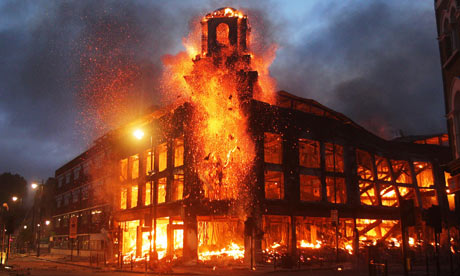
London riots spread to other cities in England on Mon and Tues, rioters coordinating looting and attacks on police via mobile phones and Twitter

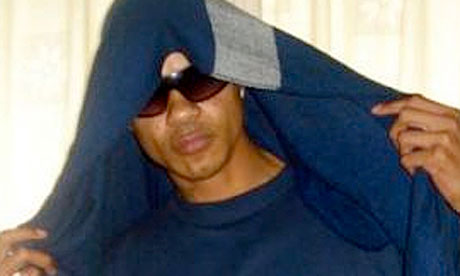
The late Mr Duggan, taxi driver and alleged drug dealer, whose shooting death by police sparked a protest that morphed into the London riots. "He is survived by his fiancée Semone Wilson with whom he had four children (one of whom was a stillborn) and by a child from another relationship."


See also August 8 Guardian report about handgun that Mark Duggan was carrying at the time he was shot. "Ballistics tests on weapon found with dead man in Tottenham indicate firearm had been changed to use live ammunition."

BBC Graphic

"It looks like a war zone - I have never seen anything like it in all my life” -- Christian Potts, Ealing resident

"But eyewitnesses reported as trouble spread across the city, there were often few police officers around when violence flared."

Both quotes from BBC report, below.

From the Guardian's latest report on the rioting -- August 9; no time stamp:
[...] In a bid to contain the trouble, Scotland Yard introduced special powers in four areas – Lambeth, Haringey, Enfield and Waltham Forest, allowing stop and search without reasonable suspicion. The section 60 powers were invoked at midnight on Sunday. One incident of stop and search in Hackney was reportedly the catalyst for violence which erupted in Mare Street shortly after 4pm, and saw local hooded youths battle police.

The Guardian understands senior officers are prepared to add more areas to the list. The special powers have been perceived as targeting certain ethnic groups, thus fuelling tensions.

Meanwhile, the maker of the BlackBerry smartphones, Research in Motion, said it would co-operate with a police investigation into claims its popular BlackBerry Messenger service played a key role in organising the London riots.

Brixton bore the brunt of Sunday's violence. The Lambeth council leader, Steve Reed, said: "We are asking the mayor's office for additional police for tonight and the next few nights."

Condemning the "copycat activity", he said: "Somebody described it as gangs of kids doing Supermarket Sweep. It was Curry's where they were after plasma screen TVs, and H&M and Foot Locker where it was clothes and trainers. It wasn't about social issues, it was an opportunity to go on the rob."
[...]
Glad you could cut short your vacation, Boris

From the Guardian's live blogging on the riots:
5.42pm BST, August 8: The Press Association news agency is reporting that Boris Johnson, the mayor of London, is to return to the capital tomorrow to deal with the growing crisis in the capital.
You might have gotten tennis elbow, anyhow, Mr Prime Minister, if you'd continued with your tennis lessons in Tuscany

"David Cameron broke off his holiday in Italy on Monday to fly home. He was due to chair a meeting of Cobra, the government's crisis committee, at 9 a.m. to work out a strategy to prevent more violence and consider why the riots broke out and spread so fast, taking the authorities by surprise." -- Quote from the following Reuters report via MSNBC, updated around 11:00 PM ET, August 8:
[...] Despite a heavy presence on some streets, police appeared unable to contain the violence as rioters who had initially coordinated through mobile phones and Twitter became increasingly confident.

Monday's looting began long before nightfall when workers were returning home, many of them forced to walk as buses to areas hit by rioting were canceled.
[...]
From BBC report last updated at 11:30 PM ET, August 8:
Rioting has spread across London on a third night of violence, with unrest flaring up in other English cities.

An extra 1,700 police officers were deployed in London, where shops were looted and buildings were set alight.

Birmingham, Liverpool, Manchester and Bristol also experienced disturbance.

The prime minister is returning early from holiday to discuss the unrest, which first flared on Saturday after a peaceful protest in Tottenham over the fatal shooting of a man by police.
[...]
At least 334 people have been arrested and 69 charged following the riots across London over the past three days, Scotland Yard said.

Nine police forces from other parts of the country were assisting in providing support, as well as the City of London Police and British Transport Police.
[...]
Monday's violence started in Hackney after a man was stopped and searched by police but nothing was found.

The trouble spread outside London on Monday evening and early on Tuesday, with police in riot gear being deployed in Birmingham city centre after scores of youths rampaged through the shopping area, smashing windows and looting from shops.

West Midlands Police also confirmed that a police station in Holyhead Road in Handsworth, Birmingham, was on fire.

In Birmingham, police said officers had made 100 arrests.

There were reports of cars being damaged in Manchester and of up to 200 youths with masks roaming through Toxteth in Liverpool.

Merseyside police said they were dealing with a number of incidents in south Liverpool, including cars being set alight.

Police in Bristol said they were dealing with outbreaks of disorder involving about 150 people.

Meanwhile in London:

> Several fires broke out in Croydon, including one at a large sofa factory which spread to neighbouring buildings and tram lines

> In Hackney 200 riot officers with dogs and mounted police were located around Mare Street where police cars were damaged

> Looters raided a Debenhams store and a row of shops in Lavender Hill in Clapham, as well as shops in Stratford High Street

> A Sony warehouse in Solar Way, Enfield, a shopping centre in Woolwich New Road, a timber yard in Plashet Grove, East Ham and a building on Lavender Hill were all on fire

> More than 100 people looted a Tesco store in Bethnal Green, the Met said, and two officers were injured

> Cars were set on fire in Lewisham

> A bus and shop were set alight in Peckham

> Buses were diverted as the violence spread to Bromley High Street

> There were reports of looting of phone shops in Woolwich High Street, in south London, and a torched police car

> Shops and restaurants were damaged in Ealing, west London, and there was a fire in Haven Green park opposite Ealing Broadway Tube

> Football matches at Charlton and West Ham which were due to be played on Tuesday have been postponed at the request of the police

> At Clapham Junction looters stole masks from a fancy dress store to hide their identity

The fresh violence prompted Mr Godwin to call on parents to contact their children and urge the public to clear London's streets.

In the first outbreak of violence on Monday, groups of people began attacking the police in Hackney at about 16:20 BST, throwing rocks and a bin at officers.

Police cars were smashed by youths armed with wooden poles and metal bars.

Looters also smashed their way into shops, including a JD Sports store, before being dispersed by police.

Catherine Holmes, a resident in Hackney, said: "The common feeling in Hackney Central is that our community has been hurt and damaged by causeless violence."

[Report continues with additional eyewitness descriptions of looting/violence]

Met Deputy Assistant Commissioner Stephen Kavanagh said there were "significant resources" on the streets, with a third more officers on duty than on Sunday.

He said: "When we have large numbers of criminals intent on that type of violence, we can only do that, get lots of officers there quickly and try to protect local businesses and local people."

But eyewitnesses reported as trouble spread across the city, there were often few police officers around when violence flared.
Just after midnight (Eastern Time) today the Beeb published a roundup/review of U.K. news headlines and photos about the rioters.

Monday, August 8

London Rioters: "These guys had nice cars, nice mobiles."


Photo: Lewis Whyld/PA

Not everyone's buying the 'social deprivation' meme to explain the widespread arson and looting. From the Guardian's August 8 report, published 21.37 BST: London riots: MPs to examine 'toxic mix' that led to violence:
Nick de Bois, the Tory MP for Enfield North who witnessed the disturbances in his constituency on Sunday night, said the violence could not be blamed on social deprivation. De Bois said: "When police dispersed groups, they [the rioters] ran up the neighbouring residential streets, did a bit of terrifying of residents. But what angered everyone was they jumped into their nice Golf GTIs and tore off round the corner, parked somewhere else, came back and did some damage, and loaded their cars up with whatever they could loot. It wasn't a question of social justice. These guys had nice cars, nice mobiles."
A Labor MP disagrees:
One veteran Labour MP, who sits on the home affairs select committee, warned that a "toxic mix" of poor policing of black and minority ethnic communities and social deprivation was a key factor in fuelling the violence.
But I think both sides of the debate can agree on this much:
The weekend's riots and looting may have serious repercussions on long-term efforts to regenerate some of London's struggling high streets, business leaders have warned.

As businesses begin to tally the cost of stolen goods and damaged stores the British Retail Consortium (BRC) has warned many of the shops affected may never reopen, while other firms may rethink their investment plans for areas such as Tottenham and Wood Green.

Stella Creasy, Labour MP for Walthamstow, which was affected by widespread looting of the one store in the area.

"Tesco were up and running by Monday morning – you can see the damage but they're determined to keep trading," she said. "It's difficult to tell what the longer-term situation is because last night was so unusual. The looting was coordinated and organised. This is a type of organised crime we've never seen before. Businesses are angry as their property has been damaged, but people seem calmer today."

Lord Harris of Peckham, owner of the Carpetright chain, an outlet of which was burned down in Saturday's Tottenham riots, told an interviewer: "It has damaged my business but big companies can withstand it. It's the little entrepreneurs, people who have greengrocers and clothes shops I really do feel sorry for. Who is going to shop there now?"

This view was echoed by the BRC, which said rioters had defeated any hoped-for objective. "In the short term this is bad for the locals who work in or rely on the services of the businesses that have been affected," said spokesman Richard Dodd. "Longer term, a proportion of these stores were struggling already. They will have to look at their future in the area – many will reopen but some won't, which will harm the areas' prospects."
The question is what their hoped-for objective was, beyond smash and grab.

*********

Friday, August 5

The lengthening shadow in Pakistan


Karachi, one of the world's megacities


Odd, isn't it, how nothing ever changes until it does. Take Cuba: the peasants were always staging their little rebellions and the army always put them down and Fulgencio Batista always remained in power. That's the way things were in Cuba because, well, nothing ever changed there. Then one day everything changed. [snapping her fingers] And just like that, Batista was gone.

It was only later, when it finally sank in that Cuba had changed, that people could look back and see there had been a lengthening shadow, the signs and portents warning that a change was coming.

You're 20 years old, your baby son has died of dehydration from dysentery, your wife is ill, you're unemployed and after two months of looking you still can't find work. There's no money, no food, and now there's no water, and even if you had the money to pay the gouge price the water mafia charges for water that's supposed to be free, now the electrical blackouts in Karachi mean that even the mafia has a hard time siphoning off water. The city has become hell, with armed robbers roving everywhere and gangs of refugees from the flooding in Sindh fighting with other gangs. You pass by a shop that has a television and see images of thousands of young men, men very much like yourself, massed in a place called Tahrir Square in Egypt; they're demanding the country's leader step down and they're protesting police brutality. A few days later you hear to your amazement that the leader has stepped down, that the head of the national police is under arrest.....

August 4, 2011, Business Standard (India):
Meanwhile, the Pakistani press is full of reports on how its economy is nose-diving. The overall budget deficit stands at 6.5 per cent of the GDP against a revised target of 4.7 per cent, and in the wake of the US cancelling $800 million worth of aid to Pakistan, officials in Islamabad are nervously wondering if they want to ask the IMF to revive its suspended bailout programme. Under the circumstances, Islamabad’s purported rejection of buying electricity from India, ostensibly because the power project is in Kashmir, would amount to cutting its nose to spite its face.
From the rest of the report it's not clear whether Pakistan has actually rejected the offer as yet. And in 2006 Pakistan's leaders similarly dragged their feet about accepting an offer from Iran to sell the country electricity at a subsidized rate. But the Business Standard report makes clear that Pakistan's Keepers of the Faith -- those Old Guard military men and civil servants who since the country's inception have defined the country's reason for existence to be 'destroy India' -- are playing political games about Kashmir with India's offer to sell electricity. This, despite the fact that Indian Kashmiris don't want Pakistan meddling in their affairs, as the recent election uproar in Kashmir made clear.

Pakistani pundit Mohammad Taqi did a good job the other day of sending up Pakistan's blinkered Old Guard, but there's not much room for levity when one studies Pakistan's electricity crisis and how it's playing into the cycle of violence in Karachi, which prompted the government on Tuesday to deploy paramilitary units in the city. The routine electrical blackouts, for up to 10 hours a day, have worsened the water-supply crisis in the city and added to the jobless crisis there. And all three crises exacerbate the violence in the poorer neighborhoods of the city, where most of the bloodshed has occurred. But unlike, say, the murderous feuds that erupted between drug gangs in Chicago's poorer neighborhoods a few years ago, the violence in Karachi frequently shuts down the city, which is the country's business hub. So the violence is greatly hampering Pakistan's attempts to attract foreign direct investment, which it needs if it's to pull out of its economic slump.

From that viewpoint Pakistan's leaders shouldn't look a gift horse in the mouth if India's offering to sell them electricity on an expedited basis. I understand the leaders are boxed in by the Old Guard's longstanding policy on Indian Kashmir, but if they think they can let Pakistan's electrical crises continue for years more, why, they're as blind as Batista was. And so are those in Washington who support the Old Guard.

Washington is looking in the wrong directions in Pakistan, as it did in Cuba, as it did in Iran, as it did in Egypt and so many other places. That's because Washington is always looking for verification of its assumptions. It needs to look for signs arising outside its assumptions; only from such effort can the outline of a lengthening shadow be intuited.

TWO SIGNS

August 26, 2010:
Crush of Refugees Inflames Karachi
By Tom Wright,
The Wall Street Journal

KARACHI, Pakistan - Hundreds of thousands of refugees from Pakistan's devastating floods are seeking shelter in this city of 18 million, exacerbating ethnic strife that has already escalated this year ... The local administration says it is expecting and can cope with up to one million of the refugees. But many others who have made it to Karachi say they are being turned away from shelters on the outskirts and are pouring in to the city, deepening ethnic rivalries with Karachi's majority ethnic community that have simmered for years. ... For Karachi's dominant group, the Urdu-speaking Muhajirs, the influx of Sindhi refugees poses a threat to the established order.

"If they come in hundreds of thousands, how will they survive?" says Khawaja Izhar ul Hassan, a member of the provincial assembly from the Muttahida Qaumi Movement, or MQM, which is largely a Muhajir political party and forms part of Sindh province's ruling coalition government. ...
I'm being unfair to Christian Parenti, the author of the next report I'm featuring here, because I'm omitting much of the first part of his discussion, which focuses on his interest in climate change and its connection to social unrest. Mr Parenti sees the massive flooding in Sindh last year as an example of how climate change is causing massive dislocations in human populations; the first part of his report reflects that view. I've omitted that part for two reasons:

First, even if one assumes for the sake of argument that the weather conditions leading to the flooding were the result of climate change, the destructiveness of the flooding in Sindh was greatly due to human negligence, not the climate. That part of Pakistan is flood prone, which is why the British built an extensive and effective flood management system in the region. The system was allowed to fall into disrepair after Pakistan became an independent nation and no attempt was made to modernize flood management principles. (Parenti's discussion does touch on the issue although I've omitted it here.)

Secondly, it's the major portion of Parenti's investigative work that I find to be vital information -- the best window the general public has on a social upheaval in Pakistan that was touched off the 2010 flooding, but which is rooted in an essentially feudal society coming up against a 'third tier' of urbanization in a developing country.

(In first-tier ubanization the city is a commercial and/or governing hub. In second-tier urbanization large numbers of rural peoples arrive to reside and look for work in the hub as its commerce/government workforce expands. If the wave or waves of arrivals are sudden, driven by catastrophe(s) in the rural regions, this creates third-tier urbanization, which has a refugee or 'displaced persons' component.)

I hope you'll read Parenti's report in its entirety at the Agence Global website (see below); here I've provided enough of it to show that the options provided to the poor by rapid urbanization in Pakistan, which is symbolized by the megacity of Karachi, are now presenting a challenge to the country's ruling class (including the military) that it might not be able to deflect.

June 30, 2011:
Pakistan One Year After the Floods
by Christian Parenti
The Nation (U.S. publication) via Agence Global

Funding for this article was provided by the Dorothea Lange-Paul Taylor Documentary Prize from The Center for Documentary Studies at Duke University. Christian Parenti is a contributing editor for The Nation and visiting scholar at the CUNY Graduate Center. He is the author of Tropic of Chaos: Climate Change and the New Geography of Violence (Nation Books, June 2011).

KARACHI -- A hot, gritty wind carries the stench of pit latrines across a refugee camp on the western outskirts of Karachi, on Pakistan’s southern-facing coast. In the sky, vultures and eagles circle. At its peak, this camp held 1,400 families, all poor farmers displaced by the Indus floods of 2010, which inundated an area the size of England and affected more than 20 million people.

Before the massive floods of 2010 -- the worst in memory -- much of central and southern Asia was suffering through a brutal ten-year drought, during which crops did poorly and farmers sank ever deeper into debt. Pakistan is considered one of the most arid countries in the world and one of the most water-stressed. The flood was just the latest bit of extreme weather.
[...]
In rural Sindh, the floodwaters have finally receded, but the old problems have not. It is time to plant new crops, but in many refugee camps there are people refusing to go back to the land. At the windswept camp outside Karachi only half the residents have gone home. Aid agencies are cutting off relief, and the government is telling people to leave. Yet many refugees are stubbornly staying put.

“We will die here before we go back to those landlords,” says Mehboob Ali, the camp spokesman.

He and his neighbors seem to mean it. The day before I visited, the camp’s incipient social organization, the Mutasereen ("affected people") Action Committee, marched demanding the right to stay and build houses. Police met the marchers with volleys of tear gas and a baton charge. [...]

Why would desperately poor flood victims fight to stay in a dust-choked tent camp on the outskirts of a violent mega-city rather than go back to their homes?

The answer lies in the horrible exploitation and humiliation that is everyday life for most people in rural Pakistan. In Sindh, the traditional landlords are called zamindars and their tenant farmers are haris. Since independence and partition, in 1947, various Pakistani leaders have attempted land reform, but little has ever been achieved. And so, today the zamindars still own vast tracks of land on which their serflike haris live and work.

Several hundred miles north of Karachi on the edge of Sukkur, where old British-built barrages regulate the flow of the Indus, I found another camp of displaced people who don’t want to move. These people could also be described as escapees from feudalism. The camp lacks a school, a clinic, even basic sanitation, and aid is being cut off. But the remaining residents are finding ways to fit themselves into the local labor market: young men work on construction sites and in granaries and warehouses. Women go to the kachcha -- the wild area along the river -- where they pay armed men for the right to cut wood for resale to restaurants in Sukkur city.

“We don’t want to go back because the landlord will double our debt,” says Hassan Khoso. “We want the government to give us land.” He goes on, “Some poor tenant farmers ran off in the first week of the flood, before the water could even reach their district.”

Such was their desire to flee. Khoso, who’s from near Jacobabad, owed 50,000 rupees (about $560) last year but fears the debt will be 100,000 if he returns. He lost a rice crop worth 30,000 rupees, two water buffalo and two goats. He says that landlords have been coming to the camp urging the haris to return. Khoso and others say that is part of what keeps them close to the city. Along with work, there is access to hospitals and the promise -- at least the promise -- of education for their children.

As at the camp on the western edge of Karachi, these people have formed a camp committee. To make their demands heard they marched to the local press club and held a sit-in. And how are such calls for reform and development being met by officials?
Dead silence.

The floods inundated an area the size of England, destroyed almost 5 million acres of crops, killed about 1,750 people and left 10 million homeless. Rebuilding is expected to take three to five years. Despite the scale of the damage, the discourse around reconstruction involves very little if any public discussion of how things can be improved; ideas like social justice, land reform, climate adaptation or climate justice are missing. Local left parties are marginalized and hounded by landlord thugs.

The reason for this is simple: landlords have too much power. They control the sale of seed and fertilizer, set the prices of crops, rig local elections, imprison in private jails those who oppose them, use village schools to stable their cattle and generally have their own way regarding the people. Their influence on the government is pervasive at all levels.

There has been no pressure for change coming from the US government, which has given Pakistan $18 billion in assistance and payments since 2002. Nor has any [pressure] come from the international NGOs and the UN -- both of which run large aid and development programs here.

When I interviewed a spokeswoman for the UN World Food Program, so diligently did she tiptoe around the sensibilities of the Pakistani government that she refused even to use the word “corruption.”

Oxfam, on the other hand, has launched an investigation into “financial irregularities” within its own flood-relief work.

And so, the haris are bereft of allies or champions. If they want justice they’ll have to get it on their own. But in flood-ravaged Sindh the zamindars have a different plan: they want their haris back.

At the camp on the outskirts of Karachi one landlord from Baluchistan came with five armed guards, threatening to take away several brothers from a family named Bux. All the brothers were in debt to the landlord; he threatened to lock them in his private jail if they did not return and start working. But the camp rallied and faced him down.

All through the Indus flood zone I heard similar stories: landless haris in urban camps preferring to become day laborers rather than return to debt peonage in the districts and landlords complaining that relief aid was keeping the haris away from their obligations.

Standing on an earthen levee along a canal in the village of Arazi in the Dadu district of northern Sindh, a stout landlord named Kahari Bhutto exclaimed, “The farmworkers -- their homes were wiped out, and they are gone. I don’t know where they are. Landowners themselves are having to do the work!”

As the floodwaters receded, Bhutto, like most farmers, threw down a late emergency crop of wheat. Fortunately, the flood had deposited a rejuvenating layer of nutritionally rich river silt, and the emergency wheat crop across Sindh has been very robust, so too some fast-growing sunflowers given out by USAID.

Measures like these have helped offset the damage of the flood. To harvest cotton, says Bhutto, he would normally hire ten to fifteen people, through sharecropping arrangements. But this year he hired only three, and his brother and father also worked. And now, instead of paying 250 rupees per day for labor, he has to pay 500.

When I check at a nearby tent camp full of people who had come from Baluchistan, refugees working as day laborers confirmed that labor prices have indeed gone up. But as one, Mir Mumtaz, explained, the people are in a bind: they do not want to go back to Baluchistan and face their old landlords, nor do they want to enter into sharecropping agreements here in Sindh. “We are afraid of just going into debt again.”

To be clear: although displacement is an escape from debt, it has also meant impoverishment. Khairam Hatar, an older, educated and rather distinguished-looking widow, explained, “I do embroidering here in Dadu town. Before, I had a sewing machine and was able to make money on my own. But I lost that during the flood.” Her sporadic income is a fraction of what it was when she was self-employed in Baluchistan.

Farther up the river in Shikarpur, I meet Mohammad Arif Khan Mahar. A prominent landlord, he was a local politician, and his brother is a member of the provincial parliament. Khan Mahar hosts my traveling companions and me in his attock -- a combination guesthouse/meeting hall away from the family house. In the wide courtyard several neem trees shed their blossoms, which a young male servant sweeps up. Around the courtyard are the bedrooms and several plush meeting rooms. The attock halls are decorated with photographic portraits and decorative swords.

The zamindar has many complaints: the government is corrupt -- “Our officials mismanaged everything. There’s no accountability for state officials, no planning, no organization whatsoever.” The workforce is illiterate -- “Frequently, the labor is useless if the tasks are complex and involve machinery.”

He says that indeed many indebted haris “have run away from their responsibilities.” And though he notes rising tension and criminal violence, he says, “Here, there is no insurgency yet.”

The next day we tour his lands by SUV, accompanied by two armed guards. When the SUV stops and the zamindar steps out to survey the damage, his haris drop their tasks and crowd around him, crouching and bowing as they approach to shake his hand. The thin, sinewy, sun-beaten haris, splattered with mud and straw from brick-making and home-rebuilding contrast sharply with the tall, rotund, relatively pale landlord. Except for the SUV, the guns and the sunglasses, this could be a scene from medieval times.

The rage this inequality creates simmers, then boils over. When Benazir Bhutto was assassinated in December 2007, much of rural Sindh exploded in riots that had a decidedly class angle: when the flames died down, thirty-four gas stations, eighteen rail stations, hundreds of private cars and shops, and 176 banks had been looted and burned. Just north of here in Punjab some of the haris are gravitating toward a new Punjabi Taliban, which, in rhetoric at least, invoke issues of class exploitation and call for land reform.

What does my host think of land reform? “The government should first give away unused land. Rather than coming after the productive farms just to make a political show.”

In many ways Khan Mahar is progressive, adopting new technologies and, according to his workers, paying much better than most landlords. But he is still a feudal landlord with luxury and power, and wants to keep his vast holdings and the indebted haris who live there. He need not worry: there is no discussion of land reform and no chance it will be attempted.

When I ask about relief in the area, he waves away the question: “They’ve had enough relief!”

During the first weeks of flooding, relief went relatively smoothly. International aid agencies brought supplies, and the military pulled trucks, planes and helicopters out of Kashmir and the war zones of the Federal Administered Tribal Areas to move supplies to stranded populations. But once the emergency was over, the endemic problems of government corruption and the fetters of landlord influence on politics returned. According to Transparency International’s 2010 ranking, only thirty-three nations are more corrupt than Pakistan.

“NGOs hire locals to have some accountability and traction,” says Qadeer Ansari, a manager with the General Services Department of Dadu district, where 60 to 70 percent of houses were damaged.

“But who are these locals? Very often they are just the same old influential people, landlords and their representatives. Nepotism, patronage and corruption shape how relief and reconstruction operate. And often food is simply stolen and sold.”

* * *
[...]
Is there a plan for repairing and managing the increasingly extreme hydrological patterns of the Indus River? Talking with the head of IT, I notice how few computers he has for his department.

“Well,” says the clerk sheepishly, “we really just use these computers as typewriters. Just to print out documents and then pass them around in hard copy.” As we are talking, a messenger is collecting a fourth signature and stamp on a document.

This system -- in which every little petty potentate in every department has to sign off on every document -- is designed to facilitate a culture of bribery. When real planning or technical work is needed, the government outsources these “special projects” to development experts at the World Bank or private firms. As a result, the capacity of the Pakistani state remains malformed and stunted.

Again, the roots of this problem go back to the power of the rural elites. The zamindars systematically crush those who oppose them, preventing the creation of good governance and a literate population because it would undermine their power.
[...]
For more on Pakistan's electricity-shortage crisis, see The Nation's (Pakistan) July 28, 2011 report, No let-up in Karachiites’ sufferings, and Wikipedia's article, Electricity Sector in Pakistan ("Contrary to Pakistani government and expatriate claims, Pakistan suffers from a massive electricity shortage.")

Thursday, August 4

Pakistan maybe sort of extends MFN trading status to India

I direct your attention to the closing paragraphs in the following report -- the ones about Pakistan's economy and India's offer to sell electricity to the country -- because they'll lead off my next post, which is about the Old Guard's blindness to the lengthening shadow stalking their regime.
Pak to give India MFN status
by Jyoti Malhotra
August 04, 2011, Business Standard (India)

Pakistan has, in principle, agreed to give India Most Favoured Nation (MFN) status, a basic international trading procedure that has been languishing on the margins for the last two decades, but which will now allow both countries to conduct normal trade with each other.

The trade concession is likely to see the day when Pakistan commerce minister Makhdoom Amin Fahim comes to Delhi for talks with his Indian counterpart Anand Sharma in September. A letter from Sharma inviting Fahim to Delhi was carried by India’s high commissioner to Pakistan, Sharad Sabharwal, when he returned to Islamabad last week after the conclusion of the foreign minister-level talks between SM Krishna and Hina Rabbani Khar.

Perhaps it was the stardust that Khar threw in the eyes of the media during her visit to Delhi, which caused both sides to miss the seminal reference to MFN status hidden deep inside the joint statement, issued at the conclusion of the bilateral conversation.

The Indian and Pakistani media seemed so overcome by the designer memorabilia adorning Khar — Roberto Cavalli sunshades, Birkin bag and South Sea/Mikimoto pearls — that it failed to comprehend the fundamental nature of the shift that seems to be taking inside Pakistan today.

Clause number 12 of the joint statement, then, refers to both ministers agreeing that an increase in trade and economic engagement between the two countries would be mutually beneficial.

It then goes on to add: “In this context, (they) emphasised the early establishment of a non-discriminatory trade regime between the two countries, including reduction/removal of tariff and non-tariff barriers.”

According to highly placed government sources, this “non-discriminatory trade regime” is really an alias for MFN status, only Pakistan will never use that phrase.

Interestingly, Delhi hardly seems to mind. The breakthrough, in fact, came in April when Commerce secretary Rahul Khullar travelled to Islamabad to talk to his counterpart Zafar Mahmood.

Punjabi happened to be a common language between the two men, and even between large parts of the two delegations, but according to one source who was present, “it was the fundamental change taking place inside Pakistan that was the most important thing to behold.”

Both Commerce secretaries agreed that they would take this “non-discriminatory regime” idea forward when Zafar Mahmood came to Delhi for talks around November. In the meantime, Delhi got cracking with conducting a study on the impact of the so-called “positive list” that exists between India and Pakistan, about 1,938 items, and what would happen if this list were to be substantially scrapped.

In the Prime Minister’s Office, too, the idea that trade and commerce should be used as the bait to draw the neighbourhood closer gradually began to take hold. While Bangladesh has been a perfect example of that policy, the difference between Pakistan and Bangladesh is that Dhaka currently has an India-friendly government in place.

Last week’s foreign minister-level talks saw India unveil this gambit. The focus was on trade across the Line of Control, in deference to what the people of Kashmir would want. And since Pakistan had been obsessed with “Kashmir” since 1947, how could it possibly refuse cross-LoC measures that India was proposing?

Then there was the reference to increased trade across the international border at Wagah-Attari. The foundation of this enhanced trade had been laid during the Khullar-Mahmood talks in April. Both sides had, at the time, agreed that an integrated check-post should come up sooner than later at Wagah-Attari, enabling more trucks to be parked there.

But with Sharma now having invited his counterpart to come to Delhi in September, official sources said they expected the talks to speed up.

Meanwhile, the Commerce ministry’s study on reducing the “positive list” of items that can be traded between India and Pakistan, seems to have also come to the conclusion that India, as the much larger economy, can easily absorb the consequent opening-up to Pakistan.

It is believed that the 1,938 items can be pruned to about 200 items. Meaning, save for these items on the list, trade between India and Paksitan will be free.

However, earlier in July, word came from Islambad requesting Delhi to postpone the working group meetings on electricity and petroleum, that were to take place at about the exact time that Khar and S M Krishna were meeting on July 27. The working groups were supposed to go into modalities of how India could sell electricity and petroleum to Pakistan, thereby enhancing the integration between the two economies.

In the meantime, Pakistan’s newspaper ‘Dawn’ reported that Pakistan had already decided to turn down the Indian offer to sell electricity because the power would reportedly come from the Kishenganga hydroelectric project in Kashmir, which Pakistan had already taken to the international court for arbitration.

“India has massive electricity shortages but they want to sell some power to Pakistan. This will strengthen their claims in the court that they are producing cheap electricity and sharing the gains with Pakistan,” an official from Pakistan’s ministry of water resources was quoted by Dawn as saying.

Meanwhile, the Pakistani press is full of reports on how its economy is nose-diving. The overall budget deficit stands at 6.5 per cent of the GDP against a revised target of 4.7 per cent, and in the wake of the US cancelling $800 million worth of aid to Pakistan, officials in Islamabad are nervously wondering if they want to ask the IMF to revive its suspended bailout programme.

Under the circumstances, Islamabad’s purported rejection of buying electricity from India, ostensibly because the power project is in Kashmir, would amount to cutting its nose to spite its face.

However, Commerce ministry officials would not comment on the media report. “We have not heard anything about any rejection. We are continuing with our work on the basis that the working groups will soon meet again.”

Perhaps the visit of Makhdoom Amin Fahim in September will clear the air on this front.

A fine bit of withering sarcasm from a Pakistani pundit about the country's military establishment


From Dr Mohammad Taqi's August 4 op-ed for Pakistan's Daily Times, Pakistan’s foreign policy: grandeur of delusions — I —:
[...]
Following the [U.S.] arrest of Dr Ghulam Nabi Fai, the US-based lobbyist who headed the Kashmir American Council (KAC) and has been accused of being an ISI agent, things are not exactly a cakewalk for the Pakistani diplomats in Washington, DC.
[...]
What is really fascinating is the coterie of retired brigadiers and ambassadors, many having served at obscure stations, writing about the Pak-US relationship, especially in the context of Afghanistan. Their writings echo the Pakistani security establishment’s thought process and mysteriously precede the rolling out of the latter’s plans and the so-called ‘massive operations’ against the militants.

Brigadier (retd) Shaukat Qadir, who is the former president of the Islamabad Policy Research Institute, writes: “Policy formulation is a complicated business and foreign policy is perhaps the most difficult of all policies to flesh out since it involves relations with other countries, each of which have their own policies.”

Now who would have guessed that foreign policy might entail dealing with, well, foreign countries, which may actually be really diverse!

The fact of the matter is that those peddling ‘innovative’ ideas like above, or their cohorts, were at the helm in the military and civil establishment when the misadventures like Ghulam Nabi Fai were being planned and executed.

FBI Special Agent Sarah Linden’s affidavit in Dr Fai’s case makes an interesting read. The code words allegedly used by Dr Fai and his military handlers (who have been named in the document), such as requesting "half a dozen Brylcreem," meaning $60,000, are cheesier than a B-movie.

But more pathetic is the fact that the sleuths hatched a stupid conspiracy to do something, which if legitimate, could have been done legally. In fact, the US Department of Justice had written to Dr Fai in March 2010 to register under the Foreign Agents Registration Act (FARA) if he was acting as an agent of Pakistan. He categorically denied any connection to Pakistan at the time and did not register under the FARA.

But just as a few in the Pakistani-American community were getting ready to rally for his defence, Dr Fai apparently admitted last week to have received money from the ISI. The retired ‘grandmasters’ had got it wrong then and are bound to fumble again!

As the recent events in Turkey have shown, the praetorian control over the domestic and foreign affairs of a nation is untenable and incompatible with the changing geopolitical situation.

Turkey’s ‘zero problem’ foreign policy aimed at harmonious relations with its neighbours as well as regional and international actors, democratic changes tipping the domestic power balance against military and withering of the national security state paradigm, culminated in consolidation of the civilian control there.

In democracies, civilian control over the military is inevitable; Turkey was not an exception and neither is Pakistan. Just as war is too serious a matter to entrust to military men, foreign policy is a concept largely foreign to the military planners — the constellation of geopolitical events suggests that they will have to cede this domain.
I've cherry-picked my favorite parts but the whole thing is worth the read.

Monday, August 1

Pundita's Vacation Diary


OLD PUNDITA PROVERB: HE WHO PLACATE TIGER BY FEEDING IT HIS FINGER SOON MISSING HIS HEAD
July 31: China officially offers squadron of J-10 fighter jets to Pakistan

August 1: China announces Pakistan-trained militants behind terrorist attack in China

Meanwhile, General Pasha, the globe-trotting head of Pakistan's ISI, is off to Beijing in the attempt to make a widely-advertised secret deal with China's leaders.

BEST EVER TITLE FOR A BLOG POST
Nathan Hodge's May 2009 Mullen Pinky-Swears: We Don’t Bankroll Pakistan’s Nukes

FUNNIEST FOLLOW-UP TO HODGE'S POST
Mullen's comments reported on July 26, 2011 about U.S.-Pakistan military relationship. From Mullen's last presser before retiring as JCS chairman.

BIGGEST FREUDIAN SLIP THIS YEAR BY A NEWS ORGANIZATIONFrom July 26 AFP report headlined US military chief nominee says to press Pakistan:
General Martin Dempsey, answering questions from senators at his confirmation hearing [to replace Mullen as JSC chairman], said that he would urge Pakistan not to eliminate the safe haven enjoyed by militants in its lawless areas bordering Afghanistan.
STRONGEST TEETH IN THE NEWS WORLD
The Gray Lady chewed through her muzzle in record time then banged out a July 24 report titled Pakistan Spies on Its Diaspora, Spreading Fear.

SLOWEST INQUIRY IN WASHINGTON
The U.S. Senate-led Commission on Wartime Contracting in Iraq and Afghanistan took three years ('We kept running out of yellow legal-size tablets and No. 10 pencils') to determine that the American contractors and U.S. Department of Defense have been subsidizing the Taliban.

SECOND SLOWEST
An as-yet unreleased Pentagon-led investigation took a year ('We kept having trouble with the PowerPoint slide projector'). From Washington Post report U.S. trucking funds reach Taliban:
The unreleased investigation provides seemingly definitive evidence that corruption puts U.S. transportation money into enemy hands, a finding consistent with previous inquiries carried out by Congress, other federal agencies and the military. Yet U.S. and Afghan efforts to address the problem have been slow and ineffective, and all eight of the trucking firms involved in the work remain on U.S. payroll. In March, the Pentagon extended the contract for six months.
UH OH. HILLARY CLINTON CHASING GRAY LADY AROUND MANHATTAN WITH A NET AND TASER
July 28: Times Editorial Board falls in line with State Department's message on Pakistan which can be summed as 'Yes of course they're wicked but we have no other option but to put up with them.'

WHO SEZ US GOV CAN'T HANDLE PAKISTAN'S MILITARY?
From July 30 ABC News report CIA Chief in Pakistan Exits; Led OBL Hunt Team
"Pakistan has been harassing U.S. personnel working in the country for months," complained a U.S. official. Pakistan even threatened to impose more formal restrictions on the travel of all U.S. diplomats and require prior notification, but dropped the demand when the U.S. threatened similar restrictions for its diplomats inside the United States, according to one U.S. official.
So for all you 12 year-olds out there, the U.S. government has always had plenty of options that don't require an armed invasion to settle Pakistani military's hash.

As to why the options are rarely deployed, go ask the head of NATO or MI6 oh but that's right I forgot they won't tell you. So go ask Hamid Karzai, but you'd need to get him while he's so furious at NATO he doesn't care that blurting out the truth could shorten his life span. Come to think of it, this might be a good time to ask him.

NEWS THAT'S ALMOST FIT TO PRINT FROM WHITEHALL
July 31: Afghan civilians pay lethal price for new policy on air strikes.

The UN statistics might be inflated but that wouldn't overturn the major news in the report, which was probably leaked by a bunch of renegades in Britain's MoD who have something called 'a conscience.' I'll bet it's the same bunch that leaked the news in 2006 that Pakistan's ISI was behind the Taliban attacks on NATO troops. Tony Blair forced them to backpedal in their public statements but they got out the word.

Monday, July 25

Note

The next post will be on Monday August 1.

Best regards to all,
Pundita

Thursday, July 21

Where there's a will....

Washington's defense/foreign relations policies as seen from outer space

It's amazing what people can do when they set their minds to it. Take the insoluble problem of U.S. dependency on Pakistan for shipping NATO supplies to Afghanistan. Well, I don't know about "NATO" but by the end of this year about 75 percent of supplies for US troops will be shipped to Afghanistan by other routes, and I've seen one estimate that by December zero supplies will be trucked through Pakistan.

Now just see what can happen when the American public starts screaming and yelling, 'Whaddya mean we have to keep tolerating Pakistan's military plotting murder and mayhem against U.S. forces because we need to ship stuff through Pakistan?'

Another demonstration of how creativity blossoms when the will is there to get smart:

Changing the flow of downrange water
New purifiers eliminating need for bottle shipments

By Geoff Ziezulewicz, Matt Millham, Martin Kuz
Stars and Stripes
Published: July 16, 2011

NAPLES, Italy — NATO spends about 50 million euro a year to ship approximately 200 million half-liter bottles of water to NATO bases in Afghanistan, often across long and dangerous supply routes.

Increasingly, those stationed at forward bases are purifying their own water — reducing cost, risk and the need to dispose of those millions of plastic bottles. Some even say the purified water tastes better.

ISAF spokesman Tim James, who provided the statistics on the cost of moving the water, said much of it is shipped from Pakistan via long and dangerous supply routes that have repeatedly faced insurgent attacks.

“There is a significant effort to increase the amount of water sourced from within Afghanistan,” James said in an email.

According to National Defense Magazine, the Marines are using 25 Lightweight Water Purification Systems. Each can fit in a Humvee and pump out 125 gallons of potable water per hour.

The service has 21 Tactical Water Purification Systems in place as well, according to the article, which can filter up to 1,500 gallons an hour.

Marine units are not mandated to use the systems, but are encouraged to do so, Col. Robert J. Charette Jr., head of the commandant’s expeditionary energy office, told National Defense.

“Every time you have to move large amounts of bottled water, we put our Marines at risk,” he said.

According to National Defense, a Marine Corps team tasked with figuring out the full cost of delivering essential supplies to Afghanistan found that hauling water takes up 51 percent of the logistical burden.
[...]
If you ask, 'It took these geniuses a decade to figure this out?' -- now, now; remember necessity is the mother of invention. As as long as the public wasn't screaming and yelling about the U.S. need to leave Afghanistan and the need to stop relying on what are clearly arch-enemies for assistance, and wasn't having fits about the defense budget, there wasn't much impetus for the creative juices to flow.

You should read the entire report if you really want to tear out your hair. In one part it mentions that the "U.S. Navy is testing the use of unmanned helicopters to deliver water and other supplies." Why they couldn't have done this years ago? Because the Afghan War was the Forgotten War. Remember?

I started this blog in November 2004 but it wasn't until late 2007 that I began focusing a great deal of attention on Afghanistan. This was so for many Americans. The Americans who warned between the years 2002 and 2007 that a very bad situation was building in Afghanistan were largely ignored. The mainstream media largely ignored Afghanistan during those years, and even though there were many reports published in the press about Afghanistan during those years the reports rarely made it to the front page or the nightly TV news shows.

If you ask, 'Then does this mean we have to do everything?' -- the military must have its secrets, but many of the problems that arose in Afghanistan weren't under the control of the military. They were consequences of NATO-country politics, Washington agendas, including trade agendas, lobbying agendas, and so on. Such activities could and should have been monitored more closely by the public.

From the longest view the course of the Afghan War has been a horrific lesson to Americans that we can never again afford to take our eyes off the ball. I'm not saying it's all our fault -- Americans are, after all, paying a government handsomely to do a job so the tax payers don't have to do everything. However, the U.S. federal government has become a vast maze of interests that are often in competition, leading in many cases to situations that are nothing short of chaotic.

For an example of the chaos, wait'll you read my post titled Yes we have no mangos, which I might publish tomorrow. I've been sitting on the essay for several days because I've been a little worried that Americans who read it will show up at Foggy Bottom with pails of tar and feathers.

Please don't get mad at the U.S. Department of State, just understand that it wants to be different things at the same time. It wants to be a big part of the war effort. It wants to oversee the diplomatic corps. It wants to help U.S. corporations do more business overseas. It wants to do development work in foreign countries -- be a sort of mini-World Bank. And it wants to influence U.S. foreign/defense policies in such a way that the policies last through more than one presidential election.

All laudable goals on their own, to be sure. But as you might imagine sometimes these goals conflict when pursued from within one agency and thus, the mango mess and many other messes.

The simple solution -- I didn't say easy, I said simple -- would be to divest State of some of its goals; e.g., allow the U.S. Department of Commerce to take over the full responsibility for being agent for U.S. business expansion outside the USA. Another solution would be to completely remove USAID from State oversight, which it gained over USAID during the Clinton administration.

The sticking point is that State doesn't want to be divested of anything because that would mean an even smaller budget and it's trying to hang onto the size of its present budget and even increase the amount.

But where there's a will there's a way. Higher salaries for foreign service officers and their bosses, for example -- as long as they promise to hew to the basic duties of a foreign office and stop trying to take on the role of about ten different agencies including the war office.

That kind of solution -- getting certain U.S. agencies to confine their goals -- won't make the maze go away. But it will chop it down to a more manageable size, meaning it will be a little easier for Congress, and the U.S. public, to oversee. That will reduce the chaos in Washington. It just takes the will to implement the solution. Not easy, but doable.

Wednesday, July 20

TWO women -- Wendi Deng Murdoch and Janet Nova -- foiled Parliament pie assailant! This story just keeps getting better! (UPDATED 8:40 PM EDT

UPDATE
The NYT report I feature below says that Janet Nova's actions "may have gone unnoticed in the scuffle and in the media hype that ensued ..."

What media hype? At first the news media ignored the incident because the press wanted to focus on Rupert Murdoch's answers in the hearing. They wanted to see him get a beating in Parliament. But when Wendi leaped up to defend her husband, an act shown round the world on TV, the incident immediately went viral because of Twitter comments. It was the people outside the media establishment who pushed the story into the mainstream, until Google News finally caved in and ran the story at the top of its news page late this afternoon.

By the way Wendi is already a cultural hero among women in China because of her act. It's a runaway story, and now we learn it gets even better.

***************************

The first photo I saw of the incident was a very small version of the one above, so I was confused when I learned that Wendi had been wearing pink because a woman in gray seemed to be fending off the attacker. Today the New York Times sorted out the mystery:
Unsung Woman in Gray Blocked Protester First
By GRAHAM BOWLEY
Published: July 20, 2011

LONDON — The heroics of Wendi Deng Murdoch drew gasps of awe when she lunged out of her seat in a committee room Tuesday to protect her husband, Rupert Murdoch, from a protester [make that a "would-be assailant"] wielding a shaving cream pie.

But there was another woman who actually intervened before Mrs. Murdoch did: Janet Nova, the News Corporation’s interim group general counsel.

It may have gone unnoticed in the scuffle and in the media hype that ensued, but Ms. Nova was the first to react to the [would-be assailant's] approach. She leapt to her feet and, clutching her iPad, tried to block the man’s reach toward her boss. Mrs. Murdoch followed right behind her, and appeared to reach over Ms. Nova as she swung her arm in a great arc to deliver a sharp punch.

Ms. Nova, who is 46 and is based in New York, is a graduate of Princeton University and Columbia Law School who has been with the company since 1997. She was one of the troupe of company lawyers and public relationship advisors who prepared Mr. Murdoch for his appearance on Tuesday before a parliamentary committee looking into phone hacking by the company’s British newspapers.

Through more than two hours of questioning Ms. Nova, wearing a gray suit, sat patiently a few feet behind and to the left of Mr. Murdoch. When the [would-be assailant] — identified in British news reports as Jonathan May-Bowles, a comedian who performs under the name Johnnie Marbles — stormed toward the witness table from that side, Ms. Nova provided the first line of defense and Mrs. Murdoch the second, while James Murdoch, Rupert’s 38-year-old son, seemed frozen in surprise in his seat to his father’s right.
[...]
Ms. Nova has been in her post for only a month. Rupert Murdoch wrote in a company e-mail announcing her promotion on June 20 that she “has handled a number of major acquisitions for the company over the past several years, in addition to managing our corporate reporting and governance matters.”
Yessirreebob, Janet Nova's actions give new meaning to the legal concept of "zealous defense."

This is an incredible story from the viewpoint of signs and symbols: Two women leaping action while men nearby were still trying to process what was happening. The incident occurring in the British Parliament. And one woman an American and the other Chinese. (Well, I don't know whether Wendi became a naturalized U.S. citizen but she was born and raised in China.) Is this a sign that the U.S. and China are better off cooperating?

Then there is the detail of Janet Nova using her iPad as a defensive weapon. Now THAT would be a great selling point for an ad campaign: No mace on hand when you're attacked? Wield your iPad!

And of course there is the symbolism-laden detail that both women are in their 40s and foiled a man in his 20s. Brave young man, launching a sneak attack on a man in his 80s. He doesn't look so brave here, after Wendi and Janet got finished with him, does he? Talk about getting one's just desserts.

U.S. lawmakers, GOP committee "unknowingly" accept bribes -- er, donations -- from fronts for Pakistan's ISI


The New York Times report, below, is careful to avoid accusing the lawmakers of deliberate wrongdoing but there was never anything preventing the lawmakers from checking whether the lobbyists for Pakistan were legally registered as lobbyists for a foreign country. That kind of checking is easy but it wasn't done, not for decades, even though many of the 'donations' were in large amounts:
Pakistan’s Military Plotted to Tilt U.S. Policy, F.B.I. Says
By Charlie Savage and Eric Schmitt
July 19, 2011, published around 11:00 PM EDT
The New York Times

WASHINGTON — Pakistan’s military, including its powerful spy agency, has spent $4 million over two decades in a covert attempt to tilt American policy against India’s control of much of Kashmir — including funneling campaign donations to members of Congress and presidential candidates, the F.B.I. claimed in court papers unsealed Tuesday.
[...]
The Federal Bureau of Investigation made the allegations in a 43-page affidavit filed in connection with the indictment of two United States citizens on charges that they failed to register with the Justice Department as agents of Pakistan, as required by law. One of the men, Zaheer Ahmad, is in Pakistan, but the other, Syed Fai, lives in Virginia and was arrested on Tuesday.

Mr. Fai is the director of the Kashmiri American Council, a Washington-based group that lobbies for and holds conferences and media events to promote the cause of self-determination for Kashmir. According to the affidavit, the activities by the group, also called the Kashmiri Center, are largely financed by Pakistan’s spy agency, the Directorate for Inter-Services Intelligence, or ISI, along with as much as $100,000 a year in related donations to political campaigns in the United States. Foreign governments are prohibited from making donations to American political candidates.

“Mr. Fai is accused of a decades-long scheme with one purpose — to hide Pakistan’s involvement behind his efforts to influence the U.S. government’s position on Kashmir,” Neil MacBride, the United States Attorney in the Eastern District of Virginia, said.

“His handlers in Pakistan allegedly funneled millions through the Kashmir Center to contribute to U.S. elected officials, fund high-profile conferences and pay for other efforts that promoted the Kashmiri cause to decision-makers in Washington.”
[...]
The F.B.I. said that there was no evidence that any of the lawmakers who received campaign funds from Pakistan were aware of its origins, and it did not name any of the recipients.

However, a search in Federal Elections Commission databases for contributions by Mr. Fai showed that he has made more than $20,000 in campaign contributions over the past two decades. The bulk of his donations went to two recipients: the National Republican Senatorial Committee and Representative Dan Burton, a Republican from Indiana.
[...]
There's lots more to the Times report so I hope you'll read it in full.

Slowly, bit by bit, truths about Washington's relations with India and Pakistan, and the U.S. prosecution of the war in Afghanistan, are becoming public knowledge, in the manner of a slow descent into a vast network of sewers.

Tuesday, July 19

With one swift jab Wendi Deng Murdoch does more for the cause of women's rights than the United Nations ever did

UPDATE July 20, 8:50 PM EDT
It turns out that there were actually two woman -- an American attorney named Janet Nova is the other -- who foiled the pie attack on Rupert Murdoch. Here is the link to the New York Times report today about Janet's role in the incident. I would like to make what I think is one correction to the report, which says that Janet Nova's actions "may have gone unnoticed in the scuffle and in the media hype that ensued" about Wendi Deng's heroics.

What media hype? At first the news media ignored the incident because the press wanted to focus on Rupert Murdoch's answers in the hearing. They wanted to see him get a beating in Parliament. But when Wendi leaped up to defend her husband, an act shown round the world on TV, the incident immediately went viral because of Twitter comments. It was the people outside the media establishment who pushed the story into the mainstream, until Google News finally caved in and ran the story at the top of its news page late this afternoon.

By the way Wendi is already a cultural hero among women in China because of her act. It's a runaway story, and now that the swift action of another women has come light, the story gets even better.
*************************

The would-be assailant after Wendi was finished with him

Photo: Reuters UK

To those who'd say I'm being unfair to the United Nations -- I'm being harsh to make a point. Despite the best of intentions the United Nations approach to women's liberation -- the same approach promoted by the World Bank, the European Commission and a host of 'liberal' democratic governments around the world -- has only served to entrench gender equality by channeling women's outrage at being treated as subhuman into a set piece involving education about human rights, legal edicts and protest marches.

In one magnificent act today Wendi Deng Murdoch exposed what's wrong with the approach and showed that laws and education programs are no substitute for women -- and women who are mothers of female children -- individually demonstrating a healthy sense of moral outrage and personal courage.

That Wendi's act took place in the British Parliament is also highly symbolic. Recently British Prime Minister David Cameron listed what he called "British values." Missing from the list was British common law, which is the backbone of legal systems, including the one in the United States, that historically were in the forefront of making gender equality into law.

Mr Cameron substituted "the rule of law" for British common law so that his list of "British values" was nothing more than a description of European Union values. Cameron did this at a time when the British government continues to look the other way as tribal practices imported by immigrants from regions of the world that treat women worse than dirt have trammeled the British system of law.

That a woman of Chinese heritage, who knows first-hand of the struggle in China for gender equality, swung into action before British lawmakers should, one hopes, be a lesson in courage for the lawmakers to ponder.

Wendi (in pink jacket) before the attempted attack


Wendi in action against her husband's would-be assailant


At the start of what even the News Corp-unfriendly MSNBC TV termed an "inquisition," News Corp CEO Rupert Murdoch told the assembled Members of Parliament, "This is the most humble day of my life." His day ended, one should think, as one of the proudest of his life as his wife Wendi made history while going to battle on his behalf. The Guardian describes the incident with relish:

The Murdoch father and son were nearing the end of more than two hours of questioning when there was a sudden commotion. A woman's voice could be heard shouting, "No, no, no!" as the shaving-cream assailant, Jonathan May-Bowles, walked up to Rupert Murdoch, took aim and struck.

Deng lunged while startled police officers were barely off the back foot. While a roomful of male advisers also appeared stunned, she scooped up the paper plate fired at her husband and launched it like a grenade back at May-Bowles, a comedian, with an amazing right hook.

Such was the force of her shot that the foam directed at her husband's face landed on a police officer and on her own blue-painted toes.

Witnesses believed that if it wasn't for that officer she would have continued round the table to finish the man off.[...]
That man, at least from the BBC photo above, is heftier and a head taller than Deng. At 26 he is 16 years her junior. MSBC added these delightful details:

The protester [um, more properly described as the would-be assailant], covered in white foam, was hauled away and the session was suspended.

No sooner had Deng straightened her pink couture jacket and polka-dot pencil skirt, Twitter messages buzzed worldwide, ranging from “Go Wendi!” to “Wendi Deng, Tiger Wife!”

The chairman of the parliamentary committee even commented on her defense skill: "Mr. Murdoch, your wife has a very good left hook" [...]
The chairman, noted another news report, had been one of Rupert's toughest questioners during the grilling session.

The Guardian report also mentioned that Wendi slapped the assailant before giving him a taste of his own shaving cream.

A Reuters report examines how Wendi's bravery, toughness and lightning reflexes could impact News Corp's fortunes in the future and closes with this mention:

Wendi is also credited as producer of the just-released movie "Snow Flower and the Secret Fan," a story set in 19th century China about the tough cultural norms imposed on women [based on the New York Times 2005 bestselling novel of the same title].
So in a way she could never have imagined Wendi Deng Murdoch brought more publicity to a movie about gender inequality than a host of PR firms could have managed, catapulted the cause of women's rights into the global spotlight (the parliamentary hearing was being watched by millions around the world), and quite literally struck a resounding blow for all women -- and beleaguered husbands -- everywhere.

The Reuters report also indicates that Wendi's demonstration of toughness wasn't a fluke:

[...] The incident may illustrate how she would fight to protect what is hers and how she may play a key role in the future of the media giant, once control is handed to the next generation of Murdochs, including her two young children.

"That's our Wendi," said Vanity Fair writer Michael Wolff, author of a Murdoch biography.

"She is great -- incredibly full of energy, incredibly intelligent, living the life and just squeezing everything out of it," he said. "She is incredibly ambitious."

The daughter of a factory director in Guangzhou, China, Deng joined News Corp's Star TV as an intern in 1996, shortly after getting her MBA from Yale. She met Murdoch in 1998 when she was a junior executive who acted as his interpreter during a business trip to China. The pair married in 1999 after Murdoch divorced his wife of 31 years.

THE NEXT GENERATION

The couple have two children, Grace and Chloe. Murdoch has four grown children, Prudence from his first marriage and Lachlan, James and Elisabeth from his second.

Lachlan has held key jobs at News Corp but now only sits on the company's board. The company recently bought Elisabeth's television production company Shine, though the deal is being contested by some shareholders, and she is expected to join News Corp's board.

James is a top News Corp executive and until the scandal undermined his position was considered most likely to succeed his father as News Corp CEO.

Wolff said Deng wields some influence at News Corp but the executives "have always tried to keep her out of the way and the kids have tried to keep her at bay."

A few years ago, there were several news reports that she battled Murdoch's adult children to get her children a voting position in the family trust, which holds the Murdoch stake in News Corp, worth billions of dollars.
[...]
"Wendi Murdoch may be even smarter than Rupert Murdoch," said New York Daily News gossip columnist Joanna Molloy. "She is no dummy. She is a consigliere to him, she has a self interest. She is very protective of him and very involved."
[...]


Tiger Mom Wendi and her children


Brava, Wendi Deng Murdoch! Brava!

Painting a smiley face on a terror-sponsoring regime

Pakistan's next Foreign Minister

July 19, the (U.K.) Independent:
Pakistan is poised to appoint its first female Foreign Minister before almost immediately dispatching her to India for crucial talks due to take place later this month. Hina Rabbani Khar, 34, has been serving as acting Foreign Minister for several months and her elevation was widely expected. [...]
From the rest of the Independent report, I think Khar's critics are being a little unfair to her. Pakistan's civilian and military leaders are scrambling to paint a smiley face on their regime for the benefit of Washington, Brussels, the UN and IMF and for Pakistan's upcoming talks with India. From that limited angle Khar isn't a bad choice. Who cares if her appointment:
... is another glaring example of political patronage. Ms Khar has few, if any, credentials for the top job at the foreign office, even if she appears to have acquitted herself reasonably well as a junior finance minister under [the former leader, President Pervez] Musharraf," said Dr Farzana Shaikh, a fellow of the Royal Institute of International Affairs, based at Chatham House in London. "However, what she does have in spades is the political clout of her family name and the rich, feudal, patriarchal aura that comes with it."
Okay; so she's from a feudal family and okay, these types are the only females in Pakistan with any political power. Khar is also Western-educated (she holds a master's degree in management from the University of Massachusetts) and business oriented (she owns a restaurant in the grounds of the Lahore Polo Club,) and she positively oozes the message that Pakistan's feudal families want to be on better terms with India.

Trouble is, those families don't run things anymore in Pakistan, no more than the mullacrats run things any longer in Iran. The military runs things. As for Pakistan's feudal lords and ladies, they live in fear and with good reason; they step out of line and they know they'll end up like Benazir Bhutto.

So it's only in the last sentence that the Independent report gets down to brass tacks:
A perhaps even greater test will be the way [Khar] deals with Pakistan's military, which has always traditionally controlled key issues of foreign policy, especially in relation to both the US and India.
Khar is not in a position to deal. She's being used by Pakistan's generals to present a face to the world that it feels it can live with. Behind the face is a regime that cannot change at this time in history, and which considers terrorism a legitimate tool of policy, both external and domestic.

Why can't the regime change? Because Pakistani society is in the same boat as Egypt's although they got on board via different ramps. The military now permeates the fabric of both societies. That's why the White House announcement that it was withholding military aid but continuing civilian aid to Pakistan is a joke.

Actually, it was Pakistan's Army Chief of Staff General Kayani who recommended to the U.S. government that it stop aid to Pakistan's military and give the aid instead to Pakistan's civilian sector. He made the recommendation at least twice: during the first U.S.-Pakistani strategic partnership discussions, and after the Abbottabad raid.

Why did Kayani make such a recommendation? Because the Pentagon was putting in too many oversight mechanisms for the military aid and earmarking aid for very specific equipment and projects, whereas civilian aid is very hard for the Congress and State Department to monitor and in many cases simply not doable.

You've heard Pakistani President Zardari called, "Mr Ten Percent" for his alleged skimming from business deals? Well Pakistani's military leaders are Mr 50 Percent although that figure is a stab in the dark; I think several observers would put the estimate much higher.

As with Egypt, Pakistan's military runs so many businesses, has its fingers in so many pies, that no matter what's shown on World Bank and IMF reports, in practice there's not a clear division between the military's business dealings and those in the country's civilian business sector.

Friday, July 15

Bum's Rush

Yesterday I discussed my suspicion that ISI Chief Lt. Gen. Ahmad Shuja Pasha's hastily arranged trip to Washington was actually a last-ditch attempt ahead of the U.S.-India strategic dialogue on Monday to impress on the more impressionable members of Congress that Pakistan has greater strategic importance to the USA than India. Last night Reuters reported that Pasha's meeting at Langley "went very well" according to an unnamed U.S. official, who refused to give details beyond saying, "They agreed on a number of steps that will improve Pakistani and U.S. national security." The report ended with this note:
Pasha had also been expected to meet with the heads of congressional intelligence committees during his visit, but the meeting did not happen because of time constraints, a U.S. source familiar with the visit said.
As I mentioned in the update to yesterday's post, I guess this means the more impressionable members of Congress are not quite as impressionable as they used to be, or have less patience with twaddle since Abbottabad.

In other newsworthy speculations, I suspect State has finally managed to wrestle a muzzle on the Gray Lady; if so, then until she chews through the muzzle we won't have to hear any more howls from Islamabad that the New York Times is picking on Pakistan.

If other major U.S. news media and Washington policymakers had displayed a fraction of the gumption that the Times has done during the past year we'd be in much better shape than we are today regarding Afghanistan and Pakistan, and that's not speculation.

Thursday, July 14

What's the real story behind ISI chief Pasha's latest trip to Washington? (UPDATED July 15)

SecState Hillary Clinton arriving in India, July 2009
Things promise to be even rosier this time around


The (Pakistan) Express Tribune reports today that the Pakistani military's decision to send Inter Services Intelligence chief Lt. Gen Ahmed Shuja Pasha to meet with acting CIA Director Michael Morell on Wednesday "was reportedly taken at the corps commanders’ meeting on Wednesday, a day after US central command head Gen James Mattis met with top military officials, including the Army chief Ashfaq Parvez Kayani.

The Express also reports:

The back-to-back meetings of military and intelligence officials follow the US administration’s decision earlier this week to withhold $800 million in military aid to punish Pakistan’s security establishment for expelling several dozen alleged American spies operating in the country.

Top Pakistani military commanders on Wednesday said they would use their own resources to carry forward the war on terror in what appeared to be a ‘mild but defiant’ snub to Washington’s move.

According to senior intelligence officials here, Pasha would tell the American spy chief that the ISI has no objection to anti-terror cooperation between the two agencies but would never tolerate a private ‘network’ the CIA is secretly maintaining in Pakistan.

“We are willing to cooperate with CIA in war on terror … but there is no room for a private network. That is our position and we are going to stick to that,” said an official, giving a hint of what would be discussed during Pasha’s interaction with the Americans.

The Pakistani military has been in the process of busting what is described as an underground human network the US established over the past decade.

These local individuals associated with the CIA are believed to have played a critical role in a secret manhunt that led up to the unilateral raid in which bin Laden was killed.

The US administration has been pushing Pakistani spy agencies to release at least several hundred people who were part of the CIA network and the issue is likely to feature during Pasha’s meetings as well.

But officials here said they believed the decision to dismantle these private clusters was final and there won’t be any second thoughts.[...]
The key phrase in the above is "an underground human network the US established over the past decade." Such a network couldn't have been established in Pakistan without the knowledge and tacit agreement of Pakistan's military, which explains why the military was quickly able to roll up so much of the network after the Abbottabad raid.

However, there was no need for Pasha to make a trip to Washington, or Langley, to explain a decision that's already known to the White House and CIA and which surely had already been discussed and debated at length during Mattis's meeting with Kayani. So why, then, would Kayani pack off Shuja to Washington on the heels of the meeting?

I'd venture it's because after hearing what Mattis had to say, Kayani knew that this week was the last opportunity he'd have before the second U.S.-India strategic dialogue to impress on select members of Congress that Pakistan has greater strategic importance to the USA than India. However, the more impressionable members of Congress might not be as inclined to lap up twaddle as in the past given recent developments.

Indian defense industry analyst Ajai Shukla detailed some of the developments in his June 28 report for India's Business Standard:
[T]he pivotal Senate Armed Services Committee (SASC) has asked the Pentagon to submit by November 1, 2011, a detailed assessment of the current state of US-India security co-operation and a five-year plan for enhancing that.

Noteworthy in itself is the bipartisan belief within the Committee that “it is in the national interest of the US, through military-to-military relations, arms sales, bilateral and multilateral joint exercises, and other means, to support India’s rise and build a strategic and military culture of cooperation and interoperability between our two countries, in particular with regard to the Indo-Pacific region”.

But far more substantive is the SASC’s call on the Pentagon for “a detailed assessment of the desirability and feasibility… [of] a potential US partnership with India to co-develop one or more military weapon systems, including but not limited to the anticipated program to replace the US Air Force T-38 trainer jet”.

This is the first time that the US Congress has officially demanded a report from the Pentagon on the US-India security relationship.[...]
Shukla goes on to note that the fledgling U.S.-Indian defense partnership got off to a rocky start. However, much has changed, even since the first strategic dialogue in June 2010. Round two of the dialogue, taking place in the post-Abbottabad era, promises a reset in thinking on both sides:

Clinton visit: US committed to nuclear deal
Indo-Asian News Service
New Delhi, July 14, 2011

The US on Thursday underlined its commitment to full civilian nuclear cooperation with India as the two countries look to expand their counter-terror cooperation and discuss ways to stabilise the volatile Afghanistan-Pakistan region at their second strategic dialogue here next week.

US Secretary of State Hillary Clinton touches down here July 18 on a three-day visit that also includes a trip to Chennai, the hub of top-billing American investments.

Clinton will hold the second India-US strategic dialogue with external affairs minister SM Krishna in New Delhi on Tuesday that will encompass a broad spectrum of issues ranging from counter-terrorism and security to civil nuclear cooperation, defence and closer cooperation in science and technology.

She will also meet Prime Minister Manmohan Singh and Congress president Sonia Gandhi.

On the table will be the fate of the landmark India-US nuclear deal that has become a shade complicated following the Nuclear Suppliers Group's new guidelines adopted at its meeting in the Netherlands last month. The new norms effectively ban the export of enrichment and reprocessing technologies (ENR) to countries which have not signed the Nuclear Non-Proliferation Treaty (NPT).

“We want to implement all agreements which include 123 (bilateral civil nuclear pact) and waiver (granted by the Nuclear Suppliers Group in September 2008). No doubt nuclear issue will be discussed,” US Charge d’Affaires A. Peter Bulreigh told reporters here ahead of Clinton's visit.

“As far as the US is concerned, it will fully implement agreements made and move forward…and American companies will have contracts like other countries,” he said.

Clinton is likely to reassure India that the new guidelines will not impact the clean waiver granted by the 46-nation nuclear cartel to India in September 2008 that reopened the doors for global nuclear commerce for New Delhi after a hiatus of 34 years.

Clinton is also expected to share Washington's outreach efforts to help India become a member of the top four multilateral nuclear export regimes, including the NSG, the Wassenaar Arrangement, the Australia Group and the Missile Technology Control Regime (MTCR).

The US diplomat stressed that the US has removed most of Indian entities from the export control list and assured that the existing barriers in the way of high-tech trade will come down soon.

Counter-terror cooperation will be high on the agenda, an issue that has acquired added piquancy following July 13 Mumbai serial blasts that killed 17 people and injured over 130.

US Director of National Intelligence James R. Clapper and Deputy Secretary at the Department of Homeland Security Jane Holl Lute will be among those accompanying Clinton to India. They will be discussing issues relating to intelligence-sharing and deepening of counter-terror cooperation.

Terming the [serial terrorist blasts in Mumbai on July 13, 2011] as "despicable", Clinton has made it clear that she would go ahead with her visit to New Delhi for the strategic dialogue and said it is more important than ever to stand with India in the struggle against terrorism.

Issues relating to the stability of Afghanistan-Pakistan region will also figure prominently in the talks.[...]
UPDATE July 15
Reuters reported last night:
"The discussions today between General Pasha and the acting director of the Central Intelligence Agency went very well," a U.S. official said on condition of anonymity. "They agreed on a number of steps that will improve Pakistani and U.S. national security," the official said, without disclosing any more details.
At the very end of the report Reuters noted:
Pasha had also been expected to meet with the heads of congressional intelligence committees during his visit, but the meeting did not happen because of time constraints, a U.S. source familiar with the visit said.
So he got the Bum's Rush, huh? Well I guess this means the more impressionable members of Congress are not quite as impressionable as they used to be, or have less patience with twaddle since Abbottabad.