Translate

Showing posts with label Urban Warfare. Show all posts

Tuesday, August 9

London riots spread to other cities in England on Mon and Tues, rioters coordinating looting and attacks on police via mobile phones and Twitter

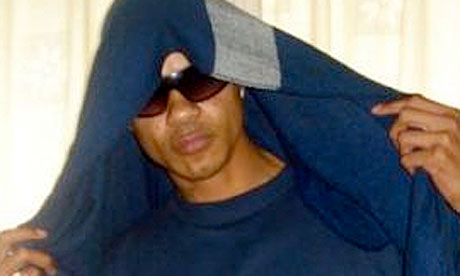
The late Mr Duggan, taxi driver and alleged drug dealer, whose shooting death by police sparked a protest that morphed into the London riots. "He is survived by his fiancée Semone Wilson with whom he had four children (one of whom was a stillborn) and by a child from another relationship."


See also August 8 Guardian report about handgun that Mark Duggan was carrying at the time he was shot. "Ballistics tests on weapon found with dead man in Tottenham indicate firearm had been changed to use live ammunition."

BBC Graphic

"It looks like a war zone - I have never seen anything like it in all my life” -- Christian Potts, Ealing resident

"But eyewitnesses reported as trouble spread across the city, there were often few police officers around when violence flared."

Both quotes from BBC report, below.

From the Guardian's latest report on the rioting -- August 9; no time stamp:
[...] In a bid to contain the trouble, Scotland Yard introduced special powers in four areas – Lambeth, Haringey, Enfield and Waltham Forest, allowing stop and search without reasonable suspicion. The section 60 powers were invoked at midnight on Sunday. One incident of stop and search in Hackney was reportedly the catalyst for violence which erupted in Mare Street shortly after 4pm, and saw local hooded youths battle police.

The Guardian understands senior officers are prepared to add more areas to the list. The special powers have been perceived as targeting certain ethnic groups, thus fuelling tensions.

Meanwhile, the maker of the BlackBerry smartphones, Research in Motion, said it would co-operate with a police investigation into claims its popular BlackBerry Messenger service played a key role in organising the London riots.

Brixton bore the brunt of Sunday's violence. The Lambeth council leader, Steve Reed, said: "We are asking the mayor's office for additional police for tonight and the next few nights."

Condemning the "copycat activity", he said: "Somebody described it as gangs of kids doing Supermarket Sweep. It was Curry's where they were after plasma screen TVs, and H&M and Foot Locker where it was clothes and trainers. It wasn't about social issues, it was an opportunity to go on the rob."
[...]
Glad you could cut short your vacation, Boris

From the Guardian's live blogging on the riots:
5.42pm BST, August 8: The Press Association news agency is reporting that Boris Johnson, the mayor of London, is to return to the capital tomorrow to deal with the growing crisis in the capital.
You might have gotten tennis elbow, anyhow, Mr Prime Minister, if you'd continued with your tennis lessons in Tuscany

"David Cameron broke off his holiday in Italy on Monday to fly home. He was due to chair a meeting of Cobra, the government's crisis committee, at 9 a.m. to work out a strategy to prevent more violence and consider why the riots broke out and spread so fast, taking the authorities by surprise." -- Quote from the following Reuters report via MSNBC, updated around 11:00 PM ET, August 8:
[...] Despite a heavy presence on some streets, police appeared unable to contain the violence as rioters who had initially coordinated through mobile phones and Twitter became increasingly confident.

Monday's looting began long before nightfall when workers were returning home, many of them forced to walk as buses to areas hit by rioting were canceled.
[...]
From BBC report last updated at 11:30 PM ET, August 8:
Rioting has spread across London on a third night of violence, with unrest flaring up in other English cities.

An extra 1,700 police officers were deployed in London, where shops were looted and buildings were set alight.

Birmingham, Liverpool, Manchester and Bristol also experienced disturbance.

The prime minister is returning early from holiday to discuss the unrest, which first flared on Saturday after a peaceful protest in Tottenham over the fatal shooting of a man by police.
[...]
At least 334 people have been arrested and 69 charged following the riots across London over the past three days, Scotland Yard said.

Nine police forces from other parts of the country were assisting in providing support, as well as the City of London Police and British Transport Police.
[...]
Monday's violence started in Hackney after a man was stopped and searched by police but nothing was found.

The trouble spread outside London on Monday evening and early on Tuesday, with police in riot gear being deployed in Birmingham city centre after scores of youths rampaged through the shopping area, smashing windows and looting from shops.

West Midlands Police also confirmed that a police station in Holyhead Road in Handsworth, Birmingham, was on fire.

In Birmingham, police said officers had made 100 arrests.

There were reports of cars being damaged in Manchester and of up to 200 youths with masks roaming through Toxteth in Liverpool.

Merseyside police said they were dealing with a number of incidents in south Liverpool, including cars being set alight.

Police in Bristol said they were dealing with outbreaks of disorder involving about 150 people.

Meanwhile in London:

> Several fires broke out in Croydon, including one at a large sofa factory which spread to neighbouring buildings and tram lines

> In Hackney 200 riot officers with dogs and mounted police were located around Mare Street where police cars were damaged

> Looters raided a Debenhams store and a row of shops in Lavender Hill in Clapham, as well as shops in Stratford High Street

> A Sony warehouse in Solar Way, Enfield, a shopping centre in Woolwich New Road, a timber yard in Plashet Grove, East Ham and a building on Lavender Hill were all on fire

> More than 100 people looted a Tesco store in Bethnal Green, the Met said, and two officers were injured

> Cars were set on fire in Lewisham

> A bus and shop were set alight in Peckham

> Buses were diverted as the violence spread to Bromley High Street

> There were reports of looting of phone shops in Woolwich High Street, in south London, and a torched police car

> Shops and restaurants were damaged in Ealing, west London, and there was a fire in Haven Green park opposite Ealing Broadway Tube

> Football matches at Charlton and West Ham which were due to be played on Tuesday have been postponed at the request of the police

> At Clapham Junction looters stole masks from a fancy dress store to hide their identity

The fresh violence prompted Mr Godwin to call on parents to contact their children and urge the public to clear London's streets.

In the first outbreak of violence on Monday, groups of people began attacking the police in Hackney at about 16:20 BST, throwing rocks and a bin at officers.

Police cars were smashed by youths armed with wooden poles and metal bars.

Looters also smashed their way into shops, including a JD Sports store, before being dispersed by police.

Catherine Holmes, a resident in Hackney, said: "The common feeling in Hackney Central is that our community has been hurt and damaged by causeless violence."

[Report continues with additional eyewitness descriptions of looting/violence]

Met Deputy Assistant Commissioner Stephen Kavanagh said there were "significant resources" on the streets, with a third more officers on duty than on Sunday.

He said: "When we have large numbers of criminals intent on that type of violence, we can only do that, get lots of officers there quickly and try to protect local businesses and local people."

But eyewitnesses reported as trouble spread across the city, there were often few police officers around when violence flared.
Just after midnight (Eastern Time) today the Beeb published a roundup/review of U.K. news headlines and photos about the rioters.

Friday, August 5

The lengthening shadow in Pakistan


Karachi, one of the world's megacities


Odd, isn't it, how nothing ever changes until it does. Take Cuba: the peasants were always staging their little rebellions and the army always put them down and Fulgencio Batista always remained in power. That's the way things were in Cuba because, well, nothing ever changed there. Then one day everything changed. [snapping her fingers] And just like that, Batista was gone.

It was only later, when it finally sank in that Cuba had changed, that people could look back and see there had been a lengthening shadow, the signs and portents warning that a change was coming.

You're 20 years old, your baby son has died of dehydration from dysentery, your wife is ill, you're unemployed and after two months of looking you still can't find work. There's no money, no food, and now there's no water, and even if you had the money to pay the gouge price the water mafia charges for water that's supposed to be free, now the electrical blackouts in Karachi mean that even the mafia has a hard time siphoning off water. The city has become hell, with armed robbers roving everywhere and gangs of refugees from the flooding in Sindh fighting with other gangs. You pass by a shop that has a television and see images of thousands of young men, men very much like yourself, massed in a place called Tahrir Square in Egypt; they're demanding the country's leader step down and they're protesting police brutality. A few days later you hear to your amazement that the leader has stepped down, that the head of the national police is under arrest.....

August 4, 2011, Business Standard (India):
Meanwhile, the Pakistani press is full of reports on how its economy is nose-diving. The overall budget deficit stands at 6.5 per cent of the GDP against a revised target of 4.7 per cent, and in the wake of the US cancelling $800 million worth of aid to Pakistan, officials in Islamabad are nervously wondering if they want to ask the IMF to revive its suspended bailout programme. Under the circumstances, Islamabad’s purported rejection of buying electricity from India, ostensibly because the power project is in Kashmir, would amount to cutting its nose to spite its face.
From the rest of the report it's not clear whether Pakistan has actually rejected the offer as yet. And in 2006 Pakistan's leaders similarly dragged their feet about accepting an offer from Iran to sell the country electricity at a subsidized rate. But the Business Standard report makes clear that Pakistan's Keepers of the Faith -- those Old Guard military men and civil servants who since the country's inception have defined the country's reason for existence to be 'destroy India' -- are playing political games about Kashmir with India's offer to sell electricity. This, despite the fact that Indian Kashmiris don't want Pakistan meddling in their affairs, as the recent election uproar in Kashmir made clear.

Pakistani pundit Mohammad Taqi did a good job the other day of sending up Pakistan's blinkered Old Guard, but there's not much room for levity when one studies Pakistan's electricity crisis and how it's playing into the cycle of violence in Karachi, which prompted the government on Tuesday to deploy paramilitary units in the city. The routine electrical blackouts, for up to 10 hours a day, have worsened the water-supply crisis in the city and added to the jobless crisis there. And all three crises exacerbate the violence in the poorer neighborhoods of the city, where most of the bloodshed has occurred. But unlike, say, the murderous feuds that erupted between drug gangs in Chicago's poorer neighborhoods a few years ago, the violence in Karachi frequently shuts down the city, which is the country's business hub. So the violence is greatly hampering Pakistan's attempts to attract foreign direct investment, which it needs if it's to pull out of its economic slump.

From that viewpoint Pakistan's leaders shouldn't look a gift horse in the mouth if India's offering to sell them electricity on an expedited basis. I understand the leaders are boxed in by the Old Guard's longstanding policy on Indian Kashmir, but if they think they can let Pakistan's electrical crises continue for years more, why, they're as blind as Batista was. And so are those in Washington who support the Old Guard.

Washington is looking in the wrong directions in Pakistan, as it did in Cuba, as it did in Iran, as it did in Egypt and so many other places. That's because Washington is always looking for verification of its assumptions. It needs to look for signs arising outside its assumptions; only from such effort can the outline of a lengthening shadow be intuited.

TWO SIGNS

August 26, 2010:
Crush of Refugees Inflames Karachi
By Tom Wright,
The Wall Street Journal

KARACHI, Pakistan - Hundreds of thousands of refugees from Pakistan's devastating floods are seeking shelter in this city of 18 million, exacerbating ethnic strife that has already escalated this year ... The local administration says it is expecting and can cope with up to one million of the refugees. But many others who have made it to Karachi say they are being turned away from shelters on the outskirts and are pouring in to the city, deepening ethnic rivalries with Karachi's majority ethnic community that have simmered for years. ... For Karachi's dominant group, the Urdu-speaking Muhajirs, the influx of Sindhi refugees poses a threat to the established order.

"If they come in hundreds of thousands, how will they survive?" says Khawaja Izhar ul Hassan, a member of the provincial assembly from the Muttahida Qaumi Movement, or MQM, which is largely a Muhajir political party and forms part of Sindh province's ruling coalition government. ...
I'm being unfair to Christian Parenti, the author of the next report I'm featuring here, because I'm omitting much of the first part of his discussion, which focuses on his interest in climate change and its connection to social unrest. Mr Parenti sees the massive flooding in Sindh last year as an example of how climate change is causing massive dislocations in human populations; the first part of his report reflects that view. I've omitted that part for two reasons:

First, even if one assumes for the sake of argument that the weather conditions leading to the flooding were the result of climate change, the destructiveness of the flooding in Sindh was greatly due to human negligence, not the climate. That part of Pakistan is flood prone, which is why the British built an extensive and effective flood management system in the region. The system was allowed to fall into disrepair after Pakistan became an independent nation and no attempt was made to modernize flood management principles. (Parenti's discussion does touch on the issue although I've omitted it here.)

Secondly, it's the major portion of Parenti's investigative work that I find to be vital information -- the best window the general public has on a social upheaval in Pakistan that was touched off the 2010 flooding, but which is rooted in an essentially feudal society coming up against a 'third tier' of urbanization in a developing country.

(In first-tier ubanization the city is a commercial and/or governing hub. In second-tier urbanization large numbers of rural peoples arrive to reside and look for work in the hub as its commerce/government workforce expands. If the wave or waves of arrivals are sudden, driven by catastrophe(s) in the rural regions, this creates third-tier urbanization, which has a refugee or 'displaced persons' component.)

I hope you'll read Parenti's report in its entirety at the Agence Global website (see below); here I've provided enough of it to show that the options provided to the poor by rapid urbanization in Pakistan, which is symbolized by the megacity of Karachi, are now presenting a challenge to the country's ruling class (including the military) that it might not be able to deflect.

June 30, 2011:
Pakistan One Year After the Floods
by Christian Parenti
The Nation (U.S. publication) via Agence Global

Funding for this article was provided by the Dorothea Lange-Paul Taylor Documentary Prize from The Center for Documentary Studies at Duke University. Christian Parenti is a contributing editor for The Nation and visiting scholar at the CUNY Graduate Center. He is the author of Tropic of Chaos: Climate Change and the New Geography of Violence (Nation Books, June 2011).

KARACHI -- A hot, gritty wind carries the stench of pit latrines across a refugee camp on the western outskirts of Karachi, on Pakistan’s southern-facing coast. In the sky, vultures and eagles circle. At its peak, this camp held 1,400 families, all poor farmers displaced by the Indus floods of 2010, which inundated an area the size of England and affected more than 20 million people.

Before the massive floods of 2010 -- the worst in memory -- much of central and southern Asia was suffering through a brutal ten-year drought, during which crops did poorly and farmers sank ever deeper into debt. Pakistan is considered one of the most arid countries in the world and one of the most water-stressed. The flood was just the latest bit of extreme weather.
[...]
In rural Sindh, the floodwaters have finally receded, but the old problems have not. It is time to plant new crops, but in many refugee camps there are people refusing to go back to the land. At the windswept camp outside Karachi only half the residents have gone home. Aid agencies are cutting off relief, and the government is telling people to leave. Yet many refugees are stubbornly staying put.

“We will die here before we go back to those landlords,” says Mehboob Ali, the camp spokesman.

He and his neighbors seem to mean it. The day before I visited, the camp’s incipient social organization, the Mutasereen ("affected people") Action Committee, marched demanding the right to stay and build houses. Police met the marchers with volleys of tear gas and a baton charge. [...]

Why would desperately poor flood victims fight to stay in a dust-choked tent camp on the outskirts of a violent mega-city rather than go back to their homes?

The answer lies in the horrible exploitation and humiliation that is everyday life for most people in rural Pakistan. In Sindh, the traditional landlords are called zamindars and their tenant farmers are haris. Since independence and partition, in 1947, various Pakistani leaders have attempted land reform, but little has ever been achieved. And so, today the zamindars still own vast tracks of land on which their serflike haris live and work.

Several hundred miles north of Karachi on the edge of Sukkur, where old British-built barrages regulate the flow of the Indus, I found another camp of displaced people who don’t want to move. These people could also be described as escapees from feudalism. The camp lacks a school, a clinic, even basic sanitation, and aid is being cut off. But the remaining residents are finding ways to fit themselves into the local labor market: young men work on construction sites and in granaries and warehouses. Women go to the kachcha -- the wild area along the river -- where they pay armed men for the right to cut wood for resale to restaurants in Sukkur city.

“We don’t want to go back because the landlord will double our debt,” says Hassan Khoso. “We want the government to give us land.” He goes on, “Some poor tenant farmers ran off in the first week of the flood, before the water could even reach their district.”

Such was their desire to flee. Khoso, who’s from near Jacobabad, owed 50,000 rupees (about $560) last year but fears the debt will be 100,000 if he returns. He lost a rice crop worth 30,000 rupees, two water buffalo and two goats. He says that landlords have been coming to the camp urging the haris to return. Khoso and others say that is part of what keeps them close to the city. Along with work, there is access to hospitals and the promise -- at least the promise -- of education for their children.

As at the camp on the western edge of Karachi, these people have formed a camp committee. To make their demands heard they marched to the local press club and held a sit-in. And how are such calls for reform and development being met by officials?
Dead silence.

The floods inundated an area the size of England, destroyed almost 5 million acres of crops, killed about 1,750 people and left 10 million homeless. Rebuilding is expected to take three to five years. Despite the scale of the damage, the discourse around reconstruction involves very little if any public discussion of how things can be improved; ideas like social justice, land reform, climate adaptation or climate justice are missing. Local left parties are marginalized and hounded by landlord thugs.

The reason for this is simple: landlords have too much power. They control the sale of seed and fertilizer, set the prices of crops, rig local elections, imprison in private jails those who oppose them, use village schools to stable their cattle and generally have their own way regarding the people. Their influence on the government is pervasive at all levels.

There has been no pressure for change coming from the US government, which has given Pakistan $18 billion in assistance and payments since 2002. Nor has any [pressure] come from the international NGOs and the UN -- both of which run large aid and development programs here.

When I interviewed a spokeswoman for the UN World Food Program, so diligently did she tiptoe around the sensibilities of the Pakistani government that she refused even to use the word “corruption.”

Oxfam, on the other hand, has launched an investigation into “financial irregularities” within its own flood-relief work.

And so, the haris are bereft of allies or champions. If they want justice they’ll have to get it on their own. But in flood-ravaged Sindh the zamindars have a different plan: they want their haris back.

At the camp on the outskirts of Karachi one landlord from Baluchistan came with five armed guards, threatening to take away several brothers from a family named Bux. All the brothers were in debt to the landlord; he threatened to lock them in his private jail if they did not return and start working. But the camp rallied and faced him down.

All through the Indus flood zone I heard similar stories: landless haris in urban camps preferring to become day laborers rather than return to debt peonage in the districts and landlords complaining that relief aid was keeping the haris away from their obligations.

Standing on an earthen levee along a canal in the village of Arazi in the Dadu district of northern Sindh, a stout landlord named Kahari Bhutto exclaimed, “The farmworkers -- their homes were wiped out, and they are gone. I don’t know where they are. Landowners themselves are having to do the work!”

As the floodwaters receded, Bhutto, like most farmers, threw down a late emergency crop of wheat. Fortunately, the flood had deposited a rejuvenating layer of nutritionally rich river silt, and the emergency wheat crop across Sindh has been very robust, so too some fast-growing sunflowers given out by USAID.

Measures like these have helped offset the damage of the flood. To harvest cotton, says Bhutto, he would normally hire ten to fifteen people, through sharecropping arrangements. But this year he hired only three, and his brother and father also worked. And now, instead of paying 250 rupees per day for labor, he has to pay 500.

When I check at a nearby tent camp full of people who had come from Baluchistan, refugees working as day laborers confirmed that labor prices have indeed gone up. But as one, Mir Mumtaz, explained, the people are in a bind: they do not want to go back to Baluchistan and face their old landlords, nor do they want to enter into sharecropping agreements here in Sindh. “We are afraid of just going into debt again.”

To be clear: although displacement is an escape from debt, it has also meant impoverishment. Khairam Hatar, an older, educated and rather distinguished-looking widow, explained, “I do embroidering here in Dadu town. Before, I had a sewing machine and was able to make money on my own. But I lost that during the flood.” Her sporadic income is a fraction of what it was when she was self-employed in Baluchistan.

Farther up the river in Shikarpur, I meet Mohammad Arif Khan Mahar. A prominent landlord, he was a local politician, and his brother is a member of the provincial parliament. Khan Mahar hosts my traveling companions and me in his attock -- a combination guesthouse/meeting hall away from the family house. In the wide courtyard several neem trees shed their blossoms, which a young male servant sweeps up. Around the courtyard are the bedrooms and several plush meeting rooms. The attock halls are decorated with photographic portraits and decorative swords.

The zamindar has many complaints: the government is corrupt -- “Our officials mismanaged everything. There’s no accountability for state officials, no planning, no organization whatsoever.” The workforce is illiterate -- “Frequently, the labor is useless if the tasks are complex and involve machinery.”

He says that indeed many indebted haris “have run away from their responsibilities.” And though he notes rising tension and criminal violence, he says, “Here, there is no insurgency yet.”

The next day we tour his lands by SUV, accompanied by two armed guards. When the SUV stops and the zamindar steps out to survey the damage, his haris drop their tasks and crowd around him, crouching and bowing as they approach to shake his hand. The thin, sinewy, sun-beaten haris, splattered with mud and straw from brick-making and home-rebuilding contrast sharply with the tall, rotund, relatively pale landlord. Except for the SUV, the guns and the sunglasses, this could be a scene from medieval times.

The rage this inequality creates simmers, then boils over. When Benazir Bhutto was assassinated in December 2007, much of rural Sindh exploded in riots that had a decidedly class angle: when the flames died down, thirty-four gas stations, eighteen rail stations, hundreds of private cars and shops, and 176 banks had been looted and burned. Just north of here in Punjab some of the haris are gravitating toward a new Punjabi Taliban, which, in rhetoric at least, invoke issues of class exploitation and call for land reform.

What does my host think of land reform? “The government should first give away unused land. Rather than coming after the productive farms just to make a political show.”

In many ways Khan Mahar is progressive, adopting new technologies and, according to his workers, paying much better than most landlords. But he is still a feudal landlord with luxury and power, and wants to keep his vast holdings and the indebted haris who live there. He need not worry: there is no discussion of land reform and no chance it will be attempted.

When I ask about relief in the area, he waves away the question: “They’ve had enough relief!”

During the first weeks of flooding, relief went relatively smoothly. International aid agencies brought supplies, and the military pulled trucks, planes and helicopters out of Kashmir and the war zones of the Federal Administered Tribal Areas to move supplies to stranded populations. But once the emergency was over, the endemic problems of government corruption and the fetters of landlord influence on politics returned. According to Transparency International’s 2010 ranking, only thirty-three nations are more corrupt than Pakistan.

“NGOs hire locals to have some accountability and traction,” says Qadeer Ansari, a manager with the General Services Department of Dadu district, where 60 to 70 percent of houses were damaged.

“But who are these locals? Very often they are just the same old influential people, landlords and their representatives. Nepotism, patronage and corruption shape how relief and reconstruction operate. And often food is simply stolen and sold.”

* * *
[...]
Is there a plan for repairing and managing the increasingly extreme hydrological patterns of the Indus River? Talking with the head of IT, I notice how few computers he has for his department.

“Well,” says the clerk sheepishly, “we really just use these computers as typewriters. Just to print out documents and then pass them around in hard copy.” As we are talking, a messenger is collecting a fourth signature and stamp on a document.

This system -- in which every little petty potentate in every department has to sign off on every document -- is designed to facilitate a culture of bribery. When real planning or technical work is needed, the government outsources these “special projects” to development experts at the World Bank or private firms. As a result, the capacity of the Pakistani state remains malformed and stunted.

Again, the roots of this problem go back to the power of the rural elites. The zamindars systematically crush those who oppose them, preventing the creation of good governance and a literate population because it would undermine their power.
[...]
For more on Pakistan's electricity-shortage crisis, see The Nation's (Pakistan) July 28, 2011 report, No let-up in Karachiites’ sufferings, and Wikipedia's article, Electricity Sector in Pakistan ("Contrary to Pakistani government and expatriate claims, Pakistan suffers from a massive electricity shortage.")

Wednesday, May 19

Thaksin issues warning to Thailand government as Red Shirt supporters set fires across Bangkok

CNN reported during their 5:00 PM EDT broadcast that Red Shirt supporters, ousted or fleeing from their camp in Bangkok by an army assualt this morning, "have set Bangkok on fire and are hurling grenades."

This is the first time I've heard about heavy use of grenades by the Red Shirts, but other news organizations are also reporting that the Red Shirts are setting fires. The government has announced that arsonists and looters caught in the act can be shot under the rules of military engagement. issued orders Reuters - Wed May 19, 11:28am)
... "Police and soliders were instructed to resolve the situation and use weapons to deter or prevent those (arson and looting) acts," Tharit Pengdit, director-general of the Department of Special Investigation, said in a televised address. ...
Reuters also has more on the phone call they received this morning from Thaksin Shinawatra -- and more on Thaksin. (I note that the following article describes him as a multi-muillionare; an earluier Reuters dispatch described him as a billionare, and Wikipedia describes him as a "multi-billionaire" and one of Thailand's richest people. Anyhow, he's rich.
Thailand's ex-PM Thaksin predicts guerrilla war

by Nopporn Wong-Anan
Reuters BANGKOK
Wed May 19, 2010 12:56pm EDT

[Summary] Exiled former Thai Prime Minister Thaksin Shinawatra said on Wednesday that a military crackdown on protesters backing him could spawn mass discontent and lead to guerrilla warfare.

Thaksin, ousted in a bloodless 2006 military coup, is denounced by adversaries as Thailand's most corrupt politician. To his anti-government supporters, who set Bangkok ablaze on Wednesday, he is a savior.

Speaking from an undisclosed location, Thaksin said the crackdown on "red shirt" protesters, which killed six people and wounded 58, could degenerate into widespread violence.

"There is a theory saying a military crackdown can spread resentment and these resentful people will become guerrillas," Thaksin told Reuters as troops fought protesters in Bangkok, sparking violence in outer provinces.

"There are lots and lots of people across the country who are upset because they were prevented from joining the Bangkok rally."

His critics say Thaksin is a crony capitalist who plundered the economy and perverted democracy for the benefit of his family and friends while in power from 2001 until the 2006 coup.

But to many rural voters, he was the first leader to consider the needs of millions living beyond Bangkok's bright lights.

Thaksin, who scored two landslide poll wins, has been living abroad in self-exile since being removed.

But a two-month campaign by his supporters to oust the government of Prime Minister Abhisit Vejjajiva, hoping to gain Thaksin a political amnesty and justice, culminated on Wednesday in the country's worst political violence in 18 years.

Rioting and fires swept Bangkok after troops stormed the protesters' encampment, forcing their leaders to surrender.

Protesters set ablaze at least 27 buildings, including the Thai stock exchange and Central World, Southeast Asia's second-biggest department store complex.

A night curfew was declared in Bangkok and 21 provinces.

THAKSIN'S GHOST

Thaksin, 60, has hovered over Thai politics since fleeing the country in 2008, accused of undermining the powerful monarchy and breaching conflict-of-interest laws. He was sentenced in absentia to two years in prison.

Government officials say the multimillionaire former telecommunications tycoon was funding the protests to the tune of about $1.5 million a day. Both Red Shirt leaders and Thaksin deny he funded the anti-government movement.

In his comments, Thaksin rejected any notion he was the stumbling block in failed talks between the government and protesters.

"I only gave them advice that they should make a collective decision as a group, not letting any individual leaders to make a decision by their own... I never discussed about my personal interests with them," Thaksin said.

Thaksin, a former policeman, is accused by critics of abusing his electoral mandate to systematically dismantle constitutional checks and balances while consolidating his own rule.

In 2005, he looked unassailable with a record majority in parliament based on the platform of cheap healthcare and handouts for rural voters that swept him to power four years earlier.

He formed the first elected government to serve a full term, after which it was re-elected. He was also the first leader in Thai history to form a one-party government.

But corruption scandals and alleged abuses of power eroded his popularity among Bangkok's middle classes. Simmering anger exploded in 2006 when his relatives sold off, tax-free, their $1.9 billion stake in Shin Corp, the telecoms empire he founded, to a Singapore state company.

Thaksin responded by calling an election three years early, which he duly won.

CONTROVERSIAL RISE

Born into a family of ethnic Chinese silk merchants in 1949 in the northern city of Chiang Mai, Thaksin became a policeman in 1973 before gaining a masters degree in criminal justice at Eastern Kentucky University.

He is still popular among rank-and-file policemen, accused by government backers of doing too little to stop the protests.

In 1987, he established a computer dealership with his wife that started selling hardware to the police. The company evolved into Shin Corp, a telecoms conglomerate with interests ranging from mobile phones to satellites, the Internet and the media.

But a corruption probe dogged him in power until he convinced investigators he made an "honest mistake" in failing to declare millions of dollars of shares transferred to his domestic staff.

A 2003 war on drugs in which 2,500 people were killed boosted his image as a crime-buster, but sparked outrage from rights groups, who said he was riding roughshod over civil liberties.

In February, Thailand's top court seized $1.4 billion of his assets, saying it was acquired through abuse of power.

(Editing by Michael Perry and Ron Popeski)

Sunday, May 16

Bangkok: Red Shirt leaders need to stand down. Now. (UPDATED 6X)

UPDATE Monday May 17 6:30 PM EDT
Frankly I am shocked that Fox News Cable and CNN have not mentioned the Bangkok crisis during the first half hour of their 6:00 AM news report.

The 3:00 PM deadline for the protestors to leave the camp has come and gone but it seems few of the Red Shirts have left, despite the government's offer of safe passage with no penalties attached. It's not clear what's going to happen next. According to the latest BBC report:
[...] The government said on Monday it would talk to the protesters as long as they showed "sincerity" by leaving their camp.
[...]
The protesters - particularly women, children and the elderly - have been told by the government they must leave the area immediately as it is too dangerous to remain.
[...]
The broadcasts warned that those who remained faced two years in prison, but gave no details about what would happen after the deadline passed.

Satit Wonghnongtaey, a minister attached to the prime minister's office, told reporters an "operation [to disperse the protesters] will be executed as soon as possible".

But the protesters appear to be defiant. As the deadline passed, there was little sign of a rush to leave the camp.

A group of around 300 people who sought refuge in a nearby temple have told volunteers there that they do not trust the government's offer of safe passage and do not dare to leave, the BBC was told.

Meanwhile, protesters are reported to be sending up fireworks at circling helicopters.
[...]
The report suggests hysteria has set in among many of the protestors, which is fueling their paranoia. They're exhausted from days of unremitting stress and little sleep. Their leadership is in disarray. I doubt many are thinking straight at this point.

Why doesn't the Sangha take a leadership role in this situation? Rival Buddhist sects should put aside their differences long enough to speak in one voice -- urge the protestors to work with the government to end the standoff. The show of solidarity among Buddhist leaders could overcome the protestors' paranoia and help calm them.

Speaking of exhaustion -- the crisis has kept me up all night. I'm going to sign off now and catch a few hours of sleep.
**********************************
Right now it's 1:34 AM EDT here in Washington, DC. The time is 12:34 PM in Bangkok --less than three hours to the government's deadline to the protestors. See the report after the updates. All we can do now is wait and hope the coolest heads prevail.
*****************************
Excerpts from AP Report May 17 12:45 AM EDT: "The political conflict is Thailand's deadliest and most prolonged in decades, and each passing day of violence deepens divides in this nation of 65 million — a key U.S. ally and Southeast Asia's second-largest economy. Thailand has long been considered a democratic oasis in Southeast Asia, and the unrest has shaken faith in its ability to restore and maintain stability."

Report also mentions that the slain Seh Daeng, a renegade army officer, was accused of creating a paramilitary force for the Red Shirt protesters:
"Seh Daeng has accomplished his duty. All of us here have the duty to carry on the quest for justice," a Red Shirt leader, Jatuporn Prompan, said. He said that the only hope now to end the violence was intervention by Thailand's revered King Bhumibol Adulyadej.

The 82-year-old monarch, hospitalized since September, has remained publicly silent on the crisis unlike decades past when he stepped in to stop bloodshed.
Breaking News: Reuters Sun May 16, 2010 11:38 PM EDT: "A rogue soldier and de facto military chief of Thailand's red shirt protest movement has died, said the director of the hospital where he was being treated after an assassination attempt. [Suspended major general] Khattiya Sawasdipol, better known as Seh Daeng, was shot in the head on Thursday in an incident that sparked the latest flare-up in violence in Bangkok."

Breaking: Pattaya Daily News May 17 12:40 AM EDT: Seh Daeng's death may spark revenge killings and have widespread political ramifications in Thailand. Warning: article has graphic photographs.

(UK) Telegraph May 17: "....A state of emergency has already spread to more than a quarter of the country after emergency decrees were declared in five more provinces, as violence erupted in the north and northeast. ..."

BANGKOK, May 16, 2010 11:23 PM EDT
(Kyodo News International) The death toll from four days of clashes between troops and antigovernment protesters in Bangkok rose to 36 on Monday following overnight violence in which an air force officer was shot dead and a luxury hotel was hit by grenades. In addition to the 36 fatalities -- nine of which occurred Sunday and two early Monday -- more than 250 people have been injured in the latest round of violence since Thursday, according to Bangkok's emergency medical center.

Local dailies reported the grenades damaged the fifth and 17th floors of the Dusit Thani Hotel, located in the Thai capital's Silom financial district opposite Lumpini Park, shortly after midnight. It was not immediately known if there were any casualties at the hotel. The hotel management was not available for any comment. Nation TV reported that only journalists were staying in the hotel.

Post Today, a Thai language daily, reported that three grenades also landed near a high-rise office building located on Rama IV Road, less than 100 meters away from the Dusit Thani.

About an hour after the grenade attacks, an air force officer was shot dead and another was slightly injured as they drove a pickup truck into the off-limits zone on Silom Road, a stretch lined with commercial banks and tall buildings that also runs alongside one of Bangkok's main nightlife areas popular with foreigners.

The daily quoted a preliminary report as saying there was a gunfight between troops stationed on Silom Road and the two air force officers in the truck.

The government has declared Monday and Tuesday this week to be public holidays in Bangkok to facilitate restoration of peace and order in the capital, though banks and the financial market opened as usual. It has also decided to postpone until May 24 the start of the new school semester in the capital. ....
*****************************
According to a Guardian report (Sunday 16 May 19:56 BST) the Thai government has ordered all women and children to leave the Red Shirt camp in central Bangkok by 3:00 PM Monday ahead of an offensive to remove anyone remaining in the camp. The government is also offering safe passage from the camp for males who want to leave:
The army said it planned to allow neutral organisations such as the Red Cross into the protest area to encourage protesters to leave. "Whoever wants to leave, the government will organise transportation, [people] can go in any direction they want. Even men and tough guys and guards, the government will transport them out – the only condition is without weapons."
That means the government has removed the threat of terrorism charges, which carry a maximum penalty of death, for the Red Shirt leaders if they leave the camp peacefully by tomorrow afternoon.

But the leaders who rejected the offer for elections (there was a split in the 22-member 'leadership council' over whether to accept the offer) don't seem to want a peaceful resolution to the violence. They had countered the government's offer with the demand that the deputy prime minister be arrested for ordering troops to move on Red Shirts on April 10, when 25 of the protestors were killed. The demand predictably caused the government to withdraw the offer.

Then today the leaders demanded the United Nations step in, but there was a catch:
"We want the UN to moderate it because we do not trust anyone else. There is no group in Thailand that is neutral enough," the redshirt co-leader Nattawut Saikua said. "We have no other condition. We do not want any more losses."
If you don't trust any group in Thailand then you're not asking for negotiation, and no offer the government can make will be acceptable.

The government rejected the demand: "If they really want to talk, they should not set conditions like asking us to withdraw troops," said Korbsak Sabhavasu, the prime minister's secretary-general. "They cannot make demands if they want to negotiate."

As for bringing in the U.N.:
" ... no governments allow any organisations to intervene in their internal affairs,” Panitan Wattanayagorn, the government spokesman, said ..."
At least some of the Red Shirts have also made the unreasonable demand that the king step in and fix things. That's setting up the king to be a pasty; so far he hasn't fallen for the ploy.

Is there a bottom line to all this, aside from a bloodbath? The urban warfare has virtually shut down one of the most important cities in Southeast Asia, delivered a blow to Thailand's economy, and scared foreign investors. On the other side of the picture, the Red Shirts claim to represent the country's electoral majority -- the poorest Thais in the rural portions of the country.

And Thaksin, a former telecom tycoon who is variously described as a multi-millionaire or billionaire, is now facing a close review of his financial records:
(Reuters - May 16, 8:19 AM EDT ) - Financial transactions involving 106 bank or stock accounts associated with former Prime Minister Thaksin Shinawatra will be halted if found to be linked to anti-government protesters, the National Security Council (NSC) said on Sunday.

The accounts and assets -- held by associates, family members and businesses linked to the exiled multi-millionaire -- will be monitored and frozen if found linked to the protest movement.

The Stock Exchange of Thailand, asset management, insurance firms and commercial banks are prohibited from facilitating any such transactions, Tawil Pliensri, secretary-general of the NSC said in a televised address.

The government says Thaksin, who is currently believed to be in Montenegro, evading a two-year jail term for graft, is the de facto leader and main financier of the red-shirted protesters occupying parts of Bangkok.
It seems members of his family had seen the writing on the wall. The Bangkok Post reported today:
Khunying Potjaman na Pombejra, ex-wife of fugitive former prime minister Thaksin Shinawatra, and her son and daughter, Panthongtae and Pinthongtha Shinawatra, left for Singapore on May 14, reports said.

Reports said another daughter, Paethongtan, was in a European country. She also left Bangkok on Friday.
A news report yesterday mentioned that Montenegro's government isn't allowing him to send "political messages" to his followers in Thailand. However, I think they'd have to place him in solitary confinement to prevent him from communicating with Red Shirt leaders. Thaksin's ouster from Thailand's government is a major grievance of the Red Shirts.

Today he issued a statement through his attorney calling for the "international community to respond to the Thai government's violent crackdown on protestors in Bangkok." It seems to me if he can get that message out to the world he can also call for the Red Shirt leaders to tell their people to stand down.

From what I've learned up to this point, I'd say the bottom line is war between Thaksin and Thailand's government. Reportedly not all Red Shirts are his supporters. But if his hard-line Red Shirt loyalists can't bring down the government it seems they want to drag it through as much mud as possible.

Thaksin became head of Thailand's government by circumventing the elite power structure; he did this by spreading a great of money among Thailand's majority, the country's rural poor. Then, once he was in power, he solidified his hold on the majority with lavish government handouts. As I noted in yesterday's post Thaksin's strategy opened Pandora's Box; to use a more Asian metaphor he caught a tiger by the tail.

It is the elite, which includes Thaksin, that built Thailand into an economic powerhouse. I doubt all the rural poor are the idiots it seems many urban Thais view them to be. But I don't think enough are qualified at this time to run a globalized and highly urbanized central government.

The fault in this goes to the elite, to be sure, so Thaksin is on the right side of history. However, he's not helping the poor if he continues to use them as pawns in his war against the government even in the face of a bloodbath that will only further divide the country.

What follows is a background report. The one I presented yesterday, by a Westerner named Charles E Morrison (the President of the East-West Center) is the best introduction I've seen to the roots of the current political melee in Thailand. The second report drills deeper and presents Thaksin's view of things.

The author, Suranand Vejjajiva, served in the Thaksin Shinawatra cabinet when Thaksin was prime minister. He's now a political analyst. He wrote the report for the Bangkok Post, and he clearly directed it to Western readers who have no familiarity with Thailand's history and politics. That leaves him with considerable leeway to shade the picture; however, the outside world does need to know more about the views of Thaksin and his supporters.

I won't resist adding that the author's criticism of government-owned media outlets in Thailand is a case of the pot calling the kettle black. While Thaksin was in power The Bangkok Post, which is not government owned, bent over backward to accommodate his government.

A final note before I cede the floor: the "different colored" shirt groups he refers to are the Red Shirts and the Yellow Shirts; the latter was originally created as a protest against Thaksin and his government's alleged corruption while he was in power. The Yellow Shirts are mainly drawn from "middle and upper-class Bangkokians and Southerners of all classes and supported by the conservative factions of the Thai Army, some leaders of Democrat Party, and members of state-enterprise labor unions," according to Wikipedia. It's a long story, and you can read about it in the Wikipedia article on the Yellow Shirts -- the neutrality of which is disputed, of course.
The challenge of building unity in a world of diversity
by Suranand Vejjajiva
Published: 14/05/2010 at 12:00 AM
The Bangkok Post; Newspaper section: News

Have you listened to the government- and army-owned television and radio stations, which in Thailand mean all with the exception of community radios and cable/satellite TV stations? Blaring out are talk shows and advertising spots calling for kwam samakkee and pen nueng deo literally calling for "unity and harmony" and "becoming one".

Then you can look at the present political conflict with different coloured shirt groups of protesters on the streets. You cannot help but wonder whether these types of nationalistic propaganda are still relevant, or are they just nostalgic sentiments among the current holders of power?

The Kingdom of Siam, or Thailand as it has been called since the change of name in 1939, is a nation state which comprises different ethnic groups living together under the monarchy, with the power structure centralised in Bangkok, the capital of the nation for the last 228 years. With the Revolution of 1932 changing absolute monarchy to a constitutional one, the three pillars of Chard, Sassana, Phra-maha-kasat or "Nation, Religion, King" have become the core principle unifying the peoples under a one-nation state.

The centralisation model used during King Rama IV (1851-1868) and King Rama V (1851-1910) to fight off the threat of European colonialism was adapted into a nationalistic regime in the guise of democracy with a constitutional monarchy, to fend off neo-colonialism and communism especially after WWII. Ethnic cultures are suppressed to favour a modern, unified "Thai-ness". The Thai "central" dialect became the "official" Thai language. Bangkok is virtually the centre of the universe to which resources from upcountry flow and in which wealth is concentrated but is barely trickled down or disbursed back.

As economic globalisation took hold in the past two decades and the threat of communism subsided politically, the "end of history" scenario as Francis Fukuyama described is just an end to one chapter while the rise of the global village and the "clash of civilisations" which Samuel Huntington theorised emerged. The advent of the internet and modern communications technology coupled with developed transportation infrastructure have brought the world closer together. On the positive side is, of course, the apparent economic advancement, but on the negative side is the raised awareness in the differences between ethnic groups - the wellbeing of peoples and communities in different areas are accentuated.

Thailand is no different. It is an illusion to believe that the "melting pot" works here, blending Thai, Lao, Chinese, Mon, Khmer, Buddhist, Christian, Muslim, Lanna and Isan through to various hill-tribes, into a perfect soup, a united monoculture. We are, in reality, more like a jub-chai kind of culture, a hotchpotch or medley of different vegetables and meat, each with its own characteristic, simmering in one pot.

The Deep South exploded first. The injustice and discrimination felt among the southern Malay Muslims are the sharpest compared to groups in other regions. Historical wounds coupled with rhetoric from the present confrontation between Muslim fundamentalists and the Western world brought about a terror campaign in the three southernmost provinces, now in its sixth year since the raid on the armoury in Narathiwat on Jan 4, 2004.

Then the red shirts rose. The Lanna North, although more gentle and peaceful, has a long history dating back even before the Ayutthaya Period. The local pride could be felt everywhere and legends of the old kingdom prevailed. The Isan Northeast, more tough and rough, not only has the largest share of the population in the country but also a rich mixed culture of local folklore and great empires of the past.

In the past, Bangkok, with its centralised but extensive bureaucratic network, was able to co-opt those people in the outer regions, suppressing dissent while handing out development projects and assistance. A governor is appointed to "rule" each province in the manner of the feudal lord who acts as a benevolent representative from the central government. But under the veil, abuses of power and extraction of local resources to feed the economic growth of Bangkok caused discontent, with strong reactionary protests, even fighting.

This is especially true for the Isan people whose poverty made the region the hotbed for communist insurgencies before - even to the point of possible secession from the Kingdom of 16 provinces at the height of the Cold War.

One may believe that Thaksin Shinawatra's Thai Rak Thai Party was the stimulant that aroused such regionalism but in reality Thaksin was riding the historical wave at the right time and place. People saw Thaksin as the leader who opened up opportunities for economic and social advancement and political rights and liberties. The red shirt movement took hold because it is crystallised from the long and bitter struggles of the past. The injustice and double-standard issues are not a recent phenomenon.

To say that these red shirt people are politically inept and can be fooled into participating in political protests is totally absurd and ignorant. The sad part is a lot of people in the Bangkok establishment circle still think that way.

The key question is: Can Thailand remain unified as a nation? Speculation of a coming civil war is just the worst-case scenario. Even with a bloody conflict very likely, the Kingdom will remain united, to a certain degree and under terms of arrangement.

The key to unity is the institution of the monarchy. The vast majority of Thais remain loyal to the monarch and are in accord that the institution be the main pillar of the nation. And the monarchy must be revered and upheld above politics and conflicts.

But being united as a kingdom does not translate into unity under any particular government or the bureaucracy or the Bangkok establishment as the current propaganda is trying to make it seem. Beneath the constitutional monarchy is democracy. And in democracy lies the answer to the challenge of building unity in a world of diversity.

A democratic process will empower people by opening up economic opportunities and guaranteeing equality in accessing resources for development and progress. Rights and liberties will be ensured. The diversity can co-exist under one united umbrella but it has to be one of true democracy, not one manipulated by the privileged for their own benefit.

That is what the red shirts are asking for, really. And if they are crushed by the weight of the Bangkok establishment this weekend, be sure that they will rise back again, and again.

###