Translate

Sunday, November 27

"Rebels Clashing in Aleppo as Radicals Prevent Other Militants From Fleeing" (UPDATED 8:10am EST)

UPDATE

Here's the updated Sputnik report. 

BREAKING NEWS
November 27, 2016 
13:29 -  updated 13:52 
Sputnik

Fighting between rebel groups in the Syrian city of Aleppo has escalated because radicals are trying to prevent other militants from leaving the embattled city, the Russian Defense Ministry said Sunday.

"Clashes between militant groups have intensified because some militants, who are controlling Eastern Aleppo, wanted to leave the city, and were encountered by the most hardline groups," the Russian Reconciliation Center's statement said. 

"Eastern Aleppo sees a growing number of locals who are disaffected with militants' actions. Grassroots revolts against terrorists' atrocities are taking place with increasing frequency." 

Aleppo's regions liberated from terrorists are returning to peaceful life, with the formation of local authorities underway, the center for Syrian reconciliation said.

"The Russian center for reconciliation of warring parties has arranged the delivery of humanitarian aid to Aleppo's regions liberated from terrorists. The neighborhoods are returning to peaceful life, local authorities are being formed, security and order are ensured," the statement said. 

It added that the Syrian government forces have significantly advanced toward eastern parts of the Aleppo city over the past two days. Five neighborhoods and over 2,000 buildings have been freed from the Nusra Front (banned in Russia) terrorists and affiliated rebel groups. 

Over the recent months, Aleppo has been a major battleground in Syria, engaging government forces, jihadists, and numerous opposition groups. Eastern Aleppo is held by militants, encircled by government forces, and the fighting has affected thousands of civilians still trapped in the city. 

In October, a humanitarian pause was introduced in Aleppo to ensure the safe evacuation of civilians and unarmed militants from eastern parts of the city through designated corridors. That pause collapsed when the militants from the Jabhat Fatah al Sham, previously known as al-Nusra Front attacked civilians, preventing them from fleeing the city. 

[MORE] DETAILS TO FOLLOW

[END REPORT]


TEHRAN (FNA)- Hundreds of fresh soldiers have arrived in Aleppo city to join the Syrian government forces' operation in the Eastern districts of the city, a field source disclosed Sunday.

"Approximately a thousand fresh soldiers have joined the Syrian army to accelerate government forces' advances against Jeish al-Fatah in Aleppo city and hit terrorists' positions in several flanks," the source said.

The source said that several thousand army soldiers, including Tiger Forces and Desert Hawks, have joined the pro-government forces in Aleppo in recent months, "while more fresh soldiers will arrive in Aleppo in coming weeks."

Another military source also disclosed that the army men are fully ready to enter the Eastern neighborhoods of Aleppo city, adding that the army commandoes and special forces have been deployed in positions overlooking the Eastern districts of Aleppo and are waiting for their commanders' order to start operations.


[...]

********

More on Bolivia's water crisis. It's even worse than initially reported.

"The problem is exacerbated in El Alto, a sprawling settlement of over a million people who have migrated from the countryside. ... By 2009, demand for water in El Alto had already outstripped supply ..."

So how do you get a million converging on such a remote area? Same way it's happened all around the world: a poorly conceived development scheme. Water supply planning didn't exist in the minds of these developers, much less how long-running drought and a large population influx would affect the supply.  

View of El Alto from Chacaltaya ski resort, which closed in 2009 due to the disappearance of the glacier on its slopes. The shrinking glaciers and snowline that provide up to 28% of water for El Alto pose serious challenges to this city of more than one million people.

Photo: Mari Tortorella

The now-barren slopes at the world's highest ski resort on Chacaltaya mountain in the Bolivian Andes above La Paz.

Photo: Ville Miettinen via Wikimedia Commons

By Jan Rocha
November 26, 2016 - 9:07am EST

Reposted with permission from our media associate Climate News Network.

The three main dams that supply La Paz and El Alto are no longer fed by runoff from glaciers and have almost run dry. Water rationing has been introduced in La Paz, and the poor of El Alto—where many are not yet even connected to the mains water supply—have staged protests.

The armed forces are being brought in to distribute water to the cities, emergency wells are being drilled and schools will have to close two weeks ahead of the summer break

President Evo Morales sacked the head of the water company for not warning him earlier of the dangerous situation, but the changes produced by global warming have been evident for some time.

Shrinking Snowline

A recent report by the Stockholm Environment Institute (SEI) says:

Temperatures in the region have risen by 0.5°C in the period 1976 to 2006, and the people of La Paz and El Alto can observe evidence of climate change in the form of the shrinking snowline in the mountains above them.
"One glacier on Chacaltaya mountain — which rises above El Alto and which once hosted the world's highest ski resort — has already completely disappeared. And the two Tuni-Condoriri glaciers that provide water for El Alto and La Paz lost 39 percent of their area between 1983 and 2006—at a rate of 0.24 sq km per year."
The SEI said that if the regional and global climate models that predict a two-degree rise in temperatures by 2050 are right, many small glaciers will completely disappear, while others will shrink dramatically. It warns:
"Glaciers are estimated to provide 20-28 percent of water for El Alto and La Paz. Therefore, glacier loss will have a considerable impact, which will be felt particularly during the dry season, when glacial water provides the majority of urban water.
"The glaciers and mountain water systems also support agriculture, power generation and natural ecosystems throughout the region."
The problem is exacerbated in El Alto, a sprawling settlement of over a million people who have migrated from the countryside.

The city's population grew by at least 30 percent between 2001 and 2012, and the city's land area has rapidly expanded by 144 percent in the last decade, spreading into the flat open countryside to the south and west. By 2050, the population is expected to double to two million people.

The SEI believes that one of the causes of this increased influx into the city will be climate change.

It said:

"Evidence from El Alto's history indicates that the fastest periods of population growth coincided with droughts, floods and bad harvests associated with the meteorological phenomena of El Niño and La Niña.
"The years 1985-1987, when migration into El Alto reached heights of 65,000 new immigrants, were also years of poor harvests."
Supply Outstripped

By 2009, demand for water in El Alto had already outstripped supply, and that supply is now increasingly under threat as climate change melts the glaciers.

Bolivia cannot rely on new sources to resolve its water crisis, given both the costs and potential range of climate change impacts. So one of the country's most critical challenges in coming years will be to plan and implement strategies for managing water under uncertain climate conditions.

Conservation and recycling methods, the SEI said, will be needed to build the resilience of Bolivian cities' water systems to climate change.

The cities will also need to find ways of reducing water consumption, especially from industries and commercial enterprises, but also from the profligacy of a small number of rich domestic consumers.

The SEI paper recommends community participation in developing strategies and decision-making on the management of water resources. But, at the moment, the only role for those affected communities is that of protest.


[END REPORT]

See also Water rationing introduced as Bolivia drought worsens; November 20, 2016, Al Jazeera

********

Saturday, November 26

Always remember to keep calling


Syrian Army Coalition Liberates Key District From Jaish al-Fatah

Just hours before the victory other sources were cautioning that the offensive could be repelled. The great importance of this victory is that it allows the SAA to enter E. Aleppo from the north. 

Does this mean that part of the city could now quickly fall to the Syrian Army? I think we should know very soon.  My understanding (don't quote me) is that the problem the SAA keeps facing is the heights -- the high points around that eastern part of the city (including apartment buildings with high floors) that have to be taken and held before they can send troops in to clean out what's left of the terrorists from E. Aleppo.  

Meanwhile, FARS reports (second report below), the Jaish al-Fatah [JaF] terrorists are badly demoralized despite severe pressure from the U.S., Turkey, and Saudi Arabia to stand their ground and fight. But civilian residents of E. Aleppo are fired up. They're confronting JaF fighters -- staging rallies that demand they leave, and putting up pictures of Bashar al-Assad on their walls.        


URGENT
Syrian Gov't Forces Liberate Hanano District East of Aleppo City
Novermber 26, 2016 - 3:10 local time
FARS

TEHRAN (FNA)- Syrian Army troops and popular forces drove Jeish al-Fatah [Jaish] terrorists out of the key district of Hanano Housing Project a few minutes ago and started to fortify their positions in the newly-liberated district.

Following days of non-stop fierce clashes, the Syrian government forces inflicted major losses on the Jeish al-Fatah collation of terrorist groups and imposed full control over the entire area of the Hanano Housing Project.

Jeish al-Fatah left behind a large number of dead and wounded members and pulled the remaining pockets of its forces back from the district.

Battlefield reports said the army is now moving both North and Southward to stretch control over neighboring districts.

Hanano quarter is of paramount importance in the war over Eastern Aleppo. The third flank of the government troops' large-scale operation against terrorists in the Eastern parts of the city concentrated on this district as it is the Southern gate to Sheikh Najjar, another key district in Northeastern Aleppo that is adjacent to a number of heights that overlook the city.


The army has also won a part of Sheikh Najjar from the Eastern direction and the striking victory in Hanano increases the Army's pressure on the terrorists from the South, cornering them in the center of Sheikh Najjar.

Meantime, later reports said that several other units of the army and popular forces are also on the offensive on the opposite direction to push further into the South of Hanano quarter to open their way into Jabal (Mount) Barou and Al-Ard Al-Hamra that, the army commanders believe, will be the decisive battle of Eastern Aleppo.

Reports said earlier today that the army soldiers and the Lebanese Hezbollah fighters continued to advance against Jeish al-Fatah terrorists in the Hanano Housing Project in Eastern Aleppo, driving the militants out of their last remaining positions.

The Army soldiers and Hezbollah fighters, who started a fresh phase of anti-terrorism offensives in Hanano on Thursday, continued to take control over more positions and are now on the verge of full victory in the district.

Hundreds of terrorists have been transferred to Hanano battlefield from other Eastern districts of Aleppo city, but the army and resistance forces have inflicted major losses on the militants and repelled their attack.

Syrian fighter jets had also been pounding terrorists' positions in Hanano Housing Project in the last few days.


[END REPORT]

Two hours before the above report was published FARS filed this one:

Syria: US, Saudi Arabia, Turkey Ask Jeish al-Fatah to Gather Strength against Army in Aleppo

TEHRAN (FNA)- The US, Saudi Arabia and Turkey have called on the Jeish al-Fatah coalition of terrorist groups to stand up against the army's all-out attack and resume offensives on government troops with maximum power, a security source told the Syrian war information center.

Some representatives from the US, Saudi Arabia and Turkey along with their counterparts from Jeish al-Fatah held a meeting in Turkey this week, the information center of E'elam al-Harbi quoted a source at the Joint Operation Room of Syrian Army and Popular Forces as saying.

"Representatives of Washington, Ankara and Riyadh, in a meeting held with the representative of Jeish al-Fatah to encourage the militants to keep their positions in the besieged districts of Aleppo city, called on the terrorist coalition to regroup its militants and get ready for a large-scale operation in the city," the source said.

Jeish al-Fatah was ordered in the meeting not to leave their positions in the besieged part of Aleppo city under any condition even if their refusal to leave the city ends in the killing of civilians.

The information center further quoted the source as saying that the meeting between the representatives of Jeish al-Fatah, the US, Turkey and Saudi Arabia proved one more time that the states that claimed responsibility about saving civilians' lives, in fact, are a part of assassination and destruction (in Aleppo) and their words are shier lies.

"The UN Syria envoy Staffan de Mistura must disclose the realities and should not be at the service of conspirators. The Syrian army will never accept terrorists' hostage-taking in the Eastern districts of Aleppo and is resolved to drive the terrorists out of these district immediately," the source added.

An analyst said on Thursday that the Syrian army's massive operations in different parts of Aleppo and their astonishing advance would soon force the terrorists to lay down arms and surrender.

The military analysts and field sources told al-Watan daily that battlefield information after the Syrian army and its allies' massive attacks in Aleppo showed that "the terrorists would soon be forced to surrender and their positions would fall one after another since they lost a large number of their commanders and members as well as arms caches and could no more resist against the Syrian troops' offensives; this was while their regional allies had also withdrawn their support for them".

"Meantime, the residents of Eastern Aleppo districts continue to stage protest rallies against the terrorists, demanding their exit," the analysts said, adding that they even mounted pictures of President Bashar al-Assad on their walls.

Local sources in Eastern Aleppo also reported that the terrorists lost confidence in their commanders after their repeated unfulfilled promises on breaking the army's siege and their morale was weakened after heavy defeats and sustaining abundant casualties and damages.

After continued defeats and nearly two months of insistence on remaining in the city and rejecting the army's several chances to leave Eastern Aleppo with their weapons, terrorists are now facing the realities of war as their comrades' massive attacks on the city to break the army's several-month-long siege have all ended up in fiasco.

The Syrian army has started special operation in Aleppo after several humanitarian pauses declared by Damascus and Moscow to give a chance to the civilian population as well as the militants to leave the Eastern parts of the city through 8 corridors.

Thousands of civilians left the city in the first few days, but militants blocked their exist paths, threatening to kill anyone who dares to approach the passages opened by the army. The terrorists aim to use the civilian population as a human shield.

The last such pause was declared Mid-November when the Syrian army gave a 24-hour lone ultimatum to the Jeish al-Fatah coalition of terrorist groups to leave the flash point city.

The Syrian Army's deadline for the exit of terrorists from Eastern districts of Aleppo ended, but no militant or civilian left the city via the humanitarian corridors.

After starting the operations in Aleppo, the Syrian army has managed to advance in several areas and retake control of new territories, killing hundreds of terrorists.

[END REPORT]

*********

Pundita's Out-In List for 2016

OUT.........................IN 

New York Times.......Drudge Report
Wall Street Journal..Max Keiser Report
CNN..........................RT
Harvard....................Community Colleges
Transnationalism.....Subnationalism
Democrats................Deplorables
Republicans........ .....Deplorables
Jon Stewart..............Milo Yiannopoulos
Kanye West..............MHD
Washington, DC......Manhattan
United States..........Any country with real problems

********

Friday, November 25

The real story about Trump's National Security Advisor, Michael Flynn

As usual, Thierry Meyssan dredges up information that is not generally known to the public, at least not the American public:  

Michael T. Flynn and Islam
by Thierry Meyssan
November 22, 2016
Voltaire Network 

The next National Security Advisor of the United States, General Michael T. Flynn, has been successively lauded as one of the most brilliant intelligence officers of his generation, and then reviled as an Islamophobe and a torturer. In the meantime, he opposed President Barack Obama and joined the camp of candidate Donald Trump.

(DAMASCUS, SYRIA)  With a load of bad faith, the Clintonian Press describes Michael T. Flynn, the next National Security Advisor of the United States, as an Islamophobe and a partisan of torture. What’s the truth behind all this?

Flynn is a Catholic of Irish origin, attached to the stability of his family. He is a dedicated sportsman, and practises both team and individual sports, but prefers sports of movement over sports of force.

Considered to be one of the most brilliant intelligence officers of his generation, commander of the Defense Intelligence Agency (DIA) from July 2012 to August 2014, he questioned the work methods of his service. According to Flynn, the systematic use of sophisticated technology does not compare with the quality of human intelligence, and the tendency to render reports in the form of well-illustrated exposés does not enable the understanding of complex situations. A written analysis is more efficient than pages of fine drawings and photos. 

Finally, the quality of the intelligence depends on a comparison with the reports of other anaylsts. It is therefore very important to co-operate and exchange with other national services and allied nations, contrary to US habits. All things considered, these are very classical positions, but in total contradiction with the habits and customs of his country.

Concerning jihadism, on which he has been concentrating for fifteen years, he has arrived at the conclusion that Islamism has nothing to do with religion, even though it uses its vocabulary and quotes the Quran - it is an exclusively political ideology. What is worse, but just as true, he affirms that the support from which the jihadists benefit in part of the Muslim population finds its roots in Islam itself. 

While he has not expressed a position on the Muslim religion, he has introduced into Donald Trump’s team [by] the Lebanese professor Gabriel Sawma, the author of a work on the Syriac origins of the Quran, which leads to a very tolerant interpretation of Islam.

The clash between Michael Flynn on one hand and Hillary Clinton and Barack Obama on the other occurred in August 2012, during the circulation of a secret note concerning the jihadists in the Levant. In the part of the docupment which had been declassified, he observed that the jihadists were at war with the Syrian Arab Republic, and were supported by the tribal populations who lived in an area straddling Syria and Iraq. 

This situation could lead to the creation of an emirate in North-East Syria, which would correspond to the strategic interests of their sponsors - Saudi Arabia, Qatar and Turkey. He explained that he had written this document -- just after the France re-launched the war against Syria -- in an attempt to oppose the support by the Obama administration for the creation of Daesh.

Concerning torture, he has explained several times that his own declarations should not be interpreted as an encouragement to its generalisation. If he is fighting the jihadists because they torture and kill, they must understand that he will not dissociate himself from his companions in arms who have practised torture, and that he will not hesitate to torture and kill in his turn if necessary. But this is not his intention, and in Afghanistan, he intervened against this practise.

Translation
Pete Kimberley

Source
Al-Watan (Syria)

[END REPORT]

********

Prolonged drought increases child brides among Guatemala's poor

Here is another of the many ways drought brings devastation to a society and worsens situations that keep entire countries in poverty. 

As to the issue of child brides as distinct from its connection to droughts, when are these people going to figure out that keeping females uneducated creates a massive internal 'brain drain' in a nation?'  

In this era, the challenges to survival for a nation are too many and complex for only one part of the adult population, the male part, to shoulder all responsibility for dealing with the challenges. And yet the challenges are such that it requires education to comprehend them and work out solutions.

I understand that the better-off nations can't let these people starve en masse, but the problem with all types of foreign assistance is that it keeps propping up ways of thinking in the recipient country that in the present era range from counterproductive to devastating.

Then the worst victims flee to other countries. But that just takes heat off the victims' government, so it can continue with stupid policies and massive corruption. Then foreign governments throw more aid at the country in an attempt to staunch the outflow of refugees.        

Thomson Reuters Foundation
Updated Nov 23, 2016

The Guam Daily Post

BOGOTA – A year after Guatemala passed a law banning child marriage, poor families who regard girls as a financial burden are still marrying them off as prolonged drought plunges many into deeper poverty, campaigners say.

[...]

Two consecutive years of drought in Guatemala and other parts of Central America has exacerbated poverty and hunger in the agriculture-dependent country since mid-2014.

"The drought means girls face an increased risk of getting married or living with an older man because the drought affects a household's income and people are worse off," said Marilis Barrientos, advocacy director for World Vision in Guatemala.

"This puts more pressure on girls to have to find a man to live with and leave home," she said.

[...]

Guatemala has one of the highest rates of child marriage in Latin America, long driven by poverty and cultural acceptance especially among the country's Maya indigenous communities, with around one third of girls married by 18.

Each year more than 15 million girls worldwide are married before they turn 18, campaign group Girls Not Brides says.

Girls forced into marriage as payment of parents' debt

Under the new law, the minimum age for marriage in Guatemala was raised to 18 but children can still get married at 16 with a judge's permission.

Since the ban on child marriage, judges have approved 12 of 37 requests for marriage for children aged 16 or 17.

In one petition for marriage that was overturned by a judge, a 16-year-old girl told the judge her father was forcing her to marry a man more than double her age so he could pay off a debt.

"The girl told the judge she wanted to have nothing to do with the man and that she was getting married because her father needed to pay a debt," said Debora Cobar, head of charity Plan International in Guatemala and a former children's state prosecutor.

Bartered for cattle or land, sold for cash

In some rural communities, girls are still sold off in exchange for cattle, cash and or plots of land, Cobar said.

Others are living with older men, pushed into marriage as families struggle to put food on the table or break with long-held traditions, she said.

"Girls are exploited. They become a servant, a sex slave," Cobar told the Thomson Reuters Foundation by telephone.

[...]

Solution: Teach girls about their rights, make sure they can attend school

Child marriage deprives girls of education, keeps them in poverty, and puts them at greater risk of domestic and sexual violence, according to the U.N. Population Fund (UNFPA).

One key way to prevent child marriage is to educate girls about their rights and ensure they go to school.

"The law is important but it's not enough," said Aida Siman, UNFPA's representative in Guatemala.

"When girls aren't in school, they are more likely to get married early and get pregnant."

[END REPORT]


*******

Is Canada's imam Mazin AbdulAdhim calling Allah stupid?

November 25, 2016, Canadian imam asks Allah to burn all of Israel:
A Canadian imam expressed joy [a day or two ago] over the fires that have broken out throughout Israel over the last few days and prayed that Allah would burn all of Israel. ... “May Allah cause the winds to increase and the fires to spread far and wide ... "
November 24, 2016, Israel wildfires spread to West Bank village
Wildfires blazing across central and northern Israel have spread to woodland near a village in the West Bank ... The wildfires, which have brought devastation to parts of Israel have spread to more parts of the West Bank. Woodland near the village of Jebiya erupted in flames.  ...
Amazing but true, winds have a way of changing course.

********

Wildfires rage in parched Israeli coastal city and Peru's high country

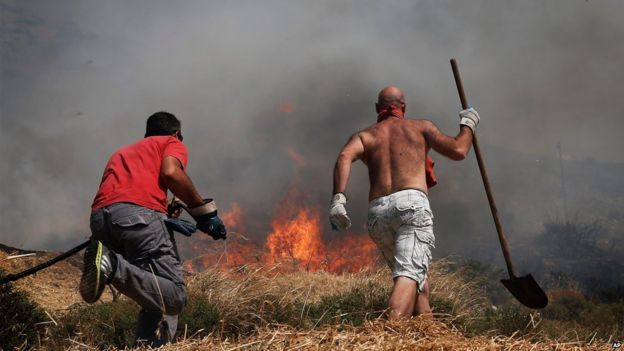
July 2015: municipal workers battle wildfire in Athens, Greece


"In August, biologists and environmentalists from around the world warned the presidents of Peru, Brazil and Bolivia about the dangers of devastating fires in what they said might be the region's worst drought in at least half a century."

" ... since this morning, the fire has been quickly spreading through the northern neighborhoods of Haifa. This is a city next to the Mediterranean Sea. It's also right next to forests. And it's unseasonably dry here and also very windy, so the fire is spreading fast."

Seven American Appalachian states are not the only drought-stricken region of the world experiencing wildfire conflagrations at this time. In the case of Israel some fires may be due to arson, as they are in the Appalachians. Such events are being called "terrorism" by Israeli officials (see second report, below). But the biggest terror is that during an extended dry period it doesn't take arson to set off huge wildfires that race through thousands of acres like a runaway freight train.

The likely cause of the wildfire outbreak in Peru, while not arson in the technical sense, is just as bad as arson under the present circumstances. It's the slash-and-burn method used by farmers there since ancient times for land clearing. Clearly the Andean farmers didn't understand what climatologists had realized:  the rain pattern in their region changed. (The same lack of awareness happened in Siberia a year or two ago, with devastating consequences.) 

The same would be true for Haifa, Israel's third-largest city, which has a Mediterranean climate. (Tiny Israel actually has two climates.) No matter how dry it gets in that kind of climate, historically there's just enough rain to prevent vegetation from completely drying out. This spares the regions from devastating wildfires. 

However, increasingly, extended droughts in a region mean it can become completely parched before rains appear. (Californians have learned the lesson the hard way during their  years-long drought in parts of the state).  So even if the change in the rain pattern is only temporary, the process of desertification leaps ahead in the wake of large-scale wildfires in drought-plagued regions. 

This sets in motion an ever-quickening vicious cycle that inexorably leads to a change in a micro-climate, leading to longer droughts, leading to more wildfires, leading to faster desertification.

But at least the wildfires in Peru and the seven U.S. states are happening in regions with sparse human populations. The nightmare scenario in Israel the past few days is that the wildfires invaded a large city. The same happened in Greece just last year.    

PERU


November 24, 2016 -  9:18pm EST
Wildfires tear across drought-stricken parts of Peru
Reuters
Wildfires have torn through more than 22,000 hectares (54,363 acres) of forest, protected areas and farmland in drought-stricken parts of Peru as the Andean country suffers one of its driest periods in years, authorities said on Thursday.

The spate of wildfires in the past week was likely started by accident after peasant farmers burned fields to prepare them for planting, said Edgar Ortega with Peru's Civil Defense Institute.


Strong winds fanned the flames that quickly crossed the Andean regions of Cajamarca and Lambayeque in northern Peru, which are experiencing prolonged droughts, Ortega said.

Fires have been contained in five nature reserves, including the Laquipampa Wildlife Refuge that is home to the protected spectacled bear, the inspiration for the Paddington Bear character in English children's literature, said Cecilia Cabello with Peru's protected areas agency Sernanp.

The charred remains of spectacled bears and other wildlife have been found in some areas, said Cabello.

Peru is experiencing one of its driest years in two decades, according to Peru's forest service Serfor.

In September, wildfires along the Ene River in a southern Amazonian region destroyed some 20,000 hectares (49,421 acres) of rainforest.

Less rain due to climate change and last year's El Nino weather pattern have made the Amazon drier than usual, scientists have said.

In August, biologists and environmentalists from around the world warned the presidents of Peru, Brazil and Bolivia about the dangers of devastating fires in what they said might be the region's worst drought in at least half a century.

"One of the most worrisome signs of global climate change is an increase in the frequency of severe droughts in the Andean-Amazonian region," they said in an open letter delivered by the NGO Pronaturaleza. "Preventing a potentially extensive emergency is a million times preferable to having to confront it."

Peru's military has deployed planes and helicopters to douse the flames with water, but firefighting has been constrained by high altitudes and difficult geography in some Andean provinces.

"In some areas the fires are contained but still not extinguished," Ortega told a news conference, adding that some hot spots are still expanding.

No one had died in the fires and no evacuations have been ordered, Ortega said.

(Reporting by Teresa Cespedes; Writing and Additional Reporting by Mitra Taj; Editing by Sandra Maler)


[END REUTERS REPORT]

ISRAEL

November 24, 2016 - 4:29pm EST
NPR
Tens of thousands of people in the Israeli [port] city of Haifa are evacuating their homes as military reservists, police, firefighters and even allied nations join forces to battle a wildfire threatening Israel's third largest city.

ARI SHAPIRO, HOST, "All Things Considered" NPR show:

Israel's third-largest city is on fire. In Haifa, tens of thousands of people have evacuated their homes. Military reservists, police and firefighters are performing search and rescue operations. Other countries have even sent aircraft to help. Political leaders say this could be politically motivated arson. NPR's Daniel Estrin is on the line from Jerusalem. 

Describe the scene in Haifa for us. How is the fire affecting the city?

ESTRIN: Well, since this morning, the fire has been quickly spreading through the northern neighborhoods of Haifa. This is a city next to the Mediterranean Sea. It's also right next to forests. And it's unseasonably dry here and also very windy, so the fire is spreading fast.

Homes have been engulfed in the flames. At least 60,000 or so people have been evacuated from the city. Roads have been clogged with cars leaving the city. At least one prison has been evacuated, and universities have also been evacuated, and military reservists have been called up, even some residents trying to put the fires out by connecting hoses from their apartment buildings. But so far there haven't been any serious injuries.

SHAPIRO: Tell us more about the belief that this might have been caused by politically motivated arson.

ESTRIN: Right. Well, the Israeli authorities are still trying to figure out exactly what caused the fires. There have actually been a number of fires in the city, and authorities say they suspect that some of them were due to negligence, like someone tossing a cigarette, and some of them were likely politically motivated arson, a kind of anti-Israel attack. You know, we've seen over the last year a number of Palestinian knife stabbings and other kinds of attacks on Israelis, and the suspicion is that this might be another kind of attack. Israeli Prime Minister Benjamin Netanyahu called it today a terror.

It could have been that some of the fires began accidentally and then arsonists joined. But there is a hashtag in Arabic that's been trending on Twitter - #israelisburning - kind of celebrating the fires because it's not just in Haifa. There have been fires throughout the country for the last three days.

SHAPIRO: There is an international effort to put out the fires, a pretty broad one. Tell us about that.

ESTRIN: Israel has gotten help from a number of countries - Greece, Italy, Croatia, Russia, Cyprus also. They've all sent firefighting airplanes, which will dump large amounts of water on the flames. And Turkey has also offered to send a large firefighting plane, and that's interesting because Turkey and Israel formally reconciled this summer and they normalized relations after six years of a soured relationship. So at least 10 firefighting airplanes are being sent here from all those countries. And it's significant because it's not that often that you see that kind of international support for Israel.

SHAPIRO: NPR's Daniel Estrin speaking with us from Jerusalem on the fires raging in Israel and the international response to them. Thanks a lot.

[...]

[END REPORT]

********

Thursday, November 24

"EU Parliament Votes in Favor of Resolution to Freeze Turkey's Accession" UPDATED

Updated report from Sputnik on Parliament vote.

****

BREAKING NEWS
Sputnik 
14:21 - 24.11.2016 (updated 14:31)

The European Parliament has voted on Thursday in favor of a non-binding resolution on freezing Turkey's EU accession talks.

Only 37 lawmakers rejected the resolution while 479 voted in favor. The resolution is non-binding. The resolution's text was augmented with a phrase that the European Parliament was worried by Turkish President Recep Tayyip Erdogan's critical statement on the Lausanne Treaty. 


DETAILS TO FOLLOW

[END REPORT]

*******

Wednesday, November 23

EU Parliament takes another step toward declaring war on Russia

The European Union Parliament has decreed that Russian news sites are on par with Islamic State propaganda.

See also Sputnik's report on the resolution.

'At war with Russia': EU Parliament approves resolution to counter Russian media ‘propaganda’
Published time: 23 Nov, 2016 12:22 Edited time 17:31
RT

MEPs in Strasbourg have voted on a non-legislative resolution which calls for the EU to “respond to information warfare by Russia.” RT and Sputnik news agency are alleged to be among the most dangerous "tools" of "hostile propaganda."

[Russian President Putin's remarks, which I've placed at the end of this report]

In the Wednesday vote, 304 MEPs supported the resolution based on the report ‘EU strategic communication to counteract propaganda against it by third parties’, with 179 voting against it and 208 abstaining.

Written by a Polish member of the European Conservatives and Reformists (ECR) group, Anna Fotyga, the report alleged that Moscow aims to "distort the truth, provoke doubt, divide the EU and its North American partners, paralyze the decision-making process, discredit the EU institutions and incite fear and uncertainty among EU citizens."

The report suggests that Moscow provides financial support to opposition parties and organizations in EU member states, causing disintegration within the bloc.

At the same time, Russia is accused of "information warfare," with such entities as RT TV channel, Sputnik news agency, Rossotrudnichestvo federal agency and the Russkiy Mir (Russian World) fund alleged to be among its most threatening propaganda "tools."

The document places Russian media organizations alongside terrorist groups such as Islamic State (IS, formerly ISIS/ISIL).

The report also mentions some "social media and internet trolls" from Russia who are thought to "challenge democratic values."

It called for the establishment of measures to tackle the perceived Russian propaganda threat, by means of "investing in awareness raising, education, online and local media." It also suggests stronger cooperation between the EU and NATO "on strategic communication."

Sputnik has already appealed to the UN, the Organization for Security and Co-operation in Europe (OSCE) and a number of international journalists' organizations and NGOs, including Reporters Without Borders, to take measures to stop what it considers to be interference into freedom of speech in the EU.

"The resolution hits straight at a number of respected media, including Sputnik agency, and has an aim to stop their activity in the EU. Moreover, the resolution bluntly contradicts the EU's own human rights and freedom of press norms," reads the letter signed by Sputnik Editor-in-Chief Margarita Simonyan.

During the parliamentary debate that preceded the vote, MEPs campaigning for the resolution said the EU was "at war with Russia, on a collision course with each other traveling faster than a jet fighter," and that with an alleged "aim to split Europe, the Kremlin forces its information into our countries."

Before the Wednesday vote, the document had been criticized by some MEPs, who called it both "insane" and "ridiculous." The EU "desperately needs an enemy, be it Russia or any other," that it can blame for any of its own failures, French MEP Jean-Luc Schaffhaueser told RT.

Spanish MEP Javier Couso Permuy said "it fosters hysteria against Russia," while British MEP James Carver noted the report is "worryingly reminiscent of the Cold War."

The Russian authorities have always treated foreign media working in Russia with respect, and have “never discriminated” against journalists from other countries, Russia’s Foreign Ministry spokeswoman Maria Zakharova said in an interview with Rossiya 1 TV channel.

Moscow has never prevented anyone from making reports from Russia based on their contents and ideology, the diplomat said, adding that it now might be forced to act accordingly and respond to the EU’s moves if Russian journalists are oppressed in the West. “It’s not our choice, and we don’t want to fuel tensions,” she said.

Moscow earlier said it would be forced to take reciprocal steps to the EU lawmakers' "unfriendly actions." Having called the MEPs' move "cynical," the Russian Federation Council member on international affairs, Igor Morozov, said that European lawmakers "should be aware that their unfriendly actions" would cause a "very tough response" from Moscow.

[...]

The EU Parliament's resolution demonstrates "political degradation" in regard to the "idea of democracy" in the West, Russian President Vladimir Putin said on Wednesday, commenting on the vote.

Putin pointed out that while "everyone tries to lecture" Russia on democracy, European lawmakers themselves resort to a policy of restrictions, "which is not the best way" to deal with any issues.

"The best approach is an open discussion, in which bright and solid arguments to support one's point of view should be presented," Putin said.

Adding that he hopes the Western move to "counter Russian propaganda" won't lead to serious restrictions, the president congratulated RT and Sputnik journalists on their work.

[END REPORT]

********

Wildfires rage across 7 parched US southern states: freak event, arson, or climate change?

Good Lord

 Photo by "Aqua" satellite NASA/Goddard/ Jeff Schmaltz/Lynn Jenner/EOSDIS/Inciweb
November 12, 2016 (Image via PBS Newshour)

Below, two news reports on the wildfires, each with a very different emphasis:

November 22, 2016 - 6:51 PM EST
How big droughts, forest fires could be the new normal in Appalachia
By Nsikan Akpan, digital science producer for PBS NewsHour
PBS NewHour
[See website for weather graphic and photo of fire haze]
The South is burning. Wildfires have burned more than 100,000 acres across seven states in the southern Appalachian Mountains since late October. Of the 44 ongoing blazes, the biggest struck northern Georgia and western North Carolina, where whole towns have fled as part of a slate of mass evacuations.
All of which, scientists say, is pretty weird.
“It’s very rare to have this many fires burning this amount of area in the Southeast,” U.S. Forest Service ecologist James Vose. “It’s typically a wet climate, especially in that southern Appalachian region where these fires are occurring.”
This year, the situation changed. The Southeast has experienced a once in a generation drought, with the area seeing little to no rainfall at all since September. 
Columbia University bioclimatologist Park Williams said the epicenter of the drought — the spot between northern Georgia, eastern Tennessee and the western Carolinas — rivals conditions typically witnessed in the American West.
More than 47 million people live in these southern drought areas, which extend from Oklahoma to Virginia, according to the Associated Press.
Those regions are definitely experiencing a one in 50 year event,” Williams said. This aridness arrived just as autumn trees across the region shed their colorful leaves — a highly flammable fuel for wildfires.
Yet climate change indicators suggest droughts of this magnitude are becoming the status quo, Vose said. Though Southeast climate leans toward abundant rainfall, the region is no stranger to drought. It cycles between stretches of dry and moist. But since the 1980s, droughts have become more frequent in the Southeast. Vose said these dry spells are also growing longer, meaning it’s drier for longer when it’s dry, and it’s wetter for longer when wet.
In the past, these dry periods would be interrupted by a rainstorm every couple of weeks, which stymied large fires, Vose said, but the new norm of extensive dry periods means that there is no rainfall to keep the fires in check.
“Consecutive dry periods are predicted to occur as a result of anthropogenic [man-made] climate change,” Vose said. “These trends make larger area burns and more fires perhaps more likely in the future.”
An onslaught of regular droughts will impose benefits and strains to southeastern wildlife. Many native water-loving pine trees will falter, but oak forests thrive in drought-stricken areas, especially those cleared by fire. The human toll may be harder to afford. More than 200 patients landed in the hospital last week in Chattanooga, Tennessee due to breathing difficulties related to wildfire smoke plumes. So far, the U.S. Forest Service has spent $45 million on firefighting expenses.
What triggered the latest wildfires remains unknown, but arson investigations are underway in Georgia, Tennessee, North Carolina and Kentucky.
[END REPORT] 
PBS Comment Section, in response to the above report:
owl905 
A 'once in 50 years event' isn't a typical signal of Climate Change. If once in 50 turns into a once in 10 pattern -- that's an example of Climate Disruption.
AMS analyzes about 30 extreme weather events per year, and looks for fingerprints of AGW/CC in them:
"https://www.ametsoc.org/ams/in..."
Even a read of one year's review is worth the time and effort. It tries to avoid the 'observational bias' of seeing a freak event as a barometer for a trend.
November 23, 2016 - 12:22 AM EST
Firefighters make progress in wildfires, but threat remains By Jeff Martin
THE ASSOCIATED PRESS
In North Carolina, most of the large fires burning in the western part of the state are suspected arsons ...
ATLANTA (AP) -- Firefighters are gaining ground in their efforts to suppress large wildfires burning in the Southeast, but several blazes continue to creep into new areas - and investigators say more fires are being lit each day by suspected arsonists.
There are 44 uncontained large fires in the South, covering a total of more than 120,000 acres, national fire officials said Tuesday.
Arson investigations are underway in Georgia, Tennessee, North Carolina and Kentucky.
In Tennessee, firefighters have responded to 27 new fires since Friday, and 19 of them are suspected arsons, the Tennessee Department of Agriculture reported. Most of those recent blazes are relatively small, the largest being a 452-acre wildfire northwest of Knoxville.
[Pundita Note: See also Nov 15 AP report, which mentions, "Of the 1,238 wildfires in Tennessee so far this year, officials suspect arson in almost half of them."]
The Southern forests have caught fire amid a relentless drought. More than 47 million people are now living in drought areas, which stretch from Oklahoma and Texas all the way east to the Carolinas and parts of Virginia, according to the latest information from the National Drought Mitigation Center.
In recent days, high winds and falling leaves have been among the toughest challenges firefighters have faced, authorities say.
"Leaves are the biggest concern for firefighters as the unseasonably late leaf fall continues to spread fresh fuel upon the fire," fire managers said in a Tuesday update on one of the South's largest wildfires, the nearly 14,000-acre Tellico Fire in western North Carolina.
More than 5,000 people from local, state and federal agencies have been battling the wildfires across the South, authorities said. The U.S. Forest Service is investigating what caused many of the larger blazes.
The U.S. Bureau of Alcohol, Tobacco, Firearms and Explosives has reached out to the Forest Service, offering to help investigate, Special Agent Larry Priester said. So far, he said, the agency has not joined the probe. "Their main focus now is just getting the fires contained," he said.
In North Carolina, most of the large fires burning in the western part of the state are suspected arsons, authorities have said. A $10,000 reward is being offered for information leading to the arrest and conviction of those responsible for them.
Some wildfire arsonists set fires for the thrill of it, while others are motivated by social or political causes, according to documents from the U.S. Fire Administration.
"We've had people in the past who said 'I like the lights of the fire,'" said Brian Haines, a spokesman with the North Carolina Forest Service. "People have strange reasons for starting fires."
There have been a handful of arrests in some of the smaller fires, including a man in Kentucky whose hobby was to broadcast weather reports on social media. He was charged with arson after police said he admitted to starting a wildfire to draw attention to his selfie videos on Facebook.
The fear is that whoever has started many of the large blazes might continue to set more fires.
[...]
The Guardian reported on November 2 that "the drought conditions are being caused by a deflected jet stream, carrying moisture and rain further north and allowing high pressure to persist through the southeastern US."   

So what's going on in those Appalachian states? Maybe a perfect storm of factors.      

Yet despite the very high incidence of arson cited in the AP report, there is not a word from interviewed officials to suggest that some of the deliberately-set fires could be related to forest clearing for marijuana farming. 

Of course it's still early days with investigations. Yet I hope that Associated Press will eventually launch their own investigation. From all I've read about illegal pot growing in those mountains, I suspect officials there have averted their eyes about the connection between wildfires and pot growing. If so, they have to stop doing that, given the change in the weather pattern in U.S. southern states noted in the PBS report. 


In any case, from the AP report it looks to me as if much stiffer penalties need to be imposed for 'wildfire arson' -- and use of the slash-and-burn land clearing method.

********