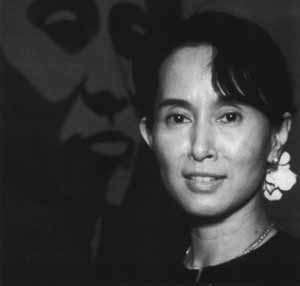
I meant to put this post up yesterday but I discovered it's really hard to type and dance around my desk at the same time. So I finally gave up on the attempt and just danced for joy. Here are the headlines that got me dancing -- and I'm sure the headlines also got Johnny Cash smiling down from his cloud in heaven (the campaign anthem of Aung San Suu Kyi's supporters is inspired by a Cash song):
Guardian: Burma celebrates Aung San Suu Kyi's apparent landslide election victory: Nobel laureate expected to take office for first time after landmark poll that could see end to 50 years of military rule
Agence France-Presse: No serious complaints in Myanmar vote: ASEAN chief.
Of course there were some shenanigans at the ballot box -- people rising from the dead to cast a vote, etc., but it's very clear that Myanmar President Thein Sein didn't want complaints from international election monitors to interfere with his star turn at the ASEAN summit on Tuesday. And, if one considers the courage he's and intelligence he displayed in somehow talking the country's generals into making Myanmar an upstanding member of ASEAN, he wanted nothing to interfere with the star turn of Myanmar's people on the world stage.
Success has been in the air for weeks; if the by-election was even halfway fair, Aung San Suu Kyi would win by at least a healthy margin. Rumors were flying last week that the government had already offered her a cabinet position and that she'd turned it down, saying being a parliamentarian was enough for her.
"Auntie Suu" was herself in such a good mood by last week that the 66-year old daughter of Burma's oops! Myanmar's founding father couldn't resist a little banter with a serious-faced Western reporter. He inquired worriedly about her health, which had been strained by the killer pace of campaigning. She told him with a grin that her health was so delicate she just might faint if the press asked her any tough political questions.
My celebratory mood was short-lived -- it is always is -- as I mulled over a long list of recriminations I might hurl at various parties because what happened yesterday in Burma could and should have happened decades ago. But I don't think Auntie Suu would appreciate my acid pen at this time. So I'll limit myself to saying to the Christian missionaries, the Soros Crowd and the Gene Sharp Crowd that if you'd like to see Burma's generals lower the boom again, push the envelope again. Are we clear? If so I'm willing to let the past remain where it is.
Now, as to whether Burma is the next Asian Tiger economy: the problem with turning your country into a fortress for decades is that the country falls greatly behind; add to that ethnic insurgencies fomented by outsiders and you end up with a fourth-world country. That's where Burma is today. But the country's potential is so great that economists and country analysts who specialize in ASEAN countries are seriously asking the question.
Here are two answers: one, from IHS Global Insight's Asia-Pacific Chief Economist Rajiv Biswas, is upbeat; the other, from Joshua Kurlantzick, a fellow for Southeast Asia at the Council on Foreign Relations, full of caution; both should be studied.
As to whether there's a tiebreaker, I think the money quote is found in Biswas's analysis:
From an economic perspective, Burma’s economic reforms and tariff liberalization will be important to ASEAN’s objective to create a single market for trade in goods by 2015.To meet the objective, Myanmar can count on help from other ASEAN members -- a lot of help.
Finally, a word to my own dear government: Don't tack 'defense-related' issues onto lifting sanctions that you said at the time you were imposing for humanitarian reasons.
Need I remind you that the Afghans are now so justifiably worried that their country is going to become a battleground between Iran and the United States that recently a member of the Afghan senate lashed out at both governments, and Hamid Karzai backed him up.
With that thought in mind, don't try to use Myanmar as a staging ground against China. If you don't want to confront Beijing's leaders directly, don't use the world's dirt-poor as a stealth weapon. I don't want to hear, 'They do it too.' Are you Chinese? And while I'm on the subject, stop weaponizing in the name of 'freedom' every principle Americans cherish.
Sorry, Auntie Suu. We're actually all for peace and love here in Punditaland.

