Translate

Showing posts with label Afghanistan war. Show all posts

Friday, June 25

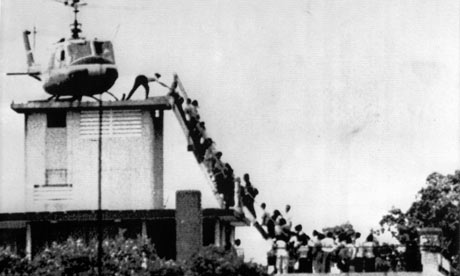
The last American helicopter out of Kabul

General Stanley McChrystal was barely out the door when the Obama administration gave the nod to America's two most influential newspapers that it was time to start telling the truth to the American public about the Afghanistan War. Thusly, The New York Times mentioned in passing yesterday that Pakistan had been fighting a proxy war against the United States in Afghanistan:
... Pakistan is presenting itself as the new viable partner for Afghanistan to President Hamid Karzai, who has soured on the Americans. Pakistani officials say they can deliver the network of Sirajuddin Haqqani, an ally of Al Qaeda who runs a major part of the insurgency in Afghanistan, into a power-sharing arrangement. In addition, Afghan officials say, the Pakistanis are pushing various other proxies, with General Kayani personally offering to broker a deal with the Taliban leadership. Washington has watched with some nervousness as General Kayani and Pakistan’s spy chief, Lt. Gen. Ahmad Shuja Pasha, shuttle between Islamabad and Kabul, telling Mr. Karzai that they agree with his assessment that the United States cannot win in Afghanistan, and that a postwar Afghanistan should incorporate the Haqqani network, a longtime Pakistani asset. ... Despite General McChrystal’s 11 visits to General Kayani in Islamabad in the past year, the Pakistanis have not been altogether forthcoming on details of the conversations in the last two months, making the Pakistani moves even more worrisome for the United States, said an American official involved in the administration’s Afghanistan and Pakistan deliberations. “They know this creates a bigger breach between us and Karzai,” the American official said. Though encouraged by Washington, the thaw heightens the risk that the United States will find itself cut out of what amounts to a separate peace between the Afghans and Pakistanis, and one that does not necessarily guarantee Washington’s prime objective in the war: denying Al Qaeda a haven. It also provides another indication of how Pakistan, ostensibly an American ally, has worked many opposing sides in the war to safeguard its ultimate interest in having an Afghanistan that is pliable and free of the influence of its main strategic obsession, its more powerful neighbor, India. The Haqqani network has long been Pakistan’s crucial anti-India asset and has remained virtually untouched by Pakistani forces in their redoubt inside Pakistan, in the tribal areas on the Afghan border, even as the Americans have pressed Pakistan for an offensive against it. General Kayani has resisted the American pleas, saying his troops are too busy fighting the Pakistani Taliban in other parts of the tribal areas. But there have long been suspicions among Afghan, American and other Western officials that the Pakistanis were holding the Haqqanis in reserve for just such a moment, as a lever to shape the outcome of the war in its favor. On repeated occasions, Pakistan has used the Haqqani fighters to hit Indian targets inside Afghanistan, according to American intelligence officials. The Haqqanis have also hit American ones, a possible signal from the Pakistanis to the Americans that it is in their interest, too, to embrace a deal. ...
The Washington Post chimed in today:
... The State Department and the U.S. Agency for International Development, which have quadrupled the number of civilians in Afghanistan in the past year, are still not confident of civilian capabilities. The Afghan government clearly cannot carry the burden. So the administration is looking for a decent, negotiated exit. The Pakistani intelligence service would act as a surrogate (and guarantor) for the Taliban, as Slobodan Milosevic did for the Bosnian Serbs 15 years ago. The Americans would deliver Kabul. The deal might leave the Taliban in control of large parts of Afghanistan but keep al-Qaeda in Pakistan, where Islamabad would agree to deal harshly with its fighters. Secretary of State Hillary Clinton has repeatedly enunciated her "red lines" for such an agreement: Taliban renunciation of violence and willingness to abide by the Afghan constitution (which guarantees women equal rights), as well as refusal to allow al-Qaeda or others to operate against the United States. ...
So let's get this straight. Pakistan's military promises to start dealing harshly with their asset al Qaeda if their other asset, the Taliban, were put in charge in Afghanistan. What Pakistan's generals could offer in return was to allow American personnel to evacuate Kabul safely and cross their hearts and hope to die they wouldn't unleash al Qaeda on the Afghans until after the last American helicopter had left Kabul. Ironically, before I learned about The New York Times report yesterday, I disagreed with The Glittering Eye's blogger, Dave Schuler, about whether Afghanistan could be considered another Vietnam. That happened while I was visiting Mark Safranski's Zenpundit blog. He'd featured two of my most recent posts on Pakistan and I'd joined the discussion about them at the Zenpundit comment section. Dave wrote:
You are … get ready for it … refighting Vietnam. Last night on OTB Radio Pat Lang, James Joyner, and I agreed that’s a pretty fair characterization of the last 9 years. With Pat and I having lived through that period (he in harm’s way in Southeast Asia) we both find it pretty darned sad.
I replied:
Dave, IMHO Afghanistan is not Vietnam although I understand the temptation to see it as such. The U.S. was not supporting the Red Chinese and Russian armies and collaborating with them while fighting their proxies in Vietnam, whereas the U.S. is going a long way toward supporting the Pakistani military and collaborating with it while fighting its proxies in Afghanistan. There are several other key differences but in short Afghanistan is a unique situation for the U.S. military; they won’t be able to fully appreciate this until they confront Pakistan’s role and admit that to leave Afghans in the care of Pakistan’s military would be to set off a humanitarian disaster on a scale the rest of the world would not accept. And in these days of satphones, camera cell phones, and internet social networks there would be no way for the U.S. government to hide the atrocities. That, too, is another difference between Vietnam and Afghanistan. If Americans throw up their hands and say we can’t afford to stay in Afghanistan forever — it won’t be forever, not with Afghanistan’s vast mineral wealth — but let this be a hard lesson that there are consequences to treating entire peoples as chess pawns, which is what Americans did to Afghans during the Cold War. The Pottery Barn rule does apply here, as it did in Iraq.
But another blogger, Lexington Green at Chicago Boyz, said it best:
This isn’t Vietnam because, unlike in Vietnam, we are supporting Diem (Karzai), building ARVN (ANA) and at the same time we are financing and arming the DRV (Pakistan), financing the Vietcong (Taliban), paying for the PAVN (Pakistani Army), and pretending that the country which is providing sanctuary to the VC (Pakistan) is our "ally." We have been paying for both sides of the same war at the same time, while getting our own people shot on one side of it. If there is a strategic "most stupid" scenario, that may be it. If it were only as bad as Vietnam, it would be progress. The one thing that was worse about Vietnam was we were sending draftees over there, getting them killed in droves, and pretty much blowing up our own society in the process. If Petraeus cannot restore some sanity, no one can. If he stays on the current course, we will lose, and Pakistan will win, and we will never have acknowledged who our real enemy was.
Well, Americans can be grateful that President Obama decided it was time for everyone to face up to reality. So I guess that means Dave gets the last word.

********

Thursday, June 24

Anti-COIN rebellion catches fire with Stanley McChrystal's departure

It might have seemed Mark Safranski spoke to soon when he announced this January that The Post-COIN Era is Here. But with General Stanley McChrystal's departure as the top commander in Afghanistan the disagreements about counterinsurgency and its applications in Afghanistan, which had been largely confined to military/ academic circles and milblogs, have suddenly gone mainstream. Writing for Newsweek today, Michael Hirsh observed:
[T]he counterinsurgency (COIN) strategy that McChrystal championed and Petraeus virtually invented may be fatally flawed, at least as it’s practiced in Afghanistan.
[...]
This grim new reality in Afghanistan in turn has given new life to a kind of insurgency-against-counterinsurgency thinking inside the military. Critics say COIN has gone too far in supplanting traditional war fighting in U.S. military doctrine (this is something of an irony since it wasn’t that long ago that the COIN types were saying that they were being ignored). These dissidents lament the “atrophying” of traditional fighting skills, and they say the COIN virus has infected the Israeli military as well because it has done little but that in years of conducting ops against the Palestinians. The critics are targeting Petraeus and leading COIN thinkers like John Nagl, the president of the Center for a New American Security, which the journalist Tara McKelvey has called “counterinsurgency central in Washington.”
[...]
At the risk of playing the kid in The Emperor's New Clothes, I would point out for the hundredth time that COIN tactics haven't been delivering in Afghanistan because the bulk of the perceived insurgency is a proxy war mounted by Pakistan's military that's cleverly disguised as an insurgency. That's the same playbook Pakistan's military used in Kashmir against India's government.

If critics of the ISAF mission in Afghanistan don't soon differentiate between proxy warfare and insurgency they'll end up throwing the baby out with the bath water. Population-centric COIN worked just fine in Iraq because there was a genuine insurgency there. To ask it to fight a proxy war is asking it to do something it wasn't designed for -- particularly when the enemy is treated as an ally.

Wednesday, June 23

Why General Stanley McChrystal is going straight to hell

(Also see today's post, David Petraeus might study Kashmir if he doesn't want to repeat Stanley McChrystal's mistakes in Afghanistan, which discusses Pakistan's proxy war in Kashmir in light of the Taliban fighting in Afghanistan against ISAF troops.)
***********************************
posted by Pundita : 11/21/2009 08:53:00 AM

Saturday, November 21, 2009

Pakistan-U.S. relations: Why General Stanley McChrystal is going straight to hell

On or about August 30, 2009, Secretary of Defense Robert Gates received a detailed assessment of the military situation in Afghanistan that included a request for additional U.S. troops. The report was from General Stanley A. McChrystal, Commander, Nato's International Security Assistance Force (ISAF) and Commander, U.S. Forces Afghanistan. But as noted on the first page the assessment was a joint effort representing input from ISAF staff and the component commands.

On the matter of Pakistan the report noted:
Afghanistan's insurgency is clearly supported from Pakistan. Senior leaders of the major Afghan insurgent groups are based in Pakistan, are linked with al Qaeda and other violent extremist groups, and are reportedly aided by some elements of Pakistan's lSI.
A year earlier McChrystal's predecessor, General David D. McKiernan, delivered a franker assessment of the same situation. He stated flatly that he was certain there was a "level of ISI complicity" in the militant areas of Pakistan and within organizations like the Taliban.

McKiernan's observation came on the heels of a secret visit by a top CIA official to Islamabad; the visit was to directly confront Pakistan's most senior officials with new data about ties between the ISI and militants operating in Pakistan tribal areas.

It seems the CIA met with the same stonewalling Britain's government encountered in 2006 when they brought virtually the same charges to Pakistan because their next move echoed the one taken by Britain's Ministry of Defense: the CIA leaked news of the trip to a major press outlet -- in their case, The New York Times.

These naive attempts to embarrass a government comprised of terror-masters, dope dealers and professional beggars skilled at wheedling billions in aid out of the West came to nothing, beyond the ISI's decision to outsource more of their oversight of terrorist attacks on NATO troops to front agencies such as the SSG.

And General McKiernan hardly needed to study a classified CIA report to know the score. Over a period of years many intelligence analysts and journalists from India, Pakistan, Europe and the USA, not to leave out Afghanistan's President Hamid Karzai and his intelligence advisors, have spent years publishing books, churning out reports, and generally doing everything they could think of to impress on Washington that Pakistan is the biggest problem.

However, look at it from Washington's viewpoint. You know how it is when you can't find the keys you lost inside the house: you go outside to search because the light is better out there.

So Washington continues to search high and low for solutions in Afghanistan that don't address the biggest problem there.

Fine. Understood. The United States has been covering Pakistan's ass for 60 years, on one excuse or another. It is a matter of public record that starting in the 1950s the U.S. government knew of A. Q. Khan's activities to sell nuclear weapons technology to any buyer and took no action to roll up his WMD network until 2003; and that the U.S. government helped the ISI sweep Daniel Pearl's murder under the rug.

But you need to draw the line when it comes to cooperating with a government that's ordering the shooting and maiming of your own troops, or you need to face a charge of treason.

The situation of Pakistan-directed attacks on ISAF troops has not been resolved. I believe that to call for more troops under such circumstances is criminally negligent.

General McKiernan might have broken rank or trod on the State Department's turf by publicly speaking about the ISI in blunt terms. Whether this might have added to Gates's displeasure with his performance, I don't know. The reasons given for the very unusual decision to fire a commander of his rank and under such circumstances have never stacked in my eyes.

I will not explore the decision here, beyond asking whether the Department of Defense thought to do a study analyzing the increased attacks on NATO forces in Afghanistan in light of any increased ISAF intelligence-sharing with Pakistan's military.

Another question I'd like answered: were any known instances of ISI spying on ISAF movements analyzed in light of the increased attacks during the same period?

From all the accounts I've read, it seems the U.S. government's public response to Pakistan's duplicity tends to echo Pakistan's claim that "rogue" elements of the ISI and military are responsible for any attacks on NATO troops. Such claims would fly in the face of history.

Writing for the January 2, 2008 edition of the Virginia Quarterly Review, Alan Brody gave the clearest summary I've ever come across of the Pakistan-backed rise to power of the Taliban.

Brody, a graduate of Harvard and the University of Iowa, worked for UNICEF for 22 years before his retirement in 2006. In 1993 he was assigned as the planning officer and deputy head of office for UNICEF in Afghanistan to deliver humanitarian aid. The periodic outbreaks of war between factions occupying Kabul, Afghanistan's capital, prevented him from living in the city. He worked from an office across the border, in Peshawar, in Pakistan's Northwest Frontier Province -- itself a very dangerous a place, a place of "intrigues," as Brody observed. But he commuted to Afghanistan and his position gave him a bird's eye view of the battles for Kabul during that era, which the Pakistan-backed Taliban forces finally won.

Writing elsewhere Brody has observed that the mujahideen groups in Afghanistan during the early 1990s were "bickering and fighting among themselves, with support to these different factions coming from their patrons in Pakistan, Iran and Saudi Arabia."

There were indeed different mujahideen factions, but it was Pakistan's Taliban that finally overran Kabul then took over much of the country until the combined U.S.-U.K. operations in 2001 routed them.

And for those who don't remember it or never knew, the U.S. sponsored evacuation dubbed "Operation Evil Airlift" made it clear that Pakistan -- a vaunted U.S. ally -- was at war with U.S. and U.K. during the 2001 invasion. I've provided the entire Wikipedia article on the operation at the end of this post. If you're new to the story and have relatives serving in Afghanistan, better belt down a stiff drink before you read it.(1)

One may lay the blame for Operation Evil with Vice-President Dick Cheney, and his act could be construed as treasonous if one doesn't know it was par for the Cold War course. But the Cold War is long gone, and Cheney has been gone for office for close to a year. Yet still the U.S. government continues to downplay that Pakistan did not create the Taliban to fight the Soviets; they did it because they saw the U.S.-led effort against the Soviets in Afghanistan as their means to take over the country without running into stiff international punishment.

And the U.S. government continues to mix apples with oranges: there are surely "rogue" elements in Pakistan's military and intelligence agency -- "rogue" meaning Pakistanis who want a Taliban-style government in Pakistan. But the entire Pakistan defense establishment and the civilian government are united in support of their decades-old cold war against India. As part of that war they want to regain the control of Afghanistan they lost because of Operation Enduring Freedom.

I think Islamabad's determination to control their neighbor has only increased with the recent discoveries of vast oil and gas reserves and key industrial/ military-use metal lodes in Afghanistan. With development, Afghanistan's fabulous store of natural resources can make the country one of the richest and even a major world power.

As long as the United States was chiefly preoccupied with Iraq, Pakistan's military was content to allow things to bump along in Afghanistan. But once the United States signaled a serious intention to build up Afghanistan's military and civilian government; once the U.S. began a close cooperation with India's external intelligence service, which provided the U.S. defense establishment with considerable evidence about Pakistan's actions against Kabul and the ISAF; and once it was evident to Islamabad that the CIA was not going to neutralize Hamid Karzai, who had allied his government with India's, the targeting of U.S. forces had to be stepped up.

The ISAF assessment tip-toes around the situation:
Indian political and economic influence is increasing in Afghanistan, including significant development efforts and financial investment. In addition, the current Afghan government is perceived by Islamabad to be pro-Indian. While Indian activities largely benefit the Afghan people, increasing Indian influence in Afghanistan is likely to exacerbate regional tensions and encourage Pakistani countermeasures in Afghanistan or India.
I'd like to know what part of Indian aid is not benefiting the Afghans. And there's no "likely" about it; any doubts that regional tensions are already exacerbated, study the two suicide bombings outside the Indian embassy in Kabul.

No amount of bribing, either from the USA or any other government or agency, is going to change the situation. Pakistan's government will take the bribes -- either in cash, loans, or military equipment -- then continue on as they've done. Why not? They have history to guide their confidence that they can play the WMD blackmail card whenever the NATO countries bring pressure on them. That's what they've been doing since 2001; without a significant change in U.S. policy they'll continue in exactly the same pattern.

Those who assume Pakistan is turning over a new leaf because of several Taliban attacks on the ISI or military facilities need to read B. Raman's crash course on Taliban factions, which he dashed off in May 2009 for Forbes magazine. He wrote in answer to a reader who asked why Taliban attacked the ISI (if the ISI indeed controlled them).

The answer has to do with internal disputes -- with tribes and sub-tribes who're mad at Pakistan's government -- and who're also mad at the USA for helping to prop up the government. (Take special note of Raman's mention of the Lal Masjid massacre.) The tribes in the pay of the ISI who attack ISAF troops are a different story.

Does all this mean there is no actual insurgency in Afghanistan, just a proxy war being fought by Pakistan, and spillovers of tribal rage toward Islamabad? The answer is to first thin the forest of Pakistan's actions in Afghanistan, then see how many trees are left standing.

Things have turned very ominous in recent months because Afghanistan's north, including the region's biggest city, Mazar-e-Sharif, is coming under increasing attack from Taliban, who are bribing unemployed locals to work for them. There is a mystery attached to the situation:
[...] Karzai ... stunned the country in October when he announced that there would be [inquiries] into reports that helicopters had been transporting Taliban fighters to the north, adding that he had known about the action for some time.

It is widely believed that such air transit could only have operated with the knowledge of local and foreign powers who control air traffic. So conspiracy theories blossomed.

People wondered if southern politicians were stirring up the rebellion to undermine their northern rivals, or if international forces were fanning the flames of violence to provide an excuse for staying the country and exploiting its mineral wealth.

The regional head of the Afghan Human Rights Commission, Qazi Same, believes that “invisible hands” may be trying to destabilise the area. But he dismisses as completely illogical the idea that either local or international armed forces are involved,

“They suffer casualties every day. That they try to spread insecurity, logically that’s not believable,” he says. [...]
I agree with Same, but his observations suggest the "invisible hand" belongs to Pakistan. They backed the Taliban's struggle to conquer Mazar-e-Sharif prior to Operation Enduring Freedom. If Taliban had won the city they would have controlled the region, and that would have consolidated Pakistan's hold on the entire country.

If my analysis of the allover situation is correct, it would indicate the U.S. needs a different plan than the stepped-up counterinsurgency operation the ISAF report recommends, or at least a greatly altered plan.

It would also indicate that General McChrystal needs to yell at the top of his lungs, in public if necessary, about a holdover Cold War-era relationship between the U.S. and Pakistan that's getting many U.S. troops killed and injured for no good reason. And wasting billions of U.S. dollars.

There are a few other things the U.S. command could do in the short term to deal more wisely with Pakistan. That would include ditching the uninformed and self-defeating "Afpak" strategy. But I think I've given you enough reading material for one day, so I'll leave further discussion for a subsequent post.

1) Operation Evil Airlift, Wikipedia (See the article for the footnotes.)
The Airlift of Evil refers to the evacuation of thousands of Pakistani military personnel, Afghan sympathizers, and some members of the Taliban and Al-Qaeda from the city of Kunduz during the week before its capture by the forces of the Northern Alliance during the early days of the War in Afghanistan (2001-present).

The idea that the American military had aided the escape of potentially dangerous individuals was politically contentious, and sparked a debate in the western media. The first reference to the term appeared in a column on msnbc.com. It is generally thought that the airlift was an attempt to avoid destabilizing the government of Pakistani President Pervez Musharraf, who, although an ally in the War on Terror, had historically supported the Taliban.

In 2008, more details have emerged in Descent into Chaos by Ahmed Rashid:

"One senior (U.S.) intelligence analyst told me, "The request was made by Musharraf to Bush, but Cheney took charge -- a token of who was handling Musharraf at the time. The approval was not shared with anyone at State, including Colin Powell, until well after the event. Musharraf said Pakistan needed to save its dignity and its valued people.

Two planes were involved, which made several sorties a night over several nights. They took off from air bases in Chitral and Gilgit in Pakistan's northern areas, and landed in Kunduz, where the evacuees were waiting on the tarmac.

Certainly hundreds and perhaps as many as one thousand people escaped. Hundreds of ISI officers, Taliban commanders, and foot soldiers belonging to the IMU and al Qaeda personnel boarded the planes.

What was sold as a minor extraction turned into a major air bridge. The frustrated U.S. SOF who watched it from the surrounding high ground dubbed it "Operation Evil Airlift."

Another senior U.S. diplomat told me afterward, "Musharraf fooled us because after we gave approval, the ISI may have run a much bigger operation and got out more people. We just don't know. At the time nobody wanted to hurt Musharraf, and his prestige with the army was at stake. The real question is why Musharraf did not get his men out before. Clearly the ISI was running its own war against the Americans and did not want to leave Afghanistan until the last moment."

Tuesday, June 22

RAND paper "Counterinsurgency in Pakistan," stuck in carrot-and-stick groove

AP's head's up about the RAND paper prior to its publication gave me hope that a major American think tank was recommending Washington abandon the carrot-and-stick approach to Islamabad. When I read the paper I saw my hope was in vain.

The paper's authors, Seth G. Jones and C. Christine Fair, did a decent job of pointing out some of the militant groups in Pakistan that receive state support. But far from recommending that Washington stop treating Pakistan's military and civilian leaders like recalcitrant donkeys they advised finding tastier carrots and bigger sticks.

Friday, June 18

Sahib Sebastian Gorka instructs John Batchelor's WABC radio audience on Afghanistan and irregular warfare

On June 11 Sebastian Gorka made his second appearance on John Batchelor's nationally syndicated radio show on 77 WABC-AM. According to attenuated résumés posted at websites for three of the many organizations Gorka is associated with (The Atlantic Council, College of International Affairs, and Foundation for Defense of Democracies -- all based in Washington) he is an internationally recognized expert on defense reform, international terrorism, national security, and democratization.

Gorka first discussed irregular warfare, which he termed war conducted by non-state actors, and how it differed from Clausewitzian war theory, which is based on the Westphalian concept of the nation state and its attendant view of sovereignty and the mating habits of pandas; just checking, you need to stay awake for this.

I raise an eyebrow at Gorka's definition of irregular warfare; although the term is used in the way he described it, a glance through this Wikipedia article on Irregular warfare indicates that the more generally accepted term is that it's a standing military's use of forces that are not 'regular.' (Think a military's covert operations, etc.) However, I'm going to let that pass because there are so many terms now in use to denote the kind of warfare conducted by non-state actors that it's getting into the weeds to attempt to nail down precise terminology.

Batchelor asked Gorka to apply his explanation about irregular warfare to the NATO mission in Afghanistan and to dealing with types Batchelor called a "mixture of tribal logic and medieval rivalry" ranged along the Afghanistan border with Pakistan.

Below are my notes on Gorka's lecture and my replies; his remarks are shown in boldface. I've numbered his remarks for reference although the numbers don't necessarily reflect the order of his remarks. You might want to listen to the WABC podcast of the interview and peruse Gorka's résumé before proceeding.

1. Gorka: We have to see there's a gulf between understanding war in the Westphalian sense of war between states and this kind of warfare, irregular -- when it's not a state you're fighting but armed bands.

Pundita: The tribal bumpkins replete with beards and baggy pants are theater. They're a carefully constructed illusion meant to mask and implement a battle plan that was faithfully copied from the Pakistan military's irregular war against India's government in Indian Kashmir.

Every detail of the Afghanistan battle plan and its rationale is found in accounts of the Kashmir 'insurgency.' The detail is the very same at every single level -- right down to the recent assassinations of key government officials in Kandahar.

There are numerous books available on the topic but those who know nothing about Pakistan's proxy war in Indian Kashmir can read Rajeev Srinivasan's 2002 two-part article for Rediff. Here is Part I and Part II. The article is not a history of the Kashmir insurgency but it will put readers in the ballpark about what's really been going on in Afghanistan. And while Srinivasan freely admits he stretches a point by arguing that Kashmir "colonized" the rest of India, he uses the stretch to good effect.

2. Gorka: We talk about cooperation (between the U.S. and Afghanistan) but do we have a functioning state to deal with when Kabul does not exercise its power across the putative nation-state of Afghanistan?

Pundita: You remember President Hamid Karzai, eh? He's the fellow who was driven mad trying to understand how Washington thinks. For years he was under the impression that because NATO was occupying his country and all, it was their job to exercise power across his putative nation state.

When he learned otherwise he blurted, 'But I'm not Genghis Khan.' When the reply cabled back, 'Better learn how to be,' he began talking to himself. When last seen he was weaving baskets and stringing beads for therapy.

3. Gorka: We're dealing with a populace that doesn't necessarily think of itself as Afghan but rather thinks in terms of tribal affiliation.

Pundita: A survey taken a few years ago found that 70 percent of Afghans identified first with their nation and second with their ethnic heritage.

The majority of the other 30 percent, I maintain, would also see themselves as Afghans first if not for Pakistan's machinations in the country, which were supported by the United States of America during the Cold War, and which continue to this day.

While it's true that the British demarcated Pakistan and Afghanistan territories in such way that there are Pashtuns who can "lunch in Pakistan and go to the loo in Afghanistan," as one analyst put it, most of Afghanistan's Pashtuns intelligently prefer to be Afghans rather than a mouse that roared.

Reference the Pakistan regime's transparent attempt to sow yet more trouble among Afghanistan's Pasthuns by rushing through (this April) the renaming of NWFP (Northwest Frontier Province to "Khyber Pakhtunkhwa."

As to the 'Pashtun majority' in Afghanistan, which feeds into the Fox News Cable-CNN view of Afghans as AK-47 toting warlords, the majority is deceptive.

Yes, the Pashtuns are in the majority, but by such a slim margin over the Tajiks that one can fairly say Afghanistan's present ethnic demographic makeup has much in common with Canada at its founding. The French and British were the majority ethnic groups in Canada, with the indigenous or 'natives' a significant minority.

The big difference is that while there are ethnic minorities in Afghanistan, the two majority groups have more in common linguistically and in their heritage than the British and French. The Pashtuns and Tajiks are Iranic peoples and Dari (a dialect of 'Persian' or Farsi), is the lingua franca of the country. The 2009 CIA World Factbook estimates that over 50% of people in Afghanistan speak in Dari as their first language but only 35% of the population speak Pashto as their first language.

In any event Pashto, the language of the Pastuns, is also derived from the Iranic linguistic tree.

4. Gorka: The Westphalian order has failed in Afghanistan because a key aspect of sovereignty is the ability of the nation-state to defend its borders and Afghanistan has been unable to do this.

Pundita: Reference my reply to #2.

5. Gorka: We still haven't established what we want to achieve in Afghanistan. First we wanted to rout al Qaeda and now we want to create a functioning Westphalian state in Central Asia where there has never been one. America has to define concrete objectives in Afghanistan and we still haven't done so.

(Gorka was clearly including Afghanistan in Central Asia even though the country is also considered to be located in South-Central Asia.)

General David Petraeus was carrying out a plan in Iraq that was a straightforward version of what's called 'population-centric' counterinsurgency tactics -- which, because there was no functioning central government to speak of at the time in Iraq, skirted Baghdad and worked directly with provincial leaders.

That's what McChrystal has been trying to replicate in Afghanistan -- although there could be a conflict in goals between the United Nations, other ISAF commands and their respective governments, and possibly factions at the U.S. Department of State. There are an awful lot of chefs in the kitchen and maybe too few line cooks.

However, the biggest problem has been that they're up against a battle plan that's invisible to them. ISAF has been on the defensive in a proxy war it's confused with an insurgency. Reference #1.

6. Gorka: We're not fighting a military band with superior fighting power but a global ideology that is not constrained by rational cost-benefit analysis, and there is no limit to the [human] resources that can be deployed against us by followers of the ideology.

Pundita: The Pakistani military is solely guided by rational cost-benefit analysis. Yes there are hare-brains hopping around Afghanistan shooting people and themselves in foot in the name of ideology. But first thin the forest, then see how many of those ideologues are left.

6. When John asked Gorka whether he thought General McChrystal had learned the lessons of Afghanistan, Gorka hedged so much it's likely he was reluctant to criticize McChrystal in public. But Gorka did say that the irregular war McChrystal was being asked to fight in Afghanistan wasn't the war he was trained for. He also said that McChrystal had to answer to his masters in Washington.

As readers of this blog know I've had my issues with General Stan regarding his prosecution of the Afghanistan campaign. But I hope Gorka knows that Stanley McChrystal is a master of irregular warfare and a card-carrying COINdinista.

In summary, Sebastian Gorka is out of his depth when he talks about Afghanistan.