Translate

Showing posts with label BP. Show all posts

Tuesday, June 8

BP Gulf Crisis: Anderson Cooper and Billy Nungesser discuss success at using simple vacuum to clean heavy oil. Meanwhile, spill threat changes.

The following exchange is from a 'rush' transcript from the June 7 AC-360 show on CNN. Most of the first part of the conversation is between show host Anderson Cooper and Plaquemines Parish President Billy Nungesser, with Douglas Brinkley joining in toward the end. Plaquemines Parish (county), in suburban New Orleans, Louisiana, has been hit hard by the oil spill.

The last part of the discussion I've excerpted is between Anderson and CNN anchor Tom Foreman, who summarizes new evidence that there's a second large underwater oil plume. BP has been denying the existence of the underwater plumes.

Of course you can choose to watch the podcast of the show. But for readers overseas who still don't understand why Americans are so very angry at BP, here's just one part of the transcript, which I've put in more readable form:
[...]

BILLY NUNGESSER: But we've ordered skimmers. We've got vacuum trucks.

ANDERSON COOPER: And you actually went out -- you know, that's been the big thing, what to do with these [oil filled] marshes, and you've been saying all along, 'Look, putting down absorbent pads isn't enough.' You actually went out this weekend with vacuums?

BILLY: We took a truck that vacuums out --

ANDERSON: Like port-a-potties?

BILLY; Right; put a truck on a barge, drove it out to the island [marsh] and sucked up several miles of that black [heavy oil] guck.

ANDERSON: You actually took a truck that's used like port-a-johns --

BILLY: Went out there and showed it works. Hopefully tomorrow we'll get approval from BP to put more suction equipment out there. We've made a proposal for the Kevin Costner-type machines as well as some other machines.

[See this Bloomberg report for more information on the KC machine.]

ANDERSON: We went out there today and saw oil all over -- [Billy?] saw it firsthand.

BILLY: We didn't see one skimmer.

ANDERSON: That's unacceptable.

BILLY: We've still got a lot of work to do.

[...]
The kind of vacuum that Billy was talking about is an ordinary industrial 'wet vacuum.' All the while BP has been stonewalling the most simple requests for the most simple measures and equipment to deal with the oil spill.

It took Billy Nungesser and other Louisiana officials appearing nightly on AC-30 for weeks, voicing their complaints, to get any noteworthy action from BP with regard to cleaning up the oil spill. But by now the spill has become far more difficult to deal with than in earlier weeks. From RTT News, June 7:
British Petroleum and Obama Administration officials responding to the ongoing gush of oil into the Gulf of Mexico are facing a new challenge as an oil slick 50 miles off the coast begins to break up.

Coast Guard Admiral Thad Allen, the top federal official overseeing the response, said Monday that the oil slick appears to be disaggregating itself.

"We're no longer dealing with a large, monolithic spill," he said at a White House briefing. "We're dealing with an aggregation of hundreds or thousands of patches of oil that are going a lot of different directions."

He added, "We've had to adapt and we need to adapt to be able to meet that threat."

Allen said the Coast Guard is shifting some of its skimming assets, boats equipped to scoop up the oil from the surface, from Louisiana to Alabama in an effort to deal with the patches of oil while they remain roughly 50 miles from the shore.

"This is an adaptation to the changing characteristics of the spill, which is no longer a single spill but a massive collection of smaller spills moving forward," he said. "What is becoming critical, in the near future we'll be able to get skimming capability offshore and be able to work those small patches."

The good news, Allen said, is that such smaller patches are allowing for the expanded use of "vessels of opportunity" - local fishing and work boats whose crews have been trained and equipped to assist in the skimming operations.

"Between Louisiana, Mississippi, Alabama and Florida, right now we have about 1,500 vessels of opportunities where we've certified the crews and put them out there," he said. "What we now have is an opportunity to match vessels of opportunity with skimmers."

"We have over 100 large vessels that are skimming offshore in and around the surface area above the well," he said. "What we want to do is take this down to a slightly lower level -- smaller skimmers and smaller vessels that can work in the harbors and the bays up to 50 miles offshore."

However, the newly separated oil patches make it more difficult for the Coast Guard to deploy booms to prevent the oil from coming ashore, on top of weather conditions that can defeat their efforts.

"Boom is not a silver bullet against oil," he said. "I think we have to deal with the reality that no matter how much boom we have out there, that this aggregation of this slick is going to cause oil to come ashore from time to time."

He added, "The question for us and the challenge for us is get quicker and agile where smaller units can get to back-bay shallow areas, and work offshore to find smaller patches of oil and deal with them as quickly as we can moving forward." [...]
Okay; here are more excerpts from the 'raw' transcript; the transcript website has more of the show's interviews regarding the oil spill, including the interview with Edward James Olmos and survivor(s) of the BP oil rig explosion:
[...]

There's a group called america's wetland.

00:03:31 And people are wondering, when will bp give money to the wetlands?

00:03:34 We're looking for $1 billion, not six berms from the fourth largest company in the world.

00:03:40 $1 Billion to refix the wetlands that are being destroyed by the oil.

00:03:44 And when you heard president obama today, how could he not erupt like that?

00:03:51 Because the more you learn the facts about this company just cutting corners on environmental safety and allowing this to happen, your impatience can't be there anymore, but you are starting to see bp even this many days later getting a little bit into stride and doing some of the symbolic and important things like you just heard in the gulf south.

In terms of bp, if they lifted this liability cap, there's some who say, look, this is not a good idea because it's going to make it difficult for oil companies, give them incentive to leave.

But in terms of this bill, getting bp to, under law, pay more than $75 billion to be a huge thing.

Absolutely.

00:04:30 It should be done.

00:04:34 The president's doing a right thing.

00:04:37 This is going to cost a lot more than $75 million.

00:04:40 Today was a big move.

[Skip part of transcript featured above]

00:05:26 More with billy and doug in just a moment.

00:05:30 We've got to take a quick break.

00:05:31 The live chat and up and running at ac360.com.

00:05:34 >>> Also, my day with edward james olmos out on the water.

00:05:36 His opinion.

00:05:37 Also new evidence to show you about those underwater plumes, the one that bp doubted for weeks.

[Ad Break]
00:09:52 >>> We're back talking about bp accountability, the white house and the breaking news tonight.

00:09:55 The administration fully supporting legislation removing that $75 million cap on liability payments for oil spills.

00:09:59 Joining me again, billy nungesser here with me and douglas brinkley in austin.

00:10:02 Billy, you met with bob dudley today, basically the new face of bp trying to confront this spill.

00:10:06 And you said to him that you needed more skimmers out there on the water.

00:10:09 And you put in basically a lot of requests to them.

00:10:12 >> We told them -- we put a lot of requests in for the suction equipment.

00:10:16 We showed it works.

00:10:18 The skimmers, we saw none out there today.

00:10:20 He saw the miles and miles of oil.

00:10:23 The thick stuff.

00:10:26 He saw the stuff that was in patches, tar balls, all over the water.

00:10:30 And we looked around, and there were no skimmers.

00:10:33 So we ordered 100 skimmers, and we turned in the request to put those skimmers on shrimp boats and let them go out and start attacking this oil.

00:10:41 >> You also said there's not enough resources being deployed to pick up these birds, pick up these animals covered in oil.

00:10:51 >> We've asked bp to make the contractor they hired, train 20 of our boat captains tomorrow.

00:10:58 >> So they have a contractor who they're paying, and only that contractor -- >> absolutely.

00:11:03 >> -- Can go out with wildlife people to pick them up.

00:11:06 >> Exactly.

00:11:07 We need to give them a course.

00:11:08 We had, last night, one of the boat captains brought in two pelicans, held them in his arms, while his wife drove him down there to turn these pelicans in.

00:11:15 He said, billy, I couldn't leave them out there.

00:11:17 They were dying.

00:11:18 The boats we saw coming back with pelicans in dog cages today, they put their hands up and said, billy, get us some help.

00:11:24 We're leaving birds out there that we should be bringing in.

00:11:26 We shouldn't let them wait till tomorrow.

00:11:28 They won't live.

00:11:29 So we've got to have more people out rescuing these animals.

00:11:31 >> It's pretty basic training, too.

00:11:33 I mean, I've seen them go out there withs and stuff.

00:11:36 They're basically grabbing birds.

00:11:38 >> Most of them can't fly, can't get away.

00:11:40 The ones we're talking about, if you don't get them in right away, they're going to die.

00:11:43 So we'd rather have someone untrained take that bird and give it a chance of living than say we can't do it because we have professionals doing it, that's absurd.

00:11:49 >> Doug, this bizarre situation, this entire disaster, I've never been in one in which a private company is essentially, I mean, government says they're the ones calling the shots.

00:11:56 A private company is sort of the -- I don't know, the sieve through which all this has to go.

00:12:01 So if you want to get more people out on the water rescuing birds, you can't just do it because there's a contractor who's being paid by bp.

00:12:08 That's what's been so frustrating, and I think the president's starting to change that paradigm.

00:12:14 He's making it very clear that the united states is in charge of this, that bp's going to do what we tell them to do, that they're going to pay.

00:12:21 And I think it's been -- the reason is that the president keeps getting information, and everywhere he works, whether it's from congressman markey, information coming in, or whether it's reports in "the wall street journal" or "new york times," this company seems to have lied numerous times to their safety record was a disaster coming into this.

00:12:42 And the obama administration, rightfully, did a couple of quick things that they probably haven't got enough credit for, the moratorium.

00:12:48 You cannot start doing well digging while this is going to be gushing for the next three or four months.

00:12:57 And number two, be cleaning house at MMS.

00:13:00 Now once he sent eric holder down to new orleans and the president made his third visit, you're starting to feel now that the administration is ready to really go after bp here.

00:13:10 They're getting enough information to realize what this company has done to that region.

00:13:16 And, again, it's not about getting a little bit of things.

00:13:20 People begging to bp for something.

00:13:24 This company should be paying $1 billion to refurbish louisiana's wetlands in the coming years.

00:13:28 And we don't need to sue them.

00:13:29 It doesn't have to wait for courts.

00:13:30 The "exxon valdez" took about a decade or 15 years.

00:13:32 That louisiana wetlands can't wait for that.

00:13:35 If this company wants to spend money on commercials, nobody's going to pay attention.

00:13:37 $1 Billion, people will feel that the company is feeling sorry for what they've done to this region.

00:13:59 >> Obviously, the moratorium on offshore drilling is very controversial down here.

00:14:03 A lot of people very concerned.

00:14:05 The governor wrote a letter to the president, concerned of the impact it's going to have on jobs.

00:14:11 What are you hearing from fishermen in terms of payment?

00:14:16 They said they've sent out a second round of these $5,000 checks.

00:14:20 There seems to be a disconnect of what I've been hearing from fishermen who, say, I can make $5,000 in a good shrimping day, it's now been two months and, you know -- >> bp has said they'll get that second check this week or next week.

00:14:34 And then they will have claims people on the ground to make everybody whole before the next monthly check is due.

00:14:40 And we've got to hold their feet to the fire.

00:14:44 And as he was saying a minute ago, the president did say in the last visit that he doesn't care who the contractor is.

00:14:52 If we've got equipment that can go to working, he wants it in the water working.

00:14:54 And so I think that's why we're turning all this -- we're finding equipment all over that we didn't know was available.

00:14:58 We're putting it in.

00:14:59 We want bp to pay for it.

00:15:03 We don't care who it works for.

00:15:04 We want it getting oil out of the marsh.

00:15:08 >> Billy nungesser.

00:15:10 Billy has oil-covered boots.

00:15:11 You've been out on the water all day, haven't you?

00:15:12 >> Yes, sir.

00:15:13 >> Appreciate it.

00:15:13 Talk to you again tomorrow night.
[Begin discussion with tom Foreman]

00:15:14 >>> The oil coming ashore, the oil droplets suspended in water, traveling these vast undersea plumes.

00:15:21 Now, until recently, bp wanted to see evidence that they even existed.

00:15:26 They denied that they existed.

00:15:27 Tonight the evidence is coming in.

00:15:30 And tom foreman has it.

00:15:31 Tom?

00:15:31 >> Hey, anderson.

00:15:32 A university of south florida researcher now says he has smoking-gun proof a chemical match between these plumes and the bp spill.

00:15:40 After extensive testing all around the gulf, taking about 130 water samples with these robots, all the way from the top down to two miles below, those researchers say this middle part of the water here, in some places, is filled with microscopic drops of oil.

00:15:54 Can't see them, but they can be chemically detected.

00:15:58 And as those robots passed through, they picked up this signature.

00:16:05 These droplets are believed to be the remnants of the oil that bp pounded with dispersants.

00:16:07 So yes, many, many barrels of oil were dispersed.

00:16:10 But they did not go away.

00:16:11 And bp now says it's looking into this information, anderson.

00:16:16 >> So where are these plumes, and how big are they?

00:16:21 >> Well, that's a good question, anderson.

00:16:25 The simple truth is, when they first found them here, let me move this one aside, the first was last month.

00:16:31 They found it generally in this area.

00:16:34 Now they found another one over in this area.

00:16:39 It's kind of hard for them to put a handle on exactly how big they are because these things, as I say, can only be detected chemically.

00:16:59 One of the concerns is this, the loop current.

00:17:05 You see it running right through here?

00:17:07 This little current right here, one of the concerns is that it will pick this up and carry it all the way up here into the east coast.

00:17:14 Both the surface spill and the subsurface spill.

00:17:16 But there's also some deepwater currents here.

00:17:17 And there's a concern about that because that could carry it this way, particularly those deep clouds of oil over here into this.

00:17:21 Remember, they're invisible clouds.

00:17:23 You can't see them.

00:17:24 But all these microfine droplets, these are all undersea, very deepsea coral colonies, anderson.

00:17:30 So a lot of concern about that.

00:17:33 >> [ANDERSON] Let me inject a note of skepticism.

00:17:37 If we're talking about oil drops so fine you can't even see them, how much danger do they pose?

00:17:41 >> Researchers, anderson, say this really is a case of uncharted water.

00:17:43 They've never dealt with anything quite like this.

00:17:44 In the worst case, what you're talking about is something where these clouds kill off microscopic organisms that feed crabs and they feed shrimp, and that filters up into grouper and amber jack and all the way into the sea birds up above.

00:17:50 So the whole food chain gets affected in the worst-case scenario.

00:17:52 In the best case, bacteria keeps eating these fine droplets until they are gone, maybe not so much damage.

00:17:58 But with no real handle with how much oil is in this cloudlike state, because we've never had a street read from bp on exactly how much oil is coming out, the danger level is anyone's guess.

00:18:11 >> All right.

00:18:12 Tom, appreciate it.

00:18:13 As always.

00:18:14 Should point out, we invited bp executives to come on the program again tonight.

00:18:19 They, of course, said no.

[...]

Tuesday, June 1

BP Gulf oil disaster: Analysts skeptical of latest BP plan to contain gusher

Reuters reports:
BP moving ahead with containment cap to corral Gulf leakBy Kristen Hays
5:14 PM EDT

HOUSTON, June 1 (Reuters) - BP Plc (BP.L) (BP.N) started sawing extraneous pipes on Tuesday at the seabed site of its latest attempt to corral oil leaking from a ruptured well in the Gulf of Mexico.

Moving past its failed "top kill" attempt to plug the leak, BP focused on containment rather than stopping the flow.

"We're not talking about capping the well anymore. We're talking about containing the well," Coast Guard Admiral Thad Allen said at a news conference on Tuesday.

BP is counting on a pair of relief wells being drilled to intercept and plug the leak far beneath the seabed.

But the relief wells, each begun in May, will not be finished until early to mid-August -- forcing the company to keep seeking a stopgap.

This week BP aims to place a containment cap with a grommet seal at the bottom on top of a lower marine riser package, or LMRP, that sits atop a failed blowout preventer at the seabed.

If the cap and seal work as hoped, leaking oil and gas will be channeled through a pipe that connects the cap to a drillship a mile (1.6 km) above the seafloor.

In addition, BP is planning to back up the containment cap operation by using seabed equipment installed for the failed top kill to pull oil and gas from the well and channel it to a different vessel at the water's surface.

BP expects that system to be ready by mid-June.

The company also is planning a containment system that can be interrupted if a hurricane blows through the Gulf. The 2010 Atlantic hurricane season began on Tuesday, and forecasters expect it to be active.

That would involve a riser that hangs 300 feet (90 metres) below the water's surface, and can connect to a hose attached to the containment cap.

If a storm approaches, the hose can be disconnected so the drillship can move out of the way, BP spokesman Jon Pack said.

The company has consistently said it expects up to a fifth of the leaking oil to escape the cap and seal.

SAW AND SHEAR

Pack said that a diamond saw held by one of several underwater robots at the seabed on Tuesday was removing pipes next to a larger, broken pipe -- called a riser -- from which up to 19,000 barrels (800,000 gallons/3 million litres) of oil are leaking into the Gulf daily for the sixth consecutive week.

At times, the sawing could be seen on BP's live seabed wecbam feed.

The riser bent and broke as Transocean's (RIG.N) Deepwater Horizon drilling rig exploded and sank in April, killing 11 workers.

Once the smaller pipes are gone, the robots will use huge shears to slice off the riser.

Then the saw will shave jagged bits to create an even opening for the cap.

Pack said oil and gas would "very definitely" spew from the opening during the operation. U.S. scientists said the move could temporarily increase the flow by 20 percent.

White House adviser Carol Browner called the possibility that the flow will temporarily increase "deeply, deeply troubling."

BP said the cap is expected to be deployed later this week.

The cap is similar in theory to a much larger containment dome that BP tried to place over the the end of the broken riser in early May. Cold seawater filled the dome and mixed with natural gas at high pressure, forming a type of ice that blocked oil from flowing upward.

Pack said the smaller containment cap is designed to keep seawater out and avoid that problem.

Analysts are skeptical of the cap plan.

Given previous failures, "this new prospect does not give us any real confidence that it will succeed," analysts from British firm Arbuthnot Research said in a note to clients. (Additional reporting by Anna Driver and Tom Bergin)

U.S. attorney general opens criminal probe of Gulf BP oil spill

The Washington Post reports:
U.S. attorney general opens criminal probe of Gulf oil spill
By Theresa Vargas
Washington Post Staff Writer
Tuesday, June 1, 2010; 5:32 PM EDT

NEW ORLEANS -- Attorney General Eric H. Holder Jr. announced Tuesday that his office is using "the full weight" of its investigative power to pursue criminal and civil investigations into the oil spill that has devastated the Gulf Coast.

"The Department of Justice will ensure that the American people do not foot the bill for this disaster and that our laws are enforced to the fullest extent possible," he said.

Earlier in the day, President Obama vowed a "full and vigorous accounting" of the causes of the disaster, telling the leaders of a new commission that they should pursue the trail of blame without limits.

"They have my full support to follow the facts wherever they may lead, without fear or favor," Obama said in the Rose Garden Tuesday after meeting with the co-chairmen of the commission, former Florida senator and governor Bob Graham and former EPA administrator William Reilly.

Holder's announcement came at an afternoon news conference in New Orleans, the same day the attorney general met with local law enforcement officials and surveyed part of the impacted area.

"What we saw this morning was oil for miles and miles and miles, oil that we know has already affected plants and animal life along the coast and has impacted the lives and livelihoods of all too many in this region," he said. "This must not be forgotten."

He also noted that eleven lives were lost the day the rig exploded. Among the statutes his office is examining: the Clean Water Act, the Oil Solution Act and the Migratory Bird and Endangered Species Act.

"As we move forward we will be guided by some relatively simple principals," Holder said. "We will ensue that every cent, every cent of taxpayer money will be repaid and that damages to the environment and wildlife will be reimbursed. We will make certain that those responsible clean up the mess that they have made... And we will prosecute to the fullest extent of the law, anyone who has violated the law."

Justice Department lawyers were sent to the gulf weeks ago to monitor the spill, and Holder said investigation has been ongoing, but he would not say who had come under focus.

"We are not in a position yet where I think we have in our own minds who should be ultimately held liable," Holder said. He added that they are taking steps to ensure the investigation does not interfere with the clean up effort, which is being spearheaded by BP. "It is in BP's interest," he said, "to keep doing what they're doing, in fact even doubling" the effort.

In Washington, Obama said he will soon appoint five other members to the commission he created to investigate the spill.

"We have an obligation to investigate what went wrong" leading to the April 20 blowout of the deep-sea oil well, Obama said. If current laws are insufficient to prevent such catastrophes, "the laws must change," he said.

"If oversight was inadequate to enforce these laws, oversight has to be reformed. If our laws were broken, leading to this death and destruction, my solemn pledge is that we will bring those responsible to justice on behalf of the victims of this catastrophe and the people of the Gulf region."

BP Gulf Disaster: Oil spill arrives on Alabama barrier island, heads toward state's coastline

Alabama, June 1 (Reuters)
The U.S. Gulf Coast state of Alabama closed its oyster beds on Tuesday and discouraged swimming on its barrier island resort of Dauphin Island due to the presence of oil, state authorities said.
The National Oceanic and Atmospheric Administration had forecast that winds could drive oil from the huge Gulf of Mexico spill onto the Alabama coast this week.

"Oil has been identified on a portion of Dauphin Island beaches and in waters immediately offshore," the state's Department of Public Health said in a statement, calling the measures precautionary. (Reporting by Kelli Dugan, Editing by Pascal Fletcher)

BP Gulf Disaster CYA

"BP's newly appointed Swedish chairman Carl-Henric Svanberg, center, poses for photographs with their current chairman Peter Sutherland, left, and CEO Tony Hayward, in London, Thursday June 25, 2009. BP's two-year hunt to fill one of Britain's most prestigious corporate jobs ended today with the appointment of Carl-Henric Svanberg as chairman. Svanberg, who is currently chief executive of the Swedish telecoms company Ericsson, will take over from Peter Sutherland in January." (AP Text; Photo/Matt Dun )
***************************************
This post picks up where the first one I posted today left off. I'll begin with excerpts from a May 31 opinion piece for the Texas Civil Rights Review written by Greg Moses of Houston IndyMedia and New Orleans IndyMedia; Elizabeth Cook of New Orleans IndyMedia contributed to the piece:
If Americans want to visualize victory over the oil spill invasion that threatens our beloved Gulf of Mexico, then we should call for a federalized war of skimmers and booms.

We should not be timid about it. We should visualize a series of booms in concentric rings that contain the spill, with skimmers at work within each ring, sucking up the oil. Industry websites claim that extracted oil can then be mixed with chemicals and reused for fuel. ...
As I mentioned in the earlier post, a drawback to the booms is that they don't work in strong currents. So while the proposed idea can work in some areas of the spill, it can't work in all. To continue:
The effort might also be helped by supertankers “that come in empty, with the huge valves and huge pumps that they have to suck the oil off the surface of the sea so it stops drifting into the wetlands”, says former president of Shell Oil John Hofmeister in a recent interview with the BBC. ...
One of the weirdest stories I've come across since I started following the BP disaster is that the U.S. Department of State somehow got involved in passing judgment on submitted suggestions from experts from around the world on how to contain the spill and stop the leaks.

The submissions piled up at State. If I recall they were sitting on 25 submissions -- although don't quote me on that number. The point is that State doesn't have the capacity to make such determinations. So no wonder experts such as Hofmiester had to approach the news media if they wanted to get across a suggestion. A story I recounted in the earlier post suggests that many real authorities haven't been able to get through to officials with their suggestions.

Moving right along:
As part of this winnable war, dispersants must be stopped.

Our winning hope for this war is nicely exemplified by the Coast Guard Cutter Walnut, which just left Hawaii for her 6,000-mile journey to the Gulf.

“The Walnut is 225-feet long, has a crew of about 50 people, and boasts state-of-the-art communications equipment and oil skimming capabilities,” reports Minna Sugimoto for Hawaii News Now. “Designed after the Exxon Valdez disaster in 1989, the Walnut comes equipped with a boom and pump oil collection system.”

"The skimmer sucks the oil in and pumps it into a bladder," says Jeffrey Randall, U.S. Coast Guard commanding officer. "That bladder is then filled up, transferred to another vessel that takes it away."

“Coast Guard officials say the crew goes through annual spill response training, but this will be the first time it'll actually put oil in the equipment,” Sugimoto reports. ...
Huh. That's interesting. The report doesn't say why it took more than a month for the Walnut to be deployed.
As early as April 29 the Los Angeles Times was reporting the Navy’s mobilization of booms and skimmers and the “opening (of) two of its bases in Mississippi and Florida as staging areas.” WLOX- Biloxi reporter Steve Phillips filed an eyewitness account of the activity from the Gulfport Seabee base. ...
Yes but Florida and Mississipi haven't seen any oil yet. It's Louisiana, which is closest to the gusher, that's been directly in the line of fire for weeks.
Vice Adm. Kevin McCoy is commander of the US Navy’s Naval Sea Systems Command's (NAVSEA) which includes the Supervisor of Salvage and Diving (SUPSALV). Within these commands we find initial offerings of equipment, expertise, and training that will be required to defend the Gulf of Mexico against the oil spill invasion.

"A team of NAVSEA professionals are working around the clock to protect the sensitive coast lined with oil booms and perform open-ocean skimming at the source,” says Vice Adm. McCoy at a web page posted by the Naval News Service (NNS).

“NAVSEA's Chief Engineer for Underwater Salvage (Capt. Patrick Keenan) has been an integral member of BP's Engineering Command Cell that has assembled the best and brightest minds from around the world to try to stop the leak," said Vice Adm. McCoy.

"With a single phone call from the U.S. Coast Guard, 66,000 feet of open ocean boom and nine self-contained skimming systems, and the professionals to install and operate them, were dispatched (representing the initial shipment). That's your Navy -- a 24-hour Navy, incredibly ready and trained to respond to a wide variety of national taskings," boasts Vice Adm. McCoy. ...
If you read the earlier post, I think you'll see why I prefer not to comment on the above verbiage, beyond noting it would be news to Louisiana officials that the 24-hour Navy has been working to stop the oil spill from reaching their shores.
While the Coast Guard and Navy probably do not have enough booms and skimmers on hand to supply the war for the salvation of the Gulf Coast, they do appear to have sufficient knowledge to gather and organize the inventories and people needed. Surely there are enough booms and skimmers in the world that can be air-transported quickly and organized effectively. ...
I agree, and they've had a month to acquire and organize those inventories and people, and to deploy them to protect Louisiana's barrier islands and coastline -- more than 100 miles of which have already been polluted by the oil.

I'll skip the next part of the report, which discusses accusations that the dispersant used by BP is toxic. A couple of the articles I link to in the earlier post address that issue, which BP is hotly contesting. The author argues that with enough booms and skimmers shouldn't be necessary to use dispersant, then he goes on to observe:
When on Sunday’s “State of the Nation” program, CNN’s Candy Crowley asked Joint Chiefs of Staff Chairman Admiral Mike Mullen to describe the military response to the Gulf oil spill, the answer she got was a textbook case of incoherence.

Within the space of 141 words the Chair of the Joint Chiefs zig-zagged between “a support role” that simply responded to BP requests on the one hand to “doing everything we can. . . with every capability that we have” on the other. His confusing ambivalence was perhaps best expressed in the sentence: “And as best I've been able to understand, the technical lead for this in our country really is the industry.”

While it may be true that the deep-water attempt to stop the oil spill belongs primarily to industry engineers (although, along with Dr. John, we may protest why this has to be the case) there is ample evidence that the military is perfectly qualified to take command of pollution control. ...
Now I'll turn to a May 23, 2010: report from CNN:
Venice, Louisiana (CNN) -- Frustrated Louisiana officials Sunday demanded the federal government approve their plans to dredge up walls of sand to protect delicate inland estuaries from the Gulf of Mexico oil spill.

"Either the Coast Guard has to side with its American citizens and protect its communities, or it has to side with a major world corporation named BP and betray American citizens in that process," St. Bernard Parish ['parish' is Louisiana talk for 'district'] President Craig Taffaro told reporters.

With oil sloshing ashore along the state's barrier islands and seeping into marshes around the mouth of the Mississippi River, state and parish leaders want to use dredges to close channels between the Gulf and the coastal estuaries.

They said those plans have been held up by the Army Corps of Engineers and the agencies in charge of the spill response, including the Coast Guard and BP, the company responsible for the spill.

Coast Guard Rear Adm. Mary Landry, the federal on-scene coordinator for the response effort, told reporters the barrier island project was still under review. Environmental and wildlife officials "are weighing in on the impact to endangered and threatened species and other impacts this large-scale project could have," she said.

But Plaquemines Parish President Billy Nungesser pointed to pictures of an oil-covered pelican nesting ground and asked reporters, "Is it affected now?"

Thousands of barrels of oil a day have been spewing into the Gulf since late April, when the BP-contracted drilling rig Deepwater Horizon blew up and sank about 45 miles off Louisiana. Beyond the state's barrier islands lie a filigree of marshlands, bayous and islands that are rich in wildlife and fisheries that represent the source of about a third of the U.S. seafood industry.

Tim Kerner, mayor of the town of Jean Lafitte, said the dredging plan is "the only plan that'll possibly work" to save those estuaries.

"It's the plan that will save the wildlife, save the marine life and also the way of life for the town of Jean Lafitte and all the coastal communities," Kerner said.

Nungesser, Taffaro and other representatives of the state's coastal parishes toured the threatened region with Gov. Bobby Jindal on Sunday.

Jindal said his state needs "a greater sense of urgency" from those in charge of the cleanup, or for them to delegate authority to regional officials. He said the state is already doing preparatory work for dredging and could begin operations immediately on receiving approval.

"Ten days later, you'll see land being built. You'll literally see sand being built along these critical passes," he said.

Mayors and parish presidents were critical of both the government and BP's handling of the cleanup, recounting stories of misdirected protective booms or skimmers that sat on trucks ashore. And a visibly angry Taffaro said the delays threatened his parish's ecosystem and the livelihoods of his people.

"I don't have a crystal ball," he said. "But if I were a betting man, I would be betting that the plan is to let us die, then come back and do $75 million worth of cleanup and close the book."

He said some officials had even suggested setting oil-soaked marshes ablaze, a step he called "not an option for us."

"That kills our hurricane protection. It wipes out our species, our ecosystem and everything we've been fighting to protect," he said.
For ongoing coverage of the disaster, see the CNN website. More than any other news media outlet, CNN has been on top of the story.

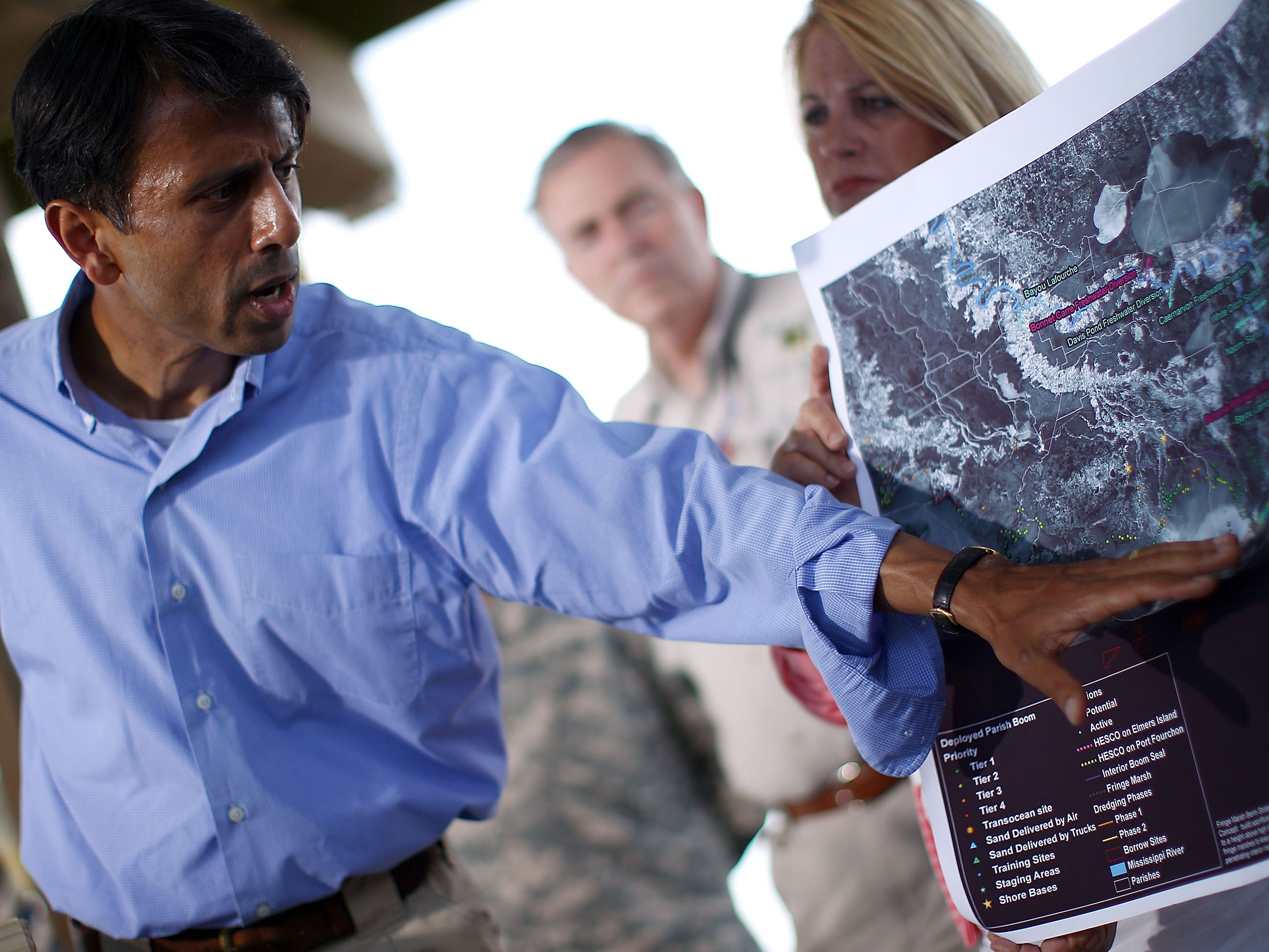
Bobby Jindal and the struggle to save Louisiana from BP Oil Disaster

Photograph by Win McNamee/Getty Images
"Let there be no mistake, we are in a fight to protect our way of life." - Louisiana Governor Bobby Jindal

May 31, 2010, (U.K.) Guardian:
...Experts say the unprecedented depth of the spill, combined with the use of chemicals that broke the oil down before it reached the surface, pose an unknown threat. [1]

"It's difficult to marshal resources to do a thorough job of charting what the impacts are," Jeffrey Short, an environmental chemist who worked on the effects of the Exxon Valdez spill, told Nature magazine. "It's especially difficult when weird things happen to catch the scientific community by surprise. That's clearly the case here."

Louisiana, the nearest state to the leaking well, some 42 miles offshore, has been the most impacted. The state's governor, Bobby Jindal, said more than 100 miles of its 400-mile coast had so far been polluted.

State officials have reported sheets of oil soiling wetlands and seeping into marine and bird nurseries, leaving a stain of sticky crude on cane that binds the marshes together. Billy Nungesser, president of Plaquemines parish, said he had seen dying cane and "no life" in parts of Pass-a-Loutre wildlife refuge. ...
May 31, 2010, Market Watch:
The National Oceanic and Atmospheric Administration on Monday expanded the area of the Gulf of Mexico that is closed to fishing due to a giant oil spill, as states along the Gulf Coast braced for the impact on jobs and their economies.

The federal government has closed all commercial and recreational fishing across nearly 62,000 square miles, or nearly 26% of federal waters in the Gulf, up from about 60,600 square miles closed on Friday, NOAA said.

In Louisiana, which is closest to the spill, officials have shut down many areas off the state's coast to fishing and shrimp and oyster harvesting, although some areas remain open.

While Louisiana officials focused on convincing a concerned American public that Gulf Coast seafood is safe to eat, Florida officials were working to entice people to visit their state, which hasn't been physically affected by the spill.

Louisiana officials on Saturday asked BP for $457 million for a long-term seafood-safety plan, and for an additional $300 million to provide emergency financial assistance for people working in the commercial and recreational fishing industries who have been hurt by the oil spill, the officials said. Louisiana's seafood industries generate about $4 billion a year, the state officials said.

"The future of this industry is in peril," Louisiana Department of Wildlife and Fisheries Secretary Robert Barham and other officials wrote in a letter to BP Chief Executive Officer Tony Hayward. ...
"We at the end of the day can't wait. We have to help ourselves"

A drama has been unfolding in Louisiana to save the state's barrier islands, fishing industry, and way of life for those who have fished Louisiana's waters for generations. Governor Bobby Jindal has been leading the charge; he's been ably backed by thousands of volunteers and a host of state officials.

Nobody involved needs to be persuaded of the seriousness of the situation, which in addition to the threat from the oil spill has included stonewalling and/or foot-dragging by federal officials, Coast Guard, Army Corps of Engineers, and BP.

On May 4 the New Orleans newspaper Times-Picayune, which played such a vital role in reporting on Hurricane Katrina's impact on Nola (New Orleans), reported on the marshaling of efforts by local officials, who knew by that time that they couldn't expect much outside help at that crucial stage -- and that they were facing an uphill battle because of powerful oil industry interests. So before I focus on Jindal's efforts I'll quote from the TP report by way of introducing you to some of the cast, which features Democrats and Republicans working in close concert:
Gov. Bobby Jindal praised the efforts of local leaders including St. Tammany Parish President Kevin Davis and New Orleans Mayor Mitch Landrieu to protect Lake Pontchartrain and adjacent areas from possible contamination by the Gulf of Mexico oil spill.

U.S. Sen. David Vitter joined Jindal, Davis and Landrieu at a press conference at a spill response command center set up at Fort Pike in eastern New Orleans, across the Rigolets from St. Tammany Parish.

Jindal credited local officials for taking the initiative to put protection plans in place. Davis oversaw the positioning of protective booms near the Rigolets and Chef Pass beginning Saturday, anticipating possible encroachment of the oil spill from the gulf into Lake Borgne and toward Lake Pontchartrain.

Local and state leaders know best what's at stake for the region, and they are formulating effective plans to keep the area save, the governor said.

"We need the Coast Guard to approve these plans," he said. "We need BP to fund these plans.

"We're not waiting for the cavalry. We're going to do everything we can to protect our coast."

BP reported today the first sighting of the oil slick as far as the Chandeleur Islands, the closest position yet to eastern New Orleans and St. Tammany Parish, Jindal said.

Landrieu, who was inaugurated Monday as mayor of New Orleans, said Davis contacted him last week, while he was still serving as Louisiana's lieutenant governor, to ask him to authorize the use of Fort Pike as an incident command center.

"We at the end of the day can't wait," Landrieu said. "We have to help ourselves."
Bobby Jindal, the one-man army

From Jesse Zwick's May 31, 2010 article for The New Republic, Post-Spill Praise For Bobby Jindal
[...] Constantly jumping in and out of National Guard helicopters and drawing up plans for additional "burrito levees" and "boudin bags" needed to stop the oil slick from flowing further into his state's marshes, Jindal has quickly mastered the details of the issue.

At a press conference in New Orleans in mid-May, the Washington Post reported that "he gave updates on the size of tar balls washing up in Port Fourchon (up to eight inches), the number of sandbags to be air-dropped (1,200) and state money spent to date ($3.7 million). He also provided a weather forecast ('The winds continue to come out of the southeast, 10 to 15 knots')."

All that knowledge has forced Jindal to admit that his state is facing a huge crisis — one that merits an equally huge state and federal response. This big government position hasn't exactly endeared him to his GOP colleagues (who think he's in league with an alarmist camp of environmental groups that want to villainize Big Oil) or to Democrats (who think his impassioned calls for a greater government response smack of hypocrisy), but Jindal has displayed the kind of smarts and ideological flexibility that we should applaud in our leaders, no matter the party.

The first thing Jindal did right was acknowledge the scope of the catastrophe. This might not seem deserving of praise — until one looks at how other Republicans have reacted. Nervous about a populist backlash against offshore drilling, or even growing momentum for a climate bill — and contemptuous of environmental science in general — many Republicans have downplayed the disaster.

For example, Jindal's gulf state GOP colleague, [Mississippi Governor] Haley Barbour, was quick to urge tourists not to cancel their trips to Mississippi's beach towns, comparing the deluge of crude to the sheen of gasoline from a motor boat.

"We don't wash our face in it, but it doesn't stop us from jumping off the boat to ski," he told the AP.

And Barbour's not alone in taking such a blasé stance. "Haley has actually taken the smarter approach, from a national perspective," a GOP operative explained to Politico yesterday. "He has taken the long view, that this shouldn't kill an important source of energy."

Rather than maintain such political orthodoxy, Jindal has been wise to stand up for his state and talk about the spill for what it is: "This oil threatens not only our coast and our wetlands; this oil fundamentally threatens our way of life here in south Louisiana." [...]
Staring down the barrel of catastrophe

The true "long view" is that the BP oil disaster is threatening the world's 29th largest economy, which is what the Gulf region is.

As for offshore oil drilling, Jindal has always been a strong proponent and I assume he remains so. One doesn't need to be a member of the Green Party to take aim at gross negligence on the part of BP and what is arguably collusion between the oil giant and the federal government. At the least the feds wimped out in their dealings with BP.

Zwick's article is a little behind events when it talks about the disagreement between Thad Allen and Jindal regarding the sand berms but before I plunge into that part of the story, readers who're trying to play catch-up with the oil disaster need to realize that the debate about the berms is a major issue. Here's why:

The 'barrier islands' dotting the Gulf coast are the only defense against the worst from hurricane winds once they hit land, and the entire Gulf coast region is hurricane alley. The islands and their vegetation brake the winds, draining off some of their fury before they make major landfall.

For various reasons, which add up to bad land management across decades, the islands, some of them so tiny they just qualify as 'marshes,' have been severely degraded. That means damage to the coastal areas from even less than catastrophic hurricanes has become worse as time has gone on. Just the mobilization effort in anticipation of the hurricanes is very expensive not to mention the cleanup from hurricane damage.

Meanwhile, a huge fishing industry grew in the Gulf coastal areas, and the Cajun-Creole cultures in southern Louisiana are greatly dependent on it. They took a bad hit from Hurricane Katrina in 2005 but they came back; as one fisherman said, "That was just wind and rain." Now, with the BP oil disaster, they're looking at the possibility that their way of life is coming to an end.

At the same time Gulf oyster and shrimp fishing became an industry U.S. oil refineries perched themselves along the Gulf shore. Add tourism to this, and that's why the region is the 29th largest economy in the world.

Governor Jindal is not only standing up for an American state but also for an entire region that is an important part of the world economy. He's also standing up for the unique culture in Louisiana, which is an important part of the American heritage.

So, those humble little pieces of land near the US coast are crucial and that's why Jindal and other Louisiana officials are knocking themselves out to save them.

Of booms and parishes

Before I return to sand berms, a few terms of art for readers who plan to follow the drama:

1) Boom: "A floating device used to contain oil on a body of water. Once the boom has been inflated, it is towed downwind of the oil slick and formed into a U-shape; under the influence of wind, the oil becomes trapped within the boom."

The oil can then be skimmed or sucked from within the boom. I don't know the exact material used in the booms; probably heavy plastic or somesuch. They look like giant sausages strung together when they're inflated.

Why sand berms, then, if the artificial booms work? They need calm waters or they get washed away. That's what happened when Alabama Governor Bob Riley tried to use them, in conjunction with gates, to keep oil out of Mobile Bay. The strong current washed them away. As to why he didn't think of that before trying the experiment -- from a May 28 New York Times piece on how the governors of five coastal states have been dealing with the oil spill threat:
...Casi Callaway, the executive director of Mobile Baykeeper, an environmental group, said she could have told him that would happen - if she and others with coastal expertise had been consulted. But they have had a difficult time getting through to the decision makers, she said.
My question is whether the sand berms hold up in hurricane-force winds. I guess Jindal will have to deal with that problem if he comes to it. Right now it's a race against time -- a race against the looming hurricane season, which started a day or so ago, and the spreading oil spill.

2) Bayou (French or Choctaw Indian word): "A body of water typically found in flat, low-lying areas, and can either refer to an extremely slow-moving stream or river (often with a poorly defined shoreline), or to a marshy lake or wetland. Bayous are commonly found in the Gulf Coast region of the southern United States, particularly the Mississippi River region, with the state of Louisiana being famous for them."

3) Parish: You'll come across the term frequently in news from Louisiana. Basically a parish is a county in Louisiana, of which the state has 64; the old name was retained as a tradition. Louisiana is a melding of French and Spanish colonies, which were Roman Catholic. From the Wikipedia article on the parishes:
Local government was based upon parishes, as the local ecclesiastical division (French: paroisse or Spanish: parroquia). Following the Louisiana Purchase in 1803, the Territorial Legislative Council divided the Territory of Orleans (the predecessor of Louisiana state) into twelve counties. The borders of these counties were poorly defined, but they roughly coincided with the colonial parishes, and hence used the same names.
See the article for more detail on the parishes and their various forms of modern-day administration.

4) Hesco baskets: At this point I refuse to get that far into the weeds of oil spill cleanup equipment so I have no idea what they are. Ditto for burrito levees and boudin bags.

5) There's a huge body of information on the internet about barrier islands and their importance but for a primer Wikipedia's article is a good start.

Jindal vs Allen

Now to return to Zwick's report. Note that the tussle between Jindal and Allen is also a window on the federal government's dealings with the states.
The administration's point man for the crisis, Coast Guard Commandant Admiral Thad W. Allen, argues that they're fulfilling all the demands outlined within the plan agreed upon by the gulf state governors, and that they'll get to Jindal's additional requests next.

Allen also takes issue with Jindal's claim that his sand-island scheme could begin working within 10 days of approval, arguing that construction would take closer to nine months. Then there's the legitimate question of whether it'd even work: "For the cost involved, the chances of being successful at doing any good … are minuscule," speculated Jerome Milgram, a professor at MIT.
The Louisiana Governor's office has a different take. From the May 28 press release:
... “We spent much of our time with [President Obama] today discussing the importance of our sand-boom [berm] plan in the fight to protect our coast against the millions of gallons of oil that continue to hit our shores.

Just yesterday, we visited the state-directed dredge at East Grande Terre near Grand Isle that we refocused to create sand-boom under our plan. On our own, we already took the dredging permit the state had control over and switched the project over to build sand booms as part of our coastal protection plan.

This state-directed project at East Grande Terre is about a 2.5-mile project where work on our sand boom plan began last week. The Coast Guard told us yesterday – after weeks of reviewing our plan that they approved a single segment of just two miles to see if the sand-boom works. This is another example of too little too late.

“We expressed this frustration to the President and he agreed that work on the first segment must begin immediately and that within two to three days they would review whether the sand boom will stop oil and make a decision about whether or not they will force BP to pay for the other five segments of the plan the Army Corps of Engineers already approved.

“We know sand boom works, we have seen it work in Thunder Bayou and Elmer’s Island, but if the federal government needs to see it work, they need to do that quickly. We don’t want the federal government creating excuses for BP. This is BP’s oil spill. They are the responsible party but we need the federal government to hold them accountable and make them responsible. We are fighting to help protect our coast under this sand-boom plan, and as of today more than 107 miles of our coast have already been impacted by oil.

We know this oil will continue to hit our coast again and again. We have to put multiple protection measures in place. We continue to ask federal officials to approve our entire sand-boom plan from the northern Chandeleurs to the Isle Dernieres chain. Our entire coast is important. ...
As to the environmental risk that the sand berms might pose to the marshes, Gov. Jindal has the answer for that too. From Bill Capo's May 27 report for Louisiana's WWL-TV:
... Jindal also took to the air to see how the dredged barriers being put out to protect the state are faring. The state began the project even before getting the go-ahead from the Coast Guard Thursday.

The dredged area is two to three miles off the coast. The machines suck up the sand in that area and pump it onto the beach.

“It dredges sand off the floor of the Gulf, that gets piped in here, and the graters work from the center of the island off in both directions,” explained Jindal. “They’ll build it up to five to six feet high and two and a half to three miles wide.”

They’re restoring 127 acres of beach and building it up to six feet high. During the trip Jindal learned that the first segment of his 24-segment, long sought dredging plan had been approved.

“It’s better than still waiting for an answer,” said Jindal of the news. “If we had gotten approval when we first asked for it, we could have built ten miles by now.”

Jindal had an answer for those who say the barrier islands would keep needed water from getting to the marshes.

“We’re not proposing to build a continuous barrier,” he said. “We know that’s not practical. So we would allow the normal tidal currents to move in; what that allows the Corps, the Coast Guard and BP to do then is to focus their booming and their skimming and resources on a few cuts in a few passes.”

The dredging on Grand Terre started last year as a coastal restoration project but it has been turned into a project to protect the beach from the spill’s effects and Jindal hopes that Obama can see the benefit first hand on his visit Friday.

“By law BP is the responsible party for this disaster but we need the government to make sure they actually are a responsible party and fulfill their obligations.”

By helicopter Jindal inspected the multiple layers of defense being used to protect against the oil, including land bridges by the National Guard to stop the pollution, large sand bags, lines of boom and barriers of Hesco baskets. ...
The Jindal-Nungesser tag team

According to a report by Arian Campo-Flores for the May 27 edition of Newsweek, it's actually Billy Nungesser, the President of Plaquemines Parish, who came up with the sand berm idea:
...In recent weeks, Nungesser and Jindal have been relentlessly pushing a new plan: to fortify barrier islands with dredged sand so that the oil has a harder time making it into the marshes. The $350 million project —which Nungesser is credited with coming up with — has intuitive appeal, and indeed, restoring those protective buffers has long been a priority for environmentalists.

Yet some scientists have raised questions about the scope of the plan. For instance, Gregory Stone, director of the Coastal Studies Institute at Louisiana State University, says it’s unadvisable “to embark on a project of this magnitude without having at least some semblance of what might actually result.”

The Army Corps of Engineers apparently has reservations as well, since so far, it has refused to grant the necessary emergency permit. Yet Nungesser and Jindal insist that their idea could save some of the marshes. And, they argue, if the federal government doesn’t like their proposal, then it should come up with an alternative—something much more aggressive than simply laying down boom.

In the past week, Nungesser and Jindal have stepped up their rhetoric against BP and the federal government, especially the Coast Guard. “We have been frustrated with the disjointed effort to date that has too often meant too little too late to stop the oil from hitting our coast,” Jindal said at a press conference on May 24.

Nungesser, for his part, has made a daily sport of lashing out at Admiral Thad Allen of the Coast Guard, calling him “an embarrassment” and “a cartoon character.” (Today, the Coast Guard approved portions of the sand-berm plan).

On Wednesday, the pair were at it again. Joined by James Carville and Mary Matalin, Jindal and Nungesser toured South Pass at the mouth of the Mississippi, heading an entourage of boats carrying wildlife officials and media.

As a storm rumbled in the distance, a few shrimpers glided past. Jindal’s and Nungesser’s boat pulled up to patches of roseau cane that were stained dark brown by oil at their base.

“Everything was dead in the marsh,” Nungesser told me afterward. “I get tears in my eyes, because when you’d pull into that marsh previously, fish would jump and scurry.” Now, “ain’t a bird, ain’t a bug, nothing.”

Worse yet, there was no sign of activity to clean up the muck or defend against the invading slick. “There was nobody out there doing anything,” said Nungesser. “It was disgusting.”
1) See this May 31 article at Times-Picayune about the dispersants and underwater plume sightings; also see the blog by Samantha Joye, one of the UGA Marine Department scientists inspecting the underwater plume, who is quoted in the article:
http://gulfblog.uga.edu/

Thursday, May 13

Fears that Gulf Oil leak much larger than estimate

On May 12, 2010 at 6:31 PM a RBO reader with the screen name "The Destructionist" left the following comment at RBO blog's crosspost of my May 1 post titled Oil Spill: Cameron International and Deepwater Horizon companies in the crosshairs over failed oil rig blowout ‘fail safe’ mechanism:
I have a sinking feeling that this oil disaster is being downplayed and may be much larger than we think. I wanted to know just how much oil was flowing into the ocean from that broken pipeline (in both barrels and in gallons) so I did some research on my own.

Barrels vs. Gallons

Most news articles claim that since April 21, 2010 roughly 4 million gallons of sweet crude have been leaked into the Gulf at a rate of 210,000 gallons per day. But according to an Associated Press article just posted today ("What went wrong at oil rig? A lot ..."), approximately 4,000,000 barrels have already spilled into the Gulf. When you convertthose barrels into gallons, you end up with a whopping 168,000,000 gallons of oil: that’s a difference of 164,000,000 gallons from the previous estimate! [...]
Around 8:45 PM tonight, May 13, The New York Times published a report by Justin Gillis titled Doubts on Estimate of Volume of Oil Spilling in Gulf. So. It seems the RBO reader's concerns are justified. The Times report becomes more troubling as it goes along and suggests there's been stonewalling or at least evasions not only from BP but also from the government regarding the estimate figure.

Here I'm only quoting the opening paragraphs of the report with the recommendation that you go to the Times site for the rest, if you're at all interested in understanding the situation with the oil spill:
Two weeks ago, the government put out a round estimate of the size of the oil leak in the Gulf of Mexico: 5,000 barrels a day. Repeated endlessly in news reports, it has become conventional wisdom.

But scientists and environmental groups are raising sharp questions about that estimate, declaring that the leak must be far larger. They also criticize BP for refusing to use well-known scientific techniques that would give a more precise figure.

The criticism escalated on Thursday, a day after the release of a video that showed a huge black plume of oil gushing from the broken well at a seemingly high rate. BP has repeatedly claimed that measuring the plume would be impossible.

The figure of 5,000 barrels a day was hastily produced by government scientists in Seattle. It appears to have been calculated using a method that is specifically not recommended for major oil spills.[...]
The Deconstructionist also provided links to two additional reports, one from the Examiner titled Toxic chemicals used in BP oil spill cleanup, oil to remain flowing through Gulf and one from AP titled Missing data causing rig reconstruction mystery by Associated Press Writers Allen G. Breed and Curt Anderson. The date on the AP report is May 13, (7:31 pm EDT). I have no idea how that report got into the Deconstructionist's May 12 comment; AP can work in mysterious ways -- not the least of which is that they tend to remove reports from the internet after so many days. That means you're out of luck if you've only saved the link and want to reference the report weeks or months later. However, the report is excellent (and extensive), as is the first AP one Deconstructionist linked to; worth copying and saving if you're planning on keeping a file on the oil spill story.