Translate

Showing posts with label Egypt. Show all posts

Thursday, February 9

Be less helpful or be less squeamish

The British air command did play a role with Germany but the basic story is that after the United States bombed Germany and Japan to rubble, the American conquerors told what was left of those nations that they were going to have the kind of democracy Americans could live with, then dictated how their governments were to be run. That bought a beleaguered world more than a half century of peace and stability in Western Europe and Japan.

That's how it's done; that's how to establish democracy in lands where the concept of sovereignty is built not on the Westphalian ideal but on the monarchist one. Yet if Americans are too squeamish to do it right, then they must to learn to rein in the urge to be helpful, as headlines from Egypt underscore.

The Wall Street Journal's Matt Bradley reported in the wee hours today from Cairo that America's top military commander, JOC Chairman Martin Dempsey, was on his way to Egypt to negotiate with Egypt's military "over the fate" of the American NGO workers now facing imminent criminal charges relating to "ill-defined political subterfuge" but which could include the charge of espionage.

The problem for General Dempsey is that the Egyptian authorities found maps among the papers they confiscated at those NGOs that could be read as intelligence-gathering as part of a covert U.S. plan to balkanize Egypt. (See Matt's report for details.)

The NGOs have what they consider to be a perfectly reasonable explanation for the maps. They used the maps, Matt reports,
... to plan monitoring missions during parliamentary elections late last year.
So the NGOs were just trying to be helpful, as State underscored:
In Washington on Wednesday, State Department spokeswoman Victoria Nuland said the U.S. is concerned that the investigation "could have implications for the whole relationship, including our ability to deliver the assistance that we have planned…to support Egypt in its democratic transition and the traditional assistance that we provide for security purposes. We do not want that to happen."
The problem for State is that the organizations those Americans now holed up in the U.S. embassy in Cairo work for are NGOs -- nongovernmental organizations -- only in the most technical legal sense of the term, as Matt's report indicates:
The targeted Americans work for four NGOs, all of which have close connections to Capitol Hill and operate almost entirely on congressional financing. In addition to Mr. LaHood's IRI, Egyptian prosecutors are investigating the National Democratic Institute, Freedom House and the International Center for Journalists.
That last one is new to me, but the others, as I've mentioned several times on this blog, are notorious GONGOs -- governmental nongovernmental organizations, which of course is a contradiction in terms. They're also INGOs -- international nongovernmental organizations.

It was just such bizarre hybrids that Vladimir Putin was aiming at, when he threw all foreign NGOs out of Russia some years back, even though the NGOs protested that they were just trying to be helpful.

As Moisés Naím indicated, one problem with institutionalizing at the government level the urge to help outside one's borders is the copycat syndrome. That's why authoritarian regimes took a page from the USA and set up their own GONGOs, all in the name of being helpful to peoples in foreign lands.

(For readers unfamiliar with Naím's discussion and the entire issue of GONGOs see my 2007 post, Of Ingos, Gongos, and Rogue Aid: three pieces of the 21st Century puzzle.)

The other big problem is that the election monitoring and other help given by American GONGOs in foreign lands is that these activities are often followed by peoples' revolutions that no matter how nonviolent in the technical sense topple regimes not to America's liking.

To state the problem with greater precision, Gene Sharp, unwittingly perhaps, opened Pandora's Box. He did this by cataloguing, codifying and publishing all the tactics that have been used successfully to mount civil protests against an authoritarian regime. It was a great idea, but the downside is that the tactics can do double duty as a blueprint for staging a soft coup.

That wasn't such a big problem in the era of fax machines and snail mail. But in this era, every authoritarian regime on the planet has downloaded Gene Sharp's rules for nonviolent protest from the Internet. So, now they know every trick in the book about how to pass off a soft coup as a nonviolent revolution.

I'd be surprised to learn that the Obama administration is trying to balkanize Egypt but given the history of GONGOs and the successful soft coups in the post-Soviet era, it's not unreasonable for Egypt's generals to suspect the worst of the American NGOs in Egypt -- particularly because the generals know the Gene Sharp-NGO drill backward and forward.

That's because they were tacitly supporting the organizers of the Tahrir Square 'nonviolent' protests, who were admittedly working from Sharp's playbook -- although the admission didn't reach the American public until after Hosni Mubarak was driven from office. The New York Times broke the story a day or two after Hosni decamped; this was followed about 10 days later by Frontline's documentary, Revolution in Cairo, aired on PBS.

Watch the documentary, and read all the supplemental material available on the PBS Frontline website and through links it provides, to understand more of this part of the story of Egypt's revolution.

What the reporters for Frontline didn't emphasize was that Egypt's military rulers found the Tahrir Square democracy activists, including the self-described "youth wing" of the Muslim Brotherhood (see the Frontline documentary), to be very useful, which is why they stood down during the protests. I think at all costs they needed to get rid of Gamal Mubarak and the Gamalists, who were methodically stripping the military of its power and who gave every indication that they meant to escalate their efforts in an upcoming election. The mass protests against Hosni Mubarak and his regime were the way to neuter the Gamalists without staging assassinations.

And, I might add, there is no instance of Sharp's tactics bringing about a soft coup without tacit cooperation from a country's security apparatus. For readers who believe in the power of nonviolent protest and Tinkerbell, I repeat: no instance.

In short, the generals cooperated with the democracy activists during the Tahrir Square protests because they saw a way to turn Gene Sharp's tactics for promoting civil rights and democracy into a tactic to reinforce their authoritarian rule.

This curious inversion is one of the many oddities of post-Mubarak Egypt, which finds the country's ultraconservative Salafist party defending the democracy-building efforts of American NGOs now facing criminal charges, and the absolute monarch Saudi King Abdullah still angry at the democratically elected Barack Obama for betraying the Gamalists -- who were trying to prepare Egypt for real democracy by breaking the military's power!

This tangled Egyptian tale is just one of the many tangled tales that Americans got tangled up with in their effort to be helpful to the cause of democracy without actually conquering other countries.

The irony is that the more America has tiptoed around in the name of being helpful, the more it's been accused of being an expansionist empire. But if Americans don't want to impose democracy through conquest, they're wise to take the present situation in Egypt -- and in Pakistan, where the generals there are also maneuvering to hold onto their power -- as a lesson. A lesson on the limits to being helpful when you don't have the power to manage unintended consequences.

The same observation holds for staging bombing raids in the name of being helpful. Last August, Mark Safranski, in a discussion with me in his blog's comment section about the militarized 'Right to Protect' doctrine, observed :
[...] Moreover, the Libyan intervention was an astrategic mess carried out in a half-baked, amateur manner that harms US long-term interests in talking states off the nuclear non-proliferation-state sponsor of terrorism ledge. What dictator in his right mind will believe our diplomatic assurances of reconciliation if they give up WMDs or change their policies after what happened to Gaddafi? We have just incentivized every potential rogue state into adopting a posture of maximum intransigence, mutual aid to fellow dictators and strategic courtship of Beijing.

Gaddafi is odious but he served a use, like Ceaucescu did, in demonstrating that America would negotiate a deal with enemies and stick to it. That card is now lost, or if not lost, seriously devalued to a short term, low-trust, expediency.
Mark hit the mark so squarely that he might as well have been reading from Rawalpindi's playbook ever since Pakistan's generals saw what happened to Gaddafi.

What the proponents of the Right to Protect doctrine don't come right out and say is how they plan to impose order in a country after they've bombed its wicked regime to smithereens. But of course they plan to send in a veritable army of NGOs (actually, GONGOs) to monitor free and fair elections and in other ways help establish a genuine democracy.

The glitch in the plan is evident in today's Egypt -- where the generals have popular support for their accusation that Americans are meddling their country -- and in today's Libya. Earlier this week a BBC correspondent gave an eyewitness report that the nation's capital was now blanketed by armed militias roaming around the streets and representing various and presumably opposing factions in Libya.

You want to send election monitors into that? Hand out pamphlets on how stage a genuine democratic election? (Here; hold my AK-47 for a minute while I read.) Not without a contingent of U.S. Marines at your back, which the European Parliament very well knows.

So what to do, if the half-baked militarized approach to being helpful and the NGO approach carry such serious downsides that they're counterproductive? Well, there's always the combination militarized-NGO approach: send in Special Forces to sneak around and be helpful to the cause of democracy. (Kid, don't touch that box marked "Pamphlets" if you don't want to blow up half your village.)

Not a new approach, to be sure, and I wouldn't be surprised to learn it's being deployed in Libya or will be soon. But in this era, when it seems half the world's nations are selling weapons to the other half, and when it's easy to order enough light arms from the Internet to start a civil war, the combo approach presents the same fundamental problem as the other two half-baked approaches: again, Americans don't have the power to manage the inevitable unintended and often completely unforeseen consequences.

So in Libya, as in Afghanistan and other countries, the bloodbath your intervention was meant stop or avert easily touches off a bloodbath that can be harder to stop than the first because it's more diffuse than the one launched by the central governing authority you toppled, or flimflammed out of office.

(I suppose I should note here that the United States didn't actually conquer Iraq; it conquered the Iranian military and Baghdad. Then because it didn't want to deploy enough troops to pacify the rest of the country it left a British command in charge of the key city of Basra. That turned out to be a tragic mistake.)

Then what's the solution, if my fellow Americans blanch at the thought of the United States becoming an expansionist empire? In my view there is no solution, although I think the globalized labor union movement would argue with me. My reply would be that switching out GONGOs for U.S. government-supported labor unions is simply putting a new face on the same downside that exists for GONGOs.

But it's possible to kick the can of armed conquest down the road by revising the approach to being helpful that became standard procedure for the U.S. government during the latter part of the Cold War. The approach was never updated for the present era, during which every authoritarian regime has a library of Gene Sharp books and has learned to play the IMF like a fiddle.

Before revision, though, must come thinking. Toward this end, it's helpful to review the Westphalian concept of sovereignty, the history of the United Arab Republic, and the British Raj. (You're not looking to become historians here; just get in the ballpark and for that, Wikipedia has prefectly serviceable articles on all three topics.)

The review can produce an understanding in Americans that our government's pro forma way of promoting democracy, which focuses on free and fair elections and civil rights, misses a crucial step.

The real battle of ideas today is not in the arena of democratically electing leaders. It's in the arena of sovereignty. Get that part down pat, and Americans don't need GONGOs in the era when a terrorist spokesman, hiding out in the boonies in Waziristan or wherever, emailed Long War Journal's Bill Roggio to inform him that he was right to be suspicious of government announcements that Hakimullah Mehsud was dead.

And in an era when villages in Afghanistan are Tweeting each other like mad on their cell phones to share stories of Taliban misdeeds. (Huh. And here we thought we were the only ones the Taliban were taxing to death.)

I add that Twittermania is a recent twist in the tangled tale of Afghanistan that's putting the Afghan Taliban, and I imagine Pakistan's military, on the back foot. Money says that's why those two are now scrambling to negotiate a power-sharing deal in Afghanistan -- before the Obama administration wakes up and realizes it's not necessary to negotiate.

Where was I? To wrap it up: if Americans really want to be helpful in this era, they can focus on making their own story hang together. The rest of the world will be all ears.

As to how to dismantle the American INGO industry that's sprouted up, get a hammerlock on American CEOs with transnational corporations who see themselves as Gandhi reborn, and elbow U.S. weapons merchants back across the line -- well, that's all part of getting our story straight.

Friday, January 27

Urgent advice for State: Warn Obama to stop pushing the envelope (UPDATED 2X)

UPDATE 2:05 PM ET January 29
Adding two important news reports to the footnotes, both of which I'd misplaced at the time I published this post and just found.

Footnote #1: Egypt faces hurdles in securing IMF aid, January 25, Reuters. Although the January 25 report doesn't contain the news about the billion dollar-'bridge' loan that I'd mentioned in the text, it presents key observations that were dropped from the updated January 26 Reuters report I'd originally linked to.

Footnote #8: Pakistan stoking anti-Indian sentiments to divert attention from the heat at home, January 26, Times of India. At first glance this report doesn't differ markedly from the one in The Hindu about the LeT 'resurgence' in Pakistan but it brings out points which underscore the seriousness of the development, and not only for India. LeT is one of the world's most dangerous international terrorist organizations; that Pakistan's military let its leader out of his cage at home at this juncture is almost beyond belief. Almost.
******************
I was sitting on the patio one morning six years ago, enjoying the quiet and early Spring weather, when I heard the most godawful sound. I'd barely blurted, "What the --?" when I learned the sound was a squirrel's idea of a battle cry issuing from maybe 200 squirrel throats. All the squirrels in the neighborhood, it seemed, had banded together to run off a large rat and the chase was taking them through my back yard. I never saw or heard anything like it my life. And let me tell you that rat was burning rubber. Never saw a rat run so fast.

I told this story not to insult any government but to graphically illustrate that when sufficiently provoked and desperate, even the weakest governments can set the mighty United States back on its heels. Once this gets underway it can snowball into a trend.

With all such situations it's perceptions of American actions that count, or to be more precise the perceived pattern of actions. During the past year the perceived pattern is that President Barack Obama is throwing his weight around the world, everywhere he can.

I understand that Obama can cite reasons for each instance in which he's crashed national borders in pursuit of the bad guys. Yet the perception is that Obama has gotten hold of two very efficient lethal weapons -- U.S. Special Forces teams and armed drones -- and is deploying them anywhere in the world he sees fit.

But even President George W. Bush and his most aggressive predecessors in the Cold War managed to meddle in ways that didn't make it look as if the entire planet was suddenly under surprise attack from the United States. They knew when to back off -- and they were operating in a communications era when their every move in a foreign country wasn't broadcast around the world.

Times have changed. It's the piling-on phenomenon that's leading people to these perceptions Okay, so you wanted to shoot rockets at al Qaeda operatives in Pakistan's badlands. Okay, so you had to support Sarkozy's war against Gaddafi. Okay, so you had shoot rockets at al Qaeda in Yemen. Okay, so you had to take out Osama bin Laden when you found him. Okay, so you had to rescue an American citizen who was kidnapped by common criminals.

But all of these "okay" situations are piled on top of Obama expressing public support for Egypt's democracy activists and as much telling Mubarak to decamp. And piled on top of meddling in spectacular fashion in Pakistan's internal affairs. And starting a cold war with Iran's regime not to mention starting a cold war with Syria's regime.

All this within the space of a year.

I don't need to tell State that the juntas in Pakistan and Egypt are in absolutely desperate straits. They are both staring at the imminent prospect of a complete economic collapse in their countries. And the fear is that raising loans amounting to a billion dollars from the World Bank and African Development Bank until the IMF can (if it chooses) to bail them out might not be enough to stave off economic collapse in Egypt. (1)

Nor should I need to tell State that both juntas have broad and deep support in their respective countries, if for no other reason than the large number of civilians the businesses owned by the juntas employ.

So a reasonable person would assume that last month, after Egypt's junta gave a clear warning to the Obama administration to back off in Egypt, State would have immediately yanked the Democratic and Republican party NGOs that were operating in Egypt. I mean -- how much more of a warning do you need, when a security force raids the NGOs and confiscates their computers while the junta accuses the NGOs of being fronts for the American government and meddling in Egypt's internal affairs? (2)

But no, the NGOs continued to operate in Egypt -- all for a good cause, of course -- after State pulled their irons out of the fire in December. Now we learn as of yesterday some Americans working for the NGOs have been barred from leaving Egypt. This is a prelude to arrest warrants being issued -- or at least that's the implied threat of the action to prevent the Americans (and some Europeans who work for othe ngos from leaving Egypt. (2)

Obama is understandably furious about the situation but he could have seen this coming even before Mubarak left office. And now Egypt's generals believe they have no other choice but to find a scapegoat for the country's economic crisis. The Obama administration's ill-conceived attempt to bring more democracy to Egypt, which is using a very small number of Egyptians, has handed the junta the perfect goat.

Now I turn to Pakistan. The country is not only facing economic collapse but it's also in the throes of the worst fuel crisis in its history. (3) So why has the Obama administration decided that this is the perfect time to turn the heat up on Iran by trying to get Pakistan's regime to abandon the gas pipeline Iran is building for them, and sign up to get gas from the TAPI pipeline? (4)(5)

Is the answer that chipmunks are managing the Pakistan portfolio for the Obama administration? I ask this also because this is the same question they're asking in Afghanistan. I mean -- our war office and State couldn't even keep track of containers being transshipped through Pakistan, many of those containers containing desperately needed food supplies for Afghans.

Why "desperate?" Because the Obama administration and Congress haven't wanted the Afghan government to use an Iranian route for shipping food to Afghanistan and because the Northern Distribution Network, where it's the middle of winter anyway, is full up with shipping war supplies for NATO. So they've had a food shortage in Afghanistan, which has driven food prices, even for food basics, through the roof.

But how can you lose track of almost 160,000 shipping containers? The containers have disappeared in Pakistan. Gone! Poof! (6)

And not to put too fine a point on it but the U.S. command can't even win a war against a bunch of guys in baggy pants who take their orders from Rawalpindi. What's been the Obama strategy to deal with this situation? Play patty-cake with the Emir of Qatar and increase meddling in Pakistan. (7)

What has the answer been from Pakistan's junta? They've let Lashkar-e-Taiba out of its cage in Pakistan. (8) Do I have to draw stick figures to explain to State what that implies?

For starters, the junta is saying to forget Doha; the Obama administration can negotiate a truce with Mullah Omar all it wants, and it won't mean squat to LeT, which just might take the prize as the world's most dangerous international terrorist organization. (9) The larger implication is that the junta is signaling Obama that if he's worried about international terrorists taking over Pakistan's nuke weapons, the worry is misplaced because the junta will simply hand them a nuke if they get any angrier at him.

I understand that little blame for the entire mess I've described above can be laid at State's door. But someone has to take responsibility for conveying the facts of life to President Obama and State has to be the designated fool in this instance.

In summary, this is one of those times it's crucial for the American government to practice message discipline across the board. Sometimes you can have it all, but if you try to have it all at the same time, you sow the impression that you're crazy. That's a fast way to replace respect with fear. When people become afraid that you're both crazy and hogging their turf, they act in the same way a bunch of Washington squirrels did one fine morning.

1) January 26, Egypt says to seek extra $1 billion to support budget; Reuters
Egypt said on Thursday it would ask the World Bank for a $500 million loan and another $500 million loan from the African Development Bank to help it fill a budget gap widened by a year of political and economic turmoil.

Egypt has also persuaded the International Monetary Fund (IMF) to reduce the interest rate it would charge on $3.2 billion loan Cairo had requested from the IMF, Planning and International Cooperation Minister Faiza Abu el-Naga told reporters.

"We have achieved a reduction from the IMF on the interest rate on the loan from 1.5 to 1.1 percent," she said, adding that this would put the cost of the finance more in line with interest rates worldwide.

The turmoil in Egypt has pushed up unemployment, widened its budget and balance of payments deficits and drained its foreign reserves. Many economists believe a currency devaluation is imminent.

Egypt announced earlier this month it had formally asked the IMF for an aid package, saying it wanted the money as soon as possible and hoped an agreement would be signed within weeks.

The IMF, however, says any agreement would have to be accompanied by financial commitments from other international donors and attract broad political support within the country.

Thrashing out the technical details of a loan will take two to three months, it said.

The World Bank and African Development Bank loans would carry an interest rate of between 7 and 8 percent, Abu el-Naga said. Egypt would request a mission from the World Bank come to Egypt soon, she added, without giving details or a date.The central bank, trying to keep the Egyptian pound stable against the dollar, has run through $9 billion of its foreign reserves since June, when the government rejected an IMF agreement similar to the one it is now seeking.

The depletion accelerated before the parliamentary election and during a series of violent political protests in November and December, with the central bank spending at least $2 billion in each of the last three months. By the end of December, reserves had fallen to $18 billion.
January 25, Egypt faces hurdles in securing IMF aid; Patrick Werr, Reuters

2) January 27, 2012: Egypt Bans Travel for 10 U.S. Citizens; Ben Hubbard, Associated Press via TIME online
CAIRO) — Egypt banned at least 10 Americans and Europeans from leaving the country, including the son of U.S. Transportation Secretary Ray Lahood, hiking tensions with Washington over a campaign by Egypt's military against groups promoting democracy and human rights.

The United States warned Thursday that the campaign raised concerns about Egypt's transition to democracy and could jeopardize American aid that Egypt's battered economy needs badly after a year of unrest. [...]

The travel ban was part of an Egyptian criminal investigation into foreign-funded democracy organizations after soldiers raided the offices of 10 such groups last month, including those of two American groups.

The investigation is closely intertwined with Egypt's political turmoil since the fall of Hosni Mubarak nearly a year ago. The generals who took power have accused "foreign hands" of being behind protests against their rule and they frequently depict the protesters themselves as receiving foreign funds in a plot to destabilize the country.
[...]
3) January 25, 2012: Energy Deficit Renders Punjab Uncompetitive; Dawn (Pakistan)

4) In the first version of this post I referred to the TAPI pipeline as "crazy;" without getting into a discussion of TAPI, I had it confused in my mind with the Nabucco gas pipeline. So many pipelines to keep straight.

5) This report is undated although it was surely published within the past week; I'm linking to this version rather than the International Herald Tribune report because of the wording of the title supplied by the Pakistani website that quotes IHT: US enticing Pakistan with cheap gas; Online International News Network (Pakistan)

6) January 27, 2012: Afghanistan bound 157,736 US containers; Aftab Maken, The News International (Pakistan)
ISLAMABAD: The Federal Board of Revenue (FBR) on Thursday made a stunning revelation before the Senate Standing Committee on Commerce that a total of 157,736 containers of the United States destined to Afghanistan have never reached the landlocked country and disappeared inside Pakistan.
[...]
7) January 25, 2012: Brahma Chellaney learns U.S. Afghan War exit strategy is literally full of gas; Pundita

8) January 24, 2012:Hafiz Saeed ‘threatens' India; Hasan Suror, The Hindu
In a spectacle guaranteed to “send a chill through New Delhi,” as The Financial Times put it, Hafiz Saeed, the suspected mastermind behind the 2008 Mumbai terror bombings, is being feted in Pakistan as a “hero” attracting thousands of people as he “criss-crosses” the country at the head of a radical road-show targeting India and calling for “jihad.”
[...]
January 26, 2012: Pakistan stoking anti-Indian sentiments to divert attention from the heat at home; Times of India

9) January 26, 2012: What's wrong with the following sentence?, Pundita

Monday, January 23

MENA's New Left (Updated)

Update 3:30 PM ET
Added a link to my discussion about a report on the Washington Consensus
**********
I offer this op-ed by Austin G. Mackell as a companion piece to the article I linked to in the previous post (Europe's New Right -- published in Foreign Policy at the height of the August 2011 riots in England). The op-ed, published at an ABC TV (Australia) blog on September 14, 2011, is titled, Believe the hype: Cairo is bigger than Berlin. By "Berlin," Mackell a self-described political 'progressive,' means the fall of the Berlin Wall and the events that led up to the historic occasion. To cut to the chase:
[...] In 2011, the spirit of Tahrir has been echoed not just around the Middle East (including in Israel) but in Greece, Spain, Portugal, the UK, the US, Chile, Burkina Faso and more. And as the workers in Wisconsin receive letters of solidarity from their comrades in Mahalla, and the internet kicks into gear as both a tool for organising and challenge to the dominance of the media giants, these local uprisings are beginning to add up to a whole greater than the sum of its parts.

The Global Justice Movement, which was -- before the racist and divisive War on Terror era -- the fastest-growing political movement in history, is ready for its second wave. Believe the hype, and then some. Something big is happening here.
So is this bigger than Berlin? He's correct about the global social justice movement taking a severe blow in the wake of 9/11, although I don't know whether it could be characterized as the fastest-growing movement in history. But I sat on the Berlin essay for so many months because I was still waiting for someone else to play the fool and explain in graphic detail that the Tahrir Square uprising was a textbook example of media manipulation. I'm still waiting but I'm getting tired of seeing the essay gather dust.

I doubt Mackell is aware that the Tahrir Square revolution was a stage show but he does try to preempt criticism of the protest movement by acknowledging that it was deeply flawed. So this is a variation on the Whistle Down the Wind thesis. I think that was the title of the movie in which some children mistook a criminal on the lam for Jesus, and yet good things came of their misplaced trust because of their great faith. Anyhow, that's basically the author's argument: that the spirit fueling the Tahrir Square protests has reinvigorated the global social justice movement and that no number of flaws in the Tahrir Square revolt would overturn this development.

The flaw in this line of reasoning was evident within days of the Tahrir Square protests launch, when a group of Egyptians rode into the square on horses and camels and attacked the protesters. CNN portrayed the attackers as government-hired goons and even after a spokesman for the government demanded that he be allowed to explain what happened, the CNN anchor who interviewed him made faces and in other ways conveyed to the audience that he was sure the spokesman was lying.

He wasn't lying. The attackers were tour guides at the pyramids. The protests had destroyed their business and so their families were facing starvation.

By this year countless other Egyptian working stiffs had turned against the ongoing Tahrir Square protests and the protest organizers -- and to such extent that many refuse to believe even video evidence that the military has continued to torture protesters. And many now believe the military's claim that the organizers are working for foreign interests -- a claim that has a little truth to it, if you recall the Associated Press report I quoted at length in the Headless Horseman essay.

My Still Waiting for Pasha essay, published at Pundita in 2005, infuriated Iranian democracy activists who read it because it poked fun at them. But they weren't willing to do their homework to bring about a real revolution. They weren't getting out in the villages and into the poorest sections of the major cities and working to win the understanding of the people outside the universities and intellectual circles. They were outwitted by Ahmadinejad, who went into the villages and the slums and played the Man of the People role to perfection.

So while it's true that good things can come from a flawed premise -- good things can come even from believing big lies -- it's also true that there is no shortcut to freedom.

The author observes that the Egyptian "revolution did not come out of nowhere in a flash of Facebook magic" and that it came from the groundwork done by labor activists. It's true that the most experienced organizers came out of the labor union movement and also true that labor strikes during the Tahrir Square protests helped cripple the country even more, leading to a general sense of chaos that was portrayed as revolutionary. However, much of Egypt's work force does not belong to a labor union! This to include Egyptians who collect a paycheck from the military.

None of the above is any reason not to read the Berlin essay. I think it's an important writing because it aptly summarizes what many people around the world believe today. (By the way some of the author's digs at the Washington Consensus are justified. See my January 24, 2012 post.)

The catch is that if the beliefs are based in a yearning for the sense of order reflected in the rule of kings they wouldn't be open to rational argument. What to do, in such case? Gosh, that question was asked in ancient Athens. If I recall the answer was, 'When Zeus is uncrowned the whirlwind rules.'

Tuesday, September 13

A closer call at the Israeli embassy in Cairo than initially realized, plus analysis of the new dynamic for Israel in MENA

September 12:
Israel watches its old alliances crumble

The overthrow of President Mubarak in Egypt, the estrangement of Turkey and a UN vote on Palestinian statehood combine to make an intractable set of problems.

By Adrian Blomfield
8:34PM BST
(U.K.) Telegraph

Secluded in an emergency operations bunker, long after darkness had fallen to mark the start of the Sabbath last Friday, Israel’s most powerful men had become convinced that history was about to repeat itself.

Hundreds of miles away, six intelligence officers, detailed to protect Israel’s embassy in Cairo, had barricaded themselves in the building’s strongroom. A mob of hammer-wielding Egyptians were closing in. The rioters had already broken down two of the strongroom’s doors and were now hammering on the third. Three of the Israelis drew their guns, preparing for a last stand.

Speaking to Benjamin Netanyahu, the Israeli prime minister who had been patched through on a secure line, the most senior of the men, identified only as Jonathan, asked his commander-in-chief to deliver news of his capture or death to his wife in person, rather than by telephone.

For all involved, as Israeli officials later recounted, the drama threatened to become a reprise of the 1979 Iran hostage crisis, when 52 US diplomats were held captive for 444 days after an Islamist mob had stormed the American mission in Tehran.

This time, the most feared outcome was averted -– thanks to the intervention of the White House. Facing American threats of dire retribution if any of the Israelis was harmed, Egypt’s military rulers dispatched a team of commandos to rescue the trapped men, a mission completed in the nick of time.

In the wake of the incident, Egypt and Israel have worked hard to avert a full-scale diplomatic crisis, with both states emphasising their commitment to the peace treaty they signed in the same year the Shah fell. Even so, in Israel the mood was one of relief rather than jubilation. There is a growing conviction that disaster has merely been postponed rather than resolved.
[...]
The rest of the report is an excellent analysis of fast-collapsing support for Israel among regional players and ends with the following observations about the U.S. role:
Even as Israel grapples with the situation in Egypt, a fresh crisis – one of possibly even greater magnitude – is about to wash over the Netanyahu government, which could also cause serious damage to Washington’s already weakened standing in the region.

Ignoring vocal US opposition, the Palestinian leadership has announced it will press ahead with a bid for statehood recognition at the United Nations when the General Assembly convenes next week. Both Israel and the United States denounce the move as a unilateral step that will undermine the Middle East peace process, perhaps fatally.

President Barack Obama has already signalled his determination to wield the American veto if the application is brought before the Security Council, scuppering any chances of the state of Palestine being given full membership of the UN. That threat has failed to deter the Palestinians, who could seek recognition instead from the General Assembly, which has the power to make Palestine a non-voting member of the UN . For the Israelis, such an outcome is seen as disastrous because it could pave the way for the Palestinians to pursue them in international courts .

The United States has threatened Mahmoud Abbas, the Palestinian leader, with a reduction in American aid if he persists with his application. But such a move could be worse news for Israel. Without US financing, the Palestinian Authority could go bankrupt, forcing itself to dissolve and hand full control of the West Bank back to Israel. The prospect of Israeli troops returning to Palestinian cities is relished by no one in Israel .

Protests against the occupation could erupt anyway, leading to demonstrations in sympathy elsewhere in the Arab world, and increasing the pressure on Egypt and Jordan, Israel’s only other ally in the region, to downgrade or even sever relations.

The anger of the street could also be turned against the United States. Mr Obama was once hailed as a hero for standing up to Israel and demanding a halt to Jewish settlement construction in the West Bank. But, facing a backlash from the pro-Israeli lobby at home, he later vetoed a Security Council resolution condemning Israel’s settlement building.

A second veto, or a reduction in Palestinian aid, would only confirm in the eyes of many that the United States – just like Israel – is the enemy of the Arab people and their aspirations.

Monday, September 12

Turkey's PM Erdogan receives tumultuous welcome as he arrives in Egypt to sign strategic agreement: "Egypt-Turkey: one fist."

September 12:
Egyptians Cheer Erdogan as Turkey Seeks Partnership With Egypt
By Emre Peker [reporting from Ankara]
8:08 PM EDT
Bloomberg

Thousands of cheering Egyptians greeted Turkish Prime Minister Recep Tayyip Erdogan at about midnight in Cairo, where he arrived to establish a strategic partnership.

The crowd waved Egyptian, Libyan and Turkish flags, as well as those of the premier’s governing Justice and Development Party, while chanting, “Egypt-Turkey: one fist” and “brave Erdogan welcome to your second home.”

Turkey’s prime minister is visiting Egypt for the first time since the ouster of longtime leader Hosni Mubarak. He had publicly called on Mubarak to step down in a televised speech broadcast at Tahrir Square, the revolution’s epicenter.

The premier’s hard line against Israel is also attracting supporters in Egypt, where tensions culminated in an attack on the Israeli embassy last week.

“Turkey-Egypt hand in hand, greetings to Egypt’s youth, to the Egyptian people,” Erdogan said while raising a joint fist with his counterpart, Prime Minister Essam Sharaf.

Turkey’s prime minister will meet with religious, military and civilian leaders during his two-day stay, before moving on to Tunisia and Libya to meet with transitional leaders.

The Turkish and Egyptian prime ministers plan to sign an agreement today establishing a Turkish-Egyptian high-level strategic council, according to Erdogan’s schedule.

Erdogan said he won’t visit the Gaza Strip during his three-country tour, which had been a matter of speculation for the past week. He said a trip during his current tour is “out of the question,” although he is “longing to visit Gaza as soon as possible,” according to state-run Anatolia news agency.

The Turkish prime minister’s popularity in the Arab world surged as he has frayed relations with Israel by demandingg an apology for the killing of Turkish activists on a flotilla to Hamas-controlled Gaza Strip last year.

Egypt's military reverses decision on tourist visas but pulls al Jazeera station from air

Note: The WSJ reporter who filed the following report describes al Jazeera's coverage of the 'protests' that brought down the Mubarak regime as "trenchant." Trenchant, huh? I could write a twenty-page essay full of links to news reports to dispute that claim.

However, the reporter has gathered valuable information about the present state of affairs in Egypt so I'm going to let the claim stand uncontested, for now, with only the comment that while much could be said about al Jazeera's coverage of the protests and coverage of the same protests provided by every single national TV station in the United States -- CBS, NBC, ABC, PBS, MSNBC, CNN, FNC -- I think it would be wrong, or at least very uninformed, to portray it aa trenchant.

September 12:
Egypt Curbs Media After Cairo Melee
By Matt Bradley
Wall Street Journal

CAIRO—Law-enforcement officials pulled an Egyptian affiliate of the Qatar-based satellite news channel Al Jazeera off the air on Sunday as Egypt's interim leadership struggled to deflect blame onto foreign media for a violent attack on the Israeli embassy.

Earlier on Sunday, the government capitulated to tourism officials to reverse a decision last week that would have prevented visitors to Egypt from purchasing visas at the airport—a move that could have further damaged the country's ailing tourism industry.

Both decisions point to the military-led transitional government's increasingly chaotic governance amid growing challenges to its authority by casting blame on foreigners and the media.

Activists and human-rights groups have complained that the interim leadership is resorting to the draconian methods of former President Hosni Mubarak, who was ousted in an uprising in February.

"The fear of the outside continues to dominate the discourse and the actions now for the military council," said Hossam Bahgat, a pro-democracy activist and the director of the Egyptian Initiative for Personal Rights. "This is typical of security agencies under Mubarak: They always seek to keep independent media outlets and human-rights organizations on fragile grounds so that they can always decide when to stop tolerating these independent voices."

The raid on Al Jazeera Live Egypt comes nearly one week after Egypt's cabinet announced that it had frozen permits for new satellite television news channels and would re-evaluate existing licenses.

Employees at Al Jazeera Live, which started broadcasting from Egypt shortly after the revolution against Mr. Mubarak, said they believed Egypt's Ministry of Interior was retaliating against Al Jazeera because it broadcast live images of protesters' attacking the Israeli embassy late Friday night.

A large protest dubbed "Correct the Path" turned ugly when thousands of activists demanding an end to military trials for civilians and a clear timetable for the democratic transition crossed the Nile River to the Israeli embassy. The confrontation led to the deaths of three demonstrators and prompted Egyptian officials to evacuate the ambassador, his family and dozens of staff in the middle of the night.

More
Israel Reels Over Rifts With Allies
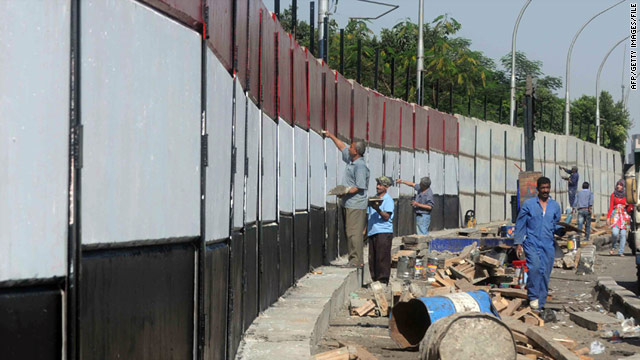
.The demonstrators, who included deep ranks of Egyptian football hooligans, tore down a recently constructed wall built to protect the embassy and invaded the building.

Police detained one Al Jazeera employee for questioning and confiscated equipment, the interior ministry official said.

A spokesman for Egypt's Ministry of Interior said they had pulled Al Jazeera Live off the air because the channel was operating without a permit. They were also responding to "neighborhood complaints" of high levels of foot traffic and blocked cellphone signals in the building the channel occupied.

The broadcaster, also known as Al Jazeera Mubasher, which means live in Arabic, shares the same building as the Cairo bureau of the British Broadcasting Corporation, said Abdel Moneim Mahmoud, a secretary at Al Jazeera Live Egypt. He said Al Jazeera Live's repeated efforts to secure a broadcast permit were stymied by bureaucratic delays.

Al Jazeera Mubasher's shutdown comes as Egypt's ruling Supreme Council for the Armed Forces, or SCAF, seeks to counter criticism from within Egypt that it didn't adequately protect the Israeli embassy.

Throughout the course of the "Arab Spring" of successive pro-democracy uprisings, Arab leaders have repeatedly made a scapegoat out of the Doha-based broadcaster, accusing it of inciting the Arab public.

The channel has distinguished itself for its trenchant coverage both of Israel and Arab autocrats, offering extensive airtime to anti-Israel activists.

Egypt's Minister of Justice, Mohamed Al Guindi, told a television talk show audience on Saturday that the violence outside the Israeli embassy was the first part of a scheme to undermine Egypt's transitional government.

In a thinly veiled reference to Gulf Arab states, Mr. Al Guindi said "neighboring" governments hoped to quash Egypt's revolution for fear that it might motivate revolts in their own countries.

Throughout the summer, the SCAF has ramped up its rhetoric against perceived foreign saboteurs. The military says it believes such people are seeking to destabilize Egypt through proxies in the media and activist communities.

Meanwhile, the cabinet's decision to reverse the decision announced last week to stop issuing tourist visas upon arrival to individual visitors was welcomed by tourism officials. Some tourism and other government officials had been puzzled as to why the government would issue a decision that could further diminish a tourism industry already struggling after Egypt's revolution.

Many analysts speculated that the decision was taken out of concern that terrorists were able to enter the country on ordinary tourist visas.

"I don't care why. What I care for is the welfare of our tourists," Hisham Zazou, the deputy minister of tourism, said in an interview. "They evaluated the situation, they said no, and we will go back to normal."

State of emergency widened in Egypt: "The military is giving broad and excessive powers to a police force that continues to be abusive."

September 12:
Egypt military to widen state of emergency
By Samer al-Atrush
AFP
[Report posted 2:00 PM EDT]

CAIRO — One of Egypt's ruling generals said Monday the military will expand a state of emergency because of a "breach in public security" after protesters stormed Israel's embassy and clashed with police, state news agency MENA reported.

The ruling military council issued a decree to widen the scope of the emergency law -- restricted in 2010 by ousted president Hosni Mubarak to narcotics and terrorism cases -- to target labour strikes and the "spread of false rumours."

It will also target acts that "disrupt traffic," MENA reported. That could possibly outlaw many demonstrations like the regular protests held after an uprising overthrew Mubarak in February.

"Widening the scope of crimes liable under the emergency law along with terrorism and narcotics is the result of the security conditions the country is undergoing and the breach in public order," the agency quoted General Mamduh Shahin as saying.

The general, a member of Egypt's ruling Supreme Council of the Armed Forces, stressed the "necessity of confronting thuggery and all who threaten Egypt's security and harm its reputation abroad."

Those arrested under the law face emergency state security courts, which critics say are unfair and result in harsh sentences.

Protesters clashed with police overnight on Friday after demonstrators stormed a high-rise building housing the Israeli embassy and dumped thousands of documents from a balcony.

Three protesters were killed in the clashes, which left more than 1,000 people wounded. Israel's ambassador and many of his staff were evacuated home.

The incident proved an embarrassment to the country's rulers, with US President Barack Obama calling on Egypt to "honour its international obligations to safeguard the security of the Israeli embassy."

Since the 18-day uprising that ousted Mubarak, Egypt's police force has largely collapsed and the military, unused to civilian policing, has struggled to deal with sporadic and at times deadly unrest.

But critics say widening the emergency law, continuously in place since Islamists assassinated Mubarak's predecessor Anwar Sadat in 1981, is unnecessary and a revival of former practices.

The military had promised that parliamentary elections scheduled by the end of the year would not be conducted under a state of emergency.

"It's a human rights catastrophe," said Hossam Bahgat, the director of the Egyptian Initiative For Personal Rights, a leading rights group.

"It's not only reneging on the promise to lift emergency law, but it revives one of the worst aspects of Mubarak rule and risks introducing the notorious system of administrative detention without charge and trial," he said.

Heba Morayef, a Cairo-based representative of the international rights watchdog Human Rights Watch, called the measure "unnecessary, overly broad and disproportionate."

"This is the classic Mubarak reaction to any perceived security risk," she said. "The military is giving broad and excessive powers to a police force that continues to be abusive and incompetent."

Essam al-Erian, vice president of the influential Muslim Brotherhood's Freedom and Justice Party, said "the general trend is in opposition" to the measure.

"There was a promise that elections would be held without the emergency law. What this means is that either the elections will take place under the emergency law or they will be delayed," he said.

The military has not suggested that it would delay the elections.

But the state-owned Al-Akbar newspaper reported on Monday that the electoral commission agreed in a meeting with military ruler Field Marshal Hussein Tantawi to hold separate parliamentary and senate elections rather than simultaneously as planned previously.

Amr Mussa, a leading presidential candidate and former Arab League chief, suggested in an interview published on Monday that the military work on a "road map" with a civilian council on a transition to civilian government.

In the interview with the Egyptian newspaper Al-Masry Al-Youm, he added that attacking embassies and "Egyptian institutions" was "an attempt to spread chaos and assert lawlessness."

Sunday, September 11

US officials save guards at Israel's Cairo embassy from mobs; meanwhile Egypt's authorities tell their side of the story. Rise of Piñata Journalism.

Whereupon propaganda outlets Xinhua and Al Ahram, battered by opposing forces, struggle to report the news from Egypt......


The following report is from Xinhua, China's official press agency, which is being pressured by its CCP bosses to become a world-class news source while presenting the party line and at the same time appeasing China's increasingly restive upper-income readers, who want 'real' news:
U.S. officials involved in rescue of Israeli embassy guards in Egypt: media

["Media" meaning culled from unidentified news reports outside China. Side note to Mu Xuequan: You know, I too hate collecting links and taking the time to identify every news report that I quote to my readers; in fact I don't know anyone who enjoys the tedious, time-consuming chore. Tell your bosses to suck it up if they want Xinhua taken seriously as a news source outside China.]

JERUSALEM, Sept. 11 (Xinhua) -- More than 100 U.S. officials were involved in pressing Egypt to order the rescue operation of six security guards at the Israeli embassy in Cairo that had come under attack over the weekend, Israeli media revealed Sunday.

As hundreds of Egyptian rioters swarmed through the embassy building, the six men barricaded themselves inside a safe room sealed with a steel door and reinforced glass. At some point, they had fired warning shots in the air with their pistols in a bid to deter some demonstrators who had tried to break down the door.

Prime Minister Benjamin Netanyahu, accompanied by Foreign Minister Avigdor Lieberman and Shin Bet (Israel Security Agency) chief Yoram Cohen, had overseen the frantic attempts to secure the rescue of the six guards from a situation room at the Foreign Ministry in Jerusalem.

Reports said that around midnight Friday Netanyahu decided to call U.S. President Barack Obama to ask for his personal involvement after all attempts to reach the head of Egypt's Supreme Military Council and the de facto head of state, Gen. Mohamed Hussein Tantawi, had failed.

The source said that in the hours that preceded the arrival of Egyptian commandos at the scene, "Obama spoke with Gen. Tantawi and was in constant contact with (his national security advisor Tom) Donilon and Secretary of State Hillary Clinton."

Donilon and Clinton reportedly coordinated the efforts of more than 100 U.S. officials who were scrambled to press the Egyptians to rescue the Israelis, among them senior officials in Washington and the U.S. embassies in Tel Aviv and Cairo.

The Egyptian commandos who ultimately arrived at the embassy were able to get to the Israelis after firing live ammunition and tear gas at the demonstrators.

The Israelis were dressed in keffiyehs and traditional Arab dress to conceal their identities, placed inside armored personnel carriers and rushed to Cairo's airport, where they boarded a private jet dispatched by the Israeli Air Force.

Editor: Mu Xuequan
The following report is from Al Ahram, for generations Egypt's more-or-less state-run press outlet, which did a volte-face during the 'peaceful' protests that brought down the Mubarak regime so that its editors and reporters wouldn't be strung up by mobs chanting, 'The People demand change!'

(Actually, signs of an about-face were emerging at Al Ahram even before the Tahrir Square protests, when it began sharply criticizing the National Democratic Party under Gamal Mubarak's leadership. This gave early warning that the country's military rulers were very angry with Gamal Mubarak and the Gamalists in his father's government.)

Today, while trying to stay on the good side of The People, the paper also strives to appease the country's military leaders. This buffeting from conflicting forces is adding to what might be termed the Piñata style of journalism.(1)
Egypt and Israel after the embassy

Egypt told Israel to allow its ambassador to take a holiday, but it didn't. Then the embassy was attacked, say officials

Dina Ezzat
11 September 2011

"For Israel, good relations, even in the context of the so called 'cold peace', are a very serious matter; it is much more important than relations with Turkey or the situation in Syria, and for us in Egypt keeping peaceful relations with Israel is essential and there is no doubt about it," said an Egyptian diplomat who asked for his name to be withheld.

He added that the US, the guarantor of the Egypt-Israel peace, is also "very serious about avoiding any rupture in relations between Cairo and Tel Aviv, especially now with so many anti-Israeli sentiments being expressed all over the region".

The tension, however, is not to be underestimated. Israel, according to Western diplomats in Cairo, is complaining a lot about the vibes of animosity that are being increasingly voiced against its limited presence in Cairo.

The consecutive angry demonstrations in front of the Israeli Embassy in Giza, to protest the killing of six Egyptian border guards last month by the Israeli army, who violated Egyptian territorial sovereignty, and the taking down of the Israeli flag twice in less than four weeks is making the government of Binyamin Netanyahu very uncomfortable.

"The Israelis tell us they know that the Egyptian authorities are committed to peace with Israel, but they are not sure how far the public anger could go, and how much it would influence the decisions of the authorities towards Israel," the same diplomat added.

According to identical accounts offered by Egyptian officials and foreign diplomats in Cairo, Egypt had asked Israel before the developments of last Friday to keep the Israeli ambassador in Tel Aviv and to reduce the volume of its staff to the minimum, but Netanyahu insisted on sending the ambassador back only a few days before the latest protest.

"We are not expelling him, but we thought a long holiday for the Israeli ambassador in Egypt would be useful for all of us now; unfortunately, Israel thought otherwise and when anger erupted on Friday evening they had to solicit the intervention of the Americans who sent a plane to carry him and the rest of the staff out of Egypt," said one official.

Today, there is a tacit agreement between Egypt and Israel that the long holiday for the ambassador is in place and there are guarantees offered by Cairo to both Washington and Tel Aviv that stepped up security measures will be in place to prevent another attack on the embassy.

Meanwhile, Egypt is insisting that Israel should proceed faster with its investigation in the killing of Egyptian border guards – despite Israeli hesitation and complaints about the attack on its embassy.

"We are telling the Israelis that the authorities have to tell the public that it did not turn a blind eye to the killing of Egyptian soldiers," the same official added.
1) For more on the present relations between Egypt's military and the nation's news media, see Egypt's Military Criticized for Move to Rein In Media (September 9, Wall Sreet Journal), which reported on the decision by Egypt's interim ruling military council to freeze licenses for new satellite-news channels in order to control what it called the nation's "unruly" news media. The decision, announced late on September 7, two days before planned massive street protests that included the attack on Israel's embassy, "added to a growing list of complaints by politicians and activists that the military leading the nation's transition is retreating to the authoritarian methods of the former regime."

"Retreating?" That's an odd way of describing the situation. But then the Wall Street Journal never got the memo that Mubarak was removed by a military-backed coup. The military showed leniency during the protests that brought down Mubarak only to the extent that this suited its purpose of ejecting the Gamalists; otherwise, there has been no change in what has been a military dictatorship since the overthrow of Egypt's monarchy.

Saturday, September 10

Egyptian mob near Israeli embassy attacks CNN, PBS and other journalists, accusing them of being American spies

1. First, a correction to the "Two photos" post. From the following CNN report, journalist Mohamed Fadel Fahmy is "a producer working for CNN." So this corrects -- at least tentatively -- my original guess, in the earlier post, that he was an independent reporter.

September 10, 8:42 PM EDT:
Angry crowd turns on journalists reporting embassy attack in Egypt
From Ivan Watson, CNN
September 10, 2011 8:54 p.m. EDT

Cairo (CNN) -- An angry crowd lingering near the Israeli embassy in Cairo after an attack on the building a day earlier turned on journalists reporting the incident Saturday, accusing at least one of being an Israeli spy.

As a CNN crew filmed the embassy from across the street, another crew from American public television -- led by Egyptian television producer Dina Amer -- approached the building.

The crew's Russian cameraman was preparing to film the embassy when a woman in the crowd began hurling insults at the TV team, Amer said.

"There was this older lady who decided to follow me and rally people against me," Amer recalled.

"She said 'you're a spy working with the Americans.' Then they swarmed me and I was a target."

A growing crowd surrounded Amer and her colleagues, as they tried to leave the scene.

Mohamed Fadel Fahmy, a producer working for CNN, rushed to help escort Amer through the angry crowd. But suddenly the two reporters were pinned against the railing of an overpass by young men who were accusing Amer of being an Israeli spy.

Yelling "I'm Egyptian," Fahmy managed to pull Amer another 10 meters down the road, until the pressure from the mob overwhelmed the pair.

Amer screamed as she and Fahmy were knocked to the ground and the crowd started to trample them.

Other CNN journalists tried to reach in to help, but were pushed back by a wall of angry men.

Fahmy lay on top of Amer, shielding her with his body.

"I was thinking, how powerless I was because there was no police to save us," Fahmy said. "I was worried that they were going to rape her."

At that moment, a student bystander named Mohammed el Banna called out to the journalists and pointed out a nearby car.

Somehow, Fahmy managed to carry Amer to the open door of the public television crew's car, where two of her female colleagues were waiting just a few feet away.

The mob pounded on the windows and tried to reach into the vehicle as the panicked reporters fumbled and struggled to get behind the steering wheel.

When Margaret Warner, a correspondent with the PBS program "Newshour" managed to get the vehicle moving away from the crowd, men threw stones at the departing vehicle.

Amer had few words to describe the terrifying ordeal.

"They were animals," she said.

Other Egyptian journalists told CNN they were also attacked Saturday while trying to report near the Israeli embassy.

Ahmed Aleiba, a correspondent with Egyptian state television, said he was pursued by civilians and soldiers.

"I had to run because obviously they were targeting journalists," Aleiba said in a phone call with CNN. "They attacked two other TV crews."

"I was in the car getting ready to film. A soldier knocked on the window with his stick and said 'if you don't leave by midnight your car will be destroyed,"" said Farah Saafan, a video journalist with the English-language newspaper Daily News Egypt.

Journalists have been targeted before in Cairo.

On February 2, dozens of journalists of different nationalities were beaten and pursued around the city while trying to report on pro-Mubarak demonstrations. The day descended into one of brutal street violence, as pro-regime supporters backed by men on horses and camels attacked opposition demonstrators on what became known as the "Battle of the Camel."

And CBS News correspondent Lara Logan suffered a brutal sexual assault in Tahrir Square while covering the celebrations that followed former President Hosni Mubarak's resignation on February 11.

On Saturday, as some journalists ran for their lives from the Israeli Embassy, the interim government was holding crisis talks with Egypt's ruling military council and top intelligence chief.

The emergency session concluded with a pledge to honor Egypt's international treaties and defend foreign embassies. The government also announced plans to re-activate the country's 30-year-old emergency law.

Application of the law had lapsed since the overthrow of Mubarak, according to a senior official in the National Security Directorate, who spoke to CNN on condition of anonymity.

One of the five measures announced after Saturday's crisis talks calls on authorities to make "media and political powers accountable for inciting security lapses."

"It's obvious that there is some sort of plan leading to military rule in this country," warned Egyptian state TV's Aleiba. "The next step will be martial law."

Note (UPDATED 10:43 PM EDT

UPDATE September 10, 10:43 PM EDT
From a CNN report published at 8:54 EDT tonight (Angry crowd turns on journalists reporting embassy attack in Egypt), journalist Mohamed Fadel Fahmy is "a producer working for CNN." So this corrects my original guess in the 'Egypt photos' post that he was an independent reporter. I note from the CNN report above Fahmy is a producer who risked his life to save a female reporter who was being trampled by a furious mob.
*************
I just added an extensive update to the 'Egypt photos' post. (See following post). Over and out for the rest of the weekend.
Pundita

Friday, September 9

Two very different photos of the attack on Israel's embassy in Cairo (Updated 3X)

UPDATE September 10, 10:40 PM EDT
From a CNN report published at 8:54 EDT tonight (Angry crowd turns on journalists reporting embassy attack in Egypt), journalist Mohamed Fadel Fahmy is "a producer working for CNN." So this corrects my original guess that he was an independent reporter. (See the post below.) I note from the CNN report above that he is a producer who risked his life to save a female reporter who was being trampled by a furious mob.
UPDATE September 10, 5:00 AM EDT
1. The Associated Press photo featured in the discussion below, showing a fire/fires outside the Israeli embassy, was indeed taken during the Friday attack on the Israeli embassy. Here are two other AP photos of the same incident from a nine-photo galley of the unrest in Cairo on Friday. The fires seem to be from torched vehicles. (Google hosted website link):


The photo caption reads:
A protester holds the Egyptian national flag as a fire rages outside the building housing the Israeli embassy in Cairo, Egypt, Friday, Sept. 9, 2011. Hundreds of Egyptian protesters, some swinging hammers and others using their bare hands, tore down parts of a graffiti-covered security wall outside the Israeli embassy in Cairo on Friday. Thousands elsewhere protested for the first time in a month against the country's military rulers. (AP Photo)
A second photo from the gallery that shows fire:


2. The AC-360 CNN news show made no mention of Friday's unrest in Egypt nor of the attack on the Israeli embassy, not even during the news break at the bottom of the hour, and even though the news featured an update on the unrest in Syria and Libya. This doesn't mean the attack wasn't mentioned earlier during CNN's news broadcasts, but that all mention was omitted from AC-360 suggests the Obama White House/State Department were struggling at the time of the broadcast with how they wanted the unrest/attack on the embassy to be framed.

A potentially serious issue that's been building since Thursday in Egypt is that the government has stopped foreigners from being able to purchase visas when they arrive in the country (see report below); there's confusion about the ruling, which government authority imposed it and why.

In short, the situation behind Friday's unrest might be more serious than the Obama administration wanted to acknowledge last night and/or it was still collecting intelligence on the fast-moving and chaotic events on Friday and their implications.

**********************
Associated Press Photo for AP report via (U.K.) Guardian, Egyptian protesters break into Israeli embassy in Cairo, published Sept. 10, 00.08 British Summer Time


Below, photo accompanying CNN report, Protesters in Egypt breach wall, enter Israeli Embassy, published September 9, 6:58 p.m. Eastern Daylight Time. Photo caption: "Workers paint Egyptian colours on the wall built to protect the Israeli Embassy in Cairo (File picture)"


It goes without saying that the AP photo gives a very different impression of the attack on the Israeli embassy than the CNN one. And the "File picture" caption for the CNN photo suggests it could have been taken after the last riot against the Israeli embassy.

Is it possible that the AP photo is also from an earlier riot at the embassy? From Bikya Masr's September 9 report (no time stamp) filed by Joseph Mayton, Egyptians storm Israel Embassy archives, documents fly out window (emphasis mine):
CAIRO: After knocking down the wall aimed at securing the Israeli Embassy building in Giza, Egyptian activists stormed the embassy’s archives late on Friday night and sent documents flying out the window. One image shows the embassy, or an archive apartment, on a high floor of the building, in flames.

It is unclear what exactly is happening, but reports from the area indicate the embassy has been breached and Egyptian protesters are destroying the place.[...]
I don't think the Guardian would deliberately publish an old photo, and while mistakes can happen in publishing, from the Bikya Masr report it seems a fire was set.

All else I can glean is that while there is no byline on the AP report (a common occurrence, particuarly when another news organization is posting a newswire's report), I know that Hamza Hendawi is the Cairo Bureau Chief for AP. I consider Hendawi's reports on the Cairo protests that brought down Hosni Mubarak's government to be the most informative and accurate of all the mainstream reporting on the situation.

The above-mentioned CNN report is bylined "From Mohamed Fadel Fahmy, For CNN." From a Google search Fahmy is described as a Cairo-based journalist, which suggests he is an independent reporter, or at least not a CNN employee.

Is there any significant difference between the AP and CNN reports that are published with the photos?

Well, Fahmy's report says:
Egyptians have been angry about the killing of police officers by Israeli soldiers last month when Israel went after militants who had attacked civilians near the Israeli-Egyptian border.
The AP report says:
Anger increased last month after Israeli forces – responding to a cross-border attack – mistakenly killed five Egyptian police officers near the border.
There are additional less obvious differences in the two reports, but I'd say there's the answer.

Also from the closely-followed Bikya Masr site, another troubling report today from Joseph Mayton:
Confusion as Egypt says no visas on arrival

CAIRO: In the past 24 hours, foreign nationals living in Egypt have become increasingly concerned over the reports that the Egyptian government has ended the ability to purchase a visa upon arrival in the country. It comes on the heels of reports of visa extensions also being turned down in recent months.

Despite the reports, Egyptian consulates and embassies across the globe appear to know little to nothing about the new restrictions.[...]
See the rest of Mayton's investigative report on the situation.

Also, (Iran's) Press TV has reported (Sep 10, 1:36AM GMT) gives a brief update on the situation in Egypt:
The Israeli ambassador to Egypt has flown out of Cairo, a few hours after demonstrators stormed the Israeli embassy.

Yitzhak Levanon boarded a plane before dawn on Saturday morning.

Meanwhile, Israeli Defense Minister Ehud Barak called US Defense Secretary Leon Panetta in the early hours of Saturday morning Tel Aviv time and urged Washington to help protect the Israeli embassy in Cairo.

Egyptian protesters stormed the embassy on Friday, destroying a part of a barricade wall around the building in the process.

Egyptian police used tear gas to disperse the crowd, and one person reportedly died due to asphyxiation after inhaling tear gas.

A protester tore down the Israeli flag at the embassy, to the cheers of thousands of demonstrators on the scene.

In addition, tens of thousands of Egyptians once again gathered at the iconic Liberation Square in Cairo to demand that the military government hand over power to a civilian administration. The protesters gathered in the square after Friday prayers to participate in the "Correcting the Path" demonstration.
I can't wait to see what CNN's AC-360 show will report tonight on the situation in Egypt. Given all that CNN did to promote Egypt's 'revolution,' I am very interested to see what they will have to say about the big breaking news from Cairo.

Wednesday, March 30

Washington's headless horseman and President Obama's Address to the Nation on Libya

President Obama's Monday address to the nation about Libya ended at 7:57 PM ET. By 8:05 PM, CNN's Nic Robertson was reporting to Anderson Cooper from Tripoli that the Libyan opposition battling Moammar Gadhafi is deeply divided in their view of the International Coalition's intervention on their behalf, with one side believing that the intervention represents an attempt to split the country in order to steal Libyan oil. I have no idea how that side came to such a ridiculous idea.

But moving along, yesterday U.S. Secretary of State Hillary Clinton was in London on a cat-herding mission for President Obama, who is rather desperately trying to persuade the International Coalition to think and speak in one voice on the matter of Libya.

Desperation would be an understatement on account of Obama's advisory bench being heavy on Arab affairs advisors and light on African affairs advisors. What this means is that Obama didn't realize at first that (a) Gadhafi thinks like an African, (b) Gadhafi plays the archetypical role of the African chief, and (c) many Africans think like Africans.

What (c) boils down to, in terms of the situation at hand, is that in the view of many Libyans you give the chief the shirt off your back no matter how much he abuses you and the stronger the chief the less you complain about the abuse.

That's the way things are in Africa. That's the way things have been in Africa for countless millennia, on the theory that new-fangled ideas of government come and go while a strong father's will to protect his children is eternal.

Will this theory eventually die out? Will the Libyan opposition on the other side of the split, with leaders educated in the USA and Europe, and including a wafer-thin stratum of democracy activists, someday prevail over the atavistic African model of the most reliable form of government? One would hope so, but right now the President of the United States is facing the stark prospect that not only might Gadhafi survive the International Coalition's onslaught but also that any support Gadhafi receives in Libya could further fracture the Coalition, which is already at loggerheads on how to proceed.

Prime Minister David Cameron made an appeal for unity at the London Summit, which was attended by senior diplomats representing no less than 40 countries, including some Arab countries:
“We are all here in one united purpose, that is to help the Libyan people in their hour of need.”
But when one notes that many Africans (a) consider the Arab Spring an Arab thing (b) still think of the Arabs in Africa as conquerors and colonialists, and (c) have never stopped fuming about European colonial adventures in Libya, I'm afraid that appeals to humanitarianism play better in the United States than where it counts.

None of the above goes near addressing the problem I mentioned in the last post, which is that the 'cooperative' side of the Libyan opposition -- the side that welcomes Coalition intervention against Gadhafi -- has elements that are sympathetic to America's enemies. Top of the enemies list is al Qaeda.

To put the cherry on top, Gadhafi is not a forgive-and-forget sort of person. Thusly, if he survives one must assume he'll divert a considerable portion of Libyan oil revenue to wreaking terrorism on the countries that shot up his air defense system. Top of the shooters list would be the United States of America. Against this prospect is the major rationale Obama cited last night for the timing of the U.S. military action in Libya:
Now, we saw regime forces on the outskirts of [Benghazi]. We knew that if we waited one more day, Benghazi –- a city nearly the size of Charlotte –- could suffer a massacre that would have reverberated across the region and stained the conscience of the world.
As I noted in the March 15 post, Gadhafi had no intention of launching a massacre in Benghazi, which would have been counterproductive for his purposes. His plan was to partly encircle the city, then use a variety of measures to encourage and pressure the Benghazis to drive the rebel leaders through the opening in the circle, out into the desert, where he intended to pick off the leaders. So this was going to be a waiting game, not an invasion.

However, governments are entitled to their propaganda and Gadhafi might have been lying in his teeth, so I won't labor the point about Obama's hair-trigger response to Gadhafi's military threat to Benghazi. Moving to the major secondary rationale Obama cited:
A massacre would have driven thousands of additional refugees across Libya’s borders, putting enormous strains on the peaceful -– yet fragile -– transitions in Egypt and Tunisia. The democratic impulses that are dawning across the region would be eclipsed by the darkest form of dictatorship, as repressive leaders concluded that violence is the best strategy to cling to power. The writ of the UN Security Council would have been shown to be little more than empty words, crippling its future credibility to uphold global peace and security. So while I will never minimize the costs involved in military action, I am convinced that a failure to act in Libya would have carried a far greater price for America.
Yes, the refugee problem is considerable. On Monday CNN correspondent Ivan Watson reported that refugees from Libya had been flooding into Tunisia and Egypt at the rate of 15,000 per day. That the flood had been stanched somewhat since the Coalition took military action didn't mean an end to the humanitarian crisis created by the refugees.

And yet the price of all that for America can't be counted because right now there is no limit to the cost of blinkered U.S. initiatives to bring about democratic reform in Egypt; that's because the sky's the limit for the unintended consequences.

If you ask what initiatives I'm talking about -- I forgot to mention that part, perhaps because of embarrassment that I led myself down the garden path after I read a Wikileaks leaked State Department cable about Egypt that the (U.K.) Telegraph published on January 28. You remember that cable; right? I discussed it in the February 14 post in which I contended that under cover of 'peaceful' protests Egypt's military had launched a successful coup to remove Gamal Mubarak and the Gamalists from power.

From the cable's wording it certainly seemed that the idea to have the Obama administration back Egypt's April 6 Youth Movement had been abandoned, so I assumed that the entire project had been shelved. What I didn't stop to consider was that there could be many similar projects afoot in Washington, and that these were never abandoned. So I got a nasty jolt, which frankly I'm still recovering from, when I read Associated Press Special Correspondent Charles J. Hanley's report on March 12 titled, US training quietly nurtured young Arab democrats, and which reads in part:
The revolutionary roar from the Arab street, shaking the palaces of the privileged, toppling presidents, has echoed around the globe, dominating the headlines and airwaves for weeks. But behind this story of political upheaval lies another, quieter story of outside organizations that, with U.S. government and other money, tutored a young Arab generation in the ways of winning in a political world.

All involved emphasize that what has happened sprang from deeply rooted grievances in the autocratic Arab world, not from outside inspiration. But they say the confidence-building work of democratic coaches, led by the U.S. but also including Europeans, was one catalyst for success.

That success, meanwhile, points up a core paradox: A U.S. government that long stood by Mubarak and other Arab leaders as steadfast allies was, at the same time, financing programs that ultimately contributed to his and potentially others' downfall.

Some see American shrewdness at work, covering multiple political bets in Egypt and elsewhere. Others see an America too big and complex to be consistent.

"Speaking as a Canadian, one of the beauties of the U.S. system is that there are many, many entry points in many centers of power, and they can have conflicting policies," said Les Campbell, Middle East chief for the U.S. National Democratic Institute for International Affairs.

The NDI, affiliated with the Democratic Party, and the GOP-affiliated International Republican Institute (IRI) are links in the nurturing "democratic assistance" web, key conduits for grants from the State Department's Agency for International Development (USAID) and from the National Endowment for Democracy, a private organization funded by the U.S. Congress.
[...]
If readers who've been with this blog for years find Hanley's report to have a familiar ring, you might be recalling the following report from Ian Trayner at the (U.K.) Guardian, which I've mentioned several times over the years, and which received mention on the first day of this blog's existence, on November 28, 2004:

November 26, 2004
US Behind the Turmoil in Kiev
[...]
Ukraine, traditionally passive in its politics, has been mobilised by the young democracy activists and will never be the same again. But while the gains of the orange-bedecked "chestnut revolution" are Ukraine's, the campaign is an American creation, a sophisticated and brilliantly conceived exercise in western branding and mass marketing that, in four countries in four years, has been used to try to salvage rigged elections and topple unsavoury regimes.
[...]
The Democratic party's National Democratic Institute [NDI], the Republican party's International Republican Institute [IRI], the US state department and USAID are the main agencies involved in these grassroots campaigns as well as the Freedom House NGO and billionaire George Soros's Open Society Institute. [...]
If American readers -- and for that matter, readers in Western Europe -- say, 'Forget the history lesson; how much is putting humpty-dumpty back together again going to cost us?' -- well, as I mentioned earlier, there are many unintended consequences spinning out from the magical ouster of Hosni Mubarak -- magical, that is, to audiences throughout the Middle East, who watched the CNN International and Al Jazeera Hollywood-style productions made from the Egyptian protests and thought, 'Oh snap, we can do that here, too.'

So, again, because there's no way to factor in the unintended consequences at this point there's no way to even estimate the cost to taxpayers who'll be stuck with the bill for putting Libya back together into some semblance of order.

Technically, the Gadhafi assets frozen by UN mandate should cover the costs for Libya, but those can't be disbursed immediately and immediately is what's needed. As to the cost in human lives and wrecked economies to -- again, there's no way to tell at this point how much it will add up to.

The taxpayer doesn't necessarily have to pay immediately, at least not the American taxpayer. That's because the Federal Reserve can simply make more money, or the appearance of more money, by pressing a few keys on computers. Of course there is a huge cost to that way of funding activities running into many billions of dollars. But large amounts of money must be found immediately. To quote again from Charles Hanley's report:
National Endowment money, $100-million-plus a year, is at work in more than 90 countries worldwide. But it's the USAID grants, from an $800 million budget for developing "political competition" and "civil society" in 67 nations, that have proved vital to activists in a half-dozen Arab lands, from Morocco to Yemen. Some $104 million was requested for them in the proposed 2011 budget.

In post-Mubarak Egypt, that help is about to balloon.

Of a $150 million Egyptian "transition fund" announced by Washington, $50 million will go toward democracy and governance programs like the ones that have nurtured hundreds of Egypt's rising democrats, The Associated Press has learned. That would triple the 2011 funding previously planned.

"We need more support, and fast," said Abdallah Helmy, 34, co-founder of Egypt's dissident Reform and Development Party and one who benefited in recent years from "hundreds and hundreds of hours" of U.S.-supported training in everything from managing campaigns and elections to using Twitter, Facebook and other social media for political messaging.

It's estimated more than 10,000 Egyptians since 2005 have participated in USAID-financed democracy and governance programs, carried out by NDI, IRI and 28 other international and Egyptian organizations - not only political training, but also projects to prepare judges, build PTA-style school associations and otherwise deepen civic involvement.
[...]
Those are all wonderful projects. Pity they wouldn't be worth much in a country where the military cut a deal with the Muslim Brotherhood in exchange for the Brothers' help in ousting Gamal Mubarak. The March 24 New York Times report that discusses speculation about such a deal doesn't mention the part about a coup; to my knowledge the Times hasn't entertained the possibility that a coup happened.

Anyhow the Times report came too late to warn Egypt's secular democracy activists who were engaged in the protests -- although I seem to recall that John Batchelor warned during the early days of the Egyptian protests that the Brothers and the military had cut a deal, and repeated the warning more than once on his show and his blog. Yet within days of Hosni Mubarak's departure from office, and without prompting from outsiders, many secular Egyptians who took part in the protests did become suspicious that they'd been duped by the military and even some of their leaders; unfolding events in Egypt have not eased their suspicions.

In short, it's going to take huge infusions of cash and technical help if Egypt's genuine democracy advocates are to have even a ghost of chance against a coalition of the military's old guard, the Muslim Brotherhood, and the most radical of Egypt's conservative organizations.

To argue that establishing a genuine democracy is always a rocky road would be to ignore or overlook that it would have been impossible for the military to stage a bloodless coup in Egypt without the assistance of the Western-trained democracy activists who planned and led the initial protests. That the activists might have been innocent dupes wouldn't change the fact that democracy activism, as taught and funded by Western organizations, made it possible for Egypt's military to palm a coup in full view of the world.

If you want to argue that there was no coup I'll be glad to debate you on that score, and I'll do it in a Note at the end of this post. For now, the point is that the more players involved in democracy-promotion initiatives that are mounted or supported by foreign governments, the harder it becomes to monitor them all and control how they're used, and where the funds actually end up.

It all started with the best of intentions, in the 1980s, with the establishment of the National Endowment for Democracy to promote democracy around the world. Its activities were to be closely monitored by Congress because even though it was a private organization it would receive federal funding. The idea worked so well that others started copying it. Not in a year or two but over decades a thick forest of NGOs, GONGOs (government-sponsored non-governmental organizations) and INGOs (international GONGOs) grew up.

The idea became attractive to all kinds of players, not all of them interested in democracy. But set aside democracy initiatives that are fronts for lobbies only interested in business deals or in manipulating a country's politics; set aside local crooks and transnational criminal gangs that set up phony NGOs to cover their tracks. I'm talking about what happened when the sincere democracy-promotion organizations morphed into a kind of industry -- a completely unregulated one.

Les Campbell spoke of the "many, many entry points in many centers of power," in America and called this a beautiful system even though it could produce conflicting policies.

But when the unintended consequences arising from the activities of thousands of people scattered across hundreds of organizations, agencies and departments that operate out of sight of the American voter and often in conflict or with no coordination and official mandate suddenly manifest in the screaming headlines of crisis, what then of the beautiful system?

What then is that there's no one to call to account -- no one to bring before a congressional committee or eject from political office, no one to ask, 'What were you thinking, you goddamn lunatic?'

There is only dense fog on a moonless night in Washington, the hooting of an owl wheeling along the dark waters of the Potomac River and the faint sound of a horse's hooves nearer and nearer --

March 30
Hillary Rodham Clinton remark at London [summit], "... to achieve their aspirations through political change ..." is the blandest way of describing what begins now as years of manipulation and misdirection by the Euro colonial powers to secure the energy fields of Libya without looking as if they are running 6 million people as feudal tenants.

The obstacle to this utopian fairy tale is Q [Gadhafi]. Am told Q is looking at exile and sniffing, 'What about Charles Taylor, oh great Uncle Sugar?' You promised him safe exile in Nigeria if he'd depart his Monrovia nest; however, as soon as the Liberian gov changed hands and decided that Taylor was an outlaw (guided by the geniuses at George Bush State) the ICC closed in and Chuck T sits in the Hague playing video games and hiding his money.
[...]
Q knows the ICC is the threat, and he does not believe State. Also, the rebels are a nightmare of stooges and regime plants. Also the rebel soldiers are all featured on Al Q jihadist websites as heroes of Iraq and Afghanistan. Guys we used to chase we are now protecting with air.

Laughter is a useful emotional release for the You Can't Make This Stuff Up planet of chuckleheads and deadbeats called Earth.

Final note: the deep conflict in London is that Pop Q wants Saif Q to take command of apparatus at Tripoli and run election which he will win overwhelmingly. The Benghazi TNC, stooges all with Western educations and Euro bank accounts, reject this Son-for-Dad deal as the end of their days. Pop the popcorn, as the Italians and Turks love the deal, and the US and French hate it.
-- Saif to the rescue; John Batchelor
Who, then, is the victim in all this madness? For a headless horseman must always have a victim. The victim is America's most cherished values, which Barack Obama spoke with great feeling about during his address to the nation about Libya.

******
Note

The Coup

First, for those who read my February 14 post on Egypt but missed the update I added on the 17th, I'll fill you in. On February 14 STRATFOR chief George Friedman joined Associated Press Cairo Bureau Chief Hamza Hendawi in concluding that the Egyptian military used the protests in the country to carry out a 'soft' coup that was aimed at forcing Hosni Mubarak to resign. And while Friedman stressed the military's fear that Hosni's youngest son, Gamal, would be the father's successor as president, he stayed with Hendawi's view that the coup was an ad hoc affair; i.e., improvised after the protests were already underway.(1)(2)

My analysis, the one I published on the 14th, had gone much further than Hendawi and Friedman; I'd concluded that a cadre in the military's high command (the 'Old Guard') had used youth groups to stage protests that masked a coup, which was aimed at routing not Hosni but Gamal and Gamal's closest associates.

However, I had little evidence to shore my contention that the military had planned the initial protests as cover for a coup, and the evidence I'd scraped together could only be considered suggestive. I'd based my conclusion almost entirely on what I'd learned about Egypt's military and its increasingly desperate struggle against the Gamalists, and also on logical argument. In the update I used the same logic to dispute Friedman's conclusion that the coup had been ad hoc:

Friedman had emphasized the military's struggle against Gamal, which was heating up as Egypt's 2011 presidential election drew near. Yet Friedman was willing to assume that despite their desperation the military's Old Guard would simply wait and hope for a serendipitious moment to give them an opportunity to oust Gamal.

The Old Guard was in no position to wait and hope. Ironically, a February 16 report from STRATFOR titled Egypt's Next Crisis: The Economy, aided my argument. The report, which was republished by the Market Oracle website, throws vastly more light on the Old Guard's reasons for wanting to oust Gamal than even the reports I'd used as the basis for my analysis.

What I found most astonishing about the STRATFOR report is that it revealed that Gamal and his band of reformers in the government had achieved more success in breaking the military's hold on the Egyptian economy than had been reported before to the public -- at least, the publics outside Egypt:
Until just a few years ago, Egypt’s ruling military elite was able to “borrow” money from Egyptian banks with no intention of paying it back. President Hosni Mubarak’s son Gamal changed all that, reforming and privatizing the system in order to build an empire for himself.
[...]
One of the many changes [Gamal] made was empowering the central bank to actually enforce underwriting standards at the banks. The effort began in 2004, and early estimates indicated that as many as one in four outstanding loans had no chance of repayment.

By 2010 the system was largely reformed and privatized, and the military elite’s ability to tap the banks for “loans” had largely disappeared. The government was then able to step into that gap and tap the banks’ available capital to fund its budget deficit. In fact, it is this arrangement that allowed Egypt to weather the recent global financial crisis as well as it did. For the first time in centuries, Egypt’s financial position was not entirely dependent upon outside forces.
[...]
From Gamal Mubarak’s point of view, four problems had been solved. The government had more stable financing capacity, the old military guard had been weakened, the banks were in better shape, and he was able to build his own corporate empire on the redirected financial flows in the process.

But these changes and others like them earned the Mubarak family the military’s ire. Mubarak and his reform-minded son are out of the picture now, and the reform effort with them.

With the constitution suspended, the parliament dissolved and military rule the order of the day, it stretches the mind to think that the central bank will be the singular institution that will retain any meaningful policy autonomy.

If the generals take the banks back for themselves, Egypt will have no choice but to seek international funds to cover its budget shortfalls. Incidentally, we do not find it surprising that now — five days after the protests ended — the banks are still closed by order of the military government.

Yet Egypt cannot simply tap international debt markets like a normal country. While its foreign debt load is small, its total debt levels are very similar to states that have faced default and/or bailout problems in the past. An 8-percent-of-GDP budget deficit and a 72-percent-of-GDP government debt load are teetering on the edge of what is sustainable.
[...]
Based on all I've learned about Gamal I'd dispute that he undertook the reforms for the express purpose of building a personal financial empire. And in any event he would have needed all the financial empire he could muster in order to keep prying the Old Guard's fingers away from Egypt's throat.

I also dispute Friedman's claim, in the February 14 report, that Hosni wanted his son to succeed him in the near term; see my Valentine's Day post for my reasons, although I won't plant a flag on that point. I'm willing to concede that the Old Guard might have had inside information that Gamal was going to make a try for the presidency in 2011.

I'll even concede that there could have been two coups - the one I outlined, and the kind of ad hoc coup that Hendawi and Friedman described. I can see how the Old Guard, once noting the military was being hero-worshipped by the protestors, might have decided to throw Hosni to the lions just to make Double Dutch sure that Gamal had no more supporters in the regime -- even though Hosni made every concession the they wanted on January 29 by naming Old Guard champion Omar Suleiman as vice president and calling for the resignation of Egypt's Cabinet, thus ejecting the peskiest of the Gamalist economic reformers from government.

But no matter how you slice and dice it the Old Guard had to act. If they didn't want to resort to a wave of assassinations to solve their Gamal problem their best window for action was the annual Police Day commemoration in Tahrir Square on January 25.

Their biggest problem would have been persuading the April 6 Youth Movement leaders and other activist group leaders that if they mustered their followers to come out in full force to protest on Police Day, they wouldn't be targets of a sting operation to single out and neutralize opposition ahead of the presidential election. They managed to persuade them, but all that for another day.