"Yo Mama" event at highest level of Karzai's regime between pro- and anti-American staff; Allen and Crocker leap in to prevent fisticuffs. [wiping tears of laughter] This is what a highly decorated career diplomat came out of a happy and well-deserved retirement for and how a four-star Marine general has to spend his time.
I grudgingly admit Al Jazeera English bats it out of the park with their gossipy and very informative report. Because this is AJ, after all, the reporters, one based in Qatar, slip in a few snarky comments toward the end. A mere quibble, in light of the fact that they provide Americans with their first clear picture of what's really going on inside Afghanistan's government.
As long as I'm dishing out compliments, thanks to e-Ariana for spotting the AJ report. An Afghan War version of the late, great Iraq Slogger they ain't, but they try hard within their means to find reports that give insight into the dizzying array of issues critical to what may be the craziest war ever fought.
"It has been one and half years that the palace has been fractured into two groups."
Karzai's team clash over relations with US
By Qais Azimy and Mujib Mashal
Al Jazeera English
March 21, 2012
[See the report at the AJ website for a photograph of Messrs. Ludin and Khurram in a calmer moment inside the palace.]
Kabul - The increasing influence of a conservative circle within President Hamid Karzai's palace has impeded progress in signing a crucial strategic agreement with the US to chart the relationship beyond 2014, officials and analysts have said.
Their outspoken anti-US views have frustrated Karzai's diplomats negotiating with US officials, often resulting in messy clashes.
On March 8, a day before Afghanistan and the United States signed an agreement to gradually transfer control of prisons to the Afghan government, Jawid Ludin, the deputy foreign minister, and Karim Khurram, Karzai's chief of staff, were summoned to brief Karzai ahead of a video conference with US President Barack Obama. Also in the room were General John Allen, the US commander of NATO forces in Afghanistan, and Ryan Crocker, the US ambassador to Kabul.
Just minutes before the call between the two leaders, Karzai left the room for a break, according to three separate sources inside the palace. In the following few minutes, in a confrontation that reportedly verged on physical violence, Khurram and Ludin accused each other of spying - one for Pakistan, the other for the United States. They were split up by the NATO commander and the US ambassador.
Accusations
It all began with a complaint from General Allen, the palace sources said. The US embassy and NATO declined to comment for this article.
General Allen reportedly stated that the prison would be gradually handed over, one of Karzai's pre-conditions to signing a long-term strategic agreement on wider issues. But the Afghan government's media wing must tone down its anti-US rhetoric, Allen insisted.
The Government Media and Information Center (GMIC) falls directly under the authority of Khurram, Karzai's chief of staff.
Ludin, one of Karzai's chief negotiators, turned to Khurram and reiterated the General's point - that such comments hindered negotiations with the US.
Khuram, according to the palace sources, said GMIC was only defending Afghanistan's interests - which Ludin took as an insult.
What Khurram insinuated, an official close to Ludin said, was that the foreign ministry was betraying Afghanistan in negotiations with the US.
Ludin said he would take it upon himself to stop GMIC from making such statements, to which Khurram reportedly responded: "Not even your father can do that."
"You are a spy for the Americans, you do whatever they tell you," Khurram told Ludin at the meeting, according to one official.
Ludin, in return, accused Khurram of spying for Pakistan. At that point, General Allen and Ambassador Crocker are said to have stepped in to prevent a physical confrontation.
Ludin declined to comment for this article. Khurram, after hearing about the premise in person, promised an interview, but then refused to answer his phone.
"Diplomacy was set aside," one senior government official told Al Jazeera about the meeting. "They turned to the Afghan way of arguing."
When Karzai returned to the room, the video-conference went ahead. The prison deal, gradually transferring control to the Afghan government over six months, was signed before the cameras of the world's media the next day, as planned. But the reported confrontation underlines how divided President Karzai's inner court is, with regard to the nature of the long-term relationship with the United States.
Divided palace
"It has been one and half years that the palace has been fractured into two groups," said analyst Abdul Waheed Wafa, the director of the Afghanistan Center at Kabul University.
"On the one side, you have people who say: 'We have not achieved what we want, but we need to stick with the internationals because the alternative is chaos.' Then the other elements - they are against night raids, and against a long-term US and international presence."
The strategic agreement is supposed to provide Afghanistan - a poor country that requires foreign donations for roughly 90 per cent of its annual budget - some assurance to continue its new beginning after decades of war. More importantly, the support of the US would bolster Afghan standing in a volatile region, where the country's neighbours have long been accused of interfering in its internal affairs. For the US, a longer presence in Afghanistan would ensure that it could operate against "threats to US national security", by being able to go after the sanctuaries of those who it believes would use violence against US interests.
But the increasing influence of the conservative chief of staff, and his clashes with what he sees as pro-US elements within Karzai's circle and beyond, has hindered progress to such a point that, in recent weeks, the US announced "it is more important to get the right agreement than to get an agreement". Some interpreted that as the US expressing a decreasing interest in the commitment.
Wafa said the announcement was a bluff that put pressure on the Afghan negotiators, who then compromised, tabling certain preconditions for separate discussions.
"The change of tone in the US was partly to pressure Afghans," said Wafa. "But some Afghans believe it is true - that these people [US officials] are fully frustrated, the US public opinion is against the war, even some senators who were staunch supporters of the war are now saying it is hopeless. That those who wanted an exit got an excuse - that look, the Afghans don't want us, they don't want to sign a long term commitment."
Three issues have been of contention in the negotiating process: US control over Afghan detainees, night raids, and permanent military bases. The two sides agreed to remove the issues of prison transfer and night raids from the strategic agreement, allowing them to be discussed separately.
The prison transfer was signed on March 9, while the memorandum over night raids is being finalised this week, according to an official at the national security council. But the contentious issue of military bases still looms large.
Divisive figure
The argument on March 8 was not just a spur of the moment event. Those views were repeated in subsequent interviews.
"Khurram clearly has an agenda - and he wants to disturb any progress in the relations with the US," an official close to Ludin insisted days after the incident. The other side was no different.
"Absolutely, there are circles that see their sustenance in the West's benefits, and they don't think about the nation," said analyst Ghulam Gilani Zwak, the director of Kabul's Afghan Research and Consulting Center. "They insist on not negotiating and bargaining, and their actions are slave-like.
"But there are others who have the interest of the nation in mind, who don't want the repeat of what Dr Abdullah Abdullah and Younus Qanooni signed with the US in December 2001, bringing our independence under question."
Zwak was referring to an alleged status of force agreement signed between the US government and representatives of the northern alliance, then a minority group holed up in the north, which helped the US topple the Taliban.
The foreign ministry's dysfunction is much spoken about in Afghanistan. Zalmai Rasul, an aging foreign minister, has been called a passive operator without much foreign policy experience. Ludin, a former spokesman and chief of staff to Karzai, shoulders most of the responsibility in the foreign ministry, where many appointments are allegedly based on kinship.
"Our foreign policy weakness is that we haven't had a stable foreign policy, a clear vision. It's all been reactionary, ad-hoc," said Wafa.
Ahmad Shuja, a Washington-based Afghan analyst, believes the palace repeatedly steps on the toes of the diplomats, making it difficult for them to do their job.
"Karzai's statement, his dynamism, eclipses the efforts of the foreign ministry to set policy. It is diplomacy 'Afghanistan style' - not policy in the conventional sense."
And Khurram's tight grip over the president in the past year has made the job much more difficult for diplomats like Ludin, said analysts.
Frustrations
A controversial former minister of culture, Khurram took over the post of Karzai's chief of staff in early 2011 - a position that has held increasingly more power in the country, particularly under Khurram's predecessor, Omar Dawoodzai.
During his stint as culture minister, Khurram was known as a strict censor of television programmes.
Shuja believes Khurram's seemingly anti-US views stem from two sources.
"His political ideology is shaped by his alignment with Hizb-e-Islami, and that seems to figure in his calculations," he said. Led by Gulbuddin Hekmatyar, Hizb e Islami began as a political party that fought the Soviets. It played a major role in Afghanistan's bloody civil war in the 1990s, and now is considered the third (and weakest) faction of the anti-US insurgency.
"But also, let's not forget that they have been trying to reach out to the insurgency. Delaying the signing of a strategic pact will help them in appeasing the Taliban," added Shuja.
In purging the GMIC, which is largely funded by the US embassy, the new chief of staff announced his intention to control the government's message. Frustrated with Khurram's control, the US embassy cancelled funding for a brief period and withdrew its advisers from the media group.
Khurram also issued a warning to the president's press staff, ordering them not to allow US advisers in press conferences, one palace official tols Al Jazeera.
The US embassy declined to comment for this story. But a US official based in Kabul confirmed the frustrations with the palace.
"For the embassy, it is hard to get any access inside the palace since the chief of staff changed," the official said.
Khurram has at least three private newspapers, a television channel and a radio station under his control, directly or indirectly, one official - who formerly worked for him - said.
"The message is not just an anti-American one, but also divisive internally," said Khurram's former colleague. "His brand of conservative Pashtunism strengthens the notion that all Pashtuns are unilateralist and conservative by nature.
"The president's non-Pashtun allies have been increasingly isolated. The damage that Khurram has inflicted on President Karzai's image in one year - his enemies could not have done the same."
Reporting by Qais Azimy in Kabul, Afghanistan and Mujib Mashal in Doha, Qatar.
Showing posts with label Hamid Karzai. Show all posts
Showing posts with label Hamid Karzai. Show all posts
Wednesday, March 21


Friday, March 16
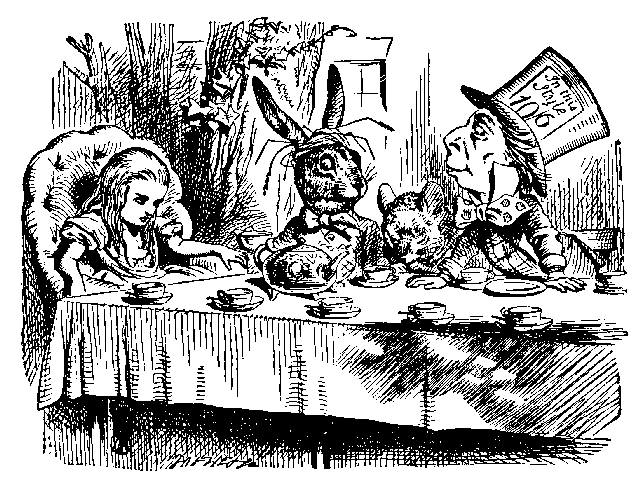
BREAKING NEWS: Pundita finds the bunny
March 15, The New York Times:
But let us return to the news from Helmand; to continue with the report from the Scotsman:
As to where I found the bunny -- oh, the same place I always find him.
KABUL, Afghanistan — Prospects for an orderly withdrawal of NATO forces from Afghanistan suffered two blows on Thursday as President Hamid Karzai demanded that the United States confine troops to major bases by next year, and the Taliban announced that they were suspending peace talks with the Americans.March 16, the Scotsman:
A two-month operation to clear poppy fields in Helmand province -- the world’s largest opium-producing region -- has begun.Now just see what patiently hunkering down in the duck blind can net you while editorialists, salaried opinion experts, members of Congress and national leaders hold forth on the meaning of the latest two-step from Karzai and Taliban.
But let us return to the news from Helmand; to continue with the report from the Scotsman:
Afghan enforcement teams have a 60-day window between early March and late April, dictated by growing patterns, in which to take action to eradicate crops in the war-torn province of Afghanistan.Any questions about Karzai's recent spate of seemingly irrational demands and Taliban's latest hissy fit?
The aim is to eliminate harvesting of the illegal crop from at least 2,000 hectares in the food zone around the Helmand valley.
The drive is being led by the province’s governor Gulab Mangal, aided by the work of Afghan security forces following years of fighting by coalition troops to secure swathes of land.
Major Ross Brown, head of eradication for the Provincial Reconstruction Team’s (PRT) counter-narcotics department, said Afghan teams from each district would use tractors and ploughs, provided by international funding, to target farms ranging from small holdings to large, organised crime operations.
They will face constant danger as many poppy producers use improvised explosive devices (IEDs) - more commonly associated with the insurgency - to protect their crops.
Maj Brown said a carrot and stick approach was being used - almost literally.
Farmers who have been offered the opportunity and support to switch to growing carrots and wheat, but who have refused to take up the offer, will be targeted first.
Maj Brown said: “The long-term aim is to create a secure and stable food zone in the heart of Helmand.”
As to where I found the bunny -- oh, the same place I always find him.
Saturday, March 3
Afghan Koran Burning incident: Here ye! Here ye! Kangaroo courts now in session!
Afghan-US military inquiry may lead to review of at least five personnel despite concluding burning of texts unintentional ... But a different panel appointed by the Afghan president, Hamid Karzai, to investigate the incident, has concluded that the burning of the holy books was deliberate. ... "What the Afghan president has requested from US officials and the US military is a trial and punishment."
The NATO panel is still investigating.
US troops could face disciplinary action over Qur'an burning in Afghanistan
March 3, 2012
The Guardian (U.K.)
Staff and agencies
At least five US military personnel could face a disciplinary review following the burning of copies of the Qur'an by American soldiers in Afghanistan.
A joint investigation by senior Afghan and US military officials has concluded that although mistakes were made when troops at Bagram airbase, near Kabul, had burned copies of the Qur'an and other religious literature along with piles of waste paper, there was no intent to desecrate the Islamic religious texts.
A western official said the investigation could lead to a disciplinary review of at least five US military personnel involved.
But a different panel appointed by the Afghan president, Hamid Karzai, to investigate the incident, has concluded that the burning of the holy books was deliberate.
Maulvi Khaliq Dad, a senior Afghan religious leader on the panel, said US troops told Afghans at the base that the religious materials pulled from a detention centre library were to be stored, but were then sent for incineration.
"They are claiming that it was not intentional. Our investigative team says it was intentional," Dad said.
After the panel presented its findings, Afghanistan's top religious leaders demanded on Friday that those involved be put on public trial and be punished, a position that Karzai backs.
Barack Obama and other US officials have apologised for the incident on 20 February, which triggered six days of riots across Afghanistan. The apologies, which described the incineration as accident, have failed to quell the anger in the country, although the violent protests that killed more than 30 Afghans and six US troops have subsided.
Karzai's office said on Saturday it had only seen the report drafted by the religious leaders and had not yet been given the joint report, so could not comment on it.
"We are waiting for the result of the investigation by Nato, which will probably show who is involved in this and how many people are involved. After studying it we will announce our stance," said a presidential spokesman, Aimal Faizi. "What the Afghan president has requested from US officials and the US military is a trial and punishment."
The NATO panel is still investigating.
US troops could face disciplinary action over Qur'an burning in Afghanistan
March 3, 2012
The Guardian (U.K.)
Staff and agencies
At least five US military personnel could face a disciplinary review following the burning of copies of the Qur'an by American soldiers in Afghanistan.
A joint investigation by senior Afghan and US military officials has concluded that although mistakes were made when troops at Bagram airbase, near Kabul, had burned copies of the Qur'an and other religious literature along with piles of waste paper, there was no intent to desecrate the Islamic religious texts.
A western official said the investigation could lead to a disciplinary review of at least five US military personnel involved.
But a different panel appointed by the Afghan president, Hamid Karzai, to investigate the incident, has concluded that the burning of the holy books was deliberate.
Maulvi Khaliq Dad, a senior Afghan religious leader on the panel, said US troops told Afghans at the base that the religious materials pulled from a detention centre library were to be stored, but were then sent for incineration.
"They are claiming that it was not intentional. Our investigative team says it was intentional," Dad said.
After the panel presented its findings, Afghanistan's top religious leaders demanded on Friday that those involved be put on public trial and be punished, a position that Karzai backs.
Barack Obama and other US officials have apologised for the incident on 20 February, which triggered six days of riots across Afghanistan. The apologies, which described the incineration as accident, have failed to quell the anger in the country, although the violent protests that killed more than 30 Afghans and six US troops have subsided.
Karzai's office said on Saturday it had only seen the report drafted by the religious leaders and had not yet been given the joint report, so could not comment on it.
"We are waiting for the result of the investigation by Nato, which will probably show who is involved in this and how many people are involved. After studying it we will announce our stance," said a presidential spokesman, Aimal Faizi. "What the Afghan president has requested from US officials and the US military is a trial and punishment."
Friday, February 10
Amrullah Saleh on Afghanistan's neglected majority
Readers who've followed my blog for years would understand why I interrupted my weekend to post the following op-ed at the Wall Street Journal.
My mother once told me that I was a sunny, even-tempered toddler, but that every so often I lost my temper. She said that at those times I expressed outrage by going to the kitchen cabinet where the pot and pans were stored -- the cabinet was at my eye level -- then with all my might hurling every pot and pan out of the cabinet, which of course made a huge racket. Having made my editorial statement I'd then return all the cookware to the cabinet, neatly stacking each one in its proper place.
Reading through Amrullah's latest attempt to talk to reason to Washington, for the first time I understand exactly how I felt when I headed for the kitchen cabinet. For years I've kept my nose to the grindstone of the Afghan War by telling myself that if Amrullah Saleh can see all he's seen and still remain calm and reasonable in his discussions with Washington I have no right to scream and yell on this blog. But sometimes.....
Why Negotiate With the Taliban?
By AMRULLAH SALEH
February 9, 2012 - 8:03 P.M. ET
The Wall Street Journal
Washington's olive branch to the Taliban -- no matter the excuses or justifications -- amounts to the management of failure, not the mark of victory. Negotiating with the Taliban after more than 10 years of fighting means giving legitimacy and space to militant extremism.
The objective of NATO's post-9/11 intervention in Afghanistan was to starve militant extremism by defeating the nexus of al Qaeda and the Pakistan-backed Taliban. That now seems like a dream.
With support from Pakistan, the Taliban has managed to protract the fighting and create a strategic deadlock. The U.S. military surge in 2010 weakened the Taliban, but it hardly pressured their strategic support across the Durand line in Pakistan. So the deadlock remains -— chiefly because of Pakistan's unwillingness to cooperate fully with NATO, coupled with the fractured state of Afghan politics since the fraud-marred 2009 presidential elections.
Pakistan and the Taliban have no interest in producing quick positive results from talks. The Taliban has already gained certain advantages, including the possible transfer or release of their commanders from U.S. custody, the opening of an office in Qatar, and the legitimacy to enter into mainstream politics at the time of their choosing. They will definitely use these preliminary gains to further their psychological influence over the Afghan populace. And they won't likely bargain away the gains they have earned by suicide bombings, ambushes and the marginalization of civil society. Now that the Taliban has guaranteed its basic survival, it will fight for domination.
Washington's talks with the Taliban -- taking place, on and off, in Qatar -- come at a time when most anti-Taliban Afghan civil society leaders have deserted President Karzai. He is head of a heavily subsidized state whose pay master (Washington) is now largely bypassing his government to negotiate with the enemy. This raises the question: Who and what does President Karzai represent?
In a bid to make himself relevant, President Karzai has adopted a strategy of meddling. He has demanded that NATO halt night raids, hand over the Bagram detention facility, and place strict restrictions on security companies. He has also refused to echo NATO's mission goals and justifications, and he wanted the Taliban to open an office in Saudi Arabia, not Qatar.
In return, NATO has accused Mr. Karzai of corruption, of committing abuses of human rights, and of being detached from reality. Successful counterinsurgency work requires international troops and the host nation to be seen as unified; that is simply not the case here.
Pakistan and the Taliban are more coordinated in their approaches than are NATO and Afghanistan. This is one of the key reasons why concerned anti-Taliban Afghans are creating a third force to ensure their rights and interests are represented and protected. They no longer see either President Karzai or NATO committed to those rights and interests. Though fragmented in their approach, these forces share a common goal: to counterbalance the growing influence of the Taliban and to fill the vacuum created by the declining relevance of Afghanistan's democratic institutions.
Certainly no Afghan political coalition can stop Washington from talking to the Taliban -- but those talks won't bring stability. Talks and a potential ceasefire may provide the U.S. and its NATO allies their justification for a speedy withdrawal, but it won't change the fundamentals of the problem in Afghanistan. Striking a deal with the Taliban without disarming them will shatter the hope of a strong, viable, pluralistic Afghan state.
The absolute majority of the Afghan people are against the Taliban and the domination of our country by militant extremism. They have wholeheartedly supported and participated in the democratic process, but they are now marginalized both by President Karzai, who controls massive resources with no accountability, and the international community, which is focused disproportionately on transition, withdrawal and the Taliban.
Afghanistan's neglected majority can provide a political alternative for the military mission in Afghanistan. Its inclusion, which the U.S. could secure by pursuing reconciliation in a way that pressures President Karzai to respect the role of parliament and independent judges, would contain or push back the Taliban, increase the cost of war for Pakistan, and provide hope for post-transition Afghanistan. By contrast, should that majority remain outside the strategic calculus, we'll see further fragmentation of political power and legitimacy in Afghanistan. That will weaken Washington's position and endanger the entire mission.
Mr. Saleh, who directed Afghanistan's national security directorate from 2004 to 2010, is now an opposition political activist.
My mother once told me that I was a sunny, even-tempered toddler, but that every so often I lost my temper. She said that at those times I expressed outrage by going to the kitchen cabinet where the pot and pans were stored -- the cabinet was at my eye level -- then with all my might hurling every pot and pan out of the cabinet, which of course made a huge racket. Having made my editorial statement I'd then return all the cookware to the cabinet, neatly stacking each one in its proper place.
Reading through Amrullah's latest attempt to talk to reason to Washington, for the first time I understand exactly how I felt when I headed for the kitchen cabinet. For years I've kept my nose to the grindstone of the Afghan War by telling myself that if Amrullah Saleh can see all he's seen and still remain calm and reasonable in his discussions with Washington I have no right to scream and yell on this blog. But sometimes.....
Why Negotiate With the Taliban?
By AMRULLAH SALEH
February 9, 2012 - 8:03 P.M. ET
The Wall Street Journal
Washington's olive branch to the Taliban -- no matter the excuses or justifications -- amounts to the management of failure, not the mark of victory. Negotiating with the Taliban after more than 10 years of fighting means giving legitimacy and space to militant extremism.
The objective of NATO's post-9/11 intervention in Afghanistan was to starve militant extremism by defeating the nexus of al Qaeda and the Pakistan-backed Taliban. That now seems like a dream.
With support from Pakistan, the Taliban has managed to protract the fighting and create a strategic deadlock. The U.S. military surge in 2010 weakened the Taliban, but it hardly pressured their strategic support across the Durand line in Pakistan. So the deadlock remains -— chiefly because of Pakistan's unwillingness to cooperate fully with NATO, coupled with the fractured state of Afghan politics since the fraud-marred 2009 presidential elections.
Pakistan and the Taliban have no interest in producing quick positive results from talks. The Taliban has already gained certain advantages, including the possible transfer or release of their commanders from U.S. custody, the opening of an office in Qatar, and the legitimacy to enter into mainstream politics at the time of their choosing. They will definitely use these preliminary gains to further their psychological influence over the Afghan populace. And they won't likely bargain away the gains they have earned by suicide bombings, ambushes and the marginalization of civil society. Now that the Taliban has guaranteed its basic survival, it will fight for domination.
Washington's talks with the Taliban -- taking place, on and off, in Qatar -- come at a time when most anti-Taliban Afghan civil society leaders have deserted President Karzai. He is head of a heavily subsidized state whose pay master (Washington) is now largely bypassing his government to negotiate with the enemy. This raises the question: Who and what does President Karzai represent?
In a bid to make himself relevant, President Karzai has adopted a strategy of meddling. He has demanded that NATO halt night raids, hand over the Bagram detention facility, and place strict restrictions on security companies. He has also refused to echo NATO's mission goals and justifications, and he wanted the Taliban to open an office in Saudi Arabia, not Qatar.
In return, NATO has accused Mr. Karzai of corruption, of committing abuses of human rights, and of being detached from reality. Successful counterinsurgency work requires international troops and the host nation to be seen as unified; that is simply not the case here.
Pakistan and the Taliban are more coordinated in their approaches than are NATO and Afghanistan. This is one of the key reasons why concerned anti-Taliban Afghans are creating a third force to ensure their rights and interests are represented and protected. They no longer see either President Karzai or NATO committed to those rights and interests. Though fragmented in their approach, these forces share a common goal: to counterbalance the growing influence of the Taliban and to fill the vacuum created by the declining relevance of Afghanistan's democratic institutions.
Certainly no Afghan political coalition can stop Washington from talking to the Taliban -- but those talks won't bring stability. Talks and a potential ceasefire may provide the U.S. and its NATO allies their justification for a speedy withdrawal, but it won't change the fundamentals of the problem in Afghanistan. Striking a deal with the Taliban without disarming them will shatter the hope of a strong, viable, pluralistic Afghan state.
The absolute majority of the Afghan people are against the Taliban and the domination of our country by militant extremism. They have wholeheartedly supported and participated in the democratic process, but they are now marginalized both by President Karzai, who controls massive resources with no accountability, and the international community, which is focused disproportionately on transition, withdrawal and the Taliban.
Afghanistan's neglected majority can provide a political alternative for the military mission in Afghanistan. Its inclusion, which the U.S. could secure by pursuing reconciliation in a way that pressures President Karzai to respect the role of parliament and independent judges, would contain or push back the Taliban, increase the cost of war for Pakistan, and provide hope for post-transition Afghanistan. By contrast, should that majority remain outside the strategic calculus, we'll see further fragmentation of political power and legitimacy in Afghanistan. That will weaken Washington's position and endanger the entire mission.
Mr. Saleh, who directed Afghanistan's national security directorate from 2004 to 2010, is now an opposition political activist.
Saturday, October 1
STRIKE UP THE BAND! HAMID KARZAI MAKES A SMART DECISION!
This is what I've been waiting for:
Associated Press, 7:40 PM EDT, UPDATED 8:00 PM:
As for Karzai: Make sure, make goddamn sure, that this time you don't give into pressure from the U.S. and the U.K. regimes; no matter what they throw at you stand by your words today. They pressure you again, and they will, they blackmail you again, and they will, they threaten you again, and they will, just tell 'em, 'I refuse to keep taking orders from fiends -- and governments that knowingly pay another government to murder their own troops are nothing more than a collection of fiends -- fiends and ghouls.'
As to the perils of telling a fiend straight to its face that it's a fiend -- yes, well, that's a conundrum I've never quite resolved for myself, so I am not taking the high road with Karzai. But I do know from experience that there are times when one has no option but to name evil for what it is and yes, tell it straight out that you know you're confronting a real fiend. I think that now is one of those times for Hamid Karzai.
Associated Press, 7:40 PM EDT, UPDATED 8:00 PM:
Afghan president gives up trying to talk with TalibanAw, put a sock in it, Gilani.
By DEB RIECHMANN
Kabul, Afghanistan (AP) President Hamid Karzai has given up trying to talk to the Taliban, saying in a video released Saturday that Pakistan holds the only key to making peace with insurgents and must do more to support a political resolution to the war.
Karzai revealed his tougher stance against Pakistan, which he claims is harboring militants, on the same day that the Afghan intelligence service said it has hard evidence that the assassination of former President Burhanuddin Rabbani was planned on the southern outskirts of Quetta, the Pakistani city where key Taliban leaders are based.
Interior Minister Bismullah Khan Mohammadi went even further, stating in an Afghan parliamentary session that Pakistan’s Inter-Services Intelligence agency was involved in Rabbani’s killing — an allegation Pakistan has denied.
"Without any doubt, ISI is involved in this," Mohammadi told Afghan lawmakers on Saturday.
The claims follow similar accusations against Pakistan from the United States, reflecting the growing frustrations with a central player in the region whose cooperation is crucial even as its intentions are under question.
Critics have accused the Pakistani government of protecting Taliban leaders to maintain good relations with the group in anticipation of Western forces’ eventual withdrawal from the country — an allegation denied by Pakistan. Many analysts also believe the ISI’s alleged support for insurgent groups is an attempt to promote Pakistan’s interests in Afghanistan and counter the influence of archenemy India, which Karzai plans to visit this week.
Addressing a public rally on Saturday, Pakistani Prime Minister Yusuf Raza Gilani offered to share intelligence on Rabbani’s assassination and said his nation was ready to hold talks with anyone interested in peace. Most of the Taliban leadership is thought to be living in Pakistan, and its governing council, the Quetta Shura, is named after the Pakistani city.
Calling Karzai his brother and friend, Gilani said, "He has some misunderstanding on the assassination of Professor Rabbani."
As for Karzai: Make sure, make goddamn sure, that this time you don't give into pressure from the U.S. and the U.K. regimes; no matter what they throw at you stand by your words today. They pressure you again, and they will, they blackmail you again, and they will, they threaten you again, and they will, just tell 'em, 'I refuse to keep taking orders from fiends -- and governments that knowingly pay another government to murder their own troops are nothing more than a collection of fiends -- fiends and ghouls.'
As to the perils of telling a fiend straight to its face that it's a fiend -- yes, well, that's a conundrum I've never quite resolved for myself, so I am not taking the high road with Karzai. But I do know from experience that there are times when one has no option but to name evil for what it is and yes, tell it straight out that you know you're confronting a real fiend. I think that now is one of those times for Hamid Karzai.
Friday, June 24
Karzai surrounding himself with anti-US advisors as he realizes US military pullout from Afghanistan in 2014 will be total
June 23, 2011:
• Fears peace talks will see Taliban return to power
• Pakistan, India, Russia and China jockey for position
And if anyone's interested in more of the Obama administration's blither about Pakistan:
The regime has repeatedly used the tool against unarmed civilians, repeatedly used it to fight undeclared wars, and used it as a foreign policy tool. So what does it say about the United States of America that instead of declaring Pakistan a state sponsor of terrorism, in the face of overwhelming evidence going back decades that it does indeed use terrorism as a tool of war, the U.S. regime blithers about values and balancing a ledger?
Karzai surrounding himself with anti-US advisersSee also the Guardian's June 23 report, US pullout from Afghanistan signals new power struggle in fragile nation. The highlights:
By Kathy Gannon
Associated Press
KABUL, Afghanistan – President Hamid Karzai is increasingly isolated and has surrounded himself with an inner circle of advisers who are urging him to move closer to Iran and Pakistan as the U.S. draws down its role in Afghanistan, several friends and aides tell The Associated Press.
Their advice is echoed in Karzai's anti-West rhetoric, which has heightened both in his public speeches and in private. He met recently with Iran's defense minister, and constantly cautions against trusting the U.S. to have Afghanistan's best interests at heart.
[...]
"A lot of Afghans are very concerned about the direction the country is taking, moving away from the international community ... toward a more conservative practice in which the religious people and warlords have more power," Human Rights of Afghanistan Commissioner Nader Nadery said.
"Consistently his aides are pushing him toward Iran and Pakistan," Nadery said. "All those who are managing and controlling his schedule, providing appointments, all see the advantages of breaking with the international community."
[...]
In part, Nadery blamed Karzai's disappointment at not getting a strategic forces agreement with the United States that would allow for U.S. bases in Afghanistan as well as give the president protection and negotiation room with Washington. Instead, the document the U.S. gave to Karzai spoke only of a complete withdrawal, he said.
The United States has said it will have all its fighting forces out of Afghanistan by 2014 and that the security of Afghanistan will be turned over to Afghan forces. The U.S. has not asked for any bases or centers to remain under its control.
"I think the reality of their complete withdrawal has struck home," Nadery said. "Now he sees they may go and they don't want a (military) presence here, there were no bases that they requested and perhaps now he is thinking, `Who will protect me?' And he has turned to Hizb-i-Islami and conservative elements in the country like those on the Ulema (clerics) Council, former warlords, as well as getting closer to Pakistan and to Iran."
[...]
• Fears peace talks will see Taliban return to power
• Pakistan, India, Russia and China jockey for position
And if anyone's interested in more of the Obama administration's blither about Pakistan:
June 23, 2011 -(Reuters) - Secretary of State Hillary Clinton warned Pakistan on Thursday that U.S. military aid could suffer if Islamabad failed to address rising U.S. doubts over its commitment to fighting Islamist militants.The official, declared state policy of Pakistan is that terrorism is a legitimate tool of war.
Clinton told a Senate panel that the Obama administration viewed Pakistan as a crucial partner as it seeks to wind down the U.S.-led war in neighboring Afghanistan and vanquish al Qaeda and other militant groups.
But under skeptical questioning from U.S. lawmakers, Clinton said Washington remained concerned that Pakistan's actions were sometimes not lining up with its words -- and that it could affect the billions of dollars in annual U.S. aid to Pakistan.
"When it comes to our military aid, we are not prepared to continue providing that at the pace we were providing it unless and until we see some steps taken," Clinton told the Senate Foreign Relations Committee.
She didn't specify the steps, but stressed it was time for the United States and Pakistan -- which saw relations deeply strained after U.S. special forces raided a Pakistani compound in May to kill al Qaeda leader Osama bin Laden -- to ensure they are on the same page.
"On one side of the ledger are a lot of actions that we really disapprove of and find inimical to our values and even our interests," Clinton said.
"Then on the other side of the ledger there are actions that are very much in line with what we are seeking and want. So we're constantly balancing and weighing that."[...]
The regime has repeatedly used the tool against unarmed civilians, repeatedly used it to fight undeclared wars, and used it as a foreign policy tool. So what does it say about the United States of America that instead of declaring Pakistan a state sponsor of terrorism, in the face of overwhelming evidence going back decades that it does indeed use terrorism as a tool of war, the U.S. regime blithers about values and balancing a ledger?
Sunday, December 5
Amrullah Saleh sets the record straight on Taliban imposter, and the question that haunts
Of course this report got no play in the USA:
Note the date of the cable under discussion in the following report: January of this year. Yet at that time (and up to this day) there were elements in Washington, including elements in the U.S. military, which continued to insist that Pakistan's military command and ISI had turned over a new leaf. The willful blindness of these factions led the Obama administration to push for an equally blind pursuit of reconciliation with the Taliban.
The question that haunts me is just how far the U.S. is willing to go in the attempt to discredit Karzai's warnings about the intentions of Pakistan's military. I suspect it's a question that also haunts Karzai -- and Saleh:
Taliban impostor warnings ignored by Afghan leaders, says former spy chiefThere's more in the report that calls for close attention but I want to turn now to another report, one that throws additional light on Saleh's trials as he tried to talk sense into men pursuing a mirage.
by Jon Boone
(U.K.) Guardian, November 28, 2010
Desperate for a peace deal with the Taliban, officials dismissed security advice over bogus go-between
Hamid Karzai's desperation for a "Good Friday agreement for Afghanistan" led officials to ignore repeated warnings from their own spy chief that they should not trust a man who orchestrated a humiliating face-to-face meeting between the Afghan president and a shopkeeper who pretended to be the Taliban's second most powerful leader.
Amrullah Saleh, the former head of the National Directorate of Security (NDS), Afghanistan's equivalent of MI5, said his agency first vetted the man, who claimed to be a representative of Mullah Akhtar Mohammad Mansour, one of the highest-ranking figures in the Taliban, in mid-2008, but rejected him after he was unable to prove his credentials.
However, the go-between, who said he was a Taliban leader from Kandahar called Muhammad Aminullah, subsequently approached the interior minister, Hanif Atmar, the following year and was enthusiastically embraced by an Afghan government desperate for a breakthrough in peace talks.
Saleh, a highly regarded administrator who was sacked by Karzai earlier this year, said all his warnings were ignored. "I tried time and again to convince my colleagues in the ministry and subsequently at the palace that he is not a genuine representative of anybody," he told the Observer.
The rare public statement by Afghanistan's former top spy contradicted attempts yesterday by the Afghan government to deny that "Mansour" had ever held high-level meetings in Kabul. It also further undermines claims by the Afghan government that MI6 was entirely to blame for the fiasco. [...]
Note the date of the cable under discussion in the following report: January of this year. Yet at that time (and up to this day) there were elements in Washington, including elements in the U.S. military, which continued to insist that Pakistan's military command and ISI had turned over a new leaf. The willful blindness of these factions led the Obama administration to push for an equally blind pursuit of reconciliation with the Taliban.
The question that haunts me is just how far the U.S. is willing to go in the attempt to discredit Karzai's warnings about the intentions of Pakistan's military. I suspect it's a question that also haunts Karzai -- and Saleh:
Pak Army and ISI continue to support Afghan Taliban: Karzai
Press Trust Of India
December 3, 2010
(Washington) Over a month after the new Af-Pak policy was unveiled, Afghan President Hamid Karzai warned the US that no success could be achieved in the war against terrorism [while] the Pakistan Army and ISI continued to support Afghan Taliban. Welcoming a delegation of US lawmakers, including Republican John McCain, Karzai told them that the improvement in the overall bilateral relationship between Afghanistan and Pakistan was held back by the Army and ISI who continue to help the Afghan Taliban.
This was written by US Ambassador to Afghanistan Karl Eikenberry ... in a secret cable dated January 10, 2010, which was released by WikiLeaks. President Barack Obama unveiled his Af-Pak policy in December, 2009. The United States, which has charged the Wikileaks of indulging in a criminal act by stealing and releasing these cables, has neither confirmed nor denied the authenticity of these documents.
Karzai said he wants to engage more and have US support in doing so, since "the war won't end easily without Pakistani cooperation", the cable said.
"He was pessimistic about the internal situation, as was his intelligence chief, Amrullah Saleh. Saleh noted that Pakistan's energy sector was in decline and that discontent in Pashtun areas was higher than it had been in the volatile 1960s and 1970s," the cable said.
Karzai also said his Pakistani counterpart Asif Ali Zardari is using Baloch nationalists as his base of support. "Saleh predicted that neither the army nor Nawaz Sharif would bring Zardari's term to an abrupt end," the Ambassador wrote.
Explaining his reintegration approach, Karzai noted that the peace process and reintegration efforts help in the fight against the Taliban by working with those who are willing to come back, especially the "foot soldiers".
Reconciliation would extend to more senior level Taliban (not Mullah Omar, he clarified) who are not linked to Al Qaeda, "some of whom are willing" to talk. Lots of contacts are taking place, Karzai said, but no common reconciliation policy has emerged, the cable said.
"McCain noted that for this to be successful the other side should be convinced they can't win and this should probably be timed to work with the new influx of troops now underway.
"He agreed that those fighting for reasons other than ideology should be helped to return and that the fight should continue against the ideologically-motivated Taliban, stressing the importance of educating the country that both efforts were ongoing at the same time," the cable said.
Subscribe to:
Posts (Atom)