Translate

Sunday, August 8

Well well. I see Sahib Sebastian Gorka is finally making useful himself to John Batchelor's audience.


I did not listen to the Sahib's Friday night chat with John on account of my blood pressure already being high enough for that day. But it turned out the one time I didn't tune in he presented a perfectly respectable and informed analysis of Obama's Iraq exit strategy. Happily John summarized Gorka's points in a post (see below), which boil down to the leader of the world's lone superpower nation squirting WD-40 on the floorboards so they won't squeak when he orders the U.S. military to tiptoe out the back door.

So. Provided Gorka stays away from discussing again what Pakistani generals and high-level Afghan officials tell him the United States should do in Afghanistan I might sheathe my claws in future. However, I have advice for the Sahib: the next time Pakistani generals tell him about their red-line issues in Afghanistan, he's not supposed to pass along their caterwauling. He's supposed to sneeze in their faces.
Five Years from Iraq
by John Batchelor
August 7, 2010

Spoke to Sebastian Gorka [Foundation for the Defense of Democracies] re the Obama administration policy for Iraq and learned that there is no policy after the withdrawal of combat troops.

POTUS Obama asserts that he is keeping a campaign pledge to move the US out of Iraq. This is not the same as establishing a policy with goals and alternatives. POTUS and VPOTUS are satisfied with quitting a fragile state that is easily pulled apart by the usual thugs.

Gorka asserts that AlQ will be first to take advantage of our exit and will rally the usual Sunni Baathists. The Kurds easily reject the Baghdad crowd. The Shia of the south are well under the wing of Tehran. The current PM Maliki is a viceroy of the IRGC.

Five years from now? A client state of Tehran, contributing troops, ships and rhetoric to the witches brew cooked up by the Twelvers of Tehran. POTUS knows some of this, and yet continues to assume that his diplomacy will win over the Twelvers and their sadistic military cult, the IRGC. This is delusional planning at best.

Five years from now, Iraq will mount missiles that can reach Israel and the Arabian oilfields. Five years from now, Russia will be doing big business in Iraq with energy and arms. Five years from now, POTUS and VPOTUS will be avoiding the question, "Who lost Iraq?" I remind myself with Colin Powell's famous proverb, You break it, you own it.

We broke Iraq. We interrupted Iraq's self-loathing; we introduced another kind of fate; we banished the wretchedness of the Saddamites. We broke the savage Iraq. We own it.

Saturday, August 7

See what all that U.S. aid to Arabs has wrought: "Angry at US, Arabs support an Iran nuclear bomb"

[T]his image of an Iran of little overall threat to the region contrasts starkly with the view advanced by US officials that Arab countries fear the consequences of a nuclear Iran. That US perspective is more the result of positions diplomats hear from Arab leaders who are not always in synch with their publics

I read Gurdjieff oh, let's see, about 40 years ago, so my memory is hazy on many details of his teachings, and I never could make heads or tails of the Enneagram. But every so often since the war on terror began, I've found myself recalling some of his aphorisms. The one I recall at this moment, which he might have attributed to his uncle:
The first time you do something for a man, he thanks you. The second time you do something for him, he says nothing. The third time he asks, "What took you so long?"
Check.
New poll: angry at US, Arabs support an Iran nuclear bomb
By Howard LaFranchi, Christian Science Monitor, August 6, 2010

A new poll of Arab opinion finds that for the first time a majority of the public across the region – including a sizable minority in Saudi Arabia – believes a nuclear-armed Iran would be a positive development in the Middle East.

The portion of the Arab population thinking that way has doubled since a similar survey a year ago, in part because of huge majorities this year in Egypt and Morocco. Egypt, which makes up a quarter of the Arab world, was not in last year’s survey.

The findings, however, say less about a change in Arab opinions of Iran than they do about a change in opinions about another country, say the organizers of the 2010 Arab Public Opinion Poll: Arabs have soured on the United States of Barack Obama.

The poll finds that Arabs have traded in last year’s “wait-and-see” attitude toward the new American president in favor of something much more negative, and the support for Iran is, in many ways, being seen as one part of that anger.

“What this poll reveals is a backlash against the United States, reflecting the loss of hope that people had in what they thought were to be the policies of the new President Obama,” says Shibley Telhami, a University of Maryland Middle East expert, who conducted the poll with the polling firm Zogby International. “It’s really people venting by supporting ‘the enemy of my enemy.’”

Enemy again

This year’s poll finds that large majorities of Arabs list the United States and Israel as the region’s worst enemies, far above Iran. The US returns to one of the top rungs of the “enemies list” after having been judged positively by a small majority of Arabs last year, a shift from past years that Mr. Telhami qualifies as nothing short of “amazing” given longstanding Arab views of the US.

In 2009, 51 percent of the public was “optimistic” about the US. This year, nearly two-thirds say they are “discouraged” about America’s actions in the region.

The specific reasons for the shift: disappointment over the lack of progress on the Israeli-Palestinian conflict, and a perception of little change in US Iraq policy.

Describing a “triangulation” of Arab opinion, Telhami says, “Arab views of the US are formed largely through the prism of the Arab-Israeli issue. And Arab views of Iran are very much the function of views of the US and prospects for peace in the Middle East.”

When asked to name two countries they see posing the biggest threat to their country, 77 percent named the US (second only to Israel) while Iran was named by 10 percent – down from 13 percent last year. At the same time, however, majorities in several countries, including the United Arab Emirates, Lebanon, and 52 percent in Saudi Arabia, say it would be “mostly negative” if Iran were to acquire nuclear weapons.

Bad information?

Still, this image of an Iran of little overall threat to the region contrasts starkly with the view advanced by US officials that Arab countries fear the consequences of a nuclear Iran.

That US perspective is more the result of positions diplomats hear from Arab leaders who are not always in synch with their publics, Telhami says. “Arab governments are more worried about the prospects of a nuclear Iran than the publics are,” he says.

Still, the poll does not reveal any surging support for Iran. Iranian President Mahmoud Ahmadinejad does move up slightly in the estimation of Arabs, but his small rise as an “admired” leader is nothing compared to that of Turkish Prime Minister Recep Tayyip Erdogan, who rode his reputation for standing up to Israel (and the United States) to take the top spot in the “admired leader” category.
Well, if it's any comfort, France has declared war on al Qaeda. Better late than never.

Snark. Shoes for Zardari.

The unfunny part: the civilian government's crummy response to the flood crisis has made the Pakistan military look like heroes.

From al Jazeera today:
Zardari faces flood protests in UK

Noisy protests have marked the Pakistani president's visit to the British city of Birmingham where he addressed supporters of his Pakistan Peoples' Party (PPP).

A shoe was reportedly thrown at Asif Ali Zardari as he delivered his address on Saturday and 250 people rallied outside to vent their anger against his UK visit, while Pakistan reeled from floods.

"They [the protesters] come from various groups with various messages but one thing they all agree on is that he should not be here," Al Jazeera's Alan Fisher, reporting from Birmingham, said.

"[They say he] should be back in Pakistan, co-ordinating rescue efforts for those caught up in the floods."

Some held up shoes to pictures of Zardari, while others held placards reading "1,000s dying, president is holidaying".

One of the demonstrators told Al Jazeera: "He's here living in five-star hotels while whole villages have been wiped out. I just think it's a shame."

Another said: "He should be over there looking after the people but obviously he doesn't see them as people. He sees them as nobody, otherwise he would not be here."

Unpopular president

Zardari was already unpopular before the floods hit Pakistan and he has been nicknamed "Mr 10 per cent" over widespread allegations of fraud.

"Zardari's poll ratings are the lowest they've ever been," our correspondent said.

"There are elections in Pakistan next year. It's thought that the PPP will do exceptionally bad and most of that will be because of Zardari."

The rally in Birmingham had raised expectations that Bilawal Bhutto Zardari, son of the president and the assassinated prime minister Benazir Bhutto, would make his maiden political speech after graduating in June from Oxford University.

But in an apparent attempt to appease anger over the handling of the floods which have killed at least 1,600 people, the 21-year-old cancelled plans to attend and said he would instead stay in London to collect donations for flood victims.

Bilawal defended his father's visit to Europe, saying the president was raising much-needed funds.

"He's doing the best he can and what he thinks is best to help the people of Pakistan," Bilawal said.

"His personal presence in Pakistan would not be able to raise this much money."

He said multi-million dollar donations had been made by France, Britain and Abu Dhabi.

'All lies'

The PPP is co-chaired by Zardari and his son.

Asked whether he was using his father's UK visit to launch his own political career, Bilawal: "That's all lies."
[...]

Friday, August 6

A murder in Karachi: Caution about leaping to conclusions (UPDATED)

UPDATE July 7
A reader asked it I'd meant to type "lost-cost" loans while I was upbraiding foreign governments for throwing money at Pakistan. It was a typo; I'd meant to type "low-cost loans," but I think it was also a Freudian slip. I'm going to let the typo stand because it's an apt summary of what international development schemes have sown in Pakistan.
**************************************************
The press interpreted the spectacular terrorist attacks in June on two Ahmadi mosques as a sign of escalating violence against Pakistan's minority religious sects. But I pointed to the location of the mosques and in particular the one in Old Town, noted Karachi's white-hot real estate market, and noted that authorities should first inquire into local disputes between businesspeople, real estate speculators, business interests among the city's most powerful politicians, etc. before pinning blame on sectarianism.

On Monday Raza Haider, a lawmaker in Karachi's leading political party (MQM), was gunned down. The assassination was the latest in a string of killings of politicians in Karachi during the past month. Haider's death touched off revenge attacks and wreaked so much havoc in Pakistan's second largest city and the country's business hub that the Pakistani rupee came under further downward pressure. At last count more than 90 people have died in the violence and at least 195 suspects are under arrest.

The killings point to sectarian fault lines in the ethnically-diverse city but an AP report on Haider's death sounded a cautionary note:
[Karachi] has long been plagued by political violence between supporters of rival parties that draw votes from different ethnic groups in the city of 16 million people. Their supporters are accused of running protection rackets and illegally seizing land, muddying the reasons for the bloodshed.
[...]
Sharfuddin Memon, the head of the Citizens' Police Liaison Committee, speculated the killing of Haider and others may be related to a government operation against so-called "land mafias," which illegally occupy commercially valuable land often allegedly with the backing of political parties.

"The assassination and the ensuing killing have diverted the government focus from that operation," said Memon. "And this mafia, it is not operating in isolation, there are elements in the civil administration who are in connivance with them."
This is not to discount the seriousness of ethic and religious strife; Haider's party has been very outspoken in their criticism of the "Talibanization" of Karachi since large numbers of Pashtuns from Taliban areas flooded into the city. And it could well be that Haider's murder was carried out by a Taliban terrorist group.

But Pakistan is not only the 'land of the generals;' it is also the land of 'mafias' -- land mafia, transportation mafia, water mafia, you name it mafia. Everything of any great value is controlled by gangs with connections to the military and civilian government officials. That needs to be kept in mind when assessing reports of terrorism in Pakistan.

One also has to keep the mafias in mind when taking in accounts of Pakistan's police and soldiers slain in the government's war on terrorists. As the AP report suggested, the true situation can be murky in many cases.

If Haider was one of the good guys I'm sorry for his death but in any event his murder and the events that followed in Karachi should scare a little sense into Saudi Arabia, Beijing, NATO governments, and the United Nations. Stop throwing aid at Pakistan; stop throwing lost-cost loans at the government; stop being an enabler, stop lying.

During the days of Eliot Ness, gang warfare in Chicago was called gang warfare, even though the murder carried out by the gangs against any honest cop, judge, journalist, or politician who challenged them could also be described as terrorism.

It's now time to call a spade a spade in Pakistan. Start talking straight to Pakistan's regime, if any government on this planet even knows the meaning of the concept any longer. Millions of lives hang in the balance. Granted, the regimes that have done the most to enable Pakistan's criminals couldn't care less about those millions. So it's up to the taxpayers in the democracies that are helping the regime rape its country's poor, decimate what exists of its middle class, and wreak bloodshed on innocents in Afghanistan and India, to call out their own governments over the matter of Pakistan's gangsterism.

Always count the silverware after the Atlantic Council comes to dinner

If I hear Shuja Nawaz, Director of the Council's South Asia Center, utter the words "What Pakistan needs..." one more time, I'm going to scream.

Why doesn't the Atlantic Council relocate from Washington to Brussels? They'd be so much happier there, at least until the USA is officially renamed "United States of NATO." Go, shoo, scat.

"Why don't you come here to prison to debate us?" Michael Ledeen's report for John Batchelor show on what's really going on inside Iran

What's going on, according to Michael Ledeen's report to John Batchelor last night, is so much dissent that after a funeral for Iran's favorite singer drew huge crowds Ali Khamenei, the country's 'supreme leader,' issued a fatwa against music. That only poured oil on the flames of ever-growing public anger in Iran against the regime. ("I keep saying that Khamenei is the CIA's best operation in Iran," drily observed Ledeen.)

Actually Khamenei didn't issue a fatwa banning music -- not yet, at any rate -- but he did condemn Iranian interest in music. According to the (U.K.) Guardian his statement was "among the most extreme comments by a senior regime figure since the 1979 revolution."

Ledeen also reported that 250 Revolutionary Guards soldiers had sided so openly with opponents of the regime that the IRCG Commander-in-Chief, Maj. General Mohammad Ali Jafari, had no choice but to relieve them of duty. Sympathy with the opposition, and outrage about corruption in the regime and the corps itself, has been skyrocketing within the IRGC.

The Islamic Revolutionary Guard Corps now controls by conservative estimates a third of Iran's economy but they're supposed to be incorruptible guardians of the faith. See this July 2010 BBC report on the economic power that the IRGC has amassed over the past two decades and in particular since Ahmadinejad came to power. The corps has followed Pakistan and Burma's military in doing big business at the expense of the rest of the country's citizens. IRGC, Inc. has created a sense of betrayal among the more idealistic members of the Guards not to mention Iran's regular military.

Another news item that never saw the light of day outside the country until Ledeen's report: the challenge issued to President Mahmoud Ahmadinejad by five jailed political dissenters when they learned he'd challenged President Obama to a debate: Come to prison; we'll be glad to debate you.

A year ago word of the challenge wouldn't have made it beyond the prison walls but with sympathy for the dissenters breaking out all over Iran, the opposition has become ever more outspoken even as the regime retaliates with torture and executions and ever more wacky fatwas.

As I observed the other day you can't keep 'em down on the farm forever; the mullahcrats are trying to stop the tides by hurling toothpicks at them.

Listen to the podcast of the 10 PM Batchelor show segment for the rest of Leeden's news about Iran. The first part of the podcast is news and analysis about Lebanon that hasn't made into the mainstream news, either, so you won't be bored waiting for Ledeen's turn at the microphone.

As to whether any of this is leading anywhere -- I've seen nothing to suggest that the Iranian opposition is committed to democracy and the defense of human rights. Instead, they still think it's possible to get comfy in hell by rearranging the furniture of the Iranian Revolution so it's more democratic, more committed to human rights. If, under pressure from the Western powers, more Iranian activists are putting freedom first, I'll be glad to retract my words or at least qualify them.

None of this means that pressure from the opposition, financial sanctions, Iran's worsening economic situation, and Khamenei's passing (reportedly he's dying from cancer or something or other) won't combine to remove Ahmadinejad and replace him with a kinder, gentler face of Islamic government in Iran and nicer attitude toward Israel. So I guess we should content ourselves with that much.

However, such an eventuality would exacerbate the problem at the heart of many matters, which is that the United States is closely allied with the Kingdom of Saudi Arabia. Because you can bet that no matter how much of a smiley face a different Iranian leadership paints on, they're not going to be BFF with the Saudis and other Gulf oil states.

Better relations between Israel and Iran would also finally force the Israeli leadership to confront the worst realities of the Saudi-U.S. relationship. In my view it's because of the relationship that the Israelis are barking mad to be so greatly involved with the U.S., but that's just Pundita rambling on.

Yet if the Israelis ever notice that no matter what Iran does to offer a compromise the U.S. keeps setting the bar higher, they might quit barking long enough to do a little simple arithmetic.

Thursday, August 5

How to kill a lot of Taliban in Afghanistan? Arm Afghan women. There's just one catch.

Photo at left: Police Lt-Col Malalai Kakar, head of Kandahar's department of crimes against women, once killed three would-be Taliban assassins in a spectacular gun battle. The Talban finally killed her in September 2008 in a sneak attack.

Nine years into the Afghan War it's time for ISAF to listen to advice that Canadian feminist Wendy McElroy gave in November 2001. Writing for Fox Opinion McElroy noted in part:
In the 1970's, Afghan women were among the most Westernized and liberated in the Islamic world. Their pre-Taliban role as doctors, bankers, lawyers, and teachers has been well documented. But almost no attention has been given to the part they played as freedom fighters against the Soviets, or to their potential for armed resistance against future oppressors who may again try to hijack the country as the new government takes form.

Yet the evidence indicates that many Afghan women would fight to protect themselves and their families.

In October 1996, the New Internationalist magazine interviewed Nooria Jehan, a mother who joined the anti-Soviet mujahideen in guerilla warfare.

"I learned explosive techniques and began supervising and teaching the younger men," Nooria recalled. "We would stick explosives and detonators under the Russians' tables and chairs."

When asked what she would do if the women-hating Taliban captured her city of residence, Kabul, Nooria said, "We will fight them as we fought the Russians."

That is what some women have done. In the Nov. 12 Newsday, journalists Matthew McAllester and Ilana Ozernoy quoted a woman named Malika, a mother whose family lived on the Taliban front line of Bagram just north of Kabul.

"At night I go up on the roof with my Kalashnikov [a Russian assault rifle] and my hand grenades to protect my house," Malika declared.

As the journalists commented, the very existence of Afghan women who take up arms suggests "a female population with more vitality and self-confidence than is immediately apparent." ...

In 1964, Afghanistan adopted a constitution that included universal suffrage and equality for women. Women assumed roles in both the government and the judiciary, and constituted some 30 percent of Afghanistan's civil service. But active participation in government didn't prevent the Taliban from shrouding them in burqas. The ability to defend themselves might have.

Western forces cannot and should not patrol the streets of Afghanistan to prevent violence against women. If these women are to resume the Western advantages of having careers, freedom of speech and representation in government, they must also assume the responsibility of self-defense.

There is a saying: "Give a man a fish, you feed him for a day. Teach a man to fish, you feed him for a lifetime." Give an Afghan woman the right to own a gun and you protect her long after the current tragedy has become old news. A gun in the hand of a mother who is protecting her child may be the most humanitarian relief of all.
There's one problem with re-arming Afghanistan's female civilian population: President Hamid Karzai's regime is "increasingly eager to bolster its Islamic credentials in an effort to blunt the Taliban influence," according to an alarming Wall Street Journal report titled, TV Host Targets Afghan Women's Shelters.

That explains why Afghan women in the country's north, which up to this point has been the region safest from the Taliban, are now retreating behind the veil out of fear that the Taliban are advancing on the north. With Karzai's regime pandering to Saudi Wahabist ideology, the women of Afghanistan can't expect support from their government in standing up to the Taliban. They can't expect much support from the ISAF, either, which is pandering to Karzai's moral cowardice.

It also explains why recruitment for Afghan female police trainees is way down: As of June 2010 there were only 1,100 women in a police force of 107,000.

I recall several women in the Adhamiyah section of Baghdad. They got tired of cowering inside the house while their menfolk took up patrols against al Qaeda and insurgents. The women asked for and received training from U.S. forces in handling weapons and doing patrols.

See The Tension blog for more of the story.

I also find myself recalling the first time I heard Christopher Hitchens speak. I don't remember what year this was -- the years blur together in my memory since 9/11 -- but it might have been around the time of the U.S. invasion of Iraq. He was a guest on a short-lived TV talk show hosted by political conservative Tucker Carlson. Hitchens, a leftist, was a strong supporter of the invasion and the U.S.-led war on terror.

They were discussing a communist insurgency group in Iran that the U.S. regime had labeled a terrorist organization, yet which was the only group in Iran making a strong stand against Iran's totalitarian Islamist regime and institutionalized misogyny.

Hitchens said, "I keep telling conservatives that the communists are the best friends America has in the war on terror."

I muttered at the TV, "With friends like that we don't need enemies."

Today, I'm not so sure. Not after reading the Wall Street Journal report I linked to above and pondering the extent of my government's hypocrisy regarding Islamism in Afghanistan and Pakistan.

How did it come to the point where U.S. forces, which defend a country founded on Christian principles, now fight to protect a regime in Afghanistan that serves up the death penalty for anyone proselytizing for Christianity? How did we arrive at the juncture where America, which enshrines women's rights, props up a regime that is trampling the rights of Afghan women and females seeking refuge from severe abuse?

The only answer I find comes from the cynical wisdom of George Gurdjieff, who observed that people who live in sleep always bring about the very situations they most wanted to avoid.

Whoops! Indian reader catches major gaffe! (UPDATED 4:50 AM)


"Hi Pundita,

The [Reuters] photograph you have taken from the Maclean's article, Land of the Generals, is actually of soldiers from India's BSF and the Indian Army. Notice that the photo is taken from the Indian side of the Wagah border and the label on the arch in the background is Pakistan, implying that the land beyond the arch is Pakistan.

Also, the uniforms of the border guards in the foreground are khaki - which is the colour of the Border Security Force's uniforms. Pakistan's border guards - Pakistan Rangers - have a black uniform, as can be seen with the chap standing on the arch just above the 'P.'

Third: The headgear of the soldiers in khaki has the Ashok emblem on it - India's official emblem. The gents with red tabs on their collar are officers of the Indian Army whereas the ones with black tabs are officers of the BSF.

Please remove this pic. It is rather embarrassing to have the Indian armed forces confused for their Paki counterparts. 60 years without a single coup attempt have earned the men on the Indian side of the border the right not to be confused with the feudal lords of Rawalpindi. :-)

Regards,
Shaunak"

Shaunak --
Thank you very much! I have removed the photo and edited the accompanying text. I will write Maclean's to alert them, as well.
Pundita

"Pundita,
There might be one small error I've made in my previous email to you. The gent in the khaki uniform with the red tab on his collar is definitely the only Pakistan Army officer in the entire pic (The Indian Army's uniform is olive green).

The rest of the details I mentioned (The arch, BSF uniforms, Ashok emblems etc.) remain true, as can be verified via this pic taken from the Indian side of the border. Notice the same arch on the Pakistani side. Apologies for the earlier error.
Regards,
Shaunak"

See the link Shaunak provides for the full-sized photo, which is too large for this blog.

Wednesday, August 4

Mired in corruption, inept State Dept. and USAID now want Americans to donate to relief of Pakistan's flood victims (UPDATED 9 PM ET)

9 PM Update: Added several links and additional material
***************************
Meanwhile, Pakistan's President "fiddles while Pakistan drowns."

From the (U.K.) Telegraph's August 3, 2010 report, Asif Ali Zardari: life and style of Pakistan’s Mr 10 Per Cent:
[President Zardari] is said to have interests in three properties in London, but it was his ownership of 335-acre Rockwood House in the North Downs in Surrey that came to symbolize his wealth and ambition. He is said to have bought the £4  million mock Tudor pile partly because he had fallen in love with the local pub, the Dog and Pheasant.

When the landlord refused to sell him the pub, he is said to have had a replica built in the basement of the house. The property also boasted polo pitches, a stud farm and a golf course. Faced with claims that he had bought the house with money made illegally, he denied he was even the owner, asking: “How can anyone think of buying a mansion in England when people in Pakistan don’t even have a roof over their heads?”

It was only after the house had been sold and the Pakistani authorities tried to seize some of the money that he acknowledged his ownership.
The essays that put Pundita on the map -- at least, in Europe -- were two 2005 posts in which I nominated, only half in jest, Eliot Spitzer for President of the World Bank. This was years before Spitzer's little problem with an extramarital affair; at the time he was a 'lynching prosecutor' who'd gone after big-time white collar criminals with such zeal that just the mention of his name was enough to strike terror in the hearts of Wall Street denizens.

That made him the World Bank President this country, and the world's downtrodden, needed. I figured that within three months of arriving at the Bank Spitzer would call in an army of forensic accountants. That would lead to yellow police tape being wrapped entirely around the perimeter of World Bank and State Department headquarters buildings in Washington, DC.

Then would come the perp walks, with Bank and State employees throwing their jackets over their heads as the international press corps snapped photos and CNN cameras rolled.

Of course all that was a complete fantasy. The Bank is an international institution, virtually beyond the reach of the U.S. Department of Justice. And the day federal warrants are served at State will be the day hell freezes.

Instead of Eliot Spitzer the World Bank got Paul Wolfowitz, a man whose intellectual brilliance is more than matched by his naivete. The Bank's Mandarins took one look at his anti-corruption drive then with State cheering them on chewed him up and spat him out in the form of thumb tacks.

The only reason I called for donations to Haiti's earthquake victims is that I knew State and USAID would have very little control over the bulk of the money, and that the earthquake had delivered a decapitation strike to Haiti's corrupt regime. With so little functioning government in the country, international aid organizations were able, in large measure, to avoid the kind of red tape in Haiti that funnels much donation money to corrupt local government officials. My concern is that this will not be so in the case of Pakistan's flood victims.

All that is another way of saying don't be a fool.

If I knew of any good grass roots organizations in Pakistan I'd say that if you want to donate, then go through those. There are a few such organizations that are not run by the terrorists, but I don't know their names.

The perennial problem in international relief work is that it's a G2G affair -- government to government. The donations you send to Red Cross or Red Crescent or Oxfam, etc. do not go directly from those organizations to victims of a disaster. The organizations have to go through the afllicted country's government. It's the same with governments that provide official aid to the country; it first passes through the red tape and its distribution is under control of the local government.

As to the U.S. regime using American tax dollars in the attempt to use flood relief aid to win Pakistani hearts and minds, as State is now doing -- short of armed insurrection there is no way Americans can change the way things work in Washington, and I'm not sure even insurrection would work. There's simply too much money to be made from contracts connected with international aid relief to impose any more than cosmetic changes on the system.

And in the case of Pakistan, State and USAID are not even capable of monitoring corruption in Afghanistan, which has only the most rudimentary bureaucracy.(1) Decades ago Pakistan's regime turned fleecing international aid and development institutions into an art form, which entailed setting up sophisticated and elaborate bureacratic machinery. State's perennial argument is that they can't deal effectively with such situations because its understaffed and underfunded. First I want to see the perp walks, then I'll consider the argument.

Before State took it over USAID was perfectly capable of developing and overseeing good projects in the developing world, including Pakistan, and without a huge budget and staff.(2)

U.S. aid to Pakistan's earthquake victims in 2005 backfired; it served to create more anti-American feelings among Pakistanis. State's reply is that this time it will be different because they're going to throw even more money to helping Pakistanis in the present disaster, and they're going to make the assistance long term. That reply takes us into Red Queen logic, which I refuse to debate on the grounds that I'm not Alice.

There is another factor to consider. Out of all the press that covered a recent terrorist attack inside Pakistan, only the New York Times reported that the organization that was handing out crutches and wheelchairs when the terrorists struck was USAID. The terrorists inside Pakistan and Afghanistan are fighting USAID tooth and nail, with the most needy Pakistanis and Afghans caught in the crossfire.

The U.S. military has diverted some helicopters from the Afghan campaign to help with the rescue of thousands of Pakistanis trapped by the floodwaters and overseen the distribution of hundreds of thousands of (halal) meals to flood victims.

ISAF can't really spare the helicopters but I don't begrudge any of that type of help. Yet that's where U.S. help should end, beyond pressing the international community to take on the burden of flood relief aid in Pakistan. Tehran sent its condolences to Pakistan's people. Tehran can cough up a few thousand dollars, blankets, tents, and so on. Ditto for many other countries.

Meanwhile --
Asif Ali Zardari is fiddling while Pakistan drowns
by Con Coughlin
(U.K.) Telegraph, August 4, 2010

Pakistan has had to endure more than its fair share of disasters, but even by its harsh standards, the floods that have driven millions of people from their homes, and killed at least 1,700, qualify as a tragedy.

In such circumstances, you might expect Asif Ali Zardari, the country's president, to abandon his European tour and return home at the earliest opportunity to assume personal control of the relief operation – such as it is. The military's failure to organise the evacuation has left entire communities stranded, while the authorities' wider inability to deal with the floods' aftermath has led to outbreaks of cholera in the Swat valley.

[Pundita note: that's not the half of it; the regime didn't even bother to warn Pakistanis downstream that the floods were on their way.]

And yet Mr Zardari displays no inclination to return home, even though David Cameron's injudicious comments about Pakistan's ambivalent approach to fighting terrorism provided him with the perfect excuse. [Pundita note: the remarks weren't injudicious but that doesn't invalidate the writer's point]

His officials insist that he is leaving the crisis in the capable hands of his prime minister, Yousef Raza Gilani, while he presses on with his equally important diplomatic mission to France and Britain to discuss global security issues.

But the reality is that Mr Zardari has a very different agenda – which is why, after spending a convivial few days at his family's opulent chateau in northern France, he and his entourage have taken up residence in London's Churchill hotel. They will then travel to Chequers for talks with Mr Cameron, before concluding their visit with the highlight of the entire tour, at least as far as Mr Zardari is concerned – a massive rally in honour of his eldest son, Bilawal Zardari Bhutto.

Under Pakistan's constitution, Bilawal, who will be 22 next month and has just completed a history degree at Oxford University, is not allowed to run for office until he is 25. But ever since Benazir Bhutto was assassinated by a suicide bomber in the garrison town of Rawalpindi in December 2007, Mr Zardari, her husband, has been determined to ensure that Bilawal becomes the latest in a long line of Bhuttos to lead the ruling Pakistan Peoples Party.

The fortunes of the 700,000-strong Bhutto clan have fluctuated wildly since the PPP was founded by Zulfiqar Ali Bhutto, Pakistan's first elected prime minister, in 1967. His government collapsed amid allegations of corruption in 1977, and he was hanged two years later under martial law. Benazir was only 24 at the time of her father's death. Initially, she was placed under house arrest, but in 1984 made her way to London, where she became the PPP's leader-in-exile.

She returned in triumph following the mysterious death in a helicopter crash of General Zia al-Haq, the country's military dictator, and fulfilled her life-long ambition of becoming prime minister in 1988. The previous year she had married Mr Zardari, the son of a wealthy tribal leader from Sindh. When she was forced out of office in 1990, Mr Zardari found himself at the centre of corruption allegations surrounding a variety of property deals.

Although Mr Zardari has always protested his innocence, he spent a total of 11 years in jail – many of them in solitary confinement. Even after his release, rumours swirled that he had acquired a fortune worth £1 billion, including homes in France and Britain. For years, Mr Zardari denied ownership of a 335-acre estate in Surrey, until his stake in the property was revealed when it was sold.

In the light of Mr Zardari's controversial past, it is unlikely that he would ever have become president had it not been for his wife's dramatic assassination. Even then, other factions within the family believed they had a better claim, including Mumtaz Bhutto, the 77-year-old clan leader who had previously opposed Benazir's accession.

To keep the rival factions at bay, Mr Zardari worked hard to safeguard the position of his eldest son. And it is to this end that, rather than returning home to rally his country in its hour of need, he will be attending Saturday's 3,000-strong rally in Birmingham, where Bilawal is to make his first political speech.

For the past two-and-a-half years, Mr Zardari, who shares the chairmanship of the PPP with his son, has effectively acted as a regent. Soon, he is expected to stand down as the PPP's co‑chairman, opening the way for Bilawal to become its undisputed leader.

The importance of Saturday's rally lies in the fact that the majority of the 1.2 million Pakistanis resident in Britain support the PPP, not least because it has always taken care to protect the interests of Britain's Pakistani immigrants, as well as taking a hard-line position on Kashmir. The British Government, for its part, has quietly lent its support because of the party's perceived pro-Western stance.

But beyond the power politics, Saturday's rally is a microcosm of the wider problem that afflicts Pakistan. By attending, Mr Zardari will help to secure the PPP's leadership for his son – yet in doing so, he will, like so many before him, be putting clan before country. And few in Pakistan will easily forget the image of their president's helicopter leaving the elegantly manicured lawns of his French villa at a time when millions of his countrymen have been deprived of homes of their own.

[Pundita note: According to Pakistan's Nation the villa actually belongs to Zardari's father but somehow I don't think the majority of Pakistani flood victims read the rag.] And from The Telegrah I quoted at the start of this post, Zardari surely paid for the villa even if the deed is in his father's name.


1) Reuters, April 1, 2010; Jonathan Burch: Where has all the Afghan aid gone?

2) From Harper's 2008 interview with Ahmed Rashid:
HARPER'S: You note that the effort to rebuild Afghanistan after the invasion had the benefit of many of the “best and the brightest,” but you’re also sharply critical of U.S. efforts, which you describe as incompetent or perhaps corrupt.

You contrast the USAID you remember from your childhood [in Pakistan], when it was very active in Pakistan, with the current USAID, which seems to exist to dole out contracts to cronies and which places millions of dollars in the hands of a group from California that wants to build California-style schoolhouses in Afghanistan, where the weight of the snowfall would crush them. The Bush Administration argues that contracts are more cost-efficient and more reliable than a government-run effort. How do you rate the performance of USAID in Afghanistan?

AHMED RASHID: USAID has been one of the biggest disappointments in the entire effort to combat extremism and it has contributed to the way many people see the United States in the Muslim world today. It’s sad to say this of an organization that is supposed to do good around the world. In Afghanistan it has made few friends amongst any of the important stakeholders: the Afghan government; the UN; other international donor and aid agencies; NGOs–almost anyone else. The Bush Administration has essentially run USAID into the ground, even though the rot started much earlier in the Clinton administration when it was merged into the State Department, its staff and budget were drastically cut, and it ceased to house any kind of professional staff in the field of development.

Today it is a bureaucracy that signs checks–usually to “for profit” beltway bandits–consultancies and companies that have no essential knowledge about countries like Afghanistan or Pakistan, and sub-contract their work to others. In the past USAID was filled with committed professional engineers or water or agricultural specialists who devised projects, implemented them, and then monitored their progress. Those people are gone now. This is not to criticize some of the very good people who work for the organization, but its role has essentially been destroyed by this administration. Help could be on the way, for U.S. think tanks, Congress, and leading Democrats have been up front in criticizing the performance of USAID and demanding change. I hope the next administration will take these criticisms seriously. ...

Key political risks to watch in Iran

Reuters has prepared a cheat sheet. Now you can impress dates and co-workers by sounding as if you know what's going on in Iran. Great pick-up line: "Do you think Turkey should be invited to join the P5+1?"

Ahmed Rashid tries to help Robert Blackwill find Afghanistan on a map

Wakey-wakey, Mr Blackwill
Divide Afghanistan at your peril
The Financial Times, 08/03/2010
By Ahmed Rashid
Over the past 32 years, Afghans have fought a series of wars to keep their country together. For all the machinations of great powers and neighbouring states, no Afghan warlord or leader has ever succumbed to outside pressure for partition. ... Afghanistan has been a nation state since 1761 -- a good deal longer than four of its immediate neighbours (Pakistan, Turkmenistan, Uzbekistan and Tajikistan). Even though Afghanistan has suffered severe internal wars and coups, falling victim to the entire gambit of 20th-century ideologies, the country and its people have shown remarkable resilience.

The latest attempt to suggest partition comes from an American, Robert Blackwill, a former official in the Bush administration and former US ambassador to India. Mr Blackwill wrote recently in the [Financial Times; America must give the south to the Taliban] that as the US cannot win the current war in Afghanistan, it should consider a de facto partition of the country, handing over the Pashtun south to the Taliban and propping up the north and west where Uzbeks, Tajiks and Hazaras live. Such a partition, he writes “is now the best that can realistically and responsibly be achieved’’.

Really?

Not a single Afghan will ever support such a demand. In 1988-89, as the Soviets withdrew from Afghanistan, the KGB tried hard to convince the Uzbek warlord General Rashid Dostum to create a buffer state to protect Soviet central Asia from the Mujaheddeen. Gen Dostum described to me how he gruffly refused.

In the 1980s, and again in the 1990s, Iran tried to persuade its Shia and Hazara protégées to create a Shia corridor linking western and central Afghanistan with Iran. Afghan leaders turned Iran down. In the mid-1990s some of Tajikistan’s leaders tried, and failed, to persuade the Afghan Tajik leader Ahmed Shah Massoud to build a Greater Tajikistan.

In 1996, when the Taliban captured Kabul but initially failed to take the north, Pakistan’s Inter-services Intelligence (ISI) suggested that the Pashtun group create their own state in the south. The Taliban refused, despite their dependence on the ISI.

Twenty years ago, Gen Dostum told me that the first Afghan who suggests partition would have his throat slit. Before the attacks of September 11 2001, Taliban leaders told me the same thing. The same holds true today.

The first thing to note is that Afghanistan’s ethnic mix is extremely complex, with millions of Pashtuns living in the north amidst the Uzbeks and Tajiks. Likewise, the south has its fair share of non-Pashtuns. Partition could lead to worse horrors than witnessed at India’s division in 1947. Mr Blackwill blithely writes that “small islands of non-Pashtuns in the south and east would be an unfortunate but unavoidable consequence”.

Moreover, abandoning the south would betray those Pashtuns who have resisted the Taliban. Partition would relegate the Pashtuns to pariah status, ignored and forgotten except when the US finds it necessary – as Mr Blackwill suggests it sometimes will – to send in the drones.

Such a policy would seriously undermine Afghanistan by fuelling inter-ethnic war. It would endanger Pakistan, encouraging some of the 40m Pashtuns in Pakistan to link up with their 15m Afghan Pashtun brothers and forge an extremist ethnic state that gives refuge to terrorists.

The tragedy of the Bush administration was that for too long after September 11 all Pashtuns were treated as the enemy, and the south and east of Afghanistan became a free-fire zone for US forces. Only recently, under President Barack Obama, has there been a decisive attempt by the US and Nato to woo the Pashtuns and also to strengthen those Pashtun tribes, peoples and women who have been resisting the Taliban all this time.

In Pakistan, several thousand moderate Pashtuns have been gunned down by the Pakistani Taliban. They too need to be bolstered and supported as the Pakistan army is now, finally, belatedly trying to do.

Afghans and Pakistanis have seen the bloody results of 20th-century partitions – not only in India but also Korea, Vietnam, Germany, Yugoslavia, even Pakistan, with the separation of East Pakistan in 1971. To play around now with the borders of a region beset with extremism, terrorism and ethnic conflict would be to throw a match on a ready-made bonfire. ...
Here I'm going to switch off Mr Rashid's microphone because he leaps from the excellent data he marshals to offering that the only solution to the Afghan War is to open a dialogue "between the genuine Taliban leadership, Kabul and Washington for a power-sharing deal at both the centre and in the provinces."

This advice flies in the face of observations he made in a July 2008 interview with Harper's. For readers who fainted from shock to learn from WikiLeaks that the ISI directs the Taliban, Harper's introduces Mr Rashid with these words:
The CIA, we learned in a report today, has compiled damning evidence of the Pakistani military’s complicity with the Taliban. But this is hardly news. Indeed, one analyst has repeatedly warned that Pakistani dictator Pervez Musharraf and his intelligence service have been taking America for a ride, pretending to support U.S. counter-terrorism operations while sheltering and supporting the Taliban and numerous other extremist organizations. That analyst is Ahmed Rashid, and he is the most articulate of the observers of the region between the Oxus and the shores of Karachi. Based in Lahore, Rashid combines scholarly excellence with popular appeal, as demonstrated by his book on the Taliban, which is Yale University Press’s all-time best-seller.
Mr Rashid's idea to open a dialogue with the "genuine" Taliban leadership also goes against the revelations in his book, Taliban, as can be seen from this chapter-by-chapter synopsis by Lt. Col. Noel Williams, PP&O, Strategic Initiatives Group.

My advice to Messrs. Rashid and Blackwill is a variation of advice I gave when even Col. Oliver North was saying that a troop surge wouldn't turn things around in Iraq. Sit on the assumption that the war in Afghanistan has been lost to the Taliban.

Tuesday, August 3

To protest Cameron's remarks about Pakistan ISI cancels a meeting with Brits that was never scheduled. HaHa! We wuz HAD!

"Pakistan made big play of cancelling a planned meeting between the head of its ISI spy agency and its British counterparts. Which would be worrying, except…no such meeting was due to take place. They made up a meeting, then cancelled it. Cue much chortling, and some sneaking admiration, here in London."

"Big play" is right. British Labor and the foreign office were running around like chickens with their heads cut off because of Mahatma Dave's statement about Pakistan. Even Lord Tebbit, former Conservative party chairman, took a whack at him for dissing Islamabad:
"I called it sloppy, slap-happy government. It is time for some disciplined thought and disciplined action. Being a prime minister is a serious business."
You bet it's serious, and for that reason I'm happy to pass along news that David Cameron is hanging tough:
"I gave a pretty clear and frank answer to a clear and frank question, and I don't regret that at all. It is important to speak frankly about these things while at the same time – as I did in India – recognising that in Pakistan they themselves have suffered terribly from terrorism."
For readers who were spelunking last week, Britain's Prime Minister set off an uproar when he said in India:
"We cannot tolerate in any sense the idea that [Pakistan] is allowed to look both ways and is able, in any way, to promote the export of terror, whether to India or whether to Afghanistan or anywhere else in the world."
Press and bloggers on both sides of the Pond breathlessly reported on Pakistan's outrage about the remark and the fallout, which included a crowd of Pakistanis burning Dave in effigy and marching in the streets, the ISI canceling their attendance at an important upcoming meeting in London about terrorism, rumors that the British high commissioner in Islamabad had been summoned for a dressing down, and that President Zardari was reconsidering his meeting with Cameron.

Today the Daily Telegraph's Deputy Editor Benedict Brogan poured cold water on the hysteria by sifting the chaff from the grain. So maybe now U.S. Secretary of Defense Bob Gates can get off all fours:
The Foreign Office should relax, Pakistan knows David Cameron is right

Pakistan’s anger at David Cameron and his remarks about terrorism are getting great play ahead of president Asif Ali Zardari’s visit. The Telegraph details today the real purpose of his appearance in Britain, namely to promote the political interests of his Pakistan People’s Party and his son Bilawal, who is being lined up to succeed him. There’s a big rally in Birmingham on Saturday (sorry, no cameras apparently). Which helps to explain why the visit wasn’t cancelled as some demanded: the dinner at Chequers on Friday was always incidental.

But I gather the reality is even less dramatic than we realised. For a start, the British high commissioner in Islamabad wasn’t ordered in for a meeting and what talks did take place were fairly amicable.

Better still, British diplomats point out that what Mr Cameron might have suggested about Pakistan’s equivocal relationship with terrorists is as nothing compared to what Mr Zardari had to say about the ISI when Benazir Bhutto was killed.

“He all but accused Pakistan and its intelligence agencies of colluding with the terrorists who killed his wife. He’s an even harsher critic than we are,” one official tells me.

“The Foreign Office is running around in a panic apologising to everyone, when actually the PM meant what he said.”

One more clue that tells us this is temporary hysteria rather than fundamental crisis: Pakistan made big play of cancelling a planned meeting between the head of its ISI spy agency and its British counterparts. Which would be worrying, except…no such meeting was due to take place. They made up a meeting, then cancelled it. Cue much chortling, and some sneaking admiration, here in London.
Zardari is going through the motions of protesting Carmeron's remark; he said today:
"The war against terrorism must unite us and not oppose us. I will explain face to face [in his meeting with Cameron] that it is my country that is paying the highest price in human life for this war. ..."
However, I recall that shortly after he became president many Pakistanis accused Zardari of being a girly man for suggesting that Pakistan offer an olive branch to India. It could turn out that recent revelations about the Pakistani military's double dealing on terrorism will help Zardari's government stand up to the country's military. We'll see.

Meanwhile, the U.S. diplomatic and defense establishments need to stop making fawning remarks about Pakistan's military; at the least they should maintain an arch public silence in response to press questions about the military's perfidy, instead of defending it; that is, if Washington is serious about wanting to see civilian government strengthened in Pakistan.

'Life in the Green Zone' author settles into watching as Kandahar COIN operation launches

The Washington Post's Rajiv Chandrasekaran wrote the best book on the CPA in Baghdad. (Imperial Life in the Emerald City: Inside Iraq's Green Zone). Now he's taking notes as Gen. Petraeus recycles the Baghdad COIN approach for the city of Kandahar. Will it work to flummox the Taliban? There's lots of complaints already, as there were in Baghdad when the operation got underway. (These cement barriers are keeping my store safe but now I have no customers; these bomb-jamming devices are interfering with my cell phone reception; etc. etc.) Yes it'll work. The biggest problem, however, has no ready solution: finding enough Afghans to fill government posts.

Meanwhile, General Petraeus has issued his first official guidance to Allied troops in Afghanistan.

"Common Pakistanis are the sole victims of this state-sponsored pillage"

Using the debacle of the country's once-great railway system as illustration, Pakistani free-lance journalist and activist Saad Khan sketches a portrait of the corruption and climate of fear that is Pakistan. And speaking of the devil, Khan mentions the dreaded 'transportation mafia,' which I'd briefly returned to in my earlier post today. My only quibble with Khan's observations are that the 'common' Pakistani is not the only victim of the regime. This is what your tax dollars, euros, and pounds are propping up, every time Pakistan gets an IMF bailout or Western aid. Meanwhile Pakistan's poor get poorer. Kudos to Huffington Post for featuring Khan's very informative report -- and note the part about China dumping junk on the country.

While it stays far away from corruption issues, Foreign Policy's Pakistan's infrastructure, which looks at the country's electiricty and water crises, makes a good companion read to Khan's report.

Joe Klein's column on Pakistan for TIME overlooks a few things -- actually, a great many things

The British Martial Race theory had an elegant symmetry: Indians who were intelligent and educated were defined as cowards, while those defined as brave were uneducated and backward.


First a recap of my Friday post about Joe Klein's column:
Joe Klein's column for TIME's August 9 issue is on solid ground when it sticks to a summary of David Kilcullen's testimony earlier this week before the Senate Foreign Relations Committee ("We need to kill a lot of Taliban," explained Dave) and Matt Waldman's paper on the control that Pakistan's military has over Taliban killing ISAF troops in Afghanistan. After that he gets lost in the Great American Fog about Pakistan, created by Pakistani influence agents plying propaganda in Washington and the American think tanks and reporters that drink in their every word.
I invite you to read the column before continuing because I only quote a few passages from it here. And I would ask you to study the map of Afghanistan, below, before proceeding. Note the thin blue lines representing rivers, where they flow to, and all the countries neighboring Afghanistan, because all this is a big part of the war situation.
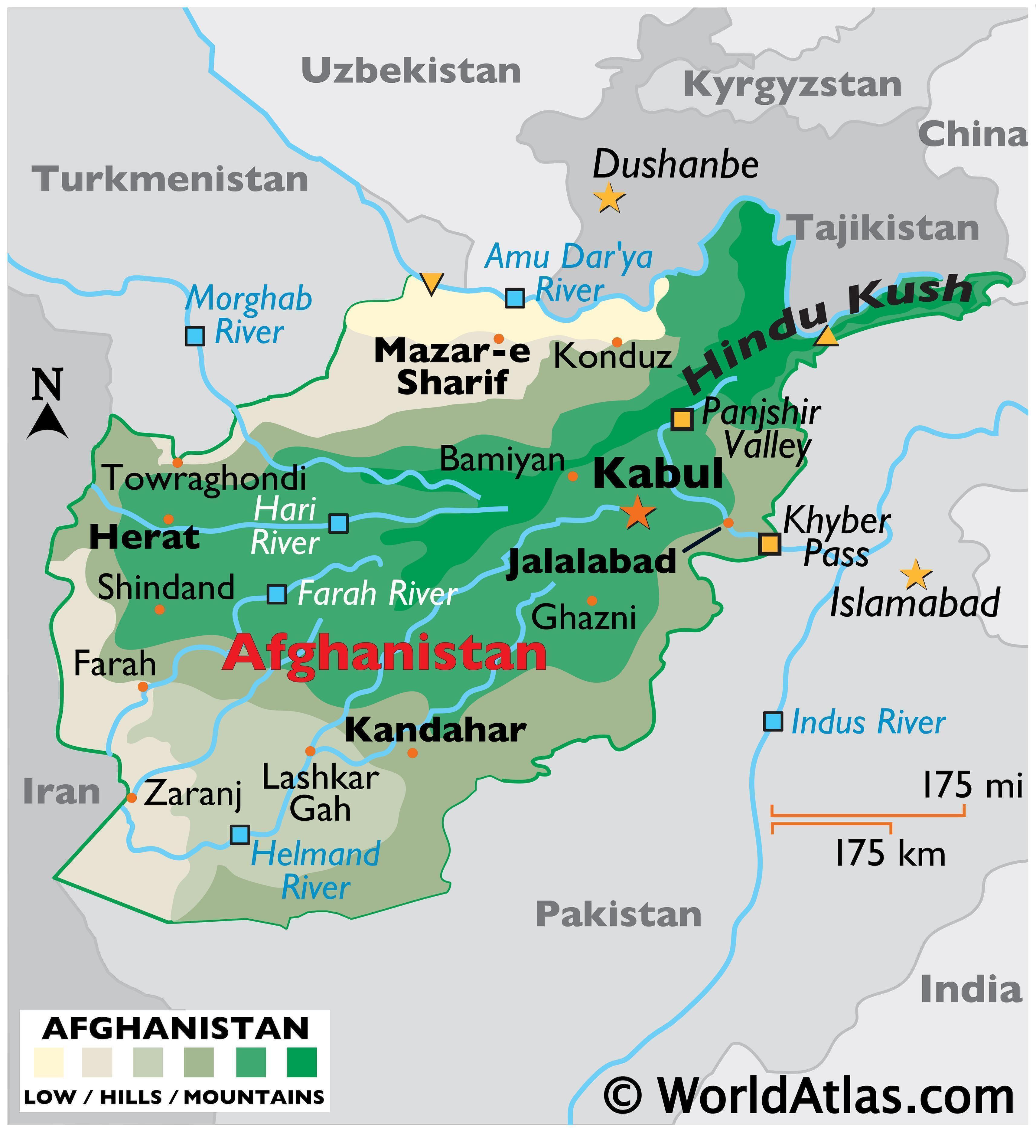

All right, to begin; no need to quote some of Mr Klein's remarks as they're self-evident from my replies:

> Amrullah Saleh is not an Indian agent and Pakistan's military knows this. He is something far worse in their eyes: an Afghan patriot who can't be bought or bullied, and who has proved to be a very hard man to kill. And no, Karzai didn't fire him; Saleh resigned his post.

> Relations between President Hamid Karzai and Islamabad have not exactly 'warmed.' To the extent Karzai reached out to Pakistan's regime he did so only under the most severe pressure from the NATO command, and also because he came to believe, amd with justification, that NATO forces would abruptly decamp, leaving his government high and dry. (For the moment, at least, the U.S. has re-thought on the matter of the timing of troop withdrawals, according to Bob Gates's remarks on Sunday.)

> Mr Klein writes:
"Why on earth are elements of the Pakistani military supporting the Taliban? In a word, India. India is, first and last, the strategic obsession of the Pakistani military. The U.S. has come and gone from the region in the past; the perceived Indian threat is eternal.
Here he relates a canard that's been repeated so many times by Pakistani influence agents and apologists that the Western press and even many Western 'Pakistan experts' take it on faith. Pakistan's military leaders are not obsessed with India. They are obsessed with maintaining a rationale for their control of Pakistan's society and their vast military organization; India is the handy excuse for both.

> Regarding this howler:
The one thing the U.S. can do to reduce [the threat of Pakistan's nukes falling into the hands of Taliban] is to convince the Pakistanis that we will be a reliable friend for the long haul — providing aid, mediating the tensions with India; that we will help stabilize Afghanistan; that we will support the primacy of Pakistan's civilian government.
The "one" thing, eh? Anything else we can do for the Pakistanis? Take out their trash, serve them up tea? The one thing we can and must do is convey to Pakistan's leaders that terrorism is not an acceptable tool of diplomacy and that if they want to continue designating terrorism as 'jihad,' they're going to have a war on their hands. If President Bush had named Pakistan as part of the Axis of Evil we could have been out of Afghanistan by now.

> Mr Klein writes:
Afghanistan is really a sideshow here. Pakistan is the primary U.S. national-security concern in the region. It has a nuclear stockpile, and lives under the threat of an Islamist coup by some of the very elements in its military who created and support the Taliban.
I've got news for Mr Klein: if the law of your land is the death penalty for any citizen who even inadvertently insults your religion's founder, that indicates your government -- and your nukes -- are already controlled by religious fanatics.

Afghanistan, not Pakistan, is the key country, and a stabilized Afghanistan is the key to bringing about positive changes in Pakistan's society. This is so for several reasons, some of which are hard for Westerners to understand. But just as Iraq is the model for Iran, so an Afghanistan renaissance will be the model for Pakistan -- provided the Pakistani military isn't allowed to smash the model as they did the last time.

Critics of the U.S. invasion of Iraq have not yet seen the truth, even though it's before their eyes with every fresh crackdown on freedoms in Iran: the repression and end-of-days rhetoric have followed the curve of Iranians' visits to the democracy next door.

It might not look like much of a democracy to Americans, but what's been happening in Iraq since the country survived the fall of the Baathists and clambered out from the worst of the insurgency has been a revelation to Iranians who visit the country. They are carrying their revelations back to their own country.

So, somewhat in the manner of preachers during an earlier era in America who warned of hellfire and damnation, as hoardes of young adults left the farm for work in the big city, Iran's mullacrats are responding to the ever increasing cross-border traffic between Iraq and Iran by hanging anyone who disagrees with them and measuring the hem length of Iranian women's skirts.

But just as you couldn't keep 'em down on the farm, so Iran's mullahcrats are fighting a losing battle against the inevitable. It's one thing for the West to lecture Iranians about democracy; it's another for Iranians to see with their very own eyes how the neighbors are living with more freedom than anyone in that region can remember. These revelations are building to a critical mass.

So while it pains me whenever I have to agree with Michael Vlahos, he was right when he advised John Batchelor's radio audience that the best help Americans can give to Iranians at this time is to back off and let them go the final miles on their own.

I would only add to the advice that it's still necessary for the USA to maintain a presence in Iraq, just to make sure the playing field doesn't slope into a cliff. As to how long we should remain -- we'll know the correct time to leave.

With regard to Pakistan, the real problem isn't Islam; it's an ancient way of life that I've explained many times got frozen in time -- frozen first by the British Raj and then by U.S. Cold War strategy.

One point I haven't mentioned before is that the British Raj propounded the 'martial races' concept, which had a big impact on the Indian subcontinent, and which Pakistan continued to accept after independence. Technically the concept was abandoned in the 1970s within the Pakistan military but until just a couple years ago Pakistani society held the military as the highest ideal -- and (alongside cricket stars) the ideal for the male.

The fiercest of military men as the model for manhood followed the British colonizer's dictum, which was dryly summarized by Dr. Jeffrey Greenhut:
The Martial Race theory had an elegant symmetry. Indians who were intelligent and educated were defined as cowards, while those defined as brave were uneducated and backward.
The 'high' culture of the Bengalis in East Pakistan, which placed great emphasis on the arts and intellectual pursuits, was intolerable to West Pakistan's military class -- and this was partly the reason for the horrific atrocities they carried out against the Bengalis, both Hindu and Muslim.

While the Western imagination popularly envisions Afghans as an uncouth warlike mountain people, the following two photographs, taken from a handbook of Afghan urban life in the 1960s, provide a more accurate view of Afghans who didn't live in mountain redoubts.


The photographs and captions are from a handbook published by Afghanistan's planning ministry in the 1960s. Mohammad Qayoum obtained a copy of the book, digitized the photographs, which number more than a score, and published them along with captions and his commentary at Foreign Policy in May under the title Once Upon a Time in Afghanistan. (Or view the article and photos at the e-Ariana website, which published them on one page.)

Qayoum, an Afghan expat who is president of California State University, grew up in Kabul and came to work in the United States in 1978. Since 2002 he's volunteered his time in Afghanistan's reconstruction efforts, serving on the board of directors to the central bank and as senior advisor to the minister of finance.

Qayoum republished the book's images in part because he was tired of hearing Western officials and Afghanistan 'experts' describe his countrymen as barbarians. Here is a picture of the barbarians in Cabinet session:


Most high-ranking Afghan government officials in that era had a master's or doctoral degree. It's not for nothing that Afghanistan was once called "the Geneva of Central Asia."

I urge you to study the rest of the photographs in the handbook, which offset the impression of Afghanistan that the Western press has bombarded the public with. Yet I think the two photos I've chosen convey the great emphasis the Afgans place on learning and reasoned deliberation (consider their endless councils!) and that even though they had a king during the era of the photographs they supported meritocracy.

In Pakistan the military is the one institution that places a value on earned merit and it's a kind of refuge from the country's very rigid caste system. Pakistanis who are not in the military or the highest castes, and not holders of vast tracts of land, are at the mercy of a social system that in modern eyes is cruel, and which devalues the concept of hard work as the means to upward mobility.

So here are a few of the big differences between Pakistan and Afghanistan: the latter is not a caste society, and Afghans escaped the psychological tactics the British Raj used to keep the natives in line on the Indian subcontinent. That means among other things that Afghans have a self-confidence not shared by the Pakistanis. Post-colonial India's size and raucous diversity allowed it to regain confidence lost under the British rule fairly quickly. This was not so for Pakistanis, who retained the worst of both the ancient Indian and British colonial-era mindsets.

Curiously -- curious, because it's brought out so little -- the Afghans had a leg up when it came to embracing the values underpinning Western civilization; this is because the Greek civilization that Alexander of Macedon brought with him to the region profoundly influenced the society for centuries. The city of Kandahar was established by Alexander. The society was also influenced by the fabulous Gandhara civilization and of course by the Persian empires. So I am always surprised when I hear Afghanistan described as a backwater peopled with primitives; Afghanistan -- or more precisely Ariana -- was at the crossroads of several of the world's most advanced ancient civilizations.

If you find the photographs of what Afghanistan was like a half century ago in relation to today to be unsettling -- oh yes, very unsettling, to think how quickly a modern society can collapse. But as I explained in the NO COMPROMISE post, for all its modernity in that era the country's infrastructure -- bridges, 'interstate' roadways, dams; etc. -- was not sufficiently developed. And because they'd refused to allow the British to build railways out of fear that the rails would be used to quickly transport British troops through the country, the outbreak of war quickly took them from modernity back to the Middle Ages and even earlier in many places.

What war didn't do, Pakistani gangs did. They picked that country clean -- gutted factories and office buildings, ripped out telephone poles -- basically everything that wasn't nailed down and could be sold. Then the Pakistani 'transportation mafia' stripped the country of its forests. They did the same thing to their own country, by the way.

If you ask, 'Where was Pakistan's government while all this was going on?' -- the government was the "22 feudal families" that with the military is the real Pakistan. And those families didn't excel at governing and still don't. They excel at only one thing: being served.

So here we are today, still cleaning up after them while the U.S. regime continues to prop them up. As to the gratitude: America, peel us a grape.

I swear, it's almost enough to turn one into a Trotskyite.

Where was I? It's proving very hard for the Pakistanis to accept India's progress as a model to emulate -- here I am speaking of a psychological model. They will be able to accept a resurgent Afghan society as a model. But first they have to be prevented from raping the country again, as they did with the help of American military training, funding, and arms.

This time the American military must throw all its weight into keeping Pakistanis on their side of the fence, so to speak, until Afghanistan's army and police are strong enough to make the boundaries stick.

All this won't be as hard as it might seem at this point; just a few days ago a former Pakistani prime minister and now the leader of Pakistan's major opposition party, Nawaz Sharif, dismissed the 'strategic depth' canard propagated by Pakistan's military. He said shortly that Pakistan shouldn't meddle in Afghanistan's affairs.

Also, several factors, which I've discussed before on this blog, are naturally lessening the hold that extreme militarism has on the popular imagination in Pakistan.

Aside from the psychological stuff that has made Pakistan very predatory in its relations with Aghanistan, there is Afghanistan's 'natural' power in the region because of its command of key rivers, which flow into neighboring countries, including Pakistan, a power the Pakistanis greatly fear (chiefly because they know what they'd do to others if they had such power).

Afghanistan's power over its neighbors is overlooked when considering the country's landlocked position. A man who always sounds as if he's reading from the Pakistani military's Propaganda Manual 101 when he talks about Afghanistan observed recently that Pakistan would have great influence in Afghanistan after ISAF forces moved out because Pakistan is Afghanistan's only gateway to a port. He neglected to mention that the power of the gateway is more than offset by the power of Afghanistan's rivers. Because of decades of poor water management, Pakistan is dying for water. According to a recent AP report, "At least 90 percent of Pakistan's water is used for farming, and around 25 percent is wasted by farms that use flood irrigation..."

Two other reports, one from the Christian Science Monitor and one from the Afghanistan embassy in Poland, detail the seriousness of the issue regarding Afghanistan's rivers. The country's water management has been virtually nonexistent for decades, which has allowed other countries to use, between them, two-thirds of Afghanistan's water supply. Now Afghanistan wants more control of its own water supply -- a very unwelcome idea in Pakistan.

Working out water sharing pacts will be a delicate matter, whch goes against the Pakistani military's smash-and-grab tactics when they saw anything they wanted in Afghanistan. The same for the country's incredible mineral riches, which Pakistan's military has known about since the Soviet era.

In sum, the American enterprise in that part of the world should be focused on Afghanistan, not Pakistan. This doesn't mean turning our backs on Pakistan -- never wise to turn one's back on a tiger, particularly not after grabbing its tail -- but the sooner Afghanistan is stabilized the sooner we can draw down troops there then fall into the 'hovering' routine we currently perform in Iraq until Pakistan gets clear that Afghanistan is not its sandbox.

I was very glad to see that Joe Klein's column gave space to Matt Waldman's paper on the ISI's involvement with the Taliban because the paper has not gotten enough attention in the mainstream media. However, Mr Klein is wrong to assume that the paper's revelations are in the rear-view mirror. Pakistan's military/ISI have not turned over a new leaf, not yet, and it's not a given that they will. They have simply become aware that they're now under great scrutiny from the international community, so they've become more careful. For that reason, the scrutiny should be unrelenting until there is strong evidence they've stopped using their purported fear of India as justification to sponsor terrorism.

With all the above said, I was impressed by Mr Klein's sincerity; he was clearly trying to work his way through to an understanding of the Pakistan situation. Sincerity is not enough, however; as I hope this post indicates, it must be shored with better knowledge of Pakistan and Afghanistan.

Finally, for the colleague who has thrown up her hands in despair about the snail's pace of the war and its cost to American lives and the U.S. budget:

The Wikileaks scandal serves as a morality tale about the evils of playing Pandora, for in war there must be secrets. However, if not for the release of the Wikileaks Afghan War logs, the vast majority among the general public would still be unaware of the extent to which Pakistan's military acted against ours and those of other NATO nations. Where is the golden mean in this tragic situation?

Both the Iraq and Afghan campaigns were rooted in situations created by the U.S. government and some of its closest allies while they were fighting the Soviets. In both cases -- Iraq and Afghanistan -- the U.S. government viewed peoples in far flung regions -- peoples who'd never harmed the United States -- as chess pieces and the regions as a chessboard. That view is un-American, an affront to our Constitution and every value we hold dear.

So it came to a day when U.S. soldiers walked slowly down a dusty road in Iraq, patiently and at great risk to life and limb clearing IEDs. Lined along the road watching the soldiers were members of a Sunni tribe. Finally the Sunnis turned to each other and said, 'Why are we standing here watching these Americans risk their lives for us? We should be helping in this work.'

And so they did and thus, the true birth of the Anbar Awakening, which Bing West recounts in The Strongest Tribe. The Sunnis along the road also saw the true face of America that day.

This awful war, this long and costly war, is reminding us of who we really are. It we take that remembrance and fashion it into the determination that we must never again allow the kind of elected and appointed officials who find nothing strange in conceiving of other people as chess pieces, I don't think we'll ever to have to fight such a long war again.

The 1960s found the Afghans a self-reliant people who had no desire to make war on any of their neighbors, and who never did a damn thing to hurt America. We can't undo the wrongs we did to those people. We can insure that the country does not fall prey to Pakistan again as soon when we pull out.

I understand my words are cold comfort to Americans who have lost relatives in the war or seen them returned maimed in body or spirit. But it's by such words that I return again and again after quitting. I think it's okay to despair, okay to quit. Just not okay to quit for long. Too many people are depending on us.

Monday, August 2

Quit monkeying around, Mr Miliband


With the entire foreign policy establishment of the United States now residing in the trees it was left to the United Kingdom's new Prime Minister, David Cameron, to stand upright on two legs in the manner of humans and deliver a promise to the Indian people -- one they should have been given more than a quarter century ago:
"We cannot tolerate in any sense the idea that [Pakistan] is allowed to look both ways and is able, in any way, to promote the export of terror, whether to India or whether to Afghanistan or anywhere else in the world."
The editorialist at DNA was unmoved; he spoke for the vast majority of Indians when he grimly observed We need action, not words, Mr David Cameron:
The fact of the matter is that Pakistan would not have been able to export terror anywhere had it not been for the support — tacit or otherwise — it has received from the UK and the US.
That is exactly the case; perhaps mindful of this, the Prime Minister put a little more than hot air behind his words. The next day, July 31, DNA reported:
British prime minister David Cameron has swung into action in his fight against terror. He has ordered a freeze on the assets of key terror groups and terrorists associated with the Taliban and al-Qaeda. ...
Yet even these small twitches of civilizational certainty proved too much for Labor's shadow foreign secretary David Miliband, who took it upon himself to robustly defend the monkey busines school of foreign relations currently the rage in Washington. Following up on his earlier remark that the Prime Minister was a "loudmouth," Miliband wrote for today's Independent:
The Pakistan issue is the most important. It is the region's tinderbox. We have 10,000 young men and women at risk in Afghanistan. Only a political settlement can bring an end to the war. For that we need Pakistan; and they need our economic and military support. ...
While allowing that the PM was right that "terrorist groups have launched attacks from Pakistan, and links into parts of the Pakistani state have been an open secret over the past 20 years," Miliband directed the PM's attention to the great suffering of Pakistan's people:
Pakistan has also been the victim of terror. ... Bombs and attacks blamed by the Pakistani government on Taliban and al-Qa'ida-linked militants have killed more than 3,500 people in the past three years. Benazir Bhutto was killed by terrorism in her own country.

But the Prime Minister, in attacking Pakistan for "looking both ways", did not tell this side of the story. In highlighting attacks originating from areas like Peshawar, he ignored the murder of people from Peshawar struggling to prevent them. And he showed no understanding of Pakistan's path back to democratic rule in the past two years.

It would have been better for the Prime Minister to talk about ways we can support Pakistan. The level of EU funding in Pakistan is just half a euro per person compared to five to 10 times as much in other parts of the world not only more developed, but less crucial to global security. ...
I'm sure British troops now serving in Afghanistan and relatives of British soldiers killed and maimed in the country will be interested to learn it was an open secret for 20 years that Pakistan's military backed the Taliban.

Moving right along, the deaths of 3,500 Pakistanis at the hands of Pakistani terrorists is what's known as blowback. Benazir Bhutto was drenched in the blood of Kashmiri Muslim and Hindu civilians. And that Pakistan's adults are learning what it feels like to be under constant fire from terrorists -- it couldn't happen to a more deserving people, virtually all of whom accept the idea that provided one first labels another country an enemy it's okay to launch terrorist attacks against its civilians.

As to Pakistan's "path back to democratic rule," is Miliband making a little joke? In the past two years Pakistan's military has consolidated its grip on the civilian government to such extent that the country no longer even qualifies as a Potemkin Village democracy.

Miliband's solution -- to bribe Pakistanis into civilized behavior -- receives a strong argument from history, which saw Pakistanis write the book on fleecing international charitable and development loan organizations. As to where all the aid money and low-cost loans went, B. Raman neatly summarizes:
Pakistan has become a land of serious shortages -- shortage of water for agricultural and drinking purposes, shortage of electricity and gas for private and industrial consumers, shortage of money for development. However, there is no shortage of US dollars. The misuse of the enhanced economic assistance from the US under the Kerry-Lugar Act is resulting in a situation where much of the money is misutilised for non-development purposes or for feeding corruption.
As to providing more assistance to Pakistan's military -- where is evidence that current assistance has done anything more than help the military kill its domestic enemies, oppress the country's poor, and bedevil India?

In providing training, intelligence reports and weapons to Pakistan's military my government has repeated the mistake it made when it supported Batista -- a mistake President John F. Kennedy publicly apologized for in 1963:
"I believe that there is no country in the world including any and all the countries under colonial domination, where economic colonization, humiliation and exploitation were worse than in Cuba, in part owing to my country’s policies during the Batista regime. ..."
The policies of the United States -- and, more recently, the European Union -- have, at every step of the way, aided and abetted Pakistani regimes in oppressing their nation's poor. The upshot is that many of the so-called 'Taliban' in Pakistan have more in common with Che Guevara's politics than Islam.

Is Miliband seriously suggesting that the European Union help Pakistanis find their Fidel Castro? That will be the upshot unless NATO sticks to the narrowest of aims in Pakistan -- paying to transship ISAF supplies -- and reduces all cooperation with Pakistan's military to sympathetic clucks of the tongue.

Or is Miliband's idea that the Western powers must take it upon themselves to quash any possibility that Pakistan's poor will catch a break?

Melanie Phillips has already raked the PM over the coals for his incorrect statement about Gaza, somewhat obtuse reasoning about Turkey, and the remark that Britain was the junior partner to the USA in fighting Nazis in 1940:

"In 1940, of course, America had not yet even entered the war and Britain alone held fascism at bay. So how could Cameron have said something so unbelievably ignorant? Can he really be that stupid?"

But to conflate those remarks with what was in effect a public apology to India, and which was decades overdue from the British government, is wrong. It also sends the message to the Pakistani regime, and to Taliban and al Qaeda, that there are divisions in British politics about the stand against terrorism that can be exploited.

What Pakistan needs most at this time is neither more aid nor sympathy; it needs to understand that behaviors the U.K. and other Western powers long condoned are no longer acceptable.

As to how British Pakistanis and Pakistani expats in the U.K. will take such an unequivocal stand, did they flee their homeland in order to live in Pakistan Lite? I believe the majority would say no. Yet no matter how many might say yes, it is up to the British regime to muster a united front on the matter of civilizational certainty; that is, unless it wants to take to the trees.

For readers who are not clear on the concept of civilizational certainty, I'll quote from my January 16, 2008 post titled, Don't rile the natives, or what do Canada and Chechnya have in common?
You cannot confuse tolerance with respect for human life. Even the British at the height of their colonialist enterprise understood that. There were times when they knew they had to draw the line:

'... the British in India were faced with the practice of “suttee” -- the tradition of burning widows on the funeral pyres of their husbands.

'General Sir Charles Napier was impeccably multicultural: “You say that it is your custom to burn widows. Very well. We also have a custom: when men burn a woman alive, we tie a rope around their necks and we hang them. Build your funeral pyre; beside it, my carpenters will build a gallows. You may follow your custom. And then we will follow ours.” '

To the tune of "Rock the Casbah"

"The fact remains that the most significant salient point from the WikiLeaks disclosures is that the US has trapped itself in Afghanistan by its overwhelming dependence on the Pakistan military."

The above observation is from the subtle Indian career diplomat (ret.) M.K. Bhadrakumar, who turned the Persian card face up in his July 31 op-ed for the Asia Times in order to show Washington a possible way to exit Afghanistan and still retain a shred of dignity. Alas, the good witch arrived too late.

Just as the U.S. regime had snubbed Putin's help in Afghanistan because it wanted to give Moscow a black eye in Georgia and Ukraine, it had scoffed at Tehran's white flag in 2003. And so in the manner of the prettiest girl at the ball who's so choosy she ends up with no dance partner except the creep with two left feet and halitosis, the Obama administration has to continue the tradition of covering for Pakistan's military.

Yesterday on NBC TV's Meet the Press, Secretary of Defense Bob Gates:
... defended the U.S. relationship with Pakistan, disputing claims that intelligence elements in the country are actively aiding the Taliban.

"I see a change in the strategic calculus in Pakistan," Gates said.
Have you ever noticed clairvoyants never provide really useful information, such as which nag is coming in first at long odds? There is one way and one way only that Pakistan will change its strategic calculus. That's if Gates and Admiral Mullen sit down with the heads of Pakistan's army and ISI, unfold a map of Pakistan, point to a couple regions and say, 'You see these places? The ones that are dying for independence? One more ISAF solider or Afhghan gets killed by your goons, one more ISI terrorist plot against another country gets uncovered, and Pakistan will shrink to the size of a postage stamp so fast your heads will spin. Now get the fuck out of Afghanistan and stay out. Have a nice day.'

If Kayani and Pasha complain that MI6 has a gun at their backs, I guess President Obama could ring up Prime Minister David Cameron and say something like this:

'My background is community organizing not petroleum -- heh, no this isn't about BP -- so I get confused when I study oil pipeline maps. I'm trying to remember something Dick Cheney told me once, or maybe it was James Baker, about an old pipeline built in the Shah's time between Israel and Iran. If that pipeline became operational again it wouldn't exactly put Saudi Arabia and the other Arab Gulf oil states out of business; right? Not with today's demand for oil. But it would shave anywhere from one to three dollars off the price of a barrel of oil shipped to East Asia because the route would avoid the surcharge on shipping oil through the Suez Canal; right?

'What I'm trying to figure out is if you hooked up that old pipeline with the one put back in use since Russia and Israel started getting along -- that was in 2002, I think -- would that pipeline arrangement crash OPEC? I wouldn't want that; think what would happen to your country's banking system and mine, especially if Saudi oil sales took a big dive. By the way MI6 isn't still trying to jolly Taliban into negotiating peace, is it? Kayani and Pasha told my guys they have to keep paying the Taliban to kill U.S. troops because MI6 told them to do it. I know, I know; they never get a story straight. Just thought you'd like to hear what they said.'

But that's just me, and no one will ever call me subtle.

Memo to Bob Gates: I see war historians trashing your career if you don't get that war in Afghanistan won. And if the brother of the Lion of Panjshir says the war can be won, it's winnable.