Translate

Thursday, February 16

What may be perverse good news about the Syrian War, plus breaking news

The formal part of the negotiations in Astana was postponed from yesterday to today, although there were informal talks on the 15th.  It's 4:00 PM in Astana so it could be a few more hours before we hear anything about the talks -- which, as with all negotiations the Syrian-Russian governments conduct with the opposition groups, is an attempt to peel away Syrian fighters from groups that are sponsored by foreign regimes or wealthy Syrian expats who have long opposed the present Syrian government.

While Staffan de Mistura is not in attendance at the Astana talks, he sent five reps from the UN to observe and report back, in preparation for the UN-led negotiations in Geneva. These are scheduled to start formally on February 23.

In the weeks running up to the planned Geneva talks all hell broke loose, as NATO/Arab Gulf- controlled media outlets and ngos hurled at the public every bit of dirt they could find or make up about the Syrian-Russian government prosecution of the Syrian War.

It's happened before, but this time opponents of a Syrian government-brokered peace have pulled out all the stops. I'm wondering whether there's a new reason for this. 

Wait, I think I have gotten an answer from breaking news at Sputnik; I just went there to look for any early statements about the Astana talks:

Clashes Between Syrian Gov't and Moderate Opposition Forces Ended - Shoigu

Clashes between the Syrian government and moderate opposition forces have fully stopped, Russian Defense Minister Sergei Shoigu stated during his meeting with UN Special Envoy for Syria Staffan de Mistura.

He also stated that the fights were fully eliminated with the help of the conflict sides and the mediators.
"We hope to further build a constructive dialogue with the opposition. All in all, progress we made after December 29 [nationwide ceasefire], progress we have now — this scenario is much better than it used to be. The amount of shellings has significantly fallen, direct clashes have stopped completely," he stated.
Russia hopes for a roadmap on separating terrorists from the moderate opposition in Syria at ongoing ceasefire talks in Astana, Russian Defense Minister Sergei Shoigu also said.
"We hope that decisions to draw up a single Syrian map and approve it will be made today [at talks in Astana], a map where we will finally secure all the information given to us by the Syrian opposition and government where we precisely define the location of the moderate opposition that joined the ceasefire and those that did not join it," Shoigu said.
The delegations to the talks on Syria in Geneva should be formed more thoroughly for productive work, the Russian Defense Minister stated.
"Of course, we all hope that the meeting that you organize in Geneva, we fully support it… We hope that those people who really want to solve the problems, and not just to discuss this subject gather there," Shoigu said.
He underscored the importance of locating the positions of the Daesh jihadist group and the ex-Nusra Front, both outlawed in Russia, and stressed that Russia will continue anti-terrorist efforts in alliance with the moderate Syrian opposition, Turkey, and Iran.
Last week, the Russian Defense Ministry said that the Syrian government forces and Ankara-backed Free Syrian Army have agreed on a demarcation line in the city of al-Bab, where both Damascus and the rebels are currently conducting an operation to free the area from Daesh.
[END REPORT]

All right. From all the reporting on kinetic battles I've seen in the past couple weeks, it could be that the major part of the Syrian War is winding down. That could explain redoubled attempts to demonize the Syrian and Russian governments. If I'm right, the attempts are actually good news, in a perverse sort of way, if they imply the enemy governments had realized peace was at hand.

We'll know soon. If you're inclined to pray, please take a moment to pray for a good and speedy end to the Syrian War. Peace-loving Syrians have suffered enough.

********
  

Wednesday, February 15

Putin tampers with presidential election in Limpopo

"President Ai Bolyt from Lim-Po-Po country… Russian fairy tales are becoming truth. God, don't leave America!"
-- Maria Zakharova, Russian Foreign Ministry spokesperson

Two notorious Russian pranksters figured that if U.S. Rep. Maxine Waters believed the Russians had invaded "Korea" she might fall for even bigger whoppers. She did. 

*********

US military has been hiding the number of its airstrikes in Syria, Iraq, A'stan

"It’s unclear whether this statement was intentionally misleading, or simply indicative of widespread internal ignorance, confusion or indifference about what’s contained in this data." 

Now that they've been caught with their hands in the cookie jar, so to speak, the military can explain. The explanation, however, is almost as scary as the implications of the chronic under-reporting.
H/T to The Corbett Report for scooping up news of the Military Times investigation.  See the MT website for video and graphics accompanying the following report:  

The U.S. military's stats on deadly airstrikes are wrong. Thousands have gone unreported.

By: Andrew deGrandpre and Shawn Snow
February 5, 2017
Military Times

The American military has failed to publicly disclose potentially thousands of lethal airstrikes conducted over several years in Iraq, Syria and Afghanistan, a Military Times investigation has revealed. The enormous data gap raises serious doubts about transparency in reported progress against the Islamic State, al-Qaida and the Taliban, and calls into question the accuracy of other Defense Department disclosures documenting everything from costs to casualty counts.

In 2016 alone, U.S. combat aircraft conducted at least 456 airstrikes in Afghanistan that were not recorded as part of an open-source database maintained by the U.S. Air Force, information relied on by Congress, American allies, military analysts, academic researchers, the media and independent watchdog groups to assess each war's expense, manpower requirements and human toll.

Those airstrikes were carried out by attack helicopters and armed drones operated by the U.S. Army, metrics quietly excluded from otherwise comprehensive monthly summaries, published online for years, detailing American military activity in all three theaters.

Most alarming is the prospect this data has been incomplete since the war on terrorism began in October 2001. If that is the case, it would fundamentally undermine confidence in much of what the Pentagon has disclosed about its prosecution of these wars, prompt critics to call into question whether the military sought to mislead the American public, and cast doubt on the competency with which other vital data collection is being performed and publicized.

Those other key metrics include American combat casualties, taxpayer expense and the military’s overall progress in degrading enemy capabilities.

U.S. Central Command, which oversees military activity in all three war zones, indicated it is unable to determine how far back the Army’s numbers have been excluded from these airpower summaries. Officials there would not address several detailed questions submitted by Military Times, and they were unable to provide a full listing of annual airstrikes conducted by each of the Defense Department's four military services.

“It is really weird. We don’t track the number of strikes from Apaches, for example” said a U.S. military official with knowledge of CENTCOM's data collection and reporting practices. The official, who spoke to Military Times on the condition of anonymity to freely discuss internal procedures, was referring to AH-64 Apache attack helicopters, which the Army has used prolifically in combat over the last 15 years, most recently in support of American allies battling the Islamic State.

“I can tell you, unequivocally, we are not trying to hide the number of strikes," the official said. "That is just the way it has been tracked in the past. That’s what it’s always been.”
[GRAPHIC]

It’s a significant discrepancy, though, and one for which the full scope remains unclear. Airstrikes, according to definitions established and followed by members of U.S.-led coalitions, can involve fighters and other jets, attack helicopters and drones, and they can include any combination of munitions. 

A single airstrike can be carried out by multiple aircraft on multiple targets, and use multiple bombs, missiles, rockets and machine gun rounds. It can include combat sorties with predefined targets and attacks carried out during the course of close air support operations. 

The Army views things differently, though.  

"It seems to me the collection or distribution of airstrike data is not an Army Title 10 responsibility," a senior Army official told Military Times on the condition of anonymity. Title 10 of the U.S. Code sets the laws that dictate the military services' roles, responsibilities and missions. 

"This responsibility should lie with the operational or combatant commander. Additionally, Apaches for example, conduct close combat attacks as a maneuver element supporting a ground force in contact with the enemy. I would not consider this in the category of 'airstrike.' " 

The Air Force's open-source database includes all such missions as part of its airstrike totals. The media and others have depended on these figures for years with the understanding they are a comprehensive rollup of all American and coalition activity. And while the data has been cited in countless reports — from newspaper articles to academic research to analytics provided to lawmakers — no one from the military ever has come forward to clarify that it is wholly incomplete. 

As recently as December, an Air Force official told Military Times that its monthly airpower summary of activity in Iraq and Syria specifically represents the entire U.S.-ed coalition “as a whole, which is all 20-nations and the U.S. branches.” 

It’s unclear whether this statement was intentionally misleading, or simply indicative of widespread internal ignorance, confusion or indifference about what’s contained in this data. Regardless, it does include airstrikes conducted by the U.S. Air Force, Navy and Marine Corps — but not the Army. 

Financial implications, if any, are unclear. The Pentagon discloses its top-line expenditures for each of these ongoing military operations, but that data is not readily broken down by the number of sorties flown by specific U.S. aircraft and the amount of munitions they deploy. Consider, though, that Apache helicopters can carry a variety of weapons, including Hellfire missiles with a per-unit cost of $99,600, according to figures maintained by AeroWeb, a defense marketing intelligence firm that closely tracks international defense acquisition. 

Such record keeping is no trivial matter. Even federal agencies routinely reference these airstrike figures in reports designed to influence Congress. Military Times’ investigation discovered multiple instances in which an inspector general drew significant conclusions, briefed to high ranking government officials working in the State Department and leading members of Congress, from open-source airstrike data. 

The omission of Army strike data is one of multiple errors, discrepancies and shortcomings, raising questions about the validity of policies and methods used by the U.S. military to compile and disseminate information about its worldwide operations. 

[...]
*****
There is a great deal more to the report. From the MT website: Andrew deGrandpre is the Military Times’ senior editor and Pentagon bureau chief. On Twitter:
@adegrandpre; Shawn Snow is a staff writer and Military Times' Early Bird editor. On Twitter: @SnowSox184. With additional reporting by Air Force Times’ senior writer Stephen Losey. On Twitter: @StephenLosey. 

******** 

"US promised it wouldn’t use Depleted Uranium in Syria. But then it did."

My question: How did the Russian air force manage to destroy the same type oil tankers without using depleted uranium shells? 

Answer: Most likely because the trucks weren't armored, for crying out loud. 

On to the report, by the author who initially blew the lid off the situation; see the website for U.S. videos showing airstrikes under discussion:  

By Samuel Oakford
February 14, 2017
Airwars

[emphasis mine]

US now says it has fired thousands of depleted uranium rounds in Syria — first confirmed use of controversial munition since Iraq invasion.


Officials have confirmed that the US military – despite vowing not to use controversial Depleted Uranium (DU) weapons on the battlefield in Iraq and Syria – fired thousands of rounds of such munitions during two high-profile raids on oil trucks in Islamic State-controlled Syria in late 2015. The air assaults mark the first confirmed use of this armament since the 2003 Iraq invasion, when hundreds of thousands of rounds were fired, leading to outrage among local communities which alleged that toxic remnants caused both cancer and birth defects.

US Central Command (CENTCOM) spokesman Major Josh Jacques told Airwars and Foreign Policy that 5,265 armor-piercing 30mm rounds containing depleted uranium (DU) were shot from Air Force A-10 fixed-wing aircraft on November 16th and 22nd 2015, destroying about 350 vehicles in the country’s eastern desert.

Earlier in the campaign, both Coalition and US officials said the ammunition had not and would not be used in anti-Islamic State operations. In March 2015, Coalition spokesman John Moore said, “US and Coalition aircraft have not been and will not be using depleted uranium munitions in Iraq or Syria during Operation Inherent Resolve.” Later that month, a Pentagon representative told War is Boring that A-10s deployed in the region would not have access to armor-piercing ammunition containing DU because the Islamic State didn’t possess the tanks it is designed to penetrate.

It remains unclear if the November 2015 strikes occurred near populated areas. In 2003, hundreds of thousands of rounds were shot in densely settled areas during the American invasion, leading to deep resentment and fear among Iraqi civilians and – later – anger at the highest levels of government in Baghdad. In 2014, in a UN report on DU, the Iraqi government expressed “its deep concern over the harmful effects” of the material. DU weapons, it said, “constitute a danger to human beings and the environment” and urged the United Nations to conduct in-depth studies on their effects. 

Such studies of DU have not yet been completed, and most scientists and doctors say as a result there is still very limited credible “direct epidemiological evidence” connecting DU to negative health effects.

The potential popular blowback from using DU, however, is very real. While the United States insists it has the right to use the weapon, experts have called the decision to use the munition in such quantities against targets it wasn’t designed for — such as tanks — peculiar at best.

The US raids in 2015 were part of “Tidal Wave II” — an operation aimed at crippling infrastructure that the Islamic State relied on to sell millions of dollars’ worth of oil. The Pentagon said the November 16th attacks happened in the early morning near Al-Bukamal, a city in the governorate of Deir Ezzor near the border with Iraq, and destroyed 116 tanker trucks. 

Though the Coalition said the strikes occurred entirely in Syrian territory, both sides of the frontier were completely under the control of the militant group at the time. Any firing of DU in Iraqi territory would have had far greater political repercussions, given the anger over its previous use there. The November 16th video below shows tankers hit first by larger ordnances, before others are engulfed in sparks and are ripped apart by fire from 30mm cannons.

Video of the second DU run on November 22nd destroyed what is described as 283 “Daesh Oil trucks” in the desert between Al-Hasakeh and Deir Ezzor — both capitals of governorates of the same names.

The use of DU in Syria was first reported by this author in IRIN News last October. CENTCOM and the US Air Force at first denied it was fired, then offered differing accounts of what happened, including an admission in October that the weapon had been used. However, the dates confirmed by CENTCOM at that point were off by several days. It is now clear that the munitions were used in the most publicized of the Tidal Wave II attacks.

Armoured targets

Depleted uranium is left over from the enrichment of uranium 235. It is exceptionally hard, and has been employed by militaries both to penetrate armoured targets and to reinforce potential targets like tanks against enemy fire. Though less radioactive than the original uranium, DU is toxic and is considered by the US Environmental Protection Agency to be a “radiation health hazard when inside the body.”

The most likely way for such intake to occur is through the inhalation of small particles near where a munition is used. But doctors and anti-nuclear activists alike say there hasn’t been enough research done to prove the precise health effects and exposure thresholds for humans. This lack of comprehensive research on illnesses and health outcomes in post-conflict areas where DU was used has led to a proliferation of assumptions and theories about DU’s potential to cause birth defects and cancer. 

Firing rounds near civilian populations also has a powerful psychological effect, causing distress and severe anxiety, as the International Atomic Energy Agency noted in 2014.

Internationally, DU exists in a legal gray area. It is not explicitly banned by UN conventions like those that restrict land mines or chemical weapons. And although the United States applies restrictions on the weapon’s handling domestically, it does not regulate its use overseas in civilian areas with nearly the same caution.

“I think this is an area of international humanitarian law that needs a lot more attention,” says Cymie Payne, a legal scholar and professor of ecology at Rutgers University who has researched DU. “As we’ve been focusing more in recent years on the post-conflict period and thinking about peace building… we need a clean environment so people can use the environment.”

Major Jacques, the CENTCOM spokesman, says the ammunition was fired that November because of a “higher probability of destruction for targets.” Shortly after both attacks, the US-led Coalition released the videos showing multiple vehicles lit up by bombs, missiles, and prolonged fire from the 30 mm cannons of Air Force A-10s — but did not specify that the flight crews had loaded those cannons with DU. Those videos — along with dozens of other strike recordings — have been removed from official Coalition channels in recent months.

When DU rounds are loaded in A-10s, they are combined with a lesser amount of non-DU high-explosive incendiary (HEI) rounds, amounting to a “combat mix.” In November 2015, a total of 6,320 rounds of the mix were used in Syria: According to CENTCOM, 1,790 30 mm rounds — including 1,490 with DU — were fired on November 16; on November 22, 4,530 rounds of combat mix were fired containing 3,775 DU armor-piercing munitions. Though DU rounds have been fired in other theaters — including the Balkans — much of the attention centers on Iraq, where an estimated 1 million rounds were shot during the first Gulf War and the 2003 invasion.

A recent analysis of previously undisclosed firing data from the 2003 US invasion of Iraq showed that most DU rounds were fired at so-called soft targets, such as vehicles or troop positions, instead of targeting the tanks and armoured vehicles according to Pentagon guidelines that date back at least to a 1975 review by the US Air Force. The Pentagon’s current Law of War Manual states, “Depleted uranium (DU) is used in some munitions because its density and physical properties create a particularly effective penetrating combination to defeat enemy armored vehicles, including tanks.”

‘At risk of exposure’

The oil trucks hit in November 2015 were also unarmoured and would qualify as soft targets, the researchers who performed the analysis of the 2003 targeting cache contend. The trucks, in fact, were most likely manned by civilians rather than Islamic State members, according to US officials. A Pentagon representative said the United States had dropped leaflets warning of an imminent attack before the November 16th strike, in an effort to minimize casualties.

“The use of DU ammunition against oil tankers seems difficult to justify militarily on the basis of the arguments used by the US to support its use — that it is for destroying armoured targets,” says Doug Weir, head of the International Coalition to Ban Uranium Weapons. “Tankers are clearly not armoured, and the alternative non-DU HEI [high-explosive incendiary] rounds would likely have been sufficient for the task.”

The spent ammunition littering eastern Syria after the attack, along with the wreckage of the trucks, was almost surely not handled appropriately by the occupying authority — that is, the Islamic State. Even if civilians driving the trucks were not initially exposed to the toxic remnants of DU, scavengers and other local residents will likely be placed at risk for years to come.

“What will happen with the destroyed vehicles? Usually they end up in scrapyards, are stripped of valuable parts and components, and dumped,” says Wim Zwijnenburg, senior researcher at the Dutch research NGO Pax. “This puts scrap-metal workers, most likely local civilians, at risk of exposure.”

If there are few ideas for what post-Islamic State governance will resemble in eastern Syria, there are none at all about how to safely handle the depleted uranium that the US-led Coalition has placed into the environment.

Published in conjunction with Foreign Policy

[END REPORT]

Tuesday, February 14

Astana talks Feb 15-16: 'We don't want to be an accessory to their delegation'

Yippee!  They're meeting at the Rixos hotel again.

Kazakh Foreign Minister: Astana meeting will discuss mechanism of monitoring cessation of hostilities in Syria
February 14, 2017
SANA

Astana, SANA – Kazakhstan’s Foreign Minister Kairat Abdrakhmanov said on Tuesday that Astana meeting on the crisis in Syria which is scheduled for February 15-16 will discuss the mechanism of monitoring the cessation of hostilities agreement.

“In particular, a mechanism for recording ceasefire violations as well as sanctions against those who violate the ceasefire will be discussed,” he told reporters.

Abdrakhmanov added that the delegations of the Syrian Arab Republic and Russia have already arrived and that other delegations are expected to arrive soon.

According to the Kazakh top diplomat, five United Nations officials will also take part in the meeting. However, in his words, there was no information on the US participation yet.

In a relevant development, Kazakh Foreign Ministry said that the first meeting of Syrian talks in Astana on Wednesday will be held behind closed doors.

In a statement, the Ministry said that the next round in Astana as part of the process on the settlement of the crisis in Syria will start at a high level at 13:00 local Astana time at the Rixos Hotel.

M. al-Frieh/H. Said

[END REPORT]

Cairo group of Syrian opposition reluctant to join HNC delegation — representative
February 13, 17:59 UTC+3
TASS

[HNC = High Negotiations Committee, Saudi controlled]

The envoy noted that the Cairo group expects a decision of the United Nations Special Envoy for Syria, Staffan de Mistura, on the format of representation at Geneva talks

MOSCOW, February 13. /TASS/. The Syrian opposition’s Cairo group rejects a proposal of participants of Riyadh meeting who invited representatives of the Moscow and Cairo groups to their delegation to the Geneva talks, a representative of the Cairo platform of the opposition Jihad Makdissi said.

"No, we already told them we don't agree [with initiative of Riyadh group or the High Negotiations Committee]. We don't want to be an accessory in their delegation."

"We offered to create a delegation from three platforms instead: Moscow platform, Cairo platform and Riyadh platform. Since they created their own delegation, it means the answer (to our proposal) is "no," Makdissi said.

He noted that the Cairo group expects a decision of the United Nations Special Envoy for Syria, Staffan de Mistura, on the format of representation at the Geneva talks. Makdissi noted that he could not say now about the composition of the Cairo group at the talks on Syria.

The participants in the meeting of the part of the Syrian opposition, primarily representatives of the High Negotiations Committee (HNC), offered a 21-member delegation for consultations in Geneva in their final communique in Riyadh on February 10. Representatives of the Moscow and Cairo groups were offered one seat each in it.
[END REPORT]

********

Trump: The business of America is business, not global hegemony and war

From Thierry Meyssan's latest article on the Trump Administration, it's clear the Washington political and foreign policy establishments, as well as the U.S. media, are out of their depth about what Trump is actually aiming for in the early days of his presidency. 

Trump is a non-political president, which is hard for Americans to wrap their minds around. And so there is a Twilight Zone aspect to discussions about him that fill the mainstream media. They're seeing what they want to see, what they understand, even though it's not the reality. 
  
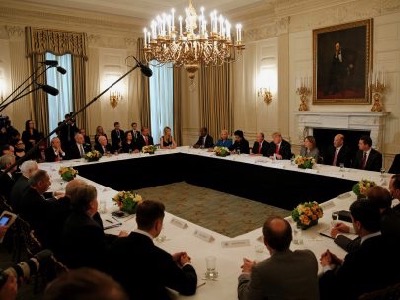
Donald Trump inaugurates the « Strategy and Policy Forum » at the White House (3 February 2017)

.
Trump - business against war
By Thierry Meyssan
February 14, 2017
Voltaire Network
Thierry Meyssan invites us to observe Donald Trump without judging him by the same criteria as his predecessors, but by trying to understand his own logic. He notes that the President of the United States is trying to restore peace and relaunch world commerce, but on new foundations, completely different from the current system of globalisation.
According to the Puritan ideology, which has been in fashion since the dissolution of the Soviet Union, mixing state policy with one’s own private affairs is a crime – one of the reasons for which a strict separation has been installed between these two worlds. On the contrary, though, during the last few centuries, politics was not regarded from a moral standpoint, but from that of efficiency. It was therefore considered normal to associate entrepreneurs with politics. Their own personal enrichment was not considered to be «corruption» unless they grew fat on the proceeds of the Nation, but not when they developed it on their own.
Concerning his relations with the Great Powers, President Trump approaches Russia on the political level, and China on the commercial level. He is relying on Rex Tillerson (ex-head of Exxon-Mobil), a personal friend of Vladimir Putin, as his Secretary of State - and on Stephen Schwarzman (the boss of the capital-investment company Blackstone), a personal friend of President Xi Jinping, as President of a new consultative organisation tasked with proposing the new commercial policy - the Strategy and Policy Forum, inaugurated by President Trump on 3 February at the White House [1]. 
The meeting brought together 19 top-level entrepreneurs. Contrary to previous practises, his advisors were not chosen according to whether or not they had supported the President during his electoral campaign, nor in terms of the size and influence of the businesses they managed, but rather in terms of their personal capacity as managers.
Thus begins Meyssan's analysis, which is worth close study and not a little deep thought. There is today much criticism of globalization but it's not so much 'bad' as having outlived the imperial and colonial hegemonic ages that shaped it.  With most of the world's societies now pursuing one form or another of democracy, humanity does need an international system of trade that better reflects this.

******** 

Now for an unvarnished version of upcoming Syria talks in Geneva LOL

From Ziad Fadel, AMN Chief Leith Fadel's dad, at Mr Fadel's Syrian Perspective site:
GENEVA: Two “prominent” schools of opposition will lead the negotiations with the [Syrian] government at Geneva under the pinched nose of Steffan de Mistura [UN and Arab League Envoy to Syria]. 

We have learned that there is a “Russian Platform” group and a “Cairo Platform” group. The first is led by the unctuous traitor, Qadri Jameel. The second is led by the former Foreign Ministry ingrate, Jihaad Maqdisi. Both these turkeys are doomed to live out their lives in a chicken coop. Along with the rodent, Qadri, we are expecting another Moscow Mule, ‘Alaa` ‘Arafaat, to join the festivities.

Faylaq Al-Rahmaan has been invited and will attend. Liwaa` Al-Sultaan Muraad, a possible reference to any one of 6 Ottoman leaders, the last being a deposed imbecile, Muraad V. The name of the group, once again, indicates an origin in the MIT of Turkey.

The chief negotiator for the group of vultures is Nasr Al-Hareeri, a Der’ah born 40 year-old internist, who succeeds former Brig.Gen. As’ad Al-Zu’bi, another Der’ah denizen who defected from the opposition.

Notable for their absences are Jaysh Al-Islam headed by Muhamamad ‘Alloosh, Saudi stooge and child molester. In his stead, Muhammad Sabraa has been appointed to lead another delegation. Ahraar Al-Shaam, too, has not been invited.

Ignorant hag and CIA agent, Basma Qudhmaani, who wrote a flagrantly idiotic editorial for the NYT, “Sometimes it Takes a Minority” about how Alawis should join her imaginary revolution, will attend in order to please the disgruntled terrorist supporters at the CIA. She is joined by notorious clown, Fu`aad ‘Ulayku.

Another 20, so-called legal, military and political experts will join the terrorists at Geneva. It’s going to be a ball.

[END REPORT]

A pity Mr Fadel doesn't report on the Syrian War for The New York Times, eh?  

See my post yesterday for a varnished version of the meeting, projected to start Feb 20-23. 

******** 

The Get Russia crowd and Syria

After reviewing the Get Russia crowd's efforts to derail the possibility of  U.S. rapprochement with Russia, Moon of Alabama's February 13 analysis (Organized Campaigns Hit At Trump's Foreign Policy Plans) tackled recent machinations to derail any rational American actions in Syria:

BEGIN QUOTES

Indeed a second well-coordinated assault on an announced Trump policy, a change of course in Syria, is already in the making. This one aims at further maligning the Syrian government in an effort to make it impossible to argue for cooperation in the fight against the Islamic State.
  • A few days ago Amnesty International published an unfounded report about alleged executions in Syrian prisons.
  • Today Human Rights Watch claims that the Syrian government systematically used chlorine in the fight over Aleppo. The sources are solely opposition supporters.
  • Based on similar vague "facts" the Atlantic Council, a NATO lobby with financial ties to Gulf governments, launches a huge propaganda report (large pdf) about the "war crime" of liberating Aleppo from jihadis.
None of these "humanitarian" organizations is concerned about the current devastating situation in Aleppo. For 40 days the water has been cut off by the Islamic State at the Euphrates pumping stations. There is no electricity. Fuel is sparse. Medications are difficult to find.

Their hypocrisy stinks to high heaven. These organizations all assert that the Syrian government, for example, attacked hospitals in east Aleppo solely to hit civilians. At the same time they all applaud a much bigger assault on the Islamic State held Mosul by U.S. and Iraqi troops. There, the head of Human Rights Watch asserts, the hospitals are used by the jihadis and thus attacks on them are justified:
Kenneth Roth @KenRoth
As battle for Mosul proceeds, ISIS is regularly occupying hospitals & medical facilities, endangering patients/staff bit.ly/2kqXuUR
END QUOTES

Got all that? Can anything be done to stop the predations? Prayer is a help to ward off the very worst. 

Beyond that, not so much, barring direct intervention by God.

Happy Valentine's Day!     

********

Who needs any other musical instrument when you have your voice?

There are no musical instruments other than the human voice in this entire amazing gospel concert by South Side chorus, with guest appearance (final song) from Terri Mays in what I think is her best performance of "If you can't make it through a storm" (how can you say God is the captain of your life?). 


Photo from Terri's Facebook page. 

********

Gen. Flynn resigns

11:55 PM EST 2/13 NBC News

This is what can happen when the 'Get Russia' crowd draws a bead on someone. The people in that crowd are extremely, extremely dangerous.  

I take much of this NBC Breaking News report about the background to Flynn's resignation with a grain of salt, but here is the mainstream-sanctioned version of the events:

Michael Flynn Resigns as National Security Adviser
by RICHARD GREENBERG, ALEX JOHNSON and KRISTEN WELKER
11:56 PM EST
NBC News

Michael Flynn abruptly resigned as President Donald Trump's national security adviser Monday night, hours after it was learned that the Justice Department informed the White House that it believed he could be subject to blackmail.

Retired Army Gen. Keith Kellogg, a top policy adviser for Trump's presidential campaign, was appointed acting national security adviser, the White House said in a statement announcing Flynn's replacement.

Kellogg, 72, a former commander of the fabled 82nd Airborne Division, was chief operating officer of the Western coalition in Baghdad, Iraq, after the U.S.-led invasion in 2003. A senior administration official told NBC News that Kellogg was under consideration for the permanent job, along with retired Navy Vice Adm. Robert Harward, former deputy commander of U.S. Joint Forces Command, and former CIA Director David Petraeus.

Two senior U.S. officials told NBC News that Harward was considered the favorite for the job.


Flynn's status was considered perilous after it was disclosed that he had misled Vice President Mike Pence and other senior officials about his communications with Sergei Kislyak, Russia's ambassador to the United States.

"Unfortunately, because of the fast pace of events, I inadvertently briefed the Vice President Elect and others with incomplete information regarding my phone calls with the Russian Ambassador. I have sincerely apologized to the President and the Vice President, and they have accepted my apology," Flynn said in his resignation letter.

The senior U.S. official confirmed part of a report in The Washington Post, which quoted current and former U.S. officials Monday as saying Sally Yates, then the acting attorney general, delivered the message that Flynn was considered vulnerable to White House counsel Donald McGahn.

The Post reported that Yates was privy to FBI monitoring showing that Flynn discussed sanctions on Russia with Kislyak — even though Flynn told administration officials that he hadn't. Pence repeated the misinformation in national television appearances.

Trump fired Yates as acting attorney general late last month after she directed Justice Department lawyers not to defend his executive order on immigration.


A senior intelligence official confirmed to NBC News last week that Flynn discussed the sanctions, which the Obama administration imposed to punish Russia for its campaign to interfere in the presidential election.

Related: Flynn in Hot Seat Over Discussing Sanctions With Russians

The intelligence official said there had been no finding inside the government that Flynn did anything illegal.

Democrats, meanwhile, welcomed Monday night's news with barely concealed glee.

Rep. Adam Schiff of California, the ranking Democrat on the House Intelligence Committee — which is investigating the Trump campaign's alleged contacts with Russia — said Flynn's resignation was "all but ordained the day he misled the country about his secret talks with the Russian Ambassador."

"In fact, Flynn was always a poor choice for National Security Advisor, a role in which you need to be a consensus builder, and possess sobriety and steady judgment," Schiff said in a statement. "It is certainly no role for someone who plays fast and loose with the truth."

In a joint statement, Reps. John Conyers of Michigan and Elijah Cummings of Maryland, the ranking Democrats on the House Judiciary and Oversight committees, respectively, called for a full classified congressional briefing by Justice Department and the FBI no later than Thursday.

"The reality is General Flynn was unfit to be the National Security Advisor, and should have been dismissed three weeks ago," they wrote. "Now, we in Congress need to know who authorized his actions, permitted them, and continued to let him have access to our most sensitive national security information despite knowing these risks."
[...]

[END REPORT]
********

Monday, February 13

Racing the rain: Critical Oroville Dam repairs must be done by Wednesday

This is a literal cliffhanger given that rain is expected again on Wednesday. CNN's extensive report, published 1:56 PM EST, comes with an easy-to-understand graphic showing the problem with America's tallest dam, which must be solved by Wednesday.

********

Intra-Syrian talks in Geneva on for Feb 23; Damascus offers more prisoner swaps for hostages

February 9:  Syrian Army completes prisoner swap to free 54 Syrian women, children who'd been kidnapped in Lattakia and held by terrorists for 3-1/2 years. 


I don't know where the Feb 23 Geneva talks leave the 'technical' talks involving de Mistura that are supposed to launch in Astana on Feb 15-16, or whether they've been cancelled now that a firm date for the Geneva round has been announced by de Mistura.

From two reports (see below) it could be that Astana is going to be a Russian/Syrian government-led show, and that the talks will specifically address another exchange of prisoners with terrorist groups for hostages and abductees. We'll know in two days the status of that meeting.

Anyway, with regard to the UN-led negotiations, the key parties are currently slated to convene in Geneva on Feb. 20 for pre-talk talks. 

Lavrov is cautiously optimistic about the Geneva talks. From SANA, Feb 12, before de Mistura announced Feb 23 as the official start date for the Geneva negotiations and sent out invitations:
Moscow, SANA – Russian Foreign Minister Sergey Lavrov affirmed on Sunday that the current situation is much more convenient to take practical steps to resolve the crisis in Syria, pointing out that work is underway to prepare for a round of talks in Geneva on the 20th of this month under UN auspices.
 In an interview with the NTV Russian Channel, Lavrov said that the “opposition” posing preconditions may lead to postponing this round of talks which would seriously harm the reputation of the UN.
He called on the UN Special Envoy to Syria Staffan de Mistura to assume his responsibilities related to the formation of an “opposition” delegation to participate in Geneva talks, saying the fluctuating positions of the “opposition groups”, especially those abroad, should not be taken into account. [emphasis mine]
He pointed out that the date of February 20th to resume Syrian dialogue in Geneva is still valid, hoping that the United Nations Secretary-General Antonio Guterres and de Mistura take their responsibilities in this regard.
Lavrov said that Russia is preparing for new contacts between the Syrian government and the “armed groups” in the Kazakh capital of Astana this week.
“The US was present as an observer at the first Syrian meeting in Kazakhstan’s capital,” he said, adding “they have an invitation from us to send their representative for participation in further contacts, as soon as they form up their Middle East Syrian team.”
He noting that Jordan has assisted in “joining to the process of the armed groups, which are in the so-called Southern Front, and on which Jordan has influence, as they are working right across the border with Syria.”
 M. al-Frieh/H. Said
[END REPORT]
Damascus, SANA – The Syrian government, due to its keenness on the lives of abducted Syrian citizens, is ready to swap prisoners in exchange for Syrian abductees and hostages held by terrorist groups, an official source said Monday.
The source added that due to the continued coordination between ministries and other bodies concerned and the success of the Syrian government in liberating many civilians and soldiers abducted by the terrorist groups, the government is continuously ready, and particularly in the framework of the exerted efforts for holding next Astana talks, to swap prisoners in exchange for Syrian abductees and hostages held by terrorist groups including men, women, children, civilians and soldiers.
On Thursday and after three and a half years of abduction by the terrorist organizations, scores of women and children returned home to Lattakia after being recently freed from terrorist abduction.
R.Raslan/Ghossoun
[END REPORT]
********

BBC tackles the question of what's so far-right about Marine Le Pen

This is the question I'd asked in a Feb. 4 post. All right, let's see what the Beeb has to say. If French readers sniff at a British publication trying to analyze Le Pen -- the key here is that the Beeb is writing  in English. 

(I think French should be the international language rather than English, first because it's easier to think in highly abstract terms in French and second even insults sound nicer in French). 

French politics are a mystery to Americans, especially those of us who can't speak French; for instance, I'm still trying to figure out the difference between a French Leftist and a French Socialist. But from the Beeb analysis, at least my instincts were correct to wonder about the label of far-right routinely applied to Marine Le Pen.


"Marine Le Pen increasingly claims to speak 'in the name of the people'"


"Marine Le Pen appeals to French voters fed up with mainstream politics, but there is nothing far right about that."

France elections: What makes Marine Le Pen far right?
By Marysia Nowak & Becky Branford
10 February 2017
BBC News

She described Britain's vote for Brexit as the most important event since the fall of the Berlin Wall, and Donald Trump's US presidential victory as "an additional stone in the building of a new world".

Marine Le Pen, the leader of France's National Front (FN), is fighting to achieve a similar earthquake in France in the presidential elections in 2017.

But with her increasing appeal to the centre and the left of French politics, how much can she really be characterised as far-right?


Voters' perceptions and a toxic past

Marine Le Pen is the youngest daughter of Jean-Marie Le Pen, former leader of the FN and a convicted racist, who last year repeated an old anti-Semitic slur that the Nazi gas chambers were "a detail of history".

Having grown up in a political home, accompanying him to meetings from the age of 13, Marine Le Pen was always going to struggle to shake off the far-right label.

But she did denounce her father's comments in 2015, and effectively expelled him from the party. While her father was leader, the FN was the party that wanted to deport three million foreigners, the party of Holocaust denial and xenophobia. But under Marine Le Pen the FN began to distance itself from such controversial issues.

Such efforts at detoxification have proved successful, with polls suggesting support for the FN climbing from 18% in 2010 to about 24% today.

Nonetheless, when voters are questioned they still place the FN and Ms Le Pen "way more to the right than other parties", says Nonna Mayer, expert in racism and the FN at Sciences Po university.

Where does she go from here in her pursuit of a detoxified party? The FN has traditionally been a male, blue-collar-dominated party, and the leader needs to target women, says Dr Mayer. So Ms Le Pen has softened her approach to women's rights, and even sees herself as a quasi-feminist.

In fact, Dr Mayer argues, in many respects Ms Le Pen is more socially liberal than much of the mainstream right - something that has caused divisions within her own party.

A hard line on immigration

The 2017 National Front manifesto renews its commitment to a massive reduction in legal immigration. Ms Le Pen argues French citizenship should be "either inherited or merited". As for illegal immigrants, they "have no reason to stay in France, these people broke the law the minute they set foot on French soil".

But if that is a far-right stance, it is not very different from that of centre-right candidate Francois Fillon - who when first elected as the Republican candidate enjoyed a small advantage over Ms Le Pen in polls but has since been damaged by claims of improper use of state funds.

"We've got to reduce immigration to its strict minimum," he says.

In a world where the centre is shifting to the right, and the right is shifting to the centre, the lines are getting blurred.

The two are now competing for some of the same voters. While Mr Fillon is regarded as appealing more to the "respectable" middle classes, Marine Le Pen is claiming to speak for "all people", and increasingly appealing to a wider electorate, even Muslim voters in the French suburbs. [1]

However, in December she upped the ante by announcing that she would end free education for the children of undocumented immigrants, though this did not appear as a pledge in the party's manifesto.

"If you come to our country, don't expect to be taken care of, to be looked after, that your children will be educated without charge," she said in a speech in Paris. And, more threateningly, "playtime is over".

Narrowing divide on Islam and Islamist extremism

Long before the Paris attacks on 13 November 2015, Marine Le Pen made a link between immigration and militant Islamism. In the immediate aftermath, she proposed to "expel foreigners who preach hatred on our soil" and to strip dual-nationality Muslims with extremist views of their French citizenship, a view traditionally associated with the far right.

In an unprecedented move, those ideas were endorsed both by Socialist Prime Minister Manuel Valls and by President Francois Hollande, before eventually being dropped.

Many of her views have been echoed by Francois Fillon too.

Mr Fillon, a devout Catholic, described radical Islam as a "totalitarianism like the Nazis". Catholics, Protestants and Jews "don't denounce the values of the Republic," he said, indicating that was not the case with Islam.

"The clear blue water between the FN and the other parties has been disappearing and disappearing," says James Shields, professor of French politics at Aston University.
Law and order

The National Front is to the right of the Republicans on law and order issues, says Nonna Mayer.

Its 2017 election manifesto includes upping police numbers and powers and creating 40,000 new prison places.

There is no mention in this manifesto of the FN's previous pledge to restore the death penalty, an issue that divides the party's core supporters from the mainstream. Polls suggest 60% of FN voters are in favour, compared with 28% of mainstream-right and 11% of left-wing voters.

Putting 'native French' first

Treatment of immigrants in France is probably the standout, far-right policy of Marine Le Pen's FN. And it is central to the party's platform.

Jobs, welfare, housing, schools, or any area of public provision should go to French nationals before they get to "foreigners".

The centre of gravity of French politics may have shifted to the right. But no other party has adopted favouritism across the social services - and it could breach the law.

"She is upholding a policy that not only is thought by constitutional experts to be unconstitutional, but has been judged by the law to be unlawful," says Prof Shields.

In 1998, a National Front mayor, Catherine Megret, tried to implement a new policy that would give a family allowance to French or EU families, but not to other foreign families.

"Did it stand up in court? No," says Prof Shields. But, he says, so-called nativism remains central in Ms Le Pen's platform.
Le Pen the populist

Marine Le Pen appeals to French voters fed up with mainstream politics, but there is nothing far right about that.

If she wins the presidency in May, she has promised an EU referendum in France within six months of taking office. And the UK's vote to leave the EU in June 2016 has provided the template.

Portraying herself as beyond the establishment, she has championed public services - for non-foreigners - and presented herself as a protector of workers and farmers in the face of "wild and anarchic globalisation".

"She's managing to get these approval ratings by doing a Trump," says Prof Shields.

But here the lines are blurred too: left-wing parties are playing the anti-establishment, anti-globalisation card as well.

Her friends in Europe

But what sets her European views apart from the rest of the French right is the company she keeps. The FN has strong ties with the Dutch Freedom Party (PVV), Austria's Freedom Party (FPOe), Belgium's Flemish Interest (VB), Alternative for Germany (AfD) and the Italian Northern League (LN).

They are all part of the FN-led Europe of Nations and Freedom grouping in the European Parliament and are either right-wing populist or, in the case of the FPOe, far right.

Geert Wilders, of leader of the Dutch PVV, wants to ban the Koran. The Italian Northern League's leader Matteo Salvini is known for his praise of fascist leader Benito Mussolini.

These views are toxic to the political right in Europe, and many centre-right parties have said they will not form coalitions with them.

[END REPORT]

Related Articles at BBC

‘Politicians won’t change anything anyway,’ is a popular sentiment among the Muslim population in Paris’ suburbs.
“…Three young men lean against a railing at the road corner, just a few yards from an Islamic bookshop. All are Muslim, they say. One, who wears a bright, reflective jacket, is a driver and mechanic.
“I’m not against Le Pen,” he tells me. “If she wins, it will be a good thing. The left and right are all bastards. They promise things and they don’t deliver. Let’s vote for Le Pen and see what happens. It won’t change anything for us.”
He was unconcerned by the Le Pen family’s polemical comments about people like him. Le Pen may not be “pro-Muslim” but “she won’t be able to do anything,” he says. “There are too many of us.”
“We have a saying in France,” he adds. “When it’s Ramadan the French economy slows, and when Ramadan ends it starts up again. And you can see it: during that month the streets are empty.”
 BC commented, "Cripes France is further down the Rabbit Hole than [I] imagined."

Well if you want to talk about going down the Rabbit Hole, what about the French Canadians in Quebec? (BC is a Canadian blog). I went to school in Montreal for a year when I was a child, and that was before French Canadians were rioting in that beautiful city and demanding separatism for Quebec, an entire Canadian province.  

A substantial number of immigrants to America and first- generation Americans voted for Trump because they're patriots and because they worked too hard to get here and make a success to see their country overrun by illegals -- and who can collect welfare benefits.

I'd assume it's the same sentiments for many Muslims who are French patriots and whose families have been in France for generations.

********

Oroville Dam: Feds and state officials ignored warnings 12 years ago

By Paul Rogers
February 12, 2017 Updated February 13, 7:14 AM [I'll assume PST]
The Mercury News [Serves California Bay Area]

[The Latest: State officials await dawn to inspect spillway]

More than a decade ago, federal and state officials and some of California’s largest water agencies rejected concerns that the massive earthen spillway at Oroville Dam — at risk of collapse Sunday night and prompting the evacuation of 185,000 people — could erode during heavy winter rains and cause a catastrophe.

Three environmental groups — the Friends of the River, the Sierra Club and the South Yuba Citizens League — filed a motion with the federal government on Oct. 17, 2005, as part of Oroville Dam’s relicensing process, urging federal officials to require that the dam’s emergency spillway be armored with concrete, rather than remain as an earthen hillside.

The groups filed the motion with FERC, the Federal Energy Regulatory Commission. They said that the dam, built and owned by the state of California, and finished in 1968, did not meet modern safety standards because in the event of extreme rain and flooding, fast-rising water would overwhelm the main concrete spillway, then flow down the emergency spillway, and that could cause heavy erosion that would create flooding for communities downstream, but also could cause a failure, known as “loss of crest control.”

“A loss of crest control could not only cause additional damage to project lands and facilities but also cause damages and threaten lives in the protected floodplain downstream,” the groups wrote.

FERC rejected that request, however, after the state Department of Water Resources, and the water agencies that would likely have had to pay the bill for the upgrades, said they were unnecessary. Those agencies included the Metropolitan Water District of Southern California, which provides water to 19 million people in Los Angeles, San Diego and other areas, along with the State Water Contractors, an association of 27 agencies that buy water from the state of California through the State Water Project. The association includes the Metropolitan Water District, Kern County Water Agency, the Santa Clara Valley Water District and the Alameda County Water District.

Federal officials at the time said that the emergency spillway was designed to handle 350,000 cubic feet per second and the concerns were overblown.

“It is important to recognize that during a rare event with the emergency spillway flowing at its design capacity, spillway operations would not affect reservoir control or endanger the dam,” wrote John Onderdonk, a senior civil engineer with FERC, in the Federal Energy Regulatory Commission’s San Francisco Office, in a July 27, 2006, memo to his managers.

“The emergency spillway meets FERC’s engineering guidelines for an emergency spillway,” he added. “The guidelines specify that during a rare flood event, it is acceptable for the emergency spillway to sustain significant damage.”


[...]

******
Related Articles at The Mercury News

********