Translate

Monday, November 13

Death toll from earthquake in Iran-Iraq border region now at least 210

Reuters report updated 10 minutes ago, cites at least 210 dead. Also from Reuters:
More than 142 of the victims were in Sarpol-e Zahab county in Kermanshah, about 15 km (10 miles) from the Iraq border. The main hospital of the capital of the county was severely damaged and could not treat hundreds of injured people who were taken there, the head of the Iranian emergency services, Pirhossein Koulivand said.
A hospital on the Iraqi side of the border in the affected region was also severely damaged. See the Reuters report for details.

CBS/Associated Press Last Updated Nov 13, 2017 2:06 AM EST
TEHRAN, Iran -- A powerful earthquake shook the Iran-Iraq border late Sunday, killing at least 207 people and injuring at least 1,686 in the mountainous region of Iran alone, Iranian state media said.
The Baghdad government didn't immediately give word on damage or casualties in that country.
But Iranian state TV said Iraqi officials reported at least seven people dead inside Iraq, along with more than 50 people injured in Sulaymaniyah province and about 150 in the town of Khanaquin.
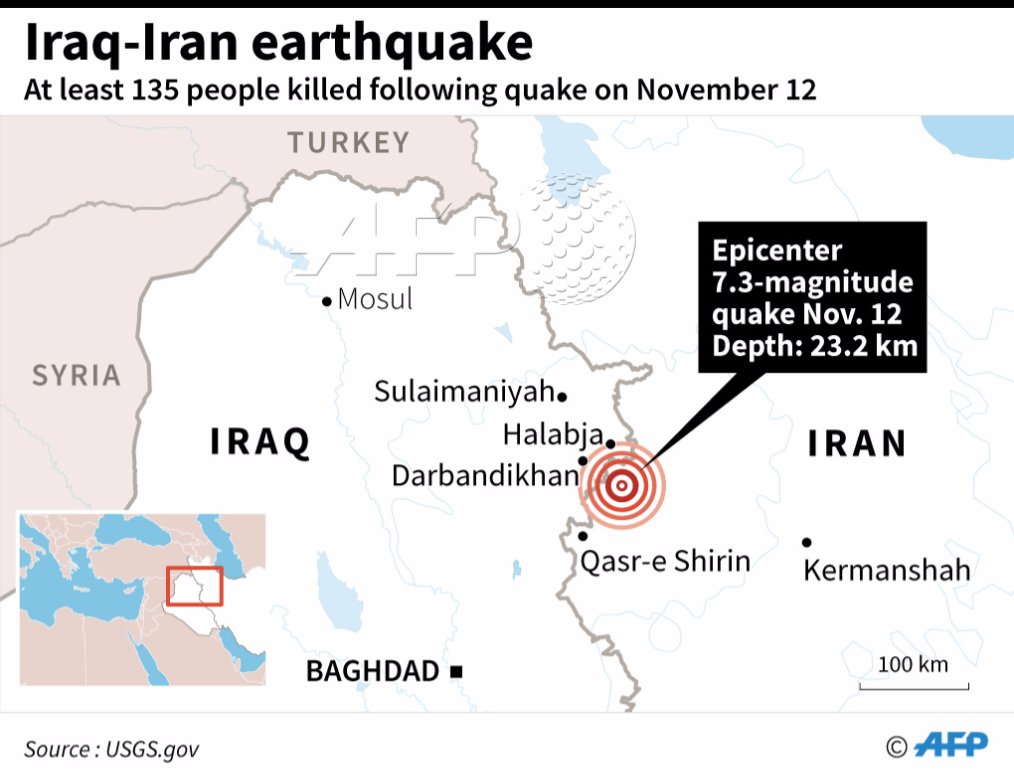
The magnitude 7.3 quake was centered 19 miles outside the eastern Iraqi city of Halabja, according to the most recent measurements from the U.S. Geological Survey. It struck at a depth of 14.4 miles, a shallow depth that can result in broad damage. Magnitude 7 earthquakes in general are capable of widespread, heavy damage.
The quake was felt as far west as the Mediterranean coast. Its worst damage appeared to be in Iran's western Kermanshah province, which sits in the Zagros Mountains that divide Iran and Iraq. Residents in the rural area rely mainly on farming to make a living.


The shaker was also felt in parts of Turkey and Israel, the Reuters news agency reports. 
[Pundita note: From CNN report, below, shocks were also felt in Pakistan, Lebanon, and Kuwait; from Gulf News, the quake was also felt in UAE and "across the Middle East."] 


Electricity was cut off in several Iranian and Iraqi cities, Reuters says, adding that Iran's military was called on to help rescue efforts.

Iranian social media and news agencies showed images and videos of people fleeing their homes into the night. Some 50 aftershocks followed.

Iran's state-run IRNA news agency said rescue work was continuing overnight and would accelerate during the daytime.
"The night has made it difficult for helicopters to fly to the affected areas and some roads are also cut off... we are worried about remote villages," Reuters quotes Iranian Interior Minister Abdolreza Rahmani Fazli as saying in an interview on state television.
Officials expected the casualty toll to rise when search and rescue teams reached remote areas of Iran, Reuters noted.
Iranian Supreme Leader Ayatollah Ali Khamenei offered his condolences on Monday morning and urged rescuers and all government agencies to do all they could to help those affected, state media reported.

The semi-official ILNA news agency said at least 14 provinces in Iran had been affected by the earthquake.
Officials announced that schools in Kermanshah and Ilam provinces would be closed Monday because of the temblor.
Iran sits on many major fault lines and is prone to near-daily quakes. In 2003, a magnitude 6.6 earthquake flattened the historic city of Bam, killing 26,000 people. The last major casualty earthquake in Iran struck in East Azerbaijan province in August 2012, killing over 300 people.

CNN, 11/13 - 1:35am ET:

More than 200 people are dead and 1,700 injured after a powerful 7.3 magnitude earthquake struck the border region between Iran and Iraq.
Iran's Press TV says the highest number of casualties in the country occurred in the town of Sarpol-e Zahab, Kermanshah province.
Iran's semi-official Mehr news agency said 100 of the 207 reported dead were from that town alone.
While most of the deaths have been reported in Iran, the quake's epicenter was across the border in Iraq, about 350 kilometers (217 miles) north of Baghdad.
The quake crushed buildings in Darbandikhan, in northern Iraq, according to video from AFP. Dozens of people from the town were injured, according to Omar Ahmad, the governor of Sulaimaniya province. In nearby Halabja, at least four people were reported dead.
Iraq's Meteorological Organization issued a warning on Iraqi State TV urging citizens to stay away from buildings and to refrain from using elevators.
Shocks were also felt in Pakistan, Lebanon, Kuwait and Turkey, news agencies in those countries reported.
Iraq's Prime Minister Haider al-Abadi was closely following the situation of the country's citizens, a statement from his office said.
Iran's Supreme Leader Ayatollah Seyyed Ali Khamenei sent a message of condolence, and urged military and civilian help to be dispatched to quake victims.
[END REPORT]

Sunday, November 12

"We changed our broadcast from leaving our town to defending our town"

The Battle of Koreatown,  Los Angeles - April 1992


India's amma canteens allow low income workers to eat well -- but no giveaways

Raju, a construction worker from Punjab, was introduced to the canteen by his co-workers. "I earn 400 rupees a day. Before these canteens came up, I used to spend at least 150 rupees on food per day. Now I spend only 20 rupees a day," he says.

Could we try something like this in the United States, I wonder?  I caution that these canteens are controversial -- something not mentioned in the glowing BBC report below. See the Wikipedia article for details about the subsidy program and complaints about it. In one sentence the biggest complaints are that corporations that subsidize the canteen food claim they are losing "massive" amounts of money, and pushcart food vendors can't compete with the very cheap meals sold by the canteens. That's right they can't, and it might also be argued that the canteens are a clever vote-buying scheme for Tamil Nadu's chief minister. But here's the bright side, from the Beeb report:
The canteens have helped poor and lower middle-class families massively slash their food bills and freed the womenfolk from the daily drudgery of cooking and cleaning.
And work in the canteens, which are run exclusively by women, provides employment for thousands of women.

I really like the part about greatly lowering food bills, and that the food isn't free, thus avoiding the welfare mentality that crippled entire generations in America. 

Maybe if the program spreads across India the canteens could be more profitable and the corporations could get some federal assistance with the subsidies. 

As for buying from the street vendors, it's like eating at fast food restaurants every day in the USA -- the expense piles up for low- and middle-income workers. On the other side, the vendors can and do offer food that isn't available on the no frills vegetarian canteen menu.  


By Geeta Panday
4 July 2016
BBC

The Tamil Nadu Chief Minister J Jayalalithaa's "amma canteens", which serve cheap meals to hundreds of thousands of people daily, have become immensely popular with the poor and the middle classes. The BBC's Geeta Pandey samples the treats at a canteen in Chennai (Madras).

It's just a few minutes after noon on a hot summer day as I join the queue of lunch-goers at the amma canteen in Pallavaram town, just outside the state capital, Chennai.

The menu today includes hot sambhar rice (rice cooked with lentils and spices) and curd rice (rice cooked in yogurt with curry leaves). The former is selling for five rupees (seven cents; five pence) a plate while the latter costs just three rupees - a fraction of what the dishes would cost in any other restaurant.

I'm famished so I buy a plate of each and move to one of the tables in the centre of the room to eat.

If you're after a fine dining experience, this place is not for you.

The heat and the humidity can be a bother and the sambhar rice is a bit too spicy for my north Indian palate.

But my fellow diners, men and women who include poor daily wage labourers, housemaids, college students, and middle-class office workers, are not complaining.

The portions are big and most describe the food as "delicious".

Lakshmi, who works in the neighbourhood as a housemaid, is a regular at this canteen.

"Earlier, my employers would give me leftovers, but now I come here for breakfast, lunch and dinner every day. For less than 20 rupees, I can eat three meals here," she tells me.

"This food is really good. I like all the dishes. My stomach's full and I'm happy," she says, patting her belly.

Raju, a construction worker from Punjab, was introduced to the canteen by his co-workers.

"I earn 400 rupees a day. Before these canteens came up, I used to spend at least 150 rupees on food per day. Now I spend only 20 rupees a day," he says.

The canteens were first started in 2013 in Chennai by Ms Jayalalithaa, who is popularly called amma (mother) - hence the name amma canteen - with the aim to provide subsidised meals to the public.

Today, there are more than 300 such eateries in the state - at least half of them in Chennai alone. They serve simple breakfast, lunch and dinner every day of the week.

"The food is prepared hygienically, it's very well made and it's tasty," says CR Saraswathi, spokeswoman for Ms Jayalalithaa's All India Anna Dravida Munnetra Kazhagam (AIADMK) party.

"Our chief minister started these canteens to provide good, cheap food to the people. It has also generated employment for thousands of women. The canteens are run by women who cook, clean and serve."

And the scheme has served Ms Jayalalithaa well too.

The canteens have helped poor and lower middle-class families massively slash their food bills and freed the womenfolk from the daily drudgery of cooking and cleaning. And their gratitude has often translated into votes for Amma.

A year after the scheme was launched, Ms Jayalalithaa's party won 37 of the 39 seats in the 2014 parliamentary elections.

In April, her party was re-elected in the state assembly polls and analysts say the canteens are among the reasons for her victory.

At the canteen, I come across S Shweta and S Pavitra - two young women who work as salesgirls in a telephone showroom nearby.

This is their first visit to an amma canteen and to mark the occasion, they are taking a selfie with their plates of rice.

The photograph, they tell me, will be uploaded on their Facebook accounts.

"This is a great initiative. Where else can poor people eat a full meal for five rupees? We support amma," says Ms Shweta.

As the popular saying goes, the way to a man's - and presumably also a woman's - heart is through the stomach. And Ms Jayalalithaa knows it well.

What's on the menu?
  • Breakfast (served from 7am to 10am) - idli (steamed rice cakes) for one rupee or pongal rice (rice cooked with lentils and peppercorn) for five rupees
  • Lunch (served from 12 noon to 3pm) - sambhar rice (rice cooked with lentils and spices) or lemon rice or curry leaf rice for five rupees each and curd rice (rice cooked in yogurt with curry leaves) for three rupees
  • Dinner (served from 5pm to 7:30pm) - two rotis with daal (handmade bread with lentil soup) for three rupees.

This is the seventh article in a BBC series India on a plate, on the diversity and vibrancy of Indian food. Other stories in the series:
[END REPORT]
*******

Saturday, November 11

Sometimes there is perfection

Andrea Bocelli singing The Lord's Prayer

Ustad Nusrat Fateh Ali Khan & Co. singing Allah Hoo!

The combined might of the Mormon Tabernacle Choir & Orchestra could not prevent Andrea Bocelli from scaling the peak of perfection. Just as some audience members mindlessly passing by the stage couldn't distract Nusrat & Co. from doing the same.  

Yes, sometimes, just sometimes, pick-up sticks cast onto the floor fall into the shape of a perfect triangle.

As to how much practice it takes to get that lucky -- oh I don't know, 10,000 years or so?   

********         

Friday, November 10

Never give the devil a ride


Thierry Meyssan at Voltaire Network is in his element talking about a Palace Coup in Riyadh. These are my favorite passages so far (I'm still reading):
... On 4 November at about 11 a.m. UTC, the Lebanese Prime Minister, speaking on the TV channel Al-Arabiya, live from the Hotel Ritz in Riyadh, and in the presence of the Saudi Crown Prince « MBS », announced his resignation. Reading carefully from the text which had been written for him, Saad Hariri suddenly forgot that he was President of a government which included ministers from Hezbollah. He expressed himself in these terms: 
[...] 
Saad Hariri added that he was afraid for his life. Shortly afterwards, Al-Arabiya explained that a few days earlier, Hariri had escaped an assassination attempt. However, first the Lebanese police, then Lebanese General Security, expressed their doubts by denying that they had any knowledge of such an attack. 
Al-Arabiya assured that Rafik Hariri, Saad’s father, had been assassinated in 2005 by Iran – despite the fact that the same channel had persisted for years in accusing the Lebanese and Syrian Presidents, Emile Lahoud and Bashar al-Assad, of having ordered the murder.
Once he had finished his speech, Saad Hariri telephoned the Lebanese President, Michel Aoun, to inform him officially of his resignation. The conversation was very brief, and he did not answer the question as to why he had resigned.
The Saudi Minister for Affairs of the Gulf, assured that, contrary to what one might think at first, Saudi Arabia had not imprisoned Saad Hariri, and that he could return to Lebanon whenever he liked. Since the rumours of his arrest persisted, the Prime Minister’s Twitter account shared a photo of him in a polo shirt with the Saudi ambassador for Lebanon.
Even before Saad Hariri had finished his speech, his rival, the ex-Central Director of the police (FSI) then Lebanese Minister for Justice, Achraf Rifi, headed to Beirut from his Italian exile. 
As it happens, since Mister Hariri is one of the most profoundly indebted people on the planet -- he owes a personal debt to the Saudi government of about four billion dollars – he is probably not in a position to take decisions which go against the interests of his creditor. ...
Mention of MbS always reminds me of the Bluegrass song, Never Give the Devil a Ride: He'll be in that driver's seat as soon as he's inside.

Have no idea why.

********

Two ways to know the world is coming to an end

1. Dog argues when ordered to stop watching a TV program that greatly interests him.  


2. Adopted raccoon has learned from the household dogs to watch TV.


Time was they broke into our houses just to steal food and the occasional rug. Soon they'll be breaking in to watch "Animal Planet."  

Can they really 'see' the TV?  I don't think a study has been done yet on raccoons and television but yes dogs, and cats, can see and 'read' in their own ways many TV images and sounds. And horror of horrors there's even TV programming  -- and advertising -- for dogs. I am not making this up.


From Why Do Dogs Watch—and React to—TV? National Geographic; 2015:

... DogTV, an HDTV cable channel designed for dogs, interests canines because HDTV has a much higher number of frames per second and is specially colored to accommodate dogs' dichromatic vision, said Dodman, who is the channel's chief scientist. (See National Geographic's best dog pictures.)
DogTV has modes for relaxation, which shows images like dogs chilling out in a grassy field; stimulation, which depicts scenes like dogs surfing in southern California; and exposure which shows things like a dog reacting to a ringing doorbell and obeying commands to acclimate them to such situations at home. ...

See also Do Dogs Understand What They Are Seeing On Television? Psychology Today, 2011. There are scads of other articles posted to the internet on the topic.  

This post was inspired by John Batchelor's recent discussions with the authors of books on cat behavior and the genesis/evolution of the relationship between humans and their two favorite housepets. The podcast for the book discussion that was aired on the Thursday show, "Citizen Canine: Our Evolving Relationship with Cats and Dogs" hasn't been posted yet but here's one from earlier in the week: 

"Cat Sense: How the New Feline Science Can Make You a Better Friend to Your Pet" by John Bradshaw. Part 1 and Part 2.

Things have certainly come a long way from the time when Rene Descartes claimed that dogs, and all living creatures other than humans, were simply machines.      

********* 

Wednesday, November 8

The UN is still covering up what happened at Khan Sheikhoun

Edmond Mulet has now as much admitted, on record, that the U.N. investigation was 'politicized.' But the admission is not enough to expose the most heinous lies told by Western members of the U.N. Security Council about an alleged chemical incident in Khan Sheikhoun. Nor is it enough to excuse the U.N. investigation, which did nothing more than rubber stamp the version of the incident told by the Western powers, including the United States of America. 

Nor does Mulet admit that the most pressure would have come not from the UNSC members but from the Gulf Arab potentates who want to control Syria and remove Bashar al-Assad from power, and whose donations to United Nations agencies keep the organization afloat. 

Investigation of Chemical Attacks in Syria Came Under Pressure From UNSC – JIM
November 8, 2017 - 09:21
Sputnik

The United Nations-Organization for the Prohibition of Chemical Weapons joint investigative mechanism's (JIM) head has spoken with Sputnik about the investigation into the chemical weapons use in Syria.
UNITED NATIONS (Sputnik) – JIM's head Edmond Mulet told Sputnik on Tuesday that countries should act in a united front to stop such incidents as the use of chemical weapons from happening instead of using the chemical files for their own political gains, stressing that attempts to influence the Mechanism’s work has come from direct contact with [UN Security] Council members.
“We are pulled from one side and then from the other, telling us how to do our business. If you don’t do it this way you have no credibility, if you don't follow our instructions because we are a member of the P5 [Permanent members of the United Nations Security Council] then we will not accept your conclusions,” Mulet said.
Khan Sheikhoun Chemical Attack
On October 26 JIM presented its report on the probe to the Security Council. According to the document, the government of Syria’s President Bashar Assad was responsible for the April 4 sarin attack. The panel also blamed the Daesh terror group (banned in Russia) for using sulfur mustard in Syria in September 2016.
Commenting on the report, Edmond Mulet told Sputnik that visiting the site of the Khan Sheikhoun chemical attack could bring some additional value, but evidence collected by the JIM is solid and corroborated.
"We are very confident in the two cases [Khan Sheikhoun and Umm Hawsh]. It would have been some value going there but nothing that would really determine or change all the elements that we already have," Mulet said.
Mulet has also responded to Moscow's calls to conduct an on-site investigation as the JIM probe lacks answers to key questions, saying that the situation in Khan Sheikhoun was and still remains very difficult, with a number of military clashes there. 
He added that he did not think anybody from his team would volunteer to go there, nor would it really be necessary in light of evidence received by the Mechanism.
Fact-Finding
Mulet has also touched upon the fact-finding issue, saying that the Khan Sheikhoun incident in Syria should change the existing procedure.
"If there is a new mandate, to give the authorization to the JIM to conduct its own investigation in parallel or simultaneously as the OPCW Fact-Finding mission. In that sense, we would really advance and we would win time instead of waiting for their result in order for us to start working," Mulet said on Tuesday.
As per its existing mandate, the Mechanism launches its investigation once it receives a report from the OPCW Fact-Finding Mission. Mulet advocated for changing this practice citing the case of Syria's Khan Sheikhoun, when such a report was only received on June 29, meaning that time was lost before JIM could start its investigation.
The report on the chemical attack in Syria "relies on the findings" of the OPCW Fact-Finding Mission (FFM) in Syria that was published in June following the investigation into the incident. The mission revealed that the victims had been exposed to sarin, a toxic substance, or a sarin-like substance. 
The FFM did not send its staff directly to the site, but completed the probe by conducting interviews, collecting evidence and samples, such as video footage of the incident and hair from a dead goat found at the scene. 
The FFM also specified that it was unable to "implement a complete chain of custody, by the team, for samples from source."
[END REPORT]
********

Tuesday, November 7

Unlikely that missile shot by Houthi forces at Riyadh airport was Iran-made

H/T Moon of Alabama (Defeated Elsewhere, Saudi Tyrant Declares War On Lebanon, 11/7):

From Henry Rome's Twitter page:
IHS Janes: Burkan-2 missile launched by Houthis is Scud derivative and is unlike variants made by Iran or DPRK
The Iranian government also disputes that they supplied the missile:

FARS
Iran Rejects Saudi Claim about Supply of Missiles to Yemen
November 6, 2017

TEHRAN (FNA)- The Iranian foreign ministry dismissed as "baseless" the Saudi-led coalition allegations that Tehran has supplied Yemen with the recent missile that was fired in the recent strike against an airport in Riyadh.

"The Saudis who have not been able to attain their ominous goals in the long war and military aggression put themselves in more bottlenecks using naïve and improper psychological operations by raising stupid, baseless and fully false allegations," Foreign Ministry Spokesman Bahram Qassemi said on Monday.

He described the Yemenis' reaction as an independent measure whose root causes should be found in the Saudis' aggressions and not another country's move or provocation.

Qassemi advised the Saudi coalition not to project the blame on others, immediately stop attacks against the innocent Yemeni people and pave the ground for Yemeni-Yemeni talks and establishment of peace in that country.

His remarks came after Saudi Arabia accused Iran of being responsible for the ballistic missile launched from Yemen that targeted Riyadh airport on Saturday, warning that it could be "considered an act of war."

The statement came after US President Donald Trump's similar allegations against Iran.

In response, Iranian Defense Minister Brigadier General Amir Hatami and Commander of the Islamic Revolution Guards Corps (IRGC) Major General Mohammad Ali Jafari dismissed US officials' allegations about the supply of Iranian missiles to the Yemeni Ansarullah group.

"The US can't accuse Iran of any event that happens in the region, although this is not unlikely of the enemy to raise such accusations," General Hatami said on Sunday.

"The enemy uses any opportunity to level accusations against Iran and we firmly reject it," he added.

"Does anyone ask the US what they supply to Saudi Arabia?" General Hatami said.

Meantime, General Jafari dismissed the allegations that Iran has supplied Ansarullah with missiles that hit the Saudi airport as "baseless".

"We don’t have the means and possibility to send missiles to Yemen and the missiles belong to themselves and they have increased their range," he underlined.

General Jafari said that the allegations are of a series of "baseless remarks and allegations" that US President Donald Trump has leveled against Iran.

Late on Saturday, a Riyadh-based press outlet reported that Saudi Arabia's air force had intercepted a ballistic missile which had been fired from Yemen over the Saudi capital. Trump, responding to the attack, expressed his support for the Saudi-led coalition and put the blame on Iran.

Ansarullah movement claimed responsibility for firing a long-range ballistic missile that travelled more than 800km over the border with Saudi Arabia.

A spokesman for Ansarollah told Al Jazeera they launched a Burkan 2-H missile towards Riyadh late on Saturday, a Scud-type missile with a range of more than 800km.

“The capital cities of countries that continually shell us, targeting innocent civilians, will not be spared from our missiles,” the spokesman said.

Al Masirah, a TV network run by Ansarollah, also claimed responsibility for the attack on their social media account.

[END REPORT]
********

Do try to hospitalize your victims AFTER the chemical attack

"At least 23% of the alleged casualties of the incident WERE ADMITTED TO HOSPITALS BEFORE THE INCIDENT HAPPENED."

UN report on Khan Sheikhoun Chemical Incident: Victims Hospitalized BEFORE Claimed Incident Happened
October 29, 2017
Moon of Alabama

A UN commission concluded that the Syrian government is responsible for a widely discussed incident in Khan Sheikhoun. An alleged gas attack by air happened in April in an al-Qaeda controlled area in Syria. It was used by the White House to justify its bombing of a Syrian airbase.

The now released report was made to fit the narrative. The details below show that it was not the result of a serious investigation. This explains why Russia blocked the extension of the mandate of the reporting commission. 

UNITED NATIONS (Reuters) - The Syrian government of Bashar al-Assad is to blame for a chemical attack on the opposition-held town of Khan Sheikhoun that killed dozens of people last April, according to a report sent to the United Nations Security Council on Thursday.
“The Syrian Arab Republic is responsible for the release of sarin at Khan Sheikhoun on 4 April 2017,” the report from the U.N. and the Organization for the Prohibition of Chemical Weapons’ Joint Investigative Mechanism (JIM) said.
The official report has not been published. But someone obtained a copy of the Seventh report of the Organisation for the Prohibition of Chemical Weapons-United Nations Joint Investigative Mechanism (pdf) and we make it herewith available.

The reports notes "irregularities" that makes one wonder how its writers could ever have come to this conclusion:
Based on the foregoing, the Leadership Panel is confident that the Syrian Arab Republic is responsible for the release of sarin at Khan Shaykhun on 4 April 2017. The findings of the Leadership Panel regarding the evidence in this case are based on the information set forth in detail in annex II.
Note the verbal choices the commission made: ".. is confident .." is not a wording that conveys surety and "..is responsible for the release" does not mean that the Syrian Arab Republic in fact did it.

The report conclusions are NOT by the Organisation for the Prohibition of Chemical Weapons or even endorsed by it. They were made by the "Joint Investigative Mechanism" which consists of a Guatemalan diplomat, an UN bureaucrat from Malaysia educated in the U.S. and a chemical expert who works for the Swiss government. It is a political board with a political judgement.

The reasons for that rather vague wording, which is not reflected in the news reports, can be found in the details. The report says on page 10:
The Mechanism determined that sarin was released from the location of a crater in the northern part of Khan Shaykhun between 0630 and 0700 hours on 4 April 2017.
Many of the reports findings are based on open source videos and photographs published by the opposition. It acquired witnesses statements from the area which is under control of al-Qaeda. It also examined forensic evidence for which no chain of custody existed. Some findings are strange.

In annex II, on page 36 (of 39) of the pdf, it notes:
Certain irregularities were observed in elements of information analysed. For example, several hospitals appeared to start admitting casualties of the attack between 0640 and 0645 hours. The Mechanism received the medical records of 247 patients from Khan Shaykhun who were admitted to various health-care facilities, including those of survivors and a number of victims who died from exposure to chemical agent. The admission times of the records range between 0600 and 1600 hours. Analysis of the aforementioned medical records revealed that in 57 cases, patients were admitted in five hospitals before the incident in Khan Shaykhun (at 0600, 0620 and 0640 hours). In 10 such cases, patients appear to have been admitted to a hospital 125 km away from Khan Shaykhun at 0700 hours while another 42 patients appear to have been admitted to a hospital 30 km away at 0700 hours. The Mechanism did not investigate these discrepancies and cannot determine whether they are linked to any possible staging scenario, or to poor record-keeping in chaotic conditions.
At least 23% of the alleged casualties of the incident WERE ADMITTED TO HOSPITALS BEFORE THE INCIDENT HAPPENED.

The hospital 125 km away, a two hour drive, must have been a regular one in Turkey. It is highly unlikely that such a well organized hospital would mix up the arrival time. It is impossible that the casualties admitted at 0700 hours were those of an incident in Khan Sheikhoun that happened, according to the commission, at 0630. The commission did not investigate the discrepancies and it asserts that it does not determine if the incident was staged or not.

Another curiosity:
An inconsistency was identified in one of the Fact-Finding Mission biomedical results from samples without a chain of custody. In sample number 133, the blood tested negative for sarin or a sarin-like substance, while the urine sample tested positive for the sarin degradation product isopropyl methylphosphonate. There is currently no explanation regarding the inconsistency.
The commission also notes a point that we had detailed back in April:
The Mechanism observed from open sources that treatment of victims from Khan Shaykhun frequently involved oxygen and cortisone therapy. This treatment is not recommended for sarin intoxication, but is mainly for lung damage, as would be caused by either chlorine or vacuum bombs.
The report misses the early reporting we had documented shortly after the incident happened:
First reports on that day by the Turkish government news agency Anadolu mentioned only chlorine ... The first OPCW statement on April 4 referred to chlorine, not sarin or similar ... The first report of the Turkish government also said chlorine
Moreover, according to local press reports the first 30 casualties that arrived at the Turkish border were diagnosed as chlorine affected, not as Sarin casualties. Neither did the patients in any of the videos show strong Sarin symptoms nor did the emergency personal take the necessary precautions for handling a Sarin incident.

The incident was most likely not caused by an air attack at 0630 that distributed Sarin. It was probably caused by a local Chlorine release that must have happened at an earlier point in time. The Sarin and air attack story was only later attached to it. The incident was adopted as a show the White House used to justify its bombing attack on Syria and to thereby divert from its domestic problems. It released an amateurish "intelligence assessment" on the incident that was not prepared by any intelligence agency but by the White House itself.

All evidence the investigation says it obtained from Khan Sheikun, biomedical, environmental, physical sample as well as media, were obtained without a chain of custody. It was taken by Al-Qaeda or by groups Al-Qaeda allows to work in areas it controls. The terrorist and the opposition to the Syrian government, and certainly their sponsors, had an obvious interest in manipulating evidence of the incident to then blame it on the Syrian government.

The former prime minister of Qatar just admitted on TV that Qatar, in tight cooperation with Saudi Arabia, Turkey and under direction of the United States delivered weapons and money to the "opposition" in Syria, including to al-Qaeda, since the very beginning of the conflict:
Al-Thani even likened the covert operation to "hunting prey" - the prey being President Assad and his supporters - "prey" which he admits got away (as Assad is still in power; he used a Gulf Arabic dialect word, "al-sayda", which implies hunting animals or prey for sport). Though Thani denied credible allegations of support for ISIS, the former prime minister's words implied direct Gulf and US support for al-Qaeda in Syria (al-Nusra Front) from the earliest years of the war, and even said Qatar has "full documents" and records proving that the war was planned to effect regime change.
These same forces, especially the U.S., are still determined to "regime change" Syria. To this purpose the U.S. military is preparing for a long-term occupation of the areas its Kurdish proxies in north-east Syria now control.


Note: Parts of the above are based on the work of Syricide

[END REPORT]

********

"Red Cross Employees Stole $6 Million From 2014 Fight Against Ebola"

02:00 07.11.2017

On Saturday, the International Federation of Red Cross and Red Crescent Societies (IFRC) confirmed that fraud by its employees during the deadly 2014-2016 Ebola virus outbreak in West Africa led to the loss of an estimated $6 million that could have been put toward saving lives.
The Ebola virus, which struck mainly Guinea, Sierra Leone and Liberia, killed more than 11,300 people and infected around 29,000 between 2014 and 2016. 
In a statement released by IFRC, the organization states that it "has zero tolerance for fraud and is committed to full transparency and accountability to our partners and the communities we stand with," adding that the IFRC is "committed to holding all those involved in any form of fraud to account, and to reclaiming all misappropriated, diverted or otherwise illegally taken funds."
In Sierra Leone, the IFRC uncovered evidence of a "likely collusion" between former IFRC employees and Sierra Leone bank staff members to misappropriate $2.1 million. In addition, overbilling and fake invoices by a customs clearance service provider in Guinea led to the estimated loss of $1.2 million. Two other investigations in Guinea are currently taking place.
Previous investigations in Liberia revealed that inflated prices for relief items and payroll costs led to an estimated $2.7 million loss.
The IFRC is currently working with anti-corruption commissions in these countries to legally pursue any individuals involved.
The IFRC statement also says the organization "has introduced a raft of reforms to root out and end any instances of fraud and corruption" and has "put in place a triple defense prevention framework to protect against fraud and corruption in high-risk operations."
[END REPORT]
********

Terrorist attack in progress at Kabul TV station 12:30pm Afghan time UPDATED 5:33am EST

UPDATE
KABUL (Reuters) - Militant group Islamic State on Tuesday claimed responsibility for an attack on a television station in Kabul, in which gunmen disguised as police killed a security guard and opened fire on staff, the latest assault on media workers in Afghanistan.
Afghan special forces suppressed the attack on Shamshad TV, a private Pashto-language broadcaster based close to the national stadium, after about two hours, but police said at least two people had been killed and 20 wounded.
“People dressed in police clothes came in and initially threw hand grenades, which killed one of our guards and wounded another,” Abed Ehsas, Shamshad’s news director told broadcaster Tolo News TV.
“After that, others got into our building and started firing. Some of our colleagues were hit, though, thank God, many others managed to get out. Some were wounded by gunshots, falling glass and when they jumped from high floors.”
During the attack, a special forces unit blasted a hole in the concrete wall around the compound and entered the site amid a crack of gunfire. At least one attacker was killed during the operation, while another was killed at the compound entrance.
In a statement on its news agency Amaq, Islamic State claimed responsibility, without giving evidence. The group, based mainly in the eastern province of Nangarhar, has claimed a number of attacks on civilian targets in the Afghan capital.
Shortly after the beginning of the attack, the Taliban’s main spokesman, Zabihullah Mujahid, issued an immediate denial of involvement.
[...]
END UPDATE

Afghan security personnel take up a position near the Shamshad TV compound 

Photograph: Rahmat Gul/AP

"Last Tuesday a suicide bomber, believed to have been as young as 12, struck Kabul’s heavily fortified diplomatic quarter and killed at least five people, showing that militants can still hit the heart of the city."

Gunmen attack Kabul TV station after explosion
Ongoing incident at Shamshad TV follows series of recent attacks by the Taliban and Isis in Afghan capital

Agence France-Presse in Kabul via The Guardian
Tuesday 7 November 2017 - 02.56 EST


Gunmen have attacked a private television station in Kabul after breaking into the building following an explosion.

Many staff were still inside, an employee told AFP, describing the attack as ongoing.

“I saw three attackers on security cameras entering the TV station building. They first shot the guard and then entered the building. They started throwing grenades and firing,” said Faisal Zaland, a reporter from Shamshad TV, who escaped through a back door.

Shamshad, a Pashto language station that broadcasts across Afghanistan, was transmitting a holding image instead of its normal programming.

Zaland said security forces were in the area of the Shamshad compound in the Afghan capital “trying to bring down the attackers”.

“Many of my colleagues are still in the building,” he added.

Zabiullah Mujahid, a spokesman for the Taliban, denied in a Twitter post that the militant group was involved in the attack.

The interior ministry said it was investigating the incident but had no further details.

Kabul has been rocked by a series of deadly attacks in recent weeks as the Taliban and Islamic State insurgents step up offensives against security installations and mosques.

Last Tuesday a suicide bomber, believed to have been as young as 12, struck Kabul’s heavily fortified diplomatic quarter and killed at least five people, showing that militants can still hit the heart of the city.
Security in Kabul has been ramped up since 31 May when a truck bomb went off on the edge of the “Green Zone”. Around 150 people were killed and 400 others were wounded.

Special truck scanners, barriers and permanent and mobile checkpoints have been rolled out across the city.

The last major assault in Kabul was on 21 October when a suicide attacker hit a bus carrying Afghan army trainees, killing 15.

A day earlier a suicide bomber pretending to be a worshipper blew himself up inside a Shia mosque in the city during evening prayers, killing 56 and wounding 55.

This month Kabul police stopped a lorry carrying 2,700kg of explosives hidden under boxes of tomatoes, averting a potentially deadly blast.


[END REPORT]

********

When the Devil Targets the Faithful in Their House of Worship

Emanuel African Methodist Episcopal Church, Charleston, South Carolina 2015


First Baptist Church, Sutherland Springs, Texas 2017


Shrine of Lal Shahbaz Qalandar, Sehwan, Pakistan 2017


That's one way of coming to the Lord on the Rough Side of the Mountain, as America's Gospel singers would put it.

Syrian Assyrian Christian praying in St. George's Church
 destroyed by ISIS before he and others in his village set to work to rebuild it

********