Translate

Sunday, April 26

Nepal: torrential rains halt rescue operations

Heavy rainfall puts a halt to rescue operations in earthquake-hit Nepal
Heavy rains in Kathamandu have put a halt to rescue operations in earthquake-hit Nepal even as the death toll has crossed to more than 2,350.
According to Headlines Today, the rainfall has also sparked fears of an avalanche and landslide.
The MET department had earlier said that there would be heavy rainfalls in Nepal for the next 48 hours. 

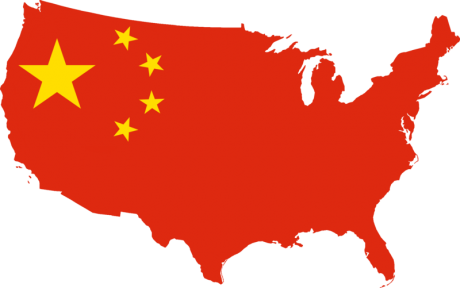
This could explain much about Beijing's more curious policies

A new study carried out at Beth Israel Deaconess Medical Center and Boston University School of Medicine reveals that the polluted air we inhale can affect our brain and lead to cognitive loss. Experts say that our brain could decrease in size and people who are most exposed are more likely to suffer from strokes or dementia. [...]
Yellow dust storm carries Chinese pollutants to Korea; 2/24; Blouin News:
On Sunday, South Korea’s meteorological service issued the year’s first yellow dust warnings for several of its major cities, calling for people to remain indoors and use masks and goggles when outside. The yellow dust comes from deserts in western China and southern Mongolia, and then becomes toxic as it passes through China’s heavily-polluting industrial areas to the east before drifting over Korea and Japan.
Exposure to high levels of “PM-10” pollutants (particles that are 10 micrometers or less in diameter) increases the likelihood of developing cardiac and respiratory problems.According to the Korea Times, “a yellow dust advisory is issued when an hourly average dust concentration of more than 400 micrograms per cubic meter is expected to last for more than two hours. More than 800 micrograms leads to a yellow dust warning.” As of 4 a.m. local time on Monday, Seoul had 1,044 micrograms per cubic meter of PM-10, making it the worst ...
[...]
China faces huge environmental and air-cleanup challenges and costs, which it is undertaking on its own. The country estimates that pollution cost it roughly 3.5% of GDP in 2010, according to a study by the Council on Foreign Relations, and life expectancy in the north has decreased about 5.5 years due to air pollution. Meanwhile, China’s investment in renewable energy has risen from $55 billion in 2004 to $310 billion in 2014.
Environment ministers from China, South Korea, and Japan meet at least once per year and have established working groups devoted to air pollution, but these don’t result in much beyond expanding tree-planting projects in inner desert regions. China’s neighbors complain about toxic yellow dust but ultimately they must make do with Beijing’s decisions, which place Chinese economic growth above all else.

That said, there are business opportunities throughout the region for air purifiers, filters, renewable energy, and vacation travel to escape cities.[...]
All right, Pundita, that's enough; there's nothing funny about this. But the other day I watched video footage featuring a BBC correspondent get through an entire explanation about China's toxic yellow dust storms without once mentioning pollutants and that the dust is toxic. Sand, he explained.  Sand from the Gobi.

********


Maybe someone should give PM Narendra Modi a copy of James Buckley's book

I've deleted my specific address to "Americans" from the title of my 4/25 post (Americans: Tired of baloney instead of a workable plan to roll back federal government?), which references a book by James L. Buckley, Saving Congress from Itself: Emancipating the States and Empowering Their People. I did this because from what Shadow Warrior says, obviously Americans are not the only ones with the same basic problem Buckley writes about,

Shadow Warrior post from 4/23, which starts:
Land Bill Being Shelved
The Modi govt is shelving the Land Acquisition Bill after political opponents have pounced upon the issue and raised increasing outcry over it.
[...]
I feel that the Modi govt should have taken the approach of handing over more control of land policy to the states. Then states with a more forward and progressive outlook could move to develop themselves faster, while states with a more regressive outlook (bimarus) could be left to lag behind. The states more amenable to change would reap the rewards sooner, while the laggard states would suffer the consequences and feel more pressure to catch up.
Modi has often spoken of empowering the states and involving the states, but on the land issue he seems to have conspicuously ignored his own advice. Maybe his rock-concert-tours abroad have misled him into believing that he can change India purely through the force of personal charisma, but he is now receiving a rude dose of reality. He does not have the personal force to just hoist up the entire country and raise the Titanic in one heave.
[...]
I don't know whether any or part of the mechanics of Buckley's plan could be applied to India's government. Yet I'll bet that federal overreach in India happened at least in part in the same way it did in the USA.  As Buckley explained during his conversation with John Batchelor on Friday, the feds made an offer to state and local governments they couldn't refuse: free money from Washington in the form of what's called "federal grants-in-aid."

However, there is a string attached in that Washington controls the programs run by the federal aid grants.

So it turned out that free money was hideously expensive for the states -- and American taxpayers in general. This is because it's really, really costly to fix a flat tire in Kansas City from a garage in Washington. DC. That's not even talking about how expensive long-distance administration is for the kind of programs the feds actually fund.

And when people are getting money for free, they're not prudent with the way they manage it.  This too turned into a huge problem for the states' taxpayers.

So why don't states just refuse the handouts from Washington?  Here we find a tangled ball of yarn.   State governments and the taxpayers in the state are in a serious bind if they want to refuse federal money for grant programs that the feds have already funded.  That's because the programs have state employees working on them. Shut down the program, throw many people in your state out of work.

Plus, people in the state collecting checks from the federally-funded program suddenly lose the check.

Plus, Washington says to a state, 'Okay, if you don't want your share of the pot of federal aid money -- which by the way taxpayers in your state have contributed to -- we'll just give it to another state.'

But what if the state applying for the 'extra' money is rich, and the state trying to withdraw from the government's free money is poor?

Now it's possible to address the dilemma on a case-by-case basis. But the only viable solution for all the U.S. states is a remedy that finally tackles the roots of the problem.  Yet despite bright minds in Washington (they do exist) wrangling over this problem for decades, proposals for a remedy always get hung up on the sticking point of rich states v. poor states.

The upshot is that taxpayers say to heck with it; we'll just keep paying for these federal aid programs because at least we'll get some of the money.

After listening to Buckley detail the situation for John Batchelor's radio audience, I was reminded of people who start using credit cards to make ends meet from month to month.  They know they're ruining themselves with the interest payments but they don't see any way out.  
Libertarians and Conservatives have had no workable answer for the states' dilemma. And Liberals ask, 'What're you gonna do if the well runs dry?'

Watch Ken Burns' Dust Bowl to understand why Liberals have a point.  What happens if there's a perfect storm of events affecting several low-income states for years, and there are no federal aid grant programs?

Actually, ways other than the federal aid grant programs can be found for the federal government to deal with real disasters in states that are overwhelmed.

And I think Conservatives would charge that the whole of the Liberal agenda since Lyndon Johnson's presidency has been to brand everything a disaster, from being poor to requiring a college education to needing medical care to being a minority, to not having the right kind of protein in public school lunches.

It's a tribute to the large hearts of Americans that this perversion of the concept of disaster hasn't destroyed volunteerism in the United States.

Yet the world changed in the wake of the 2008 financial crash.  Even many Liberals now concede that the federal aid grant program is out of control -- a disaster in itself, by their interpretation of the term. From the introduction to Buckley's book:
Saving Congress from Itself proposes a single reform: eliminate all federal grants-in-aid to state and local governments. This action would reduce federal spending by over [$641] billion a year and have a profound effect on how we govern ourselves.
The proliferation of federal grants-in-aid programs is of recent vintage: only about 100 such grants existed before Lyndon Johnson took office, and now they number more than 1,100.
Eliminating grants to the states will result in enormous savings in federal and state administrative costs; free states to set their own priorities; and improve the design and implementation of programs now subsidized by Washington by eliminating federal regulations that attend the grants.
In short, it will free states and their subdivisions to resume full responsibility for all activities that fall within their competence, such as education, welfare, and highway construction and maintenance.
And because members of Congress spend major portions of their time creating grants and allocating funds assigned to them (think earmarks), eliminating grants will enable Congress to devote its time to responsibilities that are uniquely national in character.
But that's just the introduction.  Again, the sticking point about the 'block grant' remedy has been rich states v poor ones if the grant program is ended. The rich states can survive the immediate shock when the programs are ended; poor states can't necessarily.  So it's at this point Buckley proposes a stepwise solution.

I transcribed part of his conversation with Batchelor on the John Batchelor Show about the steps. I stress there's additional steps so you want to listen to the podcast of the conversation to perceive the staircase. The entire segment for their conversation begins around the 19 minute mark. The part I'm quoting starts around the 34 minute mark.

(As I mentioned in the earlier post, James L. Buckley is a retired Senior Judge for the United States Court of Appeals for the District of Columbia Circuit and former U.S. Senator.)
My proposal is to kill all these [aid grant] programs -- just abolish them all. But because they've grown to the point where about 30 percent of the average state income is in the form of these grants, you have to fill in the gap.

My specific proposal is to immediately have Congress give each state 'block grants.' meaning grants with no strings attached, which equal the amount [states] were expecting from all the various programs and grants that had been approved. And then phase those out.

But there is an alternative that I think Congress might find more attractive and that is to convert those sums of money into what was called "revenue sharing" in the 1970s.  In other words, a return of money to the states with no strings, but in a manner that would allow a certain amount of redistribution from the wealthy states to the poor states.
[This] on the assumption there are certain levels of service that we should expect citizens to receive whether they live in a poor state or rich one.
Again, there are a couple more steps after that, as you will learn from the rest of the 39 minute conversation, but they form an integrated remedy.  The additional steps are necessary because working out a fair resolution to the rich-poor states conundrum, in the way the federal government would do it, is so incredibly complicated, as Buckley explains, it would be well into the mid-century before they had it sorted out.

Buckley is saying, 'Here's how to do it more simply.'

Now of course this doesn't solve all America's problems.  But it does solve a huge problem that seemed intractable until a 90+ year old American with vast experience in Washington, and whose mind is sharp as a tack, sat down and wrote a book. Another book, that is; Saving Congress From Itself is not the first one James Buckley has written.

********

Powerful aftershocks continue to shake Nepal's earthquake-affected regions UPDATED 7:53 AM EDT

UPDATE adds photo and Boston Herald report
**************
"Day two is just day as bad as day one — we get the aftershocks every five minutes," said Basanta Adhikari, of Biratnagar, in eastern Nepal.


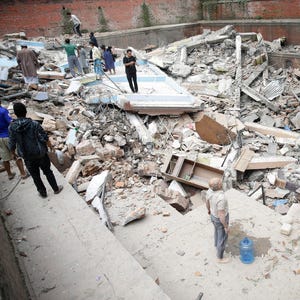
Volunteers remove debris from a collapsed building in Kathmandu’s historic Dunbar Square after yesterday's earthquake. PHOTO:  AP via Boston Herald

Experts: Powerful aftershocks to come
Owen Boss
April 25, 2015
Boston Herald

The magnitude-7.8 earthquake that rocked Nepal yesterday will likely be followed by a series of powerful aftershocks, experts warned, that could last weeks or months.

“The aftershocks from this will continue I’m sure, but the number and magnitude will decrease over time,” said Alan L. Kafka, associate professor of Earth and Environmental Science at Boston College. “We’re looking at something like a few magnitude-6 aftershocks, maybe one or two in the high sixes ... Once these spots light up, it takes a long time for the energy to die back down.”

John Bellini, a geophysicist at the U.S. Geological Survey’s National Earthquake Information Center in Golden, Colo., agreed.

“So far, we’ve recorded about 27 aftershocks over the magnitude 4.0 — one of them being a magnitude 6.6 — so we expect to see that continue over the next few weeks and months,” Bellini said.

The region has a history of damaging earthquakes. Nepal suffered its worst recorded quake in 1934. That quake measured 8.0 and all but destroyed the cities of Kathmandu, Bhaktapur and Patan. Yesterday’s quake, with the same magnitude as the one that hit San Francisco in 1906, was about 16 times more powerful than the 7.0 quake that decimated Haiti in 2010, leaving some 150,000 dead.

Bellini said the shallow depth of the massive “thrust fault” quake led to widespread devastation.

“Because it was such a large magnitude quake and it was relatively shallow beneath the surface and relatively close to populated areas like Kathmandu,” he said, “there has been quite a bit of extensive damage.”[END REPORT]

See also Why Nepal is so vulnerable to quakes; BBC April 25

The death toll is currently 2,000 but the number will continue to climb as aid workers make it to villages that were flattened by yesterday's quake.  Nepal's international airport was opened briefly then closed again today because of an aftershock.  As of the time the following USA TODAY report was published the airport is again open. But communications are still spotty and road conditions are very poor or roads are impassable because of yesterday's quake. From what I've read India's military seems to have done the best so far at getting aid into the country.  See the USA TODAY website for video of the relief efforts.

Nepal hit by major aftershock as search for quake survivors intensifies

Kim Hjelmgaard, USA TODAY
6:53 a.m. EDT April 26, 2015

The Kathmandu area of Nepal was struck by a magnitude 6.7 aftershock Sunday, just a day after a massive earthquake in the region killed over 2,000 people and devastated a large swathe of the capital city's buildings and infrastructure.
The U.S. Geological Survey said the aftershock was very likely within a radius of 31 miles of Kathmandu. The aftershock sent people in the city running for open ground. It was not clear what damage was sustained.
The aftershock came as rescuers aided by international teams intensified their efforts on Sunday to clear rubble and search for survivors in Nepal after Saturday's magnitude 7.8 earthquake — also centered outside Kathmandu. That quake was the worst to hit the poor South Asian nation in over 80 years.
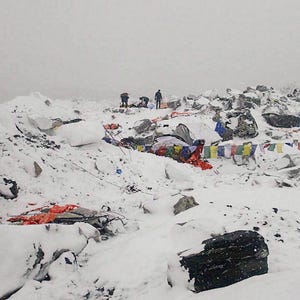
In that earlier quake, at least 721 people died in Kathmandu alone. Around 5,000 people were injured across the country and among the dead are 17 people who were struck by a quake-triggered avalanche on Mount Everest. Evacuations from the Earth's highest mountain were still ongoing. Tremors from the aftershock were also felt in India.
Laxmi Dhakal, an official from Nepal's Home Ministry, said Sunday that the number of casualties was expected to climb. At least 2,152 people are confirmed dead according to officials.
City hospitals remained overwhelmed and tens of thousands of people, fearful of aftershocks bringing down more buildings, spent Saturday night outside. The United Nations said emergency supplies were running out, as was space to store corpses.
"Day two is just day as bad as day one — we get the aftershocks every five minutes," said Basanta Adhikari, of Biratnagar, in eastern Nepal.
[...]
The world reacted quickly to the disaster, offering money, relief materials, equipment, expertise and rescue teams to the country of 28 million people that relies heavily on tourism, principally trekking and Himalayan mountain climbing.
Among the first to move in was Nepal's giant neighbor India, with which it has close political, cultural and religious ties. Indian air force planes landed Sunday with 43 tons of relief material, including tents and food, and nearly 200 rescuers.
The U.S. Mission in Nepal released an initial $1 million for immediate assistance. Australia pledged $5 million in aid. Pakistan, China, France and Britain said they would assist in the relief effort. The humanitarian aid group Oxfam said it was sending a team of technical experts from Britain to provide clean water, sanitation and food supplies.
Most areas were without power and water Sunday, but Kathmandu airport reopened briefly before closing again due to the aftershock. It has since reopened.
Rescuers were continuing to dig through the rubble of concrete, bricks, wood and iron to hunt for survivors.
[...]
 Contributing: Naila Inayat in Lahore, Pakistan; Doyle Rice, McLean, Va.; Donna Leinwand Leger and Doug Stanglin in Washington, D.C.; the Associated Press
[END REPORT] 
  

Oops

For readers who already saw the last post, whichi I've now corrected, James L. Buckley retired from the bench in 2000.

As long as I'm making corrections I forgot to publish a correction by AP regarding the California court decision about water rates, so here it is:
Correction: California Drought-Water Rates Story
LOS ANGELES — Apr 23, 2015, 2:22 PM ET
AP via ABC News
In stories April 20-21 about a court ruling that found San Juan Capistrano's tiered water rates unconstitutional, The Associated Press reported erroneously that the decision by the 4th District Court of Appeal was only binding in Orange County. The ruling is binding statewide. However, appellate courts outside Orange County could rule differently and the state Supreme Court may ultimately decide the issue.
A corrected version of the story is below: [...]
Many news outlets picked up the original AP report as did this blog because the topic is so important. As the title of my original post noted, every water agency in the state was waiting on the court decision.  And of course Sacramento was also waiting.  Factual errors happen in the best of news-gathering organizations, which Associated Press is, but this incident is a reminder to me that the more important the news, the more I should take care to check the local reporting on it.

Maybe in this case everyone got it wrong -- I haven't looked back to check the original local reports -- but given that it was a court ruling, it's more likely the locals got it right.

Here's a passage from the corrected AP report, which I don't remember seeing in the original, but which ties in a bow the current impact of the court ruling:
Water departments are being pulled in different directions by Brown's administration that demanded hitting residents in the pocketbook to save water and the legal uncertainty of charging guzzlers higher rates.
"If you have courts telling you one thing and the governor telling you something else, maybe that's a reason to sit tight," [said Ken Baerenklau, an associate professor at the University of California, Riverside who's studied tiered water rates]
Sounds like gridlock to me. All the judge for the 4th Dist. Appeal Court did was kick the can up the road to the state's Supreme Court.

********

Saturday, April 25

Tired of baloney instead of a workable plan to roll back federal government? UPDATED

A simple, workable plan does exist and what's more it has been gathering support from conservatives and liberals -- the kind who know this society is being killed by the size of the federal budget and feds' attempts to play long-distance savior to the American populace.    

The plan is found in the book Saving Congress from Itself: Emancipating the States and Empowering Their People (December 2014) by James L. Buckley, a 92 year old retired Senior Judge for the United States Court of Appeals for the District of Columbia Circuit and former U.S. Senator.

The best introduction to the plan is not found in reviews but in Judge Buckley's conversation last night with John Batchelor.  Buckley is so clear, concise, and simple in his exposition that I'm going to start wishing friends, "May you have Judge Buckley's clarity of thought in your 90s "

Buckley breaks it down for Bachelor's radio audience to explain the real reasons for fed and congressional overkill. Then he shows in paint-by-numbers style that the remedy is simpler than the uninformed would imagine.

And that's been the problem all along: over the decades hundreds of thousands of plans have been shouted at Americans by people who don't know what they're talking about.  So then it becomes a political food fight, then nobody can make heads or tails of what anybody is talking about.

Sweep aside the accumulated clutter and listen to someone with vast knowledge of exactly how the government system in the USA works.  Here's the link to the podcast of the conversation, which takes up the last two segments in the second hour of the show, starting around the 19 minute mark:

http://johnbatchelorshow.com/podcasts/fri-42415-hr-2-jbs-james-taranto-wsj-editorial-jim-mctague-barrons-james-l-buckley-author

Then, if you want to confine the federal government to its actual intended purpose, contact your representatives in Congress and tell them you want Buckley's plan.

For the doomsayers who say "They" will never let it happen -- before the financial crash I might have agreed.  But to cut through the argument, what'll it cost you to try?

UPDATE
I deleted the title's specific address to "Americans" after I read a post at a blog in India, which made me realize Americans aren't the only ones with the same basic problem described in the title.  See the next Pundita post for details.

********

Mother Earth is grumbling again. Tighten it up, people

A general view of Calbuco Volcano spewing ash and smoke is seen during sunset from Alerce town, April 24, 2015.
REUTERS/IVAN ALVARADO

Yes yes I know she's always grumbling somewhere. But just as in 2010 with the 7.0 mag earthquake that devastated Port au Prince followed two weeks later by the whopper that struck Chile, the human race has once again gotten in the way of a double whammy:  

First with the eruption of a very dangerous volanco in Chile on April 22, then on April 25 with a 7.8 - 8.1 mag earthquake that struck across a wide swath of South Asia (parts of Nepal, Tibet, Bangladesh, Pakistan, India) and with devastating force in Nepal's capital.  Note that this week's grumbling was out of the blue on both counts -- no warning.

If you say Wednesday's eruption was in a sparsely inhabited region of Chile, yes, but there is the little problem of the winds.  From Reuters, April 25, 10:56 AM EDT:
Chile volcano ash cloud reaches Brazil, flights canceled
(Reuters) - Ash from the Chilean volcano Calbuco, which erupted without warning this week, reached as far as southern Brazil on Saturday and prompted some airlines to cancel flights to the capitals of Chile, Argentina and Uruguay.
Calbuco, considered one of the most dangerous along Chile's chain of around 2,000 volcanoes, erupted twice in 24 hours on Wednesday and Thursday, sending up a spectacular 17-km-high (11 miles) cloud and coating nearby towns in a thick layer of gray ash.
Authorities have set up a 20-km (12 mile) cordon around Calbuco, in the scenic Los Lagos region, around 1,000 km (620 miles) south of the capital Santiago, evacuating more than 6,500 locals.
"The dangerous nature of volcanic activity like this plus the volcano's current instability that could lead to more intense activity in the short term indicates we should maintain the perimeter," Chile's national office of emergency said in its latest report.
Authorities allowed people who had been evacuated to briefly enter the perimeter on Saturday to check their houses, animals and medication.
Some houses and schools located close to the volcano have collapsed under the weight of the ash.
The ash also presents a threat to air traffic, as particles in the atmosphere can cause problems for planes.
With winds blowing the ash cloud northeast into Argentina, Argentine air traffic has been the worst affected so far. But a spokesman for Argentina's National Civil Aeronautic Administration said the situation was "much better than yesterday".
"The airports (of Buenos Aires) are operating normally. The first ash cloud has already passed by and the second is on the move. American Airlines is not operating on their own accord, nor are Delta Air Lines, or United. They are evaluating the situation on a day-to-day basis."
The head of Chile's mining and geological service said on Friday the volcanic process could last for weeks.
(Reporting by Felipe Iturrieta in Santiago, Additional reporting by Malena Castaldi in Montevideo and Brian Winnter in Sao Paolo, Writing by Sarah Marsh; Editing by Janet Lawrence)[END REPORT]
So I repeat the warning I gave in 2010 and I think also 2009. Get it together. Focus on the basics.  

Death toll from Nepal quake now at 1,130 and climbing UPDATED 6X

Time difference: Kathmandu, Nepal is 9 hours and 45 minutes ahead of New York, NY, which is on Eastern Daylight time.
So it's light again there now, although whether the international airport is open again is iffy. It's been shut since the quake. Aftershocks in the region still going on.
************************
Just to review: quake and aftershocks in addition to Nepal:  parts of Tibet, Bangladesh, Pakistan, India -- India as far south as Delhi. Wikipedia is also on the case now:
"The 2015 Nepal earthquake was a magnitude 7.8 or 8.1 (Mw) earthquake that occurred at 11:57 NST (6:12:26 UTC) on Saturday 25 April 2015, with the epicenter approximately 29 km (18 mi) east-southeast of Lamjung, Nepal [about 50 mi from capital of Kathmandu], and the hypocenter at a depth of approximately 15 km (9.3 mi).[1][2] It is the most powerful earthquake to have hit Nepal since the 1934 Nepal–Bihar earthquake. At least 1,505 people are known to have been killed as a result of the earthquake."

An earlier AP report put the depth at 7 mi.  but 7 or 9, that's shallow. so very violent shaking, like 7.0 quake that struck near Haiti capital Port au Prince in 2010
**********************

Aw, for Pete's sake; the international airport was shut down.  Just learned this from AP report updated 5 minutes ago.  I can see why it was shut but yes, as AP noted, that would tend to hamper international relief efforts.  The AP report has background on the country and the quake, which is 7.8 although the Guardian has it at 7.9.  The Guardian as I noted in my first entry, is doing live updates.

******************
Update 12:08 PM EDT
Zee News India latest update 21:34:

"Fresh tremors in Delhi, Nepal measuring 4.7 on Richter scale"
Aftershocks.

**********************
"A Nepali police spokesman said the latest figure includes at least 634 in the Kathmandu Valley and at least 300 more in the capital."

The Guardian is doing live updates of the worst earthquake to hit Nepal in more than 80 years.

From 2 Guardian updates 3 hrs ago:  

"Around 300,000 foreign tourists were estimated to be in Nepal for the spring trekking and climbing season. Officials have been overwhelmed by calls from concerned friends and relatives."

"Relief efforts in Nepal have been hampered because of a collapse in communication. Many of the reported deaths have been in the more populous areas, but there have also been reports of devastation in outlying, isolated mountainous areas."

************

Saturday's catastrophic earthquake in Nepal occurred because of two converging tectonic plates: the India plate and the overriding Eurasia plate to the north, the U.S. Geological Survey said.
Tectonic plates are the large, thin, relatively rigid plates that move relative to one another on the outer surface of the Earth.
Plates are always slowly moving, but they get stuck at their edges due to friction. When the stress on the edge overcomes the friction, there is an earthquake that releases energy in waves that travel through the earth's crust and cause the shaking that we feel.
The quake had a depth of only seven miles, which is considered shallow in geological terms, the Associated Press reported. The shallower the quake, the more destructive power it carries.
The earthquake was felt as far away as Lahore in Pakistan, which is more than 700 miles away. It was also felt 380 miles away in Lhasa in Tibet, and 400 miles away in Dhaka, Bangladesh.
Although a major plate boundary with a history of large-to-great sized earthquakes, large quakes in this area are rare in the documented historical era, the U.S. Geological Survey reports. Over the past century, just four events of magnitude 6.0 or larger have occurred within about 150 miles of Saturday's earthquake.


Friday, April 24

What happens when you mistake the short run for the long run?

04_20_Water_03

"One of those solutions is recharging the state's groundwater, which [Samuel Sandoval] said is rapidly disappearing because cities and farmers are extracting more water than can be replenished naturally. A way to do that, he said, is by improving the storage of water in reservoirs and aquifers when atmospheric rivers bring powerful rainstorms to California."

I found the NBC report fascinating because in telling Samuel Sandovol's story it focuses on the most overlooked aspect of drought-coping in California's farming belt: many farmers don't conserve water or don't do it enough simply because they don't know how.  (That's surely the case for farmers the world over.)  Sandoval, who is bilingual, is able to teach both Mexican immigrant and native Californian farmers the many water saving tricks that together are just as important if not more so than expensive drip tape and hi-tech methods.   

But it was the passage I cited above that really got to me.  A year ago I wouldn't have understood the meaning and import of the phrase "atmospheric rivers."  But now I understand that Sandoval is talking about flying rivers.  And yet a chill came over me as the words sank in.  How long have they known about those rivers and California? if the chill could speak. 

[shrugging]  So many different research specialities. Sandoval is a hydrologist, so he'd be in a position to know or make an educated guess.  Climate scientists and meteorologists not so much, not until very recently.  And exactly how the flying rivers intersect with other atmospheric effects, the extent to which they affect rainfall patterns region by region, and whether a specific drought can be linked to the lessening or disappearance of a particular flying river -- all those certainties are still ahead on the timeline.

The really problematical aspect about the timeline, as those who follow such matters learned just last month, is that it could end much sooner than anyone would've imagined. That's because last month the satellite images giving a precise reading of the extent of forest fragmentation, the world over, were published.   

If the flying rivers are critical drivers of rainfall in many parts of the world, the forests that generate them are being decimated so fast it's another question for science as to how long the sky torrents will continue.  

Another fun question is where the flying rivers go.  The Flying Rivers Project has been tracking the rivers in the sky but that's a Brazilian research project, largely concerned, I think, with the Amazon's flying river.  But just because a region has enough forest left to generate a pretty hefty flying river, that doesn't mean the river hangs out over the region.  The winds take over, blowing the river through the sky on what (from Amazonia's flying river route) seems a pretty set path or paths. 

That means a region that generates a big flying river can still be suffering from drought if other weather conditions don't generate rainfall whereas a region downwind, so to speak, can get the benefit of the flying river's moisture.  I guess it evened out when much of the world was covered by forest -- flying rivers zipping around the sky, bumping into each other and criss-crossing no matter what the seasons.  Another question is how much criss-crossing they do today.

Bearing down on all these question is the certainty provided by satellite imagery that has recently revealed how much groundwater the world has left. That, too, is not so much.

But for those having a hard time facing reality the word of the hour, the word of the year, now repeated so often it has its own shorthand version, is "desal."            

Yes, we are going to desalinate our way around water shortages. But desal has never been attempted on a vast scale, so whether done by reverse osmosis or the zero desalination discharge methods (ZDD), nobody has any idea what would happen if everybody did it. Better find out before fooling around even more with the oceans, which like forests generate their own world-impacting ecosystem.

A small reality check on the brute force engineeering approach to water conservation is found in a Newsweek cover story, written so well it approaches art, Drying Up: The Race to Save California From Drought by Elijah Wolfson, published yesterday; here are few passages:
California is in many ways the world’s greatest geoengineering project. But there was a fatal flaw in their system. “We had no idea how the water cycle worked” in the early 20th century, says Jay Famiglietti, senior water scientist at the NASA Jet Propulsion Laboratory. “We didn’t even know what ‘climate change’ meant.”
The ecosystem those midcentury movers of the earth created, so powerful when there is rain and snow, is entirely impotent when it stops. And now it is dangerous.
[...] 
The staggering ingenuity of those hydraulic scientists and engineers seduced the state’s residents into complacency; they assumed the pocket-protector geeks could always figure out new ways to shift water around. Cut back? Conserve? Not in the Golden State!
That attitude still exists in many corners:
There have been not entirely facetious proposals to, for example, build a massive pipeline from Alaska down to California’s Shasta Lake and construct a channel to shore up the flows of the Colorado River (which feed San Diego and other cities) with waters from the Missouri River.
Water engineering created “a momentum that took on a life of its own as the panacea,” says Chester. “This same mentality acts as a cultural myopia that prevented the consideration of alternative approaches that incorporate more practical and adaptive responses to limited water.


Thursday, April 23

See, this is why I think US and EU should mend fences with Russia ASAP


But that's just me, so for those who laughed at my advice to President Obama yesterday -- yes I'm a laugh a minute. Always have been when it comes to China.  Yet I'd venture this is a good time to think outside the box of conventional military conquest.

Beyond Land Grabs

China's government has been buying up huge chunks of land in the EU and USA under the guise of buying up companies. However, the land grabs aren't the biggest problem if one thinks in terms of conquest.  It's the control Chinese-owned companies exercise over American and European salaries that can be conceived of as a battle plan.  

With a few taps on a computer keyboard, payments on all the salaries can be stopped at the same time -- along with all payments on rental properties China's government holds, through millions of proxies, in the United States and Europe.

Through that bloodless method China could eventually conquer the US and EU within 14 minutes -- 7 minutes for the bank transactions, 7 minutes to stop laughing.  They just have to get the number of salaries up to a certain percentage before issuing blanket stop payments. And they might need a reasonably hack-proof banking intranet and their own version of SWIFT to prevent fast retaliation and an overload of transactions.  Otherwise it's pretty simple.  

Yet the war strategy has been masked by the widespread belief that whatever economic harm China might inflict on these two trade giants would ricochet.  The flaw in the reasoning is that it's confined to peacetime economics. Has nothing to do with war.

The US and EU defense establishments could mount counteroffensives but they'd be doing this on the back foot of surprise while China's defenders would be well prepared for a siege.

How Likely Is The Scenario?

Give me a moment. [cracking open a fortune cookie and pulling out the fortune]  

"145-998-03"

Hmmm. Deep.  Wait; those are my lucky numbers. [looking at the other side of the fortune]

"He who does Asia Pivot should recall Chinese PLA not potted plant"

All things equal, I'd interpret that to mean it's important not to overlook the obvious.

As to how that would translate into an action path, maybe less pirouetting around the world and more attention to basics on the home front.  Dave Schuler at the Glittering Eye put it a little differently:
With characteristic American impatience we have been pursuing one year plans when we should have been pursuing a hundred year plan. China is simply too large for anything else and we’re seeing the results of that now.
Long range planning is hard in a democratic republic. although that's what the U.S. Senate and Pentagon are supposed to do.  But how much long-range thinking is required to see the need to protect a society's flanks?

Dave also noted:
I think that Nixon erred in opening U. S. relations with China, Clinton erred in granting China “Most Favored Nation” status, and the world erred in admitting China to the World Trade Federation. Just to name a few among many missteps.
Right.  And leading governments in the European Union erred in getting along and going along with NATO in the post Cold War period.  Better long-range thinking would have meant investing in building up a "Greater European" defense force that would have included Russia.

Of course there's nothing like 20/20 hindsight; China wasn't seen as an economic or military threat back in those days  But now that it is seen as a threat, the task is to strive for balance.  That this includes very difficult fence-mending -- better to start now than when you're flat on your back.

But What About Saving Poor Ukraine From Russia?


From China will win the war over Ukraine; March 19, 2015; Fyodor Lukyanov, special to Russia Beyond the Headlines:
The most unexpected result of the crisis in Ukraine is the emergence of China as a leading Eurasian power. As Russia and the West clashed over whose integration project Ukraine will join, Beijing announced a completely different initiative, although one aimed at that geographical area.
It is symbolic that Chinese President Xi Jinping's initiative to create the Silk Road Economic Belt was announced precisely at the time – Fall 2013 – when Russia and the EU where reaching the culmination of their confrontation on Ukraine.
With the Silk Road Economic Belt, China is noticeably distancing itself from any competition, proposing a project that bypasses all others and may even absorb them. With the volume of resources that Beijing is capable of investing, it is impossible for anyone to compete. While Russia, the EU and the U.S. are operating in Eurasia mainly with political instruments that are creating friction, China is offering real money – and political neutrality.
Light Reading

The Chinese Are Buying Large Chunks Of Land Across America (And Zillow Is Now Enabling It); Tyler Durden; April 3, 2014; Zero Hedge

Zillow To Give Chinese Homebuyers Access to U.S. Listings; Dan Levy; April 2, 2014; Bloomberg Business

China Loves Buying European Companies; CNN Money; March 23, 2015

Wednesday, April 22

President Obama change your mind and attend Russia's VE Day Celebration UPDATED 8:45 PM EDT

UPDATE
It should go without saying that my advice doesn't mean I think President Obama should attend every subsequent VE Day parade in Moscow -- or any other VE Day parade.  But because the topic is so loaded this update is to underscore the great importance of America's President attending this year's event.

Rightly or wrongly, Obama's refusal to attend the parade was widely perceived as a protest of the Russian government's actions on domestic matters and international actions especially toward Syria, Ukraine, and Crimea.

But running alongside this view is an insidious propaganda 'narrative,' which gained coin in the past two years: Russian don't have a right to exist as Russians because they are too dangerous to the rest of the world as they are.  They must be purified of the dross of being Russian before they can be upstanding members of the International Community.

It's not put quite that baldly, but it is very clearly implied by the argument that Russians can't learn to practice good Western values without submitting in overt ways to the value system shared by the United States and European Union

One doesn't need to read the news out of Russia to intuit  how Russians perceive the narrative.  But the news reports shout that Russians believe the Western governments, led by the United States of America, are intent on destroying their country, their culture, and their history.

That is why President Vladimir Putin enjoys an 80+ approval rating in his country -- a rating found by every polling organization in the world that queries Russian. Even many Russians who despise Putin staunchly support him at this time.  They see him as standing up to America's attempts to wipe their nation off the map.

That is precisely why President Obama should send a loud and clear message at this time to the Russian people, a message that shouts above the noise by generated by armed conflicts, politics, propaganda, and media opinion.

The message is that Americans understand that here in the 21st Century, civilized peoples don't support or practice the ideas that undergird eugenics.

We here in America know that Russians are not sub-humans who can only be made fully human by accepting the values of NATO countries.  And if our propagandists gave a different impression they have no support from even one civilized adult in the United States.

Obama's attendance at this year's VE Day parade would be the perfect way for him to say all this, without using a bunch of words. Besides, talk is now so greatly cheapened by politics it's only actions that have any weight with the majority.

The action here would be to just go, pay his respects to the Russian Soviet war dead, then go home.

Many if not most Russians would say at first, 'It's an American trick,'  Obama's spokespeople could answer this by saying, 'You should hear what his political enemies in America have to say about it.' But they wouldn't even have to make that point; the Russians will hear what his enemies say.

So while it might take a little time, the true import of his visit would sink in among informed Russians.

Now to the specifics of my advice:

********

Related advice:

1.  DO NOT visit with "dissident" or "human rights" groups if you make the trip.  You'd have a good excuse to refrain from such meetings because trip planning would be virtually last minute.  Have State announce beforehand that the President is going to Russia simply and only to honor the fallen in World War Two.  Don't muddy the clear waters by making it into talking points for Western Values and don't try to 'explain' the decision.  Just state the purpose and have State reply to any and all hysterical questions, 'It is what it is. Deal with it because there are actually a few things more important than geopolitics.'   
   
2.  Because there's little time to arrange security for the trip, I'd hesitate to advise that you personally address a college audience -- or any audience.  But you could give a radio address if you just can't stand the thought of not getting a single Teachable Moment out of the visit  

In that event, make it a Teachable Moment on the grandest and most profound theme you and your speechwriters can muster on short notice.  Make it a BIG theme.  You know -- BIG.  I have a dream that all the world's children, etc.  But be brief. Ten minutes. Max. The less you say, the less it can be ripped apart.  

3. Now as to the problem of offending peoples in other former Soviet republics who are also having VE celebrations, if you don't attend those -- the last-minute improvised nature of the trip provides some cover. But you could give a pre-visit speech here in the USA that would work in the big theme and the importance of not letting the sufferings of the past overtake today. 

4. As to other national leaders who've cancelled their planned attendance at the parade in Moscow or refused to attend in the first place -- your visit would certainly send a strong message about cooperation to all Europe's leaders.  You wouldn't have to say much, beyond announcing the trip. Then it would be their decision to rethink or not. 

5. But the meta-message in your decision would be that the United States of America must act independently when it sees the need.  

The inescapable truth is that Americans would have lost a lot more of their finest in World War Two if the Soviets hadn't shed so much of their own blood.  And lost it to a war in which Americans had no part in starting.  Of course the Soviets weren't fighting and dying to save Americans but that's the way things worked out. This towering fact must not be forgotten.  

As for Israel:  I seem to recall reading that Bibi was originally going to attend the parade -- but that was before the Kremlin played a nuke card by inking an agreement to sell a powerful missile defense system to Tehran.

In any case, there is no such thing as ironclad ink. 

And in a world of God there is always just enough time.  Never was there a more important time to try to remember the best about the past and leave go of the rest.  

Godspeed, Mr President, if you decide to make the trip.   

******* 

NATO-Russia Crisis: For too long Europeans avoided responsibility. Now for the price.


For the latest on the NATO-Russia crisis view the sources in my post from last night.

The motivational speaker Les Brown once advised to interpret a lot of turbulence in your life as a sign that you're trying to move rapidly to a higher level, in the way jet plane passengers feel air turbulence if the plane rapidly gains altitude.

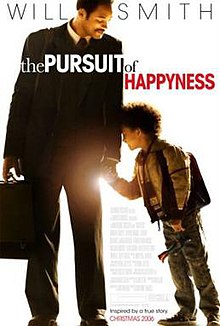
Years later The Pursuit of Happyness (2006) was like a coda to his words. I found the film, based on the true story of a black American salesman named Chris Gardner, almost unbearable in parts and at one point I did stop watching, saying, "I can't deal with this."  But a moment later I gritted my teeth and I'm glad I did.

Eventually, it starts to come clear that while everything that could go wrong for this man did, much of it was that he'd been able to put off dealing with time-consuming personal problems. Then they all came knocking again, at just the time he was homeless with a small child in tow and trying to find a new direction in his career.

He eventually became a millionaire, to be a plot spoiler, which I'm doing as a kindness to other sensitive movie viewers.  Yet even knowing this it is still hard to watch.  The story becomes bearable when it's clear he realizes that no matter what hell he was going through, he had to make time to deal with the old problems as they came back to haunt him.

To get intellectual about it, he had developed a pattern of avoidance -- a fairly common survival stratagem.  He was okay as long as he was on a routine path. Once he faced big unknowns the worst price for avoidance came due.  So while he was hit with bad breaks he was also meeting head-on a pattern of his own making.  To endure the turbulence he had undo the pattern.

This is what I'd call working to improve one's character at the point of a gun.

Of course a person isn't a nation much less a collection of ones, yet I recalled Chris Gardner's story yesterday when I read the following passages from Richard Sakwa's The Deep Roots of the Ukraine Crisis: We must rethink the post–Cold War security order. (Initially published April 15 for the May 4 edition of The Nation.):
On July 6, 1989, in an address to the Council of Europe in Strasbourg, France, Gorbachev outlined his ideas for a “Common European Home.” This vision, now commonly referred to as “Greater Europe,” laid out a program for geopolitical and normative pluralism in post–Cold War Europe. Gorbachev argued eloquently and forcefully that different systems could coexist peacefully.
Gorbachev was calling for the transcendence of Yalta, a position he would assert at the Malta Summit later that year. In Strasbourg, he called for a new dynamic in European international relations that would encompass the interests of powers both great and small. This would be a multipolar Europe with space for experimentation and diversity.
The tragedy of the Malta Summit is that Gorbachev was not talking about these ideas with European leaders, but with the president of the United States.
Unlike at Yalta, there was no Winston Churchill to speak on behalf of Europe. Not surprisingly, the idea of a Greater Europe was the last thing that Bush wished to talk about, since it would signal precisely what America had long feared: a split between the European and American wings of the Atlantic alliance.
I'd recommend you read the whole thing.  Yet Sakwa is giving Europeans a pass they had stopped meriting by the end of the Soviet Union.  From that point on the Europeans became masters at avoiding responsibility for their own security.  They would have 1,000 excuses for doing this but it boils down to "Because they could."  

The upshot was that they stayed with an ocean-spanning defense alliance rather than build their own alliance, one that should have included Russia.

The price for the pattern of avoidance?  Maybe I'll contemplate the question later today over a plate of dim sum.


Tuesday, April 21

War Escalation Russia NATO Now UPDATED 3X

There'll be a podcast later tonight but listen now if you can to Dr Stephen F. Cohen's discussion with John Batchelor; it'll be going on until 11 PM EDT.  Here's streaming link to Washington DC WMAL radio carrying the show.  

Update:  Here is the podcast. It's the entire 2nd hr of the show, which runs about 39 minutes.  

John also read excerpts from a bombshell report by Graham Allison and Dimitri K. Simes, two American heavyweight defense/geopolitical advisors (for decades), "Russia and America: Stumbling to War."  April 20, published at The American Interest.  Batchelor led off with a discussion of the report.  

He also spoke about statements made by Anders Fogh Rasmussen, former NATO Secretary-General.  (see below for link).  

Also Rasmussen's statements.  Don't have link yet will update with it.  

Keep in mind that John and Steve were the only people in the entire global media who began warning as early as a year ago that the situation now evident today was building. They were considered alarmist at the time. 

update 10:31 PM
here is link to Rasmussen interview Newsweek  April 15.  (Rasmussen is former NATO Secretary-General; his replacment is very recently installed so Rasmussen's statements still have great weight)

update 1:00 AM
As you will learn from their report Simes and Allison didn't phone it in; they took themselves to Moscow to speak in person with a wide range of high-level sources.   

Here is the link to the April 21 Deutsche Welle report about the series of assassinations in Kiev that John discussed.  But as background here's a report from April 17 I saw while I was looking for the DW link. It's from a Russian news site called Sputnik. Headline and lede:  

Extraordinary Double Standard: West Silent Over Murders of Kiev's Opponents

"The silence of the West over the deaths of Kiev's opponents - in contrast to the outcry following Russian politician Nemtsov’s death - yet again shows extraordinary double standard and its complicity in the destruction in Ukraine of the very standards of law and morality it claims to believe in."

It almost looks as if DW was stung by the Sputnik report, which does name DW along with other Western publication -- although, from some comments John made about the DW report, maybe not stung enough because they are still waffling about the fact that not all these murdered Ukrainians were Kremlin supporters. They were protesting the installed regime in Kiev.  Yet John noted that now the Germans, seeing this Pinochet-type wave of murders, are asking themselves just what they're supporting in Kiev. 

update 1:42 AM
Oops.  This was the Sputnik report (4/20) I meant to reference when I speculated above that DW was stung by 4/17 Sputnik report: Entire Western Media is a Troll Army

Heh. Tell us what you really think, Sputnik; don't hold back.  Sigh. 

The court decision every water agency in California has been waiting for

The higher rates "were exponential, arbitrary and they magically appeared out of thin air."

AP reports on the decision:

California court ruling could limit drought fighting tools

By BRIAN MELLEY, Associated Press via Seattle PI
Updated 1:48 am, Tuesday, April 21, 2015
Associated Press writers Fenit Nirappil in Sacramento and Amy Taxin in Tustin contributed to this story.

LOS ANGELES (AP) — In a ruling that Gov.Jerry Brown says puts a "straitjacket" on local governments trying to fight the severe statewide drought, an appeals court has found that an Orange County city's tiered water rates are unconstitutional.

The ruling by the 4th District Court of Appeal on Monday against the city of San Juan Capistrano potentially deals a blow to agencies statewide that have used the pricing structure to encourage water conservation.

"The practical effect of the court's decision is to put a straitjacket on local government at a time when maximum flexibility is needed," Brown said in a statement after Monday's ruling. "My policy is and will continue to be: employ every method possible to ensure water is conserved across California."

The 3-0 ruling upholds a Superior Court judge's decision that found that charging bigger water users incrementally higher rates violates a voter-approved law that prohibits government agencies from charging more than the cost of a service.

It comes shortly after Brown issued drought orders that call for rates that encourage people to save water, including tiered pricing. About two-thirds of water districts in the state use some form of tiered pricing, and the ruling was being closely watched to see how it might apply beyond the appellate court, which is only binding in Orange County.

The court said it had to follow its responsibility to uphold existing law.

"We hope there are future scientists, engineers, and legislators with the wisdom to envision and enact water plans to keep our beloved Cadillac Desert habitable," the decision said. "But that is not the court's mandate. Our job — and it is daunting enough — is solely to determine what water plans the voters and legislators of the past have put in place, and to determine whether the trial court's rulings complied with those plans."

San Juan Capistrano charged nearly four times as much per unit of water for users in the highest tier to provide an incentive to conserve. Residents complained the higher rates were arbitrary and unfair.

"They were exponential, arbitrary and they magically appeared out of thin air," said attorney Benjamin Benumof, who represented San Juan residents. "We feel vindicated and feel the constitution was upheld."

Under the ruling, tiered pricing would be legal, but it would have to be tied to the cost of the water, the court said.
[...]
Plenty more in the report.  

********