I knew before I launched the "Water Crisis Gordian Knot" series in July that there was a crisis and that it had many interwoven parts, but it wasn't until I plunged into the specifics that I realized the extent of either. At one point in my research I blurted in dawning horror, "Oh God. They left water out of everything."
"Everything" being clean energy, much of which requires vast amounts of increasingly scarce freshwater; development projects for entire regions of the world; vast modernization and industrialization schemes; globalized manufacturing and agricultural exports; democratization; political philosophies; geopolitical strategies; and government economic and social polices.
All of it, the entire edifice of the modern era, did not reflect thinking about water usage in an age of megapopulations.
It wasn't hard to see why. Water, for Europe and most of the United States, was never a big issue in the 20th Century, and it was these two regions that designed the economic, governing, and development policies that the rest of the world adopted. Freed from the bottom line for human progress, the intellect was able to create theories about human values and economic and social progress that ignored water.
Now it's all being swept away as the unyielding bottom line, and the price of ignoring it, become evident.
"We" left water out of everything, I corrected myself. We, not they. "I" not we, I corrected myself again. Now I am forced to tear apart everything I thought I understood, all the concepts I'd struggled so hard to learn over the course of my life, and try to rebuild my ideas on a new foundation. For someone closing in on 70 years of age, that's not easy.
And so for the first time I have a real idea of what it feels like for people whose house as been totaled by a natural disaster. I'm too old to start over, but having seen the truth I have the same choice that families do when they've lost the roof over their heads. Either give way to despair or rebuild.
This isn't to say that the enlightened justice systems that rose up in the West during the 20th Century were wasted effort. Humanity will need all the enlightened justice it can muster as the bottom line makes itself felt with increasing severity. But we will have to rework every economic and social system, every theory of development and sustainability we hold now, so that water is considered first in every calculation.
Oh, snap!
Then there are the added horrors to contemplate: the anorexic types, the totalitarian minded, and the ones who can convert any disaster into a free ride, will welcome the age of water crises.
Already I've come across the argument that the way to solve the world's water problem is to stop eating meat. Soon every national government will sprout a water czar. Then there will be the Global Water Regulatory Regime. And of course cap-and-trade in carbon emissions will be extended to water usage, to be overseen by the same scoundrels who made fortunes by scamming the U.N. Oil For Food Program.
The era of water crisis will also be taken up with gusto by the Occupy Wall Street crowd, which will rework the tyranny of Wall Street into the tyranny of water hogs. Already there is what's called the "Green Coast and the Brown Inland," which arose during the drought. The term applies to rich Los Angeles coastal communities that are so well-watered they look like "the Amazon jungle," as one observer put it, while the poorer neighborhoods farther inland, which can't afford fines for wasting water, have brown lawns and dying trees.
And then there are the Scarlet Letter types. Having never quite recovered from no longer being able to brand others witches, warlocks and hussies, they will have a field day pointing at water wasting criminals.
Don't laugh at the idea of criminalizing water use. This year the government in Jamaica went beyond its usual water rationing during one of the country's periodic droughts and announced that water wasters would be arrested.
Will the coming years see a Grand Water Inquisitor? A tribunal in the Hague where water wasters are put on trial?
All right, Pundita, don't scare yourself witless.
The irony is that technically there is no water scarcity. This is because all the water this planet has ever had is still with us today. As one observer put it, "Do you realize we're all drinking dinosaur piss?"
This view of water evolved the concept of "virtual" water among water scientists: everything manufactured and grown for food, everything built that uses water in its creation, is water itself albeit in a different form.
This view is driving the shift in thinking among water engineers toward reclamation as much as toward conservation. And indeed much used water can be reclaimed. I've learned that even the condensation from air conditioning units can be captured and reused.
There is, however, a caution about carrying the concept of virtual water too far. While it's true that your cell phone represents virtual water, you can't sip from your phone when you're thirsty. Water, once poured into a different form, can't be reclaimed as water.
So now plans for every building project, every manufacturing and agricultural process, must be seen first in four aspects: how much water it uses, the amount and location of the water source, and how long the source can hold out.
And gone are the days when regions could depend on an annual monsoon or melting snowpack to replenish rivers and aquifers. The snow will still fall on the mountain top, but it will evaporate in 100 degree temperatures before it can melt and flow into the river valley. The monsoons will still arrive, but they can fall on land already so parched by drought that their restorative effect is almost nil.
Not to consider those aspects is to set up a falling dominoes situation. Too much agriculture in California? Okay, transfer some of it to places in Oregon and Texas that have plenty of water. Pretty soon, the regions in those states that welcomed the new business are finding their irrigation systems are running dry.
We'll learn as we go along, but we'd better learn fast. When this close to the edge, the margin for error plummets.
Another pitfall is to place too much blame on poor water management. The most enlightened water management cannot overcome the realities of stuffing too many people into cities perched in a semi-arid or arid region. The experience of Las Vegas is ample indication of that. Led by a smart and tenacious water czar, the city by sheer dint of effort greatly reduced its water use, but it could not change its locale.
When the water czar fixed on the idea of importing water from the Great Lakes, a member of the public who lived in the Great Lakes region took objection: "Come endure our cold winters if you want our water," he snapped. And added, "Nobody told you to live in a desert."
So it's not just about water management. Every mistake in every type of policy that pertains to human populations also intersects with water use -- and with human nature, which is not the fountain of caring and sharing when it perceives gross violations of common sense.
Thus ends my account of how a series of blog posts became a personal journey of discovery. There will be one or two more posts on the water crisis but then I'll have to move along to other topics.
Yet when I look back on 2014 I will remember it as the year of "Oh by the way." Oh by the way, six U.S. states are running out of water. Oh by the way, 10 major cities in the world are running out of water. Oh by the way, our satellite imagery shows there's far less groundwater left than we'd realized. Oh by the way, oh by the way.....
My time spent on learning about the water crisis in detail has amounted to one long reading on "Oh by the way."
And I will remember, above all else, the words of a blogger at the University of California at Berkeley. In an essay titled Desertification: The Forgotten Side of Climate Change, he wrote:
"Ironically, we appear to be making great strides in enhancing our energy infrastructure, while at the same time the grass is slowly disappearing under our feet."
Yes. Those most intent on fighting global warming were looking at the atmosphere. Not at the ground, and the groundwater, beneath them. But this is not the time for recriminations. This is the time to change.
********
Friday, August 8


Thursday, August 7
What do Washington's war hawks have in common with Britney Spears, Lindsay Lohan, and Justin Bieber?
Like teeny bopper idols who find themselves washed up at the ancient age of 22, the war hawks are desperate to get back in the limelight.
Next we'll be hearing that Russia causes solar flares and China is set to invade Beverly Hills. ('China adding Bangladesh to its string of pearls?' blared a recent headline at a uh, "geopolitical" website.)
To which the American majority yawns.
See, this is the problem with running propaganda so many times everybody knows the script backward and forward. But the danger, then, is that the provocations skyrocket. By gad if Russia and China don't want war they'll just have to be provoked into wanting one.
To add insult to injury, the new kid on the block, the Hot Blonde of the Year, is -- Nature. The hawks are being upstaged by the weather. Viruses. Drought. Water. Toxic algae. You can't give away tickets to a defense briefing but if NOAA sold tickets to a briefing, the line to buy would be a mile long.
Now the hawks are ready for their close-up, Mr DeMille. Show a nipple, raise the hem to the crotch, get drunk in public, smash stuff, shoplift, just keep acting out because there's no such thing as bad publicity.
This is what happens when war becomes an industry. It acts like the teeny bopper industry. Except that Britney Spears never had a nuke in her purse.
********
Next we'll be hearing that Russia causes solar flares and China is set to invade Beverly Hills. ('China adding Bangladesh to its string of pearls?' blared a recent headline at a uh, "geopolitical" website.)
To which the American majority yawns.
See, this is the problem with running propaganda so many times everybody knows the script backward and forward. But the danger, then, is that the provocations skyrocket. By gad if Russia and China don't want war they'll just have to be provoked into wanting one.
To add insult to injury, the new kid on the block, the Hot Blonde of the Year, is -- Nature. The hawks are being upstaged by the weather. Viruses. Drought. Water. Toxic algae. You can't give away tickets to a defense briefing but if NOAA sold tickets to a briefing, the line to buy would be a mile long.
Now the hawks are ready for their close-up, Mr DeMille. Show a nipple, raise the hem to the crotch, get drunk in public, smash stuff, shoplift, just keep acting out because there's no such thing as bad publicity.
This is what happens when war becomes an industry. It acts like the teeny bopper industry. Except that Britney Spears never had a nuke in her purse.
********
Tuesday, August 5
Note
I've just updated my post earlier today about the $500/fine. It went into effect July 29, not August 1. I don't know whether this strengthens or weakens the point I made.
**
**
Drought Global: "We are standing on a precipice here" Water Crisis Gordian Knot, Part 15
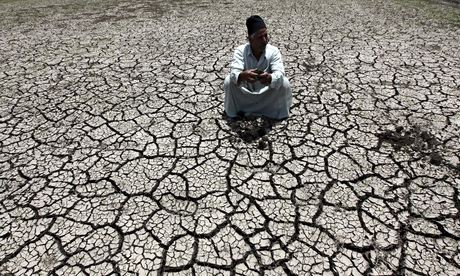 |
An Egyptian farmer sitting on cracked soil to show the dryness of the land due to drought in a farm formerly irrigated by the River Nile. Photograph: Mohamed Abd El Ghany/Corbis |
Snapshots From A Fast-Moving Train
12 Provinces Suffer from Severe Drought
New Tang Dynasty Television
While the south is experiencing severe floods, severest drought in decades is hitting 12 provinces in China such as Henan, Hebei and others.
Drought threatens vast swath of China with shortages, crop failure WantChinaTimes
Henan province faces worst drought in 63 years China Economic Net
Henan Suffers From Its Most Severe Drought In 63 Years Getty
The above is from yesterday. Last week I took five minutes to grab headlines from Google on drought. If I'd taken 15 minutes I could have found many other countries experiencing drought or that were severely water-stressed in key regions; here are the headlines:
Brazil prosecutors want water rationing plan
Yahoo News
40,000 Families affected by drought in Guatemala
Fox News Latino
Some 40,000 families have been affected by the drought caused by the El Niño weather phenomenon in Guatemala ...
Continued lack of rainfall extends drought in Puerto Rico
Fox News Latino
Drought conditions continue worse than usual in Puerto Rico due to the drastic lack of rainfall over most of the island, except for the eastern and ...
Serious drought hits Inner Mongolia and Henan
WantChinaTimes
Lingering drought in northern China's Inner Mongolia autonomous region and central China's Henan province has dried up rivers and ...
Henan ramps up emergency measures for worst drought in 63 years
Drought hits China food production - Xinhua
Thomson Reuters Foundation
Jamaica drought leads to $8 million in crop losses
Yahoo News
KINGSTON, Jamaica (AP) — A Jamaican official said Tuesday that a severe drought and brush fires on the Caribbean island have led to ...
Drought and misuse behind Lebanon's water scarcity
Middle East Eye
Over the years, drought or seasons of scarcity have become more frequent”. In his opinion, the current drought must be taken as a warning ...
Iran's water crisis the product of decades of bad planning ...
The Washington Post
Jul 2, 2014 ... TEHRAN — Iran is headed for a water shortage of epic proportions .
Drought in northern Kenya ...
The Guardian
Aside from drought, numerous factors are affecting access to food in Kenya's arid north, where the majority of people are pastoralists. Rapidly ...
Where Is Water For Sacramento County Housing Project Coming From?
CBS Local
SACRAMENTO COUNTY (CSB13) — Why are new homes going up during a drought? Tony Lopez is getting answers.
Major California reservoirs below 50% capacity as drought wears on
Los Angeles Times
Dusk falls as a lone boater heads out on Lake Shasta, near the Lake Shasta Dam amid serious drought conditions. ...
Unprecedented California Drought Restrictions Go Into Effect
TIME
California implemented emergency water-conservation measures today as it struggles to cope with an ongoing drought ...
California curbs injection of toxic fracking waste into aquifers ...
RT - Jul 22, 2014
California is shutting down 11 oil and gas wastewater injection sites and reviewing over 100 others in the state's drought-ravaged Central Valley.
13 Oregon Counties, One Third Of Nation Experiencing Notable Drought
OPB News (blog)
Thirteen of Oregon's 36 counties are feeling the effects of extreme to severe drought as we enter August, arguably the hottest month of the year.
Don't Bank on Groundwater to Fight Off Western [U.S.] Drought—It's Drying Up
Smithsonian
A growing reliance on irrigation, a growing population and the ongoing drought have led to an overreliance on groundwater supplies ...
Drought Hastens Groundwater Depletion in the Texas Panhandle
National Geographic - 5 days ago
Persistent drought in northwest Texas is leading farmers to pump more water from the Ogallala Aquifer, hastening the depletion of this crucial ...
The Drought
Santa Fe Reporter
There is a drought in Santa Fe. It is real and it is serious. It is so bad that city residents and businesses could face mandatory water rationing as ...
Klamath Basin cattle industry hit by drought
KOBI-TV NBC 5 / KOTI-TV NBC 2 - 12 hours ago
Beatty, Ore. - The Klamath Basin's cattle industry is drying up as the result of continued drought conditions.
How Long Have We Got?
Developing world fast running out of water
(Asia Times)
LONDON - The developing world is running out of water at an alarming rate, a new study ["Running on Empty"] by the London-based agency Tearfund" shows.
Two out of three people around the world will live with a drinking water shortage by the year 2025 unless drastic changes are made quickly, the report says. And these two in three will be living in developing countries.
[...]
The crisis is upon us right now, the report says. Two thirds of China's cities are facing severe water shortages. In India, the capital New Delhi will run out of ground water by 2015 at present rates of loss.
Lake Chad in Africa has shrunk from 6,900 square miles to 1,500 square miles in the last 20 years. The number of people facing serious food shortages in eastern Africa has risen to nearly 20 million because of widespread drought.
[...]
By 2025, 25 countries in Africa will be subject to water stress measured at an availability of 1,700 cubic meters per person per year. Kenya, Morocco, South Africa, India and Pakistan will have levels well below 1,000 cubic meters per person per year. These levels have been described by the United Nations as "catastrophic", the report points out.
[...]
China is facing "devastating water shortages which can no longer be blamed on unusual weather patterns". The Yellow River, one of the biggest northern rivers, now regularly runs dry; in 1997 it ran dry for 226 days of the year. "This is the result of the large number of unmanaged demands made on it by households, industry and agriculture," the report says.
(Asia Times)
By Samanta Sen
LONDON - The developing world is running out of water at an alarming rate, a new study ["Running on Empty"] by the London-based agency Tearfund" shows.
Two out of three people around the world will live with a drinking water shortage by the year 2025 unless drastic changes are made quickly, the report says. And these two in three will be living in developing countries.
[...]
The crisis is upon us right now, the report says. Two thirds of China's cities are facing severe water shortages. In India, the capital New Delhi will run out of ground water by 2015 at present rates of loss.
Lake Chad in Africa has shrunk from 6,900 square miles to 1,500 square miles in the last 20 years. The number of people facing serious food shortages in eastern Africa has risen to nearly 20 million because of widespread drought.
[...]
By 2025, 25 countries in Africa will be subject to water stress measured at an availability of 1,700 cubic meters per person per year. Kenya, Morocco, South Africa, India and Pakistan will have levels well below 1,000 cubic meters per person per year. These levels have been described by the United Nations as "catastrophic", the report points out.
[...]
China is facing "devastating water shortages which can no longer be blamed on unusual weather patterns". The Yellow River, one of the biggest northern rivers, now regularly runs dry; in 1997 it ran dry for 226 days of the year. "This is the result of the large number of unmanaged demands made on it by households, industry and agriculture," the report says.
"The drought in the North has forced the government to take drastic action by diverting the Yangtze from the South, but this action could cause the river to run dry by 2020."
The crisis is hitting Chinese cities in unexpected ways. "Shanghai is sinking because of the amount of ground water being extracted from beneath it," the report says.[emphasis mine]
The crisis is hitting Chinese cities in unexpected ways. "Shanghai is sinking because of the amount of ground water being extracted from beneath it," the report says.[emphasis mine]
"Altogether, two thirds of China's cities are facing severe water shortages."
[...]
Water tables are falling by as much as a meter a year in parts of Mexico, India, Yemen and China.
The heaviest human claim on water is agriculture. It uses 70 percent of fresh water across the world. In Asia and Africa the proportion rises to 90 percent, the report says. This raises difficult questions about the distribution of water.
[...]
Water tables are falling by as much as a meter a year in parts of Mexico, India, Yemen and China.
The heaviest human claim on water is agriculture. It uses 70 percent of fresh water across the world. In Asia and Africa the proportion rises to 90 percent, the report says. This raises difficult questions about the distribution of water.
[...]
[END REPORT]
If you don't recall seeing Sen's report at AToL -- it, and the Tearfund study, were published in March 2001. A few months later worries about global drought were relegated to the world's back burner -- except, of course, in regions that were experiencing severe drought. Then, just as the furor from the war on terrorism was cooling down, the 2008 financial crash happened. Once again the issue of global drought got lost in shuffle.
Fast forward to 2014.
Now The U.S. Military Really Has Something To Worry About
Why global water shortages pose threat of terror and war
By Suzanne Goldenberg
February 8, 2014
The Guardian Observer
From California to the Middle East, huge areas of the world are drying up and a billion people have no access to safe drinking water. US intelligence is warning of the dangers of shrinking resources and experts say the world is 'standing on a precipice'
On 17 January, scientists downloaded fresh data from a pair of Nasa satellites and distributed the findings among the small group of researchers who track the world's water reserves. At the University of California, Irvine, hydrologist James Famiglietti looked over the data from the gravity-sensing Grace satellites with a rising sense of dread.
The data, released last week, showed California on the verge of an epic drought, with its backup systems of groundwater reserves so run down that the losses could be picked up by satellites orbiting 400km above the Earth's surface.
"It was definitely an 'oh my gosh moment'," Famiglietti said. "The groundwater is our strategic reserve. It's our backup, and so where do you go when the backup is gone?"
That same day, the state governor, Jerry Brown, declared a drought emergency and appealed to Californians to cut their water use by 20%. "Every day this drought goes on we are going to have to tighten the screws on what people are doing," he said.
Seventeen rural communities are in danger of running out of water within 60 days and that number is expected to rise, after the main municipal water distribution system announced it did not have enough supplies and would have to turn off the taps to local agencies.
There are other shock moments ahead – and not just for California – in a world where water is increasingly in short supply because of growing demands from agriculture, an expanding population, energy production and climate change.
Already a billion people, or one in seven people on the planet, lack access to safe drinking water. Britain, of course, is currently at the other extreme. Great swaths of the country are drowning in misery, after a series of Atlantic storms off the south-western coast. But that too is part of the picture that has been coming into sharper focus over 12 years of the Grace satellite record. Countries at northern latitudes and in the tropics are getting wetter. But those countries at mid-latitude are running increasingly low on water.
"What we see is very much a picture of the wet areas of the Earth getting wetter," Famiglietti said. "Those would be the high latitudes like the Arctic and the lower latitudes like the tropics. The middle latitudes in between, those are already the arid and semi-arid parts of the world and they are getting drier."
On the satellite images the biggest losses were denoted by red hotspots, he said. And those red spots largely matched the locations of groundwater reserves.
"Almost all of those red hotspots correspond to major aquifers of the world. What Grace shows us is that groundwater depletion is happening at a very rapid rate in almost all of the major aquifers in the arid and semi-arid parts of the world."
The Middle East, north Africa and south Asia are all projected to experience water shortages over the coming years because of decades of bad management and overuse.
Watering crops, slaking thirst in expanding cities, cooling power plants, fracking oil and gas wells – all take water from the same diminishing supply. Add to that climate change – which is projected to intensify dry spells in the coming years – and the world is going to be forced to think a lot more about water than it ever did before.
The losses of water reserves are staggering. In seven years, beginning in 2003, parts of Turkey, Syria, Iraq and Iran along the Tigris and Euphrates rivers lost 144 cubic kilometres of stored freshwater – or about the same amount of water in the Dead Sea, according to data compiled by the Grace mission and released last year.
A small portion of the water loss was due to soil drying up because of a 2007 drought and to a poor snowpack. Another share was lost to evaporation from lakes and reservoirs. But the majority of thewater lost, 90km3, or about 60%, was due to reductions in groundwater.
Farmers, facing drought, resorted to pumping out groundwater – at times on a massive scale. The Iraqi government drilled about 1,000 wells to weather the 2007 drought, all drawing from the same stressed supply.
In south Asia, the losses of groundwater over the last decade were even higher. About 600 million people live on the 2,000km swath that extends from eastern Pakistan, across the hot dry plains of northern India and into Bangladesh, and the land is the most intensely irrigated in the world. Up to 75% of farmers rely on pumped groundwater to water their crops, and water use is intensifying.
Over the last decade, groundwater was pumped out 70% faster than in the 1990s. Satellite measurements showed a staggering loss of 54km3 of groundwater a year. Indian farmers were pumping their way into a water crisis.
The US security establishment is already warning of potential conflicts – including terror attacks – over water. In a 2012 report, the US director of national intelligence warned that overuse of water – as in India and other countries – was a source of conflict that could potentially compromise US national security.
The report focused on water basins critical to the US security regime – the Nile, Tigris-Euphrates, Mekong, Jordan, Indus, Brahmaputra and Amu Darya. It concluded: "During the next 10 years, many countries important to the United States will experience water problems – shortages, poor water quality, or floods – that will risk instability and state failure, increase regional tensions, and distract them from working with the United States."
Water, on its own, was unlikely to bring down governments. But the report warned that shortages could threaten food production and energy supply and put additional stress on governments struggling with poverty and social tensions.
Some of those tensions are already apparent on the ground. The Pacific Institute, which studies issues of water and global security, found a fourfold increase in violent confrontations over water over the last decade. "I think the risk of conflicts over water is growing – not shrinking – because of increased competition, because of bad management and, ultimately, because of the impacts of climate change," said Peter Gleick, president of the Pacific Institute.
There are dozens of potential flashpoints, spanning the globe. In the Middle East, Iranian officials are making contingency plans for water rationing in the greater Tehran area, home to 22 million people.
Egypt has demanded Ethiopia stop construction of a mega-dam on the Nile, vowing to protect its historical rights to the river at "any cost". The Egyptian authorities have called for a study into whether the project would reduce the river's flow.
Jordan, which has the third lowest reserves in the region, is struggling with an influx of Syrian refugees. The country is undergoing power cuts because of water shortages. Last week, Prince Hassan, the uncle of King Abdullah, warned that a war over water and energy could be even bloodier than the Arab spring.
The United Arab Emirates, faced with a growing population, has invested in desalination projects and is harvesting rainwater. At an international water conference in Abu Dhabi last year, Crown Prince General Sheikh Mohammed bin Zayed al-Nahyan said: "For us, water is [now] more important than oil."
The chances of countries going to war over water were slim – at least over the next decade, the national intelligence report said. But it warned ominously: "As water shortages become more acute beyond the next 10 years, water in shared basins will increasingly be used as leverage; the use of water as a weapon or to further terrorist objectives will become more likely beyond 10 years."
Gleick predicted such conflicts would take other trajectories. He expected water tensions would erupt on a more local scale.
"I think the biggest worry today is sub-national conflicts – conflicts between farmers and cities, between ethnic groups, between pastoralists and farmers in Africa, between upstream users and downstream users on the same river," said Gleick.
"We have more tools at the international level to resolve disputes between nations. We have diplomats. We have treaties. We have international organisations that reduce the risk that India and Pakistan will go to war over water but we have far fewer tools at the sub-national level."
And new fault lines are emerging with energy production. America's oil and gas rush is putting growing demands on a water supply already under pressure from drought and growing populations.
More than half the nearly 40,000 wells drilled since 2011 were in drought-stricken areas, a report from the Ceres green investment network found last week. About 36% of those wells were in areas already experiencing groundwater depletion.
How governments manage those water problems – and protect their groundwater reserves – will be critical. When California emerged from its last prolonged dry spell, in 2010, the Sacramento and San Joaquin river basins were badly depleted. The two river basins lost 10km3 of freshwater each year in 2012 and 2013, dropping the total volume of snow, surface water, soil moisture and groundwater to the lowest levels in nearly a decade.
Without rain, those reservoirs are projected to drop even further during this drought. State officials are already preparing to drill additional wells to draw on groundwater. Famiglietti said that would be a mistake.
"We are standing on a cliff looking over the edge and we have to decide what we are going to do," he said.
"Are we just going to plunge into this next epic drought and tremendous, never-before-seen rates of groundwater depletion, or are we going to buckle down and start thinking of managing critical reserve for the long term? We are standing on a precipice here."
REGIONS AT RISK
1 CALIFORNIA
The state's water resources are at critically low levels and a drought emergency has been declared. The health department says 17 rural areas are dangerously parched.
2 BRAZIL
São Paulo, the country's largest city, is on the verge of water rationing because of a severe drought and shortages are possible when the country hosts the football World Cup in the summer. January was the hottest month on record in the city and water in its main reservoir has fallen to 20.9% of its capacity, the lowest level in a decade.
3 MIDDLE EAST
Tehran, the capital of Iran, is facing a shortage so serious that officials are making contingency plans for rationing in an area where 22 million live as well as in other big cities. President Hassan Rouhani has identified water as a national security issue. Shortages are so severe in the United Arab Emirates that the country is using non-conventional resources, including desalination, treated wastewater, rainwater harvesting and cloud seeding. At a a water conference,Crown Prince General Sheikh Mohammed bin Zayed al-Nahyan said: "For us, water is [now] more important than oil." With the third lowest water reserves in the region, Jordan is struggling to cope with an influx of Syrian refugees. The country is undergoing power cuts because of water shortages. Prince Hassan, uncle of King Abdullah, warned last week that a war over water and energy could be bloodier than the Arab spring.
4 NORTH AFRICA
Egypt has demanded that Ethiopia stop construction of a mega-dam on the Nile, vowing to protect its historical rights to the river at "any cost". The Egyptian authorities have called for a study into whether the project would reduce the river's flow.
5 SOUTH ASIA
By Suzanne Goldenberg
February 8, 2014
The Guardian Observer
From California to the Middle East, huge areas of the world are drying up and a billion people have no access to safe drinking water. US intelligence is warning of the dangers of shrinking resources and experts say the world is 'standing on a precipice'
On 17 January, scientists downloaded fresh data from a pair of Nasa satellites and distributed the findings among the small group of researchers who track the world's water reserves. At the University of California, Irvine, hydrologist James Famiglietti looked over the data from the gravity-sensing Grace satellites with a rising sense of dread.
The data, released last week, showed California on the verge of an epic drought, with its backup systems of groundwater reserves so run down that the losses could be picked up by satellites orbiting 400km above the Earth's surface.
"It was definitely an 'oh my gosh moment'," Famiglietti said. "The groundwater is our strategic reserve. It's our backup, and so where do you go when the backup is gone?"
That same day, the state governor, Jerry Brown, declared a drought emergency and appealed to Californians to cut their water use by 20%. "Every day this drought goes on we are going to have to tighten the screws on what people are doing," he said.
Seventeen rural communities are in danger of running out of water within 60 days and that number is expected to rise, after the main municipal water distribution system announced it did not have enough supplies and would have to turn off the taps to local agencies.
There are other shock moments ahead – and not just for California – in a world where water is increasingly in short supply because of growing demands from agriculture, an expanding population, energy production and climate change.
Already a billion people, or one in seven people on the planet, lack access to safe drinking water. Britain, of course, is currently at the other extreme. Great swaths of the country are drowning in misery, after a series of Atlantic storms off the south-western coast. But that too is part of the picture that has been coming into sharper focus over 12 years of the Grace satellite record. Countries at northern latitudes and in the tropics are getting wetter. But those countries at mid-latitude are running increasingly low on water.
"What we see is very much a picture of the wet areas of the Earth getting wetter," Famiglietti said. "Those would be the high latitudes like the Arctic and the lower latitudes like the tropics. The middle latitudes in between, those are already the arid and semi-arid parts of the world and they are getting drier."
On the satellite images the biggest losses were denoted by red hotspots, he said. And those red spots largely matched the locations of groundwater reserves.
"Almost all of those red hotspots correspond to major aquifers of the world. What Grace shows us is that groundwater depletion is happening at a very rapid rate in almost all of the major aquifers in the arid and semi-arid parts of the world."
The Middle East, north Africa and south Asia are all projected to experience water shortages over the coming years because of decades of bad management and overuse.
Watering crops, slaking thirst in expanding cities, cooling power plants, fracking oil and gas wells – all take water from the same diminishing supply. Add to that climate change – which is projected to intensify dry spells in the coming years – and the world is going to be forced to think a lot more about water than it ever did before.
The losses of water reserves are staggering. In seven years, beginning in 2003, parts of Turkey, Syria, Iraq and Iran along the Tigris and Euphrates rivers lost 144 cubic kilometres of stored freshwater – or about the same amount of water in the Dead Sea, according to data compiled by the Grace mission and released last year.
A small portion of the water loss was due to soil drying up because of a 2007 drought and to a poor snowpack. Another share was lost to evaporation from lakes and reservoirs. But the majority of thewater lost, 90km3, or about 60%, was due to reductions in groundwater.
Farmers, facing drought, resorted to pumping out groundwater – at times on a massive scale. The Iraqi government drilled about 1,000 wells to weather the 2007 drought, all drawing from the same stressed supply.
In south Asia, the losses of groundwater over the last decade were even higher. About 600 million people live on the 2,000km swath that extends from eastern Pakistan, across the hot dry plains of northern India and into Bangladesh, and the land is the most intensely irrigated in the world. Up to 75% of farmers rely on pumped groundwater to water their crops, and water use is intensifying.
Over the last decade, groundwater was pumped out 70% faster than in the 1990s. Satellite measurements showed a staggering loss of 54km3 of groundwater a year. Indian farmers were pumping their way into a water crisis.
The US security establishment is already warning of potential conflicts – including terror attacks – over water. In a 2012 report, the US director of national intelligence warned that overuse of water – as in India and other countries – was a source of conflict that could potentially compromise US national security.
The report focused on water basins critical to the US security regime – the Nile, Tigris-Euphrates, Mekong, Jordan, Indus, Brahmaputra and Amu Darya. It concluded: "During the next 10 years, many countries important to the United States will experience water problems – shortages, poor water quality, or floods – that will risk instability and state failure, increase regional tensions, and distract them from working with the United States."
Water, on its own, was unlikely to bring down governments. But the report warned that shortages could threaten food production and energy supply and put additional stress on governments struggling with poverty and social tensions.
Some of those tensions are already apparent on the ground. The Pacific Institute, which studies issues of water and global security, found a fourfold increase in violent confrontations over water over the last decade. "I think the risk of conflicts over water is growing – not shrinking – because of increased competition, because of bad management and, ultimately, because of the impacts of climate change," said Peter Gleick, president of the Pacific Institute.
There are dozens of potential flashpoints, spanning the globe. In the Middle East, Iranian officials are making contingency plans for water rationing in the greater Tehran area, home to 22 million people.
Egypt has demanded Ethiopia stop construction of a mega-dam on the Nile, vowing to protect its historical rights to the river at "any cost". The Egyptian authorities have called for a study into whether the project would reduce the river's flow.
Jordan, which has the third lowest reserves in the region, is struggling with an influx of Syrian refugees. The country is undergoing power cuts because of water shortages. Last week, Prince Hassan, the uncle of King Abdullah, warned that a war over water and energy could be even bloodier than the Arab spring.
The United Arab Emirates, faced with a growing population, has invested in desalination projects and is harvesting rainwater. At an international water conference in Abu Dhabi last year, Crown Prince General Sheikh Mohammed bin Zayed al-Nahyan said: "For us, water is [now] more important than oil."
The chances of countries going to war over water were slim – at least over the next decade, the national intelligence report said. But it warned ominously: "As water shortages become more acute beyond the next 10 years, water in shared basins will increasingly be used as leverage; the use of water as a weapon or to further terrorist objectives will become more likely beyond 10 years."
Gleick predicted such conflicts would take other trajectories. He expected water tensions would erupt on a more local scale.
"I think the biggest worry today is sub-national conflicts – conflicts between farmers and cities, between ethnic groups, between pastoralists and farmers in Africa, between upstream users and downstream users on the same river," said Gleick.
"We have more tools at the international level to resolve disputes between nations. We have diplomats. We have treaties. We have international organisations that reduce the risk that India and Pakistan will go to war over water but we have far fewer tools at the sub-national level."
And new fault lines are emerging with energy production. America's oil and gas rush is putting growing demands on a water supply already under pressure from drought and growing populations.
More than half the nearly 40,000 wells drilled since 2011 were in drought-stricken areas, a report from the Ceres green investment network found last week. About 36% of those wells were in areas already experiencing groundwater depletion.
How governments manage those water problems – and protect their groundwater reserves – will be critical. When California emerged from its last prolonged dry spell, in 2010, the Sacramento and San Joaquin river basins were badly depleted. The two river basins lost 10km3 of freshwater each year in 2012 and 2013, dropping the total volume of snow, surface water, soil moisture and groundwater to the lowest levels in nearly a decade.
Without rain, those reservoirs are projected to drop even further during this drought. State officials are already preparing to drill additional wells to draw on groundwater. Famiglietti said that would be a mistake.
"We are standing on a cliff looking over the edge and we have to decide what we are going to do," he said.
"Are we just going to plunge into this next epic drought and tremendous, never-before-seen rates of groundwater depletion, or are we going to buckle down and start thinking of managing critical reserve for the long term? We are standing on a precipice here."
REGIONS AT RISK
1 CALIFORNIA
The state's water resources are at critically low levels and a drought emergency has been declared. The health department says 17 rural areas are dangerously parched.
2 BRAZIL
São Paulo, the country's largest city, is on the verge of water rationing because of a severe drought and shortages are possible when the country hosts the football World Cup in the summer. January was the hottest month on record in the city and water in its main reservoir has fallen to 20.9% of its capacity, the lowest level in a decade.
3 MIDDLE EAST
Tehran, the capital of Iran, is facing a shortage so serious that officials are making contingency plans for rationing in an area where 22 million live as well as in other big cities. President Hassan Rouhani has identified water as a national security issue. Shortages are so severe in the United Arab Emirates that the country is using non-conventional resources, including desalination, treated wastewater, rainwater harvesting and cloud seeding. At a a water conference,Crown Prince General Sheikh Mohammed bin Zayed al-Nahyan said: "For us, water is [now] more important than oil." With the third lowest water reserves in the region, Jordan is struggling to cope with an influx of Syrian refugees. The country is undergoing power cuts because of water shortages. Prince Hassan, uncle of King Abdullah, warned last week that a war over water and energy could be bloodier than the Arab spring.
4 NORTH AFRICA
Egypt has demanded that Ethiopia stop construction of a mega-dam on the Nile, vowing to protect its historical rights to the river at "any cost". The Egyptian authorities have called for a study into whether the project would reduce the river's flow.
5 SOUTH ASIA
About 600 million people live on the 2,000km swath that extends from eastern Pakistan, across the hot dry plains of northern India and into Bangladesh and the land is the world's most intensely irrigated. Up to 75% of farmers rely on pumped groundwater.
6 CHINA
There is increasing competition for water. More than half the proposed coal-fired power stations are expected to be built in areas of high water stress, thus threatening water insecurity for farms, other industry and the public.
6 CHINA
There is increasing competition for water. More than half the proposed coal-fired power stations are expected to be built in areas of high water stress, thus threatening water insecurity for farms, other industry and the public.
[END REPORT]
********
********
Shoot Yourself in the Foot model of globalized manufacturing and agribusiness: Water Crisis Gordian Knot, Part 14
Looking back I suppose we should have asked, "Are economists farmers? Are they water engineers? Can they read a map?" But there's nothing like hindsight. Anyhow the idea was to offshore manufacturing to the less advantaged countries, like China, so they could pull themselves up by the bootstraps of factory production.
It was supposed to be a win-win situation. The advantaged countries would save on labor and factory costs and the disadvantaged would bring in high-value foreign currency from charging the advantaged countries to manufacture in their countries.
The idea took off like a rocket; soon everybody involved in making things for sale wanted his own factory operation in China. But by the time American companies that sold very incidental stuff like baseball caps were getting into offshoring, China had also set up many factories for exporting its own manufactured products.
Then one day somebody in China's government or maybe at the World Bank got out a pad and #2 pencil and a map of China and began doing arithmetic.
By the time the totting was done it was evident that at the current rate of factory expansion soon there would be no arable land left in China. This because the land was being covered up by factories and the exponential growth of cities to house factory workers. There wouldn't be any water left, either.
That Ain't Just Hay, That's Also Water
Then some genius said, "No worries. What China is losing in food and forage can be simply imported from the United States."
Which is how tons of alfalfa for China's cows started getting shipped from California to Beijing. It was actually cheaper for alfalfa farmers in California's Imperial Valley to ship the hay to China than across a couple counties in California. This on account of container ships docking at California are laden with stuff made in China but because of the huge trade imbalance go home almost empty, meaning hay farmers could ship their produce to China for a song.
This new business model didn't make California's cattle ranchers and dairy farmers happy because they now had to stand in line behind foreigners to buy alfalfa. But raising hay for Chinese cows was so much more profitable than raising it for American ones.
There was a catch, however.
The water being used to grow the alfalfa for shipping to China didn't actually belong to California's Imperial Valley. It belonged to the Colorado River; the valley farmers only had rights to use a certain amount of the water.
Trouble is, agricorporations in six other U.S. states also had rights to the same river water, not to mention entire cities in those states -- cities like Phoenix and Los Angeles.
In fact, so much Colorado River water had been going to vitally important things like keeping umpteen Phoenix golf courses green and Los Angeles swimming pools filled that one day while rafting on the Colorado somebody said, "Is it my imagination, or is my canoe paddle scraping sand?"
So then everybody got out the maps and pads and #2 pencils and tried to figure how long before the Colorado, which is called America's Nile, would turn into a wading pond.
The irony is that alfalfa is a drought resistant plant. It can go months without being watered. How many months? I can't recall whether the National Geographic article I learned about all this stuff from (Exporting the Colorado River to Asia, Through Hay; January 23, 2014) mentioned how many. But the point is that treaties for the Colorado's water use were written many decades ago, and the way they're worded means farmers can lose their rights to the water if they don't use it.
This has meant that Imperial Valley alfalfa grown for shipment to China and other countries in China's predicament got watered, whether it needed it or not.
This wasted zillions of "acre-feet" of Colorado River water, which is how water engineers measure water. Frankly the river can't support that much waste anymore, not when golf courses, swimming pools, drinking water, waste treatment facilities, etc., for large cities in desert climes are piled on top of agriculture's huge drain on the river.
In fact, a big push was launched last week to save what's left of the Colorado and it involves spending $11 million dollars -- although if the states that joined the U.S. Bureau of Reclamation in throwing money into the pot don't resolve the water treaties issue, good intentions and millions of dollars could amount to nothing
more than cosmetic fixes.
Agra-Foolishness
Now we arrive at the pièce de résistance. At least the Chinese weren't so foolish as to attempt to copy the American model of globalized agricultural exports. Nations like Mexico and Pakistan were. This, despite the fact that those nations started out water stressed, then pile on outdated water infrastructures.
For Pakistan, this means endless squabbles with India and Afghanistan about water rights and also pumping the nation's farmbelt wells like crazy. That last means killer floods during heavy rains because the farmland has sunk so much due to the pumping, and because the efficient flood management system the British Raj set in place were allowed to fall into disrepair. It also means the flood waters carry off huge amounts of topsoil.
In Mexico, it means pumping aquifers so low to export agricultural produce to the USA under NAFTA that a "historic" drought in 2012 wiped out thousands of small farms and cattle and dairy ranches. And drove into the stratosphere the cost of drilling wells because all the easy water was drilled and used up; now the drilling has to be done deep.
Mexico and Pakistan are just two examples but I think those are enough to convey the looniest aspect of the Shoot Yourself in the Foot ("SYF") model.
As to why the USA, an agricultural exporting giant, would need to import produce, there are probably several reasons but here are three:
(1) poor water management in U.S. agricultural states such as Arizona and California;
(2) high consumer demand for out of season produce and "exotic" produce like mangos; and
(3) the fact that people in Washington's foreign policy establishment aren't farmers, either, and neither are they water engineers.
With regard to (3), the practice of the U.S. importing produce it doesn't actually need from countries that can ill afford to play the mega agri-export game often works out to a Washington tactic to keep completely insane government administrations in other countries happy. (Okay, you buy weapons from us, we'll buy your mangos and avocados.)
Flinging Around Virtual Water and Yet More on Alfalfa
The SYF model also includes the practice of throwing away imported water, or what the water scientists call "virtual water" -- products and produce in which water has been used in the manufacturing and growing processes. As to how this happens, because produce sold in grocery stores in the USA (and other Western countries) that's past its "fresh" date, or even looks wilted to the consumer, gets fed to garbage trucks and garbage dumps. Where it rots.
The only living creatures that benefit from eating the tossed produce are rodents, birds, and the occasional gourmand bear. (Dear, see if you can find some arugula in the dumpster.)
This doesn't include the acre-feet that water stressed countries use up in washing produce meant for export and otherwise processing it. And don't forget that all the crates made to pack the produce for export also represent virtual water.
Nor does it include the methods by which the less advantaged countries irrigate crops they export (and use for their own consumption). I think it's the National Geographic article on saving the Colorado River that mentions Egypt's farmers are experimenting with drip tape and burying irrigation pipes in the ground. This to prevent Nile River water used for irrigation from evaporating in the desert sun. Glad they're finally getting around to conserving Nile water in ways they should have adopted decades ago.
Now if only more California farmers would also use drip tape. Guy T. Saperstein, a past president of the Sierra Club, who from a diatribe he penned in May clearly hates Chinese cows, American cows, California Democrats, alfalfa, meat eaters, and milk drinkers in that order, fumed that California's farmers snub drip tape.
As to what he has against the Democrats:
Also, according to a June 8 Los Angeles Times report on the alfalfa issue (U.S. farmers making hay with alfalfa exports to China), Japan is a big buyer of California's alfalfa and obviously has been for a long time. That would make sense, given the country never had much arable land to begin with and that much of it went to building factories for the Japanese Manufacturing Miracle in the last century.
And I'm sure Saperstein would have been interested to learn from the LA Times report that alfalfa production has actually declined in California:
Now to put it all together. As it applies to the USA, SYF globalized manufacturing and agribusiness has two interlocked parts:
One part is that the U.S. exports huge amounts of its water in the form of agricultural produce from water-stressed U.S. states to less advantaged foreign countries. In return, the USA gets cheaply manufactured products.
The other part is a reverse of the above process. All those cheaply manufactured products equate to water shipped to the USA (in virtual form) from less advantaged countries, most of them water-stressed, in return for American dollars.
Nature's Logic
That's how the model works. However, neither the developing countries nor the U.S. agricultural states that export large amounts of produce to Asia can afford to export that much virtual water in the present era, which in great measure manifests the 4-Ds:
Drought
Desiccation
Deforestation
Desertification
These are compounded by Nature having hissy fits in drier regions; e.g., massive attacks from bark beetles that desiccate trees and massive attacks from toxic fungi that decimate certain food crops.
So there is a compounding effect with the 4Ds: the more drought, the more beetles attack trees, leading to more desiccation, leading to more deforestation, leading to more desertification, repeat the cycle, which leads to the cycle accelerating.
Then there are the 5-Ws:
Water misuse in huge amounts
Water waste in huge amounts
Water evaporation in huge amounts
(from aboveground irrigation systems and man-made reservoirs)
Water having to serve megapopulations
(human and livestock and pets)
Water turned brackish
(when marshlands guarding estuaries against the salty seas are decimated)
This era is also meeting with steadily rising global temperatures that work out to increasingly sparse rainfall in the drier regions and increasingly heavy rains in the wetter ones. The latter leads to increasingly big floods that wipe out crops and wash away huge amounts of topsoil.
Add to that the galloping expansion of cities, which sucks up huge amounts of water just in waste-processing facilities alone. According to a recent report from the United Nations, since 2010 more than half of humanity now lives in cities, with the number growing by almost 60 million every year. The expansion of cities from the human influx means a lot of paved-over arable land. And many of the cities house manufacturing hubs that follow the SYF model of globalized manufacturing and agriculture trade.
Add to that decades of dam-building, which helped prop up the SYF model and its agriculture-exporting variation in water-stressed countries.
None of the above touches on what's called the carbon footprint, which many climate scientists believe is playing a part in rising global temperatures. Greenhouse gasses and all that. But a large carbon footprint, which is made by huge amounts of electricity and diesel fuel/ gasoline use, intersects with large-scale water usage in mega- manufacturing and agricultural operations. As with dam-building, electricity and cheap carbon-based fuel help players in the SYF game fling around their water resources more than common sense would dictate.
Now it's time to get out the #2 pencil and maps and do some figuring:
Megapopulations+SYF model+4Ds+5Ws = waterwise we're screwed.
Nature's Bottom Line v. Global Business Bottom Line
The SYF business model has always been unsustainable in water-stressed regions both in the USA and other
countries. So while manufacturing outsourcing helped lift many millions of people in 'developing' countries out of abject poverty and greatly reduced the cost of manufacturing in the wealthier countries, it also opened a Pandora's Box.
However, the model didn't cause the water crisis; it just accelerated it and exacerbated its secondary effects. Without or without globalized manufacturing processes and mega-sized agricultural trade, the converging of megapopulations on limited water resources is the driver of water's bottom line.
The bottom line also limits how much recycling and conserving of water can be done in this era to offset the impact of megapopulations on water resources.
So while some urbanized populations can, through inspired water management policies and draconian enforcement, save themselves from dying of hunger and thirst, the big picture is grim. How grim, at present? I'll take up the question in the next post.
Note: I am grateful to National Geographic's illuminating reports on saving the Colorado River and the alfalfa issue. With regard to the latter, I couldn't have seen the SYF model without Ben Jervey's report, Exporting the Colorado River to Asia, Through Hay. While it doesn't make the ramifications of the model explicit, it revealed to my eyes what was hidden in plain sight about the mutual self-destructiveness of manufacturing outsourcing on an unrestrained scale.
********
It was supposed to be a win-win situation. The advantaged countries would save on labor and factory costs and the disadvantaged would bring in high-value foreign currency from charging the advantaged countries to manufacture in their countries.
The idea took off like a rocket; soon everybody involved in making things for sale wanted his own factory operation in China. But by the time American companies that sold very incidental stuff like baseball caps were getting into offshoring, China had also set up many factories for exporting its own manufactured products.
Then one day somebody in China's government or maybe at the World Bank got out a pad and #2 pencil and a map of China and began doing arithmetic.
By the time the totting was done it was evident that at the current rate of factory expansion soon there would be no arable land left in China. This because the land was being covered up by factories and the exponential growth of cities to house factory workers. There wouldn't be any water left, either.
That Ain't Just Hay, That's Also Water
Then some genius said, "No worries. What China is losing in food and forage can be simply imported from the United States."
Which is how tons of alfalfa for China's cows started getting shipped from California to Beijing. It was actually cheaper for alfalfa farmers in California's Imperial Valley to ship the hay to China than across a couple counties in California. This on account of container ships docking at California are laden with stuff made in China but because of the huge trade imbalance go home almost empty, meaning hay farmers could ship their produce to China for a song.
This new business model didn't make California's cattle ranchers and dairy farmers happy because they now had to stand in line behind foreigners to buy alfalfa. But raising hay for Chinese cows was so much more profitable than raising it for American ones.
There was a catch, however.
The water being used to grow the alfalfa for shipping to China didn't actually belong to California's Imperial Valley. It belonged to the Colorado River; the valley farmers only had rights to use a certain amount of the water.
Trouble is, agricorporations in six other U.S. states also had rights to the same river water, not to mention entire cities in those states -- cities like Phoenix and Los Angeles.
In fact, so much Colorado River water had been going to vitally important things like keeping umpteen Phoenix golf courses green and Los Angeles swimming pools filled that one day while rafting on the Colorado somebody said, "Is it my imagination, or is my canoe paddle scraping sand?"
So then everybody got out the maps and pads and #2 pencils and tried to figure how long before the Colorado, which is called America's Nile, would turn into a wading pond.
The irony is that alfalfa is a drought resistant plant. It can go months without being watered. How many months? I can't recall whether the National Geographic article I learned about all this stuff from (Exporting the Colorado River to Asia, Through Hay; January 23, 2014) mentioned how many. But the point is that treaties for the Colorado's water use were written many decades ago, and the way they're worded means farmers can lose their rights to the water if they don't use it.
This has meant that Imperial Valley alfalfa grown for shipment to China and other countries in China's predicament got watered, whether it needed it or not.
This wasted zillions of "acre-feet" of Colorado River water, which is how water engineers measure water. Frankly the river can't support that much waste anymore, not when golf courses, swimming pools, drinking water, waste treatment facilities, etc., for large cities in desert climes are piled on top of agriculture's huge drain on the river.
In fact, a big push was launched last week to save what's left of the Colorado and it involves spending $11 million dollars -- although if the states that joined the U.S. Bureau of Reclamation in throwing money into the pot don't resolve the water treaties issue, good intentions and millions of dollars could amount to nothing
more than cosmetic fixes.
Agra-Foolishness
Now we arrive at the pièce de résistance. At least the Chinese weren't so foolish as to attempt to copy the American model of globalized agricultural exports. Nations like Mexico and Pakistan were. This, despite the fact that those nations started out water stressed, then pile on outdated water infrastructures.
For Pakistan, this means endless squabbles with India and Afghanistan about water rights and also pumping the nation's farmbelt wells like crazy. That last means killer floods during heavy rains because the farmland has sunk so much due to the pumping, and because the efficient flood management system the British Raj set in place were allowed to fall into disrepair. It also means the flood waters carry off huge amounts of topsoil.
In Mexico, it means pumping aquifers so low to export agricultural produce to the USA under NAFTA that a "historic" drought in 2012 wiped out thousands of small farms and cattle and dairy ranches. And drove into the stratosphere the cost of drilling wells because all the easy water was drilled and used up; now the drilling has to be done deep.
Mexico and Pakistan are just two examples but I think those are enough to convey the looniest aspect of the Shoot Yourself in the Foot ("SYF") model.
As to why the USA, an agricultural exporting giant, would need to import produce, there are probably several reasons but here are three:
(1) poor water management in U.S. agricultural states such as Arizona and California;
(2) high consumer demand for out of season produce and "exotic" produce like mangos; and
(3) the fact that people in Washington's foreign policy establishment aren't farmers, either, and neither are they water engineers.
With regard to (3), the practice of the U.S. importing produce it doesn't actually need from countries that can ill afford to play the mega agri-export game often works out to a Washington tactic to keep completely insane government administrations in other countries happy. (Okay, you buy weapons from us, we'll buy your mangos and avocados.)
Flinging Around Virtual Water and Yet More on Alfalfa
The SYF model also includes the practice of throwing away imported water, or what the water scientists call "virtual water" -- products and produce in which water has been used in the manufacturing and growing processes. As to how this happens, because produce sold in grocery stores in the USA (and other Western countries) that's past its "fresh" date, or even looks wilted to the consumer, gets fed to garbage trucks and garbage dumps. Where it rots.
The only living creatures that benefit from eating the tossed produce are rodents, birds, and the occasional gourmand bear. (Dear, see if you can find some arugula in the dumpster.)
This doesn't include the acre-feet that water stressed countries use up in washing produce meant for export and otherwise processing it. And don't forget that all the crates made to pack the produce for export also represent virtual water.
Nor does it include the methods by which the less advantaged countries irrigate crops they export (and use for their own consumption). I think it's the National Geographic article on saving the Colorado River that mentions Egypt's farmers are experimenting with drip tape and burying irrigation pipes in the ground. This to prevent Nile River water used for irrigation from evaporating in the desert sun. Glad they're finally getting around to conserving Nile water in ways they should have adopted decades ago.
Now if only more California farmers would also use drip tape. Guy T. Saperstein, a past president of the Sierra Club, who from a diatribe he penned in May clearly hates Chinese cows, American cows, California Democrats, alfalfa, meat eaters, and milk drinkers in that order, fumed that California's farmers snub drip tape.
As to what he has against the Democrats:
Agriculture uses 93% of California's water and almost half of that is devoted to growing alfalfa for shipment to the Far East, mainly China, to feed their cows. California is, in effect, shipping almost half its precious water to China.I think Saperstein might get an argument on the 93 percent statistic he quotes although this doesn't necessarily mean he's wrong, and in any case most of the water does indeed go to agriculture. And he neglected to mention that water used in the Imperial Valley for alfalfa growing isn't exactly California's.
And none of this would have been possible without the help of Democrats. The extravagant waste of California water by California agriculture is the result of cheap water, water subsidized by state and federal water projects begun more than 50 years ago.
When water is cheap and the state is willing to continue building water infrastructure like viaducts and tunnels there is little incentive for California agribusiness to do anything but continue to feed California politicians.
Yes, California agribusiness supports Republicans too, but the Democrats get most of the big agriculture money because Democrats have delivered the water for Big Ag. Jerry Brown's father, Pat, delivered the California Water Project in 1959, and Jerry Brown supported the Peripheral Canal 30 years ago and supports the Twin Tunnels project today.
Also, according to a June 8 Los Angeles Times report on the alfalfa issue (U.S. farmers making hay with alfalfa exports to China), Japan is a big buyer of California's alfalfa and obviously has been for a long time. That would make sense, given the country never had much arable land to begin with and that much of it went to building factories for the Japanese Manufacturing Miracle in the last century.
And I'm sure Saperstein would have been interested to learn from the LA Times report that alfalfa production has actually declined in California:
China has now pushed past Japan as Asia's biggest buyer of U.S. alfalfa and is second only to United Arab Emirates as the globe's top importer, according to data from the U.S. Department of Agriculture. Sales of alfalfa shipped abroad amounted to $586 million last year, part of the nation's record $144 billion in agricultural exports.But Jay Saperstein has seen with his own eyes, or talked with people who've seen firsthand, the huge waste of water in California agriculture:
The thriving trade had largely gone unnoticed, not unlike more established export oddities to China such as scrap paper and chicken feet. But when three years of drought upended farms in the [American] West, alfalfa became one of the most sought-after commodities in the bovine business.
Cattle ranchers with withered pastures were now in the market for the pricey forage, alongside dairy farmers. At the same time, production has been steadily declining in California, replaced by more profitable crops such as almonds and wine grapes. The Golden State produced 6 million tons of alfalfa hay last year, down from a high of 8 million in 2002, according to the USDA.
[...]
Agricultural exports to China soared to $25.8 billion last year from $5 billion a decade earlier. China is the biggest buyer of U.S. soybeans, which is used to feed livestock and make cooking oil. U.S. dairy exports to China — fueled in part by U.S. alfalfa — grew to $706 million last year, up from $137 million in 2009, according to the U.S. Dairy Export Council in Virginia.
Drive down Interstate 5 in the middle of summer in 100+ degree weather and you will see huge sprinklers spraying water in the middle of the day and fields being flooded in the process, losing huge amounts of water to evaporation. Very few crops and very little acreage is watered with drip irrigation in California compared to other arid regions of the world.Shoot Yourself In the Foot Global Business Logic
Now to put it all together. As it applies to the USA, SYF globalized manufacturing and agribusiness has two interlocked parts:
One part is that the U.S. exports huge amounts of its water in the form of agricultural produce from water-stressed U.S. states to less advantaged foreign countries. In return, the USA gets cheaply manufactured products.
The other part is a reverse of the above process. All those cheaply manufactured products equate to water shipped to the USA (in virtual form) from less advantaged countries, most of them water-stressed, in return for American dollars.
Nature's Logic
That's how the model works. However, neither the developing countries nor the U.S. agricultural states that export large amounts of produce to Asia can afford to export that much virtual water in the present era, which in great measure manifests the 4-Ds:
Drought
Desiccation
Deforestation
Desertification
These are compounded by Nature having hissy fits in drier regions; e.g., massive attacks from bark beetles that desiccate trees and massive attacks from toxic fungi that decimate certain food crops.
So there is a compounding effect with the 4Ds: the more drought, the more beetles attack trees, leading to more desiccation, leading to more deforestation, leading to more desertification, repeat the cycle, which leads to the cycle accelerating.
Then there are the 5-Ws:
Water misuse in huge amounts
Water waste in huge amounts
Water evaporation in huge amounts
(from aboveground irrigation systems and man-made reservoirs)
Water having to serve megapopulations
(human and livestock and pets)
Water turned brackish
(when marshlands guarding estuaries against the salty seas are decimated)
This era is also meeting with steadily rising global temperatures that work out to increasingly sparse rainfall in the drier regions and increasingly heavy rains in the wetter ones. The latter leads to increasingly big floods that wipe out crops and wash away huge amounts of topsoil.
Add to that the galloping expansion of cities, which sucks up huge amounts of water just in waste-processing facilities alone. According to a recent report from the United Nations, since 2010 more than half of humanity now lives in cities, with the number growing by almost 60 million every year. The expansion of cities from the human influx means a lot of paved-over arable land. And many of the cities house manufacturing hubs that follow the SYF model of globalized manufacturing and agriculture trade.
Add to that decades of dam-building, which helped prop up the SYF model and its agriculture-exporting variation in water-stressed countries.
None of the above touches on what's called the carbon footprint, which many climate scientists believe is playing a part in rising global temperatures. Greenhouse gasses and all that. But a large carbon footprint, which is made by huge amounts of electricity and diesel fuel/ gasoline use, intersects with large-scale water usage in mega- manufacturing and agricultural operations. As with dam-building, electricity and cheap carbon-based fuel help players in the SYF game fling around their water resources more than common sense would dictate.
Now it's time to get out the #2 pencil and maps and do some figuring:
Megapopulations+SYF model+4Ds+5Ws = waterwise we're screwed.
Nature's Bottom Line v. Global Business Bottom Line
The SYF business model has always been unsustainable in water-stressed regions both in the USA and other
countries. So while manufacturing outsourcing helped lift many millions of people in 'developing' countries out of abject poverty and greatly reduced the cost of manufacturing in the wealthier countries, it also opened a Pandora's Box.
However, the model didn't cause the water crisis; it just accelerated it and exacerbated its secondary effects. Without or without globalized manufacturing processes and mega-sized agricultural trade, the converging of megapopulations on limited water resources is the driver of water's bottom line.
The bottom line also limits how much recycling and conserving of water can be done in this era to offset the impact of megapopulations on water resources.
So while some urbanized populations can, through inspired water management policies and draconian enforcement, save themselves from dying of hunger and thirst, the big picture is grim. How grim, at present? I'll take up the question in the next post.
Note: I am grateful to National Geographic's illuminating reports on saving the Colorado River and the alfalfa issue. With regard to the latter, I couldn't have seen the SYF model without Ben Jervey's report, Exporting the Colorado River to Asia, Through Hay. While it doesn't make the ramifications of the model explicit, it revealed to my eyes what was hidden in plain sight about the mutual self-destructiveness of manufacturing outsourcing on an unrestrained scale.
********
UPDATED: Did a draconian $500/day fine for wasting water in California cause two big water main breaks in LA? Water Crisis Gordian Knot, Part 13
UPDATE
The draconian fine went into effect July 29, not August 1. Does this overturn my point?
***************
The water crisis, which is almost global in nature, has many parts.....
"Much of [American] drinking water infrastructure is nearing the end of its useful life."
-- American Society of Civil Engineers
"[T]he country has reached a point where vast lengths of pipe are wearing out at about the same time, said Greg Kail of the nonprofit American Water Works Association."
"In Los Angeles, a million feet of piping has been delivering water for at least 100 years."
"At its peak, water was gushing out of the break in the riveted steep pipe at a rate of 75,000 gallons a minute. The amount of water spilled could serve more than 100,000 Los Angeles Department of Water and Power customers for a day."
"In 2009, several dozen breaks [in L.A.] -- one that sent up a gusher the size of Old Faithful -- flooded streets. There was disagreement on the cause, but one independent investigation found the culprit was a city law that rationed lawn watering for conservation. With residents restricted to watering only two days a week, pressure fluctuated in the city's water system, straining aging and corroded cast iron pipes until they burst, it concluded."
The above quotes are from a very informative CBS News/Associated Press report on two water main breaks in Los Angeles last week; the report provides considerable background on the city's water pipe situation, so I'm featuring a big chunk of the report later in this post.
From a July Los Angeles Times report headlined California approves big fines for wasting water during drought:
But from the last of the AP/CBS quotes I featured above, it seems to me that big fluctuations in pressure caused by a sharp increase in water usage ahead of the announced $500/day fine might have caused the "poorly engineered" pipe joint to give way -- and also another water main break two days later.
In any case, California officials have known for years that the water pipes in Los Angeles were in such bad shape that any big fluctuations in water pressure could lead to massive water main breaks. Yet still Sacramento ordered draconian water conservation measures throughout the state, punishable by a whopping fine of $500/day for violations.
Of course the two big water main breaks in LA could have been entirely unrelated to the looming fine regime. But it does raise a question.
Only about 2-4 percentage of water use in California is from individuals. Much of the rest -- I've seen an estimate as high as 93 percent -- is used by agriculture. And it's also in agriculture that the biggest water waste is in the state.
But the city of Los Angeles isn't farmland. Why, then, extend the draconian water use restrictions to the city and its fragile pipe system? Where massive water main ruptures could wipe out water savings from using spray nozzles on garden hoses, not hosing sidewalks, etc.?
Or is the point to collect enough revenue from the $500 fines to start work on replacing decrepit pipes? What is certain is that Mayor Garcetti doesn't want to raise taxes at this time for water pipe repairs. To return to the LA Times report on his presser:
Might not be possible but I want to ask the question in case there's a water engineer in the house.
Another question I have is whether it's counterproductive to sharply curtail or cut out watering trees and shrubs in the city during hot weather. I saw a headline at Google that mentioned just that issue, although I didn't stop to read the op-ed. I would even question whether L.A. homeowners should stop watering their lawns. The large number of brown patches can now been seen from NASA satellites.
Doesn't all that brown (and dead/dying trees and shrubbery) cut into sopping up carbon dioxide?
All right, that's enough questions. I think my allover point is that during a crisis government administrations can go for spectacular acts, to show they're doing something. Not all the acts are well thought out, and I wonder if this is the case with directing draconian water restrictions at Los Angeles because nobody knows how long the drought will wear on. Killing off a lot of greenery in that case in a city like LA and not thinking through the possible consequences of a draconian fine don't sound to me like good ideas..
Now on to the AP/CBS report. See the website for links in the text:
Another water main ruptures in Los Angeles
CBS/APJuly 31, 2014, 9:31 AM
LOS ANGELES -- Crews were working to repair another water main break Thursday in the wake of Tuesday's rupture of a pipeline that spewed more than 20 million gallons of water, CBS Los Angeles reports.
The pipe broke around midnight in the Eagle Rock neighborhood, the Los Angeles Department of Water and Power said.
It was unclear what caused the pipe to rupture.
Tuesday's rupture of a nearly century-old water main ripped a 15-foot hole through Sunset Boulevard and turned a swath of the University of California, Los Angeles, into a mucky mess.
The flooding sent more than 20 million gallons of water cascading from a water main in the midst of California's worst drought in decades and as tough new state fines took effect for residents who waste water by hosing down driveways or using a hose without a nozzle to wash their car.
Much of the piping that carries drinking water in the country dates to the first half of the 20th century, with some installed before Theodore Roosevelt was in the White House.
Age inevitably takes a toll. There are 240,000 breaks a year, according to the National Association of Water Companies, a problem compounded by stress from an increasing population and budget crunches that slow the pace of replacement.
"Much of our drinking water infrastructure is nearing the end of its useful life," the American Society of Civil Engineers said in a report last year, noting that the cost of replacing pipes in coming decades could exceed $1 trillion.
The association of water companies says nearly half of the pipes in the U.S. are in poor shape, and the average age of a broken water main is 47 years. In Los Angeles, a million feet of piping has been delivering water for at least 100 years.
When taps are running and swimming pools are brimming, no one pays attention to water lines, typically invisible underground. But the country has reached a point where vast lengths of pipe are wearing out at about the same time, said Greg Kail of the nonprofit American Water Works Association.
"Water pipes last a long, long time, but they don't last forever," he said. "There is a lot of pipe in the ground and there is an enormous expense, collectively, in replacing it."
The 30-inch pipe that burst Tuesday near UCLA shot a 30-foot geyser into the air that sent water down storm drains and onto campus.
The nearly century-old pipe was still gushing 1,000 gallons a minute Wednesday afternoon, but it was shut off completely by 9 p.m., some 30 hours after it stopped flowing, Los Angeles Department of Water and Power spokesman Albert Rodriguez said.
Rodriguez says workers had a giant inflatable plug at the ready to stop the flow, but it wasn't needed. Repairs were expected to take until Friday night or Saturday morning.
At its peak, water was gushing out of the break in the riveted steep pipe at a rate of 75,000 gallons a minute. The amount of water spilled could serve more than 100,000 Los Angeles Department of Water and Power customers for a day.
The pipe had been worked on before. While the cause of the break remained under investigation, Mike Miller, a district superintendent for the city Department of Water and Power, said the crack occurred near a connection where the 93-year-old water main joined a pipe installed in 1956.
The pipe must be dry for repair work to begin, but on Wednesday, leaky valves above the break allowed water to continue seeping in. Shutting off valves and pipes creates the risk of more ruptures in the 7,200-mile system, especially on hilly areas in and around campus.
The reputation of Los Angeles for producing the next new things in style and culture doesn't extend to its creaky infrastructure. The city is decades behind in repairs to cratered streets and sidewalks, and some of its water lines have been around so long that William Mulholland could have seen them going in.
Mulholland is the father of the Los Angeles Aqueduct, completed in 1913, that brings in water from 200 miles away and reshaped Los Angeles from a parched railhead into the nation's second most populous city.
Recent years have seen a series of pipe breaks that have prompted promises to expand repairs and replacements. There's been talk of a water rate increase to speed the work. [Pundita note: From Garcetti's presser, it was just talk]
In 2009, several dozen breaks -- one that sent up a gusher the size of Old Faithful - flooded streets.
There was disagreement on the cause, but one independent investigation found the culprit was a city law that rationed lawn watering for conservation. With residents restricted to watering only two days a week, pressure fluctuated in the city's water system, straining aging and corroded cast iron pipes until they burst, it concluded.
Cast iron pipes make up 65 percent of the city's water distribution system.
The UCLA flood left people stranded in parking garages and sent water cascading into the school's storied basketball court, Pauley Pavilion, less than two years after a $136 million renovation, into a mucky mess.
[...]
The draconian fine went into effect July 29, not August 1. Does this overturn my point?
***************
The water crisis, which is almost global in nature, has many parts.....
"Much of [American] drinking water infrastructure is nearing the end of its useful life."
-- American Society of Civil Engineers
"[T]he country has reached a point where vast lengths of pipe are wearing out at about the same time, said Greg Kail of the nonprofit American Water Works Association."
"In Los Angeles, a million feet of piping has been delivering water for at least 100 years."
"At its peak, water was gushing out of the break in the riveted steep pipe at a rate of 75,000 gallons a minute. The amount of water spilled could serve more than 100,000 Los Angeles Department of Water and Power customers for a day."
"In 2009, several dozen breaks [in L.A.] -- one that sent up a gusher the size of Old Faithful -- flooded streets. There was disagreement on the cause, but one independent investigation found the culprit was a city law that rationed lawn watering for conservation. With residents restricted to watering only two days a week, pressure fluctuated in the city's water system, straining aging and corroded cast iron pipes until they burst, it concluded."
The above quotes are from a very informative CBS News/Associated Press report on two water main breaks in Los Angeles last week; the report provides considerable background on the city's water pipe situation, so I'm featuring a big chunk of the report later in this post.
From a July Los Angeles Times report headlined California approves big fines for wasting water during drought:
California emergency rule allows cities to restrict outdoor wateringIt just so happens that the day before the draconian $500/day was to go into effect, there was a large water main break in Los Angeles, and two days earlier there was a massive one. According to Los Angeles Mayor Eric Garcetti, who gave a press conference yesterday on the water main breaks, the worst of the two ruptures was because of a "poorly engineered" pipe joint dating to the 1950s; that according to a Los Angeles Times report headlined Garcetti on UCLA water main break: "This will not be the last one"
Local agencies may be given power to fine water-wasters $500 a day
L.A. and Long Beach already have mandatory water restrictions because of drought; other cities may follow soon
Cities throughout California will have to impose mandatory restrictions on outdoor watering under an emergency state rule approved Tuesday.Saying that it was time to increase conservation in the midst of one of the worst droughts in decades, the State Water Resources Control Board adopted drought regulations that give local agencies the authority to fine those who waste water up to $500 a day.
Many Southern California cities, including Los Angeles, Santa Barbara and Long Beach, already have mandatory restrictions in place.
But most communities across the state are still relying on voluntary conservation, and Californians in general have fallen far short of meeting Gov. Jerry Brown’s January call for a 20% cut in water use.
The emergency rules, expected to take effect Aug. 1, don’t order cities to slash water use by a certain amount. Rather they direct agencies to — at a minimum — ban wasteful practices such as allowing runoff from outdoor sprinklers, hosing down driveways and sidewalks and using drinking water in ornamental fountains that don’t recirculate.
But from the last of the AP/CBS quotes I featured above, it seems to me that big fluctuations in pressure caused by a sharp increase in water usage ahead of the announced $500/day fine might have caused the "poorly engineered" pipe joint to give way -- and also another water main break two days later.
In any case, California officials have known for years that the water pipes in Los Angeles were in such bad shape that any big fluctuations in water pressure could lead to massive water main breaks. Yet still Sacramento ordered draconian water conservation measures throughout the state, punishable by a whopping fine of $500/day for violations.
Of course the two big water main breaks in LA could have been entirely unrelated to the looming fine regime. But it does raise a question.
Only about 2-4 percentage of water use in California is from individuals. Much of the rest -- I've seen an estimate as high as 93 percent -- is used by agriculture. And it's also in agriculture that the biggest water waste is in the state.
But the city of Los Angeles isn't farmland. Why, then, extend the draconian water use restrictions to the city and its fragile pipe system? Where massive water main ruptures could wipe out water savings from using spray nozzles on garden hoses, not hosing sidewalks, etc.?
Or is the point to collect enough revenue from the $500 fines to start work on replacing decrepit pipes? What is certain is that Mayor Garcetti doesn't want to raise taxes at this time for water pipe repairs. To return to the LA Times report on his presser:
[...] Reacting to criticism that city leaders have been loath to take the unpopular step of hiking rates that could raise revenue for repairs, Garcetti said he had voted for rate increases in the past. However, he stood by his earlier promise to not increase water or electricity rates this year, saying the city first needed to restore trust in the DWP after a billing problem that caused erroneous or inflated bills for some ratepayers.If the city is going to drag its feet about raising more revenue for replacing old pipes, could the water engineers work out a way to take pressure, and big fluctuations in water pressure, off the aged pipes?
The city has boosted its budgeted spending to maintain or replace water mains from $82 million to $112 million between 2011 and 2014, according to the mayor's office." [...]
Might not be possible but I want to ask the question in case there's a water engineer in the house.
Another question I have is whether it's counterproductive to sharply curtail or cut out watering trees and shrubs in the city during hot weather. I saw a headline at Google that mentioned just that issue, although I didn't stop to read the op-ed. I would even question whether L.A. homeowners should stop watering their lawns. The large number of brown patches can now been seen from NASA satellites.
Doesn't all that brown (and dead/dying trees and shrubbery) cut into sopping up carbon dioxide?
All right, that's enough questions. I think my allover point is that during a crisis government administrations can go for spectacular acts, to show they're doing something. Not all the acts are well thought out, and I wonder if this is the case with directing draconian water restrictions at Los Angeles because nobody knows how long the drought will wear on. Killing off a lot of greenery in that case in a city like LA and not thinking through the possible consequences of a draconian fine don't sound to me like good ideas..
Now on to the AP/CBS report. See the website for links in the text:
Another water main ruptures in Los Angeles
CBS/APJuly 31, 2014, 9:31 AM
LOS ANGELES -- Crews were working to repair another water main break Thursday in the wake of Tuesday's rupture of a pipeline that spewed more than 20 million gallons of water, CBS Los Angeles reports.
The pipe broke around midnight in the Eagle Rock neighborhood, the Los Angeles Department of Water and Power said.
It was unclear what caused the pipe to rupture.
Tuesday's rupture of a nearly century-old water main ripped a 15-foot hole through Sunset Boulevard and turned a swath of the University of California, Los Angeles, into a mucky mess.
The flooding sent more than 20 million gallons of water cascading from a water main in the midst of California's worst drought in decades and as tough new state fines took effect for residents who waste water by hosing down driveways or using a hose without a nozzle to wash their car.
Much of the piping that carries drinking water in the country dates to the first half of the 20th century, with some installed before Theodore Roosevelt was in the White House.
Age inevitably takes a toll. There are 240,000 breaks a year, according to the National Association of Water Companies, a problem compounded by stress from an increasing population and budget crunches that slow the pace of replacement.
"Much of our drinking water infrastructure is nearing the end of its useful life," the American Society of Civil Engineers said in a report last year, noting that the cost of replacing pipes in coming decades could exceed $1 trillion.
The association of water companies says nearly half of the pipes in the U.S. are in poor shape, and the average age of a broken water main is 47 years. In Los Angeles, a million feet of piping has been delivering water for at least 100 years.
When taps are running and swimming pools are brimming, no one pays attention to water lines, typically invisible underground. But the country has reached a point where vast lengths of pipe are wearing out at about the same time, said Greg Kail of the nonprofit American Water Works Association.
"Water pipes last a long, long time, but they don't last forever," he said. "There is a lot of pipe in the ground and there is an enormous expense, collectively, in replacing it."
The 30-inch pipe that burst Tuesday near UCLA shot a 30-foot geyser into the air that sent water down storm drains and onto campus.
The nearly century-old pipe was still gushing 1,000 gallons a minute Wednesday afternoon, but it was shut off completely by 9 p.m., some 30 hours after it stopped flowing, Los Angeles Department of Water and Power spokesman Albert Rodriguez said.
Rodriguez says workers had a giant inflatable plug at the ready to stop the flow, but it wasn't needed. Repairs were expected to take until Friday night or Saturday morning.
At its peak, water was gushing out of the break in the riveted steep pipe at a rate of 75,000 gallons a minute. The amount of water spilled could serve more than 100,000 Los Angeles Department of Water and Power customers for a day.
The pipe had been worked on before. While the cause of the break remained under investigation, Mike Miller, a district superintendent for the city Department of Water and Power, said the crack occurred near a connection where the 93-year-old water main joined a pipe installed in 1956.
The pipe must be dry for repair work to begin, but on Wednesday, leaky valves above the break allowed water to continue seeping in. Shutting off valves and pipes creates the risk of more ruptures in the 7,200-mile system, especially on hilly areas in and around campus.
The reputation of Los Angeles for producing the next new things in style and culture doesn't extend to its creaky infrastructure. The city is decades behind in repairs to cratered streets and sidewalks, and some of its water lines have been around so long that William Mulholland could have seen them going in.
Mulholland is the father of the Los Angeles Aqueduct, completed in 1913, that brings in water from 200 miles away and reshaped Los Angeles from a parched railhead into the nation's second most populous city.
Recent years have seen a series of pipe breaks that have prompted promises to expand repairs and replacements. There's been talk of a water rate increase to speed the work. [Pundita note: From Garcetti's presser, it was just talk]
In 2009, several dozen breaks -- one that sent up a gusher the size of Old Faithful - flooded streets.
There was disagreement on the cause, but one independent investigation found the culprit was a city law that rationed lawn watering for conservation. With residents restricted to watering only two days a week, pressure fluctuated in the city's water system, straining aging and corroded cast iron pipes until they burst, it concluded.
Cast iron pipes make up 65 percent of the city's water distribution system.
The UCLA flood left people stranded in parking garages and sent water cascading into the school's storied basketball court, Pauley Pavilion, less than two years after a $136 million renovation, into a mucky mess.
[...]
Oops! It's the Aquifers! Water Crisis Gordian Knot, Part 12
"Until now, however, no one realized the extent to which Westerners were using underground water to make up the shortfall. That knowledge required NASA satellite measurements of water mass below the surface."
What I call Alexander's Sword -- sophisticated data collection methods being deployed to cut through complicated water issues -- has produced another critical discovery. See the Bloomberg website for links in the following text:
The West's Drought Goes Underground
By The Editors
August 3, 2014 - 6:03 PM EDT
Seven Western states have just received an overdraft notice from nature's water bank, written in red ink, all caps. It turns out that three-fourths of the H2O they've been using during the American West's record drought (14 years and counting) has been drawn from their precious savings account: not the Colorado River itself but aquifers below ground.
The significance of this discovery, by scientists looking at a series of satellite measurements of the river basin, can hardly be overstated. The West has to measure and manage its underground water at least as carefully as it does the surface supply, and find new ways to drastically conserve.
The Colorado's surface water is measured and parceled out to 40 million people and 4 million acres of farmland in the basin according to the "Law of the River," a collection of almost a dozen agreements among seven states, the federal government and Mexico. That surface supply is diminishing in the present drought, as is obvious from photos of a 130-foot-deep bathtub ring around Lake Mead. This reservoir behind the Hoover Dam is at its lowest level since it was filled in the 1930s.
Until now, however, no one realized the extent to which Westerners were using underground water to make up the shortfall. That knowledge required NASA satellite measurements of water mass below the surface. Since the end of 2004, the researchers found, two Lake Meads worth of water have been drained from Colorado Basin aquifers.
The states are in charge of managing their own underground water, and many of them don't. No one knows how much of it is left, or if the withdrawals of recent years will soon be replenished. This makes it difficult, to say the least, to ensure that water use is sustainable.
What's needed are measurements of underground water tables -- this can be done by measuring a series of local wells -- and a plan to keep those levels from falling farther. The Central Arizona Groundwater Replenishment District has done this and, at least until the drought began at the start of this century, was able to keep the water levels stable.
This strategy should be expanded, and ideally states and cities throughout the basin would coordinate new efforts to monitor and conserve groundwater. However much is there, it is not infinite, and states would be foolish to keep blindly tapping it as if were.
One creative strategy to reduce demand is the Colorado River System Conservation Program, a pilot project in which water users in Denver, Las Vegas, Los Angeles and Phoenix will pay regional farmers and industries millions of dollars to use less water more efficiently. Farms, after all, account for 80 percent of Colorado River water use.
At the same time, people also need to use less water. And water agencies can give them the incentive by charging more for water use beyond what's needed for drinking and keeping clean. The California-American Water Co. in Los Angeles County also raises prices in the summer, when demand is higher. Both these strategies work best with automated meters.
[...]
[END EDITORIAL]
********
What I call Alexander's Sword -- sophisticated data collection methods being deployed to cut through complicated water issues -- has produced another critical discovery. See the Bloomberg website for links in the following text:
The West's Drought Goes Underground
By The Editors
August 3, 2014 - 6:03 PM EDT
Seven Western states have just received an overdraft notice from nature's water bank, written in red ink, all caps. It turns out that three-fourths of the H2O they've been using during the American West's record drought (14 years and counting) has been drawn from their precious savings account: not the Colorado River itself but aquifers below ground.
The significance of this discovery, by scientists looking at a series of satellite measurements of the river basin, can hardly be overstated. The West has to measure and manage its underground water at least as carefully as it does the surface supply, and find new ways to drastically conserve.
The Colorado's surface water is measured and parceled out to 40 million people and 4 million acres of farmland in the basin according to the "Law of the River," a collection of almost a dozen agreements among seven states, the federal government and Mexico. That surface supply is diminishing in the present drought, as is obvious from photos of a 130-foot-deep bathtub ring around Lake Mead. This reservoir behind the Hoover Dam is at its lowest level since it was filled in the 1930s.
Until now, however, no one realized the extent to which Westerners were using underground water to make up the shortfall. That knowledge required NASA satellite measurements of water mass below the surface. Since the end of 2004, the researchers found, two Lake Meads worth of water have been drained from Colorado Basin aquifers.
The states are in charge of managing their own underground water, and many of them don't. No one knows how much of it is left, or if the withdrawals of recent years will soon be replenished. This makes it difficult, to say the least, to ensure that water use is sustainable.
What's needed are measurements of underground water tables -- this can be done by measuring a series of local wells -- and a plan to keep those levels from falling farther. The Central Arizona Groundwater Replenishment District has done this and, at least until the drought began at the start of this century, was able to keep the water levels stable.
This strategy should be expanded, and ideally states and cities throughout the basin would coordinate new efforts to monitor and conserve groundwater. However much is there, it is not infinite, and states would be foolish to keep blindly tapping it as if were.
One creative strategy to reduce demand is the Colorado River System Conservation Program, a pilot project in which water users in Denver, Las Vegas, Los Angeles and Phoenix will pay regional farmers and industries millions of dollars to use less water more efficiently. Farms, after all, account for 80 percent of Colorado River water use.
At the same time, people also need to use less water. And water agencies can give them the incentive by charging more for water use beyond what's needed for drinking and keeping clean. The California-American Water Co. in Los Angeles County also raises prices in the summer, when demand is higher. Both these strategies work best with automated meters.
[...]
[END EDITORIAL]
********
Subscribe to:
Posts (Atom)