Translate

Monday, December 24

Thai King Bhumibol's Sufficiency Economics works in practice, study finds

“If people know they are being asked about King Rama IX’s [Bhumibol Adulyadej's] sufficiency economy, they might only say good things because they loved and respected him,” [study director Somchai Jitsuchon] explained. So he decided not to use the words “sufficiency” or “moderation” in the questions presented to respondents.


King Rama IX’s ‘sufficiency economy’ works in practice, study finds
December 07, 2018
By WICHIT CHAITRONG
THE NATION [Thailand]


AN ACADEMIC study has shown that implementing the “sufficiency economy” philosophy advocated by [the late] King Rama IX results in economic and social benefits, Thailand Development Research Institute (TDRI) research director Somchai Jitsuchon said. 

Somchai, who led the research team, presented their findings at a seminar titled “Sustainability Community Indicators” (SCI) yesterday.

This is the first time that economists have studied whether the King’s advice leads to improving the standard of living of those who put it into practice. The concept has been discussed for decades, but Somchai created “Sustainability Community Indicators” to find and measure supporting evidence. He developed 15 indicators for calibrating the implementation of the philosophy: moderation, perseverance, prudence, honesty, reasonableness, knowledge, self-reliance, resilience, sharing, public mind, social coherence, leadership, explosion [sic] from within, environment projection and community innovation. Somchai calls the combined index “SCI-S4S – sufficiency for sustainability”.

Somchai said he tried to reduce bias as he designed questions to ask 70,000 families across the country. “If people know they are being asked about King Rama IX’s sufficiency economy, they might only say good things because they loved and respected him,” he explained.

So, he decided not to use the words “sufficiency” or “moderation” in the questions presented to respondents.

The study learned that people in the Northeast have adopted sustainability practices to a considerable extent in their lives, getting the highest score at 65, followed by those in the North with scores of 64.5 and people living outside municipal areas at 62.4.

The study also looked at changes in people’s behavior and the outcome in terms of economic and social gains.

Somchai also developed outcome indicators comprising happiness, poverty-free, health, education, employment, sufficient expenditure, sufficient income, living conditions, assets, environment capital, equality, and social capital. He called it the “SCI-OC-outcome”.

The relationship between implementation and results, however, was not so straightforward. For example, those in the Northeast got only 61.8 in the SCI-OC scores, while those in the North reach 62.8, and Bangkokians got the highest score at 68.6. Somchai says that many factors are involved in the outcome indicators, including the development of better infrastructure in Bangkok, which has led to a better living standard.

“Overall, the implementation of sufficiency economy has resulted in improvements in many dimensions of development,” he concluded.

The study found that those who had changed their behavior in line with the philosophy experienced an increase in income and assets, better living conditions, employment, better education, better health, a reduction in poverty and increased happiness.

He said that the National Economic and Social Development Board can use his study to advise the government about development projects for specific locations.

“The SCI can also be used to show the rest of the world that the sufficiency model does work, and it’s not just a matter of faith,” Somchai said.

However, he does not expect the SCI to become a mainstream gauge of sustainable development, though he hopes it will be embraced as an alternative measure, similar to the Gross National Happiness index adopted by Bhutan.

The sufficiency economy is in line with the “means of implementation and financing for development” approach under the United Nations’ Sustainable Development Goals, he noted. 


[END REPORT]

*********

Rule of thumb to avoid drowning if near active volcano surrounded by water

The Guardian, with help from reports at Agence France-Presse and Associated Press, summarizes what scientists learned about the tsunami that struck Indonesia along the shore of the Sunda Strait (see the Guardian site for a graphic illustrating what happened and photos and video of the volcano eruptions):

Saturday’s tsunami in Indonesia was caused by a chunk of the volcanic Anak Krakatau island slipping into the ocean, it was confirmed on Monday, as officials at the country’s natural disaster agency said it must develop a new tsunami early warning system. ...
Well yes they certainly must develop a new system. But while the Guardian doesn't mention that the tsunami waves were higher than they would've been at other times because water displacement from the volcano wall splashdown happened during a full moon high tide, I think it's possible to devise a rule of thumb for survival without having to wait on technology:

If you live on the shore near a spewing island volcano, stay the hell away from the shore on a full-moon night.

Here is more from the Guardian report:

At least 281 people were killed, hundreds injured and many buildings were heavily damaged when the tsunami struck, almost without warning, along the rim of the Sunda Strait, between Java and Sumatra islands.

Anak Krakatau had been spewing ash and lava for months before a 64-hectare section of its southwest side collapsed, an Indonesian official said. “This caused an underwater landslide and eventually caused the tsunami,” Dwikorita Karnawati, the head of the meteorological agency, said.
Images captured by the European Space Agency’s Sentinel-1 satellite showed that a large portion of the southern flank of the volcano had slid off into the ocean, scientists said.

The fact the tsunami was triggered by a volcano rather than an earthquake meant no tsunami warning was triggered, scientists said. Coastal residents reported not seeing or feeling any warning signs before waves of up to three metres high surged in.
Hundreds of military personnel and volunteers spent Monday scouring beaches strewn with debris in search of survivors. At least 1,016 people were injured and more than 600 homes, 60 shops and 420 vessels were damaged when the tsunami struck.
Sutopo Purwo Nugroho, the chief spokesman for the Indonesian disaster agency, said the country had no early warning system for landslides or volcanic eruptions. “The current early warning system is for earthquake activity,” he wrote on Twitter.
“Indonesia must build an early warning system for tsunamis that are generated by underwater landslides & volcanic eruptions … Landslides triggered the 1992 Maumere tsunami and the Palu 2018 tsunami.”
He also said Indonesia’s tsunami buoy network had “not been operational since 2012”. “Vandalism, a limited budget, and technical damage mean there were no tsunami buoys at this time,” he said. “They need to be rebuilt to strengthen the Indonesian tsunami early warning system.”
Sutopo said on Twitter: “Anak Krakatau has been erupting since June 2018 until now,” he said. “Yesterday’s eruption was not the biggest. The October-November 2018 period had a larger eruption.”
The death toll is expected to rise as 57 people were still missing on Monday. At least 1,600 people have also been displaced. Dody Ruswandi, a senior official at the disaster agency, added that the rescue effort was likely to last a week.
Sutopo warned locals to stay away from the coast. “People should not carry out activities on the beach and stay away from the coast for a while,” he told reporters.
The University of Queensland volcanologist Teresa Ubide said Anak Krakatau had been erupting for the past few months, which was not unusual. “It seems like the volcano is active at the moment and it may happen again,” Ubide said.
“The volcano is very close to the shoreline so … there wouldn’t be much time to warn because it’s close and the tsunamis can travel very fast,” she said. The lack of seismic activity that would accompany an earthquake was also significant, she said.
Richard Teeuw of the University of Portsmouth said sonar surveys were needed to map the seafloor around the volcano, but that work usually took months.
"The likelihood of further tsunamis in the Sunda Strait will remain high while Anak Krakatau volcano is going through its current active phase because that might trigger further submarine landslides,” he said.
[...]

Sunday, December 23

"But by God there'll be dancing"

"My Best Friend's Wedding" (premiered 1997) is a wonderfully silly romantic comedy but it's also a meditation on the meaning of a true friend, the one who is there during the moments when a person feels completely broken in spirit. Often it's not the hoped-for friend, the expected friend, and just as often it's a stranger: either a person one has never met before -- or never really known before. 

Merry Christmas, everyone!

  
********
  

U.S. to leave Syria when pigs fly, the cows come home, and Mrs O'Sullivan finds her sapphire engagement ring

I have nothing else to say at this time about a claim that has generated enough hot air to heat all the houses in Peoria, Illinois for at least a month.

********

Strange and Deadly Surprise for Indonesians Near the Sunda Strait

From an official source, the latest death toll is now at 222, with 848 injured. And it seems hundreds could be missing/ unaccounted for. My condolences to Indonesians for this tragedy, which seems to have some unusual features for a tsunami.

First, it seems there was no warning for the waves, which I don't know at this point could technically be characterized as a tsunami although they're being described as such by the media at least. A tsunami is caused by a large displacement of water, but I thought the displacement allows for a warning. Well, I could be wrong; I know little about tsunamis.

Secondly, I was struck by a Norweigan amateur volcano tracker's remark, which accompanied his 26-second video footage:
Driving past debris from the impact zone of the tsunami in #Anyer. Many local houses are damaged. Note also the wierd color of the sea, never seen it like that
Yes, it's a strange color -- looks whitish to my eyes, and as far as can be seen in the video.

The video is posted as part of  Sputnik's report on the incident, which is featuring live updates on the incident including the latest death toll I quoted above. The video is also available on the Twitter page for the volcano observer,  Ã˜ystein L. Andersen, who filmed the video and is providing updates. 

From this Al Jazeera video report, the water from the waves flowed up to 20 meters inland from the Sunda Strait. A representative of the International Red Cross and Red Crescent Societies told Al Jazeera that there were four different waves, ranging in height "from under a half meter to a meter so this could have been much worse."  

The AJ report initially published about 2-1/2 hours ago also mentions that Indonesia's meteorological and geophysics agency "believes the waves could have been caused by undersea landslides from the eruption of the Anak Krakatau volcano."

The text accompanying the video report notes in part (emphasis mine):
Authorities warned residents and tourists in coastal areas around the Sunda Strait to stay away from beaches and a high-tide warning remained in place until December 25.
"Please do not be around the beaches around the Sunda Strait. Those who have evacuated, please do not return yet," said Rahmat Triyono, an official at the Meteorology, Climatology and Geophysics Agency (BMKG).
TV footage showed roads blocked by debris from damaged houses, overturned cars and fallen trees.
Coastal residents reported not seeing or feeling any warning signs, like receding water or an earthquake, before waves of up to two metres washed ashore, according to media.
******** 

Hello Sputnik, Golden Retrievers are not the only adorable dogs

Sputnik has been on a Golden Retriever kick for months now, and it's beginning to annoy because the videos are just too cloyingly cute and too staged. The one about the Golden Retriever making spaghetti, for example. Not that I have anything against Golden Retrievers, you understand. But is someone on the Sputnik editorial board a Golden Retriever owner, by any chance? Here's Sputnik's latest GR video:  

"He Was a Good Boy: Golden Retriever Writes a Letter to Santa Paws"


gah.

Ukrainians don't need enemies with friends like NATO and the EU

Music to read reports on Ukraine by:


The following three reports are published by RT, a Russian government news internet site, but there are very few English-language sites giving anything near the straight story on what's been going on Ukraine, and RT is one of them. 

I do have a quibble; from the third RT report I feature, President Putin observed that the burden of repaying the newest IMF loan would fall on future generations of Ukrainians. True, but the last sentence in the second RT report makes it clear that IMF conditions for the loan are placing an unacceptably large financial burden on the present generation of Ukrainians:
In October, the Ukrainian government announced a rise in household gas tariffs by more than 23.5 percent to unlock multi-billion-dollar loans from the IMF.
This rise is on top of the outlandishly high percentage of food costs for Ukrainians. (See first RT report, below.)  

More than a Russia problem, Ukrainians have a corruption problem. But I don't see how they can deal with what is institutionalized corruption while their politicians know they can steal as much as they want, provided they keep NATO and the EU placated. 

So from where I sit: with friends like NATO and the EU, Ukrainians don't need enemies.    
  
If you think basic items are costing you too much, take a look at this year’s research by RIA Novosti, which shows how much people in European countries spend on food, alcohol and leisure.
By far the highest expense for households in Ukraine is food, according to statistics revealing the spending habits of average families in 40 European countries. Ukrainians spend more than half their income – 50.9 percent – buying groceries, the study found. And few can afford to visit restaurants and hotels, where only 2.8 percent of their budget is spent.
Ukraine’s place in the ratings has not changed in two years, as similar research in 2016 also put the country at the bottom of the list. Back then, 54 percent of its citizens’ incomes were spent on food.
[report continues with description of food expenditures in some other countries]
12/12/18: Cost of independence: Ukraine pays record high price for ‘European’ gas
Prices for gas imported by Ukraine from European countries hit a record high in November, according to data published by the country’s State Fiscal Service. The gas is most likely Russian in origin resold to Kiev at a [whopping] premium.
The State Fiscal Service of Ukraine calculated an average cost of imported natural gas that formed during its customs clearance when it enters the territory of Ukraine.
“The price totaled some 9,472 hryvnia ($339.2) per thousand cubic meters of the fuel,” the statement said, as quoted by the Ukrainian Independent Information Agency UNIAN.
In October, Kiev reportedly bought the vital fuel at $323.44 per thousand cubic meters, while the September price amounted to $304.36, compared to $261.1 paid in February.
Ukraine is paying an excessive price for gas with the numbers revealed by the government being “self-incriminating,” according to the head of the National Energy Security Foundation, Konstantin Simonov.
“The price is very high. It is necessary to take into account Russia’s proximity. Ukraine is very close to Russia logistically, and could get gas at lower prices compared to European consumers,” Simonov said in an interview with RT.
The analyst highlighted Kiev’s groundless pride over the fact that Ukraine doesn’t have any commercial contacts with “dangerous Russia.”
“However, Kiev still insists on transits of the fuel from Russia to Europe,” he said. “Due to its own stubborn streak, Ukraine has lost colossal amounts of cash.”
[Pundita note: I wouldn't say that being an American colony reflects a "stubborn streak."
Earlier, Russian Energy Minister Alexander Novak said that Kiev halted purchases of Russian natural gas as early as in 2015. However, Ukraine reportedly continues buying reverse supplies of Russian gas at the higher price from European nations. The minister stressed that it’s not vital for Russia, as actual volume of exports and export revenues remain the same.
Earlier this year, Ukraine’s Naftogaz Commercial Director Yuriy Vitrenko said the average price of gas from European suppliers exceeded the price of gas from Gazprom by almost 34 percent.
In October, the Ukrainian government announced a rise in household gas tariffs by more than 23.5 percent to unlock multi-billion-dollar loans from the IMF.
[END REPORT]
12/21/18 Burden of repaying IMF loans will fall on future generations of Ukrainians, warns Putin
The IMF’s approval of a new $3.9 billion loan for Ukraine has already been hailed as a victory in Kiev. It’s just enough to cover some pension payments but will take a long time to pay off, said Russian President Vladimir Putin.
The executive board of the International Monetary Fund (IMF) greenlighted a new 14-month loan package, the so-called Stand-By Arrangement (SBA), for an already debt-laden Ukraine on Tuesday.
Ukraine’s Finance Ministry was quick to laud the decision and call it a “victory” as it expects to receive the first installment of $1.4 billion by Christmas. Other tranches will come after completion of semi-annual reviews, the IMF said.
While the fund says the loan deal would preserve recent economic gains and pave the way for higher sustainable growth, it might backfire on the Ukrainian people, said Putin during his annual Q&A session on Thursday.
“We realize what the IMF tranche is – it is just to pay pensions and salaries in the social sphere, and then future generations will have to pay,” said Putin, answering RT’s question on citizenship for Ukrainians.
The president added that Moscow does not want to play into the hands of those who want to split the peoples of the two historically-linked nations, a goal that the current government in Kiev made its policy.
The IMF financial package, which replaces the previous four-year financial aid for Ukraine, had been ready in mid-October but the IMF board was waiting for the Ukrainian government to issue the 2019 budget with a deficit of $3.2 billion or 2.3 percent of GDP.
Ukrainian authorities were also to complete a series of economic reforms before the aid was approved by the IMF. These included unpopular measures such as raising gas and heating rates and are considered to be a huge blow to Ukrainian leader Petro Poroshenko’s support in the upcoming elections.
[Pundita note: "Unpopular?" Well yes a ruinous rate of increase in personal energy rates would be unpopular.]
The country’s national debt stands at more than $75 billion as of October this year, this includes an external debt of $47.65 billion.
[END REPORT]
********

Saturday, December 22

McGurk OUT. A SECOND Christmas Miracle! (UPDATED 1:15 AM ET 12/23)

UPDATE
President Trump announced late Saturday that McGurk's resignation was nothing more than grandstanding given that McGurk, who'd been appointed to his post by Obama in 2015, was leaving anyhow in February. Does this mean his resignation should be moved out of the miracle category? I say it's still a miracle considering how much trouble McGurk made in Iraq, where he was throwing his weight around in Iraqi politics, and how much more trouble he could've made there before February. As to what he was supposed to be doing in his appointed role of 'ambassador' to an anti-Daesh coalition -- darned if I know.
END UPDATE

Pundita stop jumping up and down on the edge of that recliner. It's gonna tip [crashing sounds] over. All right, now just calm down. Let's not get ahead of ourselves here.

US Envoy for Anti-Daesh Coalition Resigns Over Syria Pullout
19:09 - 22.12.2018 
Sputnik 

Previously, the decision by US President Donald Trump allegedly made Defence Secretary James Mattis announce his resignation.
Brett McGurk, the US ambassador to the coalition fighting the Daesh terror group, has resigned in protest to US troops being withdrawn from Syria, a US State Department official said on Saturday.
Earlier this month, McGurk stated it would be "reckless" to believe that Daesh was defeated, and therefore, US forces must stay in the country in order to oppose terrorists.
"On Syria, we were originally going to be there for three months, and that was seven years ago — we never left. When I became President, ISIS [Daesh] was going wild. Now ISIS is largely defeated and other local countries, including Turkey, should be able to easily take care of whatever remains. We’re coming home!" Trump said on Twitter.
The official was appointed to the post by President Barack Obama in 2015 and later retained by Trump. According to AP, he claimed in the resignation letter that the withdrawal of US forces will create the conditions that gave rise to Daesh in the past.
Earlier this week Trump announced plans to pull 2,000 US troops out of northern Syria, where they have been backing the Syrian Democratic Forces (SDF). The president has also reportedly ordered the withdrawal of about half of the 14,000 US troops in Afghanistan.
[END REPORT]
********

America, From Republic to Empire in a Century

On Friday's edition of the John Batchelor Show, John and Michael Vlahos talked about America's transit from republic to empire, although it was as much a dirge as discussion. (Part 1 and Part 2) Not easy listening for anyone who once saw America as a beacon of hope for the rest of humanity, but instructive for those Americans who've realized something went terribly wrong their system of government and can't quite nail down what it is.

Late last year U.S. Secretary of Defense James Mattis, who tendered his resignation a few days ago, quietly updated the national defense policy to reflect America's imperialism. From the Business Insider, June 2018 (H/T Moon of Alabama):
... For at least two decades, the Department of Defense has explicitly defined its mission on its website as providing "the military forces needed to deter war and to protect the security of our country." But earlier this year, it quietly changed that statement, perhaps suggesting a more ominous approach to national security.
The Pentagon's official website now defines its mission this way: "The mission of the Department of Defense is to provide a lethal Joint Force to defend the security of our country and sustain American influence abroad."
The new mission statement — featured at the bottom of every page on the site — removes the words "to deter war" while adding that it is the Pentagon's job to "sustain American influence" overseas. But strangely, the about page still carries the old mission statement, though it says it has not been updated since Jan. 27, 2017. ...
The mainstream news media didn't inform the American public of the change in the wording and it's doubtful the Pentagon consulted with Congress or the White House before deciding to finally state the obvious.

Well. John and Michael said a mouthful last night. I think it's important to listen carefully to what they said and then think hard.  

********

Thursday, December 20

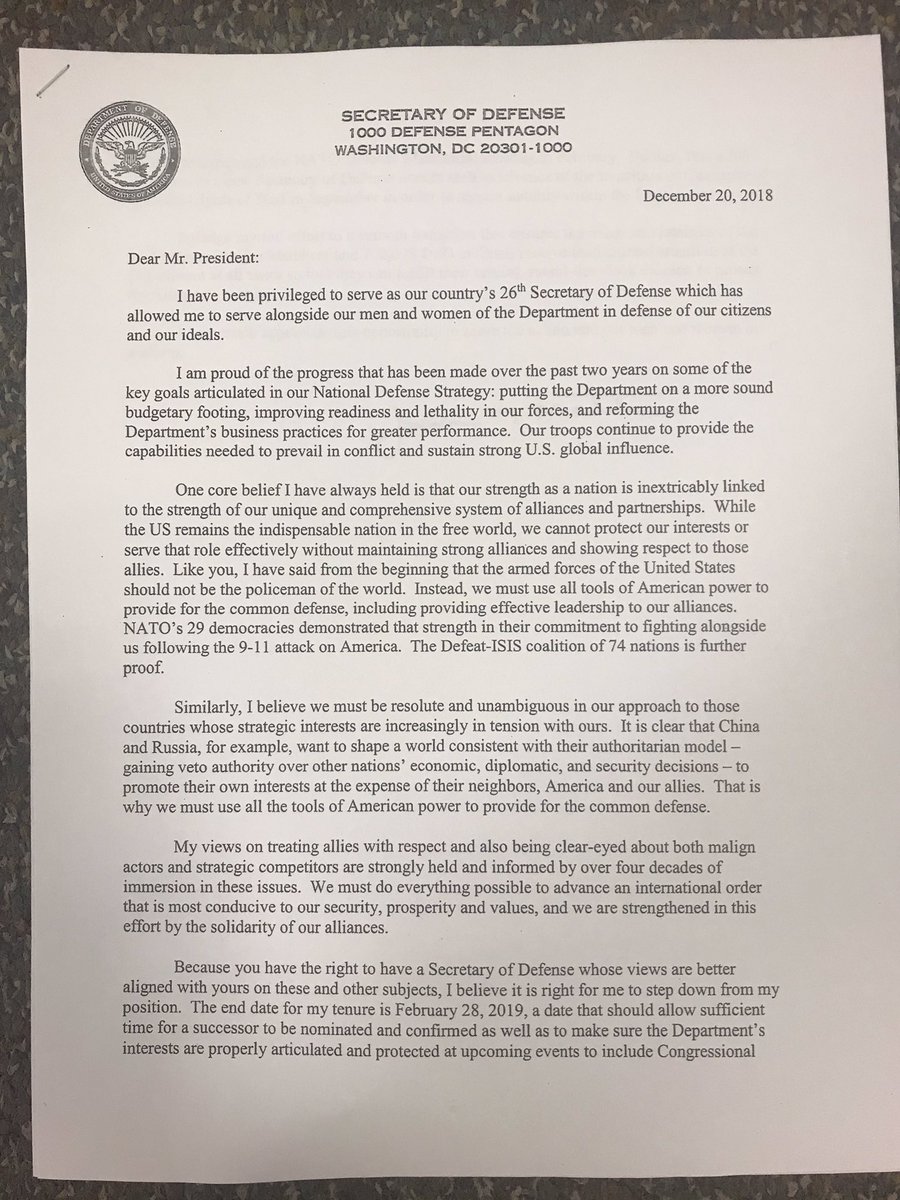
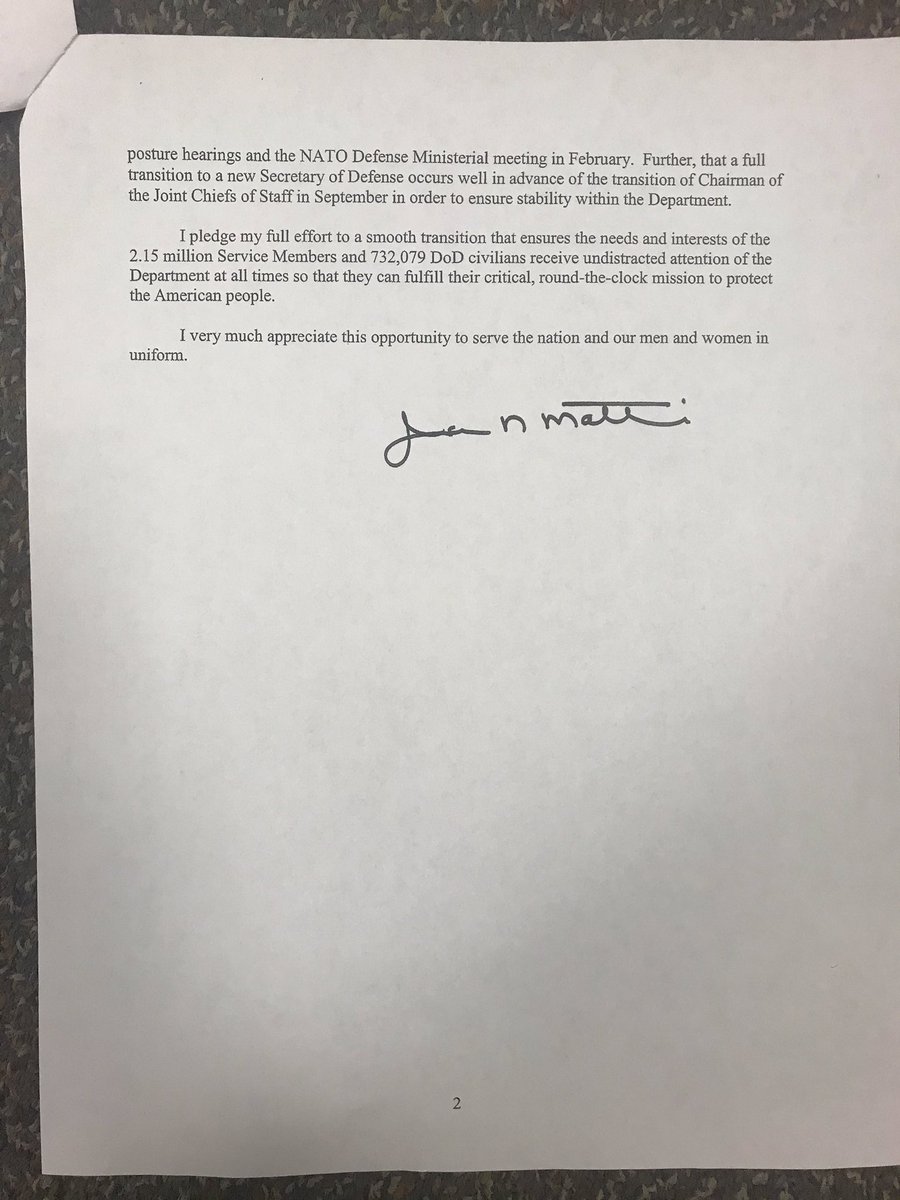
MATTIS OUT (UPDATED 6:05 PM ET & 6:15 Mattis resignation letter)

https://twitter.com/realDonaldTrump
General Jim Mattis will be retiring, with distinction, at the end of February, after having served my Administration as Secretary of Defense for the past two years. During Jim’s tenure, tremendous progress has been made, especially with respect to the purchase of new fighting equipment. General Mattis was a great help to me in getting allies and other countries to pay their share of military obligations. A new Secretary of Defense will be named shortly. I greatly thank Jim for his service!

5:21 PM ET December 20, 2018

UPDATE

Mattis quits, says his views aren't 'aligned' with Trump's
By Jeremy Diamond, Barbara Starr
December 20, 1018 - 5:59 PM ET
CNN

Defense Secretary James Mattis resigned Thursday on the heels of President Donald Trump's plans to withdraw troops from Syria, citing irreconcilable policy differences.


"Because you have the right to have a Secretary of Defense whose views are better aligned with yours on these and other subjects, I believe it is right for me to step down from my position," Mattis wrote in his letter.

He also pointedly stated that the strength of the US depends in part on the strength of its alliances around the globe, many of which have become notably frayed under Trump.
"One core belief I have always held is that our strength as a nation is inextricably linked to the strength of our unique and comprehensive system of alliances and partnerships. While the US remains the indispensable nation in the free world, we cannot protect our interests or serve that role effectively without maintaining strong alliances and showing respect to those allies," he added.

[Trump's tweet announcing Mattis departure]

Trump said a successor "will be named shortly."
Mattis and the President's other top national security advisers opposed Trump's decision to withdraw from Syria.

[END REPORT]


Mattis Letter of Resignation
via Elizabeth McLaughlin ABC reporter/producer Pentagon News
https://twitter.com/Elizabeth_McLau/status/1075881565216010246


Britain is the top foreign investor in Russia. So why do they demonize Russians?

Because the British government wants Russia for British business companies. That is why Americans, particularly those in Congress, are the biggest target for British anti-Russia propaganda; the British want to tamp down competition from Americans for Russian business. 

That also explains why the fiction about Trump's collusion with the Kremlin was concocted in Britain and pushed hard in the U.S. by the British and their surrogates. Trump's statements about Russia early during his presidential campaign suggested that he wanted to facilitate as many business deals in Russia for American companies as he could. And his actions even before the campaign indicated his pro-Russia business stance. So Trump had to be hamstrung by any means necessary on the chance he became president of the United States.

I don't think there was anything blind about the Clinton campaign's use of the Trump-Kremlin collusion meme -- I'd say Hillary Clinton always knew it was a fiction. But the pro-Clinton American media blindly regurgitated the British propaganda as did the Democratic National Party, which Clinton controlled during her 2016 run for the presidency. 

The blindness extended to the American branch of the 'Get Russia' crowd, which was rooted in the Cold War and continued even after the USSR dissolved. One would think they'd have put two and two together when they noticed that for all the British demonizing of Russians, the British wanted to do big business there. But hatred has a way of blinding people to the obvious. 

******** 

Putin's annual press conference/ marathon Q&A session, is underway

RT has live video of the event with English translation voiceover. Putin is answering a question about dealing with the scandalous amount of litter in Russia. Now to a question about the state of Russia-Chinese relations.

Have fun!   

*********

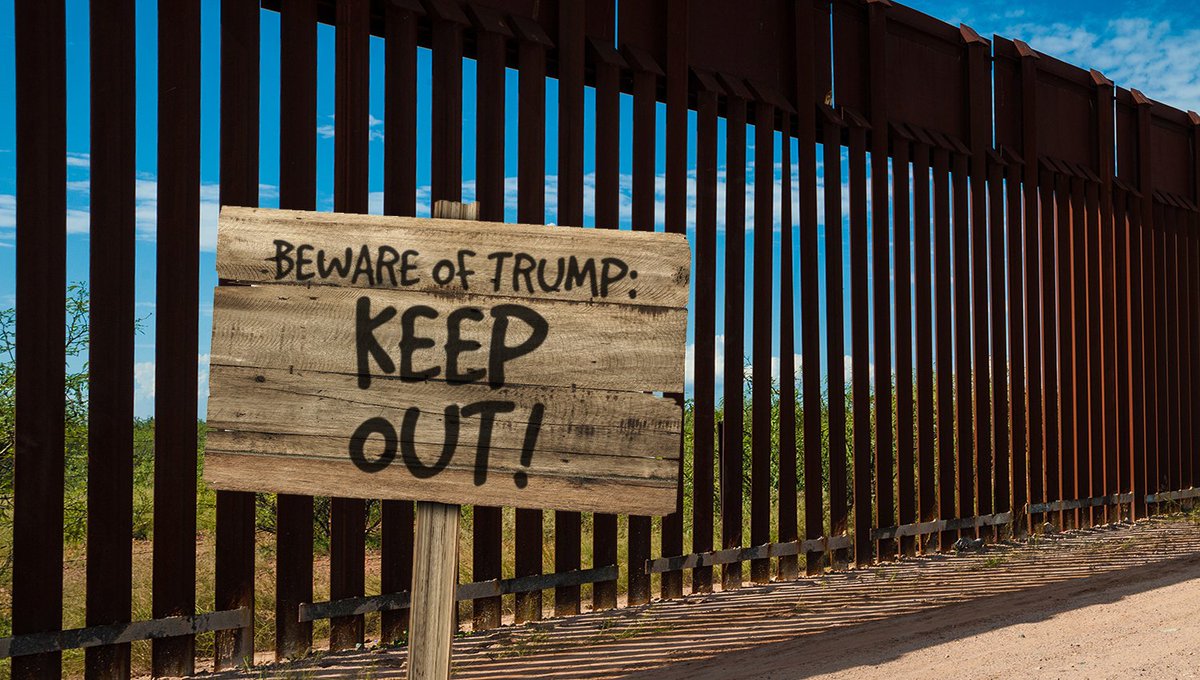
Best reason to build a wall along U.S.- Mexico border


That bon mot is from the wit (wits?) at The Babylon Bee ("Your trusted source for Christian news satire") a Twitter page that's giving the satirical website "The Onion" a run for its money. 

I'd never heard of BB until RT gave them a plug today in a report headlined "Russia wins": Fury in Washington as Trump announces withdrawal from Syria. Unfortunately, there is nothing satirical about the report but the irrepressible sense of humor RT editorial staff was compelled to develop after years of being a target of U.S./British anti-Russian propaganda finally bubbled up:
One satirical news site perhaps put it best, 'reporting' that both the left and the right were taking aim at Trump for "breaking with the longstanding American tradition of remaining in Middle Eastern countries indefinitely."
That sent me to The Babylon Bee, where I chuckled my way through several of their satirical posts ranging from U.S. political issues to whatever. Here's another one that's a keeper, although the point might be obscure for readers who don't follow gun-law issues in the USA:


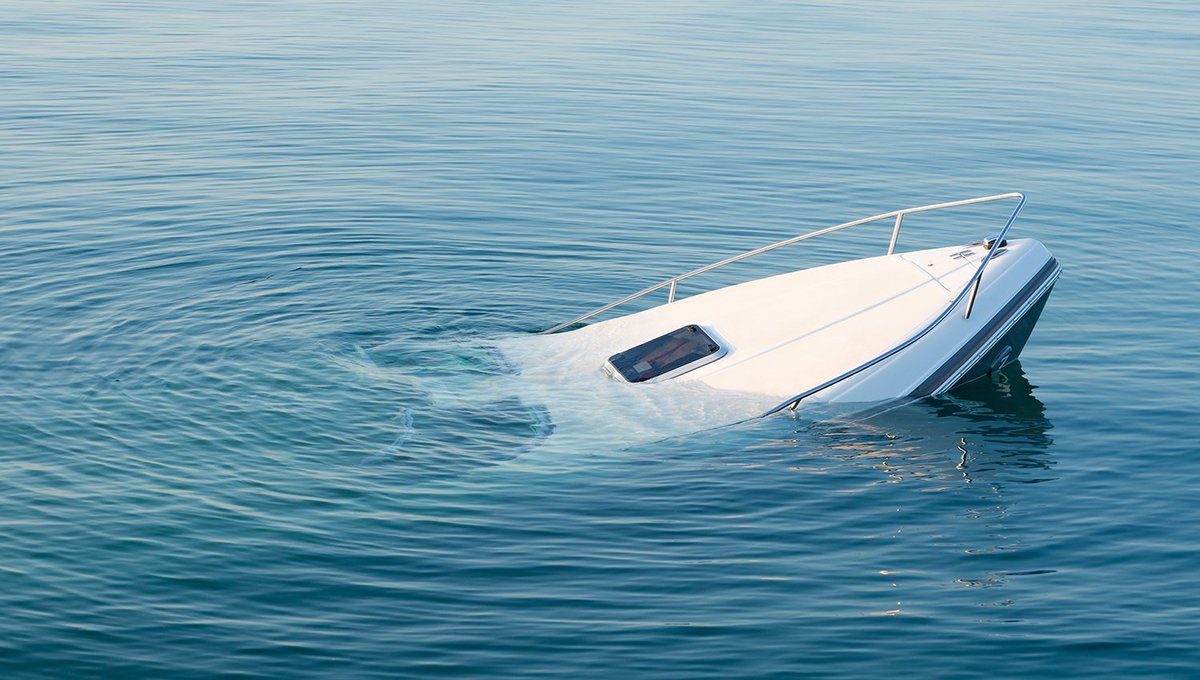
Tragic: Every Single Bump Stock In Nation Suddenly Lost In Boating Accident

But for those seeking escape from American politics, if only for the duration of the Christmas season, Babylon Bee feels your pain:


Man Really Stressed Out By All The Christmas Shopping His Wife Still Has To Do


... The man does have coping mechanisms to help with this time of year though. "The trick is not to think about all the running around your wife is doing to make sure everyone has a great Christmas. Take a few weeks off of shopping leading up to the holiday, and make sure to delegate basically everything to her. It's the only way to really keep your sanity around the holidays."
At publishing time, Benson had phoned his wife and asked her to pick up something nice for herself, since he didn't have time to buy her anything yet.


Santa Claus Converts To Calvinism, Moves Everybody To Naughty List

*********

Monday, December 17

America and its un-American foreign relations policies

The number of super-rich persons -- those whose net worth is at least $50 million -- who live in the top ten wealthiest nations totals 114,581. Out of that number 70,540 are American. China's number of super-rich is a distant second with 16,510.

The rest of the top-ten nations -- Australia, Britain, Canada, France, India, Italy, Germany, Japan -- are, individually, home to 3,000+ super-rich people. For the breakdowns by country see this December 16 RT report, Top Ten Countries the Super-Rich Call Home.

RT sticks to the ten wealthiest nations so the report doesn't address how many super-rich are in Russia and other nations that are big exporters of oil and gas. But the report does mention:
Credit Suisse analysts noted that the overall number of individuals whose wealth exceeds $50 million also rose four percent [during the past 12 months ending in October], reaching 149,890 people.
That leaves 35,309 super-rich scattered among nations that aren't in the category of top-ten wealthiest. So the number of American super-rich also dwarfs that of all super-rich individuals combined who live outside the top ten wealthiest nations.

Given America's vast geographic size and population -- second only to Russia in land mass and third to India and China's populations -- the country would be a land of idiots if our number of super-rich didn't dwarf that of others. This fact is so consistently overlooked by American politicians and foreign-relations policymakers that it's reasonable to wonder whether they really know their own country.

They don't. 

The United States of America and its population take up such a big chunk of this world that trying to get a clear idea of what it's like from looking at a map and demographic data is like trying to imagine what a million dollars looks like by reading the dollar figure.

There is only one certain way to get a deep understanding of the United States of America, and that is by walking across a big part of it. As to how many Americans in the public eye have accomplished this feat in the modern era: one.

His name is Paul Glover. He walked from the city of Boston in the state of Massachusetts to the city of San Diego in the state of California. You read that right if you're looking at a map and wondering if such a journey is even possible for one person on foot.

Added to the difficulty of gaining a clear picture of such a vast country is the low priority U.S. schools place on teaching American history. Yet there are special reasons why it's important for Americans to study their history. Because the USA grew up as a democracy it's not really accurate to describe it as a young nation. It's not the years, it's the mileage. One way to appreciate this is if you've been listening for a decade or so to John Batchelor's discussions with historians who chronicle different aspects of American history. *

The takeaway from John's tour de force, for which I believe he deserves a Medal of Freedomis that one can spend one's life studying American history and not come to the end of it. A big part of the reason is that America was forged as a constitutional republic that gave primacy to efforts of the individual and welcomed vast numbers of immigrants. And so the history of this country is stuffed with tales of ordinary people who had enough freedom under a written constitution to accomplish extraordinary things and often against overwhelming odds.

Thus, the unbridgeable gap between the history of the United States and other nations, which evolved over millenniums under kings and emperors, or empires that oversaw peoples in lands far distant from the power centers. The recorded history this produced is very much a story of rulers and the aristocracies that served them, whereas America's history is very much that of personal struggles of a great many commoners.
  
This unique aspect of the United States produced a vast storehouse of common-sense wisdom about democracy. Yet the wisdom was tossed aside when American government policies came to be shaped by those whose understanding of this country and knowledge of its history could have fit on a flea's wing. 

Nowhere is this truer than in foreign relations policies that developed in Washington after World War Two and continue to this day. That our leaders turned their backs on hard-won American wisdom in bids for power the United States in its vastness does not need, and which only drag this country down, is a horrific tragedy that has harmed Americans and many peoples outside U.S. borders. 

To this I can only cry out in fury, in despair, at the ghosts who inhabit today's imperial Washington, "What in God's name were you thinking?"

John doesn't only discuss American history. He's covered so much history from so many eras and world regions that there's no way to encompass what he's accomplished. And because he started out as a novelist he turns every history he talks about into a page-turner. Time and again I've announced to the radio, upon hearing of the show's upcoming book topic, "NO I am NOT interested," but if I don't turn off the radio right away I'm soon riveted by a tale and even on the edge of my seat wondering, "And then what happens?"

That's quite an accomplishment for a history teacher when the tale can be thousands of years old. 

[chuckling] Yes indeed, loyal John Batchelor Show listeners are students of history in spite of ourselves. The free education that no amount of money can buy is one reason I stay tuned year after year, even though I'm often in vociferous disagreement with the opinions of many of his guests and John himself about various U.S. policies.

For those who've never heard any of John Batchelor's book discussions, here's a podcast of one from 2016 that I've pulled at random from the Audioboom/JBS sidebar:

Climate 1314 AD: "The Third Horseman: A Story of Weather, War, and the Famine History Forgot" by William Rosen

********

Sunday, December 16

Kenya forested land surface temp 19° C; deforested 50° C (122° F)

... newly tree-free ground “represents huge amounts of solar energy changed into sensible heat, i.e. hot air.”

Scientific American
Clearing Forests May Transform Local—and Global—Climate 
By Judith D. Schwartz*
March 4, 2013

Researchers are finding that massive deforestation may have a profound, and possibly catastrophic, impact on local weather


In the last 15 years 200,000 hectares of the Mau Forest in western Kenya have been converted to agricultural land. Previously called a “water tower” because it supplied water to the Rift Valley and Lake Victoria, the forest region has dried up; in 2009 the rainy season—from August to November—saw no rain, and since then precipitation has been modest. Whereas hydropower used to provide the bulk of Kenya’s power ongoing droughts have led investors to pull out of hydro projects; power rationing and epic blackouts are common. In a desperate move to halt environmental disaster by reducing population pressure, the Kenyan government evicted tens of thousands of people from the land.

Severe drought, temperature extremes, formerly productive land gone barren: this is climate change. Yet, says botanist Jan Pokorny of Charles University in Prague, these snippets from Kenya are not about greenhouse gases, but rather the way that land-use changes—specifically deforestation—affect climate; newly tree-free ground “represents huge amounts of solar energy changed into sensible heat, i.e. hot air.” Pokorny, who uses satellite technology to measure changes in land-surface and temperatures, has done research in western Kenya for 25 years, and watched the area grow hotter and drier. The change from forest cover to bare ground leads to more heat and drought, he says. More than half the country used to be forested; it's now less than 2 percent.

Each year Earth loses 12 million to 15 million hectares of forest, according to the World Wildlife Fund, the equivalent of 36 football fields disappearing per minute. Although forests are ebbing throughout the world, in Africa forest-climate dynamics are easily grasped: according to the United Nations Environmental Programme, the continent is losing forests at twice the global rate. Says Pokorny, the conversion of forest to agricultural land, a change that took centuries in Europe, “happened during one generation in western Kenya.” Pokorny's work, coupled with a controversial new theory called the “biotic pump,” suggests that transforming landscapes from forest to field has at least as big an impact on regional climate as greenhouse gas–induced global warming.

After all, de-treeing the landscape alters the way ecosystems function and self-regulate. For Pokorny, the key is evapotranspiration, whereby plants continuously absorb and emit water in the form of vapor. Evaporation consumes heat and thus has a cooling effect. He calls this "the perfect and only air-conditioning system on the planet." On a moderately sunny day, a tree will transpire some 100 liters of water, converting 70 kilowatt-hours of solar energy into the latent heat held in water vapor. When soil is bare and dry—paved over or harvested—the process comes to a halt. The sun hits and warms the ground directly.

This past November found Pokorny flying a small Cessna from Lake Naivasha up the hills to the Mau Forest, where land surface temperatures in woodlands measured 19 degrees C; agricultural land that until recently had been forest hovered close to 50 degrees C. 

A photo taken from the air shows the dark green of forests diminish along the slope to the lowlands; the valley has clusters of deep forest green among the broad, pale, geometric shapes of cultivated land. His team measures surface temperature as opposed to the usual air temperature metric, two meters above. The surface “is what you are in contact with, and creates the dynamic movement of air,” he says—and ground temperature “indicates the way solar radiation is transformed at the Earth's surface.” His surveys from above combine three measures: “a normal camera, Thermovision [thermal infrared sensors] and our eyes. In putting the pictures together, we see the high temperatures are where there is no vegetation,” which includes swaths of land where forest has been cut.

The "biotic pump" theory argues that natural forests act as a “pump” that draws moisture inland. According to this concept, first described in a 2007 paper by Russian physicists Victor Gorshkov and Anastassia Makarieva of the Saint Petersburg Nuclear Physics Institute in the peer-reviewed Hydrology and Earth System Sciences, condensation, rather than temperature differential, is a primary driver of weather.

Here's a snapshot of the concept: The concentration of trees in wooded areas means a high rate of transpiration. This moist air cools as it ascends and the water vapor condenses, producing a partial vacuum. This creates an air pressure gradient, whereby the forest canopy sucks in moist air from the ocean. According to Gorshkov and Makarieva, forests don't merely grow in wet areas, they create and perpetuate the conditions in which they grow. Without forest cover—specifically mature, natural forest to ensure sufficient biomass and resilience—moisture is no longer pulled in, the physicists say. Rain becomes erratic and ultimately stalls.

The Russian scientists associate the unprecedented heat and drought in their country over the last few years with rapid deforestation in western Russia. The theory is controversial; indeed, it challenges the viability of the climate models currently in use. The theory “explains why in forested regions precipitation does not decrease with distance from the ocean, even thousands of kilometers, while the interiors of deforested parts of continents become dry already a few hundred kilometers away from the oceanic coast,” they wrote in an e-mail. "Condensation of water vapor over forests creates pressure gradients that have been shown to be sufficient to drive winds that bring moisture from ocean to land."

Should the biotic pump be confirmed by further research, it brings new urgency to the need to protect forests. “Most climate models recognize the role of "precipitation cycling" in forests, but not moisture transport by forests,” Makarieva and Gorshkov say. The difference is significant: if deforestation means simply reduced evaporation, the decline of precipitation would be significant but not catastrophic, around 15 percent; rains depend on imported moisture, however. If the vehicle for transport—an intact forest—is impaired, that's a different story. 

The physicists say: “In our theory, imported moisture will decline if the forest is destroyed, especially in the inland portion of the continent. If there is no imported moisture there is nothing to be evaporated, so the water cycle will undergo a dramatic—not minor—reduction of intensity.” In the Amazon, they add, this could be up to 90 percent.

Such ideas are not new. In his 1864 book "Man and Nature" (original title: Man the Disturber of Nature's Harmonies), George Perkins Marsh catalogued numerous examples of changing climate conditions on losing forests and wrote, “When the forest is gone, the great reservoir of moisture stored up in its vegetable mold [humus] is evaporated, and returns only in deluges of rain to wash away the parched dust into which that mold has been converted. The well-wooded and humid hills are turned to ridges of dry rock.”

Then there is the need to better understand the specific function of forests and even individual tree species. For example, can planted trees have the same effect on hydrology as intact natural forest? “A practical question is whether we're able to mimic effects of forests,” Pokorny says. “For we can't just have forests—we need agricultural land. Can other land types, like savanna and high biomass grassland, serve some functions of trees? Are there pioneer tree species that create microclimates that help other trees grow?”

Deforestation has numerous untoward environmental consequences, including the release of carbon: about one sixth of global emissions are due to cleared or degraded forests. Such deforestation also destroys the habitat for vast variety of species, and threatens the welfare of the more than a billion people who rely on forests for their livelihoods. It may also have unforeseen impacts on the water cycle—which can in turn alter climate patterns. "If we don't pay attention to this now, we could lose our forests," Makarieva told me by phone. "This would make disaster come faster by destroying the water cycle."

[END REPORT]
********

Saturday, December 15

It's that time of year again

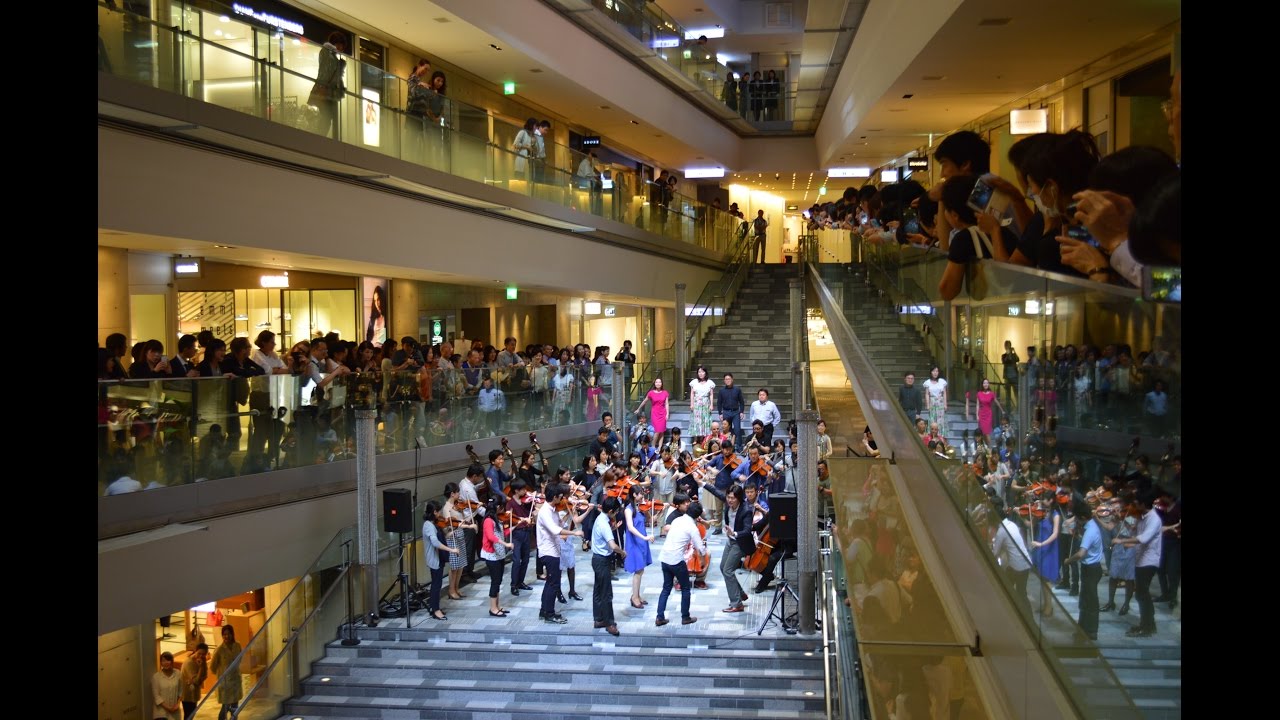
It's the time when the Christmas season gives Pundita an excuse to inflict her favorite Shopping Mall Music on readers. Okay, so it's not Beethoven -- wait, wait, what's this do my wondering ears hear? I'll be darned. Beethoven's Ninth flashmob at the Omotesando Hills shopping complex in Tokyo. September 2016. Well, September is close enough.

Wow. That's some flashmob. 

All right; let's get what is supposed to be a joyful season off with a bang. Impress the Heavenly Hosts: make as much joyful racket as you can! I don't want to hear, 'Oh Pundita I'm not Christian.' The Ninth is not exactly a Christmas carol, okay? Sing along dammit even if you don't know a word of German and can only sing off key. Ready? 

The catch is that ICT Tokushima doesn't want me posting the video. You'll have to go to the YouTube site for it but at least I can post a still from the video. That's some shopping mall, too:


********

200 years after the publication of "Frankenstein" real Dr Frankensteins abound

Dr Frankenstein and his assistant prepare to bring their bioengineered creature to life.The scene is from the 1931 film adaptation of a play based on Mary Shelley's horror novel Frankenstein, published 1818.


"An experiment in China to change the colors of Merino sheep gave some spotted fleeces akin to a panda"

PHOTO: INSTITUTE OF ANIMAL BIOTECHNOLOGY, XINJIANG ACADEMY OF ANIMAL SCIENCE; CAPTION FROM WALL STREET JOURNAL REPORT, BELOW

“But if we don’t try, we will never learn,” said Goetz Laible, who led AgResearch’s experiment.

Ah but Mr Laible you're trying to learn by trial and error or the dartboard method as it's known in engineering and applied science. Bad idea when the dartboard is the genome map.

Big Tongues and Extra Vertebrae: The Unintended Consequences of Animal Gene Editing
By Preetika Rana and Lucky Craymer
December 14, 2018
The Wall Street Journal

Unintended consequences have included enlarged rabbit tongues and extra pig vertebrae, as bioethicists warn of hubris

[See the report at the WSJ site for a video on Brazil's gene-edited cows -- the first ones engineered for warmer climates]

The purported birth last month of the world’s first gene-edited human babies, claimed by a Chinese scientist, spurred a wave of global outrage. Scientists denounced the (as yet unconfirmed) experiment as irresponsible, and the development reinforced fears that the redesigning of DNA is moving ahead too fast and without necessary oversight.

The proliferation of similar experiments on farm animals in recent years supports those concerns. Though rapid strides have been made to map genomes — the full set of genes for humans, animals, insects and plants — scientists have only begun to understand what the tens of thousands of individual genes do. Moreover, they are far from unraveling how those genes interact with each other.

Scientists around the world are editing the genes of livestock to create meatier pigs, cashmere goats with longer hair and cold-weather cows that can thrive in the tropics. The goals are to improve agricultural productivity, produce hardier beasts and reduce practices that are costly or considered inhumane. But amid some successes, disturbing outcomes are surfacing.

When Chinese researchers deleted a gene that limits muscle growth in mammals so that rabbits would grow leaner, their creations exhibited an unusual characteristic: enlarged tongues. Similar experiments on Chinese pigs led some to develop an additional vertebrae. Gene-edited calves died prematurely in Brazil and New Zealand.

The stumbles show the risks of racing ahead with such experiments, even as many governments work to clear regulatory pathways to bring meat, eggs and dairy from gene-edited animals to store shelves. Bioethicists and many geneticists have raised doubts about applying the gene-editing technology to animals and especially humans, given the continued uncertainties in both the science and the lab and field results.

“Humans have a very long history of messing around in nature with all kinds of unintended consequences,” said Lisa Moses, an animal bioethicist at Harvard Medical School’s Center for Bioethics. “It’s really hubris of us to assume that we know what we’re doing and that we can predict what kinds of bad things can happen.”

The belief has spread that scientists know how gene editing works “all the time, under all conditions,” says Odd-Gunnar Wikmark, a researcher at the Norway-based foundation GenOk, which studies the consequences of genetic engineering. “We of course do not.”

Critics say that editing animal DNA could introduce unwanted mutations that pose a threat to human health when consumed, and they fear that mutated genes may spread unchecked as animals breed. Proponents say they are engineering mutations just as traditional crossbreeding does, only faster. Though no gene-edited animal products have reached markets yet, the potential benefits to farming have led many big agricultural nations to join the race.

Crispr-Cas9, the tool introduced in 2012 that was used to engineer the human babies, is cheaper than older techniques and enables scientists to add, delete and rearrange DNA with greater precision. But an article published in the journal Nature Biotechnology in July suggests that Crispr might cause greater damage than previously understood—including changes in genes other than those intended. When DNA is cut, “a lot of odd things can happen,” study leader Allan Bradley said in July.

Take the gene called MSTN. Since 2012, Kui Li, a scientist with the state-run Chinese Academy of Agricultural Sciences, has reverse-engineered cells from adult Chinese pigs to their embryonic stage, which is a common process when cloning animals. Then, using an older editing tool, he deleted MSTN, which limits how large muscles grow in mammals, including in humans. The edited cells are infused into eggs, chemically fertilized in a lab and implanted into the womb of a surrogate. At a farm 70 miles southeast of Beijing, dozens of pigs rest in metallic cages and glass enclosures; their meat is up to 12% leaner if both copies of their MSTN gene are deleted.

But there was another effect on the pigs: One in five offspring who inherited the edited genes had an extra spinal bone known as thoracic vertebrae, Dr. Li found. He doesn’t know why, though he postulates that the MSTN gene somehow contributes to skeletal formation. Lab tests show that his pigs are safe to eat, said Dr. Li: Despite a slight fading in color after cooking, he recorded no nutritional differences. He’s begun using Crispr to make more commercial breeds like the U.K.’s Large White leaner or resistant to PRRS, a deadly viral infection.

When state-sponsored scientists at Nanjing Agricultural University used Crispr to edit MSTN out of rabbits to make them meatier, 14 of the 34 engineered offspring were inexplicably born with enlarged tongues, leading the scientists to warn of abnormalities from gene editing in a 2016 research paper on their project. “Safety issues need to be addressed in future studies before the technology can be utilized” in agriculture, the authors wrote.

“Even the genes that we think we know very well, there’s a lot to learn,” said Se-Jin Lee, one of the scientists who discovered MSTN at the Johns Hopkins University School of Medicine in 1997.

Chinese scientists at a different research facility have had to use caesarean sections to birth lambs whose MSTN genes were deleted with Crispr, because some grew too large to be birthed naturally. They have had success modifying goats’ cashmere to grow about 20% longer by preventing the gene FGF5 from regulating the growth.

Generally, the larger the animals, the greater the complications. New Zealand’s AgResearch Ltd. applied Crispr on cattle to reduce their heat stress, deleting a single amino acid on a gene that contributes to coat color (including hair and skin color in humans), in an effort to lighten the cows’ black-and-white coats to better reflect sunlight. Both calves died (one was sick and was euthanized). In a separate experiment using an older tool to enable cold-weather Angus cattle to thrive in the Brazilian tropics, one of two calves died prematurely.

Scientists in both experiments blame cloning, which created the calves but still isn’t foolproof, they say, after two decades in use. Neither is their understanding of genes. “But if we don’t try, we will never learn,” said Goetz Laible, who led AgResearch’s experiment.

Globally, at least a dozen gene-edited livestock projects are aiming to reach consumer markets. Some may face less resistance from consumers and ethicists because they could eliminate reviled practices: Cattle could be engineered without horns, for instance, obviating the need to dehorn them.

Wool from a gene-edited animal might also be more readily accepted because it is only worn, not eaten. Researchers in China’s eastern Xinjiang region used Crispr to alter the ASIP gene, believed to influence coat color in Merino sheep, with the aim of creating new breeds with darker coats—all black, gray or brown—so that off-white wool wouldn’t need to be dyed.

The results confirmed previous research suggesting that genes involved in coat color also play a role in reproduction: Only a fourth as many ewes implanted with the disrupted genes carried to term, as compared to normal circumstances. Meanwhile, for the wool itself, the results were mixed: One sheep was white, two were mostly black, and the other three had spotted fleeces akin to a panda.

The outcome also underlined how far there is to go in understanding the forces at work among the genes of humans and animals. “I think it would be an understatement to say we should be more cautious,” said Lori Marino, a neuroscientist and the founder of Utah-based Kimmela Center for Animal Advocacy. “I think we’ve already gone over the line with animals, and now humans.”

—Zhou Wei contributed to this article


[END REPORT]

********