Translate

Tuesday, July 5

Cosmic Comment on Obama's Washington: Even our televised July 4 fireworks were phony

This screen grab is a sample of what the public broadcast of the 2016 Independence Day fireworks on the National Mall looked like. Notice the clear sky: 


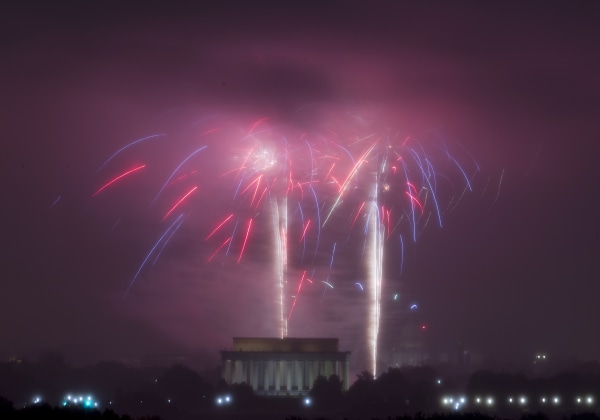
This is what the displays actually looked like last night. Notice the fireworks disappearing into fog and thick clouds:


I don't think I should describe my personal experience as a Washingtonian with this mess because I'm already in a bad mood. What they should have done yesterday morning was reschedule the fireworks display because they knew it was a virtual certainty that it was going to rain cats and dogs on and off all day and into the evening, and that it would be foggy and overcast even if the rain stopped in time for the fireworks and that all the parks would be soggy. Realize that most people who wait to watch the fireworks on the Mall and from nearby parks sit on the ground -- unless they want to stand for hours. 

I suspect PBS fudged the display not out of patriotism, as they claimed (see below), but because they didn't want TV audiences to see just how bad the city's decision had been to keep to the original schedule.

JUL 4 2016, 11:17 PM ET
PBS' 'Live' Fireworks Aren't, and the Network Hears It From Viewers
by ALEX JOHNSON
NBC News

PBS was pummeled on social media after it acknowledged having spliced in video of previous years' Washington, D.C., fireworks in its live "A Capitol Fourth" broadcast Monday night.
Hundreds of viewers complained on the annual show's Twitter and Facebook pages that the fireworks display couldn't be live because the images were in clear weather.
Washington, however, was heavily overcast and foggy Monday night — which was readily apparent as the pyrotechnics faded into dense clouds.
About 10 p.m. ET, the show's Facebook and Twitter pages acknowledged that the supposedly "live" show was, in fact, " a combination of the best fireworks from this year and previous years."
Reaction online was swift and savage:

We showed a combination of the best fireworks from this year and previous years. It was the patriotic thing to do. 

We showed a combination of the best fireworks from this year and previous years. It was the patriotic thing to do. 
[END REPORT]

Monday, July 4

What America's Independence Day Means to Google


It's always hard for me to criticize Google because without Google there would be no Pundita blog. Yes I know there are other free blog hosts but they require effort. In the earnest words of Google's CEO when years ago I refused Google's repeated requests to upgrade the program for the blog, 'Miss Pundita, I assure you, even a monkey can do this upgrade.'  (Just joking).  Google has remained understanding although it won't let me delete the blog's comment section until I upgrade, which forces me to delete most comments myself. 

But there are additional reasons I stay with Google's Blogger. One reason: early on I deleted the blog because I decided blogging was too much work. Eventually I changed my mind. Those were the days when one could write Blogger and quickly receive a personal answer -- and they cheerfully restored the blog and all its posts. For free.  

In short my relationship with Google is founded on loyalty that puts my complaints about the company in context, even though I have had rather strong criticism about the way it's conducted itself in the international sphere in several instances.  

By the same reasoning I would ask Google to think twice about what Independence Day means to them. Does it really mean eating hot dogs, mowing the lawn, marching in a band and playing baseball? Is that now the only safe way for a globalized American company to allude to the epoch-making document called the Declaration of Independence?

There are years when I am so angry at my government and politics of my fellow Americans that I don't trust myself to make any comment about Independence Day. But again it's a matter of putting things in context. If I am going to mention the day, at the least I can make a reference to what it actually stands for.

********

"Terrorists’ Key Supply Route Cut off by Syrian Army in Northern Aleppo"

I hope this good news continues to hold. For now, Castillo Road -- at least the key part -- is under the control of the army.

FARS - July 3, 2016
TEHRAN (FNA)- The Syrian Army cut off the terrorists' supply route running along the Castillo road in North of Aleppo, a military source reported.

"The army has regained control over Al-Mallah Farms and cut off the terrorists' supply route running along the Castillo road in the North of the city, thus blocking the militants in Aleppo itself," the source said.
The Syrian army has been pushing back Jeish al-Islam and Jeish al-Fatah coalition of 10 terrorist groups in Aleppo's Northern suburbs since early last week.

Early in Sunday, the Syrian military forces beat the terrorists back from their positions near an industrial region in the Northern countryside of Aleppo city, taking full control over several building complexes.
The Syrian soldiers' anti-terrorism offensives in al-Layamon industrial region inflicted major losses on the militants and forced them to retreat from several building blocks.
The militants used the entire heavy weapons [arsenal] in the clashes with the Syrian army men but could not slow down the government forces' advances in the battlefield.
[END REPORT] 

"Leader of Christian Popular Forces Reveals Saudi Envoy's Ties with ISIL in Iraq"

If he can support his accusation this would be very serious indeed. 

TEHRAN (FNA)- Secretary-General of Christian popular forces, the Babylon Battalion, revealed that he is in possession of irrefutable evidence substantiating tight relationshsip between the Saudi Ambassador to Baghdad Thamer al-Sabhan and the ISIL terrorist group.

Speaking in a live TV program on Sunday, Rayan al-Kaldani said that he is in possession of an audio file of Sabhan's phone talks with an ISIL terrorist ringleader.
"Is this a diplomatic behavior or a plot against Iraq?" he asked.
Kaldani blamed the Saudi envoy for the recent blasts in Baghdad which killed over 80 people, and said, "From now on, we consider the Saudi ambassador responsible for any blast in Baghdad."
Two blasts ripped through busy market areas in Baghdad, Iraq’s capital, killing around 80 people and injuring 160. [The death toll currently stands at 147 and is expected to rise higher.] 
Earlier this week, at least 12 people were killed and 32 injured in another suicide attack West of Baghdad, where an attacker wearing a suicide vest targeted a Sunni mosque in Abu Ghraib.

The Saudi ambassador has been criticized for his interfering remarks and undiplomatic behavior in recent months.
Last month, a senior Iraqi lawmaker called on his government to take serious measures against the Saudi Ambassador to Baghdad, and said that al-Sabhan is in Iraq to support the ISIL Takfiri terrorist group.
"The reinstatement of al-Sabhan in Baghdad is meant to support the ISIL," member of the Iraqi Parliament's Foreign Relations Committee Mesal al-Alousi said.
He underlined that Saudi Arabia meddles in the internal affairs of all the regional countries, and said, "For the same reason the Iraqi government should confront that country's ambassador to Baghdad."
"Saudi Arabia claims that it respects the Iraqi people and Shiites, but it supports the ISIL," al-Alousi said.
[END REPORT] 
********

Sunday, July 3

Death toll in Baghdad bombings, now offcially at 147, will continue to rise

See The New York Times and Iraqi News for latest news on the incident and the unfolding political repercussions.

********

Suicide attack thwarted near U.S. consulate in Jeddah

Suicide Attack Carried out Near US Diplomatic Site in Saudi Arabia
By AYA BATRAWY with additional reporting from Washington by AP writer Douglass Daniel 
DUBAI, United Arab Emirates
Jul 3, 2016, 11:25 PM EDT
Associated Press

A suicide bomber carried out an attack early Monday near a U.S. diplomatic site in the western Saudi city of Jiddah, according to the Interior Ministry.

The ministry said in a statement the attacker detonated his suicide vest when security guards approached him near the parking lot of a hospital. The attacker died and two security men were wounded with minor injuries, according to the statement published by the state-run Saudi Press Agency. Some cars in the parking lot were damaged.

Interior Ministry spokesman Maj. Gen. Mansour al-Turki said in the statement the attacker caught the attention of the security guards, who noticed he was acting suspiciously at an intersection located on the corner of the heavily fortified U.S. consulate in Jiddah, located by the Dr. Soliman Fakeeh Hospital. Most of the consulate's staff had reportedly moved offices to a new location.

The Interior Ministry did not specify if the attacker was intending to target the U.S. diplomatic compound, saying an investigation was underway to determine his identity.

U.S. Embassy officials in Saudi Arabia could not be immediately reached for comment. A State Department spokesperson, who was not authorized to be named and spoke on condition of anonymity, said U.S. officials are aware of reports of an explosion in Jiddah and are working with Saudi authorities to collect more information.

[...]

*********

Terror Attack in Dhaka By 'Nice' Boys From Good Schools: "It has become a fashion"

July 14, 2016 - 11:39 PM EDT Note to Reader:
Are you looking for a report on the terror attack in Nice, France?  This post is about the terrorists in Bangladesh who were known as "nice" boys. Here's the latest on the attack in Nice. 

****

"They are all highly educated young men and went to university. No one is from a madrassa."


Slain Dhaka terrorist Nibras Islam (at left) with chums 


CNN July 3
In a statement ISIS claimed responsibility, but Bangladeshi officials said the attack was carried out by homegrown militants and hinted towards a group called Jamaatul Mujahideen Bangladesh.

All the attackers in the deadly assault on a cafe in Dhaka were Bangladeshi citizens. Five were militants police had tried to arrest previously, Police Inspector General Shahidul Hoque said.
The attack was the deadliest and boldest act of terror in a country that has become increasingly numb to ever-escalating violence by Islamist militants.
India Today July 3

Even as Bangladesh tries to come to grips with the deadly terror attack in Dhaka, it has been revealed that one of the slain terrorists, Nibras Islam, was an educated young boy who came from an affluent family.

Nibras was allegedly brainwashed and radicalized by terrorists to carry out the heinous attack in the name of Islam.

Videos and photos from his profile show a well-spoken, pleasant young boy.

[...]

Another video shows a regular boy travelling with his friends in car, speaking fluent English, joking around.

According to his Facebook profile, the boy had studied in Monash University in Malaysia as well as Northsouth University in Dhaka.

[...]


FROM GOOD SCHOOLS

According to reports, the terrorists were all aged between 20 or 21 and were students of Dhaka's North South University.

Some of the other youths involved in the attack also seem to have belonged to affluent families and had passed out of top-notch schools in the city like Scholastica and Turkish International School.

Nibras, it seems, had been missing since January, which was the last time his parents has managed to contact him.

Nibras himself is said to have been a former student of the International Turkish Hopes school in Dhaka.

The boy was identified by his former classmates in North South University.


[...]

*********

MARIAMA MU SELA MI (Ave Marie)

Dedicated to all our Sene Gambian
Catholic brothers and sisters worldwide.
Celebrate your SangMarie in great style.
-- Arthur Cates, Gambia


Benghazi now and then: How much did Washington know before it waded into Libya?

Benghazi After Liberation

AP/Mohamed Salama

Benghazi Before Liberation


I think it's time for a little history review. As you read on, ask yourself how much of the Gulf Arab rivalry discussed in the report was understood by the American press in 2011 and explained to the American public. Ask yourself how much the U.S. Department of State and the NSC understood. Ask how much interventionists in Congress such as John McCain understood.  

As to whether Nicolas Sarkozy and David Cameron understood -- I think one thing is certain; both knew very well that when it comes to MENA, Americans in Washington can't even find their own hands with a flashlight.  So to say we were played -- you can't play someone who really doesn't care to know what's actually happening.  

Giorgio Cafiero and Daniel Wagner
December 11, 2015

The National Interest

Qatar and the UAE have deadly opposing interests in the North African state.

When the Qaddafi regime fell in 2011, centralized power quickly dissipated and Libya fell into chaos. A wide range of armed groups asserted control over large swathes of territory in the oil-rich nation without any effective central authority strong enough to exert control of the entire country. Since then, Libya has become a battleground for outside powers with competing interests and conflicting visions.
Several weeks after losing the July 2014 election, a Muslim Brotherhood–led coalition (“Libya Dawn”) seized the capital city of Tripoli. The Libya Dawn fighters established an administration (the New General National Congress) pushing the nation’s UN-recognized government into Tobruk, situated along the Mediterranean coast near Egypt. Despite UN efforts to broker peace, forces loyal to Libya’s Tripoli- and Tobruk-based governments remain in conflict. The fact that both sides have foreign sponsors has unquestionably prolonged and intensified the country’s multitude of problems.
Two Gulf Arab states, the UAE and Qatar, which both played pivotal roles in the Libyan uprising as sponsors of anti-Qaddafi rebels, have emerged as rivals in this grander geopolitical struggle. The UAE, along with Russia and Egypt, backs the Tobruk-based government; Qatar, along with Turkey and Sudan, supports the Islamist-led government in Tripoli. Abu Dhabi and Doha’s proxy war in Libya is illustrative of a division within the Gulf Cooperation Council (GCC), which is proving highly influential in shaping Libya’s post-Qaddafi political order.
At the heart of the Emirati-Qatari rivalry in Libya lie sensitive political issues for the Gulf monarchs. Specifically, how should the Council’s ruling families react to the rise of grassroots Islamist movements such as the Muslim Brotherhood (Ikhwan), which promote democratic institutions and espouse social justice concerns across the region? Naturally, the Gulf Arab monarchs were unsettled by the potential for anti-government activism in countries like Egypt to add momentum to opposition groups in the GCC. Yet, as the Muslim Brotherhood’s various political wings gained power in multiple countries through post–Arab Awakening elections, the Gulf monarchs reacted differently to the political apertures that Islamists secured in 2011 and 2012.
On one end of the spectrum, the UAE has for years conducted a staunchly anti-Islamist foreign policy. Since 2011, Abu Dhabi has invested substantial resources in efforts to counter the Muslim Brotherhood, most notably in Egypt and Libya. On the other end, Qatar has sponsored Muslim Brotherhood branches across the Arab world, viewing such factions as vehicles capable of spreading Doha’s influence and extending its geopolitical leverage. Saudi Arabia, the Council’s powerhouse, sits somewhere in the middle. The kingdom has aligned with the UAE in Egypt, where Riyadh and Abu Dhabi have invested billions of dollars in the Egyptian military since Abdel Fattah el-Sisi ousted Muslim Brotherhood President Mohammed Morsi in 2013. But in Syria, the Saudis have worked with Doha to back Sunni Islamist rebels seeking to overthrow the Assad regime.
Historical Context
Abu Dhabi’s interest in countering the Muslim Brotherhood throughout the region is rooted in its concerns about the movement’s potential to challenge the status quo in the UAE’s poorer emirates, where the local Muslim Brotherhood branch has maintained a support base for decades.
During the 1950s and 1960s, Egypt’s Arab nationalist president Gamal Abdel Nasser cracked down on the Muslim Brotherhood; many of its members fled to the Gulf. After the UAE gained independence in 1971, many of these Brotherhood members, in their capacity as educated and upwardly mobile members of society, gained prominent positions of power in the Emirates’ public and private sectors. They also held influence in the nation’s judiciary and education system. In 1974 they established Al-Islah, an official NGO which is understood to be the Muslim Brotherhood’s Emirati branch. By the 1990s, UAE authorities grew unsettled by Al-Islah’s increasingly political activity and banned the group’s members from holding public office.
After Egypt’s Muslim Brotherhood won the 2011–2012 elections, Abu Dhabi’s relationship with Cairo grew tense. Emirati officials accusedEgypt’s Islamist-led government of “encroach[ing] upon the sovereignty and integrity of other nations”. Yet, in the aftermath of the Egyptian military’s ouster of Mohamed Morsi in 2013, the UAE announced a $4.9 billion aid package to Cairo, effectively resetting the Egypt-UAE alliance.
Qatar has maintained an activist foreign policy since its Emir, Sheikh Hamad bin Khalifa Al Thani, overthrew his father in a bloodless palace coup in 1995. By launching the pan-Arab satellite network Al-Jazeera in 1996 and pursuing a more open relationship with Iran, Qatar earned a reputation as being the GCC’s “wild card.” Other Council members criticized Doha for not always keeping in mind the interests of its fellow Gulf Arab monarchies. Al-Jazeera’s coverage of other Arab nations’ affairs prompted several Arab regimes to criticize the network as early as 2002.
Another source of tension between Qatar and the rest of the Council has been the Egyptian-born senior cleric Yusuf al-Qaradawi, known as the Muslim Brotherhood’s spiritual leader, who has lived in Qatar since the 1960s. Qaradawi’s sermons have angered Doha’s fellow Council members. Emirati leaders lashed out at Qatar for not silencing the cleric after he accused the UAE of siding “against Islamic rule.” According to WikiLeaks, in 2009 Abu Dhabi’s Crown Prince Mohammed bin Zayed met with U.S. officials and declared that Qatar is “part of the Muslim Brotherhood.” The prince also encouraged Washington to examine Al-Jazeera employees, predicting that it would discover that most of the staff were tied to the Muslim Brotherhood.
Regardless, the network was popular on the Arab street, where by 2011 many hailed Al-Jazeera as a promoter of democratic change and popular revolution. Yet, certain autocratic regimes across the region viewed the Muslim Brotherhood as an existential threat, and soon saw Al-Jazeera as Doha’s political weapon, being used to stir up trouble. Qatar’s critics observed that Qaradawi was a popular television host on Al-Jazeera. According to the Egyptian Independent, in March 2011 an Egyptian Muslim Brotherhood presidential nominee, Khairat al-Shater, traveled to Doha to address coordination between “the Brotherhood, the Freedom and Justice Party [the movement’s political wing in Egypt], and Qatar in the upcoming period,” leaving many to conclude that the Qataris were seeking to influence the outcome of Egypt’s first democratic election following Mubarak’s fall from power. Qatar and Al-Jazeera soon gained reputations as being pro–Muslim Brotherhood.
In March 2014, this tension reached a new level when the UAE joined Saudi Arabia and Bahrain in recalling their ambassadors from Doha to punish Qatar for its ties with the Muslim Brotherhood—an unprecedented event in the Council’s history. Abu Dhabi, Riyadh and Manama accused Qatar of failing to abide by a November 2013agreement that committed the six members to “principals of non-interference in the internal affairs of other GCC countries and not supporting anyone who threatens the security and stability of other GCC countries including organizations and individuals and not supporting the antagonistic media.”
Eight months later, Saudi Arabia hosted a meeting in which three GCC members and Qatar agreed to end their rift. The Emirati, Saudi and Bahraini envoys returned to Doha after deciding that, in light of the “sensitive circumstances the region is undergoing,” it was in the interest of all Gulf Arab nations to turn a “new page” and restore unity to the GCC. Tension between Saudi Arabia and Qatar has eased substantially since King Salman inherited the throne in January and softened Riyadh’s harsh stance on the Brotherhood, as part of a strategy to unite the wider Sunni Arab world against Iranian influence and Daesh/Islamic State.
The Emirati-Qatari Rivalry
The UAE, however, has not softened its stance against the Muslim Brotherhood. Throughout 2015, the UAE has grown frustrated with Riyadh’s overtures to the movement, while maintaining its anti-Islamist foreign policy. Libya has become a battleground in this Gulf rivalry. The extent to which the UAE has committed itself to countering Islamist groups in Libya was underscored in August 2014, when Emirati pilots flying out of bases in Egypt carried out strikes against Islamist militants seeking control of Tripoli. Although the UAE’s strikes were futile in terms of thwarting the Libya Dawn coalition from seizing control of the nation’s capital, the military operation signaled a watershed in Emirati foreign policy. This was the first time in which the UAE military waged strikes against a foreign country without international authorization.
Last month, the New York Times exposed leaked Emirati emails revealing the UAE’s shipment of arms to certain Libyan militias—in violation of a UN arms embargo—attempting to weaken Islamist groups allegedly sponsored by Qatar. Other leaked emails show how the UAE offered Bernardino León, former UN mediator for Libya, a high-paying position as director general of the Emirates Diplomatic Academy, which he accepted while serving his then-role as mediator. Given the UAE’s outright support for the Tobruk government, many have called into question the viability of the UN’s ongoing efforts in light of the perception that León’s impartiality was compromised by a conflict of interest.
At the Camp David summit of Gulf Arab leaders earlier this year, President Obama told the Emirati and Qatari leaders that he favored an inclusive political solution in Libya. The Gulf Arab officials present agreed not to publically criticize the ongoing peace process and concurred that, as is the case with so many of the region’s conflicts, there can be no military solution. Yet, since the summit, the UAE and Qatar have reportedly continued to compete for power in Libya by backing their respective clients. Libya is certainly not the only regional battleground where Qatar and the UAE have supported opposing sides, but the stakes in that country are high for both Abu Dhabi and Doha.
Officials in Abu Dhabi have seen the rise of Qatari-backed Islamist groups in Libya and other MENA nations as an unsettling development, due to the potential implications for the UAE’s long term political and economic order. Viewing Al-Islah as a group committed to toppling the UAE’s political order, Emirati authorities have sought to crack down on the Muslim Brotherhood’s Emirati branch and antagonize the movement’s affiliates across the MENA region. In maintaining a legal, political and military campaign against political Islam, the UAE shares the Tobruk government’s conviction that the Islamist militias which have held Tripoli for the last sixteen months are “terrorists.”
Libya is where Doha is fully committed to backing its Islamist allies, which have proven resilient in many battles, have stood their ground in strategically vital areas of the country, and currently carry their share of leverage at the roundtable. Last year, the BBC described the February 17 Martyrs Brigade (a militia in the Libya Dawn coalition) as the “biggest and best armed militia in eastern Libya.”
Fighters loyal to Libya Dawn believe that they are waging the struggle against Qaddafi loyalists and authoritarianism by fighting forces loyal to the UN-recognized government in Tobruk. Whereas Qatar’s efforts to create a strong alliance with Egypt during Morsi’s presidency did not pay off, Doha sees Libya as an important battleground in the emirate’s ambitious foreign policy agenda.
Ideally, the Emirati and Qatari rulers would work together to promote peace in Libya after recognizing that stability and security in the North African nation would open many commercial and economic doors to the Gulf Arab states. In fact, one of the UAE’s main motivations for sponsoring the anti-Qaddafi uprising was to secure lucrative deals in the country following the dictator’s fall. In 2009, when Dubai’s real estate bubble burst, developers in the Emirates looked abroad, and viewed Libya as a valuable opportunity. Al Ghurair Group, DP World and Etisalat were among the major UAE-based companies which expressed interest in investing in post-Qaddafi Libya. However, Libya’s political unrest and violent turmoil forced such plans to be placed on hold.
Given that Libya’s eventual reconstruction will surely depend on support from the Gulf, the UAE and Qatar would both be wise to push toward a diplomatic settlement aimed at securing a long-term resolution of the dispute between Libya’s two governments. Doha and Abu Dhabi must recognize that neither will fully benefit from what Libya has to offer until a peaceful settlement is reached. By further militarizing the conflict, the prospects for stability in Libya will certainly diminish.

If the UAE and Qatar can shift their focus in Libya from military issues to the diplomatic arena, and if both were to make ideological compromises in the process, the goal of securing peace in Libya could become more realistic. In the absence of that, the proxy war in Libya will likely continue for a long time to come, and neighboring states will continue to suffer from the destabilizing spillover effects.
The UAE and Qatar have an opportunity to positively shape the future of post-Qaddafi Libya. The question is whether they will seize that opportunity or continue to wage their proxy war in Libya.
Giorgio Cafiero is the Co-Founder of Gulf State Analytics. Daniel Wagner is the CEO of Country Risk Solutions.

[END REPORT]

********

Over 20 feared killed in twin blasts in Baghdad; death toll expected to rise UPDATED 12:20, 12:50 PM, 11:58 PM EDT

UPDATE
The death toll is now officially 147 but the number will continue to rise as more bodies are pulled from burned-out buildings. See The New York Times and for latest news on the incident and the unfolding political repercussions.

UPDATE
From CNN video report: 500 Iraqis have been killed this year from terror attacks.   
Latest CNN update 12:22 PM EDT
For the third time in a week terrorists carried out a mass slaughter of civilians - with ISIS claiming responsibility for each attack.
The deadliest terror attack killed 125 people, including 25 children, Saturday evening in a busy shopping district in Baghdad.
    Families had gathered there to break the Ramadan fast and watch the Euro 2016 soccer tournament in a cafe when a suicide car bomb exploded, ripping through a multi-level building that also housed stores and a gym.
    At least 147 were injured.

    A second bomb exploded Sunday at an outdoor market in the Shaab neighborhood of southeastern Baghdad, killing one person and wounding five others, police said

    UPDATE
    The death toll is currently 126. From CNN's latest update (10:13 AM EDT):
    The first detonation occurred Saturday on a busy shopping street in the central Baghdad neighborhood of Karrada, killing 125 people -- including 25 children -- and wounding 147 others, police said.
    Firefighting crews pulled injured and trapped people from adjacent buildings damaged in the massive blast, including a coffee shop, stores and a gym.
    The second bomb exploded at an outdoor market in the Shaab neighborhood of southeastern Baghdad, killing one person and wounding five others, police said.
      CNN also reports 
      Meanwhile, amateur videos posted on social media showed what appeared to be angry residents throwing objects at the convoy of Iraqi Prime Minister Haider al-Abadi in Karrada.
      "Thief!" and "Get out!" protesters were heard yelling, as Abadi and other officials attempted to survey the bomb damage. Many are angry at the government's apparent inability to maintain security in the capital.
      Baghdad has witnessed a surge in the number of deadly car bomb attacks in recent weeks, with ISIS claiming responsibility for many of them. ...
      *****
      Karrada, the upper middle class district of the Iraqi capital, is mostly inhabited by Shia but also has quite a large Christian minority. The area gets really busy after sunset during the holy month of Ramadan.


      I'm so used to reports of carnage in Iraq that terrorist attacks there barely register with me.  But recent terror attacks in other parts of the world have underscored the horrors in Iraq as well. The story is told again and again: on a lovely day or evening as people were going to market or to enjoy a night out with their families, their lives were shattered.

      See RT site for photographs and video of the attack aftermath in Karrada. 

      Over 20 feared killed, scores injured as two blasts rock Baghdad (PHOTOS, VIDEO)
      Published time: 2 Jul, 2016 22:41 Edited time: 3 Jul, 2016 04:05

      RT

      Two blasts have ripped through busy market areas in the Iraqi capital, Baghdad, killing at least 23 people and injuring 61 others. The explosions targeted the Karrada and Sha'ab districts.

      The explosion in Karrada killed at least 23 people and injured 45 others.

      Interior Ministry spokesman Saad Maan confirmed that the first attack was a car bomb.

      Eyewitnesses said on Twitter that many shops burned down in the explosion. There are also fears the number of casualties could grow.

      Karrada, the upper middle class district of the Iraqi capital, is mostly inhabited by Shia but also has quite a large Christian minority. The area gets really busy after sunset during the holy month of Ramadan.

      Shortly after the explosion hit Karrada, eyewitnesses said there was a second blast that targeted the Shaab neighborhood, located in the northern part of the city.

      AP said that at least five people were killed in this explosion and another 16 were injured. Meanwhile, Sky News Arabia said a suspected homemade explosive device was used to hit a market.

      Islamic State has claimed responsibility for the attack in Karrada, Baghdad, BNO News reported.

      The tactics also resemble Islamic State's signature, as the terrorists frequently choose Shia-populated civilian areas in the capital as their targets.

      Iraqi security officials are attempting to restore control amid the state of panic existing following the attacks, Altaf Ahmad, a local journalist, told RT.

      “Major roads leading to the venue of the explosion [in Karrada] have been cut off. We know that the car bomb that went off in the area that is known to be crowded at this time. After sunset, after the break of fast during the holy month of Ramadan many people start to go out . . . We are expecting that the number could rise to 100 casualties,” Ahmad said.

      [...]


      ********

      Saturday, July 2

      The Changing (American) Workplace: A dominant motivation seems to be fear

      The Changing Workplace
      Dave Schuler
      July 1, 2016
      The Glittering Eye

      The project I’ve been working on since September 2014 has ended. It didn’t end in any sort of satisfying way—just sort of fizzled out. I’ve devoted the last several weeks to maximizing the client’s ability to salvage the work.
      For ethical reasons I’m still reluctant to share exactly what I was doing. Suffice it to say that the project offered me an opportunity to see the workings of the State of Illinois at close hand. What I observed was tremendous management nonfeasance. I don’t think that’s limited to government. I think it’s a factor in all large American organizations these days, public or private.
      I tend to be a kind of rainmaker wherever I go and in whatever I’m involved with and this project was no exception. At times I felt as though I were dragging the entire organization behind me.
      When timely management decisions are not forthcoming either of two things or both may happen. One is that you will be overcome by events—the opportunity for making an effective decision will be taken away from you by changing circumstances. The other is that policy decisions will be made by junior personnel without either your or even their being aware that’s what’s happening. It is unclear to me why managers would want policy decisions to be made by junior personnel. I won’t tolerate it and I won’t let it happen.
      One of the things that I noticed in a modern workplace is that a dominant motivation appears to be fear. Fear of losing one’s job, fear of saying the wrong thing, fear of giving offense, fear of having the wrong opinions.
      I’m old, I’m a decent person, I’m competent, and I’m confident so none of those things bother me. I stick out like a sore thumb.
      But it’s no way to run a railroad, either for accomplishing the organization’s goals, for maintaining esprit de corps, or for the personal well-being of people.

      [END]
      ********

      1 American student among dead in attack at Dhaka cafe; all attackers were Bangladeshi

      > The Hill cites 3 Americans dead; the CNN report, updated hours later at 2:37 PM EDT, states 1 American dead. From the CNN report:
      One of the dead was an American citizen, authorities said, but it was unclear if that victim was one of three students from universities in the United States. Two of them attended Georgia's Emory University, including Abinta Kabir of Miami, who was a sophomore at Emory's campus in Oxford, Georgia. She was in Dhaka visiting family and friends, the school said.
      The other was Faraaz Hossain, of Dhaka, a junior who was to attend Emory's Goizueta Business School in Atlanta.
      "The Emory community mourns this tragic and senseless loss of two members of our university family. Our thoughts and prayers go out on behalf of Faraaz and Abinta and their families and friends for strength and peace at this unspeakably sad time," a statement from the university said.
      The third student was Indian citizen Tarishi Jain, 19, who was studying at the University of California at Berkeley, according to India's minister of external affairs, Sushma Swaraj.
      > The above means that not all the murdered hostages were foreigners as stated in earlier reports, although the majority were.  
      > The banner headline accompanying The Hill's video report reads that "at least" 20 hostages were killed. 
      > The Hill report states that 6 of 7 attackers were killed (by commando forces); in that case the earlier DNA report I quoted, stating that "at least 9" attackers stormed the cafe, was wrong. The seventh attacker was captured.
        

      July 02, 2016, 11:06 am
      American students among dead in Dhaka attack
      By Harper Neidig

      The Hill

      Three students of American universities were among those killed by gunmen in Dhaka, Bangladesh, during an 10-hour hostage situation at a bakery. [Other reports put the siege at 11 or 12 hours.] 

      Two of those killed were attending Emory University, the school announced in a Facebook post Saturday morning. Abinta Kabir was a sophomore from Miami, and Faraaz Hossain, from Dhaka, was a graduate student at Emory’s business school.

      “The Emory community mourns this tragic and senseless loss of two members of our university family,” the school said. “Our thoughts and prayers go out on behalf of Faraaz and Abinta and their families and friends for strength and peace at this unspeakably sad time.”

      Also among the murdered hostages was 19-year-old Indian citizen Tarushi Jain, a student at University of California at Berkeley, according to CNN.

      Twenty of the hostages were killed, as were two officers and six of the seven attackers, according to CNN. The seventh was captured alive.

      Bangladeshi military officials told CNN the attackers used guns, explosive devices and "a lot of sharp domestic weapons,” and that all hostages killed were foreigners.

      The Islamic State in Iraq and Syria have claimed credit for the attack, but U.S. officials were not certain.

      The attack on Holey Artisan Bakery in Dhaka, the nation’s capital, took place during the Islamic holy month of Ramadan.

      The gunmen held the hostages during a 10-hour standoff.


      [END HILL REPORT]

      Updated 2:37 PM ET, Sat July 2, 2016
      Cafe attackers were Bangladeshi, authorities say
      By Madison Park, Farid Ahmed and Steve Visser, CNN

      CNN 

      Dhaka, Bangladesh (CNN) All the attackers in the deadly assault on a cafe in Dhaka were Bangladeshi citizens, and five of them were militants that police had tried to arrest previously, Police Inspector General Shahidul Hoque told CNN Saturday.
      Authorities also released the nationalities of the 20 hostages who were found dead inside the Holey Artisan Bakery cafe after Bangladeshi troops stormed the cafe early Saturday morning, ending a nearly 11-hour siege.
        Nine of the victims were Italian, seven were Japanese, one was from India, two were Bangladeshi and one was a U.S. citizen of Bangladeshi origin, according to the country's Joint Force Command. Eleven of the victims were male and nine were female.
        Two police officers had been killed in a gunfire exchange earlier in the standoff, authorities said.
        The attack in the affluent, diplomatic enclave was the deadliest and boldest act of terror in a country that has become increasingly numb to ever-escalating violence by Islamist militants.
        The victims were among roughly three dozen people taken hostage when attackers stormed the cafe Friday evening with guns, explosives and sharp weapons, authorities said.
        Some guests and workers managed to escape, jumping from the bakery's roof. Others crouched under chairs and tables as the gunmen fired indiscriminately, witnesses said.
        Early Saturday morning, military commandos moved in. By the end, 13 people had been rescued and 20 were dead, officials said.
        Six terrorists were killed and one was captured alive, Bangladeshi Prime Minister Sheikh Hasina said Saturday.

        ISIS claims attack

        ISIS claimed responsibility for the attack through its media branch, Amaq.
        Initially, a U.S. official told CNN it was more likely that al Qaeda in the Indian Subcontinent conducted this attack because it had demonstrated a more capable presence in Dhaka through attacks over the past few months. But after photos purportedly showing the inside of the cafe and dead hostages were posted on an ISIS-affiliated website, U.S. officials said they are now focused on ISIS as the perpetrator.
        The photos were posted on Amaq while the siege was ongoing, with a claim that the extremely graphic images were of foreigners killed by terrorists in the attack.
        The fact that the images were posted approximately 90 minutes before Bangladeshi forces stormed the restaurant suggest that several hostages had already been killed before the commandos moved in. While CNN can't verify the authenticity of the photos, the images show wall murals, glossy tables with carved legs, white chairs and other items very similar to those seen on the cafe website.
        These photos don't prove that ISIS had operational control of the attack, but the website also displayed the photos and noms de guerre of five individuals, claiming they carried it out.

        Majority of dead had ties to the United States,Japan and Italy

        Hasina declared two days of mourning for the victims of the massacre, a period that begins Sunday.
        One of the dead was an American citizen, authorities said, but it was unclear if that victim was one of three students from universities in the United States. Two of them attended Georgia's Emory University, including Abinta Kabir of Miami, who was a sophomore at Emory's campus in Oxford, Georgia. She was in Dhaka visiting family and friends, the school said.
        The other was Faraaz Hossain, of Dhaka, a junior who was to attend Emory's Goizueta Business School in Atlanta.
        "The Emory community mourns this tragic and senseless loss of two members of our university family. Our thoughts and prayers go out on behalf of Faraaz and Abinta and their families and friends for strength and peace at this unspeakably sad time," a statement from the university said.
        The third student was Indian citizen Tarishi Jain, 19, who was studying at the University of California at Berkeley, according to India's minister of external affairs, Sushma Swaraj.
        Italy's foreign ministry named the country's victims as Adele Puglisi, Marco Tondat, Claudia Maria D'Antona, Nadia Benedetti, Vincenzo D'Allestro, Maria Rivoli, Cristian Rossi, Claudio Cappelli and Simona Monti.
        Japan announced Saturday that seven of its nationals are confirmed dead. The victims were corporate employees having dinner with management consultant Tamaoki Watanabe, one of the survivors, said Japanese Chief cabinet secretary Yoshihide Suga.
        Watanabe and three other Almec VPI employees were on a project for Japan International Corporation Agency, a government-funded organization for international development and cooperation, according to an Almec statement.
        The company does not yet know the fate of the other three employees, according to the statement.
        The Japanese government, which is not disclosing names at this point, said it would arrange a government flight for the families of victims as early as Sunday.
        Japan has sent Vice Foreign Minister Seiji Kihara, along with a team of terrorism experts, to Dhaka.
        Two Sri Lankans were among the hostages rescued, officials said.
        Hasini said she would form anti-terrorism committees with the police and the public to help identify potential terrorists and plots. She urged the public -- and especially parents -- to combat religious extremism by teaching children and the misguided to do "the right thing."
        "For those vulnerable and young people who are being misguided, and those that are aiding them, I have one question," Hasini said. "What do you hope to achieve by killing innocent people? Islam is a religion of peace. End your killing in the name of Islam. Don't malign our holy religion."

        Workers jump from roof

        Witnesses described chaotic scenes when the gunmen burst into the cafe.
        Cafe worker Shumon Reza said he saw six to eight gunmen enter the bakery. He escaped as they came in.
        "The guests were all lying on the ground under the chairs and tables," Reza told Boishakhi TV. And we (the employees) escaped in whichever safe way we could. Some went to the roof, others went to other safe spots."
        Shortly after, Reza said, the attackers started throwing explosives, one after another.
        "We thought it wasn't safe anymore and jumped from the roof," he said.
        [...]
        *********

        If the Iraqi soldiers were right, there are now some dead CIA advisors

        Contrary to US advice, Iraq bombs an Isis convoy
        VOLTAIRE NETWORK | 2 JULY 2016

        At the end of the battle for Fallujah, a convoy of around 500 vehicles allowed Isis fighters to flee the city to Syria.

        The Pentagon refused to bomb the convoy because the vehicles belonged to civilians and [saying?] they were probably transporting the wives and children of some jihadists.

        However, the Iraqi army decided to bomb it, destroying more than 200 vehicles and killing their occupants.

        Iraqi soldiers are convinced that the Pentagon had received instruction to let the CIA advisers that were training the jihadists escape.

        Translation
        Anoosha Boralessa

        [END REPORT]

        From the accompanying photo, the dead certainly don't look from their clothing as if they were civilians.  This raises the possibility that the U.S. had bad intel about the convoy's occupants -- or lied to their Iraqi counterparts. Either way, if the report is accurate the Iraqi troops obviously don't think much of U.S. assistance. The problem is that U.S. actions to support 'moderate' terrorists have been so egregious that it's now easy to suspect the worst of all American actions in the Middle East.  

        ********