Translate

Friday, July 23

When Realpolitik becomes Russian Roulette: U.S. aid financing yet another dodgy Pakistan nuke deal

“You cannot stabilize Afghanistan without the participation of Pakistan as a legitimate concerned party.”
-- Richard "South Asia looks like the Balkans to me" Holbrooke, U.S. special envoy for Afghanistan and Pakistan, July 22, 2010
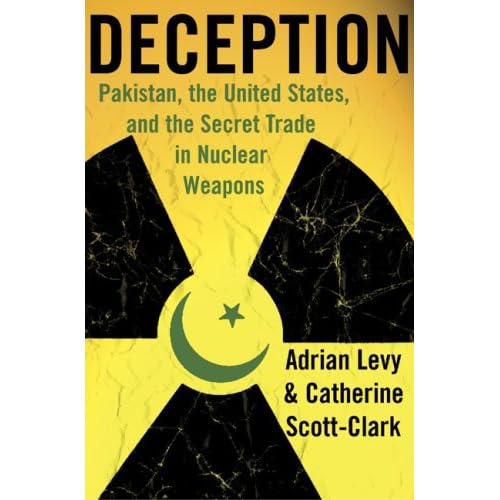

Before I turn to the main event, a little background is in order:

November 2007
... Abdul Qadeer Khan is such a compelling figure that three teams of investigative reporters have come out with books on him this fall. While differing in emphasis, they arrive at some important, common conclusions. Together, they dispel any notion that Khan was an independent actor or that he operated on the fringes of legality, beyond Pakistani government control.

They also show that U.S., British and other intelligence services knew a great deal about him. Most damning, they provide evidence that Khan's operation could have been shut down in the '70s or '80s -- long before this bitter, egomaniacal physicist was able to provide nuclear technology to Iran, Libya, North Korea and possibly other state and non-state actors.

Instead, successive U.S. administrations turned a blind eye to Khan's network in return for short-term favors from Pakistan, first in funneling arms to the mujaheddin combating the Soviet occupation of Afghanistan and, after 9/11, in helping with the global war on terror. ...
With that refresher course out of the way, I am highlighting a passage in the following article that provides specifics about Pakistan's economic dependence on the United States. So this is the country the Obama administration wants to use to help "stabilize" Afghanistan --

US aid fuels dangerous deal in Pakistan
By Selig S. Harrison
The Boston Globe
June 29, 2010

With one hand Pakistan scoops up its multiplying millions in US aid. With the other, it buys nuclear reactors from China that will give it the capability to add 24 nuclear weapons per year to its estimated existing arsenal of 70 to 90.

The Obama administration is focused narrowly on the Islamist threat in Pakistan. It has soft-pedaled its opposition to Islamabad’s $2.4 billion, US-subsidized purchase of two 635 megawatt reactors from Beijing for its plutonium production complex at Chasma. But precisely because Islamist forces are expanding, the United States should refocus on the growing danger that Islamist sympathizers in the armed forces and their intelligence agencies will once again make Pakistan a nuclear rogue state.

It was only six years ago that Pakistan’s nuclear czar, Abdul Qadeer Khan, was arrested for running a global nuclear Walmart that enabled Iran, North Korea, and Libya to start their nuclear programs. The CIA and the International Atomic Energy Agency are still barred from questioning him because the Pakistan Army fears that he would expose the role played by high-level military officers in colluding with him and in profiting from what he did.

Several confidantes of Khan have told me that he is ready to name names. In their study of the Khan scandal, Adrian Levy and Catherine Scott-Clark concluded that Khan was “the fall guy. This covert trade in doomsday technology was not the work of one man, but the foreign policy of a nation and supervised by Pakistan’s ruling military clique."

With the Khan case still in limbo, the acquisition of more plutonium reactors on top of Islamabad’s existing uranium-based nuclear program is alarming. The Obama administration expressed pro forma opposition to the Chasma deal at the New Zealand meeting last week of the Nuclear Suppliers Group, a 46-nation global nuclear watchdog agency. But the United States is not using its massive aid leverage to block it, despite the fact that US aid is subsidizing the deal.

Pakistan’s economic solvency rests largely on US financial support. In addition to earmarked economic and military aid and US-backed international Monetary Fund credits, US aid has included $10.5 billion in cash payments to the armed forces that are nominally to reimburse counter-terrorism activities but go into the general budget and can be diverted without US oversight to other uses. Pakistan’s foreign debt is nearing $15 billion, and it is only because a US orchestrated aid consortium keeps rescheduling the debt that Pakistan remains afloat economically.

Although the Chinese-built reactors at Chasma will be under IAEA safeguards, Pakistan’s Kahuta uranium enrichment plant and another plutonium reactor at Khushab are not under safeguards and are used for its nuclear weapons program. The Suppliers Group bars nuclear exports to countries that have not placed all their nuclear facilities under IAEA inspection. Nevertheless, Beijing argues, Pakistan should be given an “exception’’ for the Chasma reactors because India was given one two years ago.

Both India and Pakistan have refused to sign the Nuclear Non-Proliferation Treaty. India, however, has maintained strict controls on the export of nuclear technology, in accordance with NPT guidelines, and for this reason was given an “exception’’ to facilitate implementation of the 2008 US civilian nuclear cooperation agreement with New Delhi. By contrast, Pakistan has the most egregious record of trampling non-proliferation norms of any country.

Pakistan, like India, needs nuclear power for electricity, and hopefully, its future evolution will some day reduce the risks of a civilian nuclear program. But for the foreseeable future, the risks of adding to its nuclear capabilities are unacceptable. The repeated Islamist attacks on Pakistan’s nuclear installations in recent years make clear that the leakage of fissile material and of the components of its nuclear weapons is a clear and present danger despite IAEA safeguards.

The United States should aggressively seek China’s expulsion from the Suppliers Group unless it cancels the Chasma deal. It should condition new aid to Pakistan on the termination of nuclear purchases from China, unfettered access to Khan, the full disclosure of hitherto-suppressed details of his nuclear transfers and the removal of his collaborators from Army positions related to nuclear security.

Pakistan poses many dangers to the United States, notably its aid to Taliban insurgents in Afghanistan and the use of its territory for the training of would-be suicide bombers. But the greatest of all is that fissile material will be smuggled out of its nuclear facilities by undetected Islamist sympathizers and that a future leadership infiltrated by Islamists will risk a nuclear Armageddon in Mumbai or Washington.

Selig S. Harrison is director of the Asia Program at the Center for International Policy and the author of five books on South Asia.

Wednesday, July 21

Shirley Sherrod Affair: American post-racial prez plays race card to save his butt

"Tainting the Tea Party movement with the charge of racism is proving to be an effective strategy for Democrats. There's no evidence that the Tea Party adherence are any more racist than other Republicans and indeed many other Americans. But getting them to spend their time purging the ranks and having candidates distance themselves should help Democrats in November, having one's opponent rebut charges of racism is far better than discussing joblessness."
-- Mary Francis Berry, former chair, U.S. Commission on Civil Rights

For readers outside the USA: Ms Berry is black and given that she was appointed to chair the commission by President Jimmy Carter, then by President Bill Clinton, it's a safe bet she has voted the Democratic ticket all her voting life and wouldn't be caught dead supporting a candidate favored by any Tea Party or GOP faction.

This is by way of saying that Berry's observations were not motivated by an agenda; she was simply calling things as she saw them. However, her analysis is only partly correct, as Shirley Sherrod inadvertently revealed in her reply to CNN's Tony Harris, when he asked why she'd left her employment at the USDA:
SHIRLEY SHERROD: Why am I out? They asked me to resign. And, in fact, they harassed me as I was driving back to the state office from West Point, Georgia, yesterday. I had at least three calls [from the USDA] telling me the White House wanted me to resign.
[...]
TONY HARRIS, CNN: So the pressure came from the White House?

SHIRLEY SHERROD: And the last one asked me to pull over to the side of the road and do it.

She said, "Well, Shirley, they want you to pull over to the side of the road and do it because you're going to be on Glenn Beck tonight.
Ms Sherrod wasn't on Glenn Beck that night; neither Glenn Beck's show nor any other FNC (Fox News Cable) show mentioned Sherrod or the controversy that led to President Barack Obama's latest Beck Panic Attack, until after she was forced out of the USDA. And it was actually Beck who came out with the most eloquent defense of Sherrod.

What to make of the latest chapter in the horror story called The Present State of American Politics? I say we throw the book at the Democratic and Republican parties and draft Glenn Beck for U.S. President.

Yes yes it's already on record that he doesn't feel qualified for the job. But I think he should stop hiding behind ADHD and substance abuse recovery and his latest excuse (he might be going blind) and give into pleas that he run for the office of U.S. president.

Behind Beck's media personality is a tough-minded businessman who was managing a radio station before he was out of his teens and who parlayed his radio and TV appearances into a multi-million dollar media empire.

No one understands the problems of America's families and small business owners bettter than Beck.

No one is better at standing up to bullies and exposing hypocrites than Beck.

No one is better at multi-tasking than Beck and nobody is a better judge of character and intelligence.

No one is better at rapidly assessing complex situations and quickly absorbing reams of data.

No one is better at clearly and quickly explaining hideously complicated economic and legislative issues to the general public.

No one is harder working than Beck.

No one is more eloquent at defending America and the rights of all Americans.

And nobody is better qualified at staying focused on the big tasks.

Even guilt-ridden, medicated and blind Glenn Beck would be a better U.S. President than all the prospective contenders among the Democrats and Republicans combined.

True, he has a very strange sense of humor; perhaps only Harpo Marx and Ernie Kovacs would have found his "A Plastic Frog Had to Die" routine inspired.

But then it takes a strange sense of humor to fully appreciate how the world's lone superpower nation ended up on its knees begging for its life from China's Communist Party.

And how the world's greatest democracy ended up a flunky for the Kingdom of Saudi Arabia.

Except that Beck never laughed about those things. He wept. And for that, he would be the president to lead an American renaissance and restore respect for the United States of America.

Tuesday, July 20

America's technocratic oligarchy: the greatest threat to U.S. democracy

From Zenpundit's review of Codevilla's very scary assessment:
[...] Claremont scholar and Boston U. international relations professor Angelo Codevilla has published in The American Spectator a very lengthy, often brilliant, sometimes meandering, essay that is part analysis, part cri de coeur, but primarily the most devastating attack on America’s emerging, bipartisan, technocratic oigarchy that I have ever read [...]

Our oligarchy is in its newborn infancy, but it is hungry for power, venal in its corruption, covetous of security, impatient of democratic accountability and intolerant of dissent.

Beware of legislative moves, cloaked in high-sounding phrases, to regulate speech, circumscribe criticism of public officials, grant police powers to private corporations like BP, tax farm the many to benefit the few, and generally exclude the public from important policy decisions by making citizen participation in governmental process more complex, opaque, indirect, financially burdensome and personally risky. [...]
Read the rest of Zen's review, excerpts from Codevilla's essay, and get links to the essay and several related topics here.

Monday, July 19

Prairie Taliban, and bureaucracy run amok at Kabul Conference

Miss P, re this passage from the CNN report on U.S. aid to Pakistan you quoted today:
The United States will also invest $100 million to expand access to credit for small and medium-sized businesses, and provide $50 million to support investments in innovation and technology projects, she said. The projects will be funded by the Kerry-Lugar-Berman Act that authorizes $7.5 billion in development aid to Pakistan over the next five years.
Wow - I wonder if I started a Taliban on the Prairie if we couldn't get some of those policies enacted in the USA? There's an irony that the only place the Obama administration supports entrepreneurship and small business start-ups is in Pakistan!

Mark Safranski
Zenpundit"

Dear Mark:
Be happy; at the rate the U.S. economy is going we'll soon be able to declare the USA an 'emerging economy' (the politically-correct way of describing a third-world country) and qualify for international development aid and dirt-cheap loans.

There are downsides, of course, when a country becomes an IC Project, as Afghans are learning the hard way. What follows is super-smart Kate Clark's highly informative report for the Afghanistan Analysts Network (ANN) on the IC's funding of the plan to reintegrate the Taliban into polite Afghan society.

Clark's droll sense of humor and pitch-perfect understanding of international bureaucrats hard at work managing the Natives makes it an almost painless read for those whose taxes are funding the circus.

(Clark's writings -- and the ANN site -- are well worth following on a regular basis. Check out ANN analyst Joanna Nathan's Afghanistan's Most Under-Reported Stories in 2009, which is still very useful for those trying to get a handle on what's happening inside the country.)

[Introduction]: AAN has seen and studied the – not yet public – Afghan government’s plan to reintegrate Taleban who lay down their arms. We also took a look at an earlier draft (see an earlier blog) and have been following the process since well before the London conference. Now comes the moment, at the Kabul Conference, when the foreigners will be asked to support – and fund - the Afghan Peace and Reintegration Plan - to the tune of three quarters of a billion dollars.

Kate Clark, AAN’s senior analyst, has been wading through the 80 page document to bring you her first impressions: that it is impossible to envisage this plan being actually implemented, but very easy to see how the money will get spent.


Kabul Conference (2) How to spend three quarters of a billion dollars
Posted: 19-07-2010 by Kate Clark

This plan has a lot of pillars – two sets alone on the first page of the Executive Summary – along with a plethora of objectives, initiatives, funding lines, oversight and funding mechanisms, co-ordinating bodies and implementers. Multiple layers of government are involved: twelve Ministries; governors, supported by new technical committees, provincial reintegration committees; district governors; a new High Peace Council and a Secretariat. Community bodies will be set up where they do not exist and there is room for NGOs and civil society groups to be part of the process, mainly by bidding for projects.

It is all so mesmerising that one almost misses the one mention of a discretionary budget line of $50 million for the President. Meanwhile, the sprinkling of references to women, victims, minority groups and civil society look added on. There are statements which are blatantly untrue, such as that the Plan was developed, “on the basis of the recommendations of the…Consultative Peace Jirga” (it was clearly developed well before the peace jirga) and plenty of pious wishes like, “The outcome and recommendations of the Consultative Peace Jirga reaffirmed that the goal is the same for all Afghans: to build a better future for ourselves and our children” (which surely is true the world over).

The Plan asserts that it is Afghan-owned, despite it being entirely foreign-funded and despite the fact that the British and parts of ISAF have had a strong hand in its formation (British tax-payers in particular might be keen to monitor its progress).

Getting to the end of this 80 page project document is a feat in itself. The language is at times opaque to the point where I wondered if others more used to project proposal jargon understood it any better: a diplomat, the head of an NGO agency with two decades’ experience and a former political officer – also found it dense. Nevertheless, this is an attempt at unpicking the core of what the Afghan government is proposing to its international donors on how to reintegrate Taleban.

In the first stage (Social Outreach, Confidence-Building and Negotiation) provincial and district governors lead the outreach to individuals and communities that want to reintegrate. They facilitate confidence building. Strategic communications convince people that, the “Afghan government is doing its best to bring lasting peace and stability to Afghanistan.” There are negotiations, conflict resolution and forgiveness (afwa) “between the Government, communities, victims and ex-combatants, as necessary.”

Once there are Taleban to reintegrate – now known as “reintegrees,” - the next stage can begin (Demobilisation): “Those who join the peace process will be demobilised through a social and political process that will begin with an initial assessment, vetting and weapons management and registration.” Immediate humanitarian assistance may be given and detainees released.

Stage Three (Consolidation of Peace) consists of needs assessment and a “menu of conflict recovery options” available to assist “communities, districts and provinces” (the emphasis is not on the individual reintegree). This will include (although not for everyone): improving access to basic services, literacy and civic education – including for women - and possibly using madrassas; study visits to Turkey, Egypt or Malaysia; vocational training(*) with apprenticeships and study stipends, Islamic Education (actually de-radicalisation, but the blander name presents no opportunity for anyone to argue that the aim might be to make anyone less zealous), training and employment in a new Public Works Corps(**) and Agriculture Corps, the later carrying out watershed management, irrigation, fence construction, reforestation and dealing with soil erosion; integration into the Afghan Security Forces and “community recovery programmes”.

How many watershed management trainers are there in the target provinces – Helmand, Baghlan, Khost, Nangarhar, Kandahar, Badghis, Kunduz and Herat – one wonders.

The authors of the Plan assert that the program is political, but its solutions to the insurgency are overwhelmingly economic – to do with jobs, training, etc. If the insurgency was mainly about jobs, this approach might be useful, but in that case, the already enormous outpourings of aid should have had their effect. And as aid often fuels conflict in Afghanistan (see Andrew Wilder’s research here), preparing to spend even more vast amounts of money may actually be a highly dangerous path to take.

If, on the other hand, the insurgency has strong political roots – to do with who has power, who is marginalised, to do with grievances with local and national government, as well as foreign forces – then this plan looks to be entirely on the wrong track. Research by both AAN (see here and here) and others (see Antonio Guistozzi’s edited book, Decoding the New Taliban: Insights from the Afghan Field Chischester/New York: Hurst/Columbia University Press and this report), including interviews with Taleban and Taleban supporters, indicate that abuses of power, such as land-grabs by the locally powerful, arbitrary arrests and torture by police and NDS, political marginalisation and corruption – and having foreign forces who search houses, kill civilians and wrongly detain people - are all powerful drivers of the insurgency.

Yet in this plan, Taleban wanting to come in from the cold will have to deal with the very people who may be most problematic for them – governors, district governors and “locally respected figures” – and their security will be in the hands of forces who may also be part of the problem.(***)

The one political issue in this plan is conflict resolution and there is a nod to the fact that, although shuras should be able to sort out most grievances between Taleban and their victims/communities, grievances between the Taleban and the government may need independent mediators. Even so, the impression strongly given is that most grievances are local and apolitical and that the solution is forgiveness (or relocation). There is no suggestion that government officials might be called to account for abuses of power.

Earlier drafts of this Plan were more explicit about these political issues. At London, the contribution of the Afghan government to fuelling the insurgency was brought up much more honestly and self-critically. This included references to ‘threats’ like ‘local bullies, using their weapons or their influential governmental positions [...] igniting public hatred, creating distance between the people and the government, and preventing the implementation of law and order’. It also mentioned civilian casualties and ‘warrantless’ house searches by NATO/ISAF troops as a major grievance – which are not mentioned in the new plan. ISAF has been given a very neutral supporting role.

Comparing different stages of the document, it looks like what was difficult for the Afghan state to implement – ie a change in its behaviour – has been dropped from the Plan, while all that is easy and beneficial – spending – has been left intact. If peace is about making compromises, the government of Afghanistan envisages making precious few, while enjoying many new ways of spending money.

Can the Plan even be implemented? It envisages a hugely complex, wide-ranging set of initiatives, an awful lot of money and a great deal of co-ordination. All of this happening in a war zone (remember the high hopes and long disappointments of the “government in a box” in Marjah) and by a state which has huge problems with officials pocketing money and what even ISAF officials have called the economic mafia which controls parts of the state. Will a government which can’t even manage to pay all its teachers across the country be able to set up and run all this? The authors of the plan admit that, “the programme will be particularly challenging because it will be initiated in the absence of a national peace agreement.”

Earlier grand attempts at demobilisation, disarmament and reintegration have not fared well, but foreign backers have proved all too ready to declare them successful, despite highly critical assessments. The international track record is not good on having the intelligence, information or interest to really monitor where its money goes – and yet this all looks crucial if the Plan is to have the slightest chance of even small success.

(*) Just to give you a flavour of how language, in this case management-speak is used to add weight to some of the more fantastical suggestions, the private sector, we are told, will take time to provide jobs in insecure areas, but “MoLSAMD will continue to build its capacity to conduct local private-sector market serveys and to develop market-driven vocational training, especially at the district level. MoLSAMD, as well as private training entities and NGOs will be eligible to bid for provincial and national vocational training projects that contribute to sustained long-term peace and reintegration as identified by the provincial and district peace and reintegration committees. ”

Meanwhile, (**) the Public Works Corps will be a, “public-private partnership that supports the National Transport Strategy. MoPW is developing a corporate model of delivery whereby it delivers performance-based program management, policy and regulation and contracting and the private sector will deliver programmes.”

(***) Oh and for any of our fellow geeks who likes to keep an eye out for new types of state security forces, a new kid (with a new acronym) makes his first publicish appearance on the block – the Ministry of Interior’s Public Protection Police, known as MoI-PPP for short) will support district, village-level stability and security. It will be “American funded” and it is not a “militia”.

I believe the operative term is "quisling"

CNN - July 19: U.S. Secretary of State Hillary Clinton announced a major aid package for Pakistan on Monday -- with hundreds of millions of dollars pledged on projects to address the country's water and power shortage, and its floundering economy. ...
The projects, which Clinton called "long-term investment in Pakistan's future," include the construction of several dams, improvements to hydroelectric power plants and the country's power grid, and the construction or renovation of three medical facilities.

The United States will also invest $100 million to expand access to credit for small and medium-sized businesses, and provide $50 million to support investments in innovation and technology projects, she said. The projects will be funded by the Kerry-Lugar-Berman Act that authorizes $7.5 billion in development aid to Pakistan over the next five years.
New York Times - July 18:
... [Pakistani's tax] rules say that anyone who earns more than $3,488 a year must pay income tax, but few do. Akbar Zaidi, a Karachi-based political economist with the Carnegie Endowment, estimates that as many as 10 million Pakistanis should be paying income tax, far more than the 2.5 million who are registered.

Out of more than 170 million Pakistanis, fewer than 2 percent pay income tax, making Pakistan’s revenue from taxes among the lowest in the world, a notch below Sierra Leone’s as a ratio of tax to gross domestic product. ...

Much of the tax avoidance, especially by the wealthy, is legal. Under a 1990s law that has become one of the main tools to legalize undocumented — or illegally obtained — money made in Pakistan, authorities here are not allowed to question money transferred from abroad. Businessmen and politicians channel billions of rupees through Dubai back to Pakistan, no questions asked.

“In this country, no one asks, ‘How did you get that flat in Mayfair?’ ” said Shabbar Zaidi, a partner at A. F. Ferguson & Company, an accounting firm in Karachi, referring to an affluent area of London. “It’s a very good country for the rich man. Chauffeurs, servants, big houses. The question is, who is suffering? The common man.”

Then there are the tax-free goods supposedly meant for Afghanistan. Mr. Zaidi said much stayed in Pakistan illegally, including 50,000 tons of black tea that were imported last year. Afghans drink green tea.

“As per our information, not a single cup of black tea was drunk in Afghanistan,” he said. ...

[Akbar] Zaidi blames the United States and its perpetual bailouts of Pakistan for the minuscule tax revenues from rich and poor alike.

“The Americans should say: ‘Enough. Sort it out yourselves. Get your house in order first,’ ” he argued. “But you are cowards. You are afraid to take that chance.” ...
Now now, Mr. Zaidi, it's not helping anything to fling around wildly inaccurate insults. I always find that the more precisely one can describe a problem the more readily the solution presents itself. So let's see if we can't find a more descriptive term than "coward."

To the best of my knowledge, never before in the annals of warfare has a government aided and abetted an enemy force in the murder of the government's own troops and done this as a matter of policy. This is precisely what the American government has done, considering its collaboration with the Pakistan military, which supports Taliban that are making war on U.S. and other ISAF troops.

How to describe the kind of people who carry out such a policy? 'Coward' doesn't quite cut it, does it? Of course there's the all-purpose 'fiend,' but the term is so over-used these days and anyhow it's not very precise. Given that the situation I described seems unique it'd be nice if we could concoct a new term from the Latin or ancient Greek but I think we might make do with "quisling."

That might also be a fairly accurate term to apply to Graeme Lamb. From Patrick Cockburn's July 17 report for the (U.K.) Independent (via RAWA):
... With the war reaching a stalemate over the last year, Afghan and foreign leaders have prepared the ground for talks with insurgents by claiming they are more moderate and pragmatic than the Taliban government overthrown in 2001.

The head of the International Security Assistance Forces [ISAF] reintegration unit, Lt-General Graeme Lamb, said: "Who are these Taliban? They are local people. The vast majority are guns for hire; not fighting for some ideological reason."

The idea that the present day Taliban is less hostile to women than the old is contradicted by the experiences of women in Taliban-held districts. A report by Human Rights Watch – based on interviews with 90 women in districts largely held by insurgents in four different provinces – shows that women are being deprived of all rights.

The report, entitled The 'Ten Dollar Talib' and Women's Rights: Afghan Women and the Risks of Reintegration and Reconciliation, is released this week. It says the belief that new Taliban has emerged influenced by money rather than ideology is wrong.

It criticises the idea of the "Ten Dollar Talib" who fights for money, as an attempt by US and Nato forces to make power-sharing with them more palatable to western audiences who had previously been told they were an enemy to be defeated. Hostility to women is shared by other insurgent leaders as well as the Taliban. The strongest rebel force in the provinces south of Kabul is the Hezb-i-Islami, which Western and Afghan leaders have spoken of as a group that might be tempted to join the government.

The movement's leader is Gulbuddin Hekmatyar, whose first political act was reportedly to throw acid in the faces of unveiled female students at Kabul University in the early 1970s.

The HRW report is the first time that repression of women in Taliban- controlled areas in Afghanistan has been systematically studied. All the women interviewed – who are referred to by pseudonyms for safety reasons – said they had lost freedoms. In some cases, women have been killed.[...]
There was nothing to prevent Mr Lamb from ascertaining for himself what it took the HRW survey to bring to the fore, was there? But with POPCOIN (population-centric counterinsurgency) warfare a dismal failure in Afghanistan, it seems that the NATO command and the governments overseeing it decided that collaboration with the Taliban was the only recourse.

And yet there's something odd about the failure of POPCOIN in Afghanistan; you see, the basic tenet of the approach is that it first requires using adequate force of arms to provide security to the population.

If you say, 'That's what the troop surge Obama ordered is supposed to accomplish' -- that's what I assumed, until I read this passage from Mark Safranski's June 3 review of Sebastian Junger's book WAR, which documents a year Junger spent with the 2nd Platoon of Battle Company of the 173rd Airborne Brigade in Afghanistan's Korengal Valley:
What comes through in WAR, aside from the extremity of the terrain and the uncertainty of ever-present danger, men being shot without warning by the enemy ... is how very few men are actually involved in combat.

Battle Company is the vaunted “tip of the spear” but when only a few hundred men were taking a wildly disproportionate percentage of all combat contacts in a nation the size of Afghanistan (Junger cites 20 %) the spear begins to look more like a tiny sewing needle connected to a Leviathan-like noncombatant-administrative tail, surreally outfitted with fast food courts.
The observations caused me to recall Ann Marlowe's repeated assertions on John Batchelor's radio show in 2009 that from all she saw firsthand more combat troops weren't needed in Afghanistan; that instead the troops already in country needed to be better deployed.

An analysis of troop deployments is outside my purview but Marlowe's remarks; the passage I cited; and that odd business in 2007, when Afghanistan's secret service caught the British red-handed trying to set up training camps for Taliban fighters, raise the question of just how much enthusiasm there was on the part of ISAF to rout the Taliban.

This returns me to U.S. financial aid to Pakistan, and Sabrina Tavernise's report for The New York Times on taxes:
ISLAMABAD, Pakistan — Much of Pakistan’s capital city looks like a rich Los Angeles suburb. Shiny sport utility vehicles purr down gated driveways. Elegant multistory homes are tended by servants. Laundry is never hung out to dry.

But behind the opulence lurks a troubling fact. Very few of these households pay income tax. That is mostly because the politicians who make the rules are also the country’s richest citizens, and are skilled at finding ways to exempt themselves.

That would be a problem in any country. But in Pakistan, the lack of a workable tax system feeds something more menacing: a festering inequality in Pakistani society, where the wealth of its most powerful members is never redistributed or put to use for public good. That is creating conditions that have helped spread an insurgency that is tormenting the country and complicating American policy in the region.

It is also a sorry performance for a country that is among the largest recipients of American aid, payments of billions of dollars that prop up the country’s finances and are meant to help its leaders fight the insurgency.

Though the authorities have tried to expand the net in recent years, taxing profits from the stock market and real estate, entire swaths of the economy, like agriculture, a major moneymaker for the elite, remain untaxed.

“This is a system of the elite, by the elite and for the elite,” said Riyaz Hussain Naqvi, a retired government official who worked in tax collection for 38 years. “It is a skewed system in which the poor man subsidizes the rich man.” ...
A skewed system propped up by quislings.

Saturday, July 17

Pregnant Chinese travel to USA to obtain US citizenship for baby

U.S. officials confirm it is not a crime to travel to the United States to give birth so that the child can have U.S. citizenship. "You don't deny someone because you know they're going to the U.S. to have children," said a U.S. Embassy spokesman in Beijing.

Of course you don't deny "someone." This is not a case of individual couples deciding to have their baby in the USA. This is an industry, and industry in China is backed and overseen by China's government.

From The Washington Post today:
SHANGHAI -- What can $1,475 buy you in modern China? Not a Tiffany diamond or a mini-sedan, say Robert Zhou and Daisy Chao. But for that price, they guarantee you something more lasting, with unquestioned future benefits: an American passport and U.S. citizenship for your new baby.

Zhou and Chao, a husband and wife from Taiwan who now live in Shanghai, run one of China's oldest and most successful consultancies helping well-heeled expectant Chinese mothers travel to the United States to give birth.

The couple's service, outlined in a PowerPoint presentation, includes connecting the expectant mothers with one of three Chinese-owned "baby care centers" in California. For the $1,475 basic fee, Zhou and Chao will arrange for a three-month stay in a center -- two months before the birth and a month after. A room with cable TV and a wireless Internet connection, plus three meals a day, starts at an additional $35 a day. The doctors and staff all speak Chinese. There are shopping and sightseeing trips.

The mothers must pay their own airfare and are responsible for getting a U.S. visa, although Zhou and Chao will help them fill out the application form.

At a time when China is prospering and the common perception of America here is of an empire in economic decline, the proliferation of U.S. baby services shows that for many Chinese, a U.S. passport nevertheless remains a powerful lure. The United States is widely seen as more of a meritocracy than China, where getting into a good university or landing a high-paying job often depends on personal connections.

"They believe that with U.S. citizenship, their children can have a more fair competitive environment," Zhou said.

There are no solid figures, but dozens of firms advertise "birth tourism" packages online, many of them based in Shanghai, and Zhao said the number has soared in the past five years. But he said that many are fly-by-night operations, unlike his high-quality service.

The customers we serve are very successful and very affluent," he said.

Zhou and Chao insist that everything they do is legal, noting that the 14th Amendment to the U.S. Constitution, passed in 1868, says anyone born on U.S. soil has the right to citizenship.

"We don't encourage moms to break the law -- just to take advantage of it," Zhou said. "It's like jaywalking. The policeman might fine you, but it doesn't break the law."

"We are not snakeheads," he added, using the common term here for Chinese gangsters involved in smuggling illegal immigrants.

U.S. officials confirm it is not a crime to travel to the United States to give birth so that the child can have U.S. citizenship. "You don't deny someone because you know they're going to the U.S. to have children," said a U.S. Embassy spokesman in Beijing, who spoke on the condition of anonymity, citing embassy rules.

The spokesman, who said expectant mothers typically claim they are going to the United States as tourists, compared the baby consultancies to services that help foreign students apply for American universities: "If you have the money, they give you the service. They tell you how to prepare your dossier."

"I'm sure people in Congress would call it a loophole," the spokesman said.

Many anti-immigration activists in the United States agree. Some argue that the 14th Amendment -- aimed at guaranteeing citizenship rights to freed black slaves -- was never meant to provide an instant passport to the children of people who are in the country illegally or who travel there expressly to gain U.S. citizenship for their child.

The Department of Homeland Security and the State Department have no specific regulations regarding pregnant foreign visitors, which critics see as an issue.

"The problem here is not with the travel agencies or even the women," said Mark Krikorian, executive director of the Washington-based Center for Immigration Studies. "The real problem is the State Department. The regulations do not permit them to turn pregnant women down."

Krikorian said that it is unclear whether or how the 14th Amendment could be changed and that in any event, Congress has never seriously addressed the possibility.

Zhou, a former marketing director, and Chao, a former television producer in Taiwan, said they have helped between 500 and 600 mothers give birth to American babies in the five years they have been in business. They started with themselves, when Chao went to the United States to give birth to their daughter Fiona, now 4.

Now, they said, their clients include Chinese doctors, lawyers, business leaders, government officials, well-known media personalities -- most of whom do not want media attention and, Zhao said, would not agree to be interviewed.

About 40 percent of their clients come from Shanghai, 30 percent from Beijing and the rest from Guangzhou and elsewhere, including Taiwan. Some, the couple said, were giving birth to their second child to skirt China's one-child policy. Most say they do not intend to live in the United States themselves. [...]

Friday, July 16

Well, I see it's time to impeach Manmohan Singh. (UPDATED July 19 and 22)

UPDATE July 22
From his Wednesday post it's clear B. Raman took another look at the fallout from S.M. Krishna's embassy to Pakistan and came up with a conclusion that I find to be quite different from his initial opinion (which so upset me; see the post below). This time he's on the money, with criticism for G. K. Pillai's loose lips, and for Krishna's pursed lips in the face of S. M. Qureshi's grandstanding. Raman also rightly criticizes Krishna for his publicly blaming Pillai. Pillai certainly deserves blame, but this should have been done behind closed doors.

All in all it's a complete mess, but I still think the buck stops at the PM's desk.
UPDATE July 19
An Indian reader wrote:
We don't usually impeach our prime ministers - just throw them out of office via a Vote of No Confidence in parliament. I daresay if Mr Singh gets thrown out, it will be because of the ~10% inflation or the ~18% food price inflation we've had for more than a year now, before he gets thrown out for screwing up on Pakistan. Sugar prices appreciated ~100% in a couple of months timeframe earlier this year, lentils went up ~200% and so on and so forth. The ability to screw up on Pakistan seems to be a criteria for qualification to become prime minister ...
I delved more deeply this weekend into the contretemps between Pakistan and India's foreign ministers; it could be there's a backstory the public isn't privy to.
*************************************
"Uncertain about its goals and ever-eager to appease, India has allowed a failing state one-seventh its size to smother it."

It's interesting how much Pakistan's regime gets away with. They are helped at every turn by government leaders in foreign countries whose behavior encourages the regime to keep getting away with murder. Yet in the case of India such behavior is suicidal.

Indian Prime Minister Manmohan Singh's government claims to have evidence that Pakistan's intelligence service, ISI, directed the 26/11/08 terrorist attack on Indian civilians in Mumbai. Why, then, would Singh direct his foreign office to engage in 'trust-building' talks with counterparts in Pakistan's government? If you're so damned certain that a government has launched a terrorist attack on your soil, why go to that country for tea and crumpets? Just showing up for the 'trust-building' dialogue suggests you don't take your own accusations seriously.

The only consequence of note to emerge from the diplomatic initiative, which played out yesterday, is that Pakistan's Foreign Minister, Shah Mehmood Qureshi, grandstanded. Frankly, Qureshi was entitled to play drama queen; he was doing the right thing: staunchly defending his country's interests. He made India's Foreign Minister, S. M. Krishna, look cold-blooded to the point of creepy -- although that hardly needed assistance.

There is indeed something creepy about the way Krishna worked mention of 26/11 into the discussion -- as if the massacre was simply a bargaining chip.

I note that B. Raman, one of my favorite counterterrorism analysts, who worked for the Indian government for many years, showed the same attitude in his post about the initiative:
... The objective of the meeting as agreed to by Prime Minister Dr. Manmohan Singh and the Pakistani Prime Minister at their meeting at Thimpu in the margins of the SAARC summit ( April 28-29) was to create an atmosphere of trust between the two countries to facilitate the resumption of a formal dialogue on various pending issues. The proposed objective of the meeting as laid down by the two Prime Ministers was strategic, positive and forward-looking and not tactical and negative impeding a forward movement in bilateral relations.

One got the impression that instead the two Foreign Ministers had focussed totally on tactical issues without doing a brain-storming on various actions that could be taken to build trust. ...
But you can't have a positive and forward-looking dialogue with a government that you believe has murdered your citizens in cold blood, and which consistently practices deception and denial about their aggression.

The rest of Raman's post is taken up with a discussion of technical diplomatic maneuvers. Yet Raman was devastated by the Mumbai massacre; he took it very personally because of his years of work at India's R&AW intelligence agency; he even wrote a book about 26/11. And many times on his blog he has called out Pakistan's regime on the issue of their involvement in the massacre. And he has never once been fooled by the machinations that the Obama administration has deployed against Delhi. But on the matter of India's diplomacy with Pakistan's government, Raman's July 15 post makes Neville Chamberlain sound like Churchill.

It's almost as if technocrats in the Indian government consider it unseemly to wrestle in the mud with Pakistan's regime. But even the United Nations, which has always bent over backward to avoid criticizing Pakistan's military-backed regime, came out swinging against the ISI in their April 2910 report on Benazir Bhutto's assassination. The panel convened to investigate her death showed more clarity about the key issue of Pakistan's sponsorship of terrorism than India's government -- a major victim of the terrorism!

Rajeev Srinivasan's July 13 op-ed for DNA, titled India's Strategic Blunders, underscores the Indian government's self-defeating approach to Pakistan, which invites Islamabad to continue their covert war against India:
Several distinct but related events have shown that India’s alleged Pakistan policy is either non-existent or self-defeating. First, there is the all-but-complete transfer of two 635-mw Chinese nuclear reactors to Pakistan, which will allow them to build 24 more nuclear bombs every year in addition to their existing stockpile of 70-90, already bigger than India’s.

Second, the violence in Jammu and Kashmir is a direct result of the decision by the government to withdraw 30,000 troops. Third, the apparent willingness by Afghan president Hamid Karzai to cooperate with the intensely anti-India Haqqani network implies the total failure of India’s efforts to be a stakeholder in that nation.

China has simply ignored the proforma noises that the US made at the Nuclear Suppliers’ Group regarding likely weapons proliferation because of the new reactors being transferred to Pakistan. Selig Harrison, writing in The Boston Globe, pointed out how proliferation is part of Pakistani national policy. Despite this, and despite all the government of India’s exertions to ram the so-called ‘nuclear deal’ down India’s throat, America has no qualms about the Pakistani stockpile.

Thus the dubious nuclear deal has had the effect of strengthening Pakistan’s hand, while constraining India’s puny efforts at building a deterrent against China, exactly as opponents of the deal said, while the government proceeded with it in a haze of lies and subterfuge.

Second, the sudden upsurge of violence in Jammu and Kashmir is almost certainly a calibrated and calculated ratcheting up of tension by the ISI. Intercepted phone calls suggest that the ISI and pals like the LeT are paying ‘rage-boys’ to indulge in stone-throwing and other violence, expecting to induce over-reaction by the stressed-out paramilitary troops and police. This, then, can lead to manufactured ‘martyrs’.

The ISI has reason to believe it is on a winning track. Statements by the prime minister in Havana, Sharm-el-Sheikh and Thimphu have implied that, succumbing to American pressure, India is willing to make concessions on Kashmir to Pakistan, the only issue being how to market such a climbdown to the Indian public.

The coded talk of ‘creative solutions’ and ‘trust deficit’ have been interpreted by the Pakistanis as a ‘deficit of will’, and the likelihood that they can make J&K simply too expensive for India to hang on to. The proximate cause is the withdrawal of 30,000 troops. To the ISI, this spells “we have the UPA on the run”. They perceive a ‘backbone deficit’ and lack of will.

Intriguingly, this is almost the same feeling that the ISI has about the Obama administration after its disastrous declaration of a timetable for withdrawal from Afghanistan. They, and their proxy, the Taliban, feel that all they have to do is to wait things out — the Americans have no will to fight. Apparently president Karzai implicitly believes this — witness his alleged overtures to the Taliban and the Haqqani network. Karzai, Taliban and Haqqanis are all Pashtuns. [1]

Pashtuns account for about 40% of the Afghan population, with large groups of Tajiks, Uzbeks, and Hazaras among others. India has traditionally had good relationships with the Pashtuns but even better ties to the Tajiks, who, under the charismatic military genius Ahmed Shah Massoud of the Northern Alliance, held off the Soviets and then the Taliban.

Now all the blood and treasure — hundreds of millions of dollars — that India has poured into reconstruction efforts in Afghanistan seem to be in jeopardy because the Pakistanis have convinced the US and others that India has no business whatsoever in Afghanistan. India was not even invited to talks about that nation.

The irony is that the Pashtun issue is one of Pakistan’s key weaknesses — the Durand Line arbitrarily divides Pashtun territory into Afghanistan and Pakistan. Pashtuns themselves have never recognised it, and if given a chance, would create an independent Pashtunistan on both sides of the Durand Line.

This, of course, would be disaster for Pakistan, as it might induce restive Baluchis and Sindhis to secede as well. In fact, some analysts suggest just such a balkanisation to solve the Pakistan problem.

Somehow, the enterprising ISI has turned this weakness into a strength, by hijacking the Pashtun elements into their proxy Taliban. Similarly, the ISI, which faced the wrath of America after 9/11 with its peremptory warning to president Musharraf to behave, or else, has turned it into a $25 billion bonanza. Ironically, the Americans are in effect subsidising the Pakistani purchase of Chinese reactors!

Instead of containing Pakistan with a pincer movement with one front in Afghanistan, India is now in the unenviable situation that the ISI has achieved the ‘strategic depth’ it has always craved.

Uncertain about its goals and ever-eager to appease, India has allowed a failing state one-seventh its size to smother it. Lack of strategic intent has led to dismal failure yet again.
1) Karzai vehemently denied to General David Petraeus that he held negotiations with the Haqqanis; see The Alienation of Hamid Karzai, which I linked to yesterday, for why I'm weighted to believe him. However, given his desperation about the Obama administration's clear intent to cut and run from Afghanistan, I wouldn't put it past Karzai to have started a rumor he was negotiating with the Haqqanis. In any event the rumor certainly got a rise out of Washington.

Thursday, July 15

He ain't heavy, he's my genocidal, hallucinatory, two-faced 'ally'

Earlier this month the Chairman of the Joint Chiefs of Staff, Admiral Michael Mullen, twisted his mouth into the shape of a pretzel to explain why it was okay for the U.S. to support Pakistan's nuclear arsenal but not okay to support North Korea's arsenal and Iran's nuclear ambitions. He also saw no problem with the United States as much declaring war on India when he sympathized with Pakistan's need to use nuclear weapons against India in order to feel safe.

Then Americans wonder why Pyongyang and Tehran laugh at Washington's lectures on nuclear proliferation. The leaders of both regimes have been doing clandestine nuke business with Pakistan for decades. They know Pakistan is the biggest nuclear weapons proliferator on the planet -- and so does Mullen, who is the highest ranking military officer in the USA and as such is the principal military advisor to the President of the United States, the National Security Council, and the Secretary of Defense.

That's not the half of the double standard America has practiced with regard to Pakistan. Barely a day goes by that the American news media doesn't warn of the dangers of a nuclear-armed Iran because of the regime's end-of-time religious views, which American news analyst John Batchelor has termed "hallucinatory."

It doesn't get more hallucinatory than the views of Pakistani media mogul, Majeed Nizami, the owner of the Nawa-i-Waqt, The Nation, and Waqt TV channel. During a recent speech at a function given in his honor he declared that Pakistan's missiles and nuclear bombs were superior to "India's ghosts," and that unleashing nuclear war against India was imperative. "Don't worry if a couple of our cities are also destroyed in the process."

That would be the same Nation newspaper that cites the United States government as being behind every terrorist incident in the world, including the Times Square attack.

If you think Nizami is an isolated nut case, you don't know much about him, or Pakistan. He is the true face of the most powerful factions in Pakistan including its military leaders.

But in the view of the U.S. government and news media it's okay for Pakistan's military to hold hallucinatory views whereas it's not okay for Iran's leaders because, well, because.

It's the same for anti-Semitic views that abound in Pakistan. In the same article that discussed Nizami's view that nuclear Armageddon was the ticket to peace in South Asia, Pakistani journalist Shakil Chaudhary reported on a June 18 column in Nizami's Nawa-i-Waqt paper in which Lt. Gen. Abdul Qayyum (ret), former chairman of Pakistan Steel Mills, approvingly quoted Adolph Hitler as saying: "I could have annihilated all the Jews in the world, but I left some of them so that you can know why I was killing them."

Qayyum also cited as factual the infamous Franklin Forgery, in which Nazi propagandists put anti-Semitic statements in Benjamin Franklin's mouth.

But publishing anti-Semitic lies is perfectly okay in Pakistan as far as the American government and news media are concerned -- whereas it's not okay for Iranian hate-mongers to cite as established fact the anti-Semitic forgery Protocols of the Elders of Zion.

Then Americans wonder why Iran's leaders smirk when they hear the American government accuse them of trampling human rights and institutionalizing anti-Semitism.

As to the bone-cracking pressure that the United States has been applying to other governments in the effort to dissuade them from trading with Iran -- Pakistan's gas pipeline deal with Iran was the exception. The U.S. government perfectly understood why Pakistan would need the deal and the only worry was that Pakistan might be hurt if caught up in the sanctions the United States.

That's not the half of it. A few days ago the American news media decried the savagery of Iran's government regarding the sentence handed down to stone to death an alleged Iranian adulterer. The 'international community' also set up such a yowl that the government stayed, at least temporarily, the sentence.

Where are the yowls from the American news media and international community about government-sanctioned stoning deaths for the same charge in Pakistan? Only a small handful of American blogs (e.g., Jawa Report and Jihad Watch) have reported on the situation -- reports that have never made it into the electronic and print media in the United States.

At least Iran (and Somalia, which also carries out stoning sentences) can blame its tribal bumpkins, as one Iranian democracy activist termed Iran's rural population, for clinging to the practice of stoning. But a 2009 Pew survey of public opinion among mostly *urban* Pakistanis found they supported the death sentence of stoning for adultery. That's the not the half of it:
... One of the ironies in the survey is the extent to which Pakistanis embrace some of the severe laws associated with the Taliban and al Qaeda, even as they reject Islamic extremism and these extremist groups. The new poll finds broad support for harsh punishments: 78% favor death for those who leave Islam; 80% favor whippings and cutting off hands for crimes like theft and robbery; and 83% favor stoning adulterers.
There is no irony; Pew interprets its data too narrowly when it reports that a majority of Pakistanis reject extremism. According to the findings, a majority of Pakistanis surveyed (71%) favored giving power to "religious" (i.e., Sharia) judges. Pakistanis reject extremism only when it has a suicide vest strapped to it and it's blowing them up in their own country.

And given the death sentence for blasphemy and other infractions of religious code that Pakistan's 'civil' society supports, it's pretty much a moot point whether the judges mete out civil or Sharia justice. Yet none of this has surfaced in the U.S. news media and the U.S. government has had not a word to say about it.

And while it's not okay for Sudan's government to carry out massacres that have been termed genocide (or democide; take your pick), the U.S. has never seen anything wrong with Pakistan instigating massacres of Kashmir's Hindus, Muslim Bengalis in Pakistan, and Afghanis.

I could spend the rest of the day providing examples of the double standard that the United States practices with regard to Pakistan but to sum: When it comes to human rights, nuclear proliferation, religious intolerance, and repressive measures against democracy, the only significant difference between Iran and Pakistan is that the United States covers for Pakistan whereas it doesn't for Iran.

Anyone who claims that the double standard is rooted in the U.S. government's need to stay on good terms with Pakistan because of the war in Afghanistan is either lying or misinformed. This covering for Pakistan's government, and even aiding and abetting its predatory, genocidal ways and constant war against Pakistanis who seek to bring real democracy to the country, goes back more than 60 years. Even during the years that the U.S. placed official sanctions on Pakistan's regime, the U.S. was funneling it money through institutions such as World Bank.

To cover for Pakistan for that long has meant that the U.S. government has had to tell bigger and bigger lies, which the compliant American news media have passed along to the public.

Just one of the lies, which has been pushed hard during the past year in Washington and dutifully parroted by think-tank denizens and the news media, is that Pakistan's interest in Afghanistan is because of the need for 'strategic depth' against India. Pakistan's ex-Prime Minister/ opposition leader Nawaz Sharif made short work of the lie just a few days ago when he announced that Pakistan needed to stop meddling in Afghanistan's affairs.

I note he tactfully avoided explaining what 'strategic depth' in Afghanistan has always meant to Pakistan's regime, which is simply the rape of the country. After Russia pulled out of Afghanistan the United States turned a studiously blind eye while Pakistan's mafias stripped Afghanistan of everything that was not nailed down. That would include factories, the country's once abundant forests, and even telephone poles. Read Pakistani journalist and political activist Ahmed Rashid's Taliban for more on that angle.

Another whopper is that Afghanistan's President Hamid Karzai has embraced Pakistan and Iran and Pakistan's worst terrorist organizations. He has certainly turned to Iran for help and under extreme pressure from the United States reached out to Pakistan. But his support for the Peshawar Declaration is just one piece of evidence to show that he has never changed his mind about Pakistan's threat to Afghanistan.

If American readers have never heard of the declaration -- you wouldn't have heard about it, not from U.S. mainstream media outlets or even EU ones, all of which promote the NATO agenda. The only English-language mention of the declaration available to the Western public that I've seen is an op-ed by one of India's most experienced career diplomats, former Ambassador M K Bhadrakumar. He served in the Soviet Union, South Korea, Sri Lanka, Germany, Afghanistan, Pakistan, Uzbekistan, Kuwait and Turkey. In April of this year Bhadrakumar wrote for the Asia Times about The Alienation of Hamid Karzai in Washington:
... Obama should distinguish that it is the ISI and the Pakistani military whom Karzai (and the "warlords") considers to be his adversaries. His frustration is that the Americans are either far too naive to comprehend what is going on or are dissimulating since they are pursuing some "hidden agenda" in relation to the geopolitics of the region.

Karzai's alienation is widely shared by the Afghan elites in both Kabul and Peshawar. A grand tribal jirga was recently held in Peshawar just ahead of the US-Pakistan strategic dialogue of March 24, and was widely attended by noted Pashtun intellectuals, tribal leaders, politicians, professionals, civil society members, women's groups and representatives of established political parties of the North-West Frontier Agency.

Obama can always ask the American consulate in Peshawar for a report on the jirga. It will prove an eye-opener. Essentially, the jirga raised the widespread grievance that the Pashtuns do not trust Pakistan's Punjabi-dominated military establishment, which was leading the strategic dialogue with the US. The jirga alleged that the Pakistani military establishment's sole agenda is to attain "strategic depth" in Afghanistan and this lies at the root of the sufferings of the Pashtuns on both sides of the Durand Line.

The jirga issued the Peshawar Declaration, a statement which cautioned Washington that the root causes of terrorism lie in the Pakistani military establishment's "strategic depth" mindset and the Arab expansionism embodied by the al-Qaeda under the garb of global Islam.

It made an impassioned plea not to leave the helpless Pashtuns of the tribal agencies and the North-West Frontier Province at the mercy of the Pakistani army and the intelligence agencies.

In the prevailing circumstances, Karzai has no option but to turn toward Tehran for understanding and support. The Iranians have a profound understanding of the Afghan chessboard and can grasp the raging storms in the mind of the Pashtuns on both sides of the Durand Line. ...
Bhadrakumar, being a diplomat and all, was too polite to come out with the unvarnished truth, so I'll spit it out for him. The United States of America was planning on giving Afghanistan to Pakistan's murderous regime as a gift, in exchange for the hope that the regime would root out al Qaeda.

Then a volcano in Iceland erupted, and then there was an unusual weather pattern in Europe -- an extended 'blocking high' as meteorologists call it -- that kept large amounts of volcanic ash hanging over Europe. And then a reporter of perhaps not too sterling credentials ingratiated himself with General Stanley McChrystal.

And then, in the wake of the uproar about the reporter's story, the American public turned its eyes to Afghanistan and asked what the hell was going on over there in that country. Then the U.S. government, including the State Department and Pentagon, began to backpedal fast.

So if Afghanistan escapes the tender mercies of Pakistan's regime this time around, I guess you can file the entire affair under "Deus ex Machina." Because believe you me, given the duplicity of my government and cowardice of the American news media, it would take the intervention of God to save the Afghanis.

Tuesday, July 13

Moo Shu Pakistan

* Zardari and Hu sign six agreements but keep them secret
* China wants US to make Afghanistan into Pakistan's game preserve
* China uses Pakistan to work deals so they can avoid dealing with US in Afghanistan
* China wants US to make Afghanistan peaceful so China business can proceed there without trouble.
(VOA News) Analysts Say Pakistan is Beijing's Window on Afghanistan

Regional security analysts say a six-day visit by Pakistani President Asif Ali Zardari to China this week - his fifth since stepping into office - highlights the growing ties between the two countries. They say that in addition to providing a hedge against India in the region, Pakistan is Beijing's window on Afghanistan and its strategic interests in the war torn country.

For Pakistan, President Zardari's trip to China seems to be largely focused on drawing Chinese investment to the country.

On Wednesday in Beijing, Mr. Zardari met with Chinese business leaders from industries ranging from banking to defense. The president appealed for Chinese help in developing the country's energy sector and noted that the true potential of business opportunities between the two countries had yet to be realized.

Mr. Zardari and Chinese President Hu Jintao signed six agreements, but details were not made public.

Sumit Ganguly, a political science professor at Indiana University, says that while Islamabad is looking to Beijing to help build up its infrastructure and address its energy needs, China is looking to Pakistan to understand the future of Afghanistan.

"The Pakistanis recently have been talking to the Taliban and have been trying to convince President Karzai to reach an agreement with the Taliban as the U.S. prepares to withdraw in July 2011," he said.

Gangulay says that Pakistan would like to have a government that incorporates the Taliban in Afghanistan because Islamabad believes such a regime would be sympathetic to Pakistani interests.

"Karzai is under considerable pressure from the Pakistan to fold, and the Chinese are curious probably to know how exactly things will play out," he said. ...

Professor Gangulay says that Beijing's close relationship with Islamabad has helped China in Afghanistan and made it possible for the Chinese to avoid working with the U.S. government in any meaningful fashion.

"The Chinese are doing quite well in Afghanistan," he said. "They have managed to get lucrative contracts to extract copper and other mineral resources from Afghanistan. And as long as the Pakistanis have a substantial presence after the American withdrawal, why should they care about our [U.S.] interests?" ...
State and Pentagon, yer middle name is Chump. Pass the soy sauce.

Round up the usual suspects, work up the paperwork

AFP:
LAHORE, Pakistan — Pakistan's political heartland has ordered a crackdown on militants after a series of devastating attacks and accusations of links to banned groups, officials said Monday.

New Delhi and Washington have long demanded that Pakistan root out extremist Islamist militant groups that use its soil to launch attacks across the country, as well as in neighbouring Afghanistan and India.

But the details and scope of the apparent crackdown -- which comes just days before Pakistan is due to host India's Foreign Minister S.M. Krishna for talks in Islamabad -- were unclear.

"The government has ordered a policy of zero tolerance against all these groups. There are at least 2,000 to 2,200 activists of banned outfits being closely monitored in Punjab," police official Akram Naeem Bharoka told AFP.

"We have very clear instructions from the government that no outlawed organisation should be allowed to continue their activities in any part of the province," Bharoka said.

Asked how many people had been arrested and offices targeted, the senior official in Punjab police said only that figures were being compiled. ...

Monday, July 12

U.S. confidence-building measure for Pakistan's military: If it looks like treason and it quacks like treason.....

June 30, 2010:
(WASHINGTON) ... Speaking before the Senate Armed Services Committee here, General Petraeus said it was difficult to verify whether Pakistan was working with the Taliban or it was merely assisting the extremists to garner information.

"What we have to always figure out with Pakistan is: are they working with the Taliban to support the Taliban or to recruit sources in the Taliban? And that's the difficulty, frankly, in trying to assess what the ISI is doing in some of their activities in FATA, in contacts with the Haqqani network, or the Afghan Taliban," General Petraeus said while replying to Republican Senator John McCain's question.

McCain had asked Petraeus whether he was concerned that the ISI continued to work with the dreaded Haqqani group, an ally of Al Qaeda and other Taliban groups. ...
July 11, 2010:
(WARSAK, Pakistan) — The recent graduation ceremony here for Pakistani troops trained by Americans to fight the Taliban and Al Qaeda was intended as show of fresh cooperation between the Pakistani and American militaries. But it said as much about its limitations.

Nearly 250 Pakistani paramilitary troops in khaki uniforms and green berets snapped to attention, with top students accepting a certificate from an American Army colonel after completing the specialized training for snipers and platoon and company leaders. ...

About a dozen American trainers are assigned to yearlong duty at this training center, a cluster of classrooms and dormitories and adjacent training ranges on a large campus, which the United States spent $23 million to build, plus another $30 million for training and equipment requested by the Pakistani military.

The most gifted Frontier Corps marksmen are selected for sniper training, a skill in need against the Taliban who have been using Russian-made Dragonov sniper rifles to deadly effect against the Pakistani Army.

Five two-man sniper teams, trained to use American-made M24 rifles as well as how to work with a spotter, measure wind speeds and camouflage their positions, received awards from Colonel Sonntag. But five [other] two-man teams were dropped during the training because their math skills were not good enough, another American trainer said.

Much of the training here is aimed at building the confidence of the Frontier Corps scouts, some of whom have relatives in the Taliban, and who speak the same language, Pashto, as many militants. Often the militants are better armed and more handsomely paid than the scouts.

Three basic skills were built into the course, one of the American trainers said: How to shoot straight, how to administer battlefield first aid, and how to provide covering fire for advancing troops. ...[1]
Now let me see if I understand this correctly. General Petraeus claims the United States military is trying to learn whether Pakistan's military is "working with" the Taliban; i.e., using Taliban fighters to wage a proxy war against NATO forces in Afghanistan. Yet despite that unresolved life-or-death question for ISAF troops, the U.S. military is providing sniper training to members of Pakistan's armed forces.

So what was the plan? Cross our fingers and hope for the best? Anybody at the Pentagon consider that such a plan would be treasonous?

Or did the idea of population-centric counterinsurgency warfare become so all-encompassing that actions any reasonable person calls treason would be seen by COIN planners and the U.S. Department of State as simply another tactic for winning hearts and minds?

If that was the idea I wonder what Harry Lime would have thought of it. I guess he would have burst into laughter.

1) Read the rest of the article, published by the New York Times and titled U.S. Training of Pakistani Forces Faces Hurdles, to learn about the vaunted limitations of the program, which cry out for a category of problems labeled "Pakistani generals Mau-mauing Richard Holbrooke."

General Petraeus and the tar baby

"The Obama plan was to surge, bribe, declare victory and run like hell. They have done the surge part, and are in the process of bribing (usually the ISI and its pals), but it's not going well. The 'bribees' are not acting as expected -- Afghans seem to be taking the bribes and merrily continuing what they were doing anyway. ... The Americans may have to accept they are in it for the long term: Afghanistan may not be another Vietnam, but a tar baby. They simply cannot cut and run. They have to clean up this unholy mess of their own making."

The above quotes are from Rajeev Srinivasan's June 21 op-ed for Rediff (one of India's top ten website portals) titled, Is the US considering a long-term stay in Afghanistan?. It was published just ahead of the controversy that led to General Stanley McChrystal's resignation from the worst job in the world.

At first the uproar caused by published remarks attributed to General Stan diverted press attention from the devastating critique of the ISAF campaign he'd presented earlier in June, when he'd briefed NATO defense ministers and ISAF commanders. But on June 27 the (U.K.) Independent reported on the leaked briefing:
... General McChrystal said progress in the next six months was unlikely. He raised serious concerns over levels of security, violence, and corruption within the Afghan administration. Only five areas out of 116 assessed were classed as "secure" – the rest suffering various degrees of insecurity and more than 40 described as "dangerous" or "unsecure".

Just five areas out of 122 were classed as being under the "full authority" of the government – with governance rated as non-existent, dysfunctional or unproductive in 89 of the areas. Seven areas out of 120 rated for development were showing sustainable growth. In 48 areas, growth was either stalled or the population were at risk. Less than a third of the military and only 12 per cent of police forces were rated as "effective".

A strategic assessment referred to in the presentation revealed just how close the strategy in Afghanistan is to failing. It stated that the campaign was "on track temporarily" – but this was defined as meaning that there was "a low level of confidence that positive trends will be sustained over the next six-month period". ...
From the above I'd venture that the crafty General Stan was once again playing Chicken with Secretary of Defense Bob Gates -- this time to bargain for an extension of the July 2011 deadline. If not for the intervention of fate, in the form of volcanic ash and a Rolling Stone magazine reporter of perhaps less-than-sterling ethics, he might have won a second time, and again with no more than a slap on the wrist.

COIN in Afghanistan: Baghdad Bob couldn't have told it better

All things considered it was a good thing fate intervened because the tar baby is not exactly Afghanistan; it's this:


What you're looking at is a reduced-size PowerPoint slide titled Afghanistan Stability/ COIN Dynamics (here is the full-size version); it was produced by the U.S. military to convey the complexity of the U.S. military strategy in Afghanistan. When General Stan was shown the slide last summer in Kabul he quipped to a roomful of colleagues, “When we understand that slide, we’ll have won the war.”

The slide took on a certain infamy within the U.S. military and when NBC reporter Richard Engel got hold of the slide he showed it to the public. Since then the slide has been used as a prime example of the Pentagon's obsession with PowerPoint presentations, and it served as the inspiration for an April 2010 New York Times article titled, We Have Met the Enemy and He Is PowerPoint.

Engel introduced the slide in the course of his December 2, 2009 blog post about the troop surge that President Obama announced the day before:
KABUL, Afghanistan – Despite the fact that President Barack Obama's speech on Afghanistan was broadcast in the middle of the night for troops watching from the war zone, there was a sense of excitement among U.S. troops watching the announcement at Camp Eggers, a NATO training base in Kabul.

There is an almost universal feeling among those in uniform that this surge is the United States' last chance to turn around what is increasingly seen as a failing war.

But how can the United States turn the war around?

Gen. Stanley McChrystal, the top U.S. and NATO commander in Afghanistan, believes the way forward is to implement what the military calls its counterinsurgency strategy or "COIN" for short. COIN has become an almost sacrosanct buzzword among military thinkers and strategists, but it is relatively unknown to most Americans.

Now that more Americans troops are going to war, perhaps the public should take a look for itself at what exactly the United States is getting into in Afghanistan. What is the strategy? How do the most senior commanders plan to "get it right" in Afghanistan?

According to an unclassified military document from the office of the Joint Chiefs of Staff obtained by NBC News, the COIN strategy has a basic goal. The document says to successfully conduct a counterinsurgency, U.S. and NATO forces "must accomplish three tasks simultaneously":

"Influence insurgent-minded individuals to adopt a neutral disposition."

"Influence neutral-minded individuals to adopt a supportive disposition."

"Retain supportive individuals."

In other words, COIN's goal is to convince militants to stop fighting and to persuade Afghans sitting on the fence –- those unsure whether to back the Taliban or President Hamid Karzai's government –- to throw their support behind the U.S.-backed government and its security forces.

It sounds simple. But an attempt to visualize the strategy reveals how immensely complicated it is for U.S. forces to accomplish.

Below is the military's schematic, a map of the counter insurgency strategy, that shows what U.S. troops hope to accomplish in Afghanistan.

[Engel introduces the slide]

The slide is undoubtedly overwhelming. For some military commanders, the slide is genius, an attempt to show how all things in war -– from media bias to ethnic/tribal rivalries -– are interconnected and must be taken into consideration. It represents a new approach to war fighting, looking beyond simply killing enemy fighters. It underscores what those fighting wars have long known, that everything matters.

But for others, the diagram represents a fool's errand that the United States has taken on in the name of national security.

Detractors say the slide represents an assault on logic, an attempt to jam a square peg into a round hole. They say the concept of occupying a foreign nation to protect security at home is expensive, time consuming, ineffective and ultimately leads to the "spaghetti logic" of the slide. They say this slide is what happens when smart people are asked to come up with a solution to the wrong question. ...
Four months later, excitement among the troops had collapsed into confusion about the mission and anger about the draconian rules of engagement McChrystal imposed to minimize civilian casualties.

By June it was evident, even without McChrystal's briefing, that there was such a vast gulf between the COIN plan on paper and how it was actually working out that the effect was reminiscient of Baghdad Bob's press briefings on the U.S. invasion of Iraq.

While the U.S. command explained how COIN was protecting the population and establishing functioning local governments in Afghanistan, Taliban blew up ISAF development projects and executed any Taliban they could find who might make an effective local leader.


Can Washington disengage from a tar baby of its own making?


Well, Uncle Remus explained that the more Brer Rabbit tried to pummel the Tar Baby into better behavior the more tarred he got, until he delivered himself effectively hog-tied into Brer Fox's clutches. Yet a subsequent tale revealed there was nothing like the imminent prospect of being skinned and roasted for dinner to propel Brer Rabbit's brain cells.

Remarks General David Petraeus made during his confirmation testimony to replace General McChrystal gave ample indication that neither he nor President Barack Obama, Admiral Mike Mullen, or secretaries Bob Gates and Hillary Clinton had reached that point of extreme desperation where creativity seizes on common sense. It seems they remain determined to pummel their tar baby into better behavior.

My question is whether their determination has veered into the realm of treason. I examine the question in more detail in today's second post, titled, U.S. confidence-building measure for Pakistan's military: If it looks like treason and it quacks like treason.....

Tuesday, July 6

Somewhere over the rainbow in Mexico's elections

Trust the Washington Post, that megaphone for State Department's view of the world, to scare up the silliest observation about the country-wide state and local elections in Mexico on July 4:

"Perhaps the greatest take-away from Sunday's elections is that democracy is surprisingly healthy in Mexico, perhaps more so than many analysts recognize," said Andrew Selee, director of the Mexico Institute at the Woodrow Wilson International Center for Scholars in Washington.

Ah, the glass is always half full at the think tanks that uphold the Washington Way.


Mexican political scientist Leo Zuckerman, whose glass is always half empty, has a different take on the greatest take-way: "The stamp is very clear: crime has exercised its veto power over the power of the vote."

Zuckerman needs to look on the bright side:
Only a third of voters showed up in the country's most violent state, Chihuahua, where drug gangs hung four bodies from bridges on election day. Less than 40 percent voted in Tamaulipas, where gubernatorial candidate Rodolfo Torre was assassinated last week.
And from the same AP report that quoted sourpuss Zuckerman, a Mexican voter contributes another wet-blanket comment: "Why should we vote if we don't believe in the government, if the ones who rule our state, the ones in charge here, are the narcos?"

Indigenous polling officers wait for voters in one of the polling stations in San Bartolome Quialana, Oaxaca state, Mexico. (JUAN CARLOS REYES, AFP/Getty Images / July 4, 2010, via The Los Angeles Times report on the election. Take the morose expressions with a grain of salt; those people in Oaxaca are always teed off about something or other.)

Monday, June 28

Afghanistan War: Obama tries to quash New York Times mutiny

I don't know whether the mutiny is actually against the White House or the ISAF command or both. All I've been able to piece together is that after fortifying themselves with rum and the battle cry, 'We're nobody's poodle!' the New York Times editorial board gave the heave-ho to NATO's march to the rear in Afghanistan.

So this is a very strange turn of events and worthy of examination.

The mutiny might have started earlier but as near as I can figure it began June 11. On that date the New York Times reported on a version of what transpired during Karzai's dispute with two officials:
KABUL, Afghanistan — Two senior Afghan officials were showing President Hamid Karzai the evidence of the spectacular rocket attack on a nationwide peace conference earlier this month when Mr. Karzai told them that he believed the Taliban were not responsible.

“The president did not show any interest in the evidence — none — he treated it like a piece of dirt,” said Amrullah Saleh, then the director of the Afghan intelligence service.

Mr. Saleh declined to discuss Mr. Karzai’s reasoning in more detail. But a prominent Afghan with knowledge of the meeting, who spoke on condition of anonymity, said that Mr. Karzai suggested in the meeting that it might have been the Americans who carried it out.

Minutes after the exchange, Mr. Saleh and the interior minister, Hanif Atmar, resigned — the most dramatic defection from Mr. Karzai’s government since he came to power nine years ago. Mr. Saleh and Mr. Atmar said they quit because Mr. Karzai made clear that he no longer considered them loyal.

But underlying the tensions, according to Mr. Saleh and Afghan and Western officials, was something more profound: That Mr. Karzai had lost faith in the Americans and NATO to prevail in Afghanistan.

For that reason, Mr. Saleh and other officials said, Mr. Karzai has been pressing to strike his own deal with the Taliban and the country’s archrival, Pakistan, the Taliban’s longtime supporter. According to a former senior Afghan official, Mr. Karzai’s maneuverings involve secret negotiations with the Taliban outside the purview of American and NATO officials.

“The president has lost his confidence in the capability of either the coalition or his own government to protect this country,” Mr. Saleh said in an interview at his home. “President Karzai has never announced that NATO will lose, but the way that he does not proudly own the campaign shows that he doesn’t trust it is working.”

People close to the president say he began to lose confidence in the Americans last summer, after national elections in which independent monitors determined that nearly one million ballots had been stolen on Mr. Karzai’s behalf. The rift worsened in December, when President Obama announced that he intended to begin reducing the number of American troops by the summer of 2011.

“Karzai told me that he can’t trust the Americans to fix the situation here,” said a Western diplomat in Kabul, who spoke on condition of anonymity. “He believes they stole his legitimacy during the elections last year. And then they said publicly that they were going to leave.” ...
The revelations in the Times report about secret negotiations got no attention from the American public. But on June 24, while the nation's attention was fixed on the Afghanistan War because of General Stanley McChrystal's resignation, the Times tried again, expanding on the June 11 report and adding more specifics.

This time, news about the secret negotiations set off an uproar. For readers who missed my post The Last American helicopter out of Kabul, I'll quote again from the Times report titled Pakistan Is Said to Pursue a Foothold in Afghanistan:
...Washington has watched with some nervousness as General Kayani and Pakistan’s spy chief, Lt. Gen. Ahmad Shuja Pasha, shuttle between Islamabad and Kabul, telling Mr. Karzai that they agree with his assessment that the United States cannot win in Afghanistan, and that a postwar Afghanistan should incorporate the Haqqani network, a longtime Pakistani asset. ...

Despite General McChrystal’s 11 visits to General Kayani in Islamabad in the past year, the Pakistanis have not been altogether forthcoming on details of the conversations in the last two months, making the Pakistani moves even more worrisome for the United States, said an American official involved in the administration’s Afghanistan and Pakistan deliberations.

“They know this creates a bigger breach between us and Karzai,” the American official said.

Though encouraged by Washington, the thaw heightens the risk that the United States will find itself cut out of what amounts to a separate peace between the Afghans and Pakistanis, and one that does not necessarily guarantee Washington’s prime objective in the war: denying Al Qaeda a haven. ...
State Department spokesman P.J. Crowley, who evidently had not gotten the memo about the mutiny by the time of his June 25 press briefing, only poured fuel on the fire started by the mutineers:
QUESTION: ... the New York Times today reported that the Pakistan army has offered to mediate for peace talks with the Taliban and also with the Haqqani network. Is the offer with you?

MR. CROWLEY: Well, as we’ve said many times, this is an Afghan-led process, but obviously there are discussions going on between Afghan officials and Pakistani officials, and we certainly want to see ways in which Pakistan can be supportive of this broader process.

QUESTION: Do you see the Haqqani network coming – sharing power with the Afghan Government? Do you support that?

MR. CROWLEY: We have been very clear in terms of the conditions that any individual or any entity need to meet in order to have a constructive role in Afghanistan’s future: renouncing violence, terminating any ties to al-Qaida, and respecting the Afghan constitution. Anyone who meets those criteria can play a role in Afghan’s future.
The White House, more alarmed by the Times mutiny than Crowley's foot-in-mouth replies, scrambled to do damage control. Yesterday Democratic Senator Dianne Feinstein and a toady in the GOP camp, Republican Senator Lindsey Graham, were packed off to Fox News Cable's Sunday show to give assurances that if General Petraeus needed more time to win the war in Afghanistan he had it.

Leon Panetta was also dispatched to the Sunday morning TV network circuit, which receives close attention here in the nation's capital. So it came to pass that Panetta made his first appearance on American network television since he became director of the CIA. He appeared on ABC's "This Week" and faced questions from Jake Tapper, who soon turned discussion to the June 24 Times report:
The New York Times reported this week that Pakistani officials say they can deliver the network of Sirajuddin Haqqani, an ally of Al Qaida, who runs a major part of the insurgency into Afghanistan into a power sharing arrangement. In addition, Afghan officials say the Pakistanis are pushing various other proxies with Pakistani General Kayani personally offering to broker a deal with the Taliban leadership. Do you believe Pakistan will be able to push the Haqqani network into peace negotiations?
Panetta responded with a broad pantomime to convey that only fools believed what they read in the newspapers then replied:
You know, I read all the same stories, we get intelligence along those lines, but the bottom line is that we really have not seen any firm intelligence that there's a real interest among the Taliban, the militant allies of Al Qaida, Al Qaida itself, the Haqqanis, TTP, other militant groups. We have seen no evidence that they are truly interested in reconciliation, where they would surrender their arms, where they would denounce Al Qaida, where they would really try to become part of that society.

We've seen no evidence of that and very frankly, my view is that with regards to reconciliation, unless they're convinced that the United States is going to win and that they're going to be defeated, I think it's very difficult to proceed with a reconciliation that's going to be meaningful.
But never content to miss a chance to embarrass one of his appointees, President Obama took it upon himself to personally quash the New York Times mutiny. This set up a contradiction between his remarks and Panetta's, which the Times highlighted in their report on the Panetta interview, C.I.A. Chief Sees Taliban Power-Sharing as Unlikely:
... While Mr. Obama said a political solution to the conflict was necessary and suggested elements of the Taliban insurgency could be part of negotiations, he said any such effort must be viewed with caution. The C.I.A. director, Leon E. Panetta, was even more forceful in expressing his doubts.

“We have seen no evidence that they are truly interested in reconciliation, where they would surrender their arms, where they would denounce Al Qaeda, where they would really try to become part of that society,” Mr. Panetta said on ABC’s “This Week.”

Acknowledging that the American-led counterinsurgency effort was facing unexpected difficulty, Mr. Panetta said that the Taliban and their allies had little motive to contemplate a power-sharing arrangement in Afghanistan.

“We’ve seen no evidence of that and very frankly, my view is that with regards to reconciliation, unless they’re convinced that the United States is going to win and that they’re going to be defeated, I think it’s very difficult to proceed with a reconciliation that’s going to be meaningful,” he said.

Mr. Obama, speaking later after the Group of 20 meeting in Toronto, noted that as the Afghanistan war approached its 10th anniversary, it was the longest foreign war in American history, and that “ultimately as was true in Iraq, so will be true in Afghanistan, we will have to have a political solution.” [Pundita note: Odd. I thought it was a military victory in Iraq that was the solution.]

As for Pakistan’s effort to broker talks, Mr. Obama added: “I think it’s too early to tell. I think we have to view these efforts with skepticism but also with openness. The Taliban is a blend of hard-core ideologues, tribal leaders, kids that basically sign up because it’s the best job available to them. Not all of them are going to be thinking the same way about the Afghan government, about the future of Afghanistan. And so we’re going to have to sort through how these talks take place.”

The president avoided any direct comment on whether the Haqqani network, the Taliban element reportedly proposed by Pakistan as part of a deal, could become part of Afghanistan’s future leadership. But he said that “conversations between the Afghan government and the Pakistani government, building trust between those two governments, are a useful step.”

The comments Sunday were the administration’s first public response to a report of Pakistan’s deal-brokering efforts last week in The New York Times. ...
I appreciate Mr Panetta's college try. But if he thinks it's difficult to proceed with reconciliation unless the Taliban are convinced that "the United States is going to win and that they’re going to be defeated," how would he explain the efforts of the Obama administration and the NATO command to pressure Karzai to negotiate with Taliban fighters?

From a June 25 report for The New York Times titled Karzai Pressed to Move on Luring Low-Level Taliban to Lay Down Arms :
KABUL, Afghanistan — Three weeks after a grand assembly recommended making peace with the Taliban and other armed groups, NATO and Afghan officials are pressing President Hamid Karzai to move more quickly to set up a council to oversee the process and to set in motion a plan to win over low-level Taliban fighters.

Since the closing of the grand peace assembly, or jirga, a committee to review the cases of detainees being held without charge or evidence — another of its recommendations — has already started working and released a number of prisoners.

But a decree to initiate the rest of the program, which is focused on the reintegration of Taliban foot soldiers, has not been signed, Mohammed Massoom Stanekzai, the presidential adviser in charge of the effort, said this week.

The Afghan peace plan envisages winning over low-level fighters and commanders, while negotiating a higher-level political reconciliation with the leaders of the insurgency and conducting diplomacy to gain the support of neighboring countries, such as Pakistan and Iran, which have links to the insurgents.

The plan has moved slowly, however, because of the need to bow to Afghan political concerns, as well as reservations in Washington over making peace with the Taliban leadership. But the plan for reintegration has received American backing.

“If we don’t get it going soon we will start missing the boat,” said Maj. Gen. Philip Jones, who is in charge of the NATO unit that is working on the plan. “We have to catch this moment here in every sense.”

The reintegration plan is nominally an Afghan one, drafted by Mr. Stanekzai, but with the close collaboration of NATO officials since it is seen as a vital part of the coalition counterinsurgency strategy devised by Gen. Stanley A. McChrystal ...
"Afghan political concerns?" Well I guess that's one way of describing Afghans who're so frightened and angry about Karzai's negotiations with the Taliban they're threatening civil war. From a June 26 report for the New York Times titled Overture to Taliban Jolts Afghan Minorities:
Talks between Mr. Karzai and the Pakistani leaders have been unfolding here and in Islamabad for several weeks, with some discussions involving bestowing legitimacy on Taliban insurgents.

The leaders of these minority communities say that President Karzai appears determined to hand Taliban leaders a share of power — and Pakistan a large degree of influence inside the country. The Americans, desperate to end their involvement here, are helping Mr. Karzai along and shunning the Afghan opposition, they say.

Mr. Oghly said he was disillusioned with the Americans and their NATO allies, who he says appear to be urging Mr. Karzai along. “We are losing faith in our foreign friends,” he said.

Adm. Mike Mullen, chairman of the Joint Chiefs of Staff, said he was worried about “the Tajik-Pashtun divide that has been so strong.” American and NATO leaders, he said, are trying to stifle any return to ethnic violence.

“It has the potential to really tear this country apart,” Admiral Mullen said in an interview. “That’s not what we are going to permit.”
I'll interrupt here to ask how Admiral Mullen plans to forbid Afghanistan from tearing apart if Washington and the NATO command keep pushing Karzai to negotiate with the Taliban?

To return to the Times report:
Afghanistan’s minorities — especially the ethnic Tajiks — have always been the most reliable American allies, and made up the bulk of the anti-Taliban army that the Americans aided following the Sept. 11 attacks in 2001.

The situation is complicated by the politics of the Afghan Army, the centerpiece of American-led efforts to enable the Afghan military to one day take over. The ethnic mix of the Afghan Army is roughly proportional to the population, and the units in the field are mixed themselves. But non-Pashtuns are widely believed to do the bulk of the fighting.

There are growing indications of ethnic fissures inside the army. President Karzai recently decided to remove Bismullah Khan, the chief of staff of the Afghan Army, and make him the interior minister instead. Mr. Khan is an ethnic Tajik, and a former senior leader of the Northern Alliance, the force that fought the Taliban in the years before Sept. 11. Whom Mr. Karzai decides to put in Mr. Khan’s place will be closely watched.

One recent source of tension was the resignation of Amrullah Saleh, the head of Afghan intelligence service and an ethnic Tajik. Mr. Saleh, widely regarded as one of the most competent aides, resigned after Mr. Karzai said he no longer had faith that he could do the job.

Along with Mr. Khan, the army chief of staff, Mr. Saleh was a former aide to Ahmed Shah Massoud, the legendary commander who fought both the Soviet Union and the Taliban. Since leaving the government, Mr. Saleh has started what appears to be the beginning of a political campaign.

Other prominent Afghans have begun to organize along mostly ethnic lines. Abdullah Abdullah, the former foreign minister and presidential candidate, has been hosting gatherings at his farm outside Kabul. In an interview, he said he was preparing to announce the formation of what would amount to an opposition party. Mr. Abdullah, who is of Pashtun and Tajik heritage, said his movement would include Afghans from all the major communities. But his source of power has historically been Afghanistan’s Tajik community.

Mr. Abdullah said he disagreed with the thrust of Mr. Karzai’s policy of engagement with the Taliban and Pakistan. It would be impossible to share power with Taliban leaders, Mr. Abdullah said, because of their support for terrorism and the draconian brand of Islam they would try to impose on everyone else.

“We bring the Taliban into the government — we give them one or two provinces,” Mr. Abdullah said. “If that is what they think, it is not going to happen that way. Anybody thinking in that direction, they are lost. Absolutely lost.”

The trouble, Mr. Abdullah said, is that the Taliban, once given a slice of power, would not be satisfied. “They will take advantage of this,” he said of a political settlement, “and then they will continue.”

The prerequisite for any deal with the Taliban, Afghan and American officials have said repeatedly, is that insurgents renounce their support of terrorists (including Al Qaeda), and that they promise to support the Afghan Constitution.

Beyond that, though, Mr. Karzai’s goals vis-à-vis the Taliban are difficult to discern. Recently he has told senior Afghan officials that he no longer believes that the Americans and NATO can prevail in Afghanistan and that they will probably leave soon. [Pundita note: Reference the June 11 Times report] That fact may make Mr. Karzai more inclined to make a deal with both Pakistan and the Taliban.

As for the Pakistanis, their motives are even more opaque. For years, Pakistani leaders have denied supporting the Taliban, but evidence suggests that they continue to do so. In recent talks, the Pakistanis have offered Mr. Karzai a sort of strategic partnership — and one that involves giving at least one the most brutal Taliban groups, the Haqqani network, a measure of legitimacy in Afghanistan.

Two powerful Pakistani officials — Gen. Ashfaq Parvez Kayani, the army chief of staff; and Lt. Gen. Ahmad Shuja Pasha, the chief of the Inter-Services Intelligence agency, or ISI, — are set to arrive Monday for talks with Mr. Karzai.

Afghanistan’s non-Pashtun leaders are watching these discussions unfold with growing alarm so far they have taken few concrete steps to resist them.

But no one here doubts that any of these groups, with their bloody histories of fighting the Taliban, could arm themselves quickly if they wished.

“Karzai has begun the ethnic war,” said Mohammed Mohaqeq, a Hazara leader and a former ally of the president. “The future is very dark.”
Will President Obama manage to quell the uprising at the New York Times? From their coverage of the Panetta interview, I think the answer from the Times is 'No par-ley!'

But even if the editorial board walks the plank it's too late to stop what they started. Al Jazeera has followed the Times' lead (Karzai "holds talks" with Haqqani) and so has the Guardian (Afghanistan in turmoil after peace talk rumours). Even Dawn, Pakistan's major English-language newspaper, jumped into the fray (US aware of Afghan-Pak contacts with Haqqani).

The Guardian reporter scared up the best quote to emerge so far from the mutiny:
Michael Semple, a regional expert, said he was alarmed at the speed with which the [Afghan] political class was fissuring.

"Sane people, who've been part of this process all along, are now saying the country won't survive till the end of the year," he said.
Rum, anyone?

********