Translate

Monday, November 28

On keeping Pakistan's NATO supply route

I don't bother to observe Halloween on October 31 because it's Halloween 365 days a year in Washington. We have fiends, real fiends, running amok here.

Thousands of NATO troops in Afghanistan have been maimed and killed because their lives are worth less than geostrategic games as far as the 'Get Russia' crowd in Washington and European capitals is concerned. Because of this factions in Washington -- including the U.S. Department of State and factions in the Pentagon -- still call for placating Pakistan's junta even in the face of overwhelming evidence that Pakistan's military/ISI has been supporting and even orchestrating attacks on NATO troops in Afghanistan.

Untold billions of dollars wasted and stolen because the Get Russia crowd would prefer NATO's ISAF supply convoys go through Pakistan rather than Russia-friendly countries in Central Asia.

Now, with their backs to the massive wall of evidence that American tax money is paying Pakistan's military/ISI to murder and maim Americans in Afghanistan, the fiends have the nerve to argue that Pakistan is too nuclear to be allowed to fail.

By God, there must be a way to cut the umbilical cord that ties the United States of America to Europe including the United Kingdom. The cord is strangling Americans. And the NATO alliance's ambitions against Russia are getting America's finest young men killed and maimed in Afghanistan for no good reason, and making the war in Afghanistan unwinnable for the United States.

The above is by way of introduction to the following quotes from a November 28, 2011 Associated Press report in TIME headlined Afghanistan: Fire from Pakistan Led to Attack:
NATO has built a stockpile of military and other supplies that could keep operations running at their current level for several months even with the two crossings closed, said a NATO official closely involved with the Afghan war, speaking on condition of anonymity because of the sensitivity of the matter.

NATO once shipped about 80 percent of its non-lethal supplies through Pakistan. It has reduced that proportion by going through Central Asia. It could send more that way, but that would make NATO heavily dependent on Russia at a time when ties with Moscow are increasingly strained.
Yes, thank you, we already know.

Note to Pakistan's junta: Learn to listen when Leon Panetta speaks

From a September 15, 2011 Bloomberg report headlined U.S. says Kabul embassy hit by group tied to Pakistan’s army:
[U.S. Ambassador to Afghanistan] Ryan Crocker and U.S. Defense Secretary Leon Panetta said the Haqqani group also was behind the Sept. 10 truck-bomb attack on a U.S. base southwest of Kabul that injured 77 Americans. Panetta called the Haqqani group’s continued “safe haven” in Pakistan “unacceptable.”

“I’m not going to talk about how we’re going to respond,” Panetta told reporters. “I’ll just let you know we are not going to allow these kinds of attacks to go on.”

Here we go again: "Pakistan denies"

Haven't returned to blogging but couldn't resist posting this report. See Beeb website for a good map of the region in question:
28 November 2011 Last updated at 02:31 ET
BBC

Pakistan denies firing provoked Nato border attack

Pakistan has denied reports that it opened fire first provoking the Nato air strike which killed 24 troops at a checkpoint on the Afghan border.

It follows claims by Afghan officials that Nato forces were retaliating for gunfire from the Pakistani side of the volatile border region on Saturday.
[...]
Pakistan reacted angrily to the attack, which took place at two remote border posts in Pakistan's tribal district of Mohmand in the early hours of Saturday morning. Several protests against Nato's actions have been held across the country.

Pakistan's Prime Minister Yousuf Raza Gilani called it a "grave infringement of Pakistan's sovereignty" and officials responded by cutting key supply Pakistani lines to Nato in Afghanistan.

'Not true'

But unnamed Afghan officials quoted in The Wall Street Journal said that Saturday's attack was called in to shield Nato and Afghan forces who were under fire while targeting Taliban fighters. One official quoted in the paper says that Kabul believes the fire came from an army base.

"This is not true. They are making up excuses. What are their losses, casualties?" Pakistani army spokesman Maj-Gen Athar Abbas said in a text message in response to the allegations.

Maj Gen Abbas has also said that the raid went on for more than an hour and continued even after local commanders contacted Nato telling them to stop the strike, according to the Associated Press news agency.

Pakistani officials have consistently maintained that there had been no militant activity in the area, and most of the Pakistani soldiers were asleep. They also said Nato had the grid references of the posts and therefore should not have fired.
[...]
The night-time attack took place at the Salala checkpoint, about 1.5 miles (2.5 km) from the Afghan border, at around 02:00 on Saturday morning local time (21:00 GMT Friday).

The Pakistani army said helicopters and fighter aircraft hit two border posts, killing 24 people and leaving 13 injured. Local officials said the two posts were about 300m apart on a mountain top.

Military sources earlier told the BBC's Quentin Sommerville in Paktika province in Afghanistan that a US-Afghan special forces mission had been in the area, where they believed a Taliban training camp was operating.

They said the mission came under fire from a position within Pakistan, and they received permission from the headquarters of Nato's Isaf mission to fire back.
[...]

Tuesday, November 1

Update

I'm still immersed in plowing through personal matters and having fun checking off long-neglected tasks as I complete them. At this rate, and with holidays coming up, I don't expect to return to blogging until the new year but I'll check in on December 1st to say hello if nothing else. And if turns out I've snatched enough time from my To-do list to write up an essay I'll publish it then.

Best regards to all,
Pundita

Tuesday, October 18

Note

D -- Please believe me when I tell you that the data you're sending and your comments are much appreciated and I hope you'll continue. It's just that through diligent procrastination over a period of many months I managed to convert a few personal matters from molehills into mountains, so I am now fully engaged with scaling the heights.

I'd hoped to return to blogging and studying reports by this past weekend, but I was overly optimistic. I'm now thinking that the end of the month is a more realistic estimate as to when I can find time to gear up the analytical part of my brain again.

It's just occurred to me that I should tell Pundita readers what I've told you. I note with surprise that the last entry on the blog was the 1st of October. How time flies when one is dealing with the wages of procrastination! Yes, it would be a good idea to let my readers know I'm still hanging out in this realm. :-))

Best regards,
Pundita
____________________

And best regards to all Pundita readers, and with an apology for not explaining earlier about my sudden silence.

Saturday, October 1

STRIKE UP THE BAND! HAMID KARZAI MAKES A SMART DECISION!

This is what I've been waiting for:

Associated Press, 7:40 PM EDT, UPDATED 8:00 PM:
Afghan president gives up trying to talk with Taliban
By DEB RIECHMANN

Kabul, Afghanistan (AP) President Hamid Karzai has given up trying to talk to the Taliban, saying in a video released Saturday that Pakistan holds the only key to making peace with insurgents and must do more to support a political resolution to the war.

Karzai revealed his tougher stance against Pakistan, which he claims is harboring militants, on the same day that the Afghan intelligence service said it has hard evidence that the assassination of former President Burhanuddin Rabbani was planned on the southern outskirts of Quetta, the Pakistani city where key Taliban leaders are based.

Interior Minister Bismullah Khan Mohammadi went even further, stating in an Afghan parliamentary session that Pakistan’s Inter-Services Intelligence agency was involved in Rabbani’s killing — an allegation Pakistan has denied.

"Without any doubt, ISI is involved in this," Mohammadi told Afghan lawmakers on Saturday.

The claims follow similar accusations against Pakistan from the United States, reflecting the growing frustrations with a central player in the region whose cooperation is crucial even as its intentions are under question.

Critics have accused the Pakistani government of protecting Taliban leaders to maintain good relations with the group in anticipation of Western forces’ eventual withdrawal from the country — an allegation denied by Pakistan. Many analysts also believe the ISI’s alleged support for insurgent groups is an attempt to promote Pakistan’s interests in Afghanistan and counter the influence of archenemy India, which Karzai plans to visit this week.

Addressing a public rally on Saturday, Pakistani Prime Minister Yusuf Raza Gilani offered to share intelligence on Rabbani’s assassination and said his nation was ready to hold talks with anyone interested in peace. Most of the Taliban leadership is thought to be living in Pakistan, and its governing council, the Quetta Shura, is named after the Pakistani city.

Calling Karzai his brother and friend, Gilani said, "He has some misunderstanding on the assassination of Professor Rabbani."
Aw, put a sock in it, Gilani.

As for Karzai: Make sure, make goddamn sure, that this time you don't give into pressure from the U.S. and the U.K. regimes; no matter what they throw at you stand by your words today. They pressure you again, and they will, they blackmail you again, and they will, they threaten you again, and they will, just tell 'em, 'I refuse to keep taking orders from fiends -- and governments that knowingly pay another government to murder their own troops are nothing more than a collection of fiends -- fiends and ghouls.'

As to the perils of telling a fiend straight to its face that it's a fiend -- yes, well, that's a conundrum I've never quite resolved for myself, so I am not taking the high road with Karzai. But I do know from experience that there are times when one has no option but to name evil for what it is and yes, tell it straight out that you know you're confronting a real fiend. I think that now is one of those times for Hamid Karzai.

Friday, September 23

Caught red-handed: cell phone calls directly link Kabul US embassy attackers to ISI

For days U.S. officials have been saying publicly that the U.S. has evidence of the Pakistani regime's involvement in the attack on the U.S. embassy in Kabul; now they have made public the kind of evidence they're talking about.

In response Pakistan's foreign minister publicly issued a not-so-subtle threat to Washington. See the second report below:
Cell phones link Pakistan to U.S. embassy attack
By David Martin, National Security Correspondent, CBS News
September 23, 2011 6:33 PM EDT
CBS News

The insurgents who attacked the U.S. Embassy in Kabul last week were killed but their cell phones left a trail.

The phones had been used to call Pakistani intelligence operatives before and during the assault. This evidence lies behind the charge made by Adm. Mike Mullen, the chairman of the Joint Chiefs of Staff, that the Haqqani network is a "veritable arm" of Pakistani intelligence, CBS News national security correspondent David Martin reports.

The insurgents who attacked the U.S. Embassy in Kabul last week were killed but their cell phones left a trail.

The phones had been used to call Pakistani intelligence operatives before and during the assault. This evidence lies behind the charge made by Adm. Mike Mullen, the chairman of the Joint Chiefs of Staff, that the Haqqani network is a "veritable arm" of Pakistani intelligence, CBS News national security correspondent David Martin reports.

The attack on the U.S. Embassy and NATO's Afghan headquarters resulted in a 22-hour firefight - with American troops pinned down on roof tops.

Sixteen people were killed -- no Americans -- but the buildings in the embassy compound were damaged.

According to U.S. officials, the Haqqani network consists of several thousand fighters and operates with impunity from safe havens inside Pakistan, conducting cross-border raids into Afghanistan and up into Kabul.

The Pakistani spy agency uses the Haqqanis to sow violence so Afghanistan cannot emerge as a strong and stable country allied with Pakistan's arch enemy India.

Two days before the attack on the U.S. Embassy, a large truck bomb went off at an American combat outpost, wounding 77 U.S. soldiers.

Two days before that, U.S. intelligence intercepted communications that the Haqqani network was sending a large truck filled with explosives into Afghanistan. Gen. John Allen, the commander in Afghanistan, called Gen. Ashfaq Parvez Kayani, the commander of Pakistan's army and former head of Pakistani intelligence, and asked Kiyani to head off the attack. According to U.S. officials, Kayani promised to "make a call," but the truck continued into Afghanistan and exploded on the anniversary of 9/11.

These are only the latest in a long stream of high-profile attacks by the Haqqani network which U.S. officials say is protected and financed by Pakistani intelligence.

Just this past Friday at a meeting in Spain, Adm. Mullen met with Kiyani and complained about Pakistani support for the Haqqani network. Kayani replied that he understood but made no promises to do anything about it.

Now that Mullen has gone public with his complaints, Kayani has issued a statement saying they are not based on fact and accusing Mullen of playing a blame game.
September 23, 6:41 PM EDT:
Pakistan warns U.S.: "You will lose an ally"
By Qasim Nauman and Missy Ryan
Reuters

ISLAMABAD/WASHINGTON - Pakistan warned the United States it risked losing an ally if it kept accusing Islamabad of playing a double game in the war against militancy, escalating the crisis in relations between the two countries.

Foreign Minister Hina Rabbani Khar was responding to comments by Chairman of the U.S. Joint Chiefs of Staff Admiral Mike Mullen, who said Pakistan's top spy agency supported attacks on the U.S. Embassy and other targets by the Haqqani network, the most violent and effective faction among Islamist Taliban militants in Afghanistan.

It is the most serious allegation leveled by the United States against nuclear-armed, Muslim-majority Pakistan since they began an alliance in the "war on terrorism" a decade ago.

"You will lose an ally," Khar told Geo TV in New York in remarks broadcast on Friday. "You cannot afford to alienate Pakistan, you cannot afford to alienate the Pakistani people."

The White House on Friday reiterated its call for Pakistan to cut its ties to the Haqqani network and shut down safe havens on the Afghanistan-Pakistan border.

"It is critical that the government of Pakistan break any links they have, and take strong and immediate action against this network so that they are no longer a threat to the United States or to the people of Pakistan, because this network is a threat to both," White House spokesman Jay Carney said.

Mullen, speaking in the Senate on Thursday, alleged Haqqani operatives launched the bold attack last week on the Kabul embassy with the support of Pakistan's military intelligence.

The charges came amid mounting exasperation in Washington as the Obama administration struggles to curb militancy in Pakistan and end the long war in Afghanistan.

Pakistan's chief of army staff, General Ashfaq Parvez Kayani, rejected Mullen's comments as "very unfortunate and not based on facts."

"Singling out Pakistan is neither fair nor productive," he said, according to a military statement released on Friday.

The tensions could have repercussions across Asia, from India, Pakistan's economically booming archrival, to China, which has edged closer to Pakistan in recent years.

A complete break between the United States and Pakistan -- sometimes friends, often adversaries -- seems unlikely, if only because Washington depends on Pakistan for supply routes to U.S. troops fighting militants in Afghanistan, and as a base for unmanned U.S. drones.

'CO-DEPENDENTS'

Pakistan relies on Washington for military and economic aid and for acting as a backer on the world stage.

"The message for America is: 'They can't live with us, they can't live without us," said Prime Minister Yusuf Raza Gilani.

But support in the U.S. Congress for curbing assistance or making conditions on aid more stringent is rising rapidly.

A Senate committee voted this week to make conditioning of U.S. assistance to Pakistan more rigorous and conditioned on its cooperation in fighting militants such as the Haqqani network.

"We are going to have to have an agonizing reappraisal of our relationship, and obviously amounts of aid and conditions on aid are going to be part of it," said John McCain, a senior Republican senator and 2008 Republican presidential candidate.

Before the Kabul attack, relations were starting to recover from the unilateral U.S. raid into Pakistan that killed al Qaeda leader Osama bin Laden in May.

The dangers could be enormous if Washington and Pakistan, a largely dysfunctional state teeming with Islamist militants and run by a weak, military-cowed government, fail to arrest the deterioration in relations.

At stake are the fight against terrorism, the security of Pakistan's nuclear arsenal and -- as Islamabad plays off its friendship with China against the United States -- regional stability.

HUMILIATION

The United States has long pressed Pakistan to go after the Haqqani network, which it believes operates from sanctuaries in North Waziristan on the Afghan border.

Pakistan says its army is too stretched fighting its own Taliban insurgency. But analysts say the Islamabad government regards the Haqqanis as a way to exert its influence on any future political settlement in Afghanistan.

Where the Pakistani military will not or cannot go, the Obama administration has increased the tempo of drone strikes on militants with tacit, wary backing from Islamabad. Yet the strikes are yet another thorn as Pakistani officials fret about being seen as taking orders from the West.

On Friday, intelligence officials in Pakistan said a suspected U.S. drone fired two missiles at a house in North Waziristan tribal region, killing at least three militants.

The area is not associated with the Haqqani network, which Mullen told senators was a "veritable arm" of Pakistan's Inter-Services Intelligence agency, or ISI.

Mullen, CIA Director David Petraeus and Secretary of State Hillary Clinton all have met with their Pakistani counterparts in recent days to demand Islamabad take action against the Haqqani network.

Any Pakistani offensive against the Haqqanis would be risky. The group has an estimated 10,000 to 15,000 seasoned fighters at its disposal and analysts say the Pakistani army would likely suffer heavy casualties.

Mahmud Durrani, a retired major general and former Pakistani ambassador to Washington, said both sides should ease tensions to avoid American military action beyond drone strikes or economic sanctions.

"There's a possibility. It's wide open. But it will be absolutely, totally disastrous."

(Additional reporting by Augustine Anthony in Islamabad and Alister Bull and Susan Cornwell in Washington; Writing by Michael Georgy; Editing by John Chalmers, Raju Gopalakrishnan and Peter Cooney)

Thursday, September 15

Al Qaeda chief of Pakistan operations killed on 9/11 tenth anniversary; State Dept. designates Indian Mujahideen a terrorist organization

September 15:
Al Qaeda Chief of Pakistan Operations Killed
by Jake Tapper
ABC News (USA)

A senior administration official tells ABC News that officials have confirmed that al Qaeda’s chief of Pakistan operations, Abu Hafs al-Shahri, was killed earlier this week in Waziristan, Pakistan.

The administration does not confirm the use of predator drones, but on Sunday, the 10th anniversary of the 9/11 attacks, a drone fired two missiles at a car as it entered a compound in Mir Ali, North Waziristan, killing three militants.

“Abu Hafs’ death will further degrade al Qaeda’s ability to recover from the death last month of AQ’s number two, Atiyah, because of his operations experience and connections within the group,” the senior administration official said, referring to ‘Atiyah ‘Abd al-Rahman, the deputy leader of al Qaeda killed in August.

“Abu Hafs’ death removes a key threat inside Pakistan, where he collaborated closely with Tehrik-e Taliban Pakistan to conduct coordinated attacks.”

In addition to the killing of Atiyah as well as Osama bin Laden earlier this year, Obama administration officials point to a number of attacks decimating al Qaeda’s leadership ranks “with more key leaders eliminated in rapid succession than at any time since 9/11,” the administration claims.

These include killing al Qaeda’s number 3 commander, Sheik Saeed al-Masri in May as well as one of the terrorist group’s most dangerous commanders, Ilyas Kashmiri, who was killed in June.

[Pundita Note: although it's likely he was taken out there is a lingering question as to whether Kashmiri is dead]

Administration officials also herald the recent US/Pakistani joint arrest of Younis al-Mauritani in Quetta.
September 15:
US State Department adds Indian Mujahideen to list of terror groups [emphasis throughout mine]
By Bill Roggio
Long War Journal

Today the US State Department added the Indian Mujahideen to the list of "Foreign Terrorist Organizations" as well as to the list of specially designated global terrorist entities. The designation allows the US to freeze the group's assets, and prevents individuals from providing support to the terror organization.

State described the terror group as "an India-based terrorist group with significant links to Pakistan," and said it is "responsible for dozens of bomb attacks throughout India since 2005, and has caused the deaths of hundreds of innocent civilians."

"IM [Indian Mujahideen] maintains close ties to other US- designated terrorist entities including Pakistan-based Lashkar e-Taiba (LeT), Jaish-e-Mohammed (JEM) and Harakat ul-Jihad-i-Islami (HUJI)," the statement explained.

"IM's stated goal is to carry out terrorist actions against non-Muslims in furtherance of its ultimate objective - an Islamic Caliphate across South Asia."

The Indian Mujahideen's "primary method of attack is multiple coordinated bombings in crowded areas against economic and civilian targets to maximize terror and casualties," State continued, and said the group was involved in the terror attack in Pune in 2010 (17 people killed), New Delhi in 2008 (30 people killed), and Ahmedabad in 2008 (38 people killed). The terror group "played a facilitative role in the 2008 Mumbai attack carried out by LeT that killed 163 people, including six Americans."

While not stated in the State Dept. release, the Indian Mujahideen is suspected of conducting numerous other attacks in India, including the July 13 bombings in Mumbai that killed 21 people, and the Sept. 7 attack outside a courthouse in Delhi that killed 11 people (both the Indian Mujahideen and the Harkat-ul-Jihad-al-Islami claimed credit for this attack).

In the past the existence of the Indian Mujahideen was denied by India's Intelligence Bureau. Instead the Bureau has claimed that the terror group is a front group created by the Bangladesh-based Harkat-ul-Jihad-al-Islami, or HUJI-B, an al Qaeda affiliate. According to the Bureau, HUJI-B created the Indian Mujahideen to confuse investigators and cover the tracks of the Students Islamic Movement of India, or SIMI, which provides logistics for the attacks.

SIMI is itself a front group for the Harkat-ul-Jihad-al-Islami and Lashkar-e-Taiba inside India. It receives support from Pakistan's Inter-Services Intelligence and is an al Qaeda affiliate. SIMI provides logistical support for attacks in India.

The designation of the Indian Mujahideen was characterized by the State Dept. as a demonstration of the US government's solidarity with India.

"These designations highlight the threat posed by IM not only to Western interests, but to India, a close US partner. The Indian populace has borne the brunt of IM's wanton violence and today's actions illustrate our solidarity with the Indian Government," Ambassador Daniel Benjamin, the Department of State's Coordinator for Counterterrorism, was quoted as saying in the press release.

Rawalpindi wants proof

September 13:
Taliban launch complex attack on US embassy in Kabul
By Bill Roggio
Long War Journal

The Taliban launched a complex daylight attack on the US embassy and NATO headquarters in a secured area of Kabul this afternoon. While suicide bombers targeted the Kabul civil order police station and another police station a few kilometers away, fighters armed with rifles and RPGs fired at the embassy and NATO headquarters. Another suicide bomber was killed on a road near the airport.
[...]
The Taliban have conducted several high-profile attacks in the Afghan capital this year. On Aug. 18, a suicide assault team killed eight people at the office of the British Council. On June 28, a suicide assault team stormed the Intercontinental Hotel and killed 13 people. On June 18, a suicide assault team attacked a police station near the Interior Ministry, killing eight people. On May 21, a suicide bomber killed six people in a hospital. On April 28, a suicide bomber penetrated security at the Ministry of Defense, killing two soldiers and wounding several senior officials. On February 24, a suicide bomber detonated outside of the Safi Landmark hotel, killing two people. And on January 28, a suicide assault team killed eight people at the Finest grocery.

Today's suicide attack, like the others in Kabul, was likely carried out by the Kabul Attack Network, which is made up of fighters from the Taliban, the Haqqani Network, and Hizb-i-Islami Gulbuddin, and cooperates with terror groups such as the Lashkar-e-Taiba and al Qaeda. Top Afghan intelligence officials have linked the Kabul Attack Network to Pakistan's Inter-Services Intelligence directorate as well. The network's tentacles extend outward from Kabul into the surrounding provinces of Logar, Wardak, Nangarhar, Kapisa, Ghazni, and Zabul, a US intelligence official recently told The Long War Journal.
[...]
September 15:
U.S. warns Pakistan after suspected Haqqani attack
By Phil Stewart
Reuters
11:19am IST (Indian Standard Time)

(SAN FRANCISCO) - Defence Secretary Leon Panetta warned Pakistan on Wednesday the United States would "do everything we can" to defend U.S. forces from Pakistan-based militants staging attacks in Afghanistan.

U.S. officials, including Panetta, suspect militants from the Haqqani network were behind Tuesday's rocket attack on the U.S. Embassy compound in Kabul [nL3E7KE0HW], as well as a truck bomb last Saturday that wounded 77 American forces.

"Time and again we've urged the Pakistanis to exercise their influence over these kinds of attacks from the Haqqanis. And we have made very little progress in that area," Panetta told reporters flying with him to San Francisco.

He added, "I think the message they (the Pakistanis) need to know is: we're going to do everything we can to defend our forces."

Panetta, who was CIA director until July, has long pressed Islamabad to go after the Haqqanis, perhaps the most feared of the Taliban-allied insurgent factions fighting U.S.-led NATO and Afghan troops in Afghanistan.

He declined to answer questions about what steps the United States might take to defend U.S. forces. But Panetta said he was concerned about the Haqqanis' ability to attack American troops and then "escape back into what is a safe haven in Pakistan."

"And that's unacceptable," Panetta said.
[...]
"I'm not going to talk about how we're going to respond. I'll just let you know that we are not going to allow these kinds of attacks to go on," Panetta said.

Pakistan's Directorate of Inter-Services Intelligence, or ISI, has long been suspected of maintaining ties to the Haqqani network, cultivated during the 1980s when Jalaluddin Haqqani was a feared battlefield commander against the Soviet Union in Afghanistan.

While based in Pakistan's North Waziristan area on the Afghan border, Haqqani refrains from attacking the Pakistani state and is seen as a way to maintain Pakistani influence in any future political settlement in Afghanistan.
[...]
September 15:
Islamabad fends off U.S. warning on "Pakistan-based" militants
By Zeeshan Haider
Reuters
3:24am EDT (Eastern Daylight Time)

(ISLAMABAD) Pakistani officials on Thursday fended off a warning that the United States would do whatever it takes to defend U.S. forces from Pakistan-based militants staging attacks in Afghanistan, saying there was no proof of such cross-border operations.
[...]
Pakistani officials said it was the responsibility of U.S.-led forces to crack down on militants when they enter Afghanistan.

"We are using all our resources to fight terrorism. As far as these issues like Haqqani network launching attacks from Pakistani territory is concerned, has any proof ever been given?" said a senior Pakistani military official who asked not to be named.

A senior Pakistani government official involved in defense policy said the South Asian country, reliant on billions of dollars in U.S. aid, was doing all it could to stop militants from crossing the border to Afghanistan.

"But if the militants are doing something inside Afghanistan, then it is the responsibility of the Afghan and Western forces to hold them on the borders," he said.

"They let everyone go scot-free on their side (of the border) and then they say Pakistan is not doing enough."
[...]

Tuesday, September 13

A closer call at the Israeli embassy in Cairo than initially realized, plus analysis of the new dynamic for Israel in MENA

September 12:
Israel watches its old alliances crumble

The overthrow of President Mubarak in Egypt, the estrangement of Turkey and a UN vote on Palestinian statehood combine to make an intractable set of problems.

By Adrian Blomfield
8:34PM BST
(U.K.) Telegraph

Secluded in an emergency operations bunker, long after darkness had fallen to mark the start of the Sabbath last Friday, Israel’s most powerful men had become convinced that history was about to repeat itself.

Hundreds of miles away, six intelligence officers, detailed to protect Israel’s embassy in Cairo, had barricaded themselves in the building’s strongroom. A mob of hammer-wielding Egyptians were closing in. The rioters had already broken down two of the strongroom’s doors and were now hammering on the third. Three of the Israelis drew their guns, preparing for a last stand.

Speaking to Benjamin Netanyahu, the Israeli prime minister who had been patched through on a secure line, the most senior of the men, identified only as Jonathan, asked his commander-in-chief to deliver news of his capture or death to his wife in person, rather than by telephone.

For all involved, as Israeli officials later recounted, the drama threatened to become a reprise of the 1979 Iran hostage crisis, when 52 US diplomats were held captive for 444 days after an Islamist mob had stormed the American mission in Tehran.

This time, the most feared outcome was averted -– thanks to the intervention of the White House. Facing American threats of dire retribution if any of the Israelis was harmed, Egypt’s military rulers dispatched a team of commandos to rescue the trapped men, a mission completed in the nick of time.

In the wake of the incident, Egypt and Israel have worked hard to avert a full-scale diplomatic crisis, with both states emphasising their commitment to the peace treaty they signed in the same year the Shah fell. Even so, in Israel the mood was one of relief rather than jubilation. There is a growing conviction that disaster has merely been postponed rather than resolved.
[...]
The rest of the report is an excellent analysis of fast-collapsing support for Israel among regional players and ends with the following observations about the U.S. role:
Even as Israel grapples with the situation in Egypt, a fresh crisis – one of possibly even greater magnitude – is about to wash over the Netanyahu government, which could also cause serious damage to Washington’s already weakened standing in the region.

Ignoring vocal US opposition, the Palestinian leadership has announced it will press ahead with a bid for statehood recognition at the United Nations when the General Assembly convenes next week. Both Israel and the United States denounce the move as a unilateral step that will undermine the Middle East peace process, perhaps fatally.

President Barack Obama has already signalled his determination to wield the American veto if the application is brought before the Security Council, scuppering any chances of the state of Palestine being given full membership of the UN. That threat has failed to deter the Palestinians, who could seek recognition instead from the General Assembly, which has the power to make Palestine a non-voting member of the UN . For the Israelis, such an outcome is seen as disastrous because it could pave the way for the Palestinians to pursue them in international courts .

The United States has threatened Mahmoud Abbas, the Palestinian leader, with a reduction in American aid if he persists with his application. But such a move could be worse news for Israel. Without US financing, the Palestinian Authority could go bankrupt, forcing itself to dissolve and hand full control of the West Bank back to Israel. The prospect of Israeli troops returning to Palestinian cities is relished by no one in Israel .

Protests against the occupation could erupt anyway, leading to demonstrations in sympathy elsewhere in the Arab world, and increasing the pressure on Egypt and Jordan, Israel’s only other ally in the region, to downgrade or even sever relations.

The anger of the street could also be turned against the United States. Mr Obama was once hailed as a hero for standing up to Israel and demanding a halt to Jewish settlement construction in the West Bank. But, facing a backlash from the pro-Israeli lobby at home, he later vetoed a Security Council resolution condemning Israel’s settlement building.

A second veto, or a reduction in Palestinian aid, would only confirm in the eyes of many that the United States – just like Israel – is the enemy of the Arab people and their aspirations.

Monday, September 12

Turkey's PM Erdogan receives tumultuous welcome as he arrives in Egypt to sign strategic agreement: "Egypt-Turkey: one fist."

September 12:
Egyptians Cheer Erdogan as Turkey Seeks Partnership With Egypt
By Emre Peker [reporting from Ankara]
8:08 PM EDT
Bloomberg

Thousands of cheering Egyptians greeted Turkish Prime Minister Recep Tayyip Erdogan at about midnight in Cairo, where he arrived to establish a strategic partnership.

The crowd waved Egyptian, Libyan and Turkish flags, as well as those of the premier’s governing Justice and Development Party, while chanting, “Egypt-Turkey: one fist” and “brave Erdogan welcome to your second home.”

Turkey’s prime minister is visiting Egypt for the first time since the ouster of longtime leader Hosni Mubarak. He had publicly called on Mubarak to step down in a televised speech broadcast at Tahrir Square, the revolution’s epicenter.

The premier’s hard line against Israel is also attracting supporters in Egypt, where tensions culminated in an attack on the Israeli embassy last week.

“Turkey-Egypt hand in hand, greetings to Egypt’s youth, to the Egyptian people,” Erdogan said while raising a joint fist with his counterpart, Prime Minister Essam Sharaf.

Turkey’s prime minister will meet with religious, military and civilian leaders during his two-day stay, before moving on to Tunisia and Libya to meet with transitional leaders.

The Turkish and Egyptian prime ministers plan to sign an agreement today establishing a Turkish-Egyptian high-level strategic council, according to Erdogan’s schedule.

Erdogan said he won’t visit the Gaza Strip during his three-country tour, which had been a matter of speculation for the past week. He said a trip during his current tour is “out of the question,” although he is “longing to visit Gaza as soon as possible,” according to state-run Anatolia news agency.

The Turkish prime minister’s popularity in the Arab world surged as he has frayed relations with Israel by demandingg an apology for the killing of Turkish activists on a flotilla to Hamas-controlled Gaza Strip last year.

Egypt's military reverses decision on tourist visas but pulls al Jazeera station from air

Note: The WSJ reporter who filed the following report describes al Jazeera's coverage of the 'protests' that brought down the Mubarak regime as "trenchant." Trenchant, huh? I could write a twenty-page essay full of links to news reports to dispute that claim.

However, the reporter has gathered valuable information about the present state of affairs in Egypt so I'm going to let the claim stand uncontested, for now, with only the comment that while much could be said about al Jazeera's coverage of the protests and coverage of the same protests provided by every single national TV station in the United States -- CBS, NBC, ABC, PBS, MSNBC, CNN, FNC -- I think it would be wrong, or at least very uninformed, to portray it aa trenchant.

September 12:
Egypt Curbs Media After Cairo Melee
By Matt Bradley
Wall Street Journal

CAIRO—Law-enforcement officials pulled an Egyptian affiliate of the Qatar-based satellite news channel Al Jazeera off the air on Sunday as Egypt's interim leadership struggled to deflect blame onto foreign media for a violent attack on the Israeli embassy.

Earlier on Sunday, the government capitulated to tourism officials to reverse a decision last week that would have prevented visitors to Egypt from purchasing visas at the airport—a move that could have further damaged the country's ailing tourism industry.

Both decisions point to the military-led transitional government's increasingly chaotic governance amid growing challenges to its authority by casting blame on foreigners and the media.

Activists and human-rights groups have complained that the interim leadership is resorting to the draconian methods of former President Hosni Mubarak, who was ousted in an uprising in February.

"The fear of the outside continues to dominate the discourse and the actions now for the military council," said Hossam Bahgat, a pro-democracy activist and the director of the Egyptian Initiative for Personal Rights. "This is typical of security agencies under Mubarak: They always seek to keep independent media outlets and human-rights organizations on fragile grounds so that they can always decide when to stop tolerating these independent voices."

The raid on Al Jazeera Live Egypt comes nearly one week after Egypt's cabinet announced that it had frozen permits for new satellite television news channels and would re-evaluate existing licenses.

Employees at Al Jazeera Live, which started broadcasting from Egypt shortly after the revolution against Mr. Mubarak, said they believed Egypt's Ministry of Interior was retaliating against Al Jazeera because it broadcast live images of protesters' attacking the Israeli embassy late Friday night.

A large protest dubbed "Correct the Path" turned ugly when thousands of activists demanding an end to military trials for civilians and a clear timetable for the democratic transition crossed the Nile River to the Israeli embassy. The confrontation led to the deaths of three demonstrators and prompted Egyptian officials to evacuate the ambassador, his family and dozens of staff in the middle of the night.

More
Israel Reels Over Rifts With Allies
.The demonstrators, who included deep ranks of Egyptian football hooligans, tore down a recently constructed wall built to protect the embassy and invaded the building.

Police detained one Al Jazeera employee for questioning and confiscated equipment, the interior ministry official said.

A spokesman for Egypt's Ministry of Interior said they had pulled Al Jazeera Live off the air because the channel was operating without a permit. They were also responding to "neighborhood complaints" of high levels of foot traffic and blocked cellphone signals in the building the channel occupied.

The broadcaster, also known as Al Jazeera Mubasher, which means live in Arabic, shares the same building as the Cairo bureau of the British Broadcasting Corporation, said Abdel Moneim Mahmoud, a secretary at Al Jazeera Live Egypt. He said Al Jazeera Live's repeated efforts to secure a broadcast permit were stymied by bureaucratic delays.

Al Jazeera Mubasher's shutdown comes as Egypt's ruling Supreme Council for the Armed Forces, or SCAF, seeks to counter criticism from within Egypt that it didn't adequately protect the Israeli embassy.

Throughout the course of the "Arab Spring" of successive pro-democracy uprisings, Arab leaders have repeatedly made a scapegoat out of the Doha-based broadcaster, accusing it of inciting the Arab public.

The channel has distinguished itself for its trenchant coverage both of Israel and Arab autocrats, offering extensive airtime to anti-Israel activists.

Egypt's Minister of Justice, Mohamed Al Guindi, told a television talk show audience on Saturday that the violence outside the Israeli embassy was the first part of a scheme to undermine Egypt's transitional government.

In a thinly veiled reference to Gulf Arab states, Mr. Al Guindi said "neighboring" governments hoped to quash Egypt's revolution for fear that it might motivate revolts in their own countries.

Throughout the summer, the SCAF has ramped up its rhetoric against perceived foreign saboteurs. The military says it believes such people are seeking to destabilize Egypt through proxies in the media and activist communities.

Meanwhile, the cabinet's decision to reverse the decision announced last week to stop issuing tourist visas upon arrival to individual visitors was welcomed by tourism officials. Some tourism and other government officials had been puzzled as to why the government would issue a decision that could further diminish a tourism industry already struggling after Egypt's revolution.

Many analysts speculated that the decision was taken out of concern that terrorists were able to enter the country on ordinary tourist visas.

"I don't care why. What I care for is the welfare of our tourists," Hisham Zazou, the deputy minister of tourism, said in an interview. "They evaluated the situation, they said no, and we will go back to normal."

State of emergency widened in Egypt: "The military is giving broad and excessive powers to a police force that continues to be abusive."

September 12:
Egypt military to widen state of emergency
By Samer al-Atrush
AFP
[Report posted 2:00 PM EDT]

CAIRO — One of Egypt's ruling generals said Monday the military will expand a state of emergency because of a "breach in public security" after protesters stormed Israel's embassy and clashed with police, state news agency MENA reported.

The ruling military council issued a decree to widen the scope of the emergency law -- restricted in 2010 by ousted president Hosni Mubarak to narcotics and terrorism cases -- to target labour strikes and the "spread of false rumours."

It will also target acts that "disrupt traffic," MENA reported. That could possibly outlaw many demonstrations like the regular protests held after an uprising overthrew Mubarak in February.

"Widening the scope of crimes liable under the emergency law along with terrorism and narcotics is the result of the security conditions the country is undergoing and the breach in public order," the agency quoted General Mamduh Shahin as saying.

The general, a member of Egypt's ruling Supreme Council of the Armed Forces, stressed the "necessity of confronting thuggery and all who threaten Egypt's security and harm its reputation abroad."

Those arrested under the law face emergency state security courts, which critics say are unfair and result in harsh sentences.

Protesters clashed with police overnight on Friday after demonstrators stormed a high-rise building housing the Israeli embassy and dumped thousands of documents from a balcony.

Three protesters were killed in the clashes, which left more than 1,000 people wounded. Israel's ambassador and many of his staff were evacuated home.

The incident proved an embarrassment to the country's rulers, with US President Barack Obama calling on Egypt to "honour its international obligations to safeguard the security of the Israeli embassy."

Since the 18-day uprising that ousted Mubarak, Egypt's police force has largely collapsed and the military, unused to civilian policing, has struggled to deal with sporadic and at times deadly unrest.

But critics say widening the emergency law, continuously in place since Islamists assassinated Mubarak's predecessor Anwar Sadat in 1981, is unnecessary and a revival of former practices.

The military had promised that parliamentary elections scheduled by the end of the year would not be conducted under a state of emergency.

"It's a human rights catastrophe," said Hossam Bahgat, the director of the Egyptian Initiative For Personal Rights, a leading rights group.

"It's not only reneging on the promise to lift emergency law, but it revives one of the worst aspects of Mubarak rule and risks introducing the notorious system of administrative detention without charge and trial," he said.

Heba Morayef, a Cairo-based representative of the international rights watchdog Human Rights Watch, called the measure "unnecessary, overly broad and disproportionate."

"This is the classic Mubarak reaction to any perceived security risk," she said. "The military is giving broad and excessive powers to a police force that continues to be abusive and incompetent."

Essam al-Erian, vice president of the influential Muslim Brotherhood's Freedom and Justice Party, said "the general trend is in opposition" to the measure.

"There was a promise that elections would be held without the emergency law. What this means is that either the elections will take place under the emergency law or they will be delayed," he said.

The military has not suggested that it would delay the elections.

But the state-owned Al-Akbar newspaper reported on Monday that the electoral commission agreed in a meeting with military ruler Field Marshal Hussein Tantawi to hold separate parliamentary and senate elections rather than simultaneously as planned previously.

Amr Mussa, a leading presidential candidate and former Arab League chief, suggested in an interview published on Monday that the military work on a "road map" with a civilian council on a transition to civilian government.

In the interview with the Egyptian newspaper Al-Masry Al-Youm, he added that attacking embassies and "Egyptian institutions" was "an attempt to spread chaos and assert lawlessness."

Note

I had planned to take off for a long weekend but as you can see from the flurry of posts since Thursday night that didn't happen. I'm going to take off the rest of today.

To the reader who sent the link to the State document on Pakistan that was released through a FOIA request, I haven't forgotten it.

I'll close with thanks to the (U.K.) Telegraph and columnist Neil Tweedie for his very moving report on the unveiling of the Ground Zero memorial and the beautiful photographs from AP and Getty that were collected to accompany his writing.

Best regards to all,
Pundita

The 9/11 attack on the USA, ten years out: "We should not move through history as sleepwalkers."


I feel that ZenPundit Mark Safranski's September 11 essay, The Nine Eleven Century? speaks for many Americans both in its summary of the meaning of 9/11 for Americans and its concerns about where responses to the tragedy are leading America as a nation. My regret is that I didn't see the essay yesterday, else I would have posted about it then. The entire essay is an important read but here I quote from the closing paragraphs:
On the tenth anniversary of 9/11, as we remember the fallen and the many members of the armed services of the United States who have served for ten years of war, heroically, at great sacrifice and seldom with complaint, we also need to recall that we should not move through history as sleepwalkers.

We owe it to our veterans and to ourselves not to continue to blindly walk the path of the trajectory of 9/11, but to pause and reflect on what changes in the last ten years have been for the good and which require reassessment. Or repeal. To reassert ourselves, as Americans, as masters of our own destiny rather than reacting blindly to events while carelessly ceding more and more control over our lives and our livelihoods to the whims of others and a theatric quest for perfect security. America needs to regain the initiative, remember our strengths and do a much better job of minding the store at home.

The next ninety years being molded by the last ten is not a future I care to leave to my children. I can think of no better way to honor the dead and refute the current sense of decline than for America to collectively step back from immersion in moment by moment events and start to chart a course for the long term.

Sunday, September 11

US officials save guards at Israel's Cairo embassy from mobs; meanwhile Egypt's authorities tell their side of the story. Rise of Piñata Journalism.

Whereupon propaganda outlets Xinhua and Al Ahram, battered by opposing forces, struggle to report the news from Egypt......


The following report is from Xinhua, China's official press agency, which is being pressured by its CCP bosses to become a world-class news source while presenting the party line and at the same time appeasing China's increasingly restive upper-income readers, who want 'real' news:
U.S. officials involved in rescue of Israeli embassy guards in Egypt: media

["Media" meaning culled from unidentified news reports outside China. Side note to Mu Xuequan: You know, I too hate collecting links and taking the time to identify every news report that I quote to my readers; in fact I don't know anyone who enjoys the tedious, time-consuming chore. Tell your bosses to suck it up if they want Xinhua taken seriously as a news source outside China.]

JERUSALEM, Sept. 11 (Xinhua) -- More than 100 U.S. officials were involved in pressing Egypt to order the rescue operation of six security guards at the Israeli embassy in Cairo that had come under attack over the weekend, Israeli media revealed Sunday.

As hundreds of Egyptian rioters swarmed through the embassy building, the six men barricaded themselves inside a safe room sealed with a steel door and reinforced glass. At some point, they had fired warning shots in the air with their pistols in a bid to deter some demonstrators who had tried to break down the door.

Prime Minister Benjamin Netanyahu, accompanied by Foreign Minister Avigdor Lieberman and Shin Bet (Israel Security Agency) chief Yoram Cohen, had overseen the frantic attempts to secure the rescue of the six guards from a situation room at the Foreign Ministry in Jerusalem.

Reports said that around midnight Friday Netanyahu decided to call U.S. President Barack Obama to ask for his personal involvement after all attempts to reach the head of Egypt's Supreme Military Council and the de facto head of state, Gen. Mohamed Hussein Tantawi, had failed.

The source said that in the hours that preceded the arrival of Egyptian commandos at the scene, "Obama spoke with Gen. Tantawi and was in constant contact with (his national security advisor Tom) Donilon and Secretary of State Hillary Clinton."

Donilon and Clinton reportedly coordinated the efforts of more than 100 U.S. officials who were scrambled to press the Egyptians to rescue the Israelis, among them senior officials in Washington and the U.S. embassies in Tel Aviv and Cairo.

The Egyptian commandos who ultimately arrived at the embassy were able to get to the Israelis after firing live ammunition and tear gas at the demonstrators.

The Israelis were dressed in keffiyehs and traditional Arab dress to conceal their identities, placed inside armored personnel carriers and rushed to Cairo's airport, where they boarded a private jet dispatched by the Israeli Air Force.

Editor: Mu Xuequan
The following report is from Al Ahram, for generations Egypt's more-or-less state-run press outlet, which did a volte-face during the 'peaceful' protests that brought down the Mubarak regime so that its editors and reporters wouldn't be strung up by mobs chanting, 'The People demand change!'

(Actually, signs of an about-face were emerging at Al Ahram even before the Tahrir Square protests, when it began sharply criticizing the National Democratic Party under Gamal Mubarak's leadership. This gave early warning that the country's military rulers were very angry with Gamal Mubarak and the Gamalists in his father's government.)

Today, while trying to stay on the good side of The People, the paper also strives to appease the country's military leaders. This buffeting from conflicting forces is adding to what might be termed the Piñata style of journalism.(1)
Egypt and Israel after the embassy

Egypt told Israel to allow its ambassador to take a holiday, but it didn't. Then the embassy was attacked, say officials

Dina Ezzat
11 September 2011

"For Israel, good relations, even in the context of the so called 'cold peace', are a very serious matter; it is much more important than relations with Turkey or the situation in Syria, and for us in Egypt keeping peaceful relations with Israel is essential and there is no doubt about it," said an Egyptian diplomat who asked for his name to be withheld.

He added that the US, the guarantor of the Egypt-Israel peace, is also "very serious about avoiding any rupture in relations between Cairo and Tel Aviv, especially now with so many anti-Israeli sentiments being expressed all over the region".

The tension, however, is not to be underestimated. Israel, according to Western diplomats in Cairo, is complaining a lot about the vibes of animosity that are being increasingly voiced against its limited presence in Cairo.

The consecutive angry demonstrations in front of the Israeli Embassy in Giza, to protest the killing of six Egyptian border guards last month by the Israeli army, who violated Egyptian territorial sovereignty, and the taking down of the Israeli flag twice in less than four weeks is making the government of Binyamin Netanyahu very uncomfortable.

"The Israelis tell us they know that the Egyptian authorities are committed to peace with Israel, but they are not sure how far the public anger could go, and how much it would influence the decisions of the authorities towards Israel," the same diplomat added.

According to identical accounts offered by Egyptian officials and foreign diplomats in Cairo, Egypt had asked Israel before the developments of last Friday to keep the Israeli ambassador in Tel Aviv and to reduce the volume of its staff to the minimum, but Netanyahu insisted on sending the ambassador back only a few days before the latest protest.

"We are not expelling him, but we thought a long holiday for the Israeli ambassador in Egypt would be useful for all of us now; unfortunately, Israel thought otherwise and when anger erupted on Friday evening they had to solicit the intervention of the Americans who sent a plane to carry him and the rest of the staff out of Egypt," said one official.

Today, there is a tacit agreement between Egypt and Israel that the long holiday for the ambassador is in place and there are guarantees offered by Cairo to both Washington and Tel Aviv that stepped up security measures will be in place to prevent another attack on the embassy.

Meanwhile, Egypt is insisting that Israel should proceed faster with its investigation in the killing of Egyptian border guards – despite Israeli hesitation and complaints about the attack on its embassy.

"We are telling the Israelis that the authorities have to tell the public that it did not turn a blind eye to the killing of Egyptian soldiers," the same official added.
1) For more on the present relations between Egypt's military and the nation's news media, see Egypt's Military Criticized for Move to Rein In Media (September 9, Wall Sreet Journal), which reported on the decision by Egypt's interim ruling military council to freeze licenses for new satellite-news channels in order to control what it called the nation's "unruly" news media. The decision, announced late on September 7, two days before planned massive street protests that included the attack on Israel's embassy, "added to a growing list of complaints by politicians and activists that the military leading the nation's transition is retreating to the authoritarian methods of the former regime."

"Retreating?" That's an odd way of describing the situation. But then the Wall Street Journal never got the memo that Mubarak was removed by a military-backed coup. The military showed leniency during the protests that brought down Mubarak only to the extent that this suited its purpose of ejecting the Gamalists; otherwise, there has been no change in what has been a military dictatorship since the overthrow of Egypt's monarchy.

Saturday, September 10

Egyptian mob near Israeli embassy attacks CNN, PBS and other journalists, accusing them of being American spies

1. First, a correction to the "Two photos" post. From the following CNN report, journalist Mohamed Fadel Fahmy is "a producer working for CNN." So this corrects -- at least tentatively -- my original guess, in the earlier post, that he was an independent reporter.

September 10, 8:42 PM EDT:
Angry crowd turns on journalists reporting embassy attack in Egypt
From Ivan Watson, CNN
September 10, 2011 8:54 p.m. EDT

Cairo (CNN) -- An angry crowd lingering near the Israeli embassy in Cairo after an attack on the building a day earlier turned on journalists reporting the incident Saturday, accusing at least one of being an Israeli spy.

As a CNN crew filmed the embassy from across the street, another crew from American public television -- led by Egyptian television producer Dina Amer -- approached the building.

The crew's Russian cameraman was preparing to film the embassy when a woman in the crowd began hurling insults at the TV team, Amer said.

"There was this older lady who decided to follow me and rally people against me," Amer recalled.

"She said 'you're a spy working with the Americans.' Then they swarmed me and I was a target."

A growing crowd surrounded Amer and her colleagues, as they tried to leave the scene.

Mohamed Fadel Fahmy, a producer working for CNN, rushed to help escort Amer through the angry crowd. But suddenly the two reporters were pinned against the railing of an overpass by young men who were accusing Amer of being an Israeli spy.

Yelling "I'm Egyptian," Fahmy managed to pull Amer another 10 meters down the road, until the pressure from the mob overwhelmed the pair.

Amer screamed as she and Fahmy were knocked to the ground and the crowd started to trample them.

Other CNN journalists tried to reach in to help, but were pushed back by a wall of angry men.

Fahmy lay on top of Amer, shielding her with his body.

"I was thinking, how powerless I was because there was no police to save us," Fahmy said. "I was worried that they were going to rape her."

At that moment, a student bystander named Mohammed el Banna called out to the journalists and pointed out a nearby car.

Somehow, Fahmy managed to carry Amer to the open door of the public television crew's car, where two of her female colleagues were waiting just a few feet away.

The mob pounded on the windows and tried to reach into the vehicle as the panicked reporters fumbled and struggled to get behind the steering wheel.

When Margaret Warner, a correspondent with the PBS program "Newshour" managed to get the vehicle moving away from the crowd, men threw stones at the departing vehicle.

Amer had few words to describe the terrifying ordeal.

"They were animals," she said.

Other Egyptian journalists told CNN they were also attacked Saturday while trying to report near the Israeli embassy.

Ahmed Aleiba, a correspondent with Egyptian state television, said he was pursued by civilians and soldiers.

"I had to run because obviously they were targeting journalists," Aleiba said in a phone call with CNN. "They attacked two other TV crews."

"I was in the car getting ready to film. A soldier knocked on the window with his stick and said 'if you don't leave by midnight your car will be destroyed,"" said Farah Saafan, a video journalist with the English-language newspaper Daily News Egypt.

Journalists have been targeted before in Cairo.

On February 2, dozens of journalists of different nationalities were beaten and pursued around the city while trying to report on pro-Mubarak demonstrations. The day descended into one of brutal street violence, as pro-regime supporters backed by men on horses and camels attacked opposition demonstrators on what became known as the "Battle of the Camel."

And CBS News correspondent Lara Logan suffered a brutal sexual assault in Tahrir Square while covering the celebrations that followed former President Hosni Mubarak's resignation on February 11.

On Saturday, as some journalists ran for their lives from the Israeli Embassy, the interim government was holding crisis talks with Egypt's ruling military council and top intelligence chief.

The emergency session concluded with a pledge to honor Egypt's international treaties and defend foreign embassies. The government also announced plans to re-activate the country's 30-year-old emergency law.

Application of the law had lapsed since the overthrow of Mubarak, according to a senior official in the National Security Directorate, who spoke to CNN on condition of anonymity.

One of the five measures announced after Saturday's crisis talks calls on authorities to make "media and political powers accountable for inciting security lapses."

"It's obvious that there is some sort of plan leading to military rule in this country," warned Egyptian state TV's Aleiba. "The next step will be martial law."

Note (UPDATED 10:43 PM EDT

UPDATE September 10, 10:43 PM EDT
From a CNN report published at 8:54 EDT tonight (Angry crowd turns on journalists reporting embassy attack in Egypt), journalist Mohamed Fadel Fahmy is "a producer working for CNN." So this corrects my original guess in the 'Egypt photos' post that he was an independent reporter. I note from the CNN report above Fahmy is a producer who risked his life to save a female reporter who was being trampled by a furious mob.
*************
I just added an extensive update to the 'Egypt photos' post. (See following post). Over and out for the rest of the weekend.
Pundita

Friday, September 9

Two very different photos of the attack on Israel's embassy in Cairo (Updated 3X)

UPDATE September 10, 10:40 PM EDT
From a CNN report published at 8:54 EDT tonight (Angry crowd turns on journalists reporting embassy attack in Egypt), journalist Mohamed Fadel Fahmy is "a producer working for CNN." So this corrects my original guess that he was an independent reporter. (See the post below.) I note from the CNN report above that he is a producer who risked his life to save a female reporter who was being trampled by a furious mob.
UPDATE September 10, 5:00 AM EDT
1. The Associated Press photo featured in the discussion below, showing a fire/fires outside the Israeli embassy, was indeed taken during the Friday attack on the Israeli embassy. Here are two other AP photos of the same incident from a nine-photo galley of the unrest in Cairo on Friday. The fires seem to be from torched vehicles. (Google hosted website link):


The photo caption reads:
A protester holds the Egyptian national flag as a fire rages outside the building housing the Israeli embassy in Cairo, Egypt, Friday, Sept. 9, 2011. Hundreds of Egyptian protesters, some swinging hammers and others using their bare hands, tore down parts of a graffiti-covered security wall outside the Israeli embassy in Cairo on Friday. Thousands elsewhere protested for the first time in a month against the country's military rulers. (AP Photo)
A second photo from the gallery that shows fire:


2. The AC-360 CNN news show made no mention of Friday's unrest in Egypt nor of the attack on the Israeli embassy, not even during the news break at the bottom of the hour, and even though the news featured an update on the unrest in Syria and Libya. This doesn't mean the attack wasn't mentioned earlier during CNN's news broadcasts, but that all mention was omitted from AC-360 suggests the Obama White House/State Department were struggling at the time of the broadcast with how they wanted the unrest/attack on the embassy to be framed.

A potentially serious issue that's been building since Thursday in Egypt is that the government has stopped foreigners from being able to purchase visas when they arrive in the country (see report below); there's confusion about the ruling, which government authority imposed it and why.

In short, the situation behind Friday's unrest might be more serious than the Obama administration wanted to acknowledge last night and/or it was still collecting intelligence on the fast-moving and chaotic events on Friday and their implications.

**********************
Associated Press Photo for AP report via (U.K.) Guardian, Egyptian protesters break into Israeli embassy in Cairo, published Sept. 10, 00.08 British Summer Time


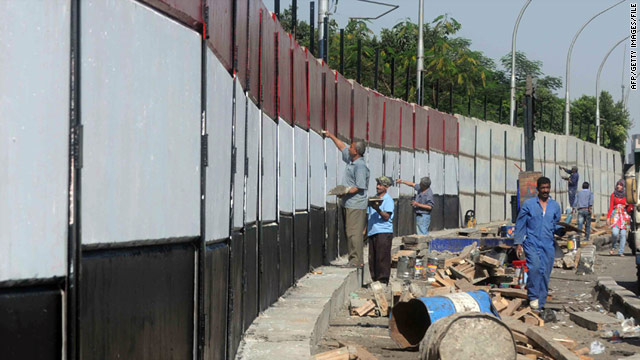
Below, photo accompanying CNN report, Protesters in Egypt breach wall, enter Israeli Embassy, published September 9, 6:58 p.m. Eastern Daylight Time. Photo caption: "Workers paint Egyptian colours on the wall built to protect the Israeli Embassy in Cairo (File picture)"


It goes without saying that the AP photo gives a very different impression of the attack on the Israeli embassy than the CNN one. And the "File picture" caption for the CNN photo suggests it could have been taken after the last riot against the Israeli embassy.

Is it possible that the AP photo is also from an earlier riot at the embassy? From Bikya Masr's September 9 report (no time stamp) filed by Joseph Mayton, Egyptians storm Israel Embassy archives, documents fly out window (emphasis mine):
CAIRO: After knocking down the wall aimed at securing the Israeli Embassy building in Giza, Egyptian activists stormed the embassy’s archives late on Friday night and sent documents flying out the window. One image shows the embassy, or an archive apartment, on a high floor of the building, in flames.

It is unclear what exactly is happening, but reports from the area indicate the embassy has been breached and Egyptian protesters are destroying the place.[...]
I don't think the Guardian would deliberately publish an old photo, and while mistakes can happen in publishing, from the Bikya Masr report it seems a fire was set.

All else I can glean is that while there is no byline on the AP report (a common occurrence, particuarly when another news organization is posting a newswire's report), I know that Hamza Hendawi is the Cairo Bureau Chief for AP. I consider Hendawi's reports on the Cairo protests that brought down Hosni Mubarak's government to be the most informative and accurate of all the mainstream reporting on the situation.

The above-mentioned CNN report is bylined "From Mohamed Fadel Fahmy, For CNN." From a Google search Fahmy is described as a Cairo-based journalist, which suggests he is an independent reporter, or at least not a CNN employee.

Is there any significant difference between the AP and CNN reports that are published with the photos?

Well, Fahmy's report says:
Egyptians have been angry about the killing of police officers by Israeli soldiers last month when Israel went after militants who had attacked civilians near the Israeli-Egyptian border.
The AP report says:
Anger increased last month after Israeli forces – responding to a cross-border attack – mistakenly killed five Egyptian police officers near the border.
There are additional less obvious differences in the two reports, but I'd say there's the answer.

Also from the closely-followed Bikya Masr site, another troubling report today from Joseph Mayton:
Confusion as Egypt says no visas on arrival

CAIRO: In the past 24 hours, foreign nationals living in Egypt have become increasingly concerned over the reports that the Egyptian government has ended the ability to purchase a visa upon arrival in the country. It comes on the heels of reports of visa extensions also being turned down in recent months.

Despite the reports, Egyptian consulates and embassies across the globe appear to know little to nothing about the new restrictions.[...]
See the rest of Mayton's investigative report on the situation.

Also, (Iran's) Press TV has reported (Sep 10, 1:36AM GMT) gives a brief update on the situation in Egypt:
The Israeli ambassador to Egypt has flown out of Cairo, a few hours after demonstrators stormed the Israeli embassy.

Yitzhak Levanon boarded a plane before dawn on Saturday morning.

Meanwhile, Israeli Defense Minister Ehud Barak called US Defense Secretary Leon Panetta in the early hours of Saturday morning Tel Aviv time and urged Washington to help protect the Israeli embassy in Cairo.

Egyptian protesters stormed the embassy on Friday, destroying a part of a barricade wall around the building in the process.

Egyptian police used tear gas to disperse the crowd, and one person reportedly died due to asphyxiation after inhaling tear gas.

A protester tore down the Israeli flag at the embassy, to the cheers of thousands of demonstrators on the scene.

In addition, tens of thousands of Egyptians once again gathered at the iconic Liberation Square in Cairo to demand that the military government hand over power to a civilian administration. The protesters gathered in the square after Friday prayers to participate in the "Correcting the Path" demonstration.
I can't wait to see what CNN's AC-360 show will report tonight on the situation in Egypt. Given all that CNN did to promote Egypt's 'revolution,' I am very interested to see what they will have to say about the big breaking news from Cairo.

Thursday, September 8

9/11 ten-year anniversary terrorist bomb threat against New York and Washington: What did you do with the bunny, Mr Obama?

A cautionary tale about media manipulation in the Age of Obama


This evening, minutes before President Barack Obama spoke to a joint session of Congress to put forward his "American Jobs Plan," I emailed a correspondent ("X") to warn him about breaking news that had just been announced on FNC (Fox News Channel) about a "credible" but officially uncorroborated terrorist threat specific to New York City and/or Washington, DC.

This post shows my email, the correspondent's responses, and my subsequent replies and updates. Before I begin, the brevity the language in the email communications requires a little unpacking, particularly for readers outside the United States:

FNC, along with CNN and MSNBC, is one of the three '24/7' national cable news stations in the USA. The parent company of FNC is Rupert Murdoch's Newscorp, which has been in hot water because of a phone hacking scandal.

Translations of the email shorthand

> "ops" is shorthand for operation/operatives; in this case political operatives at the White House.
> "AQ Central" refers to the al Qaeda command.
> "ailes" refers to Roger Ailes, chairman of the Fox Television Stations Group.
> "Brennan" refers to John O. Brennan, chief counterterrorism advisor to U.S. President Barack Obama; officially his title is Deputy National Security Advisor for Homeland Security and Counterterrorism, and Assistant to the President.
> "CNN gofer" refers to CNN being an unofficial "go-fer" or propaganda outlet for the Obama White House or to be more precise the U.S. Department of State -- a situation that goes back many years (check out CNN's key role in shaping U.S. news coverage of the 'color' revolutions in Eastern Europe) and is too complicated to explain here, except to note that although many American's assume CNN is 'left' leaning politically, close attention to its reporting over a period of years reveals that it is really oriented toward promoting State Dept. policies, which are oriented to mesh with European Union policies. And so in my estimation only within that parameter does CNN support Liberal political US agendas -- a situation that deepened this year to promote the Obama administration's spin on the 'Arab Spring' and U.S. involvement in the bombing of Libya. As I noted, it's complicated.

Now to the emails.

6:36:32 P.M. Eastern Daylight Time
Breaking - new intel credible AQ planned attack NYC or DC
Just now: FNC Jennifer Griffin report from the Pentagon. Intel not from Abbottabad. Threat "more than aspirational" but they don't have names. [*]
Pundita ["P"]

6:50:48 P.M
ailes drivel. murdoch despair. griffin tabloid rubbish.
X

8:03:52 P.M.
NO. WHITE HOUSE OPS!!! First, WH pulled fast one on GOP by telling them in advance that the speech would be 43 minutes longo w/o applause but speech was actually 32 minutes (Shep Smith reporting just now.) In other words, ops wanted to discourage GOP from making TV response to jobs speech so response wouldn't interfere with football game opener. so WH ops faked out GOP.

THEN: WH, Homeland Security, DOJ put out info about credible but unconfirmed threat so news aired JUST BEFORE job speech.

Then, right AFTER O's speech ended came WH statement, reported by Shep Smith from news wire and/or WH source:

"New statement from WH just now: WH official: "the president was briefed on the threat this morning and has been briefed on it throughout the day. Information is 'unconfirmed.' intel community has not yet confirmed. Shep Smith added but threat is specific, from overseas, from AQ Central, and involves a car bomb or car bombs."

2 breaking news reports on the threat - ABC news (Australia) 'Credible' threat of 9/11 attack anniversary and Fox Federal Authorities Probe Possible Terror Threat Around 9/11 Anniversary. CNN, other news orgs now piling on with their reports on the threat; story sprouting more legs than a centipede.
P

9:03:54 P.M.
"Awaiting NYC news conference on threat" - CNN just now
"threat quite credible -- security community became aware of threat 2 days ago. Brennan has been in touch with Obama throughout the day"
P

9:08:46 P.M.
CNN, Obama playing bomb threat like a fiddle
CNN analysis of Jobs Speech bumped from opening of CNN's Piers Morgan show 9-10 PM. Fox not caught napping; sticking with analyses of speech in their 9 PM leadoff.
P

9:06:28 P.M.
Gofer CNN making HUGE issue of bomb threat
P

9:10:11 P.M
Upcoming Presser from [NYC Mayor] Michael Bloomberg
"potentially a very serious threat" WH briefing security committee and other key members of House on why they're taking terrorist chatter more seriously than in the past and why they're alerting US public of risk. [presser began at 9:42]
P

10:53:45 P.M.
no worries. no chatter. noise.
X

10:54:44 P.M.
Thank you. BASTARDS. white house ops forced bloomberg, nypd to call presser w/in hour of obama speech.
P
__________

Here, my all-time favorite observation about Barack Obama; it's from the comment section for an April 11, 2008 report at the ABC News (U.S.) news blog site.

The report details Obama's attempts to explain away contemptuous, patronizing remarks he made about white, low-income Pennsylvania residents while he spoke to a private fundraising gathering in San Francisco and was unaware that his remarks were being recorded.

The ABC report prompted more than 200 comments, including this gem from one Ms. Sonia Trevino:
obama reminds me of a magician i saw as a little girl. he put a bunny in a hat and then pulled out a quarter. i was 7 y.o and i was not fooled i stood up and screamed where is the bunny, where is the bunny, what did you do with the bunny.
Yes, Mr. Obama; what did you do with the bunny?

I offered the email exchanges about the terrorist threat as a cautionary tale about government manipulation of information and the policies of major news media outlets, which make it easy for governments to influence public opinion without having just cause to do so. ("Just cause," in a genuine democracy, is a very high bar, usually relating to national security issues.)

Julian Assange, the founder of Wikileaks, has clearly revealed himself, since releasing hundreds of thousands of unredacted classified documents, to be a monster. He's a kind of terrorist who is less interested in honest, transparent government than in destroying the governing institutions of free societies. And yet the machinations of governments within free societies, with regard to manipulation or "shaping" of information for the public, help Assange and those who support him to rationalize the hacking of government websites.

* Around 9 PM CNN began reporting that the government did have 3 names but the names were such common Arabic ones that it couldn't use them to indentify the persons associated with the threat, which reportedly involved a car bomb or bombs.