Translate

Friday, June 24

"How did UK end up voting to leave the European Union?" Guardian analysis

"Decades of Euroscepticism and ministerial rebellion led to Britain’s self-ejection from a union that voters never fully embraced."

The Guardian analysis is quite long so I'm just going to provide the link; their take is helpful to people outside the U.K. and very interesting because it points to what is down the road for Europe.

So much excitement; I don't think anybody in the world who watches world affairs has gotten any sleep yet. How many news reports have I posted this morning on the Brexit vote? Ten? I need to snatch some sleep.

G'night all.  

******** 

DAVID CAMERON ANNOUNCES HE WILL STEP DOWN BY OCTOBER

Brexit: David Cameron to quit after UK votes to leave EU
BBC
7 minutes ago

Prime Minister David Cameron is to step down by October after the UK voted to leave the European Union.

Mr Cameron made the announcement in a statement outside Downing Street after the final result was announced.

He said he would attempt to "steady the ship" over the coming weeks and months but that "fresh leadership" was needed.

The PM had urged the country to vote Remain, warning of economic and security consequences of an exit, but the UK voted to Leave by 52% to 48%.

England and Wales voted strongly for Brexit, while London, Scotland and Northern Ireland backed staying in.

UKIP leader Nigel Farage hailed it as the UK's "independence day" but the Remain camp called it a "catastrophe".

The pound fell to its lowest level against the dollar since 1985 as the markets reacted to the results,

Flanked by wife Samantha, Mr Cameron said he had informed the Queen of his decision to remain in place for the short term and to then hand over to a new prime minister by the time of the Conservative conference in October.

It would be for the new prime minister to carry out negotiations with the EU and invoke Article 50 of the Lisbon Treaty, which would give the UK two years to negotiate its withdrawal, he said.

"The British people have voted to leave the European Union and their will must be respected," said Mr Cameron. "The will of the British people is an instruction that must be delivered."

[...]

***

Much more in the report including map showing how Britons voted in each region.

********

"Is 'Brexit' the Beginning of End for European Union?"


by ANMAR FRANGOUL
CNBC via NBC News
(Updated) JUNE 24 2016, 2:24 AM ET
First published JUNE 23 2016, 8:42 AM ET

"... the notion that integration is Europe's destiny — and irreversible — would be shattered."

Britons voted to leave the 28-member European Union and analysts are worried the outcome could have far-reaching consequences for Europe's political landscape.

A recent poll from YouGov showed that, out of seven countries polled, a majority in six of those felt that more countries would choose to leave the EU if a Brexit occurred.

Sixty-nine percent of Swedes believed it was likely there would be further exits from the EU "post-Brexit," with 66 percent of Danes and 57 percent of Norwegians feeling the same way.

"From the European perspective, the question of the outcome of the referendum is one thing, but I think if you take the broader picture then what the referendum shows is that you're dealing with these 'eurosceptic' and populist parties everywhere across the continent these days and so either way, whether the U.K. stays or leaves, I think that the main takeaway here is that the days of ever closer integration are basically over," Carsten Nickel, a political risk analyst at Teneo Intelligence, told CNBC in a phone interview before the results were known.

While the prospect of a Brexit triggering other countries in Europe to follow suit and decide to leave is not an immediate one it would "certainly sow seeds of doubt," according to Paolo Dardanelli, senior lecturer in comparative politics and acting director of the Center for Federal Studies at the University of Kent.

"Denmark and Sweden would be the ones to watch in particular, as their position would be significantly weakened," Dardanelli added via email.

Nickel went on to say that while the risk of countries pushing to leave was not immediate, the Netherlands —in addition to Sweden and Denmark — would be watched closely.

These countries would be in a position of relative strength — compared to other European countries who have been in weaker positions — if a conversation about leaving ever did take place.

"You could argue that the conversation about this could be different in a place like Denmark, or Sweden or the Netherlands, where you're looking at countries with well-functioning political institutions, and economies that are doing fairly well," Nickel said.

The tone of such conversations was already being set. "You have this already, where you have a conversation where people say 'we don't want to be paying for south Europeans who are incapable of reforming their economy,' so I think that's a problem," he went on to add.

Looking at the broader picture, Dardanelli said that there could be four main consequences of a Brexit, including, "the notion that integration is Europe's destiny — and irreversible — would be shattered."

Other ramifications Dardanelli pointed to include the further marginalization of EU members outside the euro zone, such as Denmark and Sweden; Ireland — a member of the euro zone but also closely tied to the U.K. — finding itself "in an uncomfortable situation"; and Germany finding itself "in an even more dominant position" whilst at the same time losing "a precious ally on issues such as economic reform, competitiveness, free trade and so forth."

The upshot, Dardanelli said, "is likely to be a less competitive, more protectionist EU."

[END REPORT]

Here we go: Brexit sparks calls for other 'Leave EU' referendums

Geert Wilders: "We want to be in charge of our own country, our own money, our own borders, and our own immigration policy."

43 minutes ago
BBC

The UK's vote to leave the EU has sparked demands from far-right parties for referendums in other member states.

France's National Front leader Marine Le Pen tweeted "Victory for freedom" and said the French must now also have the right to choose.

Dutch anti-immigration politician, Geert Wilders, said the Netherlands now deserved a "Nexit" vote.

The UK on Thursday voted by 52% to 48% to leave the European Union after 43 years, in a historic referendum.

Analysts say EU politicians will fear a domino effect that could threaten the whole organisation.


Ms Le Pen hailed the UK vote, tweeting: "Victory for freedom. As I've been saying for years, we must now have the same referendum in France and other EU countries."

She is the front-runner among candidates for the presidential election in 2017 but opinion polls suggest she would lose a run-off vote.

Last Friday, Ms Le Pen had told a gathering of far-right parties in Vienna: "France has possibly 1,000 more reasons to want to leave the EU than the English."

She said the EU was responsible for high unemployment and failing to keep out "smugglers, terrorists and economic migrants".

Mr Wilders, leader of the Party for Freedom in the Netherlands, said in a statement: "We want to be in charge of our own country, our own money, our own borders, and our own immigration policy.

"As quickly as possible the Dutch need to get the opportunity to have their say about Dutch membership of the European Union."

The Netherlands faces a general election in March and some opinion polls suggest Mr Wilders is leading.

He said: "If I become prime minister, there will be a referendum in the Netherlands on leaving the European Union. Let the Dutch people decide."

A recent Dutch survey suggested 54% of the people in the Netherlands want a referendum.

Austrian Foreign Minister Sebastian Kurz said he believed the EU would survive the UK exit, but that "a domino effect on other countries couldn't be ruled out".


Follow the latest developments on our live page

Results in full


World reaction as UK votes to leave EU


Europe stunned by vote to leave

[END REPORT]

AP: EU chiefs meet as UK vote sends bloc into uncharted waters

"There cannot be any special treatment for the United Kingdom. The British people have expressed their wish to leave the EU. Leave means leave. ..."

EU chiefs meet as UK vote sends bloc into uncharted waters

By Lorne Cook, Associated Press
June 24, 2016, at 2:17 a.m.

BRUSSELS (AP) — Top European Union officials were hunkering down in Brussels Friday to try to work out what to do next after the shock decision by British voters to leave the 28-nation bloc.

European Commission President Jean-Claude Juncker is hosting talks with the leaders of the European Council and Parliament, along with Dutch Prime Minister Mark Rutte, whose country holds the EU's rotating presidency.

The four will try to agree on a European position on the vote, which could see a member country leave the bloc for the first time ever, ahead of a summit of EU leaders in Brussels starting on Tuesday.

Parliamentary leaders were meeting separately, and European commissioners — the EU's executive body — could hold separate talks later.

EU officials have been aware of the possibility that a British vote to leave might come, but while the possibility of an exit is enshrined in EU law no one is sure how a departure would play out.

The head of the biggest bloc in the parliament fired an early warning shot at Prime Minister David Cameron that Britain should expect no free ride as it negotiates its departure.

"There cannot be any special treatment for the United Kingdom. The British people have expressed their wish to leave the EU. Leave means leave. The times of cherry-picking are over," European Peoples Party leader Manfred Weber said.

He insisted that the exit negotiations "should be concluded within two years."

This insistence on a "hard exit" is aimed at discouraging other countries from wanting to leave the bloc in the belief that they might be able to negotiate a comfortable partnership from the outside.

Many European officials fear the U.K. vote will play into the hands of the far right and left and fuel calls for referendums in other countries.

The exit vote also raises troubling questions about the future of Europe in the wake of the economic crisis, concern about Greece's place in the euro and the EU's inability to manage the refugee emergency.

[END REPORT]

Reuters: Brexit Leave vote "stunning repudiation of the nation's elites"

See also Reuters update page for breaking news on EU Referendum vote. 

"By 5.41 a.m. (0441 GMT), 93 percent of the vote had been counted, making Leave's lead impossible to reverse."

Britain votes to leave EU, unleashing global turmoil
Fri Jun 24, 2016 2:02am EDT
By GUY FAULCONBRIDGE and KATE HOLTON
Reuters

(LONDON) Britain has voted to leave the European Union, results from Thursday's landmark referendum showed, a stunning repudiation of the nation's elites that deals the biggest blow to the European project of greater unity since World War Two.

World financial markets plunged as nearly complete results showed a 51.8/48.2 percent split for leaving. The vote instantly creates the biggest global financial shock since the 2008 economic crisis, this time with interest rates around the world already at or near zero, stripping policymakers of the means to fight it.

The pound suffered its biggest one-day fall in history, plunging more than 10 percent against the dollar to hit levels last seen in 1985.

The vote will initiate at least two years of messy divorce proceedings with the EU and cast doubt on London's future as a global financial capital. The future of Prime Minister David Cameron -- who gambled the fate of the nation on an outcome he predicted would be catastrophic -- was doubtful at best.

An aide working in Cameron's office told reporters: "We're in uncharted territory ... Everyone's just really tired. They haven't slept."

The euro slumped more than 3 percent against the dollar on concerns a Brexit vote will do wider economic and political damage to the world's biggest trade bloc, stripped of its second largest economy.

Investors poured into safe-haven assets including gold, and the yen surged. European shares were on course to open 6 to 7.5 percent lower.

There was no immediate comment from the Bank of England. Global policymakers prepared for action to stabilize markets, with Japanese Finance Minister Taro Aso promising to "respond as needed" in the currency market.

Yet there was euphoria among Britain's eurosceptic forces, claiming a victory they styled as a protest against British political leaders, big business and foreign leaders including Barack Obama who had urged Britain to stay in the bloc.

"Dare to dream that the dawn is breaking on an independent United Kingdom," said Nigel Farage, leader of the eurosceptic UK Independence Party, calling the EU a "doomed project".

"This will be a victory for real people, a victory for ordinary people, a victory for decent people ... Let June 23 go down in our history as our independence day."

By 5.41 a.m. (0441 GMT), 93 percent of the vote had been counted, making Leave's lead impossible to reverse.

Asked if Cameron, who called the referendum in 2013 and campaigned to stay in the bloc, should resign if Britain voted for Brexit, Farage said: "Immediately."

The United Kingdom itself now faces a threat to its survival, as Scotland voted 62 percent in favor of staying in the EU and is likely to press for a new referendum on whether to become independent after its 2014 vote to stay in the UK.


[END REPORT]

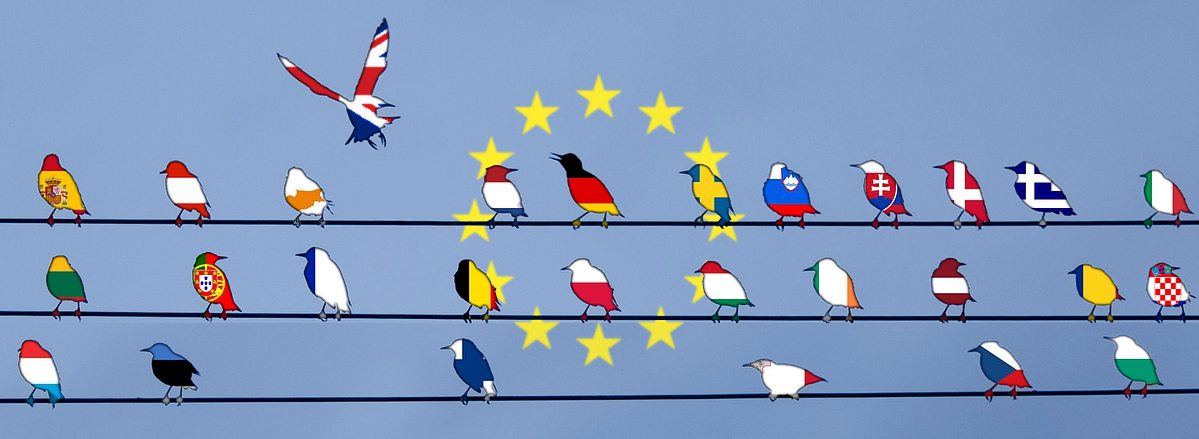
Brexit: "The Bird Has Flown"

Huzzahs for Baron at Gates of Vienna for the best headline so far about the Brexit 'Leave' vote. Here's part of his commentary and the accompanying pix:

The Bird Has Flown
Posted on June 24, 2016 by Baron Bodissey

Gates of Vienna

"Britain is nothing if not soviet-like in its current political architecture. All British citizens know that they can lose their jobs, their benefits, and possibly even face prosecution if they hold certain publicly-stated opinions."


Despite the odds that the bookmakers were giving a few days ago (three to one against), Britain has surprised the world — and especially the world financial markets — by voting to leave the European Union.

That’s according to the latest projections, including the BBC’s. However, it’s still theoretically possible that the remaining constituencies will tip the vote back to “Remain”. Not likely, but possible. So keep the cork in the bubbly for just a little while longer…

I was convinced that a majority of Britons would vote for Leave, but that postal vote fraud and other shenanigans would make sure that the referendum would deliver the results required by Frau Merkel and Messrs. Cameron and Juncker. So that means that there must have been a VERY large margin of victory for Leave, given the amount of likely fraud.

It reminds me of the Nicaraguan election of 1990. Do you remember when the Sandinistas agreed to hold an election that ended up voting them out of office?

They were certain they would win. The opinion polls said they would win. Jimmy Carter — who thought the Sandinistas were jes’ fine — was sure they would win. That’s why he talked them into holding the election: it was a way to shut those nasty conservatives up for good, and give the communist dictatorship the imprimatur of electoral legitimacy.

But it didn’t work out that way. Nicaraguans went to the polls and voted the commie rascals out. There was only one explanation: Those voters must have —gasp! — lied to the pollsters.

Now why would any comrade in a socialist paradise feel the need to do that?

Britain is nothing if not soviet-like in its current political architecture. All British citizens know that they can lose their jobs, their benefits, and possibly even face prosecution if they hold certain publicly-stated opinions.

And they know that Her Majesty’s Government has full access to all their electronic communications, including telephone calls.

So when a pollster calls, the polling company and its sponsor may not know the voter’s identity, but MI5 certainly does! The intelligence agencies know the name, address, and bank balance of the person who owns that particular phone. They may even know what he had for breakfast, depending on how up-to-date his “smart” kitchen appliances are. And now they have a digital recording of what he just told the pollster.

So tell me: if you were a Briton with a functioning cerebral cortex, would you tell the truth to a pollster?


* * * * * * * * * * * * * * *

[...]

BREXIT FIRST 100 DAYS: What to expect now that Britain has voted to LEAVE the EU

AFTER yesterday's referendum, here is a look at what will happen immediately following the historic vote for Britain to leave the EU.
By ALICE FOSTER
PUBLISHED: 06:00, Fri, Jun 24, 2016 | UPDATED: 06:29, Fri, Jun 24, 2016
Express (U.K.)

Brexit: What to expect on the first day

The count for the EU referendum took place at polling stations across the country.

Local and regional results came in overnight ahead of a national declaration.

After Britons voted to leave the EU, huge celebrations among Brexit campaigners and Eurosceptics across Britain are being prepared.

Anti-EU politicians throughout Europe are also welcoming Brexit and look to seize on the result in order to further their own causes and pushes for independence.

U leaders will immediately be forced into damage control and are likely to issue a response in a bid to defend the integrity of the European bloc.

Mr Tusk told German newspaper Bild that Europe’s “external enemies will open a bottle of champagne” to celebrate a Brexit, adding: “We should do everything to spoil that party.”

A Brexit result has sent shockwaves through the global economy and is likely to lead to a further drop in the value of the pound. Britain’s currency had already weakened ahead of the referendum.

But Ukip leader Nigel Farage had earlier said: “Even if sterling were to fall a few percentage points after Brexit, so what? The point is we have a floating currency and it will be good for exports."

Straight after the EU referendum, eurozone finance ministers could hold emergency meeting as they did in response to the debt crisis and snap referendum in Greece last year.


Brexit: What to expect in the first week

After a vote for Brexit, there will be calls for Prime Minister David Cameron to step down because he will have lost his Project Fear campaign to stay in the EU.

Amid rumours of a plot to oust Mr Cameron, senior Tory MP Andrew Bridgen said: “If the country votes to leave the EU, he should – and probably will – choose to resign.”

However, many Eurosceptic MPs, including Michael Gove and Boris Johnson, had called on the PM to remain in the post regardless of the result.

The leaders of EU member states, meanwhile, are scheduled to meet for a summit of the European Council on Tuesday June 28 and Wednesday June 29.

The agenda for the meeting notes: “The leaders will discuss the results of the UK in/out referendum from 23 June 2016.”

At this summit, Britain could trigger the EU’s Article 50 - the law that would start the process of the country’s political divorce from the EU.

This step would in effect start the timer on the two year-period that Britain would be given to negotiate its exit of the EU before the end of June 2018.

Eurosceptic cabinet minister Chris Grayling says that the Article 50 should not be immediately activated, but Britain should aim to quit the EU in 2019.

The EU’s leaders could also call an emergency summit after a Brexit vote, while Spanish citizens are due to go to the polls in a general election on Sunday June 26.


Brexit: What to expect in the first 100 days

In the aftermath of a Brexit result, Britain would start lengthy talks to renegotiate EU agreements and build new trade links with Europe and the rest of the world.

There are concerns these negotiations could be made more difficult because EU bosses would want to discourage other countries from following suit by also leaving the EU.

As well as facing tough talks over Britain’s place in Europe and the rest of the world, the country could also face the prospect of another Scottish referendum.

Former First Minister and SNP leader Alex Salmond said: “Should Brexit succeed, Cameron would embark on a two-year negotiated exit, creating a time frame for a new referendum on Scottish independence.”

Anti-EU populist parties would seek to ride on the momentum from Brexit ahead of key elections in France, the Netherlands and Germany in 2017.

If Mr Cameron does step down after the EU referendum, bookmakers have ranked Eurosceptic Tory MP Boris Johnson as the favourite for the next Conservative leader.

[END REPORT]

"We've got our country back!" Historic 'Leave' Brexit vote

Many 'Leave' voters had a hard time believing the good news....


We've got our country back. Thanks to all of you. #IndependenceDay

Sputnik - Breaking News
Britons Spurn EU as Leave Camp Gets Over 16,700,000 Votes in Referendum
08:00 24.06.2016 (updated 08:15 24.06.2016)

Brexit supporters have gained enough votes to secure the victory in the historic referendum held to decide on whether the United Kingdom should remain a member of the European Union or leave the bloc.

Britain has voted by 52 percent against 48 percent to leave the European Union. The turnout amounted to 71.8 percent with more than 30 million people casting their ballots.
Britons went to the polls on Thursday to decide on a referendum that will decide whether or not the United Kingdom should remain in the European Union.
[...]
Brexit Watch tweet: TNS and Opinium got the referendum result right and saved the reputation of the whole industry pic.twitter.com/LZMivg60gt 
[see Sputnik for details]
********

Goodbye Mr Cameron and don't let the door slam behind you

British Prime Minister will address the country at shortly after 6:00 AM BST.

“As far as Labour voters are concerned, there are two issues. There is obviously immigration, but beneath that there is a whole set of issues about people’s lives and the fact that they don’t feel politics is listening to them.”

Corbyn will admit that the result paints a picture of a “divided country” and say that his party needs to begin the uphill struggle of re-engaging with working-class voters whose fury about immigration, wages and public services have led them to vote out.

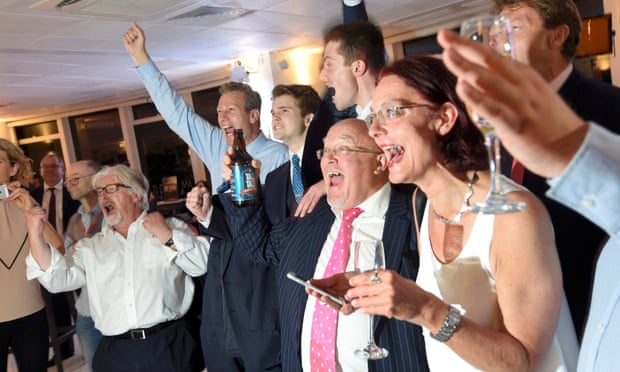
Leave supporters celebrate the result in Sunderland after polling stations closed in the EU referendum. Photograph: Toby Melville/Reuters


Britain votes for Brexit after dramatic night leaves nation divided

Historic referendum vote in favour of leaving EU raises questions over futures of David Cameron and Jeremy Corbyn

Anushka Asthana, Ben Quinn and Rowena Mason
Friday 24 June 2016 00.33 EDT
The Guardian


 The British people have voted to leave the European Union after a historic referendum in which they rejected the advice of the main Westminster party leaders and instead took a plunge into the political unknown.

The decision in favour of Brexit, following a bitterly close electoral race, represents the biggest shock to the political establishment in Britain and acrossEurope for decades, and will threaten the leaderships of both the prime minister, David Cameron, and the Labour leader, Jeremy Corbyn.
The value of the pound swung wildly on currency markets as initial confidence among investors expecting a remain vote was dented by some of the early referendum results, triggering falls of close to 9% and hitting its lowest level against some foreign currencies since 1985. Jeremy Cook, chief economist and head of currency strategy at WorldFirst, said: “Sterling has collapsed … It can go a lot further as well.”
By 4am, a series of key results signposted a likely leave victory. After a lower-than-expected margin of victory for the remain campaign in Newcastle, where it won the backing of 54% of voters, there was a jolt after midnight when leave captured Sunderland with 61.3% of the vote in a city which has traditionally been a Labour stronghold.
Cameron is expected to address the nation from Downing Street shortly after 6am, and leaving lead campaign Boris Johnson is likely to make a statement shortly afterwards.
Speaking at a party in Westminster, the Ukip leader, Nigel Farage, declared Friday the UK’s “independence day”, and said the referendum result was a “victory for real people, a victory for ordinary people, a victory for decent people”.
Hilary Benn, the shadow foreign secretary, has said Cameron will have to resign if the UK votes for Brexit. “If there were to be a vote to leave, then as far as the prime minister is concerned I don’t see how he is going to remain in his job for very long at all,” he said.
Alan Johnson, the former home secretary and leader of Labour’s remain campaign, said earlier that he thought Cameron would have to quit if leave had won.
On Thursday evening Cameron was backed by 84 pro-Brexit MPs to remain as prime minister whatever the result, but around 50 did not sign the letter, meaning there could be enough to trigger a vote of no confidence.
Cameron has said he wants to stay on to trigger article 50 and start negotiations to take the UK out of the EU in the event of a vote to leave but there is likely to be considerable pressure for him to quit given the public’s defiance of his forceful calls for the UK to remain in the EU.
There was continued joy at leave parties during the night as swing areas across England delivered wins, often of a much larger magnitude than forecast.
The first declarations in some larger areas of London saw fleeting scraps of good news for remain but it was short-lived as traditional election marginals backed leave. Nuneaton, a central English town seen as a bellwether of middle England delivered a 66% vote for leave.
In Wales too, leave voters were dominant, after at least 18 of the 22 Welsh authorities had declared. Only three – the Vale of Glamorgan in the south, Monmouthshire in the south-east and Ceredigion in west Wales – voted to remain.
As expected, remain won in Scotland, although margins of victory and turnouts fell short of what was needed to stop the leave juggernaut in the southern parts of Britain.
Corbyn will admit that the result paints a picture of a “divided country” and say that his party needs to begin the uphill struggle of re-engaging with working-class voters whose fury about immigration, wages and public services have led them to vote out.
John Mills, a major Labour donor who has been campaigning for leave, said his party’s mistake was to link itself so closely to the in campaign, instead of understanding the concerns of its traditional voters.
Recriminations are already flying within the party, with some blaming Corbyn for failing to campaign robustly enough, while others have pointed the finger at Nicola Sturgeon, the SNP leader, saying that she spent too much time attacking the remain camp and saying her “lacklustre” efforts resulted in a low turnout in Scotland.
A source within the SNP hit back at what she called a “poor attempt by Labour to deflect from its own campaign”. She said her party was securing remain wins across the country, while Labour had lost in its in heartlands.
Sturgeon was expected to speak on Friday morning, touching on the possibility of a second Scottish referendum after her country voted to remain in the EU, in contrast to England. Much of London voted convincingly to remain.
The vista of a sharply divided country with particular fault lines opening up between London and other English communities was repeatedly raised by Labour MPs reacting to the results.
The former Labour leader Ed Miliband said: “It’s a nation divided and the PM will have a big responsibility – particularly if it’s a remain win – to show he understands what people are saying on the leave side of the argument. Labour faces that responsibility too.
“As far as Labour voters are concerned, there are two issues. There is obviously immigration, but beneath that there is a whole set of issues about people’s lives and the fact that they don’t feel politics is listening to them.”
Pat McFadden, the party’s MP for Wolverhampton South East and a former shadow Europe minister, said: “It shows a country just split down the middle. Certainly for people voting to come out, immigration is very high on their list of concerns but there is also something else here too, a real sense of pessimism among people and their place in the UK.”
[END REPORT]

Thursday, June 23

BBC, ITV and Sky News call Brexit referendum vote as LEAVE (Updated 12:45 AM EDT)

Moments ago from The Telegraph's live blogging of the vote count.  You may trust nobody in the U.K. got any sleep as the votes were counted after the polls closed at 10 PM BST. Global financial markets are going crazy according to CNBC; traders had assumed the vote would go for Remain.

Update
‘Black Friday’: Pound plummets to 1985 low as 'Leave' declares victory
Published time: 24 Jun, 2016 04:07 Russia time Edited time: 04:37
RT

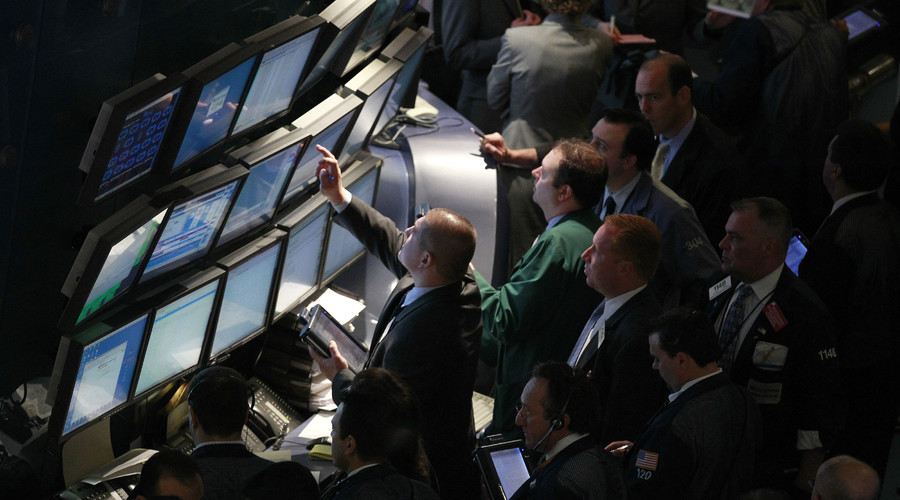
 Brendan McDermid / Reuters

A presumptive victory for Brexit has led to a sharp decline in the pound, hitting its lowest point since 1985.

The pound is now down over 8 percent against the US dollar, currently sitting at $1.34, depths it has not been plunged to in 31 years.


This is a drop of 15c from the highs it reached when polls closed and the referendum seemed to be going the way of ‘Remain.’
If ‘Leave’ comes out on top, the FTSE 100, when it opens at 8am BST, is expected to be down six percent.
If the vote for ‘Leave’ continues, experts predict the currency will continue to spiral downwards.
Some experts prior to voting forecast the pound would drop to as low as $1.20 in a Brexit scenario.
The biggest percentage drop for the pound was on October 24, 2008, when it declined 5.9 percent during the global stock market crash.
The pound on Friday has already set a record intraday swing of more than 10 percent between its high and low points.
[...]
********


Limitation of Russian fighter jets in Syria and threat of chemical war in Raqqa

This is still very much a ground war. From SouthFront's Syrian war sitrep June 23, 2016 [emphasis mine]:

The ISIS terrorist group has regained control of the al-Zakia Junction and al-Zayn Hills in the southeastern part of Raqqa province after the Syrian Arab Army withdrew to Ithriyah. Pro-government sources argue that this was a tactical move and no heavy clashes have been observed, recently.
Ground sources provide different reasons for the recent setbacks, but the most important of them are:
  • surprise vehicle-borne improvised explosive device (VBIED) attacks;
  • a lack of the air support from the Russian air grouping located in Syria.
While the effectively of countering VBIED attacks lays in in the sphere of tactical measures implemented on the ground, the location of the Russian airbase in Latakia complicates significantly close air support because a big flying time to the target doesn’t allow to hit evading targets that move fast in the desert. Information of the forward air controllers becomes outdated very fast. This is why the main striking force of the Russian military grouping in Syria – warplanes – is focused on stationary targets in different regions of Syria.
The SAA grouping at the border of Raqqa province is receiving reinforcements in order to counter-attack ISIS units in the area. Recently, a convoy of the Desert Hawks Brigade has arrived to the east Hama countryside in order to participate in the SAA’s advance on the Tabaqa military airport.
Meanwhile, Russian warplanes and helicopters raided the areas of T3-Airbase and Arak near Palmyra that had been seized by ISIS militants. Now, SAA units are deployed at the al-Talilah crossroad, east to the ancient city, preparing for fresh offensive operations.
Norway might deploy its troops and speical operation forces in Syria, the government said on June 22, following the authorization of the move by the country’s parliament. Norway is going to send some 60 troops to Jordan this summer. They will train and support “Syrian opposition “fighting the ISIS terrorist group. Most likely, this Syrian opposition is the so-called New Syrian Army.
[END REPORT]

Meanwhile, Voltaire Network has its own take on the pullback by Syrian Army forces in Raqqa. Consider the source but given the Syrian Army's claim earlier this month that terrorist organizations used "toxic substances" in attacks on troops in the Damascus countryside, the VN report is at least plausible:
VOLTAIRE NETWORK | 23 JUNE 2016
In the province of Rakka, while the Syrian Arab army was advancing and liberating villages held by Daesh and its allies, the enemy has used sarin gas, or more precisely its most dangerous version: VX gas.

The Syrian army was forced to withdraw.

To protect Qatari supporters, Saudi and Turkish jihadists, the Atlanticist propaganda assures that Syrian forces are exhausted by years of war.

Translation
Roger Lagassé
[END REPORT]
********

German attacker at cinema took hostages before being shot dead, no one else hurt – police UPDATED 2:20 PM EDT

UPDATE 
Police reported that the attacker's rifle was "blank" but now comes this report from RT; no word yet from the police on whether the grenades and suicide belt are fakes:

Suicide Belt, Grenades Found Near German Movie Theater Attacker's Dead Body
20:44 23.06.2016(updated 21:03 23.06.2016) 

A suicide belt and grenades were found by German police next to the body of a gunman who attacked a movie threater in western Germany earlier in the day, Focus reported.

The attack took place shortly after 3 p.m. local time (13:00 GMT) when the man entered the Kinopolis cinema at the Rhein-Neckar-Zentrum shopping center and opened fire. Nobody was injured in the shooting. 
The police are examining the explosive belt and grenades as it is yet unclear whether they are geniune.
[...]
END UPDATE
German attacker took hostages before being shot, no one else hurt – police
Published time: 23 Jun, 2016 14:29  Edited time: 23 Jun, 2016 17:08
RT

An armed man was killed by police after taking hostages inside a cinema complex in Viernheim, western Germany, local officials confirmed, adding that no one was hurt in the incident. Previous reports said the man had fired a gun, injuring up to 50 people.

The interior minister of the German state of Hesse, Peter Beuth, confirmed that the man was shot and killed after police stormed the complex.

The man reportedly entered the Kinopolis cinema wearing a mask and a cartridge belt around his shoulder.
Beuth said the man was armed with a rifle.
"The police had an emergency call at 2:45pm (12:45 GMT). The caller said there was a masked man...armed with a long gun. It is unclear whether it was a real gun," Beuth told the Hesse parliament.  
"The caller heard four shots and said that the masked man appeared a little mentally unstable. Police special forces were called."
Police arrived at the scene shortly after the initial reports, including a number of officers from the SEC special task force. The area was cordoned off by authorities.
Initial reports stated that the man had fired shots at people inside the building, and that between 20 and 50 people had been injured. 
However, Focus later reported that the man was armed with a blank weapon, and that people were only hurt by tear gas.

[END REPORT]


This "Breaking News" report at AMN was superseded by later reports

From Al Masdar News [no time stamp]:

As many as 50 people have been wounded in a shooting at a cinema complex in Germany, according to local media reports. An armed man has reportedly barricaded himself inside the complex, located in the town of Viernheim in western Germany. 

More follows…

[END REPORT]

The attacker, who turned out to be using a 'blank' rifle, was shot and skilled by German police. No one else was hurt.

See the RT report. 


SouthFront's disturbing warning about the Syrian Army

This is the second warning from SouthFront; the first was at least two weeks ago when the organization criticized the Syrian and Iranian military leadership for poor battle planning based on outmoded tactics. From SouthFront's June 22 Syrian war sitrep:
[...]

Almost since the start of the Syrian war, the Syrian military has suffered a lack of trained personnel. The general staff has tried to compensate for this with massive use of artillery, battle tanks and other kinds of military equipment.
However, massive usage of anti-tank weapons by militant groups opposing the Syrian government has led to a high loss rate of the SAA’s military equipment. According to local sources, about a half of these losses is lightly-damaged military equipment abandoned at the battlefield that could be easily evacuated and restored.

Even massive deliveries of modern weapon systems, including TOS-1 heavy multiple launch thermobaric rocket systems and T90 battle tanks, cannot help if the personnel, often volunteers without combat experience, cannot use them properly. 
Additionally, this is one of the reasons why some T-90 and TOS-1 were spotted in Hezbollah and IRGC units operating in Syria instead of the SAA.
[END REPORT] 
********

SCO summit starts today; Pakistan to sign document paving way for full membership

Radio Pakistan - June 22, 2016 - 9:43 PM local time

SCO full membership will allow Pakistan to play an anchor role in regional trade, peace and stability

President Mamnoon Hussain is in Tashkent, Uzbekistan, to represent Pakistan at Shanghai Cooperation Organization (SCO) Summit beginning on Thursday. He was received by Uzbek Prime Minister Shavkat Mirziyoyev on Wednesday. Foreign Affairs Adviser Sartaj Aziz, Foreign Secretary Aizaz Chaudhry, and other senior officials are accompanying the president. 

Earlier, the President visited the shrine of Imam Bukhari (RA) in Samarkand on Wednesday. On the occasion, the President appreciated the services of Imam Bukhari (RA) for Islam who compiled the most authentic book of 'Ahadiths'. The President will also hold bilateral meetings on the sidelines of the SCO summit. 

At the meeting, Pakistan is expected to sign the ‘Memorandum of Obligations,’ which will pave the way for the country to become a full member of SCO. Pakistan was invited to start the process of becoming full SCO member at the Heads of State Council meeting held in Ufa, Russia in July last year.

Earlier, as an Observer State of SCO, Pakistan has been making substantive contribution to regional peace, security and development. Pakistan became an Observer in SCO in 2005, and was the first country to apply for full membership in 2010.

The SCO aims at strengthening friendly relations amongst states, maintenance of peace, stability and security in the region. Founded in Shanghai in 2001, the SCO includes six member states, five observers and three dialogue partners.

[...]

******** 

"Pakistan’s ‘University of Jihad’ is getting millions of dollars from the government"

By subsidizing one of the world’s most controversial Islamist institutions, Ghani said the government will be helping to “mainstream it” as part of a broader reform of what 3 million Pakistani children learn in more than 100,000 madrassas.

Over the years, many Deobandi institutions received financial support from Saudi Arabia and other wealthy Persian Gulf countries. Saudi Arabia and the United Arab Emirates are both past donors to Darul Uloom Haqqania ...

But analysts say that Pakistan’s military is increasingly frustrated with both the United States and Afghanistan, which may be causing it to become even more reluctant to crack down on the Taliban.

By Tim Craig, Pakistan Bureau Chief, The Washington Post 
June 22, 2016 - 11:55 AM EDT
The Washington Post

After terrorists killed more than 100 Pakistani school children 18 months ago, the country’s leaders vowed to crack down on religious seminaries that are recruiting grounds for domestic and international Islamist militant groups.
U.S. officials have also continued to pressure Pakistan in their decade-long effort to get the government to deny safe-havens to insurgent groups destabilizing Afghanistan, especially the Taliban and its brutal offshoot, the Haqqani network.
Despite all of that, Pakistan’s Khyber Pakhtunkhwa provincial government is giving $3 million to the Darul Uloom Haqqania seminary, also known as the “University of Jihad.”
At a provincial assembly meeting last week, Khyber Pakhtunkhwa’s leaders announced the grant and said it was needed to keep one of the world’s most controversial Islamic seminaries operational. Government leaders noted the seminary currently enrolls and houses about 4,000 students, and their parents expect they will be taken care of.
“A large number of students study, live and eat in this seminary, and it's doing great service for the poor people,” Mushtaq Ghani, Khyber Pakhtunkhwa’s information minister, said in an interview with The Washington Post.
By subsidizing one of the world’s most controversial Islamist institutions, Ghani said the government will be helping to “mainstream it” as part of a broader reform of what 3 million Pakistani children learn in more than 100,000 madrassas.
But critics are blasting the move, saying it threatens to renew doubts about whether Pakistan can ever be trusted as a reliable partner in the global fight against terrorism.
If there is any institution that could elicit such a response, critics say, its Darul Uloom Haqqania.
“The Taliban are killing our children, and our government is giving money to their sympathizers,” said Shahi Syed, a Pakistani senator.
Although it was founded in 1947, the university gained prominence in the 1980s when both Pakistan and U.S. intelligence officials used it to recruit and nurture rebels who resisted the Soviet invasion of Afghanistan.
During that time, both Mohammad Omar, the founder of the Taliban, and Jalaluddin Haqqani, leader of the Haqqani network, are believed to have studied there, according to past statements made by seminary officials. Asim Umar, leader of al-Qaeda’s South Asia wing, is also believed to have been a former student.
After the former Soviet Union withdrew from Afghanistan in the late 1980s, the seminary maintained its ties to Taliban leaders who took control of Kabul in the mid-1990s. Later, after the United States helped oust the Taliban government from power in 2001, the seminary produced scores of insurgents who are still fighting Afghanistan’s U.S.-backed government.
Tariq Afaq, a militancy expert from Peshawar, Pakistan, estimates that 80 percent of Haqqania seminary students joined or sympathize with the Taliban. Former Taliban leader Akhtar Mohammad Mansour, who was killed in a U.S. drone strike last month, is also reportedly a former student.
The leader of the seminary, Samiul Haq, isn’t known to be as radical as some other Pakistani religious leaders. Haq served two terms in Pakistan’s senate and has become an advocate for vaccinating Pakistani children against the polio virus.
But in interview with Reuters two years ago, Haq embraced the title “father of the Taliban” and said his “students” should fight U.S. forces in Afghanistan.
“They are my students. In our tradition, a teacher is like a father, like a spiritual leader,” Haq said. “Afghans should be allowed to fight for their freedom.”
Last year, Pakistan’s Dawn newspaper reported that two suspects in the 2007 killing of former Pakistani prime minister Benazir Bhutto had also attended the seminary. But school officials denied ever having any affiliation with the men.
The seminary, one of the world’s largest Islamic learning centers, focuses on teaching the hard-line Deobandi strain of Islam that advocates for Sharia law.
Over the years, many Deobandi institutions received financial support from Saudi Arabia and other wealthy Persian Gulf countries. Saudi Arabia and the United Arab Emirates are both past donors to Darul Uloom Haqqania, according to Pakistan’s Express Tribune newspaper.
It’s unclear why the seminary suddenly appears to be having financial troubles. But Khyber Pakhtunkhwa's government said it will allocate the $3 million over two years to help the seminary meet its budget, and most of the money will be used to build dormitories.
National Pakistani leaders, including aides to Prime Minister Nawaz Sharif, stress the funding is a local decision. But some lawmakers say the grant upends Sharif’s recent pledge that “any enemy of Afghanistan is an enemy of Pakistan.”
“The provincial government needs to tell the people why such a big amount is to be given to one seminary,” said Sitara Ayaz, a Pakistani senator, who noted other, more moderate religions institutions are not receiving similar funding.
The grant comes at an especially strenuous time in Pakistan’s relationship with U.S. lawmakers and military leaders.
Despite an ongoing Pakistani military operation in the country’s northwestern tribal belt, U.S. officials have been criticizing Pakistan for not doing enough to eradicate Taliban safe havens within its borders.
Given the Pakistani army’s dominant role in the country’s affairs, many analysts think the army's general, Raheel Sharif, who is not related to the prime minister, could stop the grant if he chose to.
But analysts say that Pakistan’s military is increasingly frustrated with both the United States and Afghanistan, which may be causing it to become even more reluctant to crack down on the Taliban.
Earlier this year, Congress blocked U.S. subsidies for a $699 million deal to sell Pakistan eight F-16 fighter jets.
Pakistani military leaders reportedly were not consulted before President Obama authorized the drone strike that killed Mansour.
There is also growing frustration in the Pakistani capital of Islamabad over Obama’s support for India’s domestic nuclear program. And last week, Pakistan and Afghan security forces clashed at a key border crossing.
“If Pakistan is now not interested in cooperating with the U.S., that is something that shouldn’t be surprising,” said Hasan Askari Rizvi, a Lahore-based military analyst.
But Muhammad Amir Rana, an Islamabad-based security expert, said he was befuddled by the grant.
“This act will alarm the international community, and their reaction won’t be good,” said Rana, noting that it seems the money will be dispersed without any conditions. “If they are trying to mainstream the seminary, then money alone won’t serve the purpose.”
The allocation of the money, however, shows the influence that religious conservatives still yield in Pakistani politics.
In nationwide elections, conservative Islamist parties often struggle to get 10 percent of the vote. But in local elections in Khyber Pakhtunkhwa in 2014, former cricket star Imran Khan's Movement for Justice party failed to win an outright majority of provincial assembly seats. It now relies on support from Islamist parties to maintain a coalition government.
“This money has much more do with provincial politics, and power, than anything else,” said Zahid Hussain, an Islamabad-based political analyst.
But Ghani, the information minister, insists the grant was approved strictly on “humanitarian grounds.”
“If there are more such requests from seminaries, and they could be brought into the mainstream, we would take such steps,” Ghani said.
Shaiq Hussain in Islamabad and Aamir Iqbal in Peshawar contributed to this report.
[END REPORT]
********

Wednesday, June 22

Taliban execute famous, beloved Pakistani Sufi singer because of his music

Amjad Sabri singing Mein Nazar Karo - 2012


Bhar do Jholi - 2010  -- short break in the tape at the start and the sound recording isn't good but the joy is so infectious I included it. I think this is how he'd want to be remembered.
    

"Many Pakistanis took to social media to express outrage at the slaying, which took place during Ramadan, the holiest month in the Muslim calendar."

"The Sabri family and their unique, urbanized style of Qawwali have been an integral part of Pakistan's cultural landscape since the 1950s, with their music and lyrics known to almost all Pakistanis across the social and cultural spectrum."

"... as Islamic orthodoxy has moved away from music, that hostility has expanded towards the arts, including Qawwali."

"The singer was known for not having any political affiliations"


Amjad Sabri, famed Sufi singer, gunned down in Pakistan
By Sophia Saifi, CNN
Updated 6:27 PM ET, Wed June 22, 2016

CNN

Islamabad, Pakistan (CNN) Amjad Sabri, one of Pakistan's most well-known Sufi musicians, was gunned down Wednesday in the southern city of Karachi.
Sabri, 45, was the victim of what police are calling a targeted killing. Two assailants on a motorcycle opened fire on his car, firing 5 or 6 shots, according to Muqqadas Haider, a senior police official.
Sabri died of his injuries en route to the hospital, Haider told CNN. The singer was known for not having any political affiliations.
    Amjad Sabri belonged to the renowned Sabri family, members of the Chishti Sufi order and the most famous Qawwali group in the country. They had performed internationally and were known for their renditions of mystical Islamic poetry. Qawwali is a form of passionate, devotional Sufi music, specifically from South Asia.
    A faction of the Taliban claimed responsibility for the attack, citing the type of music Sabri performs as "blasphemous."
    Ahmer Naqvi, a journalist who works at local music streaming platform Patari, explained that Qawwali as an art form can be threatening to some radical Muslims.
    "It is a very much a subcontinental expression of Islam, a region that is one of the great historical centers of the religion. And as Islamic orthodoxy has moved away from music, that hostility has expanded towards the arts, including Qawwali," he said.
    The Sabri family and their unique, urbanized style of Qawwali have been an integral part of Pakistan's cultural landscape since the 1950s, with their music and lyrics known to almost all Pakistanis across the social and cultural spectrum.
    Wednesday's killing of Amjad Sabri, the family's second-generation scion, prompted an outpouring of grief across the country. Pakistani Prime Minister Nawaz Sharif released a statement calling the killing a "terrorist attack" and lauding Sabri for his efforts in the "promotion of Qawwali in the country."

    The interior ministry has released a statement stating Pakistan's security and intelligence agencies will work together to track down Sabri's killers.
    Qawwali has flourished in the shrines of Sufi saints that are dotted across Pakistan. But the mystical, moderate form of Sufi Islam practiced there has become a target of militants in recent years.
    Many Pakistanis took to social media to express outrage at the slaying, which took place during Ramadan, the holiest month in the Muslim calendar.

    The killing also follows a spike in violence in Karachi, which is Pakistan's largest and most populated city. A military operation to combat terrorism has been underway in the city since 2013.

    [END REPORT]
    ********