Translate

Sunday, February 21

More proof Middle Easterns are crazy: Dividing Lebanese garbage by religious sect

A truck drives on a highway near piled garbage in Beirut, Jan. 19, 2016. (photo by REUTERS/Aziz Taher)

Yes I'm still making a last-ditch pitch to China's oligarchs to stay out of the Middle East. From Al Monitor's howler, Will religiously divided landfills solve Lebanon's trash crisis? (November 2015):
[...]
The point of contention is the location and distribution of the landfills among the provinces, a problem that at this point has taken on a sectarian character, like the overall power structure in the country. Although Lebanon's various regions are home to a mix of sects, they are still characterized by sectarian division. The solution on the table suggests distributing waste on a regional basis, but this by nature also means on a sectarian basis.
Thus, talk of Shiite, Sunni and Christian landfills has emerged.
No sect has shown a willingness to receive waste from other areas or sects in its region. No political party, which essentially represent religious groups in the Council of Ministers, is willing to allow into its constituency the waste of other regions or religious groups.
Following much controversy, one agreement was reached in which a landfill in the Shiite area of the Bekaa Valley agreed to take in waste produced in Shiite areas elsewhere. Discussions are underway to develop a landfill in the Srar region, in Sunni-dominated Akkar, in the north. This landfill would receive and treat waste produced in Beirut, especially its Sunni areas, because efforts to develop a landfill in the densely populated capital have failed.
The waste problem from Christian areas, particularly Mount Lebanon (the Metn and Keserwan districts), stems from the old landfills being full and no possibility of creating new ones. Establishing landfills in mountainous areas is tricky given the threat posed to groundwater.
[...]
As to where things stand now in the never-ending garbage crisis, when all else fails try to export the stuff but the latest news, as of February 19, is that the plan to export the garbage to Russia fell through and what passes for a government in Lebanon can't find any country willing to accept the garbage. A small amount probably could have been received by some countries but now it's mountains of rotting garbage -- all of it untreated and unsorted.  

So Lebanese are back to square one, which is picking their way through mountains of rotting garbage and yapping at each other about religious landfills.

******** 

China in the Middle East: Oh Islam not listed on Chinese stock exchanges

"The paradox of China’s approach to the Middle East is that Beijing hopes to stabilize the region through investment but its investments require stability in order to succeed. If the closest example of Beijing’s dealing with sectarian, ethnic and religious strife is its restive Xinjiang province, then the increase in violent incidents involving Muslim Uighurs under Beijing’s policies does not bode well for its future in the Middle East."


As we all know or should know the Chinese definition of crazy is "not Chinese," and don't give me the balkanization rap that only "Han" Chinese think this way. Why, then, are Beijing technocrats fooling around in the Middle East? All those people are so crazy they only have two reasonably sane heads of state (by non-Chinese standards) -- the Sultan of Oman and Syria's President, and the only way Assad hangs onto sanity is by opening the refrigerator in his kitchen every morning and screaming into it for five minutes. 

So if I liked the Chinese I'd give them good advice: don't fool around with those people in the Middle East; stick with the Africans, who aren't quite as crazy. But I don't like the Chinese and besides they wouldn't listen to me anyway, so go right ahead; anything to keep Chinese engineering graduates gainfully employed building bridges and roads and tunnels and railways and airports and structurally sound camel paths through mountain passes.

"Let’s not talk politics": China builds Middle East ties through business
Amid lower growth expectations, Beijing investing in new Silk Road trading initiative

February 20, 2016 5:00AM ET
by Alice Su
Al Jazeera America

GUANGZHOU, China — Fahd Ali Esmail owns Saba, the only Yemeni restaurant in Guangzhou. He went to China in 2001 at the age of 18, following his father, who had been working in the garment trade in Indonesia.

Esmail spoke neither Chinese nor English then but picked up both as his family moved its fabric business to Guangzhou, then opened a restaurant in 2002. As China joined the World Trade Organization, Arab businessmen flooded into special economic zones like Guangzhou, ordering everything from lingerie to toothbrushes from Chinese factories to sell in the Middle East.

“China welcomes Arabs more than Arabs themselves,” said Esmail, who grew up in Saudi Arabia but has no intention of returning there or to Yemen, especially with the ongoing civil war. His family has found customers among the Arabs who congregate in areas like Guangzhou’s Xiaobei Lu, a hub for African and Middle Eastern communities. There, cellphone stores selling unlocked SIM cards with Facebook access sit among mini-markets stocked with dates, tahini and chocolate imported from Iran. Chinese waiters serve customers from menus filled with Levantine salads and Turkish kebabs as well as Cantonese dim sum.

Arabs are in China largely for the same reason that China is increasingly going into the Arab world: business. Last month Chinese president Xi Jinping made his first diplomatic visit to the Middle East. Amid heightened regional tensions after Saudi Arabia’s execution of prominent Shia cleric Nimr al-Nimr, Xi met with leaders in Riyadh, Cairo and Tehran. His trip underscored China’s recent attempts to expand its role in conflict resolution, even as Beijing emphasizes its principle of noninterference. China supports peace talks rather than “looking for a proxy in the Middle East or seeking any sphere of influence,” Xi remarked before the Arab League at its headquarters in Egypt.

But China’s strength lies in its economy, and as the country’s GDP growth slows down, Beijing is building its diplomatic goals on a vision of peace and stability through business as usual. Xi and his recently established Asian Infrastructure Investment Bank have already pledged $100 billion in financing for the One Belt, One Road initiative, an ambitious vision of Chinese investment and trade rejuvenating the ancient Silk Road from China through Central Asia to the Middle East. His visit helped substantiate the plan as he offered $55 billion worth of loans and investments in the region, mostly for infrastructure and industrial development.

China’s overtures to the Middle East come at a time of economic shifts. “The economic slowdown in China is exactly what’s driving Xi Jinping’s increased efforts to advertise for One Belt, One Road,” said Tong Zhao, an analyst at the Carnegie-Tsinghua Center for Global Policy.


Egypt’s President Abdel Fattah El Sisi, left, and Xi at the Luxor Temple in Luxor, Egypt, Jan. 21, 2016. Stringer/AFP/Getty Images

China’s slowdown has affected business in Guangzhou, but not to the extent that traders are withdrawing en masse. Muta Daker, a Syrian, owns La Rosetta, a lingerie franchise, with a factory in Guangzhou, that exports underwear and nightgowns to Dubai. He employs 50 people, including 35 sewing workers who live in factory dormitories, with food provided — standard for migrant workers in the area. When he opened his factory in 2008, laborers were paid 1,200 yuan ($184) per month.

“Now you can’t find a worker for 3,000 or 4,000 yuan,” he said. Costs have gone up so much that a garment business is no cheaper to run in China than in Turkey, he said. But China remains unbeatable for its sheer amount of manpower, even with rising costs. “No one can replace China in terms of productive capacity.”

Expansion of Sino-Arab trade ties benefits businesses like Seven Seas Shipping, a Jordanian air and freight company headed by Nader Shahrouri, 34. “China is the factory of the world,” he said. “All the world has an economic crisis now. China has a crisis too, but it will keep on exporting.” His company beats Chinese competitors by providing access to areas rife with conflict. Other shippers can reach Dubai, but it takes regional expertise to provide door-to-door deliveries to Damascus and Baghdad.

His company recently secured a deal to ship Chinese oil extraction and infrastructure construction equipment from Shanghai to Jordan for the Attarat Power Plant, a planned project slated to cost $1.6 billion, financed by loans from the Bank of China and the Industrial and Commercial Bank of China. Attarat could become the second-largest oil-shale-fired power plant in the world, he said, but the project has been delayed. “Oil prices are down,” he said.

As Xi made his rounds, Chinese analysts and media outlets praised China’s approach. State-run outlet The Global Times ran an article titled “The West’s interference in the Middle East hurts itself and others,” presenting China as an important alternative.

“China is the only great nation without imperial interests or demands in the Middle East,” said Li Shaoxian, the vice president of China’s Institute of Contemporary International Relations. A central cause of Middle Eastern instability is overlapping conflicts among various great powers fighting to secure their interests in the region, he wrote in The People’s Daily. China can meet the Middle East’s two urgent needs, he added: security and economic renewal. “Economic growth is the foundation for stability, especially after structural turmoil.”

But the feasibility of an economic cure-all in the Middle East is far less certain, especially amid conflicts rooted in causes more complex than mere poverty. Fighting radical violence, for example, has become a higher priority for Chinese authorities, who recently passed a new counterterrorism law allowing China’s armed forces to pursue offensive operations abroad. In November the Islamic State in Iraq and the Levant killed Chinese hostage Fan Jinghui, spurring Xi to promise that China would “firmly crack down” on a “common enemy of humanity.”

The paradox of China’s approach to the Middle East is that Beijing hopes to stabilize the region through investment but its investments require stability in order to succeed.

If the closest example of Beijing’s dealing with sectarian, ethnic and religious strife is its restive Xinjiang province, then the increase in violent incidents involving Muslim Uighurs under Beijing’s policies does not bode well for its future in the Middle East.

In September a Uighur group attacked a coal mine in Aksu in Xinjiang,killing at least 50 mostly Han Chinese workers. State security forces retaliated in November, killing 28 alleged fighters. In between, Beijing released a white paper celebrating Xinjiang’s “ethnic equality, unity and development,” supposedly brought about through the successful strategy of economic investment.

The problem of domestic Muslim minorities’ unrest has already affected Beijing’s relations abroad. Turkey, whose citizens are sensitive to the grievances of the Uighurs, a fellow Turkic people, saw violent anti-Beijing demonstrations this summer as Chinese authorities restricted Uighurs from fasting during Ramadan.

For now, China’s preference is to take gradual steps, communicate well and focus on economic strength, despite fears of irreversible slowdown. “The general approach to its domestic Muslim population is to show that China is taking no sides, just trying to advance Chinese economic interest in the region,” said Zhao. “China knows it has no experience in the region. So the safest way is to start with economics.”

In Guangzhou, Arab businessmen agreed with the approach prioritizing trade links. Syrian Khalid Beiruti owns a Levantine restaurant, Shami House, and a garment-exporting business. Syria was more developed than China in 1985, when he started his garment company. Back then, he exported from Thailand, but China became a more profitable option in 2000, so he moved to Guangzhou; 16 years later, China and Syria can’t be compared. “It’s not bad, this idea that business can solve many problems. But it’s not that simple,” he said at his restaurant.

As he paused to sip a cup of mint tea, the television behind him broadcast news of airstrikes in Aleppo. “Let’s not talk politics,” he said. “We just do business.”

[END REPORT]

Russia is tired of being party to America's crazy games in Afghanistan

“Honestly speaking, we’re already tired of joining anything Washington starts,” Mr. Kabulov said. The Kremlin, he added, “has no desire to participate in what the Americans organize ‘on the fly’ just for their own pre-election interests and where they give us the role of extras on the set.”
The Russians have finally figured out that U.S. officials don't believe in hearing what lesser mortals say, so they've taken to speaking with refreshing bluntness -- not for American officials, who don't hear even if it's yelled at them 100 times -- but for all the other lesser mortals.  

MUJIB MASHAL and ANDREW E. KRAMER
FEB. 20, 2016
The New York Times

KABUL, Afghanistan — For all the conflicts in the world in which Washington is at odds with Moscow, the deteriorating security situation in Afghanistan has been one area where the Obama administration’s interests and Russia’s concerns coincide.

Disputes over the wars in Ukraine and Syria had not stopped the governments from cooperating on counternarcotics and securing military supply lines. But after initial success on those fronts, Russia now seems to be disengaging with both the United States and the American-backed Afghan government.

On an old Cold War battlefield where Russia fought a nearly decade-long war against United States-supplied fighters, Moscow has a new strategy: the cold shoulder.

“Honestly speaking, we’re already tired of joining anything Washington starts,” Mr. Kabulov said. The Kremlin, he added, “has no desire to participate in what the Americans organize ‘on the fly’ just for their own pre-election interests and where they give us the role of extras on the set.”

The government of Mr. Putin has instead decided to address on its own what it sees as the immediate security threat from the chaos in Afghanistan and the emergence there of militants other than the Taliban, especially those from the Islamic State.

Russia has reinforced its largest foreign military base in Tajikistan, along the border with Afghanistan, and the Russian military has held regular exercises with Tajik soldiers. The Kremlin has committed $1.2 billion to train and equip the Tajik Army, forming a new bulwark in Central Asia north of Afghanistan.

Mr. Kabulov also recently disclosed that Russia had opened direct channels to the Taliban to exchange information about militants in northern Afghanistan allied with the Islamic State. (The Taliban have denied being in touch with Moscow.)

Afghan officials worry that a breakdown of consensus among the international powers with an interest in Afghanistan, and the establishment of direct contacts with those governments and the insurgent Taliban, would undermine the government in Kabul.

They are also concerned that the Russian government’s recent moves are motivated by forces outside their control, such as a lack of a clear American strategy and Mr. Putin’s tense relationship with the United States.

“Bilaterally, we have struggled to convince the Russians on certain issues because they increasingly see us only as part of this larger game with the United States,” said one senior Afghan official, who spoke on the condition of anonymity for fear his comments would further stoke the mistrust in Moscow.

The Kremlin’s recent moves are seen as a shift from the role Russia played during 14 years of NATO presence in Afghanistan — one of guarded cooperation marked by frequent contradictions. Even as Moscow was alarmed by the presence of nearly 140,000 Western troops in its backyard, often deriding the mission as a failure, Mr. Putin’s government was happy to let the American-led coalition contain the common threats posed by Al Qaeda and the Taliban, and by drugs, of which Afghanistan produced plenty that are trafficked and consumed in Russia.

In a little more than a year since the end of the NATO combat mission in Afghanistan, the fighting here has intensified, shifting to the north along the 1,250-mile border with three Central Asian states Russia still considers as its underbelly. The Taliban briefly overran the city of Kunduz last fall.

The top American general here offered contradictory statements about the insurgent group. In a hearing at the Senate Armed Services Committee this month, the commander of United States and NATO forces in Afghanistan, Gen. John F. Campbell, said, “Our country has made a decision that we are not at war with the Taliban.” Just days later in Kabul, he said the Taliban were the enemy.

The Russian government does not fear a direct threat from the Taliban as much as it is worried about Central Asian fighters who could use Afghanistan as a staging ground to penetrate Russia’s borders. One group of particular concern is the Islamic Movement of Uzbekistan, some factions of which have pledged allegiance to the Islamic State. Afghan officials have also reported the presence of militants from Tajikistan, Chechnya and Chinese Uighurs, many who relocated to Afghanistan from Pakistan’s tribal areas.

Fighting drug trafficking rings that partially fund the Afghan insurgency had been an area of common interest for the Russians and the Americans, said Yuri V. Krupnov, an adviser to the head of Russia’s antidrug agency, Viktor P. Ivanov. But that stopped when the United States Treasury Department in 2014 imposed sanctions on Mr. Ivanov, a close associate of Mr. Putin’s.

“Washington had no dialogue with us, and just asserted its interests and sovereignty, and was uninterested in the views of Russia or anybody else,” Mr. Krupnov said, adding, “The Obama administration buried this promising line of cooperation. All room for cooperation is exhausted.”

The alliance between the foreign militants in Afghanistan may not be as threatening as Russia fears. In Badakhshan Province, the number of foreign fighters is estimated to be about 500, some traveling with their families, Taliban commanders there say. The largest group is Tajik fighters, followed by Uzbeks from the Islamic Movement of Uzbekistan. Chechens and Uighurs have a smaller presence.

The militants from Central Asia have been problematic to their Afghan Taliban guests, the local commanders say, because they use harsher methods, and, somewhat scandalously, are more relaxed in how they observe Islam. On top of all of that, the local Taliban have grown furious that some of their guests have recently warmed toward the Islamic State, which they see as intruding on their turf.

“The Quetta Shura insisted that we treat them nicely, that they need our cooperation, but they have a lot of shortcomings,” said Malawi Amanuddin, the Taliban’s shadow governor in Badakhshan. “They say they are waging jihad, but their women here walk around not covering themselves according to Islamic hijab.”

It is these internal rifts, perhaps, that have encouraged Russian officials to explore their channels directly with the Taliban and drive a wedge deeper between the militants who threaten Russia and their Afghan hosts.

“The official position, and this is from the Ministry of Foreign Affairs, is that Russia is risking a lot and has nothing to gain” from cooperating with the United States, Aleksei V. Malashenko, a researcher at the Carnegie center in Moscow, said in a telephone interview. “We couldn’t agree on Georgia, on Ukraine and on Syria; why get involved in another conflict where we cannot agree?” he said, describing the Russian position as “let the Americans boil.”

Mujib Mashal reported from Kabul, and Andrew E. Kramer from Moscow.

[END REPORT]

Beijing: Say, let's blow our epic pollution into the countryside

Anything to keep China's engineering graduates gainfully employed.  

Ventilation corridors to be built across Beijing to blow away smog
21 Feb, 2016 - 07:30
RT
The Chinese capital Beijing is planning to build ventilation corridors throughout the city to get rid of pollution that is chocking the city's residents. [Pundita note: unless RT is making up a special word for Beijing pollution, I think they mean "choking."]
The plan, shared with Xinhua news, calls for erecting five 500-meter wide ventilation corridors, which will connect to a web of auxiliary corridors measuring 80 meters wide.
"Five first-level and a dozen second-level ventilation tunnels will be built. There might even be third-level ones in the future. Based on the different conditions of the tunnels, we will conduct further studies with meteorological departments and related experts. Each tunnel will have a model. The aim is to ease the urban heat island effect and decrease air pollution,"Wang Fei, deputy head of Beijing's urban planning committee announced.
[...]
RT continues laboring to explain how it's all going to work but that's enough Chinese urban planning for me for one day.       

*********

Uprising against Delhi: "No water available now. Still no hope to get it"

The following Reuters headline is doing a favor for PM Narendra Modi's administration by terming what's happening in Haryana "protests."  

Gee, for a Hindu nationalist party the BJP keeps making the same internationalist pitch, decade in, decade out. Last time they were in power it was 'Let's ask China to overrun our country.' This time it's 'Let's ask the whole world to overrun India.'   

As to Modi's "Make in India" initiative -- Swadeshi it ain't.  

Sun Feb 21, 2016 4:33am EST
Caste protests in Haryana cut water to Delhi, hit industry
NEW DELHI | BY DOUGLAS BUSVINE
REUTERS

[Emphasis in the report is mine]       

India deployed thousands of troops in Haryana on Sunday to quell protests that have severely hit water supplies to Delhi, a city of more than 20 million people, forced factories to close and killed 10 people.

The rioting in Haryana by the Jats, a rural caste, is symptomatic of increasingly fierce competition for government jobs and educational openings in India, whose growing population is set to overtake China's within a decade.

Rapid urbanisation is putting pressure on water supplies after two years of drought, with the mega-city around the capital New Delhi relying on Haryana to meet much of its needs.

"No water available now. Still no hope to get it," Deputy Chief Minister Manish Sisodia said in a tweet on Sunday morning.

The city government ordered schools to shut on Monday and rationed water supply to residents to ensure that hospitals and emergency services have enough.

The home ministry deployed 50 army columns - or 4,000 troops - and 5,000 paramilitaries from the Border Security Force in an overwhelming show of force to restore order.

It said the situation was returning to normal and roadblocks set up by protesters were being cleared, adding that "all measures" should be taken to avert a disruption in Delhi's water supplies.

Home Minister Rajnath Singh was expected to meet leaders of the Jat community - which makes up a quarter of the population in Haryana and numbers more than 80 million in northern India - in a bid to defuse the crisis.

Haryana's police chief said the death toll had risen to 10 and 150 more had been injured. "We are trying to identify the conspirators and take action," Director General of Police Yash Pal Singal told a televised news conference.

WATER STATION ATTACKED

Protesters have attacked the homes of regional ministers, torched railway stations and staged sit-ins on tracks, blocking hundreds of trains. They sabotaged pumping equipment at a water treatment plant that provides most of Delhi's water.

Maruti Suzuki India Ltd (MRTI.NS), India's biggest carmaker by sales, suspended operations at its plants in the state after the protests disrupted the supply of some components.

With many road and rail links cut, the government announced that extra flights had been laid on to destinations in northwest India.

The unrest poses a threat to Prime Minister Narendra Modi's promise of jobs and growth for the aspirational Indians who elected him in 2014 with the largest majority in three decades.

Modi, who has previously faced criticism for ignoring unrest that does not fit with the upbeat narrative of his nationalist government, avoided reference to the protests in a visit to Chattisgarh.

He unveiled a statue and spoke on efforts towards rural and urban development.

Modi wants to attract foreign investment to back his 'Make in India' drive to create 100 million manufacturing jobs by 2022. At the current rate India may only create 8 million jobs in that period, by one independent estimate.

The Jat protests echo a similar movement last year in Modi's home state of Gujarat, where the Patel community demanded a greater share of scarce government jobs and college places that are now reserved for people from lower castes.

Hardik Patel, the 22-year-old leader of the Gujarat unrest, became a national sensation after drawing half a million people to one rally. The authorities cracked down on Patel, who was charged with sedition in October.

(Additional reporting by Rupam Jain in New Delhi and Suvashree Choudhury in Mumbai; Editing by Miral Fahmy and Clarence Fernandez)

[END REPORT]

Saturday, February 20

Aleppo City: "Why is Britain supporting the terrorists in Syria’s civil war?"

"Government-held Aleppo was under siege from jihadi forces until late last year. That was never reported." 

From Peter Oborne's report, Aleppo Notebook: the city’s terrorist besiegers will now be besieged: Again and again I was asked: Why is Britain supporting the terrorists in Syria’s civil war? 

(February 13, The Spectator; H/T SST commentator):

[...]

My time in Aleppo coincided with the turning point in the Syrian civil war. Assad’s forces, with the help of Russian air power, cut off the line of supply from the Turkish border to the jihadist forces encircling the government-held areas of the city. Deprived of fresh fighters, guns and ammunition from their Turkish sponsors, Al Nusra and other groups encircling the city are, over the long term, doomed. Islamic State, which sells its oil through Turkey, will start to run short of money. Think of Stalingrad in 1942: the besiegers are now the besieged.
When I returned to London I read in the newspapers that this turn of events was regarded as a calamity. Of course, it does depend on your point of view. Government-held Aleppo was under siege from jihadi forces until late last year. That was never reported. Now the areas of Aleppo held by the rebels are coming under siege. That is reported in the western press as a catastrophe, and has brought a concerned response from the British Foreign Secretary.
Again and again I was asked: why is Britain supporting the terrorists? Western media rightly emphasise Assad’s atrocities. But the Aleppans I spoke to regularly pointed out that under Assad’s regime women can walk alone down the street and pursue a career; that a broadly liberal curriculum is taught in the schools; that Christians can worship at their churches and Muslims in their mosques. 
These Aleppans have lived under siege from groups hellbent on the imposition of a mutant version of Wahhabi Islam. They know that many of their fighters are foreigners whose ambition, encouraged by Turkish and Saudi sponsors, is to extinguish Aleppo’s tolerant culture and drive every last Christian out of the city.
These Aleppans have a point. When the history of the Syrian civil war is finally written, historians will indeed have to confront the question: why has it been British government policy to turn the ancient city of Aleppo into present-day Kandahar?
Peter Oborne is political columnist for the Daily Mail and an associate editor of The Spectator.

[END]

It was never a civil war; it was an invasion sponsored by a handful of savage rulers who received support from supposedly civilized governments, including mine. Time will not fade the stain. My government, the American government, the greatest government in modern history, threw it all away -- every single noble value, every mark of civilization. So the Aleppans will have to stand in line when it comes to asking why.   

********

Aleppo City: Al Qaeda-linked group battles YPG

Ansar al Islam battles Kurds in Aleppo
By Caleb Weiss
February 19, 2016
Long War Journal
Ansar al Islam’s branch in Syria is fighting against Kurdish forces in the Ashrafiyeh neighborhood of Aleppo, the largest city in the country. The People’s Protection Units (YPG), the main Kurdish faction in northern Syria, controls the nearby neighborhood of Sheikh Maqsud.
[...]
Ansar al Islam is an al Qaeda-linked jihadist group that was originally founded in northern Iraq in 2001. The main Iraqi faction of Ansar al Islam has suffered from defections to the Islamic State and has largely been forced underground. However, it continues to operate in Syria alongside the Al Nusrah Front, al Qaeda’s official branch in Syria, as well as other jihadist and rebel groups in the north.
***

American/West European/British propagandists and the press outlets they use depend on the public being unable to distinquish between 'rebel' groups in Syria. Thank you Long War Journal for keeping the record straight.   

But why do the French, Germans, British, and Americans continue to side with the Islamic jihadist groups trying to take over Syria? Why do they favor al Qaeda above Assad? Why do they lie when called out? What do they really want?     

********

Friday, February 19

Russian intel report on Turkey’s assistance to Islamic State

(While the following report doesn't state this, to avoid possible confusion about its reference to the Turkmen: I have read a credible statement that not all the Syrian Turkmen are pro-Turkey, some are Syrian patriots.)

Russian intelligence report on Turkey’s current assistance to Daesh
February 18, 2016
Based on Russian report dated February 10, 2016
Voltaire Network

Recruitment of foreign terrorist fighters, facilitation of their cross-border movement into Syria and the supply of weapons to the terrorist groups active there

Reportedly, representatives of ISIL — with help from the Turkish intelligence services — have established an extensive network in Antalya for the recruitment of individuals who have arrived in Turkey from the post-Soviet States, to enable their participation in the Syrian conflict and possible transfer to Russia.

The group of recruiters consists of a Kyrgyzstan national named Abdullah; a native of Adygea named Azmet; a native of Tatarstan named Elnar; a Russian Federation national named Ilyas; an Azerbaijan national named Adil Aliev; and a native of Karachay-Cherkessia named Nizam. 


They are led by a Russian Federation national, Ruslan Rastyamovich Khaibullov (also known as Baris Abdul or by the pseudonym “The Teacher”), born on 1 April 1978 in Tatarstan. He lives with his family in Antalya. He has a Turkish permanent residence permit.

Recruitment takes place with the knowledge of the temporary detention centre administration. If a detainee agrees to accept Islam and engage in terrorist activity, the recruiters promise to “do a deal” with the Turkish law enforcement agencies and offer, free of charge, the services of a Turkish lawyer, Tahir Tosolar. Sultan Kekhursaev, a Chechen who is a Turkish national, has also made visits for the same purpose to detention centres where foreigners are held.

In September 2015 a group of more than 1,000 ISIL fighters who had come from countries in Europe and Central Asia were taken from Turkey to Syria through the border crossing at Alikaila (Gaziantep).

The routes for the movement of fighters pass very close to the Turkish-Syrian border through Antakya, Reyhanlı, Topaz, Şanlıurfa and Hatay.

In March 2014 the head of the Turkish National Intelligence Organization (MIT), Mr. H. Fidan, coordinated the transfer of a large ISIL unit headed by Mahdi al-Kharati, a Libyan national [1]. The fighters were taken by sea from Libya to Syria through the Barsai crossing on the Turkish-Syrian border.

Since late December 2015, with the assistance of the Turkish intelligence services, arrangements have been made for an air route for moving ISIL fighters from Syria through Turkey to Yemen using Turkish military air transport. An alternative means of transporting fighters is by sea to the Yemeni port of Aden.

Russian Federation nationals who maintain contact with representatives of the security, police and administrative authorities in a number of Turkish cities, including Istanbul, are involved in recruitment through Turkish madrasas.

It is well known that wounded ISIL fighters are being provided with places to rest and receive treatment in areas of Turkey bordering Syria. At least 700 fighters were recuperating in Gaziantep in 2014.

Reportedly, beginning in 2015, Turkish intelligence services assisted in the removal from Antalya to EskiÅŸehir of what was termed a “Tatar Village”, which houses ethnic Tatar fighters and accomplices of the terrorist group Jabhat al-Nusrah who are natives of Tatarstan, Bashkortostan and Mordovia. Some of them are dual Russian-Turkish nationals.

One of the people actively involved in the Village is Timur Maunirovich Bichurin, a Russian national born on 15 December 1969 who is a native of Kazan and since January 2014 has been acting as an accomplice, helping Islamists fighting in Syria.

In December 2014, Turkish intelligence services helped to set up camps in Turkey, particularly in Hatay Province, to gather illegal migrants and provide training in preparation for the dispatch of extremist gangs to Syria. In January 2015, the Turkish MIT was involved in the operation to merge three terrorist bands, Osman Gazi, Omer bin Abdulaziz and Omer Mukhtar, into a group called the Sultan Abdulhamid Brigade, of which Omer Abdullah was appointed commander. 

The members of this group are trained in a camp in Bayır-Bucak in Turkey under the leadership of instructors from special operations units of the Turkish Armed Forces general command and MIT personnel. The activities of the Sultan Abdulhamid Brigade are coordinated with the activities of Jabhat al-Nusrah fighters in the north of the Syrian province of Latakia.

It is well known that on 21 September 2015, in the Syrian town of Tell Rifaat, representatives of the Syrian opposition who had received military training at a camp in Kırşehir in Turkey had delivered weapons to Jabhat al-Nusrah fighters.

Deliveries of weapons to terrorist groups in Syria are reportedly still taking place, profiting from the facilities of Turkish-based foundations İnsan Hak ve Hürriyetleri ve İnsani Yardım Vakfı (IHH — Foundation for Human Rights and Freedoms and Humanitarian Relief), İmkander and Öncü Nesil İnsani Yardım DerneÄŸi.

Supplies of various forms of weapons, military equipment and ammunition are arriving from abroad via the Turkish port of İskenderun. Military equipment and supplies are transported from there through Hatay Province (Öncüpinar border crossing) to Aleppo and Idlib in Syria using vehicles belonging to IHH, İmkander and Öncü Nesil with the following Turkish registrations: 33 SU 317, 06 DY 7807, 33 SU 540, 33 SU 960, 42 GL 074 and 31 R 5487. Within Syria, the weapons and ammunition are distributed to Turkmen gangs and Jabhat al-Nusrah units.

On 15 September 2014, representatives of IHH brought supplies of weapons and medicines from Bursa through the Ceylanpınar border crossing (Reyhanlı district) by vehicle into Syria for ISIL groups. This shipment was followed and escorted through Turkey by a vehicle carrying MIT personnel.

This report is dated February 10, 2016.

[1] Probably Mahdi al-Harati, the famous CIA spy with double nationaly from Libya and Ireland, Note by the Voltaire Network.

[END REPORT]

The French after the massacre in Paris: Ready, Aim, Look Busy!

Hollande had me fooled for a few days after the massacre in Paris; he seemed to be on the right track when he sent a warship and fighter aircraft to deal with Islamic State in Syria. But it turned out the sites the French pilots mercilessly bombed in Raqqa had been abandoned earlier, and aside from almost bumping into some Russian bombers and maybe bombing Syrian troops by mistake, the French fighter aircraft didn't do much in Syria.

But Hollande busied himself after the massacre trying to forge an international coalition to fight Islamic State. There already was a coalition but he wanted a grand one, I guess, the coalition to end all coalitions, which didn't pan out.  

Over in Germany Spiegel Online is wringing its hands about the plight of the poor Islamist fighters trapped in Aleppo because evil Russians and Syrians are bombing their redoubt. Look! [tactfully blanking out the upsetting part of the photo]  A dead Syrian baby!

If they want to stop the bloodshed so badly, why don't the Germans urge the fighters to surrender or decamp?  Barring that, why don't Germans go fight to defend Aleppo from Assad if they think he's so evil?

Oh but we can't do that! Warfare, if not done from a sufficiently high altitude, is no longer the German way.

But encouraging Islamists to fight the only true secular government in the Middle East is your way, isn't it?  

What phonies these Europeans are. What two-faced schemers, prattling about human rights and democracy while dancing to the tune of Gulf Arab despots.

********

France Rejects Russia's Proposed UN Resolution on Syria

Turkey: We are the victim so we have to keep shelling Syria 

France Rejects Russia's Proposed UN Resolution on Syria
By EDITH M. LEDERER
Feb 19, 2016 -- 7:12 PM ET
ASSOCIATED PRESS

(UNITED NATIONS) France immediately rejected Russia's proposed U.N. resolution Friday demanding an immediate halt to cross-border shelling and foreign ground intervention in Syria, warning that "a dangerous military escalation" could spiral out of control.

Russia called an emergency Security Council meeting earlier in the day to submit a draft resolution calling on Turkey to "cease any actions that undermine Syria's sovereignty and territorial integrity," according to a statement on the Foreign Ministry's website.

The Russian draft resolution didn't name Turkey but it was clearly aimed at the Turkish government, which has threatened ground action and was keeping up its cross-border artillery shelling campaign Friday against U.S.-backed Syrian Kurdish militia positions in Syria.

The draft also made no mention of the current Syrian offensive in the north, backed by Russian aerial attacks, that has almost cut off Syria's largest city, Aleppo.

Turkey's U.N. Ambassador told reporters his country was exercising its right to self-defense and responding to fire from Syrian soil. He reiterated that "Turkey will not be going into Syria with the boots on the ground if it is not a collective action, either by the Security Council or by the international coalition that we are a part of."

France's U.N. Ambassador Francois Delattre, asked whether Paris supported the Russian draft, replied: "The short answer is no."

He said the current military escalation is "the direct result of the brutal offensive in the north of Syria led by the Syrian regime and its allies." And he said Russia must understand that its support for Syria's President Bashar Assad is "a dead end that could be extremely dangerous."

"In these conditions," Delattre told reporters, "it is more urgent than ever to create the conditions leading to the resumption of negotiations."

U.S. Ambassador Samantha Power called the Russian draft "a distraction," and urged Moscow instead to implement a resolution adopted unanimously by the Security Council in December endorsing a peace plan for Syria that includes a cessation of hostilities and negotiations between the Assad government and opposition.

"It's incredibly important that we have de-escalation," Power told reporters after the closed council meeting. "We have a resolution on the books. It's the right resolution. We've committed ourselves to it and we need Russia to do the same."

The Russian draft demands that all countries "commit to and unconditionally" implement provisions of the December resolution.

It also demands that all countries refrain from "provocative rhetoric and inflammatory statements inciting further violence and interference into internal affairs" of Syria, and it reaffirms that all states must prevent the illegal movement of "foreign terrorist fighters" and weapons into Syria.

Russia's deputy U.N. ambassador Vladimir Safronkov said he told the council that Russia is open to negotiate the text and would welcome proposals.

"It's a moment of truth," he said, because the draft reaffirms and repeats what all 15 council members have said during the Syria crisis, "so I don't consider from even political reasons how they can refuse all these principles in the Russian draft."

Venezuela's U.N. Ambassador Rafarl Ramirez said he expects comments from council members on the draft resolution on Monday.

The Feb. 12 meeting in Munich of 18 key nations supporting opposing sides in Syria's five-year civil war agreed to a cessation of hostilities within a week— but that didn't happen because of intense fighting. U.N. envoy Staffan de Mistura also expressed hope that day for a resumption of peace talks by Feb. 25.

But de Mistura told the Swedish newspaper Svenska Dagbladet on Friday that he cannot "realistically" get the parties in the Syrian conflict back to the table by then, though "we intend to do so soon."

Delattre said what is urgently needed now is to prevent the current escalation from becoming "a full regional conflagration or confrontation."

This requires an immediate cessation of hostilities, unrestricted access for humanitarian aid, and a return to peace talks, he said.

[END REPORT]

God and beginner's luck aid Bedouin tribe's first tank batttle against IS in Syria

The Bedouin Ashiri tribe has joined the Syrian Army's desert war against Islamic State near Raqqa, and two plucky Russian observers decided to report from the front line. The result is a well-written and ably translated account from Komsomolskaya Pravd (authors Aleksandr Kots and Dmitriy Steshin; English translation, J. Hawk), republished yesterday by South Front. 

Beginner's luck and God seem to have a played a large role in the tribe's surprising success in its first tank battle against Islamic State:  
Nondescript guys are carefully climbing into an aged T-55 and take up their respective crew positions. They are clad in civilian clothes or mismatched camouflage or construction overalls. The vehicle, sorely tested by the war and long service life, reluctantly comes to life and spews a cloud of black smoke. Two days of training, and they’ll ride their tanks into battle.

Some of them have served in tank troops, with other armored vehicles, or artillery. The remainder are former drivers, tractor operators, construction workers. The Bukhamat detachment of the Ashiri tribe, which is scattered along the Euphrates River in Raqqa Province, is moving up to the front lines crossing the invisible boundary of Homs Province and heading toward ISIS “capital," Raqqa, which is only 50km distant -- though it is unlikely that distance will be covered quickly.
The militants have prepared a mobile defense, consisting of powerful fortified areas located every 500m on the road. If forced to retreat the Islamists will try to hold every square kilometer of this lifeless desert.
[...]
At the end of it, the SAA with help from the Bedouin had liberated another 10 square kilometers. It's just sand and scrub but it's their country, you know? 

And so it goes, kilometer by kilometer. 


Thursday, February 18

Syrian army kills scores of terrorists in Aleppo City

Scores of Takfiri Terrorists Killed in Aleppo City
February 18, 2016
FARS
TEHRAN (FNA)- Three main neighborhoods in Aleppo city were targeted by the Syrian army units on Thursday, sources said, adding that dozens of terrorists were killed in the assault.

The Syrian army forces launched attacks against the Takfiri terrorist groups’ positions in the neighborhoods of al-Rashidin, al-Ramouseh and al-Sakhour, field sources said.

The attacks killed tens of Takfiri terrorists and injured others, destroying their military vehicles, weapons and ammunition, they added.

In a relevant development on Wednesday, the Syrian air force destroyed the militants' sensitive military positions and gathering centers in three strategic towns in Aleppo province.

Scores of militants were killed and wounded in the army attacks on their positions in the towns of Al-Bab, Qabasin, Beza and Susian.

The terrorists' positions were also razed by Syrian fighter jets in Handarat and Hraytan. The militants sustained heavy losses and casualties in the Syrian airstrikes on their positions.

[END REPORT]

Plenty more good news from the war front at FARS.

********

The smell of propaganda poo is making me ill


When I get ill I regress.

This means I have two words in response to expert opinion on Syria from Foreign Affairs, The National Interest, War on the Rocks, The Washington Post, BBC, Reuters, Spiegel, and 200 other newspapers and policy rags.

SHUT UP


Heeeere come the demon hordes: Turkey invades Syria sort of maybe


Two thousand "Syrian rebels" have been transported back to Syria by Turkish military and resupplied by Turkey, reports Reuters. As to why the Reuters headline says only "hundreds" of rebels [Pundita lapses into baby talk and wiggles her ears]

By Suleiman Al-Khalidi
February 18, 2016 - 09:22 GMT
Reuters

At least two thousand Syrian rebel fighters have re-entered the country from Turkey over the last week to reinforce insurgents fending off an assault by Syrian Kurdish-led militias, rebel sources said on Thursday.

The rebel fighters, with weapons and vehicles, have been covertly escorted across the border by Turkish forces over several nights, before heading into the embattled rebel stronghold of Azaz, the sources said.

"We have been allowed to move everything from light weapons to heavy equipment mortars and missiles and our tanks," Abu Issa, a commander in the Levant Front, the rebel group that runs the border crossing of Bab al-Salam, told Reuters giving his alias and talking on condition of anonymity.

"There is tight security on the four-hour drive from one border crossing to the other," he added, saying rebels being transported excluded the hardline Nusra Front fighters and other jihadist groups.

On Sunday, the Syrian government had said Turkish forces were among 100 gunmen who had entered Syria accompanied by 12 pick-up trucks mounted with heavy machine guns, in an ongoing supply operation to insurgents.

The route across Turkey has become the only path for rebels to their north Aleppo enclave after recent Syrian army advances closed the main route into rebel territory.

The UK's Observatory for Human Rights, which tracks violence across the war torn-country, also confirmed that hundreds of rebel fighters had already crossed with weapons via a border crossing into Azaz.

Another rebel source said the Turkish military have stepped up delivery of munitions and heavy military hardware in the last two days to bolster rebels facing the major offensive launched by the Syrian army and its allies.

The assault has helped the Syrian army come within 25 miles of the Turkish border for the first time in over two years.

The rapid advance of U.S.-backed Kurdish fighters in northern Syria, taking advantage of Russian air strikes to seize territory near the Turkish border, has infuriated Ankara and threatened to drive a wedge between NATO allies.

(Editing by Toby Chopra)

[END REPORT]

Now there is a different version of matters, as reported yesterday by FARS:

Military Expert: Syrian Army Blocking Terrorists' Supply Lines from Turkey
TEHRAN (FNA)- A senior military expert lashed out at the Ankara and Riyadh governments for supporting the terrorist groups in Syria, and said that the Syrian army has closed the border holes used by the militants as supply and logistical routes.
"The Syrian army has closed off the border checkpoints used by the terrorists as supply lines from the outside world," retired Lebanese Army General Walid Zeitouni told FNA on Wednesday.
He underlined that the Syrian army backed by its allies and Russian air force has achieved great and strategic military gains over the past two months.
"As the terrorists' supply routes from Turkey are cut, they will be forced to surrender themselves to the government forces," Brigadier General Zeitouni added. [...]
As to which version seems more likely [Pundita wiggles her ears]

*******

BREAKING: 7 dead, many injured as blast hits military convoy in S.E. Turkey - reports (UPDATED LAST 9:15 AM EST with latest casualty figure)

UPDATE (see end of post for earlier updates)
9:15 AM EST

6 dead, 1 injured as blast hits military convoy in SE Turkey (VIDEO)
Published time: 18 Feb, 2016 08:36 Edited time: 18 Feb, 2016 12:00
RT
Six military personnel have been killed and one seriously wounded in an explosion that hit a military convoy in the southeast of Turkey, the armed forces said in a statement. The convoy was traveling along a highway linking Diyarbakir and Bingol.
The military also said that a handmade bomb was detonated by remote control while the military vehicle was searching for mines on the highway linking Diyarbakir to the district of Lice, Reuters reports. [...]
****

The headline is from RT, published time: 18 Feb, 2016 -  08:36

No details at this point. This incident follows the bomb attack on a military bus or buses in Ankara last night, which killed at least 28 and left more than 60 people wounded. The attack, clearly meant to target military personnel, was well planned and occurred "in close proximity to Turkey's parliament, the Presidency of the General Staff, and Army, Air Force, Navy and Coast Guard command," according to RT's report.

AP is reporting as of 3:42 EST this morning that Turkish authorities have identified one of the perps in the Feb 17 attack, allegedly a suicide bomber:
10:40 a.m. [Ankara time]Turkey's prime minister says a Syrian national with links to Syrian Kurdish militia carried out the suicide bombing in Ankara ... Ahmet Davutoglu said Thursday that Turkey's Kurdish rebels collaborated with the Syrian man to carry out the attack. The prime minister said authorities had detained nine people in connection with the attack. ... 9:35 a.m.
Turkish media reports say a Syrian national was behind the attack in Ankara that killed at least 28 people and wounded dozens of others.
Yeni Safak, a newspaper close to the government, said Thursday that the man who detonated the car bomb Wednesday that targeted buses carrying military personnel was identified from his fingerprints. It said he had been registered as a refugee in Turkey.
Pro-government Sabah newspaper said the man was linked to the outlawed Kurdistan Workers' Party, or PKK.
A government official couldn't confirm the reports.
The explosion occurred during evening rush hour in the heart of Ankara, in an area close to parliament and armed forces headquarters and lodgings.
There was no immediate claim of responsibility although suspicion fell on the PKK and the Islamic State group.
4:22 AM EST UPDATE
RT is reporting just now as breaking news that the Syrian Kurds are denying responsibility for the attack and blame it on Islamic State. RT has no details at this point. 

6:20 AM EST UPDATE
This report from RT provides details on the Kurdish response to Turkey's accusation.  

[...]
Kurdish self-defense forces did not organize the attack in Ankara, Kurdish Democratic Union (PYD) chief Salih Muslim Muhammad told RIA Novosti.
“This is absolutely not true. Kurds have nothing to do with what happened in Ankara. What happened there is related to Turkey's fight with Islamic State [IS formerly ISIS/ISIL], whose members live in Turkey.”
He also denied claims that the armed YPG wing was firing into Turkey.
"I can assure you that not even one bullet is fired by the YPG into Turkey," Salih Muslim told Reuters. "They don't consider Turkey as an enemy."
Turkey has pledged to continue to shell positions of the Syrian Kurdish YPG militia, Prime Minister Ahmet Davutoglu stated on Thursday.
Davutoglu claimed Ankara had evidence revealing where the militants came from and how they organized themselves, and that this information would be soon shared with other countries.
He also warned other nations against throwing their weight behind “an enemy of Turkey,”saying that this would risk those countries’ status as allies.
"Just like Al-Qaeda or Daesh [Arabic pejorative for IS] do not have seats at the table, the YPG, which is a terrorist organization, cannot have one,” he reportedly noted.
He also mentioned that senior members of the Kurdistan Workers Party (PKK) had been killed overnight in Turkish airstrikes on their camps in northern Iraq.
“Let’s not forget that whenever something like that happens inside Turkey, the first place that they are going to point the finger is going to be the PKK [Kurdish Workers’ Party],” Daniel Wagner, CEO of Country Risk Solutions told RT, adding that IS is “the likelier root of the cause.”
“If you look at some of the previous attacks, how successful they’ve been, the number of casualties that they’ve had in the recent months, it certainly seems to have a hallmark of Islamic State,” Wagner noted.
On Tuesday, at a closed-door meeting, called to discuss recent Turkish shelling of Kurdish YPG militia targets in Syria's north, the UN Security Council urged Ankara to comply with international law in Syria. The UN Security Council received a letter from the Syrian government in which Damascus condemned Turkey’s attacks in the north of the country.
Turkish artillery units have been shelling targets in Syria for four days in a row starting February 13, with Ankara highlighting its commitment to stopping the Kurdish Democratic Union Party (PYD) from claiming more territory in the north of the country. They have been pounding Syrian Kurdish forces in an apparent attempt to stop them from taking over the city of Azaz, 30km north-northwest of Aleppo.
According to the Russian Ministry of Defense, both government and opposition-held towns over the border from Turkey have fallen under Ankara’s shelling.
The attacks have been condemned by the international community, with the UN calling on war parties to end hostilities. The US State Department has called on all sides to avoid escalation of tensions on the Syria-Turkey border.
“We have urged the YPG to avoid moves that will heighten tensions with Turkey. But at the same time we have also urged Turkey to cease any artillery… its artillery fire across the border,” State Department spokesperson Mark Toner said on Tuesday.
Turkey “sees itself at war with the Kurds internally and now externally in Syria. It is unfortunate because the Kurds are the most effective fighters against ISIS and are de facto allies of the US and Russia,” Professor of Political History at the University of Michigan Ronald G. Suny told RT earlier this week.
[END REPORT]

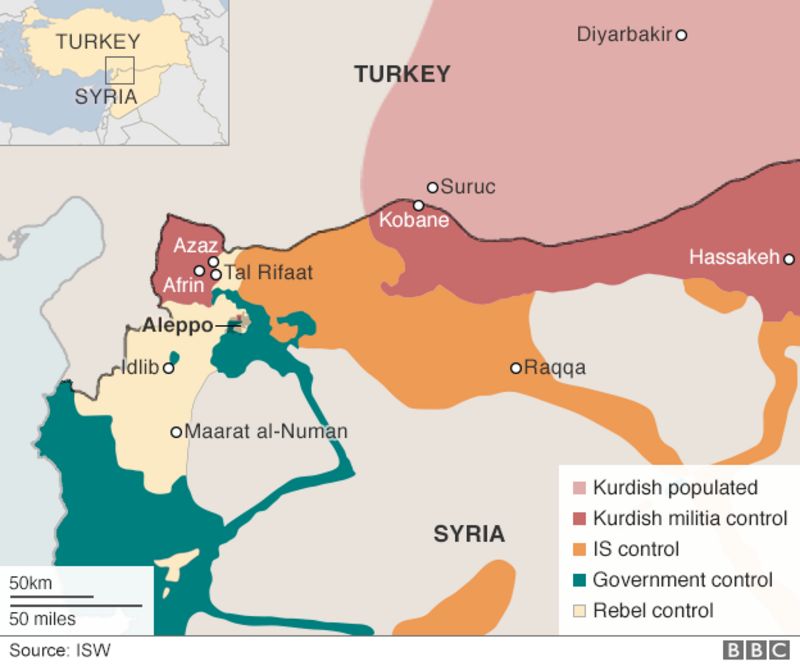
BBC reports Kurds haven't captured Azaz; why feature a map showing they have?

And notice that the Beeb report never quite gets around to stating which 'rebel' group controls Azaz. Tony Cartalucci was so right. On second thought I'm not going to bother with copying the BBC report, posted about 6 hours ago, but here's the map they feature in the report. ("ISW" stands for the Washington-based Institute for the Study of War.) It shows very clearly that Kurdish forces control Azaz. Of course it's a mistake. It's always a mistake when they get caught red-handed. 


 But to repeat, from Tony's report yesterday:
While Turkey poses as an enemy of ISIS and has not mentioned its presence in the city of Azaz or why it would attempt to protect them, it would be in 2013 that the BBC itself would declare Azaz "seized" by the terrorist group. In their article, "Isis seizure of Syria's Azaz exposes rebel rifts," the BBC would report:
...the Free Syrian Army lost the town of Azaz to the Islamic State in Iraq and Syria, or Isis, the most hardline group linked to al-Qaeda on the rebel side. As a measure of the grip the jihadis have in Azaz, one eyewitness inside the town said no-one was smoking on the streets - tobacco is forbidden according to strict Islamist doctrine.
Other reports from last year indicated that ISIS was either near or in the city -- suggesting not that it had ever lost control of Azaz but that at various moments during the conflict it suited the West and its regional allies better to pretend "moderate rebels" held it instead.

It should be noted that in all Western media stories, it is never precisely mentioned who the Kurds are fighting in Azaz -- because it is ISIS. 
********

"Gap Widening between UAE, Saudi Arabia over Yemen"

This report got lost in the shuffle on Tuesday but it's still posted at FARS; if true it's an important development in the Yemen war and regional relations. As to tossing Israel into the brew -- that could be Iranian propaganda but I don't know. I do know, from a report that Malcolm Hoeinlein gave months ago on John Batchelor's show, that UAE had opened up less frosty relations with Israel (as has Al Saud), even to the extent of setting up some kind of Israeli 'office' in the country -- not a diplomatic mission but something close to it. 

If the information is correct and still holds, and if the FARS report is correct about a gap between UAE and KSA regarding Yemen, I would question whether Israel is jumping into Yemen on Al Saud's side, or whether it's still jumping in that direction. But again, I don't know.  

In any case:

Tue Feb 16, 2016 - 12:1
FARS
Gap Widening between UAE, Saudi Arabia over Yemen, Emirati Jets Hit Pro-Saudi Camp in Lahij

TEHRAN (FNA)- The differences between the UAE and Saudi Arabia in Yemen have increased to such levels of graveness that Emirati fighter jets have targeted the positions of pro-Saudi camp in al-Hawtah city in Lahij province.

The UAE warplanes' raid on pro-Saudi militia targets in Lahij came just one day after Saudi fighter jets in a similar move pounded a UAE military convoy, killing two UAE military servicemen.

The differences between the UAE and Saudi Arabia in Yemen have heightened after the UAE replaced its soldiers with Blackwater mercenaries which faced the stern oppositions of the Riyadh government.

As a result, fugitive President Mansour Hadi and his Prime Minister Khaled Bahah have been running a feud for the past several months, and their differences grew noisy when a number of Saudi officials worked out a plan to replace the former president with his premier - who had both fled to Saudi Arabia then - in order to encourage the revolutionary forces back in Yemen to work with him and allow him to start a new government.

Political observers believe that the quarrel between Hadi and his prime minister derives from the underlying row between Saudi Arabia as supporter of Hadi and UAE as supporter of Bahah.

Meantime, Lahij and Aden provinces have been the scenes of numerous attacks against pro-Hadi forces; the latest case was the assassination of Aden governor Ja'afar Saeed.

In a relevant development in late December, Hadi's palace in Aden came under siege by his opponents, forcing him to flee Yemen to Saudi Arabia again.

A newly-formed militant group calling itself 'Southern Yemen's Resistance Forces' had besieged Hadi's place of residence in Aden, Arab media outlets reported on December 23.

Political analysts speculate that the siege of Hadi's palace had taken place with the green light of the United Arab Emirates as a result of a row between the UAE and Saudi Arabia over Hadi and his prime minister.

The speculations came as the UAE Crown Prince Mohammed bin Zayed had met the leaders of Southern Yemen, including a senior Yemeni Salafi leader Hani bin Barik, in Abu Dhabi.

[END REPORT]

Claim that Turkish-owned company loses track of radioactive material in Iraq

The missing material seems to have been stolen. Quotes from the following Reuters report:
  • [U.S. company] Weatherford said in a statement that it was not responsible or liable for the theft. "We do not own, operate or control sources or the bunker where the sources are stored," it said.
  • The material, which uses gamma rays to test flaws in materials used for oil and gas pipelines in a process called industrial gamma radiography, is owned by Istanbul-based SGS Turkey, according to the document and officials.
  • An SGS official in Iraq declined to comment and referred Reuters to its Turkish headquarters, which did not respond to phone calls and emails.
  • The security official, based in Baghdad, told Reuters there were no immediate suspects for the theft. But the official said the initial inquiry suggested the perpetrators had specific knowledge of the material and the facility. "No broken locks, no smashed doors and no evidence of forced entry," he said.
  • An operations manager for Iraqi security firm Taiz, which was contracted to protect the facility, declined to comment, citing instructions from Iraqi security authorities.
Thu Feb 18, 2016 - 3:24am IST
EXCLUSIVE - Radioactive material stolen in Iraq raises security concerns
By AHMED RASHEED, AREF MOHAMMED and STEPHEN KALIN
Reuters

Iraq is searching for "highly dangerous" radioactive material whose theft last year has raised fears among Iraqi officials that it could be used as a weapon if acquired by Islamic State.

Baghdad reported the stolen material to the International Atomic Energy Agency (IAEA) in November but has not requested assistance to recover it, the U.N. nuclear watchdog said on Wednesday.

The material, stored in a protective case the size of a laptop computer, went missing from a storage facility near the southern city of Basra belonging to U.S. oilfield services company Weatherford, an environment ministry document seen by Reuters showed and security, environmental and provincial officials confirmed.

A spokesman for Iraq's environment ministry said he could not discuss the issue, citing national security concerns.

Weatherford said in a statement that it was not responsible or liable for the theft. "We do not own, operate or control sources or the bunker where the sources are stored," it said.

The material, which uses gamma rays to test flaws in materials used for oil and gas pipelines in a process called industrial gamma radiography, is owned by Istanbul-based SGS Turkey, according to the document and officials.

An SGS official in Iraq declined to comment and referred Reuters to its Turkish headquarters, which did not respond to phone calls and emails.

The U.S. State Department said it was aware of the reports but has seen no sign that Islamic State or other militant groups have acquired it.

The environment ministry document, dated Nov. 30 and addressed to the ministry's Centre for Prevention of Radiation, describes "the theft of a highly dangerous radioactive source of Ir-192 with highly radioactive activity belonging to SGS from a depot belonging to Weatherford in the Rafidhia area of Basra province".

A senior environment ministry official based in Basra, who declined to be named as he is not authorised to speak publicly, told Reuters the device contained up to 10 grams (0.35 ounces) of Ir-192 "capsules", a radioactive isotope of iridium also used to treat cancer.

The IAEA said the material is classed as a Category 2 radioactive source, meaning that if not managed properly it could cause permanent injury to a person in close proximity to it for minutes or hours, and could be fatal to someone exposed for a period of hours to days.

How harmful exposure can be is determined by a number of factors such as the material's strength and age, which Reuters could not immediately determine. The ministry document said the material posed a risk of bodily and environmental harm as well as a national security threat.

DIRTY BOMB FEAR

Large quantities of Ir-192 have gone missing before in the United States, Britain and other countries, stoking fears among security officials that it could be used to make a dirty bomb.

A dirty bomb combines nuclear material with conventional explosives to contaminate an area with radiation, in contrast to a nuclear weapon, which uses nuclear fission to trigger a vastly more powerful blast.

"We are afraid the radioactive element will fall into the hands of Daesh," said a senior security official with knowledge of the theft, using an Arabic acronym for Islamic State.

"They could simply attach it to explosives to make a dirty bomb," said the official, who works at the interior ministry and spoke on condition of anonymity as he is also not authorised to speak publicly.

There was no indication the material had come into the possession of Islamic State, which seized territory in Iraq and Syria in 2014 but does not control areas near Basra.

A State Department spokesman declined to comment on whether the missing material might be suitable for use in a dirty bomb.

The security official, based in Baghdad, told Reuters there were no immediate suspects for the theft. But the official said the initial inquiry suggested the perpetrators had specific knowledge of the material and the facility. "No broken locks, no smashed doors and no evidence of forced entry," he said.

An operations manager for Iraqi security firm Taiz, which was contracted to protect the facility, declined to comment, citing instructions from Iraqi security authorities.

A spokesman for Basra operations command, responsible for security in Basra province, said army, police and intelligence forces were working "day and night" to locate the material.

The army and police have responsibility for security in the country's south, where Iranian-backed Shi'ite Muslim militias and criminal gangs also operate.

POLLUTION RISK

Iraqi forces are battling Islamic State in the country's north and west, backed by a U.S.-led coalition. The Sunni Muslim militant group has been accused of using chemical weapons on more than one occasion over the past few years.

The closest area fully controlled by Islamic State is more than 500 km (300 miles) north of Basra in the western province of Anbar. Islamic State controls no territory in the predominantly Shi'ite southern provinces but has claimed bomb attacks there, including one that killed 10 people in October in the district where the Weatherford facility is located.

Besides the risk of a dirty bomb, the radioactive material could cause harm simply by being left exposed in a public place for several days, said David Albright, a physicist and president of the Washington-based Institute for Science and International Security.

"If they left it in some crowded place, that would be more of the risk, if they kept it together but without shielding," he said. "Certainly it's not insignificant. You could cause some panic with this. They would want to get this back."

The senior environmental official said authorities were worried that whoever stole the material would mishandle it, leading to radioactive pollution of "catastrophic proportions".

A second senior environment ministry official, also based in Basra, said counter-radiation teams had begun inspecting oil sites, scrapyards and border crossings to locate the device after an emergency task force raised the alarm on Nov. 13.

Two Basra provincial government officials said they were directed on Nov. 25 to coordinate with local hospitals. "We instructed hospitals in Basra to be alert to any burn cases caused by radioactivity and inform security forces immediately," said one.

(Additional reporting by Humeyra Pamuk in Istanbul, Jonathan S. Landay and Arshad Mohammed in Washington; Writing by Stephen Kalin; Editing by Pravin Char/Mark Heinrich)

[END REPORT]