Translate

Tuesday, July 7

Tapwater may run out within a month for Bangkok's 2.2 million residential, business and industrial consumers

Bangkok is not only Thailand's capital city; it's also the country's largest urban area.  Note that while drought is the driver of the present water crisis, the crisis is rooted in bad water management. The same story is being repeated worldwide....    

Hit by drought and seawater, Bangkok tap water may run out in a month
Alisa Tang
July 6, 2015
Reuters

BANGKOK (Thomson Reuters Foundation) - Bangkok's tap water supply may run out in a month, as the country waits for long overdue rains to replenish sources depleted by drought and threatened by seawater creep, the chief of the capital's water authority said.

Thailand is suffering its worst drought in more than a decade. In an effort to maintain water levels in the dams that supply water for agriculture in the provinces as well as taps in the capital Bangkok, the government has asked farmers to refrain from planting rice since last October.

Despite these measures, water levels are critically low in the three key reservoirs that flow into the Chao Phraya River, one of the two main sources of Bangkok's tap water.

The quantity of water collected in the three dams totaled 5 billion cubic meters last November, compared to the normal 8 billion cubic meters, said Thanasak Watanathana, governor of the Metropolitan Waterworks Authority. As of Monday, there was about 660 million cubic meters left, according to the Royal Irrigation Department.

"Right now, there is only enough water in the dams to distribute for about 30 more days – if it doesn't rain," Thanasak told the Thomson Reuters Foundation in an interview.

Normally, the flow of water from the rains and dams keeps saltwater from the Gulf of Thailand at bay. But during droughts, the saltwater creeps upstream, turning the Chao Phraya brackish.

The seawater can kill crops and threatens the pumping station that siphons off water from the river, about 100 km (60 miles) from the gulf. The waterworks authority produces 5.2 million cubic meters of tap water per day for 2.2 million residential, business and industrial customers, but is not equipped to treat saltwater.

"Some days the saltwater increases, we don't intake the water from the Chao Phraya River. We stop and use the water from the Metropolitan Waterworks Authority stocks of water in canals. We can stop intake for 3 hours," Thanasak said.

The waterworks authority has asked Bangkok residents to store a reserve of 60 liters of drinking water in the event of a shortage. It has also urged people to use less water, but has had little success on this front in part, said Thanasak, because water customers pay only 8.50 baht ($0.25) per 1,000 liters.

"It's too cheap, so people don't feel the need to conserve. It has been this price since July 1999. It's probably the big city with the cheapest water in the world," he said.

The Metropolitan Waterworks Authority plans to invest 45 billion baht ($1.3 billion) over the next seven years to increase production and storage. It has also started discussions on a 30-year plan to forecast water demand, identify sources of water and protect against saltwater intrusion, Thanasak said.

Large-scale rainwater collection should be part of that solution, he said, adding that currently when it rains in Bangkok, all the water drains into the sea, wasted.

"We also have floods every year, and we waste that water by letting it out to the sea. So how can we save some of that water to solve the problems during the dry season?" he said.

"They are releasing so much rainwater into the sea. It's more than we have in our entire dam system. Even if we could save 10 percent of it, it would be a lot."

[END REPORT]

"Saudis quietly launch a nuclear spending spree"

I think I mentioned recently I am developing a theory that drinking plain water makes humans crazy; maybe we were meant to drink only fermented grains.  I first got this idea while watching How Beer Saved the World.  It seems the greatest advances in knowledge came while much of humanity was slightly tipsy.  

By the way my report about the show is the all-time most popular Pundita post next to one about Putin's Karakachan sheepdog puppy. I think there could be a cosmic message in this but I don't want to know out of fear I will kill myself.            

Well, all I can add to the following report is that the Russians better hurry up and invent a gizmo that neutralizes short-range nukes, not just long-range ones.

The Saudis quietly launch a nuclear spending spree
Bill Law
July 6, 2015 16:20 UTC
Middle East Eye

On second thought you'll  have to go the Middle East Eye website to read the report because I'm busy trying to remember how much water it takes on a daily basis to run a nuclear reactor. 

********

India and Pakistan to join SCO: Not an Asian NATO but trying to head in that direction

"Scientists and civil society activists are asking why"

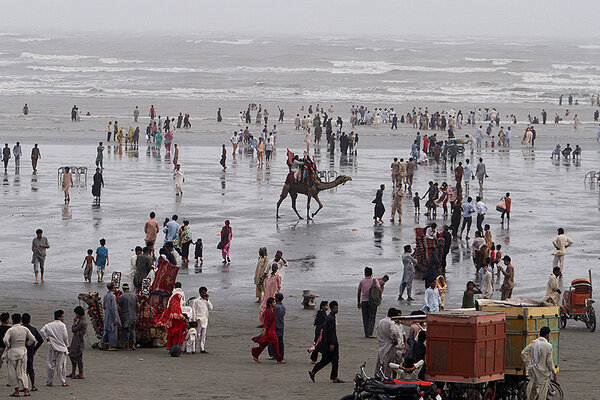
People visit Clinfton beach, during a hot summer's day in Karachi, Pakistan, Sunday, July 5, 2015
 PHOTO: Fareed Khan/AP

Is the ascension of India and Pakistan to the Shanghai organization a genuinely important development?  Some analysts interviewed by VOA think it is.  I think multilateral organizations of all kinds, including NATO, are now in the same position as the United Nations:  members are pursing so many agendas that international and regional relations now resemble a giant game of Twister.  


India, Pakistan Set for Full Membership in Shanghai Group
Anjana Pasricha
July 07, 2015  - 9:50 AM
VOA (Voice of America) 

(NEW DELHI) India and Pakistan are set to become ful members of the Shanghai Cooperation Organization (SCO) — a regional security group that comprises Russia, China and four Central Asian republics. Analysts say that the group’s expansion to include South Asia does not come without implications.
The process of the regional rivals joining the SCO is expected to begin in the remote Russian city of Ufa later this week, when both Indian Prime Minister Narendra Modi and his Pakistani counterpart, Nawaz Sharif, attend the group’s 15th meeting.
India applied to become a full member of the SCO last year, while Pakistan’s request has been pending for years. Both countries are currently observers.
Besides Russia and China, SCO’s members are the former Soviet republics of Tajikistan, Uzbekistan, Kazakhstan and Kyrgyzstan.
Analysts say expanding membership of SCO to India and Pakistan will recast the group as a more significant regional group by taking the spotlight away from it as an organization led by Russia and China.
Adding balance
Manoj Joshi, a political analyst at the Observer Research Foundation in New Delhi, notes the peculiarity of India’s inclusion.
“Actually, in a peculiar way, the Indian membership will actually balance the group. If China and Russia are seen as kind of anti-American, India has got good ties with the United States. In that sense India’s presence will add clout [to the SCO and] will balance out any kind of anti-Americanism that may be there in the SCO,” says Joshi.
China’s Vice Foreign Minister, Cheng Guoping, says the admission of India and Pakistan will play an important role in SCO’s development.
While some analysts like Joshi view the SCO as a talking shop, others say the ambitious China-led group wants to be a regional counterweight to Western alliances.
India’s quest for SCO’s membership is driven by its aim to increase engagement with the resource- and energy-rich Central Asian republics, where China already has a huge presence.
[...]
Lot's more in the report.  See also: China is building two untested nuclear reactors on Pakistan's coast, July 6; Christian Science Monitor:  "Pakistan has agreed to the construction of two nuclear reactors in Karachi, a coastal city in a tsunami-prone zone. After the 2011 Fukushima disaster in Japan, scientists and civil society activists are asking why."

********   

How to promote communism with almost nobody noticing: Use the term equality instead of communist

Meet the new Tower of Babble ....


Before anyone decries the sneakiness of communist strategists, they might have taken a page from those great defenders of freedom in Washington who install puppet governments in foreign countries under the name of democratic revolution.  Thus, a straight-up putsch to switch out one American puppet in Georgia for another was called the Rose Revolution.  

Yet for some reason the communists are particularly bad offenders.  After mangling the meaning of social, liberal, and progressive they have fixed on that most sacred of American cows, equality, to promote a communist political agenda.

However, globalized corporations are going to teach the communists a lesson in word manipulation they'll never forget:
COKE ERASES ITS LOGO IN THE MIDDLE EAST IN THE NAME OF EQUALITY AND TOLERANCE
In the Middle East, Coca-Cola's is looking to promote a world without labels and prejudices by starting with its iconic can and ditching its own logo. Of course, the label is still red and has the white swirly bit so no one's going to mistake it for a Pepsi but this is metaphor, people.

Created for Ramadan by Dubai-based agency FP7/DXB, part of McCann Worldgroup, the cans have replaced the familiar Coke logo with "Labels are for cans, not for people."
In its press release launching the campaign, the brand wasn't shy about its lofty goals, saying "In the Middle East, a region with over 200 nationalities and a larger number of labels dividing people, these Coca-Cola cans send a powerful and timeless message that a world without labels is a world without differences. And that we are all basically just the same -- human."  [...]
McCann Worldgroup is
... a leading global marketing firm providing today's marketers with best-in-class strategic and creative services that meet their brand-building needs across all communications channels. Our 23,000 employees in more than 120 countries collaborate to integrate advertising, relationship management, promotion/event marketing, design, P.R., health communications, worldwide production, and all forms of digital marketing.

... Same as the old Tower of Babble


Now just see what happens when people play with language too much; eventually it plays with them. 

******** 


Monday, July 6

"Germany says new reports of U.S. spying harm security ties"

Germany says new reports of U.S. spying harm security ties
MICHAEL NIENABER and LESLEY WROUGHTON
Thomson Reuters
July 2, 2015 - 3:31PM
Germany is taking seriously the latest reports about U.S. spying on senior government ministers and they are putting strains on vital security cooperation between the two countries, Chancellor Angela Merkel's spokesman said on Thursday.
German media have reported that the U.S. National Security Agency (NSA) bugged several senior government members, including the economy and finance ministers, as well as Merkel.
The reports are the latest twist in a long-running scandal triggered by revelations by former NSA contractor Edward Snowden of wide-ranging U.S. espionage spying on close allies.
Privacy is an especially sensitive issue in Germany after the extensive surveillance by Communist East Germany's Stasi secret police and by the Gestapo in the Nazi era.
"Such repeated events strain German and American intelligence cooperation which is essential for the safety of our citizens," spokesman Steffen Seibert said in a statement.
Earlier, in an unusual move, Merkel's chief of staff Peter Altmaier summoned the U.S. ambassador and demanded an explanation for the reports. Altmaier told the envoy that German law must be respected and violations punished, Seibert said.
In Washington, a State Department spokesman confirmed the meeting but declined to elaborate. He denied the latest reports have had a negative impact on the two countries' relations.
"What I can tell you is that nothing's changed about the strong relationship that we have and will continue to have with Germany," spokesman John Kirby said.
Germany's Sueddeutsche Zeitung daily and broadcasting network ARD reported that the NSA had targeted 69 telephone and fax numbers in the German government administration. They based their reports on documents released on the Wikileaks website.
Among the officials targeted were the economy minister and as well as several deputy ministers, the reports said.
Asked about the reports, Economy Minister Sigmar Gabriel -- who is also Germany's Vice Chancellor -- said he was most worried by the risks of industrial espionage, particularly given the links his ministry has to companies.
"It is an absurd carry-on," Gabriel told ARD television.
Interior Minister Thomas de Maiziere, who is responsible for security issues, said Germanywould look at the latest allegations.
"We have become more distrustful," he said.
The role of Germany's spies has also been in the spotlight since reports surfaced earlier this year that its BND foreign intelligence agency had cooperated with the NSA.

(Additional reporting by Andreas Rinke in Berlin and Doina Chiacu in Washington; Editing byGareth Jones)

As much as 80 percent of India’s surface water may be polluted but Indians shouldn't worry! Smart cities are on the way!

The two following reports, one from TNN, one from The Washington Post, are being added to my file titled, "Maybe it's not something in the water making so many people crazy, maybe humans are meant to drink beer."

80% of India’s surface water may be polluted, report by international body says
Sushmi Dey
June 28, 2015 - 04.35AM IST
TNN via The Times of India

NEW DELHI: Even as India is making headlines with its rising air pollution levels, the water in the country may not be any better. An alarming 80% of India's surface water is polluted, a latest assessment by WaterAid, an international organization working for water sanitation and hygiene, shows. 

The report, based on latest data from the ministry of urban development (2013), census 2011 and Central Pollution Control Board, estimates that 75-80% of water pollution by volume is from domestic sewerage, while untreated sewerage flowing into water bodies including rivers have almost doubled in recent years. 

This in turn is leading to increasing burden of vector borne diseases, cholera, dysentery, jaundice and diarrhea etc. Water pollution is found to be a major cause for poor nutritional standards and development in children also. 

Between 1991 and 2008, the latest period for which data is available, flow of untreated sewerage has doubled from around 12,000 million litres per day to 24,000 million litres per day in Class I and II towns. 

The database defines Class I towns as those with a population of more than 1 lakh [1 lakh = 100,00], whereas towns with population ranging between 50,000 to 1 lakh are classified as Class II. 

The report, titled 'Urban WASH: An Assessment on Faecal Sludge Management (FSM) Policies and Programmes at the National and State Level', is likely to be released next week. 

According to the report, inadequate sanitation facilities, poor septage management and a near absence of sanitation and waste water policy framework are primary reasons responsible for the groundwater and surface water pollution in the country.

Experts say there are glaring gaps not just in treatment of sewerage water but also in case of water treatment itself, used in supply of drinking water as well as for kitchen use etc. 

"Though there are standards, the enforcement is very low. Even the amount of water, which is treated, is also not treated completely or as per standards. And there is no civic agency accountable or punishable for that because we do not have stringent laws," says Puneet Srivastava, manager policy- Urban WASH & Climate Change at WaterAid India. 

Findings of the report show nearly 17 million urban households, accounting for over 20% of total 79 million urban households, lack adequate sanitation. 

"Among those with access to improved sanitation facilities, a vast majority relies on on-site sanitation systems, such as septic tanks and pit latrines. Today, these septic tanks and pit latrines have become a major contributor to groundwater and surface water pollution in many cities in the country," the report said. 

However, the report acknowledges that India has of late started focusing on the problem of septage management, which is one of the most immediately implementable solutions to address urban waste water. 

But there is an urgent need to focus on infrastructure as well as enforcement, says Srivastava. 

"Most of the sewerage treatment plants are performing under their capacity as these utilities do not have enough money to run full capacity," says Srivastava pointing at dearth of human resource, improper management etc. 

Estimates show there were 269 sewage treatment plants across the country, with 211 in Class I cities, 31 in Class II towns, and 27 in other smaller towns. 

"At the policy level, sanitation was not prioritized until the early 1990s and became an important policy concern only around 2008. It was not until the inception of the National Urban Sanitation Policy (NUSP) in 2008, that urban sanitation was allotted focused attention at the national level," the report said. 


Indian officials want 100 ‘smart cities.’ Residents just want water and power.
By Rama Lakshmi
June 26, 2015
The Washington Post

AJMER, India — Ajmer’s famous 13th-century Sufi shrine draws millions of pilgrims from around the world every year. The city recently launched a new Web site called “Amazing Ajmer.” But life in this ancient city of 550,000 people in northern India is anything but amazing.

Running water is available for just two hours every two days. Only 130 of 125,000 homes in the city are connected to the sewage system. Dirty water flows in open drains in cramped neighborhoods. Stepwells and lakes have become garbage dumps. Illegal buildings and slums dot the city. And only two traffic lights work.

But soon, Ajmer could be transformed into a 21st-century “smart city” — an urban-planning term for the gleaming metropolises of the future that Prime Minister Narendra Modi wants to create by 2022.

These modern marvels would be connected by grids in which water, electricity, waste removal, traffic, hospitals and schools are seamlessly integrated with information technology to run them more efficiently.

The government has set aside $7.5 billion to make it happen, and Modi officially launched the program Thursday. But it’s a grand vision that the residents of Ajmer — one of the 100 cities designated for the modernization — are not quite ready for.


Even as it becomes a buzzword, many people here are unclear about what it means to be a smart city. And others question whether Modi’s fascination with smart cities in South Korea, China and Abu Dhabi can be duplicated in India.

The ambitious project also signals a marked shift in Indian politics, analysts say. For decades, the village dominated the country’s political and economic decisions, a stubborn legacy that dates to Mahatma Gandhi’s constant refrain that “India lives in its villages.” But now the pace of urbanization is so rapid that policymakers can no longer look away.

More than 350 million Indians live in cities. According to a McKinsey Global Institute report, urban expansion will grow in the next few years “at a speed quite unlike anything India has seen before.” By 2030, more than 600 million Indians will live in crowded cities crumbling withcreaky infrastructure.

In a radical departure from the previous government’s rural focus in the past decade, Modi wants to boost cities as engines of economic growth. By 2030, officials say, 70 percent of India’s economic output is expected to come from the cities.

“Cities in the past were built on riverbanks. They are now built along highways. But in the future, they will be built based on availability of optical-fiber networks and next-generation infrastructure,” Modi saidlast year, shortly after taking office.

In the past eight years, the smart-cities rubric has become fashionable among global urban planners who want to use digital technology and big data to create surveillance-heavy intelligent systems that control how people live, consume energy, go to work, and stay healthy and safe.

India’s program involves radical renovation of deteriorating cities as well as constructing new municipalities from scratch, similar to a Wall Street-like financial hub called the GIFT city in Modi’s home state of Gujarat — where the progress is nowhere near its promised hype.


When Modi and President Obama met in Washington in September, U.S. companies selected three Indian cities, including Ajmer, to become smart cities. Last month, IBM, Oracle and several other companies met officials in Ajmer to discuss using smart technology to solve some of the city’s challenging water, traffic and waste problems.

“While we are trying to bring 21st-century technology, we also need to sort out some 19th-century challenges in Ajmer,” said Mukesh Aghi, president of the U.S.-India Business Council, which organized the meeting. “Basic services like sanitation, health, roads and electricity have not kept up with the pace of growth in these old cities. We can leverage smart technology to leapfrog some of these problems.”

Aghi said that the U.S. companies are considering a pilot project to install smart electricity meters that will help consumers track consumption and promote conservation on their own.

Ajmer’s residents have already posted a billboard in the heart of town declaring themselves a smart city. But many wonder whether the initiative is just an urban fantasy of technology and real estate companies that is being imposed on Ajmer.

“Can we first work toward becoming a functioning city before aspiring to be a smart city? We lack even the basic services that a city should typically provide,” said Suresh Mathur, a retired schoolteacher who runs a city cleanliness drive called “My Clean School.”

Other critics have dismissed Modi’s smart-cities plan as a 21st-century urban utopia, as a distant Neverland and Orwellian. They say that the idea is more suitable for richer nations whose citizens can afford to take basic urban services such as drinking water, toilets or electricity for granted.

“The Western definition of the smart city is spineless, if not altogether redundant in India — a mere glossing over of civic services and infrastructure,” Gautam Bhatia, an architect and author on urban design, wrote in The Hindu newspaper.

Some worry about damaging or destroying Ajmer’s famous cultural heritage.

“We can’t import a first-world concept of a smart city and plant it here. It has to be culturally appropriate,” said Onkar Singh Lakhawat, chairman of Heritage Preservation and Promotion Authority of Rajasthan.

Officials have held 22 meetings with residents in the past five months to convince them of the merits of the smart-city plan.

“Before you take part in the Olympics, you engage in warm-up exercises, build your stamina, physical fitness and change your attitude,” said Dharmendra Bhatnagar, divisional commissioner. As first steps, his office is arranging a flower show and a photography contest.

The big challenge, Aghi said, is figuring out where the funding for the program will come from. Most city corporations in India are severely cash-strapped. Modi wants Indian and foreign companies to invest in the program, but there is no estimate yet.

One idea is that private companies charge residents a fee to recover their investment. But that could be problematic. Last year, when a private company in Ajmer received a contract to collect and recycle trash, residents protested in the streets and refused to pay.

“There is a mind-set among people that the government should give everything free,” said the city’s mayor, Kamal Bakolia.

In the cramped and labyrinthine lanes leading to Ajmer’s Sufi shrine, there is plenty of chatter and jokes about Ajmer’s new designation. One pilgrim covers his nose with his scarf near an open drain and asks a resident, “When will your city become smart?”

Earlier this year, before Ajmer was chosen for smart-city status, Modi had also included it in a list of 12 “heritage cities” he planned to develop. And a few years ago, the government launched a program to make Ajmer a “slum-free city.”

“Real estate prices have shot up since all this talk of smart city began,” said Syed Munawwar Hussain, the shrine custodian. “We are a world-renowned city, but we are still waiting to become a world-class city.”

Read more

India is building millions of toilets, but that’s the easy part

Activists tell Indians to clean up their cities

Rama Lakshmi has been with The Post's India bureau since 1990. She is a staff writer and India social media editor for Post World.
[END REPORT]

"Then the fire did something no one here had seen before." Washington state experiences California-type wildfires for the first time

See also: The dire situation in the Olympic Mountains is hurting Washington farmers and businesses, July 1, The Wall Street Journal

Sitting on the tailgate of a pickup truck in front of what had been her home of 18 years, Sharon Cooper marveled Wednesday that all of the precautions she and her husband, Nick, had taken through the years did no good against the Sleepy Hollow fire.

Not the concrete shingles. Not the backyard fire hose with high-pressure water. Not the regular efforts to whack away the brush.


A Chelan County Sheriff's deputy races to make sure residents had left their houses as flames approach Quail Hollow Lane in Wenatchee, Wash. (Don Seabrook / Wenatchee World)  via The Los Angeles Times

By MARIA L. LA GANGA
reporting from Wenatchee, Washington
July 4, 2015 - 3:30 AM
The Los Angeles Times 


The Sleepy Hollow fire raced down the crisp Sage Hills, straight toward the Broadview neighborhood in the apple capital of the world. Flames shot high into the night, torching 29 homes and causing hundreds of people to flee. Then the fire did something no one here had seen before.

Embers flew more than a mile Sunday night, into the hardworking heart of this small city. They ignited four industrial buildings, most involved in fruit packing, at the start of the busy summer agriculture season.

The flames sent a terrifying message: Normally soggy Washington — nicknamed the Evergreen State for good reason and home to the wettest town in the Lower 48 — has never been hotter or drier at this point in the year, officials say, and the fire season has never begun so early or so fiercely.

"It's more reminiscent of Southern California and the brush fires fed by the Santa Ana winds," said Peter Goldmark, head of the state Department of Natural Resources. "Now it's up here in the state of Washington, where this kind of behavior is unseen. It's heralding a radical change in the kinds of fires we're going to see."

The Pacific Northwest has long been a magnet for California transplants, but none have been more fearsome than the most recent arrival: the Golden State-style wildfire.

The timing couldn't be worse. The snow pack is gone. Heat records are being broken statewide. More than three-quarters of Washington's rivers and streams are running at below-normal levels, nearly half of them at record lows. Trees and grasses — wildfire's favorite fuel — are as dry throughout the state as they normally would be in August.

Seattle, where conventional wisdom has it that the sun does not appear until July 5, endured its hottest June on record and its driest May and June combined. As the famously overcast region was sweating its way toward Independence Day, the National Weather Service placed the greater Puget Sound area under a heat advisory until Sunday night.

Many officials don't believe that this is a temporary phenomenon. Increasingly, they are convinced that this is the kind of early fire season that the Pacific Northwest can expect as the century unfolds.

"This is a stress test for 2070," said Cliff Mass, a professor of atmospheric sciences at the University of Washington. "We're being tested now with the warmth and lack of snowpack that will be typical at the end of the century. How do we get through it?"

Climate experts say the current conditions in the Pacific Northwest are part of a short-term climate phenomenon, but they warn that temperatures are rising everywhere. In Seattle, for example, that means warmer, wetter winters and warmer, drier summers.

State climatologist Nick Bond calls the Emerald City's weather pattern increasingly "Mediterranean." It is not good news. Such conditions augur an anorexic snowpack, worse winter flooding and scarcer water supplies during increasingly hot summers.

"We won't have the snowpack to get us through the dry season like we are used to," Bond said. "It's not going to completely go away, and it's not going happen in the next few years. But I look at it as a wake-up call and a chance to learn from this short-term climate event about how we adapt to what the future decades will bring us."

The National Interagency Fire Center in Boise ranked all of Washington and Oregon at above-normal threat for wildfires in July, along with northern and coastal California and western Montana and Idaho. By August, the threat should diminish some in Northern California, center officials say. The Pacific Northwest is not so lucky.

Two months ago, Democratic Gov. Jay Inslee declared a statewide drought emergency, a snowpack drought rather than a precipitation drought. At the time, state officials warned that the 2015 fire season could be earlier and fiercer than Washington has ever seen.

Now that it has begun in earnest, "it's worse than I feared," Goldmark said.

No one in Broadview would even think of disagreeing with him. They're the ones who have lived through Wenatchee's record-hot June, who saw the flames racing down the hills toward their well-kept homes on the hottest day ever recorded here — 109 degrees Fahrenheit as measured at the airport.

Sitting on the tailgate of a pickup truck in front of what had been her home of 18 years, Sharon Cooper marveled Wednesday that all of the precautions she and her husband, Nick, had taken through the years did no good against the Sleepy Hollow fire.

Not the concrete shingles. Not the backyard fire hose with high-pressure water. Not the regular efforts to whack away the brush.

"We were having a quiet day inside because it was so hot," Cooper recounted, as her husband wandered through the rubble. "We watched two movies and then we smelled smoke. We got our financial papers prepped. We grabbed that rifle that didn't fit in the gun safe and one handgun.

"I would have grabbed a lot of stuff, but it was so fast," Cooper said, describing a blaze "like a wave of water."

Cooper moved to the Wenatchee Valley 40 years or so ago. She remembers how smoke from last year's Carlton Complex fire — the biggest in Washington state history and just miles away — choked her town. She's never seen weather like this, she says. Her father-in-law's corn is a month ahead of schedule. The Wenatchee River is scarily lower than normal. And the entire state has been declared a drought area.

"This is August kind of stuff," Cooper said, mourning the community's loss, wondering whether she and Nick would rebuild. "Even sometimes the Fourth of July is rainy and yucky here. ... Everything's changing."

By Friday, the Sleepy Hollow fire was 98% contained, good news that couldn't come fast enough for the state's weary firefighters.

Goldmark, the head of the Department of Natural Resources, says he fears the summer ahead. He said he had asked the state Legislature for $4.5 million for fire engines, staff, helicopters and training "so we can be better prepared for this kind of wildfire season, which is much more intense and commonplace."

The Legislature budgeted $1.2 million, he said.

"I'm very short-handed in terms of staff and equipment to meet the current threat," Goldmark said. "I've got a whole state to protect, a big one and a very fire-prone one, with tremendous amounts of fuel, and population that's located close to the fuel. It's not a good mix."

At a briefing Wednesday morning, Chelan County fire Chief Mike Burnett was blunt, beseeching residents to do everything they could to keep fire danger at a minimum as the year's most incendiary holiday [July 4] approached.

"Our resources are strapped," Burnett told reporters. "We don't have what we need to fight any more large fires popping up right now. People are tired, and we're working hard to suppress the fires that we have.

"Please, everyone be careful out there."

[END REPORT]

********

Sunday, July 5

"Saskatchewan is burning" - 1,000 troops to help battle more than 100 wildfires

Saskatchewan to get military to help fight wildfires as thousands evacuated
July 05, 2015 - 6:20 PM UTC
Associated Press via (Minneapolis) Star Tribune

REGINA, Saskatchewan, Canada – Close to 1,000 Canadian military personnel are on their way to help fight wildfires in the western Canadian province of Saskatchewan where thousands of residents have been evacuated.

Duane McKay, commissioner of emergency management with the province, said Sunday that he military will bolster their ability to fight the fires. Provincial officials say about 741,000 acres (300,000 hectares) ares burning in Saskatchewan this year — around 10 times what's normal.

The Alberta government is preparing to receive up to 5,000 people evacuated from La Ronge, Saskatchewan. Saskatchewan officials say 1,136 had registered in La Ronge and were transported to Cold Lake, Alberta, on Saturday night, while thousands of others were traveling out of the community on their own and would likely stay with friends or family.
[END REPORT]

Wildfires mapped: Saskatchewan is burning
Josh Elliott, CTVNews.ca
Published Sunday, July 5, 2015 6:14PM EDT
Last Updated Sunday, July 5, 2015 9:57PM EDT

[See the website for video detailing Saskatchewan's request to firefighters in other Canadian regions for help; several are responding and on Monday there will be an updated announcement of all responding fire departments.]

Fire crews are struggling to put out more than 100 wildfires ripping through the northern region of Saskatchewan, where 51 communities have been evacuated ahead of the billowing smoke and devastating flames.

Saskatchewan's Buffalo Narrows and La Ronge regions are the hottest wildfire spots at the moment, but there are also 10 uncontained blazes tearing through the province's Prince Albert region, further to the south.

The province has now recorded 565 fires so far this season, more than tripling last year's seasonal total of 184.

More than 12,000 residents have been told to evacuate from their homes ahead of the choking smoke and flames, with many flocking to shelters in Saskatoon, Regina and Fort Battleford, while others take up refuge with friends or family living in other parts of the province. Neighbouring Alberta is also accepting evacuees in Cold Lake.

Several main highways in Northern Saskatchewan have been closed due to the fires.

Saskatchewan's latest wildfire map is shown below.

[...]

********

Drones come to American farms; their use will save much water and chemicals -- and manpower

 ... agriculture could account for 80 percent of all commercial drone use.


Chilcott is optimistic that the technology to scout out problem spots so precisely will be transformative because farmers can limit spraying just to those places. “In five years we won’t have to blanket a field with chemicals,” he says.


Geske may not be able to use drones efficiently to monitor all the irrigation pipes on his 2,100 acre Missouri farm if he has to keep them within sight. He’s still interested, though. The men he hires now use a lot of fuel and their trucks tear up his land and roads.

“You can wait forever on advancing technology,” Geske says.


By MARY CLARE JALONICK, AP
July 5, 2015 - 2:37pm EDT
Associated Press va PBS NewsHour

[...]

Farmers are eager for the technology.

The small, relatively inexpensive vehicles could replace humans in a variety of ways around large farms: transmitting detailed information about crops to combines and sprayers, directing them very precisely to problem spots and cutting down on the amount of water and chemicals that a farmer needs to use in those areas.

The Association for Unmanned Vehicle Systems International, a trade group, says agriculture could account for 80 percent of all commercial drone use.

Agricultural use of drones is about to take off after being grounded for years by the lack of federal guidelines. The Federal Aviation Administration has approved more than 50 exemptions for farm-related operations since January.

Companies with those exemptions say business has grown, helped by quick advances in the technology.

Bret Chilcott of Kansas-based AgEagle, which sells unmanned aerial vehicles and the software to help operate them, says his company took its first orders last year. Now it has a backlog of several hundred orders. He says the technology has transformed the market during that short period.

“Last year users had to land their aircraft and then take the data to the computer,” he says. “Now the data appears on your iPad or hand-held device a few minutes after flight.”

That data could be pictures, 3-D images of plants, thermal readings of crops or animals or other observations that a drone could make while in the air. Information that in the past took days to collect – or could not have been collected at all – can be gathered now in minutes or hours and, in some cases, integrated with separate data collected from other high-tech farm machinery.

Chilcott is optimistic that the technology to scout out problem spots so precisely will be transformative because farmers can limit spraying just to those places.

“In five years we won’t have to blanket a field with chemicals,” he says.

Still, most farmers cannot legally fly the vehicles yet.

[...]

Plenty more in the report, which also details concerns about guidelines for using drones.  

Russia's new super defense weapon: if it works, the best news this century

Of course every other country will have to get hold of the same weapon for it to be really good news for the entire human race. But if I understand the description correctly the Russian weapon will make long-range nuclear weapons obsolete.  As for neutralizing the short-range nukes -- Russian techies have probably chained themselves to the drawing board, to which I would add, "Faster!  Faster!" And no vodka until you've figured it out.  On second thought, more vodka.   

The bad news is the new weapon system isn't operational yet. It still needs to be tested. Yet consider what this could mean if the tests are successful.  

One thing is clear: we can't go on as we've been going, with every tinpot regime on the planet now able to buy its own nukes, and lunatics in Washington talking about 'limited' nuclear war as the way to settle Russia's hash and Russia in retaliation talking about dusting off its 'limited' nukes.

Do you realize what else this new weapon means?  Vladimir Putin could walk off with the Nobel Peace Prize yet.  In 2013 I wrote that Putin wasn't God; that he couldn't save Americans from themselves a second time.  Maybe I was wrong. Maybe he can do it twice.            

Russia claims to have super weapon that disables western satellites and long range arms
by WILL STEWART
July 5, 2015
Daily Record and Sunday Mail (U.K.) 

Russian weapon can zap satellites and switch off long range weapons

Russia is boasting a major advance in electronic warfare technology enabling Vladimir Putin’s armed forces to zap foreign military satellites, and “switch off” enemy weapons.

The new system will muzzle the guidance systems of Western cruise missiles and other high-precision arms, it is claimed.

Its Russian makers say it is a “fundamentally new electronic warfare system” which can be mounted on ground-based as well as air- and sea-borne carriers.

Russia’s Radio-Electronic Technologies Group (KRET) deputy chief Yuri Mayevsky said: “The system will target the enemy’s deck-based, tactical, long-range and strategic aircraft, electronic means and suppress foreign military satellites’ radio-electronic equipment.”

“It will not be based on satellites as this is prohibited by international rules and we comply with this rule.”

The Russian hailing of its new super weapon comes as relations with the West are at their lowest ebb since the collapse of the Soviet Union, with fears of a new Cold War.

[Pundita note: The new Cold War is at least a decade old; right now the fear among sane people is of a hot war with Russia.]

President Vladimir Putin has invested heavily in rebuilding his country’s military might, which has lagged behind the West since the end of the Soviet era.

The new technology “will fully suppress communications, navigation and target location, and the use of high-precision weapons”, said Mikheyev, who did not give further details of the claimed military breakthrough.

[END REPORT]

Saturday, July 4

Mexican gang criminality worsens in new ways

"They’re not just fighting over drug routes, or distribution points, but increasingly over Mexico’s natural resources. That’s been going on for a while, but the situation is increasingly out of control.”

“Perhaps drug organizations no longer threaten the state, at least not the way they once did ... But they do threaten millions of Mexicans in a much more direct way. The old narco model is dead, that of the Santa Claus figure who generated jobs, infrastructure improvements and were seen as OK by local authorities as long as they all shared the profits and society was left alone. These days, extortions, kidnappings are at epidemic proportions."

"May was the worst month for violence since since October 2013 ... and 2015 appears on track to surpass the estimated 20,000 drug-related homicides in 2014."

“The real question is why do we continue to elect these rats and tolerate this mess? When will we learn?”

The quotes are from Alfredo Corchado's July 3 report from the Mexico Bureau at The Dallas Morning News, As Mexico takes down kingpins, pace of killings only accelerates.

This is a very important report. It's doubly important because the information Corchado passes along from a slew of experts has been suppressed on the national news level in the United States.  It's also suppressed by Mexico's government:

“The style, form, narrative is different from Calderón, but the outcome is the same,” said Luis Astorga, an expert on organized crime at Mexico’s National Autonomous University, or UNAM, and author of What Did You Want Me To Do? — an expression once used by Calderón.
“The big difference is that under Peña Nieto, there is more control of information and less transparency for the public.”
“The bottom line in all of this,” said James Creechan, a sociologist in Toronto and author of the coming book Encyclopedia of Mexican Cartels, “is a vacuum of data useful for measuring the impact of the drug war.”
The lack of information frustrates U.S. officials, who complain of a lack of intelligence-sharing with their Mexican counterparts.
“They want to keep us in the dark,” one senior U.S. official said.
Yet enough intelligence is being shared by various state governments in Mexico to be greatly alarming.  

See also Reuters June 4 report on Mexico's June midterm elections, Mexico murders blight elections as government fails on security; at least 7 candidates were murdered -- a female mayoral candidate was beheaded -- with 20 others forced out of electoral campaigns because of death threats, and at least 9 officials murdered in different parts of the country.
"These are the dirtiest elections since the advent of democracy in Mexico," Said Raul Benitez, a security expert at the National Autonomous University of Mexico.
And see Alfred Corchado's May 31/June 1 report on the violence-filled election campaign -- and the increasing desperation of Mexican citizens about their government:
Fifty percent of eligible voters are expected to turn out, but that number is considered low for Mexico, where voters are losing faith in the main political parties, said analyst Jaime Rivera, a political scientist at the University of Michoacán in Morelia.
“Voters believe less and less in political parties, but they still want to believe in their institutions” said Rivera, who is also a state electoral adviser.
[...] 
Peña Nieto and his PRI party were voted in three years ago in large part because of concerns over violence. But those concerns remain intact as public opinion has soured on every political party, including the conservative National Action Party, the left-leaning Party of the Democratic Revolution, as well as the PRI and the president himself. All have been tainted with allegations of corruption.
In a February poll by Reforma, some 85 percent said they don’t trust Peña Nieto, and 60 percent say corruption has increased since he took office. The president has been questioned over houses built for his family by a government contractor.
Still, analysts expect the PRI to keep the upper hand in these elections as it turns out its large base.
That's what happened. See Reuters June 13 report on the election results:
Mexico's ruling party and its allies in the lower house of Congress extended their slim majority in last weekend's elections, according to a preliminary estimate from the National Electoral Institute (INE).
And this deeply ironic observation in the report:
Pena Nieto is not expected to rely on Congress as much in his last three years, having fulfilled the bulk of his main legislative pledges, including measures to end the state oil and gas monopoly and open up the telecoms sector to competition.
The system of government in Mexico is broken. Its judicial system is broken. Its law enforcement institutions are broken.  The political system is broken.  Its society is under siege; the only order is provided by thousands of Mexican troops who patrol the streets in key cities and by vigilante groups.
But by gum Peña Nieto has made foreign investors happy.

Is there a way out of the nightmare?  Not until Mexicans wake up to the fact that industrialized remittances are killers of democratic societies. The billions of dollars in remittance payments provide just enough money to allow elected governments to keep avoiding the kind of reforms that bring in decent governance.

It would be cold comfort, I know, but Mexicans who look on helplessly are not alone in the nightmare.  In June the United Nations released a report documenting that democracy is collapsing and authoritarianism is on the rise in more than 96 of its 193 member nations.  You can trace the rise of state-sanctioned remittances starting in 2004 and concomitant decline in democracy during the past decade.

Pandora's Box. They opened Pandora's Box when they industrialized remittances.

********

Thursday, July 2

Red moon over Iowa. Smoke from wildfires in drought-stricken western Canada pours into US Midwest

"As the sun comes up on July, 356 wildfires are burning in western Canada"

Smoke from Canadian wildfires turns moon over Iowa red


Smoke from fires in western Canada is steered south into the U.S. by the jet stream in a satellite image acquired June 29, 2015

Credit: NASA Earth Observatory
UPDATED 9:38 PM CDT Jun 30, 2015
KCCI-8 News 
[See website for photos of red moon in addition to one above and hazy sun]
DES MOINES, Iowa —It's not just our view of the sun and moon being affected by the smoke from the Canadian wildfires, now our air quality at the surface is being impacted.
[...]
Smoke from wildfires in Canada is pouring south into Minnesota, the Dakotas and Iowa.
Lightning sparked about 40 wildfires in forests in northern Saskatchewan, upping Canada's fire total to 113 in the province. [...]
July 1, 2015 12:00 PM
AG Web Powered by Farm Journal
The drought parching fields across parts of Canada risks triggering a shortfall in global wheat exports, according to Australia and New Zealand Banking Group Ltd., which said the event was being compared to dryness in 2002. 
Continuing drought in Canada may create a 12 million metric ton shortfall in wheat exports, Senior Agricultural Economist Paul Deane wrote in a report on Wednesday. Forecasts offered little relief, with a strong, high-pressure system set to bring high temperatures and little rain that would add to crop stress and may cause irreversible yield loss, he wrote.
Wheat futures in Chicago rallied to the highest level since December on Tuesday amid dry weather in Canada as well as parts of Europe and excess rains across the U.S. Canada’s spring-wheat prospects have been hurt by drought, Whitefish Bay, Wis.-based Martell Crop Projections said last week, citing deficient rainfall in Saskatchewan and Alberta. [...]
Signs of drought appear to be in Western Canada for the long term
Mark Hume
The Globe and Mail
Published Sunday, Jun. 14, 2015 9:33PM EDT
Last updated Monday, Jun. 15, 2015 12:56PM EDT
(Vancover) High in the Rocky Mountains along the British Columbia-Alberta divide, John Pomeroy is seeing signs of the changing climate that has brought a crippling drought to the U.S. West.
The director of the Centre for Hydrology at the University of Saskatchewan monitors 35 remote observatories in the mountains from Kananaskis, west of Calgary, to the Athabasca glacier, 100 kilometres south of Jasper.
And the data he is collecting – which show snowpacks vanishing at record speed – point to dramatically reduced river flows across B.C., Alberta and Saskatchewan this spring. With recent record dry spells in some areas, the shortage of runoff water could lead to drought across a vast region of Western Canada.  [...]
Scorched Earth Is Big Climate Concern in Alaska Wildfires
by Brian Kahn
July 1, 2015
Climate Central
Alaska and its neighbor to the east, Canada, have kicked off wildfire season in a major way. Blazes have raged across the northern stretches of North America, sending smoke streaming down into the Lower 48 and leaving the landscape charred.
[...]
This summer, a number of factors have lined up to make Alaska a tinderbox. A dry winter left little snow on the ground and record heat in May, with the state’s average temperature running 7.1°F above average, melted what little snow there was.
Similarly warm conditions stretched across a large portion of western Canada in late May and set the stage for extreme wildfire conditions. Over the period of June 18-24, the Bureau of Land Management lightning network recorded more than 71,000 lightning strikes in Alaska, igniting a large swath of fires.
As the sun comes up on July, 356 wildfires are burning in western Canada and another 297 are active in Alaska. For the year-to-date, wildfires have burned 3.2 million acres in western Canada and 1.8 million acres in Alaska.
Both numbers are well above the long-term average and in the case of Alaska, are in record territory for the amount of acreage burned for this time of year. Similar stories have played out in Siberia in 2013 and Canada’s Northwest Territories in 2014.
 [...]
For all the drama of trees lighting up like matchsticks, it’s what lurks below the forest that could be a major wildcard for future warming. Large reserves of peat make up a large portion of the soil, swamps and bogs in the northern reaches of the globe.
Flannigan refers to it as “legacy carbon,” an accumulation of centuries of plant matter that sequesters vast amounts of carbon from the atmosphere.
Despite covering slightly less area than tropical forests, boreal forest soil stores three times as much carbon as its tropical counterpart. They currently operate as carbon sinks, taking up more carbon than they emit each year. Wildfires could flip the script, though, turning boreal forests into sources of carbon emissions as fires burn through the vast reserves of carbon locked in the trees and soil (something already happening in California). If that happens, it could rapidly warm the climate.
“Up until about 10 years ago, the prevailing dogma was peatlands just didn’t burn,” Merritt Turetsky, an ecologist at the University of Guelph, said. “They were way too wet and fire played little to no role in these ecosystems. Over time, we’ve seen that just isn’t true.”
As warming dries out forests and precipitation patterns change, the water table is dropping in once swampy areas. That makes peat susceptible to burning and when it does catch fire, centuries’ worth of carbon can burn up in the span of a few hours if fires are intense enough.
[...] 
 ********


More Musings

Guess where the rain fell?
BBC, June 29, 2015
Villagers in drought-affected northern Thailand have used a toy of a popular cartoon cat to perform a rain ritual - in case anyone complained about them using a real animal, it's reported.
Ordinarily, a live cat would be used as part of the ritual to pray for rain, but locals were worried about being accused of animal cruelty, the Thai Rath website reports. Instead, they turned to the Japanese manga character Doraemon - a time-travelling robotic cat - which was duly loaded into a wooden cage and carried around the village in Phrae province. Farmers in the area grow corn, but a lack of rain means many are struggling to irrigate their crops.
Doraemon was chosen because nobody could find a more realistic cat toy, the report says. The ritual involved the toy being taken to sacred sites around the village, and ended with a ceremony at a nearby monastery, according to the Bangkok Post. 
But so far the villagers' prayers have gone unanswered, and Thailand's drought persists. As well as causing problems for farmers, the dry spell is also starting to affect tap water supply in some places. The country's rainy season usually begins in May and lasts until November.
Japan: Evacuation advisories issued for 370,000 Kyushu residents amid heavy rain
The Japan Times News, June 11, 2015
KUMAMOTO – Heavy rain hit Kyushu on Thursday, with local authorities advising 370,000 residents in 14 municipalities to evacuate the area due to an increased risk of landslides. Alerts were issued for most parts of Kumamoto Prefecture and the cities of Unzen and Minamishimabara, Nagasaki Prefecture. ...
JR Kyushu suspended some train runs on the Hisatsu Line, the Misumi Line and the Kagoshima Line due to the heavy rain, according to local media reports. Meanwhile, South Korea’s Asiana Airlines canceled two round-trip flights Thursday between Seoul and Kumamoto.
According to the Meteorological Agency, the amount of rainfall in the 24 hours through 11:40 a.m. Thursday came to 280 millimeters at Mount Unzen in Nagasaki Prefecture, 219.5 mm in the Misumi district in Uki, and 213 mm in the Hondo area in Amakusa, Nagasaki.
The agency warned that 180 mm of rain could fall in northern Kyushu and 120 mm could fall in southern Kyushu during the 24 hours ending at noon Friday.

(Iran) Press TV, May 5, 2015
"520 cities in the country are facing the crisis of drinking water shortage,” Esmaeil Najjar, who is also head of Crisis Management Organization, said.
“Over the past two decades, the scourge of drought has struck our country,” he said, adding that Iran lies on an “arid belt” on Earth.
Iran’s Energy Ministry, which is in charge of regulating the water sector, announced recently that about 60 percent of the reservoirs of major dams are already empty. The ministry further said there has been a decrease of 16 percent in inflow of water into dam reservoirs from the start of autumn.
Vice News, July 1, 2015
North Korea has asked Iran for urgent humanitarian aid to help survive what the North Korean government has called "the worst drought in 100 years."
"[Iran] is duty bound to render humanitarian aid to all countries," the head of the Iranian Red Crescent, Amir Hossein Ziaee, said, according to the Iranian state news agency IRNA. After meeting with the North Korean ambassador to Iran on Tuesday, Kang Sam Hyon, Ziaee said Iran will "spare no efforts," though no details of the aid package were yet announced.
The North Korean state news agency KCNA issued a report that more than 30 percent of rice paddies around the country were "parching up" because of a lack of rain.
Say, how much water does it take to run a nuclear reactor?

One U.S. Nuclear Reactor Uses as Much Water as All of D.C.
Wired, April 13, 2011
It takes the same amount of water required by a city of 5 million to fuel a typical U.S. nuclear power plant for one hour: 30 million gallons ...

 Lar dam, a major source of water supply to Tehran, is nearly dry


If you're not terrified of Mexico's government after reading this, you need to re-read

Mexico City: water torture on a grand and ludicrous scale
Kurt Hollander
February 5, 2014
The Guardian
[...]
Mexico City uses more water each day than any other city in the world. With its own water sources overexploited, an increasingly large part of its water must be brought in from outside the Mexico City valley.
So when I turn on the tap in my flat, the liquid that flows into my sink now mostly comes from distant bodies of water. Given that Mexico City is a mile-high mountain valley, bringing water up and into the city requires some pretty heavy duty machinery. Beginning in 1951, the Lerma river, located in the Toluca valley about 40 miles (70km) from the city, was the first outside water system to be tapped for use by residents of Mexico City.
The Lerma waterworks located in Chapultepec Park, equipped with pumps and pipes that connected the city to this distant water source, was an incredible engineering feat, acclaimed by the federal government (even though dozens of workers were killed in the process) and graced by the world's first underwater mural – Water, The Origin of Life, by Diego Rivera.
For decades, the Lerma contributed up to 15% of Mexico City's water. Over the last few decades, however, it has largely been sucked dry. What's left of this once-great waterway is forcefed 170,000 tonnes of toxic slime from the factories, industrial parks and irregular cities located along the banks of the river.
As the Mexico City population has grown exponentially, other water sources have had to be tapped to meet the increasing demand. And as its pipes suck up water from further and further away, its water costs have increased exponentially.

The Cutzamala river, twice as far away as the Lerma, now supplies up to one-third of Mexico City's water needs. The fact that local communities are being deprived of their own water sources in order to service the capital is a cause of discontent.
The Mazahua Indians who have lived around the Cutzamala for centuries now lack access to their own river water, and violent protests have resulted. In addition, as water sources tend to be interconnected, by overexploiting the river to supply drinking water to Mexico City residents, the Chapala lake in the very distant state of Jalisco is drying up.
Lack of rainfall and higher temperatures lead to lower levels in the main water sources outside the city (dams in Cutzmala have recently been as low as 30% of their capacity), and the quality of water pumped in from the bottom of these dams is poor. In extreme cases, such as the widespread death of fish due to increased temperatures, these water sources can be poisoned.
Although Mexico City as a whole depends on Cutzmala for only 30% of its water, some areas, such as the Santa Fe neighborhood in the south of the city, depend completely on water from this source and suffer droughts when its water levels sink.
Pumping more and more water up and into Mexico City requires more and more electricity.
To meet this increased demand, more and more dams have been built on the country's rivers. These dams monopolise the local use of the water and often force whole towns to move from their homeland, in turn leading to a flood of migrants into Mexico City.
Many of the millions of urban land invaders in Mexico City over the past few decades are farmers who fled rural areas impoverished from an inadequate access to water.
The new, haphazard cities these forced immigrants have created creep up and cover the mountains surrounding the city, destroying the trees and forests that normally replenish oxygen and protect the soil from becoming unusable dirt and dust. The lack of trees in turn puts these areas at risk of flooding and mudslides that claim human lives each year.
In addition, the new cities populated with millions of inhabitants that have sprung up around the periphery of Mexico City over the past couple of decades have put an added strain on the city's water supply.
Water has long ceased to be a free, readily available natural resource. Paying for a natural substance like water seems unnatural, which is perhaps why a good percentage of people and companies in Mexico City don't pay their water bills.
 If the city government should decide one day to end the subsidies and make customers pay the real cost of the poor quality liquid that comes out of their taps, blood would flow instead of water.
The demand for water in Mexico City doubles every 20 years, twice as fast as the population growth. For each square metre of new urban construction, 50 gallons of recoverable rainfall are lost each year, while for each acre of land occupied by humans the water that could be destined for more than 3,000 families is lost.
With the relentless urbanisation of every part of the Mexico City valley, water is becoming less and less a renewable resource and more and more a scarce commodity. [...]
I assure you Hollander is just getting warmed up.  Next he picks up from where he started, which was discussing the quality of Mexico City's water.  Which, frankly, makes Diego Rivera's sculpture of the Aztec rain god Tlaloc sprawled on his back and looking queasy quite the coda. 


The good news is the Holllander's writing finally explains why so many Mexicans have fled their country.  It's not the violence, it's not poverty.  It's the certain knowledge that their government is run by completely insane people.  

********