Translate

Sunday, August 18

Syrian War news

Reports today from three sites:

1. Al Masdar News, August 18, 12:35 AM Syria time: 

Syrian Army within 1 km of Khan Sheikhoun after new advance


2. SouthFront August 18 (see site for map):


The Syrian Arab Army (SAA) captured early on August 18 several large farms west and northwest of Khan Shaykhun in a move aimed at encircling the key town.
According to pro-government sources, the SAA secured the farms of Nijm, Nisr and al-Safar which are located 1,5-1km away from Khan Shaykhun in southern Idlib.
Meanwhile, the army continued its advance northwest of Khan Shaykhun imposing control of the al-Nar hill, one of the highest points in the region. The hill was reportedly captured following heavy clashes with Hay’at Tahrir al-Sham (HTS) and its allies.
By expanding its control in Khan Shaykhun’s outskirts and capturing al-Nar hill, the SAA managed to cut the militant’s supply lines west of the town. The army also made a huge step towards the Damascus-Aleppo highway.
The SAA will likely advance further around Khan Shaykhun in the upcoming few hours. Russian and Syrian warplanes are now pounding the remaining militants’ positions inside the town.
[END REPORT]
3. Syrian War headlines from FARS "most visited" links August 18. Note report re Turkey's attempt to prevent the liberation of Khan Sheikhoun:
***

Saturday, August 17

Surprise! Betrayed Syrian Kurds turn to Assad for help.

August 15, The National Interest (U.S.): 

The Syria Safe Zone Will Cripple the KurdsThe survival of the Syrian Kurds is at stake amid a U.S.-Turkey plan to create a safe zone along the country's border.


TEHRAN (FNA)- Informed sources reported that the Kurdish militants are holding talks with Damascus on delivering control of certain parts of Eastern Euphrates region to the Syrian army after the US agreement with Ankara to set up a safe zone in Syria.

The Arabic-language Bas News affiliated to the Kurds quoted the Kurdish sources as saying on Wednesday that a delegation of the Kurdish forces headed by Chairman of the Syrian Democratic Council Ilham Ahmad has recently met with senior officials in Damascus and Russia's military base in Humeimim on the fate of Eastern Euphrates region.
He added that during the talks, Damascus has urged the Syrian Democratic Council to return the heavy weapons they had taken from the Syrian army, withdraw the Syrian Democratic Forces (SDF) militants from the centers of Qamishli and Hasaka cities, and deliver their control to the Syrian government.
The source also referred to Damascus' demand from the Kurdish forces to pave the ground for the Syrian army's deployment in Hasaka province, and said an agreement will soon be made between the two sides to give control of Raqqa and al-Tabaqah to the Syrian government.
He added that at present, the problem is the US opposition, noting that Washington intends to receive some advantages from Russia first.
Kurdish sources in Syria said on Wednesday that the US had initiated a rigid move in collaboration with Turkey to undermine the Kurdish militants and force them to leave parts of Northern Syria.
The sources were quoted by the Arabic-language website of Sputnik as saying that the Kurds had sent three separate delegations to Damascus, Moscow and Cairo to find a way out of the quagmire created for them by Washington.
They added that the US has worked out a scheme to aggravate enmities between Turkey and the Kurds and launched a coup against them, moving in line with Turkey in common plans in Eastern Euphrates region.
The sources said that the US used the Syrian tribes that are supported by certain Persian Gulf Arab states as a replacement for the Kurds as they could better advance Washington's goals without threatening Turkey's interests.
They also revealed that the US is attempting to revive the ISIL in Eastern Euphrates to be used against the Syrian army.
[END REPORT]
Re the last sentence in the above report, see also: "U.S. going through Arabic dictionary to rename Islamic State fighters it trains;" Pundita, August 17.
*********

US going through Arabic dictionary to rename Islamic State fighters it trains

From FARS August 15 Syrian War sitrep under "Deir Ezzor" heading: 
Thousands of ISIL terrorists have been transferred from areas under their control in Deir Ezzur to Hasaka and Raqqa provinces and thousands of others have been taken to [U.S.] al-Tanf military base and received training there in line with Washington’s plan to revive the ISIL in Eastern Syria.
The Arabic-language website of the Russian Sputnik news agency quoted Kurdish sources in Hasaka province as saying that Washington is trying to once again revive the ISIL terrorists in Eastern Euphrates.
The Kurdish sources reiterated that the US has transferred thousands of ISIL terrorists from Baghouz region in Eastern Deir Ezzur to other parts of the province as well as Raqqa and Hasaka provinces.
“Meantime, the Ovais Qarani Brigade terrorists who are the most important ally of the ISIL terrorist group and the security branch of the Syrian Democratic Forces (SDF) have been stationed in Raqqa,” they added.
The sources said that the US Army has transferred thousands of other ISIL terrorists from different regions, including Deir Ezzur, Hasaka, Damascus outskirts, Houz al-Yarmouk in Dara’a and Taloul al-Safa in Sweida’s Badiyeh (desert), to al-Tanf military base in Eastern Syria and has been training them.
"Whenever asked, the US army introduces these ISIL militants under its training under different names and labels such as Maghavir al-Thura, Asvad al-Sharqieh or the new Syrian army," they concluded.

*********

[KNOCK! KNOCK!] "Who's there?" "Syrian Army"

(The latest report I've seen is that the SAA is about 2 kilometers from Khan Sheikoun.) 
August 16, the Defense Post:
Khan Sheikhoun a ghost town as Syrian regime [Army] advances
 As the Syrian government inches closer to retaking rebel-held [Al Qaeda-controlled] Khan Sheikhoun, the once-vibrant town in southern Idlib province is now largely abandoned.
Ahead of an expected regime [Syrian Army] assault on their hometown, residents have emptied out of Khan Sheikhoun and fled to the relative safety of areas further north. On Sunday night, the Syria Civil Defense [Al Qaeda/British-supported] workers known as the White Helmets helped evacuate the remaining families.
“[Our human shields] The children were so afraid,” Hamid Qutini, a search-and-rescue volunteer, said. “We gave them cookies and tried to assure them that we would take them far away from the sounds of the explosions.”
[...]
With the nearby Turkish border closed to refugees, many of the displaced are now living in olive groves and sheltering beneath trees. Others are packed into overcrowded displacement camps.
[...]
Since late April, forces loyal to President Bashar al-Assad have fought to wrest control of Idlib province which, along with parts of northern Hama, is the country’s last opposition stronghold after eight years of civil war.
The latest round of fighting near Khan Sheikhoun comes after the collapse of a brief ceasefire brokered by Syria’s main allies, Russia and Iran, and neighboring Turkey, which backs the opposition.
 More than three million people are packed into the northwestern enclave. Nearly half are displaced from fighting elsewhere in the country.
Since late April, Russian and Syrian aerial attacks have pummeled Idlib, which is dominated by the al-Qaida-linked Hayat Tahrir al-Sham (HTS) group. The violence has killed at least 450 civilians [whether they were "civilians" is questionable] and forced hundreds of thousands to flee their homes, according to the United Nations. 
[...]
Khan Sheikhoun is of strategic importance. The town sits on what was once a vital commercial highway connecting the large northern city of Aleppo to the capital of Damascus.
[...]
******** 

Sunday, August 11

So much for the new Peace Corridor

So what does the U.S. plan to do about the, uh, deteriorated agreement? Probably the same thing we did about the deteriorated Manbij Peace Corridor agreement.  

Aleppo: Turkish Army Conducts Heavy Attacks on Kurdish Positions After Agreement with US
August 11, 2019
FARS

[What we do without FARS, eh? Because Americans will not be hearing about this situation on the nightly news.]

TEHRAN (FNA)- The Turkish Army and its allied militants carried out heavy attacks on the Kurdish militias’ military positions in Northern Aleppo after Ankara reached an agreement with the US to establish a safe zone in Northern Syria, the Kurdish-language media outlets said.

The Turkish Army and the terrorist groups backed by Ankara carried out over 127 mortar attacks on areas under the control of the Kurdish militias in several towns in Shirawa region and in the surrounding areas of Afrin in Northwestern Aleppo as the Turkish reconnaissance aircraft flew over the region, the Kurdish-language Hawar News website reported.

The Syrian Observatory for Human Rights (SOHR) also pointed to the Turkish Army attacks on the Kurds in the town of al-Malekieh in Northern Aleppo, and said that the two sides sustained several casualties.

Meantime, Manbij Military Council affiliated to the Syrian Democratic Forces (SDF) also announced that the Ankara-backed Free Syrian Army has pounded the council’s military positions in the town of Kourhovik in the Western part of Manbij city in Northeastern Aleppo.

Meantime, battlefield sources said that the Turkish Army has dispatched forces and military equipment to the border region in Sorouj near Ain al-Arab (Kobani) region in Syria’s Northern Aleppo and Shanli Urfeh province near the city of Tal Abyaz in Northern Raqqa.

Ankara and Washington agreed last Wednesday to create a safe zone in Northeastern Syria.

In a relevant development on Wednesday, the Arabic-language media outlets reported that the Turkish Army has prepared thousands of militants for an upcoming military operation against the Kurdish militia is Eastern Euphrates.

The pro-militant Arabic-language Qassiyoun news website quoted commander of the so-called National Army affiliated to the Turkish Army Yousef Hamoud as saying that a sum of 14,000 Ankara-backed terrorists are ready for imminent military operations in Eastern Syria.

Hamoud noted that the military offensive against the Kurdish militia will take place in line with political agreements reached between the US and Turkey.

The Arabic-language website of the Russian Sputnik news agency quoted a Turkish military source as saying that Ankara’s military operations against Kurds will probably be conducted in coming days.

Meantime, several militants were killed in a recent attack by the Turkish army and its affiliated militants on Kurdish militia positions in Northern Aleppo.

Turkish President Recep Tayyip Erdogan has recently announced the start of a new round of military operations against Kurds in Eastern Syria in the near future, which he described as an extension of the Euphrates Shield and Olive Branch operations.


[END REPORT]

********

Would it surprise you to learn that Yemen has considerable oil reserves?

The following passages are from the comment section at Moon of Alabama on June 14, 2019 (comment #21):  
 [...]
As for Yemen, it has proven oil reserves of about 4 billion barrels which corresponds to about 10% of the US proven oil reserves. https://en.wikipedia.org/wiki/Economy_of_Yemen
Here is a detailed USGS analysis of Yemen oil reserves with detailed geological background information. The report states that Yemen oil reserves could be as high as 9.8 BBOI, or about 25% of US proven oil reserves for a country that has about 9% of the US population.
https://pubs.usgs.gov/bul/b2202-g/b2202-g.pdf
Other reports claim that Yemen's has even greater oil reserves bordering on Saudi Arabia.
https://www.facebook.com/yemenforgottenwar/posts/ayemen-has-the-biggest-oil-well-in-the-world-us-sky-news-station-revealed-that-y/568994609956974/
[...] 
That's all regarding Yemeni oil that's mentioned in the comment. But regarding the report posted at Facebook linked to in the comment, I've never heard of a "U.S. Sky News station;" my guess would be they pick up news reports from Britain's Sky News, which I wouldn't consider the most reliable source. But for what it's worth, here are quotes from the report posted at Facebook -- which if anywhere near the truth would be pretty astounding and put the Yemen War in a new light. Caveat: some of the English in the report is a little garbled. In any case, there is considerable oil in Yemen. The question, raised by the report at Facebook, would be how considerable.
BEGIN QUOTES
[...]
Revealed "Sky News" to station US television, the largest source of oil in the world up to oil reserves underground is in Yemen, and extends sections of it to Saudi Arabia at a fraction at a depth of 1800 meters, in a border area called Al-Jawf, but that vast reservoir is under the land of Yemen and is the first in the world, in terms of inventory, whether Saudi Arabia has 34% of the world's oil reserves, the discovery of these wells of oil in Yemen makes Yemen owns 34% of the extra global stocks.
A writer Charles Ayoub in his article published newspaper "home" of Lebanon seems to be the war that took place in Yemen and was the United States and Saudi Arabia is a party, it was about oil wells where it remained negotiations for two years, and the previous government of Yemen want to enter Russian companies to British companies and American side. But the dispute has been obtained to prevent the announcement of this new discovery in Yemen are being asked the question what is the future of Yemen at the moment ??

Because it will become richer than Saudi Arabia, but the richest country in the region and the way how to control this vast reservoir in the world, which has become is the first in the world, while the Yemeni regime is stable, despite the dominance of America on the reins of power in Yemen before and after the dimensions of President Ali Abdullah Saleh, and then keep his brother from the leadership of the army, and the dimensions of the children of his brothers for the leadership of the air, armor and Navy.
According to rumors, unconfirmed, that Saudi Arabia offered to Yemen, to pay her an annual $ 10 billion, compared to give it a privilege of extracting oil from Yemen 50 years, but that Yemen did not approve.
Also, US companies and French offered lucrative offers, but the essential problem is that the wells zones located in Al-Jawf regions and Marib, which the Americans and Saudi Arabia is trying to control them through the laying-Qaeda elements who speak Baadaiathm those who are called Houthis, who are the children of the indigenous region who reported that the Iran-backed exchange for support for Saudi Arabia America for those elements therefore struggle for energy in the next 20 years may be a great energy on Yemen, and the conflict between Moscow and Washington on oil investment in Yemen.
➖➖➖
END QUOTES

********

"South Yemen Separatists Start Withdrawal From Positions in Aden - Reports"

Sputnik
August 11, 2019 - 10:11 

MOSCOW (Sputnik) - Yemen’s separatists from the Southern Transitional Council have started withdrawing from positions under their control in the city of Aden, Al Arabiya reported on Sunday, citing an Arab coalition source.
The source said that the coalition welcomed the STC's move and was monitoring the situation, Al Arabiya reported.
"The spokesman of the Southern Transitional Council confirmed its adherence to the ceasefire called for by the leadership of the coalition", the source added.
Earlier in the day, the separatists agreed to join a ceasefire in Aden. The port city has served as a temporary capital of Yemen and the seat of the internationally recognised Yemeni government.
On Saturday, the Security Belt Forces loyal to the separatists seized military camps, government buildings, and the presidential palace in Aden.
Riyadh, which also backs the Yemeni authorities in their separate fight against Houthi movement, has urged the conflicting sides in Aden to hold urgent peace talks in the kingdom. The spokesman for the Saudi-led coalition in Yemen, Col. Turki Maliki called for an immediate ceasefire in Aden, starting at 1 a.m. on Sunday (22:00 GMT Saturday), and threatened those who violate the truce with military force.
The violence in Aden erupted on Wednesday as security forces guarding the presidential palace in the city engaged in clashes with the separatists. The escalation has already resulted in dozens of dead and wounded.
[END REPORT]
********

Washington Post takes a stab at reporting on Saudi-UAE rift in Yemen

Kareem Fahimand Ali Al-Mujahed 
[Raghavan is The Washington Post's Cairo Bureau Chief.  Fahim reported from Istanbul, Al-Mujahed from New Delhi]
 A Saudi-led military coalition fighting in Yemen targeted its own allies with airstrikes Sunday, a day after southern separatists seized control of the strategic port city of Aden, threatening to fracture the Saudi alliance and open a new front in the five-year conflict.
Even before the damage from those strikes had been assessed, the United Nations on Sunday said that as many as 40 people have been killed and 260 injured in the previous four days of clashes in Aden that erupted on the eve of one of Islam’s holiest periods, Eid al-Adha. Tens of thousands of civilians in the Red Sea city nestled on the tip of the Arabian Peninsula have fled their homes, while many others remain trapped without basic necessities, U.N. officials and aid workers said.
“It is heartbreaking that during Eid al-Adha families are mourning the death of their loved ones instead of celebrating together in peace,” Lise Grande, the top U.N. humanitarian official Yemen, said in a statement. “Our main concern right now is to dispatch medical teams to rescue the injured. We are also very worried by reports that civilians trapped in their homes are running out of food and water.”
Yemen, the Middle East’s poorest nation, was already in the grips of what the United Nations has described as the world’s worst humanitarian crisis.
The seizure of Aden has exposed divisions within a Sunni Muslim coalition led by Saudi Arabia and the United Arab Emirates that intervened in the conflict in March 2015. Together, they have been battling Iran-allied, Shiite rebels known as Houthis to restore Yemen’s internationally recognized government and prevent Tehran from gaining regional influence.
“This weakens the coalition by exposing undeniable cracks beneath the surface,” said Elisabeth Kendall, a Yemen scholar at Oxford University’s Pembroke College. “It is becoming increasingly obvious that the UAE and Saudi Arabia do not share the same end goals in Yemen, even though they share the same overarching goal of pushing back the perceived influence of Iran.”
Rifts have emerged over the past 18 months between the southern separatists, backed by the UAE, and forces aligned with Yemen’s government, backed by Saudi Arabia. 
The separatists, who want to split Yemen’s south from its north, have long been suspicious of the Yemeni government, ruled for decades by northerners. The separatists, and the UAE, also disapprove of Yemeni President Abed Rabbo Mansour Hadi’s alliance with Islah, an influential Islamist party. While the Saudis consider Islah vital for rebuilding Yemen, the UAE is opposed to any significant role for Islah because of its ties to the Muslim Brotherhood, a regional political Islamist movement that the Emirati leadership views as a domestic threat, as well as a malign and radical force in the Arab world.
Clashes engulfed Aden’s streets after a missile attack on a military parade killed dozens of separatists fighters and a prominent commander last week. The Houthis claimed responsibility for the strike, but the separatists accused Islah of playing a part.
The violence was a major blow to Saudi Arabia and its ambition of restoring Yemen’s government. Aden had served as the government’s headquarters for several years, while Sanaa, Yemen’s capital, has been under the control of the Houthis since they forced the government from power.
Statements from Saudi officials framed the violence as a worrying distraction from the campaign against the Houthis.
The Saudi foreign ministry said it had invited the Yemeni government and “all parties involved in the conflict in Aden to hold an urgent meeting in Saudi Arabia to discuss disputes, give priority to prudence and dialogue, and unify ranks.” Col. Turki al-Malki, a spokesman for the Saudi-led coalition, called for a cease-fire to begin early Sunday and for “all parties to withdraw from positions they have seized.”
Prince Khalid bin Salman, the vice minister of defense and a brother of Saudi Arabia’s de factor ruler, Crown Prince Mohammed bin Salman, wrote on Twitter that “violence in Aden will create a situation that could be utilized by terrorist organizations like the Houthis, al-Qaeda/ISIS, which KSA will never condone.”
Al-Qaeda and the Islamic State appear to be taking advantage of the security vacuum in Yemen’s south, said Kendall, who monitors both groups. In the first week of August, al-Qaeda undertook seven operations in as many days targeting UAE-backed forces, a significant uptick in attacks. And the Islamic State launched two attacks in Aden, the first time it has targeted the city in more than a year.
Despite the calls for a cease-fire, the Saudi-led coalition opted to send a warning to the separatists with airstrikes late Saturday and early Sunday. The coalition did not specify where the attacks occurred, but separatist officials and aid workers said areas in the Dar Saad and Khormaksar districts, as well as around the presidential palace, were hit.
“This is only the first operation and will be followed by others . . . the Southern Transitional Council still has a chance to withdraw,” Saudi state TV quoted the coalition as saying, according to Reuters.
On Sunday, though aid agencies and residents reported that fighting had subsided, there were no signs that separatists were leaving the positions they had seized.
Yemen’s information minister, Moammar Al Iryani, called the seizure of Aden a “coup against constitutional legitimacy” and likened it to the Houthi takeover of Sanaa.
Nizar Haytham, a spokesman for the Southern Transitional Council, said “no coup has taken place.” The separatists, he added, had a right to secure southern Yemen from “northerners who possess absolute hostility toward the south.” He then described the Islamists in the Hadi government as “al-Qaeda members” with “military titles."
In a video shared on social media Sunday, a top separatist leader, Hani Bin Brek, said they were willing to negotiate with the coalition and the Hadi government, but “not under threats.” He warned the Saudis to not continue their airstrikes.
Caroline Seguin, the Yemen program manager for Doctors Without Borders, said the organization’s hospital in the city had been overwhelmed with patients. “It has been a big nightmare,” she said, noting that the hospital received 120 injured patients in a 24-hour period. 
The majority of the casualties were civilians injured by explosions. Six people, including a child, were dead by the time they arrived at the hospital, she said. Yemeni health officials she spoke to Saturday said all the city’s hospitals and some of its private clinics were also full of patients wounded in the fighting. 
With the airport closed, the group, also known by its French acronym, MSF, was trying to bring reserve medical supplies to the hospital from Djibouti by boat, Seguin said.
Last year, after clashes erupted in Aden, Saudi Arabia and the UAE brokered a truce between both sides, leading to an uneasy alliance. Most analysts said they expect further clashes, because the grievances between the two sides have only deepened.
“At the leadership level, the coalition will likely paper over the cracks and continue to work together,” Kendall said. “But at ground level, trust has been lost and it will be increasingly difficult to integrate southern forces into the Hadi-controlled Yemeni military.”
The north-south tensions also raise questions about a fragile U.N.-brokered cease-fire agreement in the western port city of Hodeidah, north of Aden. U.N. officials view it as a key step toward a peace deal to end the war. But “the recent clashes show that a broader, more inclusive, and hence more complex, approach is needed,” Kendall said.
Fahim reported from Istanbul and Al-Mujahed reported from New Delhi.
[END REPORT]
********


Al Qaeda races reinforcements to South Idlib

(See my earlier post today, Syrian Army liberates al-Hobait, smashing key Turkish-backed HTS basefor background.) As to whether the Saudis are funding the latest al-Qaeda-linked group n Syria, well, it ain't Turkey I don't think, and I don't think the U.S. has more appetite for using AQ as proxy fighters in Syria. And I doubt it's the UAE or Qatar. And I can't feature the Germans doing it. [counting on her fingers] So I think that would leave Britain, France, or Saudi Arabia as chief financiers and weapons procurers. Or all three.  

Anyhow, from SouthFront, today:

The al-Qaeda-affiliated Wa Harid al-Muminin sent on August 11 large reinforcements to the southeastern countryside of Idlib to fend off the ongoing Syrian Arab Army (SAA) attack there.
A day earlier the SAA advanced in the region and imposed control of the key Sukayk hill. Hay’at Tahrir al-Sham (HTS) and its Turkish-backed allies failed to recapture the hill, or even to stop the army’s advance.
The deployment of al-Qaeda terrorists indicates that another attempt to recapture Sukayk hill could be in the making. Heavy clashes are already being reported in the region.
Wa Harid al-Muminin was formed last year by Jamat Ansar al-Islam, Horas al-Din, Jabhat Ansar al-Islam and Ansar al-Tawhid. Earlier this month, the terrorist coalition rejected the Sochi agreement or any political solution in Greater Idlib.
More on this topic:
[END REPORT]

The report is accompanied by another one of those situation maps that look like dog vomit to me, but for those who claim to be able to read situation maps:


********

Syrian Army liberates al-Hobait, smashing key Turkish-backed HTS base

From today's news on the Syrian war front, it looks to me as if Turkey pretty much acknowledged at Astana 13 that it had run out excuses for continuing to support HTS (Tahrir Al-Sham).  See Sultan Al Kanj's May 2019 analysis at Chatham House (the West's top foreign/defense policy think tank), Reviewing the Turkey–HTS Relationship for background on why those two interests struck agreements in the first place. 

August 10: "A battlefield source pointed to the Syrian Army’s efforts to liberate al-Hobait town in Southern Idlib, and said once the Syrian army completes control over this region, which is the gate to Idlib, it will be able to take control of the city of Khan Sheikhoun in Idlib and the international Damascus-Aleppo road." - FARS

August 11: "The Syrian Army [SAA] 
continued its military operations in Northern Syria, and regained full control over the strategic town of al-Hobait in Southern Idlib after advancing from several directions." - FARS

The SAA is proceeding full speed ahead with its encirclement plan in Southern Idlib. From the August 11 FARS report, headlined "Syrian Army Liberates Tahrir Al-Sham’s Strategic Military Base in Idlib:"

BEGIN QUOTES
[...]
The Damascus Army engaged in heavy clashes with Tahrir al-Sham al-Hay’at, Tahrir al-Sham al-Hay’at (the Levant Liberation Board or the Al-Nusra Front) terrorists in Southern Idlib, and captured al-Tamane’h Farms and the town of Mugar al-Humam near al-Hobait after retaking the town of Sakik.

The Syrian Army troops, backed by artillery and missile units, attacked the terrorists’ military positions in al-Hobait and took full control of the region after fierce clashes with the terrorists.

The Arabic-language website of the Russian Sputnik News Agency, meantime, reported that at least 60 terrorists, originating from different countries, were killed by the Syrian Army in military operation to liberate al-Hobait.

A military source also announced that the Syrian Army is making advances in the Eastern and Western directions in a move to lay siege on other terrorist groups in the towns of Kafar Zita, al-Latamaneh and Mourek in Northern Hama.

The Syrian Army advances come after it took control of al-Hobait town which is regarded as the gate to Khan Sheikhoun.

He noted that the Syrian Army’s artillery and missile units are currently pounding the terrorists’ movements in the town of al-Tamaneh, North of Sakik town.

In a relevant development on Saturday, the Syrian Army regained control of a strategic region and the nearby hills in Southern Idlib.

The army forces, backed by artillery and missile fire, engaged in heavy clashes with Tahrir al-Sham terrorists in the town of al-Tamane'ah in the Eastern parts of Khan Sheikhoun on Saturday, taking back control of the strategic town of Sakik and adjacent hills.

Meantime, a field source said that other Syrian army troops also clashed with militants in al-Latamineh and al-Habit in Western Khan Sheikhoun in Southern Idlib, adding that the army intends to surround the terrorists in Southern Idlib and facilitate the operations in Idlib and Hama by launching concurrent operations in several fronts, driving wedges to separate the region into several parts and cutting the militants' supply lines.

He added that the Syrian army has also dispatched a large number of forces and military equipment to Atshan, Abuda Ali and Abu Omar in Eastern Hama and Southern Idlib.

[...]
END QUOTES

********

Syrian Army's famous Idlib Offensive is more or less underway

From the situation report below it doesn't look as if the 13th round of the Astana Peace Process held August 1 and 2,  which focused on getting agreements about Idlib, went terribly well behind the scenes. You know what they say about the number 13.

Syrian Army Liberates Several Areas in Southern Idlib
August 10, 2019 - 5:57
FARS


TEHRAN (FNA)- The Syrian army continued military operations in Northern Syria, regaining control of a strategic region and the nearby hills in Southern Idlib.

The army forces, backed by artillery and missile fire, engaged in heavy clashes with Tahrir al-Sham al-Hay’at (the Levant Liberation Board or the Al-Nusra Front) terrorists in the town of al-Tamane'ah in the Eastern parts of Khan Sheikhoun on Saturday, taking back control of the strategic town of Sakik and adjacent hills.

Meantime, a field source said that other Syrian army troops also clashed with militants in al-Latamineh and al-Habit in Western Khan Sheikhoun in Southern Idlib, adding that the army intends to surround the terrorists in Southern Idlib and facilitate the operations in Idlib and Hama by launching concurrent operations in several fronts, driving wedges to separate the region into several parts and cutting the militants' supply lines.

He added that the Syrian army has also dispatched a large number of forces and military equipment to Atshan, Abuda Ali and Abu Omar in Eastern Hama and Southern Idlib.

The Syrian army kicked off an offensive to impose full control over the terrorists’ strategic base in the town of al-Hobait in Southern Idlib on Saturday.

The Syrian Army units conducted artillery and missile attacks on terrorists’ military positions in al-Hobait in Southern Idlib, inflicting heavy losses and casualties on the militants.

Meantime, the Syrian Army troops engaged in heavy clashes with the terrorists in Um al-Khalakhil and al-Zarzour region in the Southeastern outskirts of Idlib.

A battlefield source pointed to the Syrian Army’s efforts to liberate al-Hobait town in Southern Idlib, and said once the Syrian army completes control over this region which is the gate to Idlib, it will be able to take control of the city of Khan Sheikhoun in Idlib and the international Damascus-Aleppo road.

He also referred to the Syrian Army plan to lay siege to the remaining areas controlled by terrorists in Northern Hama, and said that the Syrian army troops will manage to take full control of Sahl al-Ghab region in Northwestern Hama once they liberate the town of al-Hobait.

[END REPORT]

********

Is it time to recalibrate U.S. policy in the Middle East again?

(I use the term "policy" loosely.) For background on my question, see my previous post. If what happened in Aden really does represent a proxy war between Saudi Arabia and the UAE, where would that put U.S. policy on the Middle East? 

More to the point, where would it leave the Trump administration's relations with Riyadh MbS and Abu Dhabi MbZ? Trump and his son-in-law, Jared Kushner, have been very friendly with both princes, who are the de facto rulers of their respective countries. 

********

Okay, everyone find Aden on a map

Just in time for the Hajj!  

"It is all over, the [Southern Transitional Council] forces are in control of all the military camps," an official in Mr Hadi's government told Reuters news agency. -- BBC

FARS 8/10 - 2:42: Arab Paper: Riyadh, Abu Dhabi Moving towards Proxy War in Yemen
The UAE has trained 90,000 Yemeni agents to separate the Southern parts of Yemen from the country," the Arabic-language al-Ray al-Youm wrote on Saturday.
BBC, about 8 hours ago:
Yemen conflict: Southern separatists seize control of Aden


Yemeni separatists have taken effective control of the port city of Aden after days of fighting with troops loyal to the internationally-backed government.

Forces aligned with the UAE-backed Southern Transitional Council (STC) - which wants an independent south - said they had seized control of military camps and the presidential palace.

The government said it was a "coup".

The action has fractured the Saudi-led coalition against Houthi rebels that both sides have fought in.

The coalition called for an immediate ceasefire in the city and said it would "use military force against anyone who violates it", Saudi Arabia's state news agency SPA reported.


The separatists agreed to the ceasefire, which was due to come into effect early on Sunday.

The southern port city of Aden has been the temporary base of President Abdrabbuh Mansour Hadi's government. The president himself is based in the Saudi capital Riyadh.

An official with the separatist Security Belt militia told AFP that it seized the presidential palace on Saturday without a fight.

"Two hundred soldiers from the Presidential Guard were given safe passage out of the palace," the official said.

An eyewitness confirmed to the news agency that the complex had been handed over.

Officials said the separatists had also seized control of the interior minister's house and military barracks belonging to Mr Hadi's forces.

"It is all over, the [Southern Transitional Council] forces are in control of all the military camps," an official in Mr Hadi's government told Reuters news agency.

The foreign ministry described the takeover as "a coup against institutions of the internationally recognised government".

The UAE, which has armed and trained thousands of southern separatist fighters, earlier called for calm and a renewed focus on battling the Iran-backed Houthis, who took over the capital Sanaa in 2014.

Doctors Without Borders on Saturday described Aden as "a battlefield" and said its hospital there was "stretched to the limit". It said it treated 119 patients in less than 24 hours amid the fighting.

More than 70 people, including civilians, have been killed, AP news agency reported, citing Yemeni security officials.

The civil war in Yemen has devastated the country, killing thousands of civilians and causing shortages of food and medical care that have affected millions.

[END BBC REPORT]


Now for the FARS report. Be sure to read down to the very last sentence:

TEHRAN (FNA)- A leading Arab newspaper underlined that the recent developments in Yemen, especially Aden, show that Saudi Arabia and the UAE are stepping towards a proxy war.

"The UAE's withdrawal from Yemen was not coordinated with Saudi Arabia. The current war in Yemen and vice president of the so-called Southern Transitional Council Sheikh Hani Ben Brik's order to put his forces on alert to expel the loyalists to fugitive Yemeni President Mansour Hadi from the city indicate that relations between Abu Dhabi and Riyadh are rapidly moving towards hostility and a proxy war. The UAE has trained 90,000 Yemeni agents to separate the Southern parts of Yemen from the country," the Arabic-language al-Ray al-Youm wrote on Saturday.

The paper stressed that the Saudi government now faces limited options as the war in Yemen has entered difficult stages, noting that Riyadh's position will weaken in any talks with Ansarallah if the war prolongs more.

"The Arab coalition (against Yemen) is also collapsing," it added.

Amid a widening rift in the Riyadh-led military coalition waging war on Yemen, new reports are recounting that the port city of Aden, which bases the ex-government of the war-ravaged country, has been rocked by deadly clashes between the UAE-backed separatists and Saudi-backed militants.

According to reports, the infighting broke out Wednesday after the Southern separatists attended a funeral for dozens of fellows, including a senior militant commander, who were killed in last week’s retaliatory missile attack by Yemen’s Ansarullah movement on a military parade.

Both the UAE-backed separatists and the militants loyal to the former Saudi-allied Yemeni government serve the Riyadh-led coalition, which has been engaged, since 2015, in a bloody military campaign against Yemen aimed at reinstating ex-president Abd Rabbuh Mansur Hadi, who resigned in 2014 and later fled to the Saudi capital.

During the funeral, the mourners chanted slogans against the self-proclaimed Hadi administration and exchanged gunfire with the guards at the presidential palace in Aden, where Hadi was supposed to be based but which remains largely empty as the ex-president lives in Riyadh.

The two sides pursue different agendas for Yemen’s future; the separatists want independence from Yemen, while the other militants seek to bring Hadi back to power, but the two camps have joined forces in the Saudi-led battle against Yemen’s Houthi movement, which has been both running state affairs and defending the country against the aggression.

Local officials and Aden residents told Reuters that Wednesday’s violence had left three people dead and nine others injured.

Brik called for a march on Hadi’s palace to oust his administration.

“The people of the south are all on the street. This is a movement by the people that cannot be stopped, except with the government’s downfall,” noted mourner Abdelhakim Tabaza.

Presidential guard Brigadier General Sanad al-Rahwa told al-Masdar Online news website that his forces had clashed with armed groups, who were trying to storm the presidential palace and the central bank.

Ties between the pro-Hadi side and the UAE-sponsored militants have grown increasingly tense over a number of issues, including what the Yemenis view as Abu Dhabi’s intention to occupy Yemen’s strategic Socotra Island and gain dominance over the major waterways in the region.

[END FARS REPORT]
[squinting at a map] Now where the heck is Aden?


That's supposed to be a map showing Aden. I don't see Aden. Do you see Aden?  [squinting] Oh yes, I see it. Here's a photo of the city, From Wikipedia:


Look at that harbor! From Wikipedia's article:
Adan Yemeni: ... is a port city and the temporary capital of Yemen, located by the eastern approach to the Red Sea (the Gulf of Aden), some 170 km (110 mi) east of Bab-el-Mandeb. Its population is approximately 800,000 people. Aden's natural harbour lies in the crater of a dormant volcano, which now forms a peninsula joined to the mainland by a low isthmus.
[...]
Aden encloses the eastern side of a vast, natural harbour that comprises the modern port. This city is rather large, yet has no natural resources available in it. However, Aden does have reservoirs, the Aden Tanks. These reservoirs accumulate rain water for the sole purpose of drinking for the city's citizens. The city is prosperous with rich merchants living here and Indian vessels arriving for trade. ... The volcanic peninsula of Little Aden forms a near-mirror image, enclosing the harbour and port on the western side. Little Aden became the site of the oil refinery and tanker port. Both were established and operated by British Petroleum until they were turned over to Yemeni government ownership and control in 1978.[...]
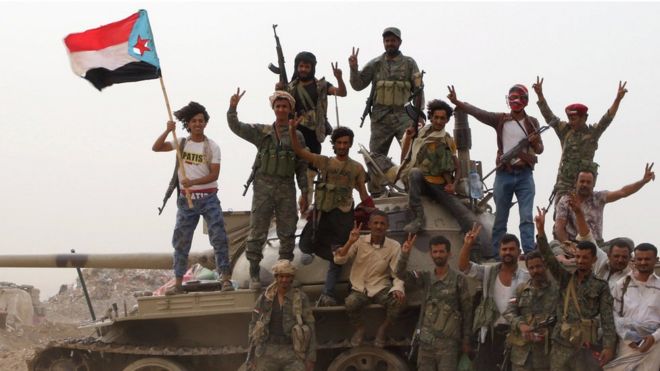
 Well, here's what Aden looked like last week (FARS pix):

********