Reports obsessing over her death have only been at the top of Google News ever since the news broke that she was dead. Who is Bobbi Brown? Some druggie who drowned in a bathtub and whose mother was a singer named Whitney Houston, who also drowned in a bathtub. Actually I loved Houston's performance in The Bodyguard but what passes for a news establishment in this country is turning me into a curmudgeon.
As for Google News -- I'm beginning to realize that "free" isn't a bargain when it comes to news aggregator sites.
The security situation in Afghanistan is at a crisis level. But you should see the reports that Google News is posting on Afghanistan. At least four -- given separate postings -- are on a shooting at a wedding party. Another is about crossing-dressing children. Another is about banning toy guns in Afghanistan.
In short Google is unable to find news reports that can give Americans an understanding of what is happening that is of great import in the country in terms of its politics and security and about NATO efforts in the country.
Given the huge investment of American lives and money in Afghanistan, that's an outrage. And given the scope of the tragedy in the country -- a tragedy that can be blamed in no small part on the most influential NATO countries pandering for years to Pakistan's regime -- the death of one spoiled American doesn't mean a damn to me.
But shouting this at Google is like telling the lame to run faster. Google can't do any better than they're doing to keep Americans informed because after all it is an American company -- a very American company.
UPDATE 7:48 AM EDT
Yes, Bobbi Brown stories are STILL at the top of Google News
********
Monday, July 27


What is NATO doing in Afghanistan? Picking its nose?
When it's not bombing Afghan Army posts by mistake? When I went looking for news on the joke called Operation Resolute Support I came across the following report at the Army Times. But first here's a photograph.
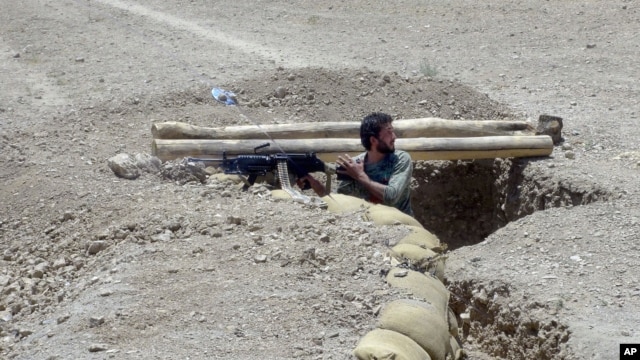 An Afghanistan National Army soldier stands guard in a trench in district of Baraki Barak in Logar province, east of Kabul, Afghanistan, July 20, 2015 (VOA).
Army engineers build roads, reassure European allies
By Michelle Tan, Staff writer
July 26, 2015
As for Operation Resolute Support in Afghanistan:
********
Army engineers build roads, reassure European allies
By Michelle Tan, Staff writer
July 26, 2015
Army engineers are spread across Eastern Europe this summer building roads and constructing training facilities as part of the United States' efforts to assure its allies in the face of Russian aggression.Why can't the East Europeans build their own roads? Because the road-building effort is a cash cow for contractors the U.S. senators who've led the charge against Russia favor. And that's what the provocations against Russia have been all about. Cash on the barrelhead.
As for Operation Resolute Support in Afghanistan:
NATO to have no military role in Afghanistan after 2016Brooks Tigner, Brussels
IHS Jane's Defence Weekly
05 July 2015
NATO's next foray in Afghanistan after its Resolute Support military train-and-advise mission ends in December 2016 will be a civilian-led effort.
It will have neither a military dimension nor any responsibility to counter the country's resurgent poppy production, according to a senior NATO official who said that must fall to other parts of the international community. Afghanistan's opium trade fuels arms to the Taliban.
"We are trying to avoid anything militaristic [within the next mission]," Nick Williams, head of NATO's Afghanistan team, said during a security policy debate in Brussels on 2 July.
"We are already thinking ahead to 2017 - beyond Resolute Support," he said, adding that during a 24-25 June meeting in Brussels of allied defence ministers the latter supported the idea of "a civil-led approach to continue the capability-building effort in Kabul".What is NATO doing at this time to counter the poppy production? What is it doing in Afghanistan, period? Certainly not building roads for the ANA.
********
"On four continents historic droughts wreak havoc"
"Overall, tracking droughts globally is difficult: No country outside the U.S. has a comprehensive effort to monitor it, said climatologist Brian Fuchs of the National Drought Mitigation Center in Lincoln, Neb." -- from the USA TODAY report
I've mentioned the tracking problem before. It is a very big issue that isn't being acted on by the 'international community.' Odd, wouldn't you say? Particularly given all the hoopla about climate change, global warming -- and global water shortages. I guess governments don't want the tracking, or they want someone else to pay for it.
I've mentioned the tracking problem before. It is a very big issue that isn't being acted on by the 'international community.' Odd, wouldn't you say? Particularly given all the hoopla about climate change, global warming -- and global water shortages. I guess governments don't want the tracking, or they want someone else to pay for it.
********
Pakistan violates ceasefire again along IB in Jammu.
Pakistan has carried out over 13 ceasefire violations this year. PTI via Times of India has the report on the latest. Now there's an idea for a horror movie: what if every country had a neighbor like Pakistan.
********
********
India's Salma Dam project in Afghanistan nears completion: finally some good news
I wasn't aware that India had also funded the building of a new Parliament building in Kabul until I read the following report. Wonder if that was a factor in the recent attack on the country's Parliament. But to return to good news:
26 July 2015
Anadolu Agency
Multimillion dollar infrastructure project moves forward as dam reservoir begins to be filled
(KABUL) The Indian-sponsored multimillion-dollar Salma Dam project in Afghanistan has passed a critical stage on Sunday with the closure of Diversion Tunnel Gate and the start of the filling of the dam reservoir.
The 20-km long and 3.7 km wide reservoir is expected to take 9 to 12 months to be filled. The dam, located in the western province Herat near Iran, has a storage capacity of 640 million cubic meters.
Salma Dam is among the major Indian-sponsored projects alongside the new parliament building in the Afghan capital Kabul and the Chah Bahar Port in Iran aimed at harnessing Indo-Afghan ties.
The reservoir project was first conceived in the late 70s, but was damaged early during the civil war in the 1990s. The project was left incomplete for a significant period of time due to the ongoing instability. Local press also blamed Iran for hindering the project.
It is the “flagship infrastructural project of India’s developmental assistance program to Afghanistan”, the Indian Embassy in Afghanistan said.
Salma Dam is a hydroelectric and irrigation project being constructed on Hari River in Chist-e Sharif district of Herat. Afghanistan is likely to get around 42 MW of power from it besides improved irrigation facilities for some 80,000 hectares of land.
The project includes the construction of a 107.5 m high and 550 m long rock fill dam and other typical components of any hydroelectric power project, i.e. a spillway, powerhouse, switchyard, and a transmission line.
Revised estimates of the project put its cost at $300 million.
[END REPORT]
********
Indian official: suspect Pakistan's LeT in Punjab attack; 9 dead so far, several injured; attack still in progress (UPDATED)
UPDATE 4:00 AM EDT
Frm The Hindu 'live blogging' of the incident
- Gunmen reportely holed up in an empty building
-- MoS Jitendra Singh goes on record to say that ISI likely behind the Gurdaspur attack.
-- Security forces want to capture the gumen for questioning so they're going slow as there doesn't seem to be a hostage situation.
The situation is still fog of war so this will be my last update for this post.
******
Zee News reports
Sophisticated, complex attack in Punjab; concerns are that it's meant to derail negotiations between India and Pakistan on a range of issues. Bloomberg reported at 1:49 AM EDT that India's government suspects LeT (a veritable arm of Pakistan's Inter-Services Intelligence agency) is the perp:
9 killed in suspected terror attack in PunjabTNN via Times of India
Jul 27, 2015
10.21 AM IST
GURDASPUR: In a suspected terror attack, gunmen wearing army uniform on Monday went on a rampage attacking a bus, a health centre and a police station, leaving nine persons, including a policeman, dead and several injured in Gurdaspur district of Punjab.
Army has launched an operation against the militants numbering about five who are holed up in Dinanagar police station complex.
The assailants also targeted a building where the families of police personnel reside and threw grenades.
According to police, the mayhem started at about 5am when the attackers first targeted a roadside eatery and took off in a car after killing a person who was sleeping near Dinanagar bypass.
They opened fire on a moving bus, in which four passengers were injured, they said.
They also targeted a community health centre adjacent Dinanagar police station, in which a policeman and three civilians including a woman who were present in the premises were killed.
READ ALSO: Govt monitoring situation, Rajnath says
The gunmen entered the Dinanagar police station and opened fire on policemen there in which five policemen were seriously injured. They then targeted other part of the building where the families of police personnel reside.
[END REPORT]
********
Frm The Hindu 'live blogging' of the incident
- Gunmen reportely holed up in an empty building
-- MoS Jitendra Singh goes on record to say that ISI likely behind the Gurdaspur attack.
-- Security forces want to capture the gumen for questioning so they're going slow as there doesn't seem to be a hostage situation.
The situation is still fog of war so this will be my last update for this post.
******
Zee News reports
A high alert has been sounded and security strengthened across Punjab, neighbouring Haryana and Union Territory of Chandigarh in the wake of the terror attack which came less than three weeks before the country's Independence Day. ... A senior police official says that in view of the attack, "maximum alert" has been sounded across the state and security has been beefed up along its borders with neighbouring Jammu and Kashmir.From another report at Zee, a countrywide terrorist alert has also been issued by the government.
Sophisticated, complex attack in Punjab; concerns are that it's meant to derail negotiations between India and Pakistan on a range of issues. Bloomberg reported at 1:49 AM EDT that India's government suspects LeT (a veritable arm of Pakistan's Inter-Services Intelligence agency) is the perp:
[...] Security forces have surrounded the militants, who are holed up in a police complex in the town of Dinanagar, Abhinav Trikha, a deputy commissioner in Punjab, said by phone.
India’s Home Ministry suspects that Pakistan-based militant group Lashkar-e-Taiba is behind the attacks, a government official told reporters in New Delhi. He asked not to be identified, citing ministry rules.
The incident is the most serious since Prime Minister Narendra Modi came to power last year. While border incidents are common in Jammu and Kashmir state further to the north, Punjab has been relatively peaceful over the past decade. [...]No mention of the accusation in what seems to be the latest report on the attack:
9 killed in suspected terror attack in PunjabTNN via Times of India
Jul 27, 2015
10.21 AM IST
GURDASPUR: In a suspected terror attack, gunmen wearing army uniform on Monday went on a rampage attacking a bus, a health centre and a police station, leaving nine persons, including a policeman, dead and several injured in Gurdaspur district of Punjab.
Army has launched an operation against the militants numbering about five who are holed up in Dinanagar police station complex.
The assailants also targeted a building where the families of police personnel reside and threw grenades.
According to police, the mayhem started at about 5am when the attackers first targeted a roadside eatery and took off in a car after killing a person who was sleeping near Dinanagar bypass.
They opened fire on a moving bus, in which four passengers were injured, they said.
They also targeted a community health centre adjacent Dinanagar police station, in which a policeman and three civilians including a woman who were present in the premises were killed.
READ ALSO: Govt monitoring situation, Rajnath says
The gunmen entered the Dinanagar police station and opened fire on policemen there in which five policemen were seriously injured. They then targeted other part of the building where the families of police personnel reside.
[END REPORT]
********
A few reasons it does no good for the US to attempt cooperation with Pakistan
Quotes that highlight some U.S. evidence on Pakistan's support on terror; from a lengthy article about the (leaked) secret U.S.-Pakistan agreement on use of armed drones in Pakistan:
by Greg Miller, Washington Post Intelligence reporter, and Bob Woodward
October 24, 2013
The Washington Post
[...]
The files serve as a detailed timeline of the CIA drone program, tracing its evolution from a campaign aimed at a relatively short list of senior al-Qaeda operatives into a broader aerial assault against militant groups with no connection to the Sept. 11, 2001, attacks.
The records also expose the distrust and dysfunction that has afflicted U.S.-Pakistani relations even amid the undeclared collaboration on drone strikes.
Some files describe tense meetings in which senior U.S. officials, including then-Secretary of State Hillary Rodham Clinton, confront their Pakistani counterparts with U.S. intelligence purporting to show Pakistan’s ties to militant groups involved in attacks on American forces, a charge that Islamabad has consistently denied.
[...]
In one case, Morell indicated that the CIA was prepared to share credit with the Pakistanis if the agency could confirm that it had killed Ilyas Kashmiri, an al-Qaeda operative suspected of ties to plots against India. The agency would do so “so that the negative views about Pakistan in the U.S. decision and opinion making circles are mitigated,” according to a diplomatic memo.
But Morell was also sent on occasion to confront Pakistan with what U.S. officials regarded as evidence of the nation’s support for terrorist groups. In June 2011, he arrived at the embassy with videos showing militants scrambling to clear materials from explosives plants that the United States had discovered and called to the attention of counterparts in Pakistan.
Rather than launching raids, the Pakistanis were suspected of tipping off the militants, who dispersed their materials in a “pickup truck, two station wagons and at least two motorcycles to multiple locations in South Waziristan,” according to the memo summarizing the meeting with Morell.
Morell warned that “these videos left a bad taste” among lawmakers and other senior officials in Washington.
Tim Craig in Islamabad and Scott Wilson, Evelyn Duffy and Julie Tate in Washington contributed to this report.
[END REPORT]
More on Taliban capture of military base in N. Afghanistan
Long War Journal certainly did much better at piercing the fog of war than the Voice of America report yesterday -- but then LWJ always does better at war reporting than the mainstream press outlets. There are still questions about the attack but one thing is clear: NATO-US forces are letting the north of the country twist in the wind.
BY BILL ROGGIO
July 26, 2015
The Long War Journal
The Taliban overran a military base in the remote northern Afghan province of Badakhshan this weekend, capturing more than 100 police and tribal fighters before disarming and freeing them.
Taliban fighters began their assault on the Qala base in the embattled district of Warduj beginning on July 24, according to the jihadist group and Afghan press reports. The base was overrun by July 25, but the Afghan government and the Taliban differ on the reasons why.
Afghan officials claimed that a police commander known as Amanullah and his officers defected to the Taliban, TOLONews reported.
“Amanullah head of the border police in the military base made a deal with the Taliban insurgents because the military base did not have any problems and they had all the equipment,” a spokesman for the provincial chief of police said.
The Taliban claimed credit for the assault in a statement that was released on its official website, Voice of Jihad, but did not give any indication that the police defected. Instead the Taliban said the assault force detained “110 hireling ANA [Afghan soldiers], police and Arbaki militiamen.” Additionally the Taliban said it seized “10 PKM machine guns, 10 RPG launchers, 90 rifles, 3 Dshk heavy machine guns, 2 mortar tubes, an artillery piece as well as a large amount of ammunition and other military gear.”
The Taliban also said it overran “6 check posts near the base” and drove Afghan security forces from 12 nearby villages, putting the jihadist group in effective contol of Warduj.
“The enemy now only controls small pockets around the district center while the entire district is currently under the control of Islamic Emirate,” according to the Taliban statement.
The Taliban’s claims cannot be independently verified. But Afghan press reports do back the Taliban’s assertion that it seized the base, captured the Afghan security personnel, and confiscated their weapons. A provincial official told Khaama Press that 107 security personnel captured at the base have subsequently been freed and the facility remains under Taliban control.
Badakhshan, which had been a relatively peaceful province up until several years ago, has become a battleground for the Taliban and its allies. The Islamic Jihad Union, an al Qaeda and Taliban-linked group, said it has deployed fighters to the province as part of the Taliban’s “azm” offensive. The districts of Jurm, Warduj, and Yamgan have shifted between government and Taliban control several times over the past year. The Taliban have taken advantage of the government’s inability to maintain security in the remote, mountainous province.
The Taliban have publicized much of the recent fighting in Badakhshan. In a video released in May, the Taliban highlighted the fighting in Warduj and Yamgan districts. Qari Fasehuddin, the Taliban shadow governor for Badakhshan who is said to have 1,000 fighters under his command, was featured in the video. [See LWJ report, Former Taliban shadow governor appears in new propaganda video depicting recent combat in Badakhshan province.]
The fighting in Badakhshan almost backfired on the Taliban after fighters beheaded seven Afghan soldiers this spring. The jihadist group was forced to issue an official statement in which it admitted the beheadings were wrong, but then placed the blame for the grisly acts on the Afghan military, claiming its forces executed Taliban fighters and civilians. [See LWJ report, Taliban admit to beheading Afghan soliders ‘in revenge’.]
Bill Roggio is a Senior Fellow at Foundation for Defense of Democracy and the Editor of The Long War Journal.
********
China's massive land grab in Australia -- with help from Aussie government, of course
"With a physical footprint far larger than the city of Sydney, the Shenhua Watermark mine has been described by local farmers as agricultural genocide."
Coal and gas mining continue to encroach on some of Australia's best farmland, pitting miners against farmers and creating a deep rift between the parties of the nation's ruling Conservative coalition.
Massive mine
Earlier this month, Chinese company Shenhua received Australian government approval for a massive open-cut coal mine three kilometres from tiny Breeza [on the Liverpool Plains of rural New South Wales].
The approval was one of the last hurdles in the company's mission to dig up 10 million tonnes of black coal a year to ship from Newcastle 282km (170 miles) to the east.
The project has been almost eight years in the making but it is only now that a very public fight has broken out between the region's competing stakeholders.
With a physical footprint far larger than the city of Sydney, the Shenhua Watermark mine has been described by local farmers as agricultural genocide.
It will operate 24 hours a day, seven days a week over its 30-year life span.
Iconic
One such farmer, Fiona Simson, described the Liverpool Plains as an iconic agricultural region because of its outstanding natural resources.
Ms Simson, whose cropping farm is 50km from the proposed mine, is a former president of the NSW Farmers Association.
"We must and will keep fighting," she told the BBC. "This project is not in the national interest."
The Liverpool Plains is often referred to as NSW's food bowl and is counted among the best agricultural land in Australia because of its fertile black soils, temperate climate, good rainfall, and rich surface and underground water resources.
he Association says fighting the A$1.2bn ($887m, £570m) mine is the most important challenge facing NSW farmers.
Shenhua says the mine will not damage the region's groundwater supplies and promises to look after vulnerable ecological communities.
And Federal Environment Minister Greg Hunt says the mine is subject to some of "the strictest conditions in Australian history".
Political rift
But the approval has deepened a rift between Australia's governing Liberal party and its coalition partner, The Nationals - which has traditionally represented farmers - in a relationship already strained by the expansion of coal seam gas (CSG) mining over farming land.
Earlier this month, about 120 people protested against CSG exploration in Gloucester, about 260km north of Sydney.
It was the 14th protest in that area, and one of hundreds of similar protests by farmers, Indigenous Australian land owners, conservationists and urban residents against the encroachment of coal and gas extraction onto rural, and in a few cases, urban land.
Agriculture Minister and Nationals member Barnaby Joyce, whose electorate of New England takes in the proposed Shenhua mine, has publicly condemned Mr Hunt's decision to approve it.
"I think it is ridiculous that you would have a major mine in the midst of Australia's best agricultural land," he wrote on his Facebook page.
The Deputy Prime Minister and leader of The Nationals, Warren Truss, seems to agree.
"The Nationals recognise the vital role that the coal mining industry plays in our national economy, but we believe that prime agricultural land should be preserved for its vital role in producing food for future generations," his spokesman told the BBC.
ural dissatisfaction
The Nationals' inability to hold back the tide of black coal has left many farmers frustrated, forcing them into unnatural alliances with environmentalists and the Greens party and leading to the formation of groups like Lock the Gate.
"We should not put our food bowl in jeopardy for the short-term benefit of a coal mine," says NSW Greens MP Jeremy Buckingham.
"Our capacity to feed ourselves is obviously fundamental to the national interest," he says.
The Nationals have already felt the pinch of rural dissatisfaction at the ballot box. At the NSW election in March, the party lost the northern seat of Ballina to the Greens and nearby Lismore nearly went the same way.
There are 110 black coal mines across Australia. Another 91 new mines or expansions of existing mines are awaiting approval, according to Greenpeace.
In many cases, farmers who have worked the same land for generations are finding themselves forced off that land, says Greenpeace campaigner Dr Nikola Casule.
"These sorts of alliances [between farmers and environmentalists] are becoming more and more common," he says.
But Ms Simson says the issue should not be about politics.
"All sides of politics have had a hand in this," she says of the Shenhua mine.
"The people in the region feel let down by not just the Nationals.
"If [the Labor Party] had still been in power, we'd potentially still be in the same situation now."
Saffron Howden is a Sydney-based writer
"If [the Labor Party] had still been in power, we'd potentially still be in the same situation now."
"Fear and greed" drive Australia's China policy, Tony Abbott tells Angela Merkel -- April 16, 2015
And these are the people Obama hopes will stand up militarily to the Chinese in the Pacific Rim? Oh, please. He'd do better with arming Greenpeace.
Saffron Howden
26 July 2015
BBC
Huge coal deposits lie under some of Australa's best farming land
Australia is one of the world's biggest coal producers
Massive mine
Earlier this month, Chinese company Shenhua received Australian government approval for a massive open-cut coal mine three kilometres from tiny Breeza [on the Liverpool Plains of rural New South Wales].
The approval was one of the last hurdles in the company's mission to dig up 10 million tonnes of black coal a year to ship from Newcastle 282km (170 miles) to the east.
The project has been almost eight years in the making but it is only now that a very public fight has broken out between the region's competing stakeholders.
With a physical footprint far larger than the city of Sydney, the Shenhua Watermark mine has been described by local farmers as agricultural genocide.
It will operate 24 hours a day, seven days a week over its 30-year life span.
Iconic
One such farmer, Fiona Simson, described the Liverpool Plains as an iconic agricultural region because of its outstanding natural resources.
Ms Simson, whose cropping farm is 50km from the proposed mine, is a former president of the NSW Farmers Association.
"We must and will keep fighting," she told the BBC. "This project is not in the national interest."
The Liverpool Plains is often referred to as NSW's food bowl and is counted among the best agricultural land in Australia because of its fertile black soils, temperate climate, good rainfall, and rich surface and underground water resources.
he Association says fighting the A$1.2bn ($887m, £570m) mine is the most important challenge facing NSW farmers.
Shenhua says the mine will not damage the region's groundwater supplies and promises to look after vulnerable ecological communities.
And Federal Environment Minister Greg Hunt says the mine is subject to some of "the strictest conditions in Australian history".
Political rift
But the approval has deepened a rift between Australia's governing Liberal party and its coalition partner, The Nationals - which has traditionally represented farmers - in a relationship already strained by the expansion of coal seam gas (CSG) mining over farming land.
Earlier this month, about 120 people protested against CSG exploration in Gloucester, about 260km north of Sydney.
It was the 14th protest in that area, and one of hundreds of similar protests by farmers, Indigenous Australian land owners, conservationists and urban residents against the encroachment of coal and gas extraction onto rural, and in a few cases, urban land.
Agriculture Minister and Nationals member Barnaby Joyce, whose electorate of New England takes in the proposed Shenhua mine, has publicly condemned Mr Hunt's decision to approve it.
"I think it is ridiculous that you would have a major mine in the midst of Australia's best agricultural land," he wrote on his Facebook page.
The Deputy Prime Minister and leader of The Nationals, Warren Truss, seems to agree.
"The Nationals recognise the vital role that the coal mining industry plays in our national economy, but we believe that prime agricultural land should be preserved for its vital role in producing food for future generations," his spokesman told the BBC.
ural dissatisfaction
The Nationals' inability to hold back the tide of black coal has left many farmers frustrated, forcing them into unnatural alliances with environmentalists and the Greens party and leading to the formation of groups like Lock the Gate.
"We should not put our food bowl in jeopardy for the short-term benefit of a coal mine," says NSW Greens MP Jeremy Buckingham.
"Our capacity to feed ourselves is obviously fundamental to the national interest," he says.
The Nationals have already felt the pinch of rural dissatisfaction at the ballot box. At the NSW election in March, the party lost the northern seat of Ballina to the Greens and nearby Lismore nearly went the same way.
There are 110 black coal mines across Australia. Another 91 new mines or expansions of existing mines are awaiting approval, according to Greenpeace.
In many cases, farmers who have worked the same land for generations are finding themselves forced off that land, says Greenpeace campaigner Dr Nikola Casule.
"These sorts of alliances [between farmers and environmentalists] are becoming more and more common," he says.
But Ms Simson says the issue should not be about politics.
"All sides of politics have had a hand in this," she says of the Shenhua mine.
"The people in the region feel let down by not just the Nationals.
"If [the Labor Party] had still been in power, we'd potentially still be in the same situation now."
Saffron Howden is a Sydney-based writer
[END REPORT]
*******
Sunday, July 26
Afghanistan: Taliban Capture Key Military Base, Claim to Have Captured Several Other Security Installations. NATO needs to act NOW
The Obama Administration, David Cameron's government, and NATO need to stop crapping around in Afghanistan; the much-hyped U.S. airstrike on July 11 that took out "one of Osama bin Laden's most trusted commanders" hasn't made a bit of difference. See also Long War Journal's July 25 report Islamic Jihad Union details its involvement in Taliban’s Azm offensive.
In my view the names don't matter; I think all the terror groups operating in Pakistan have really only one name: Rawalpindi. I know I'd get an argument; my response is, "Try rolling that ball of yarn by the NDS."
Voice of America July 26 - 5:34 AM EDT
Taliban Seizes Key Afghan Military Base
In my view the names don't matter; I think all the terror groups operating in Pakistan have really only one name: Rawalpindi. I know I'd get an argument; my response is, "Try rolling that ball of yarn by the NDS."
Voice of America July 26 - 5:34 AM EDT
Taliban Seizes Key Afghan Military Base
by Ayaz Gul
Fighting in the Tirgaran area of Badakhshan province erupted Friday night when scores of rebels staged coordinated attacks on several security outposts, the provincial police chief told reporters.
He said border police force personnel at the base surrendered to the Taliban because they were besieged and did not get reinforcement from the government.
In a statement, the Taliban has claimed its fighters have taken control of several security installations in the area and captured 110 national security forces.
Some officials are reported as saying that the commanders “made a deal” with the Taliban and the surrender included handing over all the weapons and equipment a the base to the Taliban.
Badakhshan borders China and Tajikistan and has been the scene of major clashes between Taliban and Afghan security forces in recent weeks.
While the Taliban has so far in this fighting season failed to maintain control over territories it has captured, the militants have inflicted heavy battlefield casualties on Afghan security forces.
The New York Times reported Wednesday a more than 50 percent rise in the casualty rate among Afghan security forces this year compared with the first six months of 2014. It quoted officials with the US-led military coalition as saying that about 4,100 Afghan soldiers and police officers have been killed and around 8,000 wounded.
Meanwhile, Afghan government and Taliban representatives are preparing to meet in neighboring Pakistan on Friday for a second round of peace negotiations to explore ways to end hostilities.
[END REPORT]
ISLAMABAD— Authorities in northeastern Afghanistan confirmed Sunday the Taliban has captured a key military base in overnight clashes after more than 100 Afghan security forces surrendered to the insurgents.
Fighting in the Tirgaran area of Badakhshan province erupted Friday night when scores of rebels staged coordinated attacks on several security outposts, the provincial police chief told reporters.
He said border police force personnel at the base surrendered to the Taliban because they were besieged and did not get reinforcement from the government.
In a statement, the Taliban has claimed its fighters have taken control of several security installations in the area and captured 110 national security forces.
Some officials are reported as saying that the commanders “made a deal” with the Taliban and the surrender included handing over all the weapons and equipment a the base to the Taliban.
Badakhshan borders China and Tajikistan and has been the scene of major clashes between Taliban and Afghan security forces in recent weeks.
While the Taliban has so far in this fighting season failed to maintain control over territories it has captured, the militants have inflicted heavy battlefield casualties on Afghan security forces.
The New York Times reported Wednesday a more than 50 percent rise in the casualty rate among Afghan security forces this year compared with the first six months of 2014. It quoted officials with the US-led military coalition as saying that about 4,100 Afghan soldiers and police officers have been killed and around 8,000 wounded.
Meanwhile, Afghan government and Taliban representatives are preparing to meet in neighboring Pakistan on Friday for a second round of peace negotiations to explore ways to end hostilities.
[END REPORT]
May have happened at the sub-tactical level UPDATED 6:45 AM EDT
UPDATE to July 25 RFE/RL report below re attack on security outposts
Voice of America July 26 - 5:34 AM
Taliban Seizes Key Afghan Military Base
Voice of America July 26 - 5:34 AM
Taliban Seizes Key Afghan Military Base
by Ayaz Gul
Fighting in the Tirgaran area of Badakhshan province erupted Friday night when scores of rebels staged coordinated attacks on several security outposts, the provincial police chief told reporters.
He said border police force personnel at the base surrendered to the Taliban because they were besieged and did not get reinforcement from the government.
ISLAMABAD— Authorities in northeastern Afghanistan confirmed Sunday the Taliban has captured a key military base in overnight clashes after more than 100 Afghan security forces surrendered to the insurgents.
Fighting in the Tirgaran area of Badakhshan province erupted Friday night when scores of rebels staged coordinated attacks on several security outposts, the provincial police chief told reporters.
He said border police force personnel at the base surrendered to the Taliban because they were besieged and did not get reinforcement from the government.
[...]
I'll be featuring the entire report in the next post.
*****
July 23 Tolo News (Afghanistan): Obama announces Aghanistan's war brought to a responsible end.
July 23 Tolo News (Afghanistan): Obama announces Aghanistan's war brought to a responsible end.
July 24 Press TV (Iran): Afghanistan calls in Pakistan envoy over 'cross-border shelling'
[...]“Deputy Foreign Minister Hekmat Khalil Karzai summoned the ambassador of Islamic Republic of Pakistan to Kabul, Sayed Ibrar Hussain, and expressed the protest and concern of the Islamic Republic of Afghanistan in relation to the mortar and artillery shelling of Pakistani military forces over the Afghan territory along Durand Line,” the statement read.
Hussain promised to convey the concerns of the Afghan government to the relevant authorities in Pakistan.
Senior Afghan officials say Pakistani forces shelled several villages across the eastern provinces of Nangarhar and Kunar over on Tuesday and Wednesday. Sources say up to three civilians, including a woman, were killed and two others injured in the cross-border attacks.
Karzai also noted that the attacks were fueling anti-Pakistan sentiments across Afghanistan.
[...]
Reacting to the allegations, an unnamed Pakistani military source denied that any major incident of cross-border shelling had happened over the past few days. Pakistani military officials insist that Pakistani forces usually fire at militants who try to cross the porous border between the two countries.
“It may have happened at the sub-tactical level,” Pakistan's English-language newspaper, Dawn, quoted the source as saying.
[...]
July 25 KHAAMA PRESS [Afghanistan] Two rockets land in Kabul airport, no casualties reported; NDS and Security Forces foil mass bombing attacks in Kabul
July 25 RFE/RL Taliban Fighters Attack Security Outposts In Northern Afghanistan
The province’s deputy governor, Gul Mohammad Bedar, said the attack started on June 23 in the Wardoj district and that two members of the Afghan security forces were killed.
Bedar said at least 21 militants, most of them foreigners, were killed and 13 were wounded. He also said Qari Zabihullah, the commander of Taliban fighters in the area, was arrested.
The Taliban claimed responsibility for the attack, saying militants seized one security outpost and killed several police officers.
During the past year, mountainous paths from Pakistan into Badakhshan have become conduits into northern Afghanistan for Pakistani Taliban fighters and Center Asian militants who have sworn allegiance to the Islamic State and have been fleeing a Pakistani military offensive in their former safe havens in Pakistan’s tribal regions.
[END REPORT]
Let me see if I understand this correctly. They're fleeing the Pakistani military so they can fight Afghanistan's security forces Check. And these aren't Taliban; no no they're Islamic State fighters.
A government official in Afghanistan’s northeastern province of Badakhshan has said that a group of about 100 Taliban fighters attacked several security outposts in the mountainous region in the past two days.
The province’s deputy governor, Gul Mohammad Bedar, said the attack started on June 23 in the Wardoj district and that two members of the Afghan security forces were killed.
Bedar said at least 21 militants, most of them foreigners, were killed and 13 were wounded. He also said Qari Zabihullah, the commander of Taliban fighters in the area, was arrested.
The Taliban claimed responsibility for the attack, saying militants seized one security outpost and killed several police officers.
During the past year, mountainous paths from Pakistan into Badakhshan have become conduits into northern Afghanistan for Pakistani Taliban fighters and Center Asian militants who have sworn allegiance to the Islamic State and have been fleeing a Pakistani military offensive in their former safe havens in Pakistan’s tribal regions.
[END REPORT]
Let me see if I understand this correctly. They're fleeing the Pakistani military so they can fight Afghanistan's security forces Check. And these aren't Taliban; no no they're Islamic State fighters.
Prognosis: Pakistan's government says it has only limited influence with the Taliban and of course no influence with Islamic State. So look for fewer and fewer 'Taliban' fighting in Afghanistan and more and more 'Islamic State' fighters.
********
Saturday, July 25
BREAKING NEWS: Google News Top Story not about Sandra Bland or Louisiana theater shooter!!
It's probably only a momentary glitch in one of the bots because if it's not about mass shootings and racially-charged incidents in the USA, Google News doesn't consider it the top story anymore. But I swear I just went to Google News and there at the top was a BBC report about Turkey. The country. Even though moments earlier the top story was yet another of the million reports featuring ruminations about the mental state of the theater shooter.
Well. Enjoy it while it lasts even though the report is two hours old. Yes indeed, nothing like Google News for keeping the American public up to the minute.
Now why has Google News taken up a slavish obeisance to race-baiting black American activists and President Obama's wish to see guns taken away from Americans? I have no idea but I can tell you there are some mighty strange doings at Mountain View these days.
*******
Beirut Garbage: when the streets of a major city become the landfill


All right, that's enough pictures to convey the picture but plenty more at Google Images if you enjoy being grossed out. And yes, the piles of rotting garbage stink to high heaven. Now how did this happen? Well, it's maximum cities at their maximum but of course there's always a story attached. Here's Lebanon's:
Garbage Piles Up in Beirut After Landfill Closes
John Owens
July 24, 2015 12:49 PMVoice of America
[includes video footage]
(BEIRUT) Across Beirut, rancid mountains of garbage are a testament to Lebanon’s waste management problems.
For the past week, the city’s streets have been clogged with piles of rubbish as politicians and the company officials responsible for waste management exchange barbs and blame one another.
Meanwhile, residents are left to wonder how long they will have to put up with the stink.
“Living in this country is to ignore what’s bad and look at what’s nice," said Ramsi Salman, an architect and builder based in the central district of Geitawi. "And so you can ignore [things] to a certain point, but at some point it gets stinky like this and you can’t ignore it anymore."
Long time coming
The stench is only growing. The daily buildup of refuse, which also affects nearby Mount Lebanon, is the second in two years and has been a long time in the making, triggered by events at Naameh landfill, south of Beirut.
Opened in 1997, Naameh has since become the primary dumping ground for much of greater Beirut, and now holds more than five times its planned capacity.
Unwilling or unable to find another site, government officials pushed back landfill closure dates despite vociferous protests from locals.
But last Friday, activists blocked the road to the landfill to ensure compliance, forcing its closure.
The resulting stench not only blights the surrounding area, says activist Ajwad Ayash, but even causes increased rates of cancer among local residents.
Ayash argues the closure and its subsequent impact will help people focus on addressing the bigger problem: how Lebanon can sustainably deal with its waste.
“What we’re working for here is no landfill, no dumpsites and no incinerators," said Ayash, who vowed to remain camped at the site to prevent the garbage trucks from returning," said Ayash.
“The three ‘Rs’ is the only solution we are for — to reduce, re-use and recycle.”
Trading blame
Municipalities have been asked to dispose of their own waste as the government continues an as-yet unsuccessful search for a new site.
Sukleen — the company that collects garbage across the city — has stopped removing waste, stating that its own storage facilities are now full.
In the fallout from its decision, Sukleen has faced accusations of blackmail, with one party leader accusing it of using the situation to force the extension of current work contracts — a charge Sukleen denies.
Despite the growing severity of the situation and potential health implications, a government regularly mired in political deadlock has been unable to give a coordinated response.
On Wednesday, a governmental cabinet session failed to come up with answers, while frustrated Beirutis have taken to setting fire to piles of rubbish in protest.
“Everybody is angry,” Beirut parliamentary representative Mohammad Kabbani told VOA. “Can anybody be happy when there’s garbage on the streets; with the smells, with the pollution, with the health risks and so on?”
Longer term approach
With a number of regions declining to take on waste from Beirut and Mount Lebanon, Kabbani is calling for more support from municipalities beyond the capital.
He is also stressing the need to adopt a longer-term and sustainable approach to addressing waste.
"This is a result of two things at the same time: short sightedness and not looking and finding long-term solutions — this is number one," he said. "Number two is the chaotic political situation where the government is the weakest player in the country. The political parties are stronger, the local authorities are stronger, and this is why they oppose solutions."
Regardless of whom to blame, the towering piles of litter collecting along many streets will only grow taller until a resolution is found.
And as those piles grow, so will public anger.
Motioning toward another long stretch of festering bin bags blocking the pavement, Salman, the Beirut-based architect, was scathingly philosophical.
“It represents the state of our country, and its deterioration and paralysis,” he said. “We’re a country without a head and it’s a battle on every single issue. It goes down to the dirt.”
[END REPORT]
Friday, July 24
Afghan Tragedy 3: Nation's admirable security forces under seige. They need more help from NATO.

...one army officer, Lieutenant Javed, said in a telephone interview from his outpost that he and his men had faced Taliban fire for seven months without being “out of the battle zone for a single day.”
In the past few months, some 41 of his comrades — more than a third of the soldiers in his area — have been killed, he said, as the Taliban has mined the roads and attacked their guard stations in Musa Qala.
By JOSEPH GOLDSTEIN
But with months of heavy fighting still ahead, 2015 is already shaping up to be worse for the Afghan Army and the national police, even as President Obama is set to begin deliberating this year on whether to follow through with a complete withdrawal of the United States military assistance mission here in 2016.
The forces are struggling to maintain a stalemate: an at-least token government presence in the hundreds of district capitals handed over by departing NATO combat troops.
Several Afghan officers described desertion as such a problem that soldiers and police officers in some critical areas had simply been barred from returning home on leave, keeping them on the front lines for months straight.
And after a casualty rate last year that the previous American commander called unsustainable, the numbers this year are even worse: up more than 50 percent compared with the first six months of 2014. About 4,100 Afghan soldiers and police officers have been killed and about 7,800 wounded, according to statistics provided by an official with the American-led coalition here.
A range of interviews with army and police commanders and regional government officials in crucial battleground areas indicated that even though the Afghan forces have nominally met their goal of maintaining a presence in every city and all but a very few district centers, they are often functionally penned in by the Taliban, rarely mounting patrols, much less taking territory back.
At the same time, they say the insurgents have increased their influence in many areas, even near cities, giving them the ability to move freely and mount intensified attacks on the Afghan forces.
“We are in a passive defense mode — we are not chasing the enemy,” said a retired Afghan lieutenant general, Abdul Hadi Khalid. “Units get surrounded, and we don’t send them support, so they are killed.”
He described the consequences of mounting casualties as “really grave,” undermining the confidence of the security forces and the Afghan public. “It will turn into a subversive war that benefits the enemy,” he added.
The fighting this year has put increased pressure on President Ashraf Ghani’s struggling government, even as he has succeeded in opening initial talks with the Taliban in the hope of beginning a formal peace process. For both sides in the war, battlefield results will govern how strong a hand they can bring to the negotiating table.
In several critical areas, particularly in the traditional Taliban heartland in the Afghan south and east, the army and the police say they are struggling to hold on.
In the district of Musa Qala, in Helmand Province, one army officer, Lieutenant Javed, said in a telephone interview from his outpost that he and his men had faced Taliban fire for seven months without being “out of the battle zone for a single day.”
In the past few months, some 41 of his comrades — more than a third of the soldiers in his area — have been killed, he said, as the Taliban has mined the roads and attacked their guard stations in Musa Qala.
Home visits were banned after many soldiers began deserting, and in recent months in Musa Qala and a neighboring district, there have been several cases of soldiers’ shooting themselves in the hope that they would be evacuated, said Lieutenant Javed, who spoke on the condition that he be identified only by his first name.
The urge to desert is often driven by more than just facing danger, he said. Many soldiers cannot access their pay because it can be drawn only at a bank branch in the far-off provincial capital.
“Your family is calling you and telling you they have run out of food, but you cannot send them money,” Lieutenant Javed said, describing the plight of soldiers who are often the sole breadwinners for large families. “This is depressing.”
But by one important measure, Lieutenant Javed and the other soldiers in the district are succeeding: The Taliban flag does not yet fly over Musa Qala.
And that, Afghan and American officials say, is the bottom line. Even if the Taliban are able to gain ground in large stretches of their traditional homeland, like Helmand, it is critical for the Afghan forces to maintain a government presence in the district capitals.
Generals and politicians are expressing confidence that the Afghan military — officially reported at 353,000 strong, including the national and Afghan Local Police forces — will be able to hold, despite heavy losses that a Pentagon report this June anticipated would “increase in the next several months.”
One member of Parliament, Mirdad Khan Nejrabi, said that the casualty rate was “very concerning” but would not lead to any large-scale collapse.
The top American commander in Afghanistan, Gen. John F. Campbell, who is to report to Mr. Obama in the fall with his recommendations on the future of the United States mission here, has praised the Afghan forces for their continued resilience, saying they have continued to be able to inflict heavy casualties on the Taliban.
Some of the heaviest challenges fall to the various Afghan police forces, whose reported 183,000 members are stretched over vast portions of rugged Afghan territory.
In Bati Kot district, a dangerous stretch of eastern Nangarhar Province, one upbeat police sergeant, Muhammad Daud, described how in the past 18 months, his six-man outpost — a fortified hut with a flag flying over it — had suffered only one man killed and another wounded.
That was relatively good fortune, Sergeant Daud said, and it was provided by the checkpoints in both directions down the road that left him insulated from the worst. Not far off, two checkpoints had been overrun by the Taliban, with most of the men inside killed.
He, too, described pressure to desert. He said he often received phone calls from deserters he once knew beseeching him to protect his life and leave his post. “I told them I love my country, and I love serving my country,” Sergeant Daud said.
Concerns about overall force attrition, which takes into account decisions not to re-enlist as well as casualties and desertions, rose sharply after the heavy losses last year, leading Afghan officials to mount a heavier recruiting effort. Though a few military and police recruiters interviewed at posts around Kabul said they ultimately came up short of their increased goals, most described continued success at bringing in new soldiers and police officers.
A spokesman for the Afghan Defense Ministry, Dawlat Waziri, insisted that desertions remained rare and that there had been no effort to ban leaves or to stop rotations away from the front to cut down on the number of people going absent without leave.
But interviews with soldiers and police officers repeatedly countered the government’s claims. One army major in Oruzgan Province, speaking on the condition of anonymity to avoid retribution, said, “Once the soldiers are taken for their breaks, they are unwilling to come back and join their duty — and that’s the main reason the government is not taking them out.”
Constant themes in the security forces’ accounts were worsening morale, how close they were to the Taliban, and how far they were from help and reinforcements.
“Every moment, I’m with my friends in a trench, finger on the trigger,” said Mirza Khan, a police commander who said he had been stationed at a check post in Sangin district, long the scene of some of the heaviest fighting in Helmand Province, for five years. “We are all living by chance, and death is inevitable to us.”
In Musa Qala district, where Lieutenant Javed’s unit is stationed, the lack of reinforcements and medical supplies has heavily drained morale. Somehow, in one of the top opium-producing provinces in the world, the morphine has run out, soldiers and medics in Musa Qala said. Blood transfusions are a rarity, and the blood type that soldiers have listed on their identification cards to assist medics is often incorrect.
Ahmad, a battlefield medic in Musa Qala who would only give his first name, said that he and his colleagues treated arm and leg wounds on the front lines, but that “when the soldiers got wounded on chest, head and abdomen, we cannot treat them or stop bleeding.”
Periodically cut off by the Taliban, the soldiers have not always been able to evacuate casualties out of the district. Their dead often decompose under the hot sun for days — a particular source of anxiety given the Muslim imperative to conduct burials quickly. Sometimes, soldiers have beseeched local men in the town to accept their dead and contact foreign groups like the International Committee of the Red Cross that might be able to get the bodies back to the provincial capital more quickly.
Lieutenant Javed said the prospect of remaining trapped even in death weighed heavily on him.
“I am not afraid of death,” he said. “But I am afraid of this sort of death. Will your body ever arrive safely to your family?”
Reporting was contributed by Taimoor Shah from Kandahar, Afghanistan; Khalid Alokozay from Bati Kot District, Afghanistan; and Mujib Mashal, Jawad Sukhanyar and Ahmad Shakib from Kabul.
RELATED NEW YORK TIMES COVERAGE
Suicide Bombing at Afghan Market Kills Dozens - JULY 22, 2015

U.S. Steps Up Airstrikes in Afghanistan, Even Targeting ISIS - J ULY 15, 2015

Afghans Form Militias and Call on Warlords to Battle Taliban -MAY 24, 2015

Taliban Gains Pull U.S. Units Back Into Fight in Afghanistan - APRIL 29, 2015
********
July 22, 2015
The New York Times
KABUL, Afghanistan — After suffering setbacks and heavy casualties at the hands of the Taliban in 2014, Afghan security forces came into this year with what Afghan and Western officials acknowledge were relatively modest goals: hang on till the end of the fighting season without major collapses.But with months of heavy fighting still ahead, 2015 is already shaping up to be worse for the Afghan Army and the national police, even as President Obama is set to begin deliberating this year on whether to follow through with a complete withdrawal of the United States military assistance mission here in 2016.
The forces are struggling to maintain a stalemate: an at-least token government presence in the hundreds of district capitals handed over by departing NATO combat troops.
Several Afghan officers described desertion as such a problem that soldiers and police officers in some critical areas had simply been barred from returning home on leave, keeping them on the front lines for months straight.
A range of interviews with army and police commanders and regional government officials in crucial battleground areas indicated that even though the Afghan forces have nominally met their goal of maintaining a presence in every city and all but a very few district centers, they are often functionally penned in by the Taliban, rarely mounting patrols, much less taking territory back.
At the same time, they say the insurgents have increased their influence in many areas, even near cities, giving them the ability to move freely and mount intensified attacks on the Afghan forces.
“We are in a passive defense mode — we are not chasing the enemy,” said a retired Afghan lieutenant general, Abdul Hadi Khalid. “Units get surrounded, and we don’t send them support, so they are killed.”
He described the consequences of mounting casualties as “really grave,” undermining the confidence of the security forces and the Afghan public. “It will turn into a subversive war that benefits the enemy,” he added.
The fighting this year has put increased pressure on President Ashraf Ghani’s struggling government, even as he has succeeded in opening initial talks with the Taliban in the hope of beginning a formal peace process. For both sides in the war, battlefield results will govern how strong a hand they can bring to the negotiating table.
In several critical areas, particularly in the traditional Taliban heartland in the Afghan south and east, the army and the police say they are struggling to hold on.
In the district of Musa Qala, in Helmand Province, one army officer, Lieutenant Javed, said in a telephone interview from his outpost that he and his men had faced Taliban fire for seven months without being “out of the battle zone for a single day.”
In the past few months, some 41 of his comrades — more than a third of the soldiers in his area — have been killed, he said, as the Taliban has mined the roads and attacked their guard stations in Musa Qala.
Home visits were banned after many soldiers began deserting, and in recent months in Musa Qala and a neighboring district, there have been several cases of soldiers’ shooting themselves in the hope that they would be evacuated, said Lieutenant Javed, who spoke on the condition that he be identified only by his first name.
The urge to desert is often driven by more than just facing danger, he said. Many soldiers cannot access their pay because it can be drawn only at a bank branch in the far-off provincial capital.
“Your family is calling you and telling you they have run out of food, but you cannot send them money,” Lieutenant Javed said, describing the plight of soldiers who are often the sole breadwinners for large families. “This is depressing.”
But by one important measure, Lieutenant Javed and the other soldiers in the district are succeeding: The Taliban flag does not yet fly over Musa Qala.
And that, Afghan and American officials say, is the bottom line. Even if the Taliban are able to gain ground in large stretches of their traditional homeland, like Helmand, it is critical for the Afghan forces to maintain a government presence in the district capitals.
Generals and politicians are expressing confidence that the Afghan military — officially reported at 353,000 strong, including the national and Afghan Local Police forces — will be able to hold, despite heavy losses that a Pentagon report this June anticipated would “increase in the next several months.”
One member of Parliament, Mirdad Khan Nejrabi, said that the casualty rate was “very concerning” but would not lead to any large-scale collapse.
“Our security forces disintegrating — that will not happen,” said Mr. Nejrabi, who heads the Internal Security Committee. “Our forces have no other option but to fight, to defend at whatever cost possible.”
The top American commander in Afghanistan, Gen. John F. Campbell, who is to report to Mr. Obama in the fall with his recommendations on the future of the United States mission here, has praised the Afghan forces for their continued resilience, saying they have continued to be able to inflict heavy casualties on the Taliban.
Some of the heaviest challenges fall to the various Afghan police forces, whose reported 183,000 members are stretched over vast portions of rugged Afghan territory.
In Bati Kot district, a dangerous stretch of eastern Nangarhar Province, one upbeat police sergeant, Muhammad Daud, described how in the past 18 months, his six-man outpost — a fortified hut with a flag flying over it — had suffered only one man killed and another wounded.
Concerns about overall force attrition, which takes into account decisions not to re-enlist as well as casualties and desertions, rose sharply after the heavy losses last year, leading Afghan officials to mount a heavier recruiting effort. Though a few military and police recruiters interviewed at posts around Kabul said they ultimately came up short of their increased goals, most described continued success at bringing in new soldiers and police officers.
A spokesman for the Afghan Defense Ministry, Dawlat Waziri, insisted that desertions remained rare and that there had been no effort to ban leaves or to stop rotations away from the front to cut down on the number of people going absent without leave.
But interviews with soldiers and police officers repeatedly countered the government’s claims. One army major in Oruzgan Province, speaking on the condition of anonymity to avoid retribution, said, “Once the soldiers are taken for their breaks, they are unwilling to come back and join their duty — and that’s the main reason the government is not taking them out.”
Constant themes in the security forces’ accounts were worsening morale, how close they were to the Taliban, and how far they were from help and reinforcements.
“Every moment, I’m with my friends in a trench, finger on the trigger,” said Mirza Khan, a police commander who said he had been stationed at a check post in Sangin district, long the scene of some of the heaviest fighting in Helmand Province, for five years. “We are all living by chance, and death is inevitable to us.”
In Musa Qala district, where Lieutenant Javed’s unit is stationed, the lack of reinforcements and medical supplies has heavily drained morale. Somehow, in one of the top opium-producing provinces in the world, the morphine has run out, soldiers and medics in Musa Qala said. Blood transfusions are a rarity, and the blood type that soldiers have listed on their identification cards to assist medics is often incorrect.
Periodically cut off by the Taliban, the soldiers have not always been able to evacuate casualties out of the district. Their dead often decompose under the hot sun for days — a particular source of anxiety given the Muslim imperative to conduct burials quickly. Sometimes, soldiers have beseeched local men in the town to accept their dead and contact foreign groups like the International Committee of the Red Cross that might be able to get the bodies back to the provincial capital more quickly.
Lieutenant Javed said the prospect of remaining trapped even in death weighed heavily on him.
“I am not afraid of death,” he said. “But I am afraid of this sort of death. Will your body ever arrive safely to your family?”
Reporting was contributed by Taimoor Shah from Kandahar, Afghanistan; Khalid Alokozay from Bati Kot District, Afghanistan; and Mujib Mashal, Jawad Sukhanyar and Ahmad Shakib from Kabul.
RELATED NEW YORK TIMES COVERAGE
Suicide Bombing at Afghan Market Kills Dozens - JULY 22, 2015
U.S. Steps Up Airstrikes in Afghanistan, Even Targeting ISIS - J ULY 15, 2015
Afghans Form Militias and Call on Warlords to Battle Taliban -MAY 24, 2015
Taliban Gains Pull U.S. Units Back Into Fight in Afghanistan - APRIL 29, 2015
********
"Citigroup’s Mexico Unit Faces Widening U.S. Money-Laundering Probe"
On Wednesday, Citigroup said it would close those branches after it agreed to a $140 million settlement with the Federal Deposit Insurance Corp. and California regulators over deficiencies in Banamex USA’s anti-money laundering program.
Allegations that Citibank has been involved in money-laundering with regard to Mexico go back a long time. But the bank always manages to skate through. The section in the following report about "money transfers," though sketchy, is interesting. I wonder if they're talking about remittance transfers being used to launder drug money back to Mexico. Just a question, not even a guess.
Citigroup’s Mexico Unit Faces Widening U.S. Money-Laundering Probe
by Alan Katz and Dakin Campbell
July 24, 2015 - last updated 12:30 PM EDT
Bloomberg Business
The U.S. Justice Department is investigating whether Citigroup Inc. let customers move illicit cash through its Mexico unit, setting the bank’s biggest international operation in the path of an expanding money-laundering probe.
The Justice Department subpoenaed Banco Nacional de Mexico, known as Banamex, demanding information about its anti-money-laundering controls and seeking documents about its due diligence on operations involving hundreds of clients, according to documents reviewed by Bloomberg.
The subpoena, which was sent in January but hasn’t been reported or disclosed by the bank, expands a Justice Department investigation previously known to focus only on a small U.S. unit. It shows investigators are looking into a Mexico operation that accounts for about 10 percent of the New York-based company’s core revenue, and has about 1,500 branches -- almost twice as many as Citigroup has in the U.S.
Banamex, which is wholly owned by Citigroup, is already under U.S. investigation over alleged loan fraud against the bank. Citigroup separately said it shut down a unit of Banamex security guards last year after uncovering fraud there.
The investigation further threatens the legacy of Manuel Medina-Mora, who has been a face of Banamex for nearly two decades. He led Banamex when Citigroup acquired it in 2001, later advancing to run Citigroup’s Latin American consumer operations and ultimately its global consumer bank. Medina-Mora, who stepped down as Citigroup’s co-president last month, retains the title of non-executive chairman of Banamex.
California Probe
Neither Citigroup nor Medina-Mora have been accused of wrongdoing. Molly Millerwise Meiners, a Citigroup spokeswoman, declined to make Medina-Mora available for comment. Peter Carr, a Justice Department spokesman, declined to comment.
Citigroup disclosed last year that the U.S. Attorney’s Office in Boston was looking into money-laundering controls at Citigroup and related parties. Meiners declined to comment on any probe, referring to Citigroup’s most recent disclosure of the investigation, in March, which said the bank is cooperating. The disclosures named a California unit, Banamex USA, but not the Mexico unit.
Citigroup shares fell 1.4 percent to $59.03 at 11:53 a.m. in New York, the third-worst performance in the 24-company KBW Bank Index. The stock rose 11 percent this year through Thursday.
Special Delivery
The Justice Department’s foray into Mexico comes after multiple U.S. regulators have poked at similar issues in the U.S. Banamex USA, a collection of U.S. branches that Citigroup acquired when it bought the Mexican banking giant, now consists of three branches in California and Texas. On Wednesday, Citigroup said it would close those branches after it agreed to a $140 million settlement with the Federal Deposit Insurance Corp. and California regulators over deficiencies in Banamex USA’s anti-money laundering program.
The U.S. subpoena was delivered to Banamex, on the Justice Department’s behalf, by Mexico’s banking commission, according to the documents reviewed by Bloomberg News.
Such involvement by a Mexican agency would be significant, said James Gurule, a former federal prosecutor and undersecretary of enforcement for the U.S. Treasury Department. It likely would have required considerable negotiating efforts between governments, said Gurule, now a law professor at the University of Notre Dame.
Money Transfers
U.S. prosecutors are demanding records about the relationship between the California and Mexico units, according to the documents reviewed by Bloomberg News. Some of Banamex USA’s business lines, such as operations and finance, reported to Banamex employees in Mexico while compliance and legal reported to Citigroup personnel in New York, according to the documents.
Prosecutors are seeking records of due diligence performed on money transfers between the U.S. and Mexico that the California and Mexico units handled on behalf of other companies, including money-wiring businesses. They also asked for the full banking records of five clients.
Citigroup in January said the Mexico unit wasn’t for sale, following reports that the bank was seeking a buyer.
It wouldn’t be the first time U.S. authorities expanded such a probe beyond national borders. Prosecutors pursuing suspicions of lax controls of sanctions and money-laundering rules at HSBC Holdings Plc investigated lapses in the U.S. before peering into activities in the London-based bank’s Mexico unit. As part of its $1.9 billion settlement in 2012, HSBC admitted to failing to maintain effective anti money-laundering programs in both the U.S. and Mexico.
[END REPORT]
Afghan Tragedy 2: More than met the eye in Wednesday's terror bombing
Follow war reports long enough and develop a sixth sense about the incidents of war. I knew there was something hinky about the bombing July 22 in Faryab's Almar District in N. Afghanistan, even though it seemed on the surface to be a routine Taliban targeting of shoppers and/or security forces guarding a busy market. The AP, Reuters, LA Times and other reports on the incident didn't give any indication that there was something unusual.
It wasn't until I read down to the very end of a New York Times report, filed July 22 by Mujib Mashal and Ahmad Shakib with additional reporting by Jawad Sukhanyar, Suicide Bombing at Afghan Market Kills Dozens, that I learned what was nonroutine about the attack. Here I'll include some introductory passages to set the stage:
It wasn't until I read down to the very end of a New York Times report, filed July 22 by Mujib Mashal and Ahmad Shakib with additional reporting by Jawad Sukhanyar, Suicide Bombing at Afghan Market Kills Dozens, that I learned what was nonroutine about the attack. Here I'll include some introductory passages to set the stage:
[...]
Unlike in previous years, when the Taliban’s annual offensives largely focused on the south and east of the country, the insurgency has mounted daring attacks in the north this year.
Caught off guard as Taliban fighters neared major cities, the Afghan government turned to arming militias to support its security forces, undermining a process of disarmament that has cost hundreds of millions of dollars over the past decade. In recent weeks, major strongmen in the area have vowed to continue the rearmament if the government forces fail to push back the Taliban threat.
In Faryab, the Taliban are active in “almost all the districts,” Mr. Fayeq said. They control many strategic areas on the way to neighboring provinces, he added.
“The overall security situation in Faryab is petrifying, and the residents are very tense about their fate,” he said.
The province’s deteriorating situation has alarmed the government so much that the country’s vice president, Abdul Rashid Dostum, has traveled to the area to oversee the military operations. On Tuesday night, Mr. Dostum gathered the leadership of the security forces in his pink palace in Jowzjan, his home province, which borders Faryab.
“For at least 39 years, I wore the military uniform, and I don’t remember returning from a single battle, small or big, without implementing our plan and taking back the geography — even if it took one month, two months, three months, or 100, 200 or even 1,000 casualties in a day,” Mr. Dostum told the troops.
Late in the night, Mr. Dostum’s security guards came under enemy fire on the outskirts of the provincial capital, Sheberghan. In the crossfire, one insurgent was killed and one was captured, according to the vice president’s spokesman, Sultan Faizy.
“The vice president was at his compound while the attack happened,” Mr. Faizy said.
Mr. Dostum’s next plans are to lead a high-ranking delegation to Faryab. Mr. Fayeq said that intelligence briefings suggested the attack on Wednesday had been meant for that delegation, but that the security forces learned about the plan and started a search for anyone who might be involved.
“The purpose of the suicide bomber was to target the high-ranking government officials,” Mr. Fayeq said. “The incident, unfortunately, caused grave casualties to civilians.”
What to make of this news? I'm not in the mood to ask Charlotte's bookie what he thinks so I'll take a flying leap on my own. The Taliban have always targeted whatever Afghan officials they could, but in light of the details about the July 22 attack it would seem their vaunted 'peace' talks are for show. I'd say they're not sincere and neither is the government pulling the Afghan Taliban's strings, that being Pakistan's, despite Rawalpindi's protests that they have very little control over the Taliban these days.
I'll mention one passage in The Los Angeles Times report on the July 22 incident although I don't know whether this bombing was aimed at an official and/or participant(s) in the planned conference:
I'll mention one passage in The Los Angeles Times report on the July 22 incident although I don't know whether this bombing was aimed at an official and/or participant(s) in the planned conference:
On July 15, an explosion in front of a bank in Maimana, the provincial capital [of Faryab], injured at least 20 people.********
WSJ didn't mention Turkey's regime also rounded up Kurds in raids on Islamic State
SecDef Ashton Carter arriving in Kurdistan today for a surprise visit

Pentagon chief meets Kurdish top officials in Erbil
By RUDAW [Kurdistan] 5 hours ago
US Defense Secretary Ash Carter arrived for an unannounced visit to Erbil to meet with Kurdistan Regional Government (KRG) top officials on Friday.
The head of KRG foreign relations department, Falah Mustafa, and Minister of Peshmerga Mustafa Sayed Qadir welcomed the US delegation at Erbil International Airport.
This is Carter’s first visit to the Kurdistan region as the top US defense official.
[END REPORT]
Carter's unannounced visit to Erbil suggests that while the White House is happy with Turkey's new level of cooperation it has no illusions about Erdogan and wants him to know that -- and is well aware of the key role that Kurds have played in fighting IS.
Turkey stages first airstrikes on Islamic State while rounding up Kurds
Reuters
July 24, 2015
[...]
[Turkey] has also suffered a wave of violence in largely Kurdish southeastern Turkey after a suspected Islamic State suicide bombing killed 32 people, many of them Kurds, in the town of Suruc on the Syrian border this week.
But Erdogan's critics say he is more concerned with keeping Syrian Kurdish fighters in check, afraid that gains they have made against Islamic State in the Syrian civil war will embolden Turkey's own 14 million-strong Kurdish minority.
"Even though Erdogan has so far failed to achieve his goals in Syria - the overthrow of Assad - and Islamic State has become a problem, it is nevertheless a convenient instrument for him," said Halil Karaveli, managing editor of The Turkey Analyst, a policy journal.
"Now he has all the excuses he needs to go after the Kurds and also it makes him look very good in the eyes of the US, which will be happy that Turkey is on board in the coalition."
Three F-16 fighter jets took off from a base in Diyarbakir, southeast Turkey, early on Friday and hit two Islamic State bases and one "assembly point" before returning, the prime minister's office said in a statement.
"We can't say this is the beginning of a military campaign, but certainly the policy will be more involved, active and more engaged," a Turkish government official told Reuters. "But action won't likely be taken unprompted."
Police also rounded up nearly 300 people in Friday's raids against suspected Islamic State and Kurdish militants, Prime Minister Prime Minister Ahmet Davutoglu said after vowing to fight all "terrorist groups" equally.
Local media reported that helicopters and more than 5,000 officers, including special forces, were deployed in the operation. Anti-terror police raided more than 100 locations across Istanbul alone, broadcasters CNN Turk and NTV reported.
One senior official told Reuters: "This morning's air strike and operation against terrorist groups domestically are steps taken as preventive measures against a possible attack against Turkey from within or from outside ... There has been a move to active defense from passive defense."
Turkey has repeatedly said it would take any "necessary measures" to protect itself from attack by both Islamic State and Kurdish militants.
[...]
********
BoA-Merrill Lynch announces there's a global water crisis! Thanks for letting us know.
I'm really glad such a large American institution has arrived in the 21st Century:
California's drought is "a harbinger of the coming global water crisis"
Corey SternJuly 23, 2015Business Insider[their emphasis, not mine]
The four-year California drought is causing unparalleled devastation to the region. Analysts at Bank of America Merrill Lynch think it’s going to get a lot worse.
"We view the unprecedented drought in California as a harbinger of the coming global water crisis," BAML strategists wrote in a note to clients on Tuesday.
"By 2050E, 45% of projected GDP is at risk, with as many as 50 countries at risk of conflict over water."
The numbers are scary. Groundwater levels have dropped as much as 100 feet, while the Sierra Nevada snowpack is at only 5% of historical levels.
When considering the economic impact of the drought, it gets even more frightening.
"The drought is expected to cost California agriculture alone US $2.7 billion in economic costs in 2015, with disruption extending to mandatory water restrictions, wildlife, land subsidence, seawater intrusion, wildfires, and human health," the note said.
BAML went on to estimate that California’s water supply would be more than 13 trillion gallons short of demand by 2060, "with an 80% chance of multi-decade 'mega-drought' this century."
Just look at this chart to see how serious the situation is already becoming:
[go to the website to view the scary chart]
And water shortage is not an issue exclusive to the US.
In fact, BAML reiterates from a report they put out in April that water scarcity is considered "the #1 global risk for 2015 in terms of impacts to economies, environments and people."
"Globally, 750 million people lack access to safe drinking water source and 2.4 billion have no access to proper sanitation facilities," the analysts wrote. "Close to 50 countries are officially classified as being water stressed, and up to 70% of the world’s underground aquifers have reached peak water.
Global water demand is set to overshoot supply by 40% by 2030E, and by 2050E, 3.9 billion people will be living under "severe" water stress."
[END REPORT]
Wall Street can relax. Many fortunes will be made battling the water crisis, at least 80 percent of which up to this point is due to long mismanagement of water resources and ignorance that is fast getting cured.
Now every time one turns around there's a new company selling ingenious ways to conserve water. On July 1 (July 20 print issue) Forbes published an inspiring article by Aaron Tilley, a Forbes staffer who specializes in reporting on computer hardware and chip makers, The Internet Versus The Great California Drought. He profiles four companies -- HORTAU, WATERSMART, WELLNTEL, HYDROPOINT DATA SYSTEM -- that are writing the book on intelligent water management in the era of big data and the internet.
Her report would hold no surprises for Pundita readers but she does a good job of pulling together all the issues. And I like that she emphasizes a point that tends to get lost in the shuffle: desal is siren. It can make it unnecessary to conserve water and manage it intelligently. Because there is no such thing as cheap desal despite innovations that have made it less expensive, this will be a big consideration if and when the other part of the global water crisis starts to kick in. That's the part that has nothing to do with bad water management practices or even ignorance about groundwater levels.
It's the part that has to do with the Biotic Pump Hypothesis -- although there are actually two biotic pump hypotheses -- the relatively simple one put forward decades ago by Eneas Salati, which I've discussed before on this blog.
“Water so far has pretty primitive technology being applied to it,” says David Sedlak, co-director of the Berkeley Water Center at the University of California, Berkeley and author of the book Water 4.0: The Past, Present, and Future of the World’s Most Vital Resource . While tech is no cure for the West’s extensive water crisis, it’s one of the more powerful tools we have.That it is. However, Wall Street will probably go in a big way for companies that sell big-ticket solutions: yet more dams, and desalination plants. On July 22 The New Yorker published Amanda Little's overview of the major pros and cons associated with desal, Can Desalination Counter the Drought?
Her report would hold no surprises for Pundita readers but she does a good job of pulling together all the issues. And I like that she emphasizes a point that tends to get lost in the shuffle: desal is siren. It can make it unnecessary to conserve water and manage it intelligently. Because there is no such thing as cheap desal despite innovations that have made it less expensive, this will be a big consideration if and when the other part of the global water crisis starts to kick in. That's the part that has nothing to do with bad water management practices or even ignorance about groundwater levels.
It's the part that has to do with the Biotic Pump Hypothesis -- although there are actually two biotic pump hypotheses -- the relatively simple one put forward decades ago by Eneas Salati, which I've discussed before on this blog.
The other one is very complex because it has to do with a controversial new 'theory' about how winds are created; it was put forward in 2007 by Russian biophysicists Anastassia Makarieva and Victor Gorshkov ("MG").
I haven't discussed their theory before on this blog but if Makarieva's math is right -- and there's been a lot of argument about whether it is -- the human race is screwed, unless there's a halt to decimating coastal forests and an all-out effort to replant ones that have already been destroyed.
But even that might not avert the worst. It might be too late because mature forests can't be grown quickly. Long before the postulated effects of greenhouse gases roast the planet, lack of rainfall due to malfunctioning of the biotic pumps associated with coastal forests could do us in -- if MG are right.
I'll return to the theory, eventually; for readers who'd like to stick a toe in the discussion right now, I'll recommend Clearing Forests May Transform Local -- and Global -- Climate by Judith D. Schwartz for Scientific American, (March 2013) as an introduction.
However, I warn that Schwartz only sketches the MG biotic pump hypothesis and in doing so cuts out all its complexity -- and controversy, noting only that "the biotic pump needs to be confirmed by further research."
Don't quote me on this but I think it was confirmed a long time ago; it's just that MG argue the phenomenon has much greater impact than accepted up this point by science.
In essence MG are saying that the forests don't simply attract and disperse rainfall -- the "simple" biotic pump hypothesis -- they actually make weather.
God help us all if they're right. And a Pundita Prize to the first person who can clearly explain MG's hypothesis for the layperson. Many have tried and failed. Don't look at me; my math and physics aren't up to it and this really is a story about math.
There's an aeronautical engineer who goes by the name of Jeff Id and blogs at the Air Vent. He tried his darnedest in 2010 to talk Makarieva into creating an experiment to illustrate the hypothesis given that meteorologists didn't have the math to understand it. (Start around #18 in the comment section to follow their discussion.) She refused. They had to come up to her level; she wasn't going to stoop to theirs.
She's stubborn as all get-out.

But in the final wash she's right because in this era science is all about modeling in this era and if you don't express it in math you don't have the models, then nobody who is anybody in science is going to listen to you. And that's about where things stand right now with MG's biotic pump hypothesis even though a few scientists have come into their camp.
As to my view of MG's hypothesis at this point: after I watched the BBC's documentary on the monsoon, I don't think weather is any one thing.
Even shown on the small screen at YouTube, the way the monsoon is created is frightening to watch, the forces are that powerful. (The photography of the creation process starts around the 8 minute mark and runs about five minutes in Part 1 of the documentary, featured above.) And from the documentary it seems very intense heat rising off the anvil of the desert in Australia and one other desert (in the Tibetan plateau, if I recall) is what creates winds that become the monsoon.
But maybe Anastassia Makarieva has an explanation for that too.
For now, we are facing the very prosaic issues of learning to better manage what water is available to us.
********
Subscribe to:
Posts (Atom)