"[A] number of the programs broadcasted by these TV channels and News Agency are displayed with a motive to disrupt the thinking of the Afghan people."
Of course the infiltrators are hotly denying everything, probably on the technicality that they're influence agents, not spies, lol. But by any term the NDS has gotten a step ahead of them.
Infiltration of Pakistan, Iran in Afghan Medias: NDS
Khaama Press [Afghanistan]
March 11, 2012
Officials in the Afghan Intelligence Department (National Directorate for Security) announced a number of the local TV channels and a News Agency was financially supported by neighboring Pakistan and Iran.
A spokesman for the Afghan National Directorate for Security Lotfullah Mashal said, a number of the programs broadcasted by these TV channels and News Agency are displayed with a motive to disrupt the thinking of the Afghan people.
While speaking during a press conference along with the representatives from the Afghan Medias, Afghan Ministry of Culture and Information, Afghan Interior Ministry, Afghan Foreign Ministry and NDS, Mr. Mashal said, a number of the Iranian and Pakistani nationals are working as the program and policy makers of these Media Agencies without informing the Afghan government officials.
Mr. Mashal also named Tamadon and Noor Television Channels as an exemplary which broadcasts programs in accordance with the Agendas of the Iranian government.
He said, “The subjects broadcasted by Tamadon TV was handed over to them by Iranian sources and are not created by Tamadon TV officials, and Noor TV normally invites individuals who oppose the presence of foreign troops and installation of foreign forces in Afghanistan and also criticize the achievements of the Afghan government.”
He also said, a number of Pakistani spies are also working in Shamshad TV which broadcasts in Pushto language. He said, “Shamshad TV has hired 12 foreigners without informing the Ministry of Foreign Affairs and the Ministry of Culture and Information of Afghanistan. The Financial Director and a program maker of this TV is Pakistani nationals and creates Pakistani subjects for display.”
Mr. Mashal said he was 80% sure that the 12 individuals are the spies of ISI (Inter Services Intelligence), and would formally work in this TV if they were not spies.
According to Afghan NDS spokesman Lotfullah Mashal, the presence of foreign workers in Media Agencies without informing the Afghan government indicates that these individuals are following their political targets in this country.
However Tamadon and Shamshad TV officials denied the allegations by the Afghan NDS and urged them to hand over their evidences in this regard.
Mohammad Rahmati an official at Tamandon TV said, “Mr. Mashal presented his comments based on speculations and did not present any evidence. We deny his comments and will announce our stance formally in the near future.”
Khpalwak Safi Head of the Publications for Shamshad TV said, “I challenge Mr. Mashal and invite him to present evidences in regards to his comments and prove his claims.”
Afghan NDS spokesman Lotfullah Mashal also said, Fars Press and Press TV was working without having legal permit in Afghanistan and urged Pakistan and Iran to prevent interfering in internal issues of Afghanistan.
This comes as financial support to a number of Media Agencies in Afghanistan is considered to be an ambiguous issue, where 50 TV channels, 80 Radio Stations and dozens of printing presses have been launched across the country during the past 10 years.
In the meantime officials in the ministry of culture and information of Afghanistan recently urged the Media Agencies to specify their financial sources and present it to the ministry in written statements.
********
Showing posts with label Amrullah Saleh. Show all posts
Showing posts with label Amrullah Saleh. Show all posts
Wednesday, April 11


Thursday, March 1
Mystery of the Burned Bagram Korans, Part 2: The riots
Hekmatyar is responsible for deliberately slaughtering roughly 50,000 Kabuli civilians during his bombardments of the city during the extermination campaign westerners still quaintly refer to as the “Afghan civil war,” that hellish ISI-wrought, Khomeinist-contested and Saudi-funded interregnum between the Red Army’s massacres and the Taliban despotism.
Terry Glavin tries to see behind the dust kicked up by the Koran burning riots in Afghanistan, and with help from Amrullah Saleh spies a pattern that first manifested clearly in the deadly Mazar-i-Sharif riots last year:
An Equal Opportunity Butcher Returns to Afghanistan
by Terry Glavin
The National Post [Canada]
February 27, 2012
In a column in the Ottawa Citizen I examined the shadowy and overlooked forces at work behind the latest bloodcurdling eruptions of what we’re all expected to believe are the offended religious sensibilities of those inscrutable Afghans. I relied mainly on some key observations the legendary Afghan spy chief Amrullah Saleh shared with me during a telephone conversation in the early hours of Thursday morning.
The script that’s playing out in the latest riots in Afghanistan is an almost play-by-play reenactment of last April’s berserking, which everyone was also expected to apprehend as eruptions of religious outrage, but which was also no such thing. For an elaboration of what was really going on last April, you can look it up in an essay I wrote for Dissent while the ashes in Mazar were still smouldering.
In my column, there is mention of the psychopathic mass-murderer Gulbuddin Hekmatyar. Pakistan’s notorious Inter-Services Intelligence agency also gets honourable mention, and I am not hesitant to reiterate here that no adequate remedy for the ISI may exist except to get rid of everyone above the rank of major.
To appreciate what follows, you’ll want to know straight away that Hekmatyar heads up the original faction of Hezb-e-Islami, an offshoot of which is well represented in Afghanistan’s Wolesi Jirga, and even in Afghan President Hamid Karzai’s cabinet, in the person of Economy Minister Abdul Hadi Arghandiwal.
You will also need to know that the ISI has declared that it is most pleased that the United States is setting up Mullah Omar’s Taliban in a fancy district of Qatar to begin the final forced “reconciliation” of the Afghan people with the genocidal Taliban high command. The ISI is seeing to it that Omar’s Haqqani wing will have Qatari office space of their own so that they won’t feel left out of the bargain.
And here’s Hekmatyar’s mouthpiece, immediately prior to the Koran riots: “If any groups are ignored in the peace talks, it would change to resistance force against the government and could be a major threat to Afghanistan,” Mr Baheer said. “Destabilizing Afghanistan is not a difficult task, it’s too easy.”
In other words, nice filthy little disgrace of a capitulation you’ve got going here, it would be a shame if anything happened to it, we want our piece. And with the right people in the right places, “destabilizing Afghanistan” is a very easy thing to do indeed.
I now introduce Afghan analyst Abdul Ali Faiq, who these days works in London with the European Campaign for Human Rights in Afghanistan. Abdul has closely tracked the trajectory of this past week’s protests and their locales, and he’s also closely monitored the local buzz and the factional polemics in Dari/Farsi and Pashto media. His findings stand in sharp contradiction to the story that most westerners are hearing about what’s going on. But they are perfectly consistent with Amrullah Saleh’s assessment.
The whole thing’s got Hekmatyar’s signatures all over it.
“What happened at Baghram, this is not a concern for the 29 million people of Afghanistan,” Faiq told me. Some soldiers mistakenly burned a Koran, it was a sad and regrettable mistake, even President Barack Obama is falling all over himself issuing groveling apologies. Most Afghans have their minds on other things. “They say, why should we care?”
One of Faiq’s key findings is that even in the Tajik and Hazara areas of the north – Kabul, Parwan, and so on – and in the Persian west – Herat, for instance – the specific locales of the violence and the slogans being shouted are associated with ethnic pockets of Pashtuns, but more importantly, with centres of Hezb-e-Islami.
“It’s a manipulation of the masses,” Faiq says. “It is Hekmatyar’s Hezb-e-Islami. This is a milking cow for them. They have made this drama. They made this scenario.”
Many Afghans are legitimately aggrieved by the sacrilegious aspect of the Bagram incident. But what most Afghans are more likely to notice is that it’s almost poetically emblematic of what a growing number of people across the country’s political, ethnic and religious divides now cannot help but conclude: the Obama administration holds them and their sorry little country in utter contempt, and he never did mean it when he said he was going to be the president who would take Afghanistan seriously for once.
The American surrender crept up so subtly, and was couched in such syrupy lies — of course all wars end in negotiations, of course all negotiations must be Afghan-led — that it was accomplished before most Afghans had even an inkling that they were being sold out.
You think it’s hard to figure out who’s who around the presidential palace in Kabul? Most North Americans and Europeans couldn’t tell you the first thing about who’s who around the Obama White House these days. Cut the Afghans some slack here. It’s taken them a while, but they’ve finally figured out that as far as the whole “Af-Pak” thing goes, it’s all Joe Biden, all the time, and he’s the dumbest American vice-president to come along since Dan Quayle.
My friend Sanjar Sohail, editor of the liberal Kabul daily Hasht-e Sohb, put it this way: “This is good for the Khomeinists, the ISI, and for Hezb-e Islami. If there was no Koran burning at the Bagram base, it would have been something else, and of course Hezb-e-Islami is benefiting from it.”
No serious person in Afghanistan has any doubt that Gulbuddin Hekmatyar, if not living in a mansion in Rawalpindi within a short limousine ride from ISI HQ, is living in swank digs known to the ISI, somewhere, instead of spending his days at the International Criminal Court at the Hague on charges of crimes against humanity, which is where he belongs.
It should tell you something that the reason the ISI generals invented the Taliban in the first place was that they thought Gulbuddin Hekmatyar and his Hezb-e-Islami were a bit too harsh. Hekmatyar had been the ISI’s most lavishly-funded war-criminal proxy all through the 1980s. The ISI wanted something a little less bloodthirsty, so in around 1994 they replaced him and Hezb with Mullah Omar and his Islamic Emirate of Afghanistan. Hekmatyar’s been ostensibly freelance ever since.
Hekmatyar is responsible for deliberately slaughtering roughly 50,000 Kabuli civilians during his bombardments of the city during the extermination campaign westerners still quaintly refer to as the “Afghan civil war,” that hellish ISI-wrought, Khomeinist-contested and Saudi-funded interregnum between the Red Army’s massacres and the Taliban despotism.
A Pashtun supremacist turned Stalinist, then drug-trafficker and drooling Islamist fanatic, Hekmatyar ran his Hezb faction in Leninist style, a habit he picked up from his days as a student at Kabul University, where he’d been jailed for two years for his part the murder of a Maoist rival. Hekmatyar is an equal-opportunity butcher. He was the gangster the ISI spent most of its American money on during the anti-Soviet jihad (although they say he never won a battle against the Soviets and that all his victims were Afghans) and was also the Saudis’ anointed proxy for a while, and has also been a frequent guest of Khomeinist Iran.
Hekmatyar rushed to Osama bin Laden’s aid after September 11. He brags about having helped Al Qaida forces escape through the Tora Bora mountains into Pakistan, and he brought Al Qaida fugitives back with him to Iran, where he wore out his welcome after a year or so. Dozens of the more deadly attacks carelessly attributed to the Taliban in recent years were Hekmatyar jobs. His Hezb gangsters have even carried off some spectacular whacks of Talib columns, just to prove they can do it. It was a Hekmatyar rocket that came close to killing Karzai at a military parade in Kabul in 2008.
We are supposed to believe the ISI doesn’t know his whereabouts, and we are supposed to believe the Americans will scruple about cutting Hekmatyar in on Obama’s new reconciliation and power-sharing action in Qatar. Believe what you like, but believe this: the vampire’s back in town.
Terry Glavin is a journalist and cofounder of the Canada-Afghanistan Solidarity Committee.
Terry Glavin tries to see behind the dust kicked up by the Koran burning riots in Afghanistan, and with help from Amrullah Saleh spies a pattern that first manifested clearly in the deadly Mazar-i-Sharif riots last year:
An Equal Opportunity Butcher Returns to Afghanistan
by Terry Glavin
The National Post [Canada]
February 27, 2012
In a column in the Ottawa Citizen I examined the shadowy and overlooked forces at work behind the latest bloodcurdling eruptions of what we’re all expected to believe are the offended religious sensibilities of those inscrutable Afghans. I relied mainly on some key observations the legendary Afghan spy chief Amrullah Saleh shared with me during a telephone conversation in the early hours of Thursday morning.
The script that’s playing out in the latest riots in Afghanistan is an almost play-by-play reenactment of last April’s berserking, which everyone was also expected to apprehend as eruptions of religious outrage, but which was also no such thing. For an elaboration of what was really going on last April, you can look it up in an essay I wrote for Dissent while the ashes in Mazar were still smouldering.
In my column, there is mention of the psychopathic mass-murderer Gulbuddin Hekmatyar. Pakistan’s notorious Inter-Services Intelligence agency also gets honourable mention, and I am not hesitant to reiterate here that no adequate remedy for the ISI may exist except to get rid of everyone above the rank of major.
To appreciate what follows, you’ll want to know straight away that Hekmatyar heads up the original faction of Hezb-e-Islami, an offshoot of which is well represented in Afghanistan’s Wolesi Jirga, and even in Afghan President Hamid Karzai’s cabinet, in the person of Economy Minister Abdul Hadi Arghandiwal.
You will also need to know that the ISI has declared that it is most pleased that the United States is setting up Mullah Omar’s Taliban in a fancy district of Qatar to begin the final forced “reconciliation” of the Afghan people with the genocidal Taliban high command. The ISI is seeing to it that Omar’s Haqqani wing will have Qatari office space of their own so that they won’t feel left out of the bargain.
And here’s Hekmatyar’s mouthpiece, immediately prior to the Koran riots: “If any groups are ignored in the peace talks, it would change to resistance force against the government and could be a major threat to Afghanistan,” Mr Baheer said. “Destabilizing Afghanistan is not a difficult task, it’s too easy.”
In other words, nice filthy little disgrace of a capitulation you’ve got going here, it would be a shame if anything happened to it, we want our piece. And with the right people in the right places, “destabilizing Afghanistan” is a very easy thing to do indeed.
I now introduce Afghan analyst Abdul Ali Faiq, who these days works in London with the European Campaign for Human Rights in Afghanistan. Abdul has closely tracked the trajectory of this past week’s protests and their locales, and he’s also closely monitored the local buzz and the factional polemics in Dari/Farsi and Pashto media. His findings stand in sharp contradiction to the story that most westerners are hearing about what’s going on. But they are perfectly consistent with Amrullah Saleh’s assessment.
The whole thing’s got Hekmatyar’s signatures all over it.
“What happened at Baghram, this is not a concern for the 29 million people of Afghanistan,” Faiq told me. Some soldiers mistakenly burned a Koran, it was a sad and regrettable mistake, even President Barack Obama is falling all over himself issuing groveling apologies. Most Afghans have their minds on other things. “They say, why should we care?”
One of Faiq’s key findings is that even in the Tajik and Hazara areas of the north – Kabul, Parwan, and so on – and in the Persian west – Herat, for instance – the specific locales of the violence and the slogans being shouted are associated with ethnic pockets of Pashtuns, but more importantly, with centres of Hezb-e-Islami.
“It’s a manipulation of the masses,” Faiq says. “It is Hekmatyar’s Hezb-e-Islami. This is a milking cow for them. They have made this drama. They made this scenario.”
Many Afghans are legitimately aggrieved by the sacrilegious aspect of the Bagram incident. But what most Afghans are more likely to notice is that it’s almost poetically emblematic of what a growing number of people across the country’s political, ethnic and religious divides now cannot help but conclude: the Obama administration holds them and their sorry little country in utter contempt, and he never did mean it when he said he was going to be the president who would take Afghanistan seriously for once.
The American surrender crept up so subtly, and was couched in such syrupy lies — of course all wars end in negotiations, of course all negotiations must be Afghan-led — that it was accomplished before most Afghans had even an inkling that they were being sold out.
You think it’s hard to figure out who’s who around the presidential palace in Kabul? Most North Americans and Europeans couldn’t tell you the first thing about who’s who around the Obama White House these days. Cut the Afghans some slack here. It’s taken them a while, but they’ve finally figured out that as far as the whole “Af-Pak” thing goes, it’s all Joe Biden, all the time, and he’s the dumbest American vice-president to come along since Dan Quayle.
My friend Sanjar Sohail, editor of the liberal Kabul daily Hasht-e Sohb, put it this way: “This is good for the Khomeinists, the ISI, and for Hezb-e Islami. If there was no Koran burning at the Bagram base, it would have been something else, and of course Hezb-e-Islami is benefiting from it.”
No serious person in Afghanistan has any doubt that Gulbuddin Hekmatyar, if not living in a mansion in Rawalpindi within a short limousine ride from ISI HQ, is living in swank digs known to the ISI, somewhere, instead of spending his days at the International Criminal Court at the Hague on charges of crimes against humanity, which is where he belongs.
It should tell you something that the reason the ISI generals invented the Taliban in the first place was that they thought Gulbuddin Hekmatyar and his Hezb-e-Islami were a bit too harsh. Hekmatyar had been the ISI’s most lavishly-funded war-criminal proxy all through the 1980s. The ISI wanted something a little less bloodthirsty, so in around 1994 they replaced him and Hezb with Mullah Omar and his Islamic Emirate of Afghanistan. Hekmatyar’s been ostensibly freelance ever since.
Hekmatyar is responsible for deliberately slaughtering roughly 50,000 Kabuli civilians during his bombardments of the city during the extermination campaign westerners still quaintly refer to as the “Afghan civil war,” that hellish ISI-wrought, Khomeinist-contested and Saudi-funded interregnum between the Red Army’s massacres and the Taliban despotism.
A Pashtun supremacist turned Stalinist, then drug-trafficker and drooling Islamist fanatic, Hekmatyar ran his Hezb faction in Leninist style, a habit he picked up from his days as a student at Kabul University, where he’d been jailed for two years for his part the murder of a Maoist rival. Hekmatyar is an equal-opportunity butcher. He was the gangster the ISI spent most of its American money on during the anti-Soviet jihad (although they say he never won a battle against the Soviets and that all his victims were Afghans) and was also the Saudis’ anointed proxy for a while, and has also been a frequent guest of Khomeinist Iran.
Hekmatyar rushed to Osama bin Laden’s aid after September 11. He brags about having helped Al Qaida forces escape through the Tora Bora mountains into Pakistan, and he brought Al Qaida fugitives back with him to Iran, where he wore out his welcome after a year or so. Dozens of the more deadly attacks carelessly attributed to the Taliban in recent years were Hekmatyar jobs. His Hezb gangsters have even carried off some spectacular whacks of Talib columns, just to prove they can do it. It was a Hekmatyar rocket that came close to killing Karzai at a military parade in Kabul in 2008.
We are supposed to believe the ISI doesn’t know his whereabouts, and we are supposed to believe the Americans will scruple about cutting Hekmatyar in on Obama’s new reconciliation and power-sharing action in Qatar. Believe what you like, but believe this: the vampire’s back in town.
Terry Glavin is a journalist and cofounder of the Canada-Afghanistan Solidarity Committee.
Wednesday, February 15
Reductio ad absurdum
"Pundita, [Re February 10 Pundita post, Amrullah Saleh on Afghanistan's neglected majority] please explain what majority [Amrullah] refers to, in terms other than a poll. I'm not an A'stan vet, I'm an Iraq vet, but I don't see any government or country worth mentioning. My counsel is GTFO ['Get the fuck out']; if we must return it is as Jackson not Wilson. Do I have it wrong?
B Doran"
B Doran:
I'm not clear on exactly what you mean by your question about Afghanistan's majority. So this might not be the kind of answer you're looking for, but for the record:
You don't have to take the word of pollsters to be assured that the majority of Afghans don't want Taliban to have a say in running the country. All you need do is note that the majority of Afghans insist that Pakistan controls the Afghan Taliban, and stack this against the persistent efforts of NATO and Pakistan's military to discredit the widely held belief. I can't recall offhand whether NATO spokesmen have ever specifically referred to the belief as 'paranoid' but they've consistently and clearly implied that's the case, as has Pakistan's military.
"The Afghans see us behind every rock," said one Pak brass -- or maybe he said "every tree," but the point is that Afghans do see Pakistanis behind every rock and tree. So whether or not these sightings are imaginary, the majority of Afghans believe that Pakistan has been using the Afghan Taliban to wreak mayhem on their country with the aim of controlling it.
Ergo, the majority of Afghans, to include the Afghan Pashtun, don't want the Taliban to have a say, if for no other reason than the belief that Afghan Taliban are Rawalpindi's puppets. NATO and its various member regimes should remember that, the next time they argue that most Pashtuns sympathize with the Taliban.
They should recall the same point whenever they field the argument that NATO can't win the war in Afghanistan because historically Afghans have never stop fighting foreign occupiers in their country. I'm not sure this view of Afghanistan's history is entirely correct. But following the logic of the argument, we're left to conclude that Afghans will never stop fighting Pakistan's occupation of their country, real or imagined as the case may be.
I think I completely understand the second part of your question, which I'll answer in the next post. I'll sign off by posing you a question. If Pakistan does indeed occupy Afghanistan via Taliban proxies, then who are the true insurgents?
B Doran"
B Doran:
I'm not clear on exactly what you mean by your question about Afghanistan's majority. So this might not be the kind of answer you're looking for, but for the record:
You don't have to take the word of pollsters to be assured that the majority of Afghans don't want Taliban to have a say in running the country. All you need do is note that the majority of Afghans insist that Pakistan controls the Afghan Taliban, and stack this against the persistent efforts of NATO and Pakistan's military to discredit the widely held belief. I can't recall offhand whether NATO spokesmen have ever specifically referred to the belief as 'paranoid' but they've consistently and clearly implied that's the case, as has Pakistan's military.
"The Afghans see us behind every rock," said one Pak brass -- or maybe he said "every tree," but the point is that Afghans do see Pakistanis behind every rock and tree. So whether or not these sightings are imaginary, the majority of Afghans believe that Pakistan has been using the Afghan Taliban to wreak mayhem on their country with the aim of controlling it.
Ergo, the majority of Afghans, to include the Afghan Pashtun, don't want the Taliban to have a say, if for no other reason than the belief that Afghan Taliban are Rawalpindi's puppets. NATO and its various member regimes should remember that, the next time they argue that most Pashtuns sympathize with the Taliban.
They should recall the same point whenever they field the argument that NATO can't win the war in Afghanistan because historically Afghans have never stop fighting foreign occupiers in their country. I'm not sure this view of Afghanistan's history is entirely correct. But following the logic of the argument, we're left to conclude that Afghans will never stop fighting Pakistan's occupation of their country, real or imagined as the case may be.
I think I completely understand the second part of your question, which I'll answer in the next post. I'll sign off by posing you a question. If Pakistan does indeed occupy Afghanistan via Taliban proxies, then who are the true insurgents?
Friday, February 10
Amrullah Saleh on Afghanistan's neglected majority
Readers who've followed my blog for years would understand why I interrupted my weekend to post the following op-ed at the Wall Street Journal.
My mother once told me that I was a sunny, even-tempered toddler, but that every so often I lost my temper. She said that at those times I expressed outrage by going to the kitchen cabinet where the pot and pans were stored -- the cabinet was at my eye level -- then with all my might hurling every pot and pan out of the cabinet, which of course made a huge racket. Having made my editorial statement I'd then return all the cookware to the cabinet, neatly stacking each one in its proper place.
Reading through Amrullah's latest attempt to talk to reason to Washington, for the first time I understand exactly how I felt when I headed for the kitchen cabinet. For years I've kept my nose to the grindstone of the Afghan War by telling myself that if Amrullah Saleh can see all he's seen and still remain calm and reasonable in his discussions with Washington I have no right to scream and yell on this blog. But sometimes.....
Why Negotiate With the Taliban?
By AMRULLAH SALEH
February 9, 2012 - 8:03 P.M. ET
The Wall Street Journal
Washington's olive branch to the Taliban -- no matter the excuses or justifications -- amounts to the management of failure, not the mark of victory. Negotiating with the Taliban after more than 10 years of fighting means giving legitimacy and space to militant extremism.
The objective of NATO's post-9/11 intervention in Afghanistan was to starve militant extremism by defeating the nexus of al Qaeda and the Pakistan-backed Taliban. That now seems like a dream.
With support from Pakistan, the Taliban has managed to protract the fighting and create a strategic deadlock. The U.S. military surge in 2010 weakened the Taliban, but it hardly pressured their strategic support across the Durand line in Pakistan. So the deadlock remains -— chiefly because of Pakistan's unwillingness to cooperate fully with NATO, coupled with the fractured state of Afghan politics since the fraud-marred 2009 presidential elections.
Pakistan and the Taliban have no interest in producing quick positive results from talks. The Taliban has already gained certain advantages, including the possible transfer or release of their commanders from U.S. custody, the opening of an office in Qatar, and the legitimacy to enter into mainstream politics at the time of their choosing. They will definitely use these preliminary gains to further their psychological influence over the Afghan populace. And they won't likely bargain away the gains they have earned by suicide bombings, ambushes and the marginalization of civil society. Now that the Taliban has guaranteed its basic survival, it will fight for domination.
Washington's talks with the Taliban -- taking place, on and off, in Qatar -- come at a time when most anti-Taliban Afghan civil society leaders have deserted President Karzai. He is head of a heavily subsidized state whose pay master (Washington) is now largely bypassing his government to negotiate with the enemy. This raises the question: Who and what does President Karzai represent?
In a bid to make himself relevant, President Karzai has adopted a strategy of meddling. He has demanded that NATO halt night raids, hand over the Bagram detention facility, and place strict restrictions on security companies. He has also refused to echo NATO's mission goals and justifications, and he wanted the Taliban to open an office in Saudi Arabia, not Qatar.
In return, NATO has accused Mr. Karzai of corruption, of committing abuses of human rights, and of being detached from reality. Successful counterinsurgency work requires international troops and the host nation to be seen as unified; that is simply not the case here.
Pakistan and the Taliban are more coordinated in their approaches than are NATO and Afghanistan. This is one of the key reasons why concerned anti-Taliban Afghans are creating a third force to ensure their rights and interests are represented and protected. They no longer see either President Karzai or NATO committed to those rights and interests. Though fragmented in their approach, these forces share a common goal: to counterbalance the growing influence of the Taliban and to fill the vacuum created by the declining relevance of Afghanistan's democratic institutions.
Certainly no Afghan political coalition can stop Washington from talking to the Taliban -- but those talks won't bring stability. Talks and a potential ceasefire may provide the U.S. and its NATO allies their justification for a speedy withdrawal, but it won't change the fundamentals of the problem in Afghanistan. Striking a deal with the Taliban without disarming them will shatter the hope of a strong, viable, pluralistic Afghan state.
The absolute majority of the Afghan people are against the Taliban and the domination of our country by militant extremism. They have wholeheartedly supported and participated in the democratic process, but they are now marginalized both by President Karzai, who controls massive resources with no accountability, and the international community, which is focused disproportionately on transition, withdrawal and the Taliban.
Afghanistan's neglected majority can provide a political alternative for the military mission in Afghanistan. Its inclusion, which the U.S. could secure by pursuing reconciliation in a way that pressures President Karzai to respect the role of parliament and independent judges, would contain or push back the Taliban, increase the cost of war for Pakistan, and provide hope for post-transition Afghanistan. By contrast, should that majority remain outside the strategic calculus, we'll see further fragmentation of political power and legitimacy in Afghanistan. That will weaken Washington's position and endanger the entire mission.
Mr. Saleh, who directed Afghanistan's national security directorate from 2004 to 2010, is now an opposition political activist.
My mother once told me that I was a sunny, even-tempered toddler, but that every so often I lost my temper. She said that at those times I expressed outrage by going to the kitchen cabinet where the pot and pans were stored -- the cabinet was at my eye level -- then with all my might hurling every pot and pan out of the cabinet, which of course made a huge racket. Having made my editorial statement I'd then return all the cookware to the cabinet, neatly stacking each one in its proper place.
Reading through Amrullah's latest attempt to talk to reason to Washington, for the first time I understand exactly how I felt when I headed for the kitchen cabinet. For years I've kept my nose to the grindstone of the Afghan War by telling myself that if Amrullah Saleh can see all he's seen and still remain calm and reasonable in his discussions with Washington I have no right to scream and yell on this blog. But sometimes.....
Why Negotiate With the Taliban?
By AMRULLAH SALEH
February 9, 2012 - 8:03 P.M. ET
The Wall Street Journal
Washington's olive branch to the Taliban -- no matter the excuses or justifications -- amounts to the management of failure, not the mark of victory. Negotiating with the Taliban after more than 10 years of fighting means giving legitimacy and space to militant extremism.
The objective of NATO's post-9/11 intervention in Afghanistan was to starve militant extremism by defeating the nexus of al Qaeda and the Pakistan-backed Taliban. That now seems like a dream.
With support from Pakistan, the Taliban has managed to protract the fighting and create a strategic deadlock. The U.S. military surge in 2010 weakened the Taliban, but it hardly pressured their strategic support across the Durand line in Pakistan. So the deadlock remains -— chiefly because of Pakistan's unwillingness to cooperate fully with NATO, coupled with the fractured state of Afghan politics since the fraud-marred 2009 presidential elections.
Pakistan and the Taliban have no interest in producing quick positive results from talks. The Taliban has already gained certain advantages, including the possible transfer or release of their commanders from U.S. custody, the opening of an office in Qatar, and the legitimacy to enter into mainstream politics at the time of their choosing. They will definitely use these preliminary gains to further their psychological influence over the Afghan populace. And they won't likely bargain away the gains they have earned by suicide bombings, ambushes and the marginalization of civil society. Now that the Taliban has guaranteed its basic survival, it will fight for domination.
Washington's talks with the Taliban -- taking place, on and off, in Qatar -- come at a time when most anti-Taliban Afghan civil society leaders have deserted President Karzai. He is head of a heavily subsidized state whose pay master (Washington) is now largely bypassing his government to negotiate with the enemy. This raises the question: Who and what does President Karzai represent?
In a bid to make himself relevant, President Karzai has adopted a strategy of meddling. He has demanded that NATO halt night raids, hand over the Bagram detention facility, and place strict restrictions on security companies. He has also refused to echo NATO's mission goals and justifications, and he wanted the Taliban to open an office in Saudi Arabia, not Qatar.
In return, NATO has accused Mr. Karzai of corruption, of committing abuses of human rights, and of being detached from reality. Successful counterinsurgency work requires international troops and the host nation to be seen as unified; that is simply not the case here.
Pakistan and the Taliban are more coordinated in their approaches than are NATO and Afghanistan. This is one of the key reasons why concerned anti-Taliban Afghans are creating a third force to ensure their rights and interests are represented and protected. They no longer see either President Karzai or NATO committed to those rights and interests. Though fragmented in their approach, these forces share a common goal: to counterbalance the growing influence of the Taliban and to fill the vacuum created by the declining relevance of Afghanistan's democratic institutions.
Certainly no Afghan political coalition can stop Washington from talking to the Taliban -- but those talks won't bring stability. Talks and a potential ceasefire may provide the U.S. and its NATO allies their justification for a speedy withdrawal, but it won't change the fundamentals of the problem in Afghanistan. Striking a deal with the Taliban without disarming them will shatter the hope of a strong, viable, pluralistic Afghan state.
The absolute majority of the Afghan people are against the Taliban and the domination of our country by militant extremism. They have wholeheartedly supported and participated in the democratic process, but they are now marginalized both by President Karzai, who controls massive resources with no accountability, and the international community, which is focused disproportionately on transition, withdrawal and the Taliban.
Afghanistan's neglected majority can provide a political alternative for the military mission in Afghanistan. Its inclusion, which the U.S. could secure by pursuing reconciliation in a way that pressures President Karzai to respect the role of parliament and independent judges, would contain or push back the Taliban, increase the cost of war for Pakistan, and provide hope for post-transition Afghanistan. By contrast, should that majority remain outside the strategic calculus, we'll see further fragmentation of political power and legitimacy in Afghanistan. That will weaken Washington's position and endanger the entire mission.
Mr. Saleh, who directed Afghanistan's national security directorate from 2004 to 2010, is now an opposition political activist.
Saturday, January 14
"It is a bold challenge to the United States and Pakistan to live up to their pious homilies."
"This is the first time that the leadership of the Tajik, Uzbek and Hazara communities has come to a common line of thinking to oppose the US's peace strategy and to present an alternate blueprint of pan-Afghan settlement. In essence, the Northern Alliance is being resuscitated as a political entity."
"What may have incensed the Northern Alliance groups partly at least is that, despite the chill in US-Pakistan relations, Washington has kept the Pakistani military and Inter-Services Intelligence (ISI) in the loop on the Qatar talks, while blithely ignoring them as protagonists."
"Karzai has sprung a surprise by insisting that peace talks should be "Afghan-led" - meaning, he expects a "hands-on" role for himself. He has said this before, but this time he means it. He knows that regional opinion strongly disfavors a US-led peace process, and he also anticipates the danger of being left behind as road kill unless he is in the driver's seat."
". . . On Monday, Karzai raised the stakes much higher by demanding that the Taliban must agree to a ceasefire before formal peace negotiations could begin."
- M.K. Bhadrakumar, January 12
On October 1 and again on December 29 I observed that Afghan President Hamid Karzai was being forced to stiffen his spine in his relations with Washington; Indian former Career Diplomat M.K. Bhadrakumar makes the same observation and then some in his January 12 column for Asia Times Online, There's more to peace than Taliban . The column makes up for a lot of hot air he's blown from his perch at AToL; this time, he absolutely nails a situation. (Unless one also wants to see a discussion about which nations the U.S. regime is carrying water for in Afghanistan and Pakistan, but that topic would be outside the scope of writing, as it is for every news outlet that exists.)
Before I turn to Bhadrakumar's discussion I'll note a development that probably occurred after the column was put to bed; in any case his discussion of a meeting in Berlin between Afghan opposition leaders and U.S. members of Congress didn't mention that on January 11 the Afghan Foreign Ministry issued a statement "condemning" the meeting as a breach of Afghanistan's constitution and as interference with Afghan's internal affairs and national unity.
I am still waiting for the Foreign Ministry to issue a statement condeming NATO and specifically the United States of America for trying to sell Afghanistan to Pakistan but I'll let Amb. Bhadrakumar do the talking for me this time because he says it all quite wonderfully:
"What may have incensed the Northern Alliance groups partly at least is that, despite the chill in US-Pakistan relations, Washington has kept the Pakistani military and Inter-Services Intelligence (ISI) in the loop on the Qatar talks, while blithely ignoring them as protagonists."
"Karzai has sprung a surprise by insisting that peace talks should be "Afghan-led" - meaning, he expects a "hands-on" role for himself. He has said this before, but this time he means it. He knows that regional opinion strongly disfavors a US-led peace process, and he also anticipates the danger of being left behind as road kill unless he is in the driver's seat."
". . . On Monday, Karzai raised the stakes much higher by demanding that the Taliban must agree to a ceasefire before formal peace negotiations could begin."
- M.K. Bhadrakumar, January 12
On October 1 and again on December 29 I observed that Afghan President Hamid Karzai was being forced to stiffen his spine in his relations with Washington; Indian former Career Diplomat M.K. Bhadrakumar makes the same observation and then some in his January 12 column for Asia Times Online, There's more to peace than Taliban . The column makes up for a lot of hot air he's blown from his perch at AToL; this time, he absolutely nails a situation. (Unless one also wants to see a discussion about which nations the U.S. regime is carrying water for in Afghanistan and Pakistan, but that topic would be outside the scope of writing, as it is for every news outlet that exists.)
Before I turn to Bhadrakumar's discussion I'll note a development that probably occurred after the column was put to bed; in any case his discussion of a meeting in Berlin between Afghan opposition leaders and U.S. members of Congress didn't mention that on January 11 the Afghan Foreign Ministry issued a statement "condemning" the meeting as a breach of Afghanistan's constitution and as interference with Afghan's internal affairs and national unity.
I am still waiting for the Foreign Ministry to issue a statement condeming NATO and specifically the United States of America for trying to sell Afghanistan to Pakistan but I'll let Amb. Bhadrakumar do the talking for me this time because he says it all quite wonderfully:
There's more to peace than Taliban
by M K Bhadrakumar
January 12, 2012
Asia Times Online
The hype over "secret discussions" between the United States and Taliban officials has subsided; the hot topic is vanishing from public view once again.
Nevertheless, Iranian media insist that three high-ranking Taliban leaders have been released - Mullah Khairkhawa, former interior minister; Mullah Noorullah Noori, a former governor; and Mullah Fazl Akhund, the Taliban's chief of army staff - in exchange for an American soldier held by the Taliban.
United States diplomats might have put the cart before the horse in their hurry to get a peace process going before North Atlantic Treaty Organization (NATO) leaders gather for their summit in Chicago in May. They may have made two cardinal mistakes. One, they underestimated Afghan President Hamid Karzai's political compulsions. Two, the US took it for granted that the anti-Taliban Northern Alliance groups would fall in line since many of them have been co-opted through the 10-year period of the war and their capacity to unite is in doubt.
Karzai has sprung a surprise by insisting that peace talks should be "Afghan-led" - meaning, he expects a "hands-on" role for himself. He has said this before, but this time he means it. He knows that regional opinion strongly disfavors a US-led peace process, and he also anticipates the danger of being left behind as road kill unless he is in driver's seat.
Besides, Karzai is demanding that the US should transfer any Taliban prisoners from the US detention facility at Guantanamo Bay in Cuba to his custody rather than to Qatar (as apparently sought by the Taliban). He is also raking up a related issue questioning US control of Bagram airbase near Kabul as a detention center.
On Monday, Karzai raised the stakes much higher by demanding that the Taliban must agree to a ceasefire before formal peace negotiations could begin. His spokesman, Emal Faizi, said, "When the talks start, there should be a ceasefire and the violence against the Afghan people should stop." Faizi also said it was too soon to send a delegation from Kabul to Qatar for talks. "The government has no immediate plans for such a trip."
The hardening of Karzai's stance also needs to be understood against the backdrop of growing restiveness on the part of the erstwhile Northern Alliance groups.
On Monday, the alliance stalwarts came out against the Barack Obama administration's secret discussions with the Taliban. These leaders - Ahmed Zia Massoud, brother of late Ahmad Shah Massoud and formerly vice president under Karzai; General Abdul Rashid Dostum, the Uzbek leader who leads the Jumbish in northern Afghanistan; Haji Mohammad Mohaqiq, the Hazara Shi'ite leader from Mazar-i-Sharif who heads the Hezb-e-Wahdat; Amrullah Saleh, former head of Afghan intelligence - held talks with a group of four US congress members - Dana Rohrabacher, Loretta Sanchez, Louie Gohmert and Steve King (all except Sanchez are Republicans) - in Berlin over the weekend and issued a joint statement on Monday.
This is the first time that the leadership of the Tajik, Uzbek and Hazara communities has come to a common line of thinking to oppose the US's peace strategy and to present an alternate blueprint of pan-Afghan settlement. In essence, the Northern Alliance is being resuscitated as a political entity.
Their statement attacked the power structure headed by Karzai as dysfunctional, far too centralized and rampantly corrupt and demanded that in the first instance what Afghanistan needed was an inclusive parliamentary form of government "instead of a personality-oriented presidential system", which could optimally represent all ethnic and regional interests.
They also sought a thorough revamping of the country's electoral system from the present single non-transferrable voting system to a "national-accepted variant of the proportional representative system" and the direct election of governors and provincial council leaderships with delegation of powers to create budgets, collect revenue and oversee local policing and administer social sectors.
But, most important, they frontally questioned the US's locus standi to initiate peace talks with the Taliban. Their statement said:We firmly believe that any negotiation with the Taliban can be acceptable, and therefore effective, [only] if all parties to the conflict are involved in the process. The present form of discussions with the Taliban is flawed, as it excludes anti-Taliban Afghans. It must be recalled that the Taliban extremists and their al-Qaeda supporters were defeated [in 2011] by Afghans resisting extremism with minimal human-embedded support from the United States and international community. The present negotiations with the Taliban fail to take into account the risks, sacrifices and legitimate interests of the Afghans who ended the brutal oppression of all Afghans.A challenge to Obama
In order to speed the withdrawal of international forces, the participants believe it is essential to strengthen regional and national institutions that are inclusive and represent the concerns of all the communities of Afghanistan. [Emphasis added.]
The Northern Alliance statement challenges the US's monopoly of conflict resolution and Washington's unilateralist estimation that the Taliban are the only group that matters as protagonists on the Afghan chessboard in a peace process.
Its entire approach is to take the "Afghan settlement" from the narrow path of a secretive US-Taliban-Pakistan compromise formula to a transparent, inclusive, broadly-participatory inclusive approach that would not ignore any Afghan interest group, which has genuine mass support, from participation, with strong, elected local leaderships that enjoy delegated powers of local governance.
In sum, it offers a vision for returning Afghanistan to its historical character of a federated system of government that allows a plural society to thrive, but with a representative form of government as a modern-day democracy. Indeed, the Northern Alliance statement implies readiness to reconcile politically with the Taliban, provided they "seize" power through the ballot box rather than the guns supplied from the Pakistani military inventory, among other places.
It is a bold challenge to the United States and Pakistan to live up to their pious homilies.
The alliance's strategy puts enormous pressure on Karzai. He is caught between two contending constituencies. The Northern Alliance leaders are critical of Karzai, but he finds no acceptability with the Taliban, too. Karzai's position becomes precarious if he antagonizes the Northern Alliance groups and turns them hostile. He won't want to put all his eggs in the American basket, either, since the US may find him expendable at some point. Karzai needs time to maneuver and create a new coalition that strengthens his standing.
What may have incensed the Northern Alliance groups partly at least is that, despite the chill in US-Pakistan relations, Washington has kept the Pakistani military and Inter-Services Intelligence (ISI) in the loop on the Qatar talks, while blithely ignoring them as protagonists. Nonetheless, interestingly, they made no critical reference to Pakistan.
Unsurprisingly, Islamabad is sitting tight. It refrains from taking open stance on the proposed talks with the Taliban in Qatar. At the same time, the ISI is on the ball and its chief, Lieutenant General Ahmed Shuja Pasha, even paid an overnight visit to Qatar.
Pakistan would draw satisfaction that Washington finally dropped its pre-conditions for talks with the Taliban. Equally, Pakistan would welcome any release of top Taliban figures from Guantanamo. And Pakistan didn't put roadblock when former mujahideen leader Gulbuddin Hekmatyar (who lives in Peshawar in Pakistan) deputed envoys to Kabul to sound out the US and NATO officials whether he too could be provided a seat at the conference table in Qatar.
However, Pakistan won't proffer an opinion on the prospects of the talks, rather pretending it is all a matter between Taliban leader Mullah Omar who is quartered in Quetta in Pakistan and American officials.
All this is being played against the backdrop of the troubled US-Pakistani relationship. Besides, the Taliban comprise hopelessly fragmented factions and neither Mullah Omar nor the Haqqani clan has yet commented on the proposed talks in Qatar.
Pakistan can rest on its oars that the ISI would be the only party capable of shepherding the Taliban factions to come on a united platform for talks, and the US ultimately has no choice but to knock on its doorstep seeking help.
As the Northern Alliance groups see it, Pakistani strategy is to wait out the period between now and 2014 - the date set for the US troop withdrawal - and then regroup the Taliban and make a bid to capture power in Kabul. Their strong show of unity in Berlin suggests that they will not roll over and give way to an exclusive US-Taliban-Pakistan settlement being imposed on their nation.
Their challenge to Barack Obama is to concede for the Afghan people the very minimum privilege of an Arab Spring so that Islamism can reconcile with democracy - quintessentially, expecting the US to be on the "right side of history". It is not too much to ask for, really.
Ambassador M K Bhadrakumar was a career diplomat in the Indian Foreign Service. His assignments included the Soviet Union, South Korea, Sri Lanka, Germany, Afghanistan, Pakistan, Uzbekistan, Kuwait and Turkey.
Thursday, December 29
If most Afghans don't like Taliban why is NATO trying to ram Taliban down their throats?
"And most Pashtuns don't like Taliban. They want the Taliban out because their whole tribal system has been destroyed. More than 90 percent don't want the Taliban to be ruling them."-- Former Pakistani intelligence official quoted by Pakistan-based L.A. Times journalist Alex Rodriguez in December 28, 2011 report, Pakistani death squads go after informants to U.S. drone program
December 26, 2011, Khaama Press (Afghanistan):
And one could argue that the 10 percent is largely a creation of Pakistan's ISI/military -- at least that's the perception of what is probably a majority of Afghans and it's certainly Amrullah's perception based on information he obtained while head of Afghanistan's intelligence service.
So what is the justification for the United States and its NATO partners to claim that Taliban must be included in formal peace negotiations and that only a political settlement will bring peace to Afghanistan? What is the justification for claiming that only a 'political' solution can work to end the fighting in Afghanistan?
The justification can't be that Hamid Karzai wants Taliban included in negotiations. That's because it's open knowledge Karzai made the assertion only under the most extreme pressure from the U.S. administration, which caused him to fear for his life. He was afraid that the U.S. government would order his assassination if he didn't agree to negotiate with Taliban; indeed, it was this fear that led to Amrullah Saleh's resignation from the NDS and Karzai accepting the resignation. Karzai refused to believe evidence that Amrullah brought him that a terrorist attack on a national peace assembly, which Karzai had been attending at the time of the attack, was the work of Taliban; he told Saleh it was the CIA in an attempt to kill him.
Not to make light of Karzai's plight and his fear, which I think came to border on the paranoid, but he grew some spine only when he was caught in a pincer movement -- caught between the Obama administration's demand that he 'talk' with the Taliban and strident demands from powerful opposition factions in Afghanistan that he make no concessions to the Taliban.
If anyone trys to claim that Karzai wasn't being pushed by the Obama administration to make concessions: just an agreement to talk with the Taliban before the group's terrorist rampage in Afghanistan halted was in itself forcing him into a huge concession to the Taliban.
The concession has backfired at every turn and contributed to deaths of American, British and other NATO military and civilian personnel in Afghanistan, not to mention deaths of Afghan troops and civilians. Yet this situation was rationalized by General David Petraeus while he headed the NATO effort in Afghanistan on the argument that many times in the history of warfare one side has had to negotiate with forces that are inflicting severe casualties on them.
Petraeus must have known at the time he was called before Congress to explain the U.S. decision to negotiate with Taliban that it was Pakistan's military, not any Taliban leaders, which had power to make a negotiated agreement stick. However, it's only within the past few months that anyone in official Washington has been willing to publicly acknowledge the true situation with Pakistan. That's because telling the truth would be in effect an admission that the U.S. counterinsurgency effort in Afghanistan was absurd from the start. I repeat, absurd, in the manner of the man who searched on the street for keys he knew he'd lost in his house because the light for searching was better outdoors. It's absurd because there never was an insurgency to speak of in Afghanistan and there isn't one to this day; there's a proxy war being fought by Pakistan's military against NATO forces and the Afghan government. I do not believe there has been a time when the NATO command and the civilian leaders it reports to have not known this.
And while it's true that governments have had to negotiate with insurgents that are killing a government's troops, Petraeus's attempt to Vietnamize the situation in Afghanistan was sophistry because the two situations were completely different. Only a very small number of Afghans support the Taliban and their terrorism, and only those Afghans who work for Pakistan's interests support Pakistan making proxy war on Afghanistan.
Petraeus's explanation fell apart when it became public knowledge that Osama bin Laden had been living in Pakistan under circumstances that as much clinched he was there as a guest of Pakistan's military. So the new, improved rationalization floated in Washington was that Pakistan had to be given a seat at the negotiating table, which caused Amrullah Saleh and many other Afghans to put their foot down.
If State or the Pentagon or anyone in the Obama Administration wants to defend their tactics by arguing that the U.S. still needs Pakistan's cooperation in killing al Qaeda and Taliban leaders, I'll return to Alex Rodriguez's report:
December 26, 2011, Khaama Press (Afghanistan):
Former Afghan Intelligence Chief Amrullah Saleh insists [on consideration for] the views of the Afghan people during the peace talks process as majority of the Afghans both in northern regions and southern regions have negative views regarding the Taliban group.The Pakistani ex-intelligence official spoke to Rodriguez on condition of anonymity, of course, but there you have it: a tacit admission from a knowledgeable Pakistani source that Amrullah Saleh has been speaking the truth all along. The Taliban are simply a "group" as the Khamaa report terms them, a group that does not enjoy support among any of Afghanistan's non-Pasthun ethnic groups and finds support from only about 10 percent of Pashtuns. (Note that the Pakistani source didn't distinguish between Afghan and Pakistani Pashtuns when he claimed that 90 percent didn't support the Taliban.)
While speaking during the inauguration ceremony of the Dawat-e-Islami foundation Mr. Saleh said the Afghan government and the United States of America cannot represent the anti-Taliban Afghan civilians to initiate peace talks.
He also warned that there will no significant achievements if the demands of the Afghans who are against the Taliban group are [not] considered.
The recent objections by the opposition parties of the Afghan government come amid growing efforts by the United States of America to start peace dialogues with the Taliban group.
[...]
And one could argue that the 10 percent is largely a creation of Pakistan's ISI/military -- at least that's the perception of what is probably a majority of Afghans and it's certainly Amrullah's perception based on information he obtained while head of Afghanistan's intelligence service.
So what is the justification for the United States and its NATO partners to claim that Taliban must be included in formal peace negotiations and that only a political settlement will bring peace to Afghanistan? What is the justification for claiming that only a 'political' solution can work to end the fighting in Afghanistan?
The justification can't be that Hamid Karzai wants Taliban included in negotiations. That's because it's open knowledge Karzai made the assertion only under the most extreme pressure from the U.S. administration, which caused him to fear for his life. He was afraid that the U.S. government would order his assassination if he didn't agree to negotiate with Taliban; indeed, it was this fear that led to Amrullah Saleh's resignation from the NDS and Karzai accepting the resignation. Karzai refused to believe evidence that Amrullah brought him that a terrorist attack on a national peace assembly, which Karzai had been attending at the time of the attack, was the work of Taliban; he told Saleh it was the CIA in an attempt to kill him.
Not to make light of Karzai's plight and his fear, which I think came to border on the paranoid, but he grew some spine only when he was caught in a pincer movement -- caught between the Obama administration's demand that he 'talk' with the Taliban and strident demands from powerful opposition factions in Afghanistan that he make no concessions to the Taliban.
If anyone trys to claim that Karzai wasn't being pushed by the Obama administration to make concessions: just an agreement to talk with the Taliban before the group's terrorist rampage in Afghanistan halted was in itself forcing him into a huge concession to the Taliban.
The concession has backfired at every turn and contributed to deaths of American, British and other NATO military and civilian personnel in Afghanistan, not to mention deaths of Afghan troops and civilians. Yet this situation was rationalized by General David Petraeus while he headed the NATO effort in Afghanistan on the argument that many times in the history of warfare one side has had to negotiate with forces that are inflicting severe casualties on them.
Petraeus must have known at the time he was called before Congress to explain the U.S. decision to negotiate with Taliban that it was Pakistan's military, not any Taliban leaders, which had power to make a negotiated agreement stick. However, it's only within the past few months that anyone in official Washington has been willing to publicly acknowledge the true situation with Pakistan. That's because telling the truth would be in effect an admission that the U.S. counterinsurgency effort in Afghanistan was absurd from the start. I repeat, absurd, in the manner of the man who searched on the street for keys he knew he'd lost in his house because the light for searching was better outdoors. It's absurd because there never was an insurgency to speak of in Afghanistan and there isn't one to this day; there's a proxy war being fought by Pakistan's military against NATO forces and the Afghan government. I do not believe there has been a time when the NATO command and the civilian leaders it reports to have not known this.
And while it's true that governments have had to negotiate with insurgents that are killing a government's troops, Petraeus's attempt to Vietnamize the situation in Afghanistan was sophistry because the two situations were completely different. Only a very small number of Afghans support the Taliban and their terrorism, and only those Afghans who work for Pakistan's interests support Pakistan making proxy war on Afghanistan.
Petraeus's explanation fell apart when it became public knowledge that Osama bin Laden had been living in Pakistan under circumstances that as much clinched he was there as a guest of Pakistan's military. So the new, improved rationalization floated in Washington was that Pakistan had to be given a seat at the negotiating table, which caused Amrullah Saleh and many other Afghans to put their foot down.
If State or the Pentagon or anyone in the Obama Administration wants to defend their tactics by arguing that the U.S. still needs Pakistan's cooperation in killing al Qaeda and Taliban leaders, I'll return to Alex Rodriguez's report:
Current and former U.S. officials say the CIA has decided to temporarily suspend so-called signature [drone] strikes — missile attacks against fighters and others whose actions suggest support for the Taliban and other insurgent groups — in an effort to mend relations with Pakistan.I doubt the Central Intelligence Agency decides anything on its own in this very delicate matter; it's surely acting on orders from the White House. But so much for a key feature of Obama's "War on al Qaeda," as the most recent National Intelligence Estimate terms the War on Terror. I've noted before that I think the drone war in Pakistani territory is a bad idea and that there's a better way to bag al Qaeda in Pakistan, but the point is that at the first stiff breeze coming from Rawalpindi the Obama administration has suspended its major tactic against al Qaeda fighters holed up in Pakistan. And Rawalpindi knows what this means.
Thursday, June 16
For six years Amrullah Saleh was in the best position to understand the Taliban. It's time NATO began listening to his advice about dealing with them.
This is an example of U.S. sending mixed signals to Pakistan

Many Afghans believe that to get to a negotiated settlement, the Taliban leaders involved in talks should be relocated to Afghanistan from their current locations in Pakistan, where they are protected by Pakistan’s intelligence service.
-- Amrullah Saleh
Today Bloomberg news service has published an op-ed by Amrullah Saleh, which I republish in full below. But before turning over the floor to Saleh, I want to dispute a part of his advice that pertains to dealing with Pakistan. I think Pakistan's military and civilian leaders read the "carrot and stick" approach he advocates as deliberately mixed signals, which convey acceptance for their continued prosecution of what is in effect a proxy war in Afghanistan; this on the theory that the USA finds Pakistan so valuable as a client state/strategic asset it will tolerate its aggression toward Afghanistan and even NATO troops.
In other words, what NATO leaders consider inducements (carrots) the Pakistanis read as tacit acceptance of their course of action no matter how much NATO says it dislikes the course. This situation is mirrored in the way substance abusers read continued material support from family members as sympathy for their predicament, no matter how much the family members yell and scream at them to give up dope, and no matter how many times they threaten to throw the addict out of the house or turn him into the police.
Western psychologists have a term for that kind of family member: enabler; i.e., someone who enables a person who can't on his own continue a self-destructive course of action.
Psychologists know that often the greatest obstacle to an addict confronting his dire predicament is the enabler in his life, which can be a lover or friend or even employer in addition to family members. No matter the type of relationship, the enabler always provides just enough support -- material and/or emotional -- to allow the addict to continue his self-destructive behavior with the sense that he's able to manage the addiction.
I read the very same situation in the NATO-Pakistan relationship, and in particular the British and U.S. government's relations with Pakistan's government. This is an old story that goes back to Pakistan's inception and it's created a very sick, very toxic relationship that Western psychology terms co-dependent; i.e., a need developed on both sides for a relationship that's destructive to both parties, and often those nearest them as well.
However, the difference between a co-dependent relationship between individuals and between governments is that the latter can lead to the most horrific situations involving many thousands or even millions of people. And thus, the way the Afghan War has been prosecuted by ISAF since Operation Airlift of Evil, which set the course for the rest of the war and led to a situation whereby NATO and in particular the USA is in effect paying Pakistan's military to help murder NATO troops.
But when called out on this atrocity, U.S./NATO government officials engage in rationalizations that are textbook examples of the kind of excuses that enablers deploy to rationalize their continued support for a substance abuser! Textbook. Here are the top four excuses with the U.S. variation in parentheses:
If I stop helping him:
> He'll die (Pakistan will collapse)
> He'll kill himself (Pakistan will be overrun by extremists)
> He'll turn to crime (Pakistan will start a nuclear war)
> It will break up the family (Pakistan won't give any help to NATO)
Indeed, the rationalizations voiced by NATO officials are so similar to those used by enablers that I've often wondered if the war could have been successfully concluded years ago, if psychologists who specialize in helping families stop being enablers had been brought in by CENTCOM to analyze the relationships between officials in major NATO governments and their counterparts in Pakistan's government.
Well, I've discussed this angle several times over the years on this blog, and once I went to some trouble to detail how it's possible to stop the enabling without breaking off the relationship. (See Stay out of the bazaar.) So I'll end here, with a final observation that I like Saleh's method of dealing with the Taliban because it helps distinguish those Talibs who are genuine insurgents from ones being used as proxies by Pakistan's military.
June 16, 2011, Bloomberg:
Afghan Role for Taliban, if They Play by Rules
By Amrullah Saleh
As the U.S. prepares to reduce its troop presence in Afghanistan next month, Afghans are seriously considering what will come next for our country. As Hamid Karzai’s government steers reconciliation talks with the Taliban aimed at creating enough quiet for the Americans and the rest of NATO to justify departing, Afghans like me increasingly worry that we will wind up in a situation worse than the civil war of past years.
This is avoidable. The opposition to Karzai isn’t just a rejection of the current government, as the media have emphasized. We provide an alternative vision to Karzai’s way out of the status quo. It entails a complete disarming of the Taliban, an end to Pakistan’s practice of giving sanctuary to Taliban militants and a truth-and-reconciliation process for Afghanistan.
As things are going, the future looks grim.
The North Atlantic Treaty Organization expects that a negotiated settlement, eventually, will end the fighting between Afghan government forces, on one side, and the Taliban and its allies on the other. Before extending an olive branch to the Taliban leadership, however, NATO is pursuing a military strategy to weaken the enemy. This involves brilliant special operations inside Afghanistan that have killed perhaps many hundreds of Taliban mid-level commanders. The idea is to break the leadership of the Taliban in order to get the group’s second and third tier to come in from the cold. Whether this plan works will depend on whether NATO succeeds in pressuring Pakistan, which supports the Taliban, to go along. Insurgencies don’t end when they are given sanctuary in a neighboring country.
Taliban Wants Arms
But the Pakistan-Taliban-al-Qaeda alliance wants a deal that would allow the Taliban to remain armed and mobilized so that it could again have the capacity to dominate Afghanistan, as both a political and military force.
In such a scenario, real political competition in southern Afghanistan, where the Taliban is strongest, would be either difficult or impossible. The Taliban would gain access to major funds through illegal taxation, narcotics trafficking, extortion, the sale of natural resources and the black market. These funds would enable them to sustain their organization and provide some services to their constituents. Pakistan would feel safe having its proxy control the border areas, limiting or blocking India’s access, and would use its influence with the Taliban to gain maximum concessions from the government in Kabul.
Abuse of Power
That government, today, is a conglomerate of small and big interest groups surviving through manipulation, abuse of power and criminal commerce. Its overt outreach wing for the reconciliation talks is the so-called High Peace Council. The council is largely a platform to keep the big names within the Karzai government under one tent and to give the outreach an artificial multi-ethnic face.
The council’s chief spokesman is Karzai, who has caused deep division within Afghan society by his constant, unconditional offer of alliance to the Taliban. For those who have fought for a vision of a pluralistic Afghanistan, a Karzai-Taliban alliance is a recipe for disaster. The Taliban’s return to positions of authority would raise the horrific specter of their previous time in power.
It is for fear of that outcome that voices for justice and permanent peace have been raised in Afghanistan. Many Afghans believe that to get to a negotiated settlement, the Taliban leaders involved in talks should be relocated to Afghanistan from their current locations in Pakistan, where they are protected by Pakistan’s intelligence service.
Monopoly of Force
In any agreement, the Taliban must be disarmed, demobilized and reintegrated into society. The Taliban should be allowed to become a political force and be given every chance to play according to the script of democracy. But the Afghan state alone must have a monopoly on force. It isn’t permissible to allow the Taliban to become a Hezbollah-type entity within Afghanistan -- an armed state within a state. If they agree to just a cease-fire with Karzai or his replacement, it will only bring a deceptive stability that will prove short-lived.
Many years of war have wounded the psyche of the Afghan nation. Burying the facts will not help us heal those wounds. An internationally funded truth-finding commission should investigate human-rights violations, massacres and major crimes of the past 20 years. Knowing the facts would help the Afghan people reconcile with themselves. A full report may take years to compile, but the process would create hope.
In this scenario, Pakistan must stop its support of the Taliban. The U.S., which supplied Pakistan with $4.5 billion in economic and security aid last fiscal year, would need to offer carrots and sticks to ensure that country’s compliance. Pakistan and Afghanistan would sign an agreement guaranteeing the cessation of interference in each other’s affairs, both directly and indirectly.
This is the way out for Afghanistan, the Taliban, Pakistan, as well as U.S. and other NATO forces. A settlement that falls short of these minimums will only prolong Afghanistan’s agony.
(Amrullah Saleh was the head of the National Directorate of Security in Afghanistan from 2004 to 2010. The opinions expressed are his own.)
Tuesday, May 17
Amrullah Saleh: "The amount of pain Pakistan has inflicted upon the United States in the past 12 years is unprecedented."
"I asked a U.S. politician today, I said, 'How do you explain to Americans that we give billions to Pakistan and Pakistan, in return, supports the Taliban and the Taliban, in return, yesterday killed six American soldiers?'" Saleh said.
Asked what the politician said, Saleh told Logan, "His answer was not satisfactory."
"What was it?" Logan asked.
"He said, 'Well we know this,'" Saleh said.
"And no one does anything about it?" Logan asked.
"Exactly," Saleh said.
"While American soldiers come home in body bags?" Logan asked.
"Yes. Yes," he replied.
When we went to the frontlines in eastern Afghanistan last summer, we found U.S. commanders there shared Saleh's concerns about Pakistan.
Over three weeks, the American units we were with were attacked again and again.
At one point, soldiers from the 101st Airborne Division were fighting their way out of an ambush not far from the Pakistani border. They told us that as fast as they kill their enemy, they are replaced with new fighters pouring over the border in a seemingly endless supply.
"Most of the people we are fighting are from Pakistan," Lt. Col. JB Vowell told Logan.
Vowell lost 17 soldiers over the past year. He told us his forces killed hundreds of fighters in constant battles, but you can't defeat an enemy that has safe haven over the border.
"How significant is that to the strength of the enemy?" Logan asked.
"It's very," Vowell said. 'Freedom of movement and maneuver is sacrosanct. Once you have that, all things are possible."
"And that's what they have inside Pakistan?" Logan asked.
"They have a lot of that inside Pakistan," Vowell agreed.
[...]
[U.S. House Intelligence Committee Chairman Mike Rogers] also confirmed what Saleh said about the Taliban's senior leaders operating from Quetta. "No doubt about it. For far too long. It was one of those I think arranged trade-offs for other bits of cooperation," he said.
"So the U.S. knew that and accepted it?" Logan asked.
"Well, they knew that they weren't being aggressive there. It didn't stop CIA's interest in trying to determine exactly who, what, when, where in Quetta, which is -- you've been there, I've been there -- it's a difficult place to operate under any circumstances," Rogers replied.
[...]
"The senior Taliban leaders, we would learn about their locations every day. We would have their telephone numbers," [Saleh] told Logan. [emphasis mine]
He told Logan that those telephone numbers were passed on to the U.S.
Saleh says many of those numbers were traced to Quetta, Pakistan, where the Taliban's senior leaders, known as the Quetta Shura, are based.
Saleh told Logan no action was ever taken against the Quetta Shura.
"The U.S. could have taken action against senior Taliban leadership -- " Logan remarked.
"They can take action tomorrow against -- " Saleh replied.
"They still can?" Logan asked.
"Of course," Saleh said.
"And they don't?" Logan asked.
"They don't," he replied.
______
On Sunday I mentioned the CBS 60 Minutes Lara Logan interview that night with Amrullah Saleh and pulled quotes from advance copy on the show. Yet there were so many crucial points to emerge from the interview that in addition to posting the above quotes from the interview I'm republishing the entire transcript, which also records brief interviews that Logan conducted with people commenting on Saleh's points, and which are interspersed with her interview with Salah.
Those who prefer to watch the video of the interview can do so at the same CBS website that features the transcript. The site also features two video 'extras' -- one about why Amrullah Saleh resigned from his post as the NDS chief and the other about the great value of the intelligence that Saleh gave the "international intelligence community" while he was head of the NDS.
I could say much about the interview but for this post I'll turn over the blog to Lara Logan, with profuse thanks to her and the entire 60 Minutes production team and CBS News for bringing such an important issue to prime-time American national television. And, of course, with my thanks to Amrullah Saleh, who has repeatedly risked his life to speak out.
Asked what the politician said, Saleh told Logan, "His answer was not satisfactory."
"What was it?" Logan asked.
"He said, 'Well we know this,'" Saleh said.
"And no one does anything about it?" Logan asked.
"Exactly," Saleh said.
"While American soldiers come home in body bags?" Logan asked.
"Yes. Yes," he replied.
When we went to the frontlines in eastern Afghanistan last summer, we found U.S. commanders there shared Saleh's concerns about Pakistan.
Over three weeks, the American units we were with were attacked again and again.
At one point, soldiers from the 101st Airborne Division were fighting their way out of an ambush not far from the Pakistani border. They told us that as fast as they kill their enemy, they are replaced with new fighters pouring over the border in a seemingly endless supply.
"Most of the people we are fighting are from Pakistan," Lt. Col. JB Vowell told Logan.
Vowell lost 17 soldiers over the past year. He told us his forces killed hundreds of fighters in constant battles, but you can't defeat an enemy that has safe haven over the border.
"How significant is that to the strength of the enemy?" Logan asked.
"It's very," Vowell said. 'Freedom of movement and maneuver is sacrosanct. Once you have that, all things are possible."
"And that's what they have inside Pakistan?" Logan asked.
"They have a lot of that inside Pakistan," Vowell agreed.
[...]
[U.S. House Intelligence Committee Chairman Mike Rogers] also confirmed what Saleh said about the Taliban's senior leaders operating from Quetta. "No doubt about it. For far too long. It was one of those I think arranged trade-offs for other bits of cooperation," he said.
"So the U.S. knew that and accepted it?" Logan asked.
"Well, they knew that they weren't being aggressive there. It didn't stop CIA's interest in trying to determine exactly who, what, when, where in Quetta, which is -- you've been there, I've been there -- it's a difficult place to operate under any circumstances," Rogers replied.
[...]
"The senior Taliban leaders, we would learn about their locations every day. We would have their telephone numbers," [Saleh] told Logan. [emphasis mine]
He told Logan that those telephone numbers were passed on to the U.S.
Saleh says many of those numbers were traced to Quetta, Pakistan, where the Taliban's senior leaders, known as the Quetta Shura, are based.
Saleh told Logan no action was ever taken against the Quetta Shura.
"The U.S. could have taken action against senior Taliban leadership -- " Logan remarked.
"They can take action tomorrow against -- " Saleh replied.
"They still can?" Logan asked.
"Of course," Saleh said.
"And they don't?" Logan asked.
"They don't," he replied.
______
On Sunday I mentioned the CBS 60 Minutes Lara Logan interview that night with Amrullah Saleh and pulled quotes from advance copy on the show. Yet there were so many crucial points to emerge from the interview that in addition to posting the above quotes from the interview I'm republishing the entire transcript, which also records brief interviews that Logan conducted with people commenting on Saleh's points, and which are interspersed with her interview with Salah.
Those who prefer to watch the video of the interview can do so at the same CBS website that features the transcript. The site also features two video 'extras' -- one about why Amrullah Saleh resigned from his post as the NDS chief and the other about the great value of the intelligence that Saleh gave the "international intelligence community" while he was head of the NDS.
I could say much about the interview but for this post I'll turn over the blog to Lara Logan, with profuse thanks to her and the entire 60 Minutes production team and CBS News for bringing such an important issue to prime-time American national television. And, of course, with my thanks to Amrullah Saleh, who has repeatedly risked his life to speak out.
(CBS News - Produced by Max McClellan) The news that Osama bin Laden had been hiding in plain sight in a Pakistani military town surprised many Americans, but it came as no surprise to the man you'll hear from. His name is Amrullah Saleh and four years ago he told Pakistan's president that bin Laden was living in that very area.
At the time, Saleh was at the height of his power as Afghanistan's top spy, their chief of intelligence. No one worked more closely with the U.S. in the fight against al Qaeda and the Taliban. He is also one of Pakistan's fiercest critics and long before bin Laden's death, behind closed doors, he was urging the U.S. to pay attention to the intelligence he was gathering on Pakistan's covert support for America's enemies.
Now he makes that case publicly.
"You have to give Pakistan a title. Is it a friend? What is Pakistan?" Saleh asked Lara Logan.
"It currently has the title of ally," she pointed out.
"Right; deceptive," Saleh replied.
Asked what he thinks the title should be, Saleh told Logan, "It should be a hostile country, a hostile state."
Asked if Pakistan is the enemy of the U.S., Saleh said, "The amount of pain Pakistan has inflicted upon the United States in the past 12 years is unprecedented. No other country has inflicted that amount of pain upon your nation."
"When you say pain, what do you mean specifically?" Logan asked.
"I mean, they generate fear for your country. They take your money. They do not cooperate. They created the Taliban. They are number one in nuclear proliferation, you name it. Every pain (the) U.S. has in that part of the world, the hub of that is Pakistan," Saleh explained.
That may sound harsh, considering what President Obama told Steve Kroft on "60 Minutes" last week: "Pakistan, since 9/11, has been a strong counterterrorism partner with us."
While he acknowledged Pakistan has been helpful in fighting al Qaeda, the president also said the relationship has problems. And according to Saleh, the biggest problem is that Pakistan gives safe haven to Taliban leaders.
"The senior Taliban leaders, we would learn about their locations every day. We would have their telephone numbers," he told Logan.
He told Logan that those telephone numbers were passed on to the U.S.
Saleh says many of those numbers were traced to Quetta, Pakistan, where the Taliban's senior leaders, known as the Quetta Shura, are based.
Saleh told Logan no action was ever taken against the Quetta Shura.
"The U.S. could have taken action against senior Taliban leadership -- " Logan remarked.
"They can take action tomorrow against -- " Saleh replied.
"They still can?" Logan asked.
"Of course," Saleh said.
"And they don't?" Logan asked.
"They don't," he replied. "That's why I say the surge is not addressing the fundamental question. What do you do with sanctuaries in Pakistan?"
Congressman Mike Rogers is chairman of the House Intelligence Committee that helps oversee all of America's intelligence agencies. He echoed what President Obama has said, and told us that Pakistan has arrested hundreds of terrorists in cities across the country over the last ten years.
Rogers also confirmed what Saleh said about the Taliban's senior leaders operating from Quetta. "No doubt about it. For far too long. It was one of those I think arranged trade-offs for other bits of cooperation," he said.
"So the U.S. knew that and accepted it?" Logan asked.
"Well, they knew that they weren't being aggressive there. It didn't stop CIA's interest in trying to determine exactly who, what, when, where in Quetta, which is -- you've been there, I've been there -- it's a difficult place to operate under any circumstances," Rogers replied.
"Why doesn't the U.S. say to Pakistan 'If you don't go after the Afghan Taliban's leadership, the Quetta Shura, we're going to do it'?" Logan asked.
"Well, that's a great point. Many pressed the administration to do just that. And there's been a constant debate, certainly on the intelligence committee about how far we go," Rogers said.
Asked if he considers Pakistan a good, strong ally, Rogers told Logan, "I would say Pakistan is an ally. There are challenges, there's serious challenges there, and ally may be too strong a word. We have yet to clearly define with each other that our national interests coincide."
Saleh says that Pakistan goes after some of America's enemies, while protecting others. It's a problem U.S. military and political leaders have raised repeatedly with their Pakistani counterparts.
There was a time when Saleh and Pakistan fought against a common enemy: the Soviets, who occupied Afghanistan during the 1980s.
Saleh was captured on film in a BBC documentary made some 20 years ago. At the age of 19, he was already a seasoned war veteran, in charge of rebuilding villages bombed in the fighting.
Like many Afghans, Saleh was born into war and grew up dirt poor.
His experience and intellect and hatred for the Taliban's extremist views helped his rapid rise to the powerful position of intelligence chief when he was just 32.
He quit the Afghan government last summer, but his reputation still opens doors for him in Washington today. When we saw him on his last trip, he had just met with some of the most senior people in the U.S. government responsible for Afghan policy.
"I asked a U.S. politician today, I said, 'How do you explain to Americans that we give billions to Pakistan and Pakistan, in return, supports the Taliban and the Taliban, in return, yesterday killed six American soldiers?'" Saleh said.
Asked what the politician said, Saleh told Logan, "His answer was not satisfactory."
"What was it?" Logan asked.
"He said, 'Well we know this,'" Saleh said.
"And no one does anything about it?" Logan asked.
"Exactly," Saleh said.
"While American soldiers come home in body bags?" Logan asked.
"Yes. Yes," he replied.
When we went to the frontlines in eastern Afghanistan last summer, we found U.S. commanders there shared Saleh's concerns about Pakistan.
Over three weeks, the American units we were with were attacked again and again.
At one point, soldiers from the 101st Airborne Division were fighting their way out of an ambush not far from the Pakistani border. They told us that as fast as they kill their enemy, they are replaced with new fighters pouring over the border in a seemingly endless supply.
"Most of the people we are fighting are from Pakistan," Lt. Col. JB Vowell told Logan.
Vowell lost 17 soldiers over the past year. He told us his forces killed hundreds of fighters in constant battles, but you can't defeat an enemy that has safe haven over the border.
"How significant is that to the strength of the enemy?" Logan asked.
"It's very," Vowell said. 'Freedom of movement and maneuver is sacrosanct. Once you have that, all things are possible."
"And that's what they have inside Pakistan?" Logan asked.
"They have a lot of that inside Pakistan," Vowell agreed.
"Do you think the U.S. should be more aggressive with Pakistan?" Logan asked Congressman Rogers.
"I do believe we have to be more aggressive. You can't put soldiers in harm's way and not be aggressive with where the enemies we know are threatening our soldiers and our country reside," he replied.
"What do you think is the most egregious thing the Pakistanis have done in this relationship with the U.S.?" Logan asked.
"I think they have disclosed operations that we have shared with them. I know that to be true. I think they've held back information that they could've possibly given us. We know that to be true. We have to negotiate even now to get access to the to the wives of bin Laden. They've been playing a funny game with us I think for internal political consumption, more so than in reality," Rogers said.
"And even now in the wake of bin Laden's death?" Logan asked.
"Yeah. They haven't been fully cooperative yet. I imagine that they will get there," Rogers said.
It took Pakistan more than a week to get there and so far they've only allowed the U.S. limited access to the wives under the supervision of Pakistan's intelligence service.
Saleh believes Pakistan should now deliver other high-value targets.
Rep. Rogers agrees. "I hope they see this as an opportunity to be more cooperative. To be more open, to help us with other targets that we have in Pakistan that we're very interested in having apprehended and brought to justice."
"Such as Al Qaeda's number two," Logan pointed out.
"Zawahiri is a great example. I believe he's in Pakistan," Rogers agreed.
Al Qaeda's leaders and the Taliban have been trying to kill Saleh for years. And when we first met him at Afghanistan's intelligence headquarters in Kabul in 2009, he was living under constant threat of assassination.
"I am a legitimate target," he told Logan at the time. "And if they kill me, I have told my family and my friends not to complain about anything, because I have killed many of them with pride."
Today, even though he's out of the government, he's still travels across the country campaigning for the defeat of al Qaeda and the Taliban and he's still a marked man.
He told Logan has was ambushed three times after he had resigned from the government. "When I was traveling, I was ambushed. The convoy I was traveling with was ambushed," he explained.
Asked if he's worried about his own survival, Saleh said, "No. No. There is a cause. And in pursuance of that cause I embrace death, it will be a dignified death."
The death of Osama bin Laden deep inside Pakistan didn't surprise Saleh because he had been making that case for years.
Saleh says he confronted former President Pervez Musharraf back in 2007. He told him Afghan intelligence believed bin Laden was in the Pakistani city of Mansehra.
Saleh told us Musharraf was so offended that he lunged at him, and that Afghan President Hamid Karzai had to intervene.
It turns out Mansehra is just 12 miles from where bin Laden was eventually found.
Sunday, May 15
Lara Logan interviews Amrullah Saleh about Pakistan for 60 Minutes tonight, and Sen. John Kerry's hiccup about Pakistan's regime
The interview will air on the CBS television network at 7:00 PM Eastern Time. Senator John Kerry's plane will have already landed in Pakistan by the time the show begins; he will deliver a supposedly "tough" message, according to the Wall Street Journal: "Cooperate more in uprooting terrorists in Pakistan or face losing vital aid."
From this part of the report I have no idea what Kerry considers to be tough:
Why would Kerry convey in public to the Pakistani regime that he viewed its atrocities against U.S. and other NATO troops and Osama bin Laden's residence in a Pakistani garrison town as a hiccup?
But if Kerry wanted to avoid a "recriminatory finger-pointing" argument, why did he blab to reporters about how he intended to deliver a tough message in Islamabad? Why didn't he just deliver the message? Why instead did he guarantee that Pakistan's leaders would get nasty with him in order to save face, when he announced to the world he was going to shove them around?
I also don't understand the reasoning of House Intelligence Committee Chairman Mike Rogers (R.-Mich.). He told Lara Logan, in the same 60 Minute show that airs tonight, that he now believes al-Qaeda's number-two, Ayman al-Zawahir, has been hiding in Pakistan. And this:
Amrullah Saleh, on the other hand, is certain about what he learned when he headed Afghanistan's security agency and thus when he speaks in public his words have clarity and force:
From this part of the report I have no idea what Kerry considers to be tough:
During his visit to Islamabad, Mr. Kerry is expected to press Pakistani officials to clamp down harder on militant sanctuaries along the Afghanistan border routinely used to stage attacks on U.S. forces.Hiccup? Americans are getting blown up and shot to pieces by forces working for Pakistan's military, and this is a hiccup?
Mr. Kerry, who took a short trip to the Afghanistan-Pakistan border, said there was "some evidence of Pakistan government knowledge" of militant cross-border attacks that was "very disturbing." Even so, he said he hoped to avoid a counter-productive, "recriminatory, finger-pointing" argument in Islamabad.
"For the moment, I think we want to be both hopeful and optimistic that we can work our way through this, get over this hiccup and find a positive path forward," said Mr. Kerry.
Why would Kerry convey in public to the Pakistani regime that he viewed its atrocities against U.S. and other NATO troops and Osama bin Laden's residence in a Pakistani garrison town as a hiccup?
But if Kerry wanted to avoid a "recriminatory finger-pointing" argument, why did he blab to reporters about how he intended to deliver a tough message in Islamabad? Why didn't he just deliver the message? Why instead did he guarantee that Pakistan's leaders would get nasty with him in order to save face, when he announced to the world he was going to shove them around?
I also don't understand the reasoning of House Intelligence Committee Chairman Mike Rogers (R.-Mich.). He told Lara Logan, in the same 60 Minute show that airs tonight, that he now believes al-Qaeda's number-two, Ayman al-Zawahir, has been hiding in Pakistan. And this:
Congressman Rogers says the U.S. has known for years that the Taliban's leaders are living inside Pakistan. "It was one of those, I think, arranged trade offs for other bits of cooperation," says Rogers.What is the sense of ruminating in public about cooperation from the Pakistani military? What is the reason for conjecture in a public forum, which hands advantages to Pakistan's leaders? Why speak in public, unless one is certain and until an objective related war to has been gained in negotiations with the Pakistani regime?
"[The U.S.] knew [Pakistani military] weren't being aggressive there," he says, but did arrest hundreds of terrorists in other places in Pakistan.
Asked whether he thought Pakistan was a good ally of the U.S., the chairman of the committee that oversees U.S. intelligence agencies says, "I would say Pakistan is an ally. There are challenges, there's serious challenges there and 'ally' may be too strong a word," Rogers tells Logan.
Rogers says he knows the Pakistanis have disclosed U.S. operations and held back information, but believes the killing of bin Laden may lead to more cooperation.[...]
Amrullah Saleh, on the other hand, is certain about what he learned when he headed Afghanistan's security agency and thus when he speaks in public his words have clarity and force:
Pakistan has harbored America's enemies for years, says Saleh. "The senior Taliban leaders, we would learn about their locations every day," he tells Logan. He was even able to get their telephone numbers, which were traced to the Pakistani city of Quetta. The leaders there are known as the Quetta Shura.
Did the U.S. ever move against them? "Not against Quetta Shura, never," says Saleh. While American soldiers fought against an endless stream of enemy fighters staged in Pakistan, their leaders remained protected in Quetta, Saleh says.
Friday, May 6
Amrullah Saleh tipped off Pakistan's president four years ago that bin Laden was near Abbottabad; Saleh says Mullah Omar in Karachi protected by ISI
Note: The Guardian's bias against Amrullah Saleh, which in my opinion reflects British government bias against any Afghan leader who won't play ball with Islamabad, shows through in this report but just because the Guardian keeps a close eye on Saleh we have this interesting news which includes Saleh's remarks about Omar's present whereabouts and a priceless remark by Pervez Musharraf.
 Photograph: Kamran Jebreili/AP
May 5, 2011:
Former NDS chief Amrullah Saleh at anti-Taliban rally in Kabul yesterday
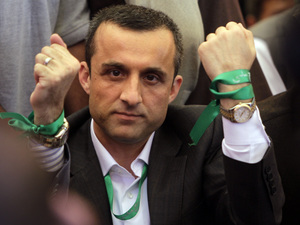 Photograph: Kamran Jebreili/AP
May 5, 2011:
Osama bin Laden death: Afghanistan 'had Abbottabad lead four years ago'
Afghanistan's former intelligence chief says Pakistan's then president Pervez Musharraf angrily rejected Osama hideout tip
By Jon Boone in Kabul
The Guardian
Afghan intelligence believed Osama bin Laden was hiding in an area close to Abbottabad four years ago – but no action was taken after the claim was furiously rejected by Pakistan's president, Afghanistan's former intelligence chief has said.
Agents working for the National Directorate of Security (NDS), the country's intelligence service, worked out that the world's most wanted man must be inside Pakistan proper, rather than the semi-autonomous tribal areas, as early in 2004, Amrullah Saleh told the Guardian. [emphasis mine]
He said they believed Bin Laden must be there based on "thousands of interrogation reports" and the assumption that Osama – "a millionaire with multiple wives and no background of toughness" – would not be living in a tent.
"I was pretty sure he was in the settled areas of Pakistan because in 2005 it was still very easy to infiltrate the tribal areas, and we had massive numbers of informants there," he said. "They could find any Arab but notBin Laden."
Their intelligence became more precise in 2007 when they believed he was hiding in Manshera, a town a short distance from Abbottabad where the NDS had identified two al-Qaida safe houses.
But the former spy chief said that Pervez Musharraf, then president of Pakistan, was outraged at the suggestion that Bin Laden was hiding in such a prominent part of the country.
In a meeting with Musharraf and Hamid Karzai the Pakistani president became furious and smashed his fist down on the table. "He said, 'Am I the president of the Republic of Banana?'" Saleh recalled. "Then he turned to President Karzai and said, 'Why have you have brought this Panjshiri guy to teach me intelligence?'"
He said Karzai had to intervene as Musharraf got increasingly angry and began to physically threaten Saleh.
Afghanistan's former top spy –- who has long been a hate figure in Islamabad among officials who believed he was implacably anti-Pakistani –- also said he had no doubts that Mullah Omar, the leader of the Taliban movement, was hiding in a safe house owned by the Inter-Services Intelligence (ISI), the Pakistani spy agency, in the city of Karachi.
"He is protected by ISI, General Pasha [Lieutenant-General Ahmad Shuja Pasha, director-general of the ISI] knows as I am talking to you where is Mullah Omar and he keeps daily briefs from his officers about the location of senior Taliban leaders; simple," he said.
Saleh was speaking to the Guardian soon after addressing a rally of several thousand Afghans in Kabul organised as a show of strength of what he called Afghanistan's "anti-Taliban constituency" who are alarmed at the prospect of peace talks with insurgents.
The killing of Bin Laden, who was sheltered by the Taliban regime in the 1990s, has prompted heady speculation that an "end game" to the 10-year conflict is now at hand, with the Afghan government and the Taliban-led insurgency striking a deal.
But "deal making" were dirty words to the crowd gathered in a huge tent in Kabul lined with banners saying "We didn't vote for Karzai to make deals" and "Don't sacrifice justice for dealing".
Speeches were interrupted several times by chants from the crowd of "Death to the Taliban! Death to the suicide bombers! Death to the Punjabis!" – a reference to the protesters' view that the Taliban are under the control of the ISI.
Saleh is a burly and comparatively young man who earned the respect of the CIA during his sometimes brutal leadership of Afghanistan's intelligence service. He received a rapturous reception from the flag-waving crowd when he marched into the tent.
[Pundita note: See this Canadian news report about humane NDS treatment of detainees while Saleh headed the intelligence organization. One of the reforms that Saleh introduced to the organization was an emphasis on human rights in dealing with prisoners and carrying out interrogations. See his biography in Wikipedia.]
Saleh lambasted Karzai for calling the Taliban disaffected "brothers".
"They are not my brother, they are not your brother – those are our enemies," he declared, to cheers.
Saleh warned the government that his movement would not remain content with peaceful demonstrations if Karzai did not change course. Later he told the Guardian that if Karzai "sold out in order to bring the Taliban" there would be no choice but to "rise up".
"We have been exposed to a lot of weapons, it is not very difficult to resort to fighting and create influence," he said.
Tuesday, January 25
Amrullah Saleh on 2008 Indian embassy bombing in Kabul and ISI complicity; Pundita on Washington's failure to grasp the meaning of policy

CIA officers who know Amrullah Saleh have described him as "brilliant" but Saleh has always been reluctant to say much on the record until his attendance at an anti-terrorism conference in Washington late last year -- and even then he didn't go into detail about his oft-repeated charge that Pakistan's ISI is complicit in terrorist attacks in Afghanistan and India.
Now, FRONTLINE has aired an interview with Saleh conducted by veteran reporter and FRONTLINE producer Martin Smith. ("The Spy Who Quit," aired January 17, 2011 on PBS). They expanded their discussion off camera, which FRONTLINE published in transcript form.
Smith has been in contact with Saleh for four years and is knowledable about the issues raised in the interview. The expanded portion of the discussion fills in several gaps in the Afghan war record, from the pre-9/11 days to the present, addresses Saleh's career in intelligence work and his relationship with Hamid Karzai, and his views on al Qaeda, the Taliban, and the U.S. war effort in Afghanistan and the war in terror in general.
But it's the part of the discussion about the ISI and specifically Saleh's charge that the ISI orchestrated the bombings of the Indian embassy in Kabul (in 2008 and 2009) that's the stunner because of the details Saleh provides for the first time about his claim of ISI involvement in the 2008 bombing. Below I feature excerpts from the transcript that address the bombing, but first I'd like to make two points:
Although Saleh was fêted in many quarters during his trip to Washington in December 2010 I find that there's a subtle bias against him within certain Washington factions - namely ones that recoil from his hawkishness toward Pakistan, or still cling to the notion that Pakistan should have a large say in Afghanistan's affairs, or which fear that he's too friendly with Russia or will become so if he gains political power.
Often the bias takes the form of faintly praising him while pointing out that as a Tajik he can't be accepted by Afghanistan's Pashtuns. This line is invariably accompanied by the claim that Pashtuns are the majority population in Afghanistan.
The Pashtuns are the majority ethnic group in Afghanistan but they make up only 40 percent of the country's population, and Amrullah Saleh's ethnic heritage is actually Tajik-Pashtun, as a reader at RFERL's Gandhara blog notes in response to Christian Caryl's speculations about Saleh's chances of becoming Afghanistan's next president.
Secondly, while Saleh speaks with frankness during the interview he avoids stating the obvious, which is that Afghanistan's 'Pakistan problem' is a U.S. problem spelled backward. The problem is that Washington can't make up its mind from one day to the next about how it deals with Pakistan.
It's because of Washington's incoherence that I don't agree with Amrullah Saleh's recommendation that the U.S./NATO "bomb" Pakistan, nor do I support the drone strikes. Or rather I think such actions put the cart before the horse.
Washington and its most powerful NATO partners should first change their tune toward Pakistan and make the tune consistent, then see if Pakistan's military/ISI continue to support terrorism in Afghanistan. Then take it to the next level if they don't abandon the support.
But it's only recently that Washington has demonstrated real opposition to the Pakistani military's support of terror sponsoring groups -- and even then the demonstration is part of a passive-aggressive approach that sends conflicting signals to Pakistan's military and civilian leaders.
Let me show you something:
October 8, 2009
US leaders say no intention to interfere in Pakistan's affairsJanuary 8, 2011
[...] Secretary of State Hillary Clinton said the United States has no intention of interfering in Pakistan's internal affairs through the [civilian] aid programme, as some critics have suggested. "Those who have questions or doubts should read the legislation, which is very clear in its intent. [...]
Islamabad - The US has the right to interfere in Pakistan’s economic and governance affairs as Washington provides funds to it, the American envoy here has asserted. US Ambassador to Pakistan Cameron Munter said the US was the largest aid giver to Pakistan and, therefore, it has the right to interfere in economic and governance affairs, Geo News reported Saturday.[...][flipping her pen in the air] Who acts like this? Only crazy people can afford the luxury of changing their minds whenever it suits them. A policy, particularly one that's written into legislation, means an assurance that's consistently applied. Policies can change but if 'change' is the operative term, one is no longer making policy.
With that off my chest I'll turn the floor over to Martin Smith and Amrullah Saleh; Smith's comments are shown in boldface:
[...]I'll break off here, but there is much more of import in the interview.
Were you in Kabul on the day that the Indian Embassy was bombed [in 2008]?
Yes.
You got the news and then you began to gather evidence.
Yes. The evidence directly linked the bombing to [the Pakistani Islamist group] Lashkar-e-Taiba and ISI.
Specifically what?
Very specific, because we got the guy who prepared the car; we got the guy who planned together with ISI in Pakistan. And we had sufficient evidence that it was ISI's plan, because prior to the bombing, I had passed many other assets they had if they could do it. So we knew they were trying to do something against the Indian Embassy.
But what was the evidence that you had?
We had the remaining members of the network arrested.
And they told you --
That they were working for Lashkar-e-Taiba.
But what was the evidence linking those Lashkar-e-Taiba operatives to the ISI?
Lashkar-e-Taiba is an ISI child, A. B, prior to the bombing, we had detected ISI surveillance of the Indian Embassy through proxy, meaning they would train people in surveillance and casing and task them to go after the Indian targets in Afghanistan and bring back information. So we knew ISI were planning to do something against the Indian Embassy.
What was the evidence that linked those proxies to the ISI?
Because it's very direct and it's very simple. Indian Embassy in Kabul is not a target for Al Qaeda. India is not doing anything against Al Qaeda, one. That's circumstantial evidence.
But hard evidence means we get the guy. He tells us about his safe house in a Pakistani city. He gives us telephone numbers. He gives us the name of this mysterious clean-shaven person who came and gave them the equipment, showed them the map and gave them the training and the money, which clearly shows ISI's hand. And we go to the ISI, and we say, "Brother, this is the location where the bombing was found."
Months later they come by and say, "Yes, we did go to the location; the house was empty." Sure, if the house was empty, you could see the register. Who are running it? Very frustrating. Very frustrating. Yeah, they were involved. They were involved. ...
And when did you present your evidence to your U.S. counterparts in the CIA?
As far as investigations were concerned, I don't know now. It was shoulder to shoulder it worked. ... On this particular incident there was nothing that we were withholding from CIA. They knew everything we were doing in the investigation, everything.
So they concluded that as well as you did that this was an ISI-sponsored operation.
We were not telling the CIA to share with us their conclusion. We were empowering them with evidence. And we were assuming that overwhelming evidence will allow them to have good judgment. ...
What was [the Haqqani network's] role in that attack?
They have facilitated, because the bombers had come to Logar with the help of Haqqani facilitators into Kabul. But it was a Lashkar-e-Taiba operation.
Lashkar-e-Taiba is a --
Is a Pakistani extremist outfit, Punjabi. It's not tribal areas. Initially created to do operations in India. They are the ones who did the Mumbai attack.
You have numerous incidents, operations that you've investigated. But can you recount for us now ... perhaps something you haven't talked about before that makes very crystal clear the involvement of the Pakistani intelligence service, the ISI, in Taliban operations inside Afghanistan?
... There is an individual called Tajmir. Tajmir, during the Taliban, was chief of their intelligence for Jalalabad. By virtue of his job he was very close to Al Qaeda, and he was trained by ISI. He's an ISI graduate, and he hails from Paktia province. Very professional in training, he uses about 70 aliases and fake names. But we know it's Tajmir.
He is directing operations from Tal, from Waziristan, from tribal areas. And more than a dozen times after we found out this particular operation was carried out with blessings of Tajmir, we told ISI: "This guy is not hiding in mountains. He is either in Peshawar, or he is in a specific building with this telephone number." They never arrested Tajmir because Tajmir is their man. CIA knows about this. The U.S. military knows about it. The FBI knows about it. And Tajmir is like chief of operations of Al Qaeda assisted by ISI. And he's responsible for more than half of the deadly, the spectacular attacks that have happened since 2004 in Kabul.
You just said that he was chief of operations for Al Qaeda or for the Taliban?
Both. For that particular region of Afghanistan.
He was trained by the ISI?
Yes, he was trained.
What convinces you that he is currently being run by the ISI?
Because he's not hiding in the mountains. He is living in a flat in town. And more than a dozen times we have passed his location and phoned to the ISI. The ISI have come back to me and said: "You were right. A cell who did that operation in Kabul or this operation in Kabul, you are right, they were in contact with their masters in Tal." But they never arrested anybody.
You've called the ISI?
Yes.
Who do you talk to?
I used to talk to [Pakistan army chief Ashfaq Parvez] Kayani, [former ISI chief] Nadim Taj and [ISI chief] Gen. [Ahmed Shuja] Pasha.
And when you talked to Kayani or Pasha, you mentioned this Tajmir?
Yes.
And they said?
They would say, "We will look into it."
Did they deny that he worked for the ISI?
Of course.
So they're denying it? And you're saying that your proof that he works for the ISI is that they don't arrest him?
He's not an ISI officer, but without ISI's protection, he cannot live where he is living. When he does an operation, he then moves to Peshawar, [where] he has a shop. ... And ISI knows about it.
Well, there's a difference, though, between hands-off policy by the ISI toward operatives and actually running them.
I am afraid the United States is becoming again so legalistic like before 9/11, and that will hurt you.
But you're an intelligence man. There is a difference, would you not admit, between a hands-off policy and actual employment and running him as an agent? Are we talking here about the refusal of the ISI to cooperate with you in going after people, or are we talking about active ISI-led operations?
ISI has created a space for Al Qaeda, Haqqani and Taliban to launch operations. Without their protection, without them tolerating the presence of these operatives to do planning, training and using Pakistani soil they won't be able to do these operations. So ISI knows they are doing it, and ISI is happy they are doing it, because through them, Pakistan promotes her policy in Afghanistan, and the policy is, "Taliban are ours, and they are to dominate Afghanistan."
And we're going to help those who help them by protecting them? By not arresting them?
Sure.
Have you ever arrested somebody engaged in a Taliban operation who was carrying papers that identified them as having communications with the ISI?
Too many.
Can you give me an example of that?
For example, there is a guy called Sayed Akbar. He's an active ISI officer, and he was embedded with Taliban in Kunar. We arrested him, and he's in jail.
Give me another example.
Another example -- my colleagues and the police arrested another ISI man fighting, embedded with Taliban in Farah.
How did they know he was an ISI man?
He's saying he's an ISI man. He gives his regiment and his office, everything.
Can you give me another example?
I wouldn't because we have an expression: When you buy apples, you just look at one, and don't necessarily look at each and every apple you buy. So what is the point going over and over this? Americans know ISI is hurting them.
The Pakistanis deny it.
Sure. It suits them.
They say: "We're being hurt and attacked by the Taliban. Why should we be helping them?"
I would say they are being hurt by anti-Pakistani elements or miscreants, but not the Taliban.
In the summer of 2008, the drone campaign in FATA [Pakistan's Federally Administered Tribal Areas] accelerates. What kind of conversations did you have with the CIA, with your U.S. counterparts and the military about this operation and what were your feelings were about it?
[...]
Wednesday, December 15
Phooey! WHAT Amrullah Saleh interview on December 14?
I'm going to have to take away one of the gold stars I just gave The New York Times for their December 14 report, Intelligence Reports Offer Dim Views of Afghan War. Look at this passage from the report:
I know that the journalists who worked on the report didn't pull the quote from thin air. But then what interview is report story talking about -- and with whom? With one of the Times reporters?
Saleh is probably still in Washington making the rounds after his talk at the Jamestown Foundation's Terrorism Conference last week. And if so it's likely he's been talking to the U.S. press, but if he gave an interview yesterday I'd sure like to know more about it and what else he said in the interview. This is because Saleh is the best Afghan War analyst there is -- at least among those analysts who're willing to speak on the record.
In any case, it's mean for a major newspaper to make such a reference without identifying it in some way or another.
But many Afghan officials say that the United States, which sends Pakistan about $2 billion in military and civilian aid each year, is coddling Pakistan for no end. “They are capitalizing on your immediate security needs, and they are stuck in this thinking that bad behavior brings cash,” said Amrullah Saleh, the former Afghan intelligence chief, in an interview on Tuesday.I assumed that the interview was available on the internet but my search turned up no record of such an interview.
I know that the journalists who worked on the report didn't pull the quote from thin air. But then what interview is report story talking about -- and with whom? With one of the Times reporters?
Saleh is probably still in Washington making the rounds after his talk at the Jamestown Foundation's Terrorism Conference last week. And if so it's likely he's been talking to the U.S. press, but if he gave an interview yesterday I'd sure like to know more about it and what else he said in the interview. This is because Saleh is the best Afghan War analyst there is -- at least among those analysts who're willing to speak on the record.
In any case, it's mean for a major newspaper to make such a reference without identifying it in some way or another.
Sunday, December 12
Amrullah Saleh comes to Washington with a message
 Amrullah Saleh spoke at the Jamestown Foundation's Fourth Annual Terrorism Conference, which was held at the National Press Club on December 9. I note that The Washington Post (a conduit for State Department views) didn't send a reporter to cover his remarks and instead published the Associated Press wire service report on them.
 It's easy to see why the Post liked the AP report, which gives space to a Pakistani rebuttal and omits key statements made by Saleh. The reporter for Mother Jones did scoop up the key statements:
"We hear the speeches of major western politicians saying, 'failure is not an option.' Now it seems as if failure is an option. And my key message, coming to Washington, is this: it is a winnable war. The nature of our enemy has not changed."State, the Pentagon, and the NSC do not want to promote any talk about the United Front taking matters into their own hands if NATO keeps screwing around in Afghanistan. But the AP report also contains valuable information on Saleh's remarks so below are both reports (with the above quotes omitted from the Mother Jones report):
He added: "People like me, who see the future of Afghanistan hanging on a cliff, we are preparing for Plan B."
Afghanistan's Ex-Spymaster Rips Karzai's Signature PolicyNow to the AP report. Note the anonymous Pakistani official quoted in the report chose to listen to only part of Saleh's statement when the official expressed relief that Saleh was at least in favor of the Afghan government talking with the Taliban. Yes, but Saleh clearly didn't think the Taliban would ever accept democracy.
by Siddhartha Mahanta for Mother Jones
December 10, 2010
It's no surprise that Amrullah Saleh, the former head of Afghanistan's National Directorate of Security, was jettisoned by Hamid Karzai back in June (or resigned, depending on the telling), ostensibly for failing to thwart a bomb attack. As Saleh made clear during a speech at a Jamestown Foundation conference on Thursday, he believes Karzai's signature strategy for ending the war, reconciliation with the Taliban, will lead to disaster. And he said the Afghan leader's drive to pursue this strategy shows just how detached his administration is from the reality on the ground.
Western officials had long viewed Saleh, an ethnic Tajik, as one of the most intelligent, trustworthy, and effective members of the Karzai government. A veteran of the Northern Alliance [United Front], fought alongside the legendary Ahmed Shah Massoud against the Taliban in the 90s, eventually becoming his intelligence chief, a role he reprised in the Karzai government.
In his speech, Saleh keyed in the pitfalls of negotiating with Taliban. "What has blurred the narrative of the war, is the talk of reconciliation," Saleh told the Jamestown audience. "We could [have reconciled] with Al Qaeda and [the] Taliban on September 14, 15, [or] September 20, 2001. What was the need for these billions and billions of dollars to be spent [on the war]? It’s the same enemy."
And in its desperation to achieve a breakthrough in the talks, the Karazi government overreached. That resulted in what Saleh referred to as the humiliating "bogus Mansour" episode, in which a grocer successfully duped government officials into believing that he was, Mullah Akhtar Muhammad Mansour, a high-ranking Taliban leader willing to come to the negotiating table. Saleh says his agency had vetted and rejected the man back in 2008 after he was unable to verify his identity, and that the Karzai government's zeal to reach a historic deal with the Taliban akin to the Good Friday Agreement or Dayton Accords -- demonstrates its unrealistic hopes for a breakthrough at this juncture.
Brokering a deal with the Taliban, in his view, serves as an excuse to draw down the United States' troop presence in the country without assessing whether any of the on-the-ground facts have changed. "A deal may bring deceptive stability, but it won't bring a long lasting stability where Afghans or foreigners will have confidence to invest, [to] convert Afghanistan into a viable economy," he said.
He questioned those skeptical of the Taliban's strength. "Will they be able to threaten our key and national interest by possessing AK-47s? Remember, when they helped Al Qaeda do 9/11, they had the same weapons."
His solution? "DDR" the Taliban. "Demobilize them, disarm them, take their headquarters out of the Pakistani Intelligence basements... Push the Taliban to play according to the script of democracy -- and if they win...allow them a chance to govern." He's confident, though, that "they will die in democracy, they will die in a country where law is ruling, not guns, not IEDs, not the spread of fear and intimidation."
Saleh also has a pretty good idea of where to change the narrative of the war: Pakistan. Since 9/11, he says, Pakistan has provided only "retail" and not "wholesale" cooperation. Time after time, the United States has been duped into trusting the country and its intelligence services. Saleh even claimed that Pakistani officials have privately admitted to him that their country has yet to change its ways despite their frequent promises to do so.
"Now the United States believes that by giving more money and resources to Pakistan, you can convert their behavior from bad to good…but it is rewarding bad behavior which [continues] that bad behavior."
Until then, government officials and security forces must be more independent, and demonstrate their accountability to Afghans, Saleh argued. Afghans and their government must be prepared for the day when an exhausted United States and NATO decide to leave their country. [...]
And as to how many of those 550 slain Pakistani officers died fighting the Afghan Taliban, I believe that's a state secret:
Former Afghan spy chief slams Taliban talks
by Kimberly Dozier for the Associated Press via The Washington Post
December 9, 2010
WASHINGTON -- Peace talks with the Taliban will lead to disaster unless the insurgent group is disarmed first, Afghanistan's former intelligence chief said Thursday.
Amrullah Saleh, who headed Afghanistan's spy agency from 2004 until earlier this year, said the key to peace with the Taliban is cutting off their support from Pakistan and disarming and dismantling the group before allowing them to operate as a normal political party.
"Demobilize them, disarm them, take their headquarters out of the Pakistani intelligence's basements," Saleh said. "Force the Taliban to play according to the script of democracy," he added, predicting the party would ultimately fail, "in a country where law rules, not the gun ... not the law of intimidation."
Saleh said the United States should give Pakistan a deadline of July 2011 to pursue top insurgents inside their borders or threaten to send in U.S. troops to do the job.
Saleh, who headed the Afghan National Directorate of Security until he resigned last June from Afghan President Hamid Karzai's government, warned an audience at the National Press Club that failure to cut off Pakistani support would allow the Taliban to only pretend to make peace, then sweep back to power after NATO troops leave.
The former spy chief's comments display the dissension at the highest levels of Afghan political society over whether to engage the Taliban in talks, or keep fighting them. His criticism of Pakistan also highlights the widespread suspicion among Afghanistan's elites that the neighboring power continues to allow militants to flourish inside Afghanistan.
U.S. officials have said that such a deal is key to drawing down U.S. and NATO troops, starting in July 2011, with eventual handover to Afghan forces in 2014.
Saleh said this year's surge of U.S. troops had accomplished a "temporary effect" of securing some territory, but failed to change the "fundamentals."
"The Taliban leadership has not been captured or killed," he said. "Al-Qaida has not been defeated."
He added: "The current strategy still believes Pakistan is honest, or at least 50 percent honest." Still, he predicted Pakistan would continue to support the Taliban and other proxies to try to maintain influence in Afghanistan.
Saleh ran Afghanistan's intelligence service after serving in the mostly ethnic Tajik Afghan Northern Alliance, which battled the Taliban before the U.S. invasion. Many members of Tajik regions together with other Afghan minorities have warned of another Afghan civil war if Karzai makes a deal with Taliban.
Saleh criticized his former administration, without naming Karzai, claiming that "political Kabul" was out of touch with the rest of the country, and too often publicly at odds with NATO.
Several Pakistani officials listening to Saleh's speech at the Jamestown Foundation's annual Terrorism Conference grimaced at his remarks.
One Pakistani official approached Saleh afterward and asked privately whether Saleh respected the fact that the Pakistani intelligence service had lost 550 officers since the war on terror began in 2001.
The official said Saleh acknowledged this was true, but insisted more cooperation between the two countries was needed and stood by his claims that Pakistan supports the Taliban.
The Pakistani said he ended the chat saying he was glad Saleh had at least backed talks with the Taliban, with conditions. The official related his comments on condition of anonymity, as he was not authorized to speak to the media.
One of Pakistan's former spy chiefs, who also spoke at the conference, predicted the only way to drive a wage between the Taliban and al-Qaida is peace talks offering the insurgents a way to leave fighting and join the governing process in Afghanistan.
Retired Pakistani Gen. Ehsan ul Haq said peace talks with the Taliban were the only way to drive the group apart from Al-Qaida. Haq said as long as the two groups were comrades at arms, they would continue to cooperate despite their differences.
Haq, former head of Pakistan's Inter-Services Intelligence, said neither Pakistan nor the west had managed to defeat the Taliban with what he called a militarized counterinsurgency strategy. Within Pakistan, he said, the civilian government had failed to backfill the areas the army had won back from the militants.
He said western policies of hunting al Qaida on the ground in Afghanistan, and by drone in Pakistan, has simply fueled their recruitment.
Subscribe to:
Posts (Atom)