Translate

Sunday, August 22

Mosque at Ground Zero: Rima Fakih versus hot air

I warn that Rima Fakih, who holds the 2010 Miss USA title, is very poorly informed about President Obama's track record as a wartime president. You can tell this because of her comment about Obama in relation to a costume she commissioned to wear in the August 23 Miss Universe competition. It's "an unusual winged, gold and silver eagle outfit" that she calls a tribute to Obama. "The symbolism of this costume is a tribute to your work to bring peace to the world," Fakih said. "The amazing costume ... represents the celebration of life, liberty and all that is American."(1)

Thank goodness she added that last part because a U.S. President with polling organizations for a spine, and who should be indicted for war crimes with regard to his version of drone warfare, should not be held up as a peacemaker.

Setting aside her many gaps in knowledge about Obama's actions since taking presidential office, Rima Fakih has taken on the role of the child in the Emperor's News Clothes with her comments about the planned mosque near Ground Zero. She said that the mosque shouldn't be so close to the World Trade Center and added, "We should be more concerned with the tragedy than religion."

With those 10 words Rima cut through the hot air uttered by pundits, politicians, religious leaders, and self-termed defenders of human rights who've held forth on the mosque issue. She also inadvertently cut through her hero's poll-straddling utterances about the mosque:
According to ABC News, U.S. president said Friday that he believes Muslims have "the right to build a place of worship and a community center on private property in Lower Manhattan," but the following day said that he would not comment on "the wisdom of making the decision to put a mosque there."(1)
Moving along, Rima's observation goes to the heart of the matter, which has become a referendum on the motives of Feisal Abdul Rauf, the imam who put forward the mosque plan.

It's not about Rauf, who is as phony as his defenders. Everyone knows that if the family of a drunk driver who ran down your relative shows up outside the memorial service to tell you the murderer doesn't represent the family, they're not sorry for your loss or the victim.

You don't force mourners into the role of a saint, and to do so is cruel and inhumane. Again, everyone knows that -- and those who refuse to acknowledge they know are pursuing a political or religious agenda.

Yet it took a beauty queen who characterizes herself as spiritual rather than religious to point out the obvious in one sentence to the Christian, Jewish, and Muslim religious leaders that upbraided Americans who just want to mourn their dead without being forcibly reminded the murderers did their evil in the name of Islam. If that's not the Cosmos making an editorial comment on religion, I don't know what is.

In closing I'd like to thank Rima for setting my own thinking straight.

As I watched the collapse of the World Trade towers I said, "Start rebuilding tomorrow, and rebuild them exactly as they were."

I was so full of rage at the moment that I was thinking of only one thing: sticking it to the enemy. However, I never revisited my opinion until Rima spoke out. After pondering her words I asked myself whether I'd like to see the Vietnam War and World War Two memorials on the Washington National Mall bulldozed to make room for office buildings.

Let's be clear: if the Americans who died in the 9/11 attack had been working in office buildings in Mashed Potato Falls, Wyoming there would be no question about making the entire site into a memorial. But because the buildings were situated on one of the world's hottest real estate properties, all the decision-makers twisted themselves into the shape of a pretzel to rationalize returning commercial office space to the site.

So if one wants to be brutally frank Rauf is simply taking a page from the planners who are returning commercial office space to the place where thousands of Americans were ground to dust by proposing an Islamic center two short city blocks from Ground Zero that includes "recreation facilities, a restaurant, swimming pool, fitness center, auditorium, a culinary school" and a mosque.(1)

I now wonder if it ever occurred to Congress to ask all Americans if they'd mind adding a few cents to their taxes in order to compensate New York City and New York State for the loss of revenue that would entail by keeping the entire World Trade Towers site as a memorial.

It would be up to a future generation to consider converting part of such a memorial to commercial office space. But I venture the present generation of Americans should be able to put the tax idea to a vote.

1) Quotes are from Natalie James's August 21 report for The Money Times, First Muslim Miss USA Rima Fakih opposes Ground Zero mosque.

Friday, August 20

Nawaz Sharif turns thumbs down on 'independent' panel set up to avoid theft of aid to Pakistan. Only hope now: UN and private charities. Small hope.

Telegraph:
Pakistan has announced it will set up an independent commission to oversee flood relief amid international concern that the country's reputation for corruption was hampering efforts to raise aid money.

Rob Crilly in Islamabad
Published: 5:52PM BST 19 Aug 2010

International aid officials are struggling to raise funds for Pakistan because of what they call an "image deficit". Business leaders inside the country are also offering goods and services rather than cash in order to make sure funds are not misused.

Yousuf Raza Gilani, the prime minister, said he would staff the National Oversight Disaster Management Council with individuals of "impeccable integrity". Their names and remit would be announced soon, he added.

"These respectable members of the council will ensure that the funds are distributed and utilised in a transparent manner and spent judiciously as per the requirements, without any discrimination to any area or province," he said.

The idea was first raised by Nawaz Sharif, leader of the country's main opposition party.

Ahsan Iqbal, a spokesman for Mr Sharif's PML-N party, said the bipartisan proposal had been watered down and the council was in danger of being little more than a "paper body".

"The government doesn't want to give up their own executive authority," he said. "After this statement, it seems that whatever body they create will defeat the spirit behind the proposal." The UN estimates that 4.6m people are still without shelter as fresh rains fell.

The Daily Telegraph has disclosed that more than £300m in foreign aid for victims of the 2005 Pakistan earthquake had been diverted to other causes.

Schools, hospitals, houses and roads planned with money offered by foreign donors were never built, almost five years after the earthquake killed 80,000 people.

This time around foreign diplomats say privately they are channelling aid through the United Nations (UN) and charities rather than the government.

Mosque at Ground Zero: Well, from this I think we can surmise that dhimmitude is not Rajeev Srinivasan's strong suit

Achmed the Dead Terrorist
When Rajeev writes only for his blog he doesn't do things such as capitalize or add links to explain Indian terms; e.g., Rama temple in Ayodha, but I think readers outside India will have no trouble following the gist:
aug 20th, 2010

mosque as a mask of conquest

mohammedans think they have conquered america and want to rub it in with this utterly insensitive plan.

just like they have always built their mosques over the ruins of the places of worship of the people they conquered.

it is an emphatic statement: my god is bigger than your god.

and they don't like it when it is done to them. they cry a lot over the alhambra and the mosque in cordoba which the reconquering christians reconverted and reconsecrated.

what's good for the goose is good for the gander, one would think.

but no, they are mohammedans, they can do this to others (eg. the rama janmabhoomi in ayodhya). but no, nobody must do it to them, or they will -- kill them (the reference is to the utterly hilarious TV show with 'achmed the dead terrorist' and his ventriloquist. every timed achmed gets upset, he rolls his eyes at the audience and says, "i kill you".)
I only glanced at the Economist column he included as the reference link for his comments but from the title I got the impression the editors think Americans who oppose the Ground Zero mosque are Neanderthals.

Thursday, August 19

Excuses for throwing what is fast approaching $2 billion in flood aid to Pakistan are not to be believed

Sen. John Kerry: "We don't want additional jihadists [and] extremists coming out of a crisis."

Juan Miranda: "We have to put every road and every bridge back into the shape where they should be. ... If we don't do it quick, if we don't do it well, what will the Pakistani people think?"

Miranda is the Asian Development Bank's director general for central and west Asia. The ADB is redirecting $2bn of existing and planned loans for reconstruction.

Above quotes taken from the Guardian's report today on the latest increase in U.S. aid to Pakistan, $60 million, which brings the U.S. total to $150 million so far. The Guardian mentions in the same reports
The [U.S.] announcement came after the European Union increased its pledge of emergency help to $135m ... Saudi Arabia yesterday announced a $105m aid contribution, according to Pakistan's National Disaster Management Authority, though just $5m of this will be in cash, with the rest in the form of relief goods. The Saudi public has separately raised $19m.
Remember, any cash given to Pakistan's regime becomes its sovereign property, meaning how it's spent can't be overseen by donors.

Just so we're clear, 1 U.S. dollar = 86 Pakistani rupees.

You've heard of The Mouse That Roared? Pakistan is the rat that roared. Pretty much the same storyline for both, though.

Pakistan's role, and America's, in the Sinhalese genocide against Sri Lanka's Tamils

I have not followed the news about Sri Lanka for many years; that's because I don't like to rake up recollections of my time in the country. So I was blindsided the other night when I scrolled through the comment section of a Guardian editorial by Delwar Hussain titled Pakistan's leaders should heed the lesson of Bangladesh.

He laid out unsettling parallels between the flooding and social unrest in today's Pakistan and the conditions 40 years ago that led to the genocide launched by Pakistan's military against Bengalis, the war between east and west Pakistan, and the creation of Bangladesh.

The central government's ruthless indifference to east Pakistan's victims of the flooding from Cyclone Bhola, one of the 20th Century's worst natural disasters, was the tipping point in the unrest that had been building for years in east Pakistan.

Some of Hussain's readers were upset that he pulled skeletons from Pakistan's closet at a time when the nation was on its knees. As invariably happens when such articles are published, a few Indian and Pakistani readers began rumbling with each other in the comment section. This led to what was for me a startling revelation: Pakistan had become a large supplier of weapons to the Sri Lankan government. A commenter quoted from a May 2009 article at Chowk, a 'liberal' website showcasing the views of Indian and Pakistani intellectuals:
...According to The News quoting reliable sources in Pakistan, military cooperation between Sri Lanka and Pakistan has grown significantly in recent years as Islamabad, unlike New Delhi, has had no problems supplying Sri Lanka's army state-of-the-art weaponry to accelerate its counter-insurgency operations against the LTTE which finally ended with the killing of the most wanted Tamil guerrilla fighter Vellupillai Prabhakaran.

The sources say it was exactly a year ago in the first week of May 2008 that Sri Lankan Army Chief General Fonseka came to Pakistan with his shopping list of high tech arms for the Lankan armed forces, who were engaged in an intense battle with the Tamil Tiger rebels at the time.

After Fonseca's visit, Pakistan sold 22 Al-Khalid tanks to Sri Lanka in a deal worth over US$100 million. Sri Lanka also purchased Multi-Barrel Rocket Launcher System (MBRLS), cluster bombs, deep penetration bombs and rockets and Unmanned Aerial Vehicles (UAV) from Pakistan, according to various reports. In fact, Sri Lanka, along with some Middle Eastern nations, has now become one of the largest buyers of Pakistani arms in the last few years.

On Jan 19, 2009, in a meeting between Pakistani Defense Secretary Lt-Gen (retd) Syed Athar Ali and his visiting Lankan counterpart Gotabhaya Rajapakse, the brother of Sri Lankan president, in Rawalpindi, an agreement was reached to enhance cooperation in military training, exercises and intelligence sharing regarding terrorism.

The agreement came amidst Sri Lankan media reports that the Pakistan Air Force (PAF) pilots had participated in several successful air strikes against LTTE military bases in August 2008. These reports further claimed that a highly trained group of the Pakistani armed forces officers is posted in Colombo to guide the Sri Lankan security forces in their counter-insurgency operations against the Tamil Tigers. ...
Cluster bombs

A March 2009 report at the Pakistani blog, Haq's Musings, discussed the Pakistani arms business in much greater detail than the Chowk piece and mentioned in passing:
Lately, Pakistan has come under severe criticism by human rights groups for being a leading manufacturer and exporter of land-mines, cluster bombs and depleted uranium munitions.
The worldwide ban on cluster bombs went into effect on August 1st of this year; however:
... The Convention on Cluster Munitions -- banning the stockpiling, use and transfer of virtually all cluster bombs -- took effect six months after 30 countries ratified the treaty, which was signed in 2008 by 107 countries.

The agreement outlaws munitions that scatter multiple smaller devices over a large area and that have become notorious for maiming civilians and children.

The treaty's rejection by the United States [which announced it will stop using the devices in 2018], Russia, China, Israel, India, and Pakistan -- countries widely thought to possess and manufacture the bulk of the weapons -- may dilute its practical impact. ...
So, the Sri Lankan government, and the government of the United States and its client state Pakistan were all very much aware at the time the Sinhalese bought the cluster bombs from Islamabad that the devices were being outlawed.

Sri Lanka's ongoing genocide, and the names Gotabaya Rajapaksa and Sarath Fonseka surface again

After a few more moments on the internet I found a report charging that the Sri Lankan regime's genocidal campaign against the country's Tamils had continued. The February 2009 report for the Boston Globe, titled Genocide in Sri Lanka, was written by Bruce Fein. Fein, the former associate deputy attorney general under President Reagan is a specialist in the areas of international and constitutional law and civil liberties. He was counsel for Tamils Against Genocide (a Maryland-based nonprofit) when he wrote the report, which reads in part:
The barrage of media reporting on the grim conflict in Sri Lanka has captured popular imagination, but has overlooked the grisly Sinhalese Buddhist genocide of innocent Hindu or Christian Tamil civilians by a US dual citizen and US green card holder. The two should be investigated and prosecuted in the United States.

Acting on behalf of Tamils Against Genocide I recently delivered to US Attorney General Eric H. Holder a three-volume, 1,000 page model 12-count genocide indictment against Gotabaya Rajapaksa and Sarath Fonseka charging violations of the Genocide Accountability Act of 2007. Derived from affidavits, court documents, and contemporaneous media reporting, the indictment chronicles a grisly 61-year tale of Sinhalese Buddhists attempting to make Sri Lanka "Tamil free."

Rajapaksa and Fonseka assumed their current offices in December 2005. They exercise command responsibility over Sri Lanka's mono-ethnic Sinhalese security forces. On their watch, they have attempted to physically destroy Tamils in whole or in substantial part through more than 3,800 extrajudicial killings or disappearances; the infliction of serious bodily injury on tens of thousands; the creation of punishing conditions of life, including starvation, withholding medicines and hospital care, humanitarian aid embargoes, bombing and artillery shelling of schools, hospitals, churches, temples; and the displacements of more than 1.3 million civilians into camps, which were then bombed and shelled.

This degree of mayhem inflicted on the Tamil civilian population because of ethnicity or religion ranks with the atrocities in Bosnia and Kosovo that occasioned genocide indictments against Serbs by the International Tribunal for the Former Yugoslavia.

During the past month, a virtual reenactment of the Bosnian Srebrenica genocide of more than 7,000 Muslims has unfolded. Sri Lanka's armed forces employed indiscriminate bombing and shelling to herd 350,000 Tamil civilians into a government-prescribed "safety zone," a euphemism for Tamil killing fields. There, more than 1,000 have been slaughtered and more than 2,500 have been injured by continued bombing and shelling.

As a preliminary to the horror, roads and medical aid were blocked, and humanitarian workers and all media were expelled. During a BBC radio interview on Feb. 2, Rajapaksa declared that outside the "safety zone" nothing should "exist." Accordingly, a hospital has been repeatedly bombed, killing scores of patients. Rajapaksa further proclaimed that in Sri Lanka, any person not involved in fighting the Liberation Tigers of Tamil Eelam [LTTE] is a terrorist. ...

The predictable defense of counterterrorism will not wash. Not a single Tamil victim identified in the model indictment was involved in the war between the Government of Sri Lanka and the Liberation Tigers of Tamil Eelam. ...

That's the Sri Lanka I remember, although the number cited for extrajudicial killings is laughably low; I suppose the indictment only included killings that could be directly traced in a court of law to Rajapaksa and Fonseka.

My only other quibble is that it's misleading to term the Sinhalese responsible for the genocide "Buddhists." When I was in the country, many of the self-described Buddhist sanghas had as much to do with Buddhism as the Klu Klux Klan has to do with Christianity. During an earlier era, when the government was still trying to apply a fig leaf to its actions against the Tamils, the sanghas came to be used as a refuge for Sinhalese who murdered Tamils. By taking on the robes of a Buddhist monk the murderers avoided arrest and prosecution. I doubt the situation has changed.

The whooshing sound of war crimes swept under the rug

A couple days ago Gotabaya Rajapaksa, Sri Lanka's secretary of defense (the one with the U.S. Green Card), dismissed claims that the military was responsible for large numbers of civilian casualties and complained that the United Nations was responsible for failing to halt the LTTE's use of civilians as human shields. That, according to The New York Times.

The other one, Fonseka, the U.S.-Sri Lankan dual citizen, abruptly retired from active duty to run in a political campaign, then was arrested and found guilty this month of engaging in politics while on active service. "He was sentenced by court martial to an honourable discharge and is to be stripped of his rank and medals," according to the BBC's August 13 report.

That's as much as I can stomach talking about the Resplendent Isle. I don't want to know what happened to the model indictment Fein delivered to the Department of Justice because I don't think much will ever come of it.

Monsters' Ball

Yet I would like to know how many more times my government intends to be involved with financing Pakistan's forays into genocide. As I discussed in Alden Pyle in Pakistan, Part 1, it is an established fact that the U.S. government aided and encouraged the Pakistani military's genocidal campaign in east Pakistan.

(See Wikipedia's article, which terms the campaign "atrocities," and Genocide Bangladesh Organization for more information but be warned the site features graphic photographs.)

I think technically the campaign was a democide but either way you want to split the semantics it was government-conducted mass murder and mass atrocities on a grand scale.

I understand this is an inconvenient time to bring up the issue of U.S. involvement with the east Pakistan genocide but there's never been a convenient time in the USA. That, too, I understand; yet just because the topic is taboo in the United States, once again the American taxpayer is drawn into financing a situation, and a social system, that is frankly monstrous.

And just as with the Sinahelse rulers of Sri Lanka, Pakistan's rulers are horrifically cruel. Some measure of the cruelty can be appreciated from the account of a Pakistani landowner named Hamir Soomro, whose farm supports 3,000 people. His response to the flooding of his 1,500 acres in recent days was to set up relief convoys to help even less fortunate victims of the floods. He told the (U.K.) Independent:

There is no coordination when it comes to either the relief effort or protecting agricultural land.

"The problem is that everyone is trying to save their own lands," says Mr Soomro. "The politicians in the area are diverting the water away from their lands and onto those of others."

A widespread allegation doing the rounds is that Khurshid Shah, a minister from the ruling Pakistan People's Party, used his clout to get the water diverted towards the populated areas near the town of Sukkur. Traditionally, floods in Sindh have been mitigated by cutting a breach on the left side of the embankment. The water is then supposed to flow towards the desert. On this occasion, the embankment was cut on the right side.

"Even in this tragedy," says Mr Soomro, "people are still playing politics."
The same charge has been made by other Paksitanis, who say that several "feudal" landlords diverted canals, which turned the floodwaters onto entire towns and villages, submerging them.

That's not the half of it. Pakistan has seen heavy flooding before, although it's been more than 80 years since the region has been hit by such heavy rains. However, the British built extensive dams, canals, and embankments in the region while they ruled India; they did this to prevent just the kind of flood catastrophe Pakistan is seeing today. But the flood management structures received little upgrading since 1947, when Pakistan became independent.

Where did the money go for upgrading flood management structures? It went to the same places U.S. tax money earmarked to pay for Pakistan's help in the war on terror went. It went to individual offshore bank accounts in places such as Dubai, to financing the lifestyles of pashas, nuclear proliferation, and preparing for yet more wars of aggression against India.

And it went toward the development of weapons that the Pakistani defense establishment then sold to Sri Lanka's genocidal regime.

Tuesday, August 17

Taliban in Afghanistan making hay from Washington's mixed signals on troop withdrawal date

August 15: General Petraeus casts doubt on July 2011 deadline for Afghanistan withdrawal

August 16: Robert Gates dismisses Gen. Petraeus's suggestion that withdrawal from Afghanistan can be postponed.

On the matter of indicting Oxfam and International Red Cross for war crimes, and a grim warning for U.S. military

Monies diverted from aid and development projects are going in part to help fund the activities of Pakistani Taliban groups attacking not only Afghans but also NATO troops in Afghanistan. This has led to donor governments and aid organizations in NATO countries in effect helping to finance the murder and maiming of their own troops. The situation is an atrocity; it should be classified as a crime against humanity and those directly involved should be indicted as war criminals.

I am sure that aid organizations such as Oxfam and the International Red Cross would be outraged at being labeled war criminals, as would governments donating to Pakistan's flood victims. But they are indeed war criminals if they don't insure that the relief money they provide is not being diverted to Pakistan's military. That's because the military has a history of diverting financial assistance to warfare against India, nuclear weapons, and terrorism.

The aid organizations and governments providing aid to Pakistan's regime invoke a fallacy to defend their criminally irresponsible behavior. Boiled down, the fallacy is that human aggression can be wiped out by developing a country's economy. Until the fallacy is dismantled, humanitarian organizations and democratic governments will be soaked in the blood of innocents.

The same observations apply to commanders in the United States military and other militaries serving in Afghanistan and the defense officials overseeing the militaries, only with an added warning:

I think only a small number of soldiers serving in Afghanistan have read the WikiLeaks documents that discuss the involvement of Pakistan's military and intelligence branch (ISI) in the deaths and injuries of ISAF troops. The same observation probably applies to Matt Waldman's recent paper for the London School of Economics, which detailed the same situation, and to similar revelations.

Various officials connected with the U.S. Department of Defense, notably Secretary of Defense Bob Gates and Admiral Mike Mullen, have publicly downplayed the revelations. However, it is only a matter of time before large numbers of returning soldiers become aware of the extensively documented instances of the Pakistani military's close involvement with Taliban fighting ISAF troops, and become fully apprised of the extent to which the U.S. government is continuing to support the Pakistani military.

I really do not want to contemplate how these discoveries might play out.

One thing seems clear at this point: the U.S. civilian government is currently held in such contempt by the majority of Americans that a full accounting of its support for Pakistan's military wouldn't come as a great shock to the general public. This would not be the case for the U.S. military, which spent decades rebuilding its image after the Vietnam War. The military is now probably the most respected institution in the United States, so it would have a very long way to fall, if it fell from grace. And in the manner of Humpty Dumpty, if it fell, it might prove impossible to restore its image.

While the military is under civilian command, it has many options for pressing the Obama administration and Congress to clean up their act with Pakistan. The military needs to start deploying the options.

As to the argument that the ISAF governments have no other choice but to continue to throw money and technical assistance at Pakistan's military because their cooperation is required in the Afghan War, that's a canard. The NATO governments are holding all the high cards in their dealings with Pakistan. That they haven't played the cards has to do with outdated geostrategic designs, not with fighting a war in Afghanistan.

Former PM Nawaz Sharif says Pakistan doesn't need Western flood aid, and other tales of flood aid to Paistan


On August 15 the (U.K.) Telegraph reported that the former Pakistani Prime Minister and leader of Pakistan's major political opposition party said Pakistan should “stand on its own two feet” as the UN chief urged the world to send massive amounts of disaster aid money to Pakistan:
Nawaz Sharif said his country had sufficient resources to rebuild millions of homes, buildings and bridges destroyed in the worst floods in 80 years. ... Sharif said his country had sufficient resources to rebuild millions of homes, buildings and bridges destroyed in the worst floods in 80 years. ... [He] said it was time for his country to take responsibility for the welfare of its people and to meet the costs of rebuilding swathes of Sindh, Punjab and Khyber-Pakhtunkhwa from its own budget.

He has proposed a series of cuts in government spending to raise £2 billion to rebuild homes and infrastructure. “If the government agrees, we have about $3 billion within our own resources,” he said. ...

He was speaking amid growing fears in Pakistan that the international community would not give as much aid for flood relief as it did following the 2005 earthquake. ... Islamabad has said it needs billions of dollars to rebuild. The US has pledged $100 million, while Britain has earmarked £31 million. The UN has an appeal for just under £300 million [$467million] — significantly less than the $5.5 [pounds] billion given in response to the 2005 earthquake appeal. Mr Sharif said suspicion that aid would not reach the victims was deterring both international organisations and Pakistanis from giving more.

Mr Sharif said if the fundraising effort was run by an independent commission and all party leaders worked together, Pakistan could generate enough money. “If we don’t follow this route, I can tell you there will be no rehabilitation of flood victims because people won’t trust it,” he said.
My hat's off to Mr Sharif for his comments. I note this is the second time in recent days he's been on target in his public statements; the first, Pundita readers might recall, was when he said that Pakistan needed to stop meddling in Afghanistan's affairs. I needed smelling salts to recover from that shock.

However, I warn his remarks about aid are also crafted to appeal to the hardline element in Pakistan, including the Taliban. The factions have demanded that the Zardari regime reject international flood aid on the argument that his government will steal the funds.

Here the Taliban are playing a particularly nasty two-faced game. While portraying themselves as great defenders of Pakistan's downtrodden, they're ruthlessly dangling $20 million of their own money for flood aid -- money to be released providing the government refuses the international aid.

They shouldn't be bargaining with their own people's lives; they should just go ahead and spend the $20 million on flood relief while continuing to register protests about corruption and calling on the international community to hold off on aid for that reason.

In any event, Sharif's comments to the Telegraph are very welcome; particularly so because they were made on the heels of the same newspaper's August 13 report that Zardari's regime had diverted 300 million pounds from disaster aid to Pakistan's 2005 earthquake survivors. The regime has denied the claim but the Telegraph presented enough evidence in their report to raise an eyebrow. The British regime, which coughed up a lot of aid money for the 2005 quake survivors, is investigating the situation, according to the Telegraph.

Meanwhile, over at the Jewish Journal's My Pakistan blog, Mahim Maher opens a small window on efforts by individual Pakistanis to aid their nation's flood survivors:
[Y]oung people from universities and schools have been working tirelessly to start small groups to collect donations. They have been heading off to the flood-hit areas in Sindh with truckloads of bottled water, biscuits, dried milk and medicines. Almost everyone one I know, poor and rich, have been giving money or other donations to people and groups they trust.
We need more such reports before Pakistan's national flag takes on the shape of a begging bowl.

Three quarters of Pakistan is not underwater, and 150 million Pakistanis out of the country's 170 million are not flood survivors. Even excluding children and the country's poorest from that figure, that leaves many millions of Pakistanis who should be able to help the flood survivors and rebuild after the floods have passed. Yet incessant calls for donations from the international aid groups, the United Nations, and foreign governments (including my own) eager to prop up Pakistan's military are conveying the wrong impression that all Pakistanis are professional victims.

Maher also notes:
The latest news is that our prime minister is setting up a national commission or panel of well-trusted men to oversee aid spending. Two of the names shortlisted are Edhi, the man who runs one of Pakistan’s biggest and most successful charities, and Justice (retd) Bhagwandas, a former judge with an impeccable reputation. We can only hope that the money reaches the people who need it.
I am afraid that hope is not enough when billions of dollars are in the offing. The World Bank's International Development Association has already pledged $900 million in financial assistance:
... partly by reallocating undisbursed funds from ongoing projects ... The World Bank didn’t give details of the aid beyond a $1.3 million grant and $10 million to Pakistan’s National Disaster Management Authority.
Realize that if any of that financial assistance is given in cash, Bank/IDA oversight of how the money is used becomes impossible. That's because the money becomes the property of Pakistan's government. That would be the same for all aid received in the form of cash.

And I am afraid that a panel of honest leading citizens is not a strong enough defense against theft of aid money -- and this observation doesn't only apply to Pakistan, I might add. The World Bank and international aid organizations have admitted that on average as much as 40 percent of all development loans/relief aid to poor countries is stolen or diverted by corrupt officials in recipient governments.

For those born yesterday, it's no use being outraged about the situation; the enduring argument in international aid and development circles is that monies diverted by corruption and mismanagement are simply the markup for humanitarian projects, and not enough reason to halt all aid and development assistance. Also, the development banks have worked hard for more than a decade to establish better oversight mechanisms.

However, in the case of Pakistan's regime, draconian oversight is necessary, given their history of diverting financial assistance to warfare against India, nuclear weapons, and terrorist groups. Yet every Pakistani regime has resisted adequate oversight of internationally funded aid and development projects. Thus, the present flood crisis, which is having a devastating impact on the country's fragile economy, is the perfect time for the international community to wring oversight concessions from Pakistan. This would be the best way to help the panel of honest Pakistanis stand against the corruption in their government and the military.

But the only way the international community will take such actions is if it's called out for enabling Pakistan's war machine. All previous attempts to hold the community responsible have floundered, or been too weak to do significant good. Reference the U.S.-led investigation of the horrifically corrupt Oil for Food Program, which let many of the scoundrels involved off the hook. So, this time, the calling out needs to be very strong and sustained.

Monday, August 16

61 trucks loaded with 300 tons of explosives hijiacked in India

(H/T McNorman) My only editorial comment, addressed to Xinhua: Given the cargo,"go missing" is not quite the most apt way to describe what happened to the trucks. Xinhua:
61 trucks loaded with 300 tons of explosives go missing in central India

NEW DELHI, Aug. 13 (Xinhua) -- Some 61 trucks loaded with over 300 tons of explosives have gone missing in the central Indian state of Madhya Pradesh, a senior police official said Friday.

"The trucks were sent from a state-owned factory, Rajasthan Explosives and Chemicals Limited, in Dholpur to a private company called Ganesh Explosives in the state's Sagar district. But it never reached there," the official said.

A massive search is on to track down the trucks as fear is mounting that if the explosives, including detonators and gelatin sticks, reach the wrong hands it could be devastating, he added.

Meanwhile, Rajasthan Explosives and Chemicals Limited has claimed that it can't be blamed for this disappearance as it sent explosives only in trucks authorized by the company.

"We hand over the explosives to those who have the license. And they then dispatch it on their truck. Now, whatever happens to that explosive thereafter, we are not responsible for that," Y.C. Upadhyay of the company said.

Taliban blitzkrieg in North Afghanistan. NATO blindsided. I do not want to hear they didn't get help from Pakistan military

The U.S. military does not believe the Taliban has made a strategic decision to target the north to avoid the bulk of NATO forces in the south, according to a U.S. military official. But a former senior Afghan intelligence official based in the north said that is "absolutely" what has happened.

Listen, you goddamn idiots in the Nato command, Pentagon, State Dept., Congress, White House:

STOP GIVING MONEY TO THE PAKISTAN REGIME. PUT A FREEZE ON THE FUNDS YOU'VE ALREADY PROMISED. DON'T SELL THEM ANY MORE WEAPONS.

How many more innocents do you want to see slaughtered in cold blood? How many more of your own troops do you want to pay the Pakistan military to murder? Stop the madness. Do you understand English? Just stop. Stop it.

HELP REBUILD JUST ENOUGH FROM FLOOD DAMAGE TO GET YOUR SUPPLY TRUCKS THROUGH BUT OTHERWISE NOT A DOLLAR, POUND, OR EURO MORE.

Same basic message to United Nations, IMF, World Bank, and the rest of the so-called international community. Stop helping Pakistan's regime rape their country's poor. Every time they get away with stealing from you, you're just reinforcing the idea that they do nothing wrong -- else why do you keep giving to them? Just stop it, you goddamn fools. Just stop.

The Taliban said they would donate USD 20 million to flood relief effort if the regime wouldn't take money from Western governments. Hold them to their offer. Then shake the country's rich until they collectively cough up a billion USD for flood relief. That's how it's done. That's how civilized humans act when extorted by fiends.
Taliban takes hold in once-peaceful northern Afghanistan
The Washington Post
08/15/2010
By Joshua Partlow

QAYSAR - In squads of roaring dirt bikes and armed to the teeth, Taliban fighters are spreading like a brush fire into remote and defenseless villages across northern Afghanistan.

The fighters swarm into town, assemble the villagers and announce Taliban control, often at night and without any resistance.

With most Afghan and NATO troops stationed in the country's south and east, villagers in the path of the Taliban advance into the once-peaceful north say they are powerless and terrified, confused by the government's inability to prevail -- and ready to side with the insurgents to save their own lives.

"How did the Taliban get into every village?" Israel Arbah asked from his mud hut in the Shah Qassim village of Faryab province. "They are everywhere. And they are moving very fast. To tell you honestly, I am really, really afraid."

In the past year, security in northern Afghanistan has deteriorated rapidly as insurgents have seized new territory in provinces such as Kunduz and Baghlan, and even infiltrated the scenic mountain oasis of Badakhshan, where 10 members of a Christian charity's medical team were massacred this month. Each new northern base is becoming a hive of activity, with fighters rotating in and out, daily planning meetings and announcements at the mosque.

For the first time this year, the U.S. military sent 3,000 troops to the north, based in Kunduz. A senior NATO official said that the soldiers have made progress in Kunduz and commanders are more confident than six months ago that they can halt growth in the north but that insurgents still find sanctuary in sparsely populated provinces where NATO and Afghan forces are undermanned.

The U.S. military does not believe the Taliban has made a strategic decision to target the north to avoid the bulk of NATO forces in the south, according to a U.S. military official. But a former senior Afghan intelligence official based in the north said that is "absolutely" what has happened.

One of those places is Faryab, a swath of rolling desert hills along the Turkmenistan border where a lone U.S. battalion of abut 800 soldiers arrived this spring. Starting in the Gormach district and moving through a belt of Pashtun villages that have tribal links to Kandahar and the south, insurgents have spread to nearly all the districts in the province, according to Afghan officials.

They move constantly on unmarked dirt roads outside the cities to ambush Afghan police and soldiers and to kidnap residents. They execute those affiliated with the government and shut down reconstruction projects. They plant homemade bombs, close girls' schools, and take by force a portion of farmers' crops and residents' salaries.

"This is the new policy of the Taliban: to shift their people from the south to the north, to show they exist everywhere," said Faryab Gov. Abdul Haq Shafaq. "They're using the desert, where there are no security forces at all."

Letter precedes invasion

Before the Taliban invades a village, its arrival is sometimes preceded by a letter.

"Hello. I hope you're healthy and doing very well," Mullah Abdullah Khalid, a Taliban deputy district shadow governor, wrote recently to four tribal elders in a Faryab village. "Whatever support you could provide, either financially or physically, we would really appreciate that.

"We hope that you will not deny us."

But this is just a formality, because the Taliban is coming anyway.

In early November, the villagers of Khwaji Kinti awoke to the rumble of motorcycles. The next morning, they discovered that 30 to 40 Taliban, armed with Kalashnikovs and rocket-propelled-grenades, had taken charge. Tribal elders pleaded with police to send help. None arrived.

The Taliban was welcomed by a sympathetic mullah and set to work quickly. From the shepherds, it expected "zakat," or charity: one sheep out of every 40; and it took "usher," an Islamic tax, from the wheat farmers: 10 percent of the harvest, according to villagers. Its members shut down the lone girls' school and demanded shelter and meals from different homes each night. Mohammad Hassan, a wheat farmer, said insurgents knocked on his door about once a week after the evening prayer, asking for food. "We're afraid of the Taliban and the government," he said. "We're caught in the middle -- we don't have any power."

Taliban members executed a man known as Sayid Arif, who they said worked for the Afghan government, by pulling him from his car and shooting him. They left him in the road with a note on his chest that said for whoever works with the government, "this is the punishment," said a tribal elder named Abdullah.

The Taliban began to settle disputes with arbitrary punishments -- which some consider its main public service. In one case, a dispute between a pair of brothers and another man escalated until the third man was shot. Without evidence, the Taliban chose one of the brothers, 22-year-old Mahadi, as the guilty party, villagers said. The Taliban assembled dozens of people, handed the wife of the victim a Kalashnikov and ordered her to shoot him, which she did.

"I stood there and watched that," one villager said.

Not everyone is unhappy with this. The headmaster of the boys' school in Khwaji Kinti, Agha Shejawuddin, said the Taliban is restoring order based on Islamic law. "The Koran says there should be public punishment," he said. "I think the situation under the Taliban will be better than this government."

On Aug. 5, members of the U.S. battalion, from the 10th Mountain Division, along with Afghan police and soldiers, fought the Taliban in Khwaji Kinti. This sparked an exodus, with hundreds of families fleeing town, villagers said. The U.S. soldiers decided to withdraw after three days "to prevent civilian property damage and loss of life and civilian disruption during the holy month of Ramadan," a military spokesman said.

That left the power balance unchanged, according to villagers reached by phone, and 200 to 400 Taliban members remain. The area "is still under complete Taliban control," one villager said.

Hostages at checkpoint

After a day of road building in January, two Chinese laborers and Saifullah, their 16-year-old driver, rolled up to a Taliban checkpoint on Highway 1.

They did not make it through.

The hostages -- including three other Afghans -- were taken to a village in Gormach, the most Taliban-infested district in Faryab.

"For five days, I had no news of my son," said Saifullah's father, Khairullah. "I decided to go and search for him. I told myself I would find him even if I got killed. I would go to that place."

No taxi driver would take him. He borrowed a car and went alone. In the village, he found a mosque and an adjacent house, with about 40 Afghan-assembled Pamir motorbikes outside. The buildings brimmed with gunmen.

"When I showed up, they were surprised. They said, 'Why did you come here?' " he recalled. "I told them, 'I want my son.' "

For four hours, he argued with the captors, explained his Islamic lineage and paid $1,300. He received his son, with a warning: "You must promise that your son will never work for the foreigners again."

This is the message the Taliban regularly preaches in mosque speeches and in letters distributed to villagers. One such letter, passed out on Taliban stationery in Faryab, told villagers that "you are the nation that defeated the British again and again. Once more we want your compassion."

"Come together as one hand to defeat the infidels of the world," it read. "And make Afghanistan a Jewish and Christian cemetery."

The two Chinese workers captured with Saifullah would not be released for months. In a video of them in captivity, obtained by police, the Taliban taunted them.

"There is no God but God," a Taliban fighter said in Pashto, reciting a Koranic verse known as the Kalima. "Say it. Say it. Loudly."

The Chinese men stared, not comprehending.

"Why are you not learning?" their captor said. "You're not intelligent. You haven't learned anything. We're going to kill you."

Swelling the ranks

One day, a young Taliban fighter rode up on a donkey. Nek Mohammad, 29, hadn't seen him in years but remembered him as a fellow refugee. They had both lived in Iran during the Taliban government, two Tajiks in search of work and peace.

They sat by the river to talk.

"How is your life?" Mohammad asked.

Since he'd joined the Taliban, the man said, he earned more than $400 a month. "They are paying me very well," he said. He asked Mohammad to join the insurgency.

The ranks of Taliban have swelled in Faryab because of such men: young and jobless, according to officials and residents.

They profess little allegiance to a government they view as irrelevant, at best, and exploitative, at worst. They trace the insecurity to the presence of NATO forces.

Afghan officials also see a rivalry between Pashtun tribes at play.

"If one tribe, like the Achekzai, creates 10 Taliban in their tribe, then the Tokhi says, we need 12 Taliban to defend ourselves," said Mohammad Sadiq Hamid Yar, the Qaysar district chief.

Extortion provides much of their funding, Afghan officials said, and Taliban leadership in Pakistan provides training, weapons, ammunition and additional income. Shafaq, the Faryab governor, estimated that at least 500 Taliban members are in his province, although others put the number far higher. The 1,800 police, he said, "are not enough," and the government hopes to form a 500-man militia to bolster them.

Although the new U.S. battalion has helped, Shafaq thinks that NATO troops need a more aggressive approach, including not being afraid to bomb motorcycle gangs as they crisscross the desert. If the Taliban forces have been allowed such freedom of movement, many residents reason, NATO must not be serious about fighting them. "Afghans are very familiar with this type of situation. We see which side of the scale is heavier, and we just roll to that side easily," Mohammad said. "Right now, the Taliban's scale is heavier."

Special correspondent Javed Hamdard contributed to this report.

Saturday, August 14

Katla Watch

"Eyjafjallajökull has blown three times in the past thousand years," Dr McGarvie told The Times, "in 920AD, in 1612 and between 1821 and 1823. Each time it set off Katla." The likelihood of Katla blowing could become clear "in a few weeks or a few months", he said. -- From London's Sunday Times the day after Eyjafjallajokull erupted, on March 20, 2010.
*******************************
Katla Volcano is located in southern Iceland under the Mýrdalsjökull glacier. A blogger named John posting for Discovery Magazine has been keeping a close eye on Katla. His last comment (see #17), posted August 10 in the comment section for his July 20 post on Katla, reads:
... since my post, there has not been a day without a dozen-ish earthquakes under Katla. If you click on the tab that says “Table” it lists the characteristics of the earthquakes, including their depth. Many are quite deep, 5 or more km. I have not seen any above 2 in magnitude yet. I have no idea how to interpret this but it definitely looks different since mid-July than it did previously.
See the blog for charts and comments from his readers.

Thursday, August 12

Convergence, Part 3: Fire and Rain

3/23/10 - Part 1: orange lava, red rust, yellow dust, blue moon
3/25/10 - Part 2, Yellow Dust
(Blue Moon essay not yet published)
***************************************
August 12 - 7:00 AM EDT (UKPA)
New rain piles on misery for China

Overnight thunderstorms have brought new misery to a remote area of north-western China as the death toll from weekend flooding and massive landslides rose to 1,117. The rains triggered new mudslides, leaving five more missing, and another swollen river threatening to overflow. The National Weather Centre forecast heavy rains in the coming days - up to 3.5in is expected in the already saturated region on Friday - and said the threat of additional landslides along the Bailong River was "relatively large". ...
CNN Update Pakistan floods 1321 GMT August 12:
...[I]n areas of neighboring Sindh province the Indus River was expected to crest Thursday, bringing fresh misery to a nation where torrential rains have snatched lives and livelihoods. The waters of the Indus could spread even further, damaging more crops and infrastructure. The Pakistani meteorological department put the likelihood of the river reaching flood level at "very high to exceptionally high."

From the Swat Valley in the north to Sindh province in the south, as many as 15 million Pakistanis have been affected by the massive flooding. By Thursday, the death toll had risen to 1,343, the Pakistan Disaster Authority said. It said 1,588 people have been injured and 352,291 people have been rescued. More than 722,600 houses and 4,600 villages have been damaged or destroyed.

Public health officials feared a second wave of deaths caused by water-borne diseases if action is not taken fast enough. More than 1 million people were in need of clean water. ...
August 12 - Russia wildfires update, New York Times

Russia wildfires August 11 Satellite Image: NASA Goddard
Image: BBC report August 11

Discover Magazine, August 11, 2010
Russia’s Fires & Pakistan’s Floods: The Result of a Stagnant Jet Stream?

The fires in western Russia continue to burn. Though the overall area now ablaze has shrunk, the number of individual fires has actually risen today. The death rate in Moscow has doubled, and Russia is racing to stop the flames from spreading to areas still affected by radiation from the Chernobyl nuclear disaster a quarter-century ago.

While firefighting goes on, attention turns to the “why?” Russia’s fire explosion has people wondering if there’s a bigger reason behind it. The topic seems particularly urgent because another major natural disaster is happening not so far away: in northern Pakistan, where exceptionally heavy monsoon rains have caused crushing floods. The big question–whether global warming is responsible–is still unanswered, but scientists do agree that a large weather pattern links the events.

According to meteorologists monitoring the atmosphere above the northern hemisphere, unusual holding patterns in the jet stream are to blame. As a result, weather systems sat still. Temperatures rocketed and rainfall reached extremes [New Scientist].

You’ve probably seen diagrams of the jet stream on weather charts, where a thick band represents its air currents that surge from west to east. However, New Scientist reports, a “blocking event” caused by west-pushing Rossby waves has slowed the jet stream’s flow. This happens from time to time, and it sets the stage for extreme conditions when weather systems hover over the same area.

Says Jeff Knight, climate scientist at the U.K. Met Office:

“Circulation anomalies tend to create warm and cool anomalies: while it has been very hot in western Russia, it has been cooler than average in adjacent parts of Siberia that lie on the other side of the high pressure system where Arctic air is being drawn southwards” [BBC News].

Pakistan also got stuck with a weather system that plunked down and wouldn’t move. The problem there, though, is that it’s monsoon season, and the weird circulation worsened that.
See Discover's website for additional links and data.TIME, August 10, 2010:
Will China's Bad Summer Make It Clean Up Its Act?
by Austin Ramzy

Rescuers in northwestern China are continuing to search for survivors in parts of remote Zhouqu county that were engulfed by massive mudslides early on August 8. The death toll in the disaster has risen to at least 700, with another 1,148 missing, as heavy rains unleashed waves of mud and rock that buried houses and toppled buildings. Flooding around the country over the past month has killed another 1,454 and left more than 600 missing, according to the Ministry of Civil Affairs. It is the worst flooding here in more than a decade

Premier Wen Jiabao, a frequent presence at the scene of natural disasters, has made several trips around the country over the past month, most recently to Zhouqu, where he urged rescuers to do everything possibly to find survivors during the critical hours after the disaster struck. "For those who are buried under the debris, now is the most crucial time to save their lives," he told local officials, according to the state-run Xinhua news service.

Even as rescue operations unfold, though, some Chinese are questioning why their country has been hit by such extensive natural disasters this summer. The immediate cause is record rainfall. Officials have also blamed the Zhouqu disaster on the loose soil and lack of vegetation in arid Gansu province, as well as the lingering effects of the 2008 Sichuan earthquake on the stability of hillsides.

But some observers suggest the devastation has been exacerbated by aggressive efforts to spur economic growth in China's less prosperous regions. Western China has been the target of ongoing campaigns to bring development levels closer to those of the country's booming coastal areas. Now there are calls to examine just what impact that development is having.

"I hope this will lead to a review of national policy, to try to stop the grand development of the west from becoming a grand excavation of the west," says Ma Jun, director of the Beijing-based Institute of Public and Environmental Affairs. "I think we should recognize how fragile the ecology is in the west of China and then change the policy."

That's just what happened in 1998, after heavy flooding killed some 4,000 people. In response, the government ordered the construction of greater flood-control mechanisms, especially along the Yangtze River, where several sections of levees failed.

To curb erosion, China also paid farmers to abandon steep, hillside plots and banned logging in virgin forests. Those steps all helped reduce environmental degradation, says Ma.

But as the Chinese economy has grown — it quintupled between 1998 and 2009 — the nature of the threat to river systems has changed. "Now it is construction of major projects in those regions, like dam projects and mining," Ma says.

"These projects have caused a new round of destruction in the hilly regions and the scale is pretty big." (Read "Battling Floods in China.")

A 2006 study by scholars from Lanzhou University, in the provincial capital, found that 50 years of human activity, including farming, logging, mining, road construction and dam building meant that "unstable mountainsides, avalanches, landslides and debris flows had become increasingly frequent."

According to a February 2009 report by Zhouqu's office of science and technology, the county had five hydroelectric plants and planned to build another six over the next two years, tripling the total power output.

"Western regions like Gansu have seen extraordinary economic growth in recent years," says Xu Xiangyang, professor of hydrology at Hohai University in Nanjing. "At the same time, local governments don't put as much emphasis on environmental protection, which is partially why landslides have been more frequent these years. Even though the central government has attached great importance to the environment, local governments often neglect it because it does not generate fast money." ...
— with reporting by Jessie Jiang / Beijing
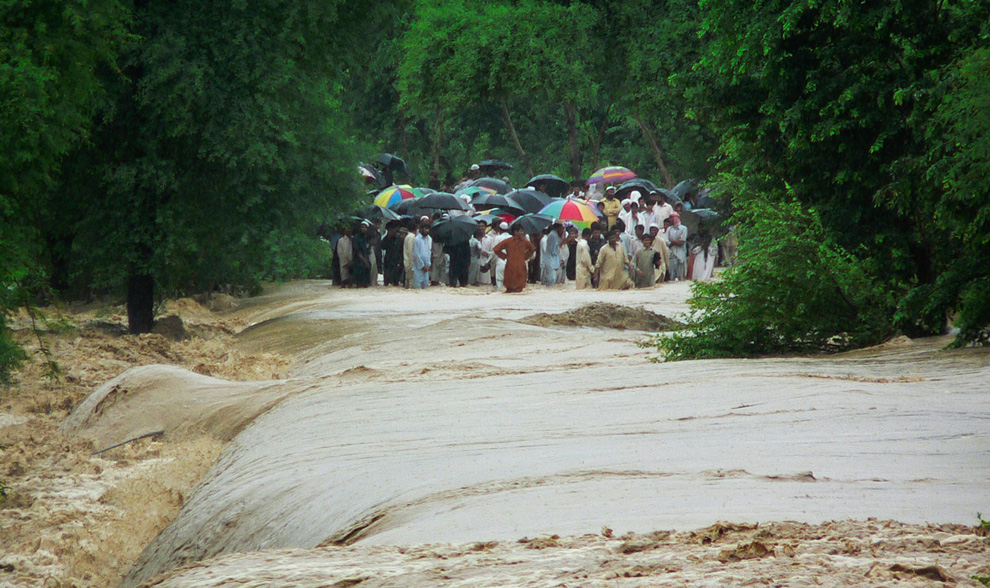
People wait to cross a flooded road in Bannu, northwestern Pakistan on Tuesday, Aug. 3, 2010. (AP Photo/Ijaz Mohammad) For full-size version of photo (#22) see Boston Globe's stunning photo album of 40 'Big Pictures' of flooding and rains in Pakistan that Globe staff picked from best newswire photographs.

Lessons of "Fire Wars" still not learned: Russia's critical mistakes in wildfire management lead to a nuclear cliffhanger

Two very instructive news reports, which I provide in full below (one is a hair-raising look at nuclear facilities endangered by the wildfires), underscore the large role that human error can play in exacerbating the damage from wildfires. (See Discover Magazine's 1994 article for the science of firestorms.)

In 2002 American PBS television aired a NOVA special about wildfire management called Fire Wars. It was a primer on the evolving 'science' of fighting wildfires and the lessons learned. The DVD for the documentary is available, and I think I've linked to it least twice over the years on this blog and maybe even published the transcript once. In any event, enough knowledge is already out there; it's a matter of putting it to use. Once upon a time Russia had a world-class wildfire-fighting organization. Now see what happened to it:

August 12, 2010:
Top Firefighter Longs for ‘Good, Old System’
By Nikolaus von Twickel, The Moscow Times

The devastating wildfires have shown severe shortcomings in Russia's firefighting organization, deficits that are all the more bizarre because until recently the country possessed one of the world's biggest task forces specialized in combating burning woods and fields.

That organization, the Aerial Forest Protection Center, or Avialesokhrana, employed some 9,000 firefighters specially trained and equipped to put out wildfires in Soviet times.

Most of them were so-called smokejumpers, who fly and parachute right into remote fire-hit areas.

In the 1990s, their number was slashed to about 4,000, and in 2007, the center was reduced to the status of a monitoring agency, with just 1,800 personnel left at its disposal.

This summer's catastrophic fires have shown that the reform was a failure and the best way out is to re-establish a unified wildfire fighting center, Andrei Yeritsov, deputy director of the Aerial Forest Protection Center, said Wednesday.

"It would be good if the responsibility for putting out fires were handed back to the federal level," Yeritsov told The Moscow Times.

The reform was part of the new Forest Code, which came into effect on Jan. 1, 2007.

The code, which has been lambasted by environmentalists as the result of timber and real estate industry lobbying, transferred responsibility for the country's vast woodlands to local owners and regional authorities, effectively crippling the woodland fire control system.

The case of the Aerial Forest Protection Center highlights environmentalists' argument.

With the reform, most of the center's resources went into the hands of the country's regions, which seriously impeded effective firefighting activities, Yeritsov said.

Much of the center's staff and equipment ended up in the regions where they happened to be based, leading to massive misallocations, he said.

As an example, he named the center's once formidable fleet of firefighting planes and helicopters. All 106 aircraft, mainly consisting of An-2 biplanes, were given to the regions, where just half of them are now being used for firefighting.

The Vladimir region, east of Moscow, got 16 planes, although it needed only one, meaning that the aircraft sit mostly on the ground or are used for other, commercial purposes.

"This is absurd," Yeritsov said.

The regions also laid off many of the firefighters they inherited, leading to the current shortage of wildfire specialists, he said.

"These people have enormous experience in putting out wildfires — they did it every year. Normal fire brigades do this maybe once in a decade," he said.

Officials with the Aerial Forest Protection Center have asked the government to consider re-establishing the center's position as the central institution for fighting wildfires and hope that they will be successful, Yeritsov said.

"We know our suggestions are being considered. It would be good to return to the old system," he said.

Prime Minister Vladimir Putin, who signed the Forest Code as president in 2006, said Tuesday that the Federal Forest Agency, which oversees the Aerial Forest Protection Center, should be placed under direct government control. The agency now answers to the Agriculture Ministry.

Oleg Aksyonov, a spokesman for the ministry, said he could not comment on further reforms because they would be taken directly by the government.

Putin's spokesman Dmitry Peskov did not answer repeated calls to his cell phone Wednesday.

The situation is unlikely to improve soon because regional governors will be reluctant to hand back their powers to the Aerial Forest Protection Center, said Johann Goldammer, head of the Global Fire Monitoring Center at the University of Freiburg in Germany.

In a telephone interview, Goldammer assailed the Forest Code for transferring responsibility from the state to commercial owners.

"These owners are more interested in quick profits than in sustainable forestry," he said.

State control should be reinstated because the country's vast forests and carbon-producing marshes are hugely important for the global ecosystem, he said.

But Russia is not alone when it comes to disorganized firefighting capabilities. The most widespread problem is that traditional firefighters are not trained and equipped for wildfires, Goldammer said.

In that respect, the Aerial Forest Protection Center had been a model agency. "In good times they had very good equipment and trained specialists," he said.

Decentralization often makes things more complicated, yet some European regions have successfully built efficient structures.

"Catalonia in Spain and regions in the south of France probably have Europe's best capacities to fight wildfires," Goldammer said.

Others, notably Greece, have failed by introducing reforms aiming at shifting powers from forest authorities to firefighters.

Europeans and Russians could also learn from the United States, where state-level organization is backed up with national coordination.

A specialist team from the U.S. Forest Disaster Assistance Support Program is currently in Moscow to assess how Washington can help fighting the wildfires, State Department spokesman Philip Crowley told reporters in Washington on Tuesday.

"They’re working — continuing to consult with the Russian government about how we can be helpful," he said, according to a transcript on the State Department's web site.

The meetings come after Secretary of State Hillary Clinton last week offered help to Foreign Minister Sergei Lavrov.

Both countries have a history of cooperation in fighting fires. In the 1970s, they began an exchange of smokejumpers, according to the U.S. government's web site.

In 2008, representatives of the Aerial Forest Protection Center held an exchange of ideas with American wildfire managers in California, and U.S. Forest Service specialists participated in a June conference on cross-border forest fires in the East Siberian city of Irkutsk.
August 11, 2010:
Wildfires in Russia Fan Nuclear Fears
By Judy Pasternak, AOL News

The United States has spent hundreds of millions of dollars and years of effort to help Russia secure its nuclear stockpiles from what is euphemistically referred to as "diversion." But the 600 wildfires raging across the Russian countryside spotlight another risk to the nuclear-industrial complex: natural disaster.

Add to the flaming peat and forest infernos, the acrid city smog and the scorched village dwellings the specter of an atomic explosion or plumes of unseen radiation. "It demonstrates that terrorists are not the only threat against Russian nuclear weapons," Hans Kristensen, a nuclear researcher with the Federation of American Scientists, told AOL News.

Russia's frantic maneuvers to protect radioactive material and weapons labs suggest that the government was caught unprepared. With a state of emergency declared in the Chelyabinsk region Tuesday, vegetation was hastily stripped from around the Mayak uranium reprocessing complex. About 700 miles away, at a major lab in Sarov, troops rushed to dig a five-mile moat. Both of these sites played major roles in the development of the first Soviet atomic bomb in 1949.

Sarov, about 220 miles east of Moscow, is one of Russia's "secret cities" closed to outsiders. A former monastery, it was the site of Design Bureau No. 11, which carried out the production and assembly of the first Soviet bomb. The complex, then known as Arzamas-16, grew into a design center for thermonuclear weapons and is still Russia's main nuclear research laboratory. The southern part of the grounds is thickly wooded.

Russia's nuclear director, Sergei Kiriyenko, has assured President Dmitry Medvedev that all radioactive materials had been spirited away from the installation, just in case. "I can guarantee that even in an extreme situation with squalling winds, there is no danger to nuclear security, no threat of radiation, explosions or environmental consequences," he said last week.

Over the weekend, a blazing wall of fire in the area was broken down into smaller patches that could be more easily contained.

Yet the transport of that material -- experts say probably by rail -- exposes it to the possibility of accident or even theft, the traditional fear among security researchers. Highly enriched uranium is frequently shipped to Siberia; the Russians burn it down to a depleted state for use by U.S. nuclear power plants to produce electricity.

"But it's not usually in a hurry, and they probably didn't have quite the same preparation that they normally would," Matthew Bunn, a Harvard University nuclear researcher, told AOL News. "I would certainly have concerns while it was on the road."

Nobody has mentioned moving the fissile material at Mayak, where the plutonium for the first bomb was refined and a huge processing center for plutonium and tritium developed. "There are thousands and thousands of canisters of plutonium oxide," Bunn said.

Several American nuclear analysts said they also worry about fire protection at the temporary storage sites where tactical nuclear weapons are often kept while in transit. These are warheads for smaller missiles and submarines, as opposed to the long-range intercontinental missiles that make up the vast majority of Russia's nuclear arsenal. "It's hard to say if they are threatened, because we don't know where all of them are," Robert S. Norris of the Natural Resources Defense Council told AOL News.

The long-range missiles, which make up the bulk of the country's 12,000 nuclear weapons, should be safe, Kristensen said, despite the fact that they are stored deep in Russia's dark pine forests, with the treeline in many cases just 35 feet away. The storage site Irkutsk-45, for instance, consists of five vaults near Zalari in the Transbaikal, where fires have been severe. But they lie in state at the center of underground bunkers made of concrete and steel, with perimeter chambers around them. The protection is designed to withstand a direct nuclear hit.

Still, Lt. Gen. Dirk Jameson, who served as deputy commander in chief and chief of staff of the U.S. Strategic Command, said in a statement that because the New START pact has not been ratified, the U.S. has "no on-site inspectors or other verification measures to monitor the risks to the security of Russian weapons or nuclear material" during the fires. "These risks could pose serious security implications not just for Russia but for the U.S. and for the world ... that our current intelligence is unable to watch closely."

Yet arms inspectors would not be able to examine the tactical weapons that pose the most concern; these are not covered by treaties anyway. Russia keeps very quiet about the number. But estimates peg the inventory at about 5,400 with slightly more than 2,000 operational. The U.S., by comparison, keeps approximately 500 active tactical weapons, including 200 in Europe, and an additional 700 in storage.

As if all that weren't enough, at Mayak, where the plutonium for the first bomb was refined, another problem looms. This is a heavily contaminated area. Between 1949 and 1956, the plant directly released radionuclides into a reservoir. In 1957, there was an explosion in a tank that held high-level radioactive waste. In 1967, the wind blew radioactive material out of the dried-up bed of Lake Karachav and dispersed the particles around the community.

A 2008 study by the Norwegian Radiation Protection Authority found increased incidences of leukemia, solid cancers and birth defects among Mayak residents, which scientists linked to radiation exposure. If fire unleashes radioactive material deposited in the Mayak forests, "I would argue that the dangers to human health from fires and particulates are far higher than that from the radiation that would be stirred up," Harvard's Bunn said.

Experts said the same is true for the contaminated zones around Chernobyl, the nuclear power plant where a series of explosions rocked the No. 4 reactor on April 26, 1986, sending radioactive dust across Ukraine, Russia, Belarus and Europe.

Greenpeace Russia issued a statement today that three fires had been registered in the Bryansk region, which includes Chernobyl, in forests highly polluted with the nuclear isotope cesium-137.

Andrew Sowder, a health physicist who monitored Chernobyl safety issues for the U.S. State Department, told AOL News that much of the radioactive material from the accident has decayed or become so tightly bound to the soil that it should not be easily dispersed by fire. Though he expects the health risks to be low, Sowder recommended monitoring and added that it will be important to reseed the area to keep the radioactive soil from blowing away later. "You don't want erosion," he said.

According to Reuters, radiation levels in Moscow today were within normal limits, said Yelena Popova, who heads the region's monitoring center.

Putin, World's Coolest PM


The only levity to emerge from news about Russia's wildfires comes from the Russian bloggers who huffed that Prime Minister Vladimir Putin was piloting a plane without a license while he was putting out a couple wildfires from the cockpit of a firefighting aircraft.

Although news reports initially placed Putin in the co-pilot's seat, one lawyer and political activist pointed out that he was actually in the pilot's seat. Will Putin pay the fine of 2,000 to 2,500 rubles for flying without a license? The Moscow Times, which reported on the story, deadpanned that he "also sat in the pilot's seat of a Tu-160 bomber in 2005 and a Su-27 fighter in 2000."

Gee I hope it doesn't take a special driver's license to operate a Harley-Davidson motorcycle in Russia because Putin recently took one of those for a spin, too.  So, okay, it was a three-wheeler. He is the Prime Minister, after all.


More from The Moscow Times report:
... After the firefighting flight, Putin visited the Ryazan regional village of Kriusha, where wildfires have destroyed 54 houses, and met with residents. He once again pledged that everyone who had lost a home would be paid cash compensation or receive a new house. Regardless of the size of the burned house, claimants can only collect up to 2 million rubles ($66,600), Putin said.

The residents complained that their village did not have a firetruck, and Putin said the government planned to purchase more firetrucks in the future. He also promised to build a school, kindergarten and a sports center in the village.

Ahead of his visit to the Ryazan region, Putin met with Mayor Yury Luzhkov and praised him for ending a trip to Europe "in due time."

Luzhkov left Russia on Aug. 2 for what his spokesman Sergei Tsoi initially described as a vacation and later as a trip to seek treatment for an unspecified sports injury. He flew back Sunday night after initially resisting calls to return as thick smog cloaked Moscow.

An unidentified Kremlin official told Interfax on Tuesday that Luzhkov should have returned to Moscow earlier because his absence "didn't contribute to making the necessary decisions on time."

Luzhkov, who faced no criticism from Putin at their meeting, called the situation in Moscow "not simple, but under control," even as a blue sky appeared over the city for the first time since last Thursday.

Putin also asked Luzhkov to assist in reconstructing houses in the Ryazan and Voronezh regions, which together with the Moscow region are among the seven regions where the government has declared a state of emergency because of the fires. With Luzhkov overseeing the wealthiest economic center in the country, he is often asked to help out in needier areas. His billionaire wife, Yelena Baturina, owns the Inteko construction company.

Putin said during his visit to the Ryazan region that Luzhkov agreed to provide 1 billion to 1.5 billion rubles from a reserve fund.

He suggested that the Federal Forestry Agency be placed under the Cabinet's control. The agency now answers to the Agriculture Ministry.

The economic damage caused by the wildfires amounts to about $15 billion, equal to 1 percent of Russia's gross domestic product, Kommersant reported Tuesday. The government has not tallied the economic cost yet, although economists largely agreed with Kommersant's estimate.

Luzhkov, at a City Hall meeting, blamed Moscow region officials for the peat bog fires that fueled the smog in the capital, saying they had ignored fire safety measures drafted after fires caused similar smog during the summer of 2002.

"At our initiative, the Russian government in 2002 ordered that protective measures be drafted against peat bog fires. They were prepared, but no one is fulfilling them," Luzhkov said, adding that those guilty must be punished. He did not elaborate on who is to blame.

But the ax fell Tuesday on the director of the Moscow regional branch of the forestry agency, Sergei Gordeichenko, who resisted calls last week to end a vacation to deal with the fires. Agriculture Minister Yelena Skrynnik ordered Gordeichenko's dismissal.

President Dmitry Medvedev threatened to fire forestry officials who refuse to end their vacations Monday.

The situation with fires in the Moscow region remained "tense" on Tuesday, the regional branch for the Emergency Situations Ministry said in a statement. At least 37 fires were burning on about 190 hectares, it said.

In all, fires were burning on about 174,000 hectares around Russia on Tuesday, the Emergency Situations Ministry said in a statement. In addition to 165,700 Russians, about 400 foreign firefighters were deployed with 52 planes, helicopters, firetrucks and other equipment, it said.

They were joined Monday by a group of U.S. fire experts from the U.S. Agency for International Development, who arrived in Moscow following a telephone conversation between U.S. Secretary of State Hillary Clinton and Foreign Minister Sergei Lavrov on Friday, the State Department said.

Environmentalists warned on Tuesday that the fires have reached forests in the Bryansk region, bordering Ukraine, which is polluted with radioactive emissions from the 1986 Chernobyl disaster.

Greenpeace said at least 20 fires were burning in the area as of Monday, including three in highly polluted forests. It cited a satellite map of the fires provided by the Fire Information for Resource Management, a fire monitoring agency based at the University of Maryland.

The Emergency Situations Ministry denied that there were any fires in the Bryansk region's polluted forests.

The top health official in the Moscow region, Vladimir Semyonov, told journalists that the region's death rate had increased by 25 percent within three weeks, Interfax reported. He added that comparative figures for previous years were not available yet.

Moscow's top health official said Monday that the number of deaths had doubled since the start of the fires.

Luzhkov said Tuesday that ambulances calls have risen by nearly a quarter since the heat wave struck the city in late June.

To provide heat- and smog-weary Moscow residents with some relief, city authorities have organized free admission from Tuesday to Sunday to select movie theaters, including the Neva, Khudozhestveny, Svoboda, Fakel, Ulan-Bator, Vladivostok and Sputnik, the city's culture department said. It said the moviegoers would be supplied with free water.

The Norwegian Embassy in Moscow has suspended visa applications for individuals and tour groups, joining the U.S., German and other embassies in cutting back their workload amid the heat and smog. It is still possible to apply for a Norwegian visa via the country's consulate general in St. Petersburg.
********

Tuesday, August 10

UN report: Students of the Koran, not NATO troops, responsible for spike in civilian deaths in Afghanistan

If the United Nation huffs that they referred to "Taliban," not "Students of Koran" -- what do they think "Taliban" means in English? It means "students" but specifically students of the Koran. The Students of the Koran have been winning the propaganda war in Afghanistan chiefly because the U.S. and other coalition commands have broken the cardinal rule of warfare: Never, ever, allow the enemy to control how you refer to him. That needs to change, "yesterday." If they don't want to call a spade then come up with another name for the enemy -- one he can't hide behind.

That's Pundita's contribution to General Petraeus's call for improved coalition strategic communications in Afghanistan.

August 10, 2010
(Christian Science Monitor) According to a new UN report, the Taliban and other insurgents are largely responsible for the recent surge in civilian deaths, not coalition forces. Gen. David Petraeus has ordered a related PR offensive.

According to the UN, the number of civilians killed in the conflict in the first half of this year numbered 1,271, more than a 20 percent jump over the same period last year. Under stricter rules of engagement, coalition forces reduced civilian killings by 29 percent, while insurgents killed 48 percent more civilians than at the same time last year. Overall, insurgents were responsible for 72 percent of this year's civilian deaths.

NATO’s tighter rules of engagement have resulted in grumbling in the ranks, but Petraeus hasn’t changed the rules much since he took command in July. Instead, he is pushing his public affairs officers to reap greater benefits from the Taliban’s increasingly poor record on killing innocents.

“He has made it very clear from the beginning that it’s his intent to hold the Taliban accountable for what they are doing – and to announce what they are doing,” says Lt. Col. John Dorrian, the public affairs team chief for international coalition forces. [...]
Strategic communications have been a disaster for the coalition forces in the Afghan campaign, so good for Petraeus's efforts to improve the situation.

Afghan War: Pundita throws her shoes at the 'Get Russia' crowd

I see the great Helmand offensive may have to be delayed on account of NATO supply trucks in Pakistan floating into the Indus River.

This could have been avoided if years ago the U.S. had asked Russia for help with a safer route for supplies bound for Afghanistan -- one where the U.S. and European taxpayer didn't have to pay an estimated $4 million a year to the Taliban not to attack the supply route in Pakistan. These would be the same Students of the Koran killing NATO troops in Afghanistan.

Of course the route the Ruskis worked out would have been slower -- yet once in the pipeline, there would have been a steady stream of supplies.

But no, it wouldn't look right to ask Ivan for help seeing how the 'Get Russia' crowd on both sides of the Pond was trying to provoke a war with the Ruskis over Georgia and Ukraine.

So I just want to know if the Washington branch of the 'Get Russia' crowd is happy now. Is there anything else you can think of doing to screw up the U.S. war effort and get U.S. troops killed?

And I don't want to hear that almost nine years into the Afghan campaign the U.S. finally experimented with the route the Russians recommended. Yes I know all about that experiment -- and the little editorial statement the Pakistani military made about it. Don't sit there and look as if you don't know what I'm talking about.

Don't you tell me nobody can prove the arrival of the first shipment via the experimental route and the attack on the NATO supply near Islamabad happening on the same day wasn't a coincidence. Save it for the Americans who don't bother to read the news from Pakistan closely.

Go! In the name of God, go! All of you! Leave these shores and relocate yourselves and your lobbyists to Kiev! Better still, take up residence in Karachi.

Monday, August 9

Critics of TIME cover picture of Aisha get it wrong, but so did TIME editors. And a few words about RAWA, CIA, FireDogLake, and Malalai Joya

I'll preface this post with a note to the France24 news organization, Siun at FireDogLake, and Brad Adams and all the other thousands of Western human rights activists who've leaped blindly into the maelstrom of Afghan politics before they've looked. Watch carefully, don't blink:

From France24's interview with Malalai Joya:
“The US used the plight of Afghan women as an excuse to occupy Afghanistan in 2001 by filling television screens, Internet pages and newspapers with pictures of women being shot down or beaten up in public. Once again, it is moulding [sic] the oppression on women into a propaganda tool to gain support and staining their hands with ever-deepening treason against Afghan women,” Joya added.
From RAWA's article, Afghan feminists fighting from under the burqa:
During Taliban rule, RAWA ran secret girls' schools and filmed the state killings of women using cameras hidden under their burqas, creating footage that helped to fuel international outrage against the regime.
All right; to begin:

The uproar TIME set off by featuring a maimed teenage Afghan girl named Aisha on their cover obscured what should have been the key point of her story: She was rescued and given refuge by a women's shelter in Afghanistan, and all that's keeping such shelters open in the country is international pressure. That's because Hamid Karzai is pandering to fundamentalists in the attempt to make his regime more appealing to Afghan Taliban. If TIME had blazoned that news on their cover instead of using language that made Aisha a poster child for continued U.S. presence in Afghanistan much controversy might have been avoided.(1)

That said, international pressure is a very uncertain line of defense against the Taliban demon who maimed Aisha and left her for dead -- an occurrence that happened while ISAF forces were in the country, as more than one critic of the TIME cover stressed. (Aisha is getting a new nose, by the way.)

Propagandists for Rawalpindi have pointed that Aisha's husband, who hacked off her ears and nose, is a Pashtun, and that the nose cutting is the punishment in Pashtun society for a wife who disgraces her husband. Aisha's husband is a Taliban fighter. And unless the propagandists are prepared to argue that every Pashtun wife who 'shames' her husband has had her nose cut off, they need to stop talking trash and admit that Aisha's maiming is distant thunder to what's going to happen to Afghanistan's women if the Taliban take over in Afghanistan.

However, an element of the American Left is so greatly against continued U.S. military presence in Afghanistan that no matter how TIME had positioned Aisha's story it would have been harshly criticized by the faction.

And unless TIME had placed the caption 'This is why the U.S. must quit Afghanistan immediately' above Aisha's picture neither RAWA, which stands for Revolutionary Association of the Women of Afghanistan, nor Malalai Joya, would have been mollified.

RAWA is also more incensed than usual with the CIA:
A less publicised leak by the [WikiLeaks] website in March 2010 exposed a confidential CIA document urging the use of abused Afghan women to shore up support for the war.

“Afghan women could serve as ideal messengers in humanising the ISAF [International Security Assistance Force] role in combating the Taliban because of women’s ability to speak personally and credibly about their experiences under the Taliban, their aspirations for the future, and their fears for a Taliban victory," read the memo.
I'm incensed too. It took the CIA all these years to figure out that emphasizing the plight of Afghan women would be a good way to combat the Taliban propaganda machine? What are we paying them for?

Or are we paying them in this case? Was the report written by a contractor who's not American? Well, maybe RAWA's quote from WikiLeaks changed "humanizing" to the British spelling. But why do that? When I find time I'll check the WikiLeaks source document to resolve that minor mystery.

One would think RAWA ("Let's rise against the war crimes of the U.S. and its fundamentalist lackeys!") would have been thrilled at the news that a major Western publication had seen fit to dedicate a cover story to atrocities against Afghan women, but no. They're furious about the TIME cover. As to why, the answer entails getting to know a little about RAWA. One must make a distinction between their website and the organization itself, which is highly secretive. From RAWA's website:
Official disapproval means the group has many of the attributes of an underground movement. Parween [a RAWA member] only knows a handful of other members because, like a terrorist network, it operates through a cell structure. The idea is to protect the wider membership of around 2,000 women by not allowing a single activist to reveal names to the NDS, the country's intelligence service (which Parween refers to as Khad – its name during the Soviet occupation of the 1980s when the service was controlled by the KGB).
Why does the Karzai government disapprove of RAWA? According to the same RAWA article I linked to above, they consider it a Maoist organization.

If Beijing is behind RAWA, that would certainly explain a peculiar aspect of RAWA's rhetoric. They have a bug in their ear about the Northern Alliance, which historically has close ties with Russia's government, and which they conflate with the Taliban. Yet since the fall of the Taliban regime, Afghan women have been so safe in regions controlled by the Northern Alliance that the difference between those regions and the rest of the country is like night and day.

Afghan women have thrived under the Northern Alliance; they've started businesses and moved about with no fear of being abused -- that is, until a several months ago, when they became frightened that the Taliban were set to take over the region. After that, many took to covering themselves head to toe and veiling their faces.

So one would think that RAWA, which is so dedicated to the rights of Afghan women, would have a few kind words to say about the Northern Alliance. Granted, RAWA is focused on reporting atrocities against Afghan women, not on any progress that Afghan women have made. But still I find their hatred of the Northern Alliance perplexing with regards to the rights of women in the country. There are Northern Alliance warlords, of course, but again the RAWA website seems to be sending out mixed signals.

What's easy to grasp about RAWA is that at least in their writings they adhere to a type of feminist activism that reflects the Western antiwar movement and the Western Left.

"RAWA believes that freedom and democracy can’t be donated; it is the duty of the people of a country to fight and achieve these values," explains their website.

Given that RAWA is dedicated to nonviolent means of fighting, that leaves the running dogs of capitalism -- namely, the United States -- to do all the icky-poo work of killing the chauvinist pigs trammeling the rights of Afghan women while RAWA shrieks "War Crime!" every time civilians get caught in the crossfire.

As to Malalai Joya's highly critical view of the Aisha TIME cover, which she expressed in an interview with France24: The Propagandist, a Canadian website, was not fooled by the mountain of honors that Leftists, socialist governments, and Western human rights organizations have heaped on her over the years. Writing for The Propagandist, Lauryn Oates pegged Joya as a stoppist who's aligned with Canadian anti-war organizations, then made short work of Joya's sensational claim, “During the Taliban’s regime such atrocities [as those carried out against Aisha] weren’t as rife as it is now and the graph is hiking each day."(2)

Joya is most certainly a stoppist and is so anti-American that in the France24 interview she terms the "foreign fighters" in her country "enemy" forces according to France24's Mehdi Chebil:
Malalai Joya said she would be “very happy” to see foreign troops leave. “Currently, Afghan people especially women are squashed between three enemies: Taliban, fundamentalist warlords and troops. If the foreign enemy leaves the Afghan grounds my people would face two internal enemies.
Joya is clearly referring to U.S. and other NATO troops but oddly she makes no reference to the great influence of Pakistan on her country, at least in that quote.

I don't know about Joya's connections with Canadian antiwar organizations, although her rhetoric about the NATO war effort in Afghanistan mirrors the view of those organizations. However, I'd peg Joya first and foremost as a useful idiot.

I don't think there's any question about her dedication to defending the rights of Afghan women. But if she hadn't existed the Pakistan military or Taliban commanders under their control would have invented her. She is a strong voice in the West and particularly Europe for demanding that NATO quit Afghanistan. Pakistan's military wants nothing more than for ISAF to quit Afghanistan.

Reportedly, there have been threats against Joya's life; I wouldn't be surprised to learn that some Afghan warlords -- the ones she accused of being war criminals -- have made such threats. Yet I can't imagine why the Taliban would want her dead until after U.S. forces leave Afghanistan. Until then she is very useful to them.

I note that Joya also conflates the Northern Alliance with the Taliban and shares RAWA's hatred of the Alliance.

I will close with a message for FireDogLake, a collaborative blog that's an influential voice in the Leftist part of the American blogosphere. I mention the blog here because a FDL contributor named Siun supported RAWA's line on the TIME-Aisha controversy.

Careful attention to the RAWA website and Joya's remarks suggest political and possibly even ethnic and religious currents that are not obvious to Westerners. FireDogLake, and indeed all Western blogs and other media outlets, need to become more knowledgeable about Afghan politics, and the history of the South-Central Asian region and Iran, before promoting agendas of particular Afghans.

One thing is certain about Joya and RAWA: they are skilled at speaking in ways they know resonate with Western human rights activists. That's okay, but it's what we don't know about their country's politics and the clan, religious, and ethnic rivalries that's not okay when we try to be helpful.

According to a report on RAWA's own website, the organization's radicalism has spelled trouble for other women's rights advocates in Afghanistan:
But others say [RAWA's] radicalism comes at the cost of effectiveness. Wazhma Frogh, an independent women's activist, says only a tiny minority of literate, urban women are even aware of the "ghost" association. "They have created trouble for other women activists who are usually labelled as linked to RAWA."
Frogh's words are a sobering indication that Western human rights activists should look very carefully before they leap to help Afghan activists.

1) For readers interested in learning more about Karzai's pandering to Afghanistan's fundamentalists, this 2009 report by the (U.K.) is a must read. He's used Afghan women as the sacrificial pawn in his dealings with Tehran; this, in a bid to curry favor with a Shiite faction of Afghanistan's Hazaras that leans toward Iran -- even though the majority of Hazaras reportedly want nothing to do with his machinations.

2) Here are a few choice quotes from The Propagandist article, which is well worth the read in its entirety.
[...] Because there were no studies undertaken during the Taliban's regime on the statistical rates of violence against women, there is no data from that period that could prove that violence against women is better or worse now.
[...]
Not only is there no evidence that violence against women was worse now than under the Taliban, an analysis of the conditions now and the conditions then should lead to an educated guess that it is more likely to have been worse then. When the Taliban were in power, there were no women's shelters. There are now more than a dozen across the country. There are numerous counseling programs, legal aid clinics and advocacy organizations operating to serve victims of violence. There is a Ministry of Women's Affairs and a referral system in place that mobilizes the resources of dozens of frontline organizations.
[...]
There are also reporting systems in place for the first time, with organizations like the Ministry of Women's Affairs and the Afghan Independent Human Rights Commission collecting and storing data on the cases they process. This means more cases are being reported, and not necessarily that more incidences of violence are happening than were previously occurring when there were no reporting mechanisms in place.
[...]
********