Translate

Showing posts with label India. Show all posts

Thursday, September 15

Al Qaeda chief of Pakistan operations killed on 9/11 tenth anniversary; State Dept. designates Indian Mujahideen a terrorist organization

September 15:
Al Qaeda Chief of Pakistan Operations Killed
by Jake Tapper
ABC News (USA)

A senior administration official tells ABC News that officials have confirmed that al Qaeda’s chief of Pakistan operations, Abu Hafs al-Shahri, was killed earlier this week in Waziristan, Pakistan.

The administration does not confirm the use of predator drones, but on Sunday, the 10th anniversary of the 9/11 attacks, a drone fired two missiles at a car as it entered a compound in Mir Ali, North Waziristan, killing three militants.

“Abu Hafs’ death will further degrade al Qaeda’s ability to recover from the death last month of AQ’s number two, Atiyah, because of his operations experience and connections within the group,” the senior administration official said, referring to ‘Atiyah ‘Abd al-Rahman, the deputy leader of al Qaeda killed in August.

“Abu Hafs’ death removes a key threat inside Pakistan, where he collaborated closely with Tehrik-e Taliban Pakistan to conduct coordinated attacks.”

In addition to the killing of Atiyah as well as Osama bin Laden earlier this year, Obama administration officials point to a number of attacks decimating al Qaeda’s leadership ranks “with more key leaders eliminated in rapid succession than at any time since 9/11,” the administration claims.

These include killing al Qaeda’s number 3 commander, Sheik Saeed al-Masri in May as well as one of the terrorist group’s most dangerous commanders, Ilyas Kashmiri, who was killed in June.

[Pundita Note: although it's likely he was taken out there is a lingering question as to whether Kashmiri is dead]

Administration officials also herald the recent US/Pakistani joint arrest of Younis al-Mauritani in Quetta.
September 15:
US State Department adds Indian Mujahideen to list of terror groups [emphasis throughout mine]
By Bill Roggio
Long War Journal

Today the US State Department added the Indian Mujahideen to the list of "Foreign Terrorist Organizations" as well as to the list of specially designated global terrorist entities. The designation allows the US to freeze the group's assets, and prevents individuals from providing support to the terror organization.

State described the terror group as "an India-based terrorist group with significant links to Pakistan," and said it is "responsible for dozens of bomb attacks throughout India since 2005, and has caused the deaths of hundreds of innocent civilians."

"IM [Indian Mujahideen] maintains close ties to other US- designated terrorist entities including Pakistan-based Lashkar e-Taiba (LeT), Jaish-e-Mohammed (JEM) and Harakat ul-Jihad-i-Islami (HUJI)," the statement explained.

"IM's stated goal is to carry out terrorist actions against non-Muslims in furtherance of its ultimate objective - an Islamic Caliphate across South Asia."

The Indian Mujahideen's "primary method of attack is multiple coordinated bombings in crowded areas against economic and civilian targets to maximize terror and casualties," State continued, and said the group was involved in the terror attack in Pune in 2010 (17 people killed), New Delhi in 2008 (30 people killed), and Ahmedabad in 2008 (38 people killed). The terror group "played a facilitative role in the 2008 Mumbai attack carried out by LeT that killed 163 people, including six Americans."

While not stated in the State Dept. release, the Indian Mujahideen is suspected of conducting numerous other attacks in India, including the July 13 bombings in Mumbai that killed 21 people, and the Sept. 7 attack outside a courthouse in Delhi that killed 11 people (both the Indian Mujahideen and the Harkat-ul-Jihad-al-Islami claimed credit for this attack).

In the past the existence of the Indian Mujahideen was denied by India's Intelligence Bureau. Instead the Bureau has claimed that the terror group is a front group created by the Bangladesh-based Harkat-ul-Jihad-al-Islami, or HUJI-B, an al Qaeda affiliate. According to the Bureau, HUJI-B created the Indian Mujahideen to confuse investigators and cover the tracks of the Students Islamic Movement of India, or SIMI, which provides logistics for the attacks.

SIMI is itself a front group for the Harkat-ul-Jihad-al-Islami and Lashkar-e-Taiba inside India. It receives support from Pakistan's Inter-Services Intelligence and is an al Qaeda affiliate. SIMI provides logistical support for attacks in India.

The designation of the Indian Mujahideen was characterized by the State Dept. as a demonstration of the US government's solidarity with India.

"These designations highlight the threat posed by IM not only to Western interests, but to India, a close US partner. The Indian populace has borne the brunt of IM's wanton violence and today's actions illustrate our solidarity with the Indian Government," Ambassador Daniel Benjamin, the Department of State's Coordinator for Counterterrorism, was quoted as saying in the press release.

Thursday, September 8

Crazy Indians, crazier Americans

From Indian investigators arrest three men in Kashmir over Delhi bomb, (U.K.) Telegraph, September 8:
Meanwhile, prime minister Manmohan Singh's Congress Party-led federal coalition was also loath to even hint at the involvement of either Bangladesh or Pakistan in the bombing as it could handicap improving diplomatic relations after years of hostility.
Yup. But if you think that's crazy, the faction in Washington that wants to keep Pakistan as a U.S. client state at all costs, including the cost to American and Afghan lives, has won out over the sane people. And they are using India's attempts to 'get along' with Pakistan as a rationale to keep covering for Pakistan's military.

The Indians haven't been playing it any more stupid than the USA all these decades with regard to Pakistan, so if they want to go on playing stupid and throw crazy into the mix that's their problem.

The problem for Americans is that our most influential Washington policymakers think the world is high school. So now they want to be BFF with India, and you know how it is with BFFs. If you see them doing something crazy you go along.

Is the solution to ban high school? I am beginning to wonder.

Thursday, July 14

What's the real story behind ISI chief Pasha's latest trip to Washington? (UPDATED July 15)

SecState Hillary Clinton arriving in India, July 2009
Things promise to be even rosier this time around


The (Pakistan) Express Tribune reports today that the Pakistani military's decision to send Inter Services Intelligence chief Lt. Gen Ahmed Shuja Pasha to meet with acting CIA Director Michael Morell on Wednesday "was reportedly taken at the corps commanders’ meeting on Wednesday, a day after US central command head Gen James Mattis met with top military officials, including the Army chief Ashfaq Parvez Kayani.

The Express also reports:

The back-to-back meetings of military and intelligence officials follow the US administration’s decision earlier this week to withhold $800 million in military aid to punish Pakistan’s security establishment for expelling several dozen alleged American spies operating in the country.

Top Pakistani military commanders on Wednesday said they would use their own resources to carry forward the war on terror in what appeared to be a ‘mild but defiant’ snub to Washington’s move.

According to senior intelligence officials here, Pasha would tell the American spy chief that the ISI has no objection to anti-terror cooperation between the two agencies but would never tolerate a private ‘network’ the CIA is secretly maintaining in Pakistan.

“We are willing to cooperate with CIA in war on terror … but there is no room for a private network. That is our position and we are going to stick to that,” said an official, giving a hint of what would be discussed during Pasha’s interaction with the Americans.

The Pakistani military has been in the process of busting what is described as an underground human network the US established over the past decade.

These local individuals associated with the CIA are believed to have played a critical role in a secret manhunt that led up to the unilateral raid in which bin Laden was killed.

The US administration has been pushing Pakistani spy agencies to release at least several hundred people who were part of the CIA network and the issue is likely to feature during Pasha’s meetings as well.

But officials here said they believed the decision to dismantle these private clusters was final and there won’t be any second thoughts.[...]
The key phrase in the above is "an underground human network the US established over the past decade." Such a network couldn't have been established in Pakistan without the knowledge and tacit agreement of Pakistan's military, which explains why the military was quickly able to roll up so much of the network after the Abbottabad raid.

However, there was no need for Pasha to make a trip to Washington, or Langley, to explain a decision that's already known to the White House and CIA and which surely had already been discussed and debated at length during Mattis's meeting with Kayani. So why, then, would Kayani pack off Shuja to Washington on the heels of the meeting?

I'd venture it's because after hearing what Mattis had to say, Kayani knew that this week was the last opportunity he'd have before the second U.S.-India strategic dialogue to impress on select members of Congress that Pakistan has greater strategic importance to the USA than India. However, the more impressionable members of Congress might not be as inclined to lap up twaddle as in the past given recent developments.

Indian defense industry analyst Ajai Shukla detailed some of the developments in his June 28 report for India's Business Standard:
[T]he pivotal Senate Armed Services Committee (SASC) has asked the Pentagon to submit by November 1, 2011, a detailed assessment of the current state of US-India security co-operation and a five-year plan for enhancing that.

Noteworthy in itself is the bipartisan belief within the Committee that “it is in the national interest of the US, through military-to-military relations, arms sales, bilateral and multilateral joint exercises, and other means, to support India’s rise and build a strategic and military culture of cooperation and interoperability between our two countries, in particular with regard to the Indo-Pacific region”.

But far more substantive is the SASC’s call on the Pentagon for “a detailed assessment of the desirability and feasibility… [of] a potential US partnership with India to co-develop one or more military weapon systems, including but not limited to the anticipated program to replace the US Air Force T-38 trainer jet”.

This is the first time that the US Congress has officially demanded a report from the Pentagon on the US-India security relationship.[...]
Shukla goes on to note that the fledgling U.S.-Indian defense partnership got off to a rocky start. However, much has changed, even since the first strategic dialogue in June 2010. Round two of the dialogue, taking place in the post-Abbottabad era, promises a reset in thinking on both sides:

Clinton visit: US committed to nuclear deal
Indo-Asian News Service
New Delhi, July 14, 2011

The US on Thursday underlined its commitment to full civilian nuclear cooperation with India as the two countries look to expand their counter-terror cooperation and discuss ways to stabilise the volatile Afghanistan-Pakistan region at their second strategic dialogue here next week.

US Secretary of State Hillary Clinton touches down here July 18 on a three-day visit that also includes a trip to Chennai, the hub of top-billing American investments.

Clinton will hold the second India-US strategic dialogue with external affairs minister SM Krishna in New Delhi on Tuesday that will encompass a broad spectrum of issues ranging from counter-terrorism and security to civil nuclear cooperation, defence and closer cooperation in science and technology.

She will also meet Prime Minister Manmohan Singh and Congress president Sonia Gandhi.

On the table will be the fate of the landmark India-US nuclear deal that has become a shade complicated following the Nuclear Suppliers Group's new guidelines adopted at its meeting in the Netherlands last month. The new norms effectively ban the export of enrichment and reprocessing technologies (ENR) to countries which have not signed the Nuclear Non-Proliferation Treaty (NPT).

“We want to implement all agreements which include 123 (bilateral civil nuclear pact) and waiver (granted by the Nuclear Suppliers Group in September 2008). No doubt nuclear issue will be discussed,” US Charge d’Affaires A. Peter Bulreigh told reporters here ahead of Clinton's visit.

“As far as the US is concerned, it will fully implement agreements made and move forward…and American companies will have contracts like other countries,” he said.

Clinton is likely to reassure India that the new guidelines will not impact the clean waiver granted by the 46-nation nuclear cartel to India in September 2008 that reopened the doors for global nuclear commerce for New Delhi after a hiatus of 34 years.

Clinton is also expected to share Washington's outreach efforts to help India become a member of the top four multilateral nuclear export regimes, including the NSG, the Wassenaar Arrangement, the Australia Group and the Missile Technology Control Regime (MTCR).

The US diplomat stressed that the US has removed most of Indian entities from the export control list and assured that the existing barriers in the way of high-tech trade will come down soon.

Counter-terror cooperation will be high on the agenda, an issue that has acquired added piquancy following July 13 Mumbai serial blasts that killed 17 people and injured over 130.

US Director of National Intelligence James R. Clapper and Deputy Secretary at the Department of Homeland Security Jane Holl Lute will be among those accompanying Clinton to India. They will be discussing issues relating to intelligence-sharing and deepening of counter-terror cooperation.

Terming the [serial terrorist blasts in Mumbai on July 13, 2011] as "despicable", Clinton has made it clear that she would go ahead with her visit to New Delhi for the strategic dialogue and said it is more important than ever to stand with India in the struggle against terrorism.

Issues relating to the stability of Afghanistan-Pakistan region will also figure prominently in the talks.[...]
UPDATE July 15
Reuters reported last night:
"The discussions today between General Pasha and the acting director of the Central Intelligence Agency went very well," a U.S. official said on condition of anonymity. "They agreed on a number of steps that will improve Pakistani and U.S. national security," the official said, without disclosing any more details.
At the very end of the report Reuters noted:
Pasha had also been expected to meet with the heads of congressional intelligence committees during his visit, but the meeting did not happen because of time constraints, a U.S. source familiar with the visit said.
So he got the Bum's Rush, huh? Well I guess this means the more impressionable members of Congress are not quite as impressionable as they used to be, or have less patience with twaddle since Abbottabad.

Monday, April 25

There is no contraption: The Tale of Sathya Sai Baba and the Spitball

Around 2 AM on Saturday I read a summary of a speech that Noam Chomsky had given in Amsterdam in March. I don't agree with Chomsky's politics or his unrelievedly negative view of American defense/foreign policy but I have a soft spot in my heart for him because of what he did decades ago to the Behaviorists and in particular the followers of B. F. Skinner. 

You would need to have lived through that era in the United States to know how close the Behaviorists came, with the cooperation of U.S. public school educators, at turning American public school students into Stepford Children. The Behaviorists, building on the research of Pavlov, had found what totalitarians had always sought: they'd discovered how to condition their human test subjects into adopting just about any kind of behavior they wanted to produce. Then they'd peddled their findings to the U.S. government and school systems.

By the time Noam Chomsky finished taking apart the theories of the Behaviorists, the field they'd come to dominate, psychology, had turned on them, and the U.S. government and school administrators had backed away from them.   

So I was alarmed while reading his Amsterdam speech to discover that Chomsky, the very antithesis of machine-like behavior, had in his old age constructed a kind of mental contraption in which the vast varieties of human experience were reduced to the Oppressed and the Oppressors.

Under ordinary conditions my reaction would have been to dash off a cutting essay for this blog but because of the inestimable service Chomsky rendered American schoolchildren I couldn't bring myself to do that. Yet I didn't want to let my observation go without remark. Chomsky is one of the most influential intellectuals in the world, and if he'd drifted into echoing the mechanistic Behaviorist outlook was something that needed to be pointed out in the public sphere.

So I put on my thinking cap. Suddenly I recalled a prank Sathya Sai Baba had played on me many years before. The recollection had come from the outfield but it would be a way to illustrate my point about Chomsky. After I'd slept on it I decided to ditch the idea. I had enough on my plate without receiving emails from devotees of Sathya Sai Baba informing me I was being disrespectful to him, Hindus who told me I was insulting their religion and clowns telling me Sai Baba was a fraud and a pederast. Noam Chomsky would just have to wait until I came up with a less incendiary way of driving home my points.

Around 2 AM Sunday I checked Google News one last time before calling it a day. One particular headline caught my eye. It referred to Sathya Sai Baba in the past tense.

"Must be a typo," I muttered.

That's how I learned Sai Baba had been gravely ill for weeks and had died that morning.

Now it was decision time. I didn't deserve to give him a proper eulogy and it would be up to others to attempt to detail the millions of humanitarian projects done over almost a century in his name or inspired by his example and teachings.

Nor could I be the one to explain what British-ruled India was like in the year of his birth or tell about Sathya Sai Baba's single-handed resurrection of religious traditions that centuries of British and Mogul influence had wiped out. His contributions in those areas would be for Indian historians to document.

What I could do was what I'd thought of doing: tell a story from my experiences with Sathya Sai Baba to illustrate that this realm is not bound by the laws of political discourse and that the human spirit is not circumscribed by victimhood.

To tell the story, however, I would need to turn back the clock to about 30 years ago, to a time when Puttaparthi was still a sleepy little village; a time when there was no airport, train station and "super-speciality" hospital serving Prasanthi Nilayam ashram; to a time before the grounds in front of the mandir (temple) at Prasanthi Nilayam had been expanded to the size of two football fields and paved over with marble and roofed.

This wasn't the earliest era at the ashram, when guest accommodations were just large sheds and Sai Baba freely walked the grounds and casually chatted with visitors. But it was a time when the formal, twice-daily darshan (in this context "seeing the ultimate truth, especially in the form of a holy person or divine figure") on the temple grounds was a simple affair. The crowds during the non-holiday times were still small enough that Sai Baba could easily interact with people sitting crosslegged on the ground in the darshan rows arrayed on the temple grounds.

It was also a time when a lottery system was instituted to determine who got to sit where on the darshan rows. When I first arrived the old seating system was still in effect, the old system being sharp elbows and scrimmaging.

The new system was part of the reality of the ever-growing numbers of people who were visiting the ashram. But it came about after Sai Baba, who lived at that time on the top floor of the temple, asked, "What is that thundering herd of elephants outside my window every morning?"  

Thus, the lottery system, to the great relief of the foreign devotees -- and in particular the Germans, who could not bring themselves to battle for seating position outside a temple, and so never got anywhere near the front of the darshan line until the lottery system.

The Indian villagers for their part were philosophical about the new system; after hogging the front line ever since darshan on the mandir grounds was first instituted, they were willing to put the matter of seating in God's hands.

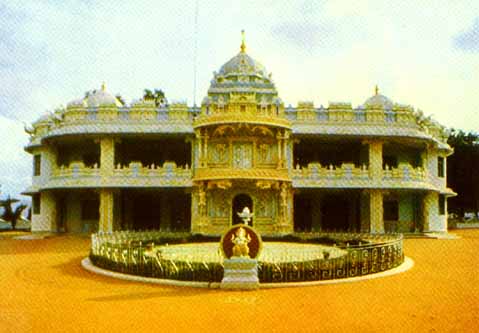
I never took a camera to the ashram but I've found a photograph on the internet that to my memory seems pretty much the way the temple and darshan area looked like while I was at Prasanthi Nilayam. The photo helps set the stage for my story so I include it here. Because the temple grounds and the process of darshan played a significant role in the tale of Sai Baba and the spitball I'll go into some detail to describe both.


The circular construct in front of the temple is ornamental grillwork enclosing vegetation and Sai Baba's Sarva Dharma (all faiths) symbol. The circle also separated the seating sides on the temple grounds for males and females.  The gold-painted statue is of the elephant-headed god Ganesh, remover of obstacles.  

The area to the right of the circle in the photo was reserved for women; a part of the men's area on the left, which isn't shown, had some shade. The women's side had no shade, no matter what time of day.

It's not clear in the photograph but there was a veranda running the length of the front of the temple. It was there that schoolchildren and sometimes visiting VIPs were seated. People chosen by Sai Baba from the darshan line for an interview inside the temple were also directed to sit on the veranda until darshan ended.

The brownish stuff on the ground is packed sand that was swept by volunteers before people entered the temple grounds for darshan. Although Sai Baba left Prasanthi Nilayam during the hottest months, often by the time darshan got underway the sun had risen high enough that the unshaded area on the women's side was not unlike sitting in a toaster oven.

The blazing sun was hard on elderly women in frail health. This prompted me to write a letter of complaint to ashram administration, which eventually resulted in small roofed seating structures being built along the wall that marked off the darshan area on the women's side from the rest of the ashram. 

No umbrellas were allowed during darshan. But people were allowed to bring cushions and folded blankets with them for darshan, which gave a little relief to one's bottom from the scorching sand. The comforts were abused by some Westerners, who brought cushions as wide as boats in the attempt to eke out space on either side of their place on the darshan row; this so they didn't have to sit what was for a Westerner uncomfortably close to others.

The counter-tactic was Indian volunteers who walked along the darshan rows, glowering at the worst offenders, making scooching movements with their hands and hissing, "Move over to make more space for others."

If the space hogs didn't like being squished they always had the option of decamping to the back rows, and the real wimps could sit on chairs to the side of the darshan line.

However, all this adjusting and measuring of millimeters around one's personal space could include minor squabbles when people tried to advance their position by sticking their knees into the backs of the people in front of them or leaning on the back of the person in front.  This unsporting behavior on temple grounds sometimes resulted in Sai Baba not coming out for darshan.

Then everyone got to go through the entire routine at the next scheduled time for darshan, and the next, until enough people drew a connection between their rowdiness and Sai Baba's refusal to leave the temple.

I add that the veterans eschewed cushions, preferring to endure scorched bottoms for the chance to quickly advance if someone nearby gave up a choice position on the darshan line.

Just another day at the office at Prasanthi Nilayam, "the abode of perfect peace."

There was a low curving wall marking off the temple grounds where darshan took place. People left their footwear along the outside of the wall before proceeding to the grounds; this practice of shoe removal was only done for darshan periods.  

A large sandy area just outside the temple grounds is where the lottery lines formed for the women's side. (I can't recall where the men's side formed their rows.) When there were so many people in the ashram that the lottery area couldn't accommodate them, which happened during festivals, the darshan on the mandir grounds was suspended. Then the large Poornachandra auditorium was opened for darshan; seating there was on a first-come, first-served basis with hordes of volunteers present to maintain order.

The lottery system was simple: as people entered the area after breakfast or the afternoon snack they sat behind the person who'd entered before them. When one line stretched back so far, a volunteer directed the next person entering the area to start a new line.

When all the lines had been established the person sitting at the head of each line drew a chit from a bag held out by a volunteer. The number on the chit showed the order in which the line would proceed onto the temple grounds.

The formation of the darshan rows was split into two -- one formation of rows facing the temple and the other facing the opposite end of the mandir grounds. This arrangement provided the opportunity for two front rows. Thus, it could be hard to tell during the lottery drawing which number on the chit meant a front row seat.

Only those in Line 1, the first to enter the mandir grounds, were guaranteed a front row seat. This line made up the first row in the formation that faced the opposite end of the grounds. I'll call this formation Block A. Much else depended on the number of people in the ashram on that day and how long the lottery lines were. When the crowd was small, sometimes people on the Number 2 line hit it lucky and got to sit in the first row in Block A if there was still enough space in the front row to accommodate a few more people.

When the first formation filled up, the line with the next number got to form a first row in the formation facing the temple -- Block B. And so it went until the Block B formation filled up. Then everyone settled down to wait for Sai Baha to emerge from the temple.

His darshan walkabout varied, but in general he stopped first to speak with the people seated on the verandah. Then he proceeded to the men's side of the temple grounds, stopping sometimes to chat with a man, taking letters offered to him, blessing books or other objects held out to him, allowing some in the front row to touch his feet, and sometimes materializing vibhuti (sanctified ash) or objects such as rings and religious medallions, and choosing people for an interview.

The routine was repeated on the women's side. There were complaints from the women about being second, although sometimes Sai Baba reversed the process and visited the women's side first. But the women's side could take twice as long to visit as the men's side because the babies (both male and female) were with their mothers on the women's side.

Women would hold up their babies for a blessing, no matter how far back they sat on the darshan lines. Maneuvering the babies and their mothers to the front or side of a row where Sai Baba was standing could take time. And often he'd materialize talismans for the babies and mark their foreheads with vibhuti and talk at length with the mothers about the babies. Then he would talk with the mothers about their home situation in general, make vibhuti for them, and so on.

By visiting the women's side last Sai Baba could take more time with the women without keeping the men waiting -- a point the complainers didn't tend to consider.

That's all the technical details I can recall of the darshan process on the mandir grounds and I think that's enough detail for the purposes of my story. I'll add two points, the significance of which will become clear when the story gets underway:

> The person at the head of lottery line who drew the Number 1 chit would enter Block A first and would have no one seated on her right.

> The low curving brick wall was repeated on the Block A side; again, it separated a side of the temple grounds from the rest of the ashram. It was behind this wall that a woman I'll call Vicky was standing during a part of the story. So while she could see Sai Baba when he approached Block A, she couldn't see what was happening amongst the women in the first row of the block who were facing Sai Baba. Nor could she readily hear what was being said on the front row of Block A.

The details I've provided about the mandir darshan suggest that Prasanthi Nilayam wasn't so much a melting pot as a clash of cultures that was kept to a dull roar by Sai Baba's oversight and a small army of dedicated Indian volunteers. Prasanthi Nilayam 30 years ago was a microcosm of every problem arising from 'East meets West,' and every problem arising from the clashes between modern and traditional societies.

Indeed, one way to describe Prasanthi Nilayam in those days is to say it was in the vanguard of the globalized society.

But as more foreigners from myriad societies took their place among Sai Baba's devotees, the Indians had to learn to "move over and make more space." This caused great resentment, particularly among the villagers, who didn't see why the foreigners couldn't get their own Avatar of the Lord and leave theirs alone.

And the emerging urbanized Indian middle class of Sai Baba devotees, traditionally more tolerant of foreigners, also had to struggle with resentment, as its members saw Sai Baba becoming less and less available for interviews. They struggled, too, with worries that Prasanthi Nilayam and Hinduism itself would be overtaken by Westernization.

For their part the Western devotees, whose ideas of the divine and monotheism were vastly different from the Hindu ones, were put off by the way so many Indians treated Sathya Sai Baba as a household Hindu god.

Such Westerners didn't understand that Sai Baba was acting not so much in the manner of a Hindu god as in the manner of the ideal kings in the ancient world, who were bound by duty to grant a reasonable request put to them by any subject who approached them for help. Those kings did double duty as judges, as a reading of the Old Testament makes clear.

One of Sai Baba's most important functions among the Indians was to resolve disputes. Again, this was a chief function of kings in ancient times.  While both foreigners and Indians asked Sai Baba for healing from physical ailments, one line separating the Westerners from the Indians was that Westerners tended to approach Sai Baba in a quest for 'answers' -- whether answers to personal problems or spiritual questions -- whereas many Indians wanted his help in settling disputes.

There were striking exceptions; e.g., Westerners who'd made Sanskrit a lifetime study or were scholars of Indian history, but most of the Westerners who visited the ashram simply didn't have the knowledge to put the historical and religious significance of the traditions around Sathya Sai Baba in proper context.

That was okay with Sai Baba, who placed his teaching emphasis on character development and universal values. But the Westerners' dearth of knowledge about the ancient traditions that Sai Baba represented meant they tended to supply the context for him rom their own experience. For many of the American Westerners this worked out to a concept of Sai Baba that was a concatenation of New Age philosophies, pop American psychology and Judeo-Christian theology. This version of Sai Baba made no sense to the rural Hindus and even to many urbane Hindus, which also contributed to an undercurrent of tension at the ashram.

These gulfs in understanding say nothing about the resentments among followers of different Hindu sects who venerated Sai Baba but stayed with their own sect and its dogmas.

Add to this caste prejudices that lurked in even the most prosaic situations at the ashram, which Western foreigners in particular rarely noticed. Even the darshan lottery system had upset the caste ecosystem. No longer could a group of Indians shut out members of a lower caste from 'their' part of the darshan line.

Yet all the above doesn't begin to describe what the ashram was like. One part Canterbury Tales, one part Tales of the Arabian Nights; the human drama at its most sublime and wretched, its most silly and mundane, all worked into a tapestry of the mystery of the divine and its involvement with human affairs.

It's against this backdrop that my tale of Sai Baba and the spitball unfolds. Here I'll break off and take up the story in the next post.

********

Wednesday, January 19

"The Quaid-i-Azam has a bad cold:" Margaret Bourke-White's piercingly accurate report on 1947 Pakistan and its lessons for today.

Best friends forever, before they stopped being friends


Many thanks to the reader who sent a link to excerpts from Margaret Bourke-White's 1949 book, Halfway to Freedom, and which I republish in this post. The book was based on dispatches Bourke-White filed for LIFE magazine on post-Independence India and Pakistan. The excerpts deal with the earliest days of Pakistan and the last days of its founding father (pictured above with Mohandas K. Gandhi), Muhammad Ali Jinnah (1876-1948), the Quaid-i-Azam ("great leader").

Margaret Bourke-White (1904-1964) was the first female war correspondent and the first female journalist to report from combat zones in World War Two. Her legacy has been so greatly colored by her photojournalism -- her photographs of the war, American industry, the Depression era, and the horrors of Buchenwald concentration camp and India's partition -- that it can be hard to remember she was also a great reporter.

She was also an extraordinarily lucky person, who often found herself at the right place at the right time to report on events that would be of historical importance. She interviewed Gandhi just a few hours before his assassination, and learned of Jinnah's mental state shortly before his own death simply because she'd been waiting around his official residence to make a photographic portrait of him for a LIFE cover. Yet she always shored her luck with careful observations. It is downright eerie to read her reporting about 1947 Pakistan and its founding father in light of today's Pakistan.

The excerpts from her book will also educate readers who've bought the fiction that Pakistan's religious extremism is rooted in the 1980s policies of General Mohammad Zia ul-Haq. Pakistan was born in religious extremism that was nurtured and exploited by Jinnah and the ruling families he served. Zia simply painted a Saudi face on the extremism.

Bourke-White couldn't see around history's corners, however. By the time Halfway to Freedom was published Pakistan's leaders had already been granted the wish they'd expressed to her to receive support from the U.S. government.

Jinnah and the other Indian Muslims who wanted a separate state couldn't see around corners, either -- a point I made in The Ghost. Bourke-White's reportage makes clear just how short-sighted the decision was to break with India. It's all very well and good to ask, What were they thinking? But in 1936, when Jinnah revived the Muslim League, no one could imagine the collapse of the British Empire, the seeming suddenness of the collapse and how imminent it was. At the time all the problems that an imagined Islamic nation would face were to be smoothed over by the might of the British Empire.

By the time Margaret Bourke-White took her last photographs of Pakistan's founder it was clear that he'd staked the lives of many millions of people on an illusion. But that was seen only with hindsight, in the harsh dawn of the post-World War Two era.

The excerpts from Halfway to Freedom are provided by the Indian Relief and Education Fund website along with their introduction:
The Messiah and The Promised Land

Margaret Bourke-White was a correspondent and photographer for LIFE magazine during the WW II years. In September 1947, White went to Pakistan. She met Jinnah and wrote about what she found and heard in her book "Halfway to Freedom: A Report on the New India," Simon and Schuster, New York, 1949. The following are the excerpts:

Pakistan was one month old. Karachi was its mushrooming capital. On the sandy fringes of the city an enormous tent colony had grown up to house the influx of minor government officials. There was only one major government official, Mahomed Ali Jinnah, and there was no need for Jinnah to take to a tent. The huge marble and sandstone Government House, vacated by British officialdom, was waiting. The Quaid-i-Azam ["Great Leader"] moved in, with his sister, Fatima, as hostess.

Mr. Jinnah had put on what his critics called his "triple crown": he had made himself Governor-General; he was retaining the presidency of the Muslim League -- now Pakistan's only political party; and he was president of the country's lawmaking body, the Constituent Assembly.

"We never expected to get it so soon," Miss Fatima said when I called. "We never expected to get it in our lifetimes."

If Fatima's reaction was a glow of family pride, her brother's was a fever of ecstasy. Jinnah's deep-sunk eyes were pinpoints of excitement. His whole manner indicated that an almost overwhelming exaltation was racing through his veins. I had murmured some words of congratulation on his achievement in creating the world's largest Islamic nation.

"Oh, it's not just the largest Islamic nation. Pakistan is the fifth-largest nation in the world!"

The note of personal triumph was so unmistakable that I wondered how much thought he gave to the human cost: more Muslim lives had been sacrificed to create the new Muslim homeland than America, for example, had lost during the entire second World War. I hoped he had a constructive plan for the seventy million citizens of Pakistan. What kind of constitution did he intend to draw up?

Of course it will be a democratic constitution; Islam is a democratic religion."

I ventured to suggest that the term "democracy" was often loosely used these days. Could he define what he had in mind?

"Democracy is not just a new thing we are learning," said Jinnah. "It is in our blood. We have always had our system of zakat -- our obligation to the poor."

This confusion of democracy with charity troubled me. I begged him to be more specific.

"Our Islamic ideas have been based on democracy and social justice since the thirteenth century."

This mention of the thirteenth century troubled me still more. Pakistan has other relics of the Middle Ages besides "social justice" -- the remnants of a feudal land system, for one. What would the new constitution do about that? ...

"The land belongs to the God," says the Koran.

This would need clarification in the constitution. Presumably Jinnah, the lawyer, would be just the person to correlate the "true Islamic principles" one heard so much about in Pakistan with the new nation's laws. But all he would tell me was that the constitution would be democratic because "the soil is perfectly fertile for democracy."

What plans did he have for the industrial development of the country? Did he hope to enlist technical or financial assistance from America?

"America needs Pakistan more than Pakistan needs America," was Jinnah's reply. "Pakistan is the pivot of the world, as we are placed" -- he revolved his long forefinger in bony circles -- "the frontier on which the future position of the world revolves."

He leaned toward me, dropping his voice to a confidential note. "Russia," confided Mr. Jinnah, "is not so very far away."

This had a familiar ring. In Jinnah's mind this brave new nation had no other claim on American friendship than this -- that across a wild tumble of roadless mountain ranges lay the land of the Bolsheviks.

I wondered whether the Quaid-i-Azam considered his new state only as an armored buffer between opposing major powers. He was stressing America's military interest in other parts of the world.

"America is now awakened," he said with a satisfied smile. Since the United States was now bolstering up Greece and Turkey, she should be much more interested in pouring money and arms into Pakistan.

"If Russia walks in here," he concluded, "the whole world is menaced."

In the weeks to come I was to hear the Quaid-i-Azam's thesis echoed by government officials throughout Pakistan.

"Surely America will build up our army," they would say to me. "Surely America will give us loans to keep Russia from walking in."

But when I asked whether there were any signs of Russian infiltration, they would reply almost sadly, as though sorry not to be able to make more of the argument, "No, Russia has shown no signs of being interested in Pakistan."

This hope of tapping the U. S. Treasury was voiced so persistently that one wondered whether the purpose was to bolster the world against Bolshevism or to bolster Pakistan's own uncertain position as a new political entity.

Actually, I think, it was more nearly related to the even more significant bankruptcy of ideas in the new Muslim state -- a nation drawing its spurious warmth from the embers of an antique religious fanaticism, fanned into a new blaze.

Jinnah's most frequently used technique in the struggle for his new nation had been the playing of opponent against opponent. Evidently this technique was now to be extended into foreign policy. ....

No one would have been more astonished than Jinnah if he could have foreseen thirty or forty years earlier that anyone would ever speak of him as a "savior of Islam."

In those days any talk of religion brought a cynical smile. He condemned those who talked in terms of religious rivalries, and in the stirring period when the crusade for freedom began sweeping the country he was hailed as "the embodied symbol of Hindu-Muslim unity."

The gifted Congresswoman, Mrs. Naidu, one of Jinnah's closest friends, wrote poems extolling his role as the great unifier in the fight for independence.

"Perchance it is written in the book of the future," ran one of her tributes, "that he, in some terrible crisis of our national struggle, will pass into immortality" as the hero of "the Indian liberation."

In the "terrible crisis," Mahomed Ali Jinnah was to pass into immortality, not as the ambassador of unity, but as the deliberate apostle of discord. What caused this spectacular renunciation of the concept of a united India, to which he had dedicated the greater part of his life? No one knows exactly.

The immediate occasion for the break, in the mid-thirties, was his opposition to Gandhi's civil disobedience program. Nehru says that Jinnah "disliked the crowds of ill-dressed people who filled the Congress" and was not at home with the new spirit rising among the common people under Gandhi's magnetic leadership.

Others say it was against his legal conscience to accept Gandhi's program. One thing is certain: the break with Gandhi, Nehru, and the other Congress leaders was not caused by any Hindu-Muslim issue.

In any case, Jinnah revived the moribund Muslim League in 1936 after it had dragged through an anemic thirty years' existence, and took to the religious soapbox. He began dinning into the ears of millions of Muslims the claim that they were downtrodden solely because of Hindu domination.

During the years directly preceding this move on his part, an unprecedented degree of unity had developed between Muslims and Hindus in their struggle for independence from the British Raj. The British feared this unity, and used their divide-and-rule tactics to disrupt it. Certain highly-placed Indians also feared unity, dreading a popular movement which would threaten their special position.

Then another decisive factor arose. Although Hindus had always been ahead of Muslims in the industrial sphere, the great Muslim feudal landlords now had aspirations toward industry. From these wealthy Muslims, who resented the well-established Hindu competition, Jinnah drew his powerful supporters.

One wonders whether Jinnah was fighting to free downtrodden Muslims from domination or merely to gain an earmarked area, free from competition, for this small and wealthy clan.

The trend of events in Pakistan would support the theory that Jinnah carried the banner of the Muslim landed aristocracy, rather than that of the Muslim masses he claimed to champion. There was no hint of personal material gain in this. Jinnah was known to be personally incorruptible, a virtue which gave him a great strength with both poor and rich. The drive for personal wealth played no part in his politics. It was a drive for power. ...

Less than three months after Pakistan became a nation, Jinnah's Olympian assurance had strangely withered. His altered condition was not made public.

"The Quaid-i-Azam has a bad cold" was the answer given to inquiries.

Only those closest to him knew that the "cold" was accompanied by paralyzing inability to make even the smallest decisions, by sullen silences striped with outbursts of irritation, by a spiritual numbness concealing something close to panic underneath. I knew it only because I spent most of this trying period at Government House, attempting to take a new portrait of Jinnah for a Life cover.

The Quaid-i-Azam was still revered as a messiah and deliverer by most of his people. But the "Great Leader" himself could not fail to know that all was not well in his new creation, the nation; the nation that his critics referred to as the "House that Jinnah built."

The separation from the main body of India had been in many ways an unrealistic one. Pakistan raised 75 per cent of the world's jute supply; the processing mills were all in India. Pakistan raised one third of the cotton of India, but it had only one thirtieth of the cotton mills. Although it produced the bulk of Indian skins and hides, all the leather tanneries were in South India. The new state had no paper mills, few iron foundries. Rail and road facilities, insufficient at best, were still choked with refugees.

Pakistan has a superbly fertile soil, and its outstanding advantage is self-sufficiency in food, but this was threatened by the never-ending flood of refugees who continued pouring in long after the peak of the religious wars had passed.

With his burning devotion to his separate Islamic nation, Jinnah had taken all these formidable obstacles in his stride. But the blow that finally broke his spirit struck at the very name of Pakistan. While the literal meaning of the name is "Land of the Pure," the word is a compound of initial letters of the Muslim majority provinces which Jinnah had expected to incorporate: P for the Punjab, A for the Afghans' area on the Northwest Frontier, S for Sind, -tan for Baluchistan. But the K was missing.

Kashmir, India's largest princely state, despite its 77 per cent Muslim population, had not fallen into the arms of Pakistan by the sheer weight of religious majority. Kashmir had acceded to India, and although it was now the scene of an undeclared war between the two nations, the fitting of the K into Pakistan was left in doubt. With the beginning of this torturing anxiety over Kashmir, the Quaid-i-Azam's siege of bad colds began, and then his dismaying withdrawal into himself. ....

Later, reflecting on what I had seen, I decided that this desperation was due to causes far deeper than anxiety over Pakistan's territorial and economic difficulties. I think that the tortured appearance of Mr. Jinnah was an indication that, in these final months of his life, he was adding up his own balance sheet.

Analytical, brilliant, and no bigot, he knew what he had done. Like Doctor Faustus, he had made a bargain from which he could never be free. During the heat of the struggle he had been willing to call on all the devilish forces of superstition, and now that his new nation had been achieved the bigots were in the position of authority. The leaders of orthodoxy and a few "old families" had the final word and to perpetuate their power, were seeing to it that the people were held in the deadening grip of religious superstition.

Friday, November 26

26/11, two years out, and the illusion of NATO's seriousness about dealing with Pakistan-instigated terrorism

November 25:
We are in this alone
by B. Raman
Hindustan Times

Since the 26/11 sea-borne terrorist strikes in Mumbai [in 2008] by the Pakistan-based Lashkar-e-Taiba (LeT), we have had three acts of suspected jihadi terrorism on the Indian territory outside Jammu and Kashmir.
[...]
These attacks show that the LeT, controlled by Pakistan’s Inter-Services Intelligence (ISI), and its affiliates in India such as the IM and the Students’ Islamic Movement of India (Simi) continue to plan terrorist strikes against Indian targets despite the international surveillance of the LeT post-26/11, when the West realised that the group is as dangerous as al-Qaeda.
[...]
The LeT and other organisations have not been weakened. Their anti-India motivation remains strong. There has been no dilution in the ISI’s support for them. Their training infrastructure in Pakistani territory is intact. Their propaganda against India continues to be virulent. They are looking for opportunities to plan and carry out more acts of mass casualty terrorism.

The failure of the US to pressure Pakistan to arrest and prosecute the ISI officers named by David Coleman Headley has strengthened the ISI’s belief that as long as it cooperates with the US, the latter will continue to turn a blind eye to its use of the LeT terrorists against India.

The lack of vigorous action by the US against Pakistan for its involvement in the 26/11 strikes and its disappointing cooperation with India in the Headley case have shown that any high expectations of US cooperation with India against terrorism of Pakistani origin would be an illusion.
[...]
How quaint of the United States to attempt to head off just the kind of editorial Raman wrote for the anniversary of 26/11:

November 24, 2010:
US designates Lashkar-e-Taiba's charitable front as terror group
By Bill Roggio
Long War Journal

The US government has targeted a charitable front for the Pakistan-based Lashkar-e-Taiba and three senior leaders of the terror group by designating them as global terrorists. The Lashkar-e-Taiba receives support from Pakistan's military and its intelligence service.

Today under Executive Order 13224, the US State Department added the Falah-i Insaniat Foundation (FIF) as a terrorist entity, while the US Treasury Department added FIF leader Hafiz Abdur Rauf, along with Mian Abdullah and Mohammad Naushad Alam Khan, to the list of specially designated global terrorists. The designations allow the US to freeze the assets of the three senior leaders, prevent them from using financial institutions, and prosecute them for terrorist activities.

"Few individuals are more integral to LET's fundraising than Hafiz Abdur Rauf and Mian Abdullah," said Under Secretary for Terrorism and Financial Intelligence Stuart Levey.

The Lashkar-e-Taiba has launched multiple terror attacks against India, including the 2008 terror assault on the city of Mumbai which killed 165 people, including civilians and members of Indian security forces. Operating in conjunction with the Jaish-e-Mohammed, another Pakistan terror group, the Lashkar-e-Taiba also executed the December 2001 terror assault on the Indian Parliament in New Delhi. In addition, both groups carry out attacks against Coalition and Afghan forces in Afghanistan, and serve as al Qaeda affiliates in the region.
[...]
Pakistan has refused to crack down on homegrown terror groups such as Jaish-e-Mohammed and Lashkar-e-Taiba, despite their covert and overt support for al Qaeda, the Taliban, and other terror groups. Inside Pakistan's military and intelligence services, which are the real powers in Pakistan, groups like Jaish-e-Mohammed and Lashkar-e-Taiba are seen as 'strategic depth' against India, and are used as instruments of foreign policy.

Hafiz Saeed, the leader of the Lashkar-e-Taiba who has been designated by the US and the UN as a terrorist, remains a free man in Pakistan despite openly supporting jihad in both India and Pakistan, and regardless of his group's involvement in the Mumbai attack as well as other terror attacks. Pakistani Army corps commanders, who occupy some of the senior-most positions in the military, openly cavort with Saeed.
[...]
But wait! Frayed patience will save the day:

November 20, 2010:
U.S. wants to widen area in Pakistan where it can operate drones
By Greg Miller
The Washington Post

ISLAMABAD - The United States has renewed pressure on Pakistan to expand the areas where CIA drones can operate inside the country, reflecting concern that the U.S. war effort in Afghanistan is being undermined by insurgents' continued ability to take sanctuary across the border, U.S. and Pakistani officials said.

The U.S. appeal has focused on the area surrounding the Pakistani city of Quetta, where the Afghan Taliban leadership is thought to be based. But the request also seeks to expand the boundaries for drone strikes in the tribal areas, which have been targeted in 101 attacks this year, the officials said.

Pakistan has rejected the request, officials said. Instead, the country has agreed to more modest measures, including an expanded CIA presence in Quetta, where the agency and Pakistan's Inter-Services Intelligence (ISI) directorate have established teams seeking to locate and capture senior members of the Taliban.
[...]
U.S. officials confirmed the request for expanded drone flights. They cited concern that Quetta functions not only as a sanctuary for Taliban leaders but also as a base for sending money, recruits and explosives to Taliban forces inside Afghanistan.

"If they understand our side, they know the patience is running out," a senior NATO military official said.
[...]
I invite you to contemplate the kind of NATO official who conceives of the Pakistani military's assistance to terrorism and the murder of NATO troops as a matter calling for patience. Next to that official the fiends in Pakistan's military are as pure as driven snow.

Saturday, November 6

Obama's trip highlights the importance of democracy in Asia and sends a strong message to China

The above graphic is featured in the Christian Science Monitor's November 4 report by Howard Lafranchi titled On Asia trip, Obama to get an earful about China.

The citizens of the United States of America have paid a very high price for their 'business at any cost' mindset, including betraying all the values that Americans give lip service to as being those they hold dearest: democracy, human rights, freedom, blah blah blah. It wasn't until after al Qaeda first struck at America that a U.S. regime woke up to the fact that India, a democratic nation, would be a better ally for the United States than China. President Bill Clinton's ice-breaking trip to India was followed by President George Bush's trip and strong gestures of friendship. Now President Barack Obama has joined the scramble to make up for lost time. It's a little late in day, however. Lafranchi reports:
... Mr. Obama will not touch down on Chinese soil, but at every stop he does make – from India to Japan, with Indonesia and South Korea in between – China and its economic, political, and military rise will either explicitly or implicitly figure on the agenda.

• In India, Obama will hear of Indian concerns about China's strengthening ties to – and plans to sell nuclear reactors to – rival Pakistan, even as the United States and India discuss a mutual interest in seeing China's rise occur peacefully.

• In Indonesia, the discussion will turn to China's growing naval and shipping presence in key trade and strategic maritime routes.

• South Korean leaders will want to address China's unflagging support for an increasingly aggressive North Korea, even as Obama takes the issue of China's trade practices and currency manipulation to a Group of 20 summit in Seoul.

• In Japan, China's growing assertiveness on everything from economic issues to territorial disputes is sure to be an item on the bilateral agenda and at a summit of the Asia-Pacific Economic Cooperation forum.

"China is going to be the apparition at the table of discussion at every one of Obama's stops on this trip," says David Lampton, director of Chinese studies at Johns Hopkins University's School of Advanced International Studies in Washington.

The No. 1 topic in all of these countries will be the US economy and prospects for a return to sustained growth, Mr. Lampton says, given the importance the US has as a market for the region's exports. But the leaders Obama meets will have one overarching question on their minds, he adds: Will the US be a long-term counterbalance in the region as China continues its rise?

"All of these countries are looking for an equilibrating force in the region," Lampton says, "and in that context they are looking to the US and asking themselves if the US is going to be around, and in what role."

The Obama administration has stressed its efforts to improve US-China relations, but what the administration has billed as working with China has repeatedly been tagged as accommodating China by critics at home and in the region.

More recently, as China boomed through the global recession and increasingly adopted what Washington perceived as aggressive stances in security and territorial disputes with neighboring countries, the administration has shifted its posture. By visiting four of Asia's major democracies and taking up the trade and security issues topping the agendas of China's smaller neighbors, Obama is signaling an intention to maintain robust American leadership in Asia, regional experts say.

Administration officials insist they want to maintain strong cooperation with a rising global power, but at the same time the president's trip is seen as the appropriate occasion for assuaging the region's concerns about both China and continuing US leadership.

"I think most everyone in Asia appreciates the need for a cool-headed, constructive diplomacy between the United States and China in the current environment," said Kurt Campbell, assistant secretary of State for East Asian and Pacific Affairs, at a recent briefing with reporters. "We're also working closely with a number of states in the Asia-Pacific region, most prominently to underscore the strong US commitment to remain an active and engaged diplomatic, political, security, and economic player."

South Korea, where Obama will spend two days largely focused on the G20 summit of developed and emerging economies, is a prime example of a US partner warily watching China's growing shadow.

China is the South's largest trading partner – imported Chinese cabbage recently came to the rescue when a dearth of home-grown cabbage left distraught Koreans without kimchi, their beloved national dish. But the US, which is now the South's fourth-largest trading partner, remains its vital security guarantor, not only against the volatile North, but more subtly in the neighborhood of a rising China.

The potential for growing friction with China is a key reason the South Korean government values approval of the stalled Free Trade Agreement (FTA) with the US – as much or more as a sign of a strategic US commitment to North Asia as for its economic potential.

"We need more US engagement in Asia – especially in North Asia – as a stabilizing force. One of the more salient examples of that stabilizing presence would be through the FTA," said South Korea's ambassador to Washington, Han Duk-soo, at a recent dinner with Washington reporters.

Ambassador Han did not overtly link his country's desire for an American "stabilizing force" in the region to a rising China, but South Korean diplomats do so privately. One diplomat, discussing Obama's trip, referred to a cold-war era "equilibrium" of major powers that South Koreans fear could be lost, adding that the South is "looking for reassurances that the US will remain a balancing power in our region."

Tuesday, October 26

So India is supposed to eat America's shit? Is that the story behind the bombshell report on Tehran's payments to Karzai?


Ever since The New York Times broke the story on October 23 I have been trying to figure out why Tehran's bribes to Karzai's regime, which have been going on practically since Karzai was installed in office, were turned into a sensational news story, replete with 'leaks' from unnamed officials and lots of horrifying details. What else was happening that might explain why unnamed officials wanted to announce just then that there was gambling in Casablanca? I noted on the 24th that the latest strategic dialogue between Pakistan and the United States was happening, which led me to conclude:
I suspect the sudden airing of many details about Iran's machinations, including their continued support for Gulbuddin Hekmatyar "one of the most brutal of Afghan warlords," is in response to howls from Pakistani officials that they shouldn't be accused of all things bad in Afghanistan while the Iranians are running riot there.
But while reading Bret Stephens's op-ed today for the Wall Street Journal that's titled, The Pakistan Paradox, suddenly another possibility dawned. The bombshell New York Times report on Iran's machinations in Afghanistan was published little more than two weeks before President Barack Obama is scheduled to leave for a visit to India:

> Where he is going to have to face pointed questions from Prime Minister Manmohan Singh about what U.S. intelligence agencies knew regarding the planned 2008 terrorist strike on Mumbai, orchestrated by a terror group with close ties to Pakistan's military, and exactly when they knew it.

> Where he going to ask for the Indian government's continued understanding about the U.S. government's close involvement with a terror-sponsoring regime that keeps mounting attacks on Indian civilians.

> And where he is going to attempt to bully, bribe, and cajole Mr Singh into cutting off friendly diplomatic relations with Tehran.

Bingo! Double Bingo!

As to what Bret Stephens's op-ed has to do with any of this -- nothing, not directly. He argues that Indians will have to suck it up regarding the U.S. relationship with Pakistan because, well, the USA needs Pakistan's help right now:
[...] If there's an overarching logic here it's that Islamabad wants to preserve its options. Uncertainty about U.S. staying power in Afghanistan helps explain why Pakistan will not entirely forsake its erstwhile clients in the Taliban and the mujahedeen. Pakistani fears are further exacerbated by America's recent tilt toward India.

And while the Obama administration has made much of its aid packages for Pakistan—$1.5 billion a year on the civilian side, followed last week by the announcement of another $2 billion for the military—Pakistani officials complain that only a small fraction of the funds have been disbursed.

What, then, to do? First, instead of publicly lecturing Pakistanis on how they need to get tough with the Taliban, the administration would do better to make good on its existing commitments. Say what you will about Mr. Zardari's abilities, he has aided the U.S. military effort in a way his predecessor Pervez Musharraf, supposedly a pro-American strongman, never did.

That's a relationship to build on, quietly and incrementally, not to tear down. So it would be helpful if the administration doesn't repeat the mistake of blabbing to Bob Woodward, whose book may have helped Mr. Obama seem more presidential but didn't do any favors to his presidency.

Equally helpful would be to stop mindlessly demanding that military assistance to Pakistan go toward fighting the Taliban instead of arming against India.

The missing ingredient in Pakistan's counterinsurgency effort isn't the right military tool kit, such as night-vision goggles or Apache helicopters. It's the will of the Pakistani general staff to cooperate more fully in the fight. If that cooperation can be secured by selling conventional weapons such as F-15s and M-1 tanks to Pakistan, so much the better.

(As for India, it has less to fear from a reasonably well-armed, confident Pakistani army that has strong ties to the U.S. than it does from a poorly armed Pakistan that mistrusts the U.S. and continues to consort with jihadists as a way of compensating for its weakness.)

Finally, the administration ought to understand that Pakistan's reluctance to defeat the Taliban at any price is a mirror image of our own reluctance. The July 2011 "deadline" to begin withdrawing troops was bound to affect Islamabad's calculations, and not for the better. The sooner we junk it, the better the cooperation we'll get.

It's an old American habit to lament the incompetence and duplicity of our wartime allies, and Pakistan abounds in both qualities. But unless we are prepared to deal with Pakistan as an adversary, we must make do with it as a friend.
Bret's claim that India has less to fear from a well-armed, "confident" Pakistani army with close ties to the USA is so ignorant of the history of Pakistan's relations with the U.S. and India as to be insulting to a well-informed reader's intelligence.

Bret is a superhawk about dealing with Iran -- he once urged in writing that Israel bomb Iran. It struck me that some version of his argument about India and Pakistan is standard issue for superhawks on Iran and that some of them also downplay the importance of Afghanistan and a U.S. victory there.

Such arguments seem to arise from a view that the Pakistan and the Afghan conflict is nowhere near as important as the threat to Israel from Iran. From that line of reasoning it would follow that India needs to distance itself from Iran if it's to have a good relationship with the United States, and that it shouldn't try to push the USA to get tough with Pakistan.

At any rate, those were the thoughts that struck me after I finished reading Bret's essay. Actually, the first thought was, 'So Bret's an expert now on Pakistan and India, is he?'

Well, many in the American branch of the Commentariat are scrambling to become overnight experts on those two countries after finding them on a map. Anyhow, it was a hop and a skip from the above thoughts to my little Eureka! moment about the timing of the report on Iran raining cash on Karzai's regime.

Is she right, is she wrong? Either way I have no intention of giving back my bingo prize.

.