Through it all -- throughout all the deceptions, denials, evasions, rationalizations and insultingly useless advice given over the years by Americans in civilian government, the military and academia -- there is one question relating to U.S. tolerance for Pakistan's proxy war against NATO and Afghanistan that towers above all others. And yet it's the one question that has never been asked of a public figure. So in the title of this post I've put the question to the public.
I'd say the answer to the question is "Very unlikely."
By this I don't mean to shift blame to Americans at large, nor am I arguing to restore conscription. I'm simply pointing out that if service in the U.S. military was compulsory, there would have been such a large number of Americans personally involved in the outcome of the Afghan War that there would have been no 'dark' or 'lost' years in the war while the U.S. was fighting in Iraq.
Combine this with the instant era in global communications, and I think the outcome would have been that factions in Washington that managed for the better part of a decade to hide Pakistan's proxy war from the American public would have found their machinations quickly overwhelmed by the volume of complaints from conscripted Americans and their parents -- many of those parents veterans of the Vietnam War, I might add.
This would have forced the U.S. news media to dig deeper and faster into the conditions that kept Pakistanis pouring across the Afghan-Pakistan border to kill Afghans and Americans and troops from other NATO countries. This would have quickly destroyed the rationalizations voiced by factions in Washington and Brussels that wanted to hand off Afghanistan to Pakistan's junta, or which preferred to see American troops die as a tradeoff for what they term "geostrategic" reasons; e.g., keeping Russia off balance, placating Saudi Arabia, etc.
Again, I'm not arguing for conscription but I am asking whether it's possible for the United States to field an all-volunteer fighting force that's not treated as a mercenary army. The question needs to be answered. Unless you want to subscribe to the thesis I floated several weeks ago, which is that card-carrying fiends attached themselves to the U.S.-NATO prosecution of the Afghan War. By the way, my thesis does carry some weight. Let's face it: even history's most sadistic tyrants wouldn't have paid a military to murder and maim the tyrant's own troops. Even Vlad the Impaler wouldn't have thought of that one.
So we have very little wiggle room when it comes to explaining why the U.S. regime did pay Pakistan's junta to murder and maim American troops, then spent years lying to cover up this practice, then more years attempting to rationalize the practice when it finally came to public light -- a cycle of betrayal, deception and denial that continues to this day.
If you want to run with the fiend thesis, it's possible the entire problem of the U.S. approach to Pakistan could be solved by deploying a contingent of exorcists around various civilian government and military buildings, lobbying firms and academic institutions in Washington and Brussels.
But if you pooh-pooh the idea that Hell somehow got loose in those two seats of power you might want to opt for the only other proposition I can see that covers all the bases. This is that U.S. soldiers wouldn't be treated with such contempt if they weren't considered disposable; i.e., as mercenary hirelings. And as corollary that this treatment wouldn't occur if U.S. military service was compulsory.
.
Showing posts with label American capitulation to Pakistan. Show all posts
Showing posts with label American capitulation to Pakistan. Show all posts
Saturday, December 17
Monday, November 28
Here we go again: "Pakistan denies"
Haven't returned to blogging but couldn't resist posting this report. See Beeb website for a good map of the region in question:
28 November 2011 Last updated at 02:31 ET
BBC
Pakistan denies firing provoked Nato border attack
Pakistan has denied reports that it opened fire first provoking the Nato air strike which killed 24 troops at a checkpoint on the Afghan border.
It follows claims by Afghan officials that Nato forces were retaliating for gunfire from the Pakistani side of the volatile border region on Saturday.
[...]
Pakistan reacted angrily to the attack, which took place at two remote border posts in Pakistan's tribal district of Mohmand in the early hours of Saturday morning. Several protests against Nato's actions have been held across the country.
Pakistan's Prime Minister Yousuf Raza Gilani called it a "grave infringement of Pakistan's sovereignty" and officials responded by cutting key supply Pakistani lines to Nato in Afghanistan.
'Not true'
But unnamed Afghan officials quoted in The Wall Street Journal said that Saturday's attack was called in to shield Nato and Afghan forces who were under fire while targeting Taliban fighters. One official quoted in the paper says that Kabul believes the fire came from an army base.
"This is not true. They are making up excuses. What are their losses, casualties?" Pakistani army spokesman Maj-Gen Athar Abbas said in a text message in response to the allegations.
Maj Gen Abbas has also said that the raid went on for more than an hour and continued even after local commanders contacted Nato telling them to stop the strike, according to the Associated Press news agency.
Pakistani officials have consistently maintained that there had been no militant activity in the area, and most of the Pakistani soldiers were asleep. They also said Nato had the grid references of the posts and therefore should not have fired.
[...]
The night-time attack took place at the Salala checkpoint, about 1.5 miles (2.5 km) from the Afghan border, at around 02:00 on Saturday morning local time (21:00 GMT Friday).
The Pakistani army said helicopters and fighter aircraft hit two border posts, killing 24 people and leaving 13 injured. Local officials said the two posts were about 300m apart on a mountain top.
Military sources earlier told the BBC's Quentin Sommerville in Paktika province in Afghanistan that a US-Afghan special forces mission had been in the area, where they believed a Taliban training camp was operating.
They said the mission came under fire from a position within Pakistan, and they received permission from the headquarters of Nato's Isaf mission to fire back.
[...]
Sunday, December 5
Amrullah Saleh sets the record straight on Taliban imposter, and the question that haunts
Of course this report got no play in the USA:
Note the date of the cable under discussion in the following report: January of this year. Yet at that time (and up to this day) there were elements in Washington, including elements in the U.S. military, which continued to insist that Pakistan's military command and ISI had turned over a new leaf. The willful blindness of these factions led the Obama administration to push for an equally blind pursuit of reconciliation with the Taliban.
The question that haunts me is just how far the U.S. is willing to go in the attempt to discredit Karzai's warnings about the intentions of Pakistan's military. I suspect it's a question that also haunts Karzai -- and Saleh:
Taliban impostor warnings ignored by Afghan leaders, says former spy chiefThere's more in the report that calls for close attention but I want to turn now to another report, one that throws additional light on Saleh's trials as he tried to talk sense into men pursuing a mirage.
by Jon Boone
(U.K.) Guardian, November 28, 2010
Desperate for a peace deal with the Taliban, officials dismissed security advice over bogus go-between
Hamid Karzai's desperation for a "Good Friday agreement for Afghanistan" led officials to ignore repeated warnings from their own spy chief that they should not trust a man who orchestrated a humiliating face-to-face meeting between the Afghan president and a shopkeeper who pretended to be the Taliban's second most powerful leader.
Amrullah Saleh, the former head of the National Directorate of Security (NDS), Afghanistan's equivalent of MI5, said his agency first vetted the man, who claimed to be a representative of Mullah Akhtar Mohammad Mansour, one of the highest-ranking figures in the Taliban, in mid-2008, but rejected him after he was unable to prove his credentials.
However, the go-between, who said he was a Taliban leader from Kandahar called Muhammad Aminullah, subsequently approached the interior minister, Hanif Atmar, the following year and was enthusiastically embraced by an Afghan government desperate for a breakthrough in peace talks.
Saleh, a highly regarded administrator who was sacked by Karzai earlier this year, said all his warnings were ignored. "I tried time and again to convince my colleagues in the ministry and subsequently at the palace that he is not a genuine representative of anybody," he told the Observer.
The rare public statement by Afghanistan's former top spy contradicted attempts yesterday by the Afghan government to deny that "Mansour" had ever held high-level meetings in Kabul. It also further undermines claims by the Afghan government that MI6 was entirely to blame for the fiasco. [...]
Note the date of the cable under discussion in the following report: January of this year. Yet at that time (and up to this day) there were elements in Washington, including elements in the U.S. military, which continued to insist that Pakistan's military command and ISI had turned over a new leaf. The willful blindness of these factions led the Obama administration to push for an equally blind pursuit of reconciliation with the Taliban.
The question that haunts me is just how far the U.S. is willing to go in the attempt to discredit Karzai's warnings about the intentions of Pakistan's military. I suspect it's a question that also haunts Karzai -- and Saleh:
Pak Army and ISI continue to support Afghan Taliban: Karzai
Press Trust Of India
December 3, 2010
(Washington) Over a month after the new Af-Pak policy was unveiled, Afghan President Hamid Karzai warned the US that no success could be achieved in the war against terrorism [while] the Pakistan Army and ISI continued to support Afghan Taliban. Welcoming a delegation of US lawmakers, including Republican John McCain, Karzai told them that the improvement in the overall bilateral relationship between Afghanistan and Pakistan was held back by the Army and ISI who continue to help the Afghan Taliban.
This was written by US Ambassador to Afghanistan Karl Eikenberry ... in a secret cable dated January 10, 2010, which was released by WikiLeaks. President Barack Obama unveiled his Af-Pak policy in December, 2009. The United States, which has charged the Wikileaks of indulging in a criminal act by stealing and releasing these cables, has neither confirmed nor denied the authenticity of these documents.
Karzai said he wants to engage more and have US support in doing so, since "the war won't end easily without Pakistani cooperation", the cable said.
"He was pessimistic about the internal situation, as was his intelligence chief, Amrullah Saleh. Saleh noted that Pakistan's energy sector was in decline and that discontent in Pashtun areas was higher than it had been in the volatile 1960s and 1970s," the cable said.
Karzai also said his Pakistani counterpart Asif Ali Zardari is using Baloch nationalists as his base of support. "Saleh predicted that neither the army nor Nawaz Sharif would bring Zardari's term to an abrupt end," the Ambassador wrote.
Explaining his reintegration approach, Karzai noted that the peace process and reintegration efforts help in the fight against the Taliban by working with those who are willing to come back, especially the "foot soldiers".
Reconciliation would extend to more senior level Taliban (not Mullah Omar, he clarified) who are not linked to Al Qaeda, "some of whom are willing" to talk. Lots of contacts are taking place, Karzai said, but no common reconciliation policy has emerged, the cable said.
"McCain noted that for this to be successful the other side should be convinced they can't win and this should probably be timed to work with the new influx of troops now underway.
"He agreed that those fighting for reasons other than ideology should be helped to return and that the fight should continue against the ideologically-motivated Taliban, stressing the importance of educating the country that both efforts were ongoing at the same time," the cable said.
Tuesday, October 26
Hey, hey Admiral Mullen how many US troops have you killed today?
Adm. Mullen has long been the most outspoken member of the U.S. government in support of Pakistan's military efforts. Adm. Mullen has used his close relationship with Gen. Ashfaq Kayani, the Pakistani army chief of staff, to prod the military to step up its actions against militants.
- Wall Street Journal, October 15, 2010

October 17, 2010, Long War Journal
Don't give me that yap about Obama Made Me Do It. If Obama told you to jump off a cliff would you?
If you want to be diplomat, go work for State. If you want to lobby for Pakistan's regime, go to work on K Street. But whatever you do, get out of the U.S. military. Scat! Shoo! You, you, you -- Blue Falcon! Blue Falcon! Bad Bill Roggio! Bad! Bad! Teaching innocent old women military curse words!
Long War Journal, October 26, 2010
- Wall Street Journal, October 15, 2010

October 17, 2010, Long War Journal
Pakistan is not conducting 'surgical' raids in North WaziristanDo you have any idea what you have done, Mullen? Do you even care? Right now ISAF is having to use a cutthroat warlord to clear Taliban for them because of your man crush on Kayani -- or is that you've Gone Native?
By Bill Roggio
Buried at the end of this Wall Street Journal article on Admiral Mike Mullen's infatuation with Pakistan (a topic worthy of a book in itself), are these two completely false paragraphs that claim Pakistan is conducting covert operations against al Qaeda, the Taliban, and the Haqqani Network based in North Waziristan:Pakistan currently conducts "surgical" raids against militants in North Waziristan—home to the al Qaeda-linked Haqqani network -- but has said a large-scale operation to clear the area of all military would threaten Islamabad's ability to keep militants out of other areas it cleared previously.There is absolutely not one shred of evidence to back this up. None. Pakistani forces have not killed a single leader or senior operative of al Qaeda, the Taliban, the Haqqani Network, the Islamic Movement of Uzbekistan, the Islamic Jihad Group, the Eastern Turkistan Islamic Party, the Lashklar-e-Jhangvi, the Lashkar-e-Taiba, the Jaish-e-Mohammed, the Harkat-ul-Mujahideen, the Harkat-ul-Jihad-i-Islami, the Fedayeen-i-Islam, etc., based in North Waziristan. The only "surgical raids" being carried out in North Waziristan are done by the unmanned US Predators and Reapers.
Islamabad is willing to step up their surgical raids in North Waziristan if the U.S. provides them with more information about the location of militants they want removed, a senior Pakistan official said this week.
In the interview, Admiral Mullen describes Pakistan's counterinsurgency efforts against the Taliban and al Qaeda in Swat and South Waziristan as "heroic." Yet there is nothing remotely heroic in Pakistani officials making false claims about Pakistan's efforts to take on terrorist sanctuaries in North Waziristan. In the ranks of the US military, there is a term for those who pump up their exploits at the expense of those fighting alongside them: blue falcon.
Don't give me that yap about Obama Made Me Do It. If Obama told you to jump off a cliff would you?
If you want to be diplomat, go work for State. If you want to lobby for Pakistan's regime, go to work on K Street. But whatever you do, get out of the U.S. military. Scat! Shoo! You, you, you -- Blue Falcon! Blue Falcon! Bad Bill Roggio! Bad! Bad! Teaching innocent old women military curse words!
Long War Journal, October 26, 2010
Pakistan: North Waziristan operation is not on the table
By Bill Roggio
Just days after the US government committed to providing the Pakistani military more than $2 billion in aid, the top general in the northwest said an operation in North Waziristan won't happen anytime soon. From Dawn:
"Pakistan will consider mounting an anti-Taliban offensive in North Waziristan only when other tribal areas are stabilised, a senior military officer said on Tuesday, a position likely to anger ally Washington.
Pakistan has resisted mounting US pressure to launch a major operation in North Waziristan to eliminate the Haqqani Taliban faction.
Pakistan's army has repeatedly said it is too stretched fighting Taliban insurgents in other forbidding mountaineous regions, and that only it can determine if and when to strike.
Lt.-Gen Asif Yasin Malik, the main military commander for the northwest, said it would take at least six months to clear militants from Bajaur and Mohmand, two of Pakistan's seven semi-autonomous tribal agencies.
“What we have to do is stabilise the whole area. I have a very large area in my command,” he told reporters on a trip to Orakzai agency. “The issue is I need more resources.”
There are already six brigades in North Waziristan which carry out daily operations, he said.
Surprising, isn't it?
And as we noted [on October 17] the Pakistani military is not carrying out operations in North Waziristan.
So India is supposed to eat America's shit? Is that the story behind the bombshell report on Tehran's payments to Karzai?

Ever since The New York Times broke the story on October 23 I have been trying to figure out why Tehran's bribes to Karzai's regime, which have been going on practically since Karzai was installed in office, were turned into a sensational news story, replete with 'leaks' from unnamed officials and lots of horrifying details. What else was happening that might explain why unnamed officials wanted to announce just then that there was gambling in Casablanca? I noted on the 24th that the latest strategic dialogue between Pakistan and the United States was happening, which led me to conclude:
I suspect the sudden airing of many details about Iran's machinations, including their continued support for Gulbuddin Hekmatyar "one of the most brutal of Afghan warlords," is in response to howls from Pakistani officials that they shouldn't be accused of all things bad in Afghanistan while the Iranians are running riot there.But while reading Bret Stephens's op-ed today for the Wall Street Journal that's titled, The Pakistan Paradox, suddenly another possibility dawned. The bombshell New York Times report on Iran's machinations in Afghanistan was published little more than two weeks before President Barack Obama is scheduled to leave for a visit to India:
> Where he is going to have to face pointed questions from Prime Minister Manmohan Singh about what U.S. intelligence agencies knew regarding the planned 2008 terrorist strike on Mumbai, orchestrated by a terror group with close ties to Pakistan's military, and exactly when they knew it.
> Where he going to ask for the Indian government's continued understanding about the U.S. government's close involvement with a terror-sponsoring regime that keeps mounting attacks on Indian civilians.
> And where he is going to attempt to bully, bribe, and cajole Mr Singh into cutting off friendly diplomatic relations with Tehran.
Bingo! Double Bingo!
As to what Bret Stephens's op-ed has to do with any of this -- nothing, not directly. He argues that Indians will have to suck it up regarding the U.S. relationship with Pakistan because, well, the USA needs Pakistan's help right now:
[...] If there's an overarching logic here it's that Islamabad wants to preserve its options. Uncertainty about U.S. staying power in Afghanistan helps explain why Pakistan will not entirely forsake its erstwhile clients in the Taliban and the mujahedeen. Pakistani fears are further exacerbated by America's recent tilt toward India.Bret's claim that India has less to fear from a well-armed, "confident" Pakistani army with close ties to the USA is so ignorant of the history of Pakistan's relations with the U.S. and India as to be insulting to a well-informed reader's intelligence.
And while the Obama administration has made much of its aid packages for Pakistan—$1.5 billion a year on the civilian side, followed last week by the announcement of another $2 billion for the military—Pakistani officials complain that only a small fraction of the funds have been disbursed.
What, then, to do? First, instead of publicly lecturing Pakistanis on how they need to get tough with the Taliban, the administration would do better to make good on its existing commitments. Say what you will about Mr. Zardari's abilities, he has aided the U.S. military effort in a way his predecessor Pervez Musharraf, supposedly a pro-American strongman, never did.
That's a relationship to build on, quietly and incrementally, not to tear down. So it would be helpful if the administration doesn't repeat the mistake of blabbing to Bob Woodward, whose book may have helped Mr. Obama seem more presidential but didn't do any favors to his presidency.
Equally helpful would be to stop mindlessly demanding that military assistance to Pakistan go toward fighting the Taliban instead of arming against India.
The missing ingredient in Pakistan's counterinsurgency effort isn't the right military tool kit, such as night-vision goggles or Apache helicopters. It's the will of the Pakistani general staff to cooperate more fully in the fight. If that cooperation can be secured by selling conventional weapons such as F-15s and M-1 tanks to Pakistan, so much the better.
(As for India, it has less to fear from a reasonably well-armed, confident Pakistani army that has strong ties to the U.S. than it does from a poorly armed Pakistan that mistrusts the U.S. and continues to consort with jihadists as a way of compensating for its weakness.)
Finally, the administration ought to understand that Pakistan's reluctance to defeat the Taliban at any price is a mirror image of our own reluctance. The July 2011 "deadline" to begin withdrawing troops was bound to affect Islamabad's calculations, and not for the better. The sooner we junk it, the better the cooperation we'll get.
It's an old American habit to lament the incompetence and duplicity of our wartime allies, and Pakistan abounds in both qualities. But unless we are prepared to deal with Pakistan as an adversary, we must make do with it as a friend.
Bret is a superhawk about dealing with Iran -- he once urged in writing that Israel bomb Iran. It struck me that some version of his argument about India and Pakistan is standard issue for superhawks on Iran and that some of them also downplay the importance of Afghanistan and a U.S. victory there.
Such arguments seem to arise from a view that the Pakistan and the Afghan conflict is nowhere near as important as the threat to Israel from Iran. From that line of reasoning it would follow that India needs to distance itself from Iran if it's to have a good relationship with the United States, and that it shouldn't try to push the USA to get tough with Pakistan.
At any rate, those were the thoughts that struck me after I finished reading Bret's essay. Actually, the first thought was, 'So Bret's an expert now on Pakistan and India, is he?'
Well, many in the American branch of the Commentariat are scrambling to become overnight experts on those two countries after finding them on a map. Anyhow, it was a hop and a skip from the above thoughts to my little Eureka! moment about the timing of the report on Iran raining cash on Karzai's regime.
Is she right, is she wrong? Either way I have no intention of giving back my bingo prize.
.
Friday, June 25
The last American helicopter out of Kabul
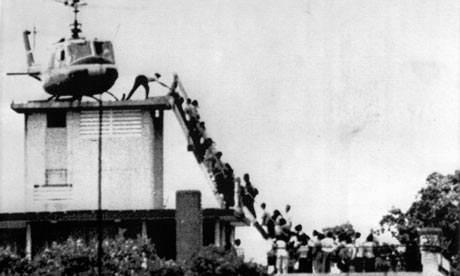 General Stanley McChrystal was barely out the door when the Obama administration gave the nod to America's two most influential newspapers that it was time to start telling the truth to the American public about the Afghanistan War.
Thusly, The New York Times mentioned in passing yesterday that Pakistan had been fighting a proxy war against the United States in Afghanistan:
General Stanley McChrystal was barely out the door when the Obama administration gave the nod to America's two most influential newspapers that it was time to start telling the truth to the American public about the Afghanistan War.
Thusly, The New York Times mentioned in passing yesterday that Pakistan had been fighting a proxy war against the United States in Afghanistan:... Pakistan is presenting itself as the new viable partner for Afghanistan to President Hamid Karzai, who has soured on the Americans. Pakistani officials say they can deliver the network of Sirajuddin Haqqani, an ally of Al Qaeda who runs a major part of the insurgency in Afghanistan, into a power-sharing arrangement. In addition, Afghan officials say, the Pakistanis are pushing various other proxies, with General Kayani personally offering to broker a deal with the Taliban leadership. Washington has watched with some nervousness as General Kayani and Pakistan’s spy chief, Lt. Gen. Ahmad Shuja Pasha, shuttle between Islamabad and Kabul, telling Mr. Karzai that they agree with his assessment that the United States cannot win in Afghanistan, and that a postwar Afghanistan should incorporate the Haqqani network, a longtime Pakistani asset. ... Despite General McChrystal’s 11 visits to General Kayani in Islamabad in the past year, the Pakistanis have not been altogether forthcoming on details of the conversations in the last two months, making the Pakistani moves even more worrisome for the United States, said an American official involved in the administration’s Afghanistan and Pakistan deliberations. “They know this creates a bigger breach between us and Karzai,” the American official said. Though encouraged by Washington, the thaw heightens the risk that the United States will find itself cut out of what amounts to a separate peace between the Afghans and Pakistanis, and one that does not necessarily guarantee Washington’s prime objective in the war: denying Al Qaeda a haven. It also provides another indication of how Pakistan, ostensibly an American ally, has worked many opposing sides in the war to safeguard its ultimate interest in having an Afghanistan that is pliable and free of the influence of its main strategic obsession, its more powerful neighbor, India. The Haqqani network has long been Pakistan’s crucial anti-India asset and has remained virtually untouched by Pakistani forces in their redoubt inside Pakistan, in the tribal areas on the Afghan border, even as the Americans have pressed Pakistan for an offensive against it. General Kayani has resisted the American pleas, saying his troops are too busy fighting the Pakistani Taliban in other parts of the tribal areas. But there have long been suspicions among Afghan, American and other Western officials that the Pakistanis were holding the Haqqanis in reserve for just such a moment, as a lever to shape the outcome of the war in its favor. On repeated occasions, Pakistan has used the Haqqani fighters to hit Indian targets inside Afghanistan, according to American intelligence officials. The Haqqanis have also hit American ones, a possible signal from the Pakistanis to the Americans that it is in their interest, too, to embrace a deal. ...The Washington Post chimed in today:
... The State Department and the U.S. Agency for International Development, which have quadrupled the number of civilians in Afghanistan in the past year, are still not confident of civilian capabilities. The Afghan government clearly cannot carry the burden. So the administration is looking for a decent, negotiated exit. The Pakistani intelligence service would act as a surrogate (and guarantor) for the Taliban, as Slobodan Milosevic did for the Bosnian Serbs 15 years ago. The Americans would deliver Kabul. The deal might leave the Taliban in control of large parts of Afghanistan but keep al-Qaeda in Pakistan, where Islamabad would agree to deal harshly with its fighters. Secretary of State Hillary Clinton has repeatedly enunciated her "red lines" for such an agreement: Taliban renunciation of violence and willingness to abide by the Afghan constitution (which guarantees women equal rights), as well as refusal to allow al-Qaeda or others to operate against the United States. ...So let's get this straight. Pakistan's military promises to start dealing harshly with their asset al Qaeda if their other asset, the Taliban, were put in charge in Afghanistan. What Pakistan's generals could offer in return was to allow American personnel to evacuate Kabul safely and cross their hearts and hope to die they wouldn't unleash al Qaeda on the Afghans until after the last American helicopter had left Kabul. Ironically, before I learned about The New York Times report yesterday, I disagreed with The Glittering Eye's blogger, Dave Schuler, about whether Afghanistan could be considered another Vietnam. That happened while I was visiting Mark Safranski's Zenpundit blog. He'd featured two of my most recent posts on Pakistan and I'd joined the discussion about them at the Zenpundit comment section. Dave wrote:
You are … get ready for it … refighting Vietnam. Last night on OTB Radio Pat Lang, James Joyner, and I agreed that’s a pretty fair characterization of the last 9 years. With Pat and I having lived through that period (he in harm’s way in Southeast Asia) we both find it pretty darned sad.I replied:
Dave, IMHO Afghanistan is not Vietnam although I understand the temptation to see it as such. The U.S. was not supporting the Red Chinese and Russian armies and collaborating with them while fighting their proxies in Vietnam, whereas the U.S. is going a long way toward supporting the Pakistani military and collaborating with it while fighting its proxies in Afghanistan. There are several other key differences but in short Afghanistan is a unique situation for the U.S. military; they won’t be able to fully appreciate this until they confront Pakistan’s role and admit that to leave Afghans in the care of Pakistan’s military would be to set off a humanitarian disaster on a scale the rest of the world would not accept. And in these days of satphones, camera cell phones, and internet social networks there would be no way for the U.S. government to hide the atrocities. That, too, is another difference between Vietnam and Afghanistan. If Americans throw up their hands and say we can’t afford to stay in Afghanistan forever — it won’t be forever, not with Afghanistan’s vast mineral wealth — but let this be a hard lesson that there are consequences to treating entire peoples as chess pawns, which is what Americans did to Afghans during the Cold War. The Pottery Barn rule does apply here, as it did in Iraq.But another blogger, Lexington Green at Chicago Boyz, said it best:
This isn’t Vietnam because, unlike in Vietnam, we are supporting Diem (Karzai), building ARVN (ANA) and at the same time we are financing and arming the DRV (Pakistan), financing the Vietcong (Taliban), paying for the PAVN (Pakistani Army), and pretending that the country which is providing sanctuary to the VC (Pakistan) is our "ally." We have been paying for both sides of the same war at the same time, while getting our own people shot on one side of it. If there is a strategic "most stupid" scenario, that may be it. If it were only as bad as Vietnam, it would be progress. The one thing that was worse about Vietnam was we were sending draftees over there, getting them killed in droves, and pretty much blowing up our own society in the process. If Petraeus cannot restore some sanity, no one can. If he stays on the current course, we will lose, and Pakistan will win, and we will never have acknowledged who our real enemy was.Well, Americans can be grateful that President Obama decided it was time for everyone to face up to reality. So I guess that means Dave gets the last word.
********


Subscribe to:
Posts (Atom)