Translate

Tuesday, December 22

BREAKING NEWS: Iraqi Army troops storm center of Ramadi

Tue Dec 22, 2015 - 4:31am EST
Reuters

Iraq's armed forces stormed the center of Ramadi on Tuesday to try to dislodge Islamic State militants who have held the western city since May, a spokesman for the counter-terrorism units, Sabah al-Numani, said.

The operation to recapture Ramadi, 100 km (60 miles) west of Baghdad, began early last month after a months-long effort to cut off supply lines to the city, whose fall to Islamic State was a major defeat for Iraq's weak central government.

"Our forces are advancing toward the government complex in the center of Ramadi," Numani said. "The fighting is in the neighborhoods around the complex, with support from the air force."Iraqi intelligence estimates the number of Islamic State fighters entrenched in the center of Ramadi, capital of Western Anbar province, at between 250 and 300.

Retaking the city would provide a major psychological boost to Iraqi security forces after Islamic State seized a third of Iraq, a major OPEC oil producer and U.S ally, last year.

(Reporting by Ahmed Rasheed and Saif Hameed; Writing by Maher Chmaytelli; Editing by Louise Ireland)


[END REPORT]

See also Reuters report from Baghdad Dec 20 - 10:37 am EST Iraq military asks residents of ISIS-controlled Ramadi to leave city. The army dropped leaflets telling residents to evacuate and giving the best routes out of the city. RT reported today (9:33 GMT) that IS had been preventing people from leaving the center or trying to; the fear was that IS was planning on using them as human shields when the army attacked. From this Reuters photo on Dec. 20, it seems several residents were able to flee. As to how many IS fighters were among them -- [shrugging].  But I think the army is fine if IS wants to sneak out; this way civilian and troop casualties can be as small as possible during the fighting.  


"Wild bee populations dwindle in main U.S. crop regions: study"

So. Much of the mystery of the wild bees disappearing has been solved.  Vast swaths of flower-bearing habitats have been replaced by crops that need little to no pollination. This includes corn for biofuel. As one scientist I quoted months ago noted, the wild bees are starving to death. So how's that green energy biofuel program been working out?  

By WILL DUNHAM
Dec 22, 2015 6:42am IST

[emphasis mine]

Wild bees, crucial pollinators for many crops, are on the decline in some of the main agricultural regions of the United States, according to scientists who produced the first national map of bee populations and identified numerous trouble spots.

The researchers on Monday cited 139 counties as especially worrisome, with wild bee numbers decreasing while farmland for crops dependent on such pollinators is increasing.

The counties included agricultural regions of California such as the Central Valley, the Pacific Northwest, the upper Midwest and Great Plains, west Texas and the southern Mississippi River valley.

The counties grew crops such as almonds, pumpkins, squashes, blueberries, watermelons, peaches and apples that are highly dependent on pollinators, or had large amounts of less-pollinator-dependent crops including soybeans, canola and cotton.

Taylor Ricketts, director of the University of Vermont's Gund Institute for Ecological Economics, said the 139 counties represent 39 percent of the pollinator-dependent crop area of the United States and most likely will face inadequate pollination in the future.

"Wild bee declines may increase costs for farmers and, over time, could even destabilize crop production," Ricketts said.

Some crops such as corn and wheat do not need pollinators.

The study estimated that wild bee numbers diminished in 23 percent of the continental United States between 2008 and 2013 in a trend driven by conversion of their natural habitat into farmland including corn for biofuel production.

Pesticides and diseases were cited as other factors behind the declines among the roughly 4,000 U.S. species of wild bees.

"Wild bees help pollinate many of our most nutritious crops, support natural ecosystems and contribute over $3 billion to the U.S. economy each year," Ricketts said.

Their decline may prompt greater dependence on commercial honeybee colonies for pollinating crops, but honeybee numbers also are falling, added Gund Institute researcher Insu Koh, the lead author of the study published in the Proceedings of the National Academy of Sciences.

"Our results highlight the need for strategies to maintain pollinator populations in farmland, and the importance of conservation programs that provide flowering habitat that can support wild bees and other pollinators," said Michigan State University entomologist Rufus Isaacs, who heads the U.S. Department of Agriculture-funded Integrated Crop Pollination Project.

The study followed a 2014 memorandum by President Barack Obama creating a task force to study pollinator losses. The task force in May called for preserving wide swathes of pollinator habitats.

[END REPORT]

Monday, December 21

Any questions about why all hell has broken loose in Afghanistan?

Let's see what's happening today. 
  • Six American troops were killed in suicide attack just outside the NATO base at Bagram, near Kabul. The perp was most probably a Haqqani Network operative. The Pentagon is shocked
  • Three explosions shook the Wazir Akbar Khan district of Kabul, near key ministries, embassies and residences. ... one of the missiles hit Massoud Square, adjacent to the well-fortified US embassy, and another landed in Shirpur Square, close to the sprawling presidential complex. A third rocket detonated further away from the heart of the city.
  • Afghan officials confirmed that the Taliban overran the Sangin district center [in Helmand Province] and seized control of all of its administrative buildings and the police headquarters over the past 24 hours, Pajhwok Afghan News reported. ... A member of Afghanistan’s parliament told the news agency that all police and military bases in Sangin are now under the Taliban’s control. Long War Journal also reports today that Taliban had targeted the strategic district of Sangin for takeover since mid-2014 and now controls or contests nearly all of Helmand.   
Pakistan-brokered peace talks between Afghanistan and Taliban insurgents could restart in early January, Reuters reported, citing officials in Islamabad and Kabul.
The head of Pakistan’s army, General Raheel Sharif, is expected in Afghanistan this week, the latest in a series of high-level contacts aimed at restarting the peace process which was broken off in July. The resumption of talks should take “not longer than two weeks. "I would say the first week of January we will see the process restart,” said a senior Pakistani official.
One of the world’s most quixotic energy projects finally kicked off this month, with the formal groundbreaking of the so-called TAPI pipeline meant to tap into the gas fields of Turkmenistan, snake across Afghanistan and Pakistan, and end up fueling thirsty markets in India. ...
All righty, that's the day's big news about Afghanistan. Now let's look at maps. The first one shows the country's provinces. Pay special attention to the southern provinces. (Quandahar = Kandahar)  The second one shows the route of TAPI.


What does it all add up to?  My guess would be that Al Saud has told Gen. Sharif, 'You have 15 minutes left to get control of Afghanistan for us or we'll do it using Islamic State.'

******** 

Reportedly 90 percent Islamic State oil capacity now destroyed in Syria, Iraq

Now if my theory is right that IS is actually a criminal enterprise formed to trade in illegal oil, we should be seeing a rather sudden exit of IS from Syria and Iraq very soon. However, the person who made the announcement is Col. Steve Warren. For some reason I don't consider him a terribly reliable source. 

Maybe this has to do with the time he said it was absolutely true that the Turks warned the Russian crew 10 times after they violated Turkish air space because the warnings were made on an open channel. I can't remember whether he also said he had heard the 10 warnings himself. Anyhow, the problem being that if the Russian aircraft was in Turkish air space at all, and it doesn't seem so, it was there between 14 and 17 seconds. Not much time to issue 10 warnings.     

Int'l Coalition Announces 90% of Daesh Oil Capacity Destroyed in Syria, Iraq
15:01 21.12.2015 (updated 15:47 21.12.2015)
Sputnik

International coalition announced Monday that 90 percent of Daesh oil destroyed in Syria and Iraq, Al-Sumaria Iraqi state TV channel reports.

A spokesman for the US-led coalition, Col. Steve Warren announced Monday the destruction of 90 percent of the Daesh oil capacity in Iraq and Syria, Al-Sumaria reports. [Arabic language] He also noted that terrorists have lost 40 percent of its territory due to coalition's airstrikes.

On Thursday, the UN Security Council passed a resolution obliging all countries to fight against sources of income for terrorists.

It is widely believed the Islamic States receives most of its funding through illegal oil sales and smuggling. Russia has said that much of the illegal oil is smuggled into Turkey and resold on markets.

[...]

Obama preferred terrorists running Syria to Assad so some US military took action: Bombshell Report

So in the autumn of 2013 they decided to take steps against the extremists without going through political channels, by providing US intelligence to the militaries of other nations, on the understanding that it would be passed on to the Syrian army and used against the common enemy, Jabhat al-Nusra and Islamic State.

That explains how Bashar al-Asssad knew they were under attack from terrorists. He was getting his information from U.S. military intelligence!   

H/T Col. Pat Lang at Sic Semper Tyrannis. He wrote that he wasn't surprised although he knew many would be. The surprise isn't so much Obama, it's that some in the Pentagon risked it all to offset the worst harm he was doing. We owe much to their courage and patriotism, although they'd brush off the thanks. Just doing their job -- their real job, which doesn't include following orders from the President to shove the United States of America off a cliff.
      
As to why Obama did it, you can read the theory, below, but it could also be that he was trying to placate Al Saud or Qatar or even the British regime, or all three.   
  
Military to Military
London Review of Books - 7 January 2016 Edition

Barack Obama’s repeated insistence that Bashar al-Assad must leave office – and that there are ‘moderate’ rebel groups in Syria capable of defeating him – has in recent years provoked quiet dissent, and even overt opposition, among some of the most senior officers on the Pentagon’s Joint Staff. Their criticism has focused on what they see as the administration’s fixation on Assad’s primary ally, Vladimir Putin. In their view, Obama is captive to Cold War thinking about Russia and China, and hasn’t adjusted his stance on Syria to the fact both countries share Washington’s anxiety about the spread of terrorism in and beyond Syria; like Washington, they believe that Islamic State must be stopped.

The military’s resistance dates back to the summer of 2013, when a highly classified assessment, put together by the Defense Intelligence Agency (DIA) and the Joint Chiefs of Staff, then led by General Martin Dempsey, forecast that the fall of the Assad regime would lead to chaos and, potentially, to Syria’s takeover by jihadi extremists, much as was then happening in Libya. A former senior adviser to the Joint Chiefs told me that the document was an ‘all-source’ appraisal, drawing on information from signals, satellite and human intelligence, and took a dim view of the Obama administration’s insistence on continuing to finance and arm the so-called moderate rebel groups.

By then, the CIA had been conspiring for more than a year with allies in the UK, Saudi Arabia and Qatar to ship guns and goods – to be used for the overthrow of Assad – from Libya, via Turkey, into Syria. 

The new intelligence estimate singled out Turkey as a major impediment to Obama’s Syria policy. The document showed, the adviser said, ‘that what was started as a covert US programme to arm and support the moderate rebels fighting Assad had been co-opted by Turkey, and had morphed into an across-the-board technical, arms and logistical programme for all of the opposition, including Jabhat al-Nusra and Islamic State. The so-called moderates had evaporated and the Free Syrian Army was a rump group stationed at an airbase in Turkey.’ 

The assessment was bleak: there was no viable ‘moderate’ opposition to Assad, and the US was arming extremists.

Lieutenant General Michael Flynn, director of the DIA between 2012 and 2014, confirmed that his agency had sent a constant stream of classified warnings to the civilian leadership about the dire consequences of toppling Assad. The jihadists, he said, were in control of the opposition. Turkey wasn’t doing enough to stop the smuggling of foreign fighters and weapons across the border.

‘If the American public saw the intelligence we were producing daily, at the most sensitive level, they would go ballistic,’ Flynn told me. ‘We understood Isis’s long-term strategy and its campaign plans, and we also discussed the fact that Turkey was looking the other way when it came to the growth of the Islamic State inside Syria.’ 

The DIA’s reporting, he said, ‘got enormous pushback’ from the Obama administration. ‘I felt that they did not want to hear the truth.’

‘Our policy of arming the opposition to Assad was unsuccessful and actually having a negative impact,’ the former JCS adviser said. ‘The Joint Chiefs believed that Assad should not be replaced by fundamentalists. The administration’s policy was contradictory. They wanted Assad to go but the opposition was dominated by extremists. So who was going to replace him? 

To say Assad’s got to go is fine, but if you follow that through – therefore anyone is better. It’s the “anybody else is better” issue that the JCS had with Obama’s policy.’ The Joint Chiefs felt that a direct challenge to Obama’s policy would have ‘had a zero chance of success’. 

So in the autumn of 2013 they decided to take steps against the extremists without going through political channels, by providing US intelligence to the militaries of other nations, on the understanding that it would be passed on to the Syrian army and used against the common enemy, Jabhat al-Nusra and Islamic State.

[...]

****

Lot's more in the report.


********
        

Pundita PSA: Why you may feel sick after getting a flu shot but get the blasted shot

  • About 30 percent of those who get the vaccine may get symptoms
  • It’s an immune response - not the flu itself
  • The flu is a very serious illness; it’s worth getting vaccinated
That's from the Sacramento Bee's helpful article on the flu shot. As the reporter points out, it's impossible to get sick from the shot itself -- unless one is allergic to eggs. But the flu bug that's injected is deader than a doornail. The flu shot is like giving a kitten a toy mouse to play with. Nobody dies but it keeps the kitten's instincts on their toes. Same with the immune system. It gets to thump its chest at an invader. We're so clean these days the immune system doesn't get a lot of exercise.  

And if you're one of those people who get cold symptoms for a few days after the shot -- rejoice; that indicates your immune system is very healthy. A bit hyper, but healthy. And better than getting deathly ill from the real thing.

However, I would suggest that you make sure the alcohol that's swabbed on your arm is dry before the needle is plunged in. It takes about 30 seconds, and sometimes the nurse or pharma person doesn't wait. Your arm is probably pretty clean if you shower and change your shirt every day but if you want the site sterile, the alcohol msut have those seconds to do its work. The evaporation process is what removes the bacteria.  

Don't be afraid to speak up, even if the needle jabber rolls his eyes. Tell 'em to wait for the whole 30 seconds. I actually insist on 45 seconds.  And I don't take any chances. I carry a bottle of 90 percent alcohol with me and slosh some on my arm while I'm waiting for the jabber to show up. THEN I complain if they don't wait for the swab they use to dry.

Does it really make a difference?  I reason that it's possible some reactions to the flu shot might be due an unsterile jab site.  


After all, you're getting stabbed. If your arm is dirty or the clothing on the arm isn't sterile, then some of that could get into your blood stream. Couldn't it? 

Might make a difference especially with children, who are not notoriously clean, getting the shot.  

And keep an eye on the jabber's gloves and how they put on the bandage. If the gloves have touched something else and touch your jab site while they're putting on the bandage, rip the bandage off and slosh on more alcohol.  And of course you're carrying your own bandage, right?

One more point. It's no longer an excuse if you're over 65. They make a souped up version of the shot for older people.  

**********  


Read
more here: http://www.sacbee.com/news/nation-world/national/article50769245.html#storylink=cpy

Uh oh. Is Al Saud acting out in Nigeria? UPDATED 8:30m ET

UPDATE
See also Saudis Opt for 'Hardline Solutions' to Regional Conflicts; Sputnik, Dec 13.  
***
I was afraid this would happen if I started hanging out at FARS. I told myself, 'Remember it's the Iranians. Just look for Syrian war news and don't pay attention to anything else.'  

(6:20am update: By the way, FARS is brimming with Syrian war news today; too many reports for me to post.) 

I have no idea if there's any truth to this FARS report but I do know from reports this year from Western mainstream sources that the Saudis are acting act more and more. If I have any of those reports saved I'll find them and update this post with it. [See update] But the gist is that they've become quite the war dogs and it seems challenging anyone to stop them. 

Eyewitness Discloses Saudi Embassy's Role in Masterminding Massacre in Nigeria

Sun Dec 20, 2015 - 6:13
FARS

TEHRAN (FNA)- The Saudi embassy in Abuja directly commanded the Nigerian army attacks on the Shiite Muslims in Zaria region which claimed hundreds of civilian lives, an eyewitness and student of the Leader of the Islamic Movement of Nigeria, Sheikh Ibraheem Zakzaky, revealed.

"Informed sources from inside the Nigerian regime have stated that the incident happened in coordination with the Saudi embassy and the Nigerian army directly took the order for attack from the Saudi mission in Abuja," Ismail Shoaib said in an interview with al-Waqt news website on Sunday.

"We also saw that the commandoes driving on an army vehicle who attacked the Hussainiya (Shiites' religious center) were not Nigerians and were white people who were spraying bullets directly on the people," he added.

Shoaib also revealed that the new Nigerian government has been receiving financial aids from Saudi Arabia in the past six months of its life.

The Nigerian army attacked two religious centers of the country's Shiite community on December 12, killing hundreds of defenseless civilians there. A few hours later on December 13, the military arrested Sheikh Ibraheem Zakzaky after raiding his house and killing three of his sons, assistants and followers.

Political activists said on Thursday that the Nigerian army forces were burying and setting fire on the corpses of those Shiite Muslims who had been killed during the recent raids in Zaria region.

"The Nigerian army has buried in mass graves and burnt a large number of dead bodies of those Muslims who have been massacred in the recent army forces' attacks," the activists revealed.

They said that the army was attempting to destroy every evidences of its crimes against the suppressed Muslim community, adding that if it had any convincing reason for the mass-killing, it wouldn’t resort to such methods to conceal its crimes.

[END REPORT] 

SYRIAN ARMY LIBERATES ALMOST ALL N. LATAKIA -- NEAR TURK BORDER

They're on a roll. 


Syrian Army Scores Victories in 'Fierce Battles' Close to Turkish Border
09:00 - 21.12.2015 (updated 09:35)
Sputnik

The Syrian Arab Army (SAA), assisted by the Russian Air Force and Hezbollah fighters, is reported to have freed almost all northern Latakia, taking more than ten strategic hilltops under control and killing dozens of terrorists over the weekend.

On Sunday, the SAA pushed militants out of Rweiset Addou, Ketf al-Harami and Yaqouber, the Fars news agency detailed. The three hilltops are located between the regions of Salma and Kabani.
In addition, "the Syrian Army troops and the country's National Defense Forces stormed the militant groups' positions near al-Kabir village, killed or wounded a large number of militants and retook full control over the village," the media outlet cited the Syrian army as saying.
A day earlier, Damascus-led forces scored a number of victories in what the news agency described as "fierce battles" with militants. The large-scale offensive ended with the SAA taking eight strategic heights and a village in the Latakia province under control.
Militants, according to Fars news, fled from Heights 652, 687.5, 526, 662.8, 427, 754.5, Syriatel Tower, Jabal al-Aswad al-Kabir and Atira village. More than 25 terrorists were killed in the operation. The SAA also destroyed military hardware.
[end report]

See also:
Syrian Army, Hezbollah Fend off Militants' Counterattack on Khan Touman; FARS, Dec. 20.

********

"Islamic State supporters show training camp in Philippines"

December 21. Report at Long War Journal on the training camp video. The country is already a hotbed of jihad groups. From the report:
... The identity of the specific group the fighters shown in the video belong to is uncertain. The jihadist groups Abu Sayyaf Group (ASG), the Bangsamoro Islamic Freedom Fighters (BIFF), and a group calling itself Ansar al Khilafah in the Philippines have all either pledged allegiance or expressed support for the Islamic State in the past. Traditionally, ASG has had ties to al Qaeda....

Taliban battle police in Afghan town of Sangin. Helmand Province in danger of falling UPDATED 5:55 am ET Mon Dec 12

UPDATE
Mohammad Jan Rasolyaar, deputy governor of Helmand province, took an unusual step over the weekend to ask President Ashraf Ghani for help in an open letter on Facebook.
He said he had no other options left to deliver his message and explain the real situation in Helmand to the President but to turn to Facebook.
Rasolyaar said people around the President didn't want him to know about the reality on the ground there.
He warned that all Helmand province could fall to the Taliban if the President didn't take any action to save it.
From CNN report 5:33 AM ET today,

"At least 90 Afghan soldiers killed in recent fighting" - caption for beeb photo of Taliban fighters
BBC - 40 minutes ago
Fierce fighting is continuing around the police HQ in Sangin, in the Afghan province of Helmand, as security forces try to hold off a Taliban attack.
Police Commander Mohammad Dawood told the BBC via satellite phone that he was surrounded by Taliban fighters and that he needed urgent help.
Otherwise, he added, he and his men couldn't hold for long as they were running out of ammunition.
Helmand's governor says the whole province could fall to the Taliban.
"The bazaar is closed; we have been surrounded for the past two days," Commander Dawood told the BBC's Mahfouz Zubaide.
[end report]

Sunday, December 20

When RT has a breaking news report from USA before Google News, that's a problem UPDATED 4X

I stopped by RT 10-15 minutes ago; it carried a "breaking news" report  about a vehicle that had jumped the sidewalk outside the luxurious Paris Hotel in Las Vegas and plowed into a large group of people, and that there were at least 20 victims although not known at that point whether there were any deaths. 

I went to Google News in the hunt for more details. Reports on the incident hadn't been posted yet. At the top of Google News is a report on what Donald Trump said about Hillary Clinton.

I've seen this kind of situation before since I started following RT and Sputnik. Russian press is watching the world more closely than the beings or bots that manage Google News.

Just returned to Google. The Trump-Clinton report is still at the top. Still nothing about the Paris Hotel crash; the second story at Google News is several hours old -- ancient news -- about a Hezbollah commander killed in an Israeli airstrike in Syria. 

Speed it up people. Focus less on your bots and more on what's happening. You have only one job; right? Bring us breaking news. Just do your job.      

UPDATE 11:00 PM EST

Sputnik is carrying a report not posted yet at Google News: Drug Overdose Deaths Reach Record High in the US.

UPDATE 11:16 PM EST

Finally, finally, Google notices. Just posted -- underneath the Trump-Clinton report, of course:
  
DEC 20 2015, 11:04 PM ET - NBC News

Multiple Injuries as Car Drives Into Pedestrians on Las Vegas Strip

UPDATE 11:32 PM EST

CNN report 11:27 has a few more details

UPDATE 11:48 PM EST

Speaking of the airstrike, which again was breaking news several -- no, many -- hours ago. DEBKAfile has a blurb in their Breaking News Box that "Damascus" -- meaning the Syrian gov -- is claiming Quntar/Kuntar was killed in a 'terrorist strike.'  Meaning he wasn't killed in an airstrike or by the Israelis.

DEBKA is just passing along the claim. Is it within the realm of possibility? Well, a lot of terror orgs/ rebel groups fighting the Syrian Army are hopping mad at Hezbollah for fighting on the side of the army. But the residential building that was struck was pretty much totaled. Could ground-fired rockets have done that? I don't know.

Here's the DF blurb

Damascus claims terrorist organization killed Samir Quntar
DEBKAfile December 20, 2015, 1:03 PM (IDT)

The regime of Syrian President Bashar Assad issued an announcement on Sunday claiming a terrorist group attacked the home of Samir Kuntar and caused his death. The announcement did not blame Israel, but said that this kind of attack helps Israel. Unlike Damascus, Hizballah directly accused Israel of carrying out the attack.


[end]

1,500 Iraqi ground troops join with Syrian Army for major campaign in Syria

Coordination between Iraq and the Syrian coalition is becoming increasingly effective since Russia joined the war. Something the proxy sponsors of terrorism in Syria and Iraq didn't consider, eh?  

And it looks as if all that American training of Iraqi troops is really starting to show fruit. See also Iraqi Forces Take Control of 60 Percent of Ramadi City From Islamic State: Source

Hundreds of Iraqi Fighters Flocking to Syria to Join Army Operation North of Aleppo
Sun Dec 20, 2015 - 2:22
FARS

TEHRAN (FNA)- Intelligence sources of the Syrian Army disclosed on Sunday that large groups of the Iraqi fighters have joined the Syrian army and hundreds more are on the way to partake in the final phase of a liberating operation in the Northern parts of Aleppo province.

"Some 1,500 Iraqi fighters have joined the Syrian army and are coordinating various aspects of an imminent large-scale operation with the government forces in al-Zahra and Nubl regions in Northwest of Aleppo province," the sources said.

The sources declined to mention the date of the operation, but it is expected to begin in the coming weeks as the Syrian Armed Forces are strengthening their positions in the Southern parts of the Aleppo province.

The Syrian army and its allies have remarkably advanced against the militant groups in the Eastern, Southeastern, Southern and Southwestern parts of Aleppo province and an operational commander of the Syrian army said "the time is now ripe for carrying out a large-scale operation in the Northern battlefields of the province".

Earlier reports said that the Syrian Army alongside the National Defense Forces and Hezbollah fighters pushed the militant groups back from more territories in the Southwestern part of Aleppo province and regained full control over the town of Khan Touman on Sunday.

"Khan Touman, the main stronghold of the terrorist group of Jeish al-Fatah in the province, was recaptured minutes ago by the Syrian army and its allies," the sources said.

"After recapturing of Qarassi village, the Syrian government forces stormed the militant groups near Khan Touman and broke through their defense lines, killed many and forced them to retreat from the town," the sources added.

"Khan Touman and its nearby farms are under the full control of the Syrian forces," they said.

At least 81 Jeish al-Fatah militants were killed in the clashes in Khan Touman this morning.

"The Takfiri militant groups also withdrew forces from the Architecture Hill near Khan Touman after leaving behind scores of dead members," the sources added.

The Militants are now without a primary supply route from the provincial capital of Idlib to Aleppo province as the Syrian government troops have now cut off the Aleppo-Damascus Highway.

[END REPORT]

Leaked report for Norway's govenment: most oil stolen by Islamic State goes to Turkey


A newly-leaked report on illegal oil sales by Islamic State (IS, previously ISIS/ISIL), which was ordered to be compiled by Norway, has revealed that most of the IS-smuggled oil has been destined for Turkey, where it is sold off at bargain low prices.

Norwegian daily Klassekampen leaked details of the report, which was put together by Rystad Energy, an independent oil and gas consulting firm, at the request of the Norwegian Foreign Ministry.

“Large amounts of oil have been smuggled across the border to Turkey from IS-controlled areas in Syria and Iraq,” Klassekampen cited the report as saying. “[The] oil is sent by tankers via smuggling routes across the border [and] is sold at greatly reduced prices, from $25 to $45 a barrel.”

The crude is reportedly sold on the black market at greatly reduced prices, while the Brent benchmark is currently trading at $35-$50 per barrel.

READ MORE: Putin: ISIS financed from 40 countries, including G20 members

To compile the report, which is dated from July, Rystad Energy used its own database as well as sources in the region.

“Exports happen in a well-established black market via Turkey,” the report concluded. “Many of the smugglers and corrupt border guards, who helped Saddam Hussein avoid international sanctions, are now helping IS export oil and import cash.”

In the beginning of December, the Russian Defense Ministry released evidence which it said shows most of the illegal oil trade by IS going to Turkey.

Russia has earlier said it is aware of three main oil smuggling routes to Turkey, and Deputy Defense Minister Anatoly Antonov presented video evidence of operations, as well as detailed maps, at a briefing for journalists.

“Today, we are presenting only some of the facts that confirm that a whole team of bandits and Turkish elites stealing oil from their neighbors is operating in the region,” Antonov said, adding that this oil “in large quantities” enters the territory of Turkey via “live oil pipelines,” consisting of thousands of oil trucks.

The data directly implicated Turkish President Recep Tayyip Erdogan in the oil trade with IS.“According to our data, the top political leadership of the country – President Erdogan and his family – is involved in this criminal business.”

READ MORE: US unwilling to acknowledge Turkey-ISIS oil trade ‘smacks of direct patronage’ – Russian top brass

Ankara has denied the allegations. Erdogan said that nobody had a right to “slander” Turkey by accusing it of buying oil from Islamic State. Erdogan even claimed that he will resign if such accusations were proven to be true. Moreover, the US has defended Turkey, denying any ties between Ankara and IS.

Last October, US Under Secretary for Terrorism and Financial Intelligence David Cohen said IS was earning $1 million a day from oil sales. “According to our information, as of last month, ISIL was selling oil at substantially discounted prices to a variety of middlemen, including some from Turkey, who then transported the oil to be resold. It also appears that some of the oil emanating from territory where ISIL operates has been sold to Kurds in Iraq, and then resold into Turkey,” he said.

According to Russian Prime Minister Dmitry Medvedev, the middlemen in Turkey are not only entrepreneurs, but also Ankara officials. Turkey is protecting IS because of “direct financial interest of some Turkish officials relating to the supply of oil products refined by plants controlled by ISIS.”

These revelations come as the UN Security Council has passed a resolution strengthening legal measures against those doing business with terrorist groups. It stems from a UNSC action taken in February against illegal trafficking of antiquities from Syria, which threatened sanctions on anyone buying oil from IS or the Al-Qaeda-linked Al-Nusra Front and urged that no ransoms be paid to terrorists.

READ MORE: UN Security Council unanimously adopts resolution targeting ISIS

[END REPORT]


Iraqi Forces Take Control of 60 Percent of Ramadi City From Islamic State: Source

Sun Dec 20, 2015 - 11:37 local time

TEHRAN (FNA)- The security forces in the province of Anbar in Western Iraq announced that most of the city of Ramadi has been won back by the Iraqi army and popular forces.
"60 percent of Ramadi is now under the control of the Iraqi forces and it has been purged of Takfiri terrorists," Raje Barakat, member of Anbar governor office's security committee, said.

He reiterated that dozens of militants have been killed in the Iraqi forces' operations.

Barakat said that the Iraqi forces are advancing in Ramadi city from several directions and the ISIL has come under their siege in the city center.

Meantime, Iraqi Defense Minister Khaled al-Obeidi announced that the Iraqi forces are close to taking full control of Ramadi city.

"Losing Ramadi city was a heavy defeat to ISIL, but we have managed to change the balance of power in the city and seizing Ramadi will be a fundamental change," Obeidi added.

On Wednesday, military sources announced that the Iraqi Army and the country's popular forces were planning to start the last phase of their large-scale operation to liberate Ramadi city from the ISIL Takfiri terrorists.

"Ramadi is to be stormed in the upcoming days," sources said.

"The commanders of the Iraqi army troops and the popular forces operating in the Ramadi battlefield have held several joint meetings in Anbar province to coordinate each others' duties and missions in the final phase of liberating operation of the city," the sources said.

"The army commander vowed to do their best to have a rapid access to the defense lines of the ISIL with the lowest possible casualties," they added.

"The popular forces also are recruiting fresh fighters from the nearby villages and towns," the sources went on to say.

On November 17, the Iraqi security forces crossed the Euphrates River, for the first time since the ISIL terrorists captured Ramadi city, advancing towards the center of the city.

The Iraqi forces also regained control of several government buildings and institutions in Ramadi.

The Iraqi forces also managed to raise the Iraqi flag over the city's liberated areas after 4 days of intensified airstrikes on ISIL positions in Ramadi.
[END REPORT]

Saturday, December 19

"Syrian Forces Restore Security to Strategic Chunk of Damascus-Quneitra Highway"


FARS News 
Sat Dec 19, 2015 12:44

TEHRAN (FNA)- The Syrian Army troops and the National Defense Forces (NDF) stormed the militants' posts along the Damascus-Quneitra highway, pushed them back and cut their supply route in the region bordering Lebanon, military sources announced Saturday.

"The Syrian government forces, who had been tracking the movements of the militant groups near the border with Lebanon in recent weeks, found a number of supply lines of the militants near the border area, and targeted them in a coordinated operation," the sources said.

The Syrian forces' operation covered vast territories near the strategic city of Khan al-Sheih, and ended in the cutting of a chunk of the Damascus-Quneitra highway that connects with a number of seasonal roads and ultimately leads to the Lebanese border at Jaroud Qarah," the sources added.

"A long chunk of the Damascus-Quneitra highway, between the towns of Sa'sa and Khan al-Sheih came under the full control of the Syrian forces," the sources said.

"The militant groups left behind scores of the dead and wounded members and retreated form the nearby areas of the highway," they added.

Military experts believe that the restoration of full security to the highways across Syria stands atop the government's agenda, because the full control over the highways on one hand will decrease the militants' access to safe and rapid supplying lines and on the other hand will accelerate advances of the army troops against the terrorist groups in far territories.

Syrian army and its allies, backed up by the Russian and Syrian warplanes, have been pounding the militant groups' defense lines and concentration centers since September 30, when the Russian air fleet joined anti-terrorism war in the Middle-Eastern country.

On Wednesday, the Syrian army alongside popular forces stormed the militant groups' defense lines Northeast of Damascus province, killing at least 10 militants.

"The Takfiri militants sustained a heavy death toll after the Syrian government forces' raid in Irbin town," the sources said.

"The attack also inflicted heavy damage on the militants' military grid," the sources further added.

SYRIAN ARMY, ALLIED FIGHTERS ONLY 400 METERS FROM PALMYRA CASTLE

Well, now is the time for as many prayers as you can manage. Jai Ho! Pundita that's not a prayer.  
  Sat Dec 19, 2015 12:49
TEHRAN (FNA)- The Syrian Army announced on Saturday that its forces, Hezbollah and the National Defense Forces (NDF) are advancing rapidly against the ISIL near the ancient city of Palmyra (Tadmur) and are now only 2 km to the city gates and 400 meters to the Palmyra Castle.

"The Syrian government forces' operation was so heavy that the ISIL terrorists left behind their military hardware and retreated from the battlefield," the army announced.

"The Syrian army and its allies have deployed forces only 400 meters away from the historical Palmyra Castle," the army said.

"The ISIL terrorists have been surprised and confused by the rapid and strong operation of the Syrian forces," the army added.

"The ISIL has sustained a heavy death toll and its military hardware has also been destroyed in the operation," the army went on to say.

Syrian army and its allies, backed up by the Russian and Syrian warplanes, have been pounding the militant groups' defense lines and concentration centers near Palmyra in recent weeks to pave the ground for recapturing the city from the ISIL with the lowest number of casualties possible.

On Tuesday, the Syrian Army announced that the country's Air Force stormed the ISIL gathering centers and a military convoy in the Eastern territories of Palmyra in the Central Homs province, inflicting heavy damage on the militants.

"Nearly ten ISIL militants were killed and many more were wounded in the Syrian air attacks," the army said.

"In a separate airstrike, the Syrian bombers traced a long convoy of the ISIL military vehicles coming from Raqqa and targeted it," the army further added.

"Most of the convoys vehicles, loaded with the weapons, ammunition and fresh forces, were destroyed in the airstrike," the army said.

The government forces have deployed a large number of fresh forces, including the army men, NDF and Hezbollah fighters in different directions of Palmyra and are waiting for the imminent conquest of Quaryatayn and Maheen regions to launch a large-scale operation to end the control of the ISIL over Palmyra.

********

Friday, December 18

In a triumph for diplomacy and tenacity Sergei Lavrov and John Kerry work a miracle

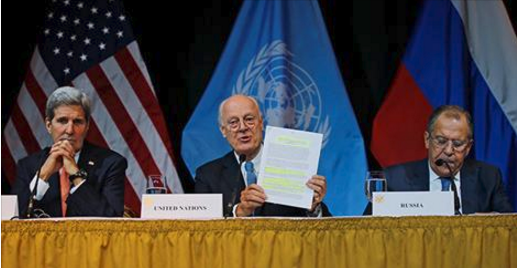
At close of Vienna Summit, November 14, 2015
"New elections to be held in Syria in 18 months"


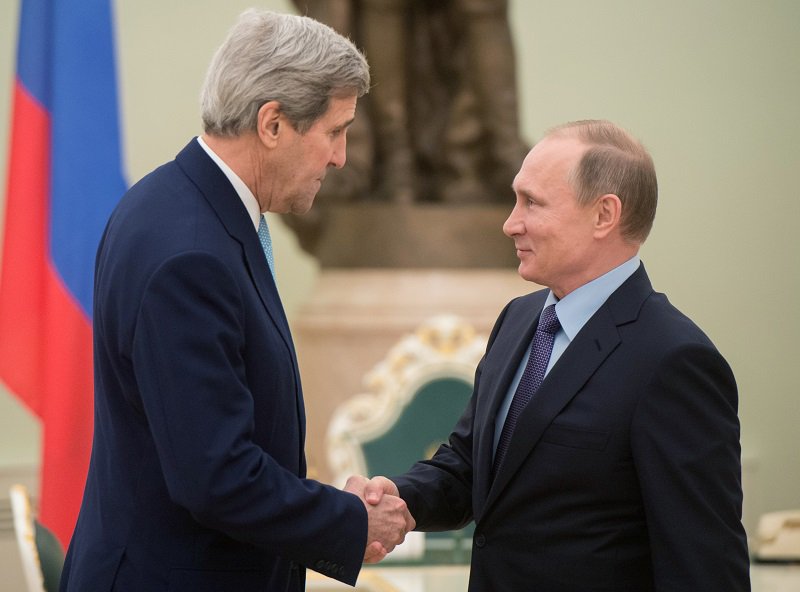
U.S. Secretary of State John Kerry's embassy to Moscow, December 15, 2015
Kerry receiving a gold star from Putin


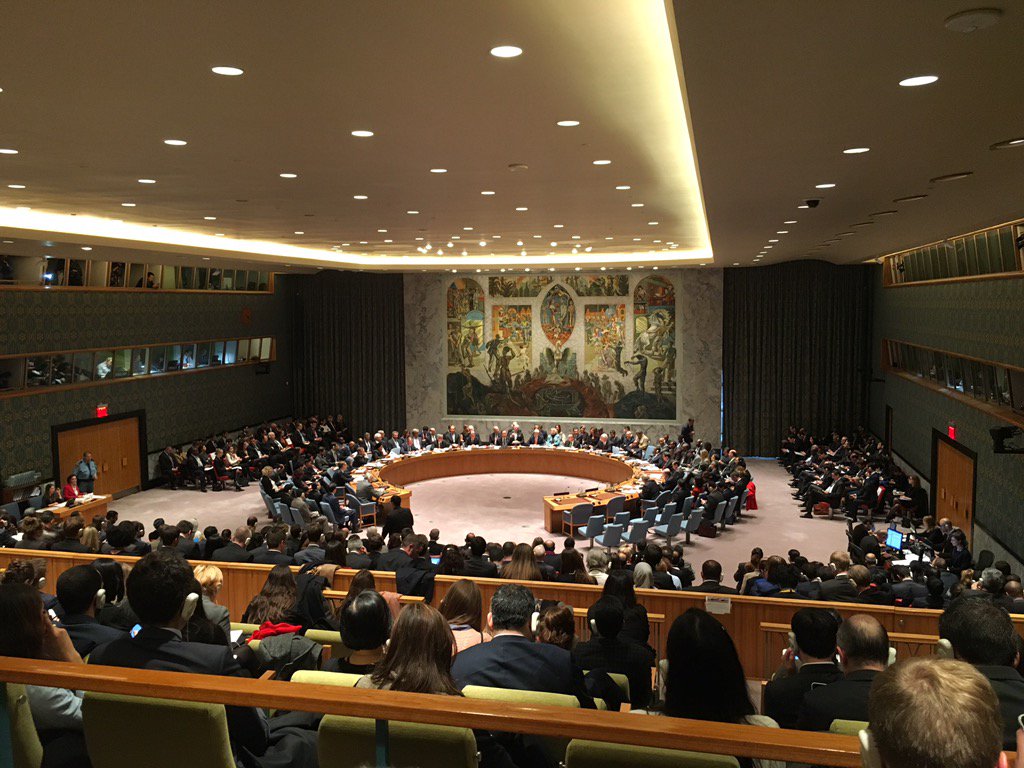
U.N. Security Council, December 18, 2015, SecState John Kerry chairing


Even a week ago observers were saying it couldn't be done. Well, it's done. Much work ahead but the path has been hacked out through dense jungle. 

Thank you, President Putin, Messrs. Lavrov and Kerry. And thanks to the Russian military and Syria's military, which is making the most out of help the Russians have given them. 

I will close by quoting stern words from Russian Foreign Minister Lavrov.


Syria Should Remain a United, Multi-Confessional State
0:46 19.12.2015 (updated 01:18 19.12.2015)
Sputnik

As the United Nations Security Council passes a resolution to end the five-year civil war in Syria, Russian Foreign Minister Sergei Lavrov praised the agreement, while stressing the role of the Syrian people in determining their own future.

During the UN Security Council meeting in which the 15 member voted unanimously to approve new draft resolution for ending the Syrian conflict, Lavrov praised the agreement's potential for creating an opportunity to create a united anti-terrorism front.

"Today's unanimous vote in the Council should pave the way for the formation of a broad front against terrorism on the basis of the UN Charter, with the support of all on Earth who are opposed to terrorism, including the army of Syria, the Kurdish militia, and the armed forces of the Syrian patriotic opposition," Lavrov said. 


"The air force of the Russian Federation, at the request of the legitimate government of the Syrian Arab Republic, is contributing to the completion of this task."

"It is important that today the UN Security Council once again confirmed the necessity of respecting the sovereignty of the Syrian Arab Republic," he added.

Lavrov also stressed that everyone shares the belief that terrorists should play no role in the peace talks, saying that "all are united in their belief that terrorists of all kinds have no place at the negotiation table, neither do those who allow a military solution."

The lead role in mediating the peace process will be overseen by UN Special Envoy Staffan de Mistura. Lavrov said that Russia is prepared to organize a meeting to assist in that effort.

The resolution also demands that all parties allow the distribution of humanitarian aid.

"The resolution stresses the need to provide humanitarian assistance to the Syrian people," Lavrov said. "It must be provided in strict accordance with the guidelines of the United Nations, enshrined in General Assembly resolutions and the decisions of the Security Council, including the principle of the consent of the host government."

[...]

*******

UN Security Council unanimously adopts Syrian roadmap resolution - BREAKING NEWS

"The Syrian people will decide the future of Syria."
Really? US Reportedly Constructing Airbase in Northeastern Syria for Airstrikes


All right, Pundita, don't rain on Lavrov and Kerry's parade. The resolution is better than nothing.

UN Security Council unanimously adopts Syrian roadmap resolution
Published time: 18 Dec, 2015 19:48 Edited time: 18 Dec, 2015 21:54
RT

The UN Security Council has unanimously adopted a resolution calling for a ceasefire and political settlement in Syria. The resolution envisions the formation of a unity government and calls for an immediate halt to any attacks on civilian targets.

Earlier, agencies leaked the draft of the document agreed by the UNSC permanent members right ahead of the session.

The four-page draft demanded that all parties to the Syrian conflict “immediately cease any attacks against civilians,” Reuters reported. A mechanism to monitor, verify and report the truce is to be worked out within a month.

The draft resolution would also ask the UN to convene formal talks on a transitional government. The talks between the regime and opposition are targeted for early January.

"The Syrian people will decide the future of Syria," says the draft.

Foreign ministers from 18 countries as well as the UN and Arab League representatives gathered in New York Friday to push the Syria roadmap. The group has already met twice in Vienna in the last six weeks and drafted a road map for the Syrian conflict reconciliation.

Apart from the UN and the Arab League, the group includes Russia, the US, the EU, the UK, Germany, France, China, Egypt, Jordan, Iran, Iraq, Italy, Qatar, Lebanon, the United Arab Emirates, Saudi Arabia and Turkey.

During the conference preceding the UN Security Council meeting, new calls for Bashar Assad to step down were voiced, arguing that the Syrian President’s exit would facilitate the battle with terrorism, Russian Foreign Minister Sergey Lavrov said.

“We confirmed our position that – as the UNSC has repeatedly stressed – there can be no pre-conditions to fight terrorism,” Lavrov said, adding that such calls did not make it into the draft. He once again said it is up to the Syrian people to determine the future of their country and its current leader.

“Only the Syrian people are to decide on their future, including the fate of President Assad – this is an answer, included into the resolution, to attempts to enforce outside will on the Syrians,”Lavrov said.

The conflict in Syria has lasted for more than four years with more than 300,000 killed.

Another goal of the talks was to work out a mechanism for establishing which rebel groups in Syria will be eligible to take part in the peace process. Islamic State (IS, formerly ISIS/ISIL) and Al-Nusra Front would be exempt from the truce.

For this purpose, Jordan, who was tasked with listing terrorist organizations in Syria, presented a document that includes 160 extremist groups, RIA Novosti reported, citing sources in the Russian Foreign Ministry.

“The list reflects positions of different sides,” Jordanian Foreign Minister Nasser Judah, who presented the document during the ISSG talks in New York, also said, according to TASS.

On Thursday, the UN Security Council unanimously passed a resolution submitted jointly by Russian and the US which allows punishing individuals or companies involved in trade with Islamic State or other terror groups.

On Tuesday, US Secretary of State John Kerry held talks with his Russian counterpart Sergey Lavrov as well as with the Russian President Vladimir Putin in Moscow.

Russia and the US managed to reach an agreement on some “critical” issues concerning Syria in particular. Kerry said that the positions of the US and Russia on Syria are “fundamentally very similar” and expressed readiness to further cooperation.

[END REPORT]

Here's AP's report:

'Agreement' on UN Draft on Syria, but No Mention of Assad
By EDITH M. LEDERER and CARA ANNA 

ASSOCIATED PRESS
December 18, 2015 - 3:46 PM EST

U.N. Security Council members agreed Friday on a resolution on a peace process for Syria involving talks by representatives of the Damascus government and the opposition, but the draft says nothing on the critical issue of what role President Bashar Assad will play.
Diplomats had rushed to overcome divisions on the draft resolution while world powers held the latest talks on how to bring an end to the conflict, which is deep into its fifth year with well over 300,000 killed.
The resolution has been described as a rare gesture of unity on the Syria peace process by a council often deeply divided on the crisis.
The U.S. and French ambassadors to the U.N. both expressed optimism ahead of the Security Council meeting, set for 4 p.m. (2100 GMT).
The draft resolution, obtained by The Associated Press, requests that U.N. Secretary-GeneralBan Ki-moon convene representatives of the Syrian government and opposition "to engage in formal negotiations on a political transition process on an urgent basis, with a target of early January 2016 for the initiation of talks."
Within six months, the process should establish "credible, inclusive and non-sectarian governance," with U.N.-supervised "free and fair elections" to be held within 18 months.
The draft calls the transition Syrian-led and Syrian-owned, stressing that the "Syrian people will decide the future of Syria."
The draft also says cease-fire efforts should move forward in parallel with the talks, and it asks Ban to report within a month of the resolution's adoption on a way to monitor the cease-fire.
The draft notes that the cease-fire "will not apply to offensive or defensive actions" against groups considered terrorist organizations, meaning that airstrikes by Russia, France and the U.S.-led coalition apparently would not be affected.
Meanwhile Friday, some 20 foreign ministers tackled those and other difficult issues for a possible end to Syria's civil war, including sorting out which Syrian groups will represent the opposition in peace talks in the new year.
Jordanian Foreign Minister Nasser Judeh said he presented lists submitted from each country of groups they consider terrorist organizations. He said some countries "sent 10, 15, 20 names" and others more.
"Now I think there will be follow-up steps in terms of countries meeting again to set criteria which will help filter the list," said Judeh, whose country is tasked with putting the final list together.
Others around the table included the United States, key European nations, Saudi Arabia and top Syria allies Russia and Iran.
Chinese Foreign Minister Wang Yi said the two most important issues are launching political negotiations among Syrian parties and implementing a U.N.-monitored cease-fire. "Without peace talks, the cease-fire cannot be sustained. Without a cease-fire, peace talks cannot continue to produce results," he said.
Wang noted the "severe threat posed by international terrorism," a reference to the Islamic State group, which has exploited the chaos to seize large parts of Syria.
A peace plan agreed to last month by 20 nations meeting in Vienna sets a Jan. 1 deadline for the start of negotiations between Assad's government and opposition groups.
That deadline is "too ambitious a timetable," the U.N. representative for the Syrian National Coalition, the main Western-backed opposition group, told reporters Friday. Najib Ghadbian estimated that a month of preparation is needed.
Ghadbian also said a comprehensive solution to the conflict requires "the removal of all foreign troops from Syria, all of them," including Russia, which began airstrikes there in September. The strikes are focused on more moderate forces fighting Assad in areas where the Islamic State group has little or no presence.
The coordinator of the opposition team that will negotiate with the Syrian government, former Prime Minister Riad Hijab, said in Saudi Arabia on Friday that Assad should have no role during a transitional period. He also called for "confidence-building measures" such as the lifting of a siege imposed on rebel-held areas and a halt to airstrikes.
———
Associated Press writer Bassem Mroue in Beirut contributed.
[END REPORT]

Sources: Berlin Wants to Cooperate With Assad, Set Up Intel Agency in Damascus

14:25 18.12.2015 (updated 14:58 18.12.2015) 

In a dramatic move, Germany is set to become the first western nation and NATO member to break ranks and begin cooperating with Syrian President Bashar al-Assad and set up an intelligence agency branch in Damascus.

Although there has been no official announcement, anonymous sources quoted in the German Bild newspaper, confirmed that the federal government is keen to establish a branch of its Federal Intelligence Service (BND) in Damascus in an effort to counter Daesh, also known as ISIL.

The source said a decision on the move to renew ties with the Syrian intelligence agencies could be made as early as 2016 and may even involve reopening the German embassy in Damascus, which was closed in February 2012, when the German ambassador was withdrawn. The BND is reported to be anxious to quickly set up as a so-called Residentur in the Syrian capital, with a view to permanently stationing staff there.

There has been a long history of intelligence-sharing between Berlin and Damascus, which Germany believes is an important partner in the fight against radical Islamists. Diplomatic relations were broken off in 2012 when, the then Foreign Minister Guido Westerwelle, expelled the Syrian ambassador from Germany. The German ambassador to Damascus was withdrawn and the embassy closed for safety reasons.

High Alert

Germany has been put on high terror alert this years, following both the Charlie Hebdo attacks in January and the November 13 Paris attacks, which killed 130 people and injured hundreds more. The latter attack had links with Germany and one man was arrested in Stuttgart for allegedly supplying weapons to the Paris attackers.

The threat from Daesh is now being taken very seriously by Germany, which recently voted in parliament to begin support operations with its coalition partners against Daesh in Syria and Iraq. Police arrested three Islamists believed to have planned an attack in Dortmund, and a fourth man, in Stuttgart, believed to have supplied weapons to the jihadists who carried out the Paris attacks.

[...]

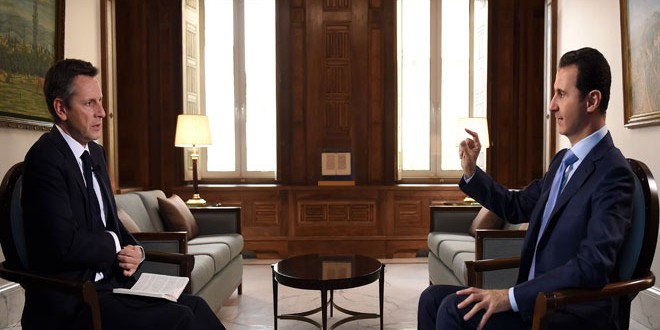
Ouch: Assad, speaking truth to Western power. The Dutch NPO2 TV interview

Question 13: Moving on. As you know, we are from Holland, from the Netherlands, and my country is bombing ISIS just across the border here in Iraq. They are fighting the same enemy as you are. Would you consider the Netherlands an ally?

President Assad: It depends on the real intention. What do you mean by fighting terrorists? Is it just because ISIS came here? Is it because you are afraid of their influence or effects in your region? If the incentive is fear, no, we’re not allies.

Question 14: You think the incentive is fear?

President Assad: Yes, not values. Because why didn’t they fight terrorism from the very beginning, before ISIS appeared? You had al-Nusra, you had Al Qaeda, you had many terrorists. You didn’t fight. Only this fight on terrorism started to appear when there was September 11 in the United States, the recent attacks in Paris, and in different European countries, but before that they didn’t say we are at war with terrorism.

Question 15: So you mean they are late? They’re late to the party?


President Assad: It should be a matter of principle. When it’s a principle, it should be sustainable, not what you call a kneejerk reaction when something you want to do it just as a reaction to something. So, it’s not principle. Fighting terrorism should be a stable, sustainable principle. This is the way we can be allies.

Question 16: So you say, in our case, Dutch bombers over Iraq bombing ISIS is a kneejerk reaction? It’s not sustainable?

President Assad: It is part of European politics and European politics is part of the American, it’s not independent. Everybody knows this. So, I cannot judge only Dutch politics as an isolated case; it’s part of this, and all this, let’s say, Western politics regarding terrorism, is not objective, and not realistic, and actually not only not productive; it’s counterproductive.

*****
Not for anything will Bashar al-Assad be diplomatic. He is only diagnostic. And he manages to be diagnostic graciously in the old-world European manner. No wonder so many governments want to shut him down. 

There is much more in the interview that is noteworthy, so let's get to it. 


President al-Assad to DUTCH NPO2 TV: The western policy towards counter-terrorism file is not objective
December 17, 2015
SANA

Damascus, SANA-President Bashar al-Assad affirmed that the majority of international reports about Syria are politicized, incredible and financed by the Qataris and Saudis. 

President al-Assad added in an interview given to DUTCH NPO2 TV that the western policy towards counter-terrorism file is not objective and not stable.
Following is the full text.
Question 1: Mr. President, after four years of civil war in your country, what’s left of Syria?
President Assad: What’s left is about the people. If you talk about the infrastructure, many have been destroyed during the last four years and few months, but it’s about the people, what’s left of the people, that is the question, and it’s about how much they withstand this dark ideology that the terrorists brought with them from different countries. I think the majority of the people now support their government, regardless of their political spectrum, and they still support the unity of Syria and the integration of the society as one society with multi-color aspects.


Question 2: Now, we hear shelling every day, even here in Damascus, even close by to where we are now. You said there is unity, the people believe in their government. Are you still so confident about that?
President Assad: I’m more confident than before, to be frank, because if you go to the areas under the control of the government, you can see all the different colors of the Syrian society with no exception. If you go to the areas where the terrorists control, you can see either part of this Syrian spectrum, social spectrum, or you can see no inhabitants, only fighters. So the contrast is very clear.
Question 3: Now, roughly 4,000 Syrians flee your country every day, 4.3 million up to date, and you must hear some of their stories, why they are leaving. How does it make you feel if you hear that?
President Assad: They are sad stories. It’s about the hardship of every single person, every single family. We live with these stories on a daily basis, as you mentioned. But it’s not enough to feel; what can we do? They left because of the terrorist attacks, direct attacks, because the terrorists attacked the infrastructure, and because of the Western embargo that led to the same target of the terrorists, directly or indirectly. I think most of those are ready to go back to their country. They still love their country, but living in Syria could be unbearable for them for different circumstances.
Question 4: You say most of them are ready to come back, but from many stories they tell, they flee from terrorism, of course, but a lot of them flee from your government, your armed forces, as well.
President Assad: You are in Syria now, you can go to the areas under our control. You can see that some of the families of the terrorists or the extremists or the militants, whatever you want to call them, live under the supervision of the government and the support of the government. So, why didn’t those families leave Syria?
Question 5: Okay, while we hear stories in the West of Syrians coming here, they talk about torture, widespread, people in prison, things done by your armed forces. That’s the reason why they leave. Is there truth to their stories?
President Assad: Let’s talk about the facts. The facts will tell you if it’s true or not. If you are torturing your people, attacking, killing, and so on, and you have the enmity of Western governments, the strongest countries in the world, the richest countries like in the Gulf, like Turkey, our neighbors, are against me as president or against the government, how could you withstand for nearly five years in such circumstances if you don’t have public support? And how can you have public support if you are torturing your people? I mean, if you have mistakes in reality, that could happen, that would happen anywhere.
Question 6: So there are mistakes?
President Assad: Of course, especially when there is war, you could have a single mistake committed by a single person, that would happen. You have chaos, sometimes that would happen, we don’t exclude this. But there’s a difference between having this kind of mistakes and having a policy in order to torture your people and lose their support.
Question 7: You say there is no such policy?
President Assad: No, definitely.
Question 8: Because today, Human Rights Watch, and the UN before that, came out with a report saying there’s widespread, as they call it, “death and dying in detention centers, since the uprising in 2011.” Is there any truth to that?
President Assad: If you want to verify the credibility of those reports, to say that they’re not politicized, they’re not talking about one side of the story. You mentioned the shelling of Damascus a few days go, and that happens every few days, killing many civilians, innocent civilians. Did they mention anything about this in the reports? You have many pieces of evidence that’s been published by the terrorists on the internet, photos, videos, about torturing, about killing, about beheading. Did they mention those stories?
Question 9: So it’s one sided? Even the UN?
President Assad: Of course, definitely, it’s politicized. Even the UN, it’s controlled by the United States, and the United States is against Syria. This is the reality, everybody knows it.
Question 10: But you are part of the UN. Syria is part of the UN family.
President Assad: Of course, but the UN is a biased institution because it is under the control of the United States and its allies.
Question 11: And so, you say reports about widespread torture, human rights violations after 2011, those are biased, not true?
President Assad: They are based on stories. Stories, you can pay anyone to tell you any story, like the Qataris are doing this. They publish many reports financed by the Qataris, by the Saudis, this means nothing. You want to make investigations, come to Syria. You have reality, it’s obvious.
Question 12: They say it’s difficult to come to Syria and doing independent investigation.
President Assad: No, it’s not difficult. You are here, so anybody could do the same. Otherwise, if it’s difficult for them to come, it’s going to be difficult for them to judge the situation and to make reports.
Question 13: Moving on. As you know, we are from Holland, from the Netherlands, and my country is bombing ISIS just across the border here in Iraq. They are fighting the same enemy as you are. Would you consider the Netherlands an ally?
President Assad: It depends on the real intention. What do you mean by fighting terrorists? Is it just because ISIS came here? Is it because you are afraid of their influence or effects in your region? If the incentive is fear, no, we’re not allies.
Question 14: You think the incentive is fear?
President Assad: Yes, not values. Because why didn’t they fight terrorism from the very beginning, before ISIS appeared? You had al-Nusra, you had Al Qaeda, you had many terrorists. You didn’t fight. Only this fight on terrorism started to appear when there was September 11 in the United States, the recent attacks in Paris, and in different European countries, but before that they didn’t say we are at war with terrorism.
Question 15: So you mean they are late? They’re late to the party?
President Assad: It should be a matter of principle. When it’s a principle, it should be sustainable, not what you call a kneejerk reaction when something you want to do it just as a reaction to something. So, it’s not principle. Fighting terrorism should be a stable, sustainable principle. This is the way we can be allies.
Question 16: So you say, in our case, Dutch bombers over Iraq bombing ISIS is a kneejerk reaction? It’s not sustainable?
President Assad: It is part of European politics and European politics is part of the American, it’s not independent. Everybody knows this. So, I cannot judge only Dutch politics as an isolated case; it’s part of this, and all this, let’s say, Western politics regarding terrorism, is not objective, and not realistic, and actually not only not productive; it’s counterproductive.
uestion 17: Right, because, you would say, well, you would say they’re bombing your enemy, so, well, they’re helping in some way.
President Assad: Because when you don’t have the real intention and the realistic vision, the result will be in the other direction. You’ve been bombing, maybe you had intentions. Maybe, I mean, the politicians in your country, have good intentions, but what is the reality? The reality is that ISIS has been expanding since the coalition started in 2014.
Question 18: So bombing is not working?
President Assad: It’s not working. You cannot fight terrorism without troops on the ground, and without a real incubator, a social incubator that supports you in your war against those terrorists.
Question 19: So you say, bombing like the Dutch are doing, is for show?
President Assad: Maybe for show, that depends on the intention. But in reality, for nothing, let’s say, for no avail.
Question 20: Our government is, next month, deciding whether or not they will start bombing in your airspace as well, bombing ISIS targets in Syria, and as they are debating this, what would you tell them?
President Assad: This is illegal. This is against the international law. We are a sovereign country. If you are serious about fighting terrorism, what is the obstacle for that government to call the Syrian government, to say “let’s cooperate in fighting terrorism?” The only obstacle is that the Western policy today towards Syria is “we need to isolate this state, that president, so we cannot deal with him.” Okay, you cannot reach anything then.
Question 21: So you say it’s illegal if the Dutch bomb? They should ask your permission, that’s what you’re saying?
President Assad: The Syrian government’s permission.
Question 22: Have they ever been in touch with you about any of this?
President Assad: No-one of them, no-one. Some European governments send their intelligence in order to make a kind of cooperation, security cooperation, regarding terrorism, because they are afraid of the terrorists. Of course, we refused.
Question 23: Because they say there’s a mandate for it, because Iraq has asked for help, and now we can bomb in Syria as well.
President Assad: No, they cannot, they don’t have the right, this is illegal, in every sense of the word illegal.
Question 24: Now, moving on as well, the Netherlands, for what it’s worth, as you were saying, the Netherlands are also saying if there should be sustainable peace in Syria, that has to be without you. There might be a transitional period, but in the end, it can only be without you. What would you say to a statement like that?
President Assad: If you accept as a Netherlands citizen that somebody in Syria would tell you who’s going to be your Prime Minister or not, we would accept it. But you don’t accept it, and we don’t accept it. As you say, we are a sovereign country, whether they have a good president or bad president, this is a Syrian issue, it’s not European. The Europeans have nothing to do with such a thing. That’s why we don’t respond. We don’t care about it.
Question 25: Right. You don’t care about, in this case, the Dutch-
President Assad: No, no. This is a Syrian issue. The Syrian people would say who’s going to stay or not. If the Syrian people doesn’t want me to stay, I have to leave right away, today.
Question 26: One more question about Holland and our neighboring country Belgium. Hundreds of wannabe Jihadis come here to Syria. Why are they coming here, what are they looking for?
President Assad: The most important question is: why did you have them in Europe? Coming, that’s natural; when you have chaos, when Syria has been turned into a hotbed for terrorism because Europe and Turkey and Saudi Arabia and Qatar and those countries supported terrorists in different ways, of course you’re going to have chaos, and it’s going to be a nexus for terrorism. That’s natural for this, how to say, fertile soil, to attract terrorists from the rest of the world. But the question: why did you have them in Europe? You didn’t deal with terrorism in a realistic base.
Question 27: So what did Europe do wrong in dealing with them?
President Assad: I think it’s about two things, if you ask me about why. First of all, the European governments didn’t do their job to integrate these people in their societies; they lived in a ghetto. When you live in a ghetto, you’re going to be an extremist. The second one, many European officials have sold their values for the petrodollar, and they allowed the Wahabi Saudi institutions to pay money and to bring this dark and this extremist ideology to Europe, and that’s why now you are exporting terrorists to us. We don’t export, actually, they came to Syria, and then they go back to Europe.
Question 28: They come back to us.
President Assad: And the three criminals who committed the attacks in Paris, all of them lived in Europe; Belgium and France and others. They didn’t live in Syria.
Question 29: Now, internationally, the United States always said “President Assad has to go.” Even yesterday, Secretary Kerry said, “well, maybe not immediately, and we’re not looking for a regime change.” Even the French are now saying the President may be part of a solution. Your luck seems to be changing.
President Assad (sarcastically): Thank them for saying that; I was packing my luggage, I had to leave, now I can stay. We never care about whatever they say. They’ve been saying the same for four years now. Did anything change regarding that issue? Nothing. So, this is a Syrian issue, whether it’s Obama or the United States or Europe or any country, we don’t care about it. As long as the Syrians want this president or any other president to be in power, he will be there. So, to say that that he’s leaving now or leaving in six months or six years, it’s not their business, very simply.
Question 30: Okay, but it might help in negotiations, some sort of peace, their attitude towards you.
President Assad: This is not the issue. That depends on the problem that we’ve had in Syria. It has many aspects. What’s the relation between this president or any other president to be in power and ISIS and al-Nusra and Al Qaeda coming to Syria and terrorists killing and beheading? There’s no relation, so this is just to mislead the public opinion, just to say that the problem is in Syria is the president. So, who’s more important, the president or the country? Of course the answer is the country, so the president has to leave. So, this is the equation that they’re trying to promote. The only equation for the president is the public opinion in his country, like your country, like any other country. 
Other than this, if they are serious in solving the problem in Syria, every European official just trying to deliver homilies that could be suitable for church and for mosque, not for politicians, they have to go and work to stop the flood and the flowing of terrorists and the money and logistic support, armaments, through Turkey. That’s what they have to do.
Question 31: Turkey is the key in all of this?
President Assad: Of course, this is the logistical key. Of course, Saudi Arabia is the other key, with their money and their ideology.
Question 32: Well, coming to that, you say there’s Turkey, Saudi Arabia. Internally, if there is – because there are three different initiatives to come to some sort of peace process – what would be the parties you are willing to negotiate with?
President Assad: Any person who holds armaments and kills people and destroys public and private properties and so on, he’s a terrorist, so we don’t, as a government, we don’t make negotiations with the terrorists.
Question 34: But the problem in this whole conflict is that everybody does that.
President Assad: Exactly. So, how? How to deal with this situation? Because we are very realistic and pragmatic, we made negotiations with groups of militants, not organizations; we don’t recognize them as legitimate, to say we are making negotiations about the future of Syria. All of them are terrorists, and they don’t have any political agenda, by the way. We made negotiations with a group of those in order to go back to their normal lives, to give up their armaments, and to have amnesty, and it worked, and this is a real solution on the ground now. It’s moving from area to area.
Question 35: Because, as I said, all the parties are involved in shelling, killing, your government as well. How about international parties, because they are involved in this conflict as well. Who would you be willing to talk to? Is it the United States, Saudi Arabia, Turkey, or just Iran and Russia?
President Assad: We are talking to everyone who wants to help in solving the problem. We don’t have a problem about talking. The question is who is ready to deliver? That is the question.
Question 36: And who is ready to deliver?
President Assad: None of them, only Russia and Iran and their allies, and the other countries that support politically the Syrian government or the Syrian legitimacy, but not the West, no-one in the West is ready, few countries are ready, because they don’t dare to make contact with Syria to solve the problem unless the United States wants to impose its agenda on them and on us.
Question 37: But in the end, you would have to negotiate with as many parties as possible. Would you be willing to negotiate with parties whose aim it is to have you removed, in the end?
President Assad: Of course, of course. I mean, their way, if they want me to go, they have the ballot box. We are ready, we don’t have a problem. They can convince the Syrian people that there’s a better alternative, this is not an appropriate choice for the future, and the president will leave. We don’t have a problem.
Question 38: That sounds really good, but in practice, realistically, in Syria, if you see the history of Syria, how much freedom do opposition parties have? How much freedom do politicians have to criticize you or to rise up against you?
President Assad: Let me be objective; we’re not Europe yet, and this is a cultural issue, it’s not only political. But we are on the way for more democracy in Syria. We are moving slowly but surely. It’s not something related to the president, because Syria is not my company; it’s a country, it has people. I mean, the process of democracy is a social process, and political at the same time, so we’re moving forward.
Question 39: But, one could say that four years ago, there was a step in that process of people rising up, and there was a brutal crackdown.
President Assad: How many? How many rose up? Do you have a number? The majority of the number, in one day, in Syria, at the beginning of the crisis, was 130,000, let’s make them double, 300, double them again, 600,000. It’s nothing out of 24 million Syrians.
Question 40: So you’re saying nobody really has risen up against you during those day?
President Assad: No, no, you have of course, but it was a mixture between people who really wanted to demonstrate against the political system that they don’t believe in, you have people who have been paid by Qatar in order to demonstrate for the propaganda, and you have the terrorists who have been infiltrating those demonstrations in order to kill the policemen in order to retaliate. That’s what happened in the first week of the crisis.
Question 41: So that’s only what happened? The police retaliated on killings that were done from within the group that was protesting?
President Assad: The first week, we had many policemen being killed by the demonstrators. Who are they? Peaceful demonstrators, of course you had machineguns and you had everything from the very beginning. So, that’s what happened. Anyway, the president, if he wants to leave, he will leave through the constitution and ballot box, and if he wants to come, he will come through the constitution and the ballot box, and both will reflect the public opinion.
Question 42: Has there been credible opposition in the last years, credible people who challenge you?
President Assad: We have, yeah. We have opposition. You can meet them, they are in Syria, they live in Syria, they have grassroots, Syrian grassroots, big, small opposition, new, old. I mean, this is not the issue, but we have them, they are allowed.
Question 43: Because we in the West would think, well, what we have seen in the media, all kinds of media, brutal crackdown, and now a war where there’s stories of barrel bombs, of massive incarceration, of extreme government violence. One would think twice before they would oppose or criticize you.
President Assad: The question is what means would you resort to when you have people killing police and destroying and burning for the first days? It didn’t happen six months later, like the propaganda in the West tried to promote, that the peaceful demonstrations turned into armed actions just because of the crackdown. That’s not true. Again, they killed the policemen in the first week.
Question 44: Looking back, what would you have done differently in 2011, what would you have done differently now?
President Assad: The two things we have based our politics on are two pillars, are dialogue and fighting terrorism. Today we are going to keep fighting terrorism and we are going to continue the dialogue with every involved party in Syria.
Question 45: Even if there will be an uprising like there was in 2011, you would react the same?
President Assad: If the same happens, people killing police, we have to respond. That’s our job as a government.
Question 46: Concluding, if you look back on four years, a large part of the country is under the control of different rebel groups, of ISIS, innocent people are dying on both sides of the front, people are suffering, and you are the president. You are responsible for protecting your people. Do you ask yourself “have I done enough to protect my people?”
President Assad: I cannot judge myself because I am not going to be objective talking about myself, I mean, the Syrian people would say the president did enough or not. At the very beginning, you mentioned the crackdown; many people said the president didn’t do enough to crack down on those terrorists. This is versus what you mentioned, and that has been published in the West. 
So, if you want to be objective, all of us as Syrians, to judge this situation, it should be at the end of the crisis, because the end result will tell you about the beginning. Now we are still in the middle, it is not enough to talk about this.
Question 47: Okay, but can you look at yourself in the mirror thinking “I am doing enough?”
President Assad: Yes, of course, and that changes every day. Sometimes you judge the same action in two different or three or four different ways every day, because we live with a very quickly changing situation, your mood, and thinking; you’re influenced by all these things on daily basis. So, you may change, but no one of them will be concrete and absolute unless you overcome this crisis. This is where you can think more objectively and realistically about your actions as a president.
Question 48: Last question: how long will this take before it’s resolved?
President Assad: If the responsible countries take actions against the flood and the flowing of terrorists and the logistic support, I can guarantee that it will take less than one year.
Question 49: Less than one year?
President Assad: Less than one year. But the problem is that they are still supporting them on daily basis more and more in order to make it more messy, and to put obstacles in front of any solution, because they want the solution, what they called a political solution, to be ended with the changing of this state, getting rid of this president or depose him, and so on. So, that’s why it will drag on.
Question 50: So, if it were without outside influence, you’d be done in one year.
President Assad: Definitely, for one reason because the terrorists in Syria, they don’t have the social incubator yet. That’s why we do not worry about them.
Journalist: Mr. President, thank you very much.
President Assad: Thank you for coming to Damascus.
[END TRANSCRIPT]
********